When She Ran Past Him
When She Ran Past Him
Part I — The Shape of Waiting
By the time Tessa saw the soldier in the middle of the arrivals hall, she was already running.
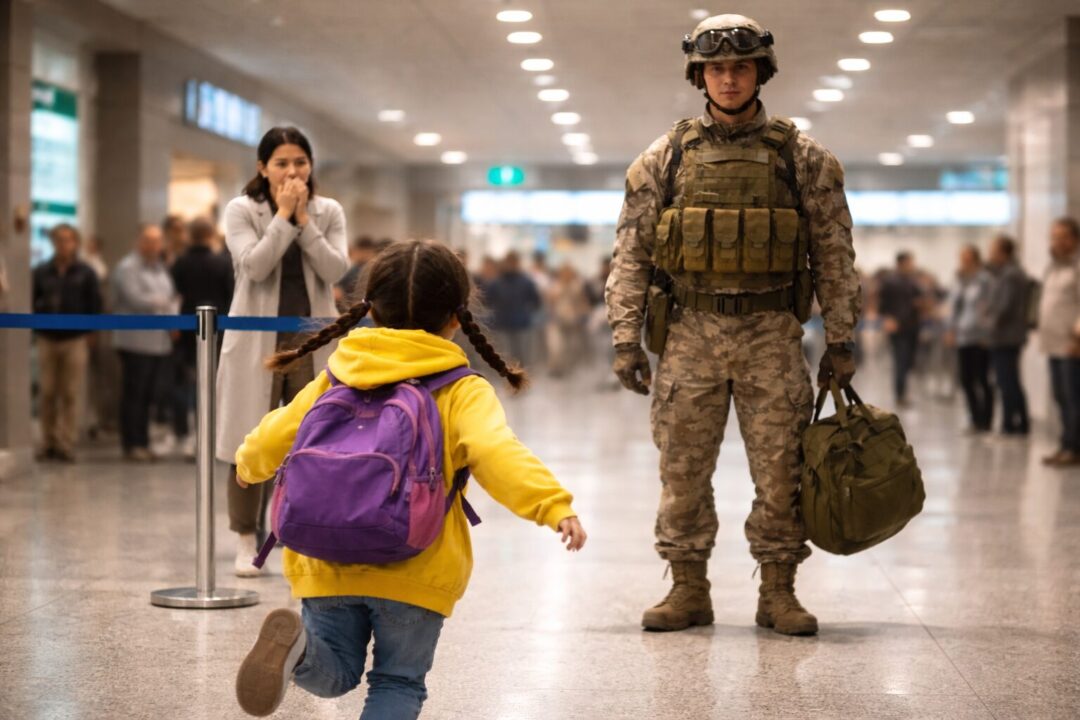
People turned before they understood why. A little girl in a yellow hoodie broke free from the waiting area and shot across the polished floor with a purple backpack bouncing against her spine, one lace untied, one braid half-undone, her whole small body tilted toward a man in full uniform standing alone beneath the overhead signs. For one sharp second, the scene looked exactly like the kind strangers cried over and replayed online later—a child racing toward someone who had finally come home.
But Tessa didn’t know yet if home had really come back.
For six months, everyone around her had used words that sounded right and felt wrong. Deployment. Return date. Delay. Processing. Home soon. Just a little longer. Adults loved phrases that tried to smooth the edges off pain. Tessa had learned to hate them all. Every time her mother said, “Maybe next week,” she heard, “Not yet.” Every time Grandma said, “He’ll be here before you know it,” she heard, “You still have to wait.”
Waiting had changed shape so many times that by the end it didn’t even feel like time anymore. It felt like weather—something cold and invisible that settled over the apartment and made everything harder. Her mother, Maren, tried to keep the house normal. She packed lunches, signed school papers, reminded Tessa to brush her teeth, and smiled at all the right moments. But the smile never lasted very long after dark.
At night, Tessa could hear her moving around the kitchen long after dishes were done.
Her father had left when the air was still warm enough to sleep with the windows cracked open. She remembered him kneeling in their hallway in uniform, his duffel bag by the door, telling her he would be back before second grade felt long. He had held her face in both hands and said the same thing three times, as if repetition could make distance easier to survive.
“You remember me, okay?”
At the time she had laughed, because what a ridiculous thing to say.
Of course she would remember him.
His name was Nolan. He smelled like soap and coffee and the cedar chest in Grandpa’s house. He always tied one of her sneakers too tight and one too loose. He cut pancakes into lopsided stars. He had a scar by his eyebrow from before she was born, and when he tucked her in, his hand always rested for half a second on top of her head, as if checking that she was real.
How could you forget somebody who lived in your bones?
But memory, Tessa discovered, did not stay still. It shifted when you were lonely. It blurred around the edges when you missed someone too hard. On video calls, Nolan’s face froze mid-laugh, pixelated, broke apart in bad connections and strange lighting. Sometimes he looked like her father. Sometimes he looked like a man pretending to be him from far away.
She began to dread the calls almost as much as she needed them.
After one call dropped three times in a row, she stopped saying much at all. Nolan would smile from a screen that made his skin look gray, and Maren would fill the silence with practical things—school, weather, the car battery, the neighbor’s dog that kept tearing through flowerbeds. Tessa would sit in her chair and stare, wanting him to reach through the glass and become real again.
When she was alone, she imagined his return over and over. But in every version, he came back looking exactly like he had left.
The problem was, nobody came back from anywhere exactly the same.
Two days before the flight, Maren found Tessa sitting on the living room rug with an old family photo album open in her lap. She had gone through it without asking. Nolan at the county fair. Nolan teaching her to ride a bike. Nolan asleep on the couch with his mouth open while she and Maren balanced crayons in his fingers. Tessa was studying his face with the intensity of someone preparing for an exam.
“What are you doing, honey?” Maren asked softly.
Tessa didn’t look up. “I’m making sure.”
Maren stood still for a second. “Making sure of what?”
“That I know him.”
The answer moved through the room like a draft. Maren sank to the rug beside her and touched the edge of one page. In the photo, Nolan was smiling at something outside the frame, squinting into sunlight, one arm looped around a toddler version of Tessa.
“You know him,” Maren said.
Tessa traced the scar over the eyebrow with one finger. “What if he looks different?”
Maren took too long to answer.
That was answer enough.
“He might,” she admitted at last. “A little.”
“How little?”
Maren gave a tired smile. “Enough to still be him.”
Tessa hated that answer, too.
On the drive to the airport, she barely spoke. Maren drove with both hands tight on the wheel and the radio off. The city looked washed clean by a rain that had ended an hour earlier. Tessa sat in the back in her yellow hoodie, backpack on even though they weren’t going anywhere except inside and back out again, as if she needed to stay dressed for movement. Her stomach felt thin and shaky.
“What if I don’t know it’s him?” she asked, halfway through the drive.
Maren kept her eyes on the road. “You will.”
“But what if I don’t?”
Maren pulled into the drop-off lane more carefully than necessary. “Then he’ll help you.”
Tessa stared out the window. That wasn’t the answer she wanted either.
Inside the terminal, everything felt too bright and too loud. Suitcases rattled over tile. Announcements burst from overhead speakers and vanished into echo. People held flowers, signs, balloons, coffees. Some looked bored. Some looked half-asleep. Some wore faces Tessa recognized from military family gatherings, the particular expression of people who had taught themselves not to trust good news too quickly.
Maren stood behind the barrier, coat folded over one arm, one hand gripping her phone so hard her knuckles went white. Tessa stood in front of her, then beside her, then in front again. She bounced on her heels. She asked what time it was three times in seven minutes.
Then the door opened.
And there he was.
Except he wasn’t.
A soldier stepped into the arrivals hall carrying a duffel bag, broad-shouldered, helmeted, rigid in the way uniformed men sometimes looked in public, as if they still belonged to some invisible line of command. The crowd around them shifted with the ripple of recognition. A few people lifted their phones.
Maren made a sound so small it was almost swallowed by the terminal noise.
“Tessa,” she whispered.
But Tessa was already gone.
Part II — The Face Behind the Uniform
She ran harder than she had ever run at school, harder than she ran in gym, harder than the day she chased a dog that had grabbed her mitten and taken off down the sidewalk. The world narrowed to the stretch of polished floor between her and the soldier. People moved out of the way. Someone gasped. Her backpack slammed against her spine.
The man in uniform stood perfectly still.
That frightened her more than if he had opened his arms.
For six months she had missed movement. Missed the ordinary things people never noticed until they vanished. A hand reaching across the breakfast table. Boots by the front door. A laugh from another room. This motionless figure in armor and straps and hard edges did not belong to the father in her memory. He looked too tall. Too severe. Too much like the idea of a soldier and not enough like the person who used to let her paint his fingernails and pretend not to mind.
She reached him and then, in the final step, swerved past.
Shoes squealed lightly against the floor as she stopped just beyond his shoulder and spun around. The gasp that moved through the nearby crowd was soft but unmistakable. For a second the whole hall seemed to hold itself still around them.
The soldier turned.
Maren’s hand flew to her mouth behind the barrier.
Tessa’s heart was hitting so hard it made her throat ache. Up close, the uniform was worse. More real. Dust in the seams. Scuffs across the helmet. Fabric darkened in places from travel, sweat, weather—she didn’t know. The duffel strap cut across his chest. The face she needed was somewhere behind all of it.
He bent slightly, as though he wanted to come down to her height, but stopped when he saw her expression.
“Tess,” he said.
The voice reached her before the face did.
Something inside her lurched. It was his voice. Not through a speaker. Not broken by static. Not delayed. Whole and human and close enough to touch.
But still she couldn’t move.
Her eyes filled so fast it made her angry. She clenched both fists at her sides and heard herself say, “No.”
The soldier froze.
“I can’t see you,” she said, and her voice came out thin and fierce at once. “Take it off.”
Behind them, the airport noise rolled on strangely, as if the world had not noticed that everything important had narrowed to one child, one soldier, and one impossible piece of distance between them.
The soldier’s shoulders changed first. Not visibly to anyone else, maybe, but enough for Tessa. The formal posture softened. The man inside it came nearer.
“Okay,” he said quietly.
He set the duffel down. Then, slowly, so slowly it made her want to scream, he lowered himself onto one knee.
That hurt too.
Because her father used to kneel like that when something mattered.
He lifted his hands to the helmet. Unclipped one side. Then the other. The hard shell came free in a single motion and dropped to his side.
Tessa stared.
His hair was shorter than before, almost gone along the sides. His face looked leaner, his skin darker from sun or dust or both. There were new shadows beneath his eyes, and lines around his mouth she had never seen. But the scar was still there, slanting through his eyebrow exactly where it had always been. His eyes were the same. Not in shape or color—those things she might have remembered wrong—but in the way they looked at her. As if there was no one else in the terminal. As if the whole long absence had narrowed to this one breath.
She had been afraid of not knowing him.
The truth was worse and better at the same time.
She knew him. She just hadn’t known what it would feel like.
Her breath broke on the way out. The tears she had been holding back rose so suddenly that the whole hall blurred. The face in front of her was her father’s, but altered by time and distance and things she could not name. The change hurt because it proved the months were real. They had happened to him, and to her, and no amount of waiting had frozen anything in place.
“There you are,” she whispered.
Nolan’s expression collapsed into something raw and shining. “Hey, baby.”
Behind the barrier, Maren made a strangled sound that turned into a sob. Tessa glanced at her mother and saw tears spilling freely now, one hand still over her mouth as if she could physically hold herself together by force.
Nolan held still. He did not rush forward. He did not try to solve her feelings for her. He looked at her with a tenderness so careful it made the ache in her chest deepen.
“I’m right here,” he said.
It should have been enough.
It almost was.
But six months is a long time when you are seven, and fear has strange places to hide. Tessa took one step forward and then stopped again.
“You look different.”
The words hung between them like an accusation she hadn’t meant to make.
Nolan nodded once. “I know.”
“You were gone a long time.”
“I know.”
“You said—” Her face twisted. The sentence fell apart before it finished.
“I know,” he said again, but this time the words were rougher. Honest enough not to dodge what they meant.
His eyes flicked toward Maren for a second, then back to Tessa. “I came home.”
That was the line that undid her.
Not because it was dramatic. Not because it fixed anything. Because it was simple. Because it did not explain or excuse or pretend the lost time had been smaller than it was. It just offered the only truth that mattered now.
I came home.
Tessa made a sound she would never later be able to describe—a small, wounded, furious sound—and then she launched herself at him.
Part III — The Weight of Return
She hit him hard enough that he rocked back on one knee, helmet clattering from his hand onto the floor. Her backpack jammed awkwardly between them, one strap sliding off her shoulder. Nolan wrapped both arms around her with a force that looked almost desperate, then checked himself halfway through and held her the way people hold something breakable they have missed too long.
Tessa buried her face in the curve of his neck. He smelled wrong at first—metal, airport air, laundry soap from a place that was not home. Then beneath that, faint and buried, came the familiar trace she had been searching for all morning. Coffee. Skin. The shape of memory becoming real enough to breathe.
And she broke.
Not neatly. Not in the sweet cinematic way strangers expected when they watched reunions. She cried the way children cry when they have run out of strength to be brave. Her whole body shook. Her hands grabbed fistfuls of fabric at the back of Nolan’s uniform as if he might vanish if she didn’t anchor him physically to the floor.
“Don’t go again,” she choked into his shoulder.
Nolan shut his eyes.
Maren had started moving before the words were fully out. She slipped under the barrier when someone nearby pulled it aside without being asked. By the time she reached them, her face was wet, her careful composure gone. She dropped beside them and touched the back of Tessa’s head, then Nolan’s shoulder, as if confirming both were solid.
For one suspended second, none of them said anything.
The crowd held its breath around them. A few people wiped their own eyes. One woman lowered her phone, suddenly ashamed to have been recording. A child somewhere behind the waiting area asked a question in a loud whisper and was shushed immediately.
Nolan opened one arm toward Maren without letting go of Tessa.
Maren went into him on the next breath.
The three of them folded together on the polished floor under the arrivals signs, not elegantly, not in a pose anyone would have chosen, but with the clumsy force of people who had spent too long speaking through screens and silence and now had the unbearable relief of touch. Tessa felt the tremor in both adults. Her mother’s fingers in her hair. Her father’s chin resting briefly against the top of her head. The damp warmth of tears on someone’s sleeve—maybe hers, maybe not.
When they finally pulled back enough to look at one another, everything seemed smaller and stranger. The terminal noise returned in fragments. Announcements. Wheels rolling. A burst of laughter from somewhere too far away to matter.
Maren touched Nolan’s face with both hands.
“You’re here,” she said, and it sounded less like a statement than a prayer she had stopped trusting herself to say aloud.
He leaned into her palms for half a second before smiling, tired and wrecked and real. “I’m here.”
Tessa still hadn’t let go.
Nolan looked down at her backpack strap twisted across his wrist. The tiniest ghost of his old teasing expression appeared. “You ran so fast you almost knocked me over.”
“You deserved it,” Tessa muttered.
That made Maren laugh through tears. Nolan laughed too, though the sound fractured in the middle. The break in it made Tessa look up. For the first time, she saw that adults could seem both relieved and hurt at once. That coming back did not erase the going.
A cart worker steered around them politely. Somebody from airport staff asked if they needed help and then, one look at their faces later, decided they clearly did not need anything except time.
Nolan stood carefully with Tessa still clinging to him, then shifted her onto his hip by instinct.
She froze.
A question from long before rose up between them—something she had not asked aloud in the terminal because it had felt too vulnerable, too childish, too dangerous to hear answered wrong.
Could he still carry her?
She was older now. Taller. Heavier. A second grader who had insisted on tying her own shoes for months, even if she did it badly. But Nolan adjusted her weight like he had never forgotten. One hand under her legs, one arm secure across her back. Solid. Easy. Familiar enough to make her throat close again.
She stared at him.
“What?” he asked softly.
Nothing, she almost said.
Instead, she rested her forehead against his temple.
Around them, the public world resumed. Families reunited and missed each other and found baggage and looked for rideshares and argued over parking validation. The airport reclaimed itself from their private earthquake.
But for Tessa, the day did not split into before and after until much later, after the drive home, after the neighbors who texted and the takeout cartons nobody finished, after the duffel bag sat unopened by the couch because no one wanted to bring the ordinary world back too fast.
That night, she stood barefoot in the hallway in her pajamas and watched light spill from the kitchen.
For a moment the old fear returned. She had seen this before: her mother awake too late, moving quietly through rooms that felt too large. The house holding its breath.
Then she heard another voice.
Nolan’s.
Low, tired, real.
Tessa padded toward the kitchen and stopped in the doorway. Her parents stood close together by the sink, talking softly. Not saying anything dramatic. Just ordinary things. Whether the milk had gone bad. Whether he was hungry. Whether the guest room sheets were still in the dryer, followed by both of them realizing at the same moment that there was no need for a guest room anymore.
Maren laughed first. Nolan covered his face with one hand, smiling.
The sound filled the room in a way a screen never could.
Nolan looked up and saw Tessa in the doorway. He opened one arm without a word.
She crossed the tile and went straight into it.
This time there was no helmet. No crowd. No polished floor bright with strangers and delay. No fear that the wrong movement would break the moment. Just kitchen light, tired bodies, and the quiet miracle of no longer having to imagine him.
She leaned against him and listened to the steady beat under his shirt.
Still there.
Still him.
Later, when he tucked her into bed, his hand rested for half a second on top of her head, just as it always had. The gesture was so small nobody else would have noticed it. Tessa almost cried from the size of it.
At the door, Nolan turned off the lamp and paused.
“Goodnight, Tess.”
She looked at him in the dimness—not the version from the photo album, not the pixelated face from a screen, not the armored stranger in the terminal. The changed one. The real one. The one who had gone away and come back carrying all the distance with him.
“Goodnight,” she said.
Then, because the truth no longer frightened her quite as much, she added, “I know you now.”
Nolan stood very still.
In the half-light, his smile was only a shape, but she heard it in his voice when he answered.
“I know you do.”
He closed the door almost all the way, leaving it open by an inch, the way he used to before he left.
And for the first time in months, the house sounded exactly like home.