The HOA Sent A Crew To Tear Down His Farm Repair Until They Learned Why He Built It
Chapter 1: The Quiet Farm Before The HOA Arrival
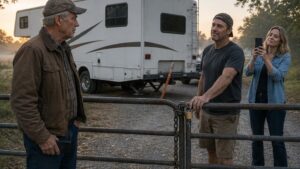
The first thing Daniel Garcia saw that morning was not the damaged fence.
It was the blue and red flash of emergency lights cutting through the gaps between the old cottonwood trees at the end of his driveway.
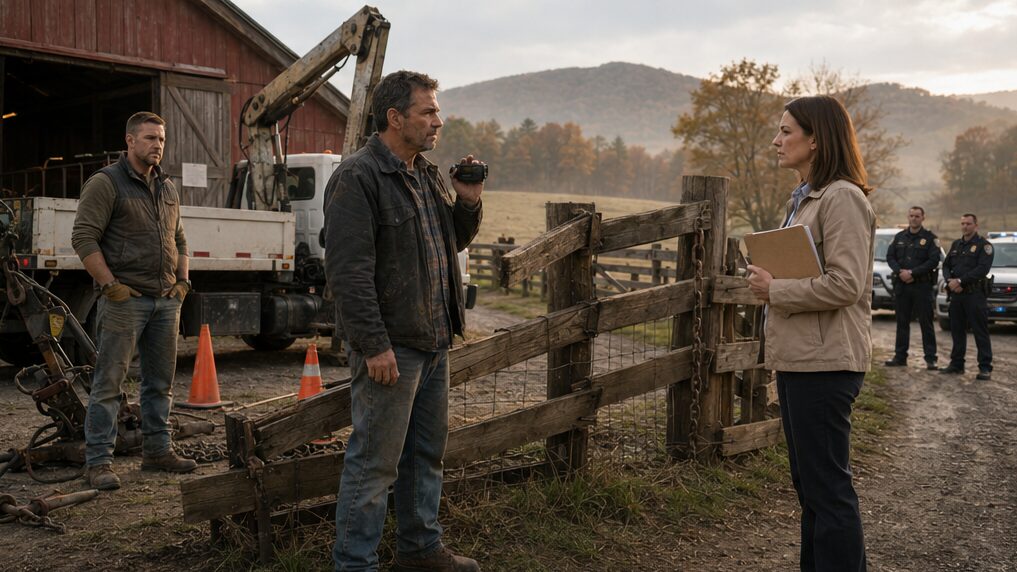
For a few seconds, he stood beside the barn with one hand resting on the weathered wooden post he had spent three weeks repairing. The early autumn air carried the smell of hay, diesel, and damp soil. His cattle were still gathered near the far pasture gate, unaware that anything unusual was happening.
Then another set of lights appeared behind the first.
A police SUV turned onto his gravel driveway, tires throwing dust into the air.
Daniel lowered the wrench in his hand.
He had lived on the farm long enough to know the difference between a normal visit and a problem arriving.
This was a problem.
The vehicles moved slowly past the equipment shed, past the old storage trailer, and toward the barn as if they already knew exactly where they were going. Daniel watched the first officer step out, then another. Neither reached for anything. Neither looked like they were responding to an emergency.
They looked like they were there because someone had called them.
And Daniel already knew who.
A dark SUV stopped behind the police vehicles.
Heather Roberts stepped out holding a folder.
She wore the same expression she had worn three days earlier when she stood beside his fence and photographed every repaired section with her phone.
Not concern.
Assessment.
Daniel placed the wrench on the wooden railing and walked toward her.
“Heather,” he said. “What is this?”
She did not answer immediately. She opened the folder.
“Daniel Garcia, you were notified that the work on this property was not approved.”
Daniel looked past her toward the officers.
“That doesn’t answer my question.”
Heather removed a paper from the folder.
“The association has made several attempts to resolve this.”
Daniel almost laughed, but stopped himself.
Attempts.
That was the word people used when they wanted to sound reasonable after ignoring something.
“I sent the repair request six weeks ago,” he said.
Heather glanced down at the paper.
“You submitted a request for a fence alteration.”
“It’s not a fence alteration.”
“It changes the appearance of the boundary line.”
Daniel looked back at the repaired section stretching along the edge of the pasture.
The old posts had been leaning for months. The wire had separated in two places after heavy rain washed away part of the soil underneath. He had warned the HOA because the broken section sat along the property boundary they shared with the community land behind him.
If one of the cows pushed through, they could reach the road.
If the runoff continued cutting through the weakened area, the damage would spread toward the lower fields.
He had not built something new because he wanted a nicer-looking farm.
He had repaired something because something was failing.
“That section was collapsing,” Daniel said. “I sent pictures.”
Heather folded the paper neatly.
“And you were told approval was required before making changes.”
“After I waited four weeks for someone to answer.”
Her expression tightened slightly.
“The process exists for a reason.”
Daniel looked at the officers again.
The process.
That phrase had followed him for years.
Every time something needed fixing, someone explained the process. Every time something became urgent, the process somehow became more important than the problem.
“I didn’t change the property line,” Daniel said. “I repaired a structure that was already there.”
Heather stepped closer.
“You made a decision without authorization.”
“No,” Daniel replied quietly. “I made a decision because nobody authorized anything.”
For the first time, Heather looked irritated.
Not angry.
Irritated.
As if Daniel had failed to understand the simple arrangement of things.
She had rules.
He had responsibilities.
And in her mind, the rules came first.
One of the officers approached slowly.
“Is there an issue here?”
Heather turned toward him.
“This homeowner has completed unapproved work and refuses to comply with removal.”
Daniel looked at her.
“Removal?”
The word felt heavier than he expected.
Heather held up another paper.
“An enforcement notice was delivered this morning.”
Daniel stared at the document.
“This morning?”
“Yes.”
He looked toward his front porch.
Nothing was there.
Then he noticed the corner of an envelope tucked beneath the barn office door.
The notice had been placed where nobody would see it unless they already knew to look.
“When did the crew arrive?” Daniel asked.
Heather did not answer.
That was the answer.
Daniel walked a few steps toward the repaired fence line.
The officers followed with their eyes.
The repaired posts were still fresh. The concrete around the base had not fully darkened yet. He could see every place where he had worked late after sunset, every section he had reinforced by hand because he did not want to wait for something worse to happen.
His father had taught him something simple.
A person who owns something is responsible for what happens to it.
Daniel had lived by that.
But standing there with police vehicles behind him and an HOA representative holding papers in front of him, he wondered if responsibility mattered when someone else controlled the paperwork.
Heather closed the folder.
“The crew will return tomorrow morning to remove the non-compliant structure.”
Daniel turned.
“You already scheduled it?”
“Yes.”
“You brought police here before even telling me?”
Her expression remained controlled.
“We are here to prevent this from becoming a larger conflict.”
Daniel looked at the vehicles filling his driveway.
The conflict was already larger.
He just had not been the one who expanded it.
That evening, Daniel sat alone in his farm office with the violation notice spread across the desk.
The room was small and crowded with years of paperwork. Tax records. Equipment receipts. Old photographs. Maintenance notes.
He pulled open a drawer and found the copies of every email he had sent.
The first request.
The photos.
The measurements.
The explanation.
He had assumed the records would be enough.
That someone would see the problem and understand.
But every email had ended the same way.
“We will review.”
“Your request is pending.”
“Please wait for approval.”
He looked at the last message.
Sixteen days old.
No response.
Outside, one of the cattle moved against the damaged section of the pasture.
The repaired barrier held.
For now.
Daniel leaned back in his chair.
He knew what Heather saw.
Wood.
Wire.
A structure.
Something that could be approved or rejected.
What she did not see was the night he found the first broken post. The hours he spent watching the animals move closer to the weak point. The risk that one failure could turn into a road accident or damaged property.
The fence was not the point.
The fence was what protected everything behind it.
His phone buzzed.
A message from an unknown number.
Daniel opened it.
It was from Heather.
Tomorrow’s removal will begin at 8:00 a.m. Please ensure access to the work area.
He stared at the screen.
Not a request.
Not a warning.
A schedule.
Daniel looked through the office window toward the fence line.
Tomorrow, someone was coming to remove something he built to prevent a problem.
And they were calling it enforcement.
Chapter 2: The Notice That Called His Repair A Violation
At 8:03 the next morning, Heather Roberts was already taking pictures of Daniel’s fence.
She stood near the repaired section with her phone raised, capturing every angle before Daniel had even reached the driveway.
He stopped beside the barn.
The sight bothered him more than he expected.
Not because she was taking pictures.
Because she was documenting the repair like evidence of wrongdoing.
“Are you seriously photographing it again?” Daniel asked.
Heather lowered the phone.
“I’m documenting the condition before further action.”
“Further action?”
She looked toward the road.
“No removal has been scheduled today.”
Daniel noticed the careful wording.
Not today.
Not canceled.
Just delayed.
“Then why are you here?”
Heather opened her folder.
“Because you continue to misunderstand the issue.”
Daniel walked closer.
“No. I understand exactly what the issue is. You think I should have waited.”
“You should have followed the approval process.”
“I did.”
Heather looked at him.
“You submitted paperwork.”
“Yes.”
“Submitting paperwork is not approval.”
Daniel nodded slowly.
That was true.
But it was also the part that bothered him.
The system allowed someone to say no without ever seeing what was happening.
“I sent everything you asked for,” he said. “Photos. Measurements. The repair description.”
“Because the request involved modifying the exterior appearance.”
Daniel looked at the fence.
“The exterior appearance was already there.”
Heather did not respond.
Daniel went back toward the office and returned with a folder of his own.
Not a violation notice.
Not a complaint.
His records.
“I want you to look at this.”
Heather hesitated.
“What is it?”
“The messages I sent before I repaired anything.”
She accepted the folder.
The first page showed photographs of the damaged posts. The second showed the dates.
The third showed his unanswered requests.
Heather flipped through them.
For the first time, her confidence slowed.
Not disappeared.
Just slowed.
“This does not change the requirement,” she said.
Daniel felt the frustration rise.
There it was again.
The requirement.
The word that erased everything around it.
“Did anyone from the board come out here?”
Heather closed the folder.
“The board reviewed the information.”
“Did anyone stand here?”
She looked away for half a second.
That pause told him more than her answer would.
“No,” she said.
Daniel looked at the fence.
“Then how did they decide it wasn’t necessary?”
Heather’s voice became firmer.
“Because necessity does not remove the requirement for approval.”
Daniel wanted to argue.
He wanted to ask how long a person was supposed to wait while a danger grew.
But he stopped.
This was exactly what he had always done.
He swallowed the argument.
He tried to make the other person understand.
He assumed reason would be enough.
Heather handed back the folder.
“The association is willing to discuss modifications.”
“After removal?”
“After compliance.”
Daniel stared at her.
The order had already been decided.
The discussion was only about whether he would accept it.
A truck passed slowly on the road outside the property.
For a moment Daniel thought it was the crew.
It wasn’t.
But the sight made the situation feel closer.
Heather placed a copy of the violation notice against the barn wall.
“You should review your options.”
Daniel picked up the paper.
The words were clean and professional.
Unauthorized modification.
Failure to obtain approval.
Corrective action required.
Nothing on the page mentioned the damaged posts.
Nothing mentioned the cattle.
Nothing mentioned the warnings.
It was a complete story.
Just not the true one.
That afternoon, Daniel drove into town to speak with the property office.
He expected another argument.
Instead, he found a locked door and a sign directing residents to communicate online.
He stood there for several minutes.
Then he returned to the truck.
On the drive home, he called the HOA office.
The voicemail answered.
He left a message.
Then another.
Then he stopped.
He realized something uncomfortable.
He had spent weeks trying to prove he was reasonable.
Meanwhile, Heather had spent weeks building a record that said he was not.
When he reached the farm, there was an email waiting.
The subject line was simple.
Final Notice of Corrective Action.
Daniel opened it.
The removal date had been moved forward.
Tomorrow.
8:00 a.m.
He read it twice.
Then he looked out the window.
The fence line stretched across the field.
The repaired section stood between the animals and the road.
Between the farm and a problem nobody else wanted to own.
Daniel picked up his phone and opened the camera.
For the first time, he recorded the entire fence.
Not because he wanted to win an argument.
Because he finally understood that being right quietly was not the same as being protected.
Tomorrow morning, the crew was coming.
And this time, Daniel planned to be there.
Chapter 3: The Machines Arrive Before Anyone Listens
The sound reached Daniel before the vehicles came into view.
A heavy engine.
Not a tractor.
Not one of his trucks.
Something larger.
He stepped out of the barn with his phone already in his hand.
At the end of the driveway, a white work truck turned onto the property. Behind it came a trailer carrying equipment Daniel recognized immediately.
A cutting saw.
Removal tools.
Heavy equipment.
For a moment, he simply stood there.
They had not come to inspect.
They had not come to talk.
They had come prepared to take something apart.
Daniel walked quickly toward the driveway.
Heather Roberts was standing beside the truck, holding her folder against her side. A crew supervisor stepped down from the vehicle and looked toward the fence.
“Morning,” the man said.
Daniel stopped several feet away.
“Are you here to remove my fence?”
The supervisor glanced at Heather.
“We’re here to complete the corrective action.”
Daniel looked at Heather.
“That’s not an answer.”
Heather opened the folder.
“Daniel, please don’t make this more difficult.”
The sentence surprised him.
Not because of the words.
Because of how calmly she said them.
As if the difficulty was his reaction.
Not the fact that strangers had arrived with equipment to dismantle something on his property.
“I want the order in writing,” Daniel said.
Heather held up the notice.
“You were provided the notice.”
“I want the actual authorization for removal.”
“The association has approved this action.”
“Then show me.”
The crew supervisor shifted his weight.
“Sir, we have a schedule.”
Daniel looked at the equipment behind him.
The machine was already being prepared.
A worker had started moving cones toward the fence line.
The same fence he had repaired because nobody else would.
Daniel raised his phone.
“I’m recording.”
Heather’s expression changed slightly.
“Daniel.”
“No.”
His voice was still quiet.
But something in it had changed.
“I’m done explaining this like I’m asking permission to care about my own property.”
The supervisor looked uncomfortable.
“We’re not here to argue.”
“Then don’t start cutting.”
The worker stopped.
For a few seconds, nobody moved.
The farm went silent except for the engine idling behind them.
Heather stepped closer.
“This structure was installed without approval.”
Daniel turned the phone slightly toward her.
“That structure was repaired after I reported the damage.”
“That doesn’t make it compliant.”
Daniel looked at her.
“Does compliance matter more than what happens if it fails?”
Heather’s jaw tightened.
“This is not about what you think is necessary.”
“No,” Daniel replied. “That’s exactly the problem.”
She opened her folder and pulled out another document.
“The association cannot allow residents to make unauthorized changes because they believe they are justified.”
Daniel glanced at the paper.
Then back at her.
“What about when the association refuses to make a decision while the problem gets worse?”
Heather did not answer.
The crew supervisor looked between them.
“Ma’am?”
Heather looked toward the fence.
“Proceed.”
Daniel stepped forward.
The worker reached for the equipment.
Daniel moved directly into the work area.
Not aggressively.
Not threatening.
Just standing there.
The supervisor immediately raised a hand.
“Sir, you need to move.”
Daniel held up his phone.
“I need your name and your company’s information first.”
The supervisor sighed.
“This isn’t necessary.”
“It is.”
Daniel looked at Heather.
“You brought people onto my land to remove something. I want every person involved documented.”
Heather stared at him.
For the first time since this began, she looked uncertain.
Not because she thought she was wrong.
Because Daniel was no longer playing the role she expected.
He was not angry.
He was not yelling.
He was not refusing because he wanted to win.
He was forcing everyone to slow down.
The supervisor lowered his hand.
“We can pause for a minute.”
Heather turned toward him.
“There’s no need.”
“There is if he is standing there.”
Daniel looked at the fence.
The damaged section was only a few yards away.
He could see the places where the soil had washed out. The places where the old posts had leaned. The places where he had reinforced everything.
“You know what happens if this comes down?” he asked.
Heather looked at the structure.
“It’s a fence.”
Daniel shook his head.
“No. It’s the thing keeping my cattle from getting onto the road.”
The crew supervisor looked at the fence again.
Heather answered before he could.
“Then you should have requested approval.”
Daniel looked at her.
“And while I waited?”
She had no answer.
That was the first crack.
Small.
But real.
The pause lasted less than ten minutes.
It felt longer.
The crew remained beside the truck. Heather continued checking papers. Daniel continued recording.
Then she walked toward him.
“The association has been patient.”
Daniel almost smiled.
Patient.
That word again.
“You call this patient?”
“I call it following procedure.”
“Procedure doesn’t repair anything.”
Heather looked at the phone in his hand.
“Are you trying to intimidate me?”
Daniel lowered it slightly.
“No.”
He looked back at the fence.
“I’m trying to make sure nobody can pretend they didn’t know what happened here.”
That sentence stayed between them.
Heather looked away first.
The supervisor approached again.
“Ms. Roberts, we need a decision.”
Heather looked at Daniel.
Then at the fence.
Then at the paperwork.
Finally, she stepped aside.
“Continue.”
The machine started.
The sound changed the entire property.
Daniel felt it in his chest.
A machine designed to remove.
The worker moved toward the first damaged post.
Daniel watched the tool come closer.
For weeks, he had been fighting with emails and forms.
Now the argument had become physical.
A piece of his property was about to be taken apart.
The worker stopped just before touching it.
“Sir?”
Daniel did not move.
He looked directly at Heather.
“You sent a crew before you ever came out here to see why it mattered.”
Heather responded immediately.
“We are enforcing the rules.”
Daniel nodded.
“And that’s all you see?”
She looked at him.
“What else should I see?”
Daniel turned toward the pasture.
One of the cows had moved closer to the far side of the field.
The weak point.
The place he had repaired.
“The reason I built it.”
For a moment, nobody spoke.
Then a vehicle appeared at the end of the driveway.
Another one.
Then another.
Daniel looked behind him.
Police vehicles.
Again.
Heather’s expression hardened.
The supervisor stepped away from the fence.
And the engine of the removal machine continued running.
Chapter 4: The Police Report That Changed Nothing Yet
The first officer stepped out of the vehicle and looked from Daniel to the equipment.
Then to Heather.
Then back to Daniel.
Nobody spoke for several seconds.
The scene explained itself before anyone did.
A homeowner standing beside a repaired fence.
A crew with tools.
An HOA representative holding paperwork.
Police officers arriving in the middle.
The officer approached.
“What’s going on here?”
Heather answered quickly.
“This homeowner is refusing to comply with an approved corrective action.”
Daniel looked at her.
The wording was careful.
Approved.
Corrective.
Action.
Every word sounded reasonable.
That was the danger.
The officer looked at Daniel.
“Sir?”
Daniel held up his phone.
“I’m recording this interaction.”
“That’s fine.”
Daniel nodded.
Then he pointed toward the fence.
“They are removing a repair I made after reporting a damaged boundary structure.”
Heather interrupted.
“He made an unapproved modification.”
Daniel turned toward her.
“It was a repair.”
The officer looked between them.
“Is this a criminal matter?”
Heather hesitated.
The hesitation was brief.
But Daniel noticed.
“It involves property compliance.”
The officer looked at the equipment.
“That’s not what I asked.”
Nobody answered.
The officer looked at Daniel again.
“Do you own the property?”
“Yes.”
“Do you have documentation?”
Daniel reached toward his truck.
Heather immediately spoke.
“He has been notified multiple times.”
Daniel stopped.
The officer looked at her.
“About what?”
“The violation.”
“Not the repair?”
Heather looked down at the folder.
The officer noticed.
Daniel noticed too.
The question had landed somewhere she did not want it to go.
Daniel walked back to the truck and returned with his folder.
He handed over the first pages.
Photos.
Dates.
Messages.
The officer studied them.
Then looked at Heather.
“You received these?”
Heather crossed her arms.
“The request was reviewed.”
“That’s not what I asked.”
Daniel watched the exchange.
For the first time, someone else was asking the question he had been asking for weeks.
Did anyone actually look?
The officer handed the papers back.
“I’m not deciding who is right about HOA rules.”
Heather nodded.
“Exactly.”
“But I am saying this looks like a civil matter.”
Her expression changed.
“We have an enforcement order.”
“An HOA order is not the same as a criminal violation.”
The crew supervisor looked toward Heather.
Daniel saw the frustration on her face.
Not anger at him.
Frustration that the presence she expected to strengthen her position was not doing what she wanted.
The officer continued.
“If you have a legal dispute, you handle it through the proper channels.”
Heather stepped forward.
“So you’re saying he can just do whatever he wants?”
“No.”
The officer looked at the fence.
“I’m saying I need more than a disagreement over approval paperwork before I tell someone to stop working on their own property.”
Daniel felt something loosen in his chest.
Not victory.
Not relief.
Just a moment where the facts existed outside of Heather’s control.
But it did not last.
Heather turned back toward the crew.
“We are still proceeding with the violation.”
The officer looked at her.
“You can handle that through your process.”
Daniel watched the machine being shut down.
The worker removed his gloves.
The fence remained standing.
For now.
Later that afternoon, after the vehicles left, Daniel sat in his office staring at the violation notice.
The paper looked different now.
Not weaker.
More dangerous.
Because he understood something.
Heather did not need to convince everyone she was right.
She only needed the paperwork to arrive first.
He pulled out his laptop and searched through old messages again.
This time, he was not looking for proof that he had tried.
He was looking for what he missed.
Something about the timeline.
Something about the approval process.
Something that explained why the HOA had been so determined to remove the repair.
Then he found it.
A message from the HOA office.
Buried between automated responses.
Six weeks earlier.
Daniel opened it.
It was not a denial.
It was not an approval.
It was a forwarded maintenance complaint.
From the HOA.
About the same damaged area.
Daniel stared at the screen.
They had known.
Not just about the request.
About the problem itself.
He kept reading.
The complaint had been marked:
“Monitor condition.”
Not repair.
Not emergency.
Monitor.
Daniel leaned back slowly.
They had seen it.
They had decided to wait.
And now they were removing the thing that fixed it.
His phone rang.
The number was unfamiliar.
He answered.
“Daniel Garcia?”
“Yes.”
“This is Elizabeth Lewis. I work with county property safety reviews.”
Daniel sat up.
“How did you get my number?”
“I was contacted regarding the dispute. I don’t represent the HOA or you.”
Daniel looked at the screen again.
“Then why are you calling?”
There was a pause.
“I saw the photographs of the damaged area.”
Daniel waited.
“And I think someone needs to look at what was there before the repair was removed.”
Daniel looked toward the window.
The fence stood in the distance.
Still intact.
Still temporary.
“Why?”
Elizabeth’s answer was quiet.
“Because the damage pattern doesn’t look like a cosmetic issue.”
Daniel looked back at the violation notice.
For the first time, he wondered if the HOA had not simply misunderstood the repair.
Maybe they had misunderstood the problem itself.
And tomorrow, he was going to find out exactly how far that misunderstanding went.
Chapter 5: The Records Behind The Broken Fence
Daniel found the email because he stopped looking for proof that he was right.
He started looking for the moment when everything went wrong.
For two hours, he sat in the farm office with the same folder open beside him. The violation notice remained on one side of the desk. His repair records sat on the other. Between them was the space where the truth had been hiding.
He searched every message.
Every attachment.
Every response.
Then he found the one he almost missed.
The subject line was not about his repair.
It was about a maintenance concern.
Six weeks earlier.
Daniel opened it.
The message came from the HOA office.
A resident report had been filed regarding erosion near the eastern boundary.
His boundary.
The report described water runoff, weakened soil, and possible damage if the area continued to deteriorate.
Daniel stared at the screen.
He read the sentence three times.
Possible damage.
Not imaginary.
Not cosmetic.
Possible damage.
He opened the attachment.
There were photographs.
Taken from farther away than his own.
The HOA had seen the same leaning posts.
The same washed-out ground.
The same problem.
Daniel leaned back in his chair.
All this time, he had thought they did not understand.
But maybe they understood more than he realized.
They just made a different choice.
His phone rang.
Elizabeth Lewis.
Daniel answered immediately.
“Hello?”
“Did you find something?”
Daniel looked at the screen.
“Yes.”
“What?”
He hesitated.
“They knew.”
There was silence on the line.
“Who?”
“The HOA.”
Elizabeth waited.
Daniel explained what he found.
The original report.
The photographs.
The date.
The lack of action.
When he finished, Elizabeth spoke carefully.
“Daniel, I want to see the site.”
“Today?”
“If you can.”
Daniel looked outside.
The repaired section of fence was still standing, but now he saw it differently.
Not as something he had built.
As something everyone had decided to ignore.
“Come out.”
Elizabeth arrived that afternoon in a plain vehicle without any markings.
That mattered to Daniel.
She did not arrive with authority.
She arrived to look.
She walked the length of the fence slowly, stopping at the areas where the ground had shifted.
She crouched near one of the posts.
“How long was it like this?”
“About two months before I repaired it.”
“Did you report it?”
Daniel almost smiled.
“Several times.”
Elizabeth stood.
“Did they respond?”
“They reviewed it.”
She looked at him.
“That isn’t the same thing.”
Daniel looked away.
It was strange hearing someone else say it.
Elizabeth took photographs.
Measured the distance between the damaged areas.
Checked the slope of the ground.
She did not speak much while she worked.
Daniel appreciated that.
Most people who came to the farm wanted him to explain everything before they looked.
Elizabeth looked first.
Then asked.
Finally, she walked back toward him.
“I need to tell you something.”
Daniel waited.
“The repair itself is not the main issue.”
He looked toward the fence.
“What is?”
“The conditions underneath it.”
She pointed toward the lower field.
“Water is moving through this area. The old barrier was not just containing animals. It was controlling where the damage spread.”
Daniel frowned.
“Meaning?”
“Meaning if the structure failed completely, the runoff could have affected the lower pasture and possibly neighboring land.”
Daniel looked back toward the barn.
“So the repair was preventing the problem.”
“Yes.”
The answer should have made him feel relieved.
Instead, it made him angry.
Not the loud kind.
The kind that settled deep.
Because he could picture Heather standing there with her folder.
Calling it a modification.
Calling it a violation.
Never asking what it was preventing.
Elizabeth noticed his expression.
“Daniel.”
He looked at her.
“How many times did you tell them?”
He looked down.
“Enough.”
She studied him.
“That doesn’t sound like a number.”
Daniel was quiet.
Then he admitted:
“I stopped pushing.”
“Why?”
He looked toward the fields.
“Because I thought if I kept sending information, eventually someone would understand.”
Elizabeth nodded slightly.
“And if they didn’t?”
Daniel did not answer.
Because he knew.
If they didn’t understand, he would have to force them to listen.
And he had spent his whole life avoiding that.
That evening, Daniel printed everything.
Not just his messages.
Everything.
The original HOA report.
The photographs.
The dates.
The unanswered requests.
He spread them across the kitchen table.
For years, he had kept records because he believed records protected the truth.
Now he realized records only mattered if someone knew where to look.
His phone buzzed.
A new message.
Heather.
Daniel opened it.
The HOA board has requested a review meeting regarding the enforcement action.
He read it twice.
A review.
Not a correction.
Not an apology.
A meeting.
He almost ignored it.
That would have been easier.
He could send everything through email.
He could let someone else explain.
But then he looked at the fence outside.
The same fence he had stood beside while machines waited to tear it apart.
He remembered Heather asking him:
What else should I see?
At the time, he had not had an answer.
Now he did.
Everything.
Daniel replied.
I will attend.
The meeting was scheduled for the following week.
But before it happened, Daniel received one more message.
This one was not from Heather.
It was from Elizabeth.
I reviewed the photographs from the HOA file. There is something else you should know.
Daniel opened the message.
Attached was one of the original photographs.
A close-up.
He zoomed in.
At the bottom corner was a date stamp.
The photo had been taken before Daniel submitted his first repair request.
Before he ever touched the fence.
Before he was accused of making an unauthorized change.
He stared at the image.
The HOA had known about the damage before he repaired it.
And they had documented it.
The question was no longer whether they knew.
The question was why they waited.
Chapter 6: The Meeting Where Rules Met Reality
Daniel arrived at the HOA meeting carrying the broken pieces of his own fence.
Not all of them.
Just enough.
A damaged post.
A section of old wire.
A piece of the concrete base that had cracked before he repaired it.
He placed them beside the entrance table.
People noticed.
Nobody asked about them.
Not yet.
Inside the meeting room, Heather Roberts sat at the front with a stack of folders.
The board members sat beside her.
Daniel recognized the same posture from the first day.
Prepared.
Organized.
Certain.
He took a seat.
The meeting began with formal language.
Violation.
Compliance.
Community standards.
Corrective action.
The words moved around the room like they belonged there.
Then Heather spoke.
“The purpose of tonight’s meeting is to address continued concerns regarding unauthorized property modification.”
Daniel listened.
He noticed something.
She never said repair.
Not once.
When his turn came, he stood.
“I want to start with one question.”
Heather looked at him.
“Go ahead.”
“When did the HOA first know there was a problem with that section of property?”
The room became quieter.
Heather glanced at the documents in front of her.
“The board was aware of concerns.”
“Before or after I submitted my request?”
A pause.
“Before.”
Daniel nodded.
That answer changed the room.
Small.
But enough.
He placed the first photograph on the table.
“This was taken by the HOA.”
Then another.
“This was my first repair request.”
Then another.
“This was the follow-up when nobody responded.”
Heather leaned forward.
“Daniel, this meeting is not about assigning blame.”
“No.”
He looked at her.
“It’s about understanding what happened.”
Heather folded her hands.
“The association cannot allow every homeowner to make changes simply because they believe those changes are necessary.”
Daniel looked at the damaged fence pieces beside him.
“I agree.”
That surprised her.
He continued.
“People should not ignore rules because they want something done their way.”
The room settled.
Then Daniel picked up the broken post.
“But people also shouldn’t use rules to ignore what is happening in front of them.”
Nobody spoke.
Heather looked at the piece of wood.
For the first time, she looked less like an enforcer and more like someone seeing the result of a decision.
She recovered quickly.
“The association was concerned about maintaining standards.”
“I understand.”
“Then you understand why approval matters.”
Daniel nodded.
“Yes.”
He placed the post down.
“But approval has to involve looking at what is being approved.”
Heather’s expression tightened.
“The board believed the work was not properly authorized.”
“And the board believed that before anyone came to the farm.”
That sentence landed harder.
Because it was true.
The decision had come first.
The understanding came later.
Elizabeth was invited to speak near the end of the meeting.
She did not take sides.
She explained conditions.
Water movement.
Soil erosion.
Risk.
The relationship between the repair and the surrounding property.
When she finished, one board member asked:
“Are you saying the repair was required?”
Elizabeth considered the question.
“I’m saying the condition required attention.”
The board member looked confused.
“That isn’t the same answer.”
“No,” Elizabeth said.
“It means the problem existed before anyone argued about the solution.”
Daniel looked down.
That was the sentence he wished he had been able to say weeks earlier.
Heather spoke quietly.
“The process still matters.”
Daniel looked at her.
And for the first time, he saw the pressure behind her position.
She was not trying to destroy his farm.
She was afraid of losing control of the system she represented.
If one person could make a decision without approval, what happened next?
That fear did not excuse what she did.
But it explained it.
“I know the process matters,” Daniel said.
Heather looked at him.
“But the process cannot be the only thing that matters.”
The room stayed silent.
After the discussion, the board reached a decision.
The removal action would be withdrawn.
The violation would be reviewed.
The repair could remain temporarily while updated approval conditions were considered.
It was not the complete victory Daniel imagined when this began.
There was no dramatic apology.
No one admitted they had been wrong in a way that erased the damage.
But the fence would stay.
That mattered.
Then Heather approached him after the meeting.
Daniel expected another argument.
Instead, she handed him the original violation notice.
“We will need a revised submission.”
Daniel looked at the paper.
“The violation is still active?”
“For now.”
He nodded slowly.
The old Daniel would have taken the paper and left.
He would have accepted the partial answer because he was tired.
But he had learned something.
Silence did not always keep the peace.
Sometimes it only made room for someone else to tell the story.
“What conditions?” he asked.
Heather looked surprised.
Then she answered.
“Updated measurements. Documentation. A review of the final materials.”
Daniel nodded.
“Fine.”
She looked at him.
“You’ll cooperate?”
Daniel looked toward the broken fence pieces near the entrance.
“I’ll participate.”
There was a difference.
And he wanted her to know he understood it.
Two days later, Daniel received the revised approval packet.
Attached was a note from the HOA.
The association acknowledges that prior review procedures did not adequately consider urgent maintenance concerns.
Daniel read the sentence carefully.
It was not an apology.
But it was the closest thing the system knew how to give.
He placed the paper beside the old violation notice.
One document had treated the repair as a problem.
The other recognized why it existed.
Outside, the repaired section of fence still showed the marks from the crew’s attempted removal.
Scratches.
Broken edges.
Evidence that someone had almost taken away the thing protecting the land.
Daniel knew the repair would stand.
But he also knew something else.
The next time someone needed help, the system could not depend on one person quietly hoping someone would notice.
And that was the part he had to decide whether to accept.
Not the repair.
The responsibility of speaking sooner.
Chapter 7: The Repair That Finally Stayed Standing
The first thing Daniel noticed was the absence of noise.
No engines.
No workers.
No voices arguing beside the driveway.
Just the sound of the repaired gate opening.
Months earlier, the sound of machinery had filled the same space.
Now the only movement came from the fence itself as Daniel pushed it open and checked the hinges one more time.
The repair looked different than before.
Not because the wood had changed.
Because he had.
The new posts were stronger. The drainage channel had been reinforced. The weak points had been corrected after the review process.
The HOA had approved the final plan two weeks earlier.
Not with celebration.
Not with an apology.
With a letter.
A simple letter stating that the repair met the updated requirements.
Daniel kept that letter.
Not because it proved he had won.
Because it reminded him how close everything had come to being lost.
He walked along the fence line slowly.
Near the corner post, he stopped.
There were still marks where the removal crew had started.
A small cut.
A damaged section of concrete.
Evidence that someone had almost taken apart the thing protecting his property.
He ran his hand over the rough edge.
For a long time, he had believed the hardest part of owning something was maintaining it.
Repairing it.
Working on it.
Taking care of problems before they became bigger.
He still believed that.
But now he understood something else.
Sometimes taking care of something meant defending it.
The HOA review process changed after the meeting.
Not dramatically.
Not overnight.
But enough.
The association created a new procedure for urgent maintenance concerns.
Requests involving safety issues would no longer wait in the same queue as cosmetic changes.
Residents would receive a response.
Inspections would happen before decisions.
It was not a perfect system.
Daniel knew better than anyone that systems could still fail.
But at least the system had admitted that a person could exist behind a request.
Heather Roberts never became his friend.
Daniel did not expect her to.
Their conversations remained careful.
Professional.
But different.
A month after the approval, she came to the farm for the final inspection.
She stood beside the repaired fence holding a clipboard.
Daniel watched her examine the work.
For a moment, neither of them spoke.
Then Heather looked toward the lower field.
“The drainage changes were necessary.”
Daniel nodded.
“Yes.”
She looked back at him.
“I should have looked at the property before making the decision.”
Daniel did not answer immediately.
Because he knew what she was doing.
It was not a dramatic apology.
It was not an admission that erased everything.
It was a person acknowledging a mistake in the only language she seemed comfortable using.
Documentation.
Process.
Facts.
“You should have,” Daniel said.
Heather accepted that.
No argument.
No defense.
Just a quiet nod.
Then she looked toward the fence again.
“I still believe approvals matter.”
Daniel looked at the repaired structure.
“So do I.”
That surprised her.
“But?”
Daniel placed his hand on the top rail.
“But approval should come after understanding what you’re looking at.”
Heather looked at him.
And this time, she did not disagree.
Later that afternoon, Daniel sat in his office sorting through the old paperwork.
The violation notice remained in the drawer.
Not thrown away.
Not displayed.
Just kept.
Beside it was the final approval.
Two pieces of paper.
One had arrived when the system saw only a violation.
The other arrived after people finally looked.
He thought about how close he had come to handling everything the same way he always had.
Quietly.
Patiently.
Waiting.
He had believed avoiding conflict was the same as being reasonable.
But the past few months had taught him something uncomfortable.
Sometimes silence did not prevent conflict.
Sometimes silence allowed someone else to define it.
He looked at the folder of records on his desk.
The one he should have organized sooner.
The one that finally forced the truth into the open.
Daniel closed the folder.
Not because he was done fighting.
Because he hoped he would not have to fight the same way again.
A few weeks later, a neighbor stopped by the farm.
The man stood near the repaired fence and looked at the new posts.
“I heard the whole thing was settled.”
Daniel smiled slightly.
“Something like that.”
The neighbor touched the wood.
“Looks better than before.”
“It is.”
The man looked toward the barn.
“Must have been frustrating.”
Daniel considered the question.
It would have been easy to say yes.
And it would have been true.
But that was not the only thing he felt.
“It was.”
He paused.
“Mostly because everyone was looking at the same thing and seeing something different.”
The neighbor nodded.
Daniel looked back at the fence.
To him, it was no longer just a repair.
It was a reminder.
A reminder of the paperwork left unanswered.
The machine that arrived before anyone listened.
The moment when he finally stepped forward instead of stepping aside.
The fence stood because the problem had been solved.
But the lesson stayed because the problem had almost never been the fence.
That evening, as the sun lowered behind the fields, Daniel walked the property one last time.
The cattle remained behind the repaired barrier.
The lower field remained protected.
The barn stood quiet.
The farm looked almost exactly as it had before.
But Daniel knew it was not the same.
He had spent years believing that being responsible meant handling everything alone.
Now he understood that responsibility also meant making sure people could not ignore what mattered.
The fence was fixed.
The records were organized.
The repair was approved.
The home was safe.
And for the first time in months, Daniel closed the gate without wondering who might come back to tear it down.
The repair finally stayed standing.
The story had ended.