The Morning My Neighbor Padlocked My Gate, I Learned Why the Whole Association Wanted Me Silent
Chapter 1: The Padlock Was Hanging on My Gate at Dawn
The chain struck the gate twice before sunrise.
Metal against metal carried farther than a shout in the quiet, sharp enough to stop me halfway across the field. I had been walking toward my truck with a thermos in one hand and a ring of keys in the other. The truck was parked beyond the gate, near the abandoned workshop I had spent the previous week clearing.
When the chain hit again, I saw the man on the other side.
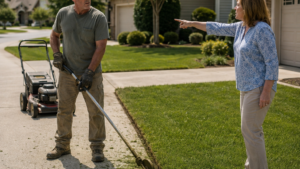
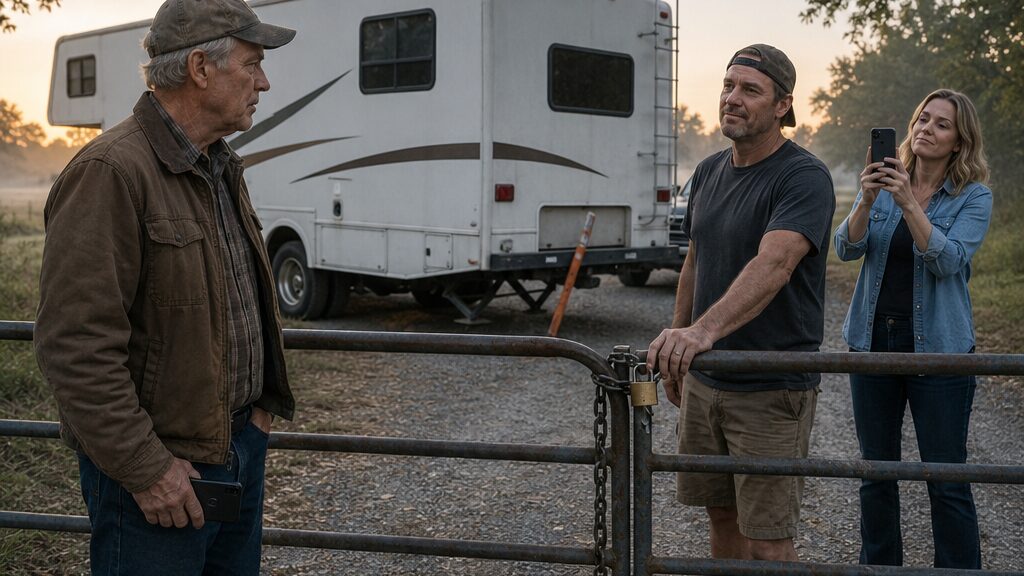
He wore sunglasses despite the low gray light. One hand rested on a new brass padlock threaded through my gate. Behind him, a motorhome sat sideways across the gravel lane, long enough that its rear wheels nearly touched one ditch while its front bumper crowded the other.
My truck was trapped behind it.
The man lifted his chin. “Morning.”
“Take that lock off.”
He glanced at the woman beside him. She already had her phone raised.
The woman smiled at the screen rather than at me. “We’ve got our new neighbor out here.”
I set the thermos on the nearest fence post.
The gate had stood there for twenty-three years according to the closing documents. The chain was mine. The padlock was not. I stepped closer and looked through the bars at the motorhome.
“You’ve blocked the only vehicle access to my property.”
The man gave a short laugh. “Your property starts farther in.”
“The lane is part of it.”
“No, it isn’t.” He tapped the padlock with one finger. “Shared association access. I’m on the road committee.”
He said it with the confidence of someone announcing the time.
I looked past him. The motorhome’s leveling jacks were down. A folding chair stood beside one of the storage compartments. A power cable ran toward Mark’s house across the road.
I did not know his name yet, but he acted as if we had been arguing for years.
The woman turned her phone slightly, fitting both of us into the frame. “Everything okay, sir?”
“You’re recording me on my property.”
She widened her eyes for whoever was watching. “We’re standing on a shared lane.”
The man folded his arms. “My mother needs a place for a little while. Nobody’s hurting anything.”
“You could have asked.”
“We didn’t need to.”
That answer changed the morning.
Until then, I had allowed for a mistake. The acreage had changed hands only a week earlier. Old rural parcels often carried arrangements nobody bothered to write down. A gate could appear private and still sit on common ground. A map could be older than the road built over it.
But people who believed they had permission usually explained it. They did not lock out the owner.
“What’s your name?” I asked.
“Mark Lewis.”
“And who authorized this?”
“The association.”
“Who at the association?”
His mouth tightened. “Brenda Smith. President.”
The woman lowered the phone just enough to look at him, then lifted it again.
I caught the movement.
“Do you have that authorization in writing?”
Mark smiled. “You planning to take us to court over gravel?”
The woman laughed. “He just bought twelve acres and now he thinks he bought the whole neighborhood.”
“I bought the recorded access to those acres.”
“There,” she said to the phone. “That’s what I mean. He’s threatening an elderly woman over a strip of gravel.”
“I haven’t threatened anyone.”
“You told us to move her home.”
“I told him to remove a lock from my gate.”
She kept filming.
For most of my working life, I had watched people ruin good positions by saying one unnecessary sentence. At municipal boundary hearings, the loudest person in the room was often the one who had brought the least evidence. Anger felt useful because it moved through the body. On paper, it usually became a liability.
I took out my phone.
Melissa’s smile faltered. “Now you’re filming us?”
“I’m documenting the obstruction.”
I photographed the padlock first. Then the chain where it passed through the gate. Then the motorhome from the centerline of the lane.
Mark stepped into one frame.
“Move, please.”
He stayed where he was.
I took the picture anyway.
The woman’s voice sharpened. “You know, the whole neighborhood already heard about you.”
“I moved in seven days ago.”
“That was enough.”
I walked along the fence until I could see the motorhome’s rear leveling jack. Beneath its square metal foot, an orange survey stake had been folded almost flat into the gravel. Only three inches remained visible.
I crouched.
The stake marked the easement edge shown on my closing survey.
There were pale scrape marks on it, fresh enough that the plastic still curled at the break.
“Did you move this stake?” I asked.
Mark looked down. “It was in the way.”
“That stake marks a recorded boundary.”
“It marks where some surveyor stuck a piece of plastic.”
“I was a survey technician for thirty-four years.”
That silenced him for less than a second.
“Then you should know maps get updated.”
“Show me the update.”
Melissa moved closer, phone still aimed at my face. “You’re trying very hard to make this ugly.”
I stood slowly.
The old instinct rose in me—the one that said not to explain, not to argue, not to give strangers anything they could twist. It had served me well in hearings and badly everywhere else. My former wife used to say I could retreat while standing in the same room.
I picked up my thermos.
“Remove the lock and move the vehicle.”
Mark shook his head. “Talk to Brenda.”
“I will.”
“You do that.”
He slapped the gate once. The chain jumped against the bars, producing the same hard sound that had drawn me there.
I walked the fence line instead of answering. There was no second entrance. The southern edge dropped into a drainage cut. The western boundary ran against thick woods and an abandoned rail berm. The only road wide enough for a truck, trailer, ambulance, or fire engine passed through the locked gate and beneath the motorhome.
When I returned, Melissa was narrating to her phone.
“He won’t even discuss a temporary accommodation,” she said. “He just keeps taking pictures.”
I looked directly at the camera. “Please include the part where I asked who gave written authorization.”
She stopped recording.
That was the first small sign that she understood the difference between a story and a record.
At 7:16, I called the number listed for the Pine Hollow Road Association. Brenda answered on the fourth ring.
Her voice was calm and administrative. “Mr. Walker, I was told there was an interaction.”
“There is an unauthorized lock on my gate and an RV blocking my only access.”
“The lane has traditionally been maintained as a shared corridor.”
“Maintained by whom?”
“The association.”
“Who owns it?”
A pause.
“These things aren’t always as simple as the deed language.”
“They usually start there.”
She sighed softly. “I’ll send you the map we use.”
“I need the vehicle moved today.”
“I can’t make that decision without consulting the board.”
“Can you tell Mark to remove his padlock?”
“Again, I don’t want to act before we verify everyone’s rights.”
“He has already acted.”
Her silence lasted long enough for me to hear papers moving on her desk.
“I’ll email you,” she said.
By eight o’clock, I was standing in the temporary rental where I had been sleeping while I repaired the workshop. My truck remained beyond the gate. My tools remained in the truck. On the neighborhood group, which Melissa had added me to without asking, a clipped video showed me saying, “Remove the lock and move the vehicle.”
Nothing before it. Nothing after it.
The caption read: NEW OWNER THREATENS DISPLACED SENIOR.
Then Brenda’s email arrived.
The attachment was a faded association map scanned crookedly from a paper original. The parcel lines were thick and imprecise. My acreage appeared as an empty green block. Across the narrow lane, in blue capital letters, someone had written:
SHARED ACCESS AND MAINTENANCE AREA.
I enlarged the image until the letters broke into pixels.
At the bottom, in smaller print, was a date from eighteen years earlier.
It was not the map attached to my deed.
Chapter 2: Eleven Mornings From the Same Patch of Gravel
On the second morning, the motorhome had not moved an inch.
The folding chair was gone, but the leveling jacks remained planted. The new padlock shone against the older chain. I stood in the same place as the day before and took the same three photographs.
Wide view of the gate.
Close view of the lock.
Full view of the obstruction.
At 6:08, Mark opened his front door across the road. He watched me from the porch without speaking.
I photographed the bent survey stake.
On the third morning, a handwritten note had been taped inside the gate.
STOP HARASSING RESIDENTS.
I photographed that too.
Brenda answered my first two emails with variations of the same sentence: the board was reviewing historical use. She did not answer when I asked whether historical use authorized a neighbor to install a lock. She did not answer when I asked what emergency vehicle could pass the RV.
Instead, an association notice appeared in my inbox reminding all owners to communicate respectfully.
By the fourth morning, my routine had become precise. I arrived before sunrise, framed the gatepost against the same branch of an old oak, and photographed the scene. Repetition mattered. A single picture could be called misleading. Eleven pictures from one fixed angle became a condition.
Melissa’s video spread through the neighborhood group.
People I had never met reacted beneath it.
Why buy rural property if you hate neighbors?
He could let an elderly woman stay for a few weeks.
Some people think a deed gives them permission to forget compassion.
I did not reply.
That was my first mistake after the gate.
Silence felt cleaner than argument, but it left every empty space available for someone else’s explanation.
On the fifth morning, I found a dark stain spreading across the lower corner of my private-access sign. A rubber drain pad had shifted beneath the motorhome, and oily water had run through the gravel toward the post.
I photographed the stain, then followed it uphill.
Mark came outside carrying coffee.
“You crawling around under there now?”
“There’s a leak.”
“It’s condensation.”
“It has an oil sheen.”
He looked once and shrugged. “Old vehicles leak.”
“Move it.”
“Board’s reviewing.”
“The board didn’t park it.”
He smiled into his cup. “You always talk like a deposition?”
I took another photograph.
His smile disappeared.
By the seventh morning, the orange survey stake had been crushed entirely beneath the leveling jack. The remaining plastic lay flat, ground pale by the metal foot.
I used a ruler from my truck’s emergency kit to show scale in the photograph. Then I recorded a slow video from the gate to the jack, speaking the date and time aloud.
Melissa stood near her mailbox watching me.
“You know people think this is excessive,” she said.
“People aren’t required to agree with evidence.”
“They think you’re waiting for something bad to happen.”
“I’m recording what already happened.”
She crossed her arms. “Betty can hear you out here every morning.”
It was the first time I heard the name.
“Betty?”
“Mark’s mother.”
“Is she living in the RV?”
Melissa’s expression closed. “You knew that.”
“No.”
“It was in the video.”
“The edited one?”
Her jaw tightened. She went inside without answering.
That evening I reviewed every image on my laptop. Seven mornings. Seven nearly identical frames. The only changes were the deepening stain, the damaged stake, and the handwritten notices Mark kept replacing when rain loosened the tape.
The repetition should have reassured me. It did not. It reminded me of years spent bringing measurements home and assuming accuracy could substitute for conversation.
When my former wife had asked whether I still wanted the marriage, I had shown her a spreadsheet of expenses and proposed changes to our schedule. She had stared at the pages and said, “Frank, I asked where you are.”
I had not understood until she stopped asking.
On the eighth morning, I went to the county records office.
The clerk pulled my parcel by instrument number and unfolded a scanned plat on the monitor. The easement line ran from the county road through my gate and ended at the interior acreage. Its width was listed clearly. The legal description matched my deed.
“The association says it’s shared access,” I said.
The clerk leaned closer. “Shared with whom?”
“That is what I’m trying to determine.”
She opened the subdivision documents. Pine Hollow Road Association had authority over the paved loop serving twelve homes. The narrow gravel spur toward my acreage was shown outside the association’s dedicated road system.
“This easement predates the association by nine years,” she said.
“So their map does not control it.”
“Recorded instruments generally control over an internal diagram, but I can’t give legal advice.”
“I’m not asking for legal advice.”
She looked at me over her glasses. “You were in government.”
“Survey division.”
“I could tell.”
For the first time in eight days, I almost smiled.
She printed certified copies of the deed, plat, and easement description. The paper carried the county seal. It was useful, but it did not explain why Brenda, after seeing the same records I had sent her, continued to call the matter uncertain.
On the ninth morning, someone had placed two orange traffic cones beside the RV, as if official-looking objects could legalize an obstruction.
On the tenth, Melissa posted another video. This one showed me measuring the stain and photographing the damaged stake. Her caption asked whether anyone else felt unsafe being watched.
The comments became colder.
One neighbor wrote that the association should investigate whether I was operating a business from the acreage. Another asked if I had permits for the workshop repairs. Brenda replied that the board would review all concerns consistently.
I finally typed a response.
I deleted it before posting.
Instead, I arranged the photographs in a grid: ten mornings, same angle, same obstruction. Under each image I placed the date, time, and visible condition. I attached the certified records and sent them to Brenda.
Her reply came three hours later.
Historical permission may affect the association’s position. Please refrain from unilateral enforcement while review continues.
Historical permission.
The phrase was more specific than anything she had said before.
On the eleventh morning, I took the final photograph at 6:11. The motorhome still blocked the lane. The padlock was damp with dew. Through a gap in the blinds, I saw someone moving inside the vehicle.
I lowered the phone.
For eleven mornings, I had photographed an object.
Now I knew there was a woman behind the glass.
At the records office later that day, the clerk had set aside another folder. She said she had searched archived correspondence connected to the parcel.
Inside was a photocopy of a handwritten note from the previous owner.
Neighbors may use gravel spur for temporary overflow parking with owner permission. No permanent structures or blocked access.
There was no date of expiration.
There was also no list of approved users, no definition of temporary, and no indication that permission transferred with the property.
At the bottom, beside the previous owner’s initials, someone had written in different ink:
Association maintains as needed.
The clerk tapped the page.
“This may be what they’re relying on.”
I read the first sentence again.
With owner permission.
The note answered why the neighborhood believed the lane had been shared.
It also raised a more difficult question.
How many years had they stopped asking?
Chapter 3: The Permission Everyone Remembered Differently
The permission note had no expiration date, and Brenda treated that absence as if it belonged to her.
She laid a copy on the association office table between us, smoothing one corner with two fingers. The room had once been a model-home sales office. Framed photographs of summer picnics and holiday decorations covered the walls.
“People have used that spur for years,” she said. “Before storms. During home repairs. When families had gatherings.”
“With the owner’s permission.”
“The owner never objected.”
“That is not the same thing.”
Brenda folded her hands. “You arrived and changed a long-standing community practice without speaking to anyone.”
“I arrived and found someone else’s lock on my gate.”
“Mark believed he had authority.”
“Did you tell him he had authority?”
She looked toward the window.
That was not an answer, but it was the first honest movement she had made.
“I told him the map identified the area as shared,” she said.
“Did you tell him to install a padlock?”
“No.”
“Did you tell him he could block the lane?”
“No.”
“Then tell him to move.”
Her mouth tightened. “We have to consider reliance.”
“Reliance on what?”
“Past practice.”
“The note says temporary parking with owner permission. It does not say the association owns the land. It does not say residents may block access. It does not say permission survives a sale.”
“I understand the wording.”
“Then what are we reviewing?”
She glanced at the certified plat beside my hand. “Consequences.”
There it was.
Not ownership. Consequences.
I waited, but she said nothing more.
I had spent decades letting silence pressure other people into filling it. At home, I had used the same silence to avoid being pressed myself. Brenda and I sat across from each other, both practiced in withholding the sentence that mattered.
Finally she said, “If the map is wrong, it affects more than one vehicle.”
“How much more?”
“I’m not prepared to discuss that.”
I gathered the documents.
“You are asking me to absorb the consequences so the association does not have to name them.”
“I’m asking you not to escalate while we resolve it.”
“The escalation is parked across my gate.”
When I returned to the property, Mark was tightening something near the motorhome’s rear compartment. Melissa stood beside him with her phone in her hand, though she was not recording yet.
I held up the archived note.
“Temporary parking required owner permission.”
Mark barely glanced at it. “Previous owner let us use it.”
“I’m not the previous owner.”
“That doesn’t erase twenty years.”
“It erases permission when permission is withdrawn.”
He stood.
“You think everything starts the day you show up?”
“No. I think ownership matters on the day someone locks the owner out.”
Melissa raised her phone.
I looked at her. “Record the whole conversation this time.”
She lowered it again.
Mark wiped his hands on his shorts. “My mother’s place had water damage. The contractor opened a wall and found mold. She can’t stay there.”
“You could have asked me.”
“Would you have said yes?”
I opened my mouth, then stopped.
He saw the hesitation.
“That’s what I thought.”
His question landed harder than I wanted it to. I had spent eleven days proving he had no right to take the space. I had not spent one minute deciding what I might have offered if he had asked.
But his assumption did not become permission.
“You did not give me the chance to answer.”
“I didn’t have time for a property seminar.”
“You had time to buy a padlock.”
His face reddened.
For a moment I thought he might step closer. Instead, he pointed toward the RV.
“That’s somebody’s home. Not an abandoned trailer. Not junk. My mother is in there.”
“Then you should not have placed her where access was disputed.”
“The association map says it isn’t.”
“The recorded plat says it is.”
“Most people don’t live by plats.”
“Most people don’t cut down survey stakes either.”
His eyes shifted toward the leveling jack.
That was enough.
“You moved it,” I said.
“It was sticking up.”
“You knew it marked something.”
“I knew it was in the way.”
Melissa said his name softly, warning him.
I took the bolt cutters from the bed of my truck.
Mark’s posture changed. “What are you doing?”
“Removing an unauthorized lock.”
“You touch that and I’ll call the sheriff.”
“Please do.”
The chain was mine. I held it steady and placed the jaws around the brass shackle. The metal resisted once, then snapped with a flat crack.
The padlock dropped into my palm.
For eleven mornings it had symbolized his confidence. In my hand, it felt small and ordinary.
I threaded my own chain through the gate and installed a lock I controlled. Then I opened the gate long enough to move my truck from the interior side to the county-road shoulder. The RV still prevented me from driving farther onto my own acreage, but I would not let Mark trap the truck again.
I fastened a weatherproof notice to the gate.
PRIVATE RECORDED ACCESS
OBSTRUCTION MUST BE REMOVED WITHIN 72 HOURS
DAILY ACCESS COSTS AND AUTHORIZED TOWING MAY FOLLOW
Mark read it twice.
“You can’t charge me whatever you want.”
“The amount will reflect documented loss and removal costs.”
“You practiced that?”
“No.”
It came out colder than I intended.
Melissa looked from the notice to me. “You’re giving an elderly woman three days to become homeless.”
“I am giving the vehicle obstructing my access three days to move.”
“That’s the same thing.”
“No, it isn’t.”
But as I said it, I knew the distinction was legally cleaner than it was humanly complete.
I had still not spoken to Betty.
I had seen movement behind the blinds. I had heard her name. I knew she had been displaced. Yet I had treated the motorhome as a measured rectangle: length, width, position, violation.
The realization irritated me because it arrived after the notice was posted.
Mark took a picture of it.
“You’re going to regret this.”
“Move the RV.”
He walked away.
That afternoon I delivered copies of the deed, plat, eleven photographs, stain documentation, and the archived permission note to the county access office. The clerk at the front desk accepted the packet and gave me a complaint number.
“An inspector may contact you tomorrow,” she said.
I returned to the workshop before dusk. Without my tools, the place remained half-cleared. Dust covered the old workbench. I set Mark’s broken padlock on it beside the copied association map.
One false claim beside another.
For a while, that arrangement satisfied me.
Then my phone rang.
Mark had left a voicemail.
His voice carried laughter, but there was strain underneath it.
“You cannot tow a home, genius. That’s somebody’s residence. Call the county and ask them. Better yet, have them come out so they can explain it to you.”
The message ended with Melissa saying something I could not make out.
I played it twice.
Then I looked through the workshop window toward the gate, where the top of the motorhome rose above the fence.
I had already called the county.
What I had not done was meet the woman living inside.
Chapter 4: The Woman Inside the Vehicle Was Never Told the Truth
The tow truck arrived before I had met the woman whose home I had authorized it to remove.
Its diesel engine settled into a low idle on the county-road shoulder at 7:42 the next morning. Amber lights turned across the metal gate, flashing over the motorhome’s white panels and the handwritten notice I had posted less than twenty-four hours earlier.
Kathleen Perez stepped from a county vehicle behind it. She wore a dark field jacket and carried a clipboard under one arm.
“You’re Frank Walker?”
“Yes.”
She looked at the RV, then at the gate. “Show me the access line.”
Mark came out of his house before we reached the crushed survey stake. He had dressed more carefully than on previous mornings—jeans, boots, a collared shirt—but the backward cap remained.
“You actually called a tow truck.”
Kathleen did not look up from the photographs I had given her. “The county requested a standby vehicle. Nobody is towing anything until I complete the inspection.”
“You can’t remove an occupied residence.”
“That depends on several facts you haven’t established.”
“I established that my mother lives there.”
Kathleen finally faced him. “You established it in a voicemail to the complainant.”
Melissa appeared behind Mark, phone already raised.
Kathleen pointed at it. “You may record from your property. Do not interfere with the inspection.”
The instruction removed some of Melissa’s confidence. She stepped back but kept filming.
I unlocked my replacement chain. Kathleen asked me not to open the gate yet. She photographed the cut brass padlock, which I had brought from the workshop in a clear plastic bag, then checked the chain, the sign, and the position of the RV.
“Your photographs show the rear jack farther north on day one,” she said.
“It shifted after the stake went under it.”
Mark shook his head. “The ground settled.”
Kathleen crouched beside the jack. The orange plastic lay crushed into the gravel, its split edge still visible beneath the steel foot.
“Ground does not flatten survey markers selectively,” she said.
She measured the clear width remaining between the RV and the ditch. It was less than five feet.
“No fire apparatus. No ambulance. No standard passenger vehicle.” She wrote each item down. “How long has this been in place?”
“Twelve days,” I said.
“Eleven,” Mark said.
Kathleen glanced between us. “Your own answer does not improve the condition.”
A curtain moved inside the motorhome.
I saw it clearly this time.
Kathleen walked to the door and knocked.
Mark moved in front of her. “My mother’s not well.”
“Then emergency access matters more, not less.”
“She doesn’t need to be dragged into this.”
“She is occupying the vehicle under inspection.”
Before Mark could answer, the door opened behind him.
The woman standing there was smaller than I expected. She wore a gray cardigan over a nightgown and held a clear plastic pill organizer against her chest. Her silver hair was flattened on one side, and a nasal-inhaler tube ran from the pocket of her cardigan to her hand.
“Mark,” she said, “why is there a tow truck?”
His shoulders dropped.
“Mom, go back inside.”
She ignored him and looked at Kathleen. Then she looked at me.
“Are you Mr. Walker?”
“Yes.”
Her eyes moved to my replacement lock on the chain.
“Why did Mark say you agreed to let me stay?”
Nobody answered quickly enough.
Betty stepped down onto the folding metal stair. “He said the association had permission from you and the man who owned this before.”
“I never gave permission.”
She turned toward Mark. “You told me it was settled.”
“It should have been.”
“That is not what I asked.”
Melissa lowered her phone.
Kathleen’s pen remained motionless above the clipboard.
Mark rubbed the back of his neck. “The association map says it’s shared. Everybody’s used it.”
“Did he agree?” Betty asked.
“No.”
“Did you ask him?”
Mark looked at me instead of her. “I knew what he’d say.”
“You did not know,” I said.
Betty descended the last step carefully. The pill organizer clicked in her hand.
“My condominium had a pipe break,” she said to me. “The contractor found mold in the wall. Mark said I could stay here until they finished. I thought this was association property.”
Her voice contained no accusation. That made it harder to defend against.
“How long did they tell you the repairs would take?” I asked.
“Another three weeks, maybe four.”
Mark stepped toward her. “You don’t need to explain your medical business.”
“I’m explaining why my bed is sitting across someone else’s road.”
He stopped.
Kathleen walked the entire width of the access again, then compared the county plat with the association map. She asked me where my truck had been on the first morning. I showed her the photographs. She called the emergency-services access officer and read measurements over the phone.
When she finished, she turned to all of us.
“The recorded easement is private access benefiting Mr. Walker’s parcel. The vehicle constitutes an obstruction under county code. The damaged marker and discharge condition may be cited separately. The association diagram does not grant a right to occupy the easement.”
Mark’s face tightened. “So you’re throwing my mother onto the road.”
“I did not say that.”
“The tow truck is sitting right there.”
Kathleen looked at me. “The property holder has completed the required obstruction complaint. Based on the inspection, removal can be authorized today.”
For twelve mornings, I had been waiting to hear those words.
The truck driver climbed down from the cab and opened a side compartment. Chains shifted inside with a heavy metallic sound.
Betty looked toward the motorhome. Through the open door I could see a narrow table, a folded blanket, prescription bottles, and a framed photograph wedged beside the sink so it would not fall while traveling.
The motorhome was an obstruction.
It was also where she had slept.
Kathleen spoke quietly enough that only I heard. “The county can establish authority. It cannot make the next choice for you.”
I disliked the sentence because it put the decision back where no document could carry it.
I looked at Mark. “Can you move it under its own power?”
“Yes.”
“Today?”
His answer came too quickly. “No.”
“Why?”
“The commercial sites want deposits. I’m working on it.”
“You had twelve days.”
“I thought the board would handle you.”
Betty closed her eyes.
There was the choice that kept him responsible. Not confusion. Not only money. He had expected Brenda and the neighborhood to make my ownership inconvenient enough that I would give up.
I turned to Kathleen.
“Hold the tow for twenty-four hours.”
Mark exhaled, almost smiling.
I raised a hand before he could speak.
“At eight tomorrow morning, either the vehicle leaves under its own power or the authorization stands. The gate stays unlocked for the move only. No new jacks, no discharge, no additional damage.”
“That’s not enough time,” he said.
“It is more time than you gave me before locking my gate.”
Betty touched his sleeve. “It’s enough time to start telling the truth.”
The tow driver closed the compartment. Kathleen wrote the temporary hold onto her form and had both Mark and me sign beneath it.
As she handed me my copy, Betty remained beside the gate.
“I’m sorry,” she said.
“You did not install the lock.”
“No. I just believed the person who did.”
Mark stared toward the road.
Betty looked at Brenda’s association map, still clipped beneath Kathleen’s county plat.
“Brenda knew the repairs weren’t temporary,” she said. “She was at my condominium when the contractor opened the wall. She knew I needed weeks, not a weekend.”
Kathleen stopped writing.
I looked at Betty. “When was that?”
“Three days before Mark parked me here.”
The question was no longer whether the association had tolerated old parking arrangements.
It was whether Brenda had knowingly turned my private access into emergency housing before I ever reached the gate.
Chapter 5: The Map Error the Board Could Not Afford to Admit
The invoice was buried in a folder labeled ROAD GRAVEL—GENERAL, but the parcel number printed at the bottom belonged to me.
I found it the afternoon Kathleen suspended the tow. Betty’s statement had been enough for Kathleen to request association maintenance records connected to the access lane. Brenda agreed to let me review them at the association office, though she insisted the treasurer remain in the room.
The invoice was four years old.
GRADING AND DRAINAGE—WEST SPUR.
Below it, the contractor had listed eighty tons of gravel, ditch shaping, and culvert clearing. Payment had come from association dues.
“That is my lane,” I said.
The treasurer leaned over the page. “It may be the common section before your gate.”
“The culvert number matches the one inside my boundary.”
Brenda sat across from us with her reading glasses in one hand. “The association maintained the road because residents used it.”
“Maintenance does not create ownership.”
“No one said it did.”
“Your map does.”
“The map identifies maintenance responsibility.”
“It says shared access.”
She set the glasses on the table. “Frank, we have already acknowledged the wording is imperfect.”
“Imperfect wording did not put a lock on my gate. People relying on it did.”
The treasurer opened another ledger. His unease showed in the care he took turning pages.
“We assessed the west-spur work across all twelve homes,” he said. “It was treated as part of the road system.”
“How many times?”
He looked at Brenda.
“Answer him,” she said.
“Three projects in nine years.”
The total was not enormous, but it was enough to matter in a small association. Residents had paid to maintain land the association did not own. Correcting the mistake could mean reimbursement disputes, revised budgets, and questions about every board decision tied to the lane.
I turned to Brenda. “When did you first learn the recorded plat did not match your map?”
She gave me the kind of expression officials used when they were deciding which version of the truth created the least exposure.
“We received questions during the prior owner’s attempted sale.”
“When?”
“Last fall.”
“Months before I bought it.”
“Yes.”
“Did you obtain a survey?”
“We received a preliminary review.”
“Where is it?”
She did not answer.
The treasurer closed the ledger.
I waited.
Brenda rose and unlocked a gray filing cabinet behind her desk. From the lowest drawer she removed a thin envelope with a survey company’s return address.
The letter inside was dated seven months earlier.
The surveyor had warned that the association’s internal map appeared to include a privately recorded access easement outside the dedicated common roads. It recommended correcting association documents and discontinuing any use that blocked the benefited parcel.
The language was cautious. The meaning was not.
“You knew,” I said.
“I knew there was a discrepancy.”
“You knew enough to be warned against obstruction.”
“We were evaluating options.”
“For seven months?”
She looked toward the picnic photographs on the wall. “You think a board can simply announce that residents paid assessments on property we may not control? That every owner who used that lane for twenty years had no continuing right? We could face demands we cannot afford.”
“So you delayed until someone else carried the cost.”
“I was trying to prevent twelve households from turning on each other.”
“You let them turn on me.”
Her face changed, not into guilt exactly, but into fatigue.
“Mark called the week before you closed,” she said. “He needed space for Betty. The commercial lot wanted first month, last month, and a utility fee. He said the old owner always allowed temporary parking.”
“And you told him the map called it shared.”
“I told him the board had not completed its review.”
“Did you tell him the surveyor advised against obstruction?”
“No.”
The treasurer looked away.
Brenda continued, more quietly. “I thought if it remained temporary, we could resolve the map before anyone was harmed.”
“My truck was trapped. My access was blocked. A boundary marker was destroyed.”
“I understand that now.”
“You understood the risk then.”
She had no answer.
Back at the workshop, I placed the survey warning beside the association map. Mark’s broken padlock remained on the bench where I had left it.
The object looked different now.
At first it had represented Mark’s certainty. Then it had become proof that I could reclaim control. Beside Brenda’s hidden letter, it looked like the final link in a chain of people choosing not to ask the question that might inconvenience them.
My phone rang.
Mark’s name appeared on the screen.
“What?” I said.
“I found a lot twenty miles south.”
“That solves tomorrow.”
“They want eight hundred up front.”
I said nothing.
“You have the tow on hold,” he continued. “Withdraw the complaint and give me one week. I’ll move it.”
“The complaint covers the blocked access and damage already done.”
“If you keep it active, the county fines me.”
“That is not new information.”
“You know why I did this now.”
“I know why you needed space. I also know you lied about permission.”
“I was trying to take care of my mother.”
“By placing her in the middle of a dispute and telling her it was settled.”
His breathing changed.
“You don’t have family depending on you,” he said.
The sentence struck the old empty place in me, but not in the way he intended.
“You do not know who depended on me,” I said.
“Then act like you understand.”
“I understand enough to give Betty twenty-four hours after I had authority to remove the RV. I am not withdrawing the record of what happened.”
“Then don’t pretend this is compassion.”
“I’m not pretending anything.”
He ended the call.
A minute later, Melissa posted in the neighborhood group.
SPECIAL ASSOCIATION MEETING—TOMORROW, 7 P.M.
Her message said the community needed to discuss “the threatened eviction of a displaced senior resident by a new property owner.” She attached a still image of me holding bolt cutters beside the gate.
The frame excluded the unauthorized padlock.
It excluded Mark.
It excluded the blocked road.
Comments began appearing before I finished reading.
Brenda called next.
“I did not authorize Melissa’s wording.”
“But you authorized the meeting?”
“The board has to address the map.”
“Then address the map.”
“People are angry about the potential assessment.”
“They should know why it exists.”
Her voice hardened. “If you walk in there demanding reimbursement, fines, towing, and a public confession, you will confirm everything they believe about you.”
For a moment, I considered letting the documents do the work. I could send the deed, the survey warning, the photographs, and Kathleen’s findings. Every fact would be there. No one could say I had hidden anything.
But I had tried that already.
Documents had proven the boundary while Melissa’s edited image defined the man standing beside it.
“I’ll attend,” I said.
Brenda exhaled. “Frank—”
“And I’ll speak for myself.”
After the call, I looked at the padlock on the workbench.
For years I had mistaken silence for restraint. Sometimes it was. Other times, silence simply left the gate open for a lie.
Chapter 6: The Board Meeting Where Silence Became Another Kind of Lie
The room fell silent when Betty walked past her son and sat beside me.
Mark had saved a chair for her in the front row of the association clubhouse. Melissa sat on his other side with her phone facedown in her lap. When Betty entered, using a cane I had not seen at the RV, Mark stood and touched the empty chair.
She shook her head.
Then she crossed the narrow aisle and lowered herself into the seat beside mine.
Brenda called the meeting to order without commenting on it.
Nearly every folding chair was occupied. Some residents carried printed copies of Melissa’s post. Others had association budget sheets. On the table before the board lay my deed, the county plat, the old permission note, the survey warning, and the broken brass padlock sealed in its clear bag.
I had considered leaving the padlock at home. Bringing it felt theatrical.
Leaving it behind felt dishonest.
Brenda began with procedural language.
“The purpose of this meeting is to address the west-spur access classification, temporary vehicle placement, potential financial consequences, and community conduct.”
A neighbor in the second row raised a hand. “Is Betty being towed out tonight or not?”
Murmurs followed.
Brenda looked at me.
I had not yet spoken, and already the decision had been placed in my lap as if nobody else had touched it.
“The county authorized removal,” I said. “I suspended it for twenty-four hours.”
“Why only twenty-four?” another homeowner asked.
“Because my access has been blocked for twelve days.”
Melissa lifted her phone.
Betty tapped her cane once against the floor.
The sound was small, but Melissa stopped.
Brenda summarized the map discrepancy. She called it an administrative error arising from historical use. She explained that correcting it might require legal review, revised maintenance plans, and a special assessment.
The room changed at the word assessment.
“How much?” someone asked.
“We do not know.”
“Why should we pay because he bought land?”
The question came from the back.
I turned toward the voice. “You would not be paying because I bought land. You may be paying because the association collected money and maintained land it did not control.”
“That sounds like a threat.”
“It is a distinction.”
Mark laughed once without humor. “That’s how he talks. Everything is a technical distinction until somebody has nowhere to sleep.”
Betty looked at him. “Stop using me that way.”
He stared at her.
She held his gaze. “You told me Mr. Walker agreed.”
“I told you it was approved.”
“By whom?”
“The association.”
“Did you ask him?”
Mark’s mouth opened, but no answer came.
Betty faced the room.
“He did not ask because he thought Mr. Walker would say no. That is what he told me this morning.”
Melissa whispered, “Betty, you don’t have to—”
“I have been sleeping across that man’s only road while all of you discuss me as if I am furniture.” Betty rested both hands on the cane. “I would have asked. If he said no, I would have been embarrassed, but I would not have taken it.”
The room remained quiet.
That was the first surprise no document could have produced.
Mark’s need had been real. His belief in the old custom had been partly understandable. But beneath both sat pride—the decision that being refused would hurt more than taking without permission.
Melissa picked up her phone.
“Before anyone makes her the villain,” she said, “Frank came out with bolt cutters and towing notices. I have the video.”
“You have part of the video,” I said.
Her eyes narrowed. “I recorded what happened.”
“Play the original.”
“It’s already online.”
“Not the edited version. The original.”
Mark turned toward her.
Melissa hesitated.
Brenda said, “If the recording is relevant, it should be complete.”
Melissa unlocked the phone. Her thumb moved across the screen. She connected it to the clubhouse television, and the first morning appeared larger than life.
The gate. The RV. Mark’s hand on the padlock.
My own face looked older and harder than I remembered.
The familiar clip played: Remove the lock and move the vehicle.
Then it continued.
On the full recording, I asked Mark who had authorized the obstruction.
He said the association.
I asked for written authorization.
After a pause, Mark answered, “I don’t need paper for something we’ve always used.”
Several people turned toward him.
Melissa stopped the video.
“No,” Betty said. “Let it finish.”
The recording continued through my photographs of the lock, the RV wheels, and the damaged stake. It captured Melissa saying I was threatening an elderly woman before I had been told anyone lived inside.
When the screen went dark, nobody applauded. I was grateful for that. Applause would have made the room too simple.
A neighbor near the aisle folded Melissa’s printed post in half.
Brenda cleared her throat. “The recording changes the conduct issue.”
“It changes the order of events,” I said. “The conduct was always there.”
I stood.
My hands wanted documents. I left them on the table.
“I have spent my life believing that if measurements were accurate, people would eventually accept them. That belief made me good at my job. It did not make me good at every conversation.”
Betty looked toward me.
“I should have asked who was inside the RV before I posted a towing notice. I did not. That was my mistake.”
Mark shifted in his chair.
“But my failure to ask does not turn your decision into permission. The lane must be cleared. The damaged marker must be restored. The discharge must be cleaned. The association map must be corrected, and the statement that I threatened Betty must be withdrawn.”
A homeowner raised a hand. “And the money?”
“The association should determine lawful reimbursement and future maintenance. I am not asking tonight for every dollar ever spent.”
Brenda studied me.
“What are you asking for?” she said.
“A written agreement. The RV moves tomorrow to a lawful site. I will release the tow hold long enough for that move. Mark reimburses the direct damage and county costs under a payment schedule if necessary. The association adopts the recorded map and acknowledges that it had prior notice of the discrepancy. Melissa posts the full correction where she posted the accusation.”
Melissa’s face tightened. “You want me to publicly humiliate them.”
“No. I want you to correct what you publicly said about me.”
“And Betty?”
“I will contribute the amount of the county tow standby fee toward the commercial-site deposit, provided it is paid directly to the lot.”
Mark stood so abruptly his chair scraped backward.
“I don’t want your charity.”
Betty turned toward him. “It is not yours.”
His face reddened.
Brenda looked over the proposed terms. “Correcting the map may require a special assessment.”
A low wave of complaint moved through the room.
“There will be legal costs,” she continued. “Possibly reimbursement claims. Every household needs to understand that.”
I nodded. “Then every household should understand what the alternative costs.”
“What alternative?”
“Leaving private access uncertain until the next blocked ambulance, the next sale, or the next owner who does not wait twelve days.”
Kathleen stood near the back wall. She had attended only to confirm the county findings. Now she said, “Emergency access is not an optional association custom.”
That ended the argument no one wanted to finish.
Brenda placed a blank agreement form on the table and began writing the terms by hand.
When she reached the relocation line, she looked at Mark.
“Mr. Lewis, the county hold expires at eight tomorrow morning. Will you accept these terms and move the vehicle voluntarily?”
Every face in the room turned toward him.
Betty did not.
She looked down at her hands, leaving him alone with the choice he had spent two weeks avoiding.
Mark could protect his pride and force the tow.
Or he could finally ask for help without pretending the road belonged to him.
Chapter 7: The Gate Opened Only After Everyone Named the Cost
At sunrise, Mark stood beside the motorhome holding the keys, but he did not offer an apology.
The county tow truck waited farther down the road with its amber lights off. Kathleen stood near the gate checking the time. Betty sat in Melissa’s car with the window lowered, her cane across her knees and a small overnight bag beside her.
Mark looked as though he had not slept.
“I signed the agreement,” he said. “That is all you need.”
“It is enough to move the vehicle,” I said.
He glanced at the chain threaded through my gate. “Open it.”
I unlocked the padlock and pulled the chain free. For two weeks, every movement at that gate had been an argument. The chain dropping into my hands made almost no sound.
Melissa stepped out of her car.
“The commercial lot confirmed the space,” she said. “They received the deposit.”
I had paid the amount directly the previous evening. Mark had not thanked me, and I had not expected him to.
Kathleen handed him a checklist. “Retract the leveling jacks, disconnect all utilities, secure the interior, and follow the approved route. The tow truck remains on standby until the access is clear.”
Mark took the paper without reading it.
Betty called through the open window. “Read it.”
“I know how to move an RV.”
“You also knew where to park one.”
Melissa looked down, but Mark only folded the sheet and pushed it into his pocket.
He disconnected the power cable and water line. I walked behind the motorhome to watch the rear jacks rise. The jack above the ruined survey stake shuddered, lifted an inch, and stopped.
Mark tried again. The motor whined, but the steel leg remained planted.
Kathleen crouched to inspect it. “The foot is twisted.”
“It settled,” Mark said.
“It was lowered onto the marker at an angle.”
He looked toward me, waiting for correction or accusation.
I gave him neither.
The tow driver brought a hydraulic jack and blocks. Mark knelt beside him, but the driver waved him back. The RV leaned slightly as pressure came off the damaged leg. Gravel shifted beneath the rear wheels.
When the jack finally retracted, the crushed orange stake remained embedded in the ground like a strip of faded ribbon.
Mark stared at it.
“I didn’t think it mattered,” he said.
“It marked the edge,” I replied.
“I mean the plastic.”
“I know.”
He rubbed dirt from his hands. “There were stakes everywhere when the old owner tried to sell.”
“That one was installed for my closing.”
He nodded once. It was not an apology, but it was the first time he had acknowledged that the damage belonged to a particular person rather than to an abstract dispute.
The engine started with a deep vibration. Cabinet doors rattled inside the motorhome. Betty closed her eyes at the sound, as though the vehicle moving proved something she had not allowed herself to expect.
Mark eased forward.
The first turn was too sharp.
The motorhome’s rear swung toward the gatepost, leaving less than a foot of clearance. Kathleen shouted for him to stop. He braked, but the vehicle rolled backward several inches on the gravel slope.
I moved before I had time to decide whether I wanted to help.
“Wheel left,” I called. “Half a turn.”
Mark leaned out the window. “That puts the front in the ditch.”
“Not if you straighten after the axle clears the culvert.”
“I can see the culvert.”
“You cannot see the rear corner.”
He looked at Melissa, then at the tow driver.
The driver pointed toward me. “Listen to the man outside.”
Mark’s jaw tightened.
Then he turned the wheel.
I walked beside the rear quarter panel, holding one hand up to show the remaining space. The white fiberglass came within six inches of the post.
“Hold it there.”
The rear cleared.
“Straighten now.”
The front wheels passed over the culvert without dropping into the ditch. The motorhome rolled through the gate and onto the county road.
For the first time since I had purchased the acreage, the lane lay open from one end to the other.
No one cheered.
The tow driver packed his equipment. Kathleen photographed the cleared access and had Mark sign the final inspection line. Melissa recorded only the empty road.
Betty stepped out of the car and looked through the gate toward the workshop.
“I should have asked you myself,” she said.
“You believed your son.”
“That does not mean I had to stop asking questions.”
Mark heard her. His face tightened, but he said nothing.
The motorhome remained on the shoulder while Melissa drove Betty ahead to the commercial lot. Before leaving, Betty touched Mark’s arm.
“Take it there,” she said. “Do not make somebody else finish what you started.”
He watched her car disappear around the bend.
Then he climbed back into the driver’s seat.
At the lot, he connected the utilities without speaking to me. The site was smaller and less shaded than the gravel spur, but it had electrical service, drainage, and a clear emergency lane. Betty’s space was lawful and temporary, which was more security than Mark’s certainty had given her.
As I prepared to leave, he came down the steps.
“I’ll pay for the stake and the cleanup,” he said.
“The agreement includes the county standby costs.”
“I know.”
“You can use the payment schedule.”
“I read it.”
There was bitterness in his voice, but not refusal.
I nodded and walked away before either of us tried to turn the moment into more than it was.
Over the next two weeks, consequences arrived without ceremony.
A survey crew replaced the damaged marker and set two recessed reference points less vulnerable to tires. The stained gravel was removed. Mark paid the first installment toward the work and county fees.
Brenda circulated the corrected association map with the recorded private easement clearly separated from the common road system. The board adopted a rule requiring written owner permission for any temporary use of private access.
The special assessment passed by a narrow vote.
Some neighbors blamed Brenda for delaying the correction. Others blamed Mark. A few blamed me because the new map made an old convenience expensive.
One morning, I found a note beneath my windshield wiper.
HOPE YOUR GRAVEL WAS WORTH IT.
I photographed it out of habit.
Then I threw it away.
Melissa’s correction appeared in the neighborhood group that afternoon. It included the full gate video, the county finding, and a statement that her earlier post had omitted relevant facts. She did not describe herself as wrong. She wrote that the initial information had been incomplete.
It was less than an apology and more than silence.
Brenda came to the workshop with the final map and the signed board acknowledgment. The broken brass padlock still sat on the bench beside my tools.
“I should have acted when the survey warning arrived,” she said.
“Yes.”
“I thought delay would give us room.”
“It gave Mark room.”
She accepted that without defending herself.
After she left, I carried the padlock to the gate.
My replacement chain still hung through the bars. For days after the RV moved, I had kept the gate locked even while I worked nearby. The lock was mine, the access was mine, and no one could trap my truck again.
Each morning, though, I found myself unlocking it, driving through, then locking it behind me as if the entire neighborhood stood waiting to take the lane back.
I removed the padlock.
I looped the chain around the gatepost and left it hanging open.
The boundary remained. The recorded line remained. So did the agreement, the corrected map, and the right to close the gate when necessary.
But an open gate was not the same as an abandoned boundary.
Near the end of the month, Betty’s condominium contractor cleared her unit for limited occupancy. Melissa brought her to the acreage so she could collect a small folding table left in my workshop during the move.
Betty drove her own sedan.
She stopped at the open gate and waited.
I walked down from the workshop.
“I wasn’t sure whether I should come through,” she said.
“You could have called.”
A faint smile crossed her face. “I thought I should ask in person.”
I stepped aside.
“You have permission.”
She drove slowly along the repaired lane. The new survey marker sat upright beyond the gravel edge, bright orange against the weeds.
When she returned, she stopped beside me and looked toward the chain hanging from the post.
“Mark says you left it open to prove a point.”
“Mark thinks most things are about him.”
That made her laugh.
She drove through the gate, then parked on the shoulder. Before getting back into her car, she lifted the gate until it met the post and drew it closed gently behind her.
She did not touch the chain.
She did not lock it.
The metal latch settled into place with one quiet click, and for the first time, the sound did not feel like someone claiming the road.
It sounded like someone respecting it.
The story has ended.