He Let the Marina Rise, Then Chose What Justice Would Cost His Neighbors
Chapter 1: The Dock Fell Before His Coffee Cooled
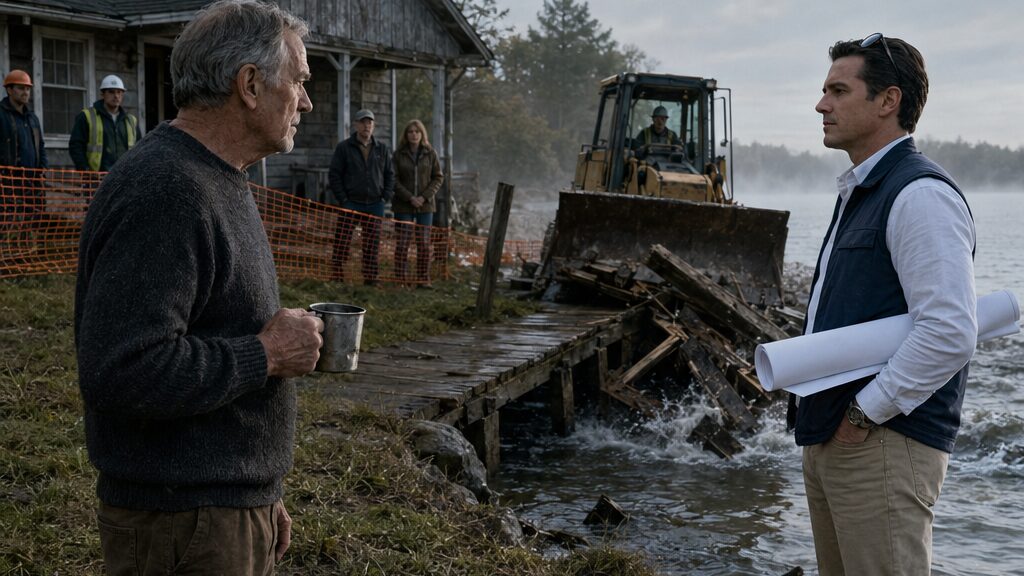
The bulldozer blade dropped through the middle of Ronald Young’s dock before he reached the shoreline.
The first impact snapped two weathered planks and drove them beneath the lake. The second folded a support post sideways. By the time Ronald crossed the wet grass behind his cottage, the machine had pushed half the structure into brown, churning water.
His coffee was still hot in the dented metal mug clenched in his right hand.
“Stop,” he called.
The operator looked toward a man standing beside the machine, not toward Ronald.
Nicholas Clark wore beige trousers, a white shirt, and a navy vest that matched the Harbor Ridge logo printed on the rolled plans under his arm. Sunglasses rested in his hair. He raised one palm toward the operator, but only long enough to make certain everyone was watching him give the order.
Then he lowered it.
The blade moved again.
A board Ronald had planed by hand thirty-eight years earlier split with a sound like a rifle crack.
“You’re across my line,” Ronald said.
Nicholas walked toward him without hurrying. Behind him, three construction workers watched from beside a stack of orange fencing. Farther uphill, two Harbor Ridge residents stood near a golf cart, their arms folded against the morning chill.
“We sent notice,” Nicholas said.
“You sent a notice about shoreline improvements.”
“The dock was inside the construction envelope.”
“It was on my deeded frontage.”
Nicholas unrolled the plans against the hood of a white pickup. A colored site map showed floating slips, a curved breakwater, and a glass-fronted clubhouse where reeds now grew along the bank.
“This survey was completed in February,” he said. “The association owns the strip from the access road to the revised high-water line.”
Ronald did not look at the bright colors. He studied the legal description printed in the lower corner.
Nicholas tapped the map with one clean fingernail. “Your cottage parcel ends here.”
The line he indicated cut behind the remains of the dock.
“That isn’t where the county monument sits,” Ronald said.
“The county approved the permit.”
“That wasn’t my question.”
Nicholas rolled the plans tighter. His patience had the polished quality of something performed for an audience.
“Mr. Young, the marina adds value to every property in Harbor Ridge, including yours. Your dock was unsafe, unpermitted under the current standards, and in the way. We’re replacing a few rotting boards with a four-million-dollar waterfront facility.”
“You could have asked before destroying it.”
“We did not need permission to clear association property.”
The bulldozer idled behind him, its engine shaking the air. Ronald could smell wet soil, diesel, and the bitter coffee cooling beneath his nose.
A worker hooked a chain through the broken frame of the dock.
Ronald looked at Nicholas. “You intend to build exactly according to the legal description filed with the county?”
Nicholas’s expression changed by less than an inch. He seemed to hear uncertainty where Ronald had placed precision.
“Exactly according to the approved plans.”
“And the parcel description attached to them?”
“Yes.”
“No field adjustment?”
“The survey controls.”
Ronald nodded once.
One of the residents by the golf cart whispered something to the other. Ronald caught the words old map and confused.
Nicholas heard them too. His shoulders loosened.
“We’ll give you until noon to move the boat,” he said. “After that, the contractor can’t guarantee access.”
The boat was a fourteen-foot aluminum skiff tied to the last intact piling. Its green paint had faded almost gray. Ronald’s wife had once said it looked less like a boat than a kitchen pan left too long in the rain.
He set his mug on a flat stone and stepped into the shallows.
The contractor approached. “Sir, you can’t be inside the work zone.”
“I’m untying my boat.”
“We can have someone do that.”
Ronald pulled the knot loose himself. The rope was swollen with water, and his fingers did not close as easily as they once had. He dragged the skiff along the shore until it rested beyond the orange stakes.
When he returned, workers were lifting broken boards toward a dump trailer.
“Those stay,” he said.
The contractor glanced at Nicholas.
“They’re debris,” Nicholas said.
“They’re mine, according to either version of your story. If they came off my dock, they’re mine. If they were abandoned on association land, I’m removing them for you.”
For the first time, one of the workers smiled.
Nicholas did not.
“Stack them outside the fence,” he told the contractor.
Ronald carried six boards up the bank himself. Some were split; others bore the black square scars of old bolts. He laid them beside the cottage, under the kitchen window.
When he picked up his mug, a fresh dent marked one side where falling timber had knocked it against the stone.
Nicholas was speaking to the residents now, pointing toward the lake as if the argument had already become a minor inconvenience behind them.
“The west slips will be finished before Labor Day,” he said. “Property values should respond immediately.”
One resident asked whether current homeowners would receive priority.
“Of course,” Nicholas said. “The board will circulate the deposit schedule this week.”
Ronald stood within earshot, but nobody asked him another question.
By nine o’clock, the dock was gone.
The disturbed lake slapped pieces of bark against the bank. A pale rectangle remained in the grass where the walkway had shaded it for decades. Ronald washed mud from his boots at the outside tap, carried the mug indoors, and closed the kitchen door.
Only then did his hand begin to tremble.
He pressed his palm against the counter until it stopped.
From the study window he could see Nicholas unfold the plans again. The clubhouse footprint stretched across the shore like a bright promise. Beyond it, the bulldozer was turning toward a row of cedars.
Ronald opened the bottom drawer of his desk.
Tax receipts lay in the front. Behind them were his wife’s old recipe cards, a bundle of photographs, and a clear protective sleeve sealed with yellowing tape.
He drew it out carefully.
The county plat inside had been recorded in 1974, before Harbor Ridge had a gatehouse, an association, or a name. Its paper had softened at the folds, but the ink remained clear. Ronald flattened it beneath a brass ruler.
The boundary line ran from an iron pin near the road to a stone monument at the original shoreline, then followed a bearing west before turning toward the lake.
He traced the numbers with one finger.
The modern plan Nicholas had shown him did not begin at the stone monument. It began at a calculated point thirty-two feet east of it.
Ronald leaned closer.
Beside the old boundary notation was the monument number he had not seen in years.
C-17.
Outside, a truck dumped gravel where the dock had stood.
Ronald looked from the plat to the bright edge of the new construction plan visible through the window.
Then he lifted the dented mug and took the first cold swallow of his morning coffee.
Chapter 2: The Old Plat Marked a Different Shore
The line from monument C-17 ended beneath the proposed clubhouse deck.
Ronald saw it before sunrise the next morning, after laying a photocopy of Nicholas’s permit map over the old county plat against the study window. The pages did not share the same scale, so he had marked two fixed road points and adjusted the copy until they aligned.
The mistake remained.
The association’s parcel description began from a newer survey point near the access road, skipped the original shoreline monument, and carried a straight bearing toward the water. On paper, it looked tidy. On the land, it shifted the western edge of the marina across Ronald’s frontage.
He circled the omitted call in pencil.
For thirty-one years, Ronald had worked in the county records department. He had indexed deeds, corrected filing references, and watched attorneys argue over commas that moved fences six inches. He knew an old plat was not magic. Roads changed. Shorelines moved. Easements accumulated. Courts interpreted what surveyors measured.
But recorded monuments were not suggestions.
At eight-thirty, he drove to the county administration building with the plat in its sleeve on the passenger seat.
The records room had been moved downstairs since his retirement. The counters were laminate now, and the bound grantor indexes he had once repaired by hand sat behind glass as decoration.
A clerk pulled the Harbor Ridge file.
“You looking for the marina permit?” she asked.
“And the chain of title on the western parcel.”
She set a stack of scanned printouts beside him. “The developer ordered most of this in January.”
Ronald worked slowly. The association deed referred to a 1998 subdivision plat. That plat, in turn, referred back to the 1974 county plat for the lakeside boundary. No release, vacation, or boundary-line agreement appeared in the chain.
He slid the old plat toward the clerk.
“Can you check whether this was ever superseded?”
She searched by recording number, then by monument reference.
“No vacation,” she said. “No corrected plat either.”
“What about a boundary adjustment?”
“Nothing recorded.”
Ronald felt a small, sharp satisfaction settle beneath his ribs.
The clerk studied his face. “Is there a problem?”
“There may be.”
“You’ll want a surveyor. We can certify records, but we can’t tell you where the line is on the ground.”
“I know.”
Her eyes narrowed with recognition. “You used to work upstairs.”
“A long time ago.”
“My supervisor still talks about your handwriting.”
“That’s unfortunate.”
She smiled, but Ronald was already reading the permit description again.
The omission was not hidden. It sat in plain type beneath the site map. Whoever had drafted it had converted a series of monument calls into a simplified line. The county reviewer had accepted it. Nicholas had financed construction against it.
Ronald paid for certified copies.
When he stepped outside, Laura was waiting beside his truck.
She held two paper cups from the café across the street. Her dark hair was clipped back, and she wore the gray jacket issued by the municipal risk office.
“You didn’t answer last night,” she said.
“I was reading.”
“You always answer.”
“Not always.”
She handed him a cup. “What happened to your mug?”
“It got hit.”
“By what?”
“A dock board.”
Laura stared at him. “You were standing that close?”
“The board came farther than expected.”
She opened the passenger door and saw the documents.
“Tell me you called an attorney.”
“No.”
“The police?”
“No.”
“The county?”
“I’m at the county.”
“You know what I mean.”
Ronald placed the certified copies beneath the old plat. “Their legal description may be wrong.”
“May be?”
“It omits C-17.”
Laura had grown up hearing monument numbers the way other children heard baseball statistics. She looked toward the building, then back at him.
“File something today.”
“I need a field survey.”
“Then hire one today and send Nicholas a written notice.”
Ronald closed the truck door.
“If I accuse him before I can prove the monument survives, he’ll call it harassment.”
“So let him.”
“He’ll move the work line just enough to muddy the issue.”
“That would be better than letting him pour concrete on your land.”
Ronald looked across the parking lot. A county maintenance crew was repainting a curb. Their roller moved back and forth, covering the old chipped yellow with a clean new line.
“He told me the filed description controls,” Ronald said.
Laura was silent for a moment.
Then she said, “That is not an answer.”
“It’s the one he gave.”
She stepped closer. “Dad, are you trying to stop this project?”
“Yes.”
“Then act like it.”
He folded the plat sleeve against his chest.
Laura’s voice softened. “This isn’t the records room. You don’t get to put the right document in the right file and wait for everyone else to discover it.”
“I’m obtaining proof.”
“You already have enough to warn them.”
“Warning isn’t proof.”
“It can keep the damage from getting worse.”
Ronald did not answer.
A truck turned into the lot carrying lengths of blue utility pipe. Harbor Ridge Marina was printed on a placard behind the windshield.
Laura followed his gaze.
“What are you waiting for?”
He thought of Nicholas standing beside the bulldozer, speaking about value while the dock cracked behind him. He thought of the residents watching as if age had made Ronald’s ownership negotiable.
“A survey that cannot be dismissed,” he said.
Laura’s expression told him she heard the part he had not spoken.
She took out her phone. “I know a licensed surveyor who handled a municipal easement case last year. Catherine Adams. She won’t tell you what you want to hear.”
“Good.”
“I’ll send you her number. Call her before noon.”
Ronald nodded.
“And send Nicholas the plat.”
“When I’m ready.”
“Before noon,” Laura repeated.
She walked back toward her car.
Ronald remained beside the truck until she drove away. Then he unfolded a sheet of county letterhead he had taken from the public counter and began drafting a notice by hand.
Mr. Clark:
The recorded documents associated with the western shoreline appear inconsistent with the parcel description used in the marina permit application…
He stopped.
The wording was accurate. It was also enough to force a pause.
He pictured construction fencing, equipment rentals, crews waiting for direction. He pictured Nicholas explaining the delay to lenders and residents before the first permanent structure existed.
That would be prudent.
It would also be easy.
Ronald folded the unfinished notice and put it in his shirt pocket.
By noon, Catherine had agreed to review the records, but her first available field date was three weeks away. She warned him that shoreline evidence could be disturbed and that no conclusion was possible until she found the controlling monuments.
“I’m not certifying your memory,” she said over the phone.
“I didn’t ask you to.”
“You sounded as though you might.”
“I’m old, not confused.”
“I’ve met both at the same address.”
That nearly made him smile.
At two, Ronald returned home.
The orange fencing had expanded across the former dock site. Survey paint marked the grass. A worker guided a trenching machine toward the shoreline while Nicholas stood beside a group of association board members.
Ronald parked near the cottage.
Nicholas noticed the document sleeve under his arm.
“Find an older map?” he called.
Ronald paused.
The unfinished notice pressed against his chest from inside his pocket.
“Several,” he said.
“Then you know subdivisions change things.”
“Recorded changes do.”
Nicholas’s face tightened, but one of the board members asked him a question and pulled his attention away.
Ronald went inside.
He placed the old plat on his desk. A ring from his coffee mug had dried on the protective sleeve, just outside the printed boundary. He wiped it with his thumb but only spread the stain.
At four-fifteen, the first concrete trucks came down the access road.
Their brakes hissed at the turn. One after another, they rolled toward the shoreline, drums rotating behind their cabs.
Ronald stood at the study window with the completed notice in his hand.
He could still walk outside. He could hand it to Nicholas before the first chute opened.
Instead, he folded the letter once, placed it beneath the county plat, and closed the drawer.
Outside, a worker swung the concrete chute into position.
Chapter 3: Every New Slip Deepened the Mistake
The first steel piling entered the lake exactly where Ronald’s plat said his property began.
The driver suspended it from a crane, lowered the black tip through the water, and struck it with the hydraulic hammer. Each blow traveled through the ground and up the legs of Ronald’s kitchen table.
He marked the location on a copy of the site plan.
Then he made coffee.
By the end of the first week, six pilings stood beyond the demolished dock. By the end of the second, the utility trench crossed the grass below his cedar trees. Crews laid blue water pipe, electrical conduit, and a drainage line beneath gravel that would become the clubhouse terrace.
Ronald photographed everything from his side of the orange fence.
Nicholas photographed it too, but for different reasons.
The Harbor Ridge newsletter showed him in a hard hat beside the crane. The caption called the marina a long-awaited investment in the community’s future. Residents were invited to reserve slips with deposits beginning at fifteen thousand dollars.
Ronald read the newsletter twice.
He put it in the file.
Laura stopped visiting on Sundays.
She still called, but their conversations had narrowed.
“Did Catherine schedule the survey?”
“August fourteenth.”
“Did you notify Nicholas?”
“I objected in person.”
“That isn’t what I asked.”
“No.”
The line would go quiet.
Once, Laura said, “I don’t know whether you’re protecting the property or punishing him.”
Ronald had replied, “Those aren’t mutually exclusive.”
She hung up.
By the fourth week, floating sections arrived on flatbed trucks. Workers assembled them in the parking area and pushed them into the lake with long aluminum poles. White pedestals appeared at each slip, fitted with electrical outlets and water taps.
The old shoreline disappeared behind scaffolding.
Ronald stacked the salvaged dock boards beneath a tarp beside the cottage. He told himself he was protecting them from rain, though they had spent nearly forty years outdoors.
One afternoon, Nicholas crossed the grass without asking permission.
He carried a glossy brochure.
“You’ve had a front-row seat,” he said.
Ronald remained seated on the porch, his mug balanced on one knee.
“To trespass?”
“To progress.”
Nicholas laid the brochure on the porch rail. An architectural rendering showed the completed marina at sunset. The clubhouse windows glowed amber. Boats filled every slip. Ronald’s cottage had been reduced to a small gray roof at the edge of the image.
“We’re offering legacy owners a reduced initiation rate,” Nicholas said.
“Legacy owners.”
“People who were here before the association expanded.”
“You mean people whose land you needed.”
Nicholas ignored that. “You could have a permanent slip for half the standard fee. Better access than the structure you had.”
“My structure was free.”
“It was also one storm away from collapse.”
“It survived your bulldozer until you started it.”
Nicholas looked toward the construction site. “You can keep fighting a change that has already happened, or you can benefit from it.”
Ronald lifted the brochure and studied the rendering.
The west row of slips crossed the old boundary line. The clubhouse deck sat over the place where his wife had tied a red ribbon around a post so their daughter could find the steps after dark.
“How many deposits have you taken?” he asked.
“That’s association business.”
“How many?”
Nicholas’s smile returned, smaller this time. “Enough to show confidence.”
He walked away, leaving the brochure behind.
Ronald tore nothing. He folded it carefully and added it to the file.
That evening, Laura arrived without calling.
She carried a binder thick with printed documents.
“What is that?” Ronald asked.
“Public association disclosures. Loan summaries. The slip-purchase package.”
“You’re not a member.”
“A homeowner gave them to me.”
“Which homeowner?”
“That doesn’t matter.”
“It matters to them.”
“They’re scared.”
Ronald set his mug on the porch rail.
Laura opened the binder. “Twenty-seven deposits. Four residents borrowed against home equity. The board approved a special assessment for utilities and shoreline reinforcement. Some of them are retired.”
“They chose to invest.”
“They chose based on permits and a survey stamped by professionals.”
“So did Nicholas.”
“That doesn’t make them Nicholas.”
Ronald looked toward the marina. The frame of the clubhouse rose above the water now, steel and glass catching the last light.
Laura turned a page toward him. “A couple on the north loop put seventy thousand dollars into a slip and assessment. That was most of what they had outside retirement accounts.”
“Why would anyone spend that much for a place to park a boat?”
“Because they were told it would increase their home value more than the cost.”
“They believed a sales pitch.”
“Yes,” Laura said. “People do that. It doesn’t mean they deserve to lose everything.”
Ronald leaned back.
The porch board beneath his chair had loosened. He had meant to repair it for months.
Laura watched him. “When Catherine confirms your line, what are you planning to demand?”
“My land back.”
“All of it?”
“It is either mine or it isn’t.”
“That’s not what I asked.”
He reached for the mug.
Laura closed the binder. “Mom used to let half the neighborhood fish from that dock.”
“This is not about your mother.”
Her face changed.
Ronald regretted the sentence before she stood, but not enough to take it back quickly.
“That dock is the only reason you care this much,” she said.
“It was property.”
“It was hers.”
“It was ours.”
“And now you’re letting Nicholas bury it under concrete because you want the mistake to become expensive.”
Ronald rose from the chair.
“You think I should save him from what he chose.”
“I think you should stop pretending the only people standing under the consequences are Nicholas and his board.”
She took the binder and walked to her car.
Ronald stayed on the porch.
A hammer rang from the marina. Workers were installing the Grand Harbor sign even though darkness had settled over the lake. Each metal letter rose beneath a temporary floodlight.
By morning, the sign stood above the clubhouse entrance.
GRAND HARBOR MARINA.
The letters were visible from Ronald’s kitchen.
Two days later, Catherine Adams arrived in a dusty utility vehicle with a total station, two tripods, a shovel, and no interest in the marina brochure.
She reviewed the plat at Ronald’s table, then walked the property without offering an opinion. She found the road pin first, measured from it, and shook her head at the orange construction stakes.
“These are layout stakes,” she said. “Not boundary evidence.”
Nicholas appeared before she reached the shoreline.
“You don’t have authorization to survey association property,” he said.
Catherine continued adjusting the tripod.
“I have authorization from Mr. Young to survey his parcel.”
“This is beyond his parcel.”
“That is the question.”
Nicholas looked at Ronald. “You waited until now?”
Ronald did not answer.
The accusation landed differently with Laura’s binder still on the kitchen table.
Catherine established a line from the road pin, then searched near the old cedar row. The monument should have been several inches below grade, but fill from the utility trench covered the area.
A construction worker leaned on his shovel nearby.
“Pipe went through here,” he said.
“How deep?” Catherine asked.
“Four feet.”
“Did you see stone or iron?”
The worker glanced at Nicholas.
Nicholas said, “The area was cleared according to the approved plans.”
Catherine knelt and examined the disturbed soil. “That wasn’t my question.”
For the first time, Ronald heard his own tone in someone else’s voice.
They searched until noon.
Catherine moved west, taking measurements from secondary references shown on the old plat. Her calculated point fell inside the construction fence, between the utility trench and the clubhouse terrace.
Nicholas blocked the gate.
“No excavation inside an active site.”
Catherine held up her license card. “I can return with a court order.”
Nicholas looked toward the workers and residents gathering near the clubhouse.
He stepped aside.
Catherine removed fresh gravel with a shovel. Six inches down, the blade struck something solid.
She cleared the soil by hand.
A squared stone emerged, its top chipped but intact. On one side, beneath a smear of red construction paint, were two carved characters.
C-17.
Ronald’s breath left him slowly.
Catherine placed the survey rod over the monument and sighted back toward the road pin. Then she turned the instrument toward the water.
The line passed several feet inside the construction fence.
It continued through the west utility trench.
Beyond that, it disappeared beneath the unfinished clubhouse deck.
Nicholas stared at the stone.
Catherine checked the reading again.
“How far?” Ronald asked.
She did not look up from the instrument.
“I won’t certify until I close the traverse.”
“How far inside?”
“At this point?” She finally raised her head. “Thirty-one feet, eight inches.”
A motor started near the lake. Workers were guiding another floating slip toward the west wing.
Catherine looked past the clubhouse, following the invisible line over the water.
“This monument puts more than the dock on your parcel, Mr. Young.”
Ronald watched the new slip move into position.
“How much more?”
Catherine folded the tripod legs.
“Enough that nobody should attach another piece until I finish.”
Chapter 4: The Survey Line Cut Through Glass
Catherine’s laser struck the clubhouse doors just below the brass handles.
The red point trembled on the glass while buyers moved behind it carrying welcome folders and plastic cups of sparkling wine. From Ronald’s position near the exposed monument, the beam formed an invisible line through the utility trench, across the terrace, and into the western corner of the new building.
Nicholas stepped between Catherine and the instrument.
“You’ve made your point,” he said.
Catherine looked through him toward the survey rod. “You’re blocking the sight line.”
“You are disrupting an active construction site.”
“This portion may not be your construction site.”
A worker cutting trim near the entrance shut off his saw. The sudden silence drew more people toward the windows.
Nicholas lowered his voice. “Your preliminary reading does not establish ownership.”
“No,” Catherine said. “The completed survey will.”
She shifted the tripod three feet and resumed measuring.
Ronald stood beside the stone marked C-17. He had imagined this moment often enough to know that reality should have felt cleaner. The monument existed. His plat had been right. Nicholas’s fence crossed Ronald’s land by more than thirty feet.
Yet through the clubhouse glass, Ronald recognized two residents who had once borrowed his ladder after a storm. They watched him now as though he had appeared at their front door carrying a bill.
Catherine completed the traverse before noon. She checked the road pin again, measured two secondary monuments, then followed the line toward the lake.
The western utility trench crossed Ronald’s parcel for forty-six feet. Three floating slips were attached beyond his boundary. A support column at the clubhouse corner stood eight feet inside it. Part of the terrace, an electrical cabinet, and a section of underground drainage occupied the same strip.
Catherine wrote each measurement in a field book.
Nicholas stayed close.
“The shoreline has changed,” he said.
“The controlling monument has not.”
“The high-water line moved.”
“The description does not use the present high-water line as its controlling call.”
“Our surveyor interpreted it differently.”
“I know.”
That answer stopped him.
Catherine opened her document case and removed the permit map Ronald had obtained from the county.
“This legal description didn’t come from the recorded subdivision plat,” she said.
Nicholas crossed his arms. “It was prepared by a licensed firm.”
“That doesn’t answer where it came from.”
“The title package.”
“Which page?”
Nicholas looked toward the clubhouse. A board member had stepped outside and was pretending to read a notice on the wall.
Catherine placed the permit map over the 1998 subdivision plat. “The bearings match an unrecorded draft prepared before the final subdivision approval. The draft used a calculated shoreline point. The recorded version restored C-17.”
Ronald leaned closer.
The numbers differed by only seconds in one bearing and several feet in one distance. To anyone reading quickly, the descriptions looked nearly identical.
“Can a draft become controlling?” Ronald asked.
“Not by being convenient.”
Nicholas’s jaw tightened. “The county approved it.”
“The county approved an application containing it,” Catherine said. “That does not move a monument.”
A buyer came through the clubhouse doors.
“What does that mean for the slips?” she asked.
Nicholas turned immediately. “Nothing has been decided. This is a private boundary disagreement.”
Catherine capped her pen. “Three west slips appear to be attached to land owned by Mr. Young.”
The woman looked from Catherine to Ronald. Her folder carried the number W-2.
“That’s mine,” she said.
Ronald felt the attention of everyone near the entrance shift toward him.
“I didn’t sell it to you,” he said.
Her face hardened. “I paid for it.”
“To the association.”
“Nicholas said the county approved everything.”
Nicholas stepped toward her. “And it did. Please go inside. We’ll address this through counsel.”
She did not move. “Can I use my slip?”
“No one has said you can’t.”
Catherine closed the document case. “I am saying no permanent use should continue across a disputed boundary until the title issue is resolved.”
Nicholas turned on Ronald.
“This is what you wanted.”
Ronald met his stare. “I wanted my dock left standing.”
“You knew about this weeks ago.”
“I knew your description was wrong.”
“And you watched us build.”
The accusation carried across the terrace. The buyer with the W-2 folder looked at Ronald again, this time with something sharper than confusion.
Ronald could have said Nicholas had been warned at the shoreline. He could have repeated that Nicholas had chosen the filed description after Ronald questioned it.
Instead, he said, “You were certain.”
“That isn’t a defense.”
“No. It isn’t.”
Nicholas stared at him, perhaps expecting more.
Catherine drove a wooden stake beside C-17 and tied orange flagging to it. Nicholas reached down and pulled it free.
She took another stake from her bag.
“Don’t,” he said.
“I need a visible reference.”
“You’re placing it inside a restricted work zone.”
Ronald set his dented coffee mug on the gravel where the stake had been.
The metal base covered the small hole Nicholas had left.
“No one will mistake that for an official marker,” Ronald said.
One worker laughed under his breath. The sound vanished when Nicholas looked toward him.
Catherine placed the new stake six inches from the mug and photographed it with C-17 visible below.
By midafternoon, she had drafted a preliminary exhibit. The boundary line cut diagonally through the western terrace and passed beneath the clubhouse roof overhang before extending into the lake.
Ronald’s claim was no longer a memory, an old man’s objection, or a faded sheet in a plastic sleeve. It was a measured line with coordinates, closures, and photographs.
That should have been enough to satisfy him.
Instead, he watched residents gather near the marina office. Some held deposit agreements. Others held phones. Their questions reached him in fragments.
Who knew?
Can they close it?
What happens to our money?
Nicholas stood in the center of them, answering with careful confidence. He said the discrepancy was technical. He said the association’s attorneys would resolve it. He said no one should panic.
Then he pointed toward Ronald.
“He waited until the marina was complete.”
Ronald picked up his mug.
The accusation was true enough to hurt and incomplete enough to anger him.
Catherine approached with her tablet. “I need you to see something before I submit the report.”
She opened a folder containing correspondence from the surveying firm that had prepared the site plan. Most messages dealt with drainage grades and utility setbacks.
One email had been sent to Nicholas four days before the first concrete pour.
Catherine enlarged it.
Field verification has identified a possible conflict between the calculated shoreline point and monument C-17 referenced in the recorded subdivision plat. Recommend suspending permanent improvements within the western thirty-five-foot corridor pending recovery of original monument.
Below the message was Nicholas’s reply.
Proceed using the approved permit geometry. Financing deadline cannot accommodate redesign. We will resolve monument issue during final certification.
Ronald read it twice.
Nicholas had not merely trusted the wrong survey.
He had known the monument might contradict it.
Across the terrace, Nicholas was telling residents that no warning had existed.
Catherine lowered the tablet.
“He continued because stopping would have cost him the loan,” she said.
Ronald looked at the glass doors, the western slips, and the crowd pressing closer around Nicholas.
The question was no longer whether Nicholas had made a mistake.
It was how many people he had allowed to stand on top of it.
Chapter 5: The Clubhouse Closed With Buyers Inside
Samuel King threaded a steel chain through the clubhouse handles while twenty-three buyers remained inside.
One of them pushed against the glass before he secured the padlock.
“You can’t lock us in.”
“The rear exit remains open,” Samuel said. “Use it now. No one reenters after the building is cleared.”
A county inspector taped a fluorescent stop-work order beside the Harbor Ridge logo. The paper slapped against the glass in the wind, covering the first word of GRAND HARBOR MARINA.
Ronald stood beyond the terrace with his coffee untouched in his hand.
For six weeks, he had pictured an official notice on that door. In the picture, Nicholas discovered it alone. He read the violation, looked across the water, and understood that the old man he had dismissed possessed the stronger claim.
There had been no buyers trapped behind glass in Ronald’s version.
No woman carrying a W-2 folder.
No retired couple arguing with a county inspector about whether their deposit still existed.
Samuel checked the lock, then faced Nicholas.
“Operations are suspended pending title verification, permit review, and correction of the western site plan.”
“You have Catherine’s preliminary report,” Nicholas said. “Not a court judgment.”
“We also have evidence that the permit description may not match the recorded plat.”
“The county approved that description.”
“And the county is reviewing how.”
Nicholas glanced at the reporter standing near the entrance. “So this is about protecting the county.”
“This is about preventing continued occupancy of a structure whose permitted footprint may cross a private boundary.”
Samuel spoke without heat. That made each word harder to push aside.
The buyers emerged from the rear door and circled the building. Questions rose at once.
“Are our slips closed?”
“Who holds the deposits?”
“Will there be another assessment?”
“Did the board know?”
Nicholas raised both hands. “The association will issue a written update this afternoon.”
A man near the front held up his purchase agreement. “You issued one yesterday.”
“This situation developed overnight.”
Ronald looked at Catherine.
She said nothing, but her eyes moved toward Nicholas.
The email had not developed overnight.
Samuel’s office had received it with Catherine’s report that morning. By ten, county attorneys had advised a temporary closure. By noon, the permit department had frozen all pending certificates.
At one-fifteen, Samuel had arrived with chain, notices, and two inspectors.
Nicholas’s phone rang. He checked the screen and walked away from the crowd.
He stopped near the marina sign, listened for less than a minute, then said, “You cannot freeze the entire facility over one corridor.”
The person on the other end spoke long enough for his shoulders to stiffen.
“The collateral package includes the whole site,” Nicholas said. “That was your requirement.”
Ronald understood before Nicholas ended the call.
The bank had found the title problem.
Nicholas lowered the phone.
One board member approached him. “What did they say?”
“Temporary hold.”
“On what?”
“Further draws.”
The second board member joined them. “We need the final contractor payment next week.”
Nicholas looked toward the buyers and lowered his voice, but Ronald could still hear.
“They’re also restricting the deposit account.”
The first board member went pale. “Can they do that?”
“They just did.”
The woman with the W-2 folder stepped between them. “Restricting whose deposits?”
Nicholas turned toward her.
“Association counsel is reviewing the bank’s action.”
“That’s my money.”
“It remains in escrow.”
“Frozen escrow.”
“For now.”
She pointed toward Ronald. “Did he cause this?”
Nicholas did not answer immediately.
Ronald watched the decision form behind his face.
“The dispute could have been raised before construction,” Nicholas said.
The woman crossed the terrace toward Ronald.
“My husband and I borrowed against our house for that slip.”
“I heard.”
“You heard?”
“Laura told me some residents had borrowed.”
“When?”
“Before the survey.”
Her grip tightened on the folder. “And you still waited?”
Ronald could have shown her Nicholas’s email. He could have explained the monument, the permit draft, the bulldozer, and the question he had asked beside the crushed dock.
None of those things changed his answer.
“Yes.”
The woman looked at him for a long moment.
Then she said, “You and he deserve each other.”
She walked away before he could decide whether to respond.
The words remained after the crowd shifted.
Samuel approached Ronald. “The county will request a formal title determination. In the meantime, no work, no occupancy, no marina operations.”
“What about removal?”
“Not today.”
“The structures are on my land.”
“Catherine’s survey is strong. The recorded instruments support it. But enforcement has steps.”
“You chained the building.”
“For safety and permit compliance. Ownership remedies require due process.”
Ronald looked at Nicholas, who was now speaking urgently with the association attorney.
Samuel followed his gaze. “You worked records long enough to know that.”
“I also worked there long enough to know how delay benefits the person already occupying the ground.”
Samuel’s expression stayed neutral. “This delay benefits no one.”
By evening, the county had invalidated the western construction approval pending review. A notice of daily civil penalties followed, though Samuel stayed enforcement for forty-eight hours to allow utilities to be secured.
The contractor removed tools from the site.
Workers left without knowing when they would return.
The clubhouse lights remained off.
At the emergency association meeting the next morning, every chair was occupied. Residents lined the walls and stood in the hallway.
Ronald sat in the back beside Laura.
She had not greeted him when she arrived.
Nicholas stood at the front with the two board members and the association attorney. His navy vest was gone. He wore a gray suit that looked slept in.
“The bank’s action is temporary,” he said. “The association remains solvent.”
A resident called out, “Then release our deposits.”
“The bank has imposed restrictions until the collateral question is resolved.”
Another voice said, “How much will this cost us?”
The association attorney answered.
“If the western wing must be redesigned, costs may be covered through existing contingency funds, insurance, recovery against responsible contractors, or, if necessary, a special assessment.”
The room broke into overlapping protests.
Laura leaned toward Ronald. “There it is.”
He knew what she meant.
A special assessment would divide the cost across homes, including those whose owners had never bought a slip.
Nicholas waited for the noise to fall.
“We relied on licensed professionals and county approvals,” he said. “No board member knowingly authorized construction on private land.”
Ronald turned toward Catherine, who stood near the side wall.
She opened her document case.
Nicholas saw the movement.
“The email,” Ronald said quietly.
Laura heard him. “What email?”
Before he could answer, Catherine handed a printed copy to Samuel, who sat near the front. Samuel read it, then passed it to the association attorney.
The attorney’s face changed.
Nicholas stopped speaking.
One board member leaned toward him. “What is that?”
“A field note taken out of context.”
Samuel stood. “It is a written recommendation to suspend improvements in the western corridor pending recovery of monument C-17.”
The room went still.
“When did you receive it?” the board member asked Nicholas.
Nicholas looked at the residents, the reporter near the door, and the attorney holding the page.
“Before the concrete pour,” he said.
A chair scraped backward.
The woman with the W-2 folder closed her eyes.
Nicholas continued before anyone else could speak. “The project was under a financing deadline. The permit geometry had already been approved. Delaying would have triggered default provisions and jeopardized the entire development.”
“So you gambled with our money,” someone said.
“I acted to protect the project.”
“You acted to protect your deadline.”
“The two were connected.”
His answer was not an apology. It was also not empty. Ronald saw the exhaustion beneath it, the fear Nicholas had hidden behind plans and polished language.
Then Nicholas made his choice again.
He pointed toward Ronald.
“He had the same concern before construction and disclosed nothing. He watched the investment grow because he intended to maximize the damage.”
Every face turned toward the back of the room.
Laura did not look at Ronald.
The association attorney approached after the meeting with a white envelope.
“This is a proposed settlement framework,” she said. “It reserves all claims concerning failure to mitigate avoidable damages.”
Ronald opened it in the parking lot.
The proposal acknowledged no final boundary but offered to purchase the disputed strip. In return, Ronald would release the association, permit the marina to reopen, and accept responsibility for losses allegedly increased by his delay.
A paragraph near the end stated that his knowing silence could support claims for unnecessary construction costs, frozen deposits, and diminished property values.
Laura read over his shoulder.
“They’re making you part of the cause,” she said.
“I am part of the cause.”
She looked at him then.
Ronald folded the proposal and returned it to the envelope.
Across the parking lot, Nicholas stood alone beside the dark clubhouse, staring at the chain around its doors.
Ronald had wanted him to understand helplessness.
Now he did.
The trouble was that Nicholas was no longer the only one learning it.
Chapter 6: The Silence Was Not Entirely Patience
“Did you want the marina stopped,” Laura asked, “or did you want Nicholas ruined?”
She stood in Ronald’s kitchen with the settlement proposal spread between them.
Outside, the closed marina reflected in the dark window. The stop-work notice remained on the clubhouse doors. No machinery moved. No buyers crossed the terrace. The silence Ronald had once wanted had spread farther than he intended.
He rinsed his dented mug and set it beside the sink.
“I wanted my land back.”
“That isn’t one of the choices I gave you.”
“They aren’t the only choices.”
“They were when you put the warning letter in your desk.”
Ronald looked toward the study.
Laura had found the unfinished notice that morning while searching for the certified plat copies. The date at the top placed it two days before the concrete pour.
“You went through my files.”
“You asked me to find the county receipt.”
“That drawer was closed.”
“So was your mouth.”
He flinched, though she had not raised her voice.
Laura pressed one finger against the letter. “You knew enough to warn him.”
“I had not found C-17.”
“You knew where it should be.”
“I knew where it had been.”
“You spent thirty years telling people that a missing monument doesn’t erase a recorded call.”
“A disturbed monument can create uncertainty.”
“Then why did you draft the notice?”
Ronald pulled out a chair but did not sit.
“Because it was prudent.”
“And why didn’t you send it?”
The answer that had sustained him for six weeks—that Nicholas would have shifted the work, hidden the mistake, or dismissed him—felt smaller now that it had to be spoken aloud.
“I wanted proof.”
“You wanted the building.”
He looked at her.
“You wanted enough built that he couldn’t laugh and move a fence,” Laura said. “You wanted the mistake to weigh something.”
“Yes.”
The word entered the room quietly.
Laura’s expression did not soften.
Ronald sat.
“I wanted him to have to look at it,” he said. “Every piling. Every window. I wanted him to know he had done it to himself.”
“That isn’t patience.”
“No.”
“What is it?”
He stared at the ring his mug had left on the table.
“Anger.”
Laura waited.
Ronald ran his thumb over the dent in the mug. The metal had bent inward where the dock board struck it. His wife had carried the same mug on winter mornings, wrapping both hands around it while she sat at the end of the dock.
“She built the first half with me,” he said.
Laura’s gaze moved toward the window.
“You never told me that.”
“You were six.”
“I remember her painting the posts.”
“She hated the color.”
“She chose it.”
“She changed her mind after the first coat.”
A brief smile crossed Laura’s face and vanished.
Ronald continued.
“The county inspector said the original platform could only be twelve feet. Your mother wanted sixteen, so she drew a smaller landing and a separate lower step. She found the rule before I did.”
“That sounds like her.”
“She let everyone use it. Children fishing. Neighbors launching canoes. People who never asked twice because she had already told them yes.”
Laura pulled out the chair across from him.
“When she got sick,” Ronald said, “we stopped going into town much. She would sit there in the evenings. Even when she couldn’t get into the boat.”
He had not spoken this part aloud since the funeral.
“She made me promise not to fence it off,” he said. “She said a place stayed alive by being used.”
Laura looked down at the table.
“And then Nicholas called it debris,” Ronald said. “He stood there while it broke and told me I should thank him.”
“So you let him build over it.”
“Yes.”
The admission carried no satisfaction now.
Laura touched the mug. “Is this hers?”
“We shared it.”
“You never let anyone else use it.”
“I never thought about it.”
“That’s not true.”
Ronald reached for the cupboard, took down a clean ceramic cup, then stopped. He slid the dented mug toward her instead.
Laura looked at it before lifting it.
The gesture did not forgive either of them. It made the space between them less defended.
She drank and set it down carefully.
“What do you actually want?” she asked.
“My boundary recognized.”
“What else?”
“The western structures removed.”
“All of them?”
“The ones blocking my access.”
“And the residents?”
Ronald looked toward the dark marina.
“I don’t know yet.”
That afternoon, the county held a preliminary enforcement hearing.
Samuel presented the survey, the permit discrepancy, and Nicholas’s email. The association attorney argued that immediate removal would cause disproportionate harm before title proceedings concluded.
The hearing officer found a substantial likelihood that Ronald owned the disputed corridor. The written order authorized the county to require removal of unpermitted improvements if no corrected agreement was reached within thirty days.
The west wing, terrace corner, utility trench, and clubhouse support all fell within the affected area.
Ronald left carrying an order powerful enough to dismantle them.
Residents waited in the hallway.
Some turned away as he passed. One man told him quietly, “Don’t make us pay for Clark’s mistake.”
Another said, “Take it all down.”
Ronald could not tell whether the second man wanted justice or a reason to stop paying assessments.
At the abandoned dock edge, Laura stood beside the salvaged boards.
“What happens now?” she asked.
“I can demand removal.”
“You can.”
“That is what the order says.”
“It says you may. It doesn’t say you must.”
He looked at the broken boards beneath the tarp. Rain had darkened the exposed ends.
A car door closed behind them.
Nicholas crossed the grass alone.
His suit jacket was gone, his sleeves rolled to the elbows. For once, he carried no plans.
Laura moved closer to Ronald.
Nicholas stopped several feet away.
“I have a proposal that doesn’t involve the association attorney,” he said.
“That usually means it should,” Laura replied.
Nicholas ignored her. “The court order gives you leverage. Use it.”
Ronald waited.
“Demand full removal of the west wing,” Nicholas said. “The clubhouse support, utilities, slips, all of it.”
“You’re asking me to tear down your marina.”
“I’m asking you to enforce your rights.”
“Why?”
Nicholas glanced toward the closed building.
“Because partial correction will drag through hearings, redesign, lender approvals, homeowner votes, and years of claims. Full removal creates a clear loss.”
“A loss for whom?”
“The project.”
“That wasn’t my question.”
Nicholas took an envelope from his pocket.
“Lakeview Development will pay you separately for access during demolition and for a release of personal claims against me.”
Laura held out her hand. “How much?”
Nicholas gave the envelope to Ronald.
The number inside was more than the cottage and land had been worth before the marina.
Ronald folded the paper.
“You want the association to collapse,” he said.
“I want an outcome that can be resolved.”
“For you.”
“For everyone who has to keep paying attorneys while this sits empty.”
Nicholas’s voice remained controlled, but something close to desperation broke through it.
“Take the money,” he said. “Enforce the order. Let the structure come down cleanly.”
Ronald looked at the marina, then at the payment offer.
Nicholas had fought every attempt to stop construction.
Now he was offering Ronald a fortune to destroy it.
Ronald handed the paper to Laura.
She read it once.
Then she looked toward Nicholas with new suspicion.
“What happens financially if the whole west wing is declared a total loss?” she asked.
Nicholas did not answer.
His silence was more revealing than any plan he had ever unrolled.
Chapter 7: The Developer Asked for the Worst Outcome
“Demolition is the cleanest outcome,” Nicholas said.
He sat across from Ronald in the lender’s temporary conference room, beneath a framed photograph of the marina taken before the chain went around the clubhouse doors. In the photograph, every slip was empty and perfect. Nothing showed the disputed line cutting through the western wing.
Laura sat beside Ronald with Nicholas’s payment offer and the association’s insurance policy open in front of her.
“Clean for whom?” she asked.
Nicholas looked toward the bank representative at the end of the table.
“For the project,” he said. “A partial redesign leaves an impaired facility, unresolved warranties, and years of litigation. A total loss can be valued.”
The bank representative folded his hands. “We are not advising any party to create a loss.”
“No one said create,” Nicholas replied. “The county has already authorized removal.”
“Authorized Mr. Young to seek it,” Laura said. “That is different.”
Ronald had left his dented mug in the truck. He had carried it into every meeting since the dock came down, as though it proved that Nicholas had failed to disturb him. This morning, he had set it in the cup holder and closed the door.
He wanted no object to speak for him now.
Laura turned several pages in the insurance binder.
“The property policy excludes title defects,” she said.
Nicholas nodded. “Which is why correction is difficult.”
“But it covers direct physical loss resulting from government-ordered demolition when part of a covered structure is unsafe or unlawfully occupied.”
The bank representative shifted in his chair.
Nicholas said nothing.
Laura tapped the page. “If the county orders the west wing removed as one integrated structure, the carrier may pay the replacement value of the damaged section.”
“May,” Nicholas said.
“And the developer’s completion guarantee?”
“That depends on the final cause determination.”
“If demolition is classified as a covered regulatory loss, Lakeview Development argues the association and insurer carry the cost. If it is treated as negligent construction after a known survey warning, you carry more of it personally.”
Nicholas’s face remained still, but Ronald saw the pulse move at his temple.
The bank representative closed his notebook. “That question will be litigated regardless.”
“Not if everyone signs the right releases,” Laura said.
Nicholas looked at Ronald. “You were offered more than fair value.”
“For helping you choose the cheaper kind of failure.”
“For ending this.”
“You mean ending your part.”
Nicholas pushed back from the table.
“You think I wanted any of this?” he said. “The shoreline was eroding. Home values had been flat for six years. Residents demanded an amenity they were already paying to plan. The lender gave us a fixed closing date. The contractor had crews scheduled. The county stamped the permit.”
“And the surveyor told you to stop,” Ronald said.
“One field email raised a possible conflict.”
“A conflict you understood.”
“I understood delay.”
Nicholas looked toward the photograph on the wall.
“If I had stopped that week, the loan would have expired. The association would still owe design costs, the residents would still be furious, and every contractor would have filed a claim. I believed the monument issue could be corrected during certification.”
“You believed you could fix the line after the building was standing.”
“I believed the project had to survive long enough to be corrected.”
Ronald recognized the logic because it was too close to his own. Nicholas had allowed harm to grow because he thought a larger consequence would force the outcome he wanted.
The difference lay in who had been given the choice.
Laura slid the policy toward Ronald.
“If you demand full removal,” she said, “Nicholas may lose his position, but the insurer and homeowners absorb much of the cost. His development company enters bankruptcy, and the personal guarantee becomes another claim among many.”
“And if I demand correction?”
“The insurer can deny more of the claim. The lender can pursue Lakeview for the known defect. The association still faces losses, but not the cost of replacing an entire clubhouse.”
Nicholas gave a humorless laugh. “Assuming the county approves a correction. Assuming the residents approve an easement. Assuming Mr. Young gives up exclusive control of land he has spent two months proving is his.”
There it was.
Not a hidden clause or technical trick, but the price of refusing both extremes.
A corrected marina could exist only if Ronald granted narrow access across part of the corridor. He would recover the shoreline in front of his cottage and remove the west slips, but a small walkway and service route would need to cross the upper edge of his parcel.
The old dock had once been open because his wife chose to make it so.
An easement would make access permanent.
Ronald looked at Laura. “How narrow?”
“Catherine thinks eight feet along the north edge. Pedestrian use only, limited hours, no vehicles except emergency access. The utility line could be rerouted onto association land.”
“And the west slips?”
“Removed.”
“The clubhouse support?”
“Rebuilt inside the correct line.”
Nicholas leaned forward. “That design will reduce capacity by almost a third.”
“That is not Ronald’s problem,” Laura said.
“It becomes his problem when the association refuses to approve it.”
Ronald looked at Nicholas. “Will you recommend it?”
Nicholas’s expression hardened.
“You want me to stand in front of the residents and admit the marina is smaller because I built across your property.”
“No,” Ronald said. “I want you to admit it is smaller because you kept building after you were warned.”
The bank representative lowered his eyes.
Nicholas stood and walked to the window. From there, the closed marina was visible across the parking lot. The glass clubhouse reflected sky and water, beautiful from a distance and useless up close.
“If I recommend correction,” he said, “the board removes me.”
“They should,” Ronald replied.
“You get your land, your access, and your public apology.”
“I did not ask for an apology.”
“What do you want?”
Ronald thought of the first morning, the blade breaking through the dock. He thought of Laura asking whether he wanted the marina stopped or Nicholas ruined.
“I want the line recorded correctly,” he said. “I want every structure blocking my frontage removed. I want the association books audited so the residents know where their money went. I want you personally responsible for the costs created after that warning email.”
Nicholas turned from the window.
“And the easement?”
Ronald did not answer immediately.
That afternoon, Catherine spread three maps across a county conference table. The first showed the marina as built. The second showed complete removal. The third showed a reduced west wing, a corrected clubhouse corner, and a narrow path crossing the upper edge of Ronald’s parcel.
Samuel stood beside her.
“The third option can meet code,” he said. “It requires Mr. Young’s voluntary grant and formal association approval.”
A resident near the door said, “Why should he give us anything?”
Another replied, “Because some of us paid for access we were told was legal.”
The argument began before the meeting formally opened.
Ronald listened until the voices blurred into the same pressure that had filled every room since the padlock went on.
Some residents wanted the marina destroyed so no one would pay another dollar.
Others wanted Ronald forced to sell.
A few wanted Nicholas prosecuted, though no criminal charge had been filed.
Nicholas sat at the far end of the table with the association attorney. He looked neither defiant nor defeated. He looked like a man calculating which version of failure he could survive.
Laura placed a blank legal pad in front of Ronald.
“You do not have to decide today,” she said.
“Yes, I do.”
He drew the old boundary first.
Then he marked the strip Catherine proposed for pedestrian access. He narrowed it near the cottage, shifted it behind the cedar row, and ended it before the place where the old dock had stood.
“No benches,” he said. “No lighting beyond shielded path lights. No commercial use. No marina carts.”
Laura wrote each term.
“Hours?” she asked.
“Dawn to nine.”
“Revocable?”
“If the association violates the conditions repeatedly.”
Samuel said, “A permanent easement cannot be casually revoked.”
“Then write enforcement provisions strong enough that they understand permanent does not mean unlimited.”
Catherine watched him redraw the path.
“What about the landing?” she asked.
Ronald looked at the open water in front of his cottage.
“Private,” he said.
Then he thought of his wife telling neighbors they did not need to ask twice.
He changed one word.
“Controlled.”
The next morning, Ronald entered the county hearing room carrying the old plat, Catherine’s corrected survey, and his own boundary-and-easement proposal.
For the first time since the bulldozer arrived, he was not waiting for someone else’s mistake to speak for him.
Chapter 8: The New Landing Used the Broken Boards
“I reject the buyout,” Ronald said. “And I reject full demolition.”
The county hearing room held no applause after either statement.
Residents shifted on wooden benches. The association attorney stopped writing. Nicholas looked up from the table where he sat alone, no longer flanked by the two board members.
Ronald placed Catherine’s corrected plan before the hearing officer.
“The western slips come out,” he continued. “The utility trench is moved. The clubhouse corner is rebuilt behind the recorded line. My frontage is restored.”
A resident in the second row called out, “And the rest of us pay for it.”
The hearing officer raised a hand, but Ronald answered.
“Not through another unrestricted assessment.”
He pointed to the next page.
“The association accounts will be audited by an independent firm. Spending tied to the defective construction will be separated from ordinary maintenance. Claims against the survey contractor, Lakeview Development, and applicable insurance will be pursued before any resident assessment.”
The association attorney stood. “Mr. Young cannot dictate corporate governance as a condition of resolving a boundary dispute.”
“He can decline to grant an easement,” Laura said from beside him.
The attorney sat again.
Ronald unfolded the final map.
“I will grant an eight-foot pedestrian easement along the north edge of my parcel. Limited hours. No vehicles except emergency access. No commercial events. No expansion without my written consent or the consent of whoever owns my property after me.”
Several residents began speaking at once.
One wanted wider access.
Another wanted no easement at all if it meant accepting a reduced marina.
The woman who had bought slip W-2 stood near the aisle, holding the same folder she had carried the day the clubhouse closed.
“What happens to the west buyers?” she asked.
“Their deposits are returned or transferred to lawful slips by agreement,” Laura said. “No one is forced to accept a smaller berth.”
“Returned from what money?”
The bank representative rose from the back row.
“The lender will release restricted deposit funds once the settlement and revised collateral plan are approved.”
The woman looked toward Nicholas. “And the rest?”
Nicholas remained seated.
The hearing officer addressed him. “Mr. Clark, does Lakeview Development accept responsibility for costs incurred after receipt of the monument warning?”
His attorney leaned toward him, but Nicholas moved the microphone closer.
“My company accepts responsibility subject to allocation through the settlement.”
“That is not the question.”
Nicholas looked at Ronald.
Months earlier, he had stood beside a bulldozer and treated certainty as authority. Now there was no machinery behind him, no rolled plan to tap with one finger.
“Yes,” he said. “I authorized continued construction after receiving the warning.”
The room went still.
“The county has referred that conduct for professional and civil review,” Samuel said. “The association board has also voted to remove Mr. Clark as president effective immediately.”
Nicholas’s mouth tightened, but he did not argue.
The hearing officer reviewed the map for several minutes.
“This settlement will not restore the site to its former condition,” she said.
“No,” Ronald replied.
“It creates permanent public-adjacent use on land you have established as private.”
“Limited association use.”
“Permanent nonetheless.”
“I understand.”
She looked at him over the top of the document. “Why agree?”
Ronald could have spoken about property values, litigation costs, or proportional remedies. All of those things were true.
“My wife and I built a landing there,” he said. “People used it because she let them. That was different from being told we had no right to it.”
He paused.
“I am not giving up the boundary. I am deciding what may cross it.”
The hearing officer signed the interim approval.
The settlement took another six weeks to finalize.
The west slips were detached first. Cranes lifted the floating sections from the water and carried them to the association’s eastern shoreline, where some could be reused. The clubhouse corner came apart more slowly. Glass panels were removed, the roof braced, and the support column rebuilt inside the corrected line.
The utility trench was filled and reseeded.
Catherine installed new permanent markers with recorded coordinates tied to C-17.
The old Grand Harbor sign came down during reconstruction. When it returned, it stood lower and carried no claim that the marina occupied the entire shore.
The audit found poor controls, rushed approvals, and development fees paid to Lakeview without adequate board review. It did not reveal a secret fortune or a hidden criminal enterprise. It revealed something more ordinary: confidence had replaced oversight until no one felt responsible for asking Nicholas to stop.
Lakeview Development surrendered its management contract. Nicholas sold one of his investment properties to satisfy part of the personal guarantee. The remaining claims continued through insurers and attorneys, but the residents were spared the catastrophic assessment they had feared.
Some still blamed Ronald.
A few blamed Laura for helping him write the easement.
Others blamed themselves for approving a project they had not understood.
No meeting ended with everyone reconciled.
Four months after the hearing, Ronald stood beside a smaller landing in front of his cottage.
The new frame rested entirely inside his boundary. The contractor had offered fresh cedar planks, but Ronald asked him to use the boards salvaged from the demolished dock wherever they remained sound.
Six had survived.
Their surfaces were scarred, dark around the old bolt holes, and lighter where the bulldozer had split away weathered edges. They did not match the new timber around them.
Ronald preferred that.
The dented mug rested on the corner post.
Behind the cedar row, the easement path curved toward the marina. It was narrow enough that two people had to turn sideways to pass. Small signs listed the hours and prohibited carts, music, and commercial use.
The path was open.
The landing was not.
Laura arrived carrying two coffees in paper cups.
“You finally replaced the porch board,” she said.
“It was loose.”
“For three years.”
“It became urgent.”
She handed him a cup but picked up the metal mug for herself.
Ronald noticed and said nothing.
The reduced marina had opened that morning. Boats moved in the eastern slips. The clubhouse remained smaller than promised, its western corner set back from the line Catherine had marked.
Nicholas was not present.
The woman who had purchased W-2 approached along the path with her husband. Their deposit had been transferred to a lawful slip on the eastern side.
They stopped where the easement ended.
The woman looked at the salvaged boards.
“I remember the old dock,” she said. “Our son caught his first fish there.”
Ronald nodded.
She waited.
Before, neighbors had crossed without asking because his wife had made welcome feel permanent. Then Nicholas had crossed because he believed permission no longer mattered.
Ronald understood now that those were not the same act, even when the footprints landed on the same boards.
“May we come down?” the woman asked.
Ronald looked at Laura.
She drank from the dented mug and watched him over its rim.
“Yes,” he said aloud. “You may.”
The couple stepped onto the landing.
The old boards held.
The story has ended.