The HOA Sent a Crew to Tear Out the Dock His Wife Needed to Get Home
Chapter 1: The Crew Was Already Cutting the Rail
The sound of the saw came before Joshua Harris saw the truck.
It tore through the quiet morning in short, metallic bursts, rising from the lake like something alive and angry. Joshua had been at the kitchen sink rinsing the coffee pot when the first scream of it crossed the cabin porch, bounced off the windows, and made the mug in his hand tap hard against the faucet.
He turned toward the glass.
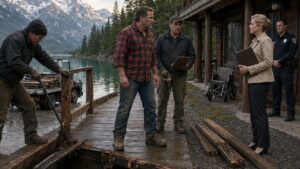
Two men in work jackets were on his dock.
One of them had a circular saw pressed into the new safety rail Joshua had finished bolting in three days earlier. The other stood beside orange cones set across the dock entrance, holding the rail steady while the blade chewed into cedar.
For a moment Joshua did not move. He only stared.
The lake beyond them was flat and blue-green, the morning sun still low behind the ridge. Their cabin sat on a slope above it, the path from the porch running down toward the dock in a narrow curve. Everything about the place was usually slow at that hour: the water, the pines, Janet’s careful routine inside the bedroom as she prepared for the day.
Now a cut section of rail dropped against the dock boards with a heavy crack.
Joshua set the coffee pot down too fast. Water splashed over his hand. He did not wipe it off.
He grabbed his phone from the counter, pushed through the screen door, and took the porch steps two at a time until the slope forced him to slow. His boots hit the gravel path. The saw started again.
“Stop cutting,” he called.
The man with the saw glanced up, but he did not stop. The blade kept moving, bright dust kicking away from the rail in a pale stream.
Joshua raised his voice only enough to carry. “Stop the saw.”
This time the other worker touched the saw man’s shoulder. The blade lifted, whining down.
The crew supervisor stood near a white pickup parked halfway across Joshua’s driveway, its tailgate lowered. A rail section had already been loaded inside. The supervisor had a clipboard under one arm and the look of a man who had practiced not seeing people when paperwork told him not to.
“You Joshua Harris?” he asked.
Joshua kept his phone low but recording. “Who gave you permission to come onto my dock?”
The supervisor shifted his jaw. “I’m Michael Flores. We’re contracted for removal.”
“Removal of what?”
Michael looked at the rail, then back at Joshua. “Unapproved lakefront structure.”
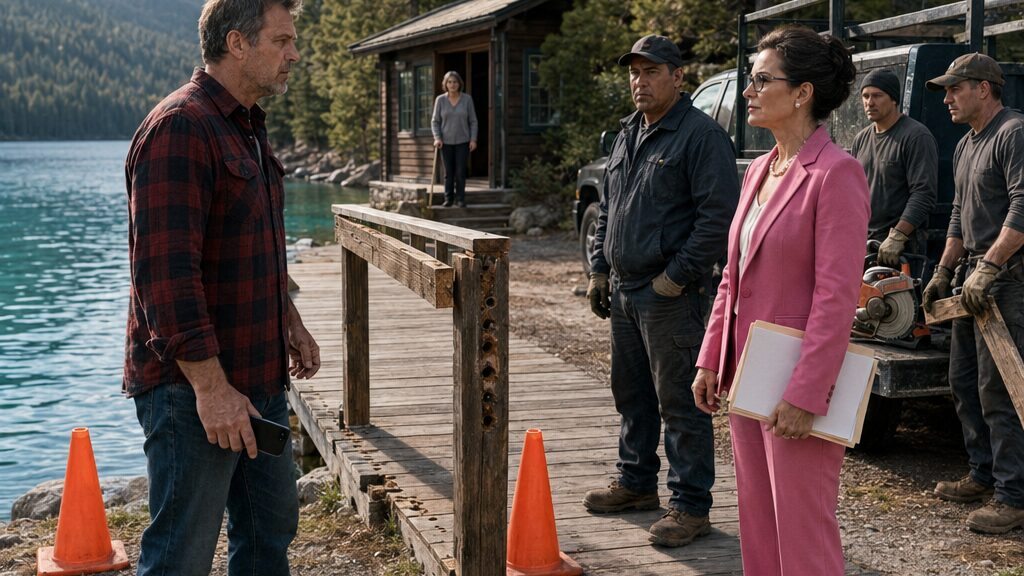
Joshua stepped onto the first dock plank. The missing section opened on his right like a pulled tooth. Four bolt holes showed fresh in the wood, dark around the edges where the screws had come out. It had taken him half a week to measure the angle, cut the cedar, sand the handhold smooth enough that Janet would not catch her palm on it.
“That rail is not lakefront decoration,” Joshua said.
Michael checked his clipboard as if the answer might improve if he read it again. “I’m just here on the work order.”
“You cut it before you spoke to me.”
“There was a notice posted.”
Joshua looked toward the cabin door. “When?”
Michael hesitated.
Before he could answer, tires crunched on the gravel behind them. A dark SUV with a blue-and-white Pine Hollow Lake Association emblem turned into the driveway and stopped at an angle that blocked the path out. The driver’s door opened.
Debra Lewis stepped out in a bright pink suit that looked impossible against the dust and pine needles. Her hair was pinned back; her sunglasses were already in one hand, folded like she had arrived in the middle of a meeting she intended to control. Behind her, a uniformed security guard got out slowly and stood near the SUV without speaking.
Joshua did not move from the dock.
Debra looked first at the cut rail, then at Michael, then at Joshua’s phone.
“Mr. Harris,” she said, “this work is being conducted under association enforcement authority. You need to step away from the dock.”
“My dock,” Joshua said.
“Your property is subject to shoreline standards.”
“My dock,” he repeated, quieter. “And you have a crew cutting into it before seven in the morning.”
Debra walked to the edge of the cones and stopped there, as if the cones belonged to her. “The board issued a removal order after your unauthorized modification was documented.”
“Show me the order.”
She opened a folder and pulled out a paper with the association letterhead. Joshua did not reach for it. He kept his phone angled to catch the paper, the crew, the missing rail, and Debra in the same frame.
“That is an HOA notice,” he said.
“That is an enforcement order.”
“From a court?”
Debra’s mouth tightened. “From the association.”
“So not a court order.”
“This community has covenants, Mr. Harris. You agreed to them when you purchased here.”
“I agreed not to build a party deck over the water. I didn’t agree to let you make my dock unsafe.”
Michael’s eyes moved toward the missing section before he caught himself. The worker with the saw lowered it to his side.
Debra looked past Joshua toward the cabin. “The railing you installed exceeds the permitted height and changes the approved lakefront profile. You did not wait for architectural approval.”
“I submitted the request.”
“You submitted an incomplete request for an aesthetic improvement.”
Joshua almost answered too fast. He felt the old reflex, the stubborn push in his chest that told him he did not owe explanations to people who arrived with trucks and orders. He held it behind his teeth.
“This isn’t aesthetic,” he said.
“Then you should have filed it properly.”
“You should have called before sending a crew.”
“We sent notice.”
“When?”
Debra glanced at Michael.
Joshua caught the glance on his phone.
Debra said, “This morning.”
“This morning when the crew was already cutting?”
The guard shifted near the SUV. Not toward Joshua, not yet, but enough to be seen.
Debra lifted her chin. “You are interfering with contracted enforcement.”
Joshua stepped to the side, not off the dock, but directly between Michael and the next section of rail. He did not touch anyone. He did not raise his hands. He simply stood where the saw would have to pass through him to continue.
“No more cutting until I see legal authority,” he said.
Debra’s voice hardened. “Mr. Harris, do not make this difficult.”
“It’s already difficult. You cut the rail first.”
Michael rubbed the back of his neck. “Ma’am, maybe we should pause until—”
“You were hired to complete a removal,” Debra said without looking at him.
“I was hired by the association,” Michael said. “I wasn’t told someone was home.”
Joshua’s eyes went to him.
There it was. A small thing, but not nothing.
Debra closed the folder. “The owner’s presence does not change the violation.”
“It changes whether you can pretend this was clean,” Joshua said.
The lake lapped under the dock. The cut rail section in the truck bed looked wrong, its fresh end pale and raw. Joshua could see his pencil mark still on one side, the small angled line he had drawn to match the slope where Janet’s right hand naturally landed.
Debra noticed him looking.
“You can reinstall something compliant after approval,” she said.
“Janet needs this one.”
It was the first time he had said her name.
Debra blinked once. “Your wife’s preferences do not override lakefront standards.”
Joshua’s hand tightened around the phone. “It is not a preference.”
From the cabin, the screen door opened.
Joshua turned before he could stop himself.
Janet stood in the doorway with one hand on the frame and the other wrapped around the top of her cane. She had not put on her shoes yet. Her gray sweater hung loose at one shoulder, and her hair was pinned in the uneven way she did it when her left hand tired too quickly.
She looked down the path, past Joshua, past Debra, past the orange cones.
Her eyes stopped on the gap in the rail.
The color left her face.
Chapter 2: The Gap Between the Cabin and the Water
Janet made it three steps down the porch path before the missing rail stopped her as surely as a locked gate.
Joshua saw it happen in pieces: her cane testing the gravel, her left foot sliding half an inch on the slope, her shoulder tightening as she reached for a handhold that was no longer there. Her hand lifted into empty air where the rail should have begun its run toward the dock.
“Jan,” he said.
“I’m fine.”
She said it too quickly. She always did when she was not.
Joshua moved toward her, but she gave him one look that made him stop. Not angry. Worse than angry. A look that said she was already measuring how many people were watching her fail at something she had done alone for years.
Debra stood near the cones with her folder pressed against her side. The guard remained by the SUV. Michael and the two workers had stepped away from the saw, but the cut rail section still lay in the truck bed like proof that the morning had already won something from them.
Janet stared at the broken line of the dock. The rail Joshua had built started too late now, beyond the first gap, beyond the place where the slope changed. The exposed bolt holes looked small from the porch, but Joshua knew exactly how much danger fit inside them.
He had built that rail because of the morning in March when Janet’s cane slipped on wet boards and she laughed before she cried. Because after the stroke, her balance returned like a reluctant guest, present some days and gone others. Because the physical therapist had told them, gently, that uneven surfaces were not a challenge to be overcome but a risk to be managed.
Because Janet had stood at the window one evening and said, “I am not moving away from the water.”
So Joshua had promised she would not have to.
“Mrs. Harris,” Debra called, “please stay clear of the work area.”
Janet looked at her then.
“It was not a work area yesterday.”
Joshua walked back up the path and offered his arm. Janet took it after a pause, not because she wanted to, but because the gap left her no graceful way to refuse. Her fingers were cold through his shirt.
He guided her to the porch chair. She sat slowly, her cane across her knees.
Debra stepped closer to the path and lifted her phone.
Joshua saw the camera open.
“What are you doing?” he asked.
“Documenting additional unauthorized safety measures.”
He followed her angle and saw what she meant. In the few minutes after the saw stopped, while Debra argued and Michael hovered, Joshua had stretched a bright yellow rope between the remaining rail post and a temporary stake near the dock entrance. It was not pretty. It was not meant to be. It was only there so Janet would not step into the gap.
“You’re photographing a rope?” Joshua said.
“I’m photographing an owner-installed barrier that was not approved.”
“It’s there because your crew cut out the rail.”
“It would not be necessary if you had waited for approval.”
Joshua felt Janet’s fingers touch his wrist. A warning, not a plea. He lowered his voice.
“Debra, you need to leave.”
“I will leave when the site is secure and the violation notice has been acknowledged.”
“You made it insecure.”
Debra’s expression flickered, but she recovered. “The association is not responsible for hazards created by unauthorized owner alterations.”
Michael looked at the dock again. He said nothing.
Joshua wanted to say Janet’s medical history out loud just to make Debra hear it. He wanted to list the appointments, the exercises, the way Janet counted each step when she thought he was not listening. But Janet’s hand tightened on his wrist.
Not here.
That had been the agreement. No public explanation unless there was no other way. No making her body into a file attachment for neighbors to discuss over coffee. No letting the association turn her private life into meeting minutes.
Joshua had honored that agreement too well.
He went inside and came back with two sawhorses, a plank, and a roll of reflective tape. Michael watched him set a temporary barrier at the start of the dock.
“Mr. Harris,” Debra said, “I need to advise you that adding more materials may increase your fines.”
“Then write that down too.”
“I intend to.”
Joshua wrapped the tape around the plank. He made sure the barrier sat before the missing section, not on it. Then he took photographs from three angles: the cut rail, the bolt holes, the truck bed, Debra’s SUV blocking the drive.
Debra handed him a folded notice.
He did not take it.
“Put it on the porch table,” he said.
“You’re refusing receipt?”
“I’m refusing the performance.”
Her eyes narrowed. She placed the notice on the table beside Janet’s mug.
The paper stayed there, bright white against old cedar.
After Debra and the guard finally left, the crew lingered. Michael walked to the truck and touched the cut rail section as if deciding whether to unload it. He looked toward Debra’s SUV disappearing up the road, then back at Joshua.
“I can leave that piece here,” he said.
“It belongs here.”
Michael nodded to one of the workers, and together they carried it out of the truck and set it beside the dock steps. The fresh cut end faced upward.
“I didn’t know,” Michael said.
Joshua did not answer.
Michael accepted that. “We’re supposed to wait for further instruction.”
“You do that.”
When the truck was gone, the property became quiet again, but it was not the same quiet. The cones were still there. The rope moved in the breeze. Janet sat on the porch with her cane across her lap, looking past Joshua toward the water she could no longer safely reach.
He picked up Debra’s notice and read it standing beside her.
Forty-eight hours to remove all remaining non-compliant rail structures and temporary barriers. Daily fines after that. Continued owner interference may result in additional enforcement action.
Janet let out a small breath.
“Josh.”
“I’ll fix it.”
“That is what got us here.”
He looked at her.
She did not soften the words. “You filed it as a repair.”
“It was a repair.”
“You did not include the letter.”
“You asked me not to.”
“I asked you not to make me the neighborhood project.” Her thumb moved along the handle of her cane. “That is not the same thing as pretending it was about lumber.”
He folded the notice once, then unfolded it.
“I thought the survey would be enough.”
“You always think the line on a map should make people behave.”
“It should.”
“But it doesn’t.”
He sat beside her then, not touching her, both of them facing the gap.
The first year after Janet’s stroke, he had treated every modification like a private apology. The grab bar in the shower. The second handrail on the cabin steps. The wider threshold into the bedroom. He installed them quietly, late at night or early in the morning, as if doing the work without naming the reason could keep grief from entering the house.
The dock rail had been different only because the HOA portal required a form.
He opened his laptop at the porch table while Janet rested. The association website still had his submission under “pending review,” then “violation issued.” He clicked the original request.
Dock rail repair along existing access path.
Below it, in a field he did not remember filling out, the category read:
Aesthetic Improvement: Lakefront Exterior Modification.
Joshua stared at the words until they stopped looking like words.
He opened the uploaded attachment. It showed his sketch of the rail, the height, the slope, the existing posts. No medical letter. No physical therapist note. No mention of Janet.
He had left those out.
But he had not chosen that category.
Behind him, Janet’s cane tapped once against the porch boards.
“What is it?” she asked.
Joshua turned the laptop toward her.
The cursor blinked beside the phrase that had made their safety look like vanity.
Chapter 3: The Board Called It a View Problem
Joshua walked into the lodge meeting room and saw his dock on the wall before anyone said his name.
The projected photo had been taken from an angle that made the new rail look taller than it was. Debra had chosen the view from below, near the shoreline rocks, where the missing section was hidden and the remaining cedar line cut across the lake like a fence. The turquoise water beyond it filled the screen.
Under the image, in bold type, was written: HARRIS PROPERTY — UNAPPROVED LAKEFRONT ALTERATION.
Joshua stopped just inside the door.
A few board members looked away. Susan Brown did not. She sat at the long table with a folder open in front of her and a pen resting between two fingers, watching him like he had arrived late to his own judgment.
Debra stood near the projector in a navy blazer today, the bright pink suit gone but not the attitude that had come with it. “Mr. Harris. You may sit.”
“I’ll stand for now.”
He carried a folder under his arm. Inside were the notice, photographs of the cut rail, the printed portal page, Janet’s physical therapist letter, and the property survey folded into quarters. He had nearly left the medical letter at home. Janet had placed it on top of the folder herself.
“Use what you need,” she had said.
“What if they ask questions they don’t need answered?”
“Then don’t answer those.”
Now the letter felt heavier than the survey.
Debra tapped the keyboard. Another photograph appeared: Joshua’s temporary rope barrier.
“This emergency session concerns continued violations at Lot Seventeen,” she said. “Unauthorized rail construction, unauthorized temporary barrier installation, and owner interference with contracted enforcement.”
Joshua heard the phrase owner interference and thought of the saw chewing into cedar while his wife stood barefoot in the doorway.
Debra continued. “The association recognizes owners may wish to personalize their homes. However, lakefront uniformity protects safety, insurance compliance, property values, and shared enjoyment.”
Susan leaned forward. “And precedent.”
Debra gave a small nod. “And precedent.”
Joshua opened his folder.
A board member near the end of the table said, “Mr. Harris, did you install the rail before approval?”
“Yes.”
Debra’s pen paused.
Joshua looked directly at the board member. “I installed it before approval because the dock approach was unsafe. I submitted the request as a repair.”
Susan’s pen tapped once. “The submission in our system says aesthetic improvement.”
“I saw that.”
“Then you admit it was processed under the correct category.”
“No. I admit your system says that. I don’t admit I chose it.”
Debra clicked to the next slide. It showed a cropped image of the railing from the lake. “Regardless of category, the installed structure exceeds the approved lakefront profile. If one owner raises a rail, another adds a ramp, another adds a screened platform, and soon the entire shoreline becomes visually inconsistent.”
Joshua looked at the picture. It did not show the slope from the cabin. It did not show the place Janet’s cane had slipped. It did not show the bolt holes or the missing first section.
Susan folded her hands. “We have renters, guests, and long-term owners who bought here under a certain standard. One exception becomes a row of private ramps and rails around the lake.”
Joshua’s voice stayed even. “You say that like ramps and rails are contagious.”
A board member shifted in his chair.
Susan’s face tightened. “I’m saying the board has a responsibility to all owners.”
“So do I.”
Debra stepped in. “Mr. Harris, no one is questioning your responsibility to your household. But the board cannot approve retroactive exterior modifications simply because an owner later claims urgency.”
There it was. Later claims.
Joshua slid the physical therapist letter from the folder. His thumb rested over most of the page.
“I’m going to read one paragraph,” he said. “Not the diagnosis. Not the therapy notes. One paragraph.”
Debra opened her mouth, then closed it.
Joshua read from the middle of the letter. “Due to impaired balance and reduced left-side stability on sloped or wet surfaces, continuous hand support is medically recommended between the residence and dock access point. Lack of support increases fall risk and may prevent safe independent use of the property.”
The room changed, but not enough.
One board member looked at the screen again as if the rail had become visible for the first time. Susan looked down at her notes. Debra’s expression did not move.
Joshua placed the letter on the table, face down.
“That rail was not for a view,” he said.
Debra adjusted the projector remote in her hand. “The association is willing to consider properly filed accommodation requests. But the issue before us is whether an owner may install an unapproved structure on the shoreline and obstruct enforcement.”
“Your crew cut out the first section before I received notice.”
Debra said, “Notice was posted.”
“This morning, while they were already cutting.”
“The timing of delivery does not eliminate the underlying violation.”
Joshua took out the folded survey and set it beside the letter. He did not open it yet.
“Neither does your process create authority you don’t have.”
Debra looked at the survey, then at him. “The association maintains shoreline easement rights under the recorded covenants.”
“For maintenance access.”
“For shoreline control.”
“Show me where it says my dock rail is yours to remove.”
Debra reached into her folder and produced a copy of an old document, highlighted in yellow. “Common lakefront easement language grants the association authority to inspect, maintain, regulate, and remove non-compliant structures within the shoreline management area.”
Joshua read the highlighted line from where he stood. It looked broad. Broader than he expected.
Susan saw his pause and used it.
“This is exactly why individual owners cannot decide for themselves. You may believe your intention is good. But if everyone builds first and argues later, we lose control of the shoreline.”
Joshua looked at the folded survey under his hand. For two days he had believed it would settle everything. His parcel line, the dock placement, the old stakes near the rocks. His land. His rules. Simple.
The highlighted easement made it less simple.
Debra lowered her voice, just enough to sound reasonable. “Mr. Harris, the board is not without sympathy. But sympathy cannot override recorded authority.”
Joshua hated that the sentence would sound sensible to anyone who had not watched Janet reach for empty air.
He opened the survey halfway, then stopped. The room was not ready for a map fight he did not fully understand. He was not ready either.
Instead, he picked up the photograph of the cut rail section from his folder and placed it beside Debra’s projected image.
“This is what your authority did before asking why the rail was there.”
No one answered immediately.
Then Debra said, “The remaining structure must be removed within forty-eight hours unless a compliant application is submitted and approved. Until then, the dock is considered unsafe for use due to owner-created alterations.”
Joshua felt the trap close. They had cut the rail. Now they called the gap his hazard.
He gathered the letter and survey without hurry. His face stayed calm because Janet had asked him not to let them turn this into shouting.
The meeting moved to the next procedural item as if the dock had been handled. Joshua stepped into the hallway outside the lodge, where framed photographs of summer picnics lined the wall. He had almost reached the exit when someone spoke from a bench near the window.
“That easement map was never meant to include your dock.”
Joshua turned.
Gary Adams sat with a worn cap in both hands, his shoulders slightly hunched, his eyes on the folder under Joshua’s arm.
Joshua knew him by sight, mostly. Retired county office, quiet house two coves over, a man who waved from his porch but rarely crossed into anyone’s business.
Gary stood slowly.
“Debra knows that map has problems,” he said.
Joshua looked back toward the closed meeting-room door.
“What problems?”
Gary glanced at the hallway, then lowered his voice.
“The shoreline line they’re using was drawn before your dock was rebuilt. And before your parcel was corrected.” He looked at the folded survey. “If that’s the map I think it is, it may prove less than you hope. But it also proves more than she wants read aloud.”
Chapter 4: The Old Map Did Not Say What Debra Said
The county clerk came back with two maps that disagreed with each other.
She set them on the counter between Joshua and the glass partition, her fingertips holding the curling corners flat. One map was a clean digital printout with crisp parcel lines and a shaded band marked SHORELINE MANAGEMENT AREA. The other looked like it had been copied too many times, the lake edge faded into gray, the old dock drawn as a narrow rectangle that did not quite meet the newer property line.
Joshua stared at the difference until the clerk said, “This happens more than people think.”
“It shouldn’t happen with land people are cutting into.”
The clerk gave him a careful look. “I can certify copies of what we have. I can’t interpret them for you.”
Beside him, Gary Adams leaned closer, one hand braced on the counter. He had met Joshua outside the records office without being asked, his old cap pulled low, his truck parked crooked across two spaces as if he had been deciding until the last second whether to leave.
“That one,” Gary said, tapping the older map without touching the ink. “That’s the correction plat.”
The clerk glanced at him. “You’re familiar with it?”
“I was in the county survey office when it came through.”
Joshua turned. “You didn’t mention that last night.”
Gary’s mouth pressed flat. “You didn’t ask last night.”
The answer irritated Joshua more than it should have, maybe because it sounded like something he would say.
He looked back at the maps. On the newer association copy, the shaded easement swallowed the dock and a strip of the shoreline path. On the older correction plat, the dock sat inside the Harris parcel line, with only a maintenance access strip along the rocks below it.
“Which one is current?” Joshua asked.
The clerk pointed to the digital printout. “This is what the association attached to the recorded covenants.”
Gary shook his head. “That’s what they attached, but not what corrected the parcel.”
“Corrected when?”
Gary took his cap off and turned it in his hands. “Years ago, when the old lodge lots were split. Before you bought. The shoreline was surveyed wrong because the waterline moved after the retaining work. Your dock was rebuilt inside the corrected line.”
“Then why does Debra have the other map?”
“Because the other map is easier to use.”
The clerk slid a request form through the slot. “If you want certified copies, I need parcel number, book reference, and the plat year.”
Joshua took the pen. His hand hovered over the form.
For two days, he had imagined walking into the association office with one clean piece of paper and ending this. Now the paper had multiplied into a tangle of versions, years, shaded bands, and language that seemed to mean different things depending on who held the highlighter.
He filled out the form anyway.
Gary watched him write. “The easement was for shared shoreline maintenance. Clearing storm debris, keeping the old access road usable, inspecting runoff. It was never meant to let them decide whether your wife gets a handrail.”
Joshua stopped writing at wife.
Gary saw it. He looked away.
“You heard that part at the meeting,” Joshua said.
“Everybody heard enough.”
“That doesn’t mean everybody gets to talk about it.”
“No,” Gary said quietly. “It doesn’t.”
The clerk took the form and disappeared again.
Joshua folded his copy of the meeting notice along the same crease three times, then forced himself to stop. Through the window, he could see the county parking lot, the dark line of pines beyond it, and Gary’s truck with one rear tire almost on the curb.
“You said Debra knew the map had problems.”
Gary’s eyes stayed on the counter. “I told the board last spring the shoreline exhibit was being used too broadly.”
“In writing?”
Gary did not answer fast enough.
Joshua laughed once, without humor. “Of course.”
“I sent an email.”
“To Debra?”
“To the board address.”
“Do you have it?”
Gary rubbed the brim of his cap. “Maybe.”
“That means yes.”
“That means I don’t know if I should be in the middle of this.”
Joshua turned fully toward him. “They cut out the rail.”
“I know.”
“They’re giving me forty-eight hours to remove the rest.”
“I know.”
“My wife stood at the top of the path this morning and couldn’t come down to the water.”
Gary’s face changed then, but not into guilt exactly. It was older than that. Recognition, maybe. Or the tired look of a man seeing a mistake he had managed to avoid calling his own.
“I signed the field note on the corrected plat,” Gary said. “Not the final association exhibit. But my note is in the file.”
“Then why let them use the wrong one?”
“I didn’t let them. I retired. People kept using what was already in their binders.” He looked at the maps. “And I didn’t want to be the old man starting fights over lines everyone thought were settled.”
Joshua heard Janet in that. You always think the line on a map should make people behave.
The clerk returned with certified copies and a receipt. Joshua paid, slid the papers into his folder, and held them against his chest as if wind could take them inside the building.
At Gary’s porch an hour later, the older man brought out a box of file folders that smelled of dust and cedar. They sat with the lake visible through trees, Joshua on the top step, Gary in a chair that creaked whenever he leaned forward.
Gary found the email after twenty minutes.
“There,” he said, turning an old tablet toward Joshua.
The message was brief, dated thirteen months earlier, addressed to the board account. Gary had warned that the shoreline management exhibit should not be used as a parcel-ownership document and that private dock structures within corrected parcel lines required separate review before enforcement.
Joshua read the last sentence twice.
Using the exhibit as automatic removal authority may create conflict with recorded private parcel corrections.
“Did Debra respond?”
Gary scrolled.
A reply appeared from Debra Lewis.
Thank you, Gary. We will keep this in mind during future shoreline compliance discussions.
Joshua took a picture of the screen.
Gary did not stop him.
“That doesn’t prove she read it carefully,” Gary said.
“It proves she was told.”
“That’s not always the same thing.”
Joshua placed the certified survey beside the email photo and the medical letter in his folder. It felt like progress, but the progress was fragile. The survey showed enough to challenge Debra. The email showed enough to question her certainty. Neither one put the rail back.
When Joshua returned home, Janet was waiting at the porch table with the laptop open. The association portal had changed again.
A new notice sat at the top of the page.
STOP-USE ORDER — HARRIS DOCK ACCESS
Joshua clicked it.
The language was cleaner than the first notice and colder. Due to owner-created alterations, partial removal, and unsafe temporary barriers, the dock was deemed hazardous until all non-compliant structures were removed and the association completed review. Continued use was discouraged. Further owner-installed barriers would be documented.
Joshua read it twice before he understood the shape of it.
“They cut the rail,” Janet said from behind him, “and now they’re calling the missing rail your hazard.”
His phone rang before he could answer.
The number was not saved. He stepped away from the table and answered.
For a second there was only breath, then a low voice.
“Mr. Harris, it’s Michael Flores.”
Joshua turned toward the dock. The rope barrier moved lightly in the afternoon wind.
Michael said, “I shouldn’t be calling you.”
“Then why are you?”
“Because the work order changed.” A pause. “We were told to return at sunrise and remove the remaining rail sections. All of them.”
Joshua looked at the certified survey lying open on the porch table, the old property line running straight past the place Debra said she controlled.
“Who told you?”
Michael exhaled. “Debra Lewis. And she said if you interfere this time, security handles it.”
Chapter 5: Sunrise Brought the Truck Back
The crew truck reversed toward the dock before the sun had cleared the ridge.
Joshua watched its white backup lights slide through the gray-blue morning, heard the soft beeping cross the yard, and felt something inside him go still in the way it did before he picked up a saw, a blade, or bad news. Janet was still inside the cabin, not dressed yet, her cane leaning against the bedroom chair. He was grateful for that and ashamed of being grateful.
He stepped onto the porch with his phone already recording.
Michael Flores climbed out of the truck first. He did not put on his work gloves. The two workers stayed inside the cab, silhouettes behind fogged glass.
Debra’s SUV followed less than a minute later.
This time she parked at the top of the slope, not blocking the driveway. The same uniformed guard got out and stood beside her, hands folded in front of him, eyes hidden behind sunglasses though the morning was barely light.
Debra carried a folder and a white envelope.
Joshua walked down the path and stopped beside the remaining rail. The certified survey was folded in his left hand. His phone was in his right.
“No saws today,” he said.
Michael’s eyes went to the survey, then to the dock. “I’m here because the work order says complete removal.”
“Have you seen the medical accommodation letter?”
Michael did not answer.
Joshua angled the phone slightly. “That is not a trick question.”
Michael looked toward Debra.
Debra began walking down the path in careful shoes not made for gravel. “Mr. Harris, communication with contractors does not change the enforcement status.”
“I asked him if he’d seen the letter.”
“The association is reviewing all relevant submissions.”
“You sent him here before reviewing them.”
Debra stopped near the cones. “The dock remains unsafe due to unauthorized owner alterations.”
Joshua looked down at the exposed bolt holes where the first section had been. “You mean due to the section your crew removed.”
“You installed a non-compliant structure. The association began correction. You interfered before the correction was complete.”
Michael’s face tightened.
Joshua noticed it and kept his voice level. “Michael, did your work order mention my wife?”
“No.”
“Did it mention a cane, a fall risk, or the physical therapist’s recommendation for continuous hand support?”
“No.”
Debra cut in. “The contractor is not here to evaluate medical information.”
“He’s here to remove the thing that information explains.”
The guard shifted one step down the slope.
Joshua saw it. He kept both hands visible, phone in one, survey in the other.
“I’m not touching your crew,” he said. “I’m not threatening anyone. I am recording the second attempt to remove a safety structure from private property after you received notice that it is medically necessary and after you received a certified survey disputing your authority.”
Debra’s eyes narrowed at the word certified.
“You have not submitted a complete formal accommodation packet,” she said.
“I submitted the letter yesterday.”
“After installing the structure.”
Joshua nodded once. “Yes.”
The admission landed harder than he expected. Debra’s posture sharpened, as if he had finally said the one word she needed.
He looked directly into his phone. “I should have filed the repair differently. I should have included the medical letter from the beginning. I did not, because my wife asked me to keep her medical condition private and because I thought a repair on my dock, inside my parcel line, would be treated like a repair.”
He turned the phone back toward Debra.
“That mistake does not give you the right to make the dock unsafe and then blame me for the gap.”
Michael looked down at his boots.
For the first time, Debra seemed less certain about the shape of the scene. Not wrong, not sorry, but aware that the recording had changed the room around her, even though they stood outside.
She opened the white envelope. “This is your updated notice. Daily fines will begin if the remaining non-compliant rail is not removed today. If you physically obstruct contracted work, the association will document refusal and may involve security to maintain access.”
“Security doesn’t create court authority.”
“The association has easement authority.”
Joshua unfolded the survey halfway. “Not the kind you’re claiming.”
Debra did not look at it. “That interpretation is disputed.”
“By you.”
“By recorded documents.”
“By an exhibit Gary Adams warned you not to use that way.”
That struck her. Briefly, but enough.
Michael saw it too.
Debra recovered by turning to him. “Mr. Flores, please proceed.”
Michael did not move.
“Michael,” she said, colder.
He opened the truck door and took out his gloves, but he only held them.
Joshua stepped beside the remaining rail, close enough that the cedar brushed his sleeve. He could feel the smoothness he had sanded into it, the place Janet’s hand fit.
“Before that machine touches anything else,” he said, “I want your name, your role, your supervisor’s name, and the written authority you are relying on. I want you to state on camera that you understand this rail is part of a medical access route.”
Debra’s face flushed. “This is harassment.”
“This is documentation.”
“This is obstruction.”
“This is my home.”
From behind him, the cabin door opened.
Joshua did not turn at first. His whole body wanted to. He stayed facing Debra because if he looked back and saw Janet at the top of the slope, the anger would rise too fast.
Then he heard the tap of her cane.
Once on the porch.
Once on the first step.
“Janet,” he said, still facing forward, “stay there.”
“No.”
The single word moved through the cold air with more force than shouting.
Janet came to the porch rail. She wore her blue cardigan buttoned wrong at the top and her shoes not fully tied. Her cane was planted in front of her. The first light caught her face and showed every bit of effort she was spending to stand there.
Debra looked uncomfortable, which somehow made Joshua angrier.
“Mrs. Harris,” Debra said, “for your safety, please remain away from the work area.”
Janet gave a small, humorless smile. “You made my way to the water a work area.”
No one moved.
Janet looked at Michael first. “Did they tell you why my husband built that rail?”
Michael’s mouth opened, then closed. “No, ma’am.”
“They told you it was ugly?”
He looked at Debra, then back at Janet. “They told me it was non-compliant.”
“That is a cleaner word.”
Debra said, “Mrs. Harris, this is not personal.”
Janet’s hand tightened around her cane. “That is what people say when they have made it personal and do not want to look at who they hurt.”
Joshua lowered the phone a little. “Jan.”
She ignored him. Not cruelly. Necessarily.
“I did not want my medical records discussed by a board,” she said. “I did not want neighbors deciding whether I was disabled enough for a handrail. So I told my husband to keep it simple. That was my pride. His too.”
Joshua felt the words hit exactly where they belonged.
Janet’s eyes moved to the missing rail gap. “But I will not pretend this is about lake views. I cannot safely reach that dock without continuous support. That dock is not a luxury to me. It is part of how I live in my own house.”
Debra’s folder lowered by an inch.
Susan Brown’s name appeared on Debra’s phone as it buzzed in her hand. Joshua saw it light up from where he stood. Debra declined the call. A text preview flashed anyway.
Insurance carrier wants written confirmation removal completed.
Debra turned the screen inward too late.
Joshua saw enough.
“So that’s the hurry,” he said.
Debra’s expression closed. “This conversation is over.”
“No. I think it just started.”
Michael took one step away from the truck and set his gloves on the tailgate.
Debra looked at him. “Mr. Flores.”
“I’m not cutting while she’s standing there,” he said.
The guard glanced at Debra, waiting.
Janet stood on the porch, breathing carefully through the effort. Then she looked directly at Debra.
“You are not protecting this community by trapping me inside my house.”
The words settled over the slope, the truck, the dock, the missing rail, and the unopened envelope in Debra’s hand.
Debra looked from Janet to Joshua’s phone, then back toward the SUV, where another message lit her screen.
Chapter 6: The Order Was Not the Same as the Right
Joshua set the cut rail section on the board table before anyone called the meeting to order.
It landed with a dull wooden thud that made two board members flinch. Fresh saw marks faced the room. One end still showed the pencil line Joshua had drawn by hand, the angle matched to the slope from the cabin to the dock. He placed the certified survey beside it, then Janet’s medical letter, then the printed screenshot of the association portal calling the repair an aesthetic improvement.
Debra stood at the far end of the table, silent.
Susan Brown was not silent. “This is inappropriate.”
Joshua looked at the rail section. “So was cutting it out before notice.”
“This is an emergency session, not a courtroom.”
“You’re right,” Joshua said. “That is why I asked for the work to stop until someone with actual authority looked at what you were doing.”
Janet sat in the second row of chairs, her cane across her knees. Joshua had asked her three times if she wanted to stay home. The third time, she had only looked at him until he stopped asking.
Michael stood near the back wall with his cap in his hands. The two workers were not there. The uniformed guard waited outside the lodge doors.
Debra finally sat. “We are here to address the status of the Harris dock enforcement matter and the owner’s continued refusal to comply.”
Joshua kept standing.
A board member near the window said, “Maybe we should start with whether removal should have continued after the medical letter.”
Susan leaned forward. “We should start with liability. The dock is currently unsafe.”
“Because the first section was removed,” Joshua said.
“Because an owner installed an unapproved structure and then blocked completion of corrective work,” Susan replied.
Janet’s cane tapped once against the floor. Joshua did not look back, but the sound steadied him.
Debra opened her folder. “The association received notice from our insurance contact that inconsistent lakefront modifications may affect coverage review. We are obligated to demonstrate enforcement of standards.”
Joshua heard the carefulness in her words. Not fear, exactly, but the shape of it. Debra was not only protecting rules. She was protecting a file, a renewal, a board record that had to show action before someone else asked why she had delayed.
“Coverage review,” Joshua said. “Is that why Mr. Flores was told to return before the accommodation request was reviewed?”
Debra’s jaw tightened. “The work order was based on the existing violation.”
Joshua looked to Michael. “When did you receive the instruction to return?”
Michael glanced at Debra. Then he looked at Janet, not Joshua.
“Yesterday afternoon.”
“Before or after I uploaded the medical letter?”
Michael swallowed. “I don’t know when you uploaded it.”
“Were you told there was a medical letter?”
“No.”
Susan sighed. “Contractors are not part of accommodation review.”
Joshua picked up the rail section and turned it so the cut end faced Susan. “They become part of it when you put the saw in their hands.”
The room went quiet.
Debra placed a document on the table. “The association is prepared to offer a conditional path forward. Mr. Harris may submit a corrected application for emergency review. In the meantime, he will sign a waiver acknowledging that the unsafe condition was caused by owner-installed alterations and agreeing to hold the association harmless.”
Joshua did not touch the paper.
There was the false door, polished and waiting. Sign, and maybe the rail returned. Sign, and Debra’s crew cutting first became his fault. Sign, and the gap Janet had stared at from the porch became a hazard he had created alone.
He thought of the March morning when Janet had fallen. Not badly, not enough for an ambulance, but enough that afterward she sat on the dock with both hands in her lap and asked him not to look so frightened. He had built the rail in his head that day. He just had not admitted it out loud.
“No,” he said.
Debra’s eyes lifted.
Joshua pushed the waiver back with two fingers. “I will not sign a false statement to make the association comfortable.”
Susan’s voice sharpened. “Then you are refusing the compromise.”
“I’m refusing blame for the section your crew removed.”
Debra said, “Mr. Harris, you did install without final approval.”
“Yes.”
The room stilled again, surprised by the admission.
He turned slightly so Janet could see his face. “I filed it wrong. Or I let it be filed wrong. I should have included the medical need clearly and requested accommodation from the start. I didn’t because I wanted to protect my wife’s privacy, and because I was too proud to believe I needed permission to make my own dock safe.”
Janet’s eyes shone, but she did not look away.
Joshua faced the board again. “That is my mistake. It does not authorize trespass beyond your easement. It does not authorize removal before meaningful notice. It does not turn her safety into an aesthetic violation.”
He unfolded the certified survey fully at last.
The paper spread across the table, crossing into the space in front of Debra. He weighted one corner with the cut rail. The corrected parcel line ran along the dock approach, clear in black ink. The shaded maintenance strip sat lower on the rocks, narrower than the association exhibit had shown.
Gary Adams stood from the back row.
Joshua had not asked him to speak. He had only told him when the meeting was happening. For a second, Gary looked like he might sit down again.
Then he came forward.
“I worked in the county survey office when that correction was filed,” Gary said. “The maintenance easement was for shoreline access. Debris, drainage, inspection. It was not a blanket ownership line.”
Debra said, “Gary, with respect, you are not representing the county.”
“No,” Gary said. “I’m representing what I should have said louder last year.”
Joshua looked at him.
Gary removed a printed email from his jacket pocket and placed it beside the survey. “I warned the board that the shoreline exhibit was being used too broadly.”
Susan’s face changed before Debra’s did.
A board member reached for the email. Debra did not stop him.
He read the date aloud. Then the subject line. Then Gary’s warning.
Joshua watched Debra’s hands. They remained folded, but the knuckles had gone pale.
Susan recovered first. “A caution from a retired technician does not eliminate our insurance obligations.”
“No,” Joshua said. “But it means you knew there was a question before sending a crew.”
Susan turned on him. “And if someone gets hurt on an inconsistent lakefront structure? If guests start complaining? If premiums rise for everyone because one owner thinks his situation is special?”
There it was, cleaner than the text preview on Debra’s phone. Not just rules. Money. Rentals. Fear dressed as community protection.
Joshua looked at Susan. “Do you rent your lake house?”
“That is irrelevant.”
“Is it?”
Debra said, “Mr. Harris.”
“No. If board enforcement is being rushed because rental owners are worried about premiums, then it matters who is pushing the rush.”
Susan stood halfway. “I will not be accused of acting improperly because I care about property values.”
Janet spoke from behind Joshua. “Property values are not people.”
No one answered her.
Debra looked down at her folder. The insurance email sat half-visible beneath the waiver. Joshua could see the subject line now: Lakefront Modification Enforcement Confirmation.
Debra saw him see it.
Michael stepped forward from the wall. “I need to say something.”
Debra closed her eyes briefly.
Michael continued anyway. “When my crew arrived the first morning, we were already cutting before Mr. Harris came outside. I was told notice had been handled. I did not see a posted notice before work began. I did not know anyone in the house needed that rail.”
Susan sat down slowly.
The board member by the window said, “Debra, is that accurate?”
Debra did not answer immediately.
Joshua felt the room tilt toward a place where everyone wanted the cleanest escape. A revised application. A waiver. A minor apology. A way to put the rail back without admitting the saw should never have touched it.
He could have let them have that, maybe, if Janet had not been behind him. If the cut rail had not been on the table. If his own voice had not already admitted the mistake he wanted to hide.
“I’m not asking you to pretend I followed the process perfectly,” he said. “I’m asking you to stop using process to cover what happened after you knew more.”
Debra looked at him then, really looked, not at his folder or phone or survey.
“What are you asking for?”
“Withdraw the violation. Pause removal. Approve an emergency safety accommodation inspection on-site today. Let a code-compliant rail go back where your crew cut it. Put in writing that the association will not remove structures inside my parcel line without proper legal authority.”
Susan said, “That exposes us.”
Joshua looked at the waiver. “So does asking me to lie.”
A long silence followed.
Debra picked up the insurance email. For the first time that day, she looked tired rather than polished. She read the first lines, then set it down beside the violation notice.
“Read the notice aloud,” she said.
Susan turned. “Debra.”
Debra did not look at her. “Line by line. I want the board to hear exactly what we issued, exactly what we claimed, and exactly what condition our contractor created before the owner received it.”
Joshua stayed standing beside the cut rail section, his hand resting on the survey, while the board member lifted the notice and began to read.
Chapter 7: The Dock Was Repaired Differently This Time
Michael Flores returned one week later with rail hardware in both hands instead of removal tools.
Joshua saw him from the porch before the truck reached the bottom of the drive. This time the tailgate was closed. No orange cones stood in the path. No saw whined across the water. The two workers stepped out quietly, carrying cedar posts, brackets, and a wrapped bundle of code-approved fasteners.
For a moment Joshua did not move.
The old cut rail section still leaned against the cabin wall where he had left it after the emergency meeting. The exposed end had darkened in the weather. Every time he passed it, he saw the board table, the printed notice, Debra’s face as the lines were read aloud.
Michael looked up the slope. “Morning.”
Joshua came down the porch steps with the certified survey under one arm. He did not need it in his hand, not today, but he brought it anyway.
“Morning.”
Michael lifted the hardware slightly. “Association approved replacement. With height adjustment.”
“I read the order.”
“Not removal,” Michael said.
“I noticed.”
The words sat between them with the weight of what neither man said. Michael looked toward the dock, where the missing rail gap still interrupted the line from cabin to water. A temporary barrier stood before it, better braced now, cleaner than the rope Joshua had tied the first morning, but still temporary. Still a warning where a handhold should have been.
“The inspector marked the first two posts good,” Michael said. “The top rail needs to sit two inches lower on the lake side. Return edge rounded. Same footprint. No extension past existing dock line.”
Joshua nodded. “I can live with that.”
Michael looked relieved enough to make Joshua feel unkind for noticing.
Before the crew unloaded, another car turned into the driveway.
Joshua’s shoulders tightened automatically.
It was Debra’s SUV, but the uniformed guard was not with her. She parked near the top of the slope and walked down alone, wearing flats this time. Her suit was gray, not pink. She carried a folder, but she did not hold it like a weapon.
Michael saw her and went still.
Debra stopped several feet from Joshua. The lake behind her was bright enough to make her squint.
“Mr. Harris.”
“Debra.”
She opened the folder and removed two documents. “The board voted to withdraw the outstanding violation notice related to the dock rail and temporary safety barrier. The emergency accommodation was approved with the inspector’s conditions. The board also agreed to revise its shoreline enforcement procedure where disputed parcel boundaries are involved.”
Joshua took the papers. He read them before he answered.
The language was careful. It did not apologize cleanly. It did not say the association had been wrong in the plain way Janet would have preferred. But the violation was withdrawn. The fines were removed. The old stop-use notice was voided. The final paragraph stated that removal of structures within corrected private parcel lines would require legal review before physical enforcement.
It was not victory in the shape of satisfaction.
It was useful.
Joshua folded the papers once and held them beside the survey. “And the unsafe-condition language?”
Debra looked toward the dock. “Removed from the active file.”
“Not revised. Removed.”
“Yes.”
He watched her face for the old deflection. He found fatigue instead.
“Susan objected,” Debra said.
“I assumed.”
“She believes this exposes the association.”
“It might.”
Debra’s mouth tightened, but she nodded. “It also protects us from doing this again.”
That was the closest she came to saying it.
Joshua looked past her to the dock. Michael and the workers had begun laying out the new rail sections on sawhorses. The cedar was clean, pale, unmarked by weather. The replacement pieces looked almost identical to what Joshua had built, except for the adjusted brackets and the softened return at the end.
“I’m not signing anything that says the first gap was mine,” he said.
“No one is asking you to.”
Debra looked toward the porch then, where Janet stood inside the screen door. She had dressed slowly that morning, refusing Joshua’s help with her cardigan, then accepting it with one button near the middle. Her cane was in her right hand. Her left rested against the doorframe.
Debra saw her and lowered her voice.
“I should have paused the work.”
Joshua did not answer for a long moment.
The lake moved under the dock with small, bright sounds. A drill started, then stopped while Michael adjusted a bracket.
“Yes,” Joshua said. “You should have.”
Debra accepted it without defending herself. That did not repair the first cut, but it changed the air enough for Joshua to breathe.
By late morning, the new rail was bolted into place. Joshua watched every measurement, not because he distrusted Michael now, but because he needed to see the line made whole again. The replacement rail followed the same route his had: from the cabin path, down the slight slope, along the dock edge where Janet’s hand naturally reached. Two inches lower on one side. Rounded at the end. Stronger brackets at the first post.
The old bolt holes remained visible just below the new hardware. Michael offered to plug them with matching dowels.
Joshua shook his head. “Leave them.”
Michael studied him, then nodded.
When the final bracket tightened, Janet came down from the porch.
Joshua moved toward her by instinct. She gave him a look, and he stopped one step away. Not far. Close enough if she needed him. Far enough to let the rail do what it had been built to do.
Janet placed her hand on the first post.
Her fingers closed around the wood.
The movement was small, but everyone on the slope seemed to understand not to speak over it. Michael stepped back. The workers looked down at their tools. Even Debra, standing near the driveway with the corrected notice still in her folder, stayed quiet.
Janet took one step. Then another.
At the place where the gap had been, her hand slid along the new rail without lifting. Her cane found the dock board. Her shoulder stayed level. She paused once, not from fear this time, but because the water had opened in front of her.
Joshua stood behind her and felt the week move through him all at once: the saw, the notice, the meeting, the folded maps, Janet’s voice on the porch telling Debra she had trapped her inside her own house.
Janet reached the dock’s wider platform and turned back.
“Well,” she said, breathless but steady, “that works.”
Michael laughed once under his breath, then looked embarrassed.
Janet held out her hand to him.
Joshua almost stepped forward. He stopped himself.
Michael hesitated, then walked onto the dock and shook her hand gently.
“Thank you for coming back with different tools,” Janet said.
Michael swallowed. “I’m sorry I came with the first ones.”
She nodded as if that was enough. Not everything. Enough.
Debra left before noon. She did not ask for photographs of Janet using the rail. She did not mention precedent. She handed Joshua one final copy of the corrected notice and said the board would schedule a full review of shoreline procedures at the next regular meeting.
Joshua watched her SUV leave without triumph.
That afternoon, he carried the old cut rail section to the shed. He stood it in the corner instead of throwing it away. Not as a trophy. Not as evidence he needed every day. Just as a reminder that a thing could be called non-compliant by someone who had never needed it.
Inside the cabin, Janet was resting in the chair by the window, shoes still on, looking toward the water.
Joshua placed the certified survey on the small table near the front door. He set the corrected notice on top of it, then the medical letter, folded so Janet’s private details were hidden inside.
Janet looked over. “You’re leaving it there?”
“For now.”
“In case?”
“In case paper makes people behave faster than maps do.”
She smiled faintly. “That sounds almost like learning.”
He looked out at the dock, at the new rail catching the late light, at the old bolt holes beneath it that still showed if you knew where to look.
“Maybe.”
Joshua smoothed the survey once with his palm and left it by the door, not as a weapon waiting to be used, but as protection he no longer had to carry alone.
The story has ended.