After My Neighbor Blocked My Garage Nineteen Times, the HOA Finally Read My Notebook
Chapter 1: The Nineteenth Morning at David’s Garage
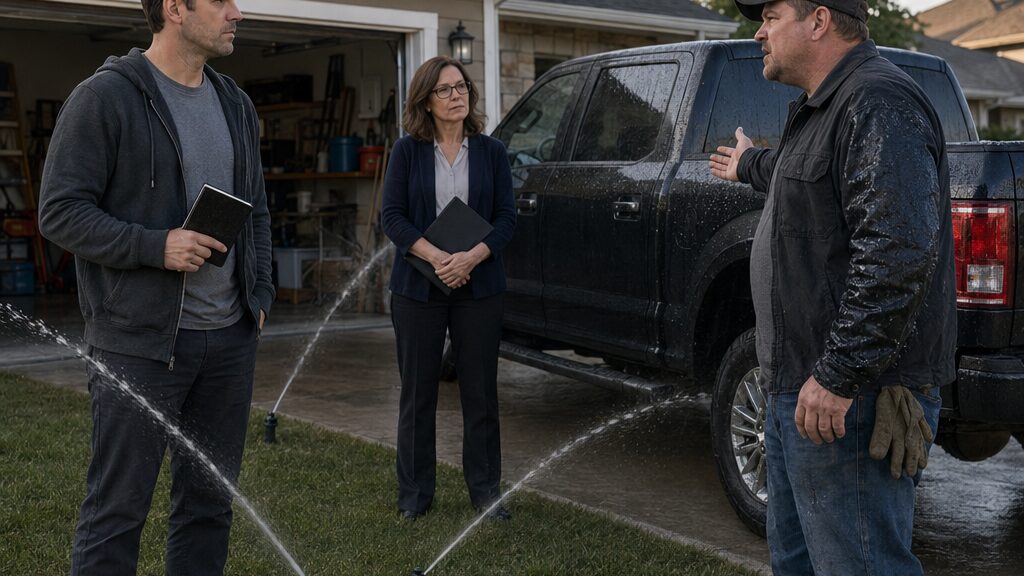
The first sprinkler rose with a metallic click just as Anthony Carter slammed the door of his pickup.
A second head followed, then a third.
Three clean arcs of water swept across the edge of David Harris’s lawn and struck the side of Anthony’s dark truck hard enough to make him jump backward.
“What the hell, David?”
David stood inside his open garage holding a small black notebook.
He said nothing.
Water slapped the passenger window, rolled over the mirror, and scattered across the pavement. Anthony hurried around the front of the truck, getting sprayed across one sleeve before reaching the driver’s door.
His pickup was parked exactly where it had been so many mornings before: angled along the curb with the rear corner extending across enough of David’s driveway to make backing out impossible without climbing the grass.
Anthony looked from the sprinklers to David.
“You did this.”
David glanced at the notebook in his hand.
Nineteen.
That was the number written beside that morning’s date.
But the story had not started with sprinklers.
Three weeks earlier, David had backed halfway out of his garage at 7:08 in the morning before realizing Anthony’s truck was blocking the opening.
David had tapped the horn once.
Anthony had appeared several minutes later carrying a folded ladder toward the common landscaping strip.
“Give me a few,” he had called.
David had been six minutes late to a client meeting.
Two mornings later, the truck was there again.
Then again.
Sometimes Anthony moved it after ten minutes. More often it took twenty. Once David sat behind the wheel for thirty-two minutes while Anthony helped replace a broken irrigation timer near the community entrance.
That morning cost David an appointment entirely.
Afterward, he bought the notebook.
He had always been the kind of man who trusted numbers more than arguments. His work as an independent project consultant depended on schedules, deliverables, invoices, and calls that began when they were supposed to begin. If something went wrong, he wanted a record.
So he started one.
Date.
Arrival time.
Departure time.
Minutes blocked.
Reason given, if any.
He also checked the timestamps from his driveway camera.
At first the notebook had made him feel calmer. The problem looked smaller when compressed into neat lines of ink.
By the tenth entry, it had stopped being calming.
By the fifteenth, David knew exactly how much time Anthony had taken from him.
By the eighteenth, he had added another column.
Cost.
A rescheduled site review. A missed consultation. A reduced invoice after a client had rearranged a morning around David’s delayed arrival.
Roughly four hundred dollars.
Not ruinous money.
That almost made it worse.
It was just enough to hurt and not enough to explain without sounding petty.
On the nineteenth morning, before the sprinklers ever came on, David had walked across the lawn and stopped beside Anthony’s truck.
Anthony was unloading two bags of grass seed.
“You’ve got my driveway blocked again.”
Anthony barely looked up. “I’m moving it.”
“When?”
“When I’m done here.”
“I need to leave now.”
Anthony sighed and set one bag down.
“David, it’s a couple minutes.”
“It was twenty-six yesterday.”
“I wasn’t here yesterday.”
“Tuesday.”
Anthony gave a short laugh.
“You’re keeping track?”
David held up the notebook.
Anthony’s expression changed, but only briefly.
“I’ve missed meetings because of this.”
“I do work around here for free,” Anthony said. “Nobody complains when the entrance lights work or the sprinkler line doesn’t flood the sidewalk.”
“I don’t care what you’re fixing. You can’t block my garage.”
Anthony picked up the grass seed again.
“You should learn to be patient.”
The sentence stayed with David longer than it should have.
It followed him inside after Anthony finally moved the truck.
It followed him through two client calls.
It followed him when he opened the notebook that afternoon and totaled the losses again.
He knew what anger felt like when it was hot.
This was different.
This was cold and precise.
The next morning, Anthony did not block him.
David almost convinced himself the argument had worked.
Then on Friday, the pickup appeared again.
Twenty-three minutes.
Monday became entry nineteen.
Now, with water spraying across Anthony’s truck, David watched his neighbor stomp toward him.
Anthony’s cap was wet along the brim.
“Turn them off.”
David reached to the controller mounted inside the garage and shut down one irrigation zone. The nearest head collapsed into the grass.
The other two continued their normal cycle.
Anthony pointed toward them. “You aimed those at my truck.”
“They’re on my property.”
“That doesn’t answer me.”
“They’re on my property.”
Anthony stared at him.
Then his eyes dropped to the notebook.
“Still writing everything down?”
“Yes.”
“You really want to turn this into a war?”
David almost answered too quickly.
Instead, he looked at the rear of the pickup still cutting across the driveway.
“I want to leave my house when I need to.”
Anthony wiped water from his cheek.
“I told you. This is HOA maintenance.”
“That doesn’t make my garage community property.”
Anthony laughed once, without humor.
“You think I’m making this up?”
“I think you’ve never shown me anything that says you can block me.”
Anthony stepped closer.
For the first time, David noticed how tired he looked. Not frightened. Not embarrassed. Just tired and angry in a way that suggested this argument was not the only one waiting for him that week.
“Ask Karen,” Anthony said.
“Karen White?”
“The community manager. Ask her why I park there.”
David looked past him toward the bags of seed beside the common strip.
Anthony opened the truck.
“Go ahead,” he said. “Take your little notebook with you.”
He got in, started the engine, and finally pulled clear of the driveway.
At 7:31, David wrote the departure time beneath entry nineteen.
Then, underneath it, he added one more line.
Anthony says HOA authorized access. Ask Karen.
For the first time in three weeks, David wasn’t sure whether the next page of the notebook would prove Anthony wrong.
Chapter 2: The Rule Nobody Could Produce
“Anthony was doing association work.”
Karen White said it before David had fully settled into the chair across from her desk.
The HOA management office occupied a small room off the community clubhouse, with two filing cabinets, a printer, and a bulletin board crowded with landscaping schedules and maintenance notices.
David placed his notebook on his knee.
“That doesn’t answer whether he can block my driveway.”
Karen folded her hands.
“No one is saying he can permanently block your driveway.”
“Twenty to thirty minutes isn’t permanent.”
“No.”
“It still keeps me from leaving.”
Karen gave him the practiced expression of someone accustomed to hearing neighbor disputes described as emergencies.
“I understand you’re frustrated.”
David almost laughed.
He had heard enough variations of that sentence in his working life to know what usually followed.
He opened the notebook instead.
“Nineteen incidents.”
Karen’s expression shifted.
David read dates, not all of them, only enough to establish the pattern.
“Seven twenty-two to seven forty-six. Seven eleven to seven thirty. Six fifty-eight to seven twenty-seven.”
“You’ve recorded all of this?”
“My camera has timestamps too.”
Karen leaned back.
“What exactly are you asking the HOA to do?”
“Tell him not to park across my garage.”
“He’s not parking there for personal reasons.”
“That changes why he’s doing it. It doesn’t change what it does to me.”
Karen looked toward the window.
Beyond it, the subdivision’s common strip ran along the inner curve of the road. A few utility boxes sat between ornamental grasses. David had seen Anthony working there dozens of times—changing bulbs, hauling mulch, checking sprinkler heads, dragging bags from his pickup.
David had always assumed Anthony simply liked being involved.
Karen said, “The board has relied on resident volunteers for minor maintenance for years.”
“Anthony?”
“Mostly Anthony lately.”
“For free?”
“Some expenses are reimbursed.”
“That’s not what I asked.”
Karen paused.
“Yes. Much of his time is unpaid.”
That bothered David more than he wanted it to.
Not enough to excuse the truck.
Enough to disturb the simple picture he had built.
“So because he volunteers,” David said, “he gets to block whoever’s closest?”
“That’s not what I said.”
“Then what is the rule?”
Karen reached for a binder.
For the next fifteen minutes, they went through sections on street parking, common-area access, contractor vehicles, obstruction of sidewalks, and temporary maintenance activity.
Nothing mentioned David’s driveway.
Nothing identified the curb beside his house as a staging zone.
Nothing gave a volunteer permission to obstruct a resident’s garage.
Karen checked a second binder.
Then a folder on her computer.
Her movements became slower.
David watched her search.
“You can’t find it.”
“There may be an older maintenance designation.”
“May be?”
“The area beside your lot has been used for access for a long time.”
“Used by who?”
“Landscapers. Irrigation contractors. Sometimes tree service.”
“Were they blocking the driveway?”
“Not usually.”
David closed the notebook.
“Then Anthony isn’t following a rule. He’s following a habit.”
Karen’s face tightened.
“That’s too simple.”
“Why?”
“Because the board eliminated one of the contractor staging areas two years ago when residents complained about equipment near the mailboxes. Since then, crews have used whichever curb space is available.”
“My garage isn’t available curb space.”
“I understand that.”
“No, you understand why Anthony is there. That’s different.”
The words came out sharper than David intended.
Karen’s eyes moved to the notebook again.
“What happened this morning?”
David said nothing for half a second too long.
Karen noticed.
“Anthony called.”
“Of course he did.”
“He said your sprinklers were directed at his vehicle.”
“They’re irrigation heads inside my property line.”
“I asked what happened, David.”
“They came on.”
“At the exact time his truck was there?”
David felt irritation rise again.
“You’ve had nineteen chances to ask him why his truck was there.”
“And I’m asking you now.”
The room went quiet.
Karen did not sound hostile. That made it harder.
She sounded tired.
David slid the notebook onto her desk and opened it to the most recent page.
“I lost about four hundred dollars because I’ve had to reschedule work around this.”
Karen looked up quickly.
“You never told us that.”
“I told Anthony.”
“You didn’t tell me.”
“I shouldn’t have to submit an income statement to get access to my own garage.”
“No. But if you wanted the association to intervene formally, consequences matter.”
David knew that was reasonable.
He disliked it anyway.
Karen flipped through several pages.
The neatness of the entries seemed suddenly embarrassing, as though he had placed three weeks of anger under fluorescent light.
“Why didn’t you bring this in after the fifth incident?” she asked.
“Because I thought a grown man would stop after I asked him.”
“And when he didn’t?”
David looked toward the window.
“I handled it.”
Karen closed the notebook.
“That is exactly what concerns me.”
She pushed it back toward him.
“I’ll review the maintenance records and speak with Anthony. But until this is resolved, don’t turn this into retaliation.”
David tucked the notebook into his jacket.
“What counts as retaliation?”
“You know what I mean.”
“I know my sprinkler system is on my property.”
Karen’s mouth tightened.
“Being technically permitted to operate equipment doesn’t mean intent can never matter under HOA rules.”
There it was.
Not a fine.
Not a threat.
A warning.
David stood.
“So Anthony gets nineteen mornings and I get one?”
“No,” Karen said. “Anthony’s behavior is being reviewed too.”
“Then show me the rule he thinks he’s following.”
“If it exists, I will.”
“And if it doesn’t?”
Karen hesitated.
“Then we have a different problem.”
David left the clubhouse less certain than when he entered.
Anthony was not simply using the curb because he felt entitled. He had been carrying maintenance work the HOA had chosen not to fully staff.
But no one had given him the right to block David.
Both things could be true.
David hated how little satisfaction there was in that.
The next morning, at 7:04, he pressed the garage-door opener.
The door rose.
Anthony’s pickup was already there.
Its rear bumper cut across the driveway.
Anthony was fifty feet away beside the common irrigation box, kneeling with a wrench.
David sat in his car and watched him.
On the passenger seat lay the black notebook.
Behind the garage wall, the irrigation controller waited in silence.
Chapter 3: Three Sprinklers and One Bad Decision
David had not opened the valve box in almost five years.
Dirt had packed around the green plastic lid. He worked a screwdriver under the edge and lifted it, exposing the manifold beneath.
For a moment, the smell of damp soil brought back another version of his life.
Four years of irrigation work.
Apartment complexes. New subdivisions. Commercial landscaping. Days spent tracing broken lines and fixing poorly aimed rotors installed by crews who had already moved to the next job.
David knew precipitation rates, pressure loss, nozzle patterns, arc adjustments.
He also knew exactly how far three heads along the front edge of his lawn could throw water.
That was the part he didn’t tell Karen.
The first morning after their meeting, Anthony blocked him for seventeen minutes.
David recorded it.
The second morning, twenty-one.
He recorded that too.
That afternoon he crouched beside the first sprinkler head with an adjustment key.
Nothing crossed the property physically.
No pipe moved.
No head was relocated.
David altered the arcs.
The first rotor swept closer to the curb.
The second covered the narrow strip beside the driveway.
The third reached the area where Anthony liked to leave his passenger side.
David stood, watched one test cycle, and made two smaller corrections.
His grass still received water.
The curb received more.
He went into the garage and looked at the controller.
There were easier choices available.
He could email Karen again.
He could wait for the review.
He could park his own car on the street overnight.
He could ask Anthony one more time.
Instead, David changed the start time.
Before pressing save, he took the notebook from his pocket.
Entry nineteen stared back at him.
Underneath it: Ask Karen.
He had asked.
No rule had appeared.
David pressed save.
The first morning, Anthony’s truck was not there.
David felt ridiculous.
The sprinklers ran across an empty curb, darkening the pavement while he stood with coffee in the garage.
The second morning, Anthony parked farther down.
David backed out cleanly.
That should have been enough.
It almost was.
The third morning, at 7:06, the pickup returned to its old position.
David saw it through the kitchen window.
Something inside him settled.
Not relief.
Expectation.
Anthony got out carrying a cardboard box of replacement sprinkler nozzles for the common area.
He walked toward the strip.
The controller clicked.
One sprinkler rose.
Then another.
Then the third.
Water hit the truck’s passenger door with a hard patter.
Anthony turned.
The first sweep caught the back of his jacket.
He jumped sideways.
“What the—”
A second arc struck the windshield.
Anthony dropped the box onto the grass and ran back toward the truck.
David stepped out of the garage.
He had imagined this moment more than once.
In his imagination, he had felt vindicated.
Watching Anthony drag the box away from the spray, David felt something more complicated.
Anthony yanked open the driver’s door.
“Shut them off!”
David stayed near the garage.
“They’re watering.”
“My truck?”
“The lawn.”
Anthony pointed at the streams striking the side windows.
“That is not the lawn.”
David walked to the nearest valve and closed it.
One head dropped.
Two kept moving through their cycles.
Anthony stared at him.
“You planned this.”
David did not answer.
That silence answered for him.
Anthony stepped toward the property line.
“You know I’m doing maintenance.”
“And you know I need access to my garage.”
“I was going to move it.”
“You always are.”
Anthony’s jaw flexed.
“You think because Karen couldn’t find some paperwork, you’re right about everything?”
“No.”
“You’ve been waiting to do this.”
David almost denied it.
Instead he looked at the wet truck.
Anthony was right about that part.
“You said I should learn patience.”
Anthony gave a disbelieving laugh.
“So this is revenge.”
“This is my irrigation system.”
“Don’t play games.”
The phrase landed harder because David knew he was playing one.
A car slowed as it passed.
One of the residents looked over, then continued toward the exit.
David suddenly saw the scene from outside himself: two middle-aged men standing beside a wet pickup at seven in the morning, arguing over sprinkler arcs and curb space.
Anthony pulled out his phone.
“Fine.”
“What are you doing?”
“Calling Karen.”
“Go ahead.”
“And code enforcement.”
David folded his arms.
“Go ahead.”
He sounded calmer than he felt.
Anthony made the first call while pacing beside his truck.
David shut down the remaining heads.
By the time Karen arrived twenty minutes later, the pavement was drying but the truck still carried sheets of water across its windows.
She stepped out of her car, looked at Anthony, then at David.
Her expression said she had hoped neither man would make the dispute worse before she finished reviewing the records.
David went inside the garage and returned with the notebook.
Karen noticed it immediately.
“How many now?”
“Still nineteen.”
Anthony turned toward him.
“Because I’ve been parking farther down.”
David knew what he meant.
For two mornings, Anthony had not blocked the garage.
The sprinklers had still been scheduled.
Karen looked from one man to the other.
“David, are all three heads inside your lot?”
“Yes.”
“Did you move them?”
“No.”
“Change the spray pattern?”
David paused.
“Yes.”
Anthony laughed sharply.
“There. Thank you.”
Karen did not react.
“Why?”
“To keep water on my side of the property.”
Anthony pointed at the truck. “Look at it.”
Karen looked at David.
He could hear the weakness in his own answer.
He opened the notebook instead.
“Nineteen times. Dates and durations. My driveway camera confirms them.”
He offered it to her.
Karen took the notebook but did not open it immediately.
“David, documentation doesn’t give you permission to harass somebody.”
“And volunteering doesn’t give him permission to block me.”
“No,” she said. “It doesn’t.”
Anthony’s expression changed slightly.
Karen opened the notebook.
She turned through several pages.
“The association is reviewing the access issue,” she said. “But now I also have to review this.”
Anthony folded his arms.
“Good.”
David felt a brief, ugly satisfaction at the wet sleeve of Anthony’s jacket.
That was when he understood Karen’s concern.
He did not merely want access anymore.
Some part of him wanted Anthony inconvenienced.
He wanted him standing beside a vehicle unable to do exactly what he intended, forced to wait while someone else controlled the timing.
The realization made David look away.
Karen closed the notebook.
“City code enforcement will determine whether there’s a municipal issue with the irrigation setup. Separately, the HOA will determine whether either of you violated community rules.”
“Either of us?” Anthony said.
Karen looked at him.
“You blocked an occupied driveway repeatedly after being directly asked to stop.”
Anthony’s confidence faded.
Karen handed the notebook back to David.
“Neither of you gets to decide this alone anymore.”
That afternoon, David received an email confirming that a municipal code inspector would visit the property in two days.
He read it twice.
Then he walked to the garage and looked at the irrigation controller.
For three weeks, the notebook had made him feel prepared.
The sprinklers had made him feel powerful.
Now both were evidence.
And someone else was coming to decide what they proved.
Chapter 4: The Map Behind the Maintenance File
The inspector did not look at Anthony’s truck first.
He walked straight past it, stepped onto David’s lawn, and crouched beside the nearest sprinkler head with a measuring tape.
Anthony stood at the curb with his arms folded.
David watched from the edge of the driveway.
The inspector measured the distance from the sprinkler to the property line, then stood and watched David run the zone for less than a minute.
Water swept across the grass, touched the curb, and broke into mist against the pavement.
“Can you reduce the arc?” the inspector asked.
“Yes.”
“Can you increase it?”
“Yes.”
“Were any heads moved recently?”
“No.”
“Any piping extended outside your lot?”
“No.”
The inspector wrote something on his clipboard.
Anthony shifted his weight.
“It’s hitting my truck.”
The inspector looked at him.
“Was the truck parked there during the test?”
“No.”
“Then right now I’m reviewing the installation.”
Anthony pointed toward David.
“He admitted he changed the heads so they’d hit me.”
The inspector turned to David.
“Did you alter the spray pattern?”
“Yes.”
“For what purpose?”
David glanced at Anthony.
He had known this question was coming.
“I wanted coverage along the edge of my lawn.”
Anthony made a sound under his breath.
The inspector looked back at David.
“Anything else?”
David could have stopped there.
Instead he said, “I also knew his truck was frequently parked beside that edge.”
Anthony raised both hands.
“There.”
The inspector wrote again.
David felt the old instinct to defend every detail rise in him, but the inspector was already moving toward the second head.
For twenty minutes, he checked the valves, controller, head placement, runoff, and curb.
When he finally straightened, his conclusion was almost disappointingly narrow.
“I don’t see a municipal property-code violation in the installation.”
Anthony stared at him.
“So he can deliberately spray someone’s vehicle?”
“I said the irrigation installation does not violate the code sections I’m inspecting.”
“That’s the same thing.”
“No, it isn’t.”
The inspector closed the clipboard.
“If water is being used to damage property or create another prohibited condition, that can become a different issue. I’m not making that finding today.”
David felt tension leave his shoulders.
Not victory.
But enough relief to notice how tightly he had been standing.
Anthony looked at Karen, who had arrived halfway through the inspection.
“You heard him.”
Karen nodded.
“I heard exactly what he said.”
David almost smiled.
Karen caught it.
“Don’t.”
His expression flattened.
The inspector gave David a copy of the inspection note and left.
Anthony remained beside the curb.
“So that’s it?”
“For the city?” Karen said. “For now.”
“For now?”
Karen looked at David.
“The HOA review is separate.”
The relief disappeared.
Anthony’s mouth curled slightly.
David turned toward Karen.
“On what basis?”
“Community conduct, nuisance provisions, intentional interference between residents.”
“You just watched the city clear the system.”
“I watched the city clear the physical installation.”
“That matters.”
“It does. It isn’t everything.”
Anthony walked toward his truck, but Karen stopped him.
“And your parking is still under review.”
His expression tightened.
“I was doing maintenance.”
“I know.”
“So why am I being treated like I caused this?”
Karen looked at the driveway.
“Because you kept blocking an occupied garage after the owner asked you to stop.”
For once, Anthony had no quick reply.
That afternoon Karen called David from the management office.
“I found something.”
He arrived fifteen minutes later.
A thick binder was open across her desk. Several pages had been pulled free and laid beside it.
Karen pointed to a faded diagram.
The subdivision road curved across the page in pale gray. Common landscaping areas were shaded. Near David’s lot, a narrow rectangle ran along the curb.
Someone had typed TEMPORARY SERVICE ACCESS inside it.
David leaned closer.
“That covers part of my driveway.”
“On this drawing, yes.”
“So Anthony was right.”
Karen did not answer.
David looked at the bottom of the page.
There were no signatures.
No approval date.
No recorded revision number.
Nothing showing board adoption.
“What is this?”
“That’s what I’m trying to determine.”
She pulled another document from the binder.
“This appears to have been prepared during a landscaping contract transition several years ago.”
“Was it ever approved?”
“I can’t find evidence that it was.”
“But people used it.”
“Apparently.”
David sat down.
The situation had become stranger than the argument he thought he was having.
Anthony had not invented the service zone.
But the service zone might never have legally existed.
Karen tapped the diagram.
“This is probably why he believed he had permission.”
“Probably?”
“I’ve seen references to ‘temporary access near Harris lot’ in maintenance emails. I assumed there was a board-approved designation.”
“You assumed.”
“Yes.”
The word came quietly.
David looked at her.
“You’ve been managing this neighborhood how long?”
“Six years.”
“And you’ve been letting people use this?”
“Contractors rarely block the driveway. They usually stage farther forward.”
“Anthony doesn’t.”
“No.”
“Did you ever tell him he could?”
Karen hesitated.
“I told him that maintenance vehicles had historically used that area.”
David leaned back.
“That sounds a lot like permission.”
“It wasn’t meant as permission to obstruct your garage.”
“But you never told him that part.”
Karen closed the binder halfway.
“No.”
The honesty surprised him.
David opened his notebook and started comparing dates.
Entry twelve: Anthony replacing entrance lights.
Entry fourteen: irrigation controller inspection.
Entry sixteen: fertilizer delivery.
Patterns that had looked like random disrespect now lined up with work David had barely noticed.
Karen watched him.
“What are you doing?”
“Checking what he was working on.”
“Why?”
“Because if this was maintenance every time, I want to know.”
Some were.
Some were not.
Entry nine had no visible maintenance activity.
Entry seventeen showed Anthony talking with another resident for nearly half an hour while the truck remained across the driveway.
David tapped that date.
“He still used the access like it belonged to him.”
“I agree.”
“But somebody taught him to think it did.”
Karen looked at the diagram.
“Yes.”
A silence settled between them.
For the first time, David understood that the dispute had not begun entirely at the curb between two stubborn men.
Someone had drawn a box years ago.
Someone else had failed to approve it.
Others had treated it as real anyway.
Then Karen pulled a yellow folder from the bottom of the binder.
“I haven’t opened this yet.”
Across the tab, in faded handwriting, were the words Maintenance Staging—Board Review.
Karen flipped it open.
The first page was a proposal.
The second contained cost estimates.
The third was marked deferred.
David looked at her.
“Deferred by who?”
Karen read farther.
Her expression changed.
Not surprise exactly.
Recognition.
“This didn’t start with Anthony.”
She turned the page toward David.
And for the first time since the nineteenth morning, he saw the possibility that the person standing closest to the problem might not be the person who had created it.
Chapter 5: Why Anthony Kept Saying It Was Temporary
Anthony arrived at the HOA meeting carrying a stack of reimbursement forms held together by a black binder clip.
He placed them on the table in front of the board.
“No one ever paid these.”
David sat three chairs away.
Karen looked at the forms.
“How far back?”
“Fourteen months.”
One board member lifted the top sheet.
The requests were ordinary: replacement bulbs, irrigation fittings, grass seed, fuel for hauling supplies.
Small amounts.
Thirty-two dollars.
Forty-eight.
Seventy-one.
None large enough to cause an argument by itself.
Together they told a different story.
“You never followed up?” Karen asked.
Anthony laughed once.
“I followed up plenty.”
The second board member shifted uncomfortably.
David opened his notebook.
For weeks he had written only one kind of number.
Minutes.
Twenty-three.
Seventeen.
Thirty-one.
Costs to him.
He had never recorded the time Anthony spent kneeling beside common sprinkler boxes, hauling mulch, or replacing entrance lights before most residents were awake.
That did not erase the blocked garage.
But it made the page feel incomplete.
Anthony pointed toward the reimbursement forms.
“You all wanted contractor-level work without contractor invoices.”
“That isn’t fair,” one board member said.
“It isn’t?”
“We’ve paid vendors.”
“For things you couldn’t get me to do.”
Karen intervened.
“Anthony.”
“No. We’re finally talking about it.”
His voice was controlled, but his hands pressed flat against the table.
“You cut the landscape maintenance contract. Then when little stuff broke, somebody called me because I had tools. I said yes because I live here too.”
David watched him.
The anger sounded familiar.
Not identical to his own.
Close enough to recognize.
Karen opened the archived maintenance folder.
“The board considered creating a formal staging area near the utility strip.”
“And rejected it because it cost money,” Anthony said.
The board member holding the reimbursements looked down.
Karen continued.
“Not rejected. Deferred.”
“For two years.”
No one corrected him.
David looked at the faded diagram lying in the center of the table.
TEMPORARY SERVICE ACCESS.
A box on paper that had become a habit.
Karen said, “I told Anthony crews had historically used that curb.”
David looked at her.
Anthony did too.
Karen did not look away.
“I should have clarified that it did not authorize blocking an occupied driveway.”
One of the board members said, “Did you believe it did?”
Anthony hesitated.
“I believed if I was there for association work, I had reasonable temporary access.”
“Across David’s garage?”
“For a few minutes.”
David felt his jaw tighten.
Anthony saw it.
“Yes,” Anthony said. “I know what he’s going to say.”
“Then say it yourself,” David replied.
Anthony looked at him.
“I stayed too long.”
The room quieted.
David had expected excuses.
That simple admission unsettled him more.
Anthony continued.
“Sometimes I thought I’d be five minutes. Then a fitting was wrong, or someone stopped me, or I had to drive back for something.”
“Twenty-eight minutes isn’t five.”
“I know.”
“You knew then.”
Anthony’s expression hardened again.
“Not at first.”
David took out the notebook.
“I told you.”
“Yes.”
“I told you I was missing meetings.”
“Yes.”
“And you kept doing it.”
Anthony leaned back.
“Because by then every time I saw that notebook, it felt like you were building a case against me instead of talking to me.”
“I did talk to you.”
“You walked over and told me what I couldn’t do.”
“I told you not to block my garage.”
“And I told you why I was there.”
“You told me to be patient.”
Anthony looked away.
That landed.
Karen let the silence sit for a moment.
Then she said, “There is another issue.”
David knew immediately.
The sprinklers.
Anthony reached for his phone but did not unlock it.
“He ran them after I stopped blocking him.”
One board member looked at David.
“For how long?”
David said nothing.
Anthony answered.
“Two mornings. I parked farther down. His sprinklers still came on toward the curb.”
“They’re automatic.”
Anthony turned toward him.
“You programmed them.”
David felt heat rise into his face.
Karen looked at him carefully.
“Is that true?”
“The zone ran.”
“That isn’t the question.”
David closed the notebook.
He remembered the first empty morning.
Water darkening pavement where no truck stood.
The moment he had realized Anthony had changed his behavior.
He could have reset the controller then.
He had not.
The next morning Anthony parked farther away again.
David still left the schedule untouched.
Why?
At the time, he had told himself he was protecting against Anthony returning to the old spot.
Sitting at the table now, the explanation felt thin.
Anthony spoke more quietly.
“My wife asked why I was getting up earlier to move the truck before the sprinklers. I told her this whole thing was ridiculous.”
David glanced at him.
Anthony’s face had changed.
The fight had moved beyond annoyance.
“Then she asked me why I didn’t just stop parking there.”
No one spoke.
Anthony rubbed his thumb over the edge of one reimbursement form.
“I didn’t have a good answer.”
That was the first surprise of the night that did not come from a file.
David looked down at his own notebook.
Anthony had been stubborn enough to keep blocking him partly because backing down felt like admitting the work he did for the neighborhood did not matter.
David had been stubborn enough to keep the sprinklers programmed because resetting them felt like surrendering the first leverage he had gained.
Different grievances.
Same pride.
Karen said, “The access arrangement was badly handled. That’s on management and the board.”
One member started to object.
Karen continued.
“But neither mistake cancels the choices made afterward.”
She turned to Anthony.
“You were told the obstruction was interfering with David’s work. You continued.”
Anthony nodded once.
Then she turned to David.
“You were told the association was reviewing the access issue. You changed the irrigation pattern anyway.”
David met her eyes.
“Yes.”
Anthony looked surprised that he had admitted it so easily.
Karen slid the faded diagram aside.
“We can fix the staging problem. We can reimburse legitimate expenses. We can establish where maintenance vehicles are allowed to stop.”
David could feel what was coming.
“But before we decide whether either resident violated the conduct provisions,” Karen said, “the board needs to understand intent.”
She looked directly at him.
One board member folded his hands.
“Mr. Harris, when you changed those sprinkler heads, were you trying to water your lawn?”
David looked at the notebook.
Then at Anthony.
The answer that protected him was sitting right there.
So was the truth.
The board member leaned forward.
“Or were you trying to punish your neighbor?”
Chapter 6: The Last Entry in the Notebook
Karen asked the question again.
“David, why did you keep the sprinklers on that schedule after Anthony stopped blocking the driveway?”
No one in the meeting room moved.
David opened the notebook.
The nineteenth entry was marked more heavily than the others because he had gone over the numbers twice.
Arrival: 7:03.
Departure: 7:31.
Blocked: 28 minutes.
Underneath it were the words Anthony says HOA authorized access.
That had been the fact he thought mattered most.
Now the blank space after it seemed more important.
David closed the notebook.
“Because I wanted him to be inconvenienced.”
Anthony looked up.
Karen said nothing.
David continued before he could edit the truth.
“The first time the truck got sprayed, I wanted him to move.”
He glanced at Anthony.
“The second time, I wanted him angry.”
One of the board members shifted.
David felt no relief from admitting it.
Only the unpleasant sensation of removing a piece of armor he had spent weeks assembling.
“I could have reset the controller after he parked farther down. I didn’t.”
Anthony folded his arms, but there was less satisfaction in his expression than David expected.
Karen asked, “Why not?”
David looked toward the clubhouse window.
Outside, the streetlights had come on along the subdivision road.
“Because for three weeks, every morning depended on whether Anthony decided my schedule mattered.”
He rubbed his thumb along the notebook’s spine.
“When the sprinklers came on, his morning depended on something I controlled.”
The room stayed silent.
David looked at Anthony.
“I liked that more than I should have.”
Anthony’s arms slowly dropped.
One board member wrote something down.
The other said, “So you acknowledge retaliatory intent.”
“Yes.”
The word sat heavily on the table.
David knew it could cost him.
A warning.
A violation notice.
Possibly a fine under the association’s nuisance provisions.
Yet the moment it was spoken, something in the dispute changed.
There was no longer anything left for Anthony to expose about him.
Karen turned to Anthony.
“Then we need the same clarity from you.”
Anthony frowned.
“About what?”
“After David told you he’d missed client appointments.”
“I already said I stayed too long.”
“That’s not what I’m asking.”
Anthony’s eyes narrowed.
Karen continued.
“Did you continue using his driveway edge because you believed it was the only workable maintenance location?”
Anthony looked toward the old service-access diagram.
For several seconds, David thought he would say yes.
Instead Anthony leaned back.
“No.”
The board members stopped writing.
Anthony exhaled.
“Not every time.”
David watched him.
Anthony rubbed both hands over his face.
“The first few times, yes. It was convenient. Close to the utility strip. I thought I was allowed.”
“And afterward?” Karen asked.
Anthony looked at David.
“After the notebook came out, I got irritated.”
David almost smiled at the symmetry.
Anthony saw it.
“Don’t.”
“I’m not.”
“You were standing there writing down the minute I moved.”
“Because you kept blocking me.”
“I know.”
Anthony’s voice rose, then settled.
“But it started feeling like every time I pulled up, you were waiting to catch me.”
“So you blocked me to prove a point?”
Anthony looked down.
“Sometimes I could have parked farther away.”
There it was.
Not an excuse.
Responsibility.
David had spent weeks wanting Anthony to admit those exact words.
Now that he had, they were less satisfying than he imagined.
Karen placed both hands on the table.
“Then we have two residents who each had a legitimate concern and each chose escalation after they knew better.”
Anthony frowned.
“That makes it sound equal.”
“It isn’t about making it equal.”
Karen pointed to the maintenance folder.
“The HOA created an informal system that should never have been informal.”
Then she pointed toward David’s notebook.
“Anthony repeatedly obstructed access after receiving direct notice of the consequences.”
Her hand moved toward the irrigation inspection.
“David used a compliant irrigation installation with acknowledged retaliatory intent.”
No one looked pleased.
That, David thought, was probably the first sign the meeting might actually accomplish something.
One board member said, “We still need corrective action.”
David opened the notebook again.
He had brought it because he expected to defend every line.
Instead he found himself reading the entries differently.
Nineteen mornings.
Nineteen small records of time taken from him.
But nothing on those pages told the board what should happen on morning twenty.
He closed it.
“What if we stop deciding who gets to use that curb?”
Karen looked at him.
“What do you mean?”
“Make the answer nobody.”
Anthony frowned.
David continued.
“Create an actual maintenance staging area. Not a box on an old diagram. A place that doesn’t block an occupied driveway.”
The board member said, “That costs money.”
“So does this.”
David gestured around the room.
“Management time. Inspections. Complaints. Reimbursements nobody processed.”
Anthony looked toward the old map.
David turned to him.
“And no maintenance vehicle stops across my garage. Ever.”
Anthony’s jaw tightened.
David kept going.
“In return, I reset the sprinklers tonight. Normal coverage. No curb targeting.”
“Targeting,” Anthony repeated.
“I said what I said.”
Karen’s expression almost changed into a smile, but didn’t.
David continued.
“Anthony gets reimbursed for documented materials the HOA approved. Future volunteer work gets a written scope before anyone does it.”
One board member looked at Karen.
“Can that be drafted?”
“Yes.”
Anthony remained quiet.
David looked at him.
“You don’t have to like me.”
“Good.”
“You don’t have to apologize.”
Anthony raised an eyebrow.
“You planning to?”
“No.”
That finally drew a faint, tired laugh from one of the board members.
David waited.
Anthony looked toward the closed notebook.
“What about the violation complaints?”
Karen answered.
“If both residents sign a corrective agreement and comply, I will recommend written warnings rather than fines.”
Anthony looked at David.
“And if he aims those sprinklers back at my truck?”
David answered before Karen could.
“Then you file the complaint.”
Anthony studied him for a long moment.
“And if I block your garage?”
“I don’t adjust a sprinkler.”
“What do you do?”
David slid the notebook across the table.
“I write down the time.”
Anthony looked at it.
For once, the object did not feel like a threat.
Just a record.
Anthony pushed it back.
“Fine.”
Karen reached for a blank legal pad.
“Then let’s make the terms specific.”
She began writing.
No maintenance staging within the driveway opening.
No vehicle obstruction of occupied residential access.
Designated common-area staging location to be marked and adopted by the board.
Volunteer maintenance tasks to require prior authorization except emergencies.
Sprinkler coverage returned to normal landscape use.
David watched the list grow.
It was less dramatic than watching water hit Anthony’s truck.
It was also the first thing they had done that could outlast the anger.
When Karen finished, she read the terms aloud.
Anthony interrupted twice to clarify access for emergency repairs.
David changed one line so a disabled vehicle would not automatically count as misconduct.
The board added a review date.
By the end, the agreement looked nothing like revenge.
It looked boring.
Specific.
Useful.
Karen placed the draft between them.
“I’ll prepare the final version for signature.”
Anthony stood.
At the door he stopped.
“David.”
David looked up.
Anthony nodded toward the notebook.
“You really had nineteen?”
David opened to the last page.
“Nineteen.”
Anthony shook his head.
“I still think that’s a little obsessive.”
David almost answered defensively.
Instead he said, “It was.”
Anthony nodded once.
“Still shouldn’t have blocked you.”
“No.”
Then he left.
David remained at the table after the board members began gathering papers.
He opened the notebook one final time that night.
Beneath entry nineteen, he drew a short horizontal line.
He did not add entry twenty.
Not yet.
The next thing he wanted written there was not another time.
It was the date of an agreement that would make another entry unnecessary.
Chapter 7: A Clear Driveway at Seven Fifteen
Anthony arrived to sign the agreement without his truck anywhere near David’s garage.
David noticed that before he noticed anything else.
The curb in front of his house was empty. The driveway opening was clear from edge to edge. Anthony had parked farther down near the clubhouse and walked back carrying a folder under one arm.
Karen was waiting inside the HOA office with the final agreement laid across the table.
Two resident witnesses sat at the far end.
Anthony took the chair opposite David.
“Looks official,” he said.
“It needed to be,” Karen replied.
She read through the terms one last time.
The old temporary service-access designation beside David’s lot was formally withdrawn.
No maintenance vehicle, contractor vehicle, or resident volunteer vehicle could block an occupied residential driveway except during a genuine emergency.
A new staging area would be marked beside the common utility strip near the clubhouse, where vehicles could load tools without interfering with garages.
Volunteer maintenance would require written authorization.
Approved material expenses would be reimbursed within the association’s normal payment cycle.
David’s irrigation system would return to ordinary landscape coverage.
Karen reached the signature lines.
“Any objections before we sign?”
Anthony tapped the paper.
“The emergency part needs to stay.”
“It stays,” David said.
Anthony looked at him.
“If a water main breaks and my truck is in your way for four minutes, I don’t want another hearing.”
“If a water main breaks, I’m not opening the notebook.”
One of the witnesses smiled.
Anthony didn’t.
But he nodded.
Karen handed him a pen.
Anthony signed first.
His handwriting was large and uneven.
Then he slid the document across the table.
David signed beneath him.
Karen signed for management, followed by the two witnesses.
There was no applause.
No handshake.
No sudden friendliness.
Karen simply gathered the pages and made copies.
It felt strangely appropriate.
For weeks, every part of the conflict had felt larger than the actual space involved: one curb, one driveway, one pickup, three sprinkler heads.
Now the solution was six pages of ordinary language.
When the meeting ended, Anthony tucked his copy into the folder.
At the door, he stopped.
“So that’s it?”
Karen looked up.
“If you both follow it.”
Anthony glanced at David.
“I’ll follow it.”
David nodded.
“So will I.”
Anthony started to leave, then turned back.
“For what it’s worth, they’re approving the reimbursements.”
David looked at the folder under his arm.
“All of them?”
“Most.”
“Good.”
Anthony shrugged as though the word had made him uncomfortable.
“I still think you could’ve handled the sprinkler thing differently.”
David almost gave the answer he would have given two weeks earlier.
You could have moved your truck.
Instead he said, “I could have.”
Anthony studied him.
“And you still think I was being an idiot.”
“You were.”
Anthony gave a short laugh.
“Fair.”
He walked away.
David remained in the office for another minute.
Karen opened a filing drawer.
“You’re surprised.”
“By what?”
“That nobody won.”
David looked through the window toward the road.
“I got my driveway back.”
“You had your driveway.”
“You know what I mean.”
Karen closed the drawer.
“Yes.”
David took his copy of the agreement and left.
That afternoon, he opened the irrigation controller in the garage.
The customized schedule was still there.
For several seconds he simply looked at it.
He remembered programming it.
The concentration.
The satisfaction of knowing exactly what would happen.
He remembered Anthony beside the wet truck, furious and suddenly subject to someone else’s timing.
At the time, that had felt like balance.
Now it felt more like proof of how easily a boundary could become a weapon once both sides stopped caring about the difference.
David selected the front zone.
He reset the start time.
Then he restored the three heads to their original arcs.
He went outside and tested them.
The first sprinkler rose and swept a clean fan across the lawn.
The second covered the narrow strip beside the driveway.
The third stopped several feet before the curb.
Water darkened the grass without touching the street.
David watched a full cycle.
Nothing dramatic happened.
That was the point.
He went inside and pulled the black notebook from the kitchen counter.
For a moment he considered putting it in a drawer.
Instead he opened to entry nineteen.
Beneath the horizontal line he had drawn after the hearing, he wrote the date.
Then:
Written access agreement signed. Staging area moved. Driveway protected.
He stopped.
There was room beneath it.
A month earlier, he would have filled that space with another calculation.
Minutes lost.
Money lost.
Something owed.
David closed the notebook.
Several weeks passed.
The HOA painted a small staging box beside the clubhouse utility strip. A simple sign identified it for maintenance use.
Anthony’s truck appeared there twice the first week.
Once while he replaced a damaged irrigation valve.
Once while a landscaping crew unloaded bags of soil.
David saw him working from the end of the street.
Anthony saw David too.
Neither waved.
That suited them both.
The relationship did not become warm.
There were no backyard beers or invitations.
When they passed at the mailbox, they nodded.
When Anthony needed access near David’s property for an irrigation check, he sent a message through the HOA office.
When David saw something wrong in the common landscaping, he reported it instead of assuming Anthony would fix it.
Ordinary distance replaced constant friction.
One morning, David found Anthony standing beside the new staging area with the hood of his truck open.
For half a second, David thought about the agreement.
Then he realized Anthony wasn’t parked anywhere near the driveway.
“Battery?” David asked.
Anthony looked up.
“Loose terminal.”
David nodded.
“You got it?”
“Yeah.”
David kept walking.
Behind him, Anthony said, “David.”
He turned.
Anthony tightened the terminal with a wrench.
“I haven’t blocked you again.”
“I noticed.”
“That notebook still running?”
David thought about the black cover sitting in his desk drawer.
“No.”
Anthony smiled faintly.
“Good.”
David continued home.
The next morning, his alarm went off at 6:45.
He showered, made coffee, checked his first client meeting, and walked into the garage.
At 7:14, he opened the door.
For months, his eyes had automatically gone first to the curb.
They did again.
Empty.
The lawn was damp from the normal irrigation cycle.
No water reached the street.
No truck waited across the opening.
David got into his car.
At 7:15, he backed out of the garage without touching the brake.
He turned into the street and kept going.
Only after reaching the subdivision entrance did he realize he had left the black notebook at home.
For the first time, he didn’t turn around for it.
The story has ended.