The Supervisor Waited for an Email While the Mall Collapsed Around Hundreds of People
Chapter 1: The Doors Refused to Open
The ceiling came down before anyone understood what the sound was.
One second David Carter was signing a delivery receipt beside his flatbed truck inside the mall’s loading concourse. The next, a thunderous crack rolled through the building.
People stopped.
Then screamed.
A section of decorative ceiling shattered above the central atrium. Dust burst outward like a wave. Shoppers scattered in every direction. Store employees rushed from their counters.
David looked up.
More cracks spread across the ceiling.
Not cosmetic cracks.
Structural cracks.
The kind that moved.
The kind that grew.
“Everybody move!” someone yelled.
A second impact echoed through the building.
The floor trembled under David’s boots.
His truck sat nearby, loaded with steel pipes bound by heavy chains. He glanced toward it automatically before looking back at the crowd.
Something was very wrong.
A woman carrying shopping bags nearly collided with him.
“What’s happening?”
David didn’t know.
But he knew panic when he saw it.
And panic was spreading fast.
Security alarms suddenly began shrieking.
Red lights flashed overhead.
People surged toward the front entrance.
David followed.
The main concourse had become chaos.
Children cried.
Store gates slammed shut automatically.
A cloud of dust drifted through the luxury storefronts.
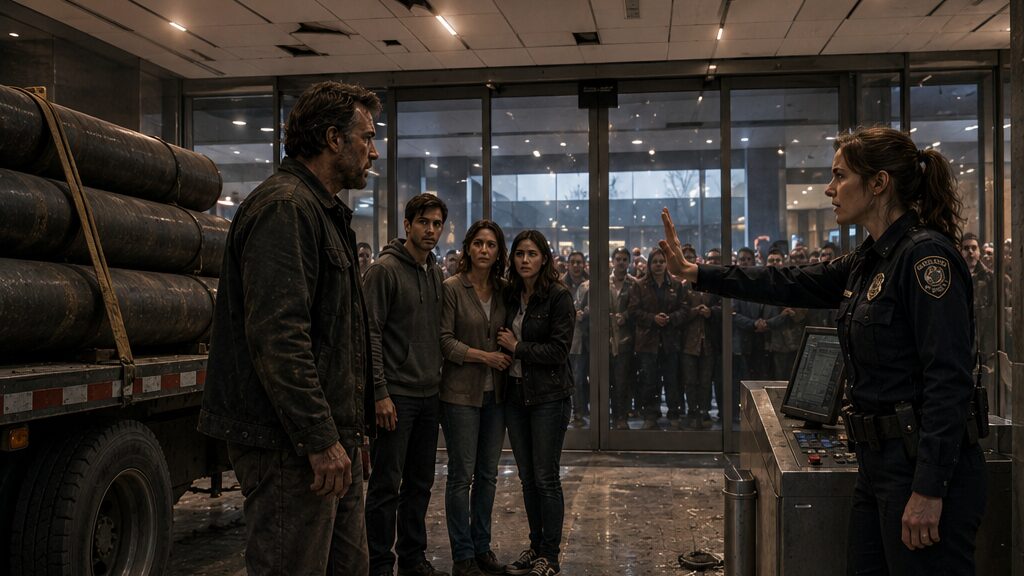
Near the front of the crowd stood a massive electronic sliding-door system that opened into the main parking area.
Hundreds of people pushed toward it.
The doors remained closed.
At first nobody noticed.
Then somebody hit the glass.
“Open!”
Others joined.
The crowd thickened.
The doors never moved.
David pushed closer.
A young supervisor wearing a security badge stood near a control station.
Ashley Taylor.
She looked terrified.
Not calm.
Not authoritative.
Terrified.
Yet somehow she was still trying to act in control.
“Please move back!” she shouted.
Nobody listened.
A loud crash echoed from somewhere deeper inside the mall.
Several people screamed.
The crowd surged again.
The doors remained shut.
“What are you doing?” a man shouted at Ashley.
“Open them!”
“The system is locked down,” Ashley said.
Her voice cracked.
“It’s automatic.”
A piece of ceiling crashed onto the floor fifty yards behind the crowd.
The sound silenced everyone for half a second.
Then panic exploded again.
David reached the front.
“Can they be opened manually?”
Ashley stared at the control screen.
Her hands shook.
“I’m trying.”
The answer sounded wrong.
Not because of what she said.
Because of how she said it.
David had spent twenty years around emergencies, construction sites, damaged roads, and equipment failures.
He recognized hesitation.
Ashley wasn’t trying.
She was afraid to try.
Another violent tremor shook the building.
The crowd screamed again.
People pressed harder against the sealed doors.
Glass rattled.
Still nothing happened.
Then came the first injuries.
An elderly man lost his footing during the surge and fell.
Several people stumbled over him before others pulled him clear.
A child struck her head against a metal railing.
Blood appeared.
Not much.
Enough.
Enough to turn fear into something worse.
David helped lift the older man upright.
“You okay?”
The man nodded weakly.
Around them, dozens of phones were recording.
Nobody wanted a souvenir.
People were recording because they were scared.
Scared enough to believe evidence might matter later.
David looked through the glass doors.
Outside looked perfectly reachable.
Just yards away.
Freedom sat on the other side of the barrier.
Yet nobody could get there.
The gate suddenly felt less like a door and more like a wall.
Another crash thundered through the mall.
Dust drifted from overhead.
David followed the sound.
A long crack had appeared across a support column.
His stomach tightened.
This wasn’t isolated damage.
Something bigger was failing.
He returned his attention to Ashley.
“What exactly happened?”
“The system entered emergency lockdown.”
“Why?”
“I don’t know.”
“You don’t know?”
“The building control center hasn’t responded.”
That answer chilled him more than the shaking floor.
No response meant nobody was running the building.
No response meant they were on their own.
People began pounding on the glass.
A woman near the front cried openly.
Others shouted threats.
Ashley stepped backward from the control station.
The screen flashed warning messages.
None of them helped.
Then a security guard came running from another corridor.
His face was pale.
“South exits are sealed too.”
Silence swept through the people nearest him.
“What?”
“The emergency corridor is blocked.”
Someone cursed.
Someone else started praying.
David felt the situation shift.
Not inconvenience.
Not delay.
Trap.
The realization spread through the crowd almost instantly.
Every visible escape route had failed.
The mall shook again.
This time a hanging light fixture crashed to the floor.
People screamed and pushed harder.
The doors shuddered from the pressure.
Still they remained closed.
David looked back toward the loading area.
Toward his truck.
Toward twenty tons of steel pipes.
The thought came and disappeared almost immediately.
Not yet.
There had to be another solution.
There had to be.
The building groaned.
Metal somewhere deep inside the structure shrieked.
Ashley stared at her monitor.
David stepped beside her.
“Can you override it?”
Her eyes darted toward him.
Then away.
For the first time he saw something hidden beneath her fear.
Not confusion.
Resistance.
“I need authorization.”
The words sounded absurd.
David frowned.
“Authorization from who?”
Ashley swallowed.
Her answer came after a long pause.
“I can’t open it without approval.”
Behind them another section of ceiling collapsed.
The crowd erupted.
And David realized the question that now mattered wasn’t whether the doors could open.
It was why Ashley Taylor was refusing to do it.
Chapter 2: Waiting for Authorization
The crowd had stopped asking politely.
People were shouting now.
Demanding.
Begging.
Threatening.
Every minute the mall grew louder.
Every minute the building looked less stable.
Ashley stood behind the control station like it was the last thing keeping her upright.
“Open the doors!” someone yelled.
“You can’t keep us here!”
A woman slammed both palms against the glass.
Another man pointed toward the widening crack running across the ceiling.
David stayed near the front.
Watching.
Listening.
Trying to understand.
The alarms never stopped.
Neither did the shaking.
Ashley stared at the monitor.
“I’ve already sent requests.”
“Requests to who?” David asked.
“Corporate.”
“Corporate where?”
“Head office.”
The answer triggered angry laughter from nearby shoppers.
“You’re emailing people?” someone shouted.
“The building is falling apart!”
Ashley flinched.
But she didn’t move away from the screen.
“I have procedures.”
David rubbed dust from his forehead.
“What procedures matter if people are trapped?”
Ashley looked at him.
For a second he thought she might finally break.
Instead she repeated herself.
“I need authorization.”
The phrase sounded rehearsed.
Like something she’d repeated so often she no longer heard how ridiculous it sounded.
A sharp crack echoed overhead.
Several people ducked instinctively.
Pieces of plaster rained down.
Children cried harder.
Near the edge of the crowd, Emma Williams was trying to calm two terrified kids.
Her hands trembled.
One child clung to her arm.
The other wouldn’t stop asking whether they were going to die.
Emma had no answer.
David heard the question anyway.
It landed heavily.
Because nobody did.
A maintenance door suddenly opened nearby.
A man in a reflective work vest emerged.
Benjamin Green.
David recognized him from the loading area.
Benjamin looked exhausted.
Sweat covered his face despite the air-conditioning.
He moved toward Ashley.
“We need to talk.”
Ashley shook her head immediately.
“Not now.”
“Now.”
Something in Benjamin’s voice caught David’s attention.
Ashley pulled him aside.
They spoke quietly.
Too quietly.
David edged closer.
“…manual system…” Benjamin whispered.
“…can’t…” Ashley replied.
“…can…”
The rest disappeared beneath the noise.
David watched Ashley’s expression harden.
Benjamin looked frustrated.
Then defeated.
He walked away.
David followed him.
“What was that about?”
Benjamin hesitated.
“I shouldn’t be talking.”
“Try me.”
The maintenance technician glanced over his shoulder.
Making sure Ashley wasn’t listening.
“There is an override.”
David stared at him.
“What?”
Benjamin lowered his voice further.
“There is a manual override.”
The words seemed impossible.
David looked back toward the control station.
“If that’s true, why are those doors still closed?”
Benjamin’s jaw tightened.
“Because activating it requires responsibility.”
“What does that mean?”
“It means if something goes wrong, somebody gets blamed.”
David felt anger rising.
“So people stay trapped because somebody might get blamed?”
Benjamin didn’t answer.
That answer was enough.
Hope appeared briefly among the frustration.
The doors weren’t impossible to open.
Someone had chosen not to open them.
But the hope didn’t last.
A few minutes later the building’s public announcement system died.
The speakers crackled.
Then silence.
Cell phone signals became unreliable.
Calls dropped.
Messages failed.
Communication outside the building began disappearing.
Panic deepened.
Ashley repeatedly refreshed her screen.
Waiting.
Watching.
Hoping.
For what?
An email.
A response.
Permission.
David could hardly believe it.
The crowd learned about the manual override quickly.
Information traveled faster than any announcement.
Soon people were confronting Ashley directly.
“Use it.”
“Open the doors.”
“What are you waiting for?”
Ashley backed away from the growing pressure.
“I don’t have approval.”
A man laughed bitterly.
“Approval from a corpse?”
Nobody found the joke funny.
Another violent tremor shook the floor.
A storefront window shattered.
People screamed.
Emma pulled her children behind a concrete pillar.
Dust filled the air.
David saw Benjamin staring toward the ceiling.
The technician looked frightened now.
Truly frightened.
Not worried about policy.
Worried about survival.
That scared David more than anything Ashley had said.
Because Benjamin understood the building.
If he was scared, everyone should be.
Ashley suddenly raised her voice.
“Listen to me!”
The crowd quieted just enough.
“The emergency lockdown protocol protects lives and property. Unauthorized access could create additional hazards.”
Nobody responded.
The statement felt detached from reality.
As if she were reading from a training manual while the world collapsed around her.
David stepped forward.
“Then use the override.”
Ashley looked directly at him.
Fear flashed across her face.
Then something else.
Pride.
Defensiveness.
The desperate need not to be wrong.
“I won’t.”
“Why?”
“Because I don’t have authorization.”
David shook his head.
“That’s not a reason anymore.”
Ashley pointed toward the sealed doors.
Her voice rose.
“If anyone damages that system, they’ll be personally liable.”
The crowd stared.
Even now she was talking about liability.
The building groaned.
The floor trembled.
And Ashley Taylor’s greatest fear seemed to be paperwork.
David looked at the doors.
Then at the people trapped behind them.
Then back at Ashley.
For the first time he wondered whether she wasn’t hiding a technical problem.
Maybe she was hiding fear.
And fear, unlike machinery, didn’t have an override switch.
Chapter 3: The Cost of Doing Nothing
The support beam collapsed with a sound like a tree splitting apart.
People ran before the dust even reached them.
A section of ceiling crashed into a jewelry store.
Glass exploded across the floor.
The entire concourse shook violently.
David grabbed a railing to stay upright.
Someone screamed for help.
Someone else shouted for a medic.
The mall was no longer threatening to fail.
It was failing.
Right now.
Right in front of them.
Benjamin stared upward.
His face drained of color.
“That’s load-bearing.”
David didn’t need an engineering degree to understand the meaning.
The technician’s voice told him everything.
Time was running out.
Fast.
The crowd surged toward the entrance again.
More people were arriving from deeper inside the mall.
Every corridor seemed to be feeding into the same trap.
The same sealed gate.
The same impossible bottleneck.
Emma struggled through the crowd carrying one child while dragging the other.
The younger one was crying uncontrollably.
The older one kept looking at the ceiling.
Watching.
Waiting.
David hated that look.
Children should never learn to watch ceilings for danger.
Benjamin moved quickly toward the control station.
This time he didn’t lower his voice.
“Ashley. We need the override now.”
Ashley remained frozen beside the monitor.
“No.”
Benjamin blinked.
“What do you mean, no?”
“I mean no.”
“The structure is failing.”
“I know.”
“People are trapped.”
“I know.”
“Then use it.”
Ashley gripped the edge of the console.
Her knuckles whitened.
David suddenly noticed something.
She wasn’t calm.
She wasn’t stubborn.
She was terrified.
Not of the building.
Of the decision.
“I can’t,” she whispered.
Benjamin stared at her.
“Can’t or won’t?”
Ashley looked away.
The silence answered.
The technician laughed once.
Not because anything was funny.
Because disbelief had nowhere else to go.
“The override works,” he said.
Several people nearby heard him.
The words spread instantly.
Like fire.
The override works.
The override works.
The override works.
The crowd erupted.
Everything changed.
The question was no longer whether escape was possible.
The question was why Ashley refused.
And she had no answer that sounded reasonable anymore.
People surrounded the control station.
Shouting.
Demanding.
Some pleaded.
Others threatened.
Emma stepped forward.
Tears streaked through the dust on her face.
“My children are here.”
Ashley swallowed.
“I know.”
“Then open it.”
“I can’t.”
“Why?”
Ashley’s voice broke.
“If I activate the override and something goes wrong, they’ll blame me.”
The crowd stared.
For a moment even the panic paused.
Because the truth sounded smaller than the disaster around them.
Smaller.
And somehow uglier.
David understood then.
This was never about technology.
It was about fear.
Fear of losing a job.
Fear of being punished.
Fear of making the wrong choice.
Fear had become its own locked gate.
Another crash interrupted everything.
A large section of decorative wall collapsed.
People scattered.
Several families became trapped behind fallen debris.
Screams filled the concourse.
David reacted automatically.
He rushed toward the blockage.
Others followed.
Together they lifted broken panels and twisted metal.
A narrow gap opened.
Emma pulled her children through first.
More survivors followed.
But every rescue cost time.
And time was disappearing.
David looked toward the entrance.
Toward the massive electronic doors.
Toward his truck visible through the haze of dust.
The steel pipes sat motionless.
Heavy.
Solid.
Capable of breaking things.
The thought returned.
This time it didn’t leave.
He hated it.
Because he knew what it meant.
Destroying the gate could cost him everything.
His truck.
His job.
His savings.
His future.
Yet every minute spent arguing had already cost something too.
Lives.
Opportunities.
Time.
Benjamin approached him.
Quietly.
“We don’t have much left.”
David nodded.
The technician followed his gaze toward the truck.
Understanding arrived instantly.
Neither man spoke.
Neither needed to.
The idea existed now.
Real.
Dangerous.
Possible.
A deep groan rolled through the building.
The floor trembled again.
Above them, new cracks spread toward the front entrance.
Toward the gate.
Toward the place everyone needed to reach.
David stared at the sealed barrier.
Not as a door.
Not as property.
As an obstacle.
A physical thing standing between life and death.
And for the first time he allowed himself to wonder whether saving everyone might require destroying it.
Chapter 4: The Million-Dollar Threat
“Nobody touches that gate.”
Ashley’s voice cut through the noise.
David turned from the entrance and saw her standing between the crowd and the control station. Dust coated her uniform. Her hair had come loose. She looked exhausted.
But she still wasn’t moving.
Another tremor rolled through the mall.
The electronic doors rattled in their tracks.
People flinched.
Ashley pointed toward the entrance.
“If anybody damages that system, they’ll be held personally responsible.”
The crowd stared at her.
A woman laughed in disbelief.
A man shouted something David couldn’t hear.
Nobody seemed interested in liability anymore.
Not with the building threatening to come down around them.
David walked toward Ashley.
“You hear what’s happening behind us?”
“I do.”
“Then open it.”
“I can’t.”
“You can.”
“I can’t.”
The argument felt absurd now.
Like arguing about parking rules inside a burning house.
Ashley glanced toward the control screen again.
Still waiting.
Still hoping for authorization.
Still believing somebody somewhere would solve the decision for her.
David followed her gaze.
The monitor showed failed connection attempts.
No response.
No approval.
No miracle email.
Nothing.
Benjamin approached from behind.
“We lost another support section.”
Ashley’s face tightened.
“The engineers will know what to do.”
Benjamin stared at her.
“What engineers?”
The question landed hard.
For the first time Ashley had no answer.
Benjamin shook his head.
“They evacuated before us.”
Silence.
The realization spread.
There was no higher authority coming.
No supervisor.
No executive.
No engineer.
No rescue coordinator hidden somewhere behind a screen.
Only the people trapped inside the building.
Only the choices they made.
A loud crash echoed from deeper in the mall.
The floor vibrated.
Dust poured from a ventilation shaft.
Several shoppers screamed.
Emma grabbed her children and moved them closer to the entrance.
Toward the gate.
Toward the one thing standing between them and safety.
David watched Ashley carefully.
Fear was all over her face now.
Not fear of collapse.
Fear of consequences.
Fear of ownership.
Fear of making a decision she could never undo.
He suddenly remembered another day.
Another emergency.
Years ago.
A highway accident during a storm.
A car trapped beneath an overturned trailer.
David had stopped.
Others had stopped too.
Everyone waited for professionals.
Everyone waited for someone more qualified.
By the time help arrived, it had been too late.
He still remembered standing beside the wreckage afterward.
Remembered wondering whether acting sooner might have changed something.
That memory had never fully left him.
The regret lived quietly inside him.
Most days he could ignore it.
Not today.
Today it stood beside him.
Watching.
Demanding an answer.
Another crack exploded overhead.
The crowd ducked.
A section of decorative stone smashed onto the floor twenty yards away.
The sound echoed through the concourse.
Benjamin cursed under his breath.
Emma pulled her children behind a pillar.
David looked toward his truck again.
The flatbed sat exactly where he had left it.
Massive.
Heavy.
Loaded with steel pipes thick enough to break concrete.
A dangerous idea.
A possible solution.
A terrible solution.
He hated how reasonable it was becoming.
Ashley suddenly pointed at him.
As if reading his thoughts.
“You are not thinking about damaging that gate.”
David didn’t answer.
“You can’t.”
He still didn’t answer.
Ashley’s voice rose.
“That entrance system cost two million dollars.”
Nobody reacted.
Not the way she expected.
She sounded detached from reality.
People were bleeding.
Children were crying.
Concrete was falling from the ceiling.
And she was talking about replacement costs.
“If you scratch the paint,” Ashley shouted, “I will sue you into bankruptcy.”
The crowd went silent.
Not because they were intimidated.
Because they couldn’t believe what they were hearing.
David looked at her.
For a brief moment he saw the person beneath the authority.
A frightened employee.
Someone who had spent her entire career learning that mistakes were punished.
Someone who genuinely believed doing nothing was safer than doing the wrong thing.
It almost made him feel sorry for her.
Almost.
Then another support beam groaned.
The sound rolled through the building like distant thunder.
Benjamin looked up.
His expression changed immediately.
“We have minutes.”
Ashley froze.
“What?”
“We have minutes.”
Not hours.
Not time to debate.
Minutes.
The crowd heard him.
Panic surged again.
People pushed toward the entrance.
Toward the gate.
Toward survival.
David felt the decision approaching.
Heavy.
Unavoidable.
He walked past Ashley.
Past the crowd.
Toward the loading concourse.
Someone called after him.
He didn’t stop.
His boots echoed against cracked tile.
The truck waited in the haze.
Dust drifted through shafts of emergency lighting.
The steel pipes sat secured behind the cab.
David placed a hand against the driver’s door.
His heart hammered.
This truck represented years of work.
Years of payments.
Years of sacrifice.
Destroying the gate might destroy the truck too.
And if Ashley was right, the lawsuits could finish the rest.
He closed his eyes briefly.
Then opened them.
Behind him another section of the mall collapsed.
The screams that followed erased every remaining doubt.
David climbed into the driver’s seat.
Chapter 5: Then Sue Me
The engine roared to life.
Heads turned across the concourse.
The sound cut through alarms, shouting, and collapsing concrete.
David gripped the steering wheel.
The truck vibrated beneath him.
Ahead stood the sealed gate.
Behind it stood freedom.
Behind him stood hundreds of trapped people.
The choice no longer felt complicated.
Only expensive.
Only dangerous.
Only necessary.
The truck rolled forward.
Slowly at first.
People moved aside.
Confused.
Watching.
Benjamin was the first to understand.
His eyes widened.
“Oh no.”
Then he corrected himself.
“Oh yes.”
The maintenance technician began waving people away from the entrance.
“Move back!”
The crowd looked from Benjamin to the truck.
Then realization spread.
David wasn’t waiting anymore.
Emma saw it too.
She gathered her children and hurried toward the side of the concourse.
Others followed.
The movement became contagious.
Within moments dozens of people were clearing space.
A path opened between the truck and the gate.
Ashley rushed forward.
“No!”
David kept driving.
She stepped into the lane.
He stopped.
Not because she ordered him to.
Because he wasn’t willing to hit her.
Ashley reached the driver’s door.
“You cannot do this.”
David looked down at her.
Concrete dust covered everything.
Even her authority.
“If you damage that property—”
David interrupted.
“People are trapped.”
“I know.”
“Then move.”
“You’ll destroy it.”
Another violent tremor shook the building.
The ceiling groaned.
David looked past her toward the crowd.
Emma was holding both children tightly.
Benjamin was helping an injured man stay upright.
Every face carried the same question.
Are we getting out?
Or not?
Ashley slammed her hand against the truck.
“You’ll lose everything.”
David believed her.
That was the worst part.
She might be right.
He looked at the steering wheel.
At the scarred dashboard.
At the truck that had paid his bills for years.
The truck that represented his future.
His stomach tightened.
For one dangerous second doubt returned.
Then a section of ceiling collapsed behind the crowd.
The impact knocked several people to the ground.
Screams erupted.
Dust exploded through the concourse.
The decision ended there.
David looked back at Ashley.
“Then sue me.”
He pressed the accelerator.
The truck surged forward.
Ashley jumped clear.
The crowd scattered toward the walls.
The engine thundered.
Steel pipes rattled against their restraints.
The gate rushed closer.
Fifty feet.
Forty.
Thirty.
The building shuddered again.
A crack raced across the floor beneath the truck.
Twenty feet.
Ten.
David tightened his grip.
The electronic doors filled the windshield.
Then impact came.
The crash sounded enormous.
Metal screamed.
Glass exploded outward.
The front of the truck slammed through the entrance.
Steel pipes punched into the door system.
Panels twisted.
Tracks tore free.
The gate folded under the force.
For a moment everything disappeared inside dust and noise.
Then daylight appeared.
Bright.
Open.
Real.
The barrier was gone.
A stunned silence lasted half a second.
Then someone shouted.
“GO!”
The crowd surged forward.
Families.
Workers.
Shoppers.
Children.
Everyone ran toward the opening.
Toward air.
Toward survival.
David climbed from the truck.
The front end was destroyed.
Twisted metal hung from the shattered entrance.
The truck looked wounded.
Maybe finished.
He barely noticed.
People were escaping.
That was enough.
Emma ran past holding her children.
One of them looked back.
Not frightened anymore.
Just running.
Just alive.
The sight hit harder than the collision.
A deep rumble rolled through the building.
Much louder than before.
David turned.
The mall was failing.
Rapidly.
Chunks of concrete crashed into the concourse they had occupied moments earlier.
Benjamin grabbed David’s arm.
“Move!”
Together they ran through the breach.
Hundreds poured through the ruined gate.
The last of them crossing into daylight as the structure behind them continued to collapse.
David stumbled outside and looked back.
The destroyed entrance stood twisted and broken.
The gate was gone.
The obstacle was gone.
The choice had been made.
But one question remained.
Had they escaped in time?
Chapter 6: Seconds Before Impact
The answer arrived with another collapse.
The section of concourse nearest the entrance crumpled inward less than a minute after the last survivors crossed through the breach.
A collective gasp spread across the crowd gathered outside.
People stared.
Nobody needed an engineer to explain what they were seeing.
If the gate had remained closed, hundreds would have been trapped inside when that section failed.
David stood beside his ruined truck and watched dust billow from the damaged structure.
His pulse still hadn’t slowed.
Children cried.
Parents hugged each other.
Emergency sirens wailed in the distance.
The worst seemed over.
Then Ashley appeared.
And brought a new problem with her.
She marched toward the truck.
Toward David.
Toward the shattered entrance.
“You destroyed private property.”
David blinked.
For a moment he thought he had misheard.
Around them survivors stared in disbelief.
Ashley pointed toward the wreckage.
“That was unauthorized destruction.”
Benjamin laughed openly.
Nobody joined him.
The situation wasn’t funny.
It was unbelievable.
“You could have killed people,” Ashley continued.
“You mean saved them,” Benjamin said.
“I mean committed a crime.”
David looked at her.
The building had nearly buried them alive.
And she was still talking about procedures.
Still talking about rules.
Still trying to place the gate above the people who escaped through it.
Police vehicles arrived.
Fire crews followed.
Paramedics rushed toward the injured.
The scene became organized chaos.
Ashley immediately approached an officer.
David couldn’t hear every word.
But he caught enough.
Property damage.
Liability.
Unauthorized actions.
Arrest.
The officer’s expression grew increasingly puzzled.
Meanwhile survivors gathered nearby.
Watching.
Listening.
Emma stepped forward first.
“He saved us.”
Others nodded.
More voices joined.
The story spread quickly.
The gate had been closed.
The override had never been used.
People had begged.
The truck had opened the way out.
Witness after witness repeated the same version.
Not perfectly.
But consistently.
A paramedic examined David’s shoulder.
Minor injuries.
Nothing serious.
As the treatment finished, Benjamin approached carrying a phone.
“You should see this.”
David frowned.
The maintenance technician turned the screen toward him.
Video.
Recorded inside the mall.
The footage showed Ashley refusing requests.
Refusing demands.
Refusing pleas.
The audio was clear.
The crowd sounded desperate.
Ashley sounded frightened.
And stubborn.
Emma appeared beside them.
“I recorded some of that.”
She held up her own phone.
“So did dozens of others.”
David watched silently.
The evidence wasn’t dramatic.
It was worse.
Ordinary.
No conspiracy.
No secret plot.
Just a person repeatedly choosing procedure over people.
The officer who had spoken with Ashley returned.
His attention shifted from David to the videos.
He watched several clips.
Then another.
Then another.
His expression changed.
Not anger.
Understanding.
The truth was becoming easier to see.
Yet uncertainty remained.
Investigations would follow.
Reports would be written.
Lawyers would appear.
David knew enough about the world to understand that doing the right thing didn’t guarantee protection.
He looked at his truck.
The front end was crushed.
The cab damaged.
The vehicle that paid his bills might never drive again.
The rescue had a cost.
A real one.
As emergency crews secured the area, news helicopters appeared overhead.
Cameras arrived.
Reporters followed.
The story was growing larger.
Much larger.
Ashley stood alone near a police vehicle.
No longer commanding.
No longer directing.
Just waiting.
For the first time she seemed to understand that her decisions had consequences too.
Benjamin looked at his phone again.
Then frowned.
“What?”
The technician turned the screen.
A new upload had appeared.
One of the videos.
Already spreading.
Already gathering views.
Already moving beyond the parking lot.
Beyond the city.
Beyond anyone’s control.
David stared at the screen.
The first comments were arriving.
The first shares.
The first reactions.
The story had escaped the mall.
And by morning, the entire country might be watching.
Chapter 7: What the Camera Recorded
By sunrise, the video had been viewed more than three million times.
David discovered that while sitting in a folding chair outside an insurance assessment yard, staring at what remained of his truck.
The vehicle looked worse in daylight.
The front end had been crushed nearly flat.
Bent steel hung from twisted supports.
Broken glass covered the cab floor.
A mechanic walked around it slowly before shaking his head.
David didn’t ask what that meant.
He already knew.
The truck had survived the collision.
Whether it would survive financially was another matter.
His phone buzzed.
Again.
And again.
Messages.
Calls.
Interview requests.
David ignored most of them.
The attention felt strange.
Uncomfortable.
He hadn’t driven through the gate to become famous.
He had driven through it because there had been no time left.
Benjamin sat nearby scrolling through his own phone.
“You should see this.”
David sighed.
“Another reporter?”
“Worse.”
Benjamin handed him the screen.
The video filled it.
Not the version David had seen the previous day.
A longer version.
Multiple angles edited together.
Clearer audio.
Clearer context.
The footage showed people begging.
It showed children crying.
It showed debris falling from the ceiling.
And it showed Ashley.
Over and over.
Refusing.
Not once.
Not twice.
Repeatedly.
The most replayed clip lasted only eleven seconds.
Ashley standing beside the control panel.
A woman shouting that people were trapped.
Ashley answering:
“I need authorization.”
The phrase had become a symbol overnight.
Comment sections were filled with it.
News channels replayed it continuously.
Talk shows debated it.
Experts discussed emergency procedures.
Lawyers discussed liability.
Former corporate employees discussed workplace cultures that punished initiative.
The story was no longer about a mall.
It had become something larger.
David handed the phone back.
Benjamin watched him.
“You okay?”
“No.”
Benjamin nodded.
“Me neither.”
The maintenance technician looked tired.
Not physically.
Emotionally.
People had begun calling him too.
Investigators.
Journalists.
Corporate lawyers.
Everyone wanted details.
Everyone wanted explanations.
Everyone wanted to understand how something so simple had become so dangerous.
A black SUV pulled into the lot.
Two people stepped out.
Neither wore emergency uniforms.
Neither carried cameras.
Corporate representatives.
David recognized them immediately.
One approached.
“Mr. Carter?”
David stood.
The woman offered a hand.
He didn’t take it.
She lowered it awkwardly.
“We’d like to discuss yesterday.”
“Why?”
Her smile faded.
“The company is conducting an internal review.”
Benjamin laughed from his chair.
The sound wasn’t friendly.
The woman ignored him.
“We believe there were communication failures.”
David stared at her.
Communication failures.
Interesting phrase.
A way to describe the event without mentioning choices.
Without mentioning responsibility.
Without mentioning the gate.
Or the people.
Or the collapse.
The woman continued.
“Management followed established procedures.”
Benjamin stood up.
“That’s exactly the problem.”
The representatives left soon afterward.
Neither side gained anything from the conversation.
But the encounter revealed something important.
The company was already trying to control the narrative.
Unfortunately for them, the narrative had escaped.
By midday the situation worsened.
For the company.
Not for David.
Financial news channels began covering the story.
The footage kept spreading.
Every replay made the corporation look worse.
Investors reacted.
Customers reacted.
Employees reacted.
Stock analysts reacted.
Benjamin called David that afternoon.
“You watching this?”
“No.”
“You should.”
David turned on a television inside a waiting room.
A financial network filled the screen.
A banner crawled across the bottom.
Questions About Emergency Response Trigger Investor Concerns.
A commentator described the viral footage.
Another mentioned the collapsing share price.
David watched numbers move downward.
Millions.
Then billions.
Market value disappearing.
Not because of the collapse itself.
Because people hated what they saw afterward.
They saw someone protecting policy while people begged for help.
And they recognized it.
Not just from this story.
From workplaces.
Hospitals.
Offices.
Agencies.
Everywhere.
The gate had become a symbol.
The stock kept falling.
By evening the board of directors held an emergency meeting.
News outlets reported every detail.
Executives issued statements.
Then revised them.
Then issued new statements.
None helped.
The footage remained.
Simple.
Unedited.
Undeniable.
Late that night Emma called.
David almost didn’t answer.
Then he recognized her name.
“Hello?”
“Hi.”
She sounded nervous.
“You remember me?”
David smiled slightly.
“You were hard to forget.”
One of Emma’s children shouted something in the background.
For the first time since the collapse, the sound felt ordinary.
Normal.
Alive.
“I wanted to thank you,” she said.
“You already did.”
“No. Not really.”
Silence lingered.
Then she continued.
“My son keeps asking about the truck.”
David glanced through the window toward the damaged vehicle.
“Does he?”
“He thinks it saved everybody.”
David didn’t know what to say.
Emma filled the silence.
“He’s probably right.”
After the call ended, David sat quietly.
Not because he wanted attention.
Not because he wanted praise.
But because hearing children in the background changed something.
The truck wasn’t the story.
The gate wasn’t the story.
The people were.
The next morning the company announced the dissolution of the entire mall management team.
Executives were removed.
Investigations expanded.
Emergency reviews began.
The announcement dominated every news cycle.
Benjamin called again.
“Looks like somebody finally got authorization.”
For the first time in days, David laughed.
But before the day ended, another story began spreading.
Not about the company.
Not about Ashley.
Not about the collapse.
About him.
And by evening, a new website appeared online with a simple message.
Let’s help rebuild the truck that saved our neighbors.
Chapter 8: The Gate That Saved Lives
The fundraiser crossed five hundred thousand dollars before David even saw it.
He stared at the screen in disbelief.
Then refreshed.
The number climbed again.
Five hundred twenty thousand.
Five hundred twenty-eight thousand.
Five hundred forty thousand.
The donations arrived faster than he could read them.
Five dollars.
Twenty dollars.
One hundred.
Small amounts from strangers.
Messages accompanied many of them.
For the truck.
For doing the right thing.
For my family.
For my son.
For all of us.
David set the phone down.
It felt unreal.
The collapse had happened only days earlier.
Yet somehow the story kept growing.
Benjamin visited that afternoon.
He found David standing beside the damaged truck.
The vehicle sat inside a repair facility now.
Still broken.
Still silent.
“You look confused.”
“I am confused.”
Benjamin laughed.
“Good. Means you’re normal.”
David handed him the phone.
Benjamin whistled softly.
“That’s a lot of money.”
“It doesn’t feel like mine.”
“Maybe because it isn’t.”
David frowned.
Benjamin nodded toward the screen.
“It belongs to everybody who got out.”
The statement stayed with him.
Because it felt true.
Later that week a community gathering was organized near the edge of town.
David tried to avoid it.
That plan lasted until Emma called.
Then Benjamin called.
Then three different local organizers called.
Eventually surrender became easier than refusing.
The event took place in a large outdoor pavilion.
Far larger than David expected.
When he arrived, hundreds of people were already there.
Families.
Workers.
Store employees.
Emergency responders.
People he recognized.
People he didn’t.
At the center stood something unexpected.
Part of the gate.
The twisted remains of the entrance structure had been salvaged and transported there.
Bent steel.
Broken tracks.
Shattered mechanical components.
The obstacle that had trapped them all.
Now displayed openly.
David stared at it.
Days earlier it had represented fear.
Now it looked small.
Powerless.
A crowd gathered as he approached.
The attention made him uncomfortable.
He preferred engines to microphones.
Concrete to speeches.
Simple problems to public recognition.
Emma found him first.
Her children ran ahead.
The younger one stopped beside the twisted steel.
“That’s it?”
David smiled.
“That’s it.”
The child looked disappointed.
“It looked bigger.”
“It did.”
The answer earned a laugh.
Not because it was funny.
Because everyone understood.
Fear had made the gate enormous.
Distance had shrunk it.
The ceremony began.
Short speeches.
Brief acknowledgments.
Nothing excessive.
People seemed to understand what David valued.
One by one survivors shared stories.
A store employee described being trapped near the front entrance.
An elderly man described falling during the panic.
A parent described carrying a child through the breach seconds before debris collapsed behind them.
Each account added another layer.
Another reminder.
Another life.
The event wasn’t about heroism.
It was about consequences.
The consequences of action.
And inaction.
Then Emma stepped forward.
She held her phone in one hand.
“The video changed a lot of things,” she said.
“It exposed mistakes.”
She glanced toward the twisted gate.
“But that isn’t why I kept it.”
The crowd listened.
“My children watched that truck come through the doors.”
Emotion briefly caught in her voice.
“They learned something important that day.”
Silence settled across the gathering.
Emma continued.
“They learned that responsibility isn’t always assigned. Sometimes it’s chosen.”
David looked away.
Not because he disagreed.
Because hearing it spoken aloud felt heavier than living it.
Later the organizers announced the fundraiser total.
The number appeared on a large screen.
One million dollars.
The crowd erupted.
Applause rolled through the pavilion.
David stood motionless.
The amount felt impossible.
Repair costs.
Replacement costs.
Future costs.
All erased.
Not by a corporation.
Not by a legal settlement.
By people.
Thousands of them.
Benjamin leaned close.
“Looks like your truck is getting a second chance.”
David nodded slowly.
Maybe it was.
Maybe he was too.
As the gathering wound down, families wandered among the displays.
Children played.
Conversations replaced speeches.
The twisted steel gate remained in the center.
No longer a barrier.
Just a reminder.
David stood before it one final time.
Days ago it had represented everything that had gone wrong.
Fear.
Delay.
Authority without responsibility.
Now it represented something else.
A choice.
One person deciding that waiting had become more dangerous than acting.
Emma’s children waved goodbye as they left.
Benjamin headed toward the parking area.
The crowd slowly dispersed.
For the first time since the collapse, quiet returned.
Not empty quiet.
Earned quiet.
David looked once more at the twisted steel.
Then turned away.
The gate had trapped hundreds of people.
But it hadn’t been the most dangerous thing inside that mall.
The most dangerous thing had been the belief that responsibility belonged only to someone else.
And that was the barrier he hoped people would remember breaking.
The story has ended.