The Day Rachel Moore Brought Her Son to Meet the Bronze Face of the Father Who Never Came Home
Chapter 1: The Boy Holding an Old Jacket
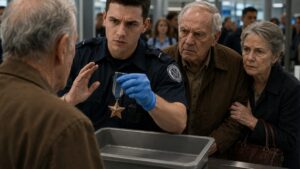
“I’m sorry, kid, but you can’t bring that old jacket in here.”
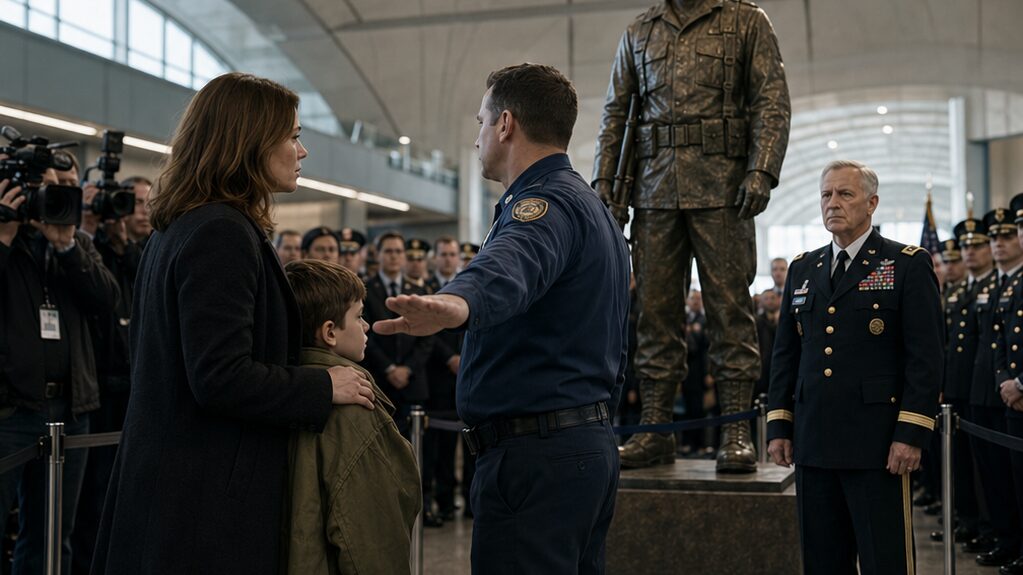
The security guard’s hand came down between Michelle Moore and the airport entrance rope.
Michelle stopped so suddenly that the sleeves of the oversized military jacket slipped from his arms and brushed the polished floor.
For a moment he simply stared.
The terminal around them surged with movement—travelers dragging suitcases, reporters carrying equipment, uniformed personnel crossing toward the secured wing of the airport.
Then the guard pointed at the jacket.
“Dress code strictly applies for today’s event.”
Rachel tightened her grip on her son’s shoulder.
“We aren’t attending as guests,” she said quietly. “We’re just passing through.”
The guard looked unconvinced.
The jacket was old enough to attract attention. The olive fabric had faded unevenly. The elbows were worn. One cuff had been repaired years ago by hand.
It looked nothing like the crisp uniforms moving through the terminal.
“Rules are rules,” the guard replied.
Michelle glanced up at his mother.
“Did I do something wrong?”
“No.”
Rachel forced a smile.
“You didn’t do anything wrong.”
The guard hesitated.
His expression softened for a second before hardening again.
“Look, ma’am. Security is tight today. Everybody’s being checked.”
Rachel nodded.
She had heard some version of that sentence all morning.
Everyone was following procedures.
Everyone was doing their job.
And every step of the way another door seemed to close.
She bent and adjusted the jacket around Michelle’s shoulders.
“Come on.”
They moved away from the entrance.
The humiliation should not have mattered.
The guard did not know them.
He could not know why the jacket mattered.
Yet Rachel felt the familiar sting anyway.
Not because she had been stopped.
Because Michelle had noticed.
The boy walked beside her in silence.
At seven years old he was old enough to recognize embarrassment.
Young enough not to understand it.
Above them, enormous banners hung from the terminal ceiling.
Photographs.
Military insignias.
Announcements welcoming guests to the memorial ceremony.
Rachel tried not to look.
She had spent months debating whether to make this trip.
Months telling herself it wasn’t necessary.
Months convincing herself she could wait another year.
Then Michelle had asked a simple question.
What did Dad look like when he was brave?
She had no answer.
Not one that felt big enough.
Pictures in albums had become ordinary.
Stories had become routine.
The distance between father and son seemed to grow larger every year.
That was why she was here.
Not for a ceremony.
Not for recognition.
For understanding.
A loudspeaker crackled overhead.
“Arrival operations will begin at eleven hundred hours.”
People immediately started moving faster.
More military personnel appeared.
Reporters gathered near temporary barriers.
The entire terminal seemed to lean toward one destination.
Rachel followed the flow of movement.
Not because she belonged there.
Because she needed to see where it led.
Michelle pointed.
“Mom?”
She followed his finger.
A massive black curtain covered something at the far end of the concourse.
The shape beneath it was unmistakably large.
A monument.
Or a statue.
Workers adjusted lights around it.
Camera crews tested angles.
Rachel quickly looked away.
Not yet.
She wasn’t ready.
“Can we go closer?” Michelle asked.
“Maybe later.”
His eyes lingered on the covered shape.
Then he looked down at the jacket.
“Do you think Dad wore this?”
Rachel smiled faintly.
“He wore it so much that I thought it would fall apart.”
Michelle grinned.
That answer pleased him.
The grin vanished when another airport employee stepped in front of them.
“Restricted access beyond this point.”
Rachel stopped.
“We only want to walk through.”
“Sorry.”
The employee pointed toward a side corridor.
“Visitors have to use the alternate route.”
The alternate route led away from the ceremony area.
Away from the monument.
Away from everything she had traveled hundreds of miles to reach.
Rachel thanked him anyway.
Then turned.
Again.
By the time they reached a public seating area, Michelle looked exhausted.
He climbed into a chair.
The oversized jacket pooled around him like a blanket.
Rachel sat beside him.
Across the terminal, television screens displayed promotional footage for the ceremony.
Names appeared.
Images appeared.
Historical photographs faded in and out.
Rachel froze.
One banner hanging from the ceiling carried a surname she knew better than her own.
MOORE.
The letters stretched across blue fabric.
Below them was a military insignia.
People walked beneath the banner without a second glance.
Rachel couldn’t stop looking.
Michelle followed her gaze.
“That’s our name.”
“Yes.”
“Why is our name up there?”
Rachel swallowed.
Because your father died carrying that name.
Because people built ceremonies around it.
Because somewhere along the way they forgot who still carried it.
Instead she said softly, “Your dad was important to some people.”
Michelle stared at the banner.
“How important?”
Rachel looked away.
That question was harder.
Not because she lacked answers.
Because none of them felt complete.
The boy had inherited stories.
Fragments.
Secondhand memories.
Old photographs.
A folded flag.
A jacket.
What he lacked was something real.
Something he could stand in front of and touch.
A reason to believe his father was more than a collection of words.
Airport announcements echoed through the terminal.
Uniformed guests continued arriving.
The ceremony was getting closer.
And Rachel felt time slipping away.
Maybe she should find someone.
Maybe she should explain.
Maybe she should finally tell people who she was.
But the thought immediately made her uncomfortable.
For years she had avoided that.
The widow of a hero.
The phrase never felt like hers.
It felt like borrowing attention that belonged to someone else.
Michelle tugged her sleeve.
“Mom?”
“Yes?”
He looked toward the distant ceremony preparations.
Toward the crowd.
Toward the hidden monument.
Then back at her.
His voice was small.
Curious.
Hopeful.
“Did Dad ever come here?”
Rachel stared at him.
And suddenly realized she didn’t know how to answer.
Chapter 2: The Ceremony They Were Not Invited To
The first military convoy arrived just before eleven.
People abandoned conversations and rushed toward viewing areas.
Reporters lifted cameras.
Airport staff straightened barriers.
A ripple of anticipation spread through the terminal.
Rachel rose from her seat.
“This way.”
Michelle followed immediately.
The crowd gave them cover.
For the first time all morning, nobody was paying attention to them.
The closer they moved toward the ceremony zone, the more obvious the separation became.
Guests with credentials entered one corridor.
Everyone else remained behind portable barriers.
Uniformed personnel checked identification badges.
Rachel slowed.
The entrance she needed was directly ahead.
Michelle looked up.
“Can we go in there?”
“I don’t know.”
The answer frustrated her.
She hated how many times she had said those words lately.
They approached a registration table.
A volunteer smiled politely.
“Invitation, please.”
Rachel shook her head.
“We don’t have one.”
The smile disappeared.
“Then you’ll need to watch from the public section.”
“I need to speak with someone organizing the ceremony.”
“Who?”
Rachel hesitated.
The truth sat right there.
I am Rachel Moore.
My husband is the reason this ceremony exists.
But she couldn’t force the words out.
“I just need a minute with a coordinator.”
The volunteer pointed toward a crowded operations area.
“Everyone’s busy right now.”
Rachel thanked him.
Another dead end.
Michelle leaned against her side.
“Mom, why didn’t they invite us?”
Rachel looked at him sharply.
The question hurt because she had asked herself the same thing for years.
She crouched beside him.
“Maybe they didn’t know where we lived.”
Michelle considered that.
“Couldn’t they ask?”
Rachel had no answer.
They continued walking.
Large display boards lined the concourse.
Historical photographs covered them.
Maps.
Military timelines.
Images from a battle years ago.
Rachel stopped in front of one photograph.
Several young soldiers stood beside a damaged transport vehicle.
Most were smiling.
One wasn’t.
Her husband.
His expression was serious even then.
Michelle stared.
“That’s him?”
“Yes.”
The boy stepped closer.
For several seconds he simply studied the photograph.
The shape of a nose.
The angle of a jaw.
The eyes.
Searching for himself inside a stranger.
“He looks like me.”
Rachel laughed softly.
“Actually, you look like him.”
A small smile appeared on Michelle’s face.
It stayed there as they continued.
The smile vanished when they reached another security checkpoint.
This one was stricter.
Additional personnel guarded the entrance.
A sign had been placed nearby.
AUTHORIZED CEREMONY ACCESS ONLY.
Rachel spotted a man carrying a headset and clipboard moving quickly between groups.
“Stay here.”
She approached him.
“Excuse me.”
The man turned.
Tired eyes.
Pressed uniform.
Constant motion.
“Can I help you?”
“I need to speak to someone about the memorial.”
“Which part?”
“The family portion.”
His expression became confused.
“Family portion?”
Rachel immediately regretted starting the conversation.
“Never mind.”
The man checked his watch.
“If you’re looking for seating information, guests need credentials.”
Then he hurried away.
Rachel watched him disappear into the crowd.
Michelle arrived beside her.
“You almost told him.”
She blinked.
“What?”
“You looked like you were going to say something.”
Children noticed more than adults realized.
Rachel managed a smile.
“Maybe.”
The loudspeakers shifted.
A recorded voice began describing the battle being commemorated.
People stopped to listen.
Rachel tried not to.
But one sentence caught her attention.
A rescue operation in the valley changed the course of the mission and saved dozens of lives.
Michelle looked up.
“Dad was there?”
“Yes.”
“Did he help?”
Rachel felt her throat tighten.
“He did.”
The boy nodded slowly.
As if assembling pieces of a puzzle.
Not complete.
But becoming clearer.
They followed the crowd toward the main viewing area.
The covered monument now stood fully illuminated.
Black fabric draped from top to bottom.
Its outline seemed larger than before.
More personal.
Rachel couldn’t look away.
Nearby plaques listed donors and committee members.
Names covered the metal surface.
Rachel recognized several immediately.
Men who had visited years ago.
People who had written letters.
Officers who had promised they would stay in touch.
Most eventually disappeared.
Not from cruelty.
Life simply moved forward.
The memorial remained.
The family remained.
Everything else faded.
Michelle squeezed her hand.
“Mom?”
“Yes?”
“Is that what we came for?”
He pointed at the enormous covered shape.
Rachel stared.
The answer felt dangerously close.
Too close.
If she said yes, she would have to explain why.
If she explained why, everything would change.
Before she could answer, an airport announcement echoed through the terminal.
“All attendees entering the memorial zone must present credentials immediately.”
Security barriers shifted.
Additional guards moved into position.
The opening she had been hoping for vanished.
The ceremony area became inaccessible.
Official.
Locked.
Rachel felt determination harden inside her.
She had spent years staying silent.
Years avoiding attention.
Years accepting distance.
For Michelle’s sake, she could not turn around now.
Then the black curtain stirred slightly in the airflow from a nearby ventilation system.
Only for a second.
But it was enough.
A glimpse of bronze appeared beneath it.
Rachel froze.
Her entire body went still.
The crowd continued moving around her.
But she saw only that small flash of metal.
The curve of a cheek.
The edge of a jawline.
A face hidden beneath cloth.
And suddenly she remembered exactly why she had come.
Chapter 3: The Name Hidden in Plain Sight
“Ma’am, you need to step back.”
The voice came from behind before Rachel realized how close she had moved to the barrier.
A security supervisor stood waiting.
Unlike the others, he wore the expression of someone already having a difficult day.
Rachel immediately backed away.
“Sorry.”
The supervisor pointed toward the public section.
“Ceremony access is restricted.”
“We aren’t trying to interfere.”
“Then please remain behind the barrier.”
People nearby had begun watching.
The attention made Rachel uncomfortable.
Michelle stepped closer to her.
Instinctively, she wrapped an arm around his shoulders.
The supervisor’s gaze settled on the old military jacket.
His eyes narrowed slightly.
Not hostile.
Judging.
Trying to place them.
Trying to decide whether they belonged.
Then he walked away.
The moment should have ended there.
Instead Rachel heard whispers.
A few people glanced toward them.
One reporter briefly aimed a camera in their direction before losing interest.
The embarrassment settled heavily in her chest.
Michelle tugged at the jacket sleeve.
“Maybe we should leave.”
The words hit harder than any confrontation.
Leave.
After all this distance.
After all these years.
Rachel shook her head.
“Not yet.”
The ceremony preparations accelerated.
Officials moved across the floor.
Military personnel formed organized lines.
A color guard assembled near the stage.
Somewhere ahead, the covered statue waited.
Then a familiar voice called out.
“Excuse me.”
Rachel turned.
The man with the headset and clipboard stood there again.
This time he wasn’t rushing.
“I’m Eric Sanchez,” he said. “Ceremony coordinator.”
Rachel recognized him immediately.
“You were busy earlier.”
“I still am.”
His smile was tired.
“But apparently you’re becoming a concern for security.”
Rachel almost laughed.
“That’s not my intention.”
“I figured.”
Eric looked toward Michelle.
Then toward the jacket.
Then back to Rachel.
“Can I ask why you’re here?”
The question lingered.
Rachel could have given a simple answer.
Instead she said, “My son wanted to learn about his father.”
Something changed in Eric’s expression.
Not recognition.
Interest.
“Was his father military?”
“Yes.”
“Connected to today’s ceremony?”
Rachel nodded.
Eric studied her for several seconds.
“You knew the soldier they’re honoring?”
The wording struck her.
Knew.
As though he were discussing a historical figure.
A distant legend.
Someone disconnected from ordinary life.
Rachel looked toward the covered monument.
Then answered.
“I married him.”
Eric blinked.
For a moment he simply stared.
The noise of the terminal seemed to fade.
“You what?”
“He was my husband.”
Silence.
Then confusion.
Then disbelief.
Eric glanced toward the stage.
Toward the monument.
Back to Rachel.
“The soldier being honored?”
“Yes.”
“You’re saying you’re Rachel Moore?”
She nodded.
His reaction was not what she expected.
Not recognition.
Not certainty.
Only uncertainty.
Like a man suddenly aware that he might be standing in the middle of a mistake.
“I didn’t know—”
He stopped.
Because he truly didn’t know.
Rachel could see it.
No deception.
No cruelty.
Just ignorance.
“You weren’t invited?” he asked.
“No.”
“That can’t be right.”
Rachel almost smiled.
She had told herself the same thing countless times.
Yet here they were.
Eric rubbed a hand across his forehead.
“Do you have any identification?”
The question landed badly.
Not because it was unreasonable.
Because it sounded so familiar.
Proof.
Credentials.
Verification.
Always another barrier.
Rachel produced her driver’s license.
He examined it.
Returned it.
Still uncertain.
A surname alone proved very little.
Before either could continue, the security supervisor appeared again.
“Everything alright?”
Eric hesitated.
The hesitation said everything.
The supervisor immediately became wary.
“We need to keep unauthorized people clear of the ceremony.”
“They may not be unauthorized,” Eric said.
“May?”
The supervisor looked at Rachel.
Then Michelle.
Then the jacket.
His skepticism was obvious.
Rachel felt anger stir for the first time that day.
Not loud anger.
Not explosive anger.
The exhausting kind.
The kind that comes after years of being overlooked.
“My husband died in the battle you’re honoring,” she said quietly.
Neither man spoke.
“I brought my son here because he deserves to know who his father was.”
The supervisor shifted uncomfortably.
Eric looked genuinely troubled.
Yet neither moved the barrier.
Neither opened a path.
Neither solved the problem.
Because uncertainty still stood between them.
And uncertainty always favored rules.
A sudden burst of applause erupted from the main floor.
The ceremony was beginning.
Music filled the terminal.
Crowds pressed forward.
Officials took their places.
Rachel looked toward the monument.
The black covering began to move.
Slowly.
Deliberately.
The fabric slipped downward.
Gasps spread through the audience.
Bronze emerged beneath.
A face.
A soldier.
A man frozen forever in metal.
Rachel stopped breathing.
Beside her, Michelle stared upward.
The old jacket slipped from one shoulder.
Neither of them noticed.
And as the final section of fabric fell away, the bronze face of the fallen soldier looked out across the terminal.
For the first time, father and son were looking at each other.
And Rachel realized with a shock that something else was wrong.
The monument stood at the center of the ceremony.
The hero was there.
His story was there.
His name was there.
So why had nobody remembered the family?
Chapter 4: I Wanted Him to See His Father’s Face
The unveiling was still happening when a security officer touched Rachel’s elbow.
“Ma’am, we’re going to need you to move farther back.”
She didn’t answer.
Neither did Michelle.
The bronze face rising above the crowd held them in place.
The sculptor had captured details photographs never could.
The slight tilt of the head.
The focused eyes.
The expression Rachel remembered seeing across dinner tables and living-room floors.
For years she had worried that Michelle would never know his father as a real person.
Now the boy stood frozen beneath that enormous likeness.
“Mom,” he whispered.
His voice sounded fragile.
“That’s really him?”
“Yes.”
The answer came out almost soundlessly.
Michelle stepped closer to the barrier.
The old jacket hung from his shoulders.
He looked impossibly small beneath the statue.
A camera operator nearby lowered his equipment and watched the child instead.
Others began noticing too.
The family that had been invisible all morning suddenly occupied the edge of everyone’s attention.
“Ma’am.”
The security officer’s tone sharpened.
“You can’t stay here.”
Rachel finally turned.
“We aren’t causing trouble.”
“This area is restricted.”
The words felt absurd now.
Restricted from what?
The face of the man whose life had shaped hers?
Before she could answer, Michelle asked a question.
“Why did they make Dad so big?”
The officer shifted awkwardly.
Rachel looked back at the statue.
“Because they wanted people to remember him.”
The boy nodded.
Then frowned.
“Did they remember us?”
Rachel couldn’t respond.
The question landed too close to the truth.
Nearby, the ceremony continued.
Speakers introduced military leaders.
Applause rose and fell.
Names echoed through the terminal.
But Rachel heard almost none of it.
Michelle had finally seen his father.
That should have been enough.
Instead she felt something growing heavier.
Because now another question stood beside it.
If all these people remembered the soldier, why had nobody remembered the family?
A movement near the stage drew her attention.
A group of senior officers approached the front row.
Among them walked General George Williams.
Even at a distance he commanded attention.
His hair had gone silver years ago.
His posture remained straight.
People made room for him automatically.
Michelle followed her gaze.
“Who’s that?”
“General Williams.”
“Did Dad know him?”
Rachel hesitated.
“I’m not sure.”
It wasn’t entirely true.
She knew the name.
Over the years she had seen it in letters.
Heard it mentioned by visiting veterans.
But she had never met him.
George Williams belonged to a world her husband rarely discussed.
A world that existed before loss and after it.
Not during.
The ceremony coordinator, Eric Sanchez, appeared beside Rachel again.
This time he looked troubled.
Very troubled.
“I spoke with a few people.”
Rachel waited.
“Nobody seems to know what’s happening.”
A humorless smile crossed her face.
“That makes two of us.”
“No,” Eric said quietly.
“I mean nobody knows why you’re not on the guest list.”
His frustration seemed genuine.
He looked toward the statue.
Then toward Michelle.
“Someone should have contacted you.”
Rachel folded her arms.
“Maybe they tried.”
“Did they?”
“No.”
The answer sat heavily between them.
Eric exhaled.
For the first time all day he stopped acting like a coordinator and looked simply like a man realizing something had gone wrong.
The master of ceremonies announced another speaker.
George Williams rose from his seat.
The crowd immediately quieted.
Even the reporters shifted forward.
Rachel expected a formal speech.
Instead George stood staring at the statue for several seconds before approaching the microphone.
His expression seemed distant.
Burdened.
The kind of look people wore when carrying memories they rarely touched.
Michelle leaned closer to Rachel.
“Do you think he knew Dad?”
Before she could answer, another security official approached.
The same supervisor from earlier.
His patience had clearly worn thin.
“Ma’am, I need a final answer.”
Rachel blinked.
“A final answer for what?”
“Either move to the public viewing section or leave the ceremony floor.”
Eric turned immediately.
“Wait.”
The supervisor looked irritated.
“This isn’t your responsibility.”
“It became my responsibility when nobody else handled it.”
Several nearby guests began watching openly now.
The attention made Rachel uncomfortable.
Exactly the kind of attention she had spent years avoiding.
She should leave.
She knew she should.
Michelle had seen the statue.
The goal was accomplished.
Nothing required her to stay.
Yet she couldn’t move.
Not while Michelle kept staring at the bronze face.
Not while questions remained unanswered.
“Mom?”
She looked down.
Michelle pointed toward the statue.
“There.”
At first she didn’t understand.
Then she followed his finger.
Near the base of the monument, carved into dark stone, was a name.
Simple.
Unadorned.
MOORE.
The sight hit her harder than the statue itself.
Because names were different.
Faces belonged to memory.
Names belonged to people left behind.
The supervisor stepped forward again.
“Ma’am.”
Rachel felt something inside her finally give way.
Not anger.
Not grief.
Exhaustion.
Years of silence.
Years of accepting distance.
Years of letting others tell the story while she remained outside it.
She looked directly at the supervisor.
Then toward the monument.
Then back at him.
“I didn’t come for special treatment.”
Nobody spoke.
“I didn’t come for recognition.”
The noise of the terminal seemed to recede.
“I brought my son because he has spent seven years hearing stories about his father.”
Michelle gripped the sleeve of the jacket.
Rachel pointed toward the statue.
Her hand trembled slightly.
“I just wanted him to see his father’s face.”
Silence crashed across the space around them.
Not the silence of confusion.
The silence that follows a truth nobody expected to hear.
Several reporters lowered their cameras.
Others lifted them.
The security supervisor’s expression changed completely.
Eric closed his eyes briefly.
As if the full meaning had finally arrived.
Then something happened Rachel did not notice immediately.
On the stage, General George Williams stopped speaking.
Mid-sentence.
His gaze had shifted.
Across the crowd.
Across the ceremony floor.
Directly toward her.
And he was no longer looking at the statue.
He was looking at Rachel.
Chapter 5: The Debt George Never Repaid
General George Williams stepped away from the microphone.
The movement confused everyone.
The audience exchanged uncertain glances.
Reporters lowered notebooks.
The ceremony staff froze.
Rachel felt Michelle press against her side.
“Mom?”
She didn’t answer.
George Williams wasn’t supposed to leave the stage.
Yet he was already walking.
Not quickly.
Not dramatically.
But with the unmistakable purpose of someone following a memory.
The crowd parted before him.
Military officers stepped aside.
Photographers shifted out of his path.
Nobody seemed to understand what was happening.
Least of all Rachel.
George stopped a few feet away.
For a long moment he simply looked at her.
His eyes moved to Michelle.
Then to the old military jacket.
Then back to Rachel.
“You said your son’s father.”
His voice was quieter than Rachel expected.
“Yes.”
“What was his name?”
The question seemed impossible.
Everyone here knew the name.
It was carved into stone.
Printed on banners.
Displayed across the terminal.
Yet suddenly the answer felt personal again.
Not a legend.
Not a monument.
Just a man.
“My husband was Donald Moore.”
George closed his eyes.
The reaction was immediate.
Not surprise.
Recognition.
The kind that reaches so deep it hurts.
When he opened them again, they glistened.
Several people nearby noticed.
The general ignored them.
“How old is your son?”
“Seven.”
George nodded slowly.
As though calculating years.
Loss.
Distance.
Everything that had happened since.
Then he looked at Michelle.
“What do you know about your father?”
The boy hesitated.
“He was brave.”
George smiled sadly.
“Yes.”
“Mom says he helped people.”
“Yes.”
“Everybody here keeps talking about him.”
The boy glanced toward the statue.
“But nobody told me why.”
George’s face tightened.
Rachel saw something unexpected there.
Not pride.
Guilt.
The realization struck her before he spoke.
This wasn’t simply a man honoring a hero.
This was a man carrying a debt.
George looked toward the stage.
Then toward the audience.
Then back to Michelle.
“Would you like me to tell you?”
The boy nodded.
The entire terminal seemed to hold its breath.
George straightened.
When he spoke again, he wasn’t addressing reporters or dignitaries.
He was talking to a child.
“There was a day when a lot of us thought we weren’t going home.”
The crowd remained silent.
“A rescue team was sent into a valley after things went wrong.”
Rachel watched his face.
He wasn’t reciting history.
He was reliving it.
“Your father was part of that team.”
Michelle listened without moving.
George continued.
“People remember that battle because many survived.”
He paused.
“I remember it because I should not have.”
A murmur moved through nearby veterans.
Several exchanged glances.
One lowered his head.
Another stared at the statue.
George wasn’t the only person carrying memories.
Rachel suddenly understood that.
Her husband existed differently inside each of them.
As a friend.
A teammate.
A debt.
A grief.
A second chance.
George looked directly at Michelle.
“Your father carried me out of that valley.”
The words landed with stunning simplicity.
No grand speech.
No dramatic flourish.
Just truth.
The boy blinked.
“You mean… he saved you?”
“Yes.”
George swallowed.
“He saved many people.”
The crowd had gone completely silent.
Even the reporters seemed reluctant to interrupt.
Michelle looked toward the statue.
Then back to George.
“Did he know he was going to die?”
The question struck the crowd like a physical blow.
Rachel closed her eyes briefly.
George took longer to answer.
“I don’t know.”
Honesty filled the space where easier words might have gone.
“I only know he kept helping people even when he could have stopped.”
The boy nodded slowly.
Trying to understand something far larger than himself.
Around them, veterans were wiping their eyes.
Not because of the story.
Because of the child hearing it.
George looked at Rachel.
For the first time, shame crossed his face openly.
“You should have been here from the beginning.”
Rachel didn’t respond.
The statement was too obvious.
Too late.
George turned sharply toward the ceremony staff.
“Who invited the family?”
Nobody answered.
Eric Sanchez stepped forward.
“They weren’t invited, sir.”
The words sounded worse spoken aloud.
George stared at him.
“What do you mean they weren’t invited?”
“We didn’t have them on any guest list.”
“Then who was responsible for contacting them?”
No answer.
Several officials exchanged nervous looks.
The security supervisor suddenly seemed very interested in the floor.
George’s voice hardened.
“This ceremony exists because of Donald Moore.”
No one disagreed.
“And nobody thought to find his wife?”
The question hung heavily over everyone.
Eric looked genuinely miserable.
“I thought another department handled family outreach.”
Another official shook his head.
“We assumed the military liaison office was responsible.”
Someone else muttered that records indicated the family preferred privacy.
Assumptions.
Delegation.
Silence.
Rachel listened as the pieces assembled themselves.
No villain.
No conspiracy.
Just years of people believing someone else would remember.
George looked increasingly disturbed.
The deeper the explanation became, the worse it sounded.
Because nobody had chosen to exclude the family.
They had simply vanished between responsibilities.
Forgotten by accident.
Which somehow felt more painful.
Michelle tugged at Rachel’s hand.
“Mom?”
“Yes?”
“Were they not looking for us?”
Rachel looked at the people gathered around them.
Then at the statue.
Then at her son.
“I don’t know.”
George heard the answer.
The guilt in his expression deepened.
He turned toward the audience.
Then toward the monument.
Then back toward the staff surrounding him.
When he spoke again, his voice carried through the terminal.
“Find out exactly how this happened.”
Nobody questioned the order.
The ceremony no longer mattered.
Something more important had interrupted it.
And as officials hurried away, George kept his eyes on Rachel and Michelle.
As though realizing that honoring a memory and caring for the people left behind were not the same thing at all.
Chapter 6: The Family Left Outside the Monument
The first folder arrived twenty minutes later.
Then another.
Then a third.
The ceremony had been paused.
Reporters were kept outside a private reception room near the memorial concourse.
Inside, military officials sat around a conference table covered with records.
Rachel hated every second of it.
She had never wanted an investigation.
She had wanted a moment for her son.
Now she sat beneath fluorescent lights while strangers examined years of paperwork.
Michelle occupied a chair beside her.
The old military jacket remained wrapped around him.
George Williams stood near the head of the table.
He had removed his ceremonial gloves.
The gesture somehow made him seem less like a general and more like a tired man.
Eric Sanchez opened the first folder.
“Family correspondence records.”
The room grew quiet.
Pages turned.
Dates were checked.
Names were compared.
The process felt painfully ordinary.
Rachel expected a dramatic answer.
Instead she found herself watching bureaucracy reveal its own story.
One official pointed to a document.
“We sent a letter here.”
Rachel looked.
The address was ten years old.
“We moved.”
“Was a forwarding request filed?”
“Yes.”
Another pause.
More pages.
Another file appeared.
An email record.
An outreach attempt.
A returned message.
A disconnected phone number.
Small failures.
Tiny breaks in communication.
Each one insignificant alone.
Together they formed a wall.
George rubbed his forehead.
“How many times did someone verify contact information?”
Nobody answered immediately.
Eventually a staff member admitted, “Not often.”
The room fell silent again.
Rachel expected anger.
Instead she felt something more complicated.
Disappointment.
Because there was no single person to blame.
No obvious enemy.
Only years of assumptions.
Eric turned another page.
Then stopped.
His expression shifted.
“What?”
George asked.
Eric looked toward Rachel.
“There are notes.”
“What kind of notes?”
He read silently for several seconds.
Then exhaled.
“Multiple departments believed Mrs. Moore preferred privacy.”
Rachel stared at him.
“What?”
Eric slid the paper across the table.
She read it herself.
Family requests minimal public involvement.
The sentence appeared repeatedly.
Copied from one record to another.
Passed between offices.
Accepted as fact.
Rachel looked up.
“I never said that.”
A military liaison officer spoke carefully.
“After the funeral, you declined several public appearances.”
Rachel remembered.
The interviews.
The ceremonies.
The requests.
At the time she could barely function.
“I declined because my husband had just died.”
The room remained silent.
The distinction suddenly seemed obvious.
Yet somewhere along the way it had transformed into a permanent assumption.
George closed his eyes briefly.
“Someone interpreted grief as a lifelong instruction.”
No one argued.
Rachel stared at the papers.
For years she had believed nobody cared.
Now she saw something different.
People had cared.
Then they had made assumptions.
Then those assumptions became records.
Then records became truth.
Michelle watched the adults.
“Did they think we wanted to stay away?”
Nobody answered immediately.
Finally Rachel nodded.
“I think they did.”
The boy considered that.
“That’s silly.”
A few people smiled despite themselves.
Because he was right.
It was silly.
And tragic.
And entirely human.
Eric reached for another photograph from the file.
“Mrs. Moore.”
Rachel looked up.
He slid the picture toward her.
She froze.
It showed the statue during construction.
Workers standing around scaffolding.
Engineers making adjustments.
At the center stood the bronze face.
Waiting.
The monument had existed for years before today.
Growing piece by piece.
While she remained unaware.
George studied her expression.
“We should have told you.”
Rachel nodded.
But for the first time, she also saw her own role.
She had spent years avoiding calls.
Ignoring invitations.
Refusing attention.
Protecting herself.
Protecting Michelle.
Every time someone mentioned public recognition, she stepped away.
Not because she was wrong.
Because she was tired.
Yet silence had consequences too.
People could not understand what she never said.
The realization stung.
Not because it excused the mistake.
Because it complicated it.
George walked toward the window overlooking the memorial area.
Thousands of people still waited outside.
The ceremony remained unfinished.
Finally he turned.
“Rachel.”
She looked up.
His voice softened.
“The ceremony is going to continue.”
She nodded.
“I assumed so.”
“No.”
George shook his head.
“Not the way it was planned.”
The room became still.
He looked at her directly.
Not as a widow.
Not as a symbol.
As a person.
“You belong on that stage.”
Rachel immediately felt resistance rise inside her.
Every instinct pushed against the idea.
Attention.
Recognition.
Public grief.
Everything she had avoided.
George seemed to recognize the hesitation.
“You don’t have to decide right now.”
Rachel glanced toward Michelle.
The boy sat quietly holding the old jacket.
Waiting.
Listening.
Learning.
For the first time all day she wondered whether refusing would help him—or only help her.
George took a slow breath.
Then asked the question she had been avoiding for years.
“Will you stand with us and let your son hear what his father meant to the people he saved?”
Chapter 7: The Wall of Soldiers
The ceremony resumed in silence.
Not the formal silence printed into programs and schedules.
A different silence.
The kind that follows when hundreds of people realize they have been looking at the wrong thing.
The monument still stood at the center of the memorial plaza.
The bronze face watched over the terminal exactly as it had before.
Yet now every eye seemed drawn elsewhere.
Toward Rachel.
Toward Michelle.
Toward the small family standing beneath the shadow of the statue.
George Williams waited near the stage steps.
He did not pressure her.
He simply stood there.
Waiting for her decision.
Rachel felt every instinct urging retreat.
For years she had avoided moments like this.
Interviews.
Ceremonies.
Public recognition.
People often assumed she disliked attention.
The truth was more complicated.
Attention always arrived carrying grief behind it.
Every speech required reopening wounds.
Every tribute reminded her of what remained missing.
“Mom?”
Michelle’s voice broke through her thoughts.
She looked down.
The boy held the old military jacket folded carefully across his arms.
“Can we go up there?”
His eyes were fixed on the stage.
Not because of the crowd.
Not because of the cameras.
Because he wanted answers.
Rachel looked toward the statue.
Then toward George.
Then back at her son.
This day had never been about avoiding pain.
It had been about helping Michelle understand.
Slowly, she nodded.
“Yes.”
The relief on his face made the decision easier.
George met them halfway.
No reporters followed.
No officials interrupted.
When they reached him, he crouched beside Michelle.
For a moment the general simply studied the boy.
Rachel realized he was searching for traces of Donald.
The shape of a smile.
A familiar expression.
A resemblance.
Finally George looked at the jacket.
“Is that his?”
Michelle nodded proudly.
“Mom saved it.”
George touched the worn sleeve carefully.
Almost reverently.
“I remember this jacket.”
Rachel blinked.
“You do?”
George smiled faintly.
“Your husband wore it constantly.”
A small laugh escaped Rachel before she could stop it.
“That’s true.”
For the first time all day, the memory brought warmth instead of pain.
George stood again.
Then he extended his hand toward Michelle.
“Would you walk with me?”
The boy looked at Rachel.
She nodded.
Michelle placed his small hand inside the general’s.
Together they walked toward the stage.
The movement rippled through the crowd.
Nobody applauded.
Nobody cheered.
The silence remained.
And somehow that felt more respectful.
Rachel followed behind.
She expected nerves.
Instead she felt strangely calm.
The hardest part had already happened.
The years of silence.
The years of distance.
The years spent wondering whether anyone remembered.
Those burdens seemed lighter now.
Not gone.
But shared.
When they reached the stage, George guided Michelle to the front.
The microphone stood waiting.
The audience stretched across the terminal.
Military personnel.
Airport staff.
Families.
Veterans.
Travelers who had stumbled into the ceremony by accident.
All watching.
George spoke first.
His voice carried effortlessly through the room.
“Today was supposed to be a ceremony about memory.”
He paused.
“Instead, it became a lesson about responsibility.”
Nobody moved.
“We built a monument to a man we admired.”
His gaze shifted toward the statue.
“Yet somehow we lost sight of the people who carried his absence every day.”
The words settled heavily over the audience.
Rachel saw several officials lower their eyes.
Not from shame alone.
From recognition.
George wasn’t condemning them.
He was including himself.
“I believed honoring Donald Moore’s sacrifice was enough.”
His voice tightened.
“I was wrong.”
The admission seemed to surprise even some of the officers nearby.
George looked toward Michelle.
Then back to the crowd.
“Memory is not bronze.”
Silence.
“It is people.”
A veteran in the front row wiped at his eyes.
Another stared at the floor.
The monument remained towering behind them.
Yet the focus had shifted entirely.
Exactly as it should.
George stepped away from the microphone.
Then he turned to the audience.
“If there is anyone here whose life was changed by Donald Moore, stand.”
For a moment nothing happened.
Then one veteran rose.
Another followed.
Then another.
And another.
Rachel felt her breath catch.
Across the plaza, men and women slowly stood from their seats.
Some wore uniforms.
Some wore civilian clothes.
Some walked with canes.
Some carried scars visible and invisible.
One by one they rose.
Until dozens remained standing.
Michelle stared in astonishment.
“Mom…”
Rachel couldn’t answer.
The sight overwhelmed her.
She had always known Donald’s actions mattered.
She had never seen the scale of it.
George looked at the standing veterans.
“Tell him.”
Nobody delivered speeches.
Nobody performed.
Instead a man in the front row spoke.
“Your dad got me home.”
Another voice answered from farther back.
“He carried supplies to us when nobody else could.”
A woman near the aisle added quietly, “Because of him, my husband survived.”
More voices followed.
Short.
Simple.
Personal.
Each one adding another piece to a man Michelle barely knew.
The boy listened carefully.
As though gathering treasures.
As though every sentence mattered.
Because it did.
Eventually the room became quiet again.
George knelt beside him.
The motion surprised everyone.
A general lowering himself to speak eye-to-eye with a child.
“What do you think?” he asked.
Michelle looked toward the statue.
Then toward the veterans.
Then toward his mother.
Finally he answered.
“I think everybody misses him.”
A few people laughed softly through tears.
George smiled.
“Yes.”
“Even people who didn’t know him very long.”
“Yes.”
Michelle considered that.
Then looked back at the monument.
“I wish I knew him.”
The words pierced the room.
Rachel closed her eyes briefly.
George remained silent for a moment.
When he finally spoke, his voice was almost gentle.
“I think you know more about him than you realize.”
Michelle frowned.
“How?”
George pointed toward the jacket.
“You carried something important all day because it mattered to your family.”
Then toward Rachel.
“You traveled all this way because you love him.”
Then toward the veterans.
“And you listened when others talked about him.”
The boy followed each gesture.
George smiled.
“That’s how people stay with us.”
For a long moment Michelle simply looked at the bronze face.
Then he did something Rachel would remember forever.
He walked toward the base of the monument.
Slowly.
Carefully.
The crowd parted.
The veterans stepped aside.
Rachel followed at a distance.
Michelle knelt.
Then folded the old military jacket and placed it beneath the statue.
Not as an offering.
Not as a goodbye.
As a connection.
A son leaving something of himself with his father.
The terminal remained completely silent.
No cameras flashed.
No announcements interrupted.
Even the reporters seemed unwilling to disturb the moment.
Michelle reached upward.
His fingertips brushed the bronze surface.
The face he had traveled so far to see.
The face he had spent years imagining.
The face that finally belonged to someone real.
Behind him, soldiers quietly formed a line.
Then another.
Then another.
Without orders.
Without ceremony.
A wall of uniforms surrounding the family.
Protecting the moment.
Rachel watched them.
Not as symbols.
Not as heroes.
Simply people choosing to stand together.
For the first time in years, the ache inside her loosened.
The grief remained.
It always would.
But it no longer felt isolated.
George moved beside her.
Neither spoke for a while.
Eventually he said quietly, “Thank you for coming.”
Rachel looked at her son touching the bronze face.
“No.”
Her voice trembled slightly.
“Thank you for helping him understand.”
George nodded.
Nothing else needed saying.
The monument would remain after today.
The ceremonies would continue.
People would still tell stories.
But something important had changed.
The statue no longer stood alone.
Because now the people it was meant to serve had finally found their place beside it.
And beneath the bronze face of the father he never came home to meet, Michelle smiled.
The story has ended.