The Influencer Threatened His Ranger Jeep, Then Thousands Recognized the Silent Man Inside
Chapter 1: The Man Who Ordered Two Coffees Every Morning
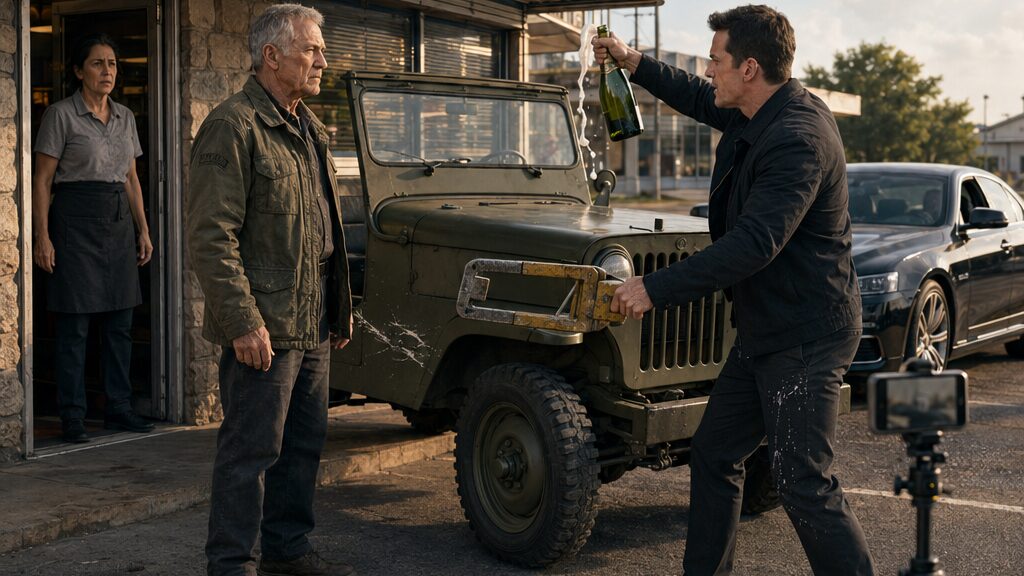
The champagne cork struck the diner window hard enough to make three customers duck.
It bounced off the glass above Raymond Moore’s booth and rolled beneath a table, leaving a wet fleck of foam on the window. Outside, a broad-shouldered man in a fitted black jacket held an open bottle above the restored military Jeep parked beside the entrance.
A phone mounted on a short grip pointed at the vehicle.
“Fake Ranger,” the man announced to his livestream. “Fake Jeep. Let’s wash the lies off.”
Raymond set down his coffee.
Across from him, a second cup steamed beside an empty place setting.
Christine Flores came around the counter with a dish towel still in one hand. She stopped when she saw the bottle.
“Do not spray that vehicle.”
The man turned the phone toward her. A tactical-style clipboard was tucked beneath his arm. The laminated badge clipped to his chest carried a seal too elaborate to read from inside.
“Owner confirms involvement,” he told his viewers. “Veteran-themed business protecting a probable stolen-valor offender.”
Christine opened the front door. “I confirmed that you need to leave.”
Raymond remained seated. His corner booth had been chosen for one reason: from it, he could see the Jeep’s passenger side through the wide front window.
Morning light rested on the olive paint. The body was clean but not polished into perfection. Small waves remained in the older metal, and a narrow repaired scar ran beneath the passenger door. Raymond had refused to sand it smooth.
Outside, the stranger moved closer to that panel.
Raymond’s right hand tightened around the coffee cup.
“Sir,” Christine said, stepping onto the sidewalk, “that parking space belongs to the diner. You have no business touching anything out here.”
“I’m Eric Walker.” He angled the phone so his face and the Jeep filled the screen together. “Independent stolen-valor investigator. People send me reports. I verify military claims the authorities ignore.”
He pulled the clipboard free and flipped open a thick citation book. Its pages were bordered in red, with boxes for insignia misuse, false decorations, unauthorized vehicle markings, and public deception.
Christine looked from the book to him. “You are not an authority.”
“That’s what enablers always say.”
A number on Eric’s phone climbed quickly. The sound of incoming comments produced a stream of bright digital chimes.
Raymond could not read the words from the booth, but he knew the rhythm. Attention gathering. Judgment accelerating before facts could catch it.
Eric pointed at a faded Ranger tab sewn above the pocket of Raymond’s field jacket, visible through the glass.
“There,” he said. “Subject is wearing restricted military identification in public.”
One of the customers muttered that Eric was wrong. Eric swung the camera toward him.
“Name and service record?”
The customer lowered his eyes to his breakfast.
Christine reached for her phone. Raymond saw the hesitation before she unlocked it. The diner had survived years of thin margins, a kitchen fire, and one ugly online campaign after she removed a group that had harassed an injured veteran. She knew what a distorted video could do.
She also believed Raymond could drain heat from a room simply by refusing to feed it.
Usually, he could.
Eric began writing.
“Location: commercial property presenting military symbolism. Subject: elderly male, approximately seventy-five, displaying Ranger identification without immediate documentation.”
Christine stared at the page. “You cannot issue him anything.”
“It’s a notice of public accountability.”
“It looks like a citation.”
“It’s supposed to.”
That answer made her expression change.
Raymond lifted his cup. The coffee had already cooled enough that the bitterness sharpened. He drank anyway.
Eric circled the Jeep, narrating each feature as though inspecting evidence. He called the hood markings inconsistent. He questioned the style of the fasteners. He declared the seat fabric “obviously modern reproduction,” which it was, because Raymond had chosen material that would survive weather without pretending it had survived a war.
Then Eric crouched beside the passenger panel.
He reached toward the repaired scar.
Raymond stood.
The booth creaked as his weight left it. Several heads turned. Christine looked back through the open door.
Raymond crossed the diner without haste. The second coffee remained where it had always remained, steam lifting over the empty seat.
“Don’t touch that panel,” he said.
Eric straightened, triumphant before he had even turned.
“There he is.”
The phone came up.
Raymond stopped inside the doorway.
Eric’s smile belonged to a man who had finally obtained the clip he expected. “State your name and unit.”
“No.”
The comment chimes accelerated.
Eric glanced at the screen. “Viewers are asking why an innocent veteran wouldn’t answer.”
Raymond looked past him to the panel. Eric’s fingers had left a pale smear in the dust near the old repair.
“Step away from the Jeep.”
“Prove it belongs to you.”
Christine moved between the door and Eric. “It belongs on my property. That is enough.”
Eric backed toward his luxury car while keeping the camera trained on Raymond. “You hear that? No denial. No documentation. Just intimidation.”
He opened the car’s rear door.
Inside sat a hard equipment case, two folded tripods, a bundle of magnetic signs, and a small cooler. He removed a chilled green bottle beaded with condensation.
Raymond watched his thumb work beneath the foil.
Christine said, “Put it away.”
Eric tore off the wire cage.
“Some people only tell the truth when you threaten the costume.”
The cork erupted. It struck the diner window, and foam rushed over Eric’s hand.
He raised the bottle toward the Jeep.
“I’m going to force the fake Ranger to react.”
Chapter 2: The Citation That Had No Authority
The fake citation struck Raymond’s table and drove coffee across the old photograph beneath his hand.
Brown liquid ran over four young men standing beside a mud-caked vehicle, blurring their boots and darkening the white border. Raymond pulled the photograph free before the spill reached the faces.
Eric leaned across the booth with his phone less than a foot from Raymond’s eyes.
“Notice served,” he said. “Refusal to provide service verification has been documented.”
Christine snatched a stack of napkins from the dispenser. “You do not serve anything in here.”
Raymond took the napkins from her and pressed them against the photograph. He did not wipe. The print was old enough that friction could lift the surface.
Eric’s camera followed his hands.
“Interesting,” Eric said. “He protects the prop photo but won’t identify the supposed men in it.”
Raymond laid the photograph on a dry section of the table. His first coffee had lost most of its heat. The second still gave off a thin curl of steam.
“Get the camera away from him,” Christine said.
“This is a public establishment.”
“It is private property.”
“Then call the police.”
Her silence lasted half a second too long.
Eric noticed.
So did Raymond.
The morning crowd had gone still around them. A fork touched a plate somewhere near the counter. The sound seemed indecently loud.
Eric flipped open his citation book and read from a printed heading. “Public Display Accountability Code, Section Eight: unauthorized representation of elite-service affiliation for reputational benefit.”
Christine leaned over the page. “What jurisdiction?”
“National.”
“That is not a jurisdiction.”
Eric moved the clipboard away from her.
She pointed to the top line. “You wrote the incident date as the twelfth.”
Eric looked down.
On the next page, beneath Raymond’s description, he had written the thirteenth.
Christine tapped both entries. “Which day are we on?”
“A clerical issue does not invalidate evidence.”
“You printed that book yourself.”
“My organization publishes standardized reporting materials.”
“Your web address is at the bottom.”
Eric turned the book so the page no longer faced the room. “This is exactly how fake veterans survive. Businesses create confusion, attack procedure, and turn basic questions into harassment claims.”
His phone chimed with a different tone.
A private message flashed across the screen before he tilted it away. Raymond caught only part of it.
NEED STRONGER EVENT FOR BONUS ELIGIBILITY.
Eric’s jaw tightened.
He looked again at Raymond’s jacket.
The Ranger tab was faded almost to gray. One edge had been repaired with uneven hand stitching. Beneath it, barely visible where the fabric folded, sat the ghost outline of an older insignia removed decades before. The pocket button was not standard issue. It had been replaced with a flat dark disk cut from another garment.
Eric stared at the stitching.
His expression changed—not much, but enough.
“You bought this jacket from a surplus shop?” he asked.
Raymond continued blotting the photograph.
“Estate sale?”
No answer.
Eric lowered the phone slightly and examined the cloth more closely. “Who sewed that tab?”
Raymond lifted his eyes.
For one instant, Eric was not performing. He was calculating.
A genuine collector could reproduce the jacket. A skilled fraud could learn the details. But the repair pattern along the tab’s lower edge was obscure—old field stitching pulled tight in alternating directions so one broken thread would not free the whole patch.
Eric knew enough to recognize it.
Not enough to admit what recognition meant.
The phone chimed again. Viewer numbers had risen beyond what they had been outside.
Eric raised the camera and recovered his voice. “Notice how he refuses every direct question. Silence is not dignity. Silence is evasion.”
Christine folded her arms. “You asked about the stitching because you knew it was right.”
“I asked because reproductions are sophisticated.”
“You hesitated.”
“I verified.”
“No. You doubted yourself.”
The room shifted toward her. Eric felt it. Raymond watched him decide which mattered more: the truth in front of twelve people or the certainty expected by several thousand strangers.
Eric placed the citation book on the table again and checked a box marked CONFIRMED MISREPRESENTATION.
Raymond’s gaze settled on his pen.
“You have not confirmed anything,” Christine said.
“I have behavioral indicators, inconsistent display items, refusal to cooperate, and a commercial setting profiting from military association.”
“This diner was opened by my father.”
“Another unsupported claim.”
Christine’s face hardened. She started to raise her phone.
Raymond touched two fingers to the tabletop.
She looked at him.
It was a small gesture, one he used when a pan flared in the kitchen or an argument near the register threatened to spread. Wait. Measure. Do not let another person choose your pace.
Christine lowered the phone, though resentment remained in her grip.
Eric saw only submission.
He tore the top sheet from the book and slid it toward Raymond. Coffee soaked one corner.
“Sign acknowledgment.”
Raymond picked up the damp page.
Eric leaned closer, eager for the image.
Raymond folded the citation once, placed it beneath the wobbling leg of the table, and pressed the tabletop until it stood level.
A laugh escaped someone near the counter before being smothered.
Eric flushed.
The phone’s comment stream accelerated.
Raymond returned the photograph to its place beside the untouched cup. One face in the picture had been marked by a narrow coffee line running from the shoulder to the edge of the frame.
Eric followed his glance.
“Who is that?” he demanded.
Raymond said nothing.
The lack of response no longer felt empty. It had weight now, and Eric needed to break it.
His eyes shifted toward the window, where the Jeep waited.
The sponsor message remained open on his screen.
Eric turned away from the booth and began writing again. Raymond could see the words inverted across the page.
AUTHENTICITY REVIEW: INCONCLUSIVE.
Eric paused.
Then he scratched through the phrase until the paper nearly tore.
Above it, in heavy block letters, he wrote:
CONFIRMED FRAUD.
Raymond watched him underline it twice.
Chapter 3: The Jeep Panel With An Old Scar
The metal clamp snapped shut around the Jeep’s front wheel with a sound like a rifle bolt.
Eric stood and faced his phone, one hand resting on the yellow-painted steel.
“Vehicle seized for fraudulent military display.”
Christine came through the diner door behind him. “Remove that now.”
“This prevents destruction or flight while evidence is documented.”
“You attached a hardware-store parking clamp to a private vehicle.”
“It is an investigative hold.”
“It is trespassing.”
Eric smiled at the screen. “Notice how quickly they become experts in law when the deception is challenged.”
Raymond stopped just outside the doorway.
Behind him, through the glass, his two cups remained on the booth table. The first no longer steamed. The second carried one last pale thread of heat that vanished as he watched.
Eric had placed the phone on a small tripod near his car, giving the livestream a wide view of the Jeep, the diner entrance, and Raymond.
The champagne bottle stood on the Jeep’s hood.
Foam slid down the glass toward the olive paint.
Raymond’s eyes moved from the bottle to the passenger panel.
The repaired scar lay several feet away, still untouched.
For now.
A comment caught Eric’s attention. He stepped toward the phone and read silently.
His mouth tightened.
“What is it?” Christine asked.
Eric tapped the screen.
A new comment appeared beneath his finger before vanishing.
THAT CITATION BOOK IS SOLD ON HIS WEBSITE. IT HAS NO AUTHORITY.
Eric blocked the account.
“That was one of his associates,” he told the stream, pointing at Raymond. “They are attempting to disrupt the investigation.”
Raymond had never seen the commenter’s name.
Christine said so.
Eric ignored her and dragged the clamp’s chain around the front axle. He did not know how to secure it properly. The loose end scraped against the rim.
Raymond stepped off the curb.
“Stop.”
Eric glanced up. “Ready to verify your service?”
“You’ll damage the wheel.”
“Then provide your records.”
Raymond looked at the steel jaw pressed against the tire. “Release it.”
“Name. Unit. Dates.”
The questions came like items from a rehearsed list. Eric had reduced a life to fields he could fill while strangers watched.
Raymond moved closer to the Jeep.
The hood had come from one vehicle. The rear gate had come from another. The passenger seat frame had been recovered from a storage yard after years beneath a collapsed roof. He had spent sixteen months searching for the correct steering assembly and another winter rebuilding the transmission at the rear of Christine’s garage.
The passenger panel had required no searching.
He had known exactly where it was.
Eric lifted the clipboard. “This vehicle contains mismatched components. That alone proves it is not what the owner represents.”
“I never represented it as anything,” Raymond said.
The words quieted even Christine.
Eric seized them. “So you admit it is fake.”
“No.”
“Then what is it?”
Raymond looked at the old body.
The answer existed, but not for Eric.
Christine approached the passenger side. She had seen Raymond repair that panel more than once, always by hand, never with the powered sander he used everywhere else.
A shallow crescent ran beneath the paint. Beside it, near the lower seam, faint letters had been scratched into the metal before the final restoration coat.
A. BROWN.
Christine crouched.
“Raymond.”
He saw where she was looking.
Her expression softened, then tightened with hurt. “You told me those were inventory marks.”
“They were.”
“That is a man’s name.”
Eric moved immediately, camera grip raised.
“Whose name?”
Christine stood between him and the panel. “Back away.”
Eric angled around her. “Is this stolen property from a deceased service member?”
Raymond’s breathing changed.
Not enough for the others to notice, perhaps. Enough for him to feel the old pressure beneath his ribs.
Eric searched the letters through his phone. “A. Brown. Ranger. Vehicle loss. Let’s see what comes up.”
Raymond took another step.
Eric saw it and lifted the heavy clamp by its handle, not quite swinging it, only making sure everyone noticed the weight.
“Maintain distance.”
Christine stared at him. “You brought that here to threaten people.”
“I brought it to secure evidence.”
“You put it between yourself and an old man.”
“He has refused lawful instructions.”
“No instruction from you is lawful.”
The champagne bottle remained on the hood, its mouth open. Eric snatched it with his free hand and shook it hard.
Foam surged up the neck.
“Maybe the vehicle will tell us the truth after we clean off the fantasy.”
He aimed the bottle toward the passenger side.
A white spray struck the pavement inches below the repaired panel.
Raymond’s composure broke in one visible place: his left hand opened, then closed.
“Not there.”
Eric’s eyes brightened. “Why?”
Raymond could hear metal cooling after sunset. A radio coughing static. Two cups knocking together on the hood of a different vehicle while Alexander laughed about coffee so bad it could strip paint.
He had not spoken the name aloud in years.
“Alexander.”
Christine looked at the scratched letters again.
Eric lowered the champagne bottle just enough to use his phone. He typed quickly.
The search result appeared.
Alexander Brown. Ranger. Killed during an overseas operation decades earlier.
For the first time that morning, Eric’s face lost all performance. He looked from the record to Raymond, then to the scarred panel.
He understood at least one thing.
The name was real.
The dead man was real.
The vehicle carried something Eric had no right to touch.
His phone chimed. The viewer count jumped again.
Eric’s uncertainty hardened into opportunity.
He raised the bottle over the scar.
“Then tell everyone why you have a dead Ranger’s Jeep.”
Chapter 4: The Seat Raymond Was Supposed To Take
Eric read Alexander Brown’s casualty record aloud as if announcing a score.
“Army Ranger. Killed during an overseas operation.” He angled the phone toward the scratched name on the Jeep’s passenger panel. “And this man cannot explain why he possesses parts from the dead Ranger’s vehicle.”
The champagne bottle remained raised above the repaired scar.
Raymond stood six feet away, watching foam gather at the mouth.
“Put it down,” Christine said.
Eric ignored her. “Was the vehicle stolen? Purchased illegally? Taken from a grieving family?”
“It is a memorial,” Raymond said.
The words stopped the chatter coming from the diner.
Eric’s eyebrows lifted. “A memorial to a man whose name you refused to say until five minutes ago?”
Raymond looked at the faded letters beneath the olive paint. He had traced them with his thumb before every coat, making certain the name remained visible.
“To more than one man,” he said.
Eric turned triumphantly toward the phone. “So he admits the vehicle is assembled from military components connected to deceased service members.”
“That isn’t what he said,” Christine snapped.
“It is exactly what he said.”
The livestream comments moved too quickly to read. Eric watched them with the satisfaction of a man seeing a door open.
Raymond saw another door.
It had been canvas, not metal, and it had slapped against a vehicle frame in hot wind while a radio hissed uselessly in his hands.
Alexander had been sitting on the hood with two dented metal cups.
“Your coffee,” he had said, passing one down. “Drink it before it learns to crawl.”
Raymond had taken the cup without tasting it. He had been listening to the radio set fail in irregular bursts, the signal breaking whenever the vehicle vibrated.
“Unit Three’s set is dying,” Raymond had said.
“Then fix it.”
“I’m assigned to Two.”
Alexander had shrugged. “Trade with me.”
It had sounded casual. Everything Alexander said sounded casual when other men were watching.
“You take Three,” he had continued. “I’ll ride your seat in Two. When we get back, you owe me coffee that doesn’t dissolve the cup.”
Raymond had looked at him.
Alexander had knocked his metal cup against Raymond’s. “That is a legally binding agreement.”
The memory vanished beneath Eric’s voice.
“Why did you never contact his family?”
Raymond’s eyes shifted to the phone.
A comment had been pinned across the screen.
WHY DID RAYMOND MOORE NEVER CONTACT US AFTER MY FATHER’S FUNERAL?
The name beneath it was Carolyn Brown.
For a moment, the parking lot narrowed to the phone in Eric’s hand.
Eric read the comment twice. The second time, he added weight to every word.
“Carolyn Brown says she is Alexander’s daughter.”
Christine looked at Raymond.
He gave her nothing.
Eric stepped closer. “She says you never spoke to them. Not once. If this is a memorial, why did the family not know about it?”
Raymond’s mouth felt dry.
He had attended the funeral from the rear of the chapel. He had left before the family turned from the flag. He had written three letters afterward and burned all three in a coffee can behind his house.
In one, he had explained the assignment exchange.
In another, he had apologized.
The third contained only Alexander’s last joke about coffee.
None had seemed like his to send.
Eric held the phone inches higher. “Answer her.”
Raymond looked directly into the lens, not at Eric.
“The Jeep is a memorial.”
“To whom?”
“To men who do not need you using their names.”
“That is not an answer.”
“It is the only one you are getting.”
The viewer count surged.
Eric smiled, but uncertainty worked at the edges of it. He knew the record was real now. He knew the panel had belonged somewhere beyond a restoration garage. Yet every new fact made the livestream more valuable.
His sponsor message flashed again.
ENGAGEMENT SPIKING. KEEP PRESSURE ON.
Eric turned the phone just enough to hide it, but Christine saw.
“They are paying you to do this.”
“They support accountability.”
“They support a scene.”
“They support exposing fraud.”
“You found a dead Ranger’s name on that Jeep, and you still have the bottle over it.”
Eric looked at the champagne as if he had momentarily forgotten it.
Then he raised it higher.
“Symbols do not become sacred because someone tells a sad story.”
Raymond heard the sentence and felt something inside him change.
For years, silence had seemed clean. It asked nothing. It claimed nothing. It did not bargain with the dead.
But Eric had filled that silence with his own meaning. He had turned Alexander into evidence for an accusation. He had made the scratched name part of a performance.
Raymond had allowed it because speaking felt like theft.
Now silence had become another kind of surrender.
“We changed seats,” Raymond said.
Eric lowered the bottle slightly.
Christine did not move.
Raymond’s eyes remained on the repaired panel. “The radio in Unit Three was failing. I was assigned to Unit Two. Alexander took my place so I could repair the set.”
“And Unit Two was hit,” Eric said.
Raymond’s jaw tightened.
The sound had been less dramatic than memory made it. A flat concussion. Dust moving sideways. Someone shouting the wrong name.
He had reached Unit Two after the fire had already eaten the canvas and blackened the frame. The passenger side had folded inward around the place where he should have been.
Alexander’s metal coffee cup had lain in the dirt with its handle torn away.
“He died in my seat,” Raymond said.
The sentence entered the livestream and seemed to still it.
Even Eric stopped speaking.
Christine’s face changed. Not pity. Something more difficult.
“You never told me,” she said.
Raymond did not look at her.
Eric recovered first.
“So this vehicle is not simply a memorial,” he said. “It is connected to an incident in which you survived by switching places with a dead man.”
Christine stared at him. “Do not twist that.”
“I’m clarifying.”
“You’re feeding it to strangers.”
Eric pointed at the phone. “The public has a right to know whether grief is being used to support a false military identity.”
Raymond finally looked at him.
“You know it is not false.”
Eric’s hand tightened around the bottle.
That single accusation struck harder than any shouted insult.
He glanced at the Ranger tab, the stitched repair, Alexander’s name, the old panel. His expression admitted the truth before his mouth rejected it.
“I know there are inconsistencies.”
“You knew inside the diner.”
“I knew nothing conclusively.”
“You wrote ‘confirmed fraud.’”
Eric’s face flushed. “Behavior matters. Evasion matters. Possession of military artifacts does not prove service.”
“No,” Raymond said. “It does not.”
The agreement unsettled him.
Raymond stepped closer to the Jeep.
“I do not owe you my record. I do not owe your viewers my dead.”
Eric backed one pace, keeping the champagne between them. “Stay where you are.”
Christine moved from the Jeep’s side. “This is over.”
She reached for the bottle.
Eric jerked it away and seized the parking clamp with his other hand. The heavy steel rose across his body, its curved jaw pointed outward.
Christine stopped.
The bottle foamed over Eric’s knuckles.
Raymond’s attention shifted completely.
Not to Eric’s face.
To the clamp.
He noted the right-handed grip, too close to the hinge. The weight pulling Eric’s shoulder down. Christine three feet to the left. The tripod behind Eric. The luxury car eight feet beyond him.
Through the diner window, two coffee cups sat in Raymond’s booth.
One for him.
One for a promise that had outlived the man who made it.
Eric lifted the clamp higher between himself and Christine.
Raymond stepped forward.
Chapter 5: The Blow That Never Touched Him
Champagne left the bottle at the same instant Raymond caught Eric’s wrist.
The spray crossed the space in a white arc.
Raymond turned Eric’s hand outward. Foam struck the pavement and the lower edge of Eric’s trouser leg, missing the Jeep by inches.
Eric shouted and drove the parking clamp forward.
Raymond had already measured the movement.
He shifted inside the clamp’s reach, trapped Eric’s forearm against the hinge, and twisted the steel toward the ground. Eric tried to hold on, but his grip had been wrong from the start. The weight rolled his wrist open.
The clamp came free.
Raymond stepped away with it.
For one exposed second, Eric stood defenseless in front of him.
The livestream captured everything: Eric’s open hands, Raymond’s shoulders squared, the heavy steel in Raymond’s grasp.
Raymond could have struck him.
Instead, he turned.
Eric’s luxury car waited behind the tripod, polished black hood reflecting the diner sign.
Raymond brought the clamp down once.
The steel hit with a deep metallic concussion.
The hood collapsed inward beneath it. Paint split along the crease. The car alarm erupted.
No one moved.
Raymond left the clamp embedded in the ruined metal.
Eric stared at the car.
Then at Raymond.
“You attacked me.”
Raymond walked past him toward the Jeep.
“You destroyed my vehicle!”
The alarm pulsed through the parking lot.
Eric snatched up the phone and swung the camera toward the damaged hood. “You all saw that. He assaulted me and destroyed private property.”
A customer near the diner door said, “He never touched you.”
Eric pointed the camera at him. “You are part of this.”
Christine stepped between the phone and the customers. “Your video shows you threatening us with that clamp.”
“It shows him taking it and committing an act of violence.”
Raymond crouched beside the passenger panel.
A few drops of champagne had reached the pavement below it. None touched the paint. He ran two fingers along the repaired scar, checking for fresh damage.
Behind him, Eric continued shouting.
“Police are on the way. Security footage will prove everything. I have thousands of witnesses.”
Raymond checked the wheel next. The clamp had scraped the rim but had not bent it. The tire remained sound.
Christine came near him. “Are you hurt?”
“No.”
“Your wrist?”
“It is fine.”
It was not. A narrow pain ran from his thumb into his forearm where he had caught Eric’s weight. He flexed once and stopped.
Christine saw.
She also saw the care with which he touched the old panel.
“That was where he sat?” she asked quietly.
Raymond’s hand remained on the metal.
“Yes.”
Eric’s voice rose over the alarm. “Do not coach the suspect.”
Raymond stood.
Eric had positioned himself beside the crushed hood, framing the damage behind him. His face had recovered some of its practiced indignation.
“This is what happens when fraud is challenged,” he told the livestream. “They resort to intimidation. They destroy evidence. They attempt to silence investigators.”
Raymond looked toward the phone.
He did not defend himself.
That seemed to enrage Eric more than argument would have.
“Say something.”
Raymond turned toward the diner.
“Admit what you did.”
Raymond stopped beside the tripod. “I stopped you.”
“You damaged my car.”
“Yes.”
The direct answer robbed Eric of momentum.
“You admit it?”
“I chose the car.”
The customers at the entrance understood before Eric did.
Christine looked at the clamp buried in the hood, then at the empty space where Eric’s body had been.
Raymond continued. “You were closer.”
Eric’s mouth opened.
Raymond entered the diner.
Through the front window, the two coffee cups remained on the booth table. His first had gone cold. The second sat untouched beside the photograph.
The car alarm stopped abruptly.
In the sudden quiet, the livestream notification tones became audible.
One after another.
Then faster.
Eric looked down at his phone.
The viewer count had doubled.
Comments flooded upward too quickly for him to control.
RAYMOND MOORE?
THAT IS MOORE FROM THE RADIO TEAM.
LOOK AT THE TAB STITCHING.
HE TURNED AWAY FROM THE MAN ON PURPOSE.
I SERVED UNDER HIM. DELETE THIS.
Eric scrolled, blocking one account, then another.
More replaced them.
A grainy photograph appeared in a shared comment—Raymond decades younger, kneeling beside a field radio with three other Rangers. The same angular face. The same habit of pressing his lips together when concentrating.
Eric’s breathing changed.
“No,” he said.
Another comment named the repaired Jeep panel and the unit that had used it.
A third identified Alexander Brown.
Then Raymond’s full name began repeating across the screen.
Not once.
Hundreds of times.
Eric Walker looked through the diner window at the silent man standing beside two cold coffees, and for the first time that morning, the camera no longer belonged to him.
Chapter 6: The Livestream Chose The Wrong Target
Eric’s first sponsor canceled him before he finished demanding Raymond’s arrest.
The message appeared across the top of his screen.
PARTNERSHIP TERMINATED EFFECTIVE IMMEDIATELY.
He swiped it away.
“You are watching a coordinated harassment campaign,” he told the livestream. “These accounts are attempting to protect a violent offender.”
A second notification arrived.
Then a third.
One sponsor requested removal of all branded content. Another froze pending payments. A platform warning appeared beneath the stream, flagging reports of impersonated authority and dangerous conduct.
Eric’s voice sharpened. “This is retaliation.”
Christine stood in the diner doorway. “No. It is a record.”
Viewers had begun reposting clips from the start of the confrontation: the fake citation, the sponsor message demanding stronger content, the champagne bottle over the Jeep, the clamp raised between Eric and Christine.
The footage did not need interpretation.
It only needed to remain unedited.
Eric tried to end the stream.
The button failed beneath his shaking thumb. He had locked the interface earlier to prevent accidental interruption during confrontations.
Comments continued pouring in.
A former Ranger posted a photograph of Raymond beside a damaged radio set. Another uploaded an old unit page containing Raymond’s name. A military vehicle restorer identified the passenger panel’s repair pattern and explained why no ordinary collector would have preserved the scar beneath fresh paint.
The facts arrived in pieces.
None proved everything alone.
Together, they dismantled Eric’s performance faster than he could rebuild it.
Raymond stood inside beside his booth.
Christine came in after him, leaving the door open so she could still watch Eric.
“Your coffee is cold,” she said.
Raymond looked at the two cups.
“Do you want me to replace it?”
Her question carried through the open door and into Eric’s phone.
A comment appeared almost immediately.
HE ORDERS TWO. ALWAYS HAS.
Another answered:
ONE WAS FOR ALEXANDER BROWN.
Raymond’s eyes moved toward the livestream.
He had never told anyone online. He had barely told Christine anything at all.
The second comment was corrected by a former Ranger.
NOT EXACTLY. ASK HIM ABOUT THE PROMISE.
Raymond’s chest tightened.
Eric read it too.
He turned the camera toward the diner. “What promise?”
Raymond sat down.
He placed the damp photograph between the cups.
Eric stepped closer to the doorway, desperate for a new angle. “If these people know you, let them explain why you never contacted Alexander Brown’s family.”
The comment feed slowed around a long message from an account displaying an old unit insignia.
BROWN VOLUNTEERED FOR THE SWITCH. UNIT THREE’S RADIO WAS FAILING. MOORE WAS THE ONLY MAN THERE WHO COULD KEEP IT WORKING. THAT RADIO BROUGHT THE REST OF US HOME.
Raymond read the words from across the room.
His hand stopped beside the cup.
Eric shook his head. “Unverified testimony.”
More accounts confirmed it.
Some remembered the radio failure. Others remembered Alexander laughing about the trade. One recalled Raymond reaching the damaged vehicle afterward and refusing to leave until every recoverable piece had been marked.
The public truth spread outward.
Raymond felt only the private wound beneath it.
Alexander had volunteered.
Raymond had always known that in the factual sense. He had heard the words. Seen the shrug. Taken the metal cup.
But knowledge had never displaced the image of the crushed passenger seat.
Christine sat across from him, in the place usually left empty.
Raymond looked at her.
She noticed and started to rise.
“Stay,” he said.
It was the first invitation he had given her in all the years she had protected the booth.
She remained seated.
Outside, Eric attempted another explanation. “People make choices under pressure. That does not establish that this man’s subsequent use of the story is legitimate.”
A new pinned comment appeared.
I AM CAROLYN BROWN. I HAVE MY FATHER’S LETTER FROM BEFORE THE MISSION. I AM COMING TO THE DINER.
Raymond read it twice.
The room seemed to lose depth.
Christine followed his gaze. “Carolyn?”
He nodded.
“You knew how to reach her?”
“I knew where not to go.”
“That is not the same thing.”
“No.”
Eric saw the comment and brightened with ugly relief. “Good. The family is coming. We will hear from someone with actual standing.”
Raymond looked at the old photograph.
Carolyn had been a child when Alexander died. He remembered her from one picture kept inside Alexander’s shirt pocket—a girl missing one front tooth, holding a fish with both hands.
He had imagined her grown face many times.
Sometimes accusing.
Sometimes grateful.
Both possibilities had kept him away.
A siren sounded faintly in the distance.
Eric gathered his clipboard and citation book from the pavement. One metal corner had snapped from the binder. Several pages were soaked with champagne.
He glanced toward the road, then at his ruined hood.
The police were coming. Sponsors were leaving. The livestream remained active.
He folded the tripod with frantic movements.
Christine stood. “Do not leave.”
“I am repositioning for safety.”
“You called the police.”
“I can speak to them remotely.”
Eric stepped backward, eyes on the phone.
His heel landed on the broken metal corner from the citation binder.
The piece rolled.
Eric’s foot shot forward. He windmilled once, struck the edge of the tripod, and fell face-first into the dirt beside his car.
The phone landed upright against the curb, still streaming.
No one laughed.
Raymond did not blink.
A sedan turned into the parking lot as Eric pushed himself onto his hands.
The driver’s door opened.
A woman stepped out holding a worn envelope.
Raymond knew her before she looked toward the diner.
Carolyn Brown had Alexander’s eyes.
Chapter 7: The Second Coffee Finally Had A Place
Carolyn placed Alexander’s unopened letter over the wet ring left by Raymond’s second coffee.
She did not sit.
Through the diner window, Eric remained beside his damaged car, brushing dirt from his jacket while two police officers separated him from the phone still propped against the curb. His mouth moved constantly. No one inside could hear him now.
Carolyn kept both hands on the back of the empty booth seat.
“You knew who I was before I got out of the car.”
Raymond looked at her face. Alexander’s eyes, but none of his easy smile.
“Yes.”
“And you still didn’t come outside.”
“No.”
Christine stood beside the table with a fresh pot of coffee. She glanced at Carolyn, then at Raymond.
“I can give you some privacy.”
Carolyn shook her head. “He has had privacy for more than forty years.”
The words landed without volume.
Christine set the pot down but remained near the counter.
Carolyn slid into the seat across from Raymond. The envelope stayed between them, yellowed at the edges and creased down the center. Alexander Brown had written her name in dark ink across the front.
Raymond knew the handwriting.
He had seen it on maintenance tags, ration cartons, maps, and once across the back of his own jacket after Alexander decided every new Ranger required “clear operating instructions.”
The sight of it tightened his throat more than Eric’s accusations had.
Carolyn watched him recognize it.
“My mother kept this,” she said. “She never opened it. She said if it was his last letter, opening it would make him finished.”
Raymond said nothing.
“She died six years ago. I found it in a box with the flag.”
“And you kept it closed.”
“I learned from both of you.”
The first siren had stopped outside. A police radio crackled through the open doorway. One officer photographed the crushed hood while the other collected the fake citation book from the dirt.
Carolyn looked toward the window.
“Everyone online is calling you a hero.”
Raymond’s mouth hardened.
“I did not come for that,” she said. “I came because a stranger shouted my father’s name into a camera, and you finally answered him.”
“I should have answered you.”
“Yes.”
There was no comfort in the word. Raymond respected her for that.
Christine approached the booth. “Both coffees are cold.”
Raymond nodded.
She removed his cup first, then reached for the untouched one.
His hand moved before he thought.
Two fingers caught the saucer.
Christine stopped.
For decades, no one had touched that cup after she set it down. The rule had never been spoken. She had learned it from the way Raymond’s eyes followed the cup when a new server tried to clear it.
Now Carolyn was watching his hand.
Raymond released the saucer.
Christine carried both cups away.
The empty places they left on the table looked larger than they should have.
Carolyn touched the envelope. “Why didn’t you come to the funeral?”
“I did.”
Her eyes lifted.
“I stood at the back.”
“You never spoke to us.”
“No.”
“My mother thought none of his unit came.”
“Others came.”
“She did not know them.”
Raymond lowered his gaze to the damp ring on the table. “I left before she turned around.”
Carolyn leaned back. Anger shifted through her face, but beneath it was something older.
“Why?”
Raymond had prepared answers for this question in three letters and hundreds of sleepless mornings. None survived her voice.
“I thought you might blame me.”
“I might have.”
“I thought you might forgive me.”
“I might not have.”
“I thought you might thank me for surviving.”
Carolyn’s expression changed.
Raymond looked at Alexander’s handwriting.
“Any of those would have made the story about me. Your father made a choice. I turned it into a debt because a debt gave me something to carry.”
Carolyn’s fingers curled around the envelope.
“So you stayed away to protect us?”
“No.” Raymond forced himself to meet her eyes. “I stayed away because I was afraid of what you would say. I called it respect because that sounded better.”
Outside, Eric raised his voice. One officer pointed toward the diner, asking Raymond to come out.
Raymond did not move.
Christine intercepted the officer at the door. After a brief exchange, she returned.
“They need a statement about the car.”
“Later.”
“The livestream is still running.”
Raymond looked past her at the phone on the curb.
“Turn it away.”
Christine went outside. She did not switch it off or touch Eric’s property. She simply stepped between the camera and the diner window until an officer picked it up as evidence.
The audience lost its view.
Only then did Raymond reach for the letter.
Carolyn kept one hand on it.
“This does not erase anything.”
“I know.”
“It does not make you my father.”
“I know.”
“It may not make me forgive you.”
Raymond nodded. “It should not have to.”
She released the envelope.
The paper inside crackled as Raymond unfolded it. Alexander’s writing crowded the page, slanting uphill as though impatient with the margins.
Most of it was ordinary. A complaint about food. A request for new fishing line. A promise to teach Carolyn how to change a tire when he returned.
Near the bottom, the handwriting tightened.
Moore is taking Three tomorrow because its radio keeps dying. I traded him for his seat in Two. He argued, so naturally I ignored him. If anything gets confused later, the trade was mine. We need the radio more than we need his stubborn face beside me.
Raymond stopped reading.
Carolyn read the lines silently from across the table.
“He knew,” Raymond said.
“He chose.”
“I should have been there.”
“Maybe.”
The answer hurt because it was honest.
Carolyn folded her hands. “But he did not write that you forced him.”
“No.”
“He did not write that you owed him your life.”
“No.”
“He wrote about fishing line.”
A sound escaped Raymond that was almost a laugh and failed halfway.
Christine returned carrying two clean cups.
She poured fresh coffee into one and placed it before Raymond.
Then she filled the second.
For a moment, she held it over the familiar empty place.
Raymond looked at Carolyn.
“Would you take it?”
Carolyn studied him, then the cup.
“Was it always for him?”
“Yes.”
“Why coffee?”
Raymond rested both hands around his own cup. Heat entered his palms.
“Before the mission, he gave me coffee from a metal cup. It was terrible.”
“That sounds like him.”
“He said when we got back, I owed him one that would not dissolve the container.”
Carolyn waited.
“We did not get back together.”
The sounds of the diner softened around them. Christine moved away without leaving entirely.
Carolyn drew the second cup toward herself but did not drink.
“Tell me something that is not in the records,” she said.
Raymond looked through the window at the Jeep. The passenger panel remained dry. Morning light caught the old scar without hiding it.
“He cheated at cards.”
Carolyn’s mouth twitched. “My mother said he never lost.”
“He said the same thing. That was how we knew he cheated.”
“What else?”
“He sang when he repaired engines.”
“Was he any good?”
“No. He knew only half of every song, so he invented the rest.”
Carolyn lifted the cup.
Outside, an officer removed the clamp from Eric’s ruined hood. Eric stood nearby without his camera, diminished to the size of an ordinary man responsible for ordinary damage.
Raymond did not watch him for long.
He looked at the photograph on the table. The coffee stain still crossed Alexander’s uniform, but his face remained clear.
For years, Raymond had believed silence kept that face from becoming a story other people could use. He had not understood that silence also kept Alexander from being remembered as a man who cheated at cards, sang badly, and made his own choices.
Carolyn took a sip.
“This coffee is not very good,” she said.
Raymond tasted his.
“No.”
She held the cup between both hands. “He would have complained.”
“For the entire meal.”
Raymond looked once more at the untouched Jeep, then at the woman sitting where no one had sat before.
He raised his coffee and drank without waiting for a dead man to return.
The story has ended.