The Veteran Who Asked the School to Stop Clapping Before They Knew Why He Came
Chapter 1: The Applause Started Before Thomas Crossed the Doorway
The applause began before Thomas Martinez had taken a single step into the hallway.
It reached him through the half-open side door in waves, bright and restless, hundreds of young hands striking together on the other side of the frame. For a moment, he stood still in the small service corridor beside the auditorium, one gloved hand around the head of his cane, the other pressed lightly against the row of medals on his olive jacket as if they had shifted out of place.
Beside him, James Carter leaned close without making it obvious.
“You all right, sir?”
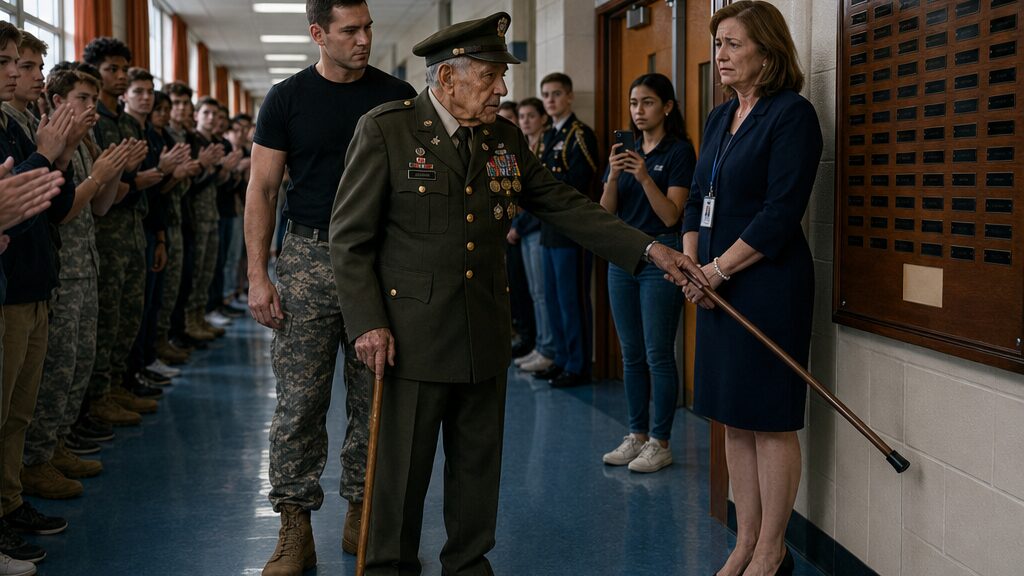
Thomas looked at the strip of polished blue floor visible beyond the doorway. It shone under the fluorescent lights like water. On both sides of it, students waited in two loose lines, some in JROTC uniforms, some in hoodies and sneakers, some already holding up phones. Their clapping carried no malice. That was what made it harder.
“I can walk,” Thomas said.
“I know you can.”
James said it quickly, with a careful kind of respect. He wore a black T-shirt tucked into camouflage trousers, his boots clean enough for the occasion but not polished for show. He had been assigned to escort Thomas from the side entrance to the auditorium, where the school planned to honor him before the Veterans Day assembly. He had explained the route twice in the car, once in the front office, and once again while helping Thomas adjust his cap.
Down the hallway, someone whispered, “That’s him.”
The applause rose.
Thomas let his cane find the floor.
Tap.
The sound disappeared under the clapping, but he felt it through his wrist. The cane had a rubber tip James had insisted on replacing two weeks earlier, after watching Thomas drag the old one across the sidewalk outside the veterans’ hall. Thomas had not wanted a new tip. The old one had known him longer. But James had knelt in the parking lot with a small wrench and said, “A man can keep his pride and still avoid breaking his hip.”
Thomas had allowed it. He had learned, late in life, that some arguments were just fear wearing a younger man’s voice.
“You’ll go slow,” James said. “No rush. Principal King will meet us at the auditorium doors. The cadets will salute when we reach the front.”
Thomas nodded, though he had stopped listening after the word doors.
He was not here for the cadets.
James opened the door wider.
The hallway came into full view. Pale walls. Orange curtains pulled back from tall windows near the lobby. A trophy case on one side. A folding table draped in red, white, and blue paper near the auditorium entrance. A district communications officer stood near the far doors with a camera on a stabilizer, already framing the shot.
And there, beyond the students, just before the auditorium, was the memorial board.
Thomas saw only the edge of it at first: dark wood, brass plates, the school seal at the top. The students blocked most of it with their shoulders and phones. He tightened his fingers around the cane.
James offered his left arm.
Thomas took it because refusing would turn the moment into a display, and he had not come to display anything.
They stepped into the hallway.
The clapping surrounded him.
A girl in a navy JROTC jacket straightened as he passed. A boy with braces smiled too wide, nervous and sincere. Someone murmured, “Thank you for your service,” but the words came tangled with applause and phone notifications and the squeak of shoes on the polished floor.
Thomas made himself smile.
He had practiced the expression in the bathroom mirror that morning, after fastening the medals with fingers that did not obey him as cleanly as they once had. His jacket smelled faintly of cedar from the closet and metal polish from James’s hands. His cap sat a little loose on his head. His shoes had been polished by a neighbor’s grandson, who had not known how to do the edges but had tried.
All morning, people had been trying.
That was why he kept the smile.
The students clapped harder when they saw it.
Tap.
Step.
Tap.
Step.
James kept his support light, just enough pressure at Thomas’s elbow to steady him without steering him. Thomas appreciated that. He had been steered too much lately. Toward chairs. Toward elevators. Toward shorter conversations. Toward remembering only what made other people comfortable.
A phone lifted close on his right. Its camera reflected his face back at him in a small glowing rectangle: a shrunken old man in a decorated uniform, eyes wet from the hallway lights, mouth arranged into gratitude.
He looked away.
The memorial board was clearer now.
CENTRAL RIDGE HIGH SCHOOL
ALUMNI WHO SERVED
Beneath the heading, rows of brass plates caught the light. Some listed graduation years. Some listed branches of service. Some names had small stars beside them. Thomas had seen a photograph of this board in an email from James three weeks earlier. The picture had been grainy, taken at an angle, but it had been enough to make his hand go cold around his coffee cup.
He had asked James then if he could see it in person.
James had thought he meant sentimentally.
“They’ll love that,” James had said. “We can build it into the ceremony.”
Thomas had not corrected him.
Tap.
Step.
The applause began to thin at the edges as students noticed his pace slowing. James shifted slightly.
“Almost there, sir,” he murmured.
Thomas’s eyes moved down the rows.
Campbell, Ronald.
Carter, James’s uncle perhaps, or no relation.
King, Walter.
Martinez, Thomas.
His own name sat on the third row, polished brighter than the plates around it. Someone had recently cleaned it. His service branch was listed neatly. His graduation year. A small symbol beside the name, because the school liked symbols. They were easier to polish than memory.
Thomas did not stop at his own name.
He moved lower.
His breath shortened. Not from the walk. From the empty space.
There was a gap where a plate should have been. Not a large one. Just enough for a name to have been removed, the wood beneath it faintly lighter than the surrounding finish. A careful repair, but not careful enough for an old man who had been looking for that absence for fifty-eight years.
The applause kept going.
Thomas’s smile left before he could stop it.
The girl in the JROTC jacket saw. Her clapping slowed. Then the boy with braces slowed. A ripple passed through the students nearest him, not silence yet, but uncertainty. The camera operator at the auditorium doors adjusted his grip.
James felt the change in Thomas’s arm.
“Sir?”
Thomas took one more step. Then another. He stood close enough to read the names without his glasses.
The missing space was still there.
He raised his right hand.
The gesture was small, but the students in front of him stopped clapping first. Then the row behind them. Then the row behind that. Applause died unevenly down the hall, replaced by whispers and the soft electronic chirp of someone’s phone refocusing.
Thomas lowered his hand to the cane.
Tap.
This time the sound carried.
Stephanie King appeared near the auditorium entrance, smiling with the tense warmth of someone who had arranged every detail and suddenly realized one of them had moved. She wore a navy dress, a school badge clipped at her waist, and a pearl bracelet that clicked faintly when she clasped her hands.
“Mr. Martinez,” she called softly, stepping forward. “We’re so honored to have you. The students are ready inside.”
Thomas did not turn toward her.
He looked at the memorial board, at his own polished name, at the pale scar beneath it.
James leaned closer. “Do you need to sit down?”
“No.”
The word came dry, but clear.
The hallway had gone still enough that a student near the trophy case lowered a phone with both hands, as if it had become too heavy.
Thomas lifted the cane, not high, not dramatically, only enough to point the rubber tip toward the empty rectangle of wood.
Stephanie’s smile tightened.
“Sir,” she said, “we can take a closer look after the assembly.”
Thomas heard the old promise then, not as words, but as breath in a place full of smoke, a hand gripping his sleeve, a voice too young to be leaving the world.
Don’t let them forget me.
Thomas swallowed.
For fifty-eight years, silence had seemed like discipline. Like loyalty. Like respect for what could not be fixed. But the school had invited him back, polished his plate, lined children along the hallway, and asked him to walk past the absence like it was part of the ceremony.
He could not.
His cane touched the board once.
Tap.
Stephanie’s eyes flicked to the district camera. James straightened beside him. Students leaned in without moving their feet.
Thomas kept his voice low, but the hallway gave it room.
“Where is his name?”
Chapter 2: The Principal Tried to Save the Ceremony
Every phone in the hallway turned toward Stephanie King before she had decided what her face should do.
That was the part no training covered. Not the district workshops on crisis communication, not the leadership seminars with laminated folders, not the private advice from the superintendent who had called twice that morning to remind her how much the veterans’ program meant to the board. None of it explained how to stand in front of an old man with medals on his chest and answer a question that should never have been asked on camera.
Where is his name?
The students waited. The district communications officer lowered his stabilizer halfway, unsure whether to keep filming or pretend he had not been filming at all. The JROTC cadets stood frozen in their neat line, their young faces caught between ceremony and confusion.
Stephanie stepped closer, keeping her hands folded so no one could see the tightness in her fingers.
“Mr. Martinez,” she said, gentle enough for the phones, firm enough for the staff watching from the auditorium doors, “we have a full program waiting. I promise we’ll discuss any concern you have as soon as the assembly is finished.”
Thomas did not move.
His cane remained angled toward the memorial board, the rubber tip hovering inches from a pale rectangle in the wood. Up close, Stephanie saw exactly where he was pointing, and a faint chill moved under the collar of her dress.
She had noticed that mark before.
Years ago, when she first became principal, she had asked the office secretary why the finish looked different there. The secretary, who had worked at Central Ridge longer than half the teachers had been alive, said only, “That was changed under your father.” Then she had looked down at her filing cabinet and ended the conversation by opening a drawer.
Stephanie had not pressed. At the time, she had been new, busy, and determined not to spend her first year interrogating every decision made by the principal whose portrait still hung in the front office.
Her father’s portrait.
Now Thomas Martinez stood beneath the fluorescent lights, making the old scar visible to every student with a camera.
James Carter shifted beside him. “Principal King, maybe we could give Mr. Martinez a minute.”
The suggestion sounded respectful. It also sounded dangerous.
“A minute is exactly what we don’t have,” Stephanie said, then softened her tone when she saw a student’s eyebrows lift. “The auditorium is full. We have elementary guests watching on livestream. The district team has a schedule.”
Thomas lowered the cane. He leaned more heavily on it now, but his eyes remained clear.
“Schedules can wait.”
The words were not loud. That made them worse.
A few students murmured. Someone near the windows whispered, “What name?” Another student answered, “I don’t know.” The sound moved along the hallway like a match dropped into dry grass.
Stephanie turned slightly, creating a barrier with her body between Thomas and the board.
“Everyone,” she said, projecting without sounding like she was scolding, “please go ahead and make your way into the auditorium. We’re going to begin in just a moment.”
No one moved.
The boy with braces looked at the girl in the JROTC jacket. The girl looked at Thomas. A student in a school media polo kept her phone chest-high, not hidden, not exactly raised. Stephanie recognized her after a second: Ashley Ramirez, junior, news team, too smart to be easily redirected and too young to know when public truth could damage people who had inherited private messes.
“Ashley,” Stephanie said, “please stop recording.”
Ashley’s thumb twitched, but the phone stayed where it was.
“I’m on school media,” she said. “The district asked us to get hallway coverage.”
“This portion is not for publication.”
“That wasn’t in the notes.”
The hallway seemed to inhale.
Stephanie felt heat rise in her neck. She could not snap at a student while standing beside an honored veteran. She could not let a student record an unscripted accusation near a memorial board. She could not ask the old man to sit down without looking like she was managing him out of sight.
Thomas saved her from choosing, though not kindly.
“I did not ask for a program,” he said. “I asked for a name.”
Stephanie turned back to him. For one second, she let the camera face drop.
“Mr. Martinez, with respect, this board has been maintained for decades. If there was a change, it would have been made through a review process.”
That sounded official. It did not sound true enough.
Thomas looked at the board, then at her.
“Who reviewed a dead boy?”
A teacher near the auditorium doors covered her mouth. James’s hand tightened slightly near Thomas’s elbow, not restraining him, only ready if his balance failed. Stephanie caught that, too. She wished James would guide him away. She wished the students would follow instructions. She wished her father had left fewer locked drawers inside the school’s history.
Instead, Thomas took his arm away from James.
The movement was small, but the meaning traveled. He stood with only the cane now. Frail, yes. Unsteady, yes. But not confused. Not wandering. Not a guest overcome by emotion.
Stephanie had been ready for a sentimental morning: pledge, choir, two student essays, a slideshow of alumni in uniform, Thomas at the podium for three prepared minutes, applause, photos, cookies in the library. The kind of program people shared online with heart emojis and comments about respect.
She had not been ready for a veteran refusing to be used as proof of respect while pointing to evidence of neglect.
“Mr. Martinez,” she said quietly, stepping close enough that the students would have to strain to hear, “I understand this may feel personal. But I need you to understand there are families connected to every name on that board. There are records. There are reasons. We can’t rewrite history in a hallway.”
Thomas’s gaze stayed on her.
“No,” he said. “You rewrote it on the wall.”
Ashley’s phone lifted half an inch.
Stephanie saw it. So did Thomas. So did James.
The district communications officer finally lowered his camera completely. “Principal King?” he said, nervous now. “Do you want me to cut?”
Cut. As if the moment were fabric. As if it could be trimmed before it showed.
Stephanie forced herself to breathe evenly.
“Students,” she said, turning with calm she did not feel, “auditorium now, please. JROTC, lead them in.”
The cadets hesitated only until James gave a slight nod. Then movement returned to the hallway, uncertain and reluctant. Students filed past slowly, looking back, whispering. Phones dipped but did not vanish. Ashley stepped aside with the school media group, still watching Thomas rather than the doorway.
As the crowd thinned, the applause did not restart.
That absence pressed harder than the clapping had.
When only a handful of staff, James, Ashley, the communications officer, and the nearest cadets remained, Stephanie lowered her voice.
“The name you’re asking about,” she said, “was removed before I became principal.”
Thomas did not answer.
“My father was principal then,” she added, and hated how much that admission cost. “He followed the guidance he had.”
James looked from her to the board.
“What name?” he asked.
Stephanie’s eyes moved to Ashley’s phone. “This is not a student media issue.”
Ashley flushed but stayed put. “Then why is there a space?”
For a moment, Stephanie saw all of them as children, even James, though he was grown and broad-shouldered and trying hard not to choose sides too quickly. Children believed an empty space meant a missing answer. Adults knew sometimes it meant a door better left shut.
Thomas reached into the inside pocket of his uniform jacket. His fingers moved slowly. James almost stepped forward to help, then stopped himself.
Thomas withdrew a folded piece of paper, old at the creases but protected inside a plastic sleeve. He did not hand it to Stephanie. He only held it against his chest.
“I wrote to the school three times,” he said. “No answer.”
Stephanie’s stomach tightened. “I never received—”
“Not you.”
The correction landed cleanly.
Thomas looked back at the board.
“Before you.”
The office secretary appeared at the edge of the hallway, drawn by the delay. Stephanie saw her glance at the board, then at the folded paper, and go pale in a way that confirmed too much.
From inside the auditorium, the microphone squealed. A student voice began filling time with an announcement about honoring all who served. The words floated into the hallway, polished and harmless.
Stephanie stepped closer to Thomas, so close now that only he and James could hear her clearly.
“Mr. Martinez,” she whispered, “that name was removed for a reason.”
Thomas’s fingers closed around the folded paper.
The cane stayed still between them, silent now, no longer asking for balance but waiting like a question no one in the hallway could safely answer.
Chapter 3: The Missing Name Was Not a Mistake
Ashley Ramirez replayed the hallway clip under a desk in an empty history classroom and heard the missing name only because the applause had dipped at the exact wrong second.
At first, the audio was just noise: clapping, shoes, a teacher whispering for students to move, the soft mechanical adjustment of her phone camera trying to focus on Thomas Martinez’s medals. Then came his hand lifting. The applause broke apart. His cane touched the floor once, sharper than Ashley remembered.
Tap.
Then his voice.
“Where is his name?”
Ashley dragged the video back with her thumb. Played it again. Louder this time.
The classroom door was locked, or she hoped it was. She had slipped in after the assembly started, while everyone else filed into the auditorium under Principal King’s tight smile. The history teacher had left a stack of handouts on the front table and a slideshow frozen on the projector screen: black-and-white service photos, flag background, bold letters reading HONORING OUR ALUMNI VETERANS.
Ashley had filmed enough school events to know what the district wanted. Smiles. Clean audio. Three usable seconds of applause. A veteran’s hand over his heart. Students looking respectful but not bored. Nothing that required context.
But her clip had context bleeding through it.
She replayed it again.
This time she heard what Thomas said after Principal King stepped close. Not all of it. Just two syllables under the scrape of a shoe and the communications officer saying something off-camera.
“…Jerry.”
Ashley sat back.
Jerry.
She opened the school archive folder on the classroom computer using the media login. The connection took too long. A small spinning circle turned in the center of the screen while the assembly echoed faintly through the walls. The choir had started. Their voices came muffled and far away, too pretty for the knot in Ashley’s stomach.
She searched the alumni database for Jerry.
Three results came up.
Jerry Young, class of 1978, baseball.
Jerry Jackson, class of 1965, debate team.
Jerry Campbell, class of 1964, no activity listed.
Ashley clicked the last one.
The page was nearly empty. Senior portrait missing. Activities blank. Post-graduation notes blank. There was one scanned document attached, labeled “Yearbook Index Correction, 1982.” When she tried to open it, a permission error appeared.
She stared at the screen.
A name did not vanish by accident and then hide behind permissions.
The hallway outside was quiet except for the occasional late step of a staff member. Ashley pulled open the bottom drawer of the teacher’s file cabinet, then froze, guilty before she had even touched anything. She was not supposed to dig through a classroom. She knew that. Her mother would say there were ways to ask. Her grandfather, who kept an old folded flag in a wooden case over his mantel, would say records mattered because memory got lazy when nobody checked it.
Ashley closed the drawer.
Then she noticed the yearbooks.
They lined the back shelf in uneven stacks, their spines cracked and dusty. Some were wrapped in plastic. Some had tape labels curling at the edges. She scanned years until she found 1964.
The book was heavier than she expected. It smelled like paper, glue, and storage rooms. She carried it to the desk and opened it carefully, half afraid the pages would tear just from being asked questions.
Jerry Campbell appeared on page forty-two.
Not missing. Not blank. A narrow face, dark hair combed too neatly, serious eyes that looked uncomfortable with the photographer. Beneath the picture: Jerry Campbell.
No activities. No quote.
Ashley took a photo, then turned to the back pages where clubs and candid shots filled the margins. She found Thomas Martinez in a group picture near the auto shop, younger than seemed possible, one arm slung around a boy whose face had been circled in faded blue ink.
The circled boy was Jerry.
Ashley’s breath caught.
At the bottom of the page someone had written, in old pen, “J.C. + T.M. before enlistment.”
The initials looked casual, maybe from a reunion note, maybe from a teacher who had known them. She flipped further, faster now.
The auditorium walls shook with applause. The assembly must have reached the part where the slideshow showed veterans’ photos. Ashley imagined Thomas sitting in the front row, hearing claps meant for him while the missing space waited in the hallway.
Her phone buzzed.
Principal King: Please report to the media table in the auditorium. Do not post hallway footage.
Ashley did not answer.
She searched the yearbook for a memorial page. Near the back, after the senior superlatives and before the advertisements, she found a grainy photograph of the old school lobby. The memorial board looked newer then, lighter, with fewer plates. Ashley zoomed in with her phone camera and held her breath as the names sharpened.
There it was.
Jerry Campbell.
A plate on the second row, right where the pale scar now sat.
Her hands went cold.
The board had been changed. Not updated. Not reorganized. Changed.
A key turned in the classroom door.
Ashley slapped the yearbook half closed as the history teacher stepped in, stopped, and looked at her with tired suspicion.
“You’re supposed to be in the auditorium.”
“I needed archive footage.”
“During the assembly?”
Ashley tried to slide her phone behind the yearbook. Too late. The teacher saw the old page on the screen, the zoomed-in memorial board, the name.
His expression changed.
Not surprise. Recognition.
“You should put that back,” he said.
“Why?”
“Ashley.”
The way he said her name carried warning without anger. That bothered her more than anger would have.
“Was Jerry Campbell on the memorial board?” she asked.
The teacher looked toward the closed door as if someone might be listening from the hallway. “That’s not part of today’s program.”
“That’s what Principal King said.”
“Then listen to her.”
Ashley stood, leaving the yearbook open. “Mr. Martinez asked where his name was.”
“And Mr. Martinez is an old man who may be dealing with memories none of us understand.”
“He looked like he understood exactly.”
The teacher’s jaw tightened. For a second Ashley thought he would order her out. Instead, he walked to the shelf, pulled down another yearbook, and opened it near the faculty portraits. He turned it toward her.
A younger man stood in the center of an old administrative photo, tall, stern, wearing a dark suit and the confident expression of someone used to being obeyed.
Principal Walter King.
Stephanie King’s father.
“He was principal when I started here,” the teacher said quietly. “He built half the traditions people still brag about. Scholarship night. Veterans wall. Senior walk. He also believed some stories were too damaging for a school to carry.”
Ashley looked from Walter King’s photograph to the page showing Jerry’s name on the old board.
“What did Jerry do?”
The teacher closed the yearbook in front of him.
“I didn’t say he did anything.”
“That’s not an answer.”
“No,” he said. “It’s a survival skill.”
Her phone buzzed again. This time it was not a text. It was the school media group chat, filling with messages.
Where are you?
King is mad.
District guy asked who has hallway footage.
Don’t post anything.
Then, from a student she barely knew:
Did anyone else hear the old veteran say Campbell?
Ashley looked back at the computer. Jerry Campbell’s restricted file still sat behind the permission error. On the shelf, the 1964 yearbook lay open to the circled photo of Jerry and Thomas. On her phone, the clipped audio waited, small and dangerous.
A knock sounded at the classroom door.
The history teacher stiffened.
Principal King entered without waiting.
Her eyes went first to Ashley, then to the open yearbook, then to the frozen computer screen.
“Ashley,” she said, quiet enough to be worse than shouting, “delete the hallway footage.”
Ashley’s thumb closed around her phone.
“It’s school media footage,” she said, though her voice was less steady than she wanted.
“It is a private disruption involving an elderly guest.”
“He asked a public question in a public hallway beside a public memorial.”
The principal’s face hardened, but something beneath it flickered—fear, not anger.
“That footage does not leave your phone,” Stephanie said. “Do you understand me?”
Ashley looked down at the old yearbook before she could stop herself.
Stephanie followed her gaze.
For a moment, nobody spoke.
Then Ashley noticed another face in the group photograph beside Jerry and Thomas. A boy standing half behind them, not circled, but clear enough. Same eyes, same squared jaw, much younger than the man in the local veterans’ group photo posted near the auditorium entrance.
She bent closer to the caption.
Ronald Campbell.
Ashley looked up.
“Why is Ronald Campbell in this picture with them?”
Stephanie did not answer. The history teacher looked away.
In the auditorium, another round of applause rose through the walls, cheerful and distant, as if the school were still certain it knew what honor sounded like.
Chapter 4: James Realized Protection Could Become Another Silence
James Carter found Thomas Martinez waiting alone in the JROTC office with his cane leaning against the desk instead of in his hand.
That was what stopped James in the doorway. Not the uniform jacket folded carefully over the back of a chair. Not the medals glinting under the cheap ceiling light. Not the abandoned paper cup of water beside Thomas’s elbow. The cane.
Thomas never left it out of reach.
“Sir,” James said, stepping inside, “you’re supposed to be in the library.”
Thomas sat straight in the visitor chair, both hands resting on his knees. Without the cap and jacket, he looked smaller, his white shirt too loose at the collar. But his eyes were fixed on James with a steadiness that made the office feel less like a classroom and more like an inspection room.
“I was placed in the library,” Thomas said. “I came here.”
“You walked here by yourself?”
“I crossed a hallway.”
James shut the door behind him before his frustration showed where a student might see it. “That hallway is full of kids changing classes.”
“I noticed.”
“You could’ve fallen.”
“I didn’t.”
The answer was so flat, so unbothered by James’s alarm, that James had to look away. On the far wall, the JROTC schedule hung beside a row of polished plaques. Drill meet. Color guard. Leadership camp. Words that looked solid from a distance and fragile up close. His cadets had spent two weeks rehearsing the Veterans Day ceremony, learning how to stand still, how to salute cleanly, how to escort guests without crowding them. He had told them respect meant attention to detail.
Then Thomas had stopped in the hallway and shown them a detail nobody had taught them to see.
James pulled the spare chair away from his desk and sat across from him.
“Principal King is trying to keep things calm,” he said.
Thomas’s mouth moved, almost a smile. “That what they call it now?”
“They moved the assembly around. The student speakers went first. They’re saying you got tired.”
“I am tired.”
“That’s not what I mean.”
“I know.”
James rubbed a hand over the back of his neck. He had spent the last hour running between the auditorium, the office, and the hallway, answering questions without having answers. Stephanie King had asked him to keep Thomas comfortable and away from students until the district team left. The communications officer had asked whether the hallway footage was going anywhere. Three cadets had asked if they had done something wrong by stopping the applause.
And Ashley Ramirez had cornered him near the trophy case with a look sharp enough to cut ribbon.
Do you know who Jerry Campbell is?
James had not. That ignorance bothered him more than he wanted to admit.
He looked at Thomas’s cane again. It rested against the desk beneath a framed copy of the cadet creed. Its rubber tip left a faint gray mark on the floor.
“Mr. Martinez,” James said carefully, “if you tell me what you’re trying to do, I can help. But I can’t help if you keep letting everyone guess.”
Thomas looked down at his hands. The knuckles were swollen, the veins raised. Hands that had buttoned a uniform that morning one medal at a time. Hands that had refused help until the pin backs defeated him.
“I asked three weeks ago to see the board,” Thomas said.
“You told me you wanted to pay respects.”
“I did.”
“You didn’t tell me you planned to challenge the school in front of half the student body.”
Thomas’s eyes lifted. “Wasn’t a plan.”
“It became one.”
Silence settled between them. In the auditorium, faint through the walls, a microphone thumped and a student voice said something about courage. James closed his eyes for half a second.
He had joined the school staff after leaving active duty because he believed structure could hold young people steady. Ceremony helped. Ritual helped. A straight line, a clean command, a flag folded correctly—these things gave shape to feelings that might otherwise spill everywhere. He had seen students change because someone finally taught them how to stand without fidgeting and speak without apologizing.
But ceremony also had a habit of making adults mistake order for truth.
Thomas reached for the cane. James leaned forward automatically, then caught himself. Thomas saw the movement.
“You think I’m breakable.”
“I think you’re ninety-one.”
“Nearly.”
“You scared the cadets.”
“I scared the principal.”
“You scared me.”
That made Thomas pause.
James had not meant to say it, not that plainly. He looked at the closed door, then back at the old man. “I had your arm. Then you pulled away. I didn’t know if you were steady.”
Thomas’s grip loosened on the cane. “I needed them to know I was standing.”
“They knew.”
“No. They knew you were holding me.”
James had no answer for that.
Thomas drew the cane toward him until it stood between his knees. He did not use it to rise. He only rested both hands on the top as if it were a witness.
“Jerry Campbell saved my life,” he said.
The office seemed to shrink around the name.
James did not move. The only sound was the air conditioner rattling in the ceiling vent.
“Was he from here?” James asked.
Thomas nodded once.
“Same school?”
“Yes.”
“Same unit?”
After a moment, Thomas said, “Same mistake.”
James waited, but Thomas’s face closed around the rest.
The office phone rang. James ignored it. It rang four times, stopped, then his cell phone buzzed on the desk. Principal King.
He let it buzz.
Thomas noticed. “You should answer.”
“I’m listening to you.”
“You weren’t told to.”
“No, sir.”
The title came out by habit, but this time it felt less like ceremony and more like permission.
Thomas looked toward the window. Outside, students crossed the parking lot in pairs, laughing too loudly after the strange morning, already turning confusion into rumor. By the end of the day, the story would be everywhere without being understood: old veteran stops ceremony, principal hides name, school deletes video, some guy named Jerry maybe disgraced. James had seen how quickly half-truths formed ranks.
Thomas had helped create one by staying silent.
“Why didn’t you tell me before?” James asked.
Thomas’s jaw tightened. “Because young men like to fix things before they understand them.”
James almost objected, then realized he had spent the morning doing exactly that.
His phone buzzed again. This time a text preview flashed across the screen.
King: Please bring Mr. Martinez to main office. We are revising program. His remarks will be removed.
James stared at it.
There it was, clean and administrative. Removed. Not delayed. Not shortened. Removed. The same word that seemed to hang over the pale mark on the memorial board.
Thomas read his face. “She canceled me.”
“She’s worried.”
“So was I. For fifty-eight years.”
James stood too fast, the chair legs scraping. He picked up his phone, not to answer, but to silence it. Then he went to the window beside the file cabinet and looked out at the flag near the parking lot entrance. It snapped once in the wind and fell still.
His job was to protect Thomas from strain. From falls. From crowds. From being used by adults who wanted a dignified photograph more than a complicated man.
But protection could become another way of moving him out of sight.
James turned back. “What do you need?”
Thomas watched him for a long moment, as if weighing whether the question had arrived too late to matter.
“Old records,” he said. “Or the man who kept them.”
“Who?”
“Ronald Campbell.”
James remembered Ashley’s question near the trophy case. Ronald’s name beside an old photo. A local veterans’ group member, invited to the reception but not the assembly. Gray hair, heavy shoulders, a handshake that had lingered too long when he saw Thomas’s name on the program.
“You think he’ll talk?”
“No.”
“Then why go?”
Thomas pushed himself upright. James stepped forward, then stopped again, hands open at his sides. Thomas noticed, and this time something like approval passed across his face.
The old man took the cane by himself.
Tap.
The sound was softer on the office tile than it had been in the hallway.
“Because I’m done letting quiet men decide what silence means.”
James picked up Thomas’s uniform jacket from the chair and held it out. “Principal King will say this is against school protocol.”
Thomas slipped one arm into the sleeve, then the other. His fingers trembled at the cuffs.
“Is it?”
James looked at the medals, the cane, the closed office door, and the phone still glowing with Stephanie’s message.
“No,” he said. “But it’ll make trouble.”
Thomas reached for his cap. “Trouble’s already been made.”
James helped him only with the top button, and only after Thomas gave a small nod.
In the parking lot, the afternoon sun flashed on rows of windshields. Students glanced over as James guided Thomas toward his truck, not by the arm this time, but by walking beside him at the pace the cane set. Halfway there, the school office secretary appeared at the main entrance and called James’s name.
He did not stop.
Behind them, the auditorium doors opened and Stephanie King stepped into the hallway, phone in hand, searching the corridor for the old man she had meant to keep comfortable.
By then, Thomas was already lowering himself into James’s passenger seat.
James closed the door gently, walked around to the driver’s side, and looked once at the school through the windshield.
“Address?” he asked.
Thomas stared ahead.
“Ronald hasn’t changed houses,” he said. “Men like him don’t. They just lock more doors.”
Chapter 5: Ronald Campbell Kept the Old Folder Closed
Ronald Campbell saw Thomas’s uniform through the front window and refused to open the door.
Thomas watched the curtain move, then fall back into place. The house was small and low, with white siding gone dull at the corners and a porch rail patched in two different colors of paint. A faded flag hung beside the door, its edge ticking softly against the post. Somewhere inside, a television murmured, then went silent.
James stood one step behind Thomas on the narrow porch, close enough to catch him but not close enough to insult him.
“He’s home,” James said.
Thomas lifted his cane and tapped once against the porch boards.
The sound carried through the door.
No answer.
Thomas waited. He had learned long ago that some men needed silence before they could lie. Ronald had always been one of them. Even at eighteen, he could disappear behind a blank face while everyone else gave themselves away with anger or laughter. He had been good with tools, good with cards, bad with apologies. His younger brother Jerry had been the opposite—too open, too quick to grin, too willing to believe that a promise made out loud became stronger than fear.
Thomas tapped again.
“Ronald.”
A bolt slid inside.
James glanced down at Thomas, surprised. Thomas kept his eyes on the door.
It opened six inches.
Ronald Campbell’s face filled the gap, older and heavier than the man in Thomas’s memory, but not unrecognizable. Age had softened his jaw and hollowed his eyes. His hair had gone thin and white, his shoulders rounded beneath a plaid shirt buttoned wrong at the collar.
He looked at Thomas’s medals first. Then the cane. Then James.
“No,” Ronald said.
Thomas had expected anger. He had not expected the smallness of the word.
“I need to talk to you.”
“No, you need to go back to wherever they’re clapping for you.”
James shifted at that, but Thomas raised two fingers from the cane. Wait.
“They removed Jerry’s name,” Thomas said.
Ronald’s eyes closed.
For a moment, the porch, the flag, the street behind them all seemed to hold still.
Then Ronald opened his eyes and said, “You came here dressed like that to tell me something I already know?”
Thomas felt the words hit their mark. He had chosen the uniform because the school had asked for it. Because the medals proved he belonged in the hallway. Because the old jacket still gave him courage he did not always possess in a cardigan.
Because part of him had wanted Ronald to see it.
That was not noble. He knew it the instant Ronald looked at the ribbons and flinched.
“I came from the school,” Thomas said.
“I know. Phone’s been ringing since noon.”
“Stephanie King says the name was removed for a reason.”
Ronald laughed once, without humor. “Of course she does. Kings always did like reasons after the damage was done.”
James looked from one man to the other. “Mr. Campbell, I’m James Carter. I work with the JROTC program at Central Ridge. We’re trying to understand—”
“You’re trying to clean up a mess before the kids post it online.” Ronald’s gaze stayed on Thomas. “That about right?”
James’s face tightened, but he did not answer.
Thomas leaned both hands on the cane. The porch boards pressed cold through the soles of his polished shoes. He had walked farther today than he should have. He could feel his pulse in his knees.
“Open the door, Ronald.”
“No.”
“Then I’ll say it here.”
Ronald’s mouth hardened.
“Jerry did not run,” Thomas said.
The old man’s face changed, not dramatically. Just a slight collapse around the eyes, as if a rope inside him had been cut.
A car slowed on the street. A neighbor looked from the driver’s seat, then continued.
Ronald noticed. Shame moved faster than mercy. He stepped back and opened the door.
“Inside,” he said.
The living room smelled of dust, coffee, and furniture polish. Framed photographs covered one wall: Ronald in a veterans’ group cap, Ronald shaking hands with students at some past event, Ronald standing beside the memorial board years ago with Stephanie’s father. There were no photographs of Jerry that Thomas could see.
That absence was its own wall.
Ronald gestured toward a chair but did not sit until Thomas did. James remained near the doorway, hands folded in front of him, suddenly looking like the only young thing in a room crowded with old decisions.
Ronald lowered himself into a recliner.
“You shouldn’t have gone to the school,” he said.
“Jerry went there.”
“A lot of boys went there.”
“Not all of them saved me.”
Ronald stared at the carpet.
Thomas’s fingers tightened around the cane. “Tell him.”
Ronald glanced at James. “Tell him what?”
“What they said Jerry did.”
A long silence followed. The television, muted but still on, showed a news anchor smiling through a segment no one in the room could hear.
Ronald rubbed both hands over his face. When he lowered them, he seemed older than he had at the door.
“They said he retreated,” he said.
James’s expression sharpened. “From what?”
Ronald looked at Thomas. “You really want this in front of him?”
“He teaches boys how to stand in lines and salute names on walls,” Thomas said. “He ought to know what a wall can leave out.”
Ronald swallowed.
“It was overseas,” he said. “Different world then. Bad orders. Bad maps. Bad weather. The kind of night where everybody later remembers being braver than they were.” He leaned back, eyes on the ceiling. “Jerry was sent with a small group to carry a message after the radios failed. He didn’t come back with them. Two men said he turned back. Said he lost his nerve.”
James looked at Thomas.
Thomas said nothing.
Ronald continued, each word dragging. “By the time anyone found his body, the story had already hardened. Cowardice is easy to file. Confusion isn’t. Sacrifice isn’t, if it makes the wrong men look wrong.”
Thomas closed his eyes.
Not from surprise. From the old sound of rain against canvas. From mud sucking at boots. From someone shouting the wrong direction in the dark. From Jerry’s hand on his shoulder, pushing him down before the ridge line opened with fire.
James spoke quietly. “But you don’t believe he retreated.”
Ronald’s laugh came out like a cough. “Believe? I knew he didn’t.”
“You knew?”
“He was my brother.”
The room shifted around that.
James looked toward the photograph wall, then back at Ronald. “Then why let them remove his name?”
Ronald’s face flushed dark. “You think I let them?”
Thomas opened his eyes.
Ronald pointed at him. “Ask him what he said when they started asking questions.”
Thomas did not move.
James turned slowly. “Mr. Martinez?”
Thomas looked at the carpet where the cane’s rubber tip rested. There was a worn circle there, as if Ronald’s own chair had been grinding the same spot for years.
“I was in the hospital,” Thomas said.
“You were awake enough when they brought the statement,” Ronald snapped.
Thomas accepted that without defense.
James’s voice was careful. “Statement?”
Ronald stood abruptly, then winced and grabbed the arm of the recliner. Age punished anger quickly. He shuffled to a narrow cabinet beneath the photographs, opened the bottom drawer, and paused with his hand inside.
For a second, Thomas saw him as he had been at seventeen, standing in the school parking lot beside Jerry’s truck, pretending not to be afraid of the future because Jerry was afraid enough for both of them.
Ronald pulled out an old brown folder tied with string.
He did not open it.
“My mother wrote letters for twenty years,” he said. “To the Army. To the school. To the local paper. To every man who came home wearing a ribbon while Jerry’s name got quieter.” His voice roughened. “Walter King told her the school could not honor a disputed record. Said it would upset other families. Said it was temporary until official clarification.”
James looked toward the folder. “And the clarification?”
Ronald’s hand tightened on the string. “Never came.”
Thomas said, “Because men stopped asking.”
Ronald turned on him. “You stopped first.”
The words entered Thomas cleanly, as if they had been waiting for the right door.
James did not interrupt.
Ronald held the folder against his chest. “You want to stand in a school hallway and point your cane now. Fine. But don’t come here like the only missing thing is a brass plate.”
Thomas’s throat worked.
“I came because I don’t have much time left.”
“That supposed to move me?”
“No.”
“Good.”
“I came because Jerry asked me.”
Ronald’s face twisted. For the first time, anger gave way to pain so naked that Thomas had to look down.
“No,” Ronald said. “Don’t you put words in his mouth.”
Thomas’s voice dropped. “He was alive when I found him.”
Ronald’s hand went slack on the folder.
James shifted, but no one spoke.
Thomas could see it again, though he had spent decades training himself not to: Jerry on his back in the mud, one hand pressed to his side, eyes fixed on Thomas as if eye contact could hold the world together. Not asking for rescue. They both knew rescue had passed them. Asking for the only thing left.
Tell them I didn’t turn back.
Thomas had nodded. He had promised.
Then he had come home wounded, praised, questioned, handled, photographed. Officers had wanted a clean report. Families had wanted clean grief. The school had wanted clean names. He had told himself there would be a right time, a better channel, a way to correct the record without breaking open what everyone else had sealed.
Silence had become easier each year because each year made it look more like respect.
Ronald looked at him as if seeing not the medals, but the space between them.
“You never told me he was alive when you found him.”
Thomas shook his head.
“Why?”
There was no answer that did not sound like cowardice wearing good manners.
Ronald lowered the folder onto the coffee table. His fingers rested on the string but did not untie it.
“The school won’t want this,” he said.
James stepped closer. “What is it?”
“Letters. Copies of statements. My mother’s notes. A photograph of the old board.” Ronald looked at Thomas. “And the statement you signed.”
The room went quiet.
Thomas kept his hands on the cane because if he let go, James might see them shake.
Ronald pushed the folder toward him, still closed.
“You want Jerry’s name back,” he said. “Then you’ll have to read the part where you helped take it off.”
Chapter 6: The Medal Did Not Tell the Whole Story
Thomas removed the medal from its case and could not remember whether the weight in his palm belonged to courage or silence.
The kitchen was dark except for the yellow light above the sink. James had offered to stay, then offered to come back in an hour, then offered to call someone. Thomas had refused all three with the stiff politeness of a man who could still lock his own door. Now the old folder lay open on the kitchen table beside a small wooden box of medals, and his cane rested against the chair across from him like someone waiting to be called as a witness.
The folder smelled like basements and years.
On top was the photograph Ronald had promised: the old Central Ridge memorial board, pale wood, fewer names, Jerry Campbell’s plate clearly visible on the second row. Thomas had touched the image once, lightly, and then turned it facedown because proof was easier to look at than memory.
Beneath it were letters written by Ronald’s mother in a careful hand that grew less steady with each year.
My son Jerry Campbell served honorably.
Please tell me who gave permission.
I am asking only that his school remember him until the Army answers.
The letters were not dramatic. That was the cruelty of them. No grand accusations. No polished grief. Just a mother trying to keep a name from being carried out of a hallway by people who found uncertainty inconvenient.
Thomas had read only three before his eyes blurred.
Then came the statement.
His own name sat at the bottom in a younger version of his signature, upright and certain-looking, as if the hand that wrote it had known what it was doing.
I did not witness Private Campbell’s final movement prior to the incident.
That sentence had survived fifty-eight years better than the truth.
Thomas remembered signing it in a hospital room that smelled of disinfectant and boiled coffee. A young officer had stood beside the bed with a clipboard. Another man had told him not to speculate. Thomas had been bandaged, medicated, feverish. He had asked whether Jerry’s family had been told. Someone said they were handling it. Someone said the Army needed clarity. Someone said Thomas had already done enough.
He had signed because he had not seen Jerry’s first movement.
He had not written what he had seen after.
Jerry crawling back through fire.
Jerry shoving him down.
Jerry bleeding into the mud and making Thomas promise.
Thomas closed his hand around the medal until its edge pressed into his skin.
A folded envelope slipped from the back of the medal box when he moved it. He knew what it was before he saw the handwriting.
His late wife had written his name on the front.
Thomas.
He sat very still.
She had given him the envelope four years before she died, on a morning when he had forgotten where he kept the coffee filters and shouted at her for moving them. She had not moved them. They had been in his hand. Later, after he apologized, she placed the envelope in the medal box and said, “Not yet. But someday you’ll go looking for what hurts, and I don’t want you pretending you found it alone.”
He had never opened it.
The paper trembled as he unfolded it.
My love,
If you are reading this, then either you are ready or you are cornered. I know you well enough to suspect the second.
He almost smiled, and that almost broke him.
You have spent your life standing straight when other men would have folded. I have loved that in you. I have also watched you use that same straight back to walk away from rooms where a name should have been spoken.
You told me once that silence was how soldiers protected each other. Maybe sometimes. But sometimes silence only protects the living from the eyes of the dead.
Jerry’s mother did not need a perfect answer. Ronald did not need you to be innocent. The boy needed you to say what you knew, even if what you knew was incomplete.
Do not confuse shame with loyalty forever.
Thomas lowered the letter.
The refrigerator hummed. A car passed outside. Somewhere down the block a dog barked twice and stopped. Ordinary sounds. The kind that continued no matter what a man finally admitted to himself at his kitchen table.
His phone rang.
The screen showed the school’s number.
Thomas let it ring until the sound drilled into the quiet. Then he answered.
“Mr. Martinez?” Stephanie King’s voice was controlled, but thinner than it had been in the hallway. “I hope I’m not calling too late.”
Thomas looked at the clock above the stove. It was not late by the world’s standards. Only by an old man’s energy.
“I’m awake.”
“I wanted to speak before tomorrow.”
He said nothing.
There was a pause. Papers shifted on her end. He imagined her in her office beneath her father’s portrait, shoes off under the desk, trying to make damage look like procedure.
“The district has concerns,” she said. “So does the veterans’ group. The clip students recorded is already being discussed, though we’ve asked them not to post it.”
“Ashley?”
“I’m not naming students.”
“No. You’re managing them.”
Her silence sharpened.
Thomas placed the medal on the table beside his statement. Metal touched paper with a soft click.
Stephanie continued. “I reviewed what records we have. There is enough ambiguity that I’m willing to recommend a private review of the memorial board.”
“Private.”
“For now.”
“After the ceremony.”
“Yes.”
Thomas closed his eyes.
There it was, offered gently: a smaller correction, a quieter room, a way to let the assembly proceed with polished gratitude. His own name would remain clean. Stephanie’s father’s portrait would remain undisturbed. Students would clap, the district would post a video, and sometime later perhaps a committee would meet and decide whether Jerry Campbell’s name could return without anyone having to say why it had left.
It was the sort of offer Thomas had accepted all his life.
“I’ll arrange for you to speak briefly tomorrow,” Stephanie said. “Prepared remarks only. No accusations. No names until the review is complete. In exchange, I’ll make sure the board is examined properly.”
Thomas opened his eyes and looked at his wife’s letter.
Do not confuse shame with loyalty forever.
“You asking me to trust another process?” he said.
“I’m asking you not to turn a student assembly into a trial.”
“It already was one.”
“That is not fair.”
“No.”
He picked up the statement and read the sentence again.
I did not witness Private Campbell’s final movement prior to the incident.
“No,” he said. “It wasn’t fair.”
Stephanie’s voice softened, and for the first time he heard the tired daughter beneath the principal.
“My father made decisions I can’t explain,” she said. “But he built that memorial to honor people. He wasn’t trying to erase anyone.”
“Good intentions don’t fill empty spaces.”
“Neither do public accusations.”
Thomas looked across the table at the cane. In the hallway, its tap had been a question. In Ronald’s living room, it had been a summons. Now, in his kitchen, it looked like a tool he had been using to avoid falling while pretending he had not already fallen long ago.
“What are you afraid of, Principal King?”
The line stayed quiet so long he thought she might have hung up.
Then she said, “That my students will learn the adults before them were careless with a dead boy’s name.”
Thomas’s throat tightened despite himself.
“They should,” he said.
“That’s easy for you to say. You’re not responsible for them.”
“No. I’m responsible for him.”
He ended the call before she could answer.
For several minutes, Thomas did not move. Then he gathered the folder, the photograph, his statement, and his wife’s letter. He placed them in a plain envelope, wrote nothing on the outside, and set it beside the medal box.
His hands were shaking badly now. He was too tired to stand cleanly. It took two tries to get out of the chair, and on the second, pain flashed through his hip so sharply he had to grip the table and breathe through his teeth.
Pride told him to wait until morning.
Fear told him to call no one.
This time, he chose neither.
He called James.
The younger man answered on the second ring. “Sir?”
“I need you to pick me up early.”
“How early?”
“Before the cameras.”
James did not speak right away. Thomas could hear him moving, maybe sitting up, maybe already reaching for keys.
“Principal King know?”
“No.”
“What are we doing?”
Thomas looked at the medal on the table, then at the statement that had told the truth narrowly enough to become a lie.
“We’re going to the auditorium,” he said. “And this time, I’m not letting them clap first.”
Chapter 7: The Cane Tap Replaced the Applause
Thomas entered the auditorium before the students had been told to clap.
That was the first thing that went wrong with the morning.
The house lights were still half up. A row of folding chairs waited on the stage beside the podium. The choir students whispered near the risers. The district communications officer was crouched by the center aisle, checking a battery pack. On the screen behind the stage, a frozen slide showed Thomas’s senior photo beside his service portrait, both images cleaned and enlarged until they looked less like a boy and a soldier than two official versions of the same acceptable story.
James held the side door open, but he did not touch Thomas’s arm.
“You sure?” he asked.
Thomas looked at the empty podium.
“No.”
James absorbed that. “We can still wait.”
“That’s what I did.”
Thomas stepped forward.
Tap.
The sound carried strangely in the auditorium, not loud, but clean. A few heads turned. The choir director stopped mid-whisper. Two cadets near the flag stands stiffened as if they had missed a command.
James walked beside him at the pace the cane allowed. In his left hand, he carried the plain envelope from Thomas’s kitchen. He had asked twice whether Thomas wanted him to hold it. Thomas had said yes the first time because his hands were tired, and no the second time because the words inside still belonged to him. So James carried it only as far as the front row, where Thomas took it back.
The auditorium smelled of waxed floor, coffee from the staff table, and the faint dust of stage curtains. It was not full yet, but students had begun filtering in by class. Their voices lowered when they recognized Thomas. Some had been in the hallway the day before. Some had only seen the clip passed from phone to phone in whispers after school, never posted openly but seen by enough eyes to become larger than any official announcement.
Ashley Ramirez sat at the media table near the side wall with headphones around her neck. When she saw Thomas, she stood too fast, bumping her chair.
Thomas saw the phone in her hand.
He did not tell her to put it away.
Stephanie King came through the opposite door carrying a folder and wearing the same composed expression she had used in the hallway, only today it sat too carefully on her face. She stopped when she saw Thomas near the podium.
For a moment, no one moved.
Then she crossed the stage steps quickly.
“Mr. Martinez,” she said, low and urgent, “we agreed you would wait in the library until I came for you.”
“I didn’t agree.”
“I asked.”
“Yes.”
James stood at the foot of the stage, not between them.
Stephanie glanced toward him. “Mr. Carter, this is not helpful.”
James’s jaw tightened, but he kept his voice even. “He asked to come early.”
“He is a guest.”
Thomas looked at her. “No. I’m an alumnus.”
That made her pause.
Students were still entering. A hush moved unevenly from row to row as they noticed the adults gathered at the podium before the program had begun. The communications officer lifted his camera, hesitated, then lowered it again.
Stephanie stepped closer to Thomas. “I called the district last night. I’m prepared to open a review. I meant what I said.”
Thomas placed the envelope on the podium.
“A review didn’t speak for Jerry before.”
“We cannot resolve fifty-eight years in front of teenagers.”
“They’re old enough to clap for what they don’t understand.”
Her face changed at that, not anger this time. Hurt.
Thomas saw it. He had not wanted to hurt her. That was the old weakness in him, the part that had spent decades softening truth because truth made rooms difficult. He let his hand rest on the podium until it stopped trembling.
“I’m not here to punish your father,” he said.
Stephanie’s eyes flicked toward the front office door, though her father’s portrait was nowhere near them.
“You don’t know what you’re asking me to put in motion,” she said.
“I do.”
“No,” she whispered. “You know your part. You don’t know mine.”
The microphone was on.
Neither of them realized it until the words moved through the speakers in a low, intimate echo.
You don’t know mine.
Every student in the first rows heard. The choir heard. Ashley’s eyes widened. The district communications officer looked down at his equipment as if it had betrayed him.
Stephanie froze.
A younger staff member near the soundboard reached for a switch. Stephanie looked toward him sharply, and he stopped with his fingers hovering over the controls.
Thomas understood then that she could still cut him off. She could still call this confusion, call James aside, ask the cadets to escort him gently to a chair, lower the microphone and raise the choir. She could still save the ceremony in the way ceremonies were usually saved: by continuing.
Instead, she looked at the students.
Rows of faces watched her without clapping.
That, more than Thomas’s uniform or the folder on the podium, seemed to decide something in her. She stepped back.
“Three minutes,” she said.
Thomas did not correct the time. A lifetime could hide inside three minutes if a man stopped wasting it.
He turned toward the auditorium.
The room had filled while he was looking at the past. Students lined the side aisles. Teachers stood at the back. The JROTC cadets had taken their places near the flags but looked uncertain about whether to salute, sit, or pretend the program was normal.
Thomas lifted the cane and brought it down once against the stage floor.
Tap.
The sound moved through the microphone, small and wooden and final.
No one clapped.
Thomas drew the envelope open. The pages inside were not arranged for a speech. There was his statement. Ronald’s photograph of the old board. A copy of a letter from Jerry’s mother. His wife’s note stayed in his jacket pocket, close to his chest, not for the school.
“My name is Thomas Martinez,” he said.
The microphone made his voice larger than it felt in his throat.
“I was asked here so you could honor me. I am grateful for that. But yesterday, in your hallway, I saw my name polished on your memorial board and another name missing from it.”
Students shifted. Someone near the back whispered “Jerry,” then went silent.
Thomas held up the photograph.
“This is your old board. The name that used to be there was Jerry Campbell.”
Stephanie closed her eyes briefly.
Thomas lowered the picture.
“Jerry went to this school. He joined the Army out of this school. He died while serving his country. For many years, people said there was confusion around how he died. That is true. There was confusion. There was fear. There were men who wanted a clean report more than a hard one.”
His fingers found the edge of his own statement.
“I was one of the men who let that happen.”
James looked down.
Ashley stopped recording for one second, not because she had been told to, but because the phone between her and the stage suddenly felt indecent. Then she raised it again, lower this time, not hunting a clip, preserving a confession.
Thomas unfolded the statement.
“I signed a sentence that was technically true. It said I did not witness Jerry’s final movement before the incident. I did not. But I did see him after. I saw him come back. I saw him pull me out of fire. I heard him tell me not to let them forget him.”
The room held itself so still that the fluorescent lights seemed loud.
Thomas took a breath. It scraped.
“I told myself I would fix it when I was stronger. Then when the official channels were clearer. Then when his family asked again. Then when I had the right words. Then one year became ten, and ten became fifty-eight.”
He looked at the students, not at Stephanie, not at James.
“Some of you clapped for me yesterday. I thank you. But if honor ends at applause, it is too easy. Honor is sometimes sitting with a truth that makes the people before you look smaller than you hoped.”
A movement near the side aisle caught his eye.
Ronald Campbell stood just inside the auditorium doors.
No one had brought him in. At least, no one Thomas had seen. He leaned against the wall with a cap crushed between both hands, his face gray with the effort of being present. James saw him and straightened.
Thomas had not expected Ronald to come.
For a moment, his voice failed.
Ronald did not step forward. He only nodded once, barely.
Thomas looked back at the room.
“Jerry Campbell did not run,” he said. “He came back.”
The sentence moved through the auditorium without echo.
Stephanie stood beside the podium, one hand pressed against her folder. Thomas saw the decision reach her face before she made it. The staff member at the soundboard looked to her again. This time she shook her head.
Do not cut it.
Thomas took the final page from the envelope: the photograph of the old board. He set it on the podium where anyone could see it.
“I am not innocent in his absence,” he said. “Neither is any record that kept repeating the easier story after evidence of the harder one remained. But I am here, while I can still stand, to say his name in this school.”
He turned slightly toward Ronald.
“Jerry Campbell.”
Ronald’s cap folded in his hands.
Thomas faced the students again.
“If this school keeps my name, it keeps his. Or it should take mine down too.”
A sound moved through the room, not applause, not shock exactly. Breath. Recognition. The kind that did not know what to do with its hands.
Stephanie stepped to the microphone.
Thomas moved away, slowly. James came toward him, then stopped at the stage steps when Thomas gave the smallest shake of his head. Not yet.
Stephanie stood before the students with her folder closed.
“My father was principal when Jerry Campbell’s name was removed,” she said.
Her voice held, but only barely.
“I have spent much of my career protecting the good things he built here. Today I am hearing that one of those things may have been protected at the expense of the truth. That is not a legacy I can defend by staying silent.”
She turned toward Thomas.
“This morning, I cannot repair everything. But I can stop making the same mistake.”
She left the microphone and walked down the stage steps. The students turned as she moved up the center aisle, past the rows, past the media table, past Ashley, who lowered her phone without being told. Stephanie went into the hallway.
No one followed at first.
Then Thomas did.
James walked beside him. Ronald came from the back wall. Students rose in uncertain waves, not clapping, not speaking, only making room.
At the memorial board, the pale space waited.
Stephanie took something from her folder. A temporary brass-colored nameplate, printed cleanly, not permanent, not enough, but no longer nothing.
Jerry Campbell.
Her hand trembled as she held it beneath the empty mark.
Thomas looked at it, then at the students gathered behind him, then at Ronald, whose eyes had not left the name.
The correction was not finished. It might still become a committee, a district argument, a public statement, a fight over files and wording and responsibility.
But the name was in the hallway again.
Stephanie pressed the temporary plate into place with both hands.
Chapter 8: The Hallway Was Quiet When They Read His Name
The students gathered in the hallway one week later, and no one clapped.
That was the instruction Ashley Ramirez had given the school media team, but it had traveled beyond them. It passed through group chats, morning announcements, JROTC practice, whispered reminders near lockers. No applause. Not because Thomas Martinez was undeserving. Not because the school had lost respect. Because this time, the hallway was not being used to celebrate before anyone had listened.
Ashley stood near the trophy case with a microphone she did not turn on yet. Her phone was in her pocket. The district had sent the same communications officer, but his camera stayed at shoulder height, not raised above the students like a command.
At the far end of the hallway, Thomas waited beside James Carter.
He was not wearing the full uniform today. Only a dark suit, his service pin, and the cap he held in one hand. The medals were absent. Ashley noticed that first, and then the cane.
Tap.
The sound moved ahead of him on the polished blue floor.
Students on both sides stood with their hands folded, or at their sides, or holding programs printed by the office that morning. Some had been disappointed there would be no big ceremony, no dramatic speech, no public apology with cameras close enough for tears. But most seemed relieved by the quiet, as if they had been trusted with something heavier than performance.
Stephanie King stood beside the memorial board.
She looked different without the folder clutched to her chest. Tired, mostly. Human in the way adults rarely allowed themselves to be in front of students. Beside her, the school office secretary held a small velvet pouch. The history teacher stood near the back, eyes lowered.
Ronald Campbell had not come.
Ashley knew because she had asked James quietly before everyone gathered. James had said Ronald had written a letter and then sat in his truck outside the school for twenty minutes before driving away. That sounded, to Ashley, like grief doing the best it could with a man who had given it too little practice.
Thomas reached the board.
This time, James did not hold his arm. He stayed half a step behind, close enough to help, far enough to let the old man arrive by himself.
The memorial board had changed.
The temporary plate was gone. In its place, set into the wood where the pale scar had been, was a permanent brass nameplate matching the others. Not brighter. Not larger. Not marked with an apology. Just present.
Jerry Campbell
Class of 1964
United States Army
The simplicity of it made Ashley’s throat tighten.
Stephanie stepped forward.
“Before we read the name,” she said, “I need to say something as principal of this school.”
A few students shifted. Thomas looked at her, not coldly, but with caution.
Stephanie did not look at the district camera. She looked at the board.
“Central Ridge kept records that made this correction harder than it should have been. Some were incomplete. Some were ignored. Some were treated as too uncomfortable to revisit. That was wrong.” She paused. “The board will be reviewed in full. Not for display. For truth.”
No one clapped.
Ashley saw Stephanie’s shoulders lower slightly, as if she had expected punishment and received something more difficult: attention.
Then Stephanie turned to Thomas. “Mr. Martinez asked that this not begin with him.”
Thomas’s fingers tightened around the cane.
Ashley stepped forward with the microphone now, though she still did not turn it on. She did not need amplification. The hallway had learned how to listen.
She opened the program in her hand. The paper shook once, and she steadied it.
“Jerry Campbell,” she read.
The name entered the hallway plainly.
Not under applause. Not beneath a choir. Not buried in a slideshow. Just a name where it belonged.
Ashley continued, because Thomas had asked her to include the next sentence exactly as written.
“Remembered today not because his story is simple, but because leaving him out was easier than telling it honestly.”
Some students looked at Thomas. Others looked at the board. A cadet in the front row blinked hard and stared at the floor. The history teacher removed his glasses.
Thomas did not smile. Not the practiced smile from the first hallway. Not the small public expression people expected from honored guests. His face shifted only slightly, something unclenching around his mouth.
Ronald’s letter sat folded in Stephanie’s hand. She had offered to read it, but Thomas had said no. Not because Ronald did not deserve a voice, but because some apologies arrived too late to be made useful in front of children. The letter would go into the archive with the other records. Not hidden. Not performed.
Stephanie looked at Thomas. “Would you like to say anything?”
He had been asked this three times in two days. Once by James in the truck. Once by Stephanie over the phone. Once by Ashley when she planned the media coverage and promised not to cut his pauses.
Now the students waited.
Thomas looked at his own name on the board. Then at Jerry’s.
“When you do this again,” he said, “start here.”
He touched the cane tip lightly to the floor beneath the names.
Tap.
“Not with the guest. Not with the applause. Start with the names.”
Stephanie nodded.
James looked away toward the windows.
Ashley felt the sentence settle into the students around her. It was not the kind of line that went viral fast. It had no shout in it. No accusation sharp enough to become a caption. But she knew she would remember it longer than anything she had filmed that week.
Thomas reached into his coat pocket and removed a small object wrapped in cloth. He unfolded it carefully. A service ribbon, faded at the edges.
He held it for a moment, then placed it on the narrow ledge beneath Jerry Campbell’s name.
James moved closer, his voice low. “Sir?”
Thomas said, “It was never mine alone.”
That was all.
Stephanie did not touch the ribbon. No one did.
The district communications officer lowered his camera completely. Ashley did not know whether he had captured the moment, and for once she did not care.
Students began to file past the board one row at a time. Some read Jerry’s name silently. Some read Thomas’s too. One cadet stopped before both plates and gave a salute so small it seemed meant only for the wood. The school office secretary wiped her eyes with the back of one hand and pretended she had dust on her fingers.
When the hallway cleared, Thomas remained.
Ashley stayed because James gave her a slight nod that said it was all right. Stephanie stayed near the front office doors. The history teacher gathered programs from a chair. Nobody rushed the old man.
Thomas looked at the board for a long time.
Finally, Stephanie said, “The district wants to interview you.”
“No.”
“They’ll ask again.”
“No.”
Ashley almost smiled.
Stephanie nodded as if she had expected that. “What should I tell them?”
Thomas turned slowly from the board.
“Tell them to interview the students in twenty years. See if they remember what was missing.”
Stephanie’s face softened with something that was not quite forgiveness and not quite relief.
James offered Thomas his cap. Thomas took it, then placed it on his head with careful fingers. When he turned toward the side exit, the movement cost him. Ashley saw the brief tightening around his eyes.
James saw it too but did not reach for him.
Thomas took one step.
Tap.
The hallway accepted the sound.
Another step.
Tap.
Students still lingered at the far end, pretending to check lockers, pretending not to watch. None of them clapped. None of them raised a phone. They simply made a path wide enough for him to pass.
At the doorway, Thomas paused and looked back once.
Not at his own name. Not even only at Jerry’s.
At the whole board, with all its polished certainty and all the questions it had not yet answered.
Then he left the hallway slowly, and this time the students let his cane be the only sound.
The story has ended.