They Told the Old Tank Mechanic to Step Away Until the Warning Light Blinked Twice
Chapter 1: The Old Man Beside the Open Panel
The repair bay was already too bright when George Bennett clocked in.
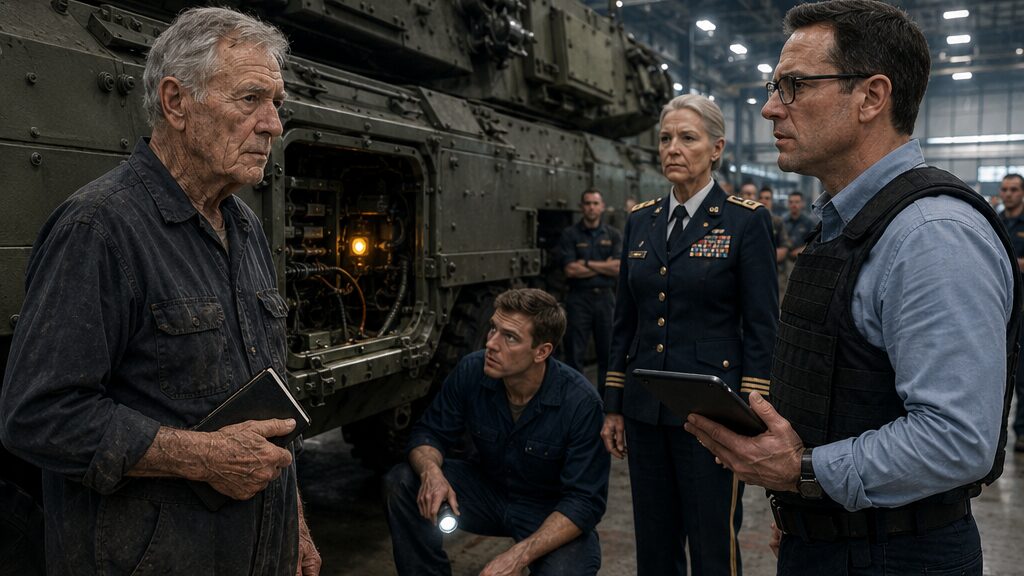
Rows of white industrial lights hummed above the concrete floor, flattening every shadow beneath the armored vehicle parked in Lane Three. The vehicle sat broad and heavy under the gantry cranes, its matte green hull raised slightly on service stands, its panels open like a patient on a table. Men and women in coveralls moved around it with tablets, carts, cables, and the quick speech of people who had a schedule taped inside their skulls.
George moved slower than they did.
He knew it. They knew it. No one said it unless they had to.
His knees gave him trouble on cold mornings, and the bay was always cold before the heaters caught up. His right hand had two fingers that didn’t close all the way unless he warmed them first around a coffee cup. His hearing was still good in the ways that mattered, though not always in the ways people expected. He missed some words when they were thrown at him from across a noisy room, but he could hear a loose bearing under a running deck fan, a relay that clicked half a breath late, a cable sheath rubbing where it had no business rubbing.
The younger technicians called that luck.
George called it listening.
He set his lunch pail under the old metal bench near Lane Three, hung his worn jacket on the hook, and buttoned his dark work shirt at the cuff. The shirt had faded where his suspenders crossed it and shined at the elbows from years of leaning into machines. His name tag, BENNETT, had been replaced twice, but the letters still looked tired.
The vehicle in Lane Three was the reason everyone had come in early.
By noon, Colonel Kathleen Miller wanted it ready for a final internal review. By the next morning, it was supposed to roll through a demonstration yard in front of officers, civilian observers, and the public affairs people who always managed to stand where they were most in the way. The bay supervisor had said the machine was nearly cleared. The diagnostics had passed, the software had been updated, the drive system had run clean through simulation.
George had heard that kind of confidence before.
It made people stand up straighter. It also made them stop bending down to look.
He took the inspection rag from his back pocket and walked along the left side of the vehicle, keeping one hand lightly against the hull. Not leaning. Never leaning unless he had to. Just touching enough to feel the cold skin of the machine and the faint vibration of auxiliary power waking up inside it.
Alexander Reed was crouched near the forward access step, tightening a cover. He looked up when George passed.
“Morning, Mr. Bennett.”
“Morning.”
“They’ve got us moving fast today.”
“Fast and right don’t always ride in the same seat.”
Alexander smiled like he wasn’t sure whether that was a joke. He was young enough to still smile at things he did not understand. George liked him for that. Some young men pretended confusion was beneath them.
A cart beeped behind them. Someone shouted for a torque driver. A diagnostic screen near the wall pulsed green across four blocks of system checks.
George stopped at the mid-hull service panel.
The cover had been left loose, two screws sitting in the magnetic tray below it. Inside, a small wiring bay was exposed: bundled cables, tagged connectors, a relay housing, and a narrow status strip no wider than a pack of gum. The strip held three tiny lights. Two were dark. One glowed amber.
George bent close.
His back protested. He ignored it.
The amber light blinked once.
He waited.
It blinked twice.
Then it held steady.
The noise of the bay seemed to pull away from him for a moment, not disappear, only thin out. The hum of lights stayed overhead. A pneumatic line hissed somewhere to his left. A technician laughed near the battery cart. But the space around the little amber light tightened.
George lifted his glasses from his shirt pocket and put them on. The frames sat crooked because he had fixed them himself with a dab of clear epoxy three months earlier. He waited through another cycle.
Steady.
A pause.
One blink.
A breath.
Second blink.
Steady again.
He did not touch it at first. He only looked.
The tag on the harness read C-17A AUX FEEDBACK. The print was fresh, machine-cut, clean enough to make a man trust it. George leaned closer and smelled the faint warm-plastic scent of a system that had been powered, reset, and powered again too many times in one morning.
“Don’t like that,” he murmured.
Alexander looked over. “Something loose?”
“Maybe.”
“The board passed last night.”
George did not answer right away. He was counting the space between blinks.
Old machines had told on themselves through oil, smoke, vibration, and heat. Newer machines told on themselves through logs, codes, and colored blocks on screens. But no machine, old or new, stopped being physical. Current still had to travel. Metal still expanded. Contacts still seated or failed to seat. A harness still knew when it had been bent one time too many.
George touched the edge of the panel with the back of two fingers, feeling for heat before he reached in. Not hot. Warm at the relay housing. Warmer than he liked.
“Mr. Bennett?” Alexander said.
“Hand me that penlight.”
Alexander slid it across the top of the service cart. George caught it with his left hand. His right fingers were stiff this morning. He clicked the penlight on and angled the beam behind the harness.
The amber light blinked again.
Once.
Twice.
George’s mouth went dry.
It was not fear exactly. Fear was too large a word for what he felt. This was smaller and older. A pressure behind the ribs. The body remembering before the mind gave permission.
He had seen warning lights lie. He had also seen men call them liars because a form told them to.
A pair of boots stopped behind him.
Not Alexander’s. These were polished, measured, impatient.
George kept the light steady inside the panel.
“Bennett,” the bay supervisor called from farther down the lane, “you on Lane Three?”
“Checking an auxiliary feedback blink.”
“The systems team already cleared that section.”
George did not look back. “It’s blinking wrong.”
There was a short silence. Not enough to stop work around them, but enough for Alexander to glance from George to the supervisor.
“Wrong how?” Alexander asked quietly.
George shifted the beam. “After reset, amber ought to hold or drop. It shouldn’t come back with two short blinks.”
Alexander leaned in, young eyes narrowing with real interest.
Then the boots behind George moved closer.
Patrick Carter’s reflection appeared first in the dull armor plate: light blue shirt, dark tactical vest, laminated badge, black-framed glasses, tablet tucked against one forearm. He was not military, but he carried himself like a man used to being obeyed by people in uniform and coveralls alike. His hair was trimmed close at the sides. His mouth had the flat line of someone who had already decided what kind of problem he was looking at.
“What’s going on here?” Patrick asked.
George clicked off the penlight but did not step away from the panel.
“Amber feedback is double-blinking after reset.”
Patrick looked at the exposed panel, then at George’s hand resting near the wires. His eyes moved to the magnetic tray and the loose screws.
“Who opened this?”
“It was open when I came up.”
“That section is under systems compliance.”
George finally turned his head. “Then systems compliance ought to look at it.”
Patrick’s face tightened, not dramatically, just enough that Alexander straightened.
Behind Patrick, farther back near the center aisle, Colonel Kathleen Miller stood with two officers and the bay supervisor. She wore her dress uniform as if it had been built around her spine. Her silver hair was pulled back neatly. She did not speak. She watched the lane, the vehicle, and the men around it with the stillness of someone weighing more than the words being said.
George noticed her, then looked back at the light.
It blinked once.
Then twice.
The small amber glow reflected in the curve of Patrick’s tablet screen.
Patrick did not look at it long enough to count.
“The diagnostic package is green,” he said. “We are not chasing ghost faults this morning.”
George took a breath through his nose. The bay smelled of metal dust, rubber, coffee, and heated insulation.
“Not a ghost,” he said.
Patrick turned fully toward him.
That was when George understood that the morning had changed. Until then, the problem had belonged to the machine. Now it belonged to the room.
And everyone in the room was about to decide whether the oldest man beside the vehicle was seeing something real, or only seeing the past.
Chapter 2: Step Away from the Vehicle
Patrick Carter did not raise his voice.
Men like him rarely had to. He had the kind of position that made people listen for irritation before it became anger. His badge clipped to his vest said SYSTEMS COMPLIANCE LEAD, and in a repair bay full of deadlines, that might as well have been a traffic signal.
“Mr. Bennett,” he said, “remove your hand from the panel.”
George looked down.
His hand was not inside the wiring bay. It rested on the outer lip of the open compartment, two knuckles lightly touching the paint. But he knew better than to argue over small facts when the larger one was already being ignored.
He removed his hand.
Slowly, because his fingers were stiff. Not because he wanted to make a point.
Patrick watched the movement anyway.
Alexander shifted beside the service cart. “Sir, he just noticed the amber—”
“I can see the indicator,” Patrick said.
George doubted that. Seeing a light was not the same as seeing what it did.
Patrick swiped his tablet awake and held it up enough for the nearest technicians to understand that the proper record was in his hand. Green bars. Cleared fields. A stamped time. A checklist that had already moved the morning forward.
“Auxiliary feedback passed at 0640,” Patrick said. “It passed again after the patch reload. There is no active fault.”
George nodded once. “Then you’ve got a fault that doesn’t know it’s active.”
One of the background soldiers near the tire rack made a small sound, almost a laugh, and smothered it. Patrick’s eyes flicked that way, then returned to George.
“This is exactly why we keep access control on open panels,” Patrick said. “Unassigned personnel create variables. Variables create delays.”
George felt Alexander go still.
Unassigned personnel.
At another time, on another morning, George might have let the words pass. He had let worse pass. Age taught a man to save his breath, and pride had never fixed a machine. But the amber light behind him blinked again, and though he did not turn to watch it, he knew the rhythm.
Once.
Twice.
Steady.
“Close the panel after you inspect the C-17A harness,” George said.
Patrick’s brows rose slightly. “Excuse me?”
George nodded toward the wiring bay. “Check the seat on the auxiliary feedback harness. Not the board. Not the code. The harness.”
Patrick gave a short exhale through his nose. “The harness was checked.”
“By hand?”
“By procedure.”
George looked at him for a long moment.
Patrick’s jaw hardened. “Mr. Bennett, you are not assigned to diagnostics on this vehicle.”
“No.”
“You are not on the systems team.”
“No.”
“And you are not authorized to interrupt the clearance chain based on a light pattern you think you remember.”
The words traveled. George felt them move outward through the bay. Tools slowed. A technician stopped uncoiling a cable. Someone near the diagnostic station looked over the top of a monitor. Even those who pretended to keep working had turned an ear toward Lane Three.
George did not mind being corrected. A man who worked around machines had to be corrected or he became dangerous. What he minded was the way Patrick looked at him as if memory itself were contamination.
Colonel Miller remained in the center aisle, arms relaxed at her sides. She did not rescue him. She did not stop Patrick. Her face gave away nothing.
George reached into his shirt pocket and pulled out his small notebook.
It was no official document. The cover was black once, now gray at the corners, soft from years of oil, sweat, and being carried close to the body. A rubber band held it shut. A pencil stub rode beneath the band. George opened it to the back pages where he kept timing marks and part numbers he did not trust to memory alone.
Patrick’s mouth tightened further. “That is not a maintenance authority.”
“No,” George said. “It’s a notebook.”
He set the notebook against his palm and tapped the pencil twice on the cover.
Tap. Tap.
Not loud. Just enough for Alexander to hear.
“That’s the blink,” George said. “Short, short, hold. After reset. If it was a normal amber hold, I’d close it myself.”
Patrick glanced at the panel as if the light had personally inconvenienced him. “Indicator behavior changed after the latest firmware load.”
“Did the relay click change too?”
Patrick paused.
It was brief, but George saw it.
The tablet had told Patrick what the software saw. It had not told him what the relay sounded like.
Alexander looked toward the open compartment. “I heard something after the last power cycle,” he said. “Kind of a double—”
Patrick turned on him. “Reed, are you assigned to certify this subsystem?”
Alexander swallowed. “No, sir.”
“Then don’t add noise.”
The young technician looked down.
George felt a flicker of anger, clean and sharp. Not for himself. For the way a young man’s curiosity had been stepped on before it could become judgment.
He closed the notebook.
“Run the reset again with the panel open,” George said. “Put a finger on the relay housing. You’ll feel it return twice.”
Patrick stared at him as if measuring whether the old man understood how close he had come to formal discipline.
“Mr. Bennett,” he said, “step away from the vehicle.”
The bay became very quiet in the way only a noisy room can become quiet—machines still running, lights still humming, but human sound withdrawn.
George could feel Colonel Miller watching.
He could feel Alexander watching.
He could feel the amber light behind him doing what it had no business doing.
There had been a time when an order like that would have moved through his body before thought. Step away. Stand down. Hands clear. He had spent enough years in uniform to know the shape of command. He also knew the difference between command and convenience.
Still, he stepped back.
One pace.
Then another.
He did it carefully, because his right knee sometimes caught if he backed up too fast. He did not want anyone mistaking a stumble for defiance or weakness. He held the notebook at his side and kept his eyes on Patrick.
“I’m away,” he said.
Patrick nodded toward the bay supervisor. “Close that panel. We’re already behind.”
The supervisor hesitated. “Do you want systems to—”
“I want the panel secured. The package is green.”
George looked past Patrick to Colonel Miller. For one second, he thought she might speak. Her gaze had moved from his face to the open panel, then to the tablet, then back to him. Something passed through her expression, too faint to name.
But she said nothing.
The supervisor reached for the cover.
George’s fingers curled around the notebook until the stiff joints complained.
Alexander moved to help, then stopped when Patrick glanced at him.
The panel cover came up, hiding the small amber light. The first screw caught. The second one turned into place. The warning disappeared behind painted metal, which made the room feel better without making the machine safer.
Patrick looked at George.
“Please return to your assigned duties.”
Please. That was the word men used when they wanted an order to sound clean.
George slipped the notebook back into his shirt pocket. He could feel the pencil stub pressing through the fabric against his ribs.
He wanted to say too much. He wanted to ask Patrick how many machines he had watched fail after every box had been checked. He wanted to tell him that a system could be green and still be wrong, that old hands were not magic but they had paid attention through consequences most people only read about.
Instead, George picked up his inspection rag from the service cart.
As he turned away, the auxiliary power cycled behind the sealed panel.
There, beneath the hum of the bay, came the sound.
Click.
Click.
Hold.
George stopped for half a breath.
Alexander heard it too. George knew because the young man’s eyes lifted, quick and uncertain, toward the closed panel.
Patrick was already looking down at his tablet.
Chapter 3: The Tablet Says Green
By late morning, the vehicle in Lane Three had become less a machine than a promise everyone was afraid to break.
The public affairs officer had already walked through twice, asking where the demonstration placards could be placed without violating safety boundaries. The bay supervisor had taped a fresh staging schedule beside the diagnostic station. A pair of soldiers polished dust from the vehicle’s side skirts even though the machine had not yet been moved. Every visible surface was being made ready for people who would never see the hidden spaces beneath it.
George returned to his assigned bench and sorted fasteners into marked trays.
It was work his hands could do without much help from his mind. Quarter-inch bolts. Panel clips. Retaining washers. The ordinary little pieces that disappeared under boots and delayed jobs by twenty minutes. He wiped each one, checked the threads, set it where it belonged.
Across the bay, Patrick stood beneath the diagnostic monitor with two members of the systems team. His tablet was connected now to the station by a black cable. Green status fields filled the larger screen. Every few minutes, someone would say “clean,” “stable,” or “no active fault,” and the words would drift through the bay like small permissions to relax.
George did not relax.
He watched the sealed panel without staring at it.
That was an old habit too. Looking without looking. In the Army, if you stared too hard at something, everyone else stared with you, and then the thing you were watching stopped being yours to understand. So George used reflections. The shine of a tool cabinet. The curve of a hub cover. The dark stripe in a polished floor patch. He watched the area around Lane Three the way a man watches weather.
Alexander came by with a tray of cable ties and stopped near George’s bench.
“You need these sorted?”
George looked at the tray. “Those are already sorted.”
“Right.” Alexander set them down anyway. “I thought maybe you could use extras.”
George picked up one cable tie and ran it between thumb and forefinger. “Extras have a way of becoming clutter.”
Alexander gave a small nod but did not leave.
George glanced at him. “Say what you came to say.”
The young technician lowered his voice. “I heard it. After the panel was closed.”
“I know.”
“Could have been normal.”
“Could have.”
“But you don’t think so.”
George put the cable tie back in the tray. “Doesn’t matter what I think. Matters what gets checked.”
Alexander looked toward Patrick. “He says the fault log is clean.”
“I heard him.”
“Is it possible the firmware changed the indicator timing?”
“Possible.”
“Is that what happened?”
George let the question sit.
He had learned not to feed young people certainty they had not earned. Certainty was heavy. If you handed it to someone too soon, they either dropped it or swung it around like a weapon.
“Go ask the system what it sees,” George said. “Then ask the machine what it did.”
Alexander frowned slightly. “How do I ask the machine?”
George pointed with his chin toward the sealed panel. “You already heard the answer once.”
A call came from the diagnostic station.
“Power cycle in ten.”
Alexander took the tray of cable ties, hesitated, and moved back toward the vehicle.
George stood.
His knee had stiffened while he sat. He gripped the edge of the bench until the first flare faded, then crossed the bay slowly enough that no one would accuse him of hurrying toward trouble. He stopped near a rolling cabinet, outside the immediate work zone, and folded his rag once in his hands.
Patrick saw him but said nothing.
Maybe he had decided George was harmless at that distance. Maybe he did not want another scene with Colonel Miller still somewhere nearby. She had left the main bay after the confrontation, but her absence had not softened the schedule. If anything, people moved faster when the officer was gone, as though trying to prove they had not needed her watching.
“Cycle,” Patrick said.
A systems technician tapped the command.
The vehicle gave a low electrical murmur. Fans dropped, relays released, screens went dark, then returned in sequence. On the diagnostic monitor, gray boxes flashed to yellow, then green. A progress bar swept left to right.
A clean restart. A handsome restart. The kind that made people nod.
George listened past it.
The bay lights hummed. The ventilation rattled in the overhead duct. A cart rolled near Lane Two. Someone coughed. Then, from behind the sealed panel, very faint but present, came a click.
A pause.
Another click.
George’s fingers tightened around the rag.
Alexander, standing near the forward step, turned his head.
Patrick did not. He was watching the tablet.
“All fields green,” the systems technician said.
Patrick nodded. “Log it.”
George waited for someone else to speak.
No one did.
The diagnostic screen settled into a clean layout. Green across the board. No active faults. No warnings. No pending alerts. It looked beautiful. It looked final.
Patrick disconnected his tablet and turned toward the bay supervisor. “We proceed to mobility staging at fourteen hundred. Final visual at sixteen hundred. Colonel Miller gets the readiness packet by close of business.”
The supervisor looked relieved. “Understood.”
George folded the rag again, though it did not need folding.
Alexander’s eyes found him from across the lane. The question in them was plain enough to read: Are you going to say something?
George looked at the sealed panel.
Then at Patrick.
Then at the workers who had begun moving again, grateful for permission to trust the screen.
He felt the old pressure behind his ribs, smaller now but deeper. A memory trying to become a warning. He pushed it down, not because it was wrong, but because memories could make a man careless if he let them drive instead of guide.
Patrick approached him with the tablet tucked at his side.
“Mr. Bennett.”
George turned.
“I appreciate that you’re trying to be thorough,” Patrick said. His tone had changed. It was smoother now, almost generous, which made it worse. “But we have a process for a reason. A demonstration like this involves command review, contractor review, safety review. Personal hunches cannot override validated systems.”
George nodded. “They shouldn’t.”
Patrick seemed satisfied too soon.
George added, “Unless the validated system missed something.”
Patrick’s expression cooled. “It didn’t.”
“You hope it didn’t.”
“I know it didn’t.”
“No,” George said, quietly. “You know what it reported.”
For a moment the space between them held.
Patrick looked tired then, not old, not weak, just pressed thin by responsibility. George saw it and felt some of his anger loosen. The man had a schedule over him, and perhaps another man over that, and another above him. Pressure moved downhill until someone at the bottom called it certainty.
Patrick lowered his voice. “Do you understand what happens if we stop this line because of an undocumented sound?”
“Yes.”
“I don’t think you do.”
George almost smiled at that. Not because it was funny.
Patrick continued, “This vehicle has been delayed twice. The demonstration has already been moved once. Colonel Miller is carrying enough scrutiny without us inventing a fault no instrument can find.”
George looked at the sealed panel. “Faults don’t need permission to exist.”
Patrick’s lips pressed together. “Return to your bench.”
This time George did not answer.
He walked back, aware of Alexander watching him and aware of his own body betraying him in small ways: the uneven step, the hand that brushed a cart for balance, the breath he took before sitting. He hated that those details could be used as evidence by people who did not know what they were seeing.
At his bench, he pulled the black notebook from his pocket.
For a while he only held it.
Then he opened to a blank line near the back and wrote with the pencil stub.
Lane Three. C-17A aux feedback. Amber hidden after close. Relay returns twice after reset. Tablet green.
He paused.
Below it, without meaning to at first, he wrote another line.
Same rhythm as Polk yard.
He stared at the words until they seemed darker than the others.
Polk yard was not a place people in this bay talked about. Most of them had never heard of it. To the Army, it had been a training incident, reviewed, filed, corrected, and buried under newer procedures. To George, it was still a young crewman sitting on the ground with dust on his face, asking why nobody had listened when the old sergeant said the relay was wrong.
George shut the notebook.
Across the bay, the armored vehicle sat clean and quiet under the lights.
Then the power-down sequence began for staging prep.
The big fans slowed.
The diagnostic monitor dimmed.
For three seconds, there was almost peace.
From inside Lane Three’s sealed panel came the faint sound again.
Click.
Click.
George closed his eyes.
When he opened them, Alexander was standing beside the vehicle, looking not at the tablet, not at Patrick, but at the place where the amber light had been hidden.
Chapter 4: The Sound George Could Not Forget
George did not go to the records room right away.
For twenty minutes, he tried to let the bay prove him wrong.
He finished sorting the fasteners. He wiped down the bench. He replaced two cracked labels on a tray of panel clips and signed off on a tool inventory sheet that no one would remember unless something went missing. He moved slowly through each task, giving his hands work that should have settled his mind.
It did not.
The vehicle in Lane Three sat with its panel closed and its status clean. Patrick’s team moved around it with the ease of men who had already crossed a problem off the list. Cables were coiled. A final staging mat was rolled beside the tracks. The bay supervisor checked off items with a marker, one quick slash after another.
George kept hearing the sound.
Click.
Click.
Not loud. That was the trouble with it. Loud failures earned respect. They smoked, snapped, flashed, spilled fluid, shattered parts. A small relay returning twice did none of that. It was too polite. It waited inside the machine and trusted someone to care.
George pressed his thumb into the sore joint of his right hand until the ache sharpened. The present came back: cold bench edge, oil smell, distant cart wheels, Alexander’s uncertain glance from across the bay.
Then another sound slipped underneath it.
A young man coughing dust out of his lungs.
George closed his eyes, then opened them hard.
“Not now,” he muttered.
But memory did not take orders. It came the way heat came off armor after a long run—slow, invisible, unavoidable.
Polk yard had been dry, bright, and loud. Not this clean white bay with polished floors and labeled stations, but a training lot beaten flat by sun and tracks. George had been younger then, though not young. Staff sergeant. Strong hands. Good knees. A voice people heard the first time.
The vehicle had been older than the one in Lane Three, but not so different underneath the skin. Power, feedback, pressure, men trusting lights because lights seemed less fallible than people. George had heard the relay chatter after reset. Not much. Two small clicks under the engine noise.
He had told the maintenance officer.
The officer had looked at the sheet.
The sheet had said clear.
A crewman named only by his face now, because George had spent years trying not to keep the name where it could cut him fresh, had climbed in after clearance. The failure had not killed him. That was what the official report cared about. It had injured him, scared him, ended his time in the vehicle program, and left George with a lesson no correction memo could soften.
A warning ignored did not disappear.
It waited for a body.
George took the notebook from his pocket and opened it again. His handwriting had grown cramped over the years, but he could still read every mark. He ran his thumb along the line he had written.
Same rhythm as Polk yard.
He shut the book before anyone saw.
Across the lane, Alexander stood near a cable rack pretending to count connectors. He looked back at the sealed panel too often. That meant the sound had entered him. Good, George thought. Then he felt sorry for thinking it. A young man should learn caution, but not through ghosts.
George pushed himself upright and walked toward the small hallway behind the bay office.
The records room sat between supply and the supervisor’s glass-walled office, behind a gray door with a keypad that stuck in humid weather. George had a code because he returned old manuals and checked out paper binders nobody else wanted to lift. He punched it in with his left hand. The lock buzzed, complained, and gave.
Inside, the air changed. Paper, dust, cardboard, dry toner, and the faint sweetness of old binder plastic. Fluorescent tubes flickered overhead. Metal shelves held rows of maintenance histories, archived bulletins, retired schematics, incident cross-references, and boxes marked with years that seemed to belong to another country.
Sandra Walker sat at the back desk with a mug of tea gone cold beside her keyboard. She wore a gray cardigan over her work blouse and had reading glasses on a chain around her neck. A printer beside her clicked to itself as if bored.
She looked up. “George Bennett in my cave before lunch. That’s never good.”
“Morning, Sandra.”
“It was morning two hours ago.” She studied his face. “You need a manual?”
“Maybe an old index.”
“How old?”
He hesitated.
She lifted the glasses from her chest and put them on. “That old?”
“Pre-digital carryover. Armored auxiliary feedback. C-series harness. Might be under training incidents, might be under service bulletins.”
Sandra leaned back. “That is not a small maybe.”
“No.”
“Is this about Lane Three?”
George did not answer quickly enough.
She sighed and turned toward her terminal. “Patrick already called down here once today.”
George looked at her.
“He asked whether any legacy bulletin was open against the platform. I said nothing active in the current system.”
“That wasn’t what I asked.”
“No,” Sandra said, fingers poised above the keyboard. “It was not.”
For a few minutes, the room held only typing, clicking, and the distant thud of work from the bay beyond the wall. George stood instead of sitting because he was afraid if he sat, his knee would stiffen beyond patience. Sandra searched through current files, then archived files, then a scanned index old enough that the software warned her twice about unsupported formatting.
“What exactly am I looking for?” she asked.
George opened his notebook to a blank corner and wrote: two-blink return after reset. He tore the corner carefully and placed it on her desk.
Sandra read it. “That’s not a technical phrase.”
“It’s what a mechanic would write before an engineer cleaned it up.”
Her expression changed slightly. She stopped searching the official fields and opened a keyword scan through scanned notes.
Outside, a cart rolled past the records room door. Voices rose and faded.
Sandra’s computer found nothing. Then nothing again. Then a partial match in a scanned maintenance index from years before George had worked in this facility.
She frowned. “Hold on.”
George’s hand tightened on the back of the chair.
Sandra clicked twice. A grainy scan opened. Most of the page was crooked, with handwritten marks in the margin. She enlarged the lower half.
“There,” she said.
George leaned in.
The line was part of an old cross-reference table, not a full bulletin. The original subject heading had been cut off by the scan. But the note was there, typed faintly, followed by a handwritten underline.
Two-blink return after reset—inspect auxiliary feedback harness seat under load before clearance.
George felt the room tilt quietly into place.
Sandra looked at him over the top of her glasses. “Is that what you saw?”
“I saw the light. Heard the relay.”
“Current system didn’t flag it?”
“No.”
She turned back to the screen. “This index points to a paper box, not a live file. Could be obsolete.”
“Obsolete doesn’t mean false.”
“No,” she said softly. “It does not.”
George copied the index number into his notebook. His hand shook once, and he closed his fingers around the pencil until it stopped.
Sandra noticed. She was kind enough not to say so.
“George,” she said, “if you take this upstairs and it turns out to be nothing, Patrick will not be gentle.”
George slipped the notebook back into his pocket.
“If it turns out to be something,” he said, “gentle won’t matter.”
Sandra stood and reached for a ring of keys hanging beside the archive shelves.
“I’ll find the box,” she said.
George looked toward the wall that separated the records room from the bay. The machinery beyond it hummed steady and confident. For the first time all morning, he did not feel alone with the sound.
Then Sandra pulled a cardboard archive carton from the lower shelf, and on its side, written in fading marker, was the same index number.
Chapter 5: A Warning Buried in Paper
The archive box left a pale trail of dust across Sandra’s desk.
She brushed the top with one hand, then thought better of it and used a cloth from the drawer. George stood opposite her, watching the old tape lift from the cardboard in dry little cracks. The box had not been opened cleanly in years. Its corners were softened, one side bowed from the weight of folders stacked badly inside.
Sandra slit the last strip of tape with a letter opener.
“Careful,” George said.
She gave him a look. “I handle old paper for a living.”
“Old paper gets proud.”
“So do old mechanics.”
He almost smiled.
Inside were yellowed folders, retired inspection sheets, a few photographs clipped to reports, and a stack of service bulletins that had been copied so many times the text looked bruised. Sandra read folder tabs while George held the index number in his notebook open beside her.
“Auxiliary power conversions,” she said. “Harness routing update. Relay housing inspection. Field training correction. Here.”
She lifted a thin folder, its metal prongs rusted at the bend.
George did not reach for it until she placed it on the desk.
His fingers had opened hundreds of folders like this in his life. Most carried ordinary mistakes: missed torque marks, wrong part substitutions, maintenance shortcuts that looked clever until they broke something expensive. But this folder seemed to pull air from the room.
Sandra turned the first page.
The heading was formal, careful, and old. Corrective Maintenance Advisory. Auxiliary Feedback Harness Seat Instability Under Load. Below it, a photograph showed a relay housing not identical to the one in Lane Three, but close enough to make George’s shoulder muscles tighten.
Sandra read in silence.
George looked for the sentence before she found it. His eyes moved down the page, past serial ranges and testing conditions, past cautions and cross-references. There it was, clinical and bloodless.
Intermittent two-pulse amber return after reset may not produce an active system fault during stationary diagnostic check.
Sandra tapped the page. “That’s it.”
George nodded.
“Does Lane Three have this exact configuration?”
“No.”
“Then Patrick will say it doesn’t apply.”
“He’ll be partly right.”
Sandra looked up.
George turned the page. “The housing changed. The behavior didn’t.”
She studied him for a moment, then closed the folder halfway. “You need someone younger to carry this.”
“I can carry paper.”
“I don’t mean the paper.”
He knew what she meant.
A warning from an old man could be treated as memory. A warning from records could be treated as outdated. A warning from a younger technician might survive long enough to be checked.
As if summoned by the thought, Alexander appeared at the records room door. He hesitated when he saw the open archive box.
“Mr. Bennett?” he said. “They’re moving Lane Three toward staging in twenty.”
George glanced at Sandra. Sandra held up the advisory.
Alexander stepped inside and read the heading. His face changed, not dramatically, but enough.
“This is real,” he said.
“It was always real,” George answered.
Alexander flushed. “I didn’t mean—”
“I know what you meant.”
Sandra made a copy of the advisory, then another. The copier complained, pulling light across the old page in slow passes. George used the time to steady himself. Evidence was useful. Evidence was not salvation. He had seen men argue with photographs, measurements, smoke, and pain when the timing was inconvenient.
Patrick was at the diagnostic station when they returned.
The bay had shifted into staging rhythm. Floor lanes were being cleared. A tow bar sat ready. The vehicle crew had arrived in clean coveralls, helmets tucked under their arms. The public affairs officer spoke with the bay supervisor near the main door, gesturing toward the demonstration yard beyond.
George walked with Sandra on one side and Alexander on the other. He disliked how that looked, as if he needed escorting. Then his knee caught slightly near the cable mat, and Alexander’s hand lifted, not touching him, just ready. George hated that too. He hated needing it. But he hated more the thought of the panel being left alone.
Patrick looked up.
His eyes moved first to George, then to Sandra, then to the folder copy in Alexander’s hand.
“Now what?” Patrick asked.
George let Alexander speak.
The young technician held out the copy. “There’s a legacy advisory for auxiliary feedback harness seat instability. It says a two-pulse amber return after reset may not show as an active fault during stationary diagnostics.”
Patrick took the page.
For a few seconds, no one spoke. His eyes moved across the heading, the paragraph, the photograph. George watched the professional part of him work. Patrick was not a fool. That made the moment more dangerous. A fool could dismiss anything. A competent man under pressure had to decide what kind of truth he could afford.
“This is an old advisory,” Patrick said.
“Yes,” Alexander replied.
“It references a previous housing configuration.”
“Yes, but the signal behavior—”
Patrick cut him off with a raised finger, still reading. “The platform has had three major electrical revisions since this note.”
George said, “A loose seat still lies the same way.”
Patrick lowered the paper. “That is not how compliance works.”
“No,” George said. “That’s how machines work.”
The bay supervisor came closer, drawn by the tone. Colonel Miller entered the bay from the side office at almost the same time. She carried no folder, no tablet. She looked at the people gathered by Lane Three and stopped just beyond the diagnostic station.
Patrick noticed her. His posture straightened.
“Colonel,” he said, “we found a legacy advisory that appears superficially similar, but it does not match the current configuration. The active system remains green.”
Kathleen held out one hand. Patrick gave her the page.
She read it without hurry.
George watched her face and saw little. That was discipline. He respected it even while it gave him nothing to hold on to.
“Mr. Bennett,” Kathleen said, still looking at the paper, “you saw this indicator?”
“Yes, ma’am.”
“Today?”
“Yes, ma’am.”
“After reset?”
“Yes, ma’am. Twice.”
She looked to Alexander. “You heard the relay?”
Alexander swallowed. “I heard two returns during power cycle. I didn’t confirm by touch.”
Patrick said, “Colonel, we cannot halt staging based on an obsolete advisory and an unverified sound.”
Kathleen’s eyes moved to him. “I did not say we were halting.”
Patrick nodded once. Relief moved through him before he could hide it.
George felt the old pressure return.
Kathleen looked back at the advisory. “What would confirmation require?”
Patrick answered first. “A full load-condition manual check would require reopening the panel, pulling the side access shield, and delaying staging. Minimum ninety minutes if nothing is found. More if they disturb the harness.”
George said, “Ten minutes to see if the relay returns under hand pressure.”
Patrick turned toward him sharply. “That is not an approved confirmation method.”
“No,” George said. “It is a first look.”
“A first look by whom?”
George met his eyes. “Someone willing to look.”
The words landed harder than he intended. Patrick’s face closed.
Kathleen folded the copy once and handed it back to Alexander.
“We proceed to staging,” she said.
George felt Alexander’s disappointment before he saw it.
Patrick gave a curt nod. “Understood.”
Kathleen continued, “But the panel stays accessible until final visual. No permanent seal. No cosmetic cover. If the indicator returns, I want to see it myself.”
Patrick’s relief thinned. “Colonel—”
“That is my decision.”
“Yes, ma’am.”
It was not enough. George knew it was not enough. The machine could sit polite through staging and betray them under demonstration load. But it was more than he had been given all morning.
The vehicle began moving thirty minutes later.
The tow motor pulled it slowly from Lane Three toward the staging lane near the main bay doors. Its tracks crept over the concrete with a heavy, dry sound. Workers walked alongside, guiding, watching clearances, calling distances. The open service panel remained covered only by a temporary latch, exactly as Kathleen had ordered.
As the vehicle passed George’s bench, Alexander walked near the mid-hull.
He glanced at George.
George gave no signal. He had none to give.
Patrick walked on the other side with his tablet, logging the move. Kathleen observed from the central aisle, hands behind her back.
For a moment, the armored vehicle was between all of them, separating screen from memory, authority from warning, speed from caution.
Then the tow motor stopped in the staging lane.
The temporary latch rattled once.
Nothing blinked that George could see.
Patrick looked across the vehicle at him, not smug exactly, but steady with vindication waiting to become official.
George lowered his eyes first.
Not in surrender. In listening.
There were too many sounds: tow motor idle, overhead ventilation, bootsteps, chain clink, a distant bay door motor. The relay, if it spoke, was buried.
Patrick announced, “Staging move complete. No active warnings.”
The bay supervisor marked the board.
The vehicle crew began preparing final exterior checks.
George stayed where he was, the old advisory copy folded in Alexander’s hand nearby, the notebook heavy in his pocket.
After a minute, Kathleen turned away to take a call.
Patrick looked at the schedule.
The room moved on.
Then Alexander, who had not stopped watching the temporary panel, whispered, “Mr. Bennett.”
George lifted his head.
The amber light, barely visible through the narrow seam of the unsealed cover, blinked once.
Then twice.
Chapter 6: George Refuses to Sign the Bay Sheet
By evening, the repair bay had lost its morning shine.
The lights were just as bright, the floor just as clean, the tools still lined in their foam-cut drawers, but fatigue had settled over the place like a film. Voices were lower. Mistakes were sharper. Every delay showed more clearly against the demonstration schedule posted by the diagnostic station.
The armored vehicle sat in the final staging lane, nose angled toward the main doors. Beyond those doors, the demonstration yard lay in strips of shadow and floodlight. Tomorrow, if the schedule held, it would roll out under flags, cameras, and careful language about readiness.
If the schedule held.
George stood beside the staging lane with the folded advisory in one hand and his notebook in the other. His right knee had gone from stiff to hot. His shoulders ached from standing too long. He had eaten half a sandwich at two in the afternoon and nothing since. None of that mattered except that other people could see it.
Patrick saw it.
George could tell by the way Patrick’s eyes dipped once to his leg, then away.
“Mr. Bennett,” Patrick said, “you’ve made your objection known.”
The temporary panel had been opened again after Alexander saw the blink through the seam. Not fully opened at first. Patrick had insisted on documenting the indicator before anyone touched a screw. The systems team had gathered. The bay supervisor had called Colonel Miller back from her office. Alexander had stood close enough to hear but not close enough to be accused of interfering.
When the cover came loose, the amber light was steady.
Not blinking.
Patrick had looked at George then, and the room had looked with him.
George said nothing. He had learned that machines liked to embarrass impatient men and patient men alike.
The power cycle had been repeated.
The light held steady.
The diagnostic screen stayed green.
A second cycle produced the same result.
By the third, Patrick’s restraint had worn thin. “We cannot keep cycling a cleared system until it produces the result someone wants.”
George had not answered.
Now the bay sheet lay on a clipboard in the supervisor’s hand. Each section needed initials before the vehicle could be handed to the demonstration crew. George was not responsible for systems compliance. Patrick had made that clear. But George had performed the earlier physical-area inspection around the mid-hull access lane. His initials were routine. Usually meaningless.
Tonight they were not.
The supervisor held the clipboard out with an apologetic face. “George, it’s just your lane inspection. Housekeeping, tool clearance, exterior access. Not systems.”
George looked at the paper.
His name was printed beside a narrow line. BENNETT, G.
He could sign it and say later that systems were not his responsibility. That would be true enough for paperwork. It would not be true enough for sleep.
Patrick’s voice sharpened. “The sheet does not certify the subsystem.”
“No,” George said.
“Then sign your section.”
George looked at the vehicle. The open panel waited, amber light steady as a held breath.
“No.”
The supervisor blinked. “George.”
“I won’t sign a clearance sheet on a vehicle I believe is still warning.”
Patrick took a step closer. “That is not your determination to make.”
“Then you sign it.”
“I already signed systems.”
“Then sign mine too.”
Silence moved outward.
Alexander stood near the service cart, holding a flashlight he had not been asked to use. Sandra had come to the bay after her shift should have ended and lingered near the records door. Colonel Kathleen Miller stood a few yards away, the old advisory copy in her hand, watching George with the same unreadable calm she had worn all day.
Patrick spoke carefully. “You understand refusal may affect your contract status.”
George did understand.
At seventy-two, a man did not collect many new chances. The contract paid for repairs on his truck, groceries that cost more every month, and the small pride of leaving the house before sunrise with a purpose in his pocket. He needed it more than he liked admitting.
His hand tightened around the notebook.
“I understand,” he said.
Patrick looked frustrated enough to be honest. “Why are you doing this?”
George almost said, Because the light blinked twice.
It was the smallest answer. The cleanest. Also not the whole one.
He looked toward the panel and saw, not the bay, but dust and sun and a crewman’s frightened eyes. He saw his own younger hand holding a report that said no active fault. He heard himself, years ago, saying, I should have pushed harder. He had said it to no one in particular. No one had disagreed.
Kathleen’s voice cut quietly through the bay.
“Mr. Bennett.”
George turned.
“What are you seeing that we are not?”
No challenge. No pity. A question.
That almost undid him.
He opened his notebook with care. The pencil marks crowded the page: timing, relay sound, advisory number, Lane Three, C-17A. He did not show them the page like proof. He used it to keep his voice level.
“Not seeing, ma’am. Pattern. Amber returns twice after reset. Relay follows it. Clean diagnostic because stationary check isn’t loading the harness the way movement does. Old advisory says inspect under load before clearance. Current housing changed, but the harness still routes through a vibration point behind the side shield.”
Patrick said, “That is speculation.”
George nodded. “Yes.”
The admission seemed to catch Patrick off guard.
George continued, “But it’s speculation tied to a light, a sound, a route, and an old correction written because somebody learned it the hard way.”
Kathleen looked at the vehicle. “What do you need?”
Patrick turned. “Colonel, with respect—”
She raised one hand, not sharply, but enough.
George looked at his own fingers. The right ones would not do the work cleanly. Not fast. Maybe not at all.
“Ten minutes,” he said. “One flashlight. Side shield loosened, not removed. Alexander’s hands on the harness. Mine aren’t good enough tonight.”
Alexander looked up.
The admission cost George more than the refusal had.
Patrick heard it too. Something shifted in his face, but not yet enough.
Kathleen said, “Do it.”
The bay moved.
Not dramatically. No one ran. The supervisor brought tools. Alexander knelt by the mid-hull panel with the flashlight clenched between his teeth until George told him to put it in his left hand and keep his right free. Patrick stood close with his tablet, recording the deviation. Kathleen watched from behind them.
George lowered himself onto one knee and regretted it immediately.
Pain flared bright up his thigh. He set one hand against the track guard and breathed through it. Alexander saw.
“I can do it if you talk me through,” the young technician said.
“That’s what I asked for.”
The side shield screws loosened one by one. The panel opened just enough to admit the flashlight beam. Behind it, cables ran in clean bundles. Too clean. New ties. New routing clips. Fresh work.
George pointed with the pencil.
“Not that one. Behind. Feel the lower seat.”
Alexander reached in.
Patrick leaned over. “Be careful with connector pressure.”
George said, “Two fingers, not a fist. Don’t pull. Seat and lift.”
Alexander’s face tightened with concentration. “I feel the housing.”
“Good. Now keep a finger there. Power reset.”
Patrick looked to Kathleen. She nodded.
The systems technician initiated the cycle.
Fans dropped. Screens dimmed. The vehicle seemed to inhale the bay’s silence.
George watched Alexander’s hand, not the tablet.
The amber light went dark, returned steady, then blinked.
Once.
A pause.
Twice.
Under Alexander’s fingertip, the relay clicked.
The young technician’s eyes widened. “I felt it.”
Patrick looked at the panel.
The diagnostic screen stayed green.
George said, “Now lift the harness a hair. Not out. Up.”
Alexander obeyed.
The amber light flickered, went steady, then blinked twice again.
This time everyone close enough saw it.
Kathleen stepped nearer. “What does that mean?”
George’s knee throbbed. Sweat had cooled at the back of his neck.
“It means the seat is lying under stillness,” he said. “Under movement, vibration can open it just enough to confuse feedback. Maybe nothing happens tomorrow. Maybe it drops a command at the wrong second. I wouldn’t clear it.”
Patrick stared at the light. His tablet, still green, reflected amber on its black edge.
For the first time all day, he did not speak first.
Kathleen did.
“Vehicle stays in bay. Demonstration delayed until manual inspection is complete.”
The words seemed to strike the floor before anyone moved.
The bay supervisor shut his marker with a click. The public affairs officer, standing near the door, lowered his phone. Alexander kept his hand steady in the panel, as if afraid the truth would disappear if he let go.
Patrick looked at George, and for a moment the frustration was still there. Then something else came through it. Not apology. Not yet. Recognition, maybe, in its most uncomfortable form.
George tried to stand.
His knee refused.
Alexander started to help and stopped, remembering pride. George looked at him once and gave a small nod.
The young technician took his elbow.
George rose slowly, with help, in front of everyone.
He hated needing it.
He was grateful for it.
When he was steady, he looked at the amber light. It had gone solid again, innocent as a star behind glass.
Kathleen held out the unsigned bay sheet.
George did not take it.
“Not yet,” he said.
This time, no one told him to step away.
Chapter 7: The Man Who Heard the Second Click
The repair bay did not cheer.
George was grateful for that.
Applause would have made the moment smaller, turned it into a performance, and there was still a machine open under floodlights with a fault hiding behind clean diagnostics. Work came first. Respect, if it was real, could wait until after the screws were counted and the system was safe.
Kathleen’s order changed the shape of the room.
The demonstration schedule came down from the board. The bay supervisor replaced it with a manual inspection list. The public affairs officer stepped outside with a phone pressed to one ear, speaking in the careful language of postponement. The vehicle crew removed their helmets and set them on a bench. Systems technicians gathered with tools instead of tablets. No one moved quickly now. They moved deliberately.
George sat on a low rolling stool near the mid-hull panel because standing had become foolish and kneeling again would have been worse. His knee pulsed with heat. His right hand ached from gripping the notebook too hard. He tucked the hand under his left arm for a moment, letting the warmth of his body ease the joints.
Alexander crouched at the opened side shield with a flashlight angled into the narrow space.
“Tell me before I touch anything,” he said.
George nodded. “Good.”
Patrick stood behind them, tablet still in hand, but no longer held like a shield. He had removed his glasses once, cleaned them with the edge of his vest, and put them back on without saying a word. The green diagnostic screen glowed from the station across the lane, looking less like an answer now and more like one witness among several.
Sandra had brought the full advisory folder from records. It lay open on a clean mat beside George’s notebook. Old paper, new tablet, flashlight, amber light. All of it in one place at last.
Alexander reached in slowly.
“Lower harness seat,” George said. “You’ll feel the clip before you see it. Don’t trust the outer tie. That’s just keeping it pretty.”
Alexander’s fingers moved through the gap. “I’ve got the tie.”
“Past it.”
“Relay housing.”
“Below.”
A pause.
Then Alexander’s brow tightened. “There’s movement.”
Patrick leaned in. “How much?”
“Not much.”
George said, “Enough is a size.”
Alexander glanced back at him, then returned to the harness. “The connector feels seated.”
“It’ll feel seated until it doesn’t.”
Patrick exhaled, but there was no contempt in it this time. Only strain.
The systems technician ran another controlled power cycle under Kathleen’s supervision. The bay held quiet around the vehicle. Fans dropped. The amber light went dark. It returned steady.
“Now lift,” George said.
Alexander lifted with two fingers.
The light blinked once.
Then twice.
The relay clicked under his touch.
Alexander froze. “There.”
Patrick took one step closer. “Hold it.”
“I am.”
George pointed with the pencil. “Ease pressure to the left. Not up. Left.”
Alexander obeyed.
The amber light steadied.
“Back right,” George said.
The light blinked twice again.
The bay supervisor swore under his breath, not loudly, but enough that Sandra looked at him over her glasses.
Patrick’s face had gone pale around the mouth. “That shouldn’t happen.”
“No,” George said. “It shouldn’t.”
They loosened the shield farther. Not removed, not yet, but opened enough for a small inspection mirror. The flashlight beam caught the underside of the harness seat. At first it looked perfect. Clean, clipped, routed, approved. Then Alexander shifted the mirror, and George saw the tiny shadow where no shadow should have been.
“There,” George said.
Alexander adjusted the beam.
A retaining tab had not fully locked. It sat almost flush, close enough to pass a glance, close enough to feel seated if checked from the wrong angle. Under stationary diagnostics, it behaved. Under slight lift and lateral pressure, it opened a hair’s width and sent the feedback relay into its double return.
Patrick stared at it.
The tablet in his hand did not know how to be ashamed.
The bay supervisor crouched beside them. “Fresh install?”
Alexander checked the tag. “Looks like from the last revision.”
Patrick said quietly, “It should have been caught.”
George kept his eyes on the connector. “Most things should be.”
No one answered.
They documented the fault properly. Patrick took photographs. Alexander marked the harness position. The systems technician captured the behavior during reset while the manual pressure reproduced it. Sandra copied the advisory reference onto the inspection packet and wrote the archive number in her neat hand. Kathleen stood nearby, reading each entry before it moved forward.
George did not touch the connector himself. His fingers were too stiff for that space, and pretending otherwise would not make the work better. He talked Alexander through the reseat instead.
“Release it clean. Don’t fight plastic.”
“I’ve got it.”
“Check for grit.”
“Clear.”
“Now seat until you feel it, not until you think you ought to.”
Alexander pressed.
A small click sounded from the connector.
Not the relay. Not the warning. A physical click, final and ordinary.
George let out a breath he had been holding too long.
“Again,” he said.
Alexander looked back. “It clicked.”
“Again.”
The young technician pressed once more, then tugged gently. “Locked.”
“Now tie it so function comes before pretty.”
Alexander cut the old cable tie and replaced it with two new ones, leaving the harness supported without forcing it against the housing. He checked it from above, then below with the mirror. Patrick watched every movement.
The next power cycle held.
No double blink.
They cycled again.
The amber light came on steady, then dropped exactly as it should.
A third time.
No double blink. No relay return. No hidden protest.
The bay stayed quiet a second longer than necessary, waiting for the old sound to come back. It did not.
Kathleen closed the advisory folder. “The vehicle remains delayed until the full harness group is inspected.”
Patrick nodded. “Yes, ma’am.”
His voice was rougher than before.
Kathleen turned to George. “Mr. Bennett.”
He pushed his palm against the stool, preparing to stand.
“Stay seated,” she said.
He stopped.
It was not pity in her voice. That mattered.
She came to stand in front of him, the open vehicle behind her and the steady amber strip visible past her shoulder.
“You were right to refuse the sheet.”
George looked down at the notebook in his lap. The pencil stub had rolled against the crease between pages.
“I was right about the light,” he said.
Kathleen studied him for a moment. “There’s a difference?”
“There ought to be.”
Something softened in her expression then, not enough for the room to use against her, but enough for George to see.
“Yes,” she said. “There ought to be.”
Patrick approached after she stepped away. For a while he looked at the floor, at the open panel, at the advisory folder, anywhere but directly at George. When he finally spoke, his voice was low.
“I treated your warning like interference.”
George said nothing.
Patrick swallowed. “I shouldn’t have.”
The simple shape of the apology surprised George more than a grander one would have. There was no speech inside it. No performance for Kathleen. No attempt to make himself the injured party. Just a man standing beside the thing he had missed.
George nodded once.
Patrick looked toward Alexander, who was still checking the new tie placement. “I also cut Reed off when he heard the same thing.”
“You can tell him that.”
Patrick gave a short, uncomfortable breath that might have become a laugh on a better day. “I will.”
George closed his notebook. “You weren’t wrong to trust your process.”
Patrick looked at him then.
“You were wrong to think it was the only thing in the room,” George said.
Patrick took that without defending himself. It seemed to cost him something. That made George respect it more.
The bay slowly emptied after midnight. The demonstration was officially delayed, the explanation written in language that would make sense to people who needed reports more than stories. The vehicle remained under inspection, panels open, wires tagged, its great weight resting quietly in the lane where it had almost been cleared too soon.
Sandra returned the old advisory to its folder but left a copy with Patrick. “Current system now has a legacy reference attached,” she said.
Patrick accepted it. “Thank you.”
She looked at George. “You done haunting my records room for one day?”
“Depends what you hide tomorrow.”
“Trouble,” she said, and carried the box away.
Alexander stayed to clean the work area. George remained on the stool, too tired to pretend he was not tired. He watched the young man gather tools in the correct order, check the mirror for cracks, cap the flashlight, and count the used cable ties before throwing them away.
“You did good,” George said.
Alexander glanced over. “I mostly followed directions.”
“That’s half of doing good.”
“What’s the other half?”
“Knowing when directions aren’t enough.”
Alexander leaned against the service cart. His face had the drawn look of someone who had learned something useful and heavy. “At first, I thought maybe you just didn’t like the new systems.”
George rubbed his thumb across the notebook cover. “I like anything that helps people come home.”
The young man nodded slowly.
George looked at the panel. “Tools change. Consequences don’t.”
The words sat between them, plain and unpolished.
Alexander picked up the flashlight again. “Would you show me the old check? Not just what we did tonight. The whole routine.”
George almost said he was not a teacher.
That would have been a lie. He had taught men in motor pools, in field yards, under rain, in dust, beside machines that had no patience for pride. He had taught by snapping, by silence, by taking tools away from careless hands, by giving them back when the hands were ready. He had not called it teaching because the Army had other words for it.
He opened the notebook and turned to a clean page.
“First thing,” he said, “you don’t start with the light.”
Alexander pulled over another stool.
Patrick, who had been packing his tablet near the diagnostic station, paused.
George saw him but did not call him over. A man had to choose to listen.
After a moment, Patrick walked back and stood beside the cart. “Would it be useful if this became an inspection supplement?”
George looked at him. “Only if the young ones learn to look before they clear.”
Patrick nodded slowly. “Then we’ll write it that way.”
George handed the notebook to Alexander, not because he was done with it, but because the page was easier for younger eyes to read under the bay lights.
“First thing,” George repeated, “you ask what changed since the last time the machine behaved.”
Alexander wrote.
George watched the pencil move across the page. His own handwriting had always been cramped and stubborn. Alexander’s was cleaner. That seemed right. The lesson did not need to look old to remain true.
Near the vehicle, the amber light held steady, then faded out during shutdown without a second blink.
No one applauded.
The bay doors stayed closed.
Outside, the demonstration yard waited in the dark, empty and unused for one more night. Inside, under white industrial lights, an old veteran sat beside a young technician and a humbled compliance lead, teaching them how to hear a machine before it had to shout.
When George finally stood to leave, Alexander offered an arm without making a show of it.
This time George accepted at once.
Patrick opened the side gate for them. Kathleen stood near the corridor, speaking quietly with the bay supervisor. As George passed, she gave him a small nod, not ceremonial, not public, not for anyone else to interpret.
George returned it.
In the corridor, away from the vehicle and the lights, his body felt every year it carried. His knee hurt. His fingers would be stiff in the morning. The contract might change, the checklist would change, and younger people would still move faster than he did.
But behind him, in the bay, the panel was open because he had refused to pretend a warning was nothing.
And for tonight, that was enough.
The story has ended.