He Came Back to the Grave Everyone Else Had Stopped Visiting
Chapter 1: The Old Soldier Who Arrived Before the Flags
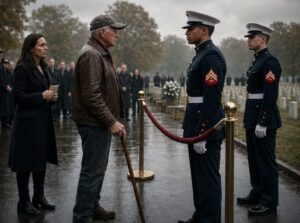
Dennis Miller’s cane slipped between two rows of white headstones before the sun had fully cleared the cemetery trees.
For one breath, his body followed it.
His left knee buckled. The medals on his brown dress jacket clinked softly against each other, a sound too small for the wide field around him, but sharp enough to shame him. He caught himself with one hand on the nearest headstone, fingers spread against the cool marble, and froze there as if the man beneath it might object.
“Sorry,” he whispered.
No one answered. Not the grave. Not the trees. Not the hundreds of names lined up in straight white ranks across the grass.
Dennis drew the cane back, planted its rubber tip carefully this time, and waited for the trembling in his leg to settle. He had told himself he would not fall here. Not today. Not in uniform. Not with the young volunteers due to arrive any minute carrying bundles of small American flags.
He straightened as much as his spine allowed. The old jacket pulled at his shoulders. He had brushed it twice the night before, though age still lived in the seams: a faint shine at the elbows, a loose thread near the cuff, a button that did not quite sit flat. His ribbons sat in their proper place. His cap was low on his brow. His shoes had been polished by hands that shook more than they used to.
He had arrived before the ceremony because he needed the cemetery while it was still honest.
Before microphones.
Before folding chairs.
Before people who said “sacrifice” beautifully and went home before lunch.
The hill rose gently ahead of him. On any other day he would have taken the paved path around it. This morning he cut through the rows because the path would bring him past the ceremony crew, and the ceremony crew would bring questions.
You all right, sir?
Need a ride?
Which section are you looking for?
Dennis did not need a ride. He did not need help finding the grave. He had found it in rain, snow, August heat, and one year through a fog so heavy the headstones appeared one at a time like men stepping forward for roll call.
He knew the count without counting.
Five rows beyond the oak with the split trunk. Twelve stones down from the maintenance marker. One row above the slight dip where water gathered after storms.
Paul Carter waited there.
Dennis moved on, slower now. The cemetery smelled of wet grass and cut stems. Somewhere near the service road, a truck door shut. The sound made him stop and look over his shoulder.
A groundskeeper in a green jacket unloaded folding barricades from a utility cart. Farther down, two young volunteers were lifting flag bundles from the back of a van. They were early. Everyone was early.
Dennis turned back toward the row and tightened his hand around the cane.
“Not yet,” he muttered. “Give me five minutes.”
His breath came shallow by the time he reached the oak. The small envelope in his jacket pocket pressed against his ribs. He had almost brought it out with him. Then, standing in his kitchen at four-thirty that morning, he had slid it back into the drawer and taken only the coin.
Letters explained too much. Coins did not ask to be read.
He stopped at the beginning of the row. The name was still too far away to see, but he knew the stone by its slight tilt, by the tiny chip on the upper right edge, by the grass that always grew thicker at its base as if the ground there remembered something warmer than marble.
Dennis took off his cap.
His hair, thin and white, lifted in the breeze. He tucked the cap under his arm and made the last twelve steps with his eyes lowered.
Paul Carter.
The letters were clean. Someone had washed the stone recently. Dennis noticed that first and felt a small, unreasonable sting of jealousy. He was glad someone had cared. He was sorry someone had come before him.
Beneath the name were the lines the government permitted: rank, branch, dates, war. Nothing about the way Paul had laughed with one shoulder higher than the other. Nothing about the black coffee he drank even when it tasted burned. Nothing about the photograph he carried wrapped in plastic because his daughter had not yet been born, and the only picture he had of her was an ultrasound image folded into a letter from home.
Dennis lowered himself with care. Not to the ground yet. Not all the way. He had learned there were stages to kneeling when a body no longer trusted itself.
First, the cane forward.
Then the right foot back.
Then the hand on the headstone, but never too heavy.
He placed his palm on Paul’s name and shut his eyes.
“Morning, Carter.”
The words came out rough. He had not spoken aloud since leaving his house.
A breeze shifted across the field. Behind him, the volunteers laughed at something near the van. The sound belonged to another country.
Dennis opened his eyes and reached into his jacket pocket.
The coin lay in his palm, old and dull. A half-dollar, its edges worn smooth from years of being rubbed between thumb and forefinger. It was not rare. Not valuable. Not military issue. Just a coin Paul had won from him in a card game, then given back two days before everything changed.
You keep it, Paul had said. You owe me interest.
Dennis had paid interest for fifty-two years.
He set the coin on top of the headstone, near the right corner, where it caught a thin line of sun. His fingers lingered there.
“There,” he said. “On time for once.”
His knees threatened to give way, so he did not try to kneel yet. He stood bent over the stone, breathing through the ache in his hip, one hand braced on the cane, the other resting beside the coin. Every year he told himself he would say more. Every year he arrived with sentences prepared like inspection lines.
I should have written.
I should have told her.
I was afraid.
Every year, when he reached the grave, the words collapsed into the same small offering of metal and silence.
The utility cart beeped as it backed up near the walkway.
Dennis flinched.
He turned his head just enough to see three volunteers in matching navy shirts unfolding chairs beside a portable speaker stand. A chaplain in a dark suit spoke with a woman holding a clipboard. Near the front path, a local news van rolled through the gate, its logo bright against the quiet stones.
Dennis looked back at Paul’s grave.
“Too many people today,” he said.
He had known it would be like this. Memorial Day weekend always made the cemetery busy. But the anniversary had fallen close this year, and Dennis had not been able to make himself come earlier. The coin was supposed to be placed on the day Paul died. Not the day convenient to old bones. Not the day with open parking.
He shifted the cane and tested his leg. If he was going to kneel, it had to be now.
The first movement sent pain flashing up through his hip. He gripped the headstone harder than he meant to and pulled back at once, ashamed, smoothing his fingers over Paul’s name as if apologizing for using him as furniture.
“Just once,” Dennis whispered. “Then I’ll get out of their way.”
He eased down another inch. His breath caught. The grass smelled sharp beneath him. The coin flashed in the corner of his eye, bright now in full sun.
A voice called from the walkway.
“Sir? Excuse me, sir.”
Dennis froze.
He knew the tone. Respectful at the edges, official underneath. A man used to giving instructions without raising his voice.
Dennis kept his hand on the stone.
“Sir,” the voice came closer. “We’re setting this section for the ceremony. I need you to step back from the grave.”
Dennis closed his eyes.
Not yet.
Boots moved through the grass behind him. Not active-duty boots; volunteer boots, polished but comfortable. Dennis could hear another person with him, lighter steps, and farther back, the small electronic chirp of a camera turning on.
He opened his eyes and looked at the coin.
The sun had warmed it.
“Sir,” the man said, nearer now, “please step away from the headstone.”
Dennis lifted the coin from Paul Carter’s grave and closed it inside his shaking fist.
Chapter 2: A Coin on a Grave That Wasn’t His
Rachel Carter saw the old man take something off her father’s grave, and the first thing she felt was not grief.
It was anger so fast and clean it frightened her.
She had come through the side path with a paper cup of coffee gone cold in her hand and a folded program tucked under her arm. She had not wanted the program. The cemetery volunteer at the entrance had pressed it on her anyway, smiling with that careful softness people used when they saw the gold-star pin on her black dress.
We’re honored to have families here today.
Families. As if one word could cover the empty chair at every school play, the folded flag in her grandmother’s cabinet, the way strangers had told her all her life that she must be proud.
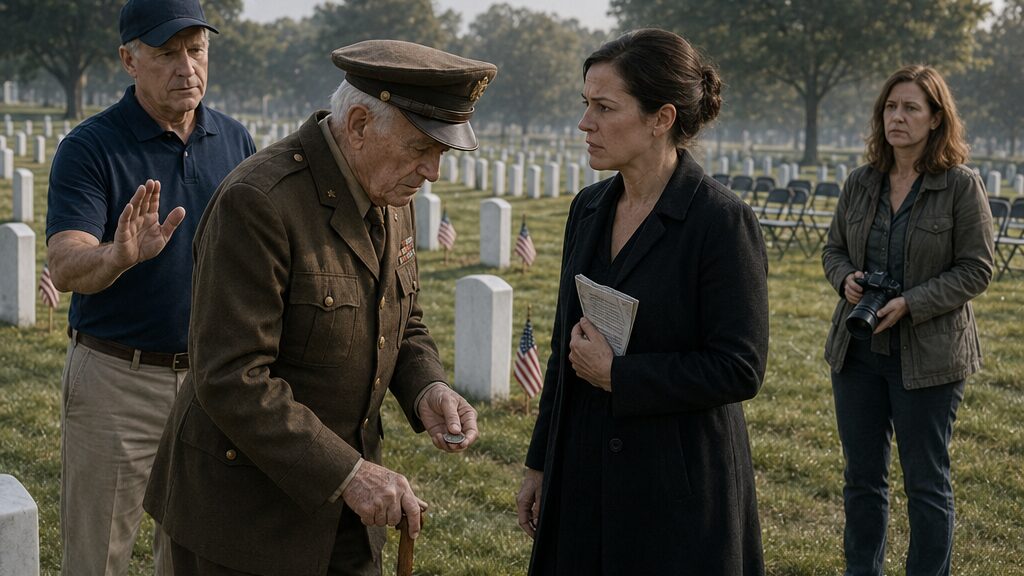
She had planned to stand at her father’s grave before the ceremony and leave before the speeches. Instead, she found a stranger in an old brown uniform bent over the stone, his hand on her father’s name, his fingers closing around a coin she had not placed there.
“Hey,” she said.
The old man did not turn right away.
A man in a volunteer polo stood a few feet behind him, stiff with discomfort. Rachel recognized him from the entrance table. Scott Williams. Retired something, probably. He had that clipped way of standing, shoulders squared even when apologizing.
A woman with a camera hovered near the walkway, not close enough to seem rude, not far enough to be innocent.
Rachel stepped off the path.
“That’s my father’s grave.”
The old man turned then.
His face stopped her for half a second. It was older than she expected, folded with pain and weather, but his eyes were steady. Not confused. Not lost. That almost made it worse.
He looked at her, then at the stone, then down at his closed hand.
“Yes, ma’am,” he said.
Ma’am. The word put distance between them. She hated it.
“What did you take?”
Scott moved slightly. “Ms. Carter, I was just asking him to clear the area. We’re trying to keep the front rows open before—”
“What did you take?” Rachel repeated.
The old man opened his fist.
A coin sat in his palm. Dull silver. Worn nearly soft around the edge.
Rachel stared at it. “Why was that on his stone?”
The old man’s fingers curled, not hiding it, just protecting it. “I put it there.”
“Why?”
He drew in a breath through his nose. The cane shook under his weight, but his voice stayed low. “Because I always do.”
The answer landed like an insult.
Rachel looked from him to Scott. “Is this part of the ceremony?”
“No,” Scott said quickly. “No, ma’am. It’s not authorized. I was handling it.”
The woman by the path lifted her camera a little. Rachel saw the lens catch the light.
“Are you filming this?” Rachel snapped.
The woman lowered the camera halfway. “I’m Michelle Taylor, with the local station. We’re doing a remembrance piece. I can stop.”
“You can stop now.”
Michelle’s cheeks tightened. “Of course.”
But the red light had already been on. Rachel had seen it.
The old man shifted his cane, trying to step back. His right knee seemed to resist him. For a moment Rachel thought he might fall, and her body moved before her anger could stop it. She reached out, then pulled her hand back just short of touching his sleeve.
He noticed.
So did she.
“You shouldn’t be leaning on it,” she said, sharper than she meant.
The old man glanced at the grave. “I know.”
“My father’s stone is not a handrail.”
Scott’s expression tightened. “Ms. Carter—”
“No.” Rachel pointed at the grave, then at the coin. “People leave flags. Flowers. Notes. They don’t come before sunrise and take things off his headstone like they have some claim.”
The old man swallowed. “You’re right.”
That stopped her again.
She had expected defense. An explanation. Some story about service and brotherhood and how civilians did not understand. She had heard enough of those to last a lifetime.
But he only stood there with the coin in his palm and accepted the blow.
Rachel looked at his uniform more carefully. The ribbons. The shoulder patch. The age of the cloth. The cap tucked under his arm. He was not wearing it for show, exactly. It hung on him like something he had once filled and now merely carried.
“Who are you?” she asked.
“Dennis Miller.”
The name meant nothing at first.
Then it did.
Not like a memory. Like a file drawer opening in a locked room.
Miller.
She had seen it in photocopied pages her mother used to keep in a blue folder, the one Rachel had not been allowed to read until she was seventeen and angry enough to search the closet. The report had been full of blocky language and blacked-out lines, but one sentence had stayed because her mother had underlined it in pencil.
Survivor recovered from final position: Miller, Dennis.
Rachel’s fingers tightened around the program.
“You knew him?”
Dennis looked at Paul’s name. “Yes.”
“How?”
“We served together.”
The answer was too small for the years it crossed.
Rachel let out a short, humorless laugh. “That’s it?”
Dennis did not answer.
Michelle stood motionless by the path, camera down now but still in her hands. Scott looked between them with the strained patience of a man watching a ceremony schedule collapse.
Rachel took one step closer. “You served with my father and you’ve been leaving coins on his grave?”
“Yes.”
“For how long?”
Dennis looked at the coin. “Long time.”
“How long?”
His jaw worked once. “Since the first year I could get here.”
The first year.
Rachel felt the phrase open beneath her. Her father had died before she was born. She had grown up with official visitors twice, maybe three times, men with polished shoes and careful faces, men who said her father had been brave and then disappeared forever. If this man had come every year, he had known where to find them. He had known the name. He had known the grave.
“You never contacted us,” she said.
Dennis’s eyes flicked to her face, then away.
“No.”
“Why?”
His silence was not empty. That was the worst part. It had weight. It had a shape. Rachel could almost see him carrying it.
Scott cleared his throat. “Mr. Miller, maybe we should continue this conversation away from the front row. Families will be arriving shortly, and we need to prepare—”
Rachel turned on him. “You knew who he was?”
“No, ma’am. I only knew he was in the section before setup.”
“But you were going to move him.”
“I was going to ask him to step back respectfully.”
“You told him to step away from the headstone.”
Scott’s face colored. “Because we have a ceremony to run, and because people filming private moments without permission can become a problem.”
Michelle lowered her eyes at that.
Dennis placed the coin into his jacket pocket. The movement looked final, and Rachel hated that too.
“Put it back,” she said.
He looked at her.
“If it meant something, put it back and tell me why.”
His hand remained near his pocket.
“I can’t.”
“Can’t, or won’t?”
Dennis’s mouth tightened. “Both.”
The answer struck deeper than another excuse would have. Rachel glanced down at her father’s name, carved clean and official in white stone. Paul Carter. A name everyone praised and no one explained.
She stepped closer until Dennis had to look at her.
“My mother died thinking my father was left in a withdrawal because someone made a mistake. I grew up hearing phrases like confusion, final position, impossible recovery.” Her voice began to shake, and she despised that the camera woman was close enough to hear it. “I saw your name in that report.”
Dennis went very still.
The morning noise seemed to thin around them. No chair legs scraping. No flags rustling. Only Rachel’s pulse in her ears and the faint clink of Dennis’s medals as his hand tightened around the cane.
She said the rest quietly.
“You were the one they brought back.”
Dennis looked at Paul’s grave, not at her.
“Yes,” he said.
Rachel waited, but he offered nothing more. Not apology. Not explanation. Not denial.
The old anger, the one she had inherited before she understood it, rose hot behind her eyes.
“My father died,” she said, “and you got to come home.”
Dennis flinched as if she had put her hand directly on an old wound.
Scott said, “Ms. Carter, that’s enough.”
Dennis raised one hand slightly, stopping him.
“No,” Dennis said. “It isn’t.”
Rachel stared at him.
He looked older now than he had a minute ago. Not weaker. Older, as if the years had suddenly remembered where he was and settled back onto his shoulders.
“The report,” Rachel said, “made it sound like you survived because he didn’t.”
Dennis’s grip on the cane turned his knuckles pale.
“That part,” he said, “is true enough to hate.”
Chapter 3: The Report That Made a Survivor Look Guilty
Scott Williams laid the old ceremony file on the cemetery office desk as if paper could keep the living from making a scene among the dead.
Dennis stood instead of taking the chair offered to him.
He did not trust chairs after confrontations. A chair invited staying. Staying invited questions. Questions invited the kind of truth that did not come out clean.
The office smelled of printer toner, coffee, and damp wool from the coat of someone who had come in early. Through the window, Dennis could see the tops of the headstones stepping down the hill, white and even and silent. Beyond them, volunteers were placing flags with careful, bright gestures.
Rachel stood near the door, arms folded around the program she had crushed in her hand. Michelle Taylor waited outside the glass, camera bag over one shoulder now, no longer filming. That did not make Dennis feel less watched.
Scott opened the file. “Mr. Miller, I need to understand whether there’s going to be an issue during the ceremony.”
Dennis looked at him. “There won’t be.”
“There already was.”
Rachel gave a short laugh. “Because you told him to get away from my father’s grave.”
Scott’s mouth tightened, but he did not snap back. Dennis recognized the restraint. Military men learned many ways to be wrong without admitting it.
Scott turned a page. “Paul Carter. Army. Killed during withdrawal operation, June seventeenth.” His eyes moved down. “Survivor recovered from final position, Dennis Miller. That’s you.”
“Yes.”
Rachel stared at him as if the word should have cost more.
Scott glanced up. “You’ve been visiting his grave annually?”
“Yes.”
“Leaving a coin?”
“Yes.”
“Does the family know you?”
Dennis’s throat closed.
Rachel answered for him. “No.”
The silence after that was worse than accusation.
Scott sat back slightly. “Mr. Miller, you understand how this looks.”
Dennis almost smiled. Not because anything was funny. Because he had spent fifty-two years understanding how things looked. Reports looked clean. Ceremonies looked honorable. A folded flag looked complete. A surviving man looked lucky.
“I understand,” he said.
“Then help us,” Scott said. His voice softened by a degree. “I’m not trying to embarrass you. But we have families coming in. A news crew. An honor guard. If there is some dispute—”
“There’s no dispute.”
Rachel stepped forward. “There is for me.”
Dennis kept his eyes on the file.
The pages were copies of copies, softened at the edges. He could see typed lines, official spacing, black marks where details had been withheld. He remembered signing a statement he could not read because his right eye had been bandaged and his left would not focus. He remembered a young officer saying, Just state what you remember, Sergeant. He remembered saying almost nothing.
Scott tapped the page. “The report says the unit was ordered to withdraw under pressure. Carter and Miller were separated from the main group. Recovery team found Miller alive. Carter was confirmed deceased at the position.”
Rachel’s breathing changed. Small, controlled, angry.
Dennis closed his eyes.
“Is that wrong?” she asked.
“No.”
“Then what is missing?”
He opened his eyes. “Most of it.”
Scott waited.
Dennis could feel the coin in his pocket. He had not realized his hand had gone there until his fingers found the edge of it through the cloth.
Rachel saw the movement. “Don’t hide behind that.”
He let his hand fall.
“I’m not.”
“You are. You’ve been doing it for years.”
That was true enough to stop him.
Scott looked from Rachel to Dennis. “Mr. Miller, did Carter die because of something you did?”
The question was blunt, but not cruel. Scott asked it like a man who had read too many reports and knew that blame often wore official language to dinner.
Dennis looked through the window.
A young volunteer knelt in the grass beside a grave, pressing a flag into place with both hands. The boy was maybe seventeen, thin as a fence rail. Dennis saw another young man for half a second, not the boy outside but Paul Carter at twenty-three, grinning with a cigarette he never lit because he kept promising to quit before his daughter was born.
“Mr. Miller,” Scott said.
Dennis answered without looking away.
“I froze.”
Rachel’s posture changed.
Scott did not move.
Dennis heard the room’s air conditioner click on. It rattled like a distant engine.
“We were ordered to pull back. It was loud. Bad visibility. Men were moving in pieces, not lines.” He swallowed. “Paul and I were behind the others. I went down. Not dead. Not brave. Just down. I remember thinking if I stayed flat enough, the world might pass over me.”
Rachel’s face had lost some color, but not anger. “And my father?”
“He came back.”
The words emptied the office.
Dennis hated them. Too small again. Always too small.
“He shouldn’t have,” Dennis said. “That’s what the report doesn’t say. He had a way out. He came back anyway.”
Rachel gripped the crushed program with both hands. “Then why does the report make it sound like he was left?”
“Because I let it.”
Scott’s brows drew together. “You gave an incomplete statement?”
“I gave what I could say.”
“That’s not the same thing.”
“No,” Dennis said. “It isn’t.”
Rachel stared at him, and for the first time her anger seemed unsure where to land. “You let my mother believe he died alone?”
Dennis looked at her then.
There were faces time blurred and faces it kept sharp. Paul’s wife had been a photograph in a hooch, a tired smile in letters, a name Paul said with a gentleness the war never managed to beat out of him. Rachel was not her mother, but something around the eyes made Dennis’s chest tighten.
“I didn’t know what they told her,” he said.
“But you knew what you didn’t tell.”
Dennis nodded once.
Scott closed the file slowly. “Why come all these years, then? Why not write? Why not ask for the record to be amended?”
Dennis could have said the Army did not amend a dead man’s last breath because an old survivor slept badly. He could have said he tried once and never mailed the form. He could have said Paul’s wife remarried and moved, and by the time Dennis found an address, Rachel was twelve and he was already a coward with too many birthdays behind him.
Instead he said, “Because a coin was easier.”
Rachel’s mouth tightened as if she might cry and refused to let herself.
Michelle appeared in the glass doorway, hesitant. “I’m sorry. The ceremony staff is asking if the family seating should still include Ms. Carter.”
Rachel did not turn. “I’m not sitting through another speech.”
Scott stood. “Ms. Carter, no one is forcing you—”
“I want the full record,” Rachel said.
Scott hesitated. “The full archival record would be through the VA or Army records channels. That can take time.”
“Then I’ll start today.”
Dennis felt the old panic rise, absurd and late. “Rachel.”
It was the first time he said her name.
She looked at him sharply.
He had no right to it. He knew that as soon as it left his mouth.
“I’m sorry,” he said.
Her eyes hardened again. “For what part?”
He could not answer fast enough.
For surviving. For keeping the message. For letting your mother age around a hole I could have named. For coming here every year like devotion could replace courage.
The coin seemed to burn against his chest through the pocket.
Scott gathered the papers, but Rachel reached across the desk and pressed her palm on the file before he could close it completely.
“No,” she said. “I want a copy of whatever you have.”
Scott exhaled. “I can give you the public ceremony file. Not restricted records.”
“Fine.”
He looked at Dennis, as if asking whether this would break some old code.
Dennis nodded.
Scott took the file to the copier in the adjoining room. The machine hummed and flashed.
Rachel stayed by the desk. She did not look at Dennis for several seconds. When she finally did, her voice was lower.
“You said the report was missing most of it.”
“Yes.”
“What else?”
Dennis felt the room tilt slightly, though he had not moved. He put one hand on the back of the chair and hated that he needed it.
Rachel saw that too. Her anger did not soften, but her eyes flicked to his hand.
He could have told her then. Part of it. Enough to make her hate him properly. Enough to make her leave.
But the words stacked behind his teeth and would not come.
Scott returned with warm copies. Rachel took them.
Dennis looked at Paul’s name on the top sheet, black ink on white paper, and saw the grave again. The coin missing from its place. The morning unfinished.
“The report doesn’t include what he asked me to do,” Dennis said.
Rachel stopped folding the copies.
“What did he ask?”
Dennis looked at the cemetery beyond the window, where the flags were going into the ground one by one.
His voice came out barely above the copier’s fading hum.
“Not here.”
Chapter 4: The Daughter Who Hated Every Perfect Speech
Rachel almost threw the coin into the trash can outside the visitor center, and the only thing that stopped her was the thought that her father might have touched it.
The trash can was green metal, bolted beside a bench where families sat to adjust flowers and wipe children’s faces before walking into the cemetery. Rachel stood in front of it with the coin pinched between two fingers and the copied report tucked under her arm, the whole morning burning a hole through her composure.
Dennis Miller’s coin was heavier than it looked.
She held it over the opening.
Drop it, she told herself.
It was not hers. It had been placed on her father’s grave by a man who had known her father and never come to the house, never called, never written, never told her mother whatever truth had made his face turn gray in the cemetery office.
But her fingers would not open.
A family walked past her carrying a wreath with a blue ribbon. The little boy in front looked at the coin, then at Rachel’s face, and quickly looked away. She lowered her hand.
Inside the visitor center restroom, she locked herself in the last stall and unfolded the copied pages. Her father’s name appeared again and again in language so careful it felt insulting.
CARTER, PAUL.
MILLER, DENNIS.
FINAL POSITION.
RECOVERED ALIVE.
She had read those words before, but never with the man himself standing in front of her, breathing, shaking, saying, That part is true enough to hate.
Rachel pressed the heel of her hand against her eye before tears could make the ink swim.
She remembered being nine years old at a school Veterans Day assembly, sitting in the front row because someone had decided that was where she belonged. A man in uniform had said her father gave everything for freedom. Everyone clapped. Rachel had clapped too because her teacher was watching. That afternoon she had gone home and asked her mother whether freedom had been worth missing every birthday.
Her mother had folded laundry for a long time before saying, “He would have come home if he could.”
It was the closest she had ever come to anger.
Now Rachel sat in the stall with a dead man’s report and a living man’s coin, and she hated every beautiful speech she had ever been given.
Her phone buzzed.
Unknown number.
She almost ignored it, then answered with a hard, “Yes?”
“Ms. Carter? This is Michelle Taylor. From the cemetery.”
Rachel shut her eyes. “I told you not to film me.”
“You did. I’m sorry. I wanted to say that directly.”
“Then say it.”
A pause. In the background, Rachel could hear newsroom noise—phones, a low voice, the thin clatter of a keyboard.
“I stopped recording when you asked,” Michelle said. “But I had already captured part of the confrontation.”
Rachel’s hand tightened around the phone. “Delete it.”
“I can. I just—my producer saw a thumbnail when I transferred the card. Not the whole clip. Just enough to ask what it was.”
Rachel stood so fast the report pages slid against the stall door. “Are you kidding me?”
“No. I’m calling because I don’t want to make it worse.”
“You already made it worse.”
“I know.”
Rachel wanted Michelle to argue. It would have been easier if everyone stayed exactly in their assigned place: reporter with no boundaries, volunteer with rules, old man with secrets. But Michelle’s voice had gone quiet in a way that was not defensive.
“The image is strong,” Michelle said. “An elderly veteran at a grave, being asked to step away. Without context, people will make it into something simple.”
“It isn’t simple.”
“That’s why I called.”
Rachel picked up the pages from the floor and tucked them against her chest. “Do not air it.”
“I won’t without permission.”
“From who? Me? Him? The cemetery?”
“That’s part of the problem.”
Rachel laughed once, bitterly. “There’s always a policy when somebody’s pain might be useful.”
Michelle did not answer right away.
When she spoke again, there was less reporter in her voice. “My father was a police officer. Not military. Different world. But after he died, people kept telling stories about him like they owned him because he wore a uniform. I thought they meant well. Sometimes they did. Sometimes they just liked how grief looked on camera.”
Rachel stared at the stall latch.
The anger in her shifted, not softening, just losing its clean edge.
“I don’t care what your producer wants,” Rachel said.
“I’ll hold the footage.”
“Delete it.”
“I can delete my copy. I can’t promise no one saw the thumbnail.”
That sentence lodged under Rachel’s ribs.
“How many people?”
“Two. Maybe three. Internal only.”
Rachel pictured Dennis bent over the headstone, his hand on her father’s name, Scott’s body squared behind him, her own voice sharp enough to cut. She pictured strangers watching without knowing the report, the coin, the way Dennis had said Rachel like it hurt him.
“Don’t delete it yet,” she said before she understood why.
Michelle went silent.
Rachel gripped the phone. “I didn’t say use it. I said don’t delete it yet.”
“All right.”
“If that man lies to me, I may want to know exactly what he did when I confronted him.”
“And if he doesn’t?”
Rachel looked down at the coin in her palm.
The surface was rubbed almost smooth in places, but one side still showed enough of the old design to catch the fluorescent light. Someone had handled it often. Not once for show. Not casually.
“If he doesn’t,” Rachel said, “then I’ll decide what my father’s grave is allowed to show.”
She ended the call before Michelle could say anything kind.
The diner across from the cemetery entrance had plastic booths, framed newspaper clippings on the wall, and a hostess who glanced at Rachel’s black dress and asked softly if she wanted a quiet table. Rachel nearly said she wanted a table where no one would thank her for anything, but she only nodded.
She spread the copied report on the table beside a cup of coffee she did not drink. The pages made no more sense the second time. The official language described movement, recovery, position, confirmation. It did not describe fear. It did not describe a man coming back. It did not explain why Dennis Miller had carried a coin for decades and left her family with a blank space where the truth should have been.
The server refilled her coffee without asking.
Rachel said, “Thank you,” automatically, then hated how normal it sounded.
She opened her purse and took out the blue folder she had brought from home that morning. She had not meant to read it at the cemetery. She had brought it because Memorial Day always made her feel like a bad daughter if she arrived empty-handed. Inside were things her mother had saved: a photograph of Paul in fatigues, two yellowed clippings, a funeral program, and a letter in her father’s handwriting.
Rachel knew most of the letter by heart. It had been written before his final deployment, cheerful in a forced way, full of jokes about bad coffee and how he was going to teach his daughter to throw a baseball whether she liked it or not.
She unfolded it anyway.
The handwriting leaned forward, eager and uneven.
Tell your mom I’m behaving. Mostly. Miller says if I don’t quit bragging about the baby, he’s going to start charging rent for all the space she takes up in the tent.
Rachel stopped.
Miller.
She pulled the page closer.
She had read that line before as a teenager and passed over it. Miller had been only a surname, one of those background men who existed in soldiers’ letters like furniture and weather. Now the name stood up from the paper.
Miller says.
Not Sergeant Miller. Not some distant superior. Just Miller.
Rachel read the next line with her breath held.
He’s got a coin of mine until I get back. Don’t let him say I gave it away.
The diner noise pressed in around her: plates, coffee cups, a bell from the kitchen window.
Rachel touched the coin lying beside the report.
Her father had mentioned it. Her father had joked about it. Her father had trusted Dennis Miller enough to put him in a letter home before Rachel was born.
The anger did not leave. It changed direction.
Rachel folded the letter carefully, as if moving too quickly might tear something that had waited fifty-two years to be understood.
Outside the window, beyond the diner parking lot, the cemetery gates stood open and bright.
Rachel picked up her phone and looked at Michelle’s number, then at the copied report, then at the coin.
If Dennis Miller had failed her father, why had her father written his name like a friend?
Chapter 5: The Promise Dennis Could Not Say Aloud
Dennis opened the cigar box and found fifty-two years of cowardice stacked in dull silver rows.
The box sat on his kitchen table beneath the yellow light, its lid warped at one corner, its paper seal long peeled away. He had bought it at a yard sale in 1974 because it was the right size for a few coins and one folded photograph. He had never meant for it to become a ledger.
Now the coins filled two neat lines along the bottom, with extras wrapped in tissue because his hands had once been steadier and his shame more organized.
One for every year he had gone to Paul Carter’s grave.
One for every year he had told himself he would speak next time.
Dennis stood over the box in his shirtsleeves. The uniform jacket hung on the back of a kitchen chair, its ribbons catching faint light from the window. Without it, his body looked smaller. Less official. More like what it was: an old man in suspenders, with a swollen knee and a pill organizer beside the salt shaker.
The coin from that morning lay alone near the edge of the table.
He had not put it back in the box. He had not put it in his pocket. He had placed it where it could accuse him properly.
The phone rang once from the counter, then stopped. A message light blinked red. His doctor’s office, probably. The nurse had called twice that week after he missed an appointment. Dennis had told her he was fine because old men who said otherwise got managed.
He pulled out a chair and sat slowly, lowering himself one inch at a time.
The house settled around him. Modest. Quiet. Too tidy in the way of a place arranged by a person who had outlived most interruptions. A framed photo of his late wife sat on the windowsill; beside it, a grocery list held down by a magnet from a veterans’ clinic. No children’s drawings. No shoes by the door except his own.
Dennis took the top coin from the first row and rubbed its edge.
He remembered Paul Carter’s hands better than his voice some days.
Long fingers. A scar across one knuckle from opening a crate with the wrong tool. Ink smudge on his thumb whenever he wrote home because he gripped pens too hard. He used to hold Rachel’s ultrasound picture like it was already a baby, already breathing.
“She looks like me,” Paul had announced the first time he showed it.
Dennis had squinted at the gray blur. “Looks like a weather report.”
“She’s got my chin.”
“That’s a medical emergency.”
Paul laughed so hard he spilled coffee on his boot.
The memory faded before the next one came, because the next one always came no matter how Dennis tried to steer around it.
Smoke. Not the dramatic kind people put in movies. Dust first, then smoke. A taste of metal. Orders breaking apart in the noise. Someone shouting left when there was no left, only ground and heat and the hard fact of bodies trying to occupy less space than fear.
Dennis had gone down without heroism.
That was the part he had never told anyone straight.
His leg had folded under him after the blast, and for several seconds—maybe longer, maybe no time at all—he had not been a sergeant, not a leader, not the man who checked everyone’s straps and made jokes when the younger men went quiet.
He had been a man with his face in dirt thinking, Stay down.
The order to withdraw had come in fragments. Men moved past him. Someone grabbed his shoulder and lost grip. Dennis remembered seeing Paul ahead, turning back.
No.
Dennis had tried to say it. Or thought it.
No, keep moving.
Paul came back anyway.
Not like in speeches. Not clean. Not upright. He crawled, cursed, grabbed Dennis by the collar hard enough to tear fabric.
“You owe me interest,” Paul shouted, or maybe Dennis supplied that later because he needed Paul to be Paul at the end.
Dennis had tried to push him away.
Paul hit him once. Open hand. Hard. The sound cut through everything.
“Move, Miller.”
“I can’t.”
“You can.”
“I can’t.”
Paul leaned close then, so close Dennis could see grit in his teeth.
“You got to.”
Dennis’s throat tightened at the kitchen table. His fingers locked around the coin.
The rest came in pieces he had spent decades pretending were not pieces.
Paul dragging him.
Dennis trying to stand and failing.
Another blast far enough away to be sound more than force.
Paul’s hand pressing something into his fist.
The coin.
A ridiculous thing to keep track of in that place.
Then Paul’s voice, lower because he had been hit by then, because the world had found a way to charge the price after all.
“My girl,” Paul said.
Dennis had said, “Don’t.”
“Tell her.”
“You’ll tell her.”
Paul’s eyes had fixed on him with sudden fury. Not fear. Not sadness. Fury, because Dennis was trying to spend the last seconds lying to him.
“Tell her I chose it.”
Dennis shook his head then, and at the table, fifty-two years later, he shook his head again.
No.
He had not understood. Or he had understood and refused it.
“Tell her,” Paul said, breath catching, “I knew her. Tell her I knew.”
“You haven’t met her.”
Paul’s fingers dug into Dennis’s sleeve.
“I did. Every letter. Every kick her mama wrote about. Every night I got home in my head.” He swallowed, face tightening. “Tell Rachel her daddy wasn’t scared of losing his life.”
Dennis had leaned close because Paul’s voice was almost gone.
“He was scared she’d think he chose leaving.”
The refrigerator hummed in the kitchen.
Dennis opened his eyes. He had not realized he had closed them.
He set the coin down carefully, but his hand kept shaking after he let go.
That was the message.
Not the report. Not the tactical correction. Not the record amendment he had drafted in his mind and abandoned a hundred times.
Tell Rachel her father chose love over fear.
Dennis had returned from the hospital with stitches, a limp that worsened with age, and a statement people wanted before he could sleep through a night without shouting. He told them the position. He told them Paul came back. Or he tried. An officer wrote something down. Another man said details could be reviewed later.
Later became a letter he did not send.
Then a funeral he watched from the back because his face was still bandaged and he did not want Paul’s wife to see the man who had come home in her husband’s place.
Then Rachel’s childhood became something he observed from a distance through one newspaper birth announcement someone mailed him, one school honor-roll clipping he had no right to keep, and finally nothing.
He had thought silence punished the correct man.
He had not understood it punished a child too.
The phone rang again.
Dennis reached for it this time.
“Mr. Miller?” The nurse’s voice carried professional patience. “We’ve been trying to confirm your appointment. The doctor was concerned about your blood pressure last week, and with the swelling you described—”
“I can’t come tomorrow morning.”
A pause. “We can move you to the afternoon, but he really does want to see you before the weekend.”
“I have somewhere to be.”
“Sir, if you’re having trouble walking—”
“I’m always having trouble walking.”
The nurse went quiet, then tried a gentler tone. “Are you having dizziness? Any chest pain?”
“No.”
It was only half a lie. There was pain everywhere. It had become weather.
“Mr. Miller, please don’t drive if you’re unstable.”
“I won’t.”
“You have someone taking you?”
Dennis looked at the empty second chair.
“Yes,” he said.
He did not know why he lied. Maybe because concern was another thing he had never learned to accept without resentment.
After he hung up, he sat still until the house seemed to grow around him.
The envelope waited in the kitchen drawer. He had written Rachel Carter on it three months earlier, during a night when his hip kept him awake and Paul’s voice would not leave the room. Inside were four pages. Too formal at the start, too broken at the end. He had read them once and hated every line.
He opened the drawer.
The envelope lay beneath a stack of utility bills.
Dennis took it out and placed it beside the coin. Then he opened the box again and removed the oldest photograph: Paul sitting on an overturned crate, grinning at something outside the frame, one hand lifted as if telling the photographer to hurry up. In the other hand, barely visible, he held the ultrasound picture.
Dennis touched the corner of it.
“I should have told her,” he said.
The kitchen gave him back nothing.
He looked at the uniform jacket on the chair. At the ribbons he had polished for men who were not there to complain. At the cane leaning against the table, rubber tip muddy from the cemetery grass.
Then he took a blank sheet of paper from the drawer.
His hand cramped before he finished the first sentence.
Rachel,
He stopped.
Not Ms. Carter. Not ma’am. Rachel.
He crossed it out, then regretted crossing it out.
On the second line, he wrote:
Your father asked me for one thing, and I failed him longer than any report says.
He sat with the pen in his hand while evening lowered itself over the yard. A car passed outside. Somewhere down the street, a dog barked twice and went quiet.
Dennis wrote for almost an hour.
Not everything. Not yet. But enough that if his courage failed at the grave, paper might do what his mouth had not.
When he finished, his fingers ached. He folded the pages without reading them and slid them into the envelope.
He sealed nothing.
The flap remained open, loose, undecided.
He placed the coin on top of it and wrote Rachel Carter again across the front, slower this time, each letter dark enough to leave an impression on the table beneath.
Then he set his alarm for before sunrise and put his cane beside the door.
Chapter 6: When the Camera Was Not the Cruelest Thing
Michelle Taylor watched the old veteran nearly collapse for the sixth time before she noticed what made the footage unbearable.
It was not Scott Williams stepping toward him.
It was not Rachel Carter’s voice cutting through the cemetery quiet.
It was Dennis Miller’s hand.
On the screen, magnified by the editing software, his fingers opened around the coin as if surrendering something alive. They shook badly, but he did not close them. He let Rachel see it. He let Scott see it. He let the camera see it before he seemed to remember the camera existed.
Michelle paused the video.
The frozen frame filled the edit bay: white headstone, old brown sleeve, dull coin, cane planted hard in the grass. Behind Dennis, Scott’s posture looked rigid enough to be cruel. Behind Scott, Rachel’s face was turned in profile, grief sharpened into accusation.
Without context, it was exactly the kind of image that moved fast online.
That was the problem.
“Tell me you have a package,” her producer said from the doorway.
Michelle did not turn. “I have footage.”
“That’s what a package is made of.”
“I don’t have consent.”
“You were on public cemetery grounds during a public ceremony setup.”
“It wasn’t a ceremony yet.”
“It’s newsworthy.”
“It’s private.”
Her producer came closer and looked over her shoulder. “A decorated old veteran being told to step away from a grave on Memorial Day weekend? Michelle, that’s not private. That’s the six o’clock lead.”
Michelle clicked the video forward one frame. Dennis’s eyes lowered to the coin.
“You don’t know what you’re looking at,” she said.
“That’s why we ask questions.”
“And while we ask, the clip leaks out of context?”
Her producer sighed. Not angry. Tired. “I’m not the enemy here.”
No, Michelle thought. That was the worst part. Almost nobody woke up planning to be the enemy. They woke up needing a segment, a ceremony, a clean record, a quiet grave.
Her phone buzzed beside the keyboard.
Rachel Carter.
Michelle picked it up and stepped into the hallway before answering.
“Did you delete it?” Rachel asked.
“No.”
“Did anyone else see it?”
“My producer. One editor saw the thumbnail. That’s it.”
“That’s it,” Rachel repeated, flatly.
“I stopped it there.”
A pause. Michelle heard traffic behind Rachel, then a car door chime.
“I found a letter,” Rachel said.
Michelle leaned against the wall. “From your father?”
“Yes. He mentioned Dennis. He mentioned the coin.”
Michelle closed her eyes briefly. The image on the screen shifted inside her mind. Not a stranger’s object. Not an old man’s prop. A piece of a dead soldier’s joke, maybe. A promise with an edge worn smooth.
“Do you want me to preserve the footage?” Michelle asked.
“I want you not to use it.”
“I won’t.”
“And not to delete it yet.”
“I’ll keep it offline.”
“Why offline?”
“Because if it’s on the station server, more people can access it.”
Rachel was quiet.
Michelle added, “I should have asked before filming him that close.”
“Yes,” Rachel said. Then, after a second, “But I may need to see it.”
“I can show you. No copies.”
“I’m going to the cemetery again tomorrow morning. Before the ceremony.”
“Is Dennis meeting you?”
“I haven’t asked him yet.”
Michelle looked back through the glass wall at the frozen image in the edit bay.
“Rachel,” she said, “if you ask him there, he might not be able to answer with people around.”
“I know.”
“Then why there?”
Rachel’s voice changed. Not softer. More exposed.
“Because everything he didn’t say started there.”
The call ended.
Michelle stood in the hallway until someone carrying a stack of scripts had to edge around her.
By late afternoon, she drove back to the cemetery instead of going home. The news van was gone now, but the preparation had intensified. Chairs stood in clean rows. Flags marked the graves in bright, repeating lines. A portable sound system waited beneath a canopy. Near the front, Scott Williams was kneeling beside a cable cover, taping it down with the focus of a man trying to make sure no one tripped on his watch.
Michelle approached with her camera bag zipped shut.
Scott looked up and immediately frowned. “If you’re here to get more footage, I’m going to ask you to coordinate through the office.”
“I’m not filming.”
“Then why bring the bag?”
“Habit.”
He returned to the tape. “Bad habit.”
She accepted that. “I need to ask about this morning.”
Scott pressed the tape flat with his palm. “I already gave your station the schedule.”
“Not the schedule. Dennis Miller.”
Scott’s hand stopped.
Michelle sat on the edge of a folded chair stack, leaving space between them. “The footage makes you look like you were pushing him away from a grave.”
“I didn’t touch him.”
“I know.”
“Does the footage show that?”
“Yes.”
“Will people care?”
Michelle did not answer.
Scott stood slowly. He was not as old as Dennis, but there was stiffness in his knees, a history in the careful way he rose. He took off his cap and rubbed one hand over his short gray hair.
“I saw an elderly man leaning on a headstone before families arrived,” he said. “A camera nearby. A ceremony about to start. My job was to keep the section clear and dignified.”
“You thought he was confused?”
“I thought if he fell, if someone filmed it, if a family came up and found a stranger at their grave, the day would turn into something it shouldn’t.”
“It did anyway.”
His jaw tightened. “Yes.”
Michelle waited.
Scott looked over the rows of chairs. “You know how many families come here wanting everything to be perfect? Not happy. Perfect. The flag straight. The name pronounced right. The bugle on time. Because if the ceremony is right, maybe the loss feels like it has order.”
Michelle followed his gaze to the headstones.
“You believe that?”
“I believe it helps some people get through the morning.”
“And you?”
Scott gave a short breath that was almost a laugh. “I coordinate parking.”
It was not an answer, which made it one.
Michelle thought of Rachel saying, Everything he didn’t say started there.
“Rachel may ask Dennis to meet her at Paul Carter’s grave tomorrow before the ceremony,” Michelle said.
Scott’s eyes came back to her. “That section will be active.”
“Can you give them space?”
“I can’t have another confrontation in front of attendees.”
“That’s why I’m telling you now.”
He looked toward Paul’s row. Michelle could see him calculating routes, timing, rules, consequences. She could also see the moment he stopped calculating and remembered Dennis’s hand on the stone.
“I was scared,” Scott said.
Michelle stayed quiet.
“Not of him. Of what it would become.” He looked at her, and for the first time his expression lost its official shape. “You put a camera on grief and people stop seeing the person. They pick a side. They make a symbol. That old man didn’t need to be a symbol this morning.”
“No,” Michelle said. “He didn’t.”
Scott nodded once, as if the admission cost him.
“If Ms. Carter requests time,” he said, “I’ll see what I can do. Quietly.”
Michelle’s phone buzzed again before she could answer.
Rachel had sent no message, only a contact card.
Dennis Miller.
Michelle stared at the number, then looked up at Scott.
“She’s going to call him,” Michelle said.
Across the cemetery, a groundskeeper tested the sound system. A burst of feedback cracked through the air and vanished.
That evening, Rachel stood in her kitchen with her father’s letter open beside the copied report and Dennis Miller’s number written on the back of the ceremony program.
She dialed before she could rehearse herself into anger.
The phone rang four times.
“Dennis Miller,” he answered.
Rachel gripped the counter. His voice sounded thinner over the phone.
“It’s Rachel Carter.”
Silence.
Then, “Yes, ma’am.”
She almost hung up at that. At the distance he kept building.
“My father wrote about you,” she said.
His breath caught. She heard it.
“He said you had his coin.”
Dennis did not speak.
Rachel looked at the half-dollar lying beside the letter. “I want to meet tomorrow morning. At his grave. Before the ceremony.”
“Rachel—”
“If you say not here again, I’m done.”
The line stayed quiet long enough that she thought he might have put the phone down.
Then he said, “I’ll be there.”
She closed her eyes.
“I don’t know if I’m coming to forgive you.”
“I wouldn’t ask that.”
“Then what are you coming for?”
This time, when he answered, the old formality was gone.
“To stop failing him in front of you.”
Chapter 7: The Name He Finally Spoke Beside the Stone
Dennis arrived without his medals polished.
He noticed it in the cemetery parking lot while reaching for his cane, one dull ribbon bar catching the light wrong against the brown jacket. Yesterday it would have sent him back inside, ashamed to stand among the dead looking careless. This morning, he only looked at it for a moment and shut the car door.
There were worse things than being seen imperfectly.
The envelope rested inside his jacket, unsealed. The coin sat in his left pocket, separate from the letter, where his fingers could find it. He had slept less than two hours, and his body had punished him for every minute he spent upright. His hip burned. His right knee felt packed with sand. When he stood, the cemetery tilted slightly before settling into rows of white stone.
A volunteer near the entrance stepped toward him. “Sir, do you need assistance?”
Dennis nearly said no.
The word had shaped most of his life.
Instead, he looked at the long walk to Paul Carter’s grave.
“Not yet,” he said.
The volunteer nodded, unsure what to do with that.
Dennis began walking.
The cemetery had changed overnight. Flags marked nearly every grave now, small and bright and restless in the morning air. Folding chairs faced the ceremony platform near the front. Families moved in dark clothes and careful voices. The sound system gave off a low hum. Somewhere beyond the trees, a bugler warmed up with three unfinished notes and then stopped.
Dennis kept to the side path, avoiding the center aisle. Yesterday he had tried to beat the ceremony. Today he had been invited into its shadow.
He saw Scott Williams before he saw Rachel.
Scott stood near the row, speaking to two honor guard members. When he spotted Dennis, his face tightened with something that was not quite embarrassment and not quite command. He excused himself and walked over.
“Mr. Miller.”
“Mr. Williams.”
Scott looked at Dennis’s cane, then at his face. “Ms. Carter is waiting.”
Dennis nodded.
“I cleared the nearest row for a few minutes,” Scott said. “Not officially. Just kept people moving toward the front.”
“Thank you.”
Scott shifted his weight. “Yesterday, I came at you like a problem to be managed.”
Dennis looked past him toward Paul’s section. “I was one.”
“No,” Scott said. The word came quickly, then he seemed to struggle with the rest. “You were a man at a grave. I should have started there.”
Dennis did not know what to do with apologies offered before he had earned them. He nodded once and moved on.
Rachel stood beside Paul’s headstone.
She wore the same black dress as yesterday, but her hair was pulled back now, and her face looked different in the morning light. Not softer. Less armored in the wrong places. In one hand she held the folded letter from her father. In the other, she held nothing.
Michelle Taylor stood far back near the walkway, camera bag at her feet, hands empty. She did not lift a lens.
Dennis stopped three steps from the grave. The headstone was clean. Paul’s name waited in the same carved silence.
Rachel looked at his jacket. Her eyes paused on the unpolished ribbons, then moved to his face.
“You came,” she said.
“Yes.”
“I thought you might leave the envelope and not show.”
“So did I.”
That answer made her look away first.
Dennis reached into his pocket and took out the coin. He did not put it on the stone. Not yet. He held it flat in his palm between them.
Rachel looked at it, then at the letter in her hand.
“My father wrote that you had it,” she said. “He made it sound like a joke.”
“It was.”
“What was the joke?”
Dennis rubbed the coin’s edge with his thumb. “Cards. I lost. Claimed he cheated. He said he’d hold my coin until I admitted I was bad at poker.”
“Did you?”
“No.”
A small sound escaped Rachel, almost a laugh and almost pain.
Dennis stared at Paul’s name. “He gave it back before the withdrawal. Said I owed him interest. I think he meant to collect when we got home.”
Rachel folded her father’s letter tighter. “But he didn’t.”
“No.”
The ceremony speakers crackled in the distance. A voice tested a microphone, then apologized to the crowd. The sound carried over the graves and faded.
Rachel’s jaw tightened. “Tell me the part you didn’t tell my mother.”
Dennis had practiced this. In the kitchen. In the car. During the walk, one step at a time.
The words still tried to fail him.
“We were ordered back,” he said. “Your father could have made it.”
Rachel’s face changed, but she did not interrupt.
“I went down. Not because I was saving anyone. Not because I was doing something brave. I went down and I stayed down too long.” Dennis’s hand tightened around the coin. “Paul came back for me.”
Rachel looked at the headstone.
“He dragged me. Cursed me the whole way. Hit me once when I told him I couldn’t move.”
“He hit you?”
“Hard enough that I listened.”
The faintest line appeared between her brows, something human breaking through the old report language.
Dennis drew a breath. “He was hit getting me out. The report says we were found at the final position. It doesn’t say he had already moved me away from where I should have died.”
Rachel’s eyes glistened, but her voice stayed controlled. “Why didn’t you say that?”
“I tried to say some of it. At first. Then people wrote what fit. I was hurt. Confused. That’s the excuse I used for a few months.” He looked at her then. “After that, it was cowardice.”
Rachel flinched as if she had expected him to defend himself.
Dennis went on before he could hide again. “I let your mother have a report instead of a man’s last words because I couldn’t stand in front of her and say her husband died pulling me out while I was afraid. I thought if I carried the shame quietly, I was honoring him.”
“Were you?”
“No.”
The answer left him emptier than he expected.
Rachel looked down at the grass.
“People kept telling me he wasn’t scared,” she said. “Like that was supposed to help. Like if he wasn’t scared, then leaving us cost him nothing.”
Dennis closed his eyes.
Paul’s hand on his sleeve. Grit in his teeth. Fury in his voice.
“He was scared,” Dennis said.
Rachel’s head lifted.
Dennis forced himself to meet her eyes. “Not of dying. Maybe of that too. I don’t know. Men say all kinds of things about fear later. Most of them are cleaned up.” His voice roughened. “But what he said to me was that he was scared you’d think he chose leaving.”
Rachel’s face went still.
“He told me to tell you he knew you.”
Her mouth parted, but no sound came.
Dennis reached into his jacket and took out the envelope. He held it toward her, but she did not take it yet.
“He said he knew you from every letter. Every kick your mother wrote about. Every plan he made out loud until the rest of us got sick of hearing it.” Dennis tried to smile and failed. “He said he got home in his head every night.”
Rachel pressed her father’s letter against her chest.
Dennis looked back at Paul’s name because he could not bear the full force of her face.
“His last request was for me to tell Rachel that her daddy wasn’t scared she’d forget him. He was scared she’d think he had forgotten her first.”
The microphone near the ceremony platform popped again. A chaplain’s voice asked attendees to take their seats.
Neither of them moved.
Rachel’s hand rose to her mouth. She turned slightly away, not to leave but to keep from being watched while the words found their place inside her.
Dennis stood with the envelope extended, arm trembling.
“I failed him,” he said. “Not by living. I know that now, or I’m trying to. I failed him by making his love carry itself without a witness.”
Rachel wiped under one eye with the back of her hand. “My mother needed that.”
“Yes.”
“I needed that.”
“Yes.”
“You don’t get to decide silence was noble because it hurt you.”
Dennis bowed his head. “No.”
The truth in her voice cut cleanly. He did not step away from it.
Rachel looked at the envelope at last. “Is that the same thing you just told me?”
“Some. Not enough. Too much in the wrong places.”
“Why bring it?”
“In case I couldn’t do this.”
“And now?”
He glanced at the open flap. “Now it’s yours to read or throw away.”
Rachel took the envelope. Her fingers brushed his, and he felt how cold her hand was.
For a few seconds, they stood with the coin between them in Dennis’s palm and the letter in Rachel’s hand, both objects too small for what they had carried.
Then Dennis looked at the grave.
“I’d like to kneel,” he said. “If you want me gone after, I’ll go.”
Rachel’s eyes moved to his cane, to his leg, to the slight tremor traveling through his shoulders.
“You can’t do that by yourself.”
“I know.”
It was the first time he had said it without bitterness.
Rachel looked toward the walkway. Scott stood at a distance, watching without watching. Michelle remained behind him, still empty-handed.
Rachel stepped closer.
Dennis tried to lower himself. Pain shot through his hip so sharply that the grass blurred. His cane wobbled. Instinct made him reach for the headstone, but Rachel caught the cane before it slipped and planted it firm.
“Wait,” she said.
Her voice was not gentle, exactly. It was practical. Present. Alive.
Dennis waited.
Rachel moved beside him, one hand steadying the cane, the other hovering near his elbow without grabbing. He lowered himself slowly, breath by breath, until one knee touched the grass.
The ground was cold even through the fabric.
He placed the coin on the grass between them, not on the stone.
Rachel looked at it.
Dennis rested one hand lightly against Paul Carter’s name.
“Morning, Carter,” he whispered.
This time, Rachel heard him.
The ceremony began behind them with a call for everyone to rise, but Rachel stayed where she was. She bent down and picked up the coin.
Dennis watched her close it in her fist.
She did not put it on the headstone.
Not yet.
Chapter 8: The Grave Everyone Passed, and the Promise That Stayed
The ceremony began without Dennis Miller in the front row.
Rachel noticed because the chair with his name printed on a white card remained empty beside the other veterans. Someone had reserved it for him, probably Scott, probably after realizing who he was. The card fluttered in the light breeze, clipped to the back of a folding chair that faced the podium, the flags, the polished microphone, the orderly version of grief.
Dennis was still on one knee at her father’s grave.
“Can you stand?” Rachel asked.
He looked embarrassed by the question, which told her the answer.
“In a minute.”
“You said that three minutes ago.”
“Then I’m consistent.”
It surprised her, the small worn edge of humor in him. It sounded nothing like forgiveness. That was all right. Rachel did not know what forgiveness would sound like if it ever came. Maybe not like a speech. Maybe not like anything clean.
Behind them, the chaplain’s voice moved over the cemetery, speaking of service, memory, sacrifice. The words were not wrong. That almost made them harder. Rachel had spent years hating the polished language because it had been used in place of truth. Now, standing over Paul Carter’s grave with her father’s letter in one hand and Dennis’s unsealed envelope in the other, she could hear both things at once.
The speeches were not enough.
They were not nothing either.
Dennis shifted, and pain crossed his face before he could hide it. Rachel slid the coin into her palm and tucked the letters under one arm.
“Don’t grab the stone,” she said.
He looked up.
“My father’s stone is not a handrail,” she said.
For one terrible second, she thought the words would wound him all over again.
Then he nodded. “No, ma’am.”
“Rachel.”
He blinked.
“If you’re going to tell me the truth after fifty-two years, you can stop calling me ma’am.”
His mouth tightened. He looked at Paul’s name and then back at her.
“Rachel,” he said.
The name sounded different this time. Less stolen. More offered back.
She held out her hand.
He stared at it.
“I’m not pulling you,” she said. “I’m helping you count.”
He understood. She saw it in his eyes before he nodded.
Together they made a slow, awkward operation of getting an old soldier upright. Cane first. Foot placed. Weight shifted. Rachel’s hand braced under his forearm but did not drag. Dennis’s breath caught twice, and both times she paused without comment. When he finally stood, his face had gone pale and damp, but he was standing.
Scott appeared at the edge of the row.
“I can bring a chair,” he said quietly.
Dennis’s pride rose visibly, then faltered.
Rachel watched him choose.
“A chair near the grave,” Dennis said. “Not the front row.”
Scott nodded as if receiving an order. “Yes, sir.”
He returned with a folding chair and set it a respectful distance from the headstone. He did not fuss. He did not apologize again. He only cleared two extra chairs from the nearest row and redirected a pair of late-arriving attendees with a low word and a pointed hand.
Public order, Rachel realized, could be used for mercy too.
Michelle stood near the walkway, watching the scene with her camera still in its bag. Rachel caught her eye.
Michelle did not raise a hand. Did not mouth anything. Did not make the moment about herself. She simply nodded once and looked away toward the ceremony.
Rachel helped Dennis sit.
The chaplain finished, and a veteran at the podium began reading names. The sound traveled unevenly across the grass. Some names reached Rachel clearly. Others dissolved into air before they got to Paul’s row.
When Paul Carter’s name came, Rachel felt it in Dennis’s body before she heard it.
He straightened in the chair.
“Paul Carter,” the voice said.
Rachel closed her fist around the coin.
No one clapped. No one cheered. The cemetery only held the name for a second, then allowed the next one to come.
For the first time in her life, Rachel did not feel that the next name erased him.
She looked at Dennis. His eyes were fixed on the stone, but his hand had relaxed on the cane. The unpolished ribbon bar on his jacket caught the light again, dull and ordinary.
“My mother used to come here,” Rachel said.
Dennis did not turn. “I saw her once.”
Rachel’s breath caught.
“When?”
“First year after. I stood too far back. She had flowers. You were…” He stopped.
“I was what?”
“Not born yet.”
Rachel looked down.
“She looked tired,” Dennis said. “Angry too. I thought if I stepped forward, I’d be asking her to comfort me. So I didn’t.”
Rachel wanted to hate him for that. Part of her did. Another part saw a younger man with bandages and a limp standing behind a tree, turning cowardice into manners because he did not know the difference.
“She was angry,” Rachel said. “Not all the time. But when people said he died doing what he loved, she got this look.”
Dennis closed his eyes. “He loved you more.”
The sentence landed without ceremony. No microphone. No prepared pause. Just an old man saying what should have been said when Rachel was small enough to believe it without having to rebuild herself around it.
Rachel unfolded her father’s letter again. The paper had softened along the creases.
“He said you were charging rent,” she said.
Dennis’s eyes opened.
“For all the space I took up in the tent.”
A weak smile moved across his face. “He never shut up about you.”
“Good.”
“Yes,” Dennis said. “It was.”
The honor guard fired the ceremonial volley in the distance. Rachel knew it was coming and still flinched. Dennis did not, but his hand tightened on the cane.
The bugle followed.
The first notes moved over the rows, thin and bright and almost unbearable. Rachel looked at the headstone because looking anywhere else felt impossible. The coin in her palm had warmed from her skin.
When the last note faded, people began to move. Chairs scraped. Programs folded. Families drifted toward graves with flowers and phones and private versions of the same ache.
Michelle approached only when Rachel looked for her.
“I won’t use the footage,” Michelle said.
Dennis looked down at his hands.
Rachel asked, “Any of it?”
“No. Not the confrontation. Not him kneeling. Not without both of you asking me to, and even then I’d argue against it.”
“What will you tell your station?”
Michelle glanced toward the podium, where people were thanking the chaplain. “That the better story wasn’t mine to take.”
Rachel studied her. “And your producer?”
“Will survive disappointment.”
Dennis made a faint sound. It might have been approval.
Michelle reached into her bag, not for the camera but for a small notebook. “If you ever want a written tribute—something about Paul, approved by you, no private footage—I’ll help. Or I’ll leave it alone.”
Rachel looked at Dennis.
He did not answer for her. That mattered.
“Maybe,” Rachel said. “Not today.”
“Not today,” Michelle agreed.
Scott returned after the ceremony crowd thinned. He stood with his cap in his hands.
“I can arrange a cart back to the parking lot,” he said to Dennis.
Dennis’s first instinct appeared again, old and stubborn.
Rachel saw it and raised an eyebrow.
He sighed. “That would be appreciated.”
Scott nodded, then looked at Rachel. “I also moved the family seating card. I should have asked before placing it.”
“Thank you.”
It was not forgiveness either, but Scott accepted it as if it were enough for the morning.
When he left to get the cart, Rachel stepped closer to the headstone. The top was clean and bare. For years, Dennis had placed the coin there before anyone came. Yesterday he had removed it under accusation. This morning he had set it between them, waiting for a decision that was not his anymore.
Rachel opened her palm.
The half-dollar lay dull and warm.
She thought of throwing it away. Of keeping it in a drawer. Of giving it back to Dennis so his ritual could remain his burden.
Instead, she placed it on the top right corner of her father’s headstone.
The coin caught a thin line of sun.
Dennis inhaled once, sharply.
Rachel kept her hand on the stone a moment longer than she meant to.
“I don’t know what I forgive,” she said.
Dennis’s voice was rough. “You don’t have to know today.”
“I don’t know if my mother would have.”
“No.”
“But I know she should have had the choice.”
“Yes.”
Rachel looked at him then. “So should I.”
He bowed his head. “Yes.”
The groundskeeper’s cart hummed up the path and stopped at the end of the row. Scott waited beside it, giving them time without making a show of it.
Dennis pushed himself up from the chair. Rachel reached for his arm, and this time he accepted before pride could make the movement harder.
They walked together toward the cart, slowly enough that several people passed them on the path. No one knew what had happened. No one applauded. No one stopped to thank Dennis for his service. Rachel was grateful for that.
At the cart, Dennis turned back toward the grave.
The coin remained on the headstone.
For the first time, Rachel understood that leaving it there was not leaving him alone.
“Will you come next year?” she asked.
Dennis looked at her. The honest answer was in his face before he spoke: he did not know what his body would allow, what time would take, what mornings he had left.
“If I’m able,” he said.
Rachel nodded. “If you’re not, I’ll come.”
His eyes lowered.
“And if you are,” she added, “you don’t come before sunrise like a thief.”
A line moved at the corner of his mouth.
“No?”
“No. You call me. We walk together.”
Dennis looked past her to Paul’s grave, where the coin shone small and stubborn among the flags.
“I can do that,” he said.
Scott helped him into the cart. Dennis settled slowly, cane across his knees, envelope no longer in his possession. Rachel held it now, along with her father’s letter, both folded together against her chest.
As the cart started toward the cemetery exit road, Dennis did not ask for the coin back.
Rachel watched the grave until the row slipped behind the hill and the white stones became a field again. Then she sat beside him, not close enough to erase the years, but close enough that when the cart jolted over a seam in the pavement, her hand moved instinctively to steady the cane.
Dennis let her.
The story has ended.