She Was Handed the Tree-Cutting Bill for a Lake View She Never Asked For
Chapter 1: The Bill Beside the Fresh Stumps
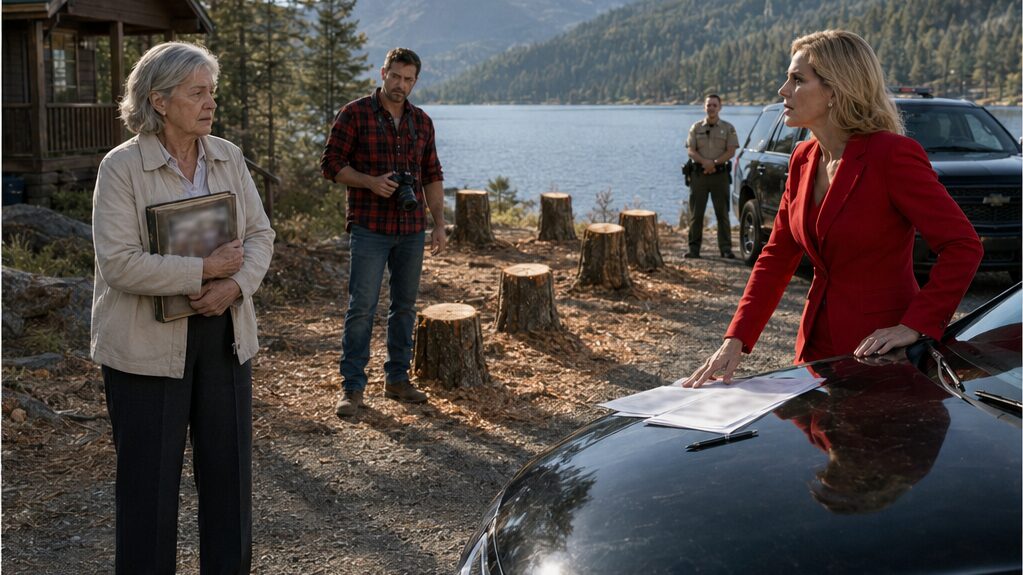
Rachel White slapped the estimate onto the hood of her black sedan hard enough to make Katherine Miller flinch.
The papers skidded once across the polished paint and stopped under Rachel’s palm. The top page had a contractor’s logo, a block of itemized charges, and a number circled in red marker.
$23,800.
Behind the car, six fresh pine stumps stood in a crooked row between Katherine’s cabin and the lake, their cut tops bright and raw against the old brown needles. The smell of sap still hung in the morning air. Sawdust had collected in pale fans along the road shoulder.
“You need to sign before the weekend inspection,” Rachel said.
Katherine looked from the number to the stumps. Her hands had gone cold, though the sun was already high enough to glare off the water.
“I’m not signing that.”
Rachel’s face tightened, not with surprise but with impatience, as if Katherine had failed to follow a simple instruction. She wore a red suit too sharp for a gravel lake road, the jacket fitted neatly at the waist, the heels already dusted from the shoulder. Her black sedan blocked half the lane, angled as though she expected the world to stop around her.
“You don’t have to make this unpleasant,” Rachel said. “Anthony Campbell’s estimate is fair. Shoreline restoration, stump removal, soil stabilization, replacement planting, association penalty review. Frankly, it could have been worse.”
Katherine heard her own breath before she trusted herself to speak. “I didn’t cut those trees.”
Rachel lifted the top page and tapped a line halfway down. “Your property. Your side of the access road. Your responsibility.”
A shutter clicked.
Both women turned.
Steven Baker stood near the nearest stump in his red-and-black plaid shirt, camera raised. He lowered it only a little when Rachel looked at him.
“Steven,” Katherine said quietly.
“What?” he said. “She brought paperwork. I’m documenting.”
Rachel’s eyes narrowed. “This is a private property matter.”
“It’s my aunt’s property,” Steven said.
“It’s an association matter now.” Rachel gathered the papers, squared them against the hood, and offered the top sheet to Katherine. “And if she’s smart, she’ll keep family emotion out of it.”
Katherine did not take the paper.
The lake behind Rachel was too calm for the way the morning had split open. A blue strip of water shone between the tree trunks that remained. Where there had been shade, there was now a raw window through to Rachel’s deck across the curve of the road. From this angle, Katherine could see the roofline of Rachel’s house for the first time in years.
Rachel followed her gaze and gave a small, bitter laugh.
“Yes,” she said. “That was my lake view. Before these half-dead pines became everyone’s problem.”
Katherine turned back to her. “Those pines were not half-dead.”
“You don’t maintain this place. You come up here when you feel sentimental, and the rest of us live with the mess.”
Steven took another picture, this time closer to the shoulder of the road. He crouched near a mark in the dirt, his camera pointed downward.
Rachel snapped, “Would you stop that?”
Steven did not look up. “There are tire tracks here.”
“There are tire tracks on every gravel road in this county.”
“These are fresh.”
Katherine wanted to tell him to be careful. Not because he was wrong, but because she knew his temper. Steven had always moved toward trouble as if the truth could be pulled out of it by force. His uncle had been the opposite. Her husband would have stood with his thumbs hooked in his belt, saying little, noticing everything.
Katherine touched the edge of the estimate but did not lift it.
The page listed “emergency tree removal damage remediation.” It listed erosion matting, sapling replacement, contractor labor, hauling, and association filing fees. It listed eight trees.
Katherine read the line twice.
Eight.
Her eyes moved to the stumps.
One beside the old cedar marker. Two near the ditch. Three along the slope. Four, five, six near the curve.
Six stumps.
“Rachel,” Katherine said.
Rachel’s chin rose a fraction. “Yes?”
“This says eight trees.”
Rachel glanced down at the paper, then toward the stumps. The pause lasted no more than a second, but Katherine caught it. Rachel recovered quickly.
“That’s what the contractor measured.”
“There are six stumps.”
“The estimate includes the two damaged saplings near the lower bank.”
Katherine looked past her. The lower bank had no saplings, damaged or otherwise. It had scrub brush, old roots, and the open slash where the pines had stood.
Steven straightened slowly, camera hanging from its strap. “There aren’t two saplings down there.”
Rachel ignored him. “The association won’t debate every twig on the roadside. The point is that the damage originated from your parcel.”
“Originated,” Katherine repeated.
“That is the word insurance will use.”
At that, something inside Katherine shifted from fear into a harder shape. Not courage exactly. Not yet. But a kind of refusal with edges.
“You already spoke to insurance?”
“I notified them that a claim may be necessary. You have an opportunity to handle this neighbor to neighbor before it becomes formal.”
“Neighbor to neighbor,” Katherine said, looking at the bill on the sedan hood.
Rachel leaned closer. Her perfume cut through the sap. “Katherine, I know this cabin means a lot to you. I also know you don’t want fines, adjusters, county inspectors, and legal letters. Sign the acknowledgment. We can arrange payments. You won’t have to manage every detail.”
The softness in her voice was worse than the accusation. It assumed too much. That Katherine would be confused by forms. That she would be grateful for someone else taking over. That the shock of a number would make her smaller.
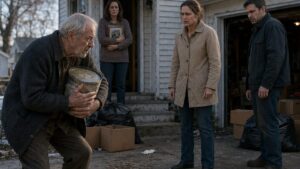
Katherine’s eyes went to the old porch of her cabin. A cardboard photo box sat just inside the screen door where she had left it that morning, still unopened. She had brought it up to sort through lake pictures for Donna, who wanted copies before the old colors faded. Her husband’s handwriting was on the lid.
Summer shoreline, west side.
She had almost left the box in the car.
Now it looked like a thing that had been waiting.
Rachel took a pen from her folder and held it out. “Just sign that you accept preliminary responsibility. It doesn’t lock you into the full amount today.”
Steven made a sound under his breath. “That’s exactly what it does.”
Rachel turned on him. “Are you an attorney?”
“No. Are you?”
Katherine put one hand up, not looking at Steven. “Enough.”
Rachel’s mouth twitched.
Katherine looked at the estimate again, then at the stumps, then at the open water beyond them. Her heart still beat too fast, and her knees felt unreliable, but her voice came out even.
“I will not sign a damage claim that starts with a lie.”
Rachel’s eyes hardened. “Careful.”
“No,” Katherine said. “You be careful. This says eight trees. There are six. It says I caused damage I did not cause. It says responsibility before there has been any inspection. I’m not signing it.”
For the first time, Rachel seemed to notice that Katherine had not raised her voice. A passing truck slowed, then rolled on. Across the road, two curtains shifted in a neighbor’s window.
Rachel slid the estimate back into her folder with a clean, angry motion. “Then I’ll let the process handle it.”
“What process?”
“The association complaint. The insurance notice. The restoration claim.” Rachel opened her car door, then paused with one hand on the frame. “By Monday, this goes to insurance with your name on it.”
She got in, shut the door, and reversed too fast, gravel spitting behind the tires.
Katherine watched the sedan disappear around the bend. The lake was visible now through the gap where the pines had been. It looked brighter than it should have.
Steven came up beside her, camera in hand. “Aunt Katherine.”
She did not answer.
He showed her the screen. A close-up of tire tracks crossed the soft shoulder near the stumps. Beside one track, half buried in sawdust, was a small strip of orange plastic.
“Do you know what that is?” he asked.
Katherine looked once toward the porch, toward the unopened photo box with her husband’s handwriting on it.
“No,” she said. “But I think we’d better find out before Monday.”
Chapter 2: The Photograph Rachel Did Not Notice
Katherine opened the photo box with a butter knife because the cardboard lid had swollen at the corners and refused her fingers.
The knife slid under the tape with a dry tear. For a moment she did not lift the lid. Her husband’s handwriting crossed the top in black marker, slightly slanted, practical and familiar enough to make her throat tighten.
Summer shoreline, west side.
Steven stood at the kitchen table with his camera, too restless to sit. He had already transferred the morning’s photos onto his laptop, which hummed beside a stack of old placemats. Through the screen door, the lake flashed between the damaged trees as if reminding them both what was missing.
“You okay?” he asked.
Katherine lifted the lid. “No.”
He went quiet.
The top layer held envelopes from the drugstore photo counter, the kind with dates stamped in blue ink along the edge. Beneath them were loose prints, some curling, some faded pink around the sky. Her husband had taken too many pictures of the same shoreline. Trees in fog. Trees in snow. Trees with Steven as a boy throwing stones badly from the lower bank. Trees after a storm, leaning but still rooted. Trees with Katherine standing in an old yellow sweater she had forgotten owning.
She picked up one envelope and read the date.
Four years ago.
Too old.
She picked up another.
Last summer.
Her fingers steadied.
Steven pulled out a chair. “We need anything before the cutting. Anything showing the trees, the road, the bank.”
“I know what we need.”
“I’m just saying—”
“I worked in a school office for thirty-two years,” she said, sharper than she meant. “I know how dates work.”
Steven’s mouth closed. Then he nodded once and looked back at the laptop.
Katherine regretted the tone immediately, but not enough to apologize yet. She had spent the morning being spoken to like a confused woman on borrowed land. She could not bear it from him too, even if he meant well.
She sorted the prints by date, then by angle. Her husband had always written small notes on the backs when something changed. New dock boards. High water line. West slope after county crew. Rachel’s roof visible after storm trim.
That last note made Katherine stop.
“What?” Steven asked.
She turned the photograph over. The picture showed the west side of the cabin from the porch. The pines stood thick along the road, but near the lower trunks, bright bands of survey ribbon hung from two branches.
Steven came around behind her. “When was that?”
Katherine checked the envelope. “May 12.”
“This year?”
She nodded.
The cutting had happened sometime in the past week. Rachel’s estimate said damage from Katherine’s “recent unauthorized removal activity” had affected the lake view and shoreline stability. But in May, someone had already marked the trees.
Steven held out his hand. “Let me scan it.”
“Don’t bend it.”
“I won’t.”
She passed it over and watched him place it carefully on the flatbed scanner. While the machine warmed, her phone rang.
Donna Nelson’s name filled the screen.
Katherine let it ring twice before answering. “Hello, honey.”
“Mom, Steven texted me.”
Katherine closed her eyes. “Of course he did.”
“He said Rachel White is demanding nearly twenty-four thousand dollars. Is that true?”
“She brought an estimate. I didn’t sign.”
“Good, don’t sign. But don’t fight her alone either. Rachel sits on that board. She knows everyone up there.”
“That doesn’t make the bill true.”
“No, but it makes it dangerous.” Donna’s voice was careful, the way she talked when she was trying not to sound like she was parenting her mother. “What if fees get added? What if insurance gets involved and they freeze something or put a claim on the property?”
Katherine glanced at Steven, who was pretending not to listen and failing.
“I’m looking through records.”
“Mom, I know you keep things, but sometimes paying less early is better than being right too late.”
The words landed harder than Donna intended. Katherine put one hand flat on the table.
“You think I should pay for trees I didn’t cut?”
“I think I want you safe. I think stress does things to you. I think Rachel is the kind of person who can turn one paper into ten.”
Katherine looked down at the photograph waiting beside the scanner. In it, the pines still stood. Her husband’s old cedar boundary marker leaned in the background, half hidden by brush. She had forgotten how clear it used to be.
“I’m not paying today,” Katherine said.
Donna sighed. “That’s not the same as a plan.”
“No,” Katherine said. “But it’s the beginning of one.”
After she hung up, Steven clicked open the scanned image. He zoomed in until the ribbons became blurred strips of orange and pink.
“Survey ribbon,” he said.
“Could be.”
“Could be? Aunt Katherine.”
“It proves they were marked. It doesn’t prove who marked them.”
He tapped the screen. “It proves Rachel’s story is thin.”
“Thin isn’t false enough for insurance.”
Steven looked at her then, his impatience dimming into something more worried. “You sound like Uncle would.”
“He taught me to hate paperwork and respect it.”
She reached into the box again. The next envelope was from early June. Dock repair. Porch railing. A crooked picture of Steven fixing the gutter because he had refused to wait for a ladder. The pines appeared in the far corner of one print.
Something black shone behind them on the access road.
Katherine leaned closer.
“Steven.”
He came around.
She handed him the photo. “Is that Rachel’s car?”
He scanned it, enlarged the corner, and cleaned the image as much as he could. The black shape sharpened into a sedan parked near the lower access road, angled in the same impatient way Rachel had parked that morning. The date stamp on the photo was June 3.
Rachel’s car had been there more than two weeks before the trees came down.
Steven’s eyes brightened. “There.”
Katherine did not share his satisfaction. The picture showed the car. It did not show Rachel. It did not show a contractor. It did not show anyone with a saw.
“It helps,” she said.
“It more than helps.”
“It helps,” she repeated.
He leaned back, frustrated. “Why do you keep trying to weaken your own evidence?”
“Because someone else will if we don’t.”
That quieted him.
Outside, a boat motor passed across the lake, the sound rising and fading. Katherine gathered the May and June photographs into one pile, then separated the rest. She forced herself not to linger on the pictures with her husband in them. One showed him standing near the pines with his hand on the old cedar marker, smiling as if the land had no future except ordinary summers.
Steven clicked through the enlarged scan again.
“Wait,” he said.
Katherine looked up.
He zoomed past the black sedan, down toward the road shoulder. Near the ditch, almost hidden by grass, stood a small orange cone. Not a child’s toy. Not a fishing marker. The same color as the strip he had found near the stumps that morning.
His finger hovered over the screen.
“That wasn’t yours, was it?”
“No.”
“Did the county put cones out there?”
“Not that I know of.”
Steven stared at the blurred orange shape, then looked out through the screen door toward the raw gap in the trees.
“Then somebody was already working near those pines before Rachel ever handed you that bill.”
Katherine picked up the photograph by its edges. The paper felt suddenly heavier than memory.
Chapter 3: A Lake View Becomes a Claim
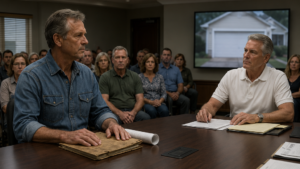
The lake association secretary read Katherine’s name as if it had already been filed under fault.
“Responsible party listed: Katherine Miller, west access parcel.”
At the front of the meeting room, Rachel White sat with a cream folder resting on her lap and did not look at Katherine. She had chosen a pale blouse instead of the red suit, softer at first glance, almost neighborly. But her posture was straight, her lips composed, her pen ready.
Katherine sat two rows back with Steven on one side and the photo folder on her knees. The association office smelled of old coffee, copier toner, and the damp carpet near the back door. A framed map of the lake hung crooked behind the secretary, marked with parcel lines that looked clean from a distance and confusing up close.
“There has been no finding,” Katherine said.
The secretary blinked over her glasses. “Excuse me?”
“You read my name as responsible party. There has been no finding.”
A few heads turned. Someone in the back shifted a metal chair against the floor.
Rachel smiled faintly without opening her mouth.
The secretary looked down at her papers. “That is the language from the preliminary report submitted.”
“Submitted by whom?”
Rachel finally turned. “By me, Katherine. As board liaison for shoreline concerns. You know that.”
“I know you handed me a bill yesterday for damage I didn’t cause.”
A murmur ran through the room. Steven leaned forward, but Katherine gave the smallest shake of her head. He sat back, jaw tight.
The association president, a broad man with a stack of bylaws in front of him, cleared his throat. “Let’s keep this procedural. Mrs. White reported unauthorized tree removal along the west access slope, possible erosion exposure, and view corridor disruption affecting adjacent properties.”
“View corridor,” Katherine repeated.
Rachel folded her hands. “That’s the term used in our maintenance guidelines.”
“It was not the term you used yesterday.”
Rachel’s face did not change. “Yesterday was upsetting for everyone.”
Katherine felt heat rise along her neck. She had slept badly, seeing the red circle around $23,800 each time she closed her eyes. But Rachel’s calmness in this room was worse than her anger on the road. Here, Rachel sounded reasonable. Concerned. Public-minded.
The president turned to Katherine. “Do you have an initial response?”
Katherine opened her folder. “I have photographs showing those trees were still standing this spring and that some of them were marked before any alleged removal by me.”
Rachel’s pen paused.
The president leaned forward. “Marked by whom?”
“I don’t know yet.”
“That’s important,” Rachel said gently. “Because the issue isn’t whether the trees stood in May. No one disputes that. The issue is who allowed activity on that side of the road.”
Katherine looked at her.
Rachel slid a photograph from her own folder and passed it to the secretary, who handed it to the president. “This was taken from my deck the morning after the cutting. You can see the stumps clearly. You can also see the slope leading directly from Katherine’s access road.”
The president studied the photo, then passed it along the table. From where Katherine sat, she could see the angle immediately. Rachel had taken it from above, looking down through the new opening. The stumps lined up perfectly with the glittering water behind them. The missing pines had not just exposed dirt.
They had opened Rachel’s lake view.
Katherine felt the realization settle coldly.
Rachel was not grieving trees. She was defending a view she had wanted.
The photo reached Katherine last. She took it by one corner. There was the raw slope, the pale stumps, the road, the bright strip of water. From Rachel’s deck, the cut looked almost deliberate, like a window.
Steven whispered, “That angle.”
“I see it,” Katherine said.
Rachel heard him anyway. “The view is not the point. The slope is destabilized.”
“You said yesterday, ‘That was my lake view.’”
Rachel’s eyes flicked toward the other board members. “I was upset.”
“Enough to bring a bill.”
“Because someone has to pay to restore what was damaged.”
The president lifted a hand. “Let’s stay focused. Katherine, did you grant anyone access to that road recently?”
The room seemed to narrow.
Steven turned toward her. He had not known. Donna knew only part of it. Katherine’s fingers pressed into the edge of the photo folder.
“Rachel asked to use the lower access road in April,” Katherine said.
Rachel’s expression softened with something that looked almost like pity.
The president made a note. “For what purpose?”
“Emergency dock repairs,” Katherine said. “Her usual delivery path was blocked after a washout. She asked if a small crew could cross near my lower bank for two days.”
“And you agreed?”
“Verbally.”
Steven closed his eyes.
Katherine kept her gaze on the president. “For dock boards. Not tree removal. Not shoreline cutting. Not equipment storage.”
Rachel sighed. “Katherine, I’m not saying you personally cut anything. I’m saying access was granted from your side, and the damage happened from that side. That creates responsibility.”
“You didn’t say that yesterday.”
“Yesterday you refused to discuss responsibility at all.”
“I refused to sign a false estimate.”
The secretary flipped a page. “The preliminary insurance notice has already been copied to the association file.”
Katherine’s stomach tightened. “Insurance notice?”
Rachel looked at her for the first time with full, polished sympathy. “Only preliminary. No one wants this to become uglier.”
Steven laughed once, short and disbelieving. Katherine put her hand on his sleeve before he could speak.
The president removed his glasses and rubbed the bridge of his nose. “Mrs. Miller, given the access issue and the restoration estimate, the board will need a written response from you. Include any photos or records. We’ll hold off on final association penalties until Monday evening.”
“Monday,” Katherine said.
“Seventy-two hours.”
“That is not enough time to correct a false claim.”
“It is enough time to respond to one.”
Rachel capped her pen. “If Katherine is willing to work toward a neighborly resolution, I’m prepared to recommend leniency on association fees.”
There it was again. The offer that carried a hook. Pay something. Admit something. Let Rachel call it mercy.
Katherine gathered her photographs slowly. Her hands wanted to shake, so she moved with care.
“You may want leniency,” she said, “because it sounds kinder than correction.”
Rachel’s cheeks colored.
The president tapped the table. “Written response by Monday, Mrs. Miller. Please include anything relevant, including the nature of any access permission.”
Outside the association office, Steven exploded before the door had fully closed.
“You should have told me about the access road.”
“I know.”
“You know? Aunt Katherine, that’s what they’re going to use. That’s the whole hinge.”
“I know.”
“Why would you let Rachel use it without writing anything down?”
Katherine stopped on the walkway. Across the parking lot, Rachel was speaking quietly to two neighbors, her cream folder tucked against her side. She glanced over once, not triumphantly. Worse. She looked relieved.
Because Katherine’s silence had done part of Rachel’s work for her.
“She said it was an emergency,” Katherine said. “And I wanted to be neighborly.”
Steven’s anger faltered. “That’s not a crime.”
“No,” Katherine said. “But it may be a mistake.”
Her phone buzzed before he could answer. An email notification from the association filled the screen.
Formal response requested within seventy-two hours regarding west access parcel damage claim and preliminary responsibility review.
Attached were Rachel’s photo, the restoration estimate, and a statement form with Katherine’s name already typed into the blank marked “owner response.”
Katherine stared at the form until the letters stopped blurring.
Steven looked over her shoulder. “We need more than photos.”
Katherine closed the email and held the folder tighter against her ribs.
“Then we find more.”
Chapter 4: The County Date Changes Everything
“The notice was entered before Mrs. White’s complaint,” the clerk said.
Katherine gripped the edge of the counter.
The county records office had opened ten minutes earlier, and already the clerk had pulled up a file that made the whole weekend tilt. On the monitor between them, a scanned shoreline notice sat in a gray viewing window, its date stamp sharp and unforgiving.
June 5.
Rachel’s complaint claimed the tree damage had been discovered after “recent activity” connected to Katherine’s access road. Her estimate suggested the cutting had happened late in the week. But this notice, logged by the county shoreline office, showed that someone had flagged possible unpermitted work near the west access slope days before Rachel had placed the estimate on her sedan hood.
Steven leaned over Katherine’s shoulder. “Can you print that?”
The clerk looked at him, then back at Katherine. “I can print a public copy. It won’t tell you who did the work.”
“It tells me the timeline is wrong,” Katherine said.
The clerk clicked a few keys. “It tells you the county had reason to look before the association did.”
The printer behind her woke with a mechanical cough. Katherine watched the pages slide out slowly, one by one. The sound felt too small for what it meant.
The clerk handed her the notice through the slot. “You’ll want to talk to the shoreline inspector if this is tied to removal.”
“Is he available?”
“Not usually without an appointment.”
Steven opened his mouth.
Katherine put a hand lightly against his sleeve before he could push. “Please,” she said to the clerk. “I have seventy-two hours to answer a claim that names me responsible. I need to know what this means before I write anything wrong.”
The clerk studied her for a second. Not with pity. Katherine was grateful for that. Then she turned and disappeared through a door behind the counter.
Steven exhaled. “That worked better than me talking.”
“Yes,” Katherine said. “That was why I stopped you.”
A few minutes later, a county shoreline inspector came out carrying a tablet and a paper cup of coffee. He was younger than Katherine expected, with tired eyes and mud dried around the soles of his boots.
“You’re asking about west access?” he said.
“Yes.” Katherine held up the printout. “This notice.”
He glanced at it. “That was a visual flag from a road pass. Possible bank disturbance, possible tree marking. We hadn’t opened a full violation.”
“Tree marking,” Steven said.
The inspector looked at him. “Ribbons. Cones. Brush disturbance. Enough to check later.”
“Before the cutting,” Katherine said.
“Before the complaint that came to us, yes.”
The answer should have made her feel steadier. Instead, it opened another door.
“Did anyone file a permit?” she asked.
The inspector tapped on his tablet. “For tree removal on that slope? No.”
“No one?”
“No one tied to your parcel. No one tied to Mrs. White’s parcel either, at least not for shoreline clearing.” He lifted his eyes. “Removal in that zone usually requires review, especially if roots stabilize the bank.”
Steven’s voice sharpened. “So whoever cut them did it without permission.”
“Maybe. Or they thought they were outside the review zone. Or they cut before applying. People do all kinds of things and then act surprised when dirt moves.”
Katherine folded the notice carefully. “If I did not hire anyone, and no permit was filed, how can they name me responsible?”
The inspector did not answer quickly. That frightened her more than if he had dismissed the claim.
“You own the west access parcel?”
“Yes.”
“Did you allow any equipment or crew to cross it?”
Her mouth dried.
Steven looked at her.
Katherine could feel the old habit rise in her, the one that wanted to protect the easy version of the story. No, she wanted to say. Not for this. Not really. Not in a way that should matter.
But really was not a word paperwork respected.
“In April,” she said, “I let Mrs. White’s dock repair crew use the lower road for two days because her regular access was washed out.”
The inspector nodded, as though this was exactly the kind of knot he had expected. “Verbal?”
“Yes.”
“Any limits written down?”
“No.”
“Any photos of the access before and after?”
Katherine opened her folder. “I have photos before. Not formal inspection photos. Family photos.”
“Sometimes those help,” he said, “but here’s the difficult part. If equipment crossed your parcel and damage occurred from that access, an insurer or association may look at whether you permitted the access, even if you didn’t authorize the damage.”
Steven’s face flushed. “That’s ridiculous.”
“It may be,” the inspector said. “I’m telling you how they’ll look at it, not what’s fair.”
Katherine looked down at the county notice, the clean date that had seemed to save her fifteen minutes earlier. June 5 was still printed there. Rachel’s timeline was still broken. Yet somehow the ground under Katherine had not become firm.
“Can we see the site?” the inspector asked. “If you’re willing.”
By late morning, they stood again beside the fresh stumps, the inspector moving slowly along the slope with his tablet. He photographed the cuts, the ditch, the lower bank, the road shoulder. Steven hovered behind him until Katherine said his name softly.
The inspector crouched near the old cedar boundary marker half buried in brush. “This marker always here?”
“As long as I’ve owned the cabin,” Katherine said. “My husband put cedar around the iron pin so we could see it.”
“Hard to see now.”
“It was clearer before.”
Steven held out one of the old photos. The inspector compared it to the slope, then to the marker. “That helps.”
“Enough?” Katherine asked.
“Enough to raise questions.”
She had begun to dislike that phrase.
The inspector moved toward the lower road. Near the ditch, he bent and picked up a crushed orange cone base half hidden under needles. Steven gave Katherine a quick look.
The inspector turned it in his hand. “Contractor marker.”
“Can you tell whose?”
“Not from this.”
Steven pulled out his camera. “We found orange plastic here Friday.”
The inspector nodded. “Make sure that stays documented.”
Katherine opened her folder to the enlarged June 3 photograph. “This was taken from my porch. It shows Rachel’s car near the access road. There’s an orange cone in the grass.”
The inspector studied it longer this time. He zoomed in on Steven’s phone, then looked back toward Rachel’s house across the bend.
“Do you know which contractor handled the dock work in April?”
“Rachel said it was Anthony Campbell’s crew,” Katherine said. “I never hired him.”
The inspector tapped again on his tablet. “Campbell Shoreline and Dock?”
“I think so.”
He scrolled, stopped, and read something silently.
Steven stepped closer. “What?”
The inspector’s expression changed only slightly, but Katherine saw it. Not surprise. Recognition.
“Anthony Campbell’s crew had a scheduled service entry on Mrs. White’s property the same week as the county notice,” he said.
Katherine looked toward the gap in the trees, where Rachel’s deck was now plainly visible through the damage.
“On Rachel’s property,” she said.
“That’s what the schedule says.”
Steven’s camera hung forgotten at his chest. “Then why is Aunt Katherine’s name on the claim?”
The inspector closed his tablet case, not answering. Katherine did not need him to. The question had become larger than the date, larger than the stumps, larger than the estimate.
If Anthony Campbell’s crew had been scheduled for Rachel, then either they had crossed the boundary by mistake, or someone had made the wrong side look like the right one.
Chapter 5: When the Folder Proves Too Little
“Photos show timing,” the insurance adjuster said. “They do not show authorization.”
Katherine sat at her kitchen table with the phone on speaker, her photo folder open in front of her like a hand she had already played and lost. The county notice lay beside it, neatly printed. Steven stood by the sink, staring out through the screen door at the fresh cut in the trees.
On the phone, the adjuster’s voice remained patient, almost kind. That made it worse.
“The county date shows the issue began before Mrs. White’s formal complaint,” Katherine said.
“It helps with timeline.”
“And the photographs show the trees standing before that.”
“They help with condition.”
“And Anthony Campbell’s crew was scheduled on Rachel’s property.”
“That may help with contractor involvement once we obtain records.”
Katherine closed her eyes. “Then what doesn’t it help with?”
There was a pause on the line.
“Mrs. Miller, the file includes a statement that you granted lower-road access for work connected to the adjacent property. If equipment used your access and damage occurred from that access, the question becomes whether your permission contributed to the loss.”
Steven turned from the sink. “That’s not what she gave permission for.”
The adjuster said, “Who am I speaking with?”
Katherine opened her eyes. “My nephew. He is here with me.”
“Understood. I’m not making a determination today. I’m explaining why the photos alone won’t close the matter.”
The photos alone.
Katherine looked at the picture her husband had taken in May, the one with ribbons bright against the pine trunks. All weekend, she had touched that photograph as if it were a railing on a steep path. Now she saw how thin paper could be when someone needed it to carry more than it could.
“What should I send?” she asked.
“Anything establishing the limits of the access you granted. Written messages, emails, notes, contractor scope, maps, any communication with Mrs. White.”
Katherine’s mouth tightened.
There it was. The space where she had chosen ease over clarity. Rachel had asked at the mailbox in April. Her regular drive had washed out, she said. The dock boards were warped, she said. Two days, maybe three. Small equipment. No trouble. Katherine had wanted to keep the lake peaceful. She had wanted not to be the widow who made everything difficult.
“I don’t have it in writing,” Katherine said.
Steven made a small, frustrated motion with one hand, then stopped himself.
The adjuster softened. “Then send what you do have. The file is still open.”
After the call ended, the kitchen seemed too quiet.
Katherine began placing the photographs back in order. May 12. June 3. June 5 notice. Friday stumps. Her fingers knew the sequence now, but the sequence did not yet know how to defend her.
Steven pulled out a chair and sat across from her. “You should’ve told me about the verbal permission earlier.”
“You said that already.”
“I know. I’m trying not to say it again.”
“You are doing poorly.”
He almost smiled, then didn’t. “I’m mad because they’ll use it.”
“So am I.”
“At Rachel?”
Katherine slid one photo into the folder. “At myself.”
The answer knocked the edge off him.
Her phone buzzed before he could speak. Donna’s name again. Katherine considered letting it go, then answered.
“I talked to Steven,” Donna said without greeting.
“I assumed.”
“Mom, I’m not trying to take Rachel’s side.”
“I know.”
“I don’t think you did it. But if the insurance people are already talking about access and responsibility, maybe there’s a way to settle part of it without admitting everything.”
Katherine looked at the estimate still sitting at the end of the table, the copy Rachel had emailed after the meeting. The red-circled number seemed louder every time she saw it.
“Settle part of a lie?”
“Settle risk,” Donna said. “There’s a difference.”
Katherine pressed her lips together.
Donna continued, gentler now. “I remember what Dad used to say. Never pay for someone else’s mistake. But Dad also wrote things down. You didn’t, Mom.”
The words struck where the adjuster’s had already bruised.
Katherine stared at the old cedar marker in one of the photographs. Her husband had wrapped the marker so visitors wouldn’t miss it. She had trusted people not to pretend they hadn’t seen it.
“I know what I failed to do,” Katherine said.
Donna was quiet. Then, “I’m scared this will hurt you more than the money.”
“It already has.”
A knock came at the front door.
Steven stood immediately. Through the screen, Rachel’s red jacket showed on the porch like a warning flag.
“Don’t open it,” Steven said.
Katherine ended the call. “If I don’t, she’ll say I refused to communicate.”
Rachel stood with a new folder against her chest. She did not try to come inside.
“I’m here as a neighbor,” she said.
Steven gave a humorless laugh from behind Katherine.
Rachel ignored him. “I heard the county came out.”
“You hear quickly,” Katherine said.
“It’s a small lake.” Rachel’s gaze moved past her to the kitchen table, to the open photo folder. “I don’t want this to get worse.”
“Then withdraw the claim.”
Rachel’s expression tightened. “I can’t withdraw a restoration issue. There are real costs.”
“Costs you placed in my name.”
“Because your access road was involved.”
“For dock repairs.”
“For work connected to my lower property. That’s the issue. Lines blur out there.”
Katherine looked at Rachel’s folder. “What is that?”
“A compromise.”
Rachel removed a single page and held it out. Katherine did not take it, so Rachel placed it against the screen door. Through the mesh, Katherine saw typed lines, signature blanks, and a number far smaller than the first but still large enough to matter.
Split responsibility.
No admission of intentional wrongdoing.
Association fees waived if signed before Wednesday inspection.
Steven stepped forward. “Absolutely not.”
Rachel’s eyes flashed. “This is not your home.”
“No,” he said. “That’s why I can still see what you’re doing.”
Katherine did not move. The phrase “split responsibility” held her attention. It was softer than guilty. Softer than liable. Soft enough for a tired person to sign.
Rachel lowered her voice. “Katherine, you made a neighborly mistake. I understand that. But the bank is open now. Soil is exposed. Trees are gone. We can fight over language for months, or we can repair what needs repairing.”
“Who cut them?”
Rachel blinked. “What?”
“Who cut the trees?”
“That’s what we’re trying to resolve.”
“No,” Katherine said. “You’re trying to resolve who pays.”
For a second, Rachel looked not angry but cornered. Then she gathered the page back from the door.
“Wednesday, then,” she said. “I hope you think carefully before making everyone’s costs higher.”
She left without slamming anything. That restraint made the threat worse.
When Katherine returned to the table, Steven had her old phone in his hand.
“I was looking through the April messages,” he said. “The ones from Rachel about the dock crew.”
“I thought there weren’t any limits in writing.”
“There aren’t. Not clean ones.” He turned the phone toward her. “But look at this.”
The thread showed Rachel’s polite April messages about boards, access, and timing. Katherine remembered them now: Rachel had texted after the mailbox conversation, not to ask permission exactly, but to confirm when the crew could cross.
Steven scrolled to a message Rachel had forwarded from someone else. The top of it showed only a partial contractor contact and a clipped line.
Lower road works if we open the lower view first.
Katherine read it once. Then again.
Steven’s voice dropped. “Aunt Katherine, that was before the dock repair.”
The kitchen seemed to pull inward around the small bright screen.
Katherine had been looking for proof that she had not authorized cutting. She had found something more dangerous: a phrase that sounded as if someone had been thinking about the view before any tree was supposed to be touched.
Chapter 6: The Contractor Remembers the Wrong Road
“You can put that phone away,” Anthony Campbell said. “I’m not being recorded.”
Katherine stopped just inside the open gate of the equipment yard, her thumb still near the record button. Behind Anthony, a row of work trucks sat streaked with dried mud, their trailers loaded with metal ramps, orange cones, rope, and stacked boards. The air smelled of fuel, wet wood, and cut weeds.
Steven shifted beside her, already bristling.
Katherine turned the phone screen off and slipped it into her purse. “Then I’ll take notes.”
Anthony gave a short laugh. “That’s not much better.”
“It’s quieter.”
He studied her for a moment. He looked tired, not evasive in the polished way Rachel was evasive. His cap was pulled low, and sawdust clung to the knees of his work pants. A clipboard rested against his truck hood, one hand pressed over it as if he had forgotten he was guarding it.
“You should talk to your insurance company,” he said.
“I have.”
“Then let them request documents.”
“They will. I’m asking what happened.”
“I don’t know what happened on your property.”
Katherine looked past him to the orange cones stacked in the trailer. The same color as the cone in the June photograph. The same color as the plastic strip in the sawdust.
“Did your crew work on Rachel White’s lower property in early June?”
Anthony’s mouth tightened. “We do a lot of lake work.”
“Did you?”
Steven said, “It’s a simple question.”
Anthony looked at him. “Simple questions turn into expensive answers.”
Katherine stepped slightly in front of Steven. “Mr. Campbell, I have a claim with my name on it. I have an estimate from your company. I have county records showing a notice before Rachel’s complaint. And I have photographs of your markers near the west access road.”
That landed. Anthony’s eyes moved toward her folder.
“May I show you?” she asked.
“I’m not confirming anything from a photograph.”
“I didn’t ask you to confirm. I asked if I may show you.”
After a long pause, he nodded.
Katherine placed the folder on the truck hood, not touching the clipboard. She laid out the June 3 photo, the enlarged corner with Rachel’s sedan, and the orange cone near the ditch. Then she placed Steven’s picture of the cone base and tire tracks beside it.
Anthony looked without bending too close. A man trying not to see too much.
“That could be anybody’s cone,” he said.
“It could.”
“But you came here because you think it’s mine.”
“I came because the county said your crew was scheduled on Rachel’s property that week.”
Anthony lifted his cap, rubbed his forehead, and set it back. “Scheduled doesn’t mean cutting trees.”
“No,” Katherine said. “What were you scheduled to do?”
“Dock access prep. Lower approach cleanup. Some brush trimming.”
“Trees?”
“No trees were supposed to come down without review.”
Steven’s jaw worked. Katherine gave him another warning look.
Anthony glanced toward the office trailer behind him, then lowered his voice. “Mrs. White wanted better access to the lower dock. Her regular drive was soft after the washout. She said you’d agreed to let equipment use the west road.”
“For dock repairs,” Katherine said.
“That’s what I understood at first.”
“At first?”
He moved the clipboard an inch closer to himself. “Look, the lower road down there curves weird. Parcel lines are old. Markers are half buried. Rachel kept saying the pines blocked the lower view.”
Katherine heard the phrase again, this time not glowing on a phone screen but spoken aloud in a man’s reluctant voice.
“Sight-blocking pines?” she asked.
Anthony looked sharply at her.
“That was the wording, wasn’t it?”
His silence answered before he did.
“It was in a preliminary note,” he said. “Not a work order.”
“Whose note?”
“Mine. From a walk-through.”
“With Rachel?”
“Yes.”
Steven took one step closer. “So Rachel asked you to clear the view.”
Anthony pointed at him. “No. Don’t put words in my mouth. She complained about the view. She complained about access. She complained about the slope and deadfall and how no one maintains anything on that side. That doesn’t mean she hired me to cut six pines.”
“Eight,” Katherine said.
Anthony looked back at her.
“Your estimate says eight trees.”
“That estimate was for restoration exposure, not a stump count.”
“Rachel said you measured eight.”
He blew out a breath, annoyed now but not at her alone. “We flagged eight possible problem trees on the preliminary walk-through. Six were mature pines. Two were saplings near the lower bank. The final cut, from what I saw afterward, was six.”
Katherine felt the small piece click into place. Not enough to close the matter. Enough to know the bill had carried an old walk-through number into a new accusation.
“You knew the estimate didn’t match the stumps,” she said.
“I knew it was based on preliminary exposure. Rachel wanted a number fast.”
“For my signature.”
“I didn’t tell her to get your signature.”
“But you gave her a bill she could use.”
His face reddened. “I gave her a remediation estimate because trees were down and the bank was exposed. I didn’t assign blame.”
“Your logo did some of that for her.”
The words were not loud, but Anthony looked away.
From inside the office trailer, someone moved past the window. Anthony lowered his voice further.
“My assistant told me the boundary markers were confusing.”
“When?”
“During the walk-through. He said the cedar marker didn’t line up with the map Rachel gave us.”
Katherine’s fingers tightened around the edge of the folder. “What map?”
Anthony hesitated.
Steven said, “The one she submitted to the association?”
“I don’t know what she submitted.”
“What map did she give you?” Katherine asked.
Anthony rubbed his jaw. “A parcel printout. Marked lower access. It showed the work approach coming down from her side, but the road it pointed to looked like yours when we got there.”
“That should have stopped the work.”
“It did stop the work that day.”
“That day?”
He gave her a tired look. “Mrs. Miller, crews come back. Assistants move cones. Homeowners call and say the access is approved. I am not saying that’s good enough. I’m saying that’s how mistakes happen.”
“Was it a mistake?”
“I’m not answering that.”
“Because you don’t know?”
“Because any answer belongs in an insurance file.”
He reached for the photos, then stopped himself because they were hers.
Katherine gathered them slowly. She had come wanting Anthony to confess to something clean: Rachel ordered it, his crew did it, Katherine was free. Instead, she had found human mess. Vague notes. Boundary confusion. A contractor who had seen too much and written too little. A neighbor who knew exactly how to use fog.
“Will you give me the walk-through note?” she asked.
“No.”
“Will you give it to the adjuster?”
“If they request it formally.”
“And the map?”
His hand returned to the clipboard. “Same answer.”
Steven made a frustrated sound. “So you’ll let her keep blaming my aunt until paperwork forces you not to.”
Anthony’s eyes hardened. “I have a business to protect.”
“So does she. It’s called her home.”
“Steven,” Katherine said.
He stopped, breathing hard.
Katherine put the folder under her arm. “Mr. Campbell, if I write down what you told me today, will you deny it?”
Anthony looked toward the stacked cones, then toward the road beyond the yard.
“I’ll say we discussed timeline and access confusion.”
“That isn’t what I asked.”
“No,” he said. “But it’s what I can say.”
She nodded once. It was not enough. But it was not nothing.
At the gate, Anthony called after her.
Katherine turned.
He stood by the truck hood with the clipboard held flat against his thigh. His face had changed; not softened exactly, but stripped of the contractor’s practiced irritation.
“Ask Rachel why she changed the access road on the map,” he said.
Steven went still.
Katherine looked back at the orange cones, the trucks, the clipboard Anthony would not hand over.
“What map?” she asked.
Anthony did not answer again. He only turned and walked into the office trailer, leaving Katherine with the one question that mattered more than his estimate.
Chapter 7: Katherine Refuses the Easy Settlement
Rachel arrived at the inspection meeting wearing the red suit.
She stepped out of her black sedan with a clipped folder in one hand and a settlement form already visible beneath the metal clasp. The same hood that had held the $23,800 estimate now reflected the pale morning sky. Behind it, the fresh stumps waited in the open strip between Katherine’s cabin and the lake.
Katherine stood on the gravel shoulder with her photo folder held against her ribs. Steven was beside her with his camera, but the strap stayed around his neck. She had asked him that morning not to lead with the lens.
“Let them look first,” she had said.
He had not liked it. He had obeyed.
The insurance adjuster was already there, standing near the county shoreline inspector, both of them studying Rachel’s submitted parcel map on the hood of the deputy’s cruiser. The sheriff’s deputy leaned against the door with a notebook, saying little. The association secretary had come too, carrying a binder and the expression of someone who wanted the matter resolved before lunch.
Rachel crossed the road without looking at the stumps.
“I’m glad everyone is here,” she said. “I think we can finish this today.”
Katherine looked at the clipped form. “Finish what?”
“The dispute.” Rachel’s voice stayed smooth. “I revised the proposal. No one has to admit intent. We divide responsibility for remediation, waive association penalties, and move forward as neighbors.”
Steven made a low sound. Katherine did not turn.
The adjuster held out a hand. “Before any settlement is discussed, we still need to review the site, the access route, and the documents requested from Mr. Campbell.”
Rachel’s smile thinned. “Of course.”
The shoreline inspector tapped the map spread across the cruiser hood. “Mrs. White, this is the map submitted with the association complaint?”
“Yes. A printout from county parcel records with the relevant access marked.”
Katherine could see the blue pen line Rachel had drawn. It curved down toward the lower road, stopping where the pines had been cut. It looked clean. Too clean. The kind of line that made an old, uneven place seem simple.
The inspector turned the map slightly. “And this is the version provided to your contractor?”
Rachel glanced at the adjuster. “I provided him a copy for access reference, yes.”
Steven’s fingers flexed near his camera.
Katherine opened her folder and removed the May photograph. She had slid each print into a clear sleeve the night before, hands careful, her husband’s notes visible on the backs. Then she took out the enlarged June image with Rachel’s sedan and the cone.
“May I place these beside the map?” she asked.
Rachel’s eyes moved to the folder. “Katherine, everyone has seen your family photos.”
“Not beside this map.”
The inspector nodded. “Go ahead.”
Katherine laid the May photograph down. The old cedar boundary marker was visible near the lower edge, partly hidden but present. Then she placed the June enlargement beside it. Then Steven’s fresh photo of the same area after the cutting.
Three pieces of time in a row.
Rachel shifted her weight.
The inspector leaned closer. The adjuster did too.
Katherine pointed to the cedar marker in the May photo. “My husband wrapped the iron pin with cedar so we could see it from the road. It’s here.”
She pointed to the same area in the current photo. “It’s here, buried in brush.”
Then she pointed to Rachel’s map. “It is not here.”
The inspector did not answer at once. He pulled the map closer and traced the edge of the printout with one finger.
Rachel said, “The county maps don’t show every old marker.”
“No,” the inspector said. “But this one has been cropped.”
The word settled over the group.
The association secretary looked up from her binder. “Cropped?”
The inspector turned the sheet toward her. “This parcel printout cuts off just west of the boundary reference. It shows the access road, but not the marker location that would make the road’s ownership clearer.”
Rachel’s mouth opened, closed, then opened again. “I printed the relevant portion.”
Katherine heard her own pulse.
The adjuster looked at Rachel. “Was the full parcel map available when you submitted this?”
“I’m sure it was. I wasn’t trying to hide a marker. I printed what fit.”
Steven spoke before Katherine could stop him. “It fit your claim.”
Rachel’s composure cracked just enough for color to rise under her makeup. “I am trying to keep this from becoming a legal mess.”
“No,” Katherine said quietly. “You are trying to keep it a small enough mess for me to sign.”
Everyone turned toward her.
She had not meant to say it so plainly, but once the words were out, she did not regret them.
Rachel held up the settlement form. “This is a compromise. You granted access. My contractor had reason to believe the approach was approved. The trees came down. The bank is exposed. We can spend months deciding whose mistake was largest, or we can repair the damage.”
The adjuster reached for the form. “May I see that?”
Rachel handed it over reluctantly.
Katherine watched him scan the page. His expression changed at the signature block.
“This names Mrs. Miller as accepting shared responsibility for unauthorized removal,” he said.
Rachel’s voice sharpened. “Shared responsibility, not sole responsibility.”
“But it still assigns responsibility.”
“Because she gave access.”
“For dock repairs,” Katherine said.
Rachel turned fully toward her then, abandoning the officials, the folder, the careful tone. “You keep saying that as if access roads know intentions. I had crews trying to fix a dangerous lower dock. You left that side of the property overgrown for years. You know what my realtor said when I bought? That the lower view could be opened if neighbors cooperated. Then every time I tried to discuss maintenance, you vanished behind grief and old photographs.”
The words struck more deeply than Katherine expected. Not because they were fair, but because parts of them touched things she had avoided. She had let the west slope grow rough. She had ignored Rachel’s early complaints because Rachel’s complaints always came wrapped in ownership. She had thought silence was better than another hard conversation.
But silence had not saved the trees.
Katherine looked at Rachel’s settlement form, then at the gap where the pines had stood. The lake glittered through it, bright and indifferent.
“You’re right about one thing,” Katherine said. “I avoided the hard conversation.”
Rachel’s face flickered with surprise.
“I should have written down the access limits. I should have said no when I didn’t trust the request. I should have marked the road again after the washout. Those were my mistakes.”
Steven looked at her sharply.
Katherine kept her eyes on Rachel. “But I did not authorize tree removal. I did not ask anyone to open your lower view. I did not crop that map. I did not turn six stumps into an eight-tree bill and put my name on it.”
Rachel’s jaw tightened. “You’re humiliating me in front of half the lake.”
“No,” Katherine said. “I’m disagreeing with you where you made the accusation.”
The deputy stopped writing.
The shoreline inspector crouched near the cedar marker, pushing brush aside with one gloved hand. He cleared enough for the old cedar wrap to show, gray and weathered, still tied around the iron pin. Then he stood and looked toward the map again.
“This marker should have been part of any access review,” he said.
The adjuster closed Rachel’s settlement form and held it without handing it back. “I’m going to need the full parcel printout, Mr. Campbell’s work-order documents, and any map versions sent before the work. Until then, I can’t recommend Mrs. Miller sign anything assigning responsibility.”
Rachel looked at Katherine, and for the first time since Friday there was fear beneath the anger. Not fear of Katherine. Fear of losing control of the story she had already told.
“This could still cost everyone more,” Rachel said.
Katherine slid her photographs back into the folder, leaving only the May image on the cruiser hood beside the cropped map.
“No,” she said. “It may cost the right person more.”
Rachel’s eyes flashed. “And you think that makes you right?”
Katherine picked up Rachel’s settlement form from the adjuster’s hand and looked at the signature line where her own name had been typed ahead of time.
Then she tore nothing, crumpled nothing, raised her voice at no one.
She placed the unsigned form back on the hood between them.
“I will not sign any document that calls someone else’s view my responsibility.”
Chapter 8: The Trees Rachel Could Not Own
“The claim is being reclassified as misdirected,” the adjuster said.
Katherine stood at the county office counter with both hands resting on the edge, not trusting her knees to do all the work. The word was not beautiful. It was not apology-shaped. It did not sound like the relief she had imagined.
Misdirected.
But it was not settled. It was not shared responsibility. It was not her name carrying Rachel’s view down into an insurance file.
Across from her, the adjuster placed three documents in a row: Anthony Campbell’s work-order summary, the full parcel map, and Rachel’s cropped version. The county shoreline inspector stood nearby with his tablet, while the association secretary waited with her binder open and a pen poised above a clean complaint form.
“Anthony’s submitted records confirm the preliminary walk-through was for Mrs. White’s lower access and view-clearing concerns,” the adjuster said. “The work order remained vague, but the map discrepancy changes the liability review.”
Katherine looked down at the full map. There, plainly beyond the edge Rachel had printed, was the boundary reference. The old marker. The piece that made the lower road belong not to Rachel’s version of the story but to Katherine’s land.
“And the tree removal?” Katherine asked.
“The unauthorized removal is being separated from your access permission. The remediation estimate will not proceed under your responsibility pending final contractor review.”
“Pending,” the association secretary said quickly, as if she needed that word to protect herself.
Katherine turned to her. “Will the association file say I caused it?”
The secretary glanced at the adjuster, then the inspector. “The current complaint will be amended.”
“That isn’t what I asked.”
A small silence followed.
Katherine had spent years softening questions so other people could answer comfortably. She did not soften this one.
The secretary looked down. “No. The amended file will not state that you caused or authorized the cutting.”
Katherine nodded once. “I would like a copy.”
“You’ll receive one by email.”
“Printed, please.”
The secretary hesitated, then went to the copier.
The inspector slid the May photograph back toward Katherine. “This helped.”
Katherine touched the plastic sleeve. In the photo, the pines still stood, their branches messy and alive. Her husband’s handwriting was on the back, unseen but present.
“It didn’t help enough by itself,” she said.
“No,” the inspector said. “But it made people look twice.”
That was something, Katherine thought. Maybe that was what records did best. They did not always save you. Sometimes they simply made the next lie work harder.
By late morning, they were back on the lake road.
Rachel was waiting beside her black sedan. She wore no red suit this time, only dark slacks and a white blouse, her hair pulled back tighter than usual. The settlement folder was gone. In its place she held a single page.
Steven stood beside Katherine, camera lowered. Donna had driven up too and stood near the cabin porch with her arms folded, watching her mother as if seeing her from a distance she did not understand.
Rachel crossed the road slowly.
“The association says the original demand is withdrawn,” she said.
Katherine did not answer.
Rachel held out the page. “That’s the amended notice.”
Katherine read it without taking it from Rachel’s hand. The language was careful. Preliminary responsibility claim withdrawn. Further review directed to contractor and adjacent-property insurance. No finding against west access owner at this time.
At this time, Katherine thought. Even correction had hedges.
“I’ll get my own copy,” she said.
Rachel lowered the page. “I wanted you to hear it from me.”
“Why?”
The question seemed to catch Rachel off guard.
She looked toward the lake. Through the raw gap, her deck was visible, the chairs lined up to face the water.
“Because I don’t want this to become the story everyone tells about us,” Rachel said.
Katherine followed her gaze. “Which story?”
“That I tried to cheat you.”
“Did you?”
Rachel’s mouth tightened. “I tried to protect my property value.”
“That’s not an answer.”
“It’s the honest one.”
For the first time, Rachel sounded tired enough to be real. Katherine could see the strain around her eyes, the faint tremor in the page she held. This did not make her innocent. It made her human, which was less satisfying and harder to dismiss.
“When I bought that house,” Rachel said, “I was told the lower view could be opened with cooperation. Then the washout happened, the dock repairs doubled, and every estimate I got was worse than the last. I thought if the access had come through your side, then some of this belonged there too.”
“Some of this,” Katherine repeated.
Rachel looked at her. “I shouldn’t have named you before the review.”
“No.”
“I shouldn’t have cropped the map.”
“No.”
Rachel flinched at the second answer.
“I printed what supported the access,” she said, but the defense came weakly.
“You printed what left out the marker.”
Rachel folded the amended notice. “Anthony’s insurance will handle most of it now.”
“Most of what?”
“The review. The remediation. The corrected estimate.”
Katherine glanced toward the stumps. Small flags had been placed beside each one, not by Rachel, but by the county inspector. The place looked less like an open wound now and more like a site that had been named correctly.
“Rachel,” Katherine said, “I want the file to say I did not authorize or cause the damage.”
“It does.”
“I want the association minutes corrected.”
Rachel’s shoulders stiffened. “That will be embarrassing.”
“So was hearing my name read as responsible party.”
Donna looked down.
Rachel pressed her lips together. “Fine.”
“And I want no neighborly statement that says we resolved this together.”
Rachel’s eyes flashed again, the old anger returning. “What does that even mean?”
“It means you don’t get to call my refusal a compromise.”
Steven’s expression changed, but he said nothing.
Rachel stood very still. The lake behind her glittered through the missing trees she had wanted gone and now could not comfortably look through.
“I have to live next door to you,” Rachel said.
“Yes,” Katherine said. “That’s why this matters.”
The deputy arrived just after noon with a corrected incident supplement from the county file. He did not make a speech. He did not scold Rachel. He simply handed Katherine the copy and confirmed that the insurance responsibility had been redirected pending contractor review.
Anthony’s name appeared twice. Rachel’s map appeared once. Katherine’s name appeared too, but not in the box marked responsible.
She read that part three times.
Donna came to stand beside her while Rachel spoke quietly with the association secretary near the sedan.
“I’m sorry,” Donna said.
Katherine looked at the paper. “For what?”
“For telling you to pay risk instead of fight the lie.”
“You were scared.”
“I was wrong.”
“Both can be true.”
Donna’s face crumpled a little, but she caught it. Katherine slipped the corrected notice into the photo folder beside the May shoreline picture.
Steven lifted his camera, then lowered it again. “Do you want a photo of the withdrawn estimate?”
Katherine looked at the original bill, now stamped withdrawn in red by the association secretary and clipped to the amended notice. It lay on the hood of the same black sedan where it had first appeared, but it no longer looked powerful. It looked like paper.
“Yes,” she said. “But after that, put the camera down.”
He took the picture.
By dusk, the officials were gone. Rachel’s sedan had disappeared around the bend. Donna had driven back toward town after making Katherine promise to call before answering any more association emails. Steven had stacked the copies on the kitchen table in careful order, then left them there when Katherine told him she knew where everything belonged.
The cabin grew quiet.
Katherine carried the old photo folder to the porch. The lake was calm, the raw gap in the pines darkening at the edges. Near the stumps, small replacement stakes marked where new trees would go after the review. They were thin and unimpressive, nothing like what had been lost.
She took out her phone.
For a moment she hesitated. Her husband had been the one who photographed the shoreline, the one who believed dates mattered, the one who wrapped cedar around an iron pin so no one could pretend the boundary was invisible. Katherine had let too many things remain spoken, neighborly, assumed.
Not anymore.
She raised the phone and framed the picture carefully: cabin rail in the foreground, stumps beyond, lake behind them, replacement stakes catching the last light.
The photo clicked.
Katherine checked that the date had saved.
Then she stood on her own porch and looked through the opening Rachel had wanted, seeing not a view stolen or a view won, but a line that had finally been named.
The story has ended.