The Day My Neighbor’s Car Rose Above the Street and Exposed What Our HOA Had Been Hiding
Chapter 1: The Car Hanging Above Daniel’s Driveway
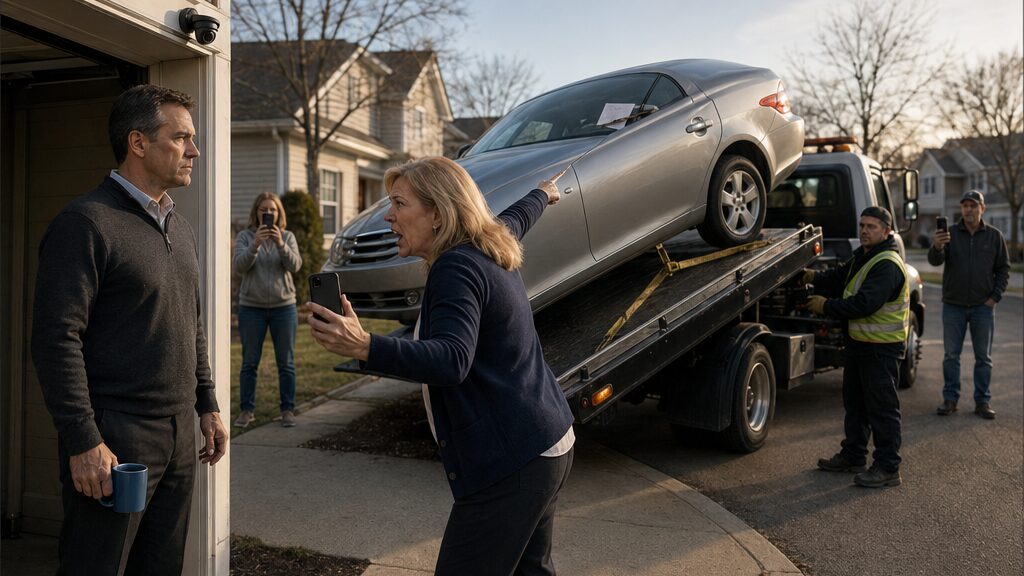
Sharon Baker’s silver sedan hung nose-up above the street, its rear tires turning slowly in the late-afternoon light.
The tow truck’s hydraulic arm groaned. A yellow strap tightened beneath the car. Three houses down, a man stood on his lawn holding his phone sideways. Across the street, a woman in gardening gloves had forgotten the hose running at her feet.
Sharon stood beside the tow operator with one hand pressed to her ear and the other cutting sharp lines through the air.
“You cannot take it,” she said. “I’m calling the association right now.”
The operator kept his eyes on the winch controls. “Once it’s secured, I can’t release it without authorization.”
“Then get authorization.”
Daniel Rivera watched from the edge of his garage with a coffee mug cooling in his hand.
Above him, fixed to the white trim beneath the gutter, a small black security camera pointed toward the driveway. Its lens reflected a hard dot of sunlight. Every few seconds, a blue status light blinked.
Sharon turned and saw him.
“This is your doing.”
Daniel did not answer immediately. He could hear several phones recording. He could also hear the thin metallic click of the tow cable settling under tension.
“I warned you twice,” he said.
“You never said you’d have my car dragged away in front of everyone.”
“It’s blocking the only entrance to my property.”
“It is beside your driveway.”
“It’s across the curb cut.”
Sharon pointed toward the pavement as though the distinction could be settled by force of gesture. “That space is marked for overflow parking. Betty approved it.”
The neighbors shifted. One of the raised phones tilted toward Daniel.
He looked at the sedan suspended above the place where his driveway met the street. For several minutes, the scene had felt like the inevitable end of something simple. Now, with one sentence, Sharon had made it uncertain.
Three days earlier, there had been no tow truck, no audience, and no camera above the garage.
There had only been Daniel standing at the end of his driveway at 7:12 on a Tuesday morning, holding his work bag and staring at a silver sedan parked sideways across his exit.
His own car sat inside the garage. The driveway was narrow, bordered on one side by a low retaining wall and on the other by a strip of landscaping he had planted with his father years earlier. There was no second exit, no gravel shoulder, no space to maneuver around the obstruction.
The sedan’s rear bumper extended past one edge of the curb cut. Its front wheel rested almost directly in front of the other.
Daniel set his bag on the concrete and checked the time.
He had spent twelve years working with municipal records, long enough to know that anger rarely improved a boundary dispute. People became certain when challenged. They remembered conversations differently. They treated volume as proof.
He walked next door instead.
Sharon answered after the second knock. She wore a navy sweater and held a child’s plastic cup in one hand.
“Morning,” Daniel said. “Is that your daughter’s car across my driveway?”
Sharon glanced past him. “Mine. She took the SUV.”
“I need to leave.”
“I’ll move it.”
“Thank you.”
She smiled, but she did not reach for her keys.
Daniel waited.
“I only need five minutes,” she said. “My grandson left his backpack, and they’re coming back for it.”
“The car is blocking me.”
“They’ll be here any second.”
Daniel looked toward his driveway. “I need it moved now.”
The smile thinned. “You’re not already late, are you?”
It was the kind of question that changed the shape of a request. His need to leave had become something she could evaluate.
“I’m asking you not to park across my driveway.”
“And I said five minutes.”
Daniel knew the next version of the conversation. He could insist. She could accuse him of being unreasonable. The child behind her could begin listening. A neighbor could step outside. A practical problem could turn into a public argument before breakfast.
He picked up his work bag and waited near his garage.
Five minutes passed.
Then ten.
At 7:29, Daniel sent a message to his supervisor saying he had been delayed by a blocked vehicle. At 7:37, he considered calling the non-emergency police number. At 7:46, Sharon finally emerged with her keys.
She walked toward the sedan without looking at him.
“That was longer than five minutes,” Daniel said.
“My daughter had a situation.”
“I understand things happen. But you can’t block this driveway again.”
Sharon opened the driver’s door. “There’s nowhere else close when the street fills up.”
“That doesn’t make this a parking space.”
She rested one arm along the roof of the car. “The HOA diagram shows overflow along this side.”
“Not across my entrance.”
“It shades the entire curb.”
Daniel glanced down. Faint blue paint marked portions of the street several yards away, but nothing designated the concrete slope in front of his property.
“Then send me the rule,” he said.
Sharon gave him a tired look. “Ask Betty.”
She moved the sedan forty-one minutes after Daniel had first found it there.
He arrived at work late enough to miss the beginning of a records review he had prepared for. No one reprimanded him. That almost made the delay worse. He spent the morning correcting other people’s parcel references while replaying Sharon’s calm certainty.
At lunch, he opened the HOA resident portal.
The parking rules were brief. Garages and driveways were to be used before curbside spaces. Vehicles could not obstruct sidewalks, hydrants, mailboxes, or traffic. Nothing specifically addressed curb cuts. Nothing described overflow parking near his house.
He searched archived newsletters, meeting packets, and resident guides. Most contained photographs of landscaping projects or reminders about trash containers.
Then he found a welcome packet uploaded four years earlier.
On page eleven was a rough street diagram with pale gray shading along several curbs. The shading continued past his property. Because the drawing was not precise, the gray band appeared to cross the mouth of his driveway.
At the bottom of the page, in small type, were the words: Additional guest parking where marked.
Daniel enlarged the image until the lines blurred.
The diagram did not show measurements. It did not cite a recorded plat. It did not distinguish the curb cut from the curb beside it.
But Sharon had not invented it.
He printed the page and set it on his kitchen counter that evening. Beside it lay an older photograph showing the garage trim before he had removed a broken floodlight. Two empty screw holes remained above the door, the perfect width for a camera bracket.
Daniel stood beneath them the next morning with a drill in his hand.
Before fastening anything into place, he looked once more at the printed diagram.
The gray shading crossed his driveway exactly where Sharon said it did.
Chapter 2: Five Minutes Became a Recorded Pattern
At 5:48 on Friday morning, Daniel’s new security camera recorded Sharon’s sedan rolling slowly into view.
His phone vibrated on the nightstand.
He opened the alert and watched the car stop with its rear half across his driveway. The screen was dark except for the pale glow of streetlamps and the camera’s timestamp in the corner.
For several seconds, Sharon remained behind the wheel. Then she got out, looked toward Daniel’s house, and walked next door.
The camera’s blue status light blinked above the garage.
Daniel dressed without hurrying. By the time he stepped outside, dawn had begun lifting the darkness from the roofs. Sharon’s car still blocked the curb cut.
He took two photographs from the sidewalk, then wrote the time in a small notebook.
The front door next door opened before he reached it.
Sharon stood there with folded arms. “I was going to move it.”
“You parked there again.”
“My daughter came in late. She has the baby with her, and every space was taken.”
“There are spaces farther down.”
“She shouldn’t have to carry a sleeping child half the block.”
Daniel looked past her. A folded stroller leaned against the entry wall. A small pair of shoes sat beside it.
He understood inconvenience. That did not change the geometry of his driveway.
“You can use my curb,” he said. “You cannot cover the entrance.”
“It’s six in the morning. You’re not going anywhere.”
The words settled between them.
Daniel felt the familiar pressure to give her the missing explanation—to tell her that departure was not always scheduled, that access could matter before anyone had time to ask whether he planned to leave. Instead, he heard himself answer in the flat tone he used at work when correcting a filing error.
“Whether I’m leaving is not your decision.”
Sharon’s expression sharpened. “You make everything sound like a regulation.”
“This is a boundary.”
“It’s a curb.”
“It’s my only way in and out.”
“And the association marks it as overflow.”
“Show me where Betty confirmed that.”
“I don’t need to prove it every time you’re annoyed.”
Daniel pointed toward the camera. “This is the second time. I’m documenting it.”
For the first time, Sharon looked above the garage. Her gaze fixed on the small lens.
“You put up a camera because of me?”
“I put it up because my driveway was blocked for forty-one minutes.”
“You timed it?”
“Yes.”
Something in his answer offended her more than anger would have.
She walked past him, opened the sedan, and moved it twenty feet down the street. Before closing the door, she looked back toward the camera.
“You should be careful about recording people.”
“It records my property.”
“It records the street.”
Daniel did not reply. He watched until the curb cut was clear, then saved the clip to a folder marked with the date.
At eight, he called Betty Nelson, the HOA community manager.
Betty’s voice carried the brisk patience of someone already handling too many small disputes.
“I saw your email,” she said. “I’m not sure why this needs formal intervention.”
“Because the resident guide appears to mark my driveway entrance as parking.”
“It’s a conceptual diagram.”
“Then it shouldn’t be used as permission.”
“It isn’t a survey.”
“Sharon Baker says you approved the space.”
A pause followed, short but noticeable.
“I told her guest parking is allowed where designated.”
“Is the curb cut in front of my driveway designated?”
“You’ll need to refer to the governing documents.”
“I did. They don’t say.”
“Then this may be a neighbor-to-neighbor matter.”
Daniel sat at his kitchen table with the diagram open beside him. “I’m asking for the association’s interpretation in writing.”
“I can’t issue a legal interpretation.”
“I didn’t ask for one. I asked whether a vehicle may block my driveway.”
“Daniel, nobody should obstruct access. But the association doesn’t regulate every temporary parking issue.”
“Forty-one minutes wasn’t temporary to me.”
Betty exhaled. “Send me the dates, and I’ll note the complaint.”
“Will you tell Sharon not to park there?”
“I’ll send a general reminder.”
A general reminder meant no finding, no acknowledgment, and no answer.
That afternoon, an email went to every resident on the street. It asked homeowners to remain considerate when using guest spaces and to avoid creating access concerns. Sharon’s name did not appear. Neither did Daniel’s driveway.
At 4:22, Sharon’s sedan returned.
Daniel was unloading groceries. Two paper bags sat in his back seat, and a carton of milk rested on the passenger-side floor. He reversed halfway down the driveway before seeing the silver car move across the entrance.
He stopped with his rear bumper six feet from the street.
Sharon got out carrying a grocery bag of her own.
Daniel lowered his window. “You’re blocking me again.”
She glanced at his car. “You’re home.”
“I’m trying to back out.”
“You just got groceries.”
“That doesn’t matter.”
“It matters if you’re making this into an emergency when it isn’t one.”
Daniel put the car in park and stepped out. The camera above them recorded the entire exchange.
“I have asked you twice,” he said. “Do not park across this driveway.”
Sharon shifted the bag against her hip. “My daughter is going through a separation. She and my grandson are staying with me. We have three vehicles and two driveway spaces. I’m doing the best I can.”
Daniel’s anger loosened for a moment. Her explanation was not permission, but it was real.
“You can ask before using the curb beside my property,” he said. “I’ll work with you when I can. But the entrance stays clear.”
“You don’t use both sides of it.”
“The whole opening is required to turn.”
“That sounds convenient.”
“It’s recorded.”
Sharon looked up at the camera again. “Of course it is.”
She moved the car, but the conversation remained lodged in Daniel’s mind. He had offered cooperation without explanation. She had offered pressure without apology. Each had given the other just enough information to remain certain.
That evening, Daniel called three towing companies.
The first would not remove a vehicle without police authorization. The second required posted signage. The third asked him to email a photograph of the driveway, the parcel boundary, and proof of ownership.
Daniel sent the county auditor map, the deed reference, and still images from both incidents.
The dispatcher called back twenty minutes later.
“We can pre-authorize for obstruction of private access,” she said. “But only if the vehicle is physically covering the curb cut when the driver arrives. The operator will document it before hooking up.”
“What about the HOA diagram?”
“That’s between you and the association. We go by the property access and local ordinance.”
Daniel looked through the kitchen window at the camera’s blue light.
“If it happens again,” the dispatcher said, “call the direct number. Don’t confront the driver if you think it’ll escalate.”
Daniel wrote the number beneath the dates in his notebook.
For the first time since Sharon’s car had appeared across his driveway, he had a consequence available.
He did not yet know whether using it would protect the boundary or make the argument larger than the street.
Chapter 3: Coffee While the Tow Cable Tightened
The silver sedan was back before Daniel finished carrying his father’s folded walker from the garage shelf.
It was Saturday afternoon. Sharon’s house was crowded for a family gathering, with voices moving through the open windows and children’s shoes scattered near the front steps. Cars lined both sides of the street.
The sedan sat directly across Daniel’s curb cut.
A white sheet of paper trembled beneath its windshield wiper.
Daniel had placed the notice there himself the previous evening after printing three sentences in plain black type:
PRIVATE DRIVEWAY ACCESS. DO NOT BLOCK. VEHICLES OBSTRUCTING ENTRY OR EXIT MAY BE TOWED.
Sharon had parked on top of the warning.
Daniel stood inside the garage, one hand resting on the walker. Samantha was supposed to bring their father the next morning, not today. There was no immediate medical need, no appointment, no crisis.
He could still knock.
He could give Sharon a third conversation and allow her to call it a first warning later.
Instead, he took out his phone and called the towing company.
The dispatcher asked for the address, vehicle description, and current position. Daniel sent a photograph showing both edges of the curb cut blocked.
“Operator should be there in twelve to fifteen minutes,” she said.
Daniel returned the walker to the shelf.
In the kitchen, he filled the coffee maker and watched the driveway through the window above the sink. His phone displayed a silent live feed from the camera. The silver sedan filled the lower half of the screen.
When the tow truck turned onto the street, Daniel poured coffee into a heavy blue mug his father had given him years earlier.
He did not drink it.
The tow operator stepped down, photographed the car from four angles, then stood at the curb studying the angle between the sedan and the driveway.
Daniel went outside.
“Property owner?” the operator asked.
“Yes.”
“You can’t get a vehicle through there without crossing the wall or the landscape.”
“That’s correct.”
“You warned the owner?”
“Twice in person. There’s a written notice under the wiper.”
The operator photographed the paper. “That helps.”
The sound of the hydraulic bed lowering brought the first neighbor out. Then another appeared across the street.
Daniel remained beside the garage while the operator worked. The cable slid under the sedan with a metallic scrape. The winch engaged.
Sharon’s front door opened just as the car began to move.
She came down the steps without a coat, phone already in her hand.
“What are you doing?”
The operator stopped the winch but did not release the tension. “Vehicle’s being removed for blocking private access.”
“No, it isn’t.”
“It’s already secured.”
Sharon turned toward Daniel. “Tell him to stop.”
Daniel held the coffee mug at waist level. “You parked across the driveway again.”
“I was inside for ten minutes.”
“You were warned.”
“This is overflow parking.”
“It blocks the curb cut.”
“My grandson’s birthday is today. There was nowhere else.”
“There are open spaces near the entrance.”
“That’s half a block away.”
The tow operator resumed the winch. The sedan’s front tires climbed onto the angled bed.
Sharon raised her voice. “I’m calling Betty.”
A neighbor across the street lifted a phone.
Another resident stepped onto the lawn, drawn by the mechanical strain and Sharon’s shouting. Within a minute, there were five people watching.
Daniel felt their attention settle on him. He knew what the scene looked like: a quiet man holding coffee while a woman’s car was pulled away from a child’s birthday gathering.
Sharon reached through the sedan’s openable door frame, then stopped when the operator warned her not to touch the vehicle.
“You wanted this,” she said to Daniel. “You’ve been waiting to do this.”
“No.”
“You installed a camera. You called companies. You printed a threat.”
“I documented a pattern.”
“You built a case against me over parking.”
“Over access.”
The distinction sounded smaller in public than it had in his kitchen.
Sharon spoke rapidly into her phone, telling Betty that Daniel was towing an authorized vehicle. The tow operator raised the bed. The sedan tilted higher, its rear wheels leaving the pavement.
One of the neighbors murmured, “That seems excessive.”
Daniel heard it clearly.
Sharon did too. She turned toward the small audience.
“The association map marks this whole section for guest parking,” she said. “He knows that.”
Then she hurried to her car’s passenger side, opened the unlocked door at the operator’s direction, and pulled a folded paper from the glove compartment.
She held it up.
Even from several feet away, Daniel recognized the pale gray shading.
“This came with my homeowner packet,” she said. “Betty told me the shaded areas were overflow.”
The operator looked at Daniel. “You have a dispute with the association?”
“I have a blocked driveway.”
“That’s what I documented,” the operator said. “I’m asking because once I leave, the fees start.”
Sharon unfolded the page against the side of the raised car. Her finger landed on the gray band crossing Daniel’s property.
“There,” she said. “Exactly where I parked.”
Daniel stepped closer.
The page was not a phone screenshot or an altered copy. It was a clean print from the same HOA packet he had found online. In the bottom corner was a revision date he had not noticed before.
The diagram had been issued the year after Daniel bought his house.
“Betty approved this?” he asked.
“She explained it to me when my daughter moved in.”
“When?”
“Last month.”
Daniel looked toward Sharon’s phone. He could hear a faint voice through the speaker, but not the words.
“Put her on speaker,” he said.
Sharon’s grip tightened. “She’s contacting the board.”
“That isn’t what I asked.”
The tow operator glanced at his watch. “I need a decision from the property owner. The vehicle is secured and the access is obstructed. I can proceed under the authorization.”
Every neighbor was now looking at Daniel.
He could stop the tow, accept another promise, and lose the only consequence Sharon had believed. Or he could let it continue while an official-looking diagram hung in the air between them.
He thought of Betty’s refusal to answer a direct question. Nobody should obstruct access, she had said. But the association doesn’t regulate every temporary parking issue.
Daniel stepped back.
“Proceed.”
Sharon stared at him as though he had confirmed everything she believed about him.
The operator raised the sedan fully onto the bed.
By the time the truck pulled away, two neighbors had recorded the entire scene. Sharon stood in the street with the HOA diagram folded against her chest.
Daniel’s coffee had gone cold.
That evening, just before the impound office closed, Sharon knocked on his door.
She demanded that he pay the release fee. Daniel brought his tablet to the entryway and opened the security footage.
He showed her the first blockage, the forty-one-minute delay, the second warning, and the third arrival. The timestamps ran across the bottom of each clip.
“You were warned twice,” he said. “And the written notice was on your windshield.”
Sharon watched without speaking until the video showed her looking directly at the notice before walking into her house.
Her face changed, but not into apology.
“That still doesn’t give you the right to ignore the HOA map.”
“It doesn’t give you the right to block the driveway.”
“You’ll hear from the board.”
She left without asking to see the footage again.
At 8:17, Daniel’s phone chimed with a new portal notification.
He opened it at the kitchen table. His cold coffee remained beside the printed diagram.
A red banner stretched across the top of the screen.
FORMAL COMPLIANCE NOTICE: UNAUTHORIZED PRIVATE TOWING AND RESIDENT CONDUCT.
The complaint demanded that Daniel reimburse Sharon’s impound charges and appear before the HOA board.
According to the notice, he—not the car across his driveway—was now the violating resident.
Chapter 4: The Map That Should Not Exist
Daniel’s HOA portal showed a red violation badge beside his name before he finished his first cup of coffee.
He opened the notice again, half expecting the language to have changed overnight.
It had not.
Unauthorized private towing. Failure to follow association dispute procedures. Conduct contributing to neighborhood disruption. Reimbursement requested in the amount of Sharon’s release fee, towing charge, and one day of storage.
At the bottom, a hearing date had been scheduled for the following Thursday.
Daniel downloaded the notice, saved it with the camera clips, and printed two copies. Then he opened the association’s parking diagram beside the recorded county plat for his property.
The two documents did not agree.
The county plat showed the full width of his curb cut as private access aligned with the garage. The HOA sketch laid a broad gray stripe along the street, continuing across that same opening as if the concrete slope were no different from an ordinary curb.
He placed the pages side by side on the kitchen table.
On his tablet, the security footage was paused at the moment Sharon’s sedan covered the driveway. Above the car, the camera’s timestamp read 3:18:42 P.M.
Three records. Three different kinds of authority.
Only one of them had resulted in Daniel being accused.
At nine, he drove to the HOA management office. Betty Nelson met him in a glass-walled conference room with the formal notice already placed between them.
She wore a gray jacket and kept both hands on a yellow legal pad.
“I want to be clear,” she said. “The board has not reached a final decision.”
“The portal calls me the violating resident.”
“That is how the system categorizes an active complaint.”
“Sharon’s car blocked my driveway three times. Where is her complaint record?”
Betty’s pen moved half an inch and stopped. “The board is reviewing the entire situation.”
“Then review this.”
Daniel laid the county plat beside the HOA diagram.
Betty looked at the plat first, then at the shaded sketch. She did not appear surprised.
“The resident guide is not a survey,” she said.
“Then why was it given to homeowners as a parking map?”
“It was intended as a general illustration.”
“Sharon says you personally confirmed that the shaded space in front of my driveway was overflow parking.”
“I told her shaded curb areas were historically used for guests.”
“That is not an answer.”
“It is the answer I can give.”
Daniel leaned back. Through the glass wall, an employee carried a box of pool-access wristbands past the room.
“Where did this diagram come from?”
“I don’t have that information in front of me.”
“It has a revision date.”
“Daniel, the immediate issue is that you authorized a private tow without contacting management.”
“I contacted you after the second blockage.”
“You filed a complaint. You did not request towing approval.”
“You refused to say whether she could park there.”
“That did not authorize you to create a public confrontation.”
“The tow truck created noise. Sharon created the confrontation.”
Betty’s expression tightened. “Several residents described your conduct as calculated.”
Daniel thought of the cold mug in his hand, the raised phones, the way he had said proceed while Sharon held the diagram against the suspended car.
“It was calculated,” he said. “I documented the obstruction and arranged a lawful remedy.”
“That wording is exactly the concern.”
“What wording?”
“You speak as though rules exist separately from people.”
The accusation landed closer than he expected.
Daniel gathered the documents into a straight stack. “Will the association reimburse me if an ambulance cannot enter because someone is parked across that opening?”
Betty looked down at her pad.
“Nobody is discussing an ambulance.”
“I am discussing access.”
“And I am trying to resolve a neighborhood dispute before it becomes a liability problem.”
The word slipped into the room before she could take it back.
Daniel watched her face.
“What liability problem?”
Betty capped her pen. “You should direct further questions to the board.”
He left with no interpretation, no source for the diagram, and no explanation for why Betty had known exactly where to look on the page.
At the municipal records counter, Daniel asked for the original subdivision street plan, curb modifications, and any approved parking markings for his block.
The clerk recognized him from work but did not treat the request casually. Daniel completed the public-record form like any other resident and waited beneath fluorescent lights while a scanner hummed in the back office.
The municipal parking officer arrived twenty minutes later carrying a rolled engineering sheet.
“You’re asking about the blue curb marks?” the officer said.
“And the guest-parking designation.”
The sheet was spread across a wide counter. It showed Daniel’s street before the houses had been built: parcel lines, sidewalks, hydrants, driveway aprons, drainage slopes.
No overflow zones appeared anywhere near his property.
The officer traced the curb with one finger. “These sections were approved for ordinary street parking. Driveway clearances remain subject to city code.”
“What about restriping by the association?”
“They can maintain private markings on association-owned lanes. This is a dedicated public street.”
“The HOA added blue marks.”
“Then somebody should have applied for a traffic-control review.”
“Did they?”
The officer searched the permit index on a terminal. Nothing appeared under Daniel’s street, the subdivision name, or the association.
“No permit,” the officer said. “No approved curb plan. No recorded change.”
Daniel photographed the screen and requested certified copies.
The discovery should have felt like victory. Instead, it widened the problem. The association had not merely issued a vague sketch. Someone had created parking guidance over a public street without municipal approval, then continued distributing it.
Back at home, Daniel uploaded the plat and permit search to the HOA portal. His submission received an automatic confirmation but no human response.
Near dusk, Nicholas Hill called.
“I’m the board treasurer,” he said. “Betty forwarded your documents.”
Daniel stood in the garage beneath the camera. The lens faced outward, recording an empty driveway.
“Did she forward my earlier complaint?”
“I saw it today.”
“I sent it before the tow.”
“I know.”
Nicholas sounded irritated, but not necessarily with Daniel.
“Does the association have a policy requiring management approval before a blocked private driveway can be cleared?” Daniel asked.
There was a pause filled by the faint clicking of a keyboard.
“I can’t find one.”
“Then what rule did I violate?”
“The board is relying on general conduct provisions and the requirement to avoid unilateral enforcement.”
“That is not a towing rule.”
“No.”
It was the first direct answer Daniel had received from anyone connected to the association.
Nicholas continued, “But your problem is not only procedure. Two residents submitted videos. They show Sharon upset, her car already raised, and you standing there with coffee while refusing to stop it.”
“They begin after the operator secured the vehicle.”
“That may be true. It is not what people see.”
“The camera shows what happened before.”
“Then bring the complete footage to the hearing.”
Daniel looked up at the small black lens. Until that moment, he had treated the recording as a clean witness. Nicholas had just reminded him that evidence could also make a person look colder than he believed himself to be.
“Who created the parking diagram?” Daniel asked.
“I’m trying to determine that.”
“Betty knows more than she is saying.”
Nicholas was quiet.
Then he said, “The association’s insurer asked whether the street markings were municipally approved.”
“When?”
“This afternoon.”
“And?”
“And Betty has not answered yet.”
The call ended with no promise beyond review.
Daniel returned to the kitchen. On the table, he positioned the paused camera footage between the county plat and the HOA sketch. The silver sedan covered his access in one image. On the two maps beside it, the same strip of pavement carried opposite meanings.
His phone vibrated.
Samantha’s name appeared on the screen.
“You need to tell me exactly what happened Tuesday morning,” she said before he could greet her.
Daniel sat down. “Sharon blocked the driveway.”
“For how long?”
“Forty-one minutes.”
Silence followed.
Then Samantha said, “The transport driver logged thirty-six.”
Daniel’s hand tightened around the phone. “What transport driver?”
“The one bringing Dad to your house.”
He looked toward the empty driveway through the darkening window.
Samantha’s voice lowered. “They reached the corner, saw they couldn’t pull in, and called me. I had them take him back to the clinic until I could leave work.”
“You never told me.”
“You never told me your driveway was blocked.”
Daniel stared at the camera image on his tablet.
The first obstruction had not only made him late for work.
While he had stood waiting for Sharon’s promised five minutes to end, his father had been sitting in a medical transport vehicle less than a block away, unable to reach the house Daniel had promised would always be accessible.
Chapter 5: What Daniel Refused to Explain
Samantha placed their father’s folded transport schedule directly on top of the HOA violation notice.
The paper was soft at the creases from being opened too many times. Thursday’s appointment was circled in blue. Beneath it, in Samantha’s handwriting, were the pickup window, medication reminder, and a note that read: Daniel’s house after clinic.
“You built an entire case,” she said, “and left out the only part that explains why this matters.”
Daniel stood on the other side of the kitchen table. “The driveway is private access whether Dad uses it or not.”
“That isn’t what I said.”
“It should not require a medical story for people to respect it.”
“No. It shouldn’t. But now they think you towed her because you hate being inconvenienced.”
“They have the timestamps.”
“They have a video of you drinking coffee while her car gets lifted.”
“I wasn’t drinking it.”
Samantha stared at him.
Daniel heard how useless the distinction sounded.
He moved the transport schedule off the violation notice and aligned it with the edge of the table.
Samantha took it back and set it crooked.
“Stop arranging the paper.”
“I’m trying to read it.”
“You already know what it says.”
The kitchen window had become a dark mirror. In it, Daniel could see his own outline and, beyond the glass, the tiny reflection of the security-camera light above the garage.
He had installed the camera to preserve facts. Now every fact seemed to lead toward something he had refused to say.
Samantha sat down.
“The driver called me at seven twenty,” she said. “Dad had finished early. They were going to wait at your place because I couldn’t leave the hospital until ten.”
Daniel remembered checking his watch at 7:29 and sending the message to his supervisor. He had been standing less than forty yards from the transport vehicle without knowing it.
“Why didn’t the driver call me?”
“I gave them my number because you were supposed to be at work.”
“You could have called.”
“I was covering a medication error review. By the time I got free, they were already taking him back.”
Daniel looked at the schedule. “Was he all right?”
“He was tired. Confused about why the plan changed.”
The answer opened an older room in Daniel’s memory.
Two years earlier, their father had called from his apartment after falling beside the kitchen counter. Daniel had been at a records hearing downtown. His phone had been silenced. By the time he saw the missed calls, Samantha had already reached the apartment and an ambulance crew was carrying their father out.
Their father recovered. He never blamed Daniel. That mercy had made the guilt harder to set down.
When they later arranged for him to spend clinic days at Daniel’s one-level house, Daniel had checked the driveway width, removed the raised threshold at the side door, and cleared a place in the garage for the walker.
“No matter what time they bring you,” he had told his father, “this house will be reachable.”
It had sounded like an ordinary promise.
Daniel had treated it like a contract.
“I should have been there,” he said.
Samantha’s expression softened, but only slightly. “That is not what this is about.”
“It is always what it is about.”
“No. You missed one call two years ago. Since then, you’ve acted like needing anyone else means you failed.”
Daniel turned toward the sink.
Samantha continued. “You could have told Sharon that medical transport uses this driveway.”
“She shouldn’t need private family information to follow a boundary.”
“You could have told Betty.”
“She would have turned it into an accommodation request and asked for forms.”
“Maybe. Or maybe somebody would have understood before a car ended up on a tow truck.”
Daniel faced her again. “So this is my fault?”
“I’m saying your silence has consequences too.”
The words stayed in the kitchen after Samantha looked away.
Daniel had wanted a conflict with one clean line: Sharon’s car crossed it; he enforced it. The transport schedule made the line no less real, but it exposed what stood behind it.
He had not kept the reason private only from Sharon. He had kept it from Samantha, from the board, and even from himself whenever he described the dispute as a matter of geometry.
That afternoon, they drove to the hospital to collect their father after a mobility assessment. The patient pickup lane was crowded. A delivery van stopped beneath the covered entrance while a transport driver tried to maneuver around it.
The driver leaned on the horn once, then got out.
“You can’t leave that here,” he told the delivery driver. “I need the ramp.”
“It’ll be two minutes.”
“I need the ramp now.”
Daniel felt the exchange before he understood why. The same casual promise. The same assumption that another person’s need could wait because the obstruction was temporary.
The delivery driver moved.
No speech. No public argument. Only a clear statement of what the access protected.
Samantha watched Daniel as the transport vehicle pulled forward.
“You see it now?” she asked.
He nodded.
Their father emerged through the hospital doors with a staff member, leaning on a walker. His face brightened when he saw them, then tightened with concentration as he approached the curb.
Daniel stepped forward to steady the walker.
“I heard you caused neighborhood excitement,” his father said.
Samantha gave Daniel a sideways look. “News travels.”
“A woman at the clinic showed me a video,” their father said. “Car in the air. You holding a mug like you were waiting for a bus.”
Daniel closed his eyes briefly.
His father laughed once, then became serious. “Was the driveway blocked?”
“Yes.”
“Then it needed clearing.”
“That isn’t the whole problem.”
“It never is.”
They guided him into Samantha’s vehicle. Daniel folded the walker and placed it in the rear.
On the drive back, his phone rang through the car speakers.
Betty Nelson.
“I’d like to discuss a possible administrative resolution,” she said.
Samantha’s hands tightened on the steering wheel.
“What resolution?” Daniel asked.
“The association would remove the conduct violation and waive any hearing-related charges.”
“In exchange for what?”
“A written parking-use understanding between you and Sharon.”
“What would it say?”
“That the curb area may be used for temporary guest parking when you have no scheduled access need, provided Sharon gives advance notice.”
Daniel looked through the windshield at the hospital entrance receding behind them.
“Who decides whether my need is scheduled?”
“The agreement would require reasonable communication.”
“My driveway would become shared unless I announce when I need it.”
“I wouldn’t describe it that way.”
“That is what it says.”
Betty’s tone became careful. “This would avoid a public hearing and protect both residents from additional expense.”
“Would the association correct the parking diagram?”
“We can review future revisions.”
“Would it acknowledge that the street markings were not approved?”
“That question is outside the neighbor agreement.”
“Would Sharon withdraw her reimbursement demand?”
“Yes.”
Samantha glanced at him. Their father sat quietly in the back seat, one hand resting on the folded transport schedule.
Betty added, “This is a practical solution, Daniel.”
It was practical in the same way silence had always been practical. No admission. No correction. No one forced to say which record was wrong or why it had remained in circulation.
The driveway would stay available only when Daniel proved his need in advance.
“I won’t sign it,” he said.
“Then the hearing will proceed.”
“I want it open to residents.”
Another pause.
“Open hearings can be difficult to control.”
“So can inaccurate rules.”
“Think carefully before making this larger.”
Daniel looked back at his father. Their eyes met in the rearview mirror.
“It became larger when the association labeled me the violator instead of correcting the map,” Daniel said. “I’ll attend the hearing.”
After the call ended, Samantha released a breath.
“You know what this means,” she said.
“Yes.”
“You’ll have to tell them.”
Daniel looked at the transport schedule in his father’s hand.
This time, he did not straighten it.
That evening, he assembled the hearing materials. He included the recordings, the tow authorization, the municipal plat, the permit search, Betty’s general reminder, and the proposed settlement.
Then he added the transport log.
For several minutes, his finger rested on the upload button.
Evidence had always been safer when it belonged to streets, parcels, and timestamps. The transport log belonged to his family. Once submitted, it would become part of the dispute.
He uploaded it anyway.
In the hearing-request field, Daniel selected the option marked Open Session.
The portal asked him to confirm.
He clicked yes.
Chapter 6: The Hearing Behind the Viral Video
Sharon’s tow video was already playing when Daniel entered the clubhouse.
The projection filled the white wall behind the board table. On-screen, the silver sedan rose at an angle while Sharon pointed toward Daniel. The recording had begun after the tow cable tightened. It showed none of the earlier warnings, none of the written notice, and none of the operator’s inspection.
It showed Daniel holding a blue coffee mug.
Someone had muted the sound, but the image did not need it.
Residents occupied nearly every folding chair. The two neighbors who had filmed the towing sat near the aisle. Samantha waited in the back row with their father’s folded transport schedule inside a clear folder.
Betty stood beside the projector. Nicholas Hill sat at the board table with a calculator, a legal pad, and a stack of municipal records.
Sharon was seated in the front row.
When she saw Daniel, she looked away.
The clip ended with the tow truck pulling down the street. Betty froze the final frame.
“This recording was submitted as part of the resident-conduct complaint,” she said.
Daniel set his binder on the small presentation table. “Will the board also play the full security footage?”
“You will have an opportunity to present your evidence.”
“After everyone sees the edited version first.”
“It is not edited.”
“It begins after the vehicle was secured.”
Betty’s jaw tightened. “Please take your seat until recognized.”
Daniel sat beside Samantha.
His father had not come. The evening would have been too long, and Daniel had refused to turn him into a prop for the room. Still, the empty chair beside Samantha seemed to carry his absence.
The board heard Sharon first.
She described the shortage of parking at her home, her daughter’s separation, and the difficulty of carrying a sleeping child from the subdivision entrance. Her voice remained controlled until she spoke about the tow yard.
“I had to pay before they closed,” she said. “My grandson kept asking why my car was taken. I had a legitimate association map in the glove compartment, and Daniel knew it existed.”
A board member asked whether Daniel had warned her.
“He complained before,” Sharon said. “But he never said the association’s map was invalid. He never told me towing had been authorized until my car was already in the air.”
“That is not what I asked,” Nicholas said. “Were you told not to block the driveway?”
Sharon looked at him. “He told me not to park there.”
“Twice?”
“Yes.”
The room shifted almost imperceptibly.
Betty asked Sharon whether she believed the area was designated parking.
“I did. Betty told me the shaded curb was available for guests.”
Every face turned toward the management table.
Betty leaned toward her microphone. “I explained the historical use of shaded areas. I did not authorize obstruction of a driveway.”
Sharon’s eyes narrowed. “You said Daniel was overreacting and that the board had never enforced that opening as private.”
“I said the diagram was unclear.”
“You told me not to let one resident rewrite the neighborhood rules.”
The sentence landed without drama, which made it worse.
Betty looked down at her notes. “That conversation is being characterized selectively.”
Nicholas wrote something on his pad.
When Daniel was recognized, he connected his tablet to the projector.
The security footage began at 5:48 on Friday morning. Sharon’s sedan entered the frame. The timestamp remained visible. The audience heard Daniel’s voice telling her that whether he planned to leave was not her decision.
Then came the second clip: his car halfway down the driveway, Sharon standing with groceries, Daniel saying clearly, “I have asked you twice. Do not park across this driveway.”
The third clip showed Sharon arriving on Saturday. She parked over the curb cut, stepped out, and looked directly at the printed warning beneath the windshield wiper before entering her house.
The room was silent when the tow truck appeared twelve minutes later.
Daniel let the video continue until the operator secured the car. Then he stopped it.
The frozen frame showed the black camera lens above the garage, the silver sedan across the driveway, and the tow cable lying on the pavement.
“This proves she was warned,” Daniel said. “It proves the access was blocked. It proves the operator documented the position before towing.”
He advanced to the county plat and placed the HOA sketch beside it.
“This is the recorded access for my property. This is the diagram distributed by the association. They conflict.”
Nicholas lifted one of the certified pages. “The city found no approval for the blue curb markings or the guest-parking diagram.”
A low murmur moved through the chairs.
Betty spoke quickly. “The markings predate the current management contract.”
“The guide does not,” Daniel said. “Its revision date is later.”
“We inherited historical materials.”
“And kept distributing them.”
Nicholas turned toward Betty. “Our insurer asked when management learned the diagram lacked municipal approval.”
Betty’s posture changed. Not much. Her shoulders lowered by less than an inch.
“When did you learn?” he asked.
“Last year, during a mailbox-access complaint.”
“Why was the guide not corrected?”
“The board had not adopted a replacement plan.”
“That is not a reason to distribute a document you knew was unreliable.”
Betty looked toward the residents rather than Nicholas. “Removing it without replacement would have created confusion and exposed the association to claims of inconsistent enforcement.”
Daniel understood then. The ambiguity had not survived by accident. It had been preserved because admitting the mistake seemed more dangerous than allowing residents to keep relying on it.
Nicholas tapped the certified permit search. “The insurer’s position is that continued distribution after notice may increase exposure, not reduce it.”
Betty’s face went still.
The official records had done what Daniel expected records to do. They had established dates, authority, and contradiction.
But the room had not changed in the way he needed.
Several residents still watched him with the guarded expression people used when rules were technically on someone’s side but sympathy was not.
Daniel looked at the frozen camera image. He could play more footage. He could explain towing ordinances. He could keep the conflict inside documents where he felt strongest.
Instead, he reached for the tablet and turned off the projector.
The wall went blank.
“I should have told Sharon why the driveway had to stay clear,” he said.
Samantha raised her eyes.
Daniel continued before he could retreat into safer language.
“My father has limited mobility. After clinic visits, medical transport sometimes brings him to my house. The driveway is the only place the ramp can align safely.”
He held up the transport log.
“During the first blockage, the driver reached our street. They could not enter. My sister had to send them back to the clinic.”
No one moved.
“I did not know that at the time,” Daniel said. “But I had already promised my father the house would always be reachable. That promise came from an earlier day when he called me after a fall and I did not answer quickly enough.”
Samantha pressed her lips together.
Daniel did not look at her.
“I kept that out of the complaint because I believed a private driveway should remain clear without requiring me to prove a family emergency. I still believe that. But I also used rules and recordings so I would not have to say what the boundary protected.”
Sharon’s hands were folded tightly in her lap.
Daniel faced her.
“You knew medical transport used the driveway before the third blockage.”
It was not a question.
The room seemed to narrow around her.
Sharon looked first at Betty, then at Daniel. “Your sister mentioned it.”
“When?”
“The morning after the second incident.”
Samantha leaned forward. “I told you Dad was coming Sunday and asked you to keep the entrance clear.”
Sharon’s voice dropped. “You said he might come.”
“I said the transport van needed the full curb cut.”
Sharon closed her eyes briefly.
Daniel had expected another denial. Her admission was worse because it came without any document forcing it.
“My daughter had called me crying,” Sharon said. “Her husband had changed the locks. She had boxes in my garage, the child was upset, and every car felt like one more thing I couldn’t control.”
She looked at Daniel now.
“You spoke to me like I was a code violation. Betty told me the shaded area was still recognized. I decided you were using your father as another reason to get your way.”
“That was a choice,” Daniel said.
“Yes.”
The single word removed the last place she could hide.
Nicholas asked Betty whether Sharon had pressured management to preserve the parking interpretation.
Betty hesitated.
Sharon answered for her. “I told her residents would blame her if she admitted the map was wrong. I said I would raise it at the annual review.”
Betty’s face flushed. “You threatened my contract.”
“I reminded you who recommended renewal.”
“And I should have corrected the record anyway,” Betty said.
The admission was quiet, almost exhausted.
No one applauded. No one needed to.
Nicholas reviewed the financial and insurance consequences. The association faced possible costs for correcting the curb markings, revising resident guides, and responding to any resident who had relied on the old diagram. Sharon’s reimbursement demand could not be separated from the association’s own error. Daniel’s use of a private tow was not expressly prohibited, though the board could still consider whether his conduct escalated the dispute.
When Nicholas finished, he looked at Daniel.
“What resolution are you requesting?”
Daniel had prepared an answer demanding dismissal, reimbursement, a written apology, and sanctions against Sharon’s committee role.
The words were typed on the page in front of him.
He turned it facedown.
“Remove the violation from my account,” he said. “Reimburse the filing and certified-record costs. Void the diagram. Correct every resident packet. Have the city review the markings and clearly protect all driveway access.”
“And Mrs. Baker?” a board member asked.
Daniel looked at Sharon.
“She should withdraw the towing claim and acknowledge the warnings. Whether she remains on a committee is the board’s decision.”
“You are not requesting suspension or removal?”
“No.”
Betty studied him with an expression he could not read.
Daniel added, “This should not end with one neighbor punished while the same bad information stays in circulation.”
Nicholas leaned back.
For the first time that evening, the blank wall behind the board seemed more important than the frozen video that had occupied it.
Daniel had entered prepared to prove who was wrong.
Instead, he asked them to repair what had allowed each person to remain wrong for so long.
Chapter 7: The Driveway Stayed Clear Afterward
The first white line appeared across the pavement at 8:06 on a Monday morning.
Daniel stood at the edge of his garage while two municipal workers measured the curb cut with a steel tape. One held the end against the retaining wall. The other marked the concrete with orange chalk, then adjusted the point twice before lowering the paint wand.
A clean no-parking boundary took shape on both sides of the driveway.
Across the street, a neighbor slowed while walking a dog. No phone appeared. No one stepped onto a lawn to watch.
Above Daniel, the security camera blinked once.
The association’s correction had required three weeks of meetings, emails, and revised drafts. The final notice stated that the old parking diagram was void, the blue street markings had never constituted authorized parking, and all driveway clearances would follow municipal standards.
Daniel’s conduct violation had disappeared from the portal.
The association reimbursed his certified-record fees and hearing charge. It did not reimburse his time. It did not restore the conversations that had hardened around the dispute. It did not remove the tow video from residents’ phones.
But the map no longer existed as a rule.
A worker pushed the paint wand toward the far edge of the curb cut. Fresh white pigment hissed onto the pavement.
“Give it an hour before anyone drives across it,” he said.
Daniel nodded.
The worker glanced toward Sharon’s house. Her driveway held two vehicles. A third was parked farther down the street, near the subdivision entrance.
“That the car?” he asked quietly.
Daniel looked at him.
“The one from the video.”
“It was.”
The worker seemed to expect more. Daniel offered none.
When the crew finished, the new boundary formed a shallow bracket around the mouth of his driveway. It was not dramatic. No sign carried his name. No warning threatened towing. The paint simply made visible what the concrete had always required.
Nicholas arrived near noon with a large envelope from the association.
He remained on the driveway rather than asking to come inside.
“The board approved the revised guide,” he said. “Every resident gets a copy this week.”
Daniel opened the envelope. The new diagram used precise breaks around each driveway entrance. A note at the bottom directed residents to municipal parking rules and prohibited any vehicle from covering a curb cut, even temporarily.
“The old packets?” Daniel asked.
“Removed from the portal and marked obsolete in the archive.”
“And Betty’s report?”
Nicholas looked toward the street.
“She submitted a written account. The board issued a formal reprimand and changed the review process. Any resident guidance involving streets or access now requires municipal verification.”
“She kept her position.”
“For now.”
Daniel folded the new guide along its original crease.
Nicholas continued, “The board decided her failure was serious, but terminating the management contract immediately would create other problems. Records access. Vendor payments. Insurance renewals.”
“Practical.”
Nicholas heard the edge in the word.
“Yes,” he said. “Practical. Not complete.”
Daniel appreciated the answer because Nicholas did not disguise it as justice.
“And Sharon?”
“She withdrew the reimbursement demand. She also resigned from the parking committee.”
“Was that required?”
“No.”
Nicholas handed him a smaller sheet. “She signed acknowledgment of the two verbal warnings and the written notice. It will remain in the case file.”
Daniel read the statement. Sharon admitted that the driveway had been obstructed. She acknowledged that the association diagram did not override municipal access requirements. She did not apologize.
At the bottom, her signature leaned sharply to the right.
“That closes the complaint,” Nicholas said.
“It closes the record.”
Nicholas gave a small nod. “Sometimes that is all a board can close.”
After he left, Daniel carried the envelope inside and placed it on the kitchen table. His blue coffee mug stood beside the sink. He filled it, then sat where the camera footage, maps, and transport log had once covered the surface.
The table looked larger without them.
His phone vibrated with a motion alert.
He opened the camera feed.
Sharon was walking up the driveway.
She carried a clear plastic folder in one hand.
Daniel set down the mug and met her outside.
For a moment, neither of them stepped across the fresh painted boundary.
“I waited until it dried,” Sharon said.
Daniel looked at the folder.
Inside were the copied still images he had given the board: her car during the first blockage, the second warning, the written notice beneath the windshield wiper, and the tow truck arriving.
“I don’t need these,” she said.
“You could shred them.”
“I thought you should have them.”
“They’re copies.”
“I know.”
She extended the folder. Daniel took it.
Sharon looked toward the camera above the garage. “Are you keeping that?”
“Yes.”
Her mouth tightened, but she nodded.
“My daughter found an apartment,” she said. “She moves next weekend. There will only be two cars again.”
“I hope it goes well.”
“She’s not doing well.”
Daniel waited.
Sharon rubbed one thumb against the edge of her sleeve. “That doesn’t excuse what I did.”
It was the first sentence she had offered without attaching a rule, a map, or another person’s need to it.
“I knew about the transport van,” she continued. “Not everything. But enough.”
Daniel said nothing.
“I told myself Samantha was exaggerating because she was angry. Then I told myself Betty had settled it. After that, stopping would have meant admitting I had pushed the issue farther than I should have.”
“You did.”
“Yes.”
A car passed at the end of the street. Sharon watched it until it disappeared.
“I’m sorry this became such a mess,” she said. “Betty should have corrected the map before any of us relied on it.”
Daniel studied her face.
“That is not the whole apology.”
Sharon’s eyes returned to him.
“I said I was sorry.”
“You said you were sorry it became a mess, and then you moved the cause to Betty.”
“She knew the map was wrong.”
“She did.”
“And she told me—”
“You parked the car after Samantha told you about the transport access.”
Sharon’s jaw tightened. For an instant, the old argument rose behind her expression.
Then it passed.
“I was wrong to do that,” she said.
Daniel held the folder against his side.
“I was angry that you spoke to me like I was something to document,” she added. “So I became exactly what you were documenting.”
The honesty did not repair what had happened. It did, however, leave no convenient version of it between them.
Daniel looked up at the camera.
“I should have told you what the access protected,” he said. “Before the tow.”
“You shouldn’t have had to.”
“No. But I could have.”
Sharon glanced toward the painted curb. “Would it have changed anything?”
Daniel considered the question.
“After the first time, maybe.”
“And after the second?”
“I don’t know.”
She accepted that without asking him to soften it.
“I’m not asking you to delete the recordings,” she said.
“I wasn’t planning to.”
“I know.”
She stepped backward, careful not to touch the fresh line.
They did not shake hands. Sharon returned home, and Daniel carried the folder inside.
That afternoon, he opened the security-camera settings. The application was configured to alert him whenever a vehicle crossed the lower edge of the frame. It had notified him about delivery vans, children on bicycles, drifting leaves, and every car slowing near the curb.
Daniel changed the detection zone.
He kept the full driveway visible but limited alerts to vehicles that stopped across the entrance for more than thirty seconds.
The camera remained a witness.
It no longer needed to behave like an alarm waiting for betrayal.
The following Thursday, Samantha called from the subdivision entrance.
“We’re five minutes away,” she said.
Daniel almost laughed at the phrase.
“I’ll open the garage.”
Their father had another clinic appointment. The medical transport driver was bringing him afterward, with Samantha following in her own car.
Daniel raised the garage door and moved the blue coffee mug from the counter to the small table near the entrance. He unfolded the walker and checked the rubber caps on its legs.
Outside, the white lines were bright against the pavement.
No vehicle covered them.
The transport van turned onto the street, moving slowly between the parked cars. Daniel watched it approach the driveway and align with the curb cut. The driver had enough room to swing wide, straighten, and back toward the garage without touching the retaining wall.
Samantha parked farther down and hurried toward the van.
Daniel’s father appeared when the side door opened. He sat near the hydraulic ramp with one hand resting on his cane.
“Looks official now,” he said, noticing the painted boundary.
Daniel stood beside the ramp. “It always was.”
His father smiled. “Sometimes people need paint.”
The ramp lowered with a soft mechanical hum.
Samantha guided the walker into place while Daniel offered his arm. Their father rose slowly, pausing until his balance settled.
No one rushed him.
No driver waited at the corner. No car needed to be moved. No phone call changed the plan.
Daniel glanced toward the kitchen window. His coffee sat untouched on the table inside.
He left it there.
With Samantha on one side and Daniel on the other, their father crossed the clear driveway toward the house.
Above them, the camera lens reflected the afternoon light, watching without needing to prove anything.
The story has ended.