They Gave Him Forty-Eight Hours to Remove His Truck, Then the Survey Line Cut Through the HOA’s Own Claim
Chapter 1: Forty-Eight Hours on His Own Driveway
The fluorescent notice was tucked beneath the blue pickup’s windshield wiper so tightly that Jason Walker had to tear one corner to pull it free.
FORTY-EIGHT HOURS stood across the top in black block letters.
Below it, the language became smaller and more official: visible fluid leakage, negative impact on neighborhood appearance, failure to maintain vehicle condition, towing authorization subject to continued noncompliance.
Jason read it twice.
Then he looked down at the driveway.
A dark stain, no wider than a dinner plate, marked the concrete beneath the truck’s transmission. He had placed a shallow drain pan under it two days earlier and already knew which seal needed replacing. The truck still started on the first turn of the key. It still hauled lumber, mulch, and anything too awkward for Elizabeth’s crossover.
More importantly, every tire was sitting on his own concrete.
He folded the notice once and carried it toward the porch.
The house had been there longer than most of the neighborhood around it. Its deep front porch stretched almost the full width of the structure, supported by square wooden posts his father had replaced one at a time over the years rather than tearing the whole thing down.
Jason had grown up measuring summers by the work done on that porch.
New boards one year. Railings another. Screen doors. Paint. Roofing.
The subdivision had arrived later.
The HOA later still.
He was halfway to the front door when a voice called from across the street.
“Jason.”
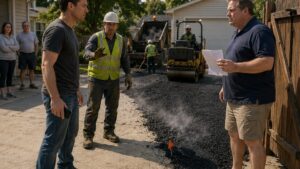
Ronald Davis stood beside the curb in pressed khakis and a pale blue shirt, one arm folded across his chest. In his other hand was a thin black folder.
Jason stopped.
Ronald crossed the street without hurrying.
“You saw the notice.”
“I’m holding it.”
Ronald glanced toward the truck. “Then you understand the deadline.”
“I understand somebody put a piece of paper on a vehicle parked on my driveway.”
“That isn’t the issue.”
“That’s exactly the issue.”
Ronald’s expression tightened, but only slightly. He had the look of a man who disliked being forced into an argument before he had decided what tone the argument should take.
“The association has standards,” he said. “They apply whether the vehicle is on the street or visible from the street.”
“The truck runs.”
“The complaint isn’t about whether it runs.”
Jason looked toward the stain.
“No,” he said. “Apparently it’s about whether you like looking at it.”
Ronald exhaled through his nose. “You can frame it that way if you want. But this isn’t personal.”
Jason almost laughed.
Instead, he unfolded the notice.
“Show me where it says you can tow a registered vehicle from a private driveway because it has a leak.”
“The property manager can provide the applicable section.”
“Then the property manager should have put that section on the notice.”
Ronald’s eyes shifted toward the porch.
It was a brief movement, but Jason caught it.
“What?”
“Nothing.”
“You looked at the porch.”
Ronald closed the folder.
“I’m telling you this as a courtesy. If you continue treating enforcement notices as optional, the board may have to review other unresolved compliance questions on the property.”
The sentence landed differently from the tow warning.
Jason lowered the notice.
“What other questions?”
Ronald gave him a measured look. “You’ll receive anything official in writing.”
Then he turned and walked back toward the street.
Jason watched him go.
For the next hour, he told himself Ronald had been bluffing.
He moved the drain pan, wiped the fresh oil from the concrete, and opened the hood. The repair was simple enough, though awkward without a lift. He had replaced worse parts in worse places when he was still working utility maintenance.
But every few minutes his eyes went toward the porch.
By noon, he had pulled a file box from the hall closet.
The closing documents from when the house had passed fully into his name were in a brown folder near the bottom. The papers smelled faintly of cardboard and dust. He carried them to the dining table and spread them beneath the hanging light.
Tax statement.
Insurance.
Old mortgage release.
A photocopied plat.
He found the driveway first.
The line was clean. The entire concrete slab sat inside the parcel.
Jason took out his phone and photographed the plat beside the tow notice.
There.
Whatever argument the HOA wanted to make about appearance, the truck was not sitting on association property.
That gave him a small, hard sense of satisfaction.
Then he noticed the porch.
On the plat, the front boundary turned at a point that did not seem to match the physical shape of the yard. Jason put his finger on the corner of the house, then traced the printed line toward the street.
The porch projected past it.
Not by inches.
By several feet.
He frowned and pulled the page closer.
The copy was old and slightly distorted. Maybe the scale was wrong. Maybe the porch had been drawn approximately. Maybe the survey used for closing had simplified older improvements.
He found a ruler in the kitchen drawer.
The more carefully he compared the drawing to the house dimensions, the less he liked what he saw.
At four-thirty, someone knocked.
Jason opened the front door expecting Elizabeth.
Instead, an HOA property manager stood on the porch with a white envelope in one hand and a tablet in the other.
“This is formal delivery,” the manager said. “You don’t have to sign.”
Jason took the envelope.
“What is it?”
“Additional compliance review.”
Jason opened it before the manager reached the steps.
The first paragraph referenced the vehicle.
The second did not.
Possible structural encroachment. Front porch projection. Association-controlled boundary area. Verification pending.
Jason looked up sharply.
The manager had already reached the walkway.
“Who raised this?”
The manager turned. “The board requested a review.”
“Ronald?”
“I can’t speak to individual board members.”
Jason looked down again.
The final line requested access for an inspection the following day.
He stepped backward and stared along the porch toward the farthest post.
For the first time since finding the tow notice, the truck no longer seemed like the real problem.
The porch did.
And according to the paper in his hand, the HOA had just made that problem official.
Chapter 2: The Porch His Father Never Moved
Elizabeth Walker had been inside the house less than five minutes when she noticed the same thing Jason had spent half the night trying not to see.
She stood at the dining table with the HOA notice in one hand and the old plat in the other.
“Dad.”
Jason remained by the coffee maker.
“What?”
She turned the plat toward him.
“This line doesn’t match the porch.”
“I know.”
“You knew?”
“Since yesterday.”
“And you didn’t call me?”
“I’m calling a surveyor.”
“That wasn’t my question.”
Jason brought his mug to the table and sat across from her.
Elizabeth was forty, practical in a way he sometimes admired and sometimes found exhausting. She had inherited none of his patience for keeping old things simply because they had always been there.
Her eyes moved from the plat to the window facing the porch.
“How old is that addition?”
“It isn’t an addition.”
“It sticks out past the house.”
“That doesn’t make it an addition.”
“Fine. How old is the porch?”
“Older than the HOA.”
“That’s not an age.”
Jason looked at the drawing again.
“My father rebuilt sections of it. His father had already used the same footprint.”
Elizabeth leaned back.
“So we’re talking decades.”
“Yes.”
“And nobody ever questioned it?”
“Not that I know of.”
She tapped the notice. “Now they are.”
Jason said nothing.
Outside, the porch posts cast long vertical shadows across the boards. He could remember his father setting one of those posts with a level pressed against the wood, refusing to accept even the smallest lean.
You build it once, you build it straight.
Jason had been twelve.
The memory came without invitation.
Elizabeth saw the change in his face.
“What?”
“Nothing.”
“Dad.”
He looked toward the porch again.
“There was something he used to say.”
“Grandpa?”
Jason nodded.
“What?”
Jason rubbed his thumb along the edge of the plat.
“He told me never to let anybody move that line.”
Elizabeth waited.
“That line where?”
“I don’t know.”
Her expression flattened.
“You don’t know?”
“He never showed me a survey.”
“Then what did he mean?”
“I assumed the front line. The drive. Something with the old road.”
“You assumed?”
Jason pushed the plat away.
“I was working sixty hours a week when he got sick. We weren’t sitting around discussing property law.”
Elizabeth’s face softened, but not enough to let him escape.
“Did he leave papers?”
“Yes.”
“Where?”
“In the house.”
“That narrows it down.”
Jason stood.
The file box from the night before was still beside the dining room wall. He pulled out a second box from the closet, then a third.
They spent nearly an hour going through receipts, tax statements, repair invoices, and brittle envelopes.
Near the bottom of the third box, Elizabeth found a coil of faded orange-red ribbon tied around a folded scrap of paper.
“What’s this?”
Jason took it.
Survey ribbon.
Old enough that the color had dulled almost to rust.
There was no map attached.
Only two handwritten numbers and his father’s initials.
Elizabeth watched him turn it over.
“Does that mean anything?”
“No.”
“You’re sure?”
Jason hated the question because he wasn’t.
He sat down.
“I remember flags.”
“When?”
“I don’t know. Years ago.”
“Before the neighborhood?”
“Some of it.”
She looked again through the box.
Jason’s phone rang.
The number belonged to the survey company he had called earlier.
He answered.
“This is Jason Walker.”
A calm male voice introduced himself as Eric Hernandez, licensed surveyor.
“I reviewed the plat you emailed,” Eric said. “I can come tomorrow morning.”
“That fast?”
“I had a cancellation.”
Jason glanced at Elizabeth.
“Good.”
“There is one thing I want to be clear about before I come.”
Jason’s grip tightened around the phone.
“What?”
“The HOA sketch you sent and the recorded plat appear consistent with each other.”
Jason said nothing.
Eric continued.
“That doesn’t mean I’m confirming the physical boundary yet. I need field measurements. But if you were hoping I’d tell you the association simply drew the line wrong, I can’t tell you that.”
Jason stared at the porch through the window.
“When can you be here?”
“Eight.”
“Come at eight.”
He ended the call.
Elizabeth had heard enough to understand.
“So the map might be right.”
“The map might show what they think is right.”
“That isn’t what he said.”
Jason stood too quickly and carried his mug to the sink.
Elizabeth followed him with her eyes.
“You’re doing it again.”
“Doing what?”
“Turning every bad fact into somebody else’s mistake.”
Jason set the mug down harder than he meant to.
“I’m not saying he’s wrong.”
“You’re already preparing to.”
He turned.
“What do you want me to do, Elizabeth? Tear the porch down because Ronald Davis sent a letter?”
“No. I want you to find out what’s true before you decide what truth you’ll accept.”
The words irritated him because they were accurate.
A knock interrupted them.
This time Ronald stood outside.
Jason opened the door but did not invite him in.
Ronald held a tablet.
“The inspection is scheduled for tomorrow at nine.”
“I have my own surveyor coming at eight.”
Ronald’s eyebrows rose.
“That’s your right.”
“I know.”
“The board will still document the condition.”
“Document whatever you want from the sidewalk.”
Ronald looked past Jason toward the porch floorboards.
“If the survey confirms the encroachment, we’ll need to discuss removal or modification.”
Jason’s jaw tightened.
“This porch was here before your association existed.”
“That may be true.”
“It is true.”
“But age doesn’t establish legal placement.”
Jason had no answer.
Ronald seemed to recognize that and, to his credit, did not press the advantage.
“This is why a survey is useful,” he said. “We’ll have something objective.”
After he left, Jason remained in the doorway.
Elizabeth came up behind him.
“You hate that he’s being reasonable.”
“I hate that he sounds reasonable.”
“That’s not the same thing.”
“No.”
He looked down at the faded survey ribbon still in his hand.
For years, he had remembered his father’s warning as one of those stubborn old-man statements that carried more certainty than explanation.
Never let anybody move that line.
Now a professional surveyor was coming to tell him where the line actually was.
And for the first time, Jason wondered whether the answer might be worse than Ronald’s accusation.
Chapter 3: Eleven Feet of Bad News
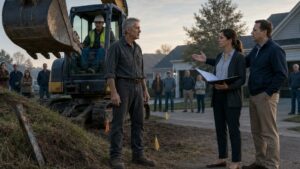
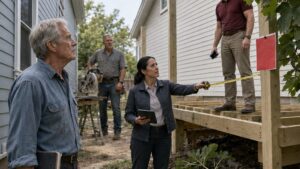
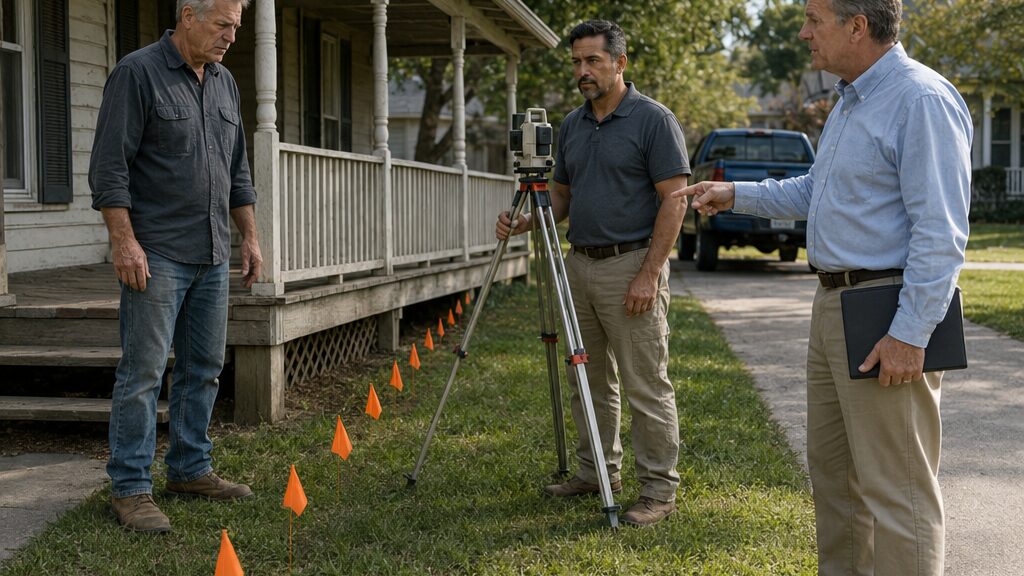
The first orange flag went into the ground six feet closer to the porch than Jason expected.
Eric Hernandez pressed the thin metal stem into the lawn, checked the screen on his survey equipment, and walked another few paces.
Jason stood beside the driveway with his arms folded.
“Is that the line?”
“Part of it.”
“That wasn’t my question.”
Eric looked up.
“It’s where the field data is taking me.”
Then he planted another flag.
And another.
A bright row began forming across the green lawn.
Jason had seen survey flags all his life. Utility markings. Easements. Road work. Construction layouts.
They had never bothered him before.
These did.
By eight-thirty, Elizabeth had arrived with coffee. She handed Jason a cup he barely touched.
Eric worked methodically, moving between a tripod-mounted instrument and points near the side yard.
The line kept advancing.
Toward the porch.
Jason had spent the previous night convincing himself that the physical measurements would expose an error in the HOA map. Maybe an old monument had been missed. Maybe a corner pin had been moved. Maybe the subdivision plan had been drafted from a bad reference.
He had imagined Ronald arriving at nine and finding a neat row of orange flags safely outside the porch.
Instead, the newest flag stood less than three feet from the steps.
Elizabeth spoke quietly.
“Dad.”
“I see it.”
At nine-four, Ronald walked up the sidewalk with the property manager.
He stopped when he saw the flags.
Jason disliked the small change in his expression more than he would have disliked a smile.
Recognition.
Confidence.
Ronald approached Eric.
“Eric Hernandez?”
“Yes.”
“Ronald Davis. HOA board president.”
Eric nodded once. “I’m working for Mr. Walker.”
“I understand. We’re here only to observe the association inspection.”
“Then observe.”
Jason almost smiled.
Ronald did not.
Eric returned to his measurements.
The next flag went beneath the outer edge of the porch.
Nobody spoke.
Jason stared at the orange plastic fluttering against the shadowed wood.
Ronald finally said, “That seems fairly clear.”
Eric straightened.
“It’s clear where the measured line is.”
Ronald glanced at Jason.
“If that’s consistent with the recorded plat, then the board can proceed on the encroachment.”
Jason felt heat rise into his face.
He wanted to tell Ronald exactly what he thought of a board that had ignored the porch for decades and suddenly discovered it after complaining about an oil stain.
Instead, he watched Eric pull a tape measure from his equipment case.
“From the line to the outer porch edge,” Eric said.
He hooked the tape near the flag and walked toward the railing.
Jason already knew he was not going to like the number.
Eric stopped.
“Ten feet, eleven inches.”
Elizabeth drew a slow breath.
Ronald looked at the property manager.
“Document that.”
The manager raised the tablet.
Jason’s embarrassment arrived in a form he had not expected.
Not shame that the porch crossed the line.
Shame that Ronald had been right about something Jason had dismissed without checking.
He had treated the survey like a weapon he was certain would point the other direction.
Now the orange flags looked like evidence of his own arrogance.
Ronald stepped closer.
“I know you don’t like this.”
Jason said nothing.
“If Hernandez signs measurements consistent with the plat, the board will have to address it.”
“Have to?”
“We can’t knowingly ignore a structural encroachment after it’s confirmed.”
Jason looked from Ronald to Eric.
“What exactly did you confirm?”
Ronald answered first.
“That the porch crosses the property line.”
Jason ignored him.
He looked at Eric.
“What did you confirm?”
Eric’s expression changed slightly.
Not surprise.
Interest.
“I confirmed the location of the boundary shown by the current recorded plat and the monuments I’ve recovered so far.”
Jason pointed toward the flags.
“So that tells us where the mapped line is.”
“Yes.”
“Does it tell us what rights affect the land on either side of it?”
Ronald frowned.
Eric looked at Jason for a moment longer.
“No.”
The answer changed the air.
Ronald said, “The structure is still across the line.”
“I didn’t say it wasn’t.”
Jason surprised himself with how calm his voice sounded.
He turned back to Eric.
“What would tell us whether there’s an easement or some older property right?”
“Title work. Deeds. Recorded agreements. Exceptions referenced in the chain.”
Eric walked back toward his equipment case and pulled out a clipboard containing printed survey information.
“I noticed something this morning.”
Jason stepped closer.
Eric pointed to a small notation near one edge of the copied record.
It was a reference number Jason had never seen.
“This is tied to an older instrument,” Eric said.
“What instrument?”
“I don’t know yet.”
Ronald leaned over slightly.
“That notation isn’t on our property packet.”
Eric nodded.
“I noticed that too.”
The property manager looked at Ronald.
Ronald’s face had lost some of its certainty.
“What does it mean?” Jason asked.
Eric tapped the page.
“It may mean nothing important. Could be an old access agreement. Could be a utility right. Could be a superseded reference.”
“Or?”
“Or it could affect how this strip is used.”
Jason looked at the orange flags running beneath the porch.
For the first time that morning, they no longer looked like a verdict.
They looked like a question.
Ronald closed his folder.
“The board still has to act on the information currently available.”
Eric looked at him.
“You can act on whatever you choose. I wouldn’t represent this survey as a full title opinion.”
“I didn’t ask you to.”
“No. I’m making sure Mr. Walker understands the difference.”
Jason turned toward Ronald.
“When is the board planning to act?”
“The vehicle deadline remains tomorrow. The porch issue will go to review after the inspection report.”
“You’re moving forward even though there’s a record neither of us has seen?”
Ronald’s jaw tightened.
“We have a valid plat and a confirmed physical line.”
“And maybe something recorded before both.”
Ronald did not answer.
That silence gave Jason more satisfaction than it should have.
Eric packed one instrument but left the orange flags in place.
Before leaving, he handed Jason the reference number.
“Go to the county records office.”
Jason looked at it.
“What am I asking for?”
“Everything connected to your parcel. Not just your deed. Prior deeds, easements, agreements, referenced instruments.”
Elizabeth stepped beside him.
“How far back?”
Eric glanced at the porch.
“As far back as it takes.”
Jason folded the paper and put it in his pocket.
Eric paused before walking to his truck.
“One more thing.”
Jason looked up.
“Don’t let anybody remove anything until you understand what that reference is.”
Ronald heard him.
So did the property manager.
Nobody spoke as Eric drove away.
Jason stood in the yard with Elizabeth while the orange flags trembled in the breeze, one after another, disappearing beneath the porch his father had once warned him never to let anyone move.
The survey had given Ronald almost eleven feet of bad news.
But it had also given Jason a number buried in an older record.
And now he needed to find out what had been recorded there before the HOA existed at all.
Chapter 4: The Record Nobody Put in the Packet
The county index showed a 1971 instrument tied to Jason’s parcel that was not listed anywhere in the HOA packet.
He stared at the reference number on the terminal screen long enough that the county records clerk finally leaned closer.
“That the one you’re looking for?”
Jason unfolded the paper Eric had given him and compared the numbers again.
“Yes.”
Elizabeth stood beside him with one hand resting on the back of the empty chair.
“Can we see it?”
The clerk nodded toward a request form.
“If it’s been digitized, I can pull it. If not, we’ll have to retrieve the scan from archive.”
Jason filled in the parcel number and instrument reference. His handwriting looked tighter than usual.
The clerk took the form and disappeared through a door behind the counter.
Jason sat.
Elizabeth remained standing.
He could feel her looking at him.
“What?”
“You could’ve asked me to come yesterday.”
“I’m asking now.”
“No. Eric told you to go as far back as it takes, and then you drove home and spent three hours digging through boxes by yourself.”
“I found the deed copies.”
“You found copies of the same things you already knew you had.”
Jason looked toward the counter.
“This isn’t the time.”
“That’s always what you say when the time gets uncomfortable.”
Before he could answer, the clerk returned carrying several printed pages clipped together.
“This one was scanned from microfilm,” the clerk said. “Quality isn’t perfect.”
Jason stood.
The first page was dense with legal description. Dates, names, bearings, references to corners and roads.
Then he saw the year.
Elizabeth leaned closer.
“Is that Grandpa’s name?”
Jason nodded.
His father’s signature appeared near the bottom of the final page.
Jason had seen that handwriting on birthday cards, repair notes, measurements scribbled inside cabinet doors.
Never here.
The clerk pointed toward one paragraph.
“You’ll probably want someone qualified to interpret the legal effect. We provide copies, not title opinions.”
Jason read slowly.
There was language describing continued use of a strip along the front portion of the property for access and improvements. Another paragraph referred to rights surviving transfer unless specifically released.
Elizabeth touched the page.
“That sounds important.”
“It sounds like lawyers wrote it.”
“Which usually means they wanted it to be important.”
Jason glanced at her.
She gave him the smallest smile.
They paid for certified copies and took the pages to a table near the windows.
Jason placed Eric’s survey sketch beside them.
The orange flags were not on the paper, but he could see them in his mind.
He followed the old legal description line by line.
A distance from an iron marker.
A turn along the former access road.
A strip measured from a reference that no longer existed physically.
He stopped.
“Wait.”
Elizabeth leaned in.
Jason traced the distance again.
“Here.”
“What?”
“This section.”
He took out the ruler he had brought from home.
The old description did not use the modern subdivision line. It described a narrow area extending across almost exactly the same portion of land that Eric’s flags had cut through.
Elizabeth’s eyes moved from the 1971 record to the survey copy.
“That’s the eleven feet.”
“Close to it.”
“So Grandpa knew.”
Jason said nothing.
A memory came back with uncomfortable clarity.
His father standing near the porch with a faded strip of survey ribbon tied around one finger.
Never let anybody move that line.
Jason had been carrying lumber. He had nodded without asking what line.
At the time, the sentence had sounded like one more instruction among hundreds.
Keep the gutters clear.
Shut off the rear spigot before a freeze.
Don’t let anybody move that line.
Jason lowered himself into the chair.
Elizabeth watched him.
“You thought he was just being stubborn.”
“Yes.”
“And you became stubborn about it without knowing why.”
Jason looked up.
“That sounded rehearsed.”
“It wasn’t.”
“It sounded rehearsed.”
“It can be true and annoying at the same time.”
He almost argued.
Then stopped.
The page under his hand made the argument feel childish.
They requested the prior deed referenced in the 1971 instrument, then two later transfers.
By early afternoon they had built a paper chain across the table.
Nothing gave Jason the clean victory he wanted.
The 1971 document was real.
The rights were real.
But later subdivision documents had redrawn parcels around them, and the language shifted from one filing to the next.
At one point Elizabeth said, “So we found it.”
Jason shook his head.
“We found something.”
“There’s a difference?”
“A big one.”
He pointed to a later deed.
“This doesn’t say the old right disappeared. But it doesn’t say, in plain English, that it stayed either.”
“Then who tells us?”
“A title examiner.”
Elizabeth sat back.
Jason saw the frustration in her face.
She had expected the old paper to operate like a key: insert, turn, problem solved.
He had wanted the same thing.
Instead, every answer had produced another document.
That bothered him less than it would have the day before.
It felt familiar.
Utility work had been like that. Find the break, trace the line, discover the first drawing was incomplete, then keep tracing until the system made sense.
He gathered the papers.
“Let’s go home.”
At the house, the orange survey flags were still in place.
The sight of them tightened his chest again, but differently now.
Elizabeth carried the records to the dining table while Jason went outside.
He walked the line from the driveway toward the porch.
At each flag, he compared Eric’s sketch with the 1971 description.
The old record tracked the same disputed strip closely enough to be impossible to dismiss.
He crouched beside the flag nearest the porch.
For two days he had treated those markers as if they belonged to Ronald.
They did not.
They were simply facts.
That distinction mattered.
Inside, Elizabeth had spread the records in chronological order.
“Come look at this.”
Jason joined her.
She pointed to a later association filing.
The document dated from years after the subdivision had been created.
A short paragraph referenced several prior recorded instruments affecting common-area boundaries.
One of the numbers matched the 1971 record.
Jason checked twice.
Then a third time.
“They referenced it.”
Elizabeth nodded.
“They knew it existed.”
“Somebody did.”
“The association?”
“The filing is theirs.”
“So doesn’t that answer it?”
“Not completely.”
She stared at him.
“You are becoming very inconvenient about evidence.”
“I’m learning.”
He picked up the newer filing.
The association had not expressly canceled the older instrument.
It had incorporated it by reference among the property interests affecting the development.
That did not yet tell Jason exactly what rights survived.
But it destroyed one assumption.
The 1971 document had not vanished into some forgotten family file.
It had been carried forward far enough for the association itself to mention it.
Jason took out his phone and photographed both documents side by side.
Then he called the title examiner whose number Eric had texted him.
He explained the dispute briefly.
The examiner asked him to send everything.
When Jason finished, Elizabeth was watching him.
“What?”
“You asked for help.”
“I hired somebody.”
“That counts.”
He ignored her.
A new email arrived before dinner.
Not from the examiner.
From the HOA.
The property manager had attached the inspection report and confirmed that the truck deadline remained in effect.
The porch review was still proceeding.
Jason read the message, then looked through the front window.
The blue pickup sat exactly where it had been.
Beyond it, the orange flags led straight under the porch.
Elizabeth came beside him.
“What now?”
Jason held up the 1971 record.
“Now we find out whether they inherited this.”
He tapped the newer association filing.
“Because somebody on their side knew it was there.”
Chapter 5: The Rule Ronald Needed to Be Simple
The oldest landscaping plan in the HOA office used the historical property reference Ronald was now treating as irrelevant.
Jason saw it within ten minutes.
The title examiner had called early Friday morning with a preliminary finding and one instruction: ask the association for any plats, improvement plans, or common-area documents that referenced the disputed strip.
Jason arrived at the HOA office with Elizabeth and a folder thick enough to feel useful.
Ronald met them in the small conference room.
“You requested records inspection.”
“Yes.”
Ronald looked at Elizabeth.
“She’s with me.”
“That’s fine.”
The property manager brought in a binder of archived site plans.
Jason started with the dates closest to the creation of the association.
Most pages were ordinary.
Drainage.
Entrance signs.
Planting beds.
Sidewalk repairs.
Then Elizabeth stopped turning pages.
“Dad.”
Jason leaned over.
A landscaping plan showed the common planting area that ran along the edge of Jason’s front property.
Near the lower corner was a notation referencing the same recorded instrument number from 1971.
Jason’s pulse quickened.
He checked the number against the certified copy in his folder.
Exact match.
Ronald was standing at the far end of the table.
Jason slid the plan toward him.
“You used it.”
Ronald’s face gave away almost nothing.
“The association used it.”
“When?”
Ronald read the date.
“Long before I was president.”
“That wasn’t my question.”
Ronald looked up.
Jason tapped the notation.
“This plan was approved using the old record. The same record your packet left out.”
Ronald folded his arms.
“I didn’t prepare the packet.”
“You signed the enforcement notice.”
“I signed based on the current association map.”
Elizabeth spoke before Jason could.
“But you knew the history was messy.”
Ronald looked at her.
“I knew there had been older boundary questions in this section.”
Jason went still.
“How long?”
Ronald hesitated.
That hesitation answered more than Jason expected.
“Ronald.”
“There were discussions years ago.”
“You knew before you put the tow notice on my truck?”
“The truck has nothing to do with the boundary.”
“You made it have something to do with the boundary.”
Ronald’s voice sharpened.
“No. You did that by refusing to address a valid vehicle violation.”
Jason stared at him.
For the first time, he saw the shape of Ronald’s argument from the inside.
Not fairness.
Control.
If one homeowner ignored a rule, the board feared the next homeowner would cite him. If the board admitted uncertainty, every old corner of the subdivision could become a dispute.
Ronald sat down.
“You think I wake up wanting to fight with residents?”
“I don’t know what you want.”
“I want rules people can understand.”
Jason pointed to the old plan.
“Then why are you enforcing the simple version when you know the property isn’t simple?”
Ronald’s jaw tightened.
“Because the association cannot function if every enforcement decision turns into a historical excavation.”
Elizabeth said, “Even when the historical excavation shows the board may be wrong?”
“That isn’t established.”
Jason opened his folder.
“The title examiner says the 1971 rights appear in later recorded documents and were never expressly released. Eric says the physical line does not answer the rights question. Your own landscaping plan references the instrument.”
Ronald looked at the papers but did not reach for them.
“That still requires legal review.”
“Then suspend enforcement.”
Ronald was silent.
Jason waited.
This was the moment he had expected Ronald to retreat.
Instead Ronald said, “No.”
Elizabeth leaned forward.
“You’re serious?”
“The vehicle deadline stands. The porch matter will go to hearing.”
Jason felt his anger rise, then settle into something colder.
“You know there’s a real dispute.”
“Yes.”
“And you’re still moving ahead.”
“Yes.”
“Why?”
Ronald looked toward the closed conference-room door.
When he spoke again, his voice was lower.
“Because if the board freezes enforcement every time someone produces an old document, we lose the ability to govern.”
“That’s not an answer.”
“It is.”
“No. That’s fear.”
Ronald’s eyes returned to him.
“You want the fuller answer?”
Jason said nothing.
Ronald leaned back.
“There are six properties along this section with old boundary references. Maybe more. If your interpretation is correct, the association may have maintained or improved land for years under assumptions that aren’t clean.”
Jason glanced at the landscaping plan.
There it was.
Not just his porch.
Not just his truck.
Exposure.
Ronald continued.
“If we treat your case as proof before review is complete, we invite every resident to challenge every setback and improvement.”
“So you decided to make an example out of me.”
“I decided not to let one unresolved record erase established enforcement.”
Jason laughed once, without humor.
“And that sounds reasonable to you?”
“It sounds necessary.”
Jason closed the folder.
For several days he had imagined Ronald as a man enjoying authority.
Now he understood something less satisfying.
Ronald was afraid.
Afraid of inconsistency.
Afraid of cost.
Afraid of being the board president who discovered that a clean map had been sitting on top of dirty history.
That did not excuse what he was doing.
It made the choice clearer.
Jason stood.
“Then put everything on the record.”
Ronald frowned.
“What?”
“The truck. The porch. The old instrument. The landscaping plan. All of it.”
“The porch hearing was already being scheduled.”
“Schedule the truck too.”
Elizabeth looked at him.
Jason continued.
“You want enforcement? Fine. I want one meeting where the board has to look at the whole thing together.”
Ronald studied him.
“You understand that if the board rules against you, the tow authorization could proceed immediately.”
“I understand.”
“And the porch matter could move toward removal.”
Jason felt the weight of that.
Then he nodded.
“Put it together.”
Outside the HOA office, Elizabeth stopped beside the car.
“That was either very smart or very stubborn.”
“Probably both.”
“You could still move the truck.”
“I could.”
“Are you going to?”
Jason looked toward home, though the house was several streets away.
“No.”
Elizabeth closed her eyes briefly.
“Dad.”
“The truck is on my property. The leak is controlled. I’ve scheduled the repair. I’m not giving them a separate excuse to pretend the property question doesn’t matter.”
“That sounds a lot like making the truck symbolic.”
“It already is.”
“To you.”
Jason did not answer.
Her expression changed.
“You know that’s part of the problem, right?”
“What is?”
“You keep turning things into promises nobody else agreed to.”
He knew she was no longer talking about Ronald.
Jason unlocked the car.
Before either of them got in, his phone buzzed.
An email.
Formal hearing notice.
Saturday, six-thirty p.m.
The subject line listed both matters together: vehicle compliance and structural encroachment review.
Jason opened the attachment.
The final paragraph authorized the board to impose immediate corrective action based on the hearing outcome.
Elizabeth read over his shoulder.
“So that’s it.”
Jason folded the phone into his palm.
“No.”
He looked back through the office windows toward the binder still lying on the conference-room table.
“That’s when it gets decided.”
Chapter 6: The Meeting Where the Map Changed Sides
Ronald opened the hearing by placing Eric’s survey on the projector and pointing directly at the eleven-foot measurement.
Jason sat three seats away with his folder closed in front of him.
“This is not speculative,” Ronald said to the board members. “The homeowner’s own licensed surveyor confirmed that the porch extends beyond the current recorded parcel line.”
A photograph filled the screen.
Orange flags crossed Jason’s lawn and disappeared beneath the porch.
For one second, Jason felt the same humiliation he had felt Wednesday morning.
His own evidence looked terrible.
One board member asked, “And the vehicle issue?”
The property manager answered.
“Registered and operable, but with documented fluid leakage and visible condition concerns. The owner has stated repairs are scheduled but has not removed the vehicle.”
Ronald nodded.
“We can address that separately after the structural issue.”
Jason opened his folder.
“No.”
The room quieted.
Ronald looked at him.
“You’ll have an opportunity to respond.”
“I’m responding to that.”
Jason pointed at the screen.
“The survey is accurate.”
Elizabeth, sitting behind him, shifted slightly.
Several board members looked at each other.
Ronald’s expression tightened with cautious satisfaction.
“You agree the porch crosses the line.”
“Yes.”
The word landed heavily.
Jason let it.
For most of his life, admitting a bad fact had felt like giving ground away.
Now he understood that refusing a fact gave the other side something better: control of the truth.
He stood and carried three pages to the table at the front of the room.
“The line shown there is the current mapped parcel line. Eric Hernandez confirmed it in the field. I was wrong when I assumed the survey would show otherwise.”
Ronald said nothing.
Jason placed the certified 1971 instrument down.
“But that isn’t the only recorded fact.”
He added the later association filing.
Then the old landscaping plan.
One board member leaned forward.
“What are those?”
Jason kept his voice even.
“The first is a recorded instrument from 1971 affecting the same strip. The second is a later association filing that references that instrument. The third is an association-approved landscaping plan that uses the same historical reference.”
Ronald said, “Those documents have not yet been determined to supersede the modern plat.”
“I didn’t say they supersede it.”
Jason looked around the table.
“That is the whole problem. The board keeps acting as if there can only be one kind of answer.”
He tapped the projected survey.
“That tells you where the line is.”
Then the 1971 document.
“This tells you there may be rights affecting how the land around that line can be used.”
He placed a letter from the title examiner on top.
“And this preliminary title review says those rights appear to have been carried forward rather than expressly released.”
A board member took the letter.
The room changed slowly.
Not dramatically.
No one gasped.
No one applauded.
They simply started reading.
That was enough.
Ronald remained standing.
“The title review is preliminary.”
“Yes.”
“So the board still lacks a final determination.”
“Yes.”
“Then you’re asking us to ignore current violations based on an unresolved claim.”
Jason looked at him.
“No. I’m asking you to stop treating an unresolved claim as if it’s resolved in your favor.”
Silence.
One of the board members turned to Ronald.
“Did we know about the older instrument before this week?”
Ronald paused.
Jason watched him.
This was the character question underneath the paperwork.
Ronald could minimize.
Deflect.
Blame previous boards.
Instead he said, “I knew there had been older references affecting this section.”
“How much did you know?”
“Enough to know it could be complicated.”
The board member sat back.
“And we proceeded anyway?”
Ronald’s face hardened.
“We had current documents, a compliance issue, and a homeowner who had already ignored notice.”
Jason almost interrupted.
Then stopped.
Ronald was not lying.
Jason had ignored the first notice.
He had treated the truck complaint like an insult unworthy of response.
His own pride had given Ronald the opening to frame him as noncompliant before the deeper dispute began.
Elizabeth’s voice came back to him.
You keep turning things into promises nobody else agreed to.
The board member looked at Jason.
“Why didn’t you respond earlier?”
Jason could have said the notice was petty.
He could have blamed Ronald.
Instead he said, “Because I was angry.”
Ronald looked at him.
Jason continued.
“I thought the truck issue was ridiculous, so I acted like the whole process was ridiculous. That was a mistake.”
The admission surprised the room more than any document had.
Jason felt it surprise him too.
“I should have answered the first notice. I should have had the truck repaired sooner. But that does not give the board permission to treat a disputed property right as settled because I was stubborn.”
A second board member asked, “Is the truck repair actually scheduled?”
Jason slid the service estimate across the table.
“Monday.”
The board member nodded.
Small issue.
Small answer.
No drama.
That was how it should have been from the beginning.
Ronald looked at the title examiner’s letter.
“If these rights are confirmed, we may have association improvements crossing the same affected area.”
Jason turned the landscaping plan toward him.
“You already do.”
A board member followed the marked strip on the plan.
“The planting wall?”
“And part of the irrigation bed,” Jason said.
The property manager leaned over the document.
Ronald’s face changed.
Not shock.
Calculation.
The issue had just expanded beyond Jason’s porch.
Correcting the record would cost the association something tangible.
One board member spoke quietly.
“We can’t order him to remove a structure under a boundary interpretation we’re simultaneously using inconsistently ourselves.”
Ronald said, “We can suspend pending review.”
Another member nodded.
“And the tow?”
The property manager glanced at the service estimate.
“If the vehicle remains registered, operable, contained for leakage, and scheduled for repair, we have discretion to suspend.”
Ronald’s mouth tightened.
Jason could see how much he disliked the word discretion.
It was the opposite of the simple rule he wanted.
The board went into closed discussion for twenty minutes.
Jason and Elizabeth waited in the hallway.
She leaned against the wall.
“You said you were wrong.”
“I was.”
“You hate doing that.”
“I noticed.”
She looked at him for a long moment.
“This house didn’t make Grandpa stay alive.”
Jason’s chest tightened.
“What does that have to do with this?”
“Everything.”
He looked away.
She lowered her voice.
“You’ve been acting like if you change anything, sell anything, throw anything away, you failed him.”
“This is not the time.”
“There it is again.”
Jason turned back.
Elizabeth’s eyes were wet, but her voice remained steady.
“I wanted you to sell because I was tired of watching you use this place as a reason not to move forward.”
“I never said I wanted to sell.”
“I know.”
“That should have ended the conversation.”
“No. It should have started a different one.”
The conference-room door opened.
The property manager called them back inside.
Ronald was seated now.
He read the decision without flourish.
“Vehicle enforcement is suspended pending completion of the scheduled repair. Structural enforcement is suspended pending independent title and boundary review.”
Jason exhaled slowly.
Ronald continued.
“The association will retain independent counsel and a title professional to review all recorded instruments affecting the disputed strip and any association improvements located within it.”
One board member added, “No alteration to the porch or affected common landscaping will occur before that review is complete.”
Jason nodded.
It was not victory.
Not yet.
But nobody was towing the truck.
Nobody was touching the porch.
And the board had finally stopped pretending the orange flags told the whole story.
As the meeting ended, Ronald gathered the papers.
Jason approached him.
“You could have suspended this three days ago.”
Ronald looked tired.
“Yes.”
“Why didn’t you?”
Ronald slid the old landscaping plan into the review packet.
“Because once a board admits a map may be wrong, every decision attached to that map becomes a question.”
Jason looked at him.
“And now?”
Ronald glanced toward the document.
“Now it’s a question whether I admit it or not.”
Jason left the clubhouse with Elizabeth.
Behind them, the board had ordered a correction process that would not stop at his porch.
The next survey would have to follow the disputed strip beyond his yard.
And when it did, the line would reach property the HOA itself had built on.
Chapter 7: What Had to Be Removed
The contractors arrived at eight-fifteen and walked past Jason’s porch without measuring a single board.
That was the first thing he noticed.
The second was the orange paint sprayed along the HOA planting bed near the sidewalk.
For two weeks, Jason had expected the correction crew to arrive with clipboards pointed toward his house. Instead, three workers unloaded shovels, a compact saw, and irrigation tools beside the association landscaping that curved along the edge of his yard.
One of the orange survey flags still stood near the porch.
Another marked the planting bed.
A maintenance contractor checked a printed plan, then pointed toward the low decorative wall and said, “We start here.”
Jason remained beside the blue pickup.
The truck had been repaired the previous Monday. The leak was gone. The concrete beneath it had been scrubbed, though a faint shadow remained where the oil had soaked into the surface.
Elizabeth pulled into the driveway a few minutes later.
She got out carrying two coffees.
“They’re not touching the porch.”
“No.”
She handed him one.
“You sound disappointed.”
“I’m waiting to see what they do touch.”
The independent review had arrived three days earlier.
It was not the sweeping declaration Jason had once imagined receiving.
There was no sentence announcing that the HOA had been completely wrong about everything.
Instead, the report separated the problem into pieces.
The modern parcel line was where Eric had measured it.
The porch crossed that line.
But the 1971 recorded instrument created continuing rights affecting the disputed strip, and later development documents had preserved those rights rather than clearly extinguishing them. The association’s predecessor had acknowledged them during subdivision planning.
The porch could remain under the existing recorded arrangement.
The association’s landscaping was another matter.
Part of the decorative planting wall, irrigation system, and several shrubs had been installed beyond the area the HOA had the right to occupy without Jason’s consent.
That correction was happening now.
The contractor started removing the first section of wall.
Concrete scraped against concrete.
Elizabeth watched for a while.
“So that’s the big revenge scene?”
Jason looked at her.
“What?”
She gestured toward the workers.
“Three guys removing landscaping while nobody cheers.”
“I wasn’t expecting cheering.”
“I know.”
He drank his coffee.
A worker lifted a shrub from the soil with most of its root ball intact and carried it toward the truck.
Nothing about the scene felt triumphant.
It felt precise.
That suited Jason better.
Ronald arrived shortly after nine.
He parked on the street and approached with the property manager.
Jason noticed that Ronald no longer carried the black folder he seemed to have lived with during the dispute.
Instead he held two sheets of paper.
“Morning.”
Jason nodded.
Ronald looked toward the workers.
“They should finish today.”
“So I was told.”
“The board approved the corrected site plan Thursday.”
Jason waited.
Ronald handed him one of the sheets.
It confirmed formal withdrawal of the structural violation.
The second confirmed closure of the vehicle matter following documented repair.
Jason read both.
“No fine?”
“No.”
“Tow authorization?”
“Withdrawn.”
“And the porch?”
“The association recognizes the recorded rights identified in the title review.”
Jason folded the papers once.
Ronald’s eyes moved toward the contractor cutting through an irrigation line.
“We’ll relocate the affected portion of the common landscaping.”
“That sounds expensive.”
“It’s manageable.”
Jason almost said that it would have been cheaper to pause the enforcement when the first conflicting record appeared.
He decided Ronald already knew.
Ronald looked toward the porch.
“I want to be clear about something.”
Jason waited.
“The original vehicle notice was not invented to get at your property.”
“I know.”
Ronald seemed surprised.
Jason continued.
“I didn’t know that the first week.”
“No.”
“And I should’ve answered it.”
Ronald nodded once.
“But,” Jason said, “you should’ve stopped when you knew the boundary question wasn’t clean.”
Ronald looked toward the workers again.
“Yes.”
The word came without defense.
It was not an apology.
Jason realized he did not need to force it into one.
Ronald added, “We’re changing the review procedure for older sections of the neighborhood. Any structural boundary violation will require a title check before corrective action.”
“That’ll slow things down.”
“Yes.”
“Thought you hated that.”
Ronald gave him a tired half smile.
“I do.”
For the first time, Jason almost smiled back.
Ronald left without offering a handshake.
Jason was glad.
A handshake would have made the whole thing feel cleaner than it was.
The workers continued removing the wall.
By noon, several orange flags had been pulled from the lawn.
One remained beside the porch.
Jason crouched and removed it himself.
The thin metal stem came out with barely any resistance.
He carried it inside and laid it on the dining table beside the old 1971 record.
Elizabeth followed him.
“You’re keeping the flag?”
“For now.”
“That is exactly how your boxes start.”
Jason looked at her.
She laughed.
He did too, despite himself.
Then she glanced through the window toward the blue pickup.
“What are you going to do with that?”
“It’s fixed.”
“That wasn’t what I asked.”
Jason’s smile faded.
Elizabeth leaned against the table.
“The repair cost more than the truck is worth.”
“It runs.”
“So did Grandpa’s refrigerator for twenty-seven years. That didn’t make it a family member.”
Jason looked at the truck.
His father had bought it used late in life.
Jason had helped replace the alternator the first winter. After his father died, the truck had remained at the house almost by accident.
Then accident became routine.
Routine became obligation.
“I use it.”
“Sometimes.”
“It’s useful.”
“Sometimes.”
He looked at her.
“Say what you’re trying to say.”
Elizabeth was quiet for a moment.
“I don’t want you to sell the house.”
That surprised him.
“You spent three years telling me to.”
“I spent three years telling you to consider whether keeping it was making you happy.”
“That’s not how I remember it.”
“I know.”
She pulled out a chair.
“I thought the house was the problem.”
Jason sat opposite her.
“And now?”
“Now I think the problem is that you made everything in it a test.”
He said nothing.
“The porch had to stay exactly where it was. The truck had to stay. Grandpa’s tools have to stay where he left them. The papers couldn’t be sorted. The garage couldn’t be cleaned out.”
“I cleaned the garage.”
“You moved three boxes.”
“That counts.”
She smiled briefly, then became serious again.
“You promised him you’d look after the place.”
Jason’s eyes moved toward the 1971 paper.
“Yes.”
“Did he say you had to preserve every object?”
“No.”
“Did he say you couldn’t change anything?”
“No.”
“Then maybe you added that part.”
Jason looked down at his hands.
His father’s last months had reduced life to instructions.
Medication times.
Doctor appointments.
Who would mow.
What account paid which bill.
Somewhere in that season, his father had gripped Jason’s wrist and said, Look after the place.
Jason had heard a command.
Maybe it had been trust.
Outside, one of the contractors called for a shovel.
The sound pulled Jason back.
He stood.
“Come with me.”
They went to the hall closet.
Jason removed the three old file boxes one at a time.
He carried them to the dining table.
The first contained property records.
The second held repair receipts dating back decades.
The third was filled with things that had no obvious legal or financial value at all.
Old handwritten measurements.
Hardware-store receipts.
Warranty cards for appliances that had been gone for years.
Elizabeth lifted one yellowed envelope.
“You kept the warranty for a water heater from 1989.”
“Your grandfather kept it.”
“And then you kept it.”
Jason sat.
For the next hour, they made three piles.
Keep.
Scan.
Discard.
Jason objected often.
Elizabeth objected to his objections.
At one point she held up a receipt for porch paint from more than twenty years earlier.
“You cannot possibly need this.”
“It shows maintenance history.”
“The porch has been legally cleared.”
“It could still—”
She stared at him.
Jason stopped.
“Discard.”
Elizabeth dropped it into the pile before he could change his mind.
By midafternoon, the contractors had removed the last disputed section of the planting wall.
The irrigation line had been relocated.
The shrubs were replanted several feet away.
The corrected boundary did not look dramatic.
Most people driving past would never know anything had happened.
Jason preferred that too.
Ronald returned briefly to sign off on the work with the contractor.
He and Jason acknowledged each other from a distance.
Nothing more was necessary.
Near four, Elizabeth walked toward her car.
Jason followed carrying the smallest file box.
“What’s that?”
“Grandpa’s records.”
“I thought we just sorted them.”
“We sorted the obvious ones.”
She opened the rear door.
Jason did not put the box inside.
Instead he held it toward her.
Elizabeth looked at him.
“What?”
“Take it home.”
Her expression changed.
“All of it?”
“No.”
He glanced toward the box.
“Help me decide what the family should actually keep.”
For a moment she said nothing.
Then she took it.
Jason returned to the porch.
Only one orange flag remained.
The one he had pulled from beside the porch earlier now lay on the dining table inside, beside the certified copy of the 1971 instrument.
He considered throwing it away.
Instead, he left it there.
Not as proof that he had defeated the HOA.
Not as proof that his father had been right.
As a reminder that a line could be real without meaning what everyone first assumed it meant.
The blue pickup sat in the driveway, repaired and clean underneath.
Jason still had not decided whether he would keep it another year.
For once, he did not need to decide immediately.
Elizabeth started her car.
Jason raised one hand from the porch.
She raised hers back.
Behind the landscaping, the corrected boundary was nearly invisible again.
But now Jason knew where it was.
More importantly, he knew he did not have to stand on every old line forever just because someone he loved had once asked him to protect it.
The story has ended.