The Day She Walked Toward Gate B42 Without Looking Back Once
Part I — The Gate
Donna kept walking even after her son stumbled beside her.
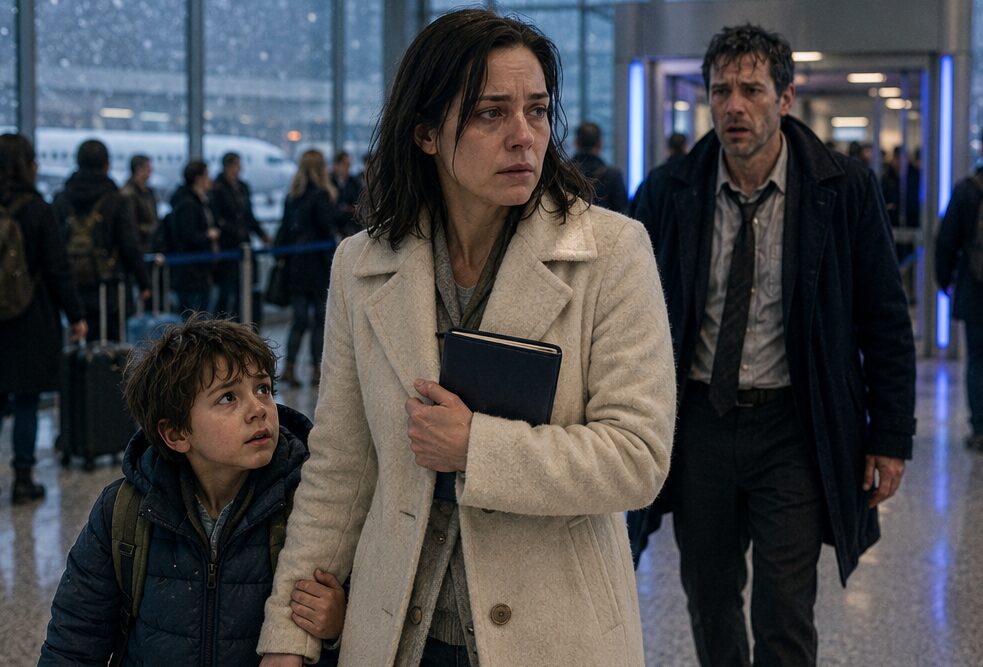
Terminal 5 blurred around them — rolling suitcases, coffee cups, overhead announcements, people pretending not to stare. Her phone buzzed again inside her coat pocket. She ignored it for the twelfth time.
“Is Dad coming?” Michael asked softly.
Before she could answer, she heard him.
“Donna!”
The sound hit her like something physical.
She turned just enough to see Dennis pushing through the crowd in a wrinkled dress shirt under an unzipped winter coat. His tie hung loose. His face looked gray with panic.
People moved aside instinctively.
Michael’s small hand tightened around hers.
Donna looked away immediately and walked faster toward Gate B42.
“Donna, stop.”
He finally caught up near a row of airport seats. Breathless. Red-faced.
“You were really going to leave without letting me say goodbye?”
She laughed once under her breath. Not because it was funny.
“You had months.”
The words landed harder than she intended.
A woman nearby stopped pretending to check her phone.
Michael lowered his head.
Dennis stared at Donna like he was trying to catch up to a conversation that had started long before today.
“You blocked my calls.”
“I needed one quiet morning.”
“You took our son to another country.”
“Temporary,” she snapped automatically.
Then she froze.
Dennis noticed it immediately.
Temporary.
The word sat between them.
Michael looked up too quickly.
Donna closed her eyes for one second. That was all it took to realize the mistake.
Dennis stepped closer. “What does temporary mean?”
“Not here.”
“Then where?”
“Please,” she whispered. “Not in front of him.”
But it was already in front of him. It had been for months.
Michael clung to her coat sleeve so tightly she could feel his fingers shaking through the fabric.
An announcement echoed overhead about boarding groups for London.
Dennis looked at the passport folder tucked under Donna’s arm.
“You bought one-way tickets.”
“I didn’t know how long I needed.”
“For what?”
She finally looked directly at him.
“To stop feeling like your emergency contact instead of your wife.”
The sentence cut through him so visibly that even Michael noticed.
Dennis opened his mouth. Closed it again.
People nearby kept glancing over with the hungry discomfort strangers get when they realize they’re standing too close to something intimate.
Donna hated that feeling.
Public concern always felt one inch away from judgment.
Her phone buzzed again.
This time Michael saw the caller ID light up before the screen faded.
Grandma.
He looked up carefully. “Are you gonna answer?”
Donna shoved the phone deeper into her pocket.
“No.”
Michael’s face changed in a way children think adults don’t notice.
Not anger.
Confusion.
Because Grandma always answered Donna.
Always.
Dennis saw it too.
“Jesus,” he muttered quietly.
Donna immediately started walking again.
He followed.
“Donna, please slow down.”
“I can’t.”
“You can.”
“No,” she said, voice trembling now. “I really can’t.”
They passed a bookstore. Then a closed café. Then another row of staring strangers.
Dennis lowered his voice.
“If this is about my mother—”
“It’s not about your mother.”
The lie came too fast.
Michael whispered, “Mom—”
“It’s not,” she repeated, but this time softer, because she heard how exhausted she sounded.
Dennis rubbed both hands over his face.
“Then tell me what this is.”
She stopped so suddenly Michael nearly collided with her.
“What this is,” she said carefully, “is me realizing that every time something broke in this family, everyone looked at me first.”
Dennis blinked.
“When your mother fell, I handled it.”
“She needed help.”
“I know she needed help.”
“When Michael got sick—”
“I handled it.”
“You wanted to—”
“When your insurance paperwork got denied? When your mother couldn’t shower alone? When the school called because Michael had another panic attack during reading hour?” Her voice cracked. “I handled it.”
Michael stared at the floor.
Dennis looked devastated now, but also confused. Like he truly had not understood the size of the thing collapsing between them.
“We were okay,” he said weakly.
Donna shut her eyes.
There it was again.
We’re okay.
The sentence that had followed every late-night argument for two years.
We’re okay.
Meaning:
Don’t make this bigger.
Don’t break the system.
Keep functioning.
Donna looked at him with sudden unbearable tiredness.
“That phrase ruined my life.”
Behind them, boarding for London officially began.
And neither of them moved.
Part II — Everything She Could Carry
Six months earlier, Sharon arrived with one suitcase and a walker.
“That’s temporary,” Dennis had said while carrying her things into the guest room.
Donna remembered smiling politely while helping arrange medication bottles beside the bed.
Temporary.
Three weeks later, she was waking up twice every night to help Sharon to the bathroom.
Three months later, she was bathing her after an accident Sharon cried through from humiliation.
Dennis always looked grateful.
That was part of the problem.
Not cruel. Not careless. Grateful.
As if gratitude could replace participation.
“You’re amazing,” neighbors kept telling her.
At first, the compliments felt warm.
Then they started feeling like bricks.
At school pickup, another mother once squeezed Donna’s arm sympathetically.
“I honestly don’t know how you do it all.”
Donna had smiled automatically.
Neither did she.
That same afternoon she sat in her parked car outside the grocery store and cried so hard she couldn’t drive home for twenty minutes.
But when she finally walked inside the house, Dennis kissed her forehead and said, “We’re okay.”
Like exhaustion itself was proof the marriage still worked.
Michael began sleeping badly around then.
He started appearing silently in kitchen doorways after midnight while Donna sat paying bills beside cold tea.
“You fighting again?” he would ask.
“No.”
“You’re talking quiet.”
That hurt more somehow.
Children knew the difference between peace and careful silence.
One night Michael climbed into Donna’s lap while she stared at spreadsheets for one of the bookkeeping clients she’d taken on quietly for extra money.
“Are you mad at Dad?”
“No.”
“Are you sad at Dad?”
Donna almost laughed.
Only children say things that accurately.
Before she could answer, Dennis came into the kitchen still answering work emails.
“Buddy, why are you awake?”
Michael didn’t move from Donna’s lap.
Dennis finally noticed the stack of insurance papers beside her.
“You’re still working on those?”
“They denied your mother’s physical therapy again.”
“We’ll figure it out.”
Donna looked at him.
That sentence too.
We’ll figure it out.
Meaning:
You’ll keep carrying this until the emergency passes.
Except the emergency never passed.
It simply became their life.
The worst part wasn’t Sharon herself.
That truth made Donna feel guilty constantly.
Sharon could be thoughtful. Funny. Elegant even while struggling to walk.
Sometimes she apologized so sincerely Donna wanted to cry.
“You must be tired of me,” Sharon said once after Donna helped wash her hair at the sink.
Donna answered too quickly.
“No.”
Sharon looked at her in the mirror.
“That sounded rehearsed.”
Donna almost broke then.
But instead she smiled.
Because smiling was faster.
Later that same night Dennis missed Michael’s winter concert because a client dinner ran late.
Michael searched the auditorium twice before the performance started.
“He’s coming?” he whispered.
“I think so.”
But he didn’t.
Donna watched her son sing while scanning the doorway the entire time.
Afterward Michael cried in the car for reasons he claimed had nothing to do with his father.
Donna sat in the driver’s seat gripping the wheel while snow hit the windshield.
When they got home, Dennis apologized immediately.
Traffic. Delays. Important client.
Then he saw Donna’s face and softened.
“We’re okay.”
Something inside her went silent after that.
Not dramatic.
Just tired enough to stop arguing.
Two weeks later the email from London arrived.
An old college friend needed temporary accounting help for a small publishing company.
Six months.
Housing included.
Donna stared at the email for three days before replying.
She didn’t tell Dennis immediately.
Not because she wanted revenge.
Because the possibility itself felt fragile.
Like admitting she wanted escape would make her impossible to forgive.
So she answered the email quietly.
Then she renewed Michael’s passport quietly.
Then she bought tickets quietly.
And all the while she kept making dinner, organizing medications, answering school emails, and smiling at neighbors who kept calling her “incredible.”
Eventually even Michael sensed something changing.
One afternoon he climbed onto the kitchen counter while Donna packed Sharon’s pills into weekly containers.
“Are we leaving?”
Donna froze.
“Why would you ask that?”
“I heard you on the phone.”
Children heard everything eventually.
Donna sat down slowly.
“It wouldn’t be forever.”
Michael’s eyes filled instantly.
“Would Dad come later?”
And there it was.
The real terror underneath everything.
Not divorce.
Division.
Part III — The Things Nobody Saw
Back at the airport, Dennis kept pace beside Donna while passengers flowed around them.
“Six months?” he asked quietly. “That’s what temporary means?”
Donna said nothing.
“You were just going to disappear for six months?”
“I told you I was drowning.”
“You said you were tired.”
“Yes.”
“I thought—”
“I know what you thought.”
Dennis stopped walking.
“No,” he said. “I don’t think you do.”
Donna turned.
For the first time, his anger looked smaller than his fear.
“I thought if I worked harder, eventually things would calm down.”
She almost laughed again.
“That was your solution to everything. Work harder somewhere else and hope home survives it.”
“That’s not fair.”
“Neither was any of this.”
Michael stood between them holding both backpack straps so tightly his knuckles looked pale.
People continued boarding behind them.
A gate agent glanced over cautiously.
Donna lowered her voice.
“You know what the worst part is?”
Dennis looked exhausted already.
“I started hating every person who called me strong.”
The sentence stunned him into silence.
She continued before she lost courage.
“Your neighbors. Your coworkers. Your mother. Everybody kept praising me because praise was cheaper than helping.”
Dennis swallowed hard.
“That’s not true.”
“Isn’t it?”
His phone buzzed.
He ignored it immediately.
Donna noticed.
A year ago he wouldn’t have.
That realization hurt too late to matter.
Michael suddenly tugged her sleeve.
“Mom.”
“What?”
His voice dropped lower.
“Are you and Dad getting divorced?”
The question landed in open air between them.
Donna closed her eyes.
Dennis crouched immediately in front of him.
“No one’s deciding anything today.”
“But she’s leaving.”
Donna looked away toward the giant airport windows.
Planes moved slowly through gray winter light.
For months she had imagined this moment as relief.
Instead it felt like standing inside a bruise.
Her phone buzzed again.
Grandma.
This time Dennis saw Donna hesitate before silencing it.
“She’s worried,” he said carefully.
Donna stared at him in disbelief.
“She’s worried?”
“Donna—”
“I know she’s worried.”
“Then answer.”
“No.”
The word came out sharper than intended.
Nearby passengers looked over again.
Michael shrank closer to her side.
Donna lowered her voice instantly.
“I can’t do it right now.”
Dennis studied her face.
And suddenly something shifted there.
Not accusation.
Recognition.
He looked at her the way someone looks at a wall crack they’ve passed for years without noticing how deep it runs.
“You really think if you stop answering,” he said slowly, “nobody gets to need you anymore.”
Donna inhaled sharply.
“That’s not what this is.”
“Then what is it?”
She opened her mouth.
Nothing came out.
Because every answer sounded ugly once spoken aloud.
I want silence.
I want nobody touching me for one week.
I want to eat dinner sitting down.
I want to stop organizing everyone else’s survival.
I want somebody to notice before I disappear completely.
Instead she whispered, “I just needed distance.”
Dennis stared at her.
And for the first time since arriving, he stopped chasing.
Completely.
The panic drained out of his posture all at once.
He looked older suddenly.
Michael looked between them nervously.
Then Dennis knelt in front of him.
“I should’ve seen it sooner,” he said quietly.
Michael blinked.
Dennis looked devastated saying it.
Not performative. Not dramatic.
Just true.
“I thought because your mom could handle everything…” He swallowed hard. “I thought that meant she was okay.”
Donna felt something crack open painfully in her chest.
Because that had always been the misunderstanding.
Not that he didn’t love her.
That he mistook her endurance for safety.
Part IV — Boarding
Final boarding for London began twenty minutes later.
Nobody had moved much.
Donna sat in an airport chair staring at the boarding pass in her hand while Michael leaned against her shoulder half-asleep from emotional exhaustion.
Dennis sat across from them.
Not touching her.
Not arguing anymore.
That somehow hurt worse.
Around them, strangers avoided eye contact with exaggerated politeness.
Public grief always made people uncomfortable.
A gate agent approached carefully.
“Ma’am?”
Donna looked up.
“We’ll be closing the gate shortly.”
Donna nodded automatically.
The woman hesitated before walking away.
Michael looked up at Donna.
“If we go…” His voice wavered. “Are we still a family?”
Nobody answered immediately.
Because children asked questions adults spend years avoiding.
Dennis looked down at the floor.
Donna felt tears pressing hard behind her eyes.
She remembered Michael at six years old refusing to let go of both their hands while crossing parking lots.
One hand for each parent.
As if physically holding them together could prevent separation.
Now he looked at them the same way.
Donna finally stood.
Dennis stood too instinctively.
“Donna—”
She turned fully toward him for the first time all day.
Really looked at him.
His exhausted face.
His wrinkled clothes.
The fear he had arrived too late.
And suddenly she understood something terrible.
He had never realized she was breaking because she had become too good at surviving.
She laughed once through tears.
“You kept loving me,” she whispered, “like I could survive anything.”
Dennis looked shattered by the sentence.
Because it was both accusation and forgiveness at once.
People nearby pretended not to listen.
Michael reached for both of them automatically.
Donna grabbed his hand.
Dennis took the other.
For one suspended second they stood there together while boarding scanners beeped behind them.
A family.
Or the shape of one.
Donna wiped her face hard.
Then she picked up the passport folder.
And walked toward the gate with Michael beside her.
Dennis stayed where he was.
That nearly made her stop immediately.
At the entrance to the boarding lane, she finally turned back.
Dennis hadn’t moved.
He looked like a man watching something leave before understanding what it had been holding together.
Donna opened her mouth slightly.
No words came.
The gate agent scanned the first boarding pass.
Beep.
Then the second.
Beep.
Michael looked back over his shoulder one last time.
Donna stepped forward.
Then stopped.
Not dramatically.
Just… stopped.
As if her body had reached the edge of something her mind still couldn’t cross.
Outside the giant windows, snow drifted slowly across the runway lights.
Nobody spoke.
Not Dennis.
Not Michael.
Not the gate agent.
The silence itself became the moment.
Part V — What Stayed Unsaid
Dennis remained near Gate B42 long after the boarding lane emptied.
At some point an airport employee quietly removed the rope barriers.
Cleaning crews rolled past.
Announcements changed.
Still he sat there staring at the darkened gate entrance.
His phone finally buzzed again.
Sharon.
He answered immediately.
“Did you catch them?”
Dennis rubbed both hands over his face.
“I don’t know.”
A pause.
Then softer:
“She didn’t answer me either.”
He closed his eyes.
For months he had thought Donna’s exhaustion was temporary. Manageable. Logical.
Something people pushed through.
Now he replayed hundreds of moments differently.
Her falling asleep at the kitchen table.
Her forgetting meals.
Her silence after he said We’re okay.
The way she flinched anytime someone asked for one more thing.
How had all of it looked normal?
“She took care of all of us,” Sharon said quietly over the phone.
Dennis could barely speak.
“I know.”
“No,” Sharon replied. “I don’t think you did.”
The words landed without cruelty.
Which somehow made them worse.
An hour later Donna finally listened to Sharon’s voicemail while sitting beside the terminal windows with Michael asleep against her arm.
Airplanes moved slowly through blue evening light outside.
No destination felt real anymore.
Sharon’s voice sounded smaller than usual.
“Donna… I think maybe everyone got used to you carrying things before they hit the ground.”
Donna stared ahead silently.
“You should’ve asked us to carry you too.”
The voicemail ended.
Donna pressed the phone against her forehead.
Beside her, Michael shifted in his sleep and instinctively reached for her hand.
She held it immediately.
Across the terminal, another flight began boarding somewhere else. More families. More goodbyes. More people pretending departures were simple.
Donna looked out at the runway lights glowing through snowfall.
Behind her sat the gate to London.
Somewhere else in the airport sat her husband.
And between those two places was the life she no longer knew how to return to unchanged.
Michael stirred awake slightly.
“Mom?”
“Yeah?”
He looked up at her with exhausted eyes.
“Are we okay?”
Donna almost answered automatically.
The old sentence rose to her lips out of habit.
We’re okay.
But for the first time in years, she let the silence stay honest.
Then she pulled him closer and kissed the top of his head while snow drifted slowly outside the glass.
“I think,” she whispered carefully, “we’re finally telling the truth.”