The HOA Dug a Stormwater Trench Through Her Yard, Then Learned Whose Engineering Seal They Had Used
Chapter 1: The Trench Was Already Across Her Garden
Laura Mitchell opened the back door and stopped with one hand still on the handle.
Where her flowerbed had been the night before, there was now a trench.
It ran from the uphill property line, cut through the grass in a raw brown stripe, and continued toward the narrow side yard beside her foundation. Clumps of sod lay overturned along both edges. Two mature hydrangeas had been pulled from the ground and left with their roots exposed. A length of white plastic pipe rested in the bottom, half-covered by loose soil.
For several seconds, Laura heard nothing except the irrigation timer clicking inside the garage.
Then a machine started somewhere beyond the fence.
She stepped outside in house shoes and followed the trench toward the side of the house. The soil was damp enough to cling to her soles. A crushed border stone lay under a mound of dirt. Orange paint marked a line that crossed directly over the place where her gas meter and foundation drain met.
At the far end, the trench disappeared beneath a section of fence that had been removed and leaned against her maple tree.
Laura took out her phone.
She photographed the pipe. The disturbed fence. The torn roots. The tire tracks pressed into her lawn. Then she crouched and held the phone low enough to capture the direction of the trench toward the house.
A voice came from behind her.
“You’re up early.”
Thomas King stood by the open gate with a paper coffee cup in one hand. He wore a green polo shirt with the neighborhood association logo embroidered over the chest. Behind him, an excavation contractor was lowering a shovel into the bed of a small machine.
Laura rose slowly.
“What is this?”
Thomas looked past her, as though assessing a project that belonged to him.
“Emergency drainage work.”
“On my property.”
“The board approved a temporary route.”
Laura looked at the trench again. “The board approved entering my yard without notice?”
“We sent an email Saturday.”
“You sent a storm advisory.”
“It included the mitigation plan.”
“It said crews might inspect common areas.”
Thomas shifted his cup to the other hand. “Your lot is the lowest point on this side of the subdivision. Water has to go somewhere.”
Laura stared at him.
He had said it gently, almost regretfully, as if gravity had made the decision and he had merely passed it along.
“Where is the discharge point?” she asked.
“The existing swale.”
“There is no existing swale beside my foundation.”
“The contractor has the drawings.”
Laura turned toward the pipe. “Stop the work.”
The contractor glanced at Thomas but did not move.
Thomas lowered his voice. “Three homes flooded last month. One family had six inches of water in their first floor. We cannot wait another season for the county.”
“That doesn’t give you authority to excavate my yard.”
“It gives us an obligation to protect the neighborhood.”
Laura felt anger rise cleanly and fast, but she kept her voice flat.
“Turn off the machine. No one touches anything else until I see the authorization.”
Thomas’s face tightened, though his tone remained reasonable. “We’re almost finished.”
“Then it should be easy to stop.”
For a moment, neither man moved.
Laura lifted her phone and began recording.
The contractor shut down the machine.
The sudden silence made the trench look even worse.
Thomas sighed. “I’ll bring you the paperwork.”
He walked back through the gate without waiting for an answer.
Laura stood beside the exposed pipe until the contractor climbed down and stepped away from it. Only then did she return inside.
She changed shoes, tied back her hair, and carried a hard plastic case from the hall closet. Inside was a compact digital level, a measuring tape, a small flashlight, and two marking pens. She had not used the field kit in months. Most of her work now involved reviews, reports, and meetings, but the weight of it in her hand was familiar.
At the uphill fence, she found three separate downspout extensions aimed toward the new pipe connection. One came from Thomas’s side of the street. Another appeared to collect water from the rear easement. A third line had been cut into an older yard drain.
This was not a temporary trench for one house.
It was a receiving route.
Laura placed the digital level on the exposed pipe.
The screen flickered, recalibrated, and settled.
0.5%.
She checked it again farther down.
0.5%.
Near the foundation, the reading dropped.
She knelt and cleared loose dirt away with her fingers. The pipe sat too high at the far end and too flat through the center. Even before it was covered, water would lose velocity and begin collecting. During a heavy storm, the line could surcharge. The lowest escape point was not the street.
It was her side yard.
Laura followed the pipe toward the wall. A shallow puddle had already formed beside the concrete footing from the previous night’s rain. She directed her flashlight across the surface.
A hairline crack ran diagonally from beneath the siding toward the ground.
She had seen it before, but it had been dry then. Now the edges were dark.
Her phone buzzed with an HOA message.
EMERGENCY DRAINAGE PROJECT—TEMPORARY COMMUNITY PROTECTION MEASURE.
Below the heading, Thomas had written that one homeowner had requested a pause, but the board remained committed to protecting flood-affected residents.
He had not used her name.
He had not needed to.
Laura took a photograph of the crack and set the level beside the puddle for scale.
By the time Thomas returned, two neighbors had appeared behind the fence. One stood with her arms folded. The other kept looking from Laura to the trench.
Thomas carried a thin folder.
“This is the board resolution,” he said. “And the approved plan.”
Laura did not take it immediately.
“Was there a recorded easement?”
“The board has emergency powers.”
“That wasn’t my question.”
“The association attorney reviewed our authority.”
“Was there a recorded easement?”
Thomas looked toward the neighbors. “We’re trying to prevent another flood.”
Laura accepted the folder.
The first page was a board memo authorizing temporary stormwater mitigation. It contained no parcel map and no homeowner consent. The second page was a county permit cover sheet. The third was a reduced drainage drawing, copied so many times that the elevation marks were difficult to read.
A bold line crossed the subdivision and ended inside the boundary of Laura’s lot.
Beside it, someone had typed: PERMANENT RECEIVING AREA.
Laura read the phrase twice.
Her lot number was correct. The line was not.
She turned the page.
At the lower right corner was a professional engineering seal.
The circular impression was faint, but she knew the arrangement of the text. She knew the license number. She knew the old firm name that had ceased operating years ago.
And beside the seal, nearly buried in the blurred copy, were two initials she had once written on hundreds of preliminary review sheets.
L.M.
Thomas watched her expression.
“You see?” he said. “It was engineered.”
Laura closed the folder.
She could have told him then that the seal did not belong on that drawing.
She could have said the plan was never meant for construction.
Instead, she looked at the trench, the wet crack beside her foundation, and the initials from the part of her career she had spent years refusing to examine.
“I see the paper,” she said.
Thomas gave a satisfied nod, mistaking restraint for surrender.
Laura held the folder against her chest.
“But I don’t yet see who authorized this version.”
Chapter 2: Half a Percent Changed the Entire Argument
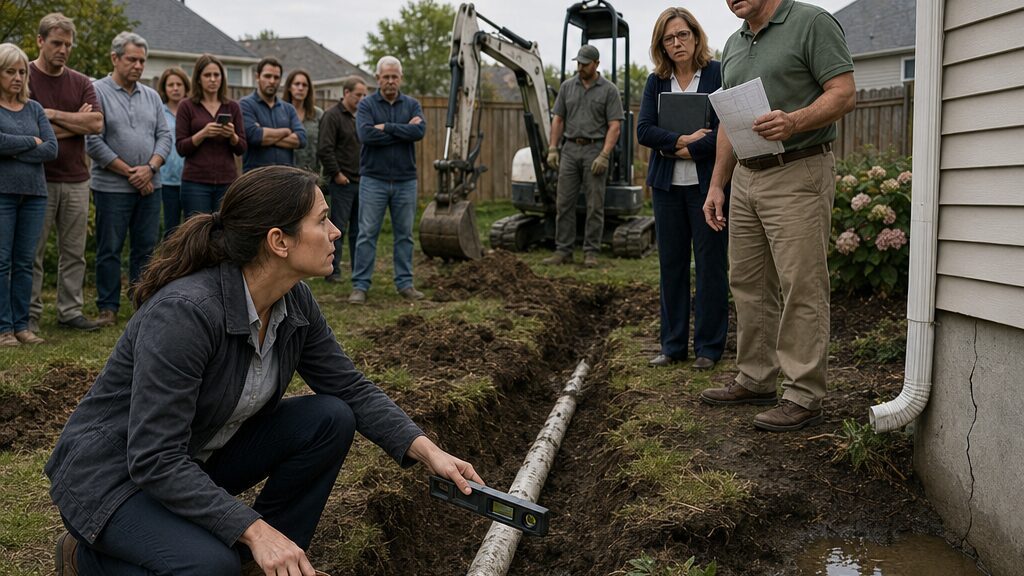
By three that afternoon, eleven people were standing in Laura’s backyard as though it had become public property.
Thomas had called it an emergency walk-through. Two HOA board members came with clipboards. Sandra Lewis carried a binder and stayed near the gate. The excavation contractor stood beside the silent machine. Several neighbors gathered along the torn edge of the lawn, some in work clothes, some with phones in their hands.
Laura recognized two residents whose homes had flooded. One of them had stacked ruined flooring at the curb after the last storm.
Thomas waited until everyone had arrived before speaking.
“We all understand this is disruptive,” he said, facing the group rather than Laura. “But the purpose is to move stormwater away from homes that have already suffered serious damage.”
A few people nodded.
He gestured toward the trench.
“This route follows the natural low point. It is temporary until the county completes the larger drainage project.”
Laura stood beside the exposed pipe with her field case open at her feet.
Thomas continued. “Unfortunately, the work was paused this morning over concerns about landscaping and access.”
The woman whose home had flooded looked directly at Laura.
“Landscaping?” she said. “My son slept in a hotel for twelve days.”
Laura felt every face turn toward her.
Thomas did not smile, but he had arranged the moment carefully. He had transformed an unauthorized trench into a choice between flowers and flooded families.
Laura looked at the woman. “I’m sorry that happened to you.”
“Then why stop the work?”
“Because this pipe does not do what you were told it does.”
Thomas stepped forward. “That’s a conclusion without evidence.”
Laura picked up the digital level.
“No,” she said. “This is evidence.”
She set it on the pipe near the uphill fence.
The display settled at 0.5%.
She waited long enough for the nearest neighbors to see.
Then she moved twenty feet down and measured again.
0.5%.
At the third point, beside the damp foundation wall, it read 0.3%.
Thomas folded his arms.
“That means nothing to most of us.”
“It means the pipe is nearly flat through the center and flatter at the outlet.”
“The contractor followed the plan.”
Laura took a can of orange marking paint from her case. She marked each measuring point on the grass beside the trench.
“The collected runoff from the uphill connections exceeds what this diameter can move at that grade. During a heavy storm, sediment will settle here.” She pointed to the center mark. “Water will back up here. And when pressure exceeds the capacity of the outlet, it will escape at the lowest open point.”
She touched the third mark.
“Beside my foundation.”
The contractor shifted his weight.
Thomas glanced at him. “Is that accurate?”
The contractor rubbed the back of his neck. “We installed to the stake marks provided.”
“That isn’t what I asked.”
The contractor looked down. “The grade is shallow.”
“How shallow?”
Laura held up the level.
“Half a percent.”
Thomas gave a short breath that might have been a laugh. “We’re stopping an emergency project over half a percent?”
Laura looked at him.
“No. We’re stopping it because half a percent is proof this was never designed as the route you are describing.”
The yard went quiet.
She walked to Sandra and held out the reduced plan from the folder.
“Would you open the drawing?”
Sandra hesitated, then placed the binder against her hip and unfolded the sheet.
Laura pointed to the heavy line crossing her parcel.
“Thomas, show everyone the approved discharge point.”
He did not move.
“It’s marked on the plan,” he said.
“Then point to it.”
One of the board members stepped closer. The neighbors crowded just enough to cast a shadow over the page.
Thomas took the paper from Sandra.
His finger moved along the bold line, past the rear easement, across Laura’s lot, and stopped near the edge of the copied image.
“The existing swale is here.”
Laura shook her head. “That symbol is a preliminary contour line.”
“It routes to the street.”
“Where?”
Thomas moved his finger again, but the line ended before reaching the curb.
Laura let the silence hold.
The flooded homeowner leaned in. “So where does the water go?”
Thomas looked toward the contractor. “The outlet extension may not be installed yet.”
The contractor spoke before Thomas could continue.
“We weren’t contracted for an extension to the street.”
Thomas’s head turned sharply.
“What were you contracted for?”
“To connect the upper drains and daylight the pipe on this lot.”
Laura felt something inside her settle.
“Daylight where?”
The contractor pointed toward the side yard beside her foundation.
Several neighbors began speaking at once.
Thomas raised a hand. “This is a temporary stage. The full route is covered by the county permit.”
Laura closed the distance between them.
“Give me the permit number.”
“It’s in the packet.”
“I want the number.”
Sandra opened her binder and read it aloud.
Laura entered it into the county’s online portal on her phone. The page loaded slowly. A permit record appeared under the subdivision’s name, marked active.
Thomas lifted his chin.
“There.”
Laura opened the associated parcel data.
The permitted work description referred to maintenance of an existing common drainage facility.
Her yard did not contain one.
She scrolled farther.
The designated receiving parcel was listed by number.
Her parcel number.
Not temporary access. Not an emergency route.
Permanent receiving basin.
Laura looked up.
“How long has this designation been in the file?”
Sandra frowned. “I’ve never seen that language.”
Thomas said, “It may be standard terminology.”
“It isn’t.”
“And you know that because?”
The question was meant to corner her. Laura heard it in his tone. So did the neighbors.
Until then, she had avoided saying what she did for a living. She had wanted the measurements to stand independently. She had wanted to keep her past separate from the present, though the seal in the folder had already made that impossible.
She placed the level on top of the plan.
“I know because I’m a licensed civil engineer.”
The woman who had challenged her stared.
Laura continued, still looking at Thomas.
“My work includes stormwater systems, foundation drainage, and subdivision design review.”
Sandra’s grip tightened around the binder.
Thomas’s face did not change immediately. Then the confidence around his mouth thinned.
Laura tapped the pipe with the toe of her boot.
“This line cannot safely carry the combined runoff shown by these connections. The outlet does not match the permit description. The grade does not match a properly designed gravity route. And this drawing does not identify a lawful discharge point.”
Thomas recovered quickly.
“You’re also the affected homeowner. That makes your opinion hardly neutral.”
“It makes my property the location of the evidence.”
“We have an approved county permit.”
“You have a permit number.”
“It was reviewed.”
“Then tomorrow I’ll obtain the full file.”
Thomas stepped closer and lowered his voice. “You’re making this harder than it needs to be.”
Laura glanced toward the neighbors. “You made my yard the receiving basin without asking me.”
“No one chose your yard personally. It is the lowest lot.”
The sentence landed differently now.
No one chose your yard personally.
But someone had entered her parcel number. Someone had attached the old drawing. Someone had known enough about the original subdivision concept to turn a contour line into a permanent receiving area.
And someone had believed she would not question the seal.
Laura picked up the level.
“Work remains stopped.”
Thomas looked at the board members. “We can vote to resume.”
Sandra spoke quietly.
“Not until we see the complete permit file.”
It was the first time anyone from the board had contradicted him.
Thomas’s jaw tightened. “Fine.”
The neighbors began leaving in small groups. The woman whose home had flooded remained near the trench.
“I didn’t know it ended here,” she said.
Laura looked at the exposed outlet beside the wall.
“Neither did the county, I suspect.”
When everyone was gone, Laura sat at her kitchen table and reopened the online permit record.
The public portal showed only a cover sheet and inspection summary. She enlarged the parcel listing until the text blurred.
PERMANENT RECEIVING BASIN: LOT 47.
Her lot.
Below it was an entry date from six weeks earlier and the initials of the applicant.
T.K.
Laura leaned back.
The problem was no longer that Thomas had misunderstood an old plan.
He had filed her property as infrastructure.
And he had done it before the so-called emergency began.
Chapter 3: The Seal Belonged to an Earlier Version
The county clerk placed two drawings on the counter and said, “They have the same project number.”
Laura looked from one sheet to the other.
They were not the same plan.
The county permit office occupied the first floor of a low brick building that smelled faintly of paper, dust, and burnt coffee. Behind the clerk, shelves held rolled plats and subdivision records. A printer hummed near the wall.
Laura had arrived when the doors opened Tuesday morning. She had asked for the complete drainage file, every revision, every routing sheet, and the permit application history.
The clerk had returned forty minutes later with a cardboard folder thick enough to bend at the corners.
Now the two drawings lay side by side beneath fluorescent light.
The first was an old preliminary grading concept from thirteen years earlier. Laura recognized the title block before she read it. The firm name appeared in the lower corner, along with the faded seal of Brian Carter, who had supervised the subdivision review team during her second year as an engineer.
The second drawing was newer. It carried the same project number, but the date had been changed. A heavy drainage line crossed Lot 47. The words PERMANENT RECEIVING AREA had been added above it.
Brian’s seal appeared on both.
Laura leaned closer.
On the older sheet, the seal was crisp and aligned with the signature line. On the newer sheet, the outer circle showed faint square edges from a scanned image.
It had been copied.
“Is there a revision letter?” she asked.
The clerk searched the folder. “No stamped narrative. No engineer response. Just the uploaded page.”
“Who submitted it?”
The clerk turned to the permit log.
“Application came through the association portal. Thomas King is listed as authorized representative.”
“Was the seal verified?”
“For a maintenance permit, probably not beyond intake review.”
Laura looked at the work description again. Maintenance of existing common facility.
The altered drawing created the appearance that the facility already existed. That fiction had moved the application into a simpler category, one that did not require a new easement, hydraulic review, or individual homeowner approval.
A small change in words had removed almost every obstacle.
“May I have certified copies?”
The clerk nodded and carried the sheets to the copier.
Laura remained at the counter, staring at the older plan.
Thin pencil marks ran along the proposed rear drainage corridor. Near Lot 47, someone had drawn a bracket and written:
MIN. 1.0%—SHARED RETENTION REQUIRED IF LOWER ROUTE USED.
The handwriting was hers.
In the margin were the initials L.M.
For a moment, the permit office disappeared.
She was twenty-seven again, standing at a drafting table in the old firm’s conference room while Brian explained that the developer wanted preliminary alternatives, not formal objections. She remembered saying the lower route would push too much water toward the final lot. She remembered Brian telling her to note the concern but not issue a rejection because the plan was conceptual.
She had written the minimum slope requirement.
She had initialed it.
Then she had allowed the sheet to return to the file without a formal memorandum.
The clerk came back with the copies.
“Are you all right?”
Laura straightened. “Yes.”
She paid the certification fee and carried the folder to her car.
For ten minutes, she sat without starting the engine.
The old note proved the current installation was wrong. It also proved she had seen the risk before the subdivision was completed.
Not approved, she told herself.
Not final.
Not her seal.
All true.
None of it changed the fact that she had recognized the danger and accepted a quiet notation when a formal objection might have forced a redesign.
Her phone rang.
Sandra.
“I pulled the reserve account records,” Sandra said when Laura answered. Her voice was tight. “Thomas authorized the contractor deposit under emergency maintenance.”
“Was there a board vote?”
“I’m checking.”
“Find the invoice description.”
A pause.
“It says rehabilitation of existing drainage asset.”
“There is no existing asset.”
“I know that now.”
Laura looked at the certified drawing on the passenger seat.
“Send me everything.”
“Thomas says we should handle this internally.”
“Of course he does.”
Sandra lowered her voice. “He says the county file was based on an old engineering plan.”
“It was.”
Silence.
Sandra said, “Whose?”
Laura looked through the windshield at the permit office doors.
“Brian Carter’s seal.”
“Is he still practicing?”
“No.”
“Then how did he approve it?”
“He didn’t.”
Sandra exhaled.
Laura could hear papers moving.
“There’s something else,” Sandra said. “The invoice date is three weeks before the last flood.”
Laura gripped the steering wheel.
Thomas had described the trench as an emergency response. But he had begun arranging it before the event he used to justify it.
“Send me the record,” Laura said.
She drove home with the certified copies on the seat beside her.
By noon, her dining table was covered with plans, permit logs, HOA memos, and photographs of the trench. She aligned the old drawing with the altered one using the property corners as reference points.
The copied version had removed the shared retention note. It had thickened the preliminary route. It had added her parcel designation.
The construction line in her yard matched the altered sheet almost exactly.
Laura opened professional seal regulations on her laptop. Copying or reusing an engineer’s seal without authorization could trigger an investigation. Submitting the altered page to the county made the issue larger than an HOA dispute.
She prepared a comparison exhibit.
Original concept.
Altered permit drawing.
Installed route.
At the bottom, she inserted the field measurements: 0.5%, 0.5%, 0.3%.
The pattern was clear.
Then she reached the older margin note.
L.M.
Her initials turned the exhibit from clean evidence into something more dangerous.
If she submitted the full file, Thomas could claim she had helped design the route. Her current employer might receive questions. The licensing board could ask why she had never elevated the issue. Her insurer could dispute any foundation claim by arguing prior knowledge.
Laura moved the cursor over the note and stopped.
She could crop the exhibit.
The copied seal and altered route were enough to challenge the permit. The old margin did not need to appear yet.
Facts should speak for themselves, she had always believed.
But facts could be arranged to speak only the part a person was willing to hear.
The doorbell rang.
The foundation estimator stood on the porch with a tablet and moisture meter. For the next hour, Laura followed him through the crawl space and along the exterior wall. He found elevated moisture beside the new outlet and movement near the existing crack.
“Too early to say the trench caused all of it,” he said, “but routing concentrated water here will make it worse.”
His preliminary repair range reached $18,400.
After he left, Laura added the estimate to the file.
At four fifteen, the county clerk emailed a scanned intake record.
The uploaded altered drawing had been named FINAL_DRAINAGE_APPROVED.
The metadata showed it had been created from a scan of the preliminary sheet.
Laura enlarged the title block.
Brian’s original seal had been lifted with it.
The phone rang again.
This time the name on the screen made her hand go still.
Brian Carter.
She had not spoken to him in almost two years.
Laura answered.
Neither of them said hello.
Brian’s voice sounded older than she remembered.
“The county called me.”
Laura looked at the old drawing spread across her table.
“Did you authorize use of your seal?”
“No.”
“Did you know the plan had been altered?”
A pause lasted too long.
“I knew someone was asking questions about the old lower route.”
“Who?”
“Thomas King contacted me last month.”
Laura closed her eyes.
“What did you tell him?”
“That the sheet was preliminary. That it was never approved for construction.”
“Did you put that in writing?”
“No.”
The answer was quiet.
Laura felt anger sharpen through the shame she had carried all day.
“So you did what we did thirteen years ago.”
“Laura—”
“You said enough to know there was a problem and not enough to stop anyone.”
“I didn’t know he would file it.”
“But you knew why he was asking.”
Brian breathed into the receiver.
Then he said, “Don’t submit the old sheet yet.”
Laura looked at her handwritten note.
“Why?”
“Because once that file becomes part of an investigation, it won’t only be about Thomas.”
Laura said nothing.
Brian continued. “Your initials are on the drainage concern. Mine is the seal. The developer is gone. The firm is closed. We will be the only professionals left for anyone to question.”
“You’re asking me to hide it.”
“I’m asking you to understand what happens next.”
Laura watched a bead of water slide down the outside of her glass and darken the table near the certified copy.
Brian’s voice softened.
“We can force them to remove the trench without reopening everything.”
Laura placed her finger over the handwritten requirement she had once believed was enough.
Minimum one percent. Shared retention required.
She had written the correct answer thirteen years ago.
Then she had allowed it to remain only a note.
“Send me everything you have,” she said.
“Laura.”
“Everything.”
He was silent.
When he finally spoke, the caution was gone from his voice.
“If you file that old sheet, you need to be ready to explain why you never objected formally.”
Laura looked through the window toward the open trench in her yard.
“I know.”
“No,” Brian said. “I don’t think you do.”
The call ended.
A minute later, an email arrived from Sandra containing the HOA payment records.
At the bottom was a message from Thomas to the contractor, dated before the latest flood.
USE LOT 47. OWNER IS UNLIKELY TO CONTEST TECHNICAL BASIS.
Laura read the line once.
Then again.
Thomas had not simply chosen the lowest property.
He had chosen the owner he believed would remain silent.
Chapter 4: The Emergency Was Real, but the Permission Was Not
The first thing placed on the HOA conference table was not a permit.
It was a stack of photographs.
A woman from the uphill row laid them down one by one beneath the fluorescent lights: a soaked living room rug, warped baseboards, a child’s dresser standing in two inches of brown water, framed family pictures spread across towels to dry.
“My insurance covered part of it,” she said. “Not the hotel. Not the mold testing. Not all the flooring.”
No one interrupted her.
Laura sat at the opposite end of the table with the certified county file closed in front of her. The old drawing was inside it. So was the altered version. So was the message in which Thomas had written that the owner of Lot 47 was unlikely to contest the technical basis.
She had not yet decided how much of the older file she would show.
Thomas sat beside Sandra, his hands folded over a yellow legal pad. He looked tired rather than defensive. That made him more difficult to dismiss.
Another resident described water entering through a garage wall. A third said he had placed sandbags along his patio twice in six weeks.
When they finished, Thomas turned toward Laura.
“This is what we were trying to prevent.”
Laura looked at the photographs again.
“I believe them.”
“Then you understand why we could not keep waiting.”
“I understand why something had to be done.”
Thomas leaned forward. “That is what was done.”
“No. Something lawful and engineered had to be done.”
One of the unnamed board members shifted in his chair. “Can we keep this focused on what happens next?”
Sandra opened her binder. “We need to establish what was approved first.”
Thomas glanced at her. “We already did.”
“No,” Sandra said. “I reviewed the minutes.”
The room changed.
She removed several printed pages and placed them in front of the board.
“There was no recorded vote authorizing excavation on Lot 47. We discussed emergency drainage options. We authorized Thomas to obtain estimates and consult the county. We did not approve construction.”
Thomas’s voice remained even. “The bylaws allow emergency action to protect common property.”
“Laura’s yard is not common property.”
“The flooding originated from common drainage failures.”
“That does not create an easement.”
He looked around the table. “Would everyone have preferred I wait until another family lost a first floor?”
No one answered immediately.
The question was effective because it contained part of the truth.
Laura opened the certified file.
“The permit application describes the work as maintenance of an existing common drainage facility,” she said. “No such facility exists on my parcel.”
She placed the original drawing and the altered drawing side by side.
“The document filed with the county was created from this preliminary concept. The route was thickened. The shared-retention note was removed. My parcel was relabeled as a permanent receiving area.”
The flooded homeowner stared at the pages.
“Who changed it?”
“The association submitted it,” Laura said.
Thomas looked at the altered plan. “The contractor needed a usable drawing.”
“A usable drawing is not an approved design.”
“It came from an engineering file.”
“It came from a preliminary file.”
Thomas tapped the title block. “It carries a seal.”
“A copied seal.”
That silenced the room.
Sandra removed her glasses and set them on the binder.
“Copied?”
“The engineer did not authorize this revision.”
“Have you spoken to him?” Thomas asked.
“Yes.”
“And is he prepared to state that formally?”
Laura hesitated.
It was brief, but Thomas saw it.
“He isn’t, is he?”
“He said the plan was never approved for construction.”
“That isn’t the same as a signed accusation of fraud.”
“No,” Laura said. “It isn’t.”
Thomas leaned back, having found room to breathe.
One board member examined the comparison sheets. “Even if the paperwork is defective, could the physical route still work temporarily?”
Laura placed the digital level on the table.
“The installed grade is half a percent through most of the trench and less near my foundation. At that slope and pipe size, the combined runoff can back up during a heavy storm.”
Thomas shook his head.
“We are talking about half a percent.”
“We are talking about concentrated flow from several lots.”
“Half a percent sounds like a technicality.”
“It sounds small because you are treating the number as an argument instead of a measurement.”
The flooded homeowner spoke from the side wall.
“If they remove the pipe, where does our water go?”
Laura looked at her.
“Back into the failed surface route until another solution is built.”
“So we flood again.”
“I did not say that.”
“But that is what happens, isn’t it?”
Laura did not answer quickly enough.
The woman’s face hardened. “You can stop it because it reaches your house. We couldn’t stop the water when it reached ours.”
Thomas did not intervene. He did not need to.
Laura felt the neat shape of her evidence begin to break apart. The permit was wrong. The trench was unsafe. Thomas had exceeded his authority. None of those facts removed the water from the uphill homes.
Sandra turned another page in her binder.
“There’s also the reserve payment.”
Thomas’s head moved toward her.
“What about it?”
“The contractor received a deposit three weeks before the last flood.”
“We had prior flooding.”
“You described this project to residents as an emergency response to the most recent event.”
“It became urgent after the most recent event.”
Sandra slid an invoice across the table.
“The payment was coded as maintenance of an existing drainage asset. That description matches the permit application.”
Thomas’s expression tightened.
“I used the category the contractor gave me.”
The contractor, seated near the door, spoke without looking up.
“I didn’t provide the account code.”
Thomas turned toward him.
The contractor continued. “I gave an excavation estimate. I was told the easement and engineering approval were already in place.”
A low murmur passed around the room.
Thomas pressed his palm against the table.
“You all knew the county project was delayed. You knew the reserve was not enough for a full redesign. A special assessment would have cost every home thousands of dollars.”
Sandra said, “So you chose one yard instead.”
“I chose the lowest route.”
“You chose the cheapest route,” Laura said.
Thomas met her eyes.
“Yes.”
The directness surprised everyone, including Laura.
He pointed toward the photographs.
“Because the cheapest route was the only route we could build before the next storm without waiting for a vote that would turn into six months of arguments. People were already refusing an assessment. The county had no schedule. Insurance renewals are coming. Property values are slipping on the flooded row.”
His voice did not rise.
“I made a decision.”
“You made it with someone else’s property,” Laura said.
“I made it because no one else would make one.”
There it was: not innocence, but justification.
For a moment, Laura saw the shape of the pressure he had been carrying. Residents had demanded action and resisted paying for it. The county had delayed. The board had discussed, postponed, and asked for more estimates. Thomas had mistaken decisiveness for authority.
Then he had crossed the line deliberately.
Sandra closed the binder.
“I’m moving that all work remain suspended pending county review.”
One board member seconded.
Thomas looked from face to face.
“You’re leaving three homes exposed.”
Sandra’s mouth tightened. “You exposed the association to a larger liability.”
The vote passed four to one.
Thomas cast the only opposing vote.
For the first time, the board’s authority separated from his.
Laura should have felt relief.
Instead, she looked at the flood photographs and saw the raw trench in her own yard, both of them evidence of the same failure moving downhill.
Her phone vibrated against the table.
A weather alert filled the screen.
SEVERE RAINFALL POSSIBLE. MULTIPLE ROUNDS BEGINNING TUESDAY NIGHT.
Five days.
The woman beside the wall read Laura’s face.
“What is it?”
Laura turned the phone so the room could see.
No one spoke.
Thomas looked at the photographs, then at Laura’s certified file.
“You can stop the trench,” he said quietly. “Can you stop the water?”
Chapter 5: Her Old Silence Was Hidden Inside the Plan
Brian arrived Friday morning carrying a black field notebook in both hands.
He did not knock immediately. Through the front window, Laura watched him stand on the porch and look toward the damaged side yard, where orange paint marks still bordered the open trench.
When she opened the door, he held up the notebook.
“I found it in a storage box.”
The cover was scuffed at the corners. A strip of faded tape ran along the spine. Laura recognized it before he stepped inside.
Her first field book.
She took it without speaking.
Brian followed her to the dining table, where the county records remained arranged in careful stacks. He was in his late sixties now, thinner than when they had worked together. His jacket hung loose at the shoulders.
Laura opened the notebook.
The pages smelled faintly of old paper and graphite. Dates, elevations, runoff calculations, and meeting notes filled her compact handwriting.
Brian watched her turn the pages.
“You always wrote everything down.”
“Not everything that mattered.”
He sat across from her.
She found the subdivision section near the middle. A folded photocopy had been tucked between two pages. On it, she had sketched three possible drainage paths.
The lower route crossed what would become Lot 47.
Beside it she had written:
LOW ROUTE UNACCEPTABLE WITHOUT SHARED RETENTION. MINIMUM 1.0% CONTINUOUS GRADE. FOUNDATION OFFSET INSUFFICIENT.
Below that was a note from a meeting two days later.
Developer rejects added basin cost. B.C. says keep as concept only. No formal review response requested.
Laura ran her thumb along the paper.
“You told me not to issue a rejection.”
Brian looked at the table. “I told you the developer had not submitted it for approval.”
“You knew they were trying to keep the option alive.”
“Yes.”
“And I let you reduce it to a note.”
“You were a junior engineer.”
“I was licensed.”
“You had been licensed for four months.”
“That did not make the water less real.”
Brian’s eyes lifted.
“No.”
The answer carried no defense.
Laura turned another page. Her calculation showed the lower route receiving runoff from seven lots, not three. The figures assumed a shared retention area across several rear property lines.
The altered permit drawing had removed the retention area and kept only the downhill line.
Brian touched the edge of the photocopy.
“This is what Thomas wanted when he called.”
“He asked for the notebook?”
“He asked whether the lower route had ever been considered viable.”
“What did you say?”
“That it was one of several preliminary concepts.”
“Did you tell him why it was rejected?”
“I told him it required easements and retention.”
“Then he knew.”
Brian’s silence answered before he did.
Laura closed the notebook.
“He knew the route could not work through one yard.”
“He knew it had conditions.”
“He knew enough to remove them from the drawing.”
Brian rubbed his forehead.
“He said the association needed a temporary path. He said the county had lost the original supporting sheets.”
“And you believed him?”
“I believed he was looking for leverage with the county. I did not believe he would copy my seal.”
“You did not ask.”
“No.”
The same pattern again. Enough concern to feel responsible. Not enough action to create a record.
Brian leaned forward.
“Laura, we can still contain this.”
She laughed once without humor.
“Contain it where? My foundation?”
“I mean professionally.”
“You want a private correction.”
“I want the trench removed, your damage paid, and the neighborhood protected without turning an old preliminary review into a licensing case.”
“The seal was used without authorization.”
“I know.”
“Then sign a statement.”
His jaw tightened.
“That statement opens questions about the original review.”
“They should be opened.”
“You think that because you are angry.”
“I think it because we were wrong.”
Brian looked toward the window. Outside, the white pipe lay exposed beneath a pale sky.
“We did not approve that route.”
“We allowed the dangerous version to remain in the file without formally killing it.”
“The developer did not ask for a final decision.”
“We knew why.”
Brian’s voice sharpened for the first time.
“And what would you have done? Defied the principal engineer? Written a rejection on a concept that had not been submitted? Risked your position over a route they said they were abandoning?”
Laura felt the old room return around her: drafting tables, red pencils, the muted confidence of men who had signed far more plans than she had. She remembered waiting outside Brian’s office with the calculations in her hand. She remembered his advice to be strategic.
She had called it patience then.
Now she knew it had been fear.
“I could have written a memorandum,” she said.
“Yes.”
“I could have asked that it remain attached to every revision.”
“Yes.”
“I could have refused to initial the sheet.”
Brian looked down.
“Yes.”
The quiet agreement hurt more than an argument would have.
A truck door closed outside. The foundation estimator had returned with the final report. Laura met him at the door, signed for the envelope, and opened it at the table.
The estimated repair cost was $18,400.
Drainage correction was listed separately.
Brian read the total upside down.
“The association’s insurance may dispute it if they learn you had prior knowledge of the subdivision risk.”
“I know.”
“Your own insurer may do the same.”
“I know.”
“And the board may argue that you failed to disclose a material defect when you bought the house.”
“I bought it years after leaving the firm. I did not remember the lot number.”
“But you remembered the plan when you saw the seal.”
“Yes.”
“You waited before telling anyone.”
Laura looked at the comparison exhibit on her laptop. She had cropped the old margin note from the version prepared for the board.
There was her complication, visible on the screen.
Not a lie.
An omission.
The kind she had spent her career telling herself was different.
Brian followed her gaze.
“You haven’t submitted the old note.”
“Not yet.”
“Then don’t.”
Laura stood and carried the notebook to the back door.
Brian followed.
They walked along the trench toward the foundation. The damp crack had widened enough that the estimator had marked it with blue tape. At the pipe, Laura placed the digital level on the exposed surface.
0.5%.
Brian stared at the display.
“That number was in your original notes.”
“One percent minimum.”
“With shared retention.”
“Yes.”
He lowered himself carefully beside the trench.
“The developer said the basin would make the lots harder to sell.”
“And we let a sales concern become a future engineering problem.”
Brian watched a small amount of water sitting motionless in the pipe.
“Thomas told me you would understand,” he said.
Laura turned toward him.
“What?”
“When he called. He said you lived on the lower lot now. I told him that made the idea even worse.”
“What did he say?”
Brian hesitated.
“He said you understood why preliminary concerns sometimes stayed preliminary.”
The meaning settled slowly.
Thomas had not merely discovered that she was an engineer after digging the trench. He had known her connection to the old file. He had believed her history would restrain her.
“Did you tell him I wrote the note?”
“I told him you had worked on the review team.”
“That was enough.”
Brian stood.
“He thought you would avoid exposing your own role.”
“And you thought the same.”
His face tightened, but he did not deny it.
Laura looked across the neighboring fences. Behind them were patios, playsets, trimmed hedges, and the uphill homes whose owners feared the next storm. The original solution had required each of several properties to surrender a narrow strip for shared retention. The developer had refused because shared sacrifice complicated sales.
Thomas had revived the cheaper alternative.
One yard.
One owner.
One person expected to remain quiet.
Laura carried the notebook inside and opened her laptop.
She attached the uncropped original plan, the field book pages, the permit metadata, Sandra’s payment records, the contractor invoice, the foundation report, and Thomas’s email.
Brian stood behind her.
“If you send that, the state board may review your conduct too.”
“Yes.”
“You could lose leverage on the damage claim.”
“Yes.”
“You could handle Thomas without doing this.”
“That is what you said thirteen years ago. Handle the immediate problem. Protect the firm. Keep the note quiet.”
Brian put one hand on the back of the chair.
“I was trying to protect you then.”
“I know.”
That was the complexity she had resisted: he had failed her partly because he had wanted to spare her. Thomas had harmed her partly because he had wanted to spare other residents. Good intentions had become permission to decide whose risk counted.
Laura added one sentence to the email.
I participated in the preliminary review and failed to elevate the attached drainage concern into a formal objection. I am disclosing that failure because it is relevant to the current unauthorized use of the plan.
She addressed the message to the county stormwater office, Jack Davis, every HOA board member, Thomas, and Sandra.
Brian read the line.
His shoulders lowered.
“Add me.”
Laura looked up.
“What?”
He removed a pen from his jacket and pulled a blank sheet from her printer.
“I will sign a statement. I directed the preliminary review. I told you not to formalize the objection.”
“You don’t have to take all of it.”
“I’m not.”
He began writing.
Laura waited until he signed, scanned the page, and handed it to her.
Then she attached it.
For one final second, her cursor rested over Send.
She thought of the $18,400 estimate, the copied seal, her initials in the margin, and the woman who had placed flood-damaged photographs on the board table.
Laura pressed the button.
The message left her outbox.
Within moments, delivery confirmations began appearing.
The private clue had become a public record.
Chapter 6: The Stop-Work Order Solved Only Half the Problem
The red notice was fastened to a wooden stake above the trench before eight Saturday morning.
STOP WORK ORDER.
Jack Davis pressed the final staple into place, then stepped back and photographed it. The white pipe ran beneath the notice like evidence displayed under a label.
Laura stood beside him with her field case.
Jack was compact, gray at the temples, and visibly irritated by the amount of paperwork spread across the hood of his county vehicle.
“I expected a permit dispute,” he said. “Not a copied seal, an altered plan, and an unrecorded drainage conversion.”
“Does the order require removal?”
“It prohibits further work. Removal needs an approved stabilization plan. I’m not authorizing anyone to tear out a half-installed system and leave an open channel before a storm.”
He crouched beside the pipe.
“Show me your readings.”
Laura placed the digital level at the first orange mark.
0.5%.
At the second point, the display matched.
At the foundation, it settled at 0.3%.
Jack recorded each number.
“The plan submitted to us indicates one percent minimum,” he said.
“The original note did.”
“The altered sheet removed the note but retained the design profile in the supporting data. Whoever assembled the permit package did not understand the calculations.”
“Or assumed no one would compare them.”
Jack stood.
“The association will receive a $4,200 civil penalty for unauthorized work and false permit classification. That does not resolve private damages.”
Laura handed him the foundation report.
He read the estimate.
“Eighteen thousand four hundred.”
“It may increase if water enters during the storm.”
Jack looked at the forecast on his tablet.
“The rain moved up. First band could arrive Sunday night.”
Laura had expected Tuesday.
The shortened deadline changed every calculation.
A car stopped at the curb. Thomas got out carrying no folder, no coffee, and no HOA-branded confidence. He waited until Jack finished photographing the trench.
“Can we speak privately?” he asked Laura.
Jack looked between them. “I’ll inspect the upper connections.”
He walked toward the rear fence.
Thomas remained beside the stop-work notice.
“The board’s insurer called me.”
Laura said nothing.
“They want to know whether this can be settled before the county refers the seal issue to the state.”
“The county already has the file.”
“The state does not.”
“It will.”
Thomas looked at the damaged hydrangeas, their leaves now curled at the edges.
“The association will restore your yard. Full landscaping, foundation repair, legal fees. Everything in the estimate.”
“In exchange for what?”
“You withdraw the professional complaint and agree the drawing was submitted in error.”
“It was not submitted by accident.”
“No. But it was submitted under pressure.”
“That distinction may matter to you.”
“It should matter to you too.”
He stepped closer, keeping his voice low.
“If the seal investigation expands, your old note becomes part of it. The association’s insurer will argue prior knowledge. Your own professional carrier may be notified. You could spend months defending conduct from thirteen years ago.”
“I disclosed it myself.”
“That does not make it painless.”
“No.”
Thomas looked toward Jack, who was examining the uphill connection.
“I am offering to make you whole.”
Laura glanced at the trench.
“Make me quiet.”
“I am offering to end the damage.”
“You cannot end it by hiding how it happened.”
His restraint finally cracked.
“People are going to flood tomorrow.”
“And your pipe would have backed water into my foundation.”
“You don’t know that.”
Jack called from the fence.
“Mr. King.”
Thomas turned.
The inspector pointed to the upper junction. “This connection combines three roof systems and the rear collection line. At the installed grade, surcharge at Lot 47 is not theoretical.”
Thomas’s face changed.
Jack returned with mud on one knee.
“This project cannot be used during the storm.”
“Then what do you suggest?” Thomas asked.
“A temporary system designed and approved by someone qualified, with written access from every affected owner.”
Thomas laughed bitterly.
“By tomorrow night?”
Jack closed his tablet. “That is the situation.”
He handed Thomas the civil notice.
The amount—$4,200—was printed beneath the violation summary.
Thomas read it once, folded it, and placed it in his pocket.
When Jack left, Laura expected Thomas to continue negotiating.
Instead, he sat on the overturned border stone beside the trench.
“For six months,” he said, “I asked residents whether they would support a special assessment. Half said no. The ones uphill said drainage was not their problem. The ones downhill said the county should pay. The flooded families wanted action immediately.”
Laura closed her field case.
“So you decided consent was optional.”
“I decided no fair solution would survive a vote.”
“That did not make the unfair solution yours to impose.”
“No.”
It was the first time he had said it plainly.
A breeze lifted one corner of the stop-work notice.
Thomas looked at the pipe.
“I thought you would object quietly. I thought we could repair the yard afterward.”
“You knew my connection to the old plan.”
“Brian mentioned you had reviewed it. I found your initials on a scanned sheet.”
“And that made me easier to target.”
“It made me think you understood the problem.”
Laura studied him.
“You thought shame would look like cooperation.”
Thomas did not answer.
Her phone sounded.
A weather update showed the first heavy band arriving before midnight Sunday, with rainfall totals increasing.
Less than forty hours.
Laura opened the subdivision plan on her tablet. The original shared-retention concept remained faint beneath years of revisions. Narrow strips crossed six rear property lines before reaching the common outfall near the street.
Not one trench.
A distributed route.
It would require temporary shallow channels, flexible pipe, portable barriers, and written access from multiple owners. It would not be elegant. It might keep the water away from foundations long enough for the storm to pass.
Thomas stood.
“What are you looking at?”
“The solution the developer rejected.”
“The shared corridor?”
“A temporary version of it.”
“We cannot build that before tomorrow.”
“We might.”
“The county would need to approve it.”
“Jack said he would review an emergency plan.”
“And the owners?”
Laura looked uphill toward the houses whose residents had stood in her yard and accused her of protecting flowers.
“They would each have to surrender part of their property.”
Thomas gave a tired shake of his head.
“They will never agree.”
“Then they will understand what they asked me to accept.”
By Sunday morning, Laura had prepared a temporary drainage layout. It used six narrow property strips, portable catch basins, surface barriers, and a controlled discharge into the common outfall. The grade varied, but nowhere fell below the minimum needed to keep the water moving.
Jack reviewed it in the HOA office while Sandra made copies of access forms.
“This is not a permanent approval,” he said.
“I know.”
“Any field change comes through me.”
“I know.”
“You cannot use the altered trench.”
“I don’t intend to.”
Jack signed the emergency authorization.
Sandra looked at the stack of consent forms.
“How do we get these signed?”
Laura picked them up.
“We ask.”
The first homeowner listened through a half-open door and refused before Laura finished explaining. The second worried about damage to a vegetable garden. The third wanted written confirmation that the HOA would restore the lawn.
Sandra promised restoration in writing.
Two signed.
One asked for time.
The flooded homeowner from the meeting stood on her porch with her arms crossed.
“You want to run water through my side yard now?”
“For approximately thirty feet, inside a temporary barrier.”
“You stopped the route through yours.”
“I stopped a route that placed all the runoff beside one foundation without consent.”
“And this is different?”
Laura handed her the plan.
“Yes. Because the burden is divided. Because the outlet is identified. Because the grade has been checked. And because you can say no.”
The woman studied the drawing.
“What happens if I do?”
“The route breaks. We redesign again, or your row remains exposed.”
For several seconds, neither woman spoke.
Then the homeowner signed.
By late afternoon, five of the six access forms were complete.
The missing property belonged to Thomas.
His rear lot contained a stone terrace, trimmed shrubs, and the shortest connection to the common outfall. Without it, the shared route would turn downhill too early and lose grade.
Laura placed his unsigned form on the HOA table.
Thomas looked at the map.
“You can go around my fence.”
“The detour drops below minimum slope.”
“Use a pump.”
“Not reliably through the full storm.”
His eyes moved toward the line crossing his landscaped side yard.
“How much damage?”
“A narrow channel. Temporary pipe. Some shrubs may need to be lifted.”
He gave a humorless smile.
“So now my yard is the necessary route.”
“No,” Laura said. “It is one necessary part of a shared route.”
Rain tapped once against the office window.
Then again.
Sandra looked toward the darkening glass.
Laura slid a pen across the table.
Thomas did not pick it up.
Outside, the first steady drops began darkening the pavement.
Five neighbors had agreed to carry a portion of the water.
The final strip of ground still belonged to the man who had tried to make one woman carry all of it.
Chapter 7: No One Yard Would Carry the Whole Neighborhood Again
Rain struck the office windows hard enough to blur the parking lot before Thomas picked up the pen.
He held it over the access form, reading the line that granted temporary use of the narrow strip beside his terrace. Outside, runoff already streamed along the curb.
Sandra stood near the copier with the other signed forms pressed to her chest. Laura waited across the table, her plan spread between them.
Thomas looked at the route crossing his property.
“You knew this was where it would end.”
“I knew your lot was part of the safest path.”
“You could have led with that.”
“You would have called it retaliation.”
He gave a brief, tired nod. “I might have.”
The rain intensified.
Thomas signed.
Laura took the form, checked the parcel description, and handed the complete packet to Jack, who had returned to oversee the emergency work.
“Six signatures,” she said.
Jack counted them.
“Then we can proceed.”
The contractor had brought flexible pipe, portable catch basins, stakes, filter fabric, and low water barriers. Neighbors emerged in rain jackets and work gloves. Some had volunteered because their homes were threatened. Others came because the county authorization required access to be monitored.
No one spoke about the argument in Laura’s backyard.
There was no time.
Laura moved from lot to lot with the plan sealed inside a plastic sleeve. She marked the route using orange paint, checked each transition with the digital level, and adjusted the barriers before crews secured them.
At the first yard, the grade held at 1.2%.
At the second, 1.1%.
At the third, the ground flattened near a patio.
Laura asked the contractor to lift the temporary line onto a gravel bed.
“How much?” he called through the rain.
“Three inches at the upstream end. Feather it down over twelve feet.”
He corrected it.
The display settled at 1.0%.
Water began entering the first catch basin before the route was complete.
“Faster,” Jack said. “Upper inlets are filling.”
The flooded homeowner stood beside Laura, holding the plastic sleeve while Laura measured the connection near her fence.
“I thought you were trying to leave us with the water,” the woman said.
Laura wiped rain from the level’s screen.
“I was trying to keep it from being transferred without a plan.”
“That is not how it looked.”
“No.”
The woman waited.
Laura could have blamed Thomas, the altered permit, or the old firm. Each answer would have been partly true.
Instead, she said, “Years ago, I saw the problem in the original design. I wrote a note. I did not force anyone to resolve it.”
The woman’s expression changed.
“You worked on this neighborhood?”
“On the preliminary review.”
“And you never told us?”
“Not until now.”
Rain ticked against the plastic plan cover.
The woman looked toward her house, then toward Laura’s torn yard beyond two fences.
“That should make me angrier.”
“It probably will later.”
The woman almost smiled.
Then the catch basin beside them shifted under the first surge.
Laura dropped to one knee.
“Hold the plan.”
She drove another stake into the soft ground and tightened the barrier strap.
The basin steadied.
“Later,” Laura said, standing again. “Right now, we keep it moving.”
By the time they reached Thomas’s property, water was running through the temporary line in a continuous brown ribbon.
His terrace stood above the marked route. Two shrubs had been lifted and laid beneath a tarp. The contractor opened a narrow channel through the lawn while Thomas watched from the edge.
Laura placed the level on the pipe.
0.8%.
“Too low,” she said.
The contractor pointed toward the common outfall. “We can shave the downstream side.”
“You’ll undercut the terrace base.”
Thomas looked at the stonework. “How much access do you need?”
Laura traced an alternate line with her finger. It crossed closer to the terrace and required removing one section of edging.
“This gives us the grade.”
“What happens to the wall?”
“It should remain stable if we brace it. I can’t guarantee there will be no cosmetic damage.”
Thomas looked at the rising water behind the upstream barrier.
For several seconds, the old instinct appeared on his face—the desire to find another property, another explanation, another person to carry the loss.
Then he stepped off the terrace.
“Take the edging out.”
The contractor hesitated.
Thomas pointed.
“Do it.”
They lifted the stones and cut the new path. Laura checked again.
1.1%.
The pipe connected to the common outfall with minutes to spare.
Then the first major surge arrived.
Water rushed through the upper catch basins, struck the flexible line, and traveled across the shared corridor. For one breathless moment, the system held.
At the fourth connection, a coupling twisted.
The pipe jumped sideways. Water poured over the barrier and spread toward a basement window.
“Shut the upper inlet!” Jack shouted.
“We’ll flood the first row,” Laura called back.
She ran through the yard, boots sinking into the softened ground. The coupling had failed because the transition angle was too sharp. The plan had accounted for grade, but not the force created where the temporary line turned around a mature tree.
Her mistake.
She dropped beside it.
“Cut six feet of pipe.”
The contractor stared. “We don’t have another fitting.”
“We don’t need one. Straighten the route.”
“That crosses the garden bed.”
The homeowner beside them looked at the flowers bending under the rain.
“Take it,” she said.
The contractor cut the line. Laura pulled the barrier stakes from the original path and moved them across the garden. Mud covered her sleeves. Water reached her knees before the new section was secured.
“Open the inlet,” she called.
Jack released the upper flow.
The repaired line filled.
It flexed once, then held.
Water moved past the basement window, through the garden, across Thomas’s stripped lawn, and into the common outfall.
No single yard carried all of it.
For the next two hours, Laura walked the corridor without stopping. She checked stakes, cleared debris, and watched every foundation. Neighbors took turns holding flashlights and moving sandbags. Thomas hauled gravel where the ground had softened. Sandra recorded damage for restoration claims.
No one applauded when the rain eased.
They were too wet and tired.
But the flooded row remained dry.
So did Laura’s foundation.
Six weeks later, the temporary pipes were gone.
The HOA had paid the $4,200 civil penalty and accepted Laura’s $18,400 repair claim, though the insurer continued reviewing part of it. The board disclosed the altered permit records to all residents. Sandra introduced new approval rules requiring recorded votes, independent engineering review, and written owner consent for work outside common property.
Thomas resigned as president.
He remained in the neighborhood.
Some residents avoided him. Others still believed he had acted from a real emergency, even if he had chosen an unlawful answer. Laura did not argue with either view.
Brian submitted his signed statement to the licensing board. Laura submitted hers as well. The review remained open, a consequence neither of them could control.
The permanent shared drainage corridor cost more than the original trench. Each participating lot surrendered a narrow easement. The association approved a special assessment after a difficult vote.
Not everyone supported it.
Enough did.
On the afternoon the landscaping crew finished restoring Laura’s yard, she walked to the side of the house with her field case.
The hydrangeas had been replaced. New sod covered the old trench. The foundation crack had been repaired, though a thin line remained visible beneath the sealant.
Beyond the fence, the permanent drainage channel crossed several properties in shallow, carefully graded sections before reaching the common outfall.
Thomas stood in his yard watching the crew reset the last stone beside his terrace.
He saw Laura and gave a small nod.
She returned it.
Nothing between them had been repaired as neatly as the lawns.
Laura crouched beside the new shared channel and placed the digital level on its edge.
The screen flickered.
1.1%.
Rain from a brief afternoon shower moved through the channel in a thin, steady sheet. It crossed her property without collecting beside the foundation, continued through the neighboring lots, and disappeared toward the street.
The engineering seal on the final plan was hers.
This time, it did not hide an authority no one had questioned.
It recorded the responsibility she had chosen to carry openly.
Laura closed the field case and stood as the water continued downhill, divided across the ground that everyone had finally agreed to share.
The story has ended.