They Towed My Car From My Deeded Space—Then the HOA’s Hidden Parking Money Surfaced
Chapter 1: They Called Me a Guest Outside My Own Home
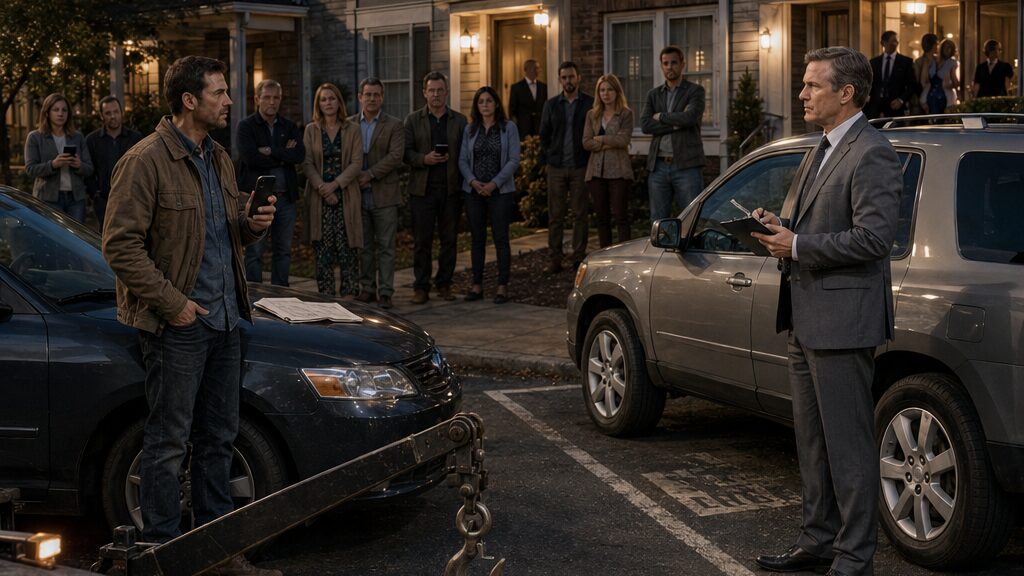
The tow hook descended toward my front wheel while twelve of my neighbors watched from the sidewalk.
Its steel edge stopped inches above the tire. The driver leaned out his open window and looked past me toward Daniel Campbell, waiting for the final signal.
Daniel stood beside his silver SUV with a clipboard tucked beneath one arm. His jacket was open, his tie loosened, and the expression on his face suggested that the inconvenience belonged entirely to him.
“Go ahead,” he told the driver.
I raised my phone and took another photograph.
The tow truck. My car. Daniel’s SUV. The faded white number beneath his rear axle.
The parking court was brighter than usual because the event hall beyond the east wall had switched on its exterior lights. People in formal clothes were crossing the sidewalk in small groups, some carrying gift bags, others following a valet who waved them toward the guest spaces inside our community.
Daniel’s vehicle occupied mine.
When I had arrived ten minutes earlier, I had parked behind him and walked to the driver’s window.
“You’re in space seventeen,” I had said.
Daniel glanced toward the painted number, then back at me. “Those assignments were reorganized.”
“No notice was sent.”
“The parking policy changed.”
“When?”
He had already started raising the window. “Guests use street parking after nine.”
I put one hand against the glass before it closed, not hard enough to strike it.
“I’m not a guest.”
His eyes moved over my work jacket, the inspection bag still sitting in my passenger seat, and the dust on my boots from a construction site across town.
“You may own a unit here,” he said, “but residents are still subject to management policy.”
Then he drove forward six feet, stopped in the middle of space 17, and called the towing company.
Now the hook hovered over my car.
A few neighbors had their phones out. Most did not. They stood at the edges of the court with the careful posture people used when they wanted to see everything and be remembered for nothing.
Daniel signed the towing authorization on the clipboard.
I zoomed in and photographed his signature.
“You’ve documented enough,” he said.
“I haven’t documented the authorizing resolution.”
His mouth tightened. “The what?”
“The board resolution approving the parking change.”
“This is an operational policy.”
“Then identify the section of the management contract that lets you alter recorded exclusive-use rights.”
The tow-truck driver looked between us.
Daniel gave a small laugh and turned toward the nearest neighbors. “This is what happens when someone mistakes an old courtesy arrangement for ownership.”
Two people smiled uncertainly. Someone behind them murmured that I should just move the car.
I opened the folder I had carried from my townhouse and removed a copy of the deed exhibit from when I purchased the unit twelve years earlier. The paper was creased down the center and soft along the edges from being handled more times than it should have been.
I placed it on the hood of my car.
The site plan showed the townhouse building, the access lane, and a row of numbered spaces. A line ran from my unit designation to space 17. Beside it were the words “exclusive use appurtenant to Lot 24.”
Daniel barely looked at it.
“That doesn’t override current safety rules.”
“What safety rule?”
“You’re blocking access.”
“Your SUV is blocking my space.”
“You chose to park behind it.”
“Because you refused to move.”
He stepped closer, lowering his voice. “Mr. Ramirez, management cannot stop operating every time a resident brings out an old piece of paper.”
The words carried farther than he intended.
I looked toward my front door, thirty feet away. The porch light had come on automatically. My house keys were still in my hand.
“A resident guest,” Daniel added, louder now, “does not dictate parking operations.”
For a moment, the humiliation reached me before the anger did. It was not the laughter or the neighbors watching. It was the way he used the language of belonging while standing between me and my own front door.
I folded the exhibit.
My father would have argued. He had believed that if people heard the truth clearly enough, they would behave differently. Years earlier, a contractor had promised him that a roof repair was covered, then denied every conversation after the leaks returned. My father had no emails, no signed change order, no proof beyond his memory.
He lost nearly ten thousand dollars.
After that, I stopped trusting conversations to carry weight.
I stepped away from the car.
“Please note that I object to the tow,” I told the driver.
He nodded once, embarrassed but not enough to refuse the job.
Daniel pointed at the truck. “Proceed.”
The hook caught the front assembly. Metal tightened against metal. My car rose by degrees while the suspension shifted with a low groan.
No one laughed then.
I photographed the angle of Daniel’s SUV, the distance between my car and the curb, the absence of red paint, the open travel lane, the time on my phone, and the numbered valet tags hanging from three nearby rearview mirrors.
One of them showed the event hall’s initials.
I noticed it, but I did not understand it yet.
Daniel watched me work.
“You could save yourself a lot of trouble by following the rules,” he said.
I slipped the phone into my pocket. “Send me the rule.”
He did not answer.
The tow truck carried my car away at 9:18 p.m.
I walked into my townhouse while Daniel remained outside directing valet traffic. Through the front window, I watched a black sedan pull into one of the community guest spaces. A valet placed a paper tag beneath its windshield wiper, then accepted folded cash from the driver.
Daniel saw the exchange. He turned away.
That should have been enough for me to act immediately.
Instead, I opened a new folder on my laptop.
I named it PARKING—SPACE 17.
I saved every photograph with the time and location. I wrote down Daniel’s exact words while they were still fresh. I downloaded the current HOA rules, the management agreement, and the last year of board minutes from the resident portal.
There was no announced parking amendment.
There was no resolution listed.
There was no reference to guests using street parking after nine.
At 10:06, the towing company emailed me an electronic receipt. The charge was $240, plus a $60 release fee if I collected the car before midnight.
I almost closed the message after saving it.
Then I read the violation field.
FIRE LANE OBSTRUCTION—11 MINUTES.
I opened the photograph showing my car, Daniel’s SUV, the curb, and the painted number 17.
There was no fire lane anywhere near the space.
Chapter 2: The Rule Nobody Had Ever Approved
The county file contained the map Daniel had said was merely an old courtesy arrangement.
It lay beneath a transparent protective sheet in the recorder’s office, signed, notarized, and stamped twelve years before his management company entered the community. Space 17 was outlined in dark ink, with a line connecting it directly to my townhouse lot.
The clerk adjusted the monitor so I could see the scanned index.
“Recorded with the declaration amendment,” she said. “It runs with the property.”
“Can management reassign it?”
She gave me the careful expression government employees used when a question drifted toward legal advice.
“I can tell you what was recorded. Interpretation is for an attorney.”
I ordered a certified copy.
The embossed seal cost fourteen dollars. I paid without hesitation, then carried the document to my truck as if it were more fragile than paper.
By Monday morning, management had already added a new charge to my owner account.
PARKING ADMINISTRATION FEE: $60.
The description beneath it said the fee covered enforcement processing associated with unauthorized overnight parking.
My car had not been parked overnight. Daniel had ordered it removed before 9:20.
I printed the account statement and placed it behind the tow receipt.
The folder was growing exactly as I had expected.
That gave me a satisfaction I should have distrusted.
At noon, I walked to Amanda Lopez’s townhouse. She opened the door before I knocked twice, still holding a conference-call headset in one hand.
“You said one question,” she told me.
“I brought one document.”
“That usually means six questions.”
Amanda was a real-estate attorney, though she had spent years training neighbors not to treat that fact as free community counsel. When the HOA had once asked her to review a landscaping dispute “as a favor,” she had responded with her hourly rate.
I handed her the certified map.
She remained standing in the doorway while she read.
Then she stepped back. “Come in.”
We sat at her kitchen counter. I showed her the deed, the declaration amendment, the new parking notice that had appeared on the resident portal only after my tow, and the twelve months of board minutes.
Amanda read without speaking. She used the end of a pen to follow the clauses.
“This isn’t a general assigned space,” she said at last.
“I know.”
“No. You know it’s numbered. That’s different.” She tapped the deed exhibit. “This language grants exclusive use as an appurtenance to your lot. It transfers with the townhouse. Management can enforce reasonable safety rules, but they can’t simply convert your property right into revocable permission.”
“What would authorize a change?”
“Possibly an amendment to the declaration. At minimum, formal board action and notice, depending on what they claim they’re doing. I don’t see either.”
“They called it an operational policy.”
Amanda looked at the photograph of Daniel’s SUV over the faded 17.
“Operational policies don’t erase recorded exhibits.”
The sentence produced the first clean relief I had felt since the tow. Not victory. Something narrower and more useful.
The rule was not merely unfair.
It had never been approved.
Amanda kept reading.
“Why did you let them tow the car?”
“To establish what they were willing to do.”
She removed her glasses. “You already knew what they were willing to do when he signed the authorization.”
“I wanted the written basis.”
“You could have stopped the tow and demanded it.”
“He would have changed the explanation later.”
“And now you’re out three hundred dollars.”
“I have the false violation in writing.”
She studied me for a moment. “You sound pleased about that.”
“I’m not pleased.”
“You’re building a case.”
“Yes.”
“Against what?”
I had no complete answer.
Daniel, certainly. The management company, perhaps. The board if it had authorized the policy. But the documents showed no authorization, and that left a question I had not expected.
Why was Pamela Moore protecting it?
That evening, I attended the monthly board meeting at the clubhouse.
Pamela sat at the center of the folding table with a printed agenda, a stainless-steel water bottle, and the practiced composure of someone who had spent six years convincing neighbors that stability was an achievement. She had campaigned twice on keeping dues nearly flat.
Daniel sat to her right.
I waited through landscaping updates, pool-key replacements, and a discussion about recycling-bin storage. During homeowner comments, I placed the certified deed exhibit and tow receipt on the table.
“I’m requesting that the board review an unauthorized parking policy and a tow from my deeded space.”
Pamela glanced at Daniel.
He answered before she did. “This is an individual enforcement matter.”
“The policy was never adopted in any published board minutes.”
“We don’t vote on every operational decision.”
“My deed grants exclusive use.”
Pamela folded her hands. “Tyler, we’re not going to litigate property language during open comments.”
“I’m asking you to put it on the next agenda.”
“The agenda is already crowded.”
“For next month.”
“We’ll refer it to management.”
“Management ordered the tow.”
A board member shifted in his chair. Another studied the table.
Pamela’s expression remained pleasant, but the temperature in her voice changed.
“You have an appeal process. Please use it rather than turning a parking disagreement into a community spectacle.”
I looked toward Daniel. He was not smiling. He was watching to see whether I would lose control.
I gathered the papers.
“Please record in the minutes that I requested board review.”
Pamela nodded toward the secretary. “Your concern will be summarized.”
“Record the request.”
“It will be handled appropriately.”
That was not the same promise.
The next morning, the official minutes appeared in draft form. My request had been reduced to one sentence:
A homeowner raised a question regarding a recent towing action and was directed to management.
No mention of the deed. No unapproved policy. No request for board review.
At 2:14 p.m., another $60 fee appeared on my account.
NOTICE REVIEW AND ADMINISTRATION.
I stared at the screen until the numbers blurred into something more insulting than expensive.
Then someone knocked on my door.
Donna Green stood outside holding three pale envelopes against her sweater. She lived two buildings over and usually offered only a brief wave when we passed.
Her eyes moved toward the parking court before she spoke.
“I heard what happened at the meeting,” she said.
I waited.
She held out the envelopes.
“Would you tell me whether these are the same kind of violations?”
Chapter 3: The Envelopes Hidden Behind Quiet Doors
Donna did not bring three violation notices.
She brought eleven.
She placed them on my dining table in two uneven stacks, then reached into her canvas shopping bag and removed another folded packet secured with a rubber band.
“I stopped opening them,” she said.
The first envelope was six months old. The last had arrived four days earlier. Some contained warnings. Others carried $60 administrative charges. Three included towing invoices.
I spread them around the certified map of the community until the numbered spaces disappeared beneath paper.
“What did they say you did?”
“I didn’t do anything. It was my caregiver.”
Donna lowered herself into the chair opposite me. She was careful with her left knee, guiding it beneath the table with both hands.
Her caregiver visited four afternoons a week and stayed overnight when Donna’s arthritis made the stairs unsafe. Under the old rules, residents registered recurring visitors through the management office. Donna had submitted the caregiver’s license plate, insurance information, and schedule.
Then Daniel’s parking policy changed.
The first notice claimed the car exceeded a four-hour guest limit. The next said overnight parking required a special permit. Donna applied for one. Management denied it because guest permits were limited to two nights per month.
“They told me to hire someone who didn’t need to stay,” she said.
The sentence was so plainly unreasonable that I looked up to see whether I had misunderstood.
“Who told you that?”
“The assistant manager. On the phone.”
“Did you write down the date?”
Donna shook her head. “I thought if I did everything else right, they would fix it.”
I heard my father in those words.
Not his voice exactly. His faith.
I turned to the first towing invoice. The vehicle had been removed at 1:37 in the morning.
“What happened that night?”
Donna’s fingers tightened around the strap of her bag.
“I fell in the bathroom. My caregiver called the paramedics and went with me to the hospital. Her car stayed here.”
Management had towed it before Donna returned.
The release charge, after storage, was $410. Donna had reimbursed half because her caregiver could not afford the full amount.
A hot pressure moved behind my ribs.
“When did you tell the board?”
“I didn’t.”
“Why?”
She looked toward my folder.
“Because you brought a deed and they still acted like you were causing trouble.”
The answer settled heavily between us.
I had believed my silence was patience. To Donna, it had looked like proof that even a man with documents could not safely challenge management.
I sorted the notices by date. Most fell on Fridays and Saturdays. Several listed times between seven and eleven at night.
Event hours.
I opened a spreadsheet and entered each date.
Donna watched me.
“What are you doing?”
“Looking for a pattern.”
“Will my name be on anything?”
“Not without your permission.”
Her shoulders eased slightly.
By the end of the week, four other residents had allowed me to review notices. None wanted their names used. One had been fined when his daughter parked overnight after missing the last train. Another had paid three administrative charges for a home-health nurse’s vehicle. A third admitted that he parked on the street during winter because he feared management would tow his son’s truck.
The notices were almost identical.
Unauthorized guest use.
Failure to display current permit.
Obstruction of community operations.
Each carried a $60 processing fee.
The dates formed a column of weekends.
Amanda sat beside me at the dining table, reading through redacted copies.
“This is not enough to prove selective enforcement,” she said.
“It shows concentration.”
“It shows concentration among the people who spoke to you. That’s not the same thing.”
“I can request the full violation log.”
“You can request association records. They may claim privacy over individual enforcement.”
“I don’t need names. I need dates, locations, and violation categories.”
Amanda leaned back. “You’ve thought about this.”
“For two weeks.”
She looked around the table. Violation envelopes covered the deed map, tow receipts, screenshots, and photographs.
“You knew after the first tow that the policy was defective.”
“I suspected it.”
“You knew after the county record.”
“Yes.”
“And you waited while they charged you again.”
“I needed to know whether it was isolated.”
“Tyler, you let them tow your car to see what they would put in writing.”
I closed the spreadsheet.
“They fabricated a fire lane.”
“And while you were building the cleanest possible case, Donna was sitting on eleven envelopes.”
The accusation was quiet because it did not need force.
“I didn’t know about her.”
“You didn’t ask.”
I wanted to say I had asked through records requests, meeting comments, and formal procedure. I wanted to explain that premature accusations gave institutions room to deny everything.
Instead, I looked at Donna’s first unopened envelope.
My evidence had become stronger because other people’s lives had become harder.
At 4:36 that afternoon, an email arrived from Daniel.
The subject line read FORMAL NOTICE—INAPPROPRIATE CONTACT WITH RESIDENTS AND STAFF.
He accused me of misrepresenting HOA policy, soliciting confidential enforcement information, interfering with management operations, and creating unnecessary alarm among homeowners. The final paragraph instructed me to direct all future communications through the management office.
Amanda read it over my shoulder.
“He wants you isolated.”
“He calls it harassment.”
“He’s creating a record that you’re disruptive.”
I saved the email to the folder.
That motion—automatic, almost satisfying—made me ashamed.
I no longer wanted a better folder. I wanted to understand what the folder was hiding.
That Friday evening, I stood near the mail kiosk and watched the guest lot fill.
A wedding was underway at the event hall next door. Music reached us in softened bursts whenever its side door opened. Valets in black shirts directed cars through the entrance of our community as if the spaces belonged to them.
Residents circled twice, then left for the street.
A white sedan stopped beside the curb. A valet lifted its windshield wiper and slid a numbered paper tag beneath it.
When he walked away, I crossed the lot and photographed the tag through the glass.
It carried a small gold logo in one corner.
I had seen the same initials on the signs outside the event hall.
Beneath the logo, in fine print, were the words:
AUTHORIZED COMMUNITY PARKING.
The permit number was handwritten.
The form itself was printed with our HOA’s name.
Chapter 4: The Nights Every Guest Space Disappeared
A valet slid an HOA parking tag beneath the windshield wiper of a wedding guest’s car while I stood twenty feet away pretending to check my phone.
The tag matched the one I had photographed the week before: our association’s name across the top, the event hall’s gold logo in the corner, and a handwritten number in black marker.
The valet pointed the driver toward space 42.
That space was marked GUEST.
So were the fourteen spaces around it, all inside our private lot.
Beyond the low brick wall, music from the event hall pulsed through an open service door. Guests in dark suits and bright dresses crossed into our community carrying wrapped boxes and small envelopes. None appeared confused about where to park. The valets moved them through the entrance with the confidence of people following a routine.
I recorded the time.
7:18 p.m.
By 7:31, every guest space was occupied.
A woman who lived in the far building drove slowly through the lot with an elderly passenger beside her. She circled once, paused near the mail kiosk, then continued toward the street. One of the valets watched her leave and guided another event guest into the space she had just passed.
Space 17 remained empty.
Daniel had placed a plastic cone over it after my complaint. A white sheet of paper was taped to the cone.
MANAGEMENT HOLD.
The phrase irritated me more than seeing his SUV there had.
The space was not restored. It was reserved for his decision.
Amanda joined me near the sidewalk at eight. She wore jeans and a dark sweater, with no briefcase or legal pad—nothing that made us look official.
“Tell me you haven’t confronted anyone,” she said.
“I asked one valet where guests should park.”
“And?”
“He pointed here.”
“That’s not enough.”
“I know.”
We walked along the public sidewalk outside the event hall. Through the front windows, I could see a reception table, floral arrangements, and a printed sign directing arrivals toward valet service. No rates were visible.
At the side entrance, a man wearing a headset stepped out and began counting claim tickets.
I waited until he finished.
“Excuse me,” I said. “Are you the operator tonight?”
He looked me over. “I manage the property.”
“I live next door. I’m trying to understand the parking arrangement.”
His expression changed from professional welcome to mild caution.
“You’ll have to talk to the valet company.”
“The tags have our HOA’s name on them.”
“Oh.” He glanced toward the lot. “That’s through your management.”
“Daniel Campbell?”
“Yes.”
“Is this for occasional overflow?”
He gave a brief laugh. “Every Friday and Saturday unless there’s a community event.”
Amanda remained several steps behind me, listening.
“How long has that been happening?”
“About a year.”
“And you pay the valet company?”
“We pay management. They coordinate the rest.”
The words arrived casually, without the secrecy I had expected.
“How much?”
His face closed.
“That’s something you’ll need to ask them.”
“Monthly?”
He hesitated. “Yes.”
A valet called to him from the curb. The operator turned away, then looked back at me.
“Daniel said the guest spaces were mostly unused. We were told the arrangement helped the association.”
He went inside before I could ask anything else.
Amanda crossed her arms.
“That is better than a logo.”
“He admitted monthly payments.”
“He admitted his business pays management. We still don’t know under what authority or where the money goes.”
I watched another vehicle turn into our lot.
“The spaces aren’t unavailable because residents misuse them.”
“No,” she said. “They’re unavailable because someone sold the use of them.”
The simplicity of it landed harder than any legal phrase.
The shortage was not a side effect of enforcement.
The shortage was the product.
Management restricted resident guests, then made the spaces available to paying outsiders.
At 9:04, Daniel’s SUV entered through the main drive. He parked beside the clubhouse and spoke briefly with the valet captain. The man handed him a small envelope.
Daniel slipped it inside his jacket.
He looked across the lot and saw us.
For a second, none of us moved.
Then Daniel walked toward me.
“You’ve been instructed not to interfere with management operations.”
“I’m standing on a community sidewalk.”
“You questioned our commercial neighbor.”
“I asked who authorized the use of HOA property.”
His gaze shifted to Amanda. “Are you representing him?”
“I’m standing on a sidewalk too,” she said.
Daniel ignored her.
“This arrangement predates your sudden interest in parking administration.”
“My interest began when you towed my car from my deeded space.”
“You blocked a travel lane.”
“You called it a fire lane.”
“It serves emergency access.”
“There’s no fire-lane designation there.”
Daniel stepped closer. His voice remained low.
“You have no understanding of this association’s finances. None. You see one car, one fee, one piece of paper, and decide you’ve uncovered corruption.”
“I haven’t used that word.”
“You’re implying it to residents.”
“Then provide the authorization and the accounting.”
His jaw tightened.
“Submit a formal records request.”
“I will.”
He turned away before I finished speaking.
The following Monday, Pamela asked me to meet her at the clubhouse.
She had chosen the small conference room rather than the board table. A manila folder sat before her, but she did not open it.
“I want to resolve your parking issue,” she said.
“My parking issue or the event hall’s parking arrangement?”
“Daniel told me you’ve been approaching vendors.”
“I spoke to the operator on a public sidewalk.”
Pamela exhaled through her nose. “This is exactly what I was worried about.”
“What were you worried about?”
“That a correctable enforcement dispute would become something larger because you refused to let the process work.”
“The process erased my request from the minutes.”
“It summarized it.”
“It redirected the complaint to the person who ordered the tow.”
Pamela opened the folder. Inside was a printed account statement with the charges highlighted.
“The board is prepared to remove both administrative fees and reimburse your towing expenses.”
“On what basis?”
“On the basis that communication could have been handled better.”
“That doesn’t answer whether the policy was approved.”
She pushed the statement toward me.
“This makes you whole.”
“No. It makes my account whole.”
Her eyes hardened.
“What else do you want?”
“The parking contract. The valet-tag logs. Deposits related to use of association spaces. Board communications authorizing the arrangement.”
“That is an excessive demand.”
“It’s an owner records request.”
“Some of those documents may contain proprietary business information.”
“Our guest spaces are not proprietary information.”
Pamela closed the folder.
“Tyler, people elected this board to keep the community functioning. We have drainage repairs, insurance increases, delinquent accounts, and residents who object to every dollar of higher dues. Daniel has found ways to manage those pressures.”
“By renting our lot?”
“I didn’t say that.”
“You didn’t deny it.”
She stood, signaling the meeting was over.
“If you accept reimbursement and withdraw the records request, we can close this matter without creating unnecessary expense for everyone.”
The offer was careful enough to sound reasonable.
That made it worse.
I left the clubhouse, returned home, and drafted the request with Amanda’s help. It cited the declaration, the state statute governing owner inspection rights, and the exact categories of records sought.
Six months of parking permits.
Six months of valet tags.
All agreements concerning use of common-area parking.
All payments received from the event hall or its vendors.
All deposits, invoices, and disbursements associated with those payments.
All board approvals.
Before sending it, I opened the photograph of space 17.
Daniel’s SUV covered most of the painted number. Only the top of the 1 and the lower curve of the 7 remained visible.
Then I opened Pamela’s offer.
Remove the fines. Reimburse the tow. Close the matter.
I attached neither document.
I sent the records demand at 6:42 p.m.
Chapter 5: The Money That Never Reached the Association
The first payment log contained more transactions than the HOA had reported in outside income for the entire year.
I counted the entries twice.
Four hundred thirty-one valet tags had been issued over six months. Each line included a date, an event code, a vehicle count, and an amount. Some nights brought in a few hundred dollars. Holiday weekends brought in more than a thousand.
The total was $21,760.
The annual financial statement listed outside parking revenue as zero.
I was sitting in the records room at the clubhouse with a management employee watching me from the opposite side of the table. She had brought three binders, one banker’s box, and a written restriction stating that I could inspect but not remove original documents.
The box looked substantial until I opened it.
There was no contract with the event hall.
No bank statement showing where the money had gone.
No board resolution.
The valet logs were present only because the numbered tags had to be reconciled.
Amanda sat beside me with her laptop closed.
“Where are the deposit records?” she asked.
The employee pointed to the written restriction. “We provided responsive association records.”
“These logs record nearly twenty-two thousand dollars,” I said. “Where was it deposited?”
“I don’t handle accounting.”
“Who does?”
“Management’s central office.”
“Is there an account ledger?”
She repeated, “We provided responsive association records.”
The sentence had been prepared for her.
I photographed every page.
The tag numbers advanced in clean sequence. The payments appeared in weekly batches, but the HOA bank summaries contained no matching deposits. Several logs showed deductions marked REPAIR OFFSET or VENDOR CREDIT.
One entry stopped me.
CONVERTIBLE EVENT SPACES: 14–17, 38–49.
Space 17 was included.
My deeded space had not been blocked by accident. Daniel had placed it inside an internal inventory of spaces available for event use.
I slid the page toward Amanda.
She read the line and looked at me.
“He knew,” she said.
The management employee shifted in her chair.
“Knew what?” I asked.
“That your space wasn’t merely caught in a general policy. It was specifically included in the event pool.”
I turned to the employee. “Who created this list?”
“I can’t authenticate internal documents.”
“It came from your binder.”
“I can’t speak to authorship.”
At noon, Daniel entered the records room carrying a second box.
He placed it on the table more forcefully than necessary.
“You requested financial support documents,” he said. “These are vendor invoices associated with parking revenue.”
The phrase was the first direct acknowledgment that the revenue existed.
I opened the box.
Invoices for drainage pumps. Asphalt patching. Emergency tree removal. Pool filtration repair. Several were addressed to the HOA. Others were addressed to Daniel’s management company, with handwritten notes indicating that payment had been applied from “special operations.”
Amanda selected one invoice.
“This repair appears in last quarter’s association report as paid from operating reserves.”
Daniel took the chair across from us.
“Because the association received the benefit.”
“That doesn’t answer where the money was held,” she said.
“It was held in a management clearing account.”
“Authorized by whom?”
“The board understood that we were pursuing outside revenue.”
“Did the board approve the contract?”
“There was no long-term contract.”
“Did the board approve commercial use of common-area parking?”
Daniel’s patience thinned.
“The board approved management discretion to address financial shortfalls.”
I looked at the invoices.
The repairs were real. I remembered the drainage failure after the spring storms, the standing water near Donna’s building, and the temporary pumps running for three days. The tree removal had happened after a limb crushed part of the pool fence.
“How much of the parking money paid these?” I asked.
Daniel named an amount just over thirteen thousand dollars.
“And the rest?”
“Valet coordination, security, administration, and vendor costs.”
“Paid to your company?”
“Some services were provided by us.”
“Reported to the HOA?”
“The expenses were incorporated into overall operations.”
“Not as parking revenue.”
Daniel leaned back.
“You think accounting categories are the scandal here. They’re not.”
“Then what is?”
“The scandal is that this community needed nearly seventy thousand dollars in urgent work and refused a six-percent dues increase.”
His voice had changed. The polished contempt from the parking lot was gone. In its place was something tighter and more tired.
“Pamela took one look at the owner response and told us to find another path. Insurance rose. Delinquencies rose. The drainage system failed. Every vendor wanted payment before the association could schedule a vote.”
“So you rented property you didn’t control.”
“I used underutilized spaces to prevent a special assessment.”
“You used my deeded space.”
“That was an administrative error.”
“You put it on a convertible-space list.”
His eyes dropped briefly to the page.
“That list was generated from an outdated site plan.”
“The same site plan you said didn’t govern current parking?”
Daniel did not answer.
Amanda closed the invoice box.
“Even if every dollar benefited the community, you concealed the source.”
“We stabilized the property.”
“You also fined residents for using spaces you had already sold to someone else,” I said.
“We regulated guest access because demand increased.”
“Demand increased because you created commercial demand.”
The management employee stared at her hands.
Daniel turned toward me.
“You want this to be simple. Corrupt manager. Innocent homeowners. Clean solution.”
“I want accurate records.”
“No, you want proof that patience made you right.”
The words found their mark because they were partly true.
Daniel continued.
“You stood there and let your car be towed because you wanted me to commit to a position. You didn’t care about the car. You cared about the file.”
I thought of Donna’s envelopes.
“You fabricated a fire-lane violation.”
“The towing company selected the code.”
“You signed it.”
“I signed an authorization to remove an obstruction.”
“You billed me afterward.”
“You blocked a travel lane deliberately.”
“And you targeted the only vehicle whose owner asked about the arrangement.”
Daniel’s face closed again.
“That accusation is false.”
He might have believed that. Or he might have needed to.
By evening, my dining table held two competing stories.
In one, Daniel had turned HOA property into an undisclosed commercial operation, invented rules to support it, and punished residents who interfered.
In the other, he had found money for necessary repairs while a frightened board refused to raise dues.
Both stories were supported by the same documents.
The difference was not whether the repairs happened.
It was whether need gave Daniel the right to decide everything else.
At 8:13, Pamela called.
Her voice was lower than usual.
“I understand you reviewed the records.”
“Yes.”
“Daniel says the financial picture is being mischaracterized.”
“The parking revenue was never reported.”
“The board knew there was outside revenue.”
“Did you know it came from renting the guest lot?”
Silence.
“Pamela?”
“I knew Daniel had arranged something with the event hall.”
“Did you review the terms?”
“No.”
“Did you ask where the money was deposited?”
“No.”
“Did you approve using deeded spaces?”
“I did not know deeded spaces were included.”
“Did you approve the fines?”
“They were management decisions.”
The pattern in her answers was clearer than a confession.
She had known enough to avoid knowing more.
“Why didn’t you ask?” I said.
Her breath caught before she answered.
“Because every time we discussed raising dues, people threatened to vote us out. They wanted the drainage fixed, the trees removed, the insurance paid, and the pool open on time. They just didn’t want to hear what any of it cost.”
“That doesn’t make the parking arrangement lawful.”
“No.”
It was the first time she had said it.
Then she added, “But if you expose all of this, the money doesn’t reappear. The bills still exist.”
Chapter 6: The Settlement Designed to Keep Everyone Silent
A check for $420 waited beside a confidentiality agreement in the HOA conference room.
The amount covered my tow, the release fee, and the two administrative charges. A second page confirmed that space 17 would be excluded from all future parking operations.
Pamela had placed a pen across the signature line.
“This is not an admission of wrongdoing,” she said.
“Then what am I agreeing not to disclose?”
Her eyes moved toward the closed door.
“Details of the resolution.”
“The resolution is that I get my money back.”
“And your space is restored.”
“Donna’s caregiver was towed.”
“That is a separate matter.”
“There are dozens of separate matters.”
Pamela sat at the end of the table rather than across from me. She looked exhausted. The usual polish remained, but it no longer concealed the strain beneath it.
“The board has consulted counsel,” she said. “If we terminate management immediately, we may owe contract penalties. An independent audit will cost money. We’ll need interim administration, legal review, revised towing procedures, and possibly a special assessment.”
“How much?”
“We don’t know yet.”
“Then homeowners should know that.”
“They will know what they need to know after we have a replacement plan.”
I looked at the agreement.
The language was broad. I would not merely promise silence about the payment. I would agree not to distribute management records, discuss settlement terms, or make statements likely to damage the reputations of the board or management company.
“This would prevent me from presenting the parking logs.”
“It would prevent selective presentation before the board completes its review.”
“You had months to review them.”
Pamela’s fingers tightened around her water bottle.
“You think I don’t understand how this looks?”
“I think you understood enough not to ask questions.”
Her expression changed.
“That’s easy for you to say. You don’t have sixty homeowners emailing you because the pool closed for three days. You don’t sit through meetings where people demand lower dues and better services in the same sentence.”
“I inspect buildings for a living. I know repairs cost money.”
“Then you know why Daniel’s solution was attractive.”
“An attractive solution can still be unauthorized.”
“And a principled correction can still force Donna to choose between groceries and a special assessment.”
The name stopped me.
Pamela saw that it had.
“The board has reviewed preliminary costs,” she continued. “If management is removed and the audit proceeds, we may need an interim assessment. The drainage reserve is still below target. Insurance renews in four months.”
She pushed the check closer.
“This resolves your injury without destabilizing the community.”
For several seconds, the room was quiet except for the ventilation fan.
The offer was not insulting because it was too small.
It was dangerous because it solved exactly what I had first wanted.
My money returned.
My space restored.
My record corrected.
I folded the confidentiality agreement without signing it.
“I need time.”
Pamela nodded, perhaps mistaking hesitation for progress.
When I left the clubhouse, an orange traffic cone stood in space 17. A laminated notice had been attached to it.
RESERVED—DO NOT USE.
There was no unit number, no reference to my deed, no acknowledgment that management had been wrong.
The cone looked less like restoration than permission.
Donna was walking slowly along the path from the mail kiosk. She saw the envelope in my hand and stopped.
“They offered you something.”
“Yes.”
“Did they cancel the fines?”
“Mine.”
She looked at the cone in space 17.
“That’s good.”
The words were generous, but her face did not match them.
“There may be an assessment if management is terminated,” I said.
“How much?”
“They don’t know.”
Donna lowered her eyes.
“I can’t handle much more.”
“I know.”
“No, you don’t.” She said it without anger. “But that isn’t your fault.”
We stood beside the row of shrubs between the walkway and the lot. A sprinkler clicked somewhere out of sight.
“If the community votes to keep Daniel because of the cost,” I said, “would you withdraw your records?”
Donna looked toward her building.
“My caregiver almost quit after the hospital tow. She said she couldn’t keep working somewhere her car might disappear.”
She adjusted the folded mail against her chest.
“I stayed quiet because I thought quiet people were left alone. They weren’t.”
“What if speaking costs you?”
“It already has.”
She walked on before I could answer.
That evening, a letter appeared beneath every homeowner’s door.
It was signed by Daniel.
The first paragraph warned that a resident campaign based on incomplete documents threatened essential services, property values, and financial stability. The second described management’s success in funding emergency repairs without a special assessment. The third stated that terminating the contract could cause “significant and immediate owner expense.”
My name did not appear.
It did not need to.
By morning, three neighbors had emailed me.
One accused me of risking the community over a parking grudge.
Another asked whether the pool would close.
The third wrote only: How much is this going to cost us?
Amanda came over before work and read Daniel’s letter at my kitchen counter.
“He’s moved the argument,” she said.
“From whether the arrangement was authorized to whether exposing it is affordable.”
“That’s the stronger argument.”
“Because it’s true.”
“Partly.”
I placed Pamela’s check beside the certified deed exhibit.
The paper edges nearly touched.
On one side was the clean personal solution. On the other was the right I had spent weeks proving.
Amanda read the agreement.
“If you sign this, the records request ends.”
“I know.”
“You would still be able to vote as an owner.”
“But not explain why.”
“Correct.”
I looked toward the window. The orange cone remained in space 17.
A temporary marker protecting one man from a system still operating around him.
“I thought the responsible thing was to wait until the evidence was complete,” I said.
Amanda did not respond.
“I kept deciding what everyone else needed to know.”
“That sounds familiar.”
“Pamela.”
“And Daniel.”
The comparison stung because it was accurate.
All three of us had used different versions of the same excuse: people would understand later, after the right result had been secured for them.
I tore the confidentiality agreement in half.
Not dramatically. The paper resisted at the fold, then separated with a soft rasp.
I returned the unsigned check to the envelope.
Amanda opened her laptop.
“To force a special meeting, you need the required percentage of owner signatures. To place termination and an audit on the ballot, the motion needs precise language.”
“Can you draft it?”
“I can make sure it follows the bylaws. You have to ask people to sign.”
The part I had avoided from the beginning.
Doors. Conversations. Doubt. Anger without folders between us.
Over the next two days, I walked the community carrying a single-page petition. Some homeowners signed after reading the first paragraph. Others asked whether I would pay their assessment. One told me Daniel had repaired more in a year than the previous manager had in three.
I did not argue.
I explained the hidden account, the invalid parking policy, the unreported revenue, and the real possibility of higher costs.
At Donna’s door, she signed without sitting down.
Pamela called after the final required signature reached the board.
“You understand what happens now?” she asked.
“The owners decide.”
“You’ve made this impossible to contain.”
“That was the point of the agreement.”
She said nothing.
That afternoon, the special-meeting notice was posted at the clubhouse.
Three motions appeared beneath the date:
Independent financial audit.
Cancellation of invalid parking penalties.
Termination of the management contract.
I signed the petition certification at the bottom of the notice.
Not the settlement.
Not the check.
Only the document that placed the decision in everyone else’s hands.
Chapter 7: We Repainted the Line After the Vote
Pamela opened the special meeting by recommending that the homeowners keep Daniel’s company.
The room reacted before she finished the sentence.
A man near the back muttered, “Of course.” Someone else said, “Let her speak.” Folding chairs scraped against the clubhouse floor as people shifted to see the board table.
Pamela waited.
Daniel sat two seats to her right, wearing the same gray jacket he had worn the night my car was towed. His hands rested flat on a closed binder. He did not look at me.
More than fifty homeowners had signed in. Some held copies of Daniel’s letter. Others carried violation notices, account statements, or nothing at all.
On an easel beside the board table, Amanda had arranged the documents permitted under the meeting rules.
The recorded site plan.
The parking logs.
The account summaries.
A photograph of the tow hook suspended above my front wheel.
The faded number 17 was visible beneath Daniel’s SUV.
Pamela read from prepared notes.
“The board does not excuse procedural failures,” she said. “However, we must consider the association’s immediate financial condition, the essential repairs funded during the past year, and the risks of terminating management without a complete transition plan.”
A homeowner raised his hand. “Are you saying they broke the rules but saved us money?”
Pamela’s mouth tightened.
“I’m saying the facts are more complicated than some residents have suggested.”
Daniel opened his binder.
“The parking initiative generated funds that paid legitimate community expenses,” he said. “No individual diverted association money for personal use.”
“That wasn’t the motion,” Amanda said from the side wall.
The room quieted.
She held a copy of the agenda.
“The question is whether management had authority to rent association parking, hold the payments outside normal accounts, impose enforcement rules without board approval, and include recorded exclusive-use spaces.”
Daniel turned toward her.
“The matter is under legal review.”
“Owners are voting tonight because the review began only after Tyler requested the records.”
A woman in the second row lifted Daniel’s letter.
“If we remove them, how much will it cost?”
Pamela gave the preliminary estimate. Audit fees. Interim administration. Legal review. A probable temporary assessment.
The number moved through the room in low voices.
Donna sat near the aisle, both hands resting on her cane. She looked down when Pamela mentioned the assessment range.
I felt the folded notes in my pocket.
They listed the dates, figures, and governing-document sections in clean order. I had spent two nights reducing the case to what could be proved.
When Pamela called my name, I carried the notes to the front but did not unfold them.
The photograph of the tow filled the easel beside me.
“I could explain why that tow was unauthorized,” I said. “Most of you have seen the deed exhibit by now.”
A few heads nodded.
“I could explain the missing board resolution, the parking tags, the unreported payments, or the fines issued on event nights.”
Daniel leaned back as though preparing to endure a familiar presentation.
“But there is something else you should know before you vote.”
The room became still.
“I knew enough after the first tow to challenge the policy immediately.”
Amanda looked at me.
I continued.
“I had the deed. I knew there was no fire lane. I knew management could not produce an authorizing resolution.”
Daniel’s expression changed slightly.
“I chose to wait.”
A man near the wall frowned. “Why?”
“Because I wanted a stronger case. I wanted Daniel to commit his explanation to writing. I wanted to see whether the fees continued and whether management changed its story.”
I looked toward Donna.
“While I was testing the system, other people were still being fined.”
No one interrupted.
“I told myself that I was protecting the truth by waiting until it could not be denied. But I was also deciding, by myself, how long everyone else should remain exposed.”
Daniel spoke from the table.
“That has nothing to do with management’s conduct.”
“It has everything to do with tonight’s choice.”
I turned toward the homeowners.
“Daniel decided that financial pressure gave him the right to bypass approval. Pamela decided that not asking questions protected the community. I decided silence was justified because I was collecting evidence.”
Pamela lowered her eyes.
“Different reasons. Same mistake.”
The folded notes remained in my pocket.
“We kept information from the people who had to live with the consequences.”
A homeowner in the front row raised her hand.
“Are the repairs real?”
“Yes.”
“Did the parking money pay some of them?”
“Yes.”
“Will we probably have to pay more if management is removed?”
“Yes.”
The answer produced a wave of discomfort.
I did not soften it.
“The vote is not between an expensive truth and a free lie. The expenses already exist. The question is whether we keep an arrangement that hid them from us.”
Daniel stood.
“I did not steal from this association.”
“No one has proved that you did.”
“I kept this property functioning while the board refused to make unpopular decisions.”
Pamela looked at him sharply.
Daniel continued.
“When the drainage system failed, vendors wanted deposits. When insurance rose, owners demanded no increase. The event hall needed parking. We had unused capacity. I solved two problems.”
“You also created new rules to protect the arrangement,” I said.
“We controlled demand.”
“You fined residents whose guests competed with paying customers.”
“That was not the intent.”
“You included space 17 in the event inventory.”
“An outdated list included it.”
“Then you towed my car from it.”
“You blocked the lane.”
“And called it a fire lane.”
Daniel’s face hardened.
“The towing company used the wrong code.”
“You signed the authorization.”
The room held the silence between us.
Daniel looked at the photograph on the easel. When he spoke again, his voice was quieter.
“I accept responsibility for the accounting structure and the lack of formal approval.”
A few homeowners shifted.
He added, “I do not accept the claim that Mr. Ramirez was targeted in retaliation.”
There it was: responsibility narrowed until it stopped just before the most personal harm.
Pamela asked him to sit.
Then she surprised me.
“I knew there was outside revenue,” she said.
Daniel turned toward her.
Pamela kept her eyes on the homeowners.
“I did not review the arrangement. I did not ask where the payments were held or which spaces were being used. I believed that if the repairs were completed and dues stayed stable, the details could be handled later.”
Her voice strained on the last word.
“That was not oversight. It was avoidance.”
No one applauded.
The absence mattered. This was not a room waiting for heroes. It was a room calculating what honesty would cost.
Pamela looked toward the board secretary.
“I support the independent audit.”
Daniel’s binder remained closed beneath his hands.
The votes were taken by written ballot.
First, the audit.
It passed easily.
Second, cancellation and review of parking penalties issued under the unauthorized policy.
That passed by a wider margin.
The final motion was termination of the management contract.
The secretary counted twice.
Twenty-nine in favor.
Twenty-six opposed.
The contract would end after the required transition period.
A woman behind me began crying quietly, not from relief but from fear. Her husband whispered about the assessment. Two homeowners left before the meeting adjourned.
Donna remained seated.
When I approached her, she held the preliminary assessment sheet in one hand.
“This will be difficult,” she said.
“I know.”
She studied me, then nodded toward the vote tally.
“But at least this one belongs to us.”
Weeks later, the audit was underway and the pool remained open. The board approved a temporary assessment smaller than the highest estimate but large enough to strain several households.
Daniel’s company turned over the records under supervision. He did not contact me again.
Pamela resigned as president but remained on the board long enough to complete the transition. At her final meeting, she voted for a rule requiring published contracts, separate accounting of outside revenue, and recorded votes for any change affecting parking rights.
There was no speech between us afterward.
She handed me a copy of the adopted policy.
“I should have read the first request,” she said.
“I should have spoken before the second tow.”
Neither statement repaired the other. Both were true.
The orange cone disappeared from space 17.
A maintenance crew arrived to repaint the lot, but I asked the board to postpone my number until the disputed guest spaces had been measured and restored. Some lines had been shifted over the previous year to increase event capacity. Two accessible guest spaces had lost part of their loading zones.
On a Saturday morning, several of us worked beside the crew with site plans and measuring tapes.
Donna sat in a folding chair near the walkway while her caregiver’s car rested in a properly marked guest space without a permit hanging from the mirror.
When every common-space line matched the recorded plan, the painter brought the stencil to mine.
The old 17 was still faintly visible beneath tire marks and gray sealant.
I held the stencil in place while he rolled fresh white paint across the pavement.
The number appeared one stroke at a time.
Straight 1.
Angled 7.
Clear boundaries where the faded ones had been.
When the stencil lifted, I did not see a victory or a warning.
I saw a space that meant exactly what the record said it meant, because people had finally agreed that rules could not belong only to those who enforced them.
Then I picked up a measuring tape and walked to the next guest space.
The story has ended.