The Blue Rock Everyone Mocked Until It Exposed What the HOA Had Forgotten
Chapter 1: The Note on Every Mailbox
By six-thirty Friday morning, every black mailbox on Briar Court had the same crooked square of paper taped to its front.
Samantha Roberts stood behind the curtain in her kitchen and watched the first neighbor find one.
The man across the street approached his mailbox with a coffee mug in one hand and his phone in the other. He stopped so suddenly the mug tilted. Coffee ran over his knuckles, but he did not seem to notice. He leaned toward the note, squinting.
Find the hidden blue rock. Win a surprise.
Samantha knew the exact slant of the F. She knew the cheap blue painter’s tape holding the corners down. She knew, too, that under Maple Glen’s handbook, Section 4.8 probably had something stern to say about “posted materials on community-facing structures.” Donna Martin had once quoted that section at a pool committee meeting because someone had taped a lost-cat flyer too close to the gate code box.
Still, Samantha kept her hand on the curtain and watched.
The neighbor read the note again, turned in a slow circle, and glanced toward the row of identical lawns. His mouth moved, not quite smiling, not quite confused. Then he looked down near the curb as though the rock might be right at his feet.
Samantha let out a breath she had not meant to hold.
The second person to find a note was an elderly neighbor in a faded cardigan, who came out with pruning shears and no mail key. She read hers, chuckled once, and bent carefully to look beneath the hedge beside her driveway. The third was a teenager on his way to the bus stop. He took a picture of the note before calling to two other kids at the corner.
By seven, Briar Court had become strange.
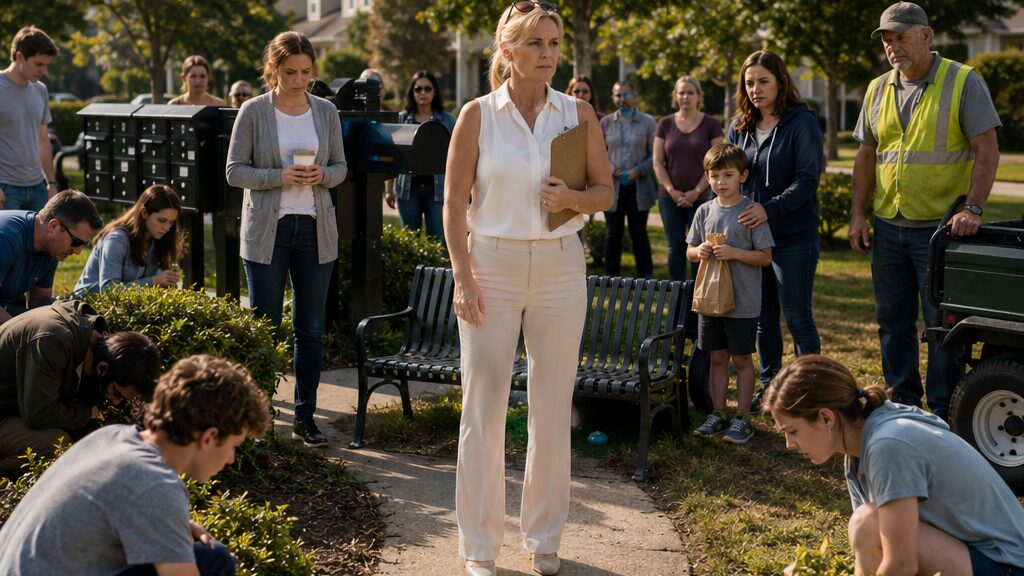
People who normally entered garages without looking sideways stood barefoot in driveways. A child in dinosaur pajamas inspected a flower bed while his father held a cereal bowl. A woman in running clothes paused her watch and checked around the base of the street sign. Two neighbors who had argued for six months about a fence stain color found themselves kneeling on opposite sides of the same patch of mulch.
Samantha’s chest tightened.
It was working.
Not fully. Not safely. Not in a way she could defend if someone asked her to cite procedure. But for a few minutes, no one was complaining about trash bins being visible after eight p.m. or the “inconsistent tone” of porch lighting. They were looking. They were calling across lawns. They were laughing softly, as if laughter itself needed approval.
She turned from the window and looked at the stack of blank paper still on her counter. The marker lay uncapped beside it, blue ink darkening the tip. Her fingers had smudges from writing the same sentence forty-two times before dawn.
Find the hidden blue rock. Win a surprise.
She had almost written “Please.” She had crossed it out every time.
A sharp voice carried through the closed window.
“This is ridiculous.”
Samantha froze.
Donna Martin stood at the mail cluster in pale slacks and a crisp white sleeveless blouse, her sunglasses pushed onto her head like a second pair of judgmental eyes. She had one hand on her mailbox and the other pinching the note as if the paper might stain her.
Three children crouched near the low shrubs beside the sidewalk. One of them looked up.
“What’s ridiculous?” the smallest child asked.
Donna gave the child the kind of smile adults used when they wanted to sound kind and still win. “Sweetheart, this is private community property. People can’t just tape nonsense everywhere.”
“It says there’s a surprise,” the child said.
“It says a lot of things.” Donna peeled the lower corner of the paper from her mailbox. The tape stretched, resisted, then snapped free. “That doesn’t make it appropriate.”
Samantha stepped away from the curtain before Donna could look toward her house. Her pulse beat at the base of her throat.
She could stop it now. She could walk outside, say she was sorry, collect the notes before breakfast, and spend the weekend pretending it had been a lapse. Everyone would forget by Monday. Donna would remember, but Donna remembered everything.
Then a laugh rose from the sidewalk.
“Maybe it’s under the pine needles,” someone called.
“No, the clue says blue. I found a blue gum wrapper. Does that count?”
“That better not be the surprise.”
More laughter.
Samantha went back to the window.
Donna had not left. She was watching the neighbors with her arms crossed, the removed note folded in one hand. Beside her, the children had returned to the shrubs. A father was pretending to inspect the mailbox post with exaggerated seriousness. The teenager who had taken the first photo was now showing it to an older neighbor on a porch.
Donna noticed him.
“Please don’t spread that,” she said, moving toward him. “We don’t know who placed these.”
“It’s just a game,” the teenager said.
“It’s an unauthorized activity.”
No one answered. That was how Maple Glen usually worked. Donna spoke in the language of rules, and people became careful. They made small faces behind her back, but they stopped doing whatever had drawn her attention.
This time, the child in dinosaur pajamas crawled behind a boxwood and shouted, “Found something!”
Every adult in view turned.
Samantha gripped the curtain.
The child held up a blue plastic bottle cap, muddy at the edges.
His father clapped anyway. “Close. Very close. Excellent rock-adjacent discovery.”
The elderly neighbor laughed so hard she had to hold the hedge.
Even Donna looked at the cap for half a second too long.
Samantha pressed her fingertips against her mouth. The laugh that rose in her came wrapped in something painful.
For three years, Maple Glen had learned how to be quiet. Not peaceful. Quiet. After the new board revised the handbook, everything had become more precise: approved mulch colors, trash-can setbacks, porch furniture limits, holiday decoration windows, “resident conduct expectations” at common amenities. People still waved from cars. They still said “busy, busy” at the mailboxes. But they no longer lingered.
Her husband had once said the neighborhood looked like it had been staged for an open house nobody wanted to attend.
She stepped back from the memory before it could fully open.
Outside, Donna had taken out her phone.
Samantha watched her hold it up and photograph the note still taped to the mailbox beside hers. Then another. Then the child with the bottle cap, though Donna angled the phone low enough that she might claim she was only documenting the shrub bed.
Samantha’s hope thinned into risk.
She should have known Donna would make a record. Donna made records of everything: leaning basketball hoops, noncompliant wreaths, guests parked overnight, pumpkins left out beyond the first week of November. Samantha had once watched her photograph a chalk rainbow on the sidewalk after a summer rain had already blurred it to dust.
A door opened behind Samantha in her own mind. A memory she had tried not to invite.
Blue paint on newspaper. A row of small rocks drying on the garage floor. Her husband’s voice saying, “If they’re going to look down at their phones all day, let’s at least give them something better to find.”
She turned away from the window too fast and bumped the kitchen chair. It scraped the floor.
No one was in the house to ask if she was okay.
That was the part that still caught her. Not the empty side of the bed, not the unopened box of his work shirts in the closet. It was the scrape of a chair, the drop of a spoon, the small domestic noise that used to draw another voice from another room.
Outside, Donna crossed the street with the folded note in her hand.
Samantha stood very still.
Donna did not come to her house. She went to the mail cluster at the corner, where five more boxes stood beneath the crepe myrtle. She photographed each note, peeled one off, and tucked it under her arm. A few residents watched but said nothing.
Samantha’s phone buzzed on the counter.
It was the Maple Glen community group.
Anyone know what this is? someone had posted, with a photo of the note.
Three typing bubbles appeared. Then four. Then seven.
My kids are obsessed already.
Kind of cute actually.
Is this HOA approved?
Who cares, I’m finding that rock.
Donna’s reply appeared after a full minute.
Please refrain from participating until the Board can determine whether these postings violate community standards and mailbox usage rules.
The thread went quiet.
Samantha looked from the phone to the window.
On the sidewalk, the child with the bottle cap had stopped searching. His father was reading his own phone now. The teenager lowered his shoulders. The elderly neighbor still stood near her hedge, but the laughter had gone out of the morning.
Then, from two houses down, someone called, “I’m still looking.”
It was Rebecca Williams, the renter who lived in the tan house with the cracked birdbath. She stood by the curb with a lunch bag over one arm and a small child beside her. She glanced at Donna, then at the shrubs.
Her child whispered, “Can we?”
Rebecca hesitated only long enough to make the choice visible.
“Five minutes,” she said. “Then school.”
The child dropped to both knees in the grass.
One by one, people looked up from their phones.
Samantha felt something unsteady move through her. Gratitude, maybe. Fear, too. It was easier to leave notes than to stand beside them.
Donna turned slowly toward Rebecca. Her face settled into that familiar calm expression she wore right before making a thing official.
“This ends today,” Donna said.
She peeled another handwritten note from the mailbox, folded it once, and held it like evidence.
Chapter 2: Donna Turns Fun Into a Violation
By noon, Samantha’s note had been covered by an HOA warning printed on thick white paper.
It was taped to the center mailbox in the cluster, exactly over the words hidden blue rock, as if the surprise itself had been formally cancelled.
NOTICE OF UNAUTHORIZED POSTING AND UNSANCTIONED COMMUNITY ACTIVITY
Samantha stood on the sidewalk with her grocery bag cutting into her palm and read the first sentence three times without moving past it. The warning did not name her. That should have comforted her. Instead it made the whole thing feel worse, like the neighborhood itself had been accused.
A few of her original notes still clung to mailboxes farther down the row, their blue tape curling in the heat. Beside the official warning, they looked small and guilty.
A landscaper pushed a mower along the far edge of the common green, the engine rising and falling as he passed the bench near the walking path. Samantha looked away before her eyes could settle there.
Not yet.
She had not hidden the rock yet.
“Ms. Roberts?”
She turned.
Patrick Green stood outside the HOA office room, which occupied the back half of the clubhouse beside the pool. He wore a tucked-in polo and the expression of a man who had been interrupted by something he wished had stayed small. Donna stood behind him with a folder tucked beneath one arm.
“Samantha,” she said, carefully pleasant. “Could we speak with you for a minute?”
It was not really a question.
Samantha shifted the grocery bag to her other hand. “About what?”
Donna’s eyes went briefly to the warning. “I think you know.”
Patrick cleared his throat. “We’re just trying to get ahead of it.”
That was Maple Glen’s favorite phrase for making residents feel late to a problem they did not know they had caused.
Inside the HOA office, the air smelled like paper, carpet cleaner, and the faint chlorine drifting in from the pool hallway. A folding table served as a desk. On it lay three of Samantha’s handwritten notes, flattened neatly beside a copy of the community handbook.
Donna placed her hand on the handbook.
“Do you recognize these?” she asked.
Samantha looked at the notes.
Her own writing stared back at her, less brave under fluorescent lights.
She could lie. She had not been seen taping them before sunrise. She had worn an old baseball cap and moved quickly, telling herself she was only doing something harmless. But lying would make it ugly. It would turn a foolish, hopeful thing into something sneaking and mean.
“Yes,” she said.
Patrick’s eyebrows lifted. Donna’s did not.
“So you placed them?” Donna asked.
Samantha set her grocery bag on the floor before the eggs cracked. “I did.”
“On every mailbox?”
“Most of them.”
“Without approval?”
Samantha almost said, It was a note, not a deck addition. Instead she looked at Patrick. “I didn’t think a weekend game needed a vote.”
Patrick leaned back in his folding chair. “The issue isn’t the game exactly.”
Donna slid the handbook forward. “It is also the game.”
Patrick gave her a small look, then continued. “Mailboxes are regulated structures. There are federal guidelines, HOA maintenance standards, and signage rules. Once residents start attaching materials, it creates precedent. Then someone tapes a business flyer. Someone else posts political material. Then we’re deciding content, and that creates liability.”
Samantha stared at him.
He was not cruel. That made it harder. He spoke as though the whole world were a line of dominoes and her blue painter’s tape had placed a finger against the first one.
“It’s a scavenger hunt,” she said.
Donna’s folder opened with a crisp sound. “It caused residents to dig through landscaped beds.”
“No one was digging.”
“I saw children pulling mulch away from shrubs.”
“They were looking.”
“Exactly.”
Samantha felt the old, dangerous urge to smile at the wrong moment. Her husband used to say that HOA arguments had a way of making adults sound like they were negotiating international treaties over a bird feeder.
But the chair across from her was empty. He was not there to nudge her knee under the table.
Donna removed a page from the folder. “We’ve had three complaints already. One resident is concerned about property damage. Another about unknown prizes being offered to minors. Another asked whether the association is sponsoring this.”
“Who complained?” Samantha asked.
Donna’s face closed. “We don’t disclose residents who report concerns.”
“Of course.”
Patrick tapped the handbook lightly. “We’re not trying to make this bigger than it is.”
“You printed a notice before lunch.”
“To prevent misunderstanding.”
“No,” Samantha said, quieter than she expected. “To prevent participation.”
Donna looked at her then, truly looked. For one second Samantha saw something more personal than procedure pass across her face.
“People live here because standards are maintained,” Donna said. “That doesn’t happen by accident.”
“No one said it did.”
“Then help us maintain them.”
Samantha bent and picked up her grocery bag. The eggs had shifted to one side, carton corner pressing through the paper.
“What do you want me to do?”
“Remove the remaining notes,” Patrick said. “Post in the group that the activity was not HOA sponsored. And confirm there’s no actual prize residents should be expecting.”
Donna added, “And retrieve the rock, wherever it is.”
Samantha’s hand tightened on the bag.
There it was. The thing they thought they were discussing. A rock not yet hidden, a prize not yet explained, a weekend almost over before it had begun.
“I’ll remove any loose tape,” Samantha said.
Donna waited. “And the rest?”
“I’ll think about what to post.”
“That isn’t sufficient.”
Patrick slid another paper toward her. “This is a written warning. No fine at this stage, provided the matter is corrected.”
At this stage.
The words sat between them like a small machine already running.
Samantha took the paper. Her name was printed near the top. So they had known before asking. Or guessed well enough.
Outside, the afternoon had brightened hard and white. She walked past the mail cluster, warning notice fluttering in the breeze, and heard voices around the corner.
Two children were checking beneath the low wall near the pool entrance. Their mother stood nearby, pretending not to supervise too closely. When she saw Samantha, she gave a quick embarrassed smile, the kind that asked permission without using words.
Samantha did not know what expression she returned.
At the far end of the cluster, one of her notes had fallen onto the sidewalk. The tape had picked up grit. Before Samantha could reach it, Eric Walker stepped from the maintenance cart parked beside the curb.
He wore a reflective vest over an old gray T-shirt and carried a pair of work gloves in one hand. He saw the note on the ground, bent down, and smoothed it against the mailbox post with two careful strips of fresh tape from his pocket.
Samantha stopped.
Eric looked over his shoulder. “Wind got it.”
“You don’t have to do that.”
“I know.”
His tone did not invite gratitude. It was simple, almost gruff, as though replacing fallen notes were ordinary maintenance, like tightening a loose sprinkler head.
Donna’s voice came from behind Samantha. “Eric.”
He turned.
Donna had followed them out with Patrick beside her. Her sunglasses were back on her head.
“Please don’t reattach unauthorized materials,” she said.
Eric glanced at the note, then at the tape in his hand. “Didn’t want it blowing into the street.”
“You could have thrown it away.”
“Could’ve.”
The silence after that was small but sharp.
Patrick stepped in. “Let’s all be reasonable.”
Eric gave him a polite nod. “Always trying.”
Samantha looked at the note. The blue ink had bled slightly where morning dew touched the paper. The word surprise looked softer now, less certain.
Donna noticed Samantha looking. “This is exactly how these things get out of hand. People start deciding which rules feel harmless.”
Samantha folded the warning notice once, then again, until it fit inside her palm. She could feel the paper edges pressing into her skin.
“I’ll handle it,” she said.
Donna seemed to hear surrender in that. Her shoulders relaxed a fraction.
But Samantha did not go home first.
She drove to the small drainage creek behind the old playground, where smooth stones collected after storms. She chose one that fit neatly in her hand, flat on one side and rough on the other. At home, in the garage, she laid it on a square of newspaper and opened the little jar of blue paint she had not touched in years.
The lid resisted.
When it finally came loose, the smell rose at once—acrylic, dust, summer heat, memory.
Her hand trembled only once.
She painted the rock a bright, unmistakable blue and left one edge bare, the way he used to. “So it still remembers it was a rock,” he had said the first time, when she had laughed at him for being sentimental over driveway gravel.
By late afternoon, the paint had dried enough.
Samantha slipped the rock into the pocket of her cardigan and walked the long loop through Maple Glen. She passed the pool, the clubhouse, the clipped hedges, the mailboxes still marked by official warning. People watched her in that careful neighborhood way, glancing without staring.
Donna was not outside.
Good.
Samantha reached the common green. The bench near the walking path sat under a young maple tree, its metal arms warm from the sun. Donna passed that bench every morning on her inspection walks. She paused there often, pretending to check emails while noting whose trash cans had not been brought in.
Samantha crouched as if tying her shoe.
The blue rock slid from her hand into the shadow beneath the bench, tucked just far enough back that only someone willing to bend down would see it.
She stood, brushed her fingers against her jeans, and looked once toward the mailbox cluster.
The official warning snapped in the breeze.
Samantha walked home without removing it.
Chapter 3: The Search That Made Neighbors Look Up
“Blue! I found blue!”
The shout came from the strip of grass between two driveways just after nine on Saturday morning, and half the street turned as if someone had called fire.
Samantha, standing by her porch with an empty watering can, watched a child lift both hands from the mulch. Between his fingers was something small, round, and bright.
For one wild second her knees weakened.
Then the child’s mother leaned closer and said, “Honey, that’s a bottle cap.”
The disappointment that moved through the gathered neighbors should have been embarrassing. Instead, it broke into laughter.
“Is there a prize for recycling?” one man called.
“Only bragging rights,” someone else answered, not knowing how close he had come to the truth.
Samantha lowered the watering can beside a pot of basil and let the porch railing hold some of her weight. The rock was still safe under the bench. She had checked at dawn, pretending to stretch her calves on the walking path. It sat where she had placed it, blue edge catching the morning light.
By now, Maple Glen had split into three groups.
The first group pretended not to care but moved more slowly past shrub beds.
The second group openly searched.
The third group, led by Donna Martin, disapproved while keeping close enough to monitor the search pattern.
Donna stood near the mail cluster with her clipboard pressed against her waist. The official HOA notice remained posted behind her, but it had not stopped the whispers. Someone had drawn a tiny blue rock in the corner of the community group thread. Someone else had posted a photo of a blue jay and asked whether birds counted. The joke had survived the warning, which made Donna’s posture even straighter than usual.
“Please stay out of the landscaped beds,” she called as two teenagers crouched near the ornamental grasses. “Those were replanted in April.”
“We’re not touching anything,” one teenager said.
“You’re leaning.”
The teenager slowly lifted both hands, palms out.
Samantha should have stepped forward. She should have said, I started it. Don’t snap at them. Fine me if you need to.
Instead she picked up the watering can and watered basil that did not need watering.
Her silence had weight now. Yesterday it had been protection. Today it was becoming cowardice with a reasonable excuse.
Across the street, Rebecca Williams came out with her child. She wore the same tired navy hoodie Samantha had seen on her during school drop-offs, sleeves pulled over her hands though the morning was warm. Her child carried a paper lunch bag decorated with marker drawings of rocks.
They crossed toward the common green, where an elderly neighbor had stationed herself on the porch with iced tea and a view of the action.
Samantha set the watering can down and met them halfway.
“Good morning,” she said.
Rebecca smiled cautiously. “Morning. We’re not breaking any rules by walking, right?”
“Not yet.”
The joke landed softly. Rebecca’s shoulders eased.
Her child held up the paper bag. “For clues.”
“Oh,” Samantha said. “Professional.”
The child nodded with complete seriousness. “Blue things go in here, but not trash. Trash goes in the trash.”
“Good system.”
Rebecca watched the child run ahead toward the sidewalk, then lowered her voice. “I hope this isn’t causing trouble for whoever did it.”
Samantha looked toward Donna. “Depends who you ask.”
“My kid talked about it all night.” Rebecca’s smile flickered, embarrassed by its own openness. “We don’t do a lot of the neighborhood things. The food truck nights get expensive. Pool guest passes, same thing. This is the first thing here that felt like it didn’t matter what house you lived in.”
Samantha’s throat tightened.
Rebecca seemed to regret saying that much. She tucked hair behind her ear and glanced toward the green. “Sorry. That sounded heavier than I meant.”
“No,” Samantha said. “It didn’t.”
A whistle chirped from the sidewalk. Eric Walker stood beside his maintenance cart, orange cones stacked in the back. He was not wearing an actual referee whistle, only a small key ring that made a bright metallic sound when he spun it around one finger.
“Reminder,” he called to the children. “If you find a sprinkler head, that is not the rock, and I will not be proud of you for pulling it up.”
Several kids groaned.
Donna turned toward him. “Eric, please don’t encourage them.”
“I’m discouraging sprinkler damage.”
“You know what I mean.”
He gave her a mild look. “Usually.”
Samantha saw Donna’s mouth tighten, but Patrick Green arrived before she could answer. He walked from the clubhouse with a folder under his arm and the careful pace of a man approaching a loose dog.
“Donna,” he said quietly.
Donna moved to meet him near the mailboxes. Samantha was too far to hear every word, but she caught enough.
“…still continuing despite notice…”
“…board exposure…”
“…emergency discussion…”
Patrick glanced toward the families on the common green.
Donna said something and pointed, not at the children, but at the bench.
Samantha’s breath stopped.
Had Donna seen it?
No. Donna’s eyes moved past the bench, scanning the green like a site plan. She had not bent down. Not yet.
Patrick opened his folder and removed a paper. Donna read it while tapping her pen against the clipboard. Their conversation ended with Donna nodding once, satisfied in the way of people who had made a problem official.
By late morning, the hunt widened.
Residents checked under the low brick sign at the entrance, around the benches, beside the pool gate, along the walking path, near mailboxes, between liriope clumps and under the old crepe myrtle. No one trampled anything. No one damaged property. Mostly they asked each other where they had already looked.
A man Samantha had never seen speak to anyone except through parking complaints held back branches for the elderly neighbor. The teenagers helped Rebecca’s child distinguish blue-gray pebbles from actual blue. Someone brought out lemonade in paper cups and set it on the porch rail with a hand-lettered sign: For Rock Hunters.
Samantha stood at the edge of it all, smiling when people looked her way, hiding when they came too close.
The game had become what she had hoped and feared.
It had moved beyond memory.
That should have made it easier to let go of the secret. Instead, it made the secret feel more dangerous. If she told them now that the first blue rocks had been painted years ago in her garage, that her husband had kept a box of them like treasure, that this whole thing began because she could not bear another spring where neighbors passed each other like locked doors—then the game might become sad.
She did not want pity standing in the place where laughter had finally returned.
Near noon, Donna approached Samantha by the sidewalk.
“I assume you’ve seen the group message,” Donna said.
Samantha had not checked her phone in an hour. “No.”
“There will be an emergency board discussion Monday evening. Attendance optional, of course, unless you receive formal notice.”
“Formal notice?”
Donna looked at her for a measured second. “Samantha, you admitted placing the notes.”
A pair of children ran past holding a blue popsicle wrapper, arguing whether it was “rock-shaped enough.”
Donna waited for them to pass before continuing.
“I don’t enjoy escalating these things,” she said.
Samantha believed her, strangely. Donna did not look pleased. She looked pressured, like someone standing on a narrow bridge she had built herself and now had to cross.
“Then don’t,” Samantha said.
Donna’s face hardened. “That’s not how responsibility works.”
Samantha almost laughed. Not because it was funny. Because responsibility had been the word everyone used when there was nothing useful left to say. Responsible homeowners. Responsible enforcement. Responsible grief, tidy and quiet and never taped to mailboxes before sunrise.
Before she could answer, Rebecca’s child shouted from across the green.
“Ms. Samantha! Is this blue?”
The question pulled several eyes toward her.
Samantha went still.
Rebecca looked apologetic. “Sorry. We ask everybody now.”
The child held up a gray stone with one bluish streak. Samantha walked over, aware of Donna watching.
She crouched to the child’s level. “That is a very good almost-blue.”
“So not it?”
“Not it.”
“Would the real one be really blue?”
Samantha looked toward the bench without meaning to.
Eric saw.
He stood by his cart, one boot on the curb, hands resting on the handle. His gaze followed hers for half a second, then returned to her face. Something changed in his expression—not surprise, exactly. Recognition.
He knew.
Or he had guessed.
Samantha stood too quickly.
The child ran off with the almost-blue stone anyway, pleased with the category.
Eric waited until Donna moved away toward Patrick, then crossed to Samantha.
“You painted it,” he said quietly.
Samantha kept her eyes on the common green. “Don’t.”
“I didn’t say anything.”
“You’re about to.”
He looked toward the children searching under the shrubs. “No. I’m about to say this is the most people I’ve seen outside here in two years.”
“That doesn’t make it allowed.”
“No,” Eric said. “Just makes it good.”
The word struck harder than she expected.
Good.
Not compliant. Not approved. Not defensible. Just good.
Samantha pressed her thumb into the curve of her palm where blue paint still lingered faintly near the nail.
Eric followed the motion. His voice softened. “He would’ve loved seeing this.”
Samantha turned toward him then, all the air leaving her chest.
Eric did not look away.
Across the green, Donna’s clipboard snapped shut. The children kept searching. The blue rock waited under the bench.
Chapter 4: The Bench Where Donna Bent Down
Donna arrived Sunday morning with a clipboard, a phone, and the expression of a woman prepared to confiscate joy if it had been placed on common property.
Residents were already on the green.
Children moved in zigzags between the trees. Adults pretended to supervise while checking beneath benches and along the path. The elderly neighbor had brought a lawn chair to the edge of her driveway and was keeping a running commentary no one had asked for but everyone seemed to enjoy.
“Too obvious under the hydrangeas,” she called. “Whoever hid it has better taste than that.”
Samantha stood near the mailboxes with her hands folded around a paper cup of coffee gone cold. She had checked under the bench before anyone came out. The rock was still there, bright blue, tucked back in the shadow where sunlight only touched one curved edge.
She had told herself she would move it if Donna became too aggressive.
She had told herself she would confess if a child got blamed.
She had told herself many things that required courage later.
Donna stopped in the middle of the sidewalk and looked around at residents crouching, laughing, pointing, and calling out false alarms. Her jaw tightened.
“Everyone,” she said, raising her voice just enough to make people look. “Please stop searching.”
A child froze with one hand halfway under a bush.
Donna lifted the clipboard. “This is no longer a harmless activity. The board has received multiple concerns. Until Monday’s meeting, this unauthorized game needs to pause.”
“Pause?” one of the teenagers said. “It’s a rock.”
“It is an object hidden on association property as part of an unsanctioned activity,” Donna said.
The teenager stared at her. “So… a rock.”
A few people laughed before they could stop themselves.
Donna’s cheeks colored. Not much. Enough.
Samantha stepped forward, then stopped. Donna looked directly at her, and in that look Samantha saw the invitation: say it, admit it, let me handle you in public.
Samantha’s mouth went dry.
Rebecca stood near the walking path with her child, who clutched the paper lunch bag from the day before. Eric leaned against his maintenance cart on the curb, arms crossed, face unreadable.
Patrick was not there. No board buffer. No careful treasurer language. Just Donna, the residents, and the thing Samantha had started.
Donna turned from Samantha to the group. “I understand some of you think this is cute. But rules exist because common spaces belong to everyone. One person doesn’t get to decide how they’re used.”
That was the first thing she said that made Samantha flinch because it was not entirely wrong.
One person had decided.
One person had written the notes, hidden the rock, and waited behind curtains for the neighborhood to become something she missed. She had dressed longing up as a game and then expected everyone else to understand without being told.
A small boy near the bench whispered, “Are we in trouble?”
Rebecca crouched beside him. “No. You’re not.”
Donna heard. “No child is in trouble. But adults should know better.”
The words struck Samantha anyway.
Eric pushed away from the cart. “Donna, nobody’s damaged anything.”
“That is not your determination to make.”
“I maintain the common areas.”
“And I chair compliance.”
“Looks like we’re both having a big weekend.”
This time the laughter came harder, then scattered quickly when Donna’s eyes moved across the group.
Samantha took another step.
Before she could speak, Donna lowered her clipboard and walked toward the bench.
It was not deliberate at first. She was moving while talking, scanning the shrubs, checking for disturbed mulch, demonstrating control over the space. But with every step she came closer to the bench where the blue rock waited.
Samantha felt her own body go still.
Eric’s eyes shifted to her.
Donna continued. “The issue is precedent. If anyone can hide objects in common areas, tape notes to mailboxes, and encourage residents to search through landscaping, then the board loses the ability to maintain standards fairly.”
A child on the grass leaned sideways, trying to see beneath the bench.
Donna stopped.
The child looked up at her.
“What are you doing?” Donna asked.
“Nothing.”
Donna followed the child’s gaze.
Samantha could hear the mower far away near the back entrance. Someone’s dog barked twice behind a fence. The whole common green seemed to draw one breath.
Donna looked beneath the bench.
For a moment, nothing happened.
Then her expression changed.
It was tiny. A narrowing of the eyes. A pause in the controlled line of her mouth. The clipboard lowered half an inch.
Samantha’s pulse beat so loudly she barely heard Rebecca’s child whisper, “What? What is it?”
Donna did not answer. She glanced left, then right, as if the responsible thing would be to ignore what she had seen. Then she bent at the waist.
The green went quiet.
Donna Martin, who had called the hunt ridiculous, who had photographed notes like evidence, who had warned children away from mulch, placed one hand on the bench arm and leaned down farther.
The blue rock sat just beyond her reach.
She crouched.
Someone made a sound that might have been a laugh or a gasp.
Donna shot a look over her shoulder. “I am retrieving an unauthorized object.”
“Sure,” Eric said, too softly for anyone but Samantha to hear.
Donna reached beneath the bench. Her fingers brushed the rock, pushed it farther back, then caught it against the metal support. She had to lower one knee onto the grass.
The children surged closer.
“Is it there?”
“Did she find it?”
“Mrs. Martin found it!”
Donna pulled her hand out.
The blue rock rested in her palm, brighter against her neat pale nails than Samantha had expected. It was imperfect, one edge left bare, a little crescent of gray stone showing through the paint.
For three seconds, Donna simply looked at it.
No one spoke.
Then Rebecca’s child began clapping.
The sound broke the scene open. Other children joined. A couple of adults laughed. The elderly neighbor on her lawn chair lifted both arms as if Donna had scored a touchdown.
“Well, look at that,” she called. “The rules found the rock.”
Donna stood too quickly. Grass clung to one knee of her slacks. She brushed at it, still holding the rock.
“This does not validate the activity,” she said.
But her voice did not land the way it usually did. There was too much blue in her hand. Too much grass on her knee. Too many people had seen her reach.
A teenager lifted his phone, then seemed to think better of it and lowered it.
Donna noticed anyway. “No recording, please.”
“No one’s recording,” Rebecca said, though Samantha saw two phones disappear into pockets.
Donna turned toward Samantha.
There it was: the moment Samantha had created and failed to control. The note. The rock. The search. The public gathering. Donna holding the prize like evidence and trophy at once.
“You knew where it was,” Donna said.
Samantha did not answer fast enough.
The group quieted again.
Donna looked from Samantha’s face to the rock. “This is yours.”
Samantha held the cold paper cup until the rim bent. She could say yes. She could tell the whole truth. She could say his name in front of everyone.
But she saw the children staring at the rock. She saw Rebecca’s guarded hope. She saw Eric watching her with patient, painful understanding.
If she told the truth now, the game would become a memorial in one breath. The laughter would turn careful. People would soften their voices. Donna would either look heartless or trapped, and Samantha did not want a victory made out of public shame.
So she chose the smaller truth.
“Yes,” she said. “I hid it.”
Donna’s eyebrows lifted. A murmur moved through the neighbors.
“And the notes?” Donna asked.
“Yes.”
Rebecca’s child looked delighted. “Ms. Samantha made the game?”
Samantha managed a smile. “I did.”
Donna held up the rock. “Then I assume you can tell us what the surprise is.”
The question spread instantly. People leaned closer. Even the adults who had pretended not to care turned toward her with naked curiosity.
There it was, the promise she had written forty-two times. Win a surprise.
She had planned this part. She had planned it when the idea was still tender and private, before warnings and folders and Donna’s grass-stained knee. It was supposed to be funny. A release. A little reminder that sometimes a prize did not have to be anything you could put in a bag.
Now her throat felt too tight for the words.
Eric shifted, as if ready to step in, but Samantha gave one small shake of her head.
She looked at Donna, then at the children, then at the people who had come outside because of a stone painted blue.
“The prize,” Samantha said, “is bragging rights.”
Silence.
Then one of the teenagers laughed.
Rebecca covered her mouth. Her child looked confused for half a second, then shouted, “Mrs. Martin gets bragging rights!”
The elderly neighbor clapped again. “Put it in the newsletter!”
Laughter rolled through the green, warm and startled, and Samantha almost laughed with them. Almost.
Donna did not.
She stood with the blue rock in her palm and grass on her knee, her mouth held in a careful line while the neighborhood laughed around her. She looked at Samantha not with anger exactly, but with something more unsettled.
“You created all this,” Donna said, low enough that only those closest heard, “for bragging rights?”
Samantha swallowed.
The joke still hung in the air, bright and harmless. The deeper thing stood behind it, pressing against her ribs.
“Yes,” she said.
Donna’s fingers closed around the blue rock.
The laughter faded at the edges.
Samantha looked down because she could not trust her face, and when she looked up again, Donna was watching her as if the answer had not explained anything at all.
Chapter 5: The Old Paint on Eric’s Hands
The box was exactly where Samantha had left it three years ago, which felt like an accusation.
It sat on the second shelf in the garage, behind a half-empty bag of potting soil and a cracked plastic tray of old paintbrushes. The cardboard had softened at the corners. Dust furred the top. In black marker, in handwriting that was not hers, two words leaned slightly uphill.
Summer rocks.
Samantha stood on a step stool with one hand on the shelf and the other hovering near the box, unable to touch it.
Outside, Sunday evening settled over Maple Glen with the sound of sprinklers ticking on in careful zones. The day’s laughter had faded. The community thread had not. Messages kept appearing, disappearing, reappearing in edited form.
Can’t believe Donna found it lol.
Honestly best weekend here in ages.
Was the prize seriously bragging rights?
Are we still getting fined for having fun?
Donna had not replied. Neither had Patrick.
Samantha had carried that silence home like a storm warning.
She pulled the box down.
It was lighter than she expected, and that hurt more than if it had been heavy. She set it on the workbench. For a while she only looked at the lid.
Then she opened it.
Blue rocks filled the bottom in uneven layers. Some were bright, some faded almost gray. A few had white dots painted on them like little stars. One had a crooked smiley face. Another had a child’s initials on the bare stone edge. Newspaper scraps clung to several where the paint had dried too fast.
Samantha picked up the top one.
The garage changed around her.
Not fully. Not in a dramatic way. The lawn mower still leaned against the wall. The recycling bin still smelled faintly of cardboard and detergent. But the air seemed to hold another summer inside it, one with the garage door open, box fans running, children sitting cross-legged on old towels while her husband handed out brushes and said, “Remember, rocks don’t have to be perfect. They’ve been stepped on for a million years. A bad paint job won’t hurt them.”
Samantha pressed the rock into her palm until its edges bit.
A knock sounded on the open garage frame.
She turned too fast.
Eric stood in the driveway, cap in hand, looking at the box without pretending not to.
“I saw the light,” he said.
“You always start conversations like you’re in a detective show?”
“Only when I’m about to be accused of trespassing.”
She looked back at the box. “You’re not trespassing.”
He stepped inside slowly, stopping beside the workbench. His gaze moved over the blue stones.
For a moment, he did not speak.
Then he picked up one with a white stripe across the middle. “I painted this one.”
Samantha looked at him.
Eric rubbed his thumb over the chipped paint. There was dirt under his thumbnail and a thin crescent of dried blue near the cuticle, fresh from the rock he had touched under the bench or old from some other maintenance paint. “Your husband said mine looked like a toothpaste accident.”
Despite herself, Samantha laughed once.
It broke and vanished.
“I forgot you were there,” she said.
“I wasn’t always. Just that first summer, when the boys’ baseball practice got rained out and he talked half the team into painting rocks in your garage.”
“He talked everybody into things.”
“He made it sound like you’d already agreed.”
“I usually hadn’t.”
Eric smiled, but it did not last.
Samantha set the rock down. “You shouldn’t be here if Donna’s still collecting evidence.”
“Donna can add me to the exhibit list.”
“Eric.”
He leaned against the bench, arms crossed. “She’s not wrong about everything.”
Samantha closed the box halfway, then stopped. “I know.”
“That’s not what you said this morning.”
“I didn’t say much this morning.”
“No,” he said. “You didn’t.”
There was no sharpness in his voice. That made it worse.
Samantha walked to the garage opening and looked out at the street. Donna’s house sat three doors down on the opposite side, porch lights on, blinds angled. Somewhere behind those windows, Donna might be writing an incident report about grass stains and resident noncompliance.
“I didn’t want it to become about him,” Samantha said.
Eric did not ask who.
“I know.”
“No, you don’t.” She turned back, anger rising because anger was easier than the other thing. “If I say his name, everyone gets that face. The soft one. The one where they suddenly remember I’m not just the quiet woman on the social committee. I become the widow again. The poor thing. The brave thing. The person they bring casseroles to and avoid in the cereal aisle.”
Eric looked down at the rock in his hand.
Samantha hated that she had started and could not stop.
“He loved this place,” she said. “Even when it got ridiculous. Even when people argued about mulch. He kept saying neighborhoods don’t die all at once. They just stop borrowing ladders. They stop asking how school went. They stop letting kids run through sprinklers because someone might complain.”
Eric’s face tightened.
“He asked me to promise him something stupid,” Samantha said.
“It wasn’t stupid.”
“You don’t know what it was.”
“I know him.”
The present tense slipped out of him before either of them could catch it.
Samantha looked away first.
Eric set the striped rock down. “He made me promise too, in his way.”
“What?”
“After he got sick enough that he couldn’t coach, I came by to fix that loose gutter.” Eric nodded toward the side of the house. “He sat right there in a lawn chair, bossing me around like I’d never used a ladder. He said, ‘Don’t let her disappear in that house.’”
Samantha went cold.
Eric seemed to regret the words but did not take them back.
“He said that?”
“Yeah.”
“When?”
“Late August.”
Late August. When her husband had still been making jokes about hospital socks. When he had still waved from the porch so neighbors would not know how much effort it took to sit upright.
Samantha gripped the edge of the workbench.
Eric’s voice softened. “I should’ve checked more.”
“That wasn’t your job.”
“Maybe not. Still.”
She wanted to tell him there had been nothing to check on. She had paid bills, attended meetings, returned serving dishes, answered sympathy texts with hearts and folded-hand emojis. She had been functional enough that people trusted her disappearance.
But the box of blue rocks sat open between them.
A chime sounded from her phone.
Then another.
Samantha did not move.
Eric looked toward the sound. “You want me to pretend I didn’t hear that?”
“No.”
She picked up the phone from the shelf beside the paint cans.
Two emails.
The first was from the HOA management portal.
Formal Notice of Hearing: Unauthorized Posting, Common Area Activity, and Resident-Created Object Placement
The second came thirty seconds later.
Proposed Fine Schedule Attached
Her hand tightened until the phone case creaked.
Eric stepped closer. “Samantha?”
She opened the attachment.
The number was not enormous. It was not the kind of money that ruined a life in one blow. But it was enough to make her think of insurance deductibles, the cracked seal on the back door, the dental bill she had postponed, the fact that one income made every official envelope feel heavier.
At the bottom, in clean administrative language, was Patrick Green’s name.
Donna had not waited until Monday.
Samantha set the phone on the workbench, screen up. The glow lit the blue rocks from below, turning them strange and underwater.
Eric read it without touching the phone.
“Tell them,” he said.
Samantha laughed once, sharp and empty. “Tell them what? That I broke the rules because my dead husband liked painted rocks?”
“Tell them he built something here that mattered.”
“They’ll call it sentimental.”
“Let them.”
“I don’t want to stand in that room and ask people to care.”
“Then don’t ask,” Eric said. “Tell the truth and let them decide what they are.”
The garage went quiet except for the sprinkler ticking across the lawn.
Samantha looked at the box. At the rock with the white stripe. At the one with a child’s initials. At the official fine glowing beside them.
For the first time all weekend, the blue paint did not look playful.
It looked like proof of something Maple Glen had misplaced and then fined her for finding.
She took one old rock from the box—the first one, the one her husband had left half gray on purpose—and placed it beside the fine notice.
The two objects sat on the workbench like opposing versions of the same neighborhood.
Samantha stared at them until the sprinkler stopped.
Chapter 6: The Meeting About a Painted Stone
Donna placed the blue rock in the center of the folding table like evidence in a case no one had agreed to hear.
It made a small sound against the plastic surface. Not loud, but every person in the HOA clubhouse meeting room looked at it.
Samantha stood near the back wall with her arms folded, her fine notice creased in one hand and the older blue rock in her cardigan pocket. She had meant to arrive early. Instead, she had sat in her car for seven minutes, watching residents walk past the clubhouse windows and wondering how many of them were there for the rock and how many were there to see her embarrassed.
The room was too full for an emergency discussion about a painted stone.
Folding chairs lined the walls. Parents stood with children near the pool hallway. The elderly neighbor sat in the front row with her purse in her lap and an expression of fierce entertainment. Rebecca Williams stood near the side exit, half-hidden behind taller homeowners, her child pressed against her leg. Eric remained by the back, still in his reflective vest, as if he might claim he was only checking the thermostat.
Patrick Green sat at the table beside Donna, papers stacked in front of him. Two board members occupied the remaining seats.
Donna tapped her pen once. “We’ll call this special discussion to order.”
A teenager whispered, “For a rock.”
His parent touched his sleeve, but not fast enough to stop several smiles.
Donna heard. Her face did not change.
Patrick leaned toward the microphone that only worked when it wanted to. “This meeting concerns unauthorized postings on community mailboxes, the placement of an object on common property, and questions regarding liability and resident participation.”
The microphone squealed on the word liability.
Someone coughed.
Samantha fixed her eyes on the blue rock. Donna had not returned it after finding it. She had carried it away in her folder, wrapped in one of Samantha’s notes. Samantha had spent Sunday night hating herself for caring that Donna had taken it.
Now it sat under fluorescent light, the bare gray edge turned toward Samantha.
Donna looked toward the room. “Before anyone mischaracterizes the issue, this is not about being against fun.”
A soft rustle passed through the chairs.
“It is about process,” Donna continued. “Common areas belong to all residents. Mailboxes are not bulletin boards. The board cannot allow individual homeowners to create unsanctioned events, especially those involving children, unknown prizes, and searches through landscaping.”
Samantha felt the old reflex: shrink, wait, let the official words pass over her until the room emptied. It had worked after the funeral. It had worked at budget meetings. It had worked every time someone said, “You’re so strong,” and she answered, “I’m fine.”
Patrick adjusted his papers. “Ms. Roberts has acknowledged placing the notes.”
The room shifted toward her.
There it was. No more hiding behind handwriting.
Samantha stepped away from the wall.
“Yes,” she said. Her voice sounded steadier than she felt. “I placed them.”
Donna glanced at Patrick, as if surprised Samantha had not waited to be summoned.
“And the rock?” Patrick asked.
“I hid it.”
“And the promised surprise?”
A few children leaned forward.
Samantha looked at the blue rock on the table. “Bragging rights.”
This time, the laughter was smaller. The room was too official for it to fully bloom.
Donna pressed her lips together. “That may sound harmless to some of you, but the association has to consider broader consequences.”
The elderly neighbor raised her hand without waiting to be recognized. “I’d like to broadly consequence that it was the nicest weekend we’ve had in months.”
A few people laughed.
Donna said, “Please, resident comments will come after board questions.”
The elderly neighbor lowered her hand with exaggerated dignity.
Patrick looked at Samantha. “Why didn’t you submit this as a proposed activity through the social committee?”
Because I knew it would be flattened into a form.
Because I did not want anyone to vote on whether my husband’s memory was useful.
Because if someone said no, I might have believed them.
Samantha answered with the smallest truth. “I thought if I asked, it would become complicated.”
“It did become complicated,” Patrick said.
“Yes.”
Donna leaned forward. “And you understand that’s exactly why approval exists?”
Samantha looked at her. “I understand approval exists because people are afraid of being blamed.”
The room went quiet.
Donna’s eyes sharpened. Patrick’s pen stopped moving.
Samantha had not planned to say that. She felt the cost of it at once. But she also felt something else: the old rock in her pocket, heavy and warm from her hand.
Rebecca shifted near the side exit.
Patrick cleared his throat. “Let’s keep this constructive.”
A board member asked whether any landscaping had been damaged. Eric answered from the back before Samantha could.
“No.”
Donna turned. “Eric, please wait to be recognized.”
He lifted both hands. “Recognized or not, no sprinkler heads broken, no plants damaged, no mulch displaced beyond normal Saturday foot traffic. I checked.”
Patrick made a note. “Thank you.”
Donna looked displeased but did not challenge it.
Then Rebecca’s child tugged at her sleeve. Rebecca bent, listened, shook her head, then straightened with a face that showed she wished the floor would open. She raised her hand halfway.
Patrick noticed. “Yes?”
Rebecca stepped forward reluctantly. “I’m Rebecca Williams. I rent on Briar Court.”
The word rent changed the room, though no one said so. Samantha saw it in the way a few heads turned with sudden placement: not an owner, not a voting member in the same way, not someone who usually spoke in rooms like this.
Rebecca knew it too. Her fingers twisted together.
“I don’t want to cause trouble,” she said.
Donna’s voice softened into procedure. “Resident input is welcome.”
Rebecca glanced at Samantha, then at the rock. “My kid hasn’t wanted to go outside much since we moved here. It’s hard to explain. Everyone’s polite, but it feels like you’re always doing something wrong before you know what it is. Where to park. When trash cans go out. Whether sidewalk chalk is okay. I know rules matter. I do. But this weekend, my kid talked to more neighbors than we’ve talked to in six months.”
Samantha looked down.
Rebecca continued, quieter now. “It didn’t feel like disorder. It felt like being invited.”
No one laughed after that.
Donna looked at the table. For the first time that night, Samantha saw her absorb something she had not prepared a response for.
Patrick shifted in his chair. “Thank you.”
Rebecca stepped back quickly, face flushed.
Another homeowner spoke about meeting the elderly neighbor for the first time. A parent admitted he had not known the teenagers on the street were “actually pretty funny.” The elderly neighbor said she had lived in Maple Glen for fourteen years and had received more violation emails than dinner invitations.
That one landed harder than a joke.
Donna kept writing, but her pen moved slower.
Samantha listened as the thing she had hidden inside a game became something the room could see without knowing the whole story. Not everyone agreed. One homeowner said rules prevented chaos. Another worried about insurance if someone tripped. Patrick nodded at those points with visible relief, as if familiar concerns were easier to hold.
Then Donna lifted the blue rock.
“I need to ask,” she said, looking at Samantha. “Was the placement under the bench intentional?”
Samantha’s breath caught.
“Yes.”
“Because I walk there?”
The room stilled.
Samantha could have denied that part. She wanted to. She had not meant it cruelly, but she had meant it. She had hidden the rock where Donna might pass it every day and never see it unless she bent down like everyone else.
“Yes,” Samantha said.
Donna’s face changed, then closed. “So it was aimed at me.”
“No,” Samantha said. “It was aimed at what you represent when you only look for violations.”
A murmur moved through the room.
Donna sat back as if struck, but the hurt in her face was not theatrical. It was quick and real, and Samantha felt the shame of having caused it.
Before Donna could answer, Samantha reached into her pocket and took out the older blue rock.
The paint was chipped. One side remained gray. The room’s attention moved to it immediately.
“My husband painted this one,” Samantha said.
The words steadied the room in a different way.
She set the old rock beside the newer one.
“He used to paint them with neighborhood kids in our garage. Years ago. Before half the street stopped coming outside unless there was a complaint or a meeting.”
Eric lowered his head.
Samantha kept going before pity could gather.
“He thought it was funny. Hide a rock, make people look, give them bragging rights when they found it. That was the whole prize. Nothing expensive. Nothing official. Just a reason to talk to each other.”
Her voice almost broke on the last sentence. She stopped, breathed once, and refused to look away.
“He asked me before he died not to let this place become a neighborhood where people only knew each other through warnings.”
No one moved.
Donna looked at the two rocks.
Patrick’s pen rested uselessly in his hand.
Samantha turned toward the board table. “I should have asked. I should not have taped anything to mailboxes. If you need to fine me for that, fine me. But don’t call what happened this weekend a nuisance just because it didn’t start on an agenda.”
Donna’s hand closed around her pen.
Samantha felt the room waiting for a softer ending, an apology, a plea. She did not give them one.
“If the rules can make space for holiday lights, pool parties, and approved yard sales, they can make space for neighbors knowing each other,” she said. “And if they can’t, then maybe the problem is not a painted stone.”
Donna looked up at her then.
The two blue rocks sat between them.
Samantha placed the fine notice on the table beside the rocks and stepped back.
“Fine me if you must,” she said. “But don’t ban people from remembering they live next door to each other.”
Chapter 7: Bragging Rights and Board Minutes
The phrase “painted rock activity” appeared in the official board minutes between “pool furniture replacement” and “north entrance irrigation leak,” and somehow that made Samantha more nervous than the fine had.
She sat at the small table in the HOA office one week after the meeting, reading the draft upside down from where Patrick Green had placed it in front of Donna.
Painted rock activity.
Not blue rock hunt. Not neighborhood game. Not the thing that made children run from yard to yard and adults forget to be careful for one weekend. In the board’s language, it had become an item to manage, a risk to contain, a sentence with no laughter in it.
Donna noticed her looking.
“It’s a draft,” Donna said.
Samantha folded her hands in her lap. “I didn’t say anything.”
“You were about to.”
“I was trying not to.”
Patrick glanced between them with the fatigued diplomacy of a man who had spent the week answering emails from both sides. The folding table held three versions of the same proposal, a clean copy of the fine notice, the two blue rocks, and Donna’s reading glasses, which she kept putting on and removing as if clarity itself were irritating.
Outside the office window, the common green looked ordinary again. Mowed grass. Empty bench. Mail cluster. No children searching. No residents lingering. The normal silence had returned, but not completely. Two neighbors had stopped beside the mailboxes that morning and talked for almost ten minutes. Samantha had watched from her car, pretending to search for lip balm.
Patrick tapped the draft. “The board is prepared to withdraw the fine.”
Samantha looked up too quickly.
He held up one hand. “With conditions.”
Of course.
Donna slid a page toward Samantha. “No mailbox postings. No hidden objects in landscaping beds. No digging, no prizes of monetary value, no implied HOA sponsorship unless approved. Any future activity needs a point person, a date, and a notice posted through approved channels.”
Samantha read the page. The words were careful, narrow, and deeply unromantic.
“An approved channels scavenger hunt,” she said.
Patrick coughed into his fist.
Donna did not smile. “A community activity exception.”
“It sounds like a tax category.”
“It sounds like something that won’t get anyone fined.”
That quieted Samantha.
She looked at the fine notice. Withdrawn was stamped across the copy in red ink. Not forgiven. Not mistaken. Withdrawn. The distinction mattered to the room, though Samantha was not sure it mattered to her.
“Why?” she asked.
Patrick looked confused. “Why what?”
“Why withdraw it?”
Patrick leaned back. “No damage occurred. Resident response was…” He searched for a word and seemed relieved when he found a neutral one. “Substantial. And several board members felt enforcement would create more division than correction.”
Samantha turned to Donna.
Donna was arranging her papers, though they were already straight.
“And you?” Samantha asked.
Donna’s hands stopped.
Patrick became intensely interested in his own pen.
Donna took a long breath through her nose. “I agreed to withdraw the fine.”
“That wasn’t what I asked.”
“No,” Donna said. “It wasn’t.”
The office was too small for silence. The pool pump hummed through the wall. Somewhere in the hallway, a vending machine clicked and dropped something into its tray.
Donna removed her glasses and placed them beside the blue rocks.
“I laughed later,” she said.
Samantha blinked.
Donna looked annoyed at having begun, but continued. “Not in front of everyone. Obviously.”
“Obviously.”
“At home.” Donna folded her hands. “I put the rock on my kitchen counter because I didn’t know what else to do with it. And every time I walked past it, I thought about that child shouting that I had bragging rights.”
Samantha pictured Donna alone in her neat kitchen, the blue rock sitting under cabinet lights like contraband.
“I didn’t want to laugh,” Donna said. “That was the irritating part.”
Samantha said nothing.
Donna’s mouth tightened, but not with anger this time. “I spend a lot of time being the person people are annoyed with. Sometimes that’s the job. If everybody likes compliance, someone isn’t doing it right.”
Patrick rubbed his forehead but wisely stayed quiet.
“But I also know,” Donna said, “that when everyone laughed on Sunday, it wasn’t only at me.”
Samantha looked down.
“I thought it was at first,” Donna continued. “I almost made that the whole story. Me being made to look foolish. You setting me up. Residents enjoying it because they don’t like being corrected.” She touched the edge of the newer rock, not picking it up. “Then I realized some of them were laughing because they were relieved.”
Samantha’s throat tightened.
Donna looked out toward the green. “That is not something I know how to put in a violation report.”
The words were plain. Not an apology. Not quite. Something more useful, maybe: a door left open.
Samantha picked up the older blue rock, the chipped one her husband had painted. “He would have said reports are where good ideas go to be embalmed.”
Patrick made the mistake of smiling. Donna saw him.
“He sounds like someone who never had to manage a parking dispute,” she said.
“No,” Samantha said. “He caused several.”
Donna’s face shifted before she could prevent it. A small smile, unwilling and brief.
Patrick slid the final page forward. “The activity exception would allow one annual resident-led community search, limited to common green areas, no mailbox attachments, no alteration of landscaping, approved notice posted at the mail kiosk and on the community portal. The board would not fund it beyond a small signage allowance.”
“A signage allowance,” Samantha repeated.
“For one approved sign,” Patrick said. “Not forty-two mailbox notes.”
Samantha looked at the window again. The mailboxes stood in a neat black row. She knew she could not tape handwritten notes to them next year. She knew that. But something in her resisted the approved sign, the scheduled date, the clean edges of permission.
The secret had kept the hunt alive. The surprise of it. The absurdity of waking up to a note no committee had sanded smooth.
Donna seemed to read that resistance.
“You can still handwrite the notice,” she said.
Samantha turned.
Donna shrugged, looking almost uncomfortable. “As long as it’s posted where notices are allowed.”
Patrick added, “And includes the required disclaimer.”
Samantha laughed despite herself. “A handwritten disclaimer.”
“Welcome to compromise,” Patrick said.
The older blue rock warmed in her palm.
A week ago, Samantha would have hated this. She still did, a little. The hunt was becoming a thing with parameters, a thing that could be minuted and filed. But perhaps that was also how a private ache survived outside one person’s garage. Not pure. Not untouched. Shared.
“What happens to the fine notice?” she asked.
Patrick took the paper and tore it once down the middle, then once across.
Donna looked pained. “We usually mark records digitally.”
Patrick dropped the pieces into the recycling bin. “We’ll do that too.”
It was a small performance, but Samantha accepted it.
Outside, a child ran across the common green and stopped near the bench, looking underneath it out of habit. Finding nothing, the child ran on.
Donna watched through the window. “If this becomes annual, it can’t depend on you hiding everything alone.”
Samantha held the old rock tighter.
There it was. The condition no paper had named.
“I know,” she said.
“People will want to help.”
“I know.”
“And they’ll ask questions.”
Samantha set the old rock beside the new one. “They already have.”
Donna nodded slowly. “You don’t have to answer all of them.”
That unexpected kindness landed awkwardly, like something Donna had not meant to reveal. She immediately reached for her glasses.
Patrick gathered the papers. “So we’re agreed? One annual event. Approved posting. No mailbox tape. No fines. Samantha coordinates the first year, then we review.”
“Fine,” Samantha said.
Donna looked at her.
Samantha corrected herself. “Agreed.”
Patrick stood, visibly relieved. “Good.”
The meeting dissolved without ceremony. Patrick took the drafts. Donna placed the newer blue rock in front of Samantha, returning it at last. Samantha picked it up and saw a faint scratch along one side, probably from Donna’s folder clip.
Proof it had traveled.
At the office door, Donna stopped beside her.
“I have one more condition,” she said.
Samantha stiffened. “It’s not in the draft.”
“No.”
Patrick, already halfway down the hall, slowed but did not turn.
Donna looked through the clubhouse doors toward the green. “Next year, if this is going to be done properly…” She cleared her throat. “I’d like to hide the rock.”
Samantha stared at her.
Donna’s face remained composed, but color rose faintly along her cheekbones.
“You?” Samantha asked.
“I found it. That gives me standing.”
“That is not how standing works.”
“It is now.”
Samantha looked at the blue rock in her hand, then at Donna Martin, who had once knelt in the grass against her own will and come up holding the thing she had tried to stop.
For the first time since the notes went up, Samantha laughed without having to swallow pain first.
Donna lifted her chin. “Is that a yes?”
Samantha looked back toward the mailboxes, toward the ordinary green, toward the place where a secret had become a rule and somehow had not entirely died.
“It’s a maybe,” she said.
Donna accepted that as if it were a signed agreement.
Chapter 8: The Surprise Was Never the Rock
The new handwritten note appeared beside the approved HOA event sign at eight o’clock on a bright Saturday morning in April, and Samantha watched three residents stop to read the handwritten one first.
That alone felt like a victory.
The official sign was neat, laminated, and secured to the community notice board with HOA-approved clips.
MAPLE GLEN SPRING BLUE ROCK SEARCH
Approved Community Activity
Please remain on sidewalks, lawns, and designated common areas.
No digging. No mailbox postings. No damage to landscaping.
Beside it, on cream paper in blue marker, Samantha had written:
Find the hidden blue rock. Win a surprise.
Underneath, in smaller letters, because Patrick had insisted:
No purchase necessary. Bragging rights have no cash value.
Her husband would have loved that part.
Samantha stood near the mail cluster with a cardboard box of lemonade packets, paper cups, and a roll of blue ribbon she did not remember buying. The common green had changed overnight, though not dramatically. A folding table stood near the walking path. The elderly neighbor had brought the same lawn chair and claimed “commentary rights” before anyone could challenge her. Rebecca Williams was helping her child draw blue stones on a poster. Eric adjusted a small wooden stake in the ground where a plaque would be placed later that afternoon.
The plaque was still wrapped in brown paper under the table.
Samantha kept not looking at it.
Donna Martin arrived at eight-fifteen carrying a canvas tote bag and wearing gardening gloves no one had asked her to wear. Her sunglasses were on her head. Her expression was too neutral.
Samantha looked at the tote.
“Is it in there?”
Donna drew the bag slightly closer to her side. “I’m not discussing operational details.”
“You hid it already?”
“I arrived at seven.”
“The event starts at eight-thirty.”
“A good hiding place requires preparation.”
Samantha narrowed her eyes. “Donna.”
Donna looked past her toward the green. “It is hidden in an approved location.”
“That is exactly what someone says before a child gets stuck in a drainage grate.”
“It is not in a drainage grate.”
“Sprinkler box?”
“No.”
“Inside the clubhouse?”
Donna gave her a look. “That would violate the spirit of the activity.”
Samantha had to turn away.
The laugh came quickly, unexpectedly, and in front of everyone. A few residents looked over. Rebecca smiled from the poster table. Eric glanced up from the wooden stake, and his face softened in a way that made Samantha busy herself with paper cups.
Donna noticed the attention and adjusted the tote on her shoulder. “It is not badly hidden,” she said.
“I didn’t say it was.”
“You thought it.”
“I thought several things.”
Donna’s mouth twitched. “Good. Curiosity is the point, apparently.”
At eight-thirty, Patrick Green stood by the notice board with a clipboard, looked at the gathering crowd, and seemed briefly amazed that a compliance-approved rock hunt had drawn more people than the last annual budget review.
“Welcome,” he said.
No microphone squealed this time because no one had brought one.
Children crowded near the sidewalk. Adults stood behind them with coffee, dogs, strollers, folded arms, cautious smiles. Some were homeowners Samantha had seen at meetings for years. Some were renters she only recognized from mailboxes and trash days. A couple of teenagers hovered at the edge pretending they were there ironically, though one of them had already asked if there would be teams.
Patrick read the safety reminders. Donna corrected one phrase under her breath. The elderly neighbor announced that no one was allowed to find the rock in under five minutes because “some of us require suspense.”
Then Samantha stepped forward.
She had not planned to speak.
That was not true. She had planned and unplanned it a dozen times. She had written sentences on the back of grocery receipts, then thrown them away. She had told herself the plaque would speak for her. She had told herself the children did not need a widow’s explanation before a game.
But then Rebecca’s child looked up at her, holding a blue marker like a tiny flag, and asked, “Ms. Samantha, do we go now?”
Everyone turned.
The old version of Samantha would have smiled and stepped aside.
This time, she held up the newer blue rock, the one Donna had found under the bench last year. It had a scratch along one side and a bare gray edge.
“Almost,” she said.
The green quieted.
“My husband started this a long time ago,” Samantha said. “Some of you knew him. Some of you moved here after. He thought people should have small reasons to talk to each other before they had big reasons to complain.”
A few people smiled. Eric looked down.
“He painted the first blue rocks in our garage with neighborhood kids and whoever else wandered in. The prize was always bragging rights because he said adults took real prizes too seriously.”
The elderly neighbor nodded. “Correct.”
The children giggled.
Samantha breathed through the ache, and it did not swallow her.
“Last year, I brought it back without asking because I missed him and because I missed what this place used to feel like.” She glanced at Donna, then Patrick. “That caused some trouble.”
“Some paperwork,” Patrick said.
“Considerable paperwork,” Donna added.
This time, the laughter included Donna.
Samantha smiled. “This year, it’s official. Which means it has rules, a sign, and a disclaimer that bragging rights have no cash value.”
Rebecca’s child raised a hand. “Can you still brag?”
“Yes,” Samantha said. “You can absolutely still brag.”
The child lowered the hand, satisfied.
Samantha set the blue rock on the table beside the wrapped plaque. “Go find Donna’s rock.”
The children scattered.
Adults followed more slowly, but not by much.
Within minutes, the green filled with movement. People checked beneath benches, around tree trunks, along the edges of the walking path. A boy lay flat on the grass to inspect under the table until Donna told him, with great seriousness, that if she had hidden it under the registration table she would resign from all future duties out of shame.
Rebecca’s child searched with two elderly neighbors, carefully holding back branches without touching mulch. The teenagers formed a “strategic perimeter” near the pool gate. Patrick kept reminding people not to run, then forgot himself and hurried toward the entrance sign when someone shouted, “Blue!”
It was a dog toy.
The elderly neighbor declared it “emotionally close.”
Samantha stood near the table, watching the thing move without her.
That was the difference. Last year she had held the game like a secret match, shielding it from wind. This year it moved on its own. People knew what it was. People had opinions about where the rock might be hidden. People accused Donna of “overthinking the hiding psychology,” which Donna accepted as a compliment.
Eric came to stand beside Samantha.
“He would’ve made fun of the disclaimer,” he said.
“He would’ve framed it.”
“He would’ve added a fake lawyer signature.”
Samantha laughed, then wiped her thumb beneath one eye before the tear could become a thing anyone had to respond to.
Eric pretended not to see. That was kindness too.
A shout came from near the mail cluster.
“Found it!”
Everyone turned.
Rebecca’s child stood beside the official notice board, one hand behind the wooden post that held the laminated HOA sign. In the other hand was a rock painted bright blue.
Donna closed her eyes.
Samantha stared, then looked at her. “You hid it behind the sign?”
Donna lifted her chin. “Approved location.”
“You hid the fun behind the rules.”
“I thought it had symbolic balance.”
Eric coughed into his hand.
The crowd gathered as Rebecca’s child ran toward the table, glowing with the kind of pride no prize card could have improved. Donna presented the bragging rights with unexpected ceremony, shaking the child’s hand and declaring the win “valid, timely, and well within the search parameters.”
“Can I brag now?” the child asked.
“Immediately,” Donna said.
The child turned to the entire green. “I found it!”
Everyone applauded.
Not wild applause. Not movie applause. Just neighbors clapping on a Saturday morning because a child had found a painted rock behind an HOA sign, and somehow everyone understood why that was funny.
Samantha laughed first.
The sound surprised her. It came out clear, before she had time to check who was watching. Donna heard it and looked relieved, which made Samantha laugh again.
After the clapping settled, Patrick nodded to Eric.
Eric carried the wrapped plaque to the wooden stake near the walking path. Samantha followed, suddenly aware of the people shifting with her. The group did not crowd. They left space. That nearly undid her.
Eric peeled away the brown paper.
The plaque was small, simple, and mounted on a smooth piece of wood.
For the neighbors who remind us to look down, look up, and notice one another.
No name.
Samantha had argued for that. Patrick had agreed first. Donna had agreed last and then pretended she had never objected.
The absence of her husband’s name had hurt when the plaque arrived. Then, slowly, it had begun to feel right. He had not painted rocks to be remembered by strangers. He had painted them so strangers might stop being strangers.
Rebecca’s child stepped close to Samantha, holding the winning rock.
“Why is it always blue?” the child asked.
The question was small enough that Samantha could have answered lightly. Because blue shows up in grass. Because the paint was on sale. Because people notice blue.
Instead she looked at the mailboxes, the bench, the green, Donna with her gardening gloves, Patrick pretending not to be moved, Eric with one hand on the wooden stake, Rebecca wiping her child’s grass-stained sleeve.
She crouched so she and the child were eye level.
“Because someone once wanted us to look down long enough to notice each other,” Samantha said.
The child considered this, then looked at the rock with new seriousness.
“Can we hide it again next year?”
Samantha looked at Donna.
Donna pretended to inspect the plaque. “Only if the hiding committee meets in advance.”
“The hiding committee?” Samantha asked.
Donna’s mouth curved. “I’m founding it.”
Rebecca laughed. The elderly neighbor immediately volunteered as chair. Patrick said no new committees could be formed without bylaws, and no one listened.
Samantha stood in the middle of Maple Glen’s common green with blue paint on a child’s fingers, a handwritten note beside an approved sign, and her husband’s old joke living in voices that did not need to whisper.
For the first time in a long time, the neighborhood did not feel like something she had failed to protect.
It felt like something willing to carry its own small stone forward.
The story has ended.