The Lakeside Repair They Ordered Removed Was The Same Structure Protecting Their Entire Community
Chapter 1: The Quiet Dock Before The Rules Arrived
The first thing Frank Mitchell noticed was not the crack.
It was the way the dock moved when there was no wind.
He stood at the end of the wooden walkway with one hand resting on the railing, watching the calm surface of the lake barely ripple beneath the boards. The water looked exactly as it had for years—flat, quiet, almost untouched by time.
But the dock was different.
A few feet below him, one of the support beams shifted with a slow, uneven movement. Not enough for someone passing by to notice. Not enough to make noise. Just enough for Frank to feel it through the soles of his boots.
He stepped back and looked down through the gaps between the boards.
The support post closest to the shoreline had a fresh split running along its side.
Frank lowered his white ceramic mug onto the railing and crouched.
The crack was wider than yesterday.
That was the part he did not like.
He had spent enough years maintaining the cabin to know the difference between something that looked old and something that was becoming dangerous. The dock had survived storms, winter ice, and years of heavy use from neighbors who borrowed the shoreline path when they needed to move equipment.
But the lake did not care how long something had survived.
Wood failed quietly.
Frank reached into his jacket pocket and pulled out his phone. He took three pictures from different angles, then slowly stood.
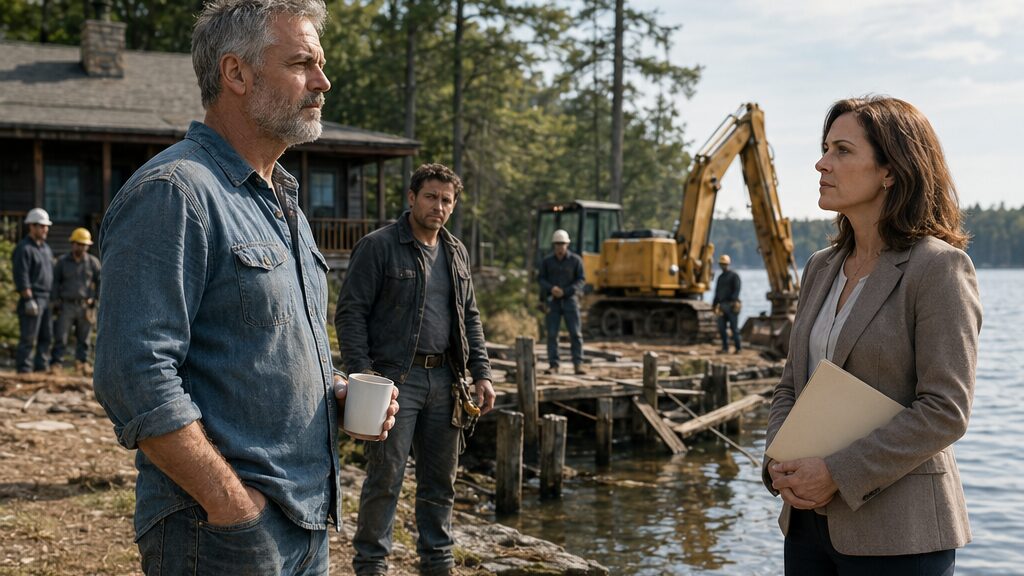
The cabin behind him sat exactly where it always had, tucked between the trees with its weathered boards and wide windows facing the water. The place was not impressive because it was large. It was valuable because it was home.
He had spent years making sure it stayed that way.
The dock was not decoration.
It was how he carried supplies down to the water. It was how neighbors reached the shoreline without walking through uneven ground. It was the safest route when someone needed to move along the edge of the property.
And now it was becoming a problem.
Frank walked back toward the cabin and found William Lewis unloading tools from his truck.
“You found something,” William said immediately.
Frank looked over.
“How can you tell?”
“Because you’re standing there holding that mug like you’re trying not to throw it into the lake.”
Frank glanced down at the mug in his hand and almost smiled.
“I’m not throwing it.”
“Good. Those things are harder to replace than people think.”
William walked toward the dock carrying a flashlight and a small measuring tool. He had repaired enough structures around the lake to know when someone was hoping for a simple answer.
Frank followed.
After several minutes of checking the supports, William stood up.
“It’s worse than it looks.”
Frank folded his arms.
“How bad?”
“Bad enough that I wouldn’t wait.”
The answer landed heavier than Frank expected.
“Can you reinforce it?”
“Yes.”
“Then do it.”
William hesitated.
“That depends.”
Frank already knew what was coming.
“The HOA.”
William nodded.
“The shoreline rules. Exterior changes. Structural modifications. You know how they are.”
Frank looked back toward the water.
“I submitted requests before.”
“And?”
“They asked for additional documents.”
“Then you sent them.”
“Yes.”
“And?”
Frank was quiet.
Nothing.
No approval.
No denial.
No response.
Just another request for more information.
William looked at the damaged support again.
“The lake doesn’t wait for paperwork.”
Frank knew that.
That was exactly why he disliked this situation.
He had never been the person who ignored rules. He had never been interested in fighting neighbors or creating problems. If a process existed, he followed it.
That was how communities worked.
People respected boundaries.
People communicated.
People solved things before they became arguments.
He took out his phone and opened the HOA portal.
“I’ll send another emergency request.”
William sighed softly.
“Frank.”
“I’ll send it.”
William studied him for a moment, then nodded.
“Okay. But make sure they understand what’s happening.”
Frank looked at the dock again.
“I’ll make sure.”
By sunset, the request was submitted.
He included the pictures.
He included William’s assessment.
He included a detailed explanation of why the repair was necessary.
He did not write angry words.
He did not accuse anyone.
He simply explained the problem.
The next morning, he checked his email before breakfast.
Nothing.
By noon, nothing.
By the afternoon, still nothing.
Frank stood at the kitchen counter staring at his phone while his coffee cooled beside him.
He told himself patience mattered.
He told himself someone at the HOA office was reviewing it.
He told himself there was a reasonable explanation.
But then he heard the sound of paper sliding against wood.
Frank looked toward the front door.
A notice had been placed there.
Not mailed.
Not emailed.
Placed.
He walked over and picked it up.
The first line was enough to make him stop.
Violation Notice.
His eyes moved down the page.
Unauthorized shoreline structure modification.
Failure to receive prior approval.
Required corrective action.
Frank read it twice.
Then a third time.
Behind the words was the same problem he had been trying to solve.
The dock was failing.
And somehow, the attempt to prevent that failure had become the violation.
He stepped outside.
The lake was still.
The cabin was quiet.
The dock waited at the shoreline, damaged but standing.
Frank looked at the notice in his hand.
For the first time, he wondered if the people reviewing his request had ever looked at the thing they were ordering him to fix.
Or if they had only looked at the form.
Chapter 2: The Approval Form That Stopped The Repair
The contractor arrived with lumber, tools, and no permission to work.
William Lewis had barely parked before a vehicle pulled in behind him.
Frank saw it through the cabin window.
A dark SUV stopped near the driveway.
A woman stepped out holding a folder.
Nancy Walker.
She walked toward the dock before she even reached the house.
Frank followed.
“Good morning,” he said.
Nancy did not return the greeting.
“Are you planning to begin construction today?”
William looked between them.
“We’re planning to stabilize a damaged structure.”
Nancy opened the folder.
“That structure was modified without approval.”
Frank looked at the papers in her hand.
“I submitted an emergency repair request.”
“You submitted a request after beginning unauthorized preparation.”
“I photographed the damage before any work started.”
Nancy looked toward the dock.
“The issue is not whether you believe the repair is necessary.”
Frank felt his jaw tighten.
“Then what is the issue?”
“The issue is compliance.”
The word sat between them.
Frank looked at the damaged support beams.
“Compliance with what?”
Nancy opened the folder and removed a printed page.
“Section seven point four. Exterior shoreline modifications require review before installation.”
“This isn’t a new installation.”
“You added reinforcement materials.”
“Because the original supports are failing.”
Nancy kept her expression controlled.
“The HOA cannot allow every homeowner to make independent changes and claim urgency afterward.”
Frank stared at her.
“This is not every homeowner.”
William stepped forward.
“The support is damaged. If it shifts, the dock could collapse.”
Nancy looked at him.
“Are you the contractor?”
“Yes.”
“Then you understand you cannot proceed without approval.”
William glanced at Frank.
Frank knew that look.
William wanted him to push harder.
Frank wanted to.
But he still believed the answer was obvious.
The damage existed.
The repair was necessary.
Someone would see that.
Someone would understand.
“Nancy,” Frank said carefully, “I am asking for an emergency review.”
“You already received a notice.”
“A violation notice is not an answer.”
“It is an enforcement action.”
Frank looked down at the paper.
“Because I tried to prevent damage?”
“Because you changed the property without authorization.”
The conversation felt like it was moving in circles.
Every explanation returned to the same place.
The form.
The approval.
The rule.
Not the dock.
Not the risk.
Not the reason.
Nancy closed the folder.
“I suggest you stop any further work.”
“And if I don’t?”
Her expression did not change.
“Then the HOA will take action to restore compliance.”
William looked toward the lake.
“Restore compliance means what?”
Nancy did not answer immediately.
That pause bothered Frank more than the words.
“It means the structure will be returned to its approved condition.”
The meaning arrived slowly.
Frank looked at the reinforced supports.
“You mean removed.”
“If necessary.”
The lake behind her remained perfectly calm.
That almost made it worse.
Because nothing about the scene looked like an emergency.
Only the people standing there knew one existed.
After Nancy left, William picked up a piece of wood from the truck and turned it in his hands.
“She’s not listening.”
Frank looked at the notice again.
“She thinks she is.”
“What’s the difference?”
Frank did not answer.
Because he knew.
Someone who refused to listen could still be reached.
Someone who believed they had already done the right thing was harder.
That evening, Frank opened the HOA portal again.
He uploaded additional photos.
He wrote another explanation.
He requested a board review.
He waited.
The next morning, a response appeared.
Request denied.
Reason:
Non-compliant modification.
Frank stared at the screen.
A few minutes later, another message arrived.
Scheduled corrective action.
Two days.
Frank walked outside.
The dock stood in the distance.
The same dock Nancy called a violation.
The same dock William said could fail.
The same dock Frank had spent years maintaining.
He placed his phone on the table and looked toward the lake.
Then he heard something.
A truck.
Not a delivery truck.
A heavier sound.
Frank walked toward the driveway.
At the edge of the property, a worker was unloading equipment.
Another worker carried tools toward the shoreline.
And behind them, attached to the truck window, was a paper with the HOA seal.
Frank stopped walking.
The removal crew had arrived.
Chapter 3: The Crew That Came To Remove Safety
The machine was already running when Frank reached the dock.
That was the first thing he noticed.
Not Nancy.
Not the workers.
Not the clipboard in the supervisor’s hand.
The machine.
Its engine vibrated beside the shoreline while a worker stood near the damaged support beams with a cutting tool.
Frank stopped halfway down the path.
For a moment, he simply watched.
The same dock he had tried to protect was now surrounded by people preparing to take it apart.
Nancy Walker stood near the water wearing a dark jacket over her office clothes, her folder tucked beneath one arm.
She looked prepared.
Frank realized she had not come to discuss anything.
She had come after the decision was already made.
“Stop the work,” Frank said.
The worker holding the tool looked toward Nancy.
Nancy stepped forward.
“Frank.”
“You sent a crew before the review.”
“The review was completed.”
“No. The request was denied.”
“Yes.”
“Because you classified a safety repair as an unauthorized modification.”
Nancy kept her voice calm.
“Because that is what it was.”
Frank reached into his pocket and turned on his phone camera.
The small motion changed her expression slightly.
“You are recording?”
“Yes.”
“Why?”
“Because this is the point where everyone remembers the conversation differently.”
The machine continued running behind them.
The sound filled the silence.
Nancy looked toward the crew.
“They have authorization to restore the property.”
Frank held up the phone.
“Show me the emergency review denial.”
Nancy paused.
“I already provided the notice.”
“That is not what I asked.”
The worker near the dock looked uncomfortable.
Frank noticed.
These people were not angry.
They were not trying to hurt him.
They had instructions.
That was almost harder.
The harm was happening without anyone feeling responsible for it.
Nancy opened her folder.
“You were notified of the violation.”
“I was.”
“You were given an opportunity to correct it.”
“I requested permission to repair it.”
“And that request was denied.”
Frank looked at the dock.
“Because you never looked at what the repair was protecting.”
Nancy’s face tightened.
“That is an assumption.”
“No.”
Frank pointed toward the support beams.
“That is the problem.”
A worker approached the first support.
Frank stepped forward.
Not aggressively.
Not shouting.
Just enough.
“Do not cut that.”
The worker stopped.
Nancy moved closer.
“Frank, step aside.”
“No.”
The word surprised even him.
For years, Frank had avoided these moments.
He had chosen patience.
Politeness.
Quiet conversations.
But watching the dock come apart was different.
This was no longer about paperwork.
This was about what happened after paperwork failed.
Nancy lowered her voice.
“You are making this more difficult.”
Frank looked at her.
“No. The difficult part happened when nobody answered.”
For the first time, Nancy looked away.
Only briefly.
But Frank saw it.
A small hesitation.
Then the supervisor stepped forward.
“We have instructions to continue.”
Frank looked at the equipment.
Then back at the supervisor.
“Do you know why this was reinforced?”
The man shook his head.
“No.”
“Because the shoreline underneath it is shifting.”
Nancy crossed her arms.
“That has not been confirmed.”
William’s truck pulled into the driveway before Frank could answer.
William hurried down the path carrying a folder.
“Stop.”
Everyone turned.
William looked at Frank first.
Then Nancy.
“You need to see this.”
Nancy did not move.
“What is it?”
William opened the folder.
“The original assessment.”
Nancy glanced at the pages.
Frank watched her eyes move.
“This is from before the repair request,” William said. “The damage wasn’t limited to Frank’s dock.”
The machine continued idling.
Nobody spoke.
William pointed toward the shoreline.
“The support system connects with the neighboring access points. If these sections fail, the erosion spreads.”
Frank looked at Nancy.
“The repair was not only for me.”
William nodded.
“It was protecting the shoreline.”
Nancy’s expression changed.
Not completely.
Not enough to admit she was wrong.
But enough to show she had not known everything.
Frank lowered his phone slightly.
The truth had entered the conversation.
But it had arrived too late.
The equipment was still there.
The order was still active.
And the question that remained was no longer whether Frank had broken a rule.
It was why nobody had looked closely enough before deciding to tear it apart.
Chapter 4: The Records Hidden Behind The Enforcement
The room went quiet when the photographs appeared on the screen.
Not because they were dramatic.
Because they were ordinary.
A wooden dock. A shoreline. A set of support beams. A section of lake access that looked exactly like hundreds of other repairs people made every year.
Until the details became impossible to ignore.
Frank Mitchell sat at the end of the HOA meeting table with his hands folded in front of him. His phone was no longer recording. There was no need.
Everyone in the room was already watching.
William Lewis stood near the screen, pointing to the images he had taken before the removal crew arrived.
“This support was damaged here,” William said. “And this section was beginning to shift here.”
One of the board members leaned forward.
“How long had this been happening?”
Frank looked toward Nancy Walker.
That was the question he had been trying to answer since the beginning.
Nancy sat across the room with her folder closed.
“Mr. Lewis, your assessment is one opinion.”
William nodded.
“It is.”
“Not an official HOA inspection.”
“No.”
Nancy looked around the room.
“And that is exactly why the approval process exists.”
Frank felt the familiar frustration return.
The words were different.
The argument was the same.
Process.
Approval.
Rules.
Everything had a place except the problem itself.
He looked at the damaged dock pieces stacked outside the meeting room window.
The broken sections had been moved there after the crew stopped work. They were still wet from the lake.
Proof that something had happened.
Proof that something had been taken apart.
But not proof that anyone had understood why.
A board member turned toward Nancy.
“When did you first receive the repair request?”
Nancy answered quickly.
“After unauthorized work had already begun.”
Frank looked up.
“That is not true.”
Nancy looked at him.
“You submitted a request after materials were delivered.”
“Because I had already documented the damage.”
“You began preparation.”
“I photographed the damage and contacted a contractor.”
“That is preparation.”
Frank paused.
He wanted to argue.
He wanted to explain every step.
Instead, he looked at the board members.
“I contacted someone because I believed the structure was becoming unsafe. I was trying to prevent a problem, not create one.”
The room became quiet again.
Not because everyone agreed.
Because the difference mattered.
A board member opened a folder.
“We have another question.”
Everyone looked over.
“The emergency review request.”
Nancy’s expression changed slightly.
“What about it?”
“When was it assigned?”
Nancy looked toward the paperwork.
“It was handled according to procedure.”
“That is not what I asked.”
Frank noticed the change.
For the first time, the conversation moved away from whether the repair should have been approved.
It moved toward whether anyone had actually looked at it.
The board member continued.
“The request was marked received.”
“Yes.”
“Then why was there no inspection scheduled?”
Nancy remained silent for a moment.
“It was determined that the modification itself violated the guidelines.”
“That decision was made before inspection?”
Nancy looked down.
Only for a second.
But everyone saw it.
Frank leaned back.
The answer had not been a denial of the danger.
It had been a denial of the possibility that the danger mattered.
William stepped closer to the table.
“There is something else.”
Nancy looked tired now.
“What?”
“The neighboring access points.”
William brought up another image.
The shoreline stretched beyond Frank’s property.
“The erosion was not staying in one place. The damaged support system was affecting the entire section.”
A board member frowned.
“You’re saying Frank’s repair protected other properties?”
“Yes.”
Frank looked at the screen.
He had known the dock mattered.
He had not known exactly how many people depended on it.
That realization changed something.
For weeks, he had thought he was fighting for his own home.
Now he understood he had been fighting for something larger.
Nancy noticed the shift in the room.
She closed her folder.
“I understand the concern.”
Frank looked at her.
It was the first time she had said anything close to that.
But then she continued.
“The HOA still cannot allow homeowners to bypass approval.”
Nobody answered immediately.
Because that statement was not completely wrong.
And that was the problem.
Frank had never wanted rules removed.
He had wanted them applied to reality.
A board member tapped the papers.
“Did you know about the erosion risk before the removal order?”
Nancy looked toward the window.
“No.”
“Did anyone in enforcement know?”
Another pause.
“No.”
Frank watched her carefully.
She was not pretending anymore.
She had made a decision with incomplete information.
But she had also chosen not to search for more information before acting.
The distinction mattered.
After the meeting ended, Frank stayed behind.
He gathered his documents slowly.
The room emptied around him.
Nancy remained.
“You think I wanted this outcome,” she said.
Frank looked up.
He had not expected that.
“I don’t know what you wanted.”
She looked toward the window.
“When I took this position, I inherited years of complaints. Everyone wanted exceptions. Everyone believed their situation was different.”
Frank placed the papers into his folder.
“Some people are different.”
Nancy looked at him.
“I know that now.”
The answer surprised him.
Not because it fixed anything.
Because it sounded honest.
Then she added:
“But if I allow every person to decide their own emergency, the rules stop meaning anything.”
Frank closed the folder.
“And if you enforce every rule without understanding the emergency, people get hurt.”
Nancy did not respond.
She did not have to.
The silence answered enough.
Frank walked outside.
Near the entrance, a board member approached him.
“Frank.”
He turned.
The board member held a printed record.
“We found something.”
Frank took the paper.
At the top was a list of shoreline properties.
His name was there.
So were several others.
“This is from the original shoreline assessment,” the board member said.
Frank scanned the page.
“These are all affected?”
“Yes.”
His eyes moved down the list.
The dock was not just one homeowner’s problem.
It was the first visible sign of something larger.
The board member looked toward the meeting room.
“Nancy thought she was stopping one unauthorized repair.”
Frank folded the paper.
“And what was she actually stopping?”
The board member looked at the damaged dock pieces outside.
“We’re trying to figure that out.”
Chapter 5: The Meeting Where Standards Faced Reality
The residents arrived expecting a violation hearing.
They found a room full of damaged dock pieces instead.
That changed everything.
Frank stood near the entrance as neighbors walked in and looked toward the broken wood stacked along the wall.
Some recognized the pieces immediately.
Others did not.
But everyone understood what they represented.
Something had been removed before everyone understood why it existed.
Frank watched Nancy enter from the other side of the room.
She did not carry the same confidence she had at the dock.
She still had the folder.
Still had the same careful posture.
But the certainty was gone.
The meeting began with a simple question from the board chair.
“Why was emergency repair treated as a standard violation?”
Nancy sat forward.
“Because the request involved a modification that had not been approved.”
A neighbor raised a hand.
“But did you know it was a safety repair?”
Nancy hesitated.
“No.”
The answer moved through the room.
Not loudly.
Not dramatically.
Just enough.
Frank noticed something important.
Nancy was no longer defending the decision as if nothing had happened.
She was defending why she had made it.
There was a difference.
The board chair looked at Frank.
“Mr. Mitchell, before we discuss changes, we need your statement.”
Frank stood.
For years, he had avoided these moments.
He hated standing in front of groups.
He hated turning disagreements into public events.
A part of him wanted to say everything privately.
Find the right person.
Explain calmly.
Wait for someone reasonable to respond.
That had always been his instinct.
But his instinct had brought him here.
To a room where a crew had arrived with equipment because quiet explanations had not been enough.
Frank looked at the residents.
“The first thing I want to say is that I do not believe rules are the problem.”
The room settled.
“Rules exist because communities need them.”
Nancy looked at him.
“But rules are supposed to protect people. They are not supposed to replace judgment.”
He held up the shoreline assessment.
“This repair was delayed because the process treated it as an appearance issue before anyone considered the safety issue.”
A resident near the back spoke.
“Did the repair affect everyone?”
William answered before Frank could.
“Yes.”
The board displayed the shoreline images again.
The conversation shifted.
People who had arrived expecting to discuss one homeowner’s violation were now discussing a shared risk.
Nancy watched the screen.
Frank saw her expression change.
Not guilt.
Not shame.
Recognition.
She had built her entire argument around preventing exceptions.
Now she was realizing she had missed the thing the rules were supposed to protect.
During a break, Frank found her standing alone outside the meeting room.
“You should have told me sooner,” she said.
Frank looked at her.
“Told you what?”
“That it affected other properties.”
Frank shook his head.
“I tried to tell you it was serious.”
“You said your dock was damaged.”
“Because that was what I knew.”
Nancy looked down.
“That sounds like the same mistake I made.”
Frank did not answer.
Because she was right.
He had also seen only part of the picture.
He had focused on saving his dock.
She had focused on enforcing the rule.
Neither had fully understood the larger problem.
Then Nancy looked back toward the room.
“But if I admit I handled this wrong, people will say enforcement is weak.”
Frank studied her.
There it was.
The thing beneath the rules.
Not cruelty.
Fear.
Fear that losing control meant losing authority.
“Being responsible is not the same as never being wrong,” Frank said.
Nancy looked at him.
“That is easy for you to say.”
“No.”
Frank glanced toward the lake.
“It isn’t.”
She waited.
“I spent weeks thinking if I explained the facts clearly enough, someone would fix it.”
He looked back at her.
“I waited too long to make people listen.”
For a moment, neither of them spoke.
Then the board chair called everyone back inside.
The final discussion lasted another hour.
The board considered temporary approval.
Emergency procedures.
Inspection requirements.
Documentation changes.
Progress.
But not a final answer.
At the end of the meeting, the board chair made one announcement.
“The board will vote after hearing directly from the homeowner.”
Frank looked up.
“From me?”
“Yes.”
The room slowly emptied.
Frank remained seated.
The dock pieces were still visible through the window.
The same pieces that had started the conflict.
The same pieces that now carried a different meaning.
He had spent his life believing that if he did the right thing quietly, the right people would recognize it.
But now he understood something.
Sometimes silence protected peace.
Sometimes silence allowed problems to grow.
The board chair placed the final hearing notice in front of him.
“Tomorrow morning.”
Frank looked at the paper.
A choice had been placed in front of him.
He could make the argument about himself.
Or he could explain why the repair mattered beyond his own property.
He picked up the notice.
And for the first time since the conflict began, he knew exactly what he needed to say.
Chapter 6: The Repair Decision That Changed The Shoreline
The same truck that had carried away pieces of the dock returned three weeks later carrying new beams.
Frank noticed it before anyone knocked.
He was standing near the kitchen window with his white ceramic mug in his hand when he saw the equipment turning onto the gravel road.
For a moment, he did not move.
The sight was almost too familiar.
A truck.
Workers.
Tools.
A machine near the shoreline.
The first time they arrived, they had come to remove something.
This time, they had come to restore it.
Frank stepped outside.
William Lewis was already walking toward the dock area.
“Looks different this time,” William said.
Frank looked at the workers unloading materials.
“It does.”
William smiled slightly.
“You sound surprised.”
“I am.”
The past few weeks had been filled with meetings, documents, inspections, and conversations that seemed to create more paperwork than solutions.
Frank had expected a fight.
He had expected people to defend their positions.
He had not expected the process to actually change.
But it had.
The board had approved a new emergency repair procedure.
Requests involving safety concerns would receive immediate review.
Temporary stabilization work could begin while final approval was pending.
And the removal order against Frank’s dock had been withdrawn.
Not erased.
Not ignored.
Documented.
That mattered to him.
A correction was not the same thing as pretending nothing happened.
Nancy Walker approached from the direction of the HOA office vehicle.
Frank noticed she looked uncomfortable.
Not angry.
Not defensive.
Just aware.
“I wanted to be here when work started,” she said.
Frank nodded.
“Why?”
Nancy looked toward the lake.
“Because I should have been here the first time.”
The answer stayed with him.
For weeks, Frank had imagined this moment differently.
He had imagined anger.
An apology.
Someone admitting they were completely wrong.
But standing there, he realized the situation had never been that simple.
Nancy had made a mistake.
A serious one.
But she had not woken up wanting the dock destroyed.
She had believed she was protecting the community.
The problem was that she had protected the rules before understanding the people those rules were supposed to serve.
“The board approved the new process,” Nancy said.
“I know.”
“And the repair?”
“Approved.”
She nodded.
A small movement.
Almost relief.
“Good.”
Frank looked at her.
“You fought for the process.”
Nancy looked surprised.
“I also caused the delay.”
“Yes.”
The honesty made her look away.
Frank continued.
“But fixing that matters.”
For a moment, the two of them watched the workers begin measuring the shoreline.
The sound of tools replaced the sound of the removal equipment from weeks earlier.
Same location.
Different meaning.
William approached with a clipboard.
“We found another issue.”
Frank turned.
“What?”
“The delay caused more damage than we originally expected.”
The words were quiet.
But they carried weight.
Frank looked toward the damaged shoreline.
“How much?”
“Not enough to stop the repair. But enough that it will take longer.”
Nancy looked at the dock pieces.
“That happened because of the delay.”
Nobody answered.
Because everyone knew.
The repair was moving forward.
The problem was that progress did not erase what had already happened.
Frank walked down toward the water.
The old dock had been a part of his daily life for years.
He remembered sitting there early mornings with coffee.
He remembered neighbors carrying supplies across it.
He remembered thinking that if something was important enough, people would recognize it.
Now he understood something else.
Sometimes people only recognize importance after something is almost lost.
The workers began placing the first support beams.
Frank watched carefully.
Not because he doubted them.
Because this time he wanted to be present.
He wanted to see the thing rebuilt.
Later that afternoon, the board chair arrived with the final approval documents.
Frank signed them.
No celebration.
No crowd.
No speeches.
Just paperwork.
A corrected process.
A repaired shoreline.
Exactly the kind of ending he had wanted from the beginning.
As the sun lowered, the workers packed their equipment.
William stood beside Frank.
“You ever think about how strange this all was?”
Frank looked at him.
“The strange part is that we almost lost something everyone needed because nobody asked why it existed.”
William nodded.
“That happens more than people think.”
Frank looked at the repaired section of shoreline.
The dock was not finished yet.
Not completely.
There were still marks where the old supports had been removed.
Still places where the damage showed.
But for the first time in weeks, those marks no longer felt like evidence of a fight.
They looked like proof that something had been repaired.
Not just wood.
Not just a structure.
A way of handling problems.
That evening, Frank walked back to the cabin alone.
The dock behind him was still unfinished.
The lake was quiet.
He placed his mug on the railing.
Then he sat down.
The same place where everything had started.
But now the question was different.
Not whether the dock would survive.
Whether he would.
Chapter 7: The Quiet Water After The Rules Changed
Frank sat at the end of the rebuilt dock exactly where he had sat before everything changed.
The difference was that now nobody was coming down the path with a folder.
Nobody was carrying a violation notice.
Nobody was bringing a machine to take something away.
The lake stretched quietly in front of him.
And the dock beneath his feet was solid.
A child from one of the neighboring homes walked across the shoreline path with a parent that morning.
A few months earlier, Frank would have barely noticed.
Now he watched.
Not because he was worried.
Because he understood what the repair meant.
It was easy to look at wood and concrete and measurements and forget what they allowed people to do.
Move.
Reach.
Visit.
Stay connected.
The dock was not important because it was a structure.
It was important because of what happened on it.
William arrived later that afternoon carrying a small toolbox.
“Still checking my work?”
Frank looked over.
“Still checking mine.”
William laughed.
“That sounds more like you.”
Frank smiled.
The repair had become part of the shoreline again.
The marks from the old damage were mostly gone.
The new supports blended with the original structure.
Someone walking by would never know how close it had come to disappearing.
Maybe that was normal.
Most important things looked ordinary once they were protected.
A vehicle pulled into the driveway.
Frank recognized it before the person stepped out.
Nancy.
She walked toward the dock slowly.
No folder.
No paperwork.
Just herself.
“I won’t stay long,” she said.
Frank nodded.
“That’s okay.”
Nancy looked around.
“The board approved the emergency procedure changes last night.”
“I heard.”
“And we’re sending the updated guidelines to everyone.”
Frank looked at the water.
“Good.”
She stood quietly beside him.
The silence between them was different now.
Not comfortable.
Not exactly.
But honest.
“I used to think consistency was the most important thing,” Nancy said.
Frank listened.
“If everyone follows the same rule, the community stays fair.”
“That makes sense.”
She looked at him.
“But I forgot something.”
“What?”
“That fairness is supposed to consider why the rule exists.”
Frank nodded slowly.
He understood that.
Because he had forgotten something too.
He had believed doing everything correctly would remove the need to fight.
But sometimes responsibility required more than following the process.
Sometimes it required making sure the process worked.
Nancy looked at the dock.
“I’m sorry for what happened.”
Frank did not answer immediately.
Not because he wanted her to suffer.
Because he wanted the apology to mean what it meant.
Finally, he said:
“I appreciate that.”
It was enough.
Neither of them needed a dramatic moment.
The lake did not change.
The house did not change.
The dock simply remained.
And that was the point.
A home was not protected by winning arguments.
It was protected by people willing to notice when something mattered.
Weeks later, the shoreline looked almost exactly as it had before the conflict.
Almost.
The only difference was the small sign near the community access path.
Emergency repairs and safety concerns receive immediate review.
Frank had voted for it.
Nancy had written the first draft.
Neither of them considered that a victory over the other.
It was a correction.
One evening, Frank returned to the dock carrying his mug.
He sat down and watched the water.
The same chair.
The same view.
The same quiet place.
But he was not the same person.
He still disliked confrontation.
He still preferred solving problems quietly.
That part of him had not disappeared.
It did not need to.
The lesson was not that patience was wrong.
The lesson was that patience could not replace action when something important was at risk.
Frank placed the mug beside him.
The dock beneath his feet held firm.
Across the lake, lights from other homes reflected on the water.
A community.
Not because everyone agreed.
Because when something mattered, they learned to look closer before tearing it apart.
The repair had started as a fight over permission.
It ended as a reminder.
A home was not just the place people lived.
It was the place they fought to keep safe.
The story has ended.