The Gold Key at His Door Could Not Unlock the Truth About the Lift
Chapter 1: The Machine Was Already Cutting Through the Porch
The saw was already cutting through the lift rail when Alexander Carter opened the front door.
The sound came through the house as a hard metallic scream, loud enough to startle both German shepherds from the rug and send Ruth’s water glass trembling against the table beside her chair.
Alexander stepped onto the threshold with his white mug still in his hand.
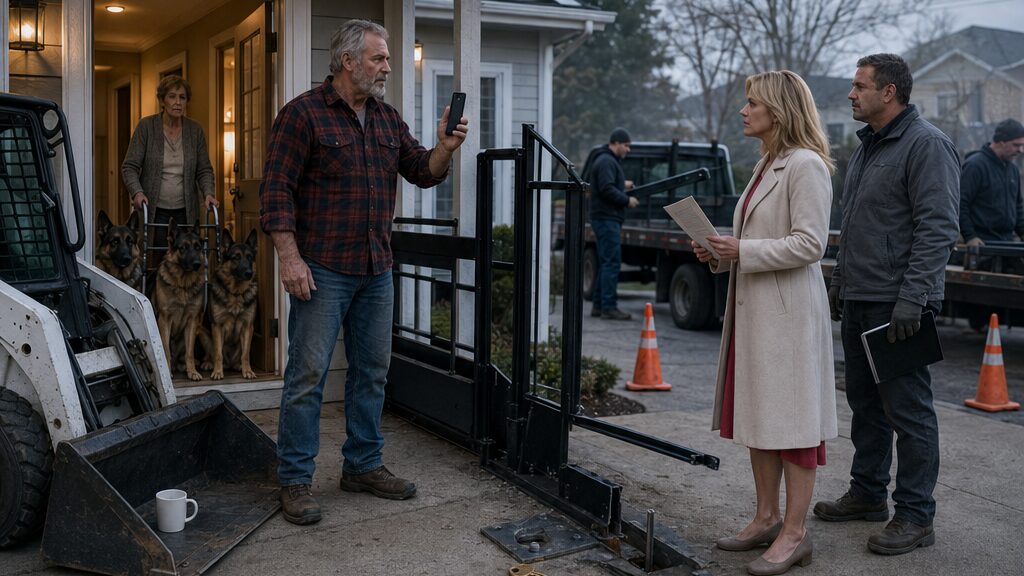
A compact loader idled in the driveway beneath the pale morning sky. Its bucket rested inches above the concrete path. One worker held a reciprocating saw against the lower rail of the platform lift. Another had already removed two sections of the black safety barrier and was carrying them toward a flatbed truck.
Orange cones stood across Alexander’s walkway as though the property had stopped belonging to him sometime before breakfast.
“Stop the saw,” he said.
The worker glanced toward a man in a gray work jacket near the loader.
The man raised one hand. The saw wound down, leaving a high ringing silence behind it.
A fresh cut shone silver through the black powder coating. Metal filings glittered across the porch boards.
Alexander stepped outside.
“Who authorized you to begin?”
The man approached without hurrying. He was broad-shouldered, perhaps forty, with a clipboard tucked under one arm. “Andrew Lewis. Site supervisor.”
“That wasn’t what I asked.”
Andrew looked past him toward the front door. “Homeowners’ association contracted us to remove an unapproved exterior structure.”
“It’s a residential platform lift.”
“I know what it is.”
“Then you know removing half of it leaves the entrance unsafe.”
Andrew’s mouth tightened. “I have a work order.”
“From a court?”
“From the association.”
Alexander placed his mug on the loader’s lowered bucket.
The ceramic made a small sound against the steel. It was not dramatic, but both workers stopped moving.
Alexander took out his phone and started recording.
“State your name again.”
Andrew looked at the phone. “Andrew Lewis.”
“Do you have a court order authorizing you to dismantle equipment attached to my house?”
“I have an HOA enforcement order.”
“That is not the same thing.”
A woman’s voice came from the driveway.
“It is sufficient under the covenants.”
Stephanie Hill stood beside a dark sedan in a bright rose-colored dress beneath a cream coat, one hand holding a folder against her ribs. The color looked almost artificial against the gray morning and the machinery. Her hair was carefully arranged. Her shoes were not made for a construction site, and she stepped around the gravel as though irritated that the ground had failed to prepare for her.
Alexander kept the phone pointed toward the crew.
“Were you here when they started?”
“I’m here now.”
“That wasn’t the question.”
Stephanie came closer. “The board authorized emergency removal after determining that this installation presents an unreviewed liability.”
“It was inspected by the installer.”
“An installer is not the architectural committee.”
“The manufacturer’s technician signed the safety certification.”
“The association never approved the exterior alteration.”
Alexander looked toward the porch. One rail section leaned against the truck. A worker had unbolted the control housing but left its wiring exposed beneath a plastic cap.
“Where is the notice?”
Stephanie opened the folder and held out a page.
He did not take it.
“When was it delivered?”
“This morning.”
“Where?”
“Your front door.”
Alexander turned his phone toward the doorway. The glass storm door stood open. The painted wood beneath the brass handle was bare. No envelope. No tape mark. Nothing on the mat except a few curls of black metal carried by someone’s boots.
“I opened that door because I heard a saw,” he said. “There was no notice.”
“It may have fallen.”
“Show me where.”
Stephanie’s expression changed by less than an inch. Her lips pressed together, then relaxed.
“The crew was instructed to post notice before beginning.”
Andrew looked toward one of the workers.
The worker shook his head once.
Stephanie noticed.
“This is not the place to debate service procedure,” she said. “The structure has no final approval, and the association has an obligation to prevent continued exposure.”
“Exposure to what?”
“Property damage. Injury. Insurance claims.”
The dogs appeared behind Alexander.
Both stopped at the interior edge of the threshold. Their ears stood forward, but neither barked. Alexander did not turn. He had trained them to hold there, and they remained motionless, dark shapes against the warm light of the hall.
Ruth’s walker touched the floor behind them.
The small rubber wheels made a soft double tap.
Alexander looked back.
She had risen from her chair despite his asking her to wait. One hand gripped the walker. The other pressed against the wall near the coat hooks. Her face was pale with the effort of crossing the room.
“Alex,” she said.
He moved toward her, but she lifted her chin.
“Don’t.”
The word stopped him.
Ruth reached the interior side of the doorway. The platform outside sat six inches lower than it had the night before because the crew had disconnected one of the stabilizing brackets. The removed rail left the side exposed above the walkway. Between her walker and the porch was a strip of metal, cut bolts, and an uneven gap.
She looked at Andrew.
“Can I use it?”
Andrew did not answer immediately.
“Not in its current condition,” he said.
“Can I use the steps?”
His eyes shifted to the three narrow concrete steps beside the lift.
Ruth’s left leg trembled visibly beneath her robe.
“No, ma’am,” he said.
Stephanie spoke before anyone else could.
“The structure was installed without authorization. Its temporary loss of use is a consequence of that decision.”
Alexander turned the phone toward her.
“Say that again.”
Stephanie looked directly into the lens. “The association did not create this situation.”
“You sent a crew that disabled the only safe entrance my wife can use.”
“You installed equipment before approval.”
“After twenty-three days without a decision.”
“The application was incomplete.”
“What was missing?”
“Final architectural authorization.”
“That is the decision you didn’t make.”
Stephanie drew a slow breath, as if disciplining herself not to answer in the tone he had earned.
“The board did not classify this as an accommodation. It was filed as an exterior alteration.”
Alexander felt Ruth behind him, close enough that he could hear the uneven rhythm of her breathing.
“I submitted plans, dimensions, electrical specifications, load ratings, and the installer’s certification.”
“You did.”
“And your office acknowledged receiving them.”
“Yes.”
“Then why is a machine on my property?”
“Because you proceeded without permission.”
The loader’s engine continued to idle. Its vibration traveled through the soles of Alexander’s shoes.
He turned to Andrew. “If you remove the rest, what happens to the doorway?”
Andrew studied the half-separated platform. “The anchors have to come out. There’ll be holes in the landing until they’re patched.”
“Today?”
“Patching isn’t in our order.”
“So you leave an open edge and exposed anchor holes where she exits.”
Andrew looked down at his clipboard.
“That is the scope we were given.”
Alexander stepped between the loader and the lift.
One of the workers shifted his weight.
Stephanie’s voice sharpened. “Do not interfere with contracted work.”
“I’m asking for the authority in writing.”
“I handed it to you.”
“You waved an association order at me after the cutting started.”
“It is signed by the board.”
“Then hold it up.”
She did.
Alexander moved closer, keeping the phone steady. The top page carried the HOA seal and four electronic signatures. The heading read EMERGENCY REMOVAL AUTHORIZATION. Below it, the lift was described as an unauthorized mechanical structure presenting potential injury and insurance exposure.
The page listed his address.
It did not mention Ruth.
It did not mention a medical need.
It did not mention the acknowledged application or the installer’s safety certification.
At the bottom, the order allowed immediate action “without further homeowner delay.”
Alexander read the phrase twice.
Behind Stephanie, the worker who had carried the rail to the truck set it down rather than loading it.
Andrew came nearer.
“I’m keeping the crew paused while this gets verified,” he said.
Stephanie turned on him. “You have already verified it.”
“I verified the association signed it. He’s claiming there’s an active accommodation issue.”
“There is no active accommodation issue.”
Ruth’s hand tightened on the walker.
Alexander saw it, though he kept the phone aimed toward Stephanie.
“What do you call a lift installed because a resident cannot use the stairs?”
“I call it an alteration unless the required accommodation process has been completed.”
“Did anyone ask why it was needed?”
“The applicant is responsible for submitting the proper request.”
“Did anyone ask?”
Stephanie looked toward Ruth then, but only briefly.
Her face held no pleasure in what was happening. That would have made her easier to understand. Instead there was strain in it, the expression of someone defending a line because she feared what would happen if the line moved.
Alexander bent and picked up one of the freshly cut anchor plates. Its edge was warm from the saw.
He held it toward the phone.
“This was secure when we went to bed.”
Stephanie lowered the order.
“You were notified that enforcement could occur.”
“Not today.”
“You knew removal was possible.”
“I knew you had threatened it.”
Andrew spoke quietly to his workers. “Nobody touches anything until I call the office.”
Stephanie stared at him. “Your company accepted this contract.”
“And the order doesn’t mention leaving an occupied home without an accessible exit.”
“It does not need to describe every consequence.”
“It does if the consequence changes the safety of the job.”
For the first time, Stephanie looked uncertain.
It lasted only a second.
She turned back to Alexander. “The board has followed the governing documents. You did not.”
Alexander pointed the camera directly at her.
“Is it your statement that no request concerning my wife’s mobility was received?”
Stephanie did not look away.
“There is no medical accommodation on file.”
Ruth made a sound behind him—not quite a word, but enough to make Alexander turn.
She was looking at him, not Stephanie.
And in her expression he saw something worse than fear.
He saw a question.
Chapter 2: The Request That Never Reached the Right Folder
The attachment list was shorter than Alexander remembered.
He sat at the kitchen table with his laptop open, the emergency removal order beside it and the warm anchor plate resting on a folded dish towel. The metal had cooled, but the saw marks remained bright.
Across the room, the dogs lay near Ruth’s chair. Neither had settled fully. One watched the hallway. The other watched Alexander.
He opened the message he had sent twenty-six days earlier.
SUBJECT: Exterior Access Modification Request—Carter Residence.
The body was precise. Measurements. Setback distance. Electrical load. Manufacturer. Installer license. A description of the rebuilt porch landing and compact platform lift. He had written that the modification was required for “safe household access.”
Below the message were four attachments.
Site plan.
Product specifications.
Installer insurance certificate.
Electrical permit application.
Four.
He remembered five.
Alexander clicked through each file anyway, as though the missing one might be hidden behind the others if he was patient enough.
It was not.
Ruth wheeled her walker closer and lowered herself into the chair opposite him. Moving even that distance left color high in her cheeks.
“You found it,” she said.
“I found the email.”
“That isn’t what I asked.”
He closed the attachment panel.
“The therapist’s letter wasn’t included.”
Ruth looked toward the narrow desk against the kitchen wall.
Alexander followed her gaze.
The desk had belonged to his father. Its top drawer stuck in damp weather and opened smoothly in winter. Alexander had used it for tax records, warranties, house plans, and every document he believed might someday matter.
He crossed the room and pulled the drawer open.
The envelope lay beneath the installer’s original estimate.
It was still sealed.
RUTH CARTER—FUNCTIONAL ACCESS RECOMMENDATION was printed across the front.
Ruth watched him carry it back.
“You said you sent everything.”
“I sent everything they needed to evaluate the structure.”
“That is not what you said.”
“They had the measurements. They had the specifications. The lift is certified.”
“That letter explains why it is there.”
“They don’t need your diagnosis.”
“It does not give them my diagnosis.”
“It identifies your therapist.”
“She wrote that I cannot safely use exterior stairs.”
“They could see that from the application.”
“Could they?”
Alexander set the envelope beside the cut anchor plate.
For weeks, he had treated the sealed paper as evidence of restraint. He had told himself that Ruth’s body was not community property, that an architectural committee had no right to a medical narrative simply because they controlled paint colors and fence heights.
He still believed that.
But the email on the screen did not say wheelchair. It did not say progressive. It did not say that Ruth had fallen on the second porch step in March and had lain against the railing while Alexander struggled to lift her without hurting her shoulder.
It said safe household access.
Technical words. Clean words.
Words that asked nobody to imagine Ruth at the threshold.
“I thought the structure should stand on its own,” he said.
Ruth’s fingers moved over the sealed edge of the envelope.
“It doesn’t stand on its own. It stands there for me.”
Alexander looked at the laptop.
Four weeks earlier, he had measured the porch three times before sending the request. He had marked the doorway width in pencil on the interior trim, then written every dimension into a table. He had checked the covenants for height limits and exterior materials. He had selected a lift with black rails because black matched the house lanterns and was less visible from the street.
The installer had warned him.
“You should submit this as an accommodation,” the man had said while kneeling beside the landing with a measuring tape.
“It’s an access lift.”
“That’s what I mean.”
“They’ll know what it is.”
The installer had looked up at him. “Committees know what paperwork tells them.”
Alexander had disliked the sentence enough to remember it exactly.
He searched his inbox for the HOA acknowledgement.
It arrived eight minutes after his request.
Your architectural modification submission has been received and assigned for exterior review.
No request for missing information.
No instruction to use a different form.
No warning that the lift would be treated as a standard alteration.
He scrolled farther.
Nine days later, he had sent a follow-up.
Please confirm review status. Installation is time-sensitive due to household access concerns.
The response came from the property manager.
The committee meets monthly. Homeowners should not begin work before written approval.
Alexander had answered that the governing documents required a decision within twenty-one days after a complete submission.
The property manager had replied: Completeness is determined by the committee.
“What did you send after that?” Ruth asked.
“The installer’s revised drawing.”
“And the letter?”
“No.”
She leaned back.
The silence between them was not angry in the way an argument was angry. It was heavier. It contained all the conversations that had stopped one sentence too early.
Alexander reopened the sent folder.
On day twenty-three, after no decision, he had notified the HOA that installation would begin because the delay was preventing safe use of the residence.
The response had come from Stephanie.
Proceeding before approval may result in fines and removal at owner expense.
He had read it at the time as a standard warning. He had printed it, filed it, and proceeded.
The lift had been installed in one day.
That evening, Ruth had used it for the first time. She had stood inside the rail enclosure gripping the control switch while the platform rose the short distance to the porch. Alexander had remained beside the stairs, one hand extended without touching her.
When the platform stopped level with the threshold, she had smiled.
Not because it was beautiful.
Because she had arrived without being carried.
Alexander looked down at the unopened envelope.
“I should have attached it,” he said.
Ruth’s expression softened, but not enough to absolve him.
“You should have asked me.”
He nodded once.
The admission hurt more because it was small.
He searched the HOA portal. The application record showed PENDING for nineteen days, then UNDER EXTERIOR REVIEW, then VIOLATION—UNAPPROVED CONSTRUCTION.
No accommodation field appeared anywhere.
“That may be their mistake,” he said.
“It may be yours too.”
He looked at her.
She did not withdraw it.
Outside, the damaged lift platform sat crooked beneath a blue tarp Andrew’s crew had placed over the exposed control housing before leaving. The tarp moved in the wind, revealing flashes of the cut rail.
Alexander opened the original application PDF.
At the bottom was a blank optional field labeled Special Circumstances.
He had written: None.
His chest tightened.
Ruth saw it.
“What?”
He turned the screen toward her.
She read the line.
“You wrote none.”
“I thought it meant design exceptions.”
“It says special circumstances.”
“I know what it says.”
“Now you do.”
Alexander closed his eyes briefly.
The mistake did not erase the HOA’s decision to dismantle equipment before notice. It did not explain Stephanie’s claim that no mobility request existed. It did not justify leaving the threshold unsafe.
But it gave the board a sentence they could point to.
None.
He had handed them the word himself.
The dogs lifted their heads when a delivery truck passed outside. Alexander waited until the sound faded.
Then he searched Stephanie’s name in the email chain.
Most messages were copied through the property manager. One was not.
It had been sent internally and accidentally included in a later forwarded thread.
From: Stephanie Hill
To: Property Manager
Subject: Carter Exterior Request
Hold until exterior review. If approved as submitted, every future mechanical addition will claim the same exception.
Alexander read it twice.
The timestamp was the morning after his original application.
Before his follow-up.
Before installation.
Before any violation.
Ruth leaned closer.
“She knew it was mechanical.”
“She knew enough to hold it.”
“Did she know why?”
Alexander scrolled upward through the forwarded chain.
Above Stephanie’s note was the property manager’s summary:
Owner describes time-sensitive safe access concern. No accommodation form attached.
Stephanie had received that too.
She had known there was an access concern.
She had also known the paperwork was incomplete.
Instead of asking for clarification, she had told the office to hold it.
Alexander printed the chain.
The printer in the corner woke with a low mechanical hum. Page after page slid into the tray.
Ruth touched the sealed therapist’s letter.
“We can still send it.”
“Yes.”
“But this time, I decide what goes with it.”
Alexander looked at her.
The question from the porch had not disappeared. It had only changed.
It was no longer whether the HOA had lost the truth.
It was whether he had ever allowed the truth to reach them.
Chapter 3: The Gold Key Fell Inside the Wrong Boundary
Alexander heard the metal enter the lock before Stephanie knocked.
It was after eight. The house was dark except for the amber lamp in the front hall and the kitchen light behind him. Ruth had gone to the bedroom early, exhausted from the morning and from the argument neither of them had fully finished.
The dogs raised their heads at the same instant.
A brass scrape came from the front door.
Then a short turn.
Alexander set his mug on the entry table.
“Stay.”
Both shepherds stood but did not move past the edge of the rug.
The lock turned again.
The handle lowered.
Alexander took out his phone and began recording before he crossed the hall.
The door opened two inches against the security chain.
Cold porch light cut through the gap.
Stephanie’s face appeared beyond it.
She froze.
Alexander did not speak.
For a moment neither of them moved. The chain held between the door and frame, trembling faintly from the pressure of her hand.
Then Stephanie released the handle.
“I was about to knock.”
“You used a key.”
“I believed the property might be temporarily unoccupied.”
“You saw my wife this morning.”
“I saw her inside a residence with a disabled entrance.”
“That made you think nobody was home?”
“I was instructed to deliver the revised notice and verify the condition of the removal site.”
“By opening my front door?”
Stephanie stepped back from the gap. She wore the same cream coat over the bright dress, though the careful arrangement of her hair had begun to loosen near one temple. A folder was tucked beneath her arm.
Alexander kept the phone raised.
“What key did you use?”
“Open the door, Mr. Carter.”
“What key?”
“This conversation does not need to become hostile.”
“You put metal into my lock.”
“The association maintains emergency access for limited circumstances.”
“This is not a vacant unit.”
“The property manager’s file indicated possible temporary relocation because the primary entrance is unusable.”
Alexander stared through the gap.
“You made the entrance unusable.”
“The crew’s work was paused.”
“After they cut it apart.”
“I am not debating that through a chained door.”
“Then leave the notice on the porch.”
Stephanie’s jaw tightened.
“I need visual confirmation that no further work has been performed on the installation.”
“You can see it from the driveway.”
“The control unit is not visible from there.”
“You do not have permission to inspect inside my house.”
“The lift is attached to an exterior landing under association jurisdiction.”
“The threshold is not.”
Behind Alexander, one dog gave a low breath through its nose.
Stephanie’s eyes shifted toward the sound.
Alexander unhooked the chain but kept one hand on the door.
He opened it only as far as his shoulder.
The dogs stepped forward together.
They stopped at the threshold.
Their bodies filled the lower half of the doorway. Their ears were upright, their attention fixed on Stephanie, but neither growled.
Stephanie moved back so quickly that the folder slipped from beneath her arm.
A folded notice struck the porch.
Something smaller hit the wood with a bright metallic sound.
A gold key spun once near the toe of her shoe, slid across the threshold, and came to rest inside the house.
Alexander looked down.
A small stamped tag hung from the ring.
HOA EMERGENCY ACCESS—MASTER.
Stephanie bent toward it.
“Leave it,” Alexander said.
She stopped.
The dogs did not move.
Alexander pointed the phone toward the key, then toward the open door and the security chain hanging loose against the frame.
“You used a master key on an occupied private residence.”
“The key is association property.”
“It is now evidence of how you entered.”
“You cannot keep it.”
“I can preserve what fell inside my home while you were trying to open the door.”
“I did not enter.”
“You opened the door.”
“The chain prevented entry.”
“The chain prevented you from going farther.”
Stephanie looked past him into the hall.
Warm light fell across the dogs’ backs. Beyond them, Ruth’s walker stood beside the bedroom door.
“This is exactly why the association requires access protocols,” she said.
Alexander almost laughed, but there was nothing humorous in the sentence.
“Protocols?”
“If a property appears vacant or unsafe, authorized representatives may confirm conditions.”
“Show me the authorization.”
She bent slowly and picked up the notice, careful not to move toward the key.
“The board issued a revised enforcement order this afternoon.”
“Slide it over.”
She pushed the folded pages across the porch with two fingers.
Alexander placed his foot on them and drew them inside without stepping past the threshold.
The first page imposed daily fines beginning the following morning. The second authorized completion of removal after a twenty-four-hour pause. A paragraph near the bottom stated that the structure could not remain in partially dismantled condition because it presented an immediate hazard.
Alexander read that line aloud.
“You created the condition, then classified it as a new emergency.”
“The structure was unauthorized before the crew arrived.”
“It was functional before the crew arrived.”
“That does not make it approved.”
“Does the order authorize your key?”
Stephanie folded her arms against the cold.
“The master key policy is separate.”
“Who told you the house was vacant?”
“The property manager’s records showed a possible relocation.”
“Whose statement?”
“I do not have that record with me.”
“Did Ruth tell anyone she had relocated?”
“No.”
“Did I?”
“No.”
“Did a neighbor?”
“I don’t know.”
“Then who converted ‘she cannot use the front entrance’ into ‘the house is vacant’?”
Stephanie’s expression shifted. Not guilt exactly. Calculation.
Alexander recognized it because he had worn the same look at the kitchen table while deciding which facts belonged on an application.
She was measuring how little she could say.
He stepped back one pace.
“Ruth,” he called.
The bedroom door opened.
She appeared with one hand on the walker, her face tired but alert. She took in the dogs, Stephanie on the porch, the notice under Alexander’s shoe, and the gold key on the floor.
“What happened?”
“She used a master key before knocking.”
Stephanie spoke quickly. “I was delivering enforcement papers and confirming whether the residence was occupied.”
Ruth stopped behind the dogs.
“You saw me this morning.”
“The file suggested you might be staying elsewhere because the entrance was inaccessible.”
Ruth’s gaze moved to the damaged lift outside.
“You made it inaccessible.”
“The board ordered removal because the installation was not approved.”
“And your answer to trapping me inside was to check whether I had left?”
The question landed without force, which made it harder to avoid.
Stephanie looked toward the driveway.
“The board cannot ignore an unreviewed mechanical structure.”
Ruth rested both hands on the walker.
“Did the board review why it was built?”
“There is no completed medical accommodation on file.”
“I sent one.”
Alexander turned toward her.
The dogs remained fixed at the threshold, but the room seemed to tilt behind them.
“When?” he asked.
Ruth looked at him.
“Three days ago.”
“You sent the letter?”
“A copy. Through the HOA portal.”
Stephanie’s face went still.
Alexander noticed.
“You received it,” he said.
“I did not say that.”
“You reacted before she finished.”
“I reacted because this is the first I have heard of a separate submission.”
Ruth shook her head. “The portal gave me a confirmation number.”
“Do you have it?”
“On my tablet.”
Stephanie adjusted the folder beneath her arm, though it was no longer there.
“If a supplement was submitted, the office will review it during business hours.”
“You authorized demolition this morning,” Alexander said. “Three days after her submission.”
“I was told no accommodation request had been processed.”
“That is not the same as none being received.”
“The board can only act on records presented to it.”
“You just used a key based on a record you cannot identify.”
Stephanie took another step back.
The porch light sharpened the lines around her mouth. For the first time that day, she looked less like an authority delivering a settled decision and more like someone standing on the edge of a process she no longer fully controlled.
Alexander picked up the gold key.
He held it close to the phone so the stamped tag filled the screen.
“Who authorized you to use this at my address?”
“The association maintains emergency authority.”
“Who authorized you?”
“I do not discuss internal assignments with homeowners at their doors.”
“You are at my door because of an internal assignment.”
Her phone rang.
The sound cut through the cold air.
Stephanie looked at the screen and turned away before answering.
“Yes,” she said.
Alexander kept recording.
She listened.
Her shoulders tightened.
“No, the house is occupied.”
Another pause.
“I understand that now.”
Alexander stepped closer to the threshold, but did not cross it.
Stephanie lowered her voice.
“He found the key.”
She ended the call without saying goodbye.
For a second, the only sound was the faint electrical buzz of the porch light.
Alexander looked at the number still visible on her screen before it went dark.
It was not the property manager’s office.
It belonged to Robert Moore.
Chapter 4: The Rule Was Written After Someone Else Got Hurt
Robert Moore did not deny that Stephanie had called him.
He only looked at the gold key in Alexander’s palm and said, “You should not have that.”
They stood in the HOA records room the following morning, a narrow space behind the management office where metal shelves rose to the ceiling. Plastic bins held years of meeting packets, insurance correspondence, architectural requests, and violation files. The fluorescent light above them flickered every few seconds, turning Robert’s face pale, then ordinary again.
Alexander placed the key on the table between them.
“It fell inside my house after she used it in my lock.”
Robert kept his hands at his sides.
“I told her the property manager had marked the residence as possibly unoccupied.”
“Why?”
“The entrance was listed as inaccessible.”
“That is not the same thing.”
“I know that now.”
Alexander took out his phone. “Did you authorize her to use the key?”
Robert’s eyes moved toward the closed door.
“I told her to verify occupancy before the removal resumed.”
“That wasn’t my question.”
“I did not tell her to enter.”
“You gave her information that made entry seem justified.”
“I gave her what was in the file.”
Alexander let the silence sit.
Robert was in his early sixties, neatly dressed in a navy sweater and pressed khakis. He had the careful posture of a man accustomed to budgets, reserve studies, and bad news delivered in controlled portions. Nothing about him suggested cruelty. That made the answer harder to dismiss.
“Show me the file,” Alexander said.
Robert hesitated.
“You submitted a records request ten minutes ago.”
“The board sent machinery before giving me one morning’s notice.”
“That does not erase procedure.”
“No. It shows how selectively you use it.”
Robert’s jaw tightened.
Then he unlocked a cabinet.
The first folder he removed did not contain Alexander’s application. It held photographs.
A warped wooden deck sagged away from the rear wall of another house. One railing post had split near the base. In the final image, a child’s red sneaker lay on the grass beside an overturned patio chair.
Alexander looked up.
“What is this?”
“The reason the board stopped treating unapproved structures as minor issues.”
Robert opened an accident report.
The injury had happened eighteen months earlier. A homeowner had extended a deck without review, using undersized supports and untreated lumber. During a family gathering, the outer railing failed. A nine-year-old child fell more than six feet.
“Was the child all right?”
“Broken wrist. Concussion. Three days in the hospital.”
Robert turned another page.
“The association’s insurer paid part of the claim, then threatened nonrenewal unless we adopted stricter controls.”
He placed a letter beside the photographs.
Alexander read the relevant paragraph. The insurer required the association to document inspection and risk review of unapproved structural alterations. It recommended stop-work orders where construction remained active.
It did not require immediate demolition.
Alexander read it again.
“This says review.”
“Yes.”
“It says nothing about tearing out a completed, certified lift.”
“The board adopted a broader enforcement policy.”
“Because you were afraid.”
Robert met his eyes.
“Yes.”
The answer was so plain that Alexander had nothing ready for it.
Robert moved the photographs into a neat stack.
“You see one lift,” he said. “The board sees every homeowner who has ever said their project was different. We see insurance cancellation. Assessments. Legal fees. People unable to sell because the association is in litigation.”
“And you decided the answer was to stop seeing people at all.”
Robert looked down at the file.
“Stephanie believed exceptions would destroy enforcement.”
“That is not an insurance rule.”
“No.”
“It is her rule.”
“It became the board’s rule when we voted for it.”
Alexander set the insurer’s letter beside the emergency removal order he had brought from home.
The contrast was almost embarrassing. One document asked for review. The other authorized destruction without delay.
“Did you vote for this?” he asked.
Robert did not pretend not to understand.
“Yes.”
“Why?”
“Because Stephanie told us there was no accommodation request and that the installation had bypassed the entire process.”
“The office had my plans.”
“Plans are not an accommodation.”
“The office had Ruth’s supplement.”
Robert frowned.
“That came later.”
“Three days before the crew arrived.”
“I never saw it.”
“Stephanie said none existed.”
“She may not have seen it either.”
“She knew my request involved safe access before she held it.”
Alexander unfolded the printed email chain and pushed it across the table.
Robert read Stephanie’s note.
Hold until exterior review. If approved as submitted, every future mechanical addition will claim the same exception.
His mouth tightened.
“She was concerned about precedent.”
“She was concerned before she asked what the lift was for.”
Robert did not answer.
Alexander looked past him toward the shelves. Each bin had a year, a category, and a handwritten index number. Order everywhere. A building full of systems designed to keep things from disappearing.
“Show me the intake log,” he said.
“That is internal administration.”
“My wife submitted a document. I want to know whether your office received it.”
“The property manager handles portal intake.”
“Then call them.”
Robert remained still.
Alexander picked up the gold key.
“Or I can ask the board attorney why your president opened an occupied home while looking for a document your office claims never arrived.”
Robert exhaled through his nose.
“You think every mistake is deliberate.”
“I think deliberate people hide behind mistakes.”
“That is not the same thing.”
“No. But it is close enough to justify looking.”
For several seconds, the only sound was the flicker above them.
Then Robert crossed to the office computer.
The portal intake system opened slowly. He logged in, selected the Carter property, and scrolled through entries.
Architectural request.
Installer certification.
Homeowner follow-up.
Violation notice.
Emergency removal authorization.
No accommodation supplement appeared in the visible folder.
Robert leaned back slightly.
“You see?”
“Search all intake.”
“That will include unclassified records.”
“Search Ruth’s name.”
Robert did.
One result appeared.
MOBILITY ACCOMMODATION SUPPLEMENT—CARTER RESIDENCE.
Received three days before demolition.
Status: Pending classification.
Robert stared at the screen.
Alexander felt no triumph. Only a narrowing coldness.
“Open it.”
Robert clicked.
A scanned letter appeared from Ruth’s occupational therapist. It stated that Ruth could not safely use exterior stairs and required a stable mechanical access solution to enter and exit the home independently.
Below it was the installer’s load certification.
Below that was Ruth’s brief request that all medical information remain limited to personnel reviewing the accommodation.
Robert read in silence.
“You said you never saw this,” Alexander said.
“I didn’t.”
“Who did?”
“The intake system assigns unclassified documents to the property manager.”
“Then why was it still pending?”
“I don’t know.”
Robert clicked the audit history.
The document had been uploaded by Ruth, acknowledged automatically, and opened once the following morning.
Opened by the property manager’s account.
No classification followed.
Alexander pointed toward the time stamp.
“Before the board signed the removal order.”
“Yes.”
“Did the property manager attend that meeting?”
“Yes.”
“Did Stephanie?”
Robert looked at him.
“Yes.”
Alexander laid the emergency order beside the screen.
“You voted because you were told no accommodation existed.”
“That is what we were told.”
“Then either no one checked, or someone did.”
Robert’s face had changed. The caution remained, but it was no longer protecting the board. It was calculating the distance between what he had voted for and what the records now showed.
He reached for a binder of meeting minutes.
The emergency session had lasted twenty-eight minutes. Robert found the page and followed the entries with one finger.
Motion to authorize immediate removal due to absence of approved accommodation or completed safety review.
Moved by Stephanie Hill.
Seconded by Robert Moore.
Four votes in favor.
One abstention.
Robert looked toward the computer again.
“The supplement was received before this meeting.”
“Yes.”
He turned another page, then stopped.
At the bottom of the intake log was a handwritten note.
Accommodation supplement received. Route after exterior status resolved.
The initials were not Stephanie’s.
They belonged to the property manager.
Robert read the sentence under his breath.
Alexander leaned closer.
“Route after exterior status resolved,” he repeated. “They postponed the medical review until after deciding whether the structure could stay.”
Robert closed the binder.
“That is backwards.”
“It is useful if you want the accommodation to arrive too late.”
“You do not know that was the intent.”
“No. I know it was the result.”
Robert’s phone buzzed. He looked at the screen, then silenced it.
“Stephanie wants to know why you are here.”
“Tell her I found the request.”
“I think she already knows.”
Alexander watched him carefully.
“What makes you say that?”
Robert pulled the intake sheet from the printer and turned it around.
There was a second access entry Alexander had not noticed.
The document had been opened again at 6:42 the morning of the demolition.
The user account was listed as BOARD PRESIDENT—S. HILL.
Robert looked at the time stamp.
Then at Alexander.
“She saw it before the crew arrived.”
Chapter 5: Ruth Refused to Be the Secret in Her Own House
“Take me to the doorway,” Ruth said, “and leave the dogs here.”
Alexander looked up from the printed intake log.
It was two days after Robert had shown him the audit record. The damaged lift remained under the blue tarp. The porch rail was still missing, and the exposed anchors had been covered with bright orange caps Andrew left behind.
The dogs stood when Ruth gripped her walker.
“They’re not in the way,” Alexander said.
“I didn’t say they were.”
“You tire faster without them pacing beside you.”
“They are not carrying me.”
Neither are you, he almost said.
Instead, he moved the dogs into the living room and closed the gate across the hallway.
Ruth watched him do it.
Alexander brought her coat, though she had not asked for it. She let him settle it around her shoulders. When he reached for the walker, she kept both hands on it.
“I can push it.”
“I know.”
“Then let go.”
He did.
They crossed the front hall slowly. Each movement of the walker made a soft rubber knock against the hardwood. At the doorway, Alexander opened the door and secured it against the wall.
Cold air entered.
The porch beyond it looked wounded.
The cut section of railing exposed the side of the platform. Two steel anchor points ended in bright caps where the crew had severed the connections. The blue tarp snapped once in the breeze and fell back.
Ruth stopped on the interior side of the threshold.
“Bring the chair.”
“You said you wanted to stand here.”
“I changed my mind.”
Alexander brought a dining chair and placed it behind her. She lowered herself carefully, facing the porch.
For a while she said nothing.
Alexander remained beside the wall.
He had spent the previous day assembling a packet for the board: the audit log, installer certification, emergency order, video stills of the key, and the insurer’s actual letter. He had arranged them chronologically in a black binder.
The binder felt useful.
Ruth did not look at it.
“You found out Stephanie opened my letter,” she said.
“She opened the file.”
“That is not what I asked.”
“She saw the supplement before the demolition.”
“And?”
“And she told the board there was no accommodation on file.”
Ruth’s fingers tightened around the arms of the chair.
“Did you send Robert the therapist’s letter?”
“No.”
“Why not?”
“It is yours.”
“That did not stop you from leaving it sealed in your desk.”
Alexander looked toward the porch.
“I was trying to protect your privacy.”
“You keep saying that as if privacy means no one can know I cannot climb stairs.”
“The board does not need your entire life.”
“No. But they did need the truth.”
“They had enough to ask.”
“They had enough to delay. You gave them that.”
Alexander turned to her.
“They delayed because Stephanie wanted to make an example.”
“And you made it easier.”
The sentence was quiet.
He felt it more sharply than anything Stephanie had said.
Ruth looked at the disabled platform.
“When I sent the supplement, I thought you would be angry.”
“I’m not.”
“You are.”
“I’m angry you had to.”
“No. You are angry I did it without asking you.”
Alexander opened his mouth, then closed it.
Ruth gave a tired nod.
“That is what I thought.”
“I was handling it.”
“You were managing the structure.”
“That structure is the reason you can leave the house.”
“I know what it is for.”
“Then you know why I couldn’t wait.”
“I know why you built it. I also know why you refused to call it what it was.”
Alexander looked away.
Across the street, a neighbor slowed near the mailbox, noticed them at the doorway, and continued walking.
Ruth pulled her coat tighter.
“The lift does not make this house less ours,” she said.
“I never said it did.”
“You didn’t have to.”
“That isn’t fair.”
“No. This isn’t fair.”
She gestured toward the torn rail.
“But you keep acting as though the unfair part began when the crew came. It began when you decided my condition was a detail you could remove from the application.”
“I did not remove you.”
“You wrote ‘none’ under special circumstances.”
Alexander’s face warmed.
“You saw that?”
“You left the form open.”
“I thought it meant design exceptions.”
“You thought that because you wanted it to.”
The tarp lifted again, revealing the control housing and the empty bracket where the rail had been.
Ruth’s voice softened.
“Do you remember the first time I used it?”
“Yes.”
“You stood beside the steps with your hand out.”
“In case you needed me.”
“I didn’t.”
“I know.”
“No, Alex. You don’t.”
She looked at him then.
“You looked relieved, but you also looked like someone had taken something from you.”
He sat on the interior bench near the door.
The wood creaked beneath his weight.
“What did you think it took?”
“The stairs.”
Ruth shook her head.
“It took the version of the future where I got better enough not to need it.”
Alexander stared at the orange caps on the cut anchors.
For months, he had translated each change into temporary language. A walker for now. The downstairs bedroom until therapy improved her balance. The lift until the inflammation settled. He had used practical words because practical things could be repaired.
He had never asked Ruth whether she shared that belief.
“You may use the stairs again,” he said.
“Maybe.”
“The therapist said progress isn’t impossible.”
“She said progression isn’t predictable.”
“That is not the same as never.”
“No.”
Ruth rested her palms on her knees.
“But pretending I might recover enough for the stairs does not make me safer today.”
Alexander said nothing.
“The lift is not an admission of defeat,” she continued. “It is how I live here now.”
He looked at the threshold beneath her feet.
It had once been only wood, paint, weather stripping. Then it became a line the dogs held. Then a height Ruth could not safely cross. Now it was a place where his idea of protecting her had become indistinguishable from hiding what she needed.
“I was afraid,” he said.
Ruth waited.
“Not of the board.”
“I know.”
“If I sent the letter, it became official.”
“It was already true.”
“I know.”
“Do you?”
He looked at her.
This time he did not answer too quickly.
“Yes,” he said. “I think I do now.”
Ruth leaned back in the chair. The tension in her face did not disappear, but something in it loosened.
“The hearing is tomorrow evening,” she said.
“They scheduled it?”
“The email came while you were printing.”
Alexander reached for his phone.
Ruth stopped him.
“There’s more.”
He looked at her.
“They are not suspending the removal order.”
The cold seemed to move deeper into the hall.
“Robert said he would ask for a hold.”
“He did. Stephanie denied it under emergency authority.”
Alexander stood.
“When?”
“The crew can return after sunrise tomorrow.”
He reached for the binder.
Ruth watched him.
“What are you going to tell them?”
“Everything necessary.”
“Necessary according to whom?”
He stopped.
The question was not accusing this time. It was a boundary.
Alexander set the binder down.
“According to you.”
Ruth nodded once.
“I will tell them I cannot use the stairs. I will tell them the lift was recommended for safe independent access. I will not discuss the rest of my diagnosis.”
“That is enough.”
“It should have been enough the first time.”
“Yes.”
She looked toward the damaged platform.
“And you will not speak for me unless I ask.”
Alexander felt the old instinct rise—the need to arrange, protect, control the order of facts so no one could use them against her.
He let it pass.
“All right.”
His phone rang.
Andrew Lewis’s name appeared on the screen.
Alexander answered.
“I wanted to tell you before the office did,” Andrew said. “We’ve been ordered back.”
“At what time?”
“Six-thirty.”
“Are you completing the removal?”
There was a pause.
“That is what the revised order says.”
Alexander looked at Ruth.
She was still facing the doorway.
Andrew lowered his voice.
“They told us the board hearing doesn’t change the work schedule.”
“Will you start before I’m notified again?”
“No.”
“You did last time.”
“I know.”
The admission sounded heavier than an apology.
“I’ll be there before the loader,” Andrew said. “But by sunrise, you need something more than an argument.”
Chapter 6: He Put the Order Beside the Cut Steel
The loader stopped on the street.
Andrew climbed down from the cab, closed the door, and walked up the driveway alone.
Alexander was already on the porch.
The blue tarp had been removed. The damaged platform stood exposed beneath the porch light, its cut rail and capped anchors visible in the gray before sunrise. On the top step, Alexander had placed the emergency removal order beneath a clear plastic sleeve.
Beside it lay the severed anchor plate.
His white mug remained inside.
Andrew noticed that first.
“No coffee today?”
“Not outside.”
Two workers waited beside the truck at the curb. Neither unloaded tools.
Andrew took off his gloves.
“I spoke to my office.”
“And?”
“They said the association confirmed the order.”
“That isn’t what I asked.”
Andrew looked toward the front door.
Ruth stood behind the glass with her walker. The dogs sat several feet behind her.
Andrew crouched beside the platform and examined the open side, the disconnected control housing, and the uneven gap between the landing and lift deck.
“The order says remove the remaining structure.”
“I read it.”
“If we do, the porch edge stays open until another contractor patches it.”
“They did not hire one.”
“No.”
“And if Ruth has to leave?”
Andrew looked toward the steps.
“She can’t use those.”
“You knew that yesterday.”
“I knew after the crew started.”
“You could have stopped sooner.”
Andrew ran one hand over the cut metal.
“Yes.”
The word stayed between them.
Alexander picked up his phone and began recording.
“State whether completing the removal creates a new access hazard.”
Andrew looked toward the camera.
“My contract does not ask for a hazard opinion.”
“I am asking you.”
“I’m not an engineer.”
“You supervise demolition.”
Andrew stood.
“Yes. Removing the rest without temporary barriers and a safe alternate exit would leave the entrance unsafe.”
“Will you continue?”
Andrew turned toward the street.
The workers watched him.
His company truck carried the HOA management firm’s logo on a magnetic sign beneath their own. The contract was likely worth more than this one job. Alexander could see that in the way Andrew studied it.
Then Andrew raised his hand.
“Leave the equipment loaded.”
One worker nodded.
The other looked surprised but obeyed.
Andrew faced Alexander again.
“I am suspending work pending written direction that addresses occupied access and site safety.”
“The association already gave written direction.”
“They gave removal instructions. They did not give a safe completion plan.”
“You may lose the contract.”
“I may.”
Andrew put his gloves in his jacket pocket.
“I should have asked before the saw started.”
It was not absolution. Alexander did not offer one.
But the loader remained on the street.
That mattered.
By eight, Stephanie had emailed Alexander that the contractor’s refusal did not legalize the lift. By nine, she had added a proposal for daily fines. By noon, the property manager sent a notice stating that any attempt to reconnect the control unit would be treated as interference with enforcement.
Alexander printed every message.
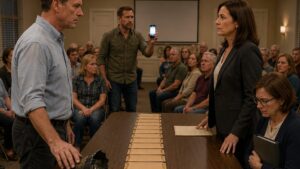
At six-thirty that evening, he entered the HOA meeting room carrying the black binder, the gold key, the severed anchor plate, and the emergency order.
Ruth walked beside him with her walker.
He did not touch it.
The board sat behind two folding tables arranged in a shallow V. Stephanie occupied the center seat. Robert sat at her right. Three other board members filled the remaining chairs. The HOA attorney sat near the wall with a yellow pad.
No audience had been invited, though two residents waited in the lobby beyond the glass door.
Alexander placed the objects on the table before him.
Gold key.
Cut steel.
Emergency order.
Accommodation intake log.
Stephanie looked at the key.
“That remains association property.”
“So does responsibility for how it was used.”
The attorney leaned toward her and whispered.
Stephanie folded her hands.
“This hearing concerns an unapproved exterior alteration, not separate allegations.”
“They are not separate.”
“The master-key issue will be reviewed administratively.”
“By the same people who authorized removal?”
Robert shifted in his chair.
Stephanie continued. “Mr. Carter, you installed a mechanical structure without final approval. You were warned not to proceed. The board acted under its enforcement authority.”
Alexander opened the binder.
“I submitted the design twenty-six days before installation. The office acknowledged it. I followed up twice. No decision was issued.”
“The application was incomplete.”
“It was classified incorrectly.”
“You wrote that there were no special circumstances.”
“I did.”
Ruth looked at him.
Alexander kept his eyes on the board.
“That was my mistake. I treated the lift as a technical problem and withheld information that belonged to my wife. But three days before demolition, she submitted a formal accommodation supplement.”
He slid the intake log forward.
“It was received. It was opened by the property manager. It was opened again by Stephanie at six forty-two on the morning the crew arrived.”
The other board members turned toward her.
Stephanie did not look away.
“I reviewed the intake entry,” she said. “The document had not been processed or verified.”
“You told the crew and the board that no accommodation was on file.”
“No approved accommodation was on file.”
“That is not what you said on my recording.”
Alexander played the clip.
Stephanie’s voice filled the room.
There is no medical accommodation on file.
When it ended, nobody spoke immediately.
The attorney wrote something.
Stephanie’s expression remained controlled, but color had risen beneath her makeup.
“The distinction may not have been stated precisely,” she said.
“The machine was precise.”
Alexander set the anchor plate beside the emergency order.
“This was attached to a certified lift when your crew arrived. They cut it before serving notice. They left the doorway unusable. Then you used a master key because a file described the home as possibly vacant.”
“The key issue is not before the board tonight.”
Ruth moved one step forward.
“It is before me.”
Her voice was quiet, and every face turned toward her.
Alexander felt the urge to fill the silence for her.
He did not.
Ruth rested both hands on the walker.
“I cannot safely use the exterior stairs. My occupational therapist recommended a mechanical access solution. The lift allowed me to enter and leave without being carried. That is the medical information relevant to this board.”
Stephanie opened her mouth.
Ruth continued.
“I submitted the letter myself because my husband did not include it.”
Alexander looked down.
“He thought he was protecting my privacy,” Ruth said. “He was also protecting himself from what the lift meant. That is between us. It does not erase the fact that your office received the request before you sent a crew.”
The room remained still.
One board member studied the intake log. Another looked at the cut steel.
Stephanie turned to the attorney.
“Even if the supplement was pending, the structure lacked approval and remained an insurance exposure.”
Robert reached for the insurer’s letter.
“The carrier required documented risk review,” he said.
Stephanie looked at him sharply.
“We adopted stricter standards after the deck accident.”
“We did,” Robert replied. “But this letter does not require demolition.”
“It warns of nonrenewal.”
“It warns us to inspect and document unapproved structural work.”
“This was unapproved.”
“It was also certified by the installer.”
“An installer has a financial interest.”
“So do we.”
The sentence changed the room.
Robert slid the insurer’s letter beside the emergency order.
“We voted for removal because we were told there was no accommodation request and no safety review. Both statements were incomplete.”
Stephanie’s composure thinned.
“We had no architectural approval.”
“You held the request before exterior review,” Alexander said. “You knew it involved safe access. You saw the supplement before the crew arrived. You chose removal first.”
“I chose consistent enforcement.”
“You chose the version of the facts that made removal easier.”
The attorney raised one hand.
“We should avoid attributing motive.”
Alexander looked at Stephanie.
“Then let’s discuss action.”
He removed a revised drawing from the binder.
“The installer can restore the lift, replace the damaged anchors, and add a narrow slatted screen on the street-facing side. It matches the porch stain and reduces visibility from the road. The electrical permit is active. The lift certification is current.”
One board member took the drawing.
Stephanie did not.
“The structure still requires committee review.”
“Review it.”
“That cannot occur instantly.”
“You made removal occur instantly.”
Ruth’s walker shifted slightly against the floor.
Alexander turned toward her.
She met his eyes, then looked back at the board.
“I am not asking you to like the lift,” she said. “I am asking you not to make my front door a wall.”
No one applauded.
No one moved.
The sentence did not need help.
Stephanie looked down at the key.
“If the board pauses enforcement,” she said, “the association may appear to reward noncompliance.”
Robert opened the insurer’s letter.
“If we continue enforcement after receiving a documented accommodation request, we may create the liability we claim to be preventing.”
“That is a legal conclusion.”
“No,” he said. “It is a financial one.”
For the first time, Stephanie looked less angry than tired.
She stared at the papers as though each had become heavier since morning.
“The board must protect the entire community,” she said.
Alexander answered before the sentence could become a shield.
“Then protect it with the rule you actually have, not the fear you added to it.”
Robert stood.
Stephanie looked at him.
“What are you doing?”
“Requesting a recess before the vote.”
“We have enough information.”
“No,” Robert said. “We have enough information to understand that we voted without enough information.”
He lifted the insurer’s letter.
“I want the delay entered into the minutes. And before we decide whether to fine the Carters, I want this requirement read aloud exactly as written.”
Chapter 7: The Door Opened Without Anyone Carrying Her
The installer stopped drilling after the first anchor came free.
He crouched beside the porch landing, brushed gray dust from the hole, and called Alexander over with two fingers.
“This isn’t a patch job.”
Alexander stepped outside.
Three weeks had passed since the board hearing. The temporary barrier Andrew’s crew had installed still enclosed the damaged edge of the porch. Behind it, the lift platform sat level but disconnected, its rail replaced only enough to prevent a fall.
The installer inserted a thin probe into the hole left by the severed anchor.
“They cut below the mounting plate,” he said. “Concrete fractured under the surface.”
“How much?”
“Enough that I won’t reuse this section.”
Alexander looked at the landing.
From above, the damage appeared limited to four clean holes and pale saw marks. Beneath the surface, the force had traveled farther.
The installer stood and wiped his hands on his work pants.
“We remove the broken section, pour new concrete, let it cure, then set fresh anchors.”
“How long?”
“Four days before I put load on it. Maybe five if the temperature drops.”
Alexander looked through the open door.
Ruth sat in the hall with the dogs beside her. She had heard.
“Five more days,” she said.
The installer removed his cap.
“I’m sorry, ma’am.”
“It isn’t your fault.”
Alexander studied the cracked edge again.
The board’s approval letter described the repair as replacement of damaged fasteners. It did not mention fractured concrete, temporary access, or the cost of rebuilding part of the landing.
“They approved anchor replacement,” he said.
“They approved less than the damage requires.”
The installer handed him a photograph taken beneath the edge.
A dark split ran through the concrete around the old anchor channel.
Alexander sent it to Robert before he went back inside.
The reply came eight minutes later.
Do not authorize additional work until the board confirms payment.
Alexander read the message twice.
Ruth watched him.
“What did he say?”
“To wait.”
She looked toward the disabled lift.
“They were fast when they wanted it removed.”
Alexander began typing, then stopped.
Three weeks earlier, he would have written a page of measurements, contract language, and timelines. He would have attached every document and expected clarity to do the work of courage.
Instead, he photographed the doorway from Ruth’s position.
The temporary barrier filled half the frame. The unusable steps filled the other.
He sent the image with one sentence.
Your contractor caused this damage while enforcing an order the board has withdrawn. We are proceeding with the repair required to restore safe access.
Robert called before Alexander could put down the phone.
“The board needs a vote for expenses beyond the approved amount.”
“The board voted to pay for damage caused by removal.”
“We did, but the authorization used the original estimate.”
“The original estimate was based on visible damage.”
“I understand.”
“Then there is nothing to debate.”
“There is always something to debate when association money is involved.”
Alexander looked at Ruth.
She had turned away from him and was speaking quietly to one of the dogs, rubbing its ear between two fingers.
“Schedule the vote today,” he said.
“I’m trying.”
“No. Schedule it.”
Robert was silent.
Alexander continued.
“The installer is here. The damaged concrete is documented. Every additional day keeps Ruth inside unless someone carries her. Put that sentence in the meeting notice.”
“You know emergency meetings create complaints.”
“So does emergency demolition.”
Robert exhaled.
“I’ll call you back.”
The installer waited near the landing.
Alexander gave him a deposit from their own account and told him to begin removing the fractured section.
It was not the clean solution he wanted. It was the necessary one.
By noon, the damaged concrete lay in broken pieces inside a wheelbarrow. Fresh forms framed the porch edge. The installer’s assistant mixed new concrete in the driveway while the dogs watched from behind the glass.
Stephanie arrived just after one.
She carried a flat document envelope and wore a dark blue suit instead of the bright clothes Alexander associated with her visits. She stopped at the edge of the work area.
“You authorized this before the board approved the revised cost.”
“I authorized restoration of the entrance.”
“The association may dispute expenses incurred without written confirmation.”
Alexander pointed toward the exposed concrete channel.
“Your crew cut through it.”
“I am aware.”
“Then what are you disputing?”
“Procedure.”
Ruth opened the storm door from inside.
Stephanie turned.
Ruth remained behind the threshold, one hand on her walker.
“Procedure is why I am still standing on this side,” she said.
Stephanie’s face changed, though not into apology.
She looked tired.
“The board approved the additional cost ten minutes ago.”
Alexander held out his hand.
Stephanie removed the papers from the envelope and gave them to him.
The authorization covered removal of fractured concrete, replacement anchors, lift recertification, and temporary safety barriers. It also withdrew all fines connected to the installation and suspended the emergency-removal policy pending revision.
The final page established a separate review track for medical and accessibility accommodations.
Alexander read the section twice.
Applications would be routed directly to the board attorney and one designated reviewer. Medical information would be limited to necessity and functional need. No physical enforcement could occur while an accommodation request remained pending unless an independent safety professional documented immediate danger.
It was not perfect.
It was specific.
Stephanie reached into her coat pocket.
The gold key lay in her palm.
For a moment, none of them moved.
“The board has discontinued unsupervised master access to occupied single-family properties,” she said. “Emergency entry will require documented consent or emergency services.”
She offered the key to Alexander.
He did not take it.
“It belongs to the association.”
“Not this one.”
“What does that mean?”
“The locksmith changed the master system yesterday. This key no longer opens anything.”
Alexander looked at the stamped tag.
HOA EMERGENCY ACCESS—MASTER.
Its authority had been removed without changing its shape.
Stephanie placed it on top of the signed authorization.
“I should not have used it,” she said.
The words were flat and difficult.
Alexander waited.
She did not add an excuse.
Ruth spoke from the doorway.
“No, you should not have.”
Stephanie nodded once.
Then she looked toward the installer pouring concrete into the form.
“I believed if we lost control of enforcement, we would lose control of the community.”
Alexander folded the authorization.
“You nearly lost control of what the rules were for.”
Stephanie accepted that without answering.
She walked back to her car before the concrete was smoothed.
The lift was not ready in five days.
It took six.
The new concrete cured slowly, and the replacement control housing failed its first test. A wire damaged during removal had to be replaced inside the porch wall. Each delay was small, defensible, and costly in the way lost days were costly.
Ruth missed two therapy appointments.
She refused to let Alexander carry her down the steps for either one.
“I have spent enough time being moved according to someone else’s decision,” she told him.
On the sixth afternoon, the installer completed the final inspection.
A narrow slatted screen now stood along the street-facing side of the lift. It matched the porch stain closely enough that it seemed part of the house without pretending the machinery was not there.
The new rail was black.
The anchors disappeared beneath fitted covers.
The platform waited at ground level.
Ruth came to the door wearing her green coat.
The dogs followed her into the hall.
Alexander stood beside the open door holding his white mug.
He had placed one hand beneath her elbow before he realized it.
Ruth looked down at it.
He withdrew his hand.
“I was only—”
“I know.”
She guided the walker onto the platform.
The dogs moved toward the threshold.
“Stay,” Alexander said.
They sat.
For weeks they had guarded that line. Now they watched Ruth cross it.
She secured the walker, closed the rail, and pressed the control switch.
The lift rose with a soft mechanical hum.
Alexander felt the old impulse to stand close enough to catch what might fail. He remained where he was.
The platform aligned with the porch.
Ruth opened the rail and rolled the walker forward.
Its front wheels crossed the threshold.
Then the back wheels.
No one lifted her.
No one steadied her.
No one gave permission.
She stopped beside Alexander.
“Your coffee is getting cold,” she said.
He looked at the mug.
“I can make another.”
Ruth smiled faintly.
“That is progress.”
She turned the walker toward the lift again.
“You’re going back out?”
“I came in. Now I’m leaving.”
Alexander moved to open the door wider, then stopped. It was already wide enough.
Ruth crossed the threshold, entered the lift, and lowered herself to the walkway.
The dogs remained inside.
At ground level, she opened the rail and moved toward the driveway, where the late sun stretched her shadow across the new concrete.
Alexander watched through the glass.
Ruth turned the walker around, reached back, and pulled the front door closed from the outside.
The story has ended.