They Called His Shoreline Repair a Violation Until the Quiet Lake Began Moving
Chapter 1: The Machine Was Already Pulling at the Dock
The winch tightened before Samuel Green reached the dock.
He heard the cable groan from halfway down the narrow path between the cabin and the shoreline. The sound was wrong. It was not the sound of someone repairing something. It was the sound of something being forced apart.
Samuel stepped faster, his boots slipping slightly on the damp wooden boards. Beyond the cabin, the water sat perfectly still, reflecting the gray morning sky and the tall trees along the opposite bank. For a second, the scene looked peaceful.
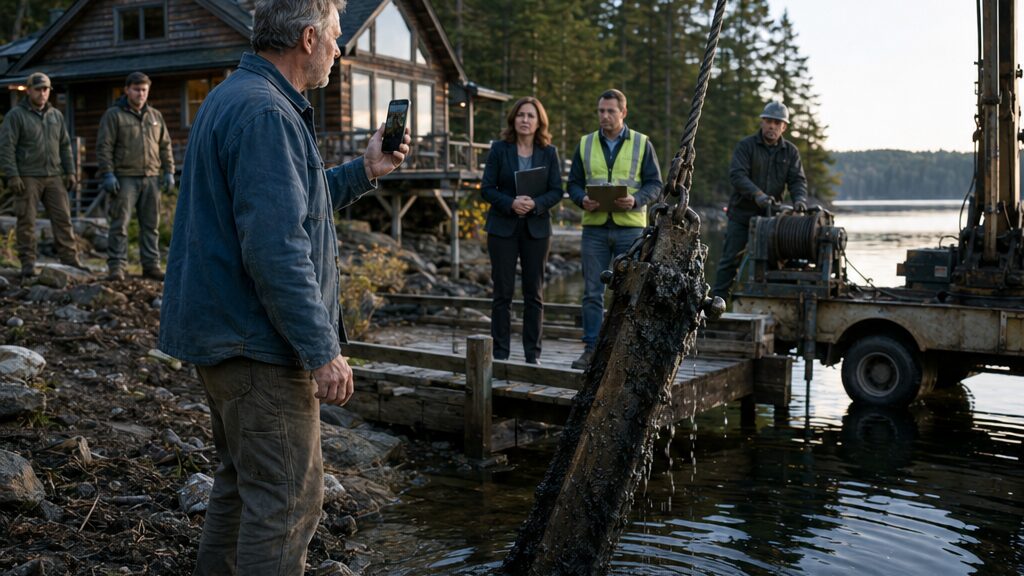
Then the steel brace beneath the dock lifted out of the water.
A thick cable pulled upward, dragging the mud-covered support toward the surface. Black water poured from the metal frame. The brace had been buried deep beneath the shoreline, holding back the slow movement of soil that had been creeping closer to the cabin foundation for months.
Now it was rising.
Samuel stopped at the edge of the path.
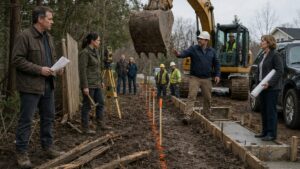
A demolition crew stood beside a truck parked near the trees. Orange cones marked off the shoreline. A man in a reflective vest held a clipboard and watched the machinery operate like he was supervising a routine landscaping job.
Brian Hill, the HOA property manager, looked up.
“Samuel,” he called. “Stay behind the barrier, please.”
Samuel stared at the exposed brace.
“You’re removing it.”
Brian glanced at the clipboard. “We are removing an unauthorized shoreline structure.”
“It’s a support brace.”
“It’s a structure attached to the shoreline without approval.”
Samuel walked closer.
“I submitted the plans.”
Brian’s expression tightened. “And they were not approved.”
“They weren’t denied either.”
“That doesn’t matter.”
The winch pulled again.
The brace scraped against rock beneath the dock, sending a vibration through the wooden boards. Samuel felt it travel through his boots.
“This stops now,” he said.
Brian sighed as if Samuel were making the situation harder than necessary.
“Samuel, you received the violation notice.”
“When?”
“Last week.”
“I received a notice yesterday.”
Brian looked away for half a second.
That was enough.
Samuel understood.
The notice had not arrived before the crew.
It had arrived after the decision was already made.
He pulled his phone from his jacket pocket and began recording.
Brian noticed immediately.
“You don’t have permission to film the workers.”
“I own this dock.”
“You own the cabin. The shoreline is controlled by the association.”
Samuel looked past him toward the water.
The shoreline looked unchanged from a distance. Calm. Clean. Safe.
But Samuel knew what was underneath.
He had spent thirty years working around drainage systems and failing foundations. He knew the difference between a stable surface and a surface pretending to be stable.
“The brace comes out,” Samuel said quietly, “and the landing shifts.”
Brian folded his arms.
“That is your opinion.”
“It’s what the engineer told me six months ago.”
“Which engineer?”
Samuel did not answer immediately.
Because the truth was complicated.
The engineer had not been hired by the HOA. He had not signed off on the project. He had simply looked at the shoreline during a private consultation and warned Samuel that waiting could cost him more than money.
Samuel had believed he could solve it quietly.
That had been his mistake.
The cable tightened again.
The steel brace rose higher.
Then the cabin door opened.
“Samuel?”
He turned.
Margaret Green stood in the doorway with one hand on her walker.
Her face was calm, but he saw the concern behind her eyes.
“Stay inside,” he said.
“I’m not made of glass.”
“I know.”
She looked toward the dock.
The landing shook slightly beneath her feet.
Her hand tightened around the walker handle.
Samuel saw it.
He saw the hesitation.
The small calculation she made before taking another step.
A calculation she used to make without thinking.
“How long?” she asked.
Samuel looked at the exposed brace.
“Not long.”
Margaret looked at Brian.
“Did anyone come inspect this?”
Brian answered carefully.
“The association reviewed the matter.”
“That wasn’t my question.”
Brian looked uncomfortable.
Samuel noticed.
Margaret noticed too.
The winch operator waited.
The entire shoreline seemed paused between one decision and another.
Then Brian raised his hand.
“Continue.”
The machine moved.
Samuel stepped forward.
“Stop.”
The operator looked at Brian.
Brian pointed toward the barrier.
“Sir, move back.”
Samuel did not touch the equipment. He did not threaten anyone. He simply stood where they could not continue without acknowledging him.
“You remove this brace,” Samuel said, “and you are changing the condition of the shoreline before anyone has inspected what it was holding.”
Brian picked up his phone.
“Call the police.”
Samuel looked at him.
“For a safety concern?”
“For refusing to leave a restricted work area.”
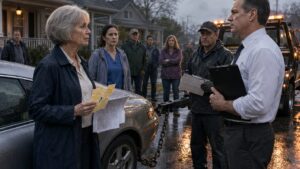
Two local officers arrived twenty minutes later.
By then, the first brace was already lying on the ground beside the truck.
It was heavier than it looked.
Mud covered the steel. Water dripped from the holes where the anchors had been buried.
Samuel walked around it slowly.
The empty holes beneath the dock bothered him more than the missing brace.
The shoreline had been resisting something.
Now nothing was resisting.
One officer approached Samuel.
“Sir, can you explain what’s happening?”
Samuel looked at the dock.
“My repair is being removed because the HOA says it changes the appearance of the shoreline.”
“And you believe it’s necessary?”
Samuel nodded.
“For my wife to reach the cabin safely.”
The officer glanced toward Margaret.
She was still standing near the doorway.
Watching.
Not helpless.
Watching.
The officer looked back at Brian.
“Do you have documentation authorizing removal?”
Brian handed him a folder.
Samuel recognized the logo on the front.
HOA enforcement.
Not an engineering report.
Not a safety inspection.
A violation packet.
The officer flipped through it.
“Mr. Hill, is there a signed emergency review?”
Brian hesitated.
“No.”
Samuel felt something cold settle in his chest.
Not anger.
Something worse.
Understanding.
The machine had not stopped because they discovered he was right.
It had stopped because they had finally realized there was a question they had not answered.
The officers asked the crew to pause until the documentation could be reviewed.
Nobody apologized.
Nobody admitted anything.
The truck remained parked beside the trees.
The removed brace remained on the ground.
And then Samuel heard a sound beneath the cabin path.
A sharp crack.
He turned.
A narrow line had opened between the dock landing and the walkway leading to the cabin.
Only an inch wide.
But Samuel knew what it meant.
The shoreline had moved.
And the brace was no longer there to stop it.
Chapter 2: The Approval Form With No Answer
Brian Hill sent the photograph before breakfast.
Samuel knew something was wrong the moment he opened the email.
The subject line read:
Property Damage Caused by Unauthorized Shoreline Work.
The image showed the crack near the dock.
The caption beneath it claimed Samuel’s construction had weakened the shoreline.
He stared at the screen.
For several seconds, he did not move.
Then he looked out the kitchen window.
The dock was still there.
The cabin was still standing.
But the space between them felt different.
Like something had changed while nobody was looking.
Margaret sat across from him with her coffee.
“They’re blaming you.”
Samuel placed the phone down.
“Yes.”
“Are they right?”
He looked at her.
The question surprised him.
Not because she doubted him.
Because she knew him well enough to ask.
“My design was supposed to stabilize the edge.”
“That wasn’t my question.”
Samuel looked away.
For thirty years, he had trusted measurements, plans, and maintenance schedules. He believed problems could be solved if people simply looked at the facts.
But facts did not matter if someone controlled which facts entered the conversation.
“I should have pushed harder,” he admitted.
Margaret watched him carefully.
“You should have told them why it mattered.”
“I told them the shoreline was failing.”
“You told them about the dirt and the dock.”
Samuel was quiet.
Margaret lowered her voice.
“You didn’t tell them about me.”
He did not answer.
Because she was right.
Six weeks earlier, Samuel had submitted the repair request through the HOA portal. He included photographs of the shoreline, contractor estimates, and measurements of the failing section beneath the dock.
He did not include the full medical-access information.
Margaret hated being discussed like a problem to solve.
He had respected that.
Maybe too much.
His phone rang.
Cynthia Clark.
Samuel answered.
“Samuel, we need to discuss yesterday.”
“I agree.”
“Your behavior forced the association into an unnecessary situation.”
“My dock was being dismantled.”
“Your unapproved structure was being removed.”
Samuel closed his eyes.
“Cynthia, I submitted the request.”
“You submitted an inquiry.”
“No. I submitted plans.”
“We reviewed them.”
“When?”
A pause.
Small.
Almost invisible.
But Samuel heard it.
“We determined they did not meet association standards.”
“After the crew arrived?”
Cynthia’s voice became colder.
“Samuel, this is exactly the problem. Residents cannot decide that silence means approval.”
“I wasn’t asking for silence to mean approval.”
“Then what were you asking for?”
“An answer.”
The call went quiet.
Then Cynthia said, “You will receive a formal notice today.”
The line ended.
Samuel sat at the table.
Margaret looked at him.
“She knew.”
“I don’t know that.”
“You do.”
He hated that she was right.
Later that morning, Samuel drove to the HOA office.
The building was small, clean, and designed to look harmless. A place where people discussed landscaping rules and neighborhood events.
A place where nobody expected a person’s home to become a legal argument.
Cynthia sat behind a desk.
Brian stood near a filing cabinet.
Samuel placed his documents down.
“Here.”
Cynthia looked at the stack.
“What is this?”
“My submission.”
She did not touch it.
“We already reviewed the matter.”
“You reviewed it after demolition was scheduled.”
“That is an accusation.”
“It’s a timeline.”
Brian shifted.
Samuel opened his laptop.
“I have the submission confirmation. Date. Time. Attachments.”
Cynthia looked at the screen.
For the first time, her expression changed.
Not guilt.
Concern.
Then it disappeared.
“You still did not have approval.”
“No.”
Samuel nodded.
“I didn’t.”
Cynthia seemed surprised by the admission.
“I needed emergency stabilization.”
“You bypassed procedure.”
“I waited.”
“Waiting does not create permission.”
Samuel looked at her.
“No. But ignoring a safety request does not erase responsibility.”
The room became quiet.
Cynthia folded her hands.
“You don’t understand what happens when every resident decides their situation is special.”
Samuel looked toward the window.
Outside, the neighborhood looked perfect.
Fresh lawns.
Clean roads.
Beautiful homes.
Everything arranged carefully.
“How much does appearance matter?” he asked.
Cynthia frowned.
“That is not fair.”
“No?”
“No. We have insurance requirements. We have regulations. We have other homeowners who depend on responsible decisions.”
Samuel nodded slowly.
That was the part that made it harder.
She did believe she was protecting people.
But she had started protecting the community’s image instead of the people inside it.
Cynthia slid a document across the desk.
“A temporary enforcement order.”
Samuel read it.
The HOA was requiring the remaining braces to stay removed until review.
There was also a fine.
He looked up.
“The remaining braces?”
Brian answered.
“The crew removed only one yesterday because of the interruption.”
Samuel folded the paper.
One brace removed.
Others still holding.
For now.
When he returned home, he found Margaret standing beside the dock path.
Not walking.
Just standing.
“You shouldn’t be out here alone.”
“I wanted to see.”
Samuel approached.
“What?”
“What you were protecting.”
She looked down at the empty space where the brace had been.
Then she touched the railing.
“I thought you were trying to protect the cabin.”
“I am.”
“No.”
She looked at him.
“You’re trying to protect me.”
Samuel did not argue.
Because that was also true.
Margaret took a slow breath.
“Samuel, I need you to stop making decisions for me because you’re afraid.”
The words hurt because they were gentle.
“I’m not afraid.”
She smiled sadly.
“You are terrified.”
The water reflected both of them.
Still.
Perfect.
Deceptive.
Samuel looked at the dock.
“I just need them to understand.”
Margaret looked back toward the cabin.
“Then maybe you need to tell them everything.”
That evening, while reviewing his old documents, Samuel noticed something.
A status change in the HOA portal.
His application had originally been marked:
Under Review.
Now it read:
Incomplete Submission.
The date of the change was after the demolition began.
Samuel stared at the screen.
Someone had changed the record.
And someone had decided the unanswered request had never existed.
Then Margaret spoke from the doorway.
“Samuel.”
He turned.
Her face was pale.
Not from fear.
From finally admitting something she had carried alone.
“I fell two weeks ago.”
He stood.
“What?”
“Near the dock.”
“Why didn’t you tell me?”
“Because I knew what you would do.”
Samuel stepped closer.
“Margaret—”
“You would have stopped everything.”
“Yes.”
“And I didn’t want to be the reason you gave up this place.”
Samuel looked toward the water.
The cabin.
The dock.
The shoreline.
Everything they had fought to keep.
But now he understood.
They had both been hiding the truth.
And the shoreline was not the only thing that had been weakening.
Chapter 3: What Margaret Refused to Call Help
The medical transport vehicle stopped before reaching the cabin.
Samuel watched the driver step out and examine the cracked turnaround near the path.
“Too unstable,” the driver said.
Samuel walked toward him.
“It’s only temporary.”
The driver shook his head.
“Temporary is exactly what worries me.”
Behind Samuel, Margaret sat in the cabin doorway.
She had asked him not to send her inside.
Not this time.
The morning air carried the sound of water moving against the shore.
Not loud.
Not dramatic.
Just enough.
A reminder.
Samuel looked at the damaged path.
For years, he had believed the cabin was isolated because he chose isolation.
Now he wondered if they had simply been slowly cut off.
The driver pointed toward the dock.
“If there was an emergency transport, we need a stable route.”
Samuel nodded.
“I know.”
Margaret spoke from behind him.
“No.”
Samuel turned.
She looked directly at him.
“You know now.”
The difference mattered.
He understood.
She had spent months adapting to the changing conditions while he focused on fixing them.
Margaret pushed her walker forward.
Samuel immediately stepped toward her.
She raised a hand.
“Don’t.”
He stopped.
“I can do this.”
The words were not angry.
They were firm.
She moved carefully toward the landing.
Each step took effort.
Samuel wanted to help.
Every part of him wanted to grab the walker and carry the burden himself.
But he stayed still.
Because that was what she had asked.
When she reached the damaged section, she placed one hand against the railing.
“This is what I was afraid of.”
Samuel looked at her.
“What?”
“That you would tell everyone I needed this fixed.”
“You do need it fixed.”
“Yes.”
She looked at him.
“But I need them to hear me say it.”
The distinction stayed with him.
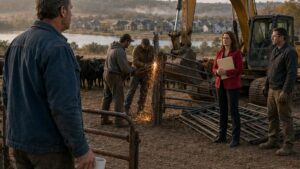
Later that morning, Heather Ramirez arrived.
She wore a red field jacket and carried a tablet.
Samuel recognized the color before he recognized the person.
The sight of another official near the water made his shoulders tighten.
Heather noticed.
“I’m not with the HOA.”
“Who sent you?”
“Your erosion complaint was forwarded to county water resources.”
She looked toward the shoreline.
Then toward the removed brace.
“You built this?”
Samuel nodded.
“Yes.”
Heather crouched near the anchor hole.
“How deep?”
“Six feet.”
“And where did the runoff go?”
Samuel hesitated.
“It followed the natural slope.”
Heather looked at him.
“That’s not an answer.”
He frowned.
“It’s what I measured.”
She stood.
“Mr. Green, I believe you are trying to protect your property.”
Samuel waited.
“But?”
“But protection can still create a problem.”
She pointed across the water.
“The flow pattern here matters. If the shoreline support changes where water moves, another area can become unstable.”
Samuel looked toward the opposite bank.
Another area.
Other homes.
Other people.
The realization bothered him.
Not because she was accusing him.
Because she might be right.
“I didn’t know.”
Heather nodded.
“That is why we inspect.”
She looked at the water again.
“What is the ownership status of this water?”
Samuel frowned.
“The HOA calls it the private lake.”
Heather turned.
“Who owns the outlet gate?”
Samuel did not answer.
Because he had never asked.
That afternoon, Samuel, Heather, and Margaret walked the shoreline.
The water remained strangely calm.
The reflection of the trees barely moved.
But at the far edge, beyond the dock, Heather found a narrow channel hidden beneath overgrown vegetation.
A concrete structure sat there.
Old.
Partially covered.
A metal gate disappeared into the water.
Heather took photographs.
Samuel stared.
“What is that?”
Heather ran her hand along the concrete.
“A control structure.”
“For the lake?”
She looked at him.
“I didn’t say lake.”
The word landed differently.
Samuel looked back toward the cabin.
For years, everyone had used the same name.
The lake.
The lake access.
The lake homes.
But nobody had ever explained what it actually was.
Heather stood.
“I need records.”
“From where?”
“County records.”
Samuel looked at the water.
The calm surface no longer felt peaceful.
It felt like something carefully hidden.
That evening, Heather called.
Samuel answered immediately.
“We found something,” she said.
“What?”
“A question, first.”
Samuel waited.
Heather’s voice became more serious.
“Who told your community this was a lake?”
Samuel looked through the window.
Cynthia’s office.
The HOA notices.
The demolition crew.
The red jackets.
All of it connected to the same place.
“I don’t know.”
Heather paused.
“Then we need to find out.”
The next morning, Samuel arrived at the dock and saw a county vehicle parked beside the trees.
A man in a red field jacket stood near the water with Heather.
He held a folder.
Samuel recognized the look on his face.
Not anger.
Not surprise.
Confirmation.
The man turned.
“Samuel Green?”
“Yes.”
“I’m Andrew Jackson. Dam-safety division.”
Samuel looked at the water behind him.
Andrew opened the folder.
“I need to ask you something.”
“What?”
Andrew glanced toward the cabin.
Then b
Chapter 4: The Lake That Was Never Recorded
The word “lake” disappeared from the conversation the moment Andrew Jackson opened the county records.
Samuel stood beside the dock while Andrew held the folder against the wind.
For years, the water behind the cabin had been the center of every neighborhood conversation. People talked about lake access, lake views, lakefront property values, and lake restrictions.
Nobody had ever questioned the name.
Now Andrew was telling him that the name itself might have been the first mistake.
“This parcel was never recorded as a recreational lake,” Andrew said.
Cynthia Clark arrived before Samuel could respond.
She came down the path quickly, followed by Brian Hill.
“What is this about?” she asked.
Andrew closed the folder.
“County review.”
Cynthia looked at the red jacket, then at Heather Ramirez standing near the outlet structure.
Her expression changed slightly.
Not confusion.
Recognition.
Samuel noticed.
“You knew they were coming.”
Cynthia ignored him.
“This is private association property.”
Andrew nodded.
“The shoreline is. The water system is another matter.”
Cynthia’s jaw tightened.
“There is no water system.”
Heather turned from the concrete structure.
“There is.”
She pointed toward the hidden gate beneath the vegetation.
“Old control structure. Concrete spillway. Outlet channel.”
Brian looked away.
Samuel caught it.
A small movement.
A person realizing a detail had been found before they were ready.
Andrew opened the folder again.
“The original development plans refer to this as a stormwater impoundment.”
The phrase sounded strange.
Too technical for the peaceful water in front of him.
Samuel looked across the surface.
The reflection of the trees remained almost perfect.
A stormwater impoundment.
Not a lake.
Not a private recreational feature.
A managed structure.
“Why wasn’t anyone told?” Samuel asked.
Cynthia crossed her arms.
“Because residents don’t need every engineering term on every piece of property.”
Andrew looked at her.
“They need accurate information when safety responsibilities are involved.”
The silence that followed was heavier than any argument.
Samuel looked at Cynthia.
“How long have you known?”
Cynthia did not answer.
That answer was enough.
Heather walked back toward the dock.
“Mr. Green, show me where your original braces were installed.”
Samuel led her beneath the landing.
The empty anchor holes remained visible.
Heather examined the exposed soil.
“Your measurements were right about the movement.”
Samuel felt a small moment of relief.
Then she continued.
“But the design was incomplete.”
The relief disappeared.
“What does that mean?”
“You were protecting this section.”
She pointed toward the shoreline.
“But the water has to move somewhere.”
Samuel looked toward the opposite bank.
“The culvert.”
Heather nodded.
“Part of the flow was being redirected.”
Samuel felt the weight of the admission.
He had spent weeks fighting to prove he was not damaging the property.
Now he had to accept that he might have been solving one problem while creating another.
“I didn’t know.”
Heather looked at him.
“I believe you.”
That mattered.
Not because it erased the mistake.
Because it separated a mistake from an accusation.
Brian stepped forward.
“So the structure was a violation.”
Samuel turned.
Brian looked uncomfortable but determined.
“If he installed something without approval—”
Andrew interrupted.
“Approval does not remove the safety issue.”
Brian stopped.
Andrew continued.
“Neither does the safety issue remove the approval problem.”
Samuel looked at him.
The inspector’s words were careful.
Balanced.
Nobody was being declared completely right.
Nobody was being declared completely wrong.
That was harder.
And more honest.
Heather walked toward the outlet channel.
“Someone maintained this system before.”
Samuel followed.
The concrete edges were covered with moss and dirt, but underneath the layers, he could see the original construction.
“This was built with the neighborhood.”
“Yes,” Andrew said.
“Then who was responsible for it?”
Andrew looked back toward Cynthia.
“The association.”
Cynthia’s face hardened.
“The association maintains common areas.”
“Correct,” Andrew said.
“And this is common water management infrastructure.”
Cynthia looked at Brian.
Neither spoke.
Samuel felt something shift.
The conflict had started with a brace.
A piece of steel beneath his dock.
Something everyone could see.
But the real structure was underneath.
Records.
Responsibilities.
Decisions made years earlier.
Heather photographed the outlet gate.
“This needs inspection.”
“When?” Samuel asked.
“Immediately.”
She looked toward the water.
“The calm surface is not proof of stability.”
The words stayed with him.
Because he had used the same mistake.
He had trusted what he could see.
The cabin.
The dock.
The still water.
He had ignored the movement underneath.
Later that afternoon, Samuel went with Andrew to the county records office.
The clerk searched through old development files.
Paper folders.
Archived maps.
Documents nobody had opened in years.
Samuel stood beside the counter as the clerk placed a large envelope on the desk.
“Development maintenance records,” she said.
Andrew opened it.
Inside were inspection notes, engineering drawings, and correspondence.
Samuel recognized the HOA name immediately.
Cynthia’s name was not there.
She had not been president eight years earlier.
But the board had been.
Andrew flipped through the pages.
Then he stopped.
His expression changed.
Samuel noticed.
“What?”
Andrew looked at the document again.
“This was addressed to the HOA board.”
Heather leaned closer.
“What is it?”
Andrew turned the page.
A faded inspection report.
Samuel read the first line.
Stormwater impoundment outlet and shoreline stabilization concerns.
The date was eight years old.
Eight years.
Before his repair.
Before the crack.
Before anyone called his work unauthorized.
Samuel looked at Andrew.
“Did they know?”
Andrew did not answer immediately.
Then the clerk spoke from behind the counter.
“There should be a second page.”
Everyone looked at her.
She reached into the folder.
“It was scanned separately.”
The page appeared.
Samuel read the final line.
Recommended immediate review due to progressive shoreline movement.
His stomach tightened.
The HOA had known.
Maybe not everything.
Maybe not the exact future.
But they had known enough.
Heather looked at him.
“This changes things.”
Samuel looked back toward the window.
Outside, the water reflected the sky.
Still.
Quiet.
Beautiful.
But now he knew what was beneath it.
A question remained.
Who had received the warning?
And why had nobody acted?
Chapter 5: The Warning Kept Behind the Water
The archive box disappeared ten minutes before Samuel arrived.
Brian Hill stood in the HOA storage room with an empty shelf behind him.
Samuel noticed immediately.
The room was too organized.
Too clean.
A place where missing things became obvious.
“Where are the maintenance records?” Samuel asked.
Brian looked up.
“What records?”
“The old inspection files.”
Brian’s expression remained neutral.
Too neutral.
“I don’t know what you mean.”
Samuel held up the copy of the county report.
The color drained slightly from Brian’s face.
Not much.
But enough.
“This was sent to the board.”
Brian looked at the paper.
“I need to check the files.”
“You already did.”
The words came out sharper than Samuel intended.
Brian looked away.
For the first time since the demolition, he looked less like an official carrying out instructions and more like someone trapped between decisions.
“I’m not the one who made those decisions.”
Samuel lowered the paper.
“Then help me understand them.”
Brian walked toward the empty shelf.
“The association was under pressure.”
“From who?”
“Everyone.”
Samuel waited.
Brian sighed.
“Residents wanted fees kept low. They wanted the neighborhood marketed as stable. Nobody wanted to hear that the water feature they loved required expensive maintenance.”
“So the report was ignored?”
Brian did not answer.
That was an answer.
The HOA meeting that evening was crowded.
Neighbors filled the room.
Some supported Samuel.
Others looked uncomfortable.
Because the argument had changed.
At first, Samuel was the homeowner who built something without permission.
Now everyone was asking why the permission process had failed before that.
Cynthia stood at the front.
“We need to be careful here.”
Samuel sat across from her.
“Careful about what?”
“About creating panic.”
Heather sat near the side of the room.
Andrew stood beside her.
Cynthia looked toward the residents.
“If people believe the association concealed dangerous information, property values will suffer. Insurance could be affected. Emergency assessments could become necessary.”
Samuel watched the room.
That was the first honest thing she had said.
Not the whole truth.
But a real fear.
Cynthia was not protecting only herself.
She was protecting the version of the community she believed everyone needed.
The problem was that the version was built on silence.
Samuel stood.
“I understand the concern.”
Cynthia looked surprised.
“But the answer cannot be pretending the problem does not exist.”
A few residents nodded.
Samuel continued.
“My repair was not perfect.”
The room became quiet.
He felt the weight of admitting it publicly.
“The engineers found issues with how I redirected the shoreline flow.”
Cynthia looked at him.
“You’re admitting that?”
“Yes.”
The room shifted.
Because everyone expected a fight.
Not responsibility.
“But the question is not whether my first design was perfect.”
Samuel held up the report.
“The question is why we reached a point where a homeowner was trying to stabilize a failing shoreline without the community knowing there was a failing shoreline.”
Nobody answered.
Later, after the meeting ended, Brian approached Samuel outside.
“I found something.”
Samuel turned.
Brian held a folder.
“I should have brought this out sooner.”
Inside were maintenance summaries.
Not the full inspection.
Not the original warning.
But references.
Repeated mentions of outlet review.
Drainage concerns.
Deferred recommendations.
“How long?” Samuel asked.
Brian looked down.
“Years.”
Samuel closed the folder.
“Why?”
Brian rubbed his forehead.
“Because every time the issue came up, someone said the same thing.”
“What?”
“Next budget cycle.”
The words felt familiar.
Too familiar.
A problem moved from one meeting to another until it became someone else’s emergency.
Brian looked toward the water.
“Cynthia didn’t create the problem.”
Samuel said nothing.
“But she decided to keep carrying it.”
That was the difference.
The next morning, rain arrived.
Not a storm.
Not dramatic.
Just steady.
Enough to change the water.
Samuel stood at the dock watching debris gather near the outlet channel.
Branches.
Leaves.
Mud.
The reflection broke apart.
For the first time since he moved there, the water looked honest.
Heather arrived within the hour.
“We need to clear the outlet.”
Samuel looked toward the channel.
“How bad?”
She did not answer immediately.
That worried him more than if she had.
Andrew joined them.
“The system was already stressed.”
Samuel looked back toward the cabin.
Margaret stood at the doorway.
Watching.
“You need to move her,” Heather said.
Samuel shook his head.
“Not yet.”
“Samuel.”
He looked at her.
“I’m not ignoring the danger.”
He looked at Margaret.
“I’m done making decisions without her.”
Margaret walked toward them slowly.
“I’m not leaving unless we know what happens next.”
Samuel wanted to argue.
He almost did.
Then he stopped.
Because he understood.
This was the same mistake he had been making all along.
Trying to protect someone by removing their choice.
Andrew looked toward the outlet.
“The board needs to act.”
Samuel watched the water rise.
The old brace beside the dock sat where the crew had left it.
Mud-streaked.
Damaged.
But still holding the shape of what it had been built to do.
A reminder.
A warning.
A piece of the problem.
And maybe part of the solution.
That night, the rain continued.
Then Brian called.
His voice was different.
Urgent.
“Samuel.”
“What happened?”
“I found the original inspection.”
Samuel sat up.
“Where?”
Brian paused.
“Cynthia had it.”
The room went silent.
“Are you sure?”
“Yes.”
Samuel looked toward the dark window.
The water was invisible now.
But he could hear it.
Moving.
“What does it say?”
Brian swallowed.
“Everything.”
A pause.
“Everything they were afraid residents would find out.”
Outside, the outlet gate groaned under the pressure of the rising water.
Chapter 6: The Repair Samuel Had to Change
Water began flowing through the empty anchor hole just after sunrise.
Samuel saw it before anyone else.
He stood beneath the dock with a flashlight in one hand and his phone in the other, watching a thin stream push through the exposed soil where the steel brace had been removed.
Not a flood.
Not a collapse.
Something quieter.
Something more dangerous.
Movement.
He climbed back onto the dock.
“Heather.”
She was already walking toward him.
“What did you find?”
Samuel pointed beneath the landing.
Heather crouched and looked through the gap.
Her expression changed.
“That’s the path of least resistance.”
Samuel looked toward the cabin.
“The water is moving under the walkway.”
“Yes.”
“How long?”
Heather stood.
“I don’t know.”
The answer bothered him more than a number would have.
A number could be measured.
A number could be controlled.
Uncertainty was harder.
Andrew Jackson arrived minutes later with the county response equipment.
The same shoreline that had once been quiet and empty was now filled with vehicles.
County trucks.
Inspection equipment.
HOA representatives.
Neighbors standing at a distance.
The scene looked like the morning of the demolition.
But it felt different.
The officials were not there to remove something.
They were there because something needed to be saved.
Cynthia Clark stepped out of her vehicle.
She looked tired.
Not defeated.
Tired.
Samuel noticed because he understood that look.
It was the expression of someone who had carried a problem too long and finally realized carrying it was not the same as solving it.
“We need temporary access,” Andrew said.
Cynthia nodded.
“Approved.”
Samuel looked at her.
The answer came too quickly.
A week earlier, she had sent workers to remove his repair.
Now she was allowing emergency work.
“What changed?” he asked.
Cynthia looked toward the water.
“The fact that everyone can see it.”
Samuel almost responded.
Then he stopped.
Because that was not entirely fair.
The problem was not only that she cared about appearances.
She had also been afraid of what the truth would cost.
The fear did not excuse the choice.
But it explained it.
Heather opened Samuel’s old repair plans on the hood of a county truck.
“These braces were designed around this section.”
She pointed to the shoreline.
“You were trying to stop erosion at your property line.”
Samuel nodded.
“Yes.”
“But the system doesn’t stop at your property line.”
He understood.
The water did not know where the HOA boundaries ended.
The soil did not care about legal descriptions.
The impoundment was one connected structure.
Heather pointed toward the outlet channel.
“The permanent solution has to address the whole flow path.”
Samuel looked at the old brace lying beside the dock.
The same piece of steel that had started the conflict.
The same object everyone had argued about.
“It stays?”
Heather shook her head.
“Not like this.”
Samuel was quiet.
A part of him wanted to defend it.
To explain every measurement.
Every calculation.
Every reason he had made the choices he made.
But he already knew.
That was the version of himself that had created the problem.
The man who believed he could quietly solve everything.
Margaret walked down from the cabin.
Slowly.
Carefully.
But without asking anyone to help.
Samuel watched her approach.
“You should be resting.”
She gave him a look.
“You’re still doing it.”
He stopped.
“Doing what?”
“Trying to protect me by making me smaller.”
The words stayed between them.
Samuel looked down.
“I’m sorry.”
Margaret reached the dock.
“I don’t need you to stop caring.”
She placed her hand on the railing.
“I need you to stop deciding that caring means carrying everything alone.”
For once, Samuel had no argument.
Heather watched quietly.
Then she looked back at the plans.
“Margaret, can you show me what route you actually use?”
Margaret nodded.
Together, they walked the shoreline.
Samuel followed.
Not ahead.
Behind.
The difference felt strange.
And important.
Margaret pointed out where the walker caught on uneven boards.
Where emergency workers would struggle.
Where the turn near the cabin became impossible when the ground was wet.
Heather wrote everything down.
“This is the information we needed.”
Samuel looked at her.
“You needed her.”
Heather nodded.
“Yes.”
The answer was simple.
And it hurt.
Because Samuel had spent so much time collecting measurements and photographs that he had forgotten the most important evidence was a person.
By afternoon, the temporary stabilization plan was ready.
It was not Samuel’s original design.
It was wider.
More expensive.
Less focused on protecting only the cabin.
The drainage path would be restored.
The shoreline support would be rebuilt differently.
The dock landing would be redesigned around Margaret’s actual movement.
Cynthia reviewed the document.
“This requires association funding.”
Andrew nodded.
“Yes.”
“That will require a vote.”
Andrew looked toward the rising water.
“You have time for a vote.”
The pause after that sentence said everything.
Not much time.
Cynthia signed the emergency access authorization.
Samuel watched her hand move across the paper.
A simple signature.
A different kind of action.
The board that had stopped his repair was now helping begin another.
Before the temporary work started, Samuel walked to the removed brace.
He ran his hand across the muddy steel.
“You were right about the danger,” Heather said behind him.
Samuel looked at her.
“But?”
She smiled slightly.
“But being right about one thing doesn’t mean every answer you choose is right.”
Samuel nodded.
He already knew.
The crew cut the brace down and repositioned it for temporary support.
The same steel.
Different purpose.
Different direction.
By evening, the first section held.
The water slowed.
The shoreline stopped shifting.
Nobody celebrated.
Nobody applauded.
They simply watched the structure do what it was supposed to do.
Protect people.
Not appearances.
Andrew packed his equipment as the sun lowered.
“The temporary system will hold.”
Samuel looked relieved.
“Then we’re done?”
Andrew shook his head.
“No.”
He handed Samuel a document.
“The association has forty-eight hours to approve the permanent correction plan.”
Samuel read the page.
The responsibility was clear.
The records.
The repairs.
The funding.
The disclosure.
Everything.
He looked toward Cynthia.
She was standing alone near the water.
For the first time, she looked less like the person blocking the repair.
And more like someone standing beside the same problem.
Samuel folded the document.
The immediate danger had passed.
But the harder question remained.
Would everyone choose the truth when the emergency was no longer visible?
Chapter 7: The Name They Put Back on the Water
The meeting packet used the new name before anyone entered the room.
Samuel noticed it immediately.
Stormwater impoundment.
Not lake.
Not private lake.
Not recreational water feature.
The words sat on the first page in plain black letters.
A name that should have been ordinary.
A name that somehow changed everything.
Two weeks earlier, the same water had represented comfort, property value, and quiet beauty.
Now it represented responsibility.
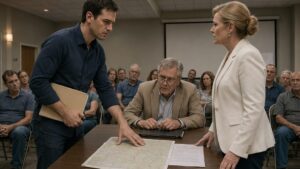
The HOA meeting room was full.
Residents sat with copies of the repair plan in front of them.
Some looked angry.
Some looked worried.
Some looked embarrassed.
Samuel understood all three reactions.
Nobody liked learning that something they trusted had been misunderstood.
Cynthia stood at the front.
She looked different.
Not weaker.
Just more honest.
“The board has reviewed the county findings,” she said.
No one interrupted.
“The water behind the homes is not a private recreational lake. It is a managed stormwater impoundment with maintenance obligations.”
The room remained silent.
Then someone asked the question everyone was thinking.
“How long did the board know?”
Cynthia looked down.
Samuel watched her.
This was the moment.
The easy choice would have been to blame someone else.
The previous board.
Old records.
Bad timing.
She did not.
“We knew there were concerns.”
A murmur moved through the room.
“We did not act with the urgency required.”
That sentence was harder than an apology.
Because it carried responsibility.
Cynthia continued.
“I believed a full disclosure would create financial problems for homeowners.”
She looked around the room.
“I was wrong to believe that protecting people meant controlling what they knew.”
Samuel listened carefully.
He expected satisfaction.
He did not feel it.
Only relief that the truth was finally being spoken.
The repair vote came next.
Heather presented the engineering plan.
The revised shoreline supports.
The restored drainage path.
The widened landing.
The access route designed around Margaret’s needs.
A resident raised a hand.
“Why does the landing need to be that wide?”
Before Samuel could answer, Margaret spoke.
“Because that is the width I need.”
The room became quiet.
She continued.
“I am not asking for special treatment.”
Her hand rested on the walker.
“I am asking for the same ability to reach my home safely.”
Nobody argued.
Because there was nothing to argue with.
The vote passed.
Not unanimously.
Some residents still worried about cost.
Some still disliked the assessment.
But enough understood.
The repair would move forward.
The violation against Samuel was withdrawn.
The fines were removed.
The original design was not approved.
The safer design was.
That mattered.
Samuel signed the revised agreement after reading every page.
Cynthia watched.
“You’re sure?”
He looked up.
“About what?”
“Accepting that your first plan changes.”
Samuel looked through the window.
The water was visible beyond the trees.
“No.”
Cynthia seemed surprised.
Samuel continued.
“But I’m sure it needs to.”
It was the first time he had admitted it without feeling like he was losing something.
The following week, the shoreline work began.
The old brace holes remained visible for a while.
The empty spaces where the original supports had been.
A reminder.
The workers installed the new supports beneath the dock.
Different angles.
Different drainage path.
Different purpose.
The same goal.
Safety.
Samuel stood beside Margaret as the final section was completed.
The water reflected the dock.
Not perfectly.
The surface moved constantly now.
Small ripples.
Small changes.
Honest changes.
Margaret looked down the rebuilt landing.
“I want to try.”
Samuel looked at her.
“Are you sure?”
She smiled.
“That’s my line.”
He stepped aside.
She moved forward.
One step.
Then another.
Samuel walked beside her.
Not ahead.
Not pulling.
Not deciding.
Just beside her.
When she reached the end of the landing, she looked back at the cabin.
The place they had fought to keep.
The place that had almost been lost because everyone was trying to protect it differently.
Samuel looked beneath the dock.
The new braces disappeared into the shoreline.
The old empty holes were still visible nearby.
Proof of what had happened.
Proof of what they had learned.
Across the water, county vehicles were gone.
The demolition truck was gone.
The emergency vehicles were gone.
Only the cabin remained.
Only the dock.
Only the water.
But now everyone knew what it was.
And because they knew, they could finally take care of it.
Samuel rested his hand on the railing.
For years, he had believed protecting home meant standing between it and everyone else.
Now he understood something different.
Sometimes protecting a place meant letting other people help carry the weight.
Margaret looked at him.
“You’re quiet.”
Samuel smiled.
“I’m listening.”
“To what?”
He looked across the water.
The movement.
The flow.
The life underneath the calm surface.
“To everything we missed before.”
The water moved gently beneath the dock.
Not like a lake pretending nothing was wrong.
Like a system finally being understood.
The story has ended.