The HOA Shut Off Her Heat After She Challenged a Repair—Then She Recognized the Gas Line
Chapter 1: The Morning Stephanie’s Thermostat Stopped Rising
At 6:14 on Tuesday morning, Stephanie Miller pressed the thermostat’s up arrow for the third time and watched the number fall anyway.
Sixty-one.
Then sixty.
The forced-air register under the living-room window breathed nothing but cool air across the hardwood floor.
She stood barefoot in the blue light from the kitchen, one hand wrapped around a mug that had stopped steaming, and listened.
The building’s boiler was running.
She could hear it through the floor: a low mechanical thrum from the basement, followed by the faint knock of pipes warming somewhere beneath her unit.
Stephanie frowned.
If the boiler was down, the building would be quiet.
If the circulation pump had failed, Christopher upstairs would already be texting the group thread.
Instead, someone flushed a toilet above her. A cabinet closed across the hall. Normal morning noises.
Her phone showed no emergency notice from management.
She opened the condo association app and checked the maintenance alerts.
Nothing.
By 6:31, the thermostat read fifty-nine.
Stephanie pulled on wool socks and a gray sweater, then called the management company’s emergency line.
The answering service took her unit number and promised a return call.
At 6:52, her phone rang.
“Stephanie, this is Sandra Torres.”
Stephanie recognized the clipped professional tone before Sandra finished introducing herself.
“My heat is off.”
“I know.”
That answer stopped her.
“You know?”
“There was work performed on the hydronic system last night.”
“You mean the common heating system?”
“Yes.”
“And nobody notified me?”
A pause.
“We were told there might be a temporary interruption.”
Stephanie looked at the thermostat.
“Only mine?”
Sandra did not answer immediately.
That was answer enough.
“Sandra.”
“The contractor isolated your branch.”
Stephanie set the mug down.
“For what reason?”
“There was a pressure imbalance after yesterday’s repair.”
Yesterday’s repair.
Stephanie pictured the basement door standing open when she had come home from work. A contractor had been kneeling beside the mechanical room with a tool bag. Robert Allen had stood behind him with his arms folded.
Stephanie had stopped because the copper lines on the floor did not match the maintenance notice owners had received.
The notice had described a valve replacement.
What she had seen looked like more than a valve replacement.
She had asked whether the work was permitted.
Robert had given her the look he always used when he believed a question had crossed into interference.
“We have licensed people handling it,” he had said.
Stephanie had asked for the permit number anyway.
He had told her to email management.
Now her apartment was fifty-eight degrees.
“Was anyone else isolated?” she asked.
“No.”
“All eleven other units have heat?”
Sandra exhaled.
“Yes.”
Stephanie stared at the phone.
“And Robert approved this?”
Another silence.
“Yes.”
The anger came slowly, which was worse than if it had arrived all at once.
“What exactly is supposed to be wrong with my branch?”
“The contractor believes your unit was contributing to the pressure instability.”
“Believes based on what?”
“I don’t have the technical report in front of me.”
“Was there a test?”
“I don’t know.”
“Was there a leak?”
“I don’t know.”
“Was my unit inspected?”
“Stephanie, I’m trying to give you the information I have.”
“No, you’re giving me the decision. I’m asking for the basis.”
Sandra’s voice tightened.
“I can have someone come out this morning.”
“To inspect the problem?”
“To restore service.”
Stephanie closed her eyes.
“Good.”
“There may be a condition.”
She opened them again.
“What condition?”
Sandra hesitated.
“Robert wants acknowledgment that the contractor’s work will not be obstructed going forward.”
Stephanie almost laughed, but nothing about the room felt funny.
“Obstructed.”
“He feels yesterday’s questioning delayed the repair.”
“I asked whether common gas and heating work had a permit.”
“I’m not taking a side.”
“You just told me my heat was shut off after I asked.”
“I told you your branch was isolated for system stability.”
“And it stays isolated until I sign something?”
Sandra’s voice became flatter.
“I’ll send the form.”
The call ended three minutes later.
Stephanie stood in the center of the living room, listening to the building warm around her.
That was the part she could not ignore.
The building was warm.
Her unit was not.
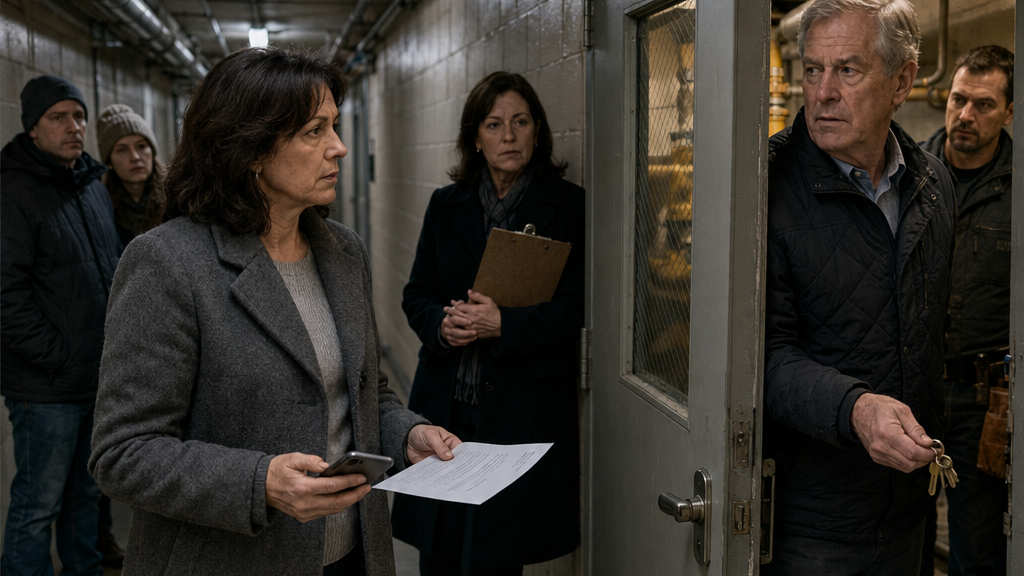
At seven-thirty, she stepped into the hallway wearing a coat over her sweater.
Christopher Hill was coming down the stairs with his child’s backpack over one shoulder.
“You doing okay?” he asked.
“Do you have heat?”
Christopher looked confused.
“Yeah.”
“How much?”
“Seventy, I think.”
He glanced toward her door.
“Yours out?”
Stephanie nodded.
“Management says they isolated my branch.”
Christopher shifted the backpack.
“Because of yesterday?”
Stephanie looked at him.
“You heard about that?”
“Robert mentioned there was an issue with access.”
“There wasn’t an access issue.”
“I’m just telling you what he said.”
Christopher was not hostile. Not yet. But there was already something cautious in his expression, the look neighbors got when they sensed that a private disagreement might become an association problem.
Stephanie thanked him and headed downstairs.
The mechanical-room corridor smelled faintly of warm metal, dust, and boiler water.
The door at the end was locked.
She tried the handle once anyway.
Through the narrow wired-glass window, she could see part of the system.
Old pipes.
A gray expansion tank.
The edge of the boiler.
And, farther in, the yellow-painted gas manifold running horizontally along the wall.
Stephanie leaned closer.
Something was different.
A section near the center had been altered. Fresh fittings stood out against older paint. New brass and steel against a manifold that had been in place for years.
She pulled out her phone and took a photograph through the glass.
Her screen lit with a new email from Sandra.
SUBJECT: Heating Service Restoration Acknowledgment.
Stephanie opened the attachment.
The wording was careful.
She would acknowledge that a condition originating within or serving her unit had contributed to common-system instability. She would agree not to impede authorized contractors. She would accept restoration after the contractor determined it was safe.
Stephanie read the first paragraph twice.
There was no test result.
No inspection finding.
No repair description.
No permit reference.
Just an admission.
Footsteps sounded behind her.
Robert Allen came down the corridor carrying a travel mug and a ring of building keys.
He was in his late sixties, neat even at that hour, wearing a dark quilted jacket over a collared shirt.
He stopped when he saw her.
“You got Sandra’s email?”
“Yes.”
“Then we can get this resolved quickly.”
Stephanie held up her phone.
“What failed in my unit?”
Robert’s face barely changed.
“The contractor told us your branch was destabilizing the loop.”
“What measurement did he take?”
“You can ask him when he gets here.”
“And why was my heat cut overnight instead of during the repair?”
Robert’s jaw tightened.
“Because the board has to protect the common system.”
“By turning off one owner’s heat?”
“By isolating the affected line.”
Stephanie looked through the glass again.
“What did you do to the manifold?”
Robert followed her gaze.
“Routine work.”
“That isn’t what the notice said.”
“The notice doesn’t have to describe every fitting.”
“No. But permitted gas work does have to exist somewhere besides a contractor’s invoice.”
Robert’s voice dropped.
“This is exactly what I mean.”
“What?”
“Every repair turns into an investigation with you.”
Stephanie looked back at him.
“I asked for a permit number.”
“And the contractor will be here at nine. Sign the acknowledgment, let him finish, and your heat goes back on.”
The hallway seemed colder than her apartment.
“You personally approved shutting it off?”
Robert did not answer immediately.
Then he said, “Yes.”
Stephanie nodded once.
It was not the answer she wanted, but it was the one she needed.
She stepped aside as he unlocked the mechanical-room door.
Warm air rolled into the corridor.
For one brief second, before Robert moved to block her view, Stephanie saw the yellow manifold clearly.
The new section was not just a replacement valve.
There were two new reducers, a relocated shutoff, and a fitting arrangement that tugged at a memory she had not touched in years.
She did not know yet what was wrong.
What unsettled her was that she recognized enough to know the work was not routine.
Chapter 2: The Permit Number Nobody Could Give Her
At nine-oh-three, the contractor placed a clipboard against Stephanie’s chest and said, “Sign there, and I can turn your heat back on.”
They were standing in the basement corridor.
Robert was beside the mechanical-room door.
Sandra had arrived in person, still wearing her office coat.
Christopher had stopped on the stairs after taking his child to school, and two other owners had drifted down after hearing voices.
Stephanie looked at the paper but did not take the pen.
“What am I certifying?”
The contractor pointed.
“Just that you understand the branch isolation was necessary.”
“That isn’t what this says.”
He shifted his weight.
“It’s standard.”
“It says my unit contributed to a common-system pressure problem.”
“That’s what we found.”
“How?”
He looked toward Robert.
Robert said, “Stephanie, we’ve been through this.”
“No, we haven’t. We’ve repeated the conclusion.”
Sandra stepped closer.
“The immediate issue is getting your heat restored.”
“I agree.”
“Then sign.”
Stephanie handed the clipboard back.
“No.”
Christopher rubbed his forehead.
“Come on.”
She looked at him.
“My kid was eating breakfast in a seventy-degree apartment this morning,” he said. “I’m not trying to be a jerk, but if this turns into another delay—”
“My heat is the one that’s off.”
“I know. I’m saying let them fix it.”
Stephanie let the words sit.
Then she turned to the contractor.
“Show me what you changed.”
Robert stepped between her and the door.
“No.”
The answer drew more attention than if he had shouted.
Stephanie looked at him.
“You want me to admit my unit caused a problem, but I’m not allowed to see the repair?”
“It’s a locked mechanical room.”
“I’m an owner in the building.”
“You are not authorized to enter.”
“I don’t need to enter. Open the door and show me from here.”
The contractor sighed.
“Robert, I can show her.”
Robert stared at Stephanie for a moment, then unlocked the door.
The mechanical room was cramped and overheated.
The boiler occupied most of the far wall. Pipes crossed the ceiling in layered runs. The yellow gas manifold ran waist-high along the left side, feeding the equipment through separate branches.
The contractor pointed.
“We replaced the regulator and rebalanced.”
Stephanie did not move.
The new fittings were easier to see now.
Fresh pipe compound.
A reducer.
A relocated valve.
A union where she did not remember one.
On the wall behind it hung an old inspection tag, faded almost beige.
“What permit was this under?” she asked.
The contractor’s shoulders tightened.
“Management handles permits.”
Sandra shook her head.
“The contractor does.”
Robert said, “It was emergency maintenance.”
Stephanie looked at him.
“Emergency work still gets a permit closeout.”
“Not necessarily before the work.”
“I didn’t say before.”
She turned back to the contractor.
“What’s the permit number?”
He opened his mouth, then closed it.
Sandra looked at Robert.
Robert said, “We can get it.”
“When?”
“Stephanie.”
“When?”
“This is why nothing gets done around here without costing twice what it should.”
She heard the accusation under the words.
Not that she was wrong.
That she was expensive.
Stephanie stepped closer to the doorway.
Something about the assembly bothered her beyond the missing paperwork.
She tilted her head.
The old manifold had been configured with a straight run, then individual takeoffs. The altered section now changed diameter before feeding the new regulator.
She had seen that arrangement before.
Not here, necessarily.
In inspection photographs.
In old training cases.
Fuel-gas systems where modifications had been performed in stages until nobody could say which version had actually been approved.
She crouched slightly to see the tag behind the line.
The bottom edge carried a city inspection sticker.
Too old to read from the doorway.
Stephanie raised her phone and zoomed in.
Robert reached out.
“No photographs.”
She lowered the phone but did not delete the image.
“It’s association property.”
“It’s a common mechanical system.”
“And you don’t have permission.”
“Then give me the permit number.”
Robert’s face colored.
Christopher spoke from behind them.
“Is this actually unsafe?”
The question changed the room.
Stephanie turned.
“I didn’t say that.”
“But you’re acting like it is.”
“I’m saying I don’t know what was inspected.”
Robert seized on that.
“Exactly. She doesn’t know.”
Stephanie looked back at him.
“No. I don’t.”
She could have pushed harder.
Years earlier, she would have. She would have asked for the pressure test, appliance load, regulator specification, inspection sequence.
Instead, she looked at the contractor.
“Was the modified section pressure-tested after installation?”
He hesitated.
“We tested operation.”
“That wasn’t my question.”
“We checked for leaks.”
“With what procedure?”
His irritation surfaced.
“Lady, I’ve been doing this twenty-two years.”
Stephanie’s expression did not change.
“So have inspectors.”
The corridor went still.
Sandra looked at her.
Robert blinked.
Christopher said, “Inspectors?”
Stephanie wished immediately that she had kept the sentence to herself.
But there was no useful way to take it back.
“I worked for the city years ago.”
“In what?” Sandra asked.
“Building safety.”
The contractor’s expression changed first.
Not fear.
Recognition.
Professional recalculation.
Stephanie pointed toward the altered section.
“I inspected fuel-gas systems. I’m not saying this is defective from the doorway. I’m saying that configuration has been changed, and nobody here can give me the permit number, final inspection, or pressure-test documentation.”
Robert recovered.
“You haven’t done that work in years.”
“That doesn’t make paperwork optional.”
“It makes you an owner with an old résumé, not the authority here.”
Stephanie nodded.
“That’s true.”
She reached for the clipboard.
Robert looked almost relieved.
Then she drew a line through the signature box.
“I’m not signing an admission that my unit caused a problem no one has documented.”
The contractor took the clipboard back.
“So I don’t restore it?”
“Restore it if it’s safe.”
Robert said, “Not without acknowledgment.”
The two other owners exchanged looks.
Christopher’s patience snapped.
“Can we please not make the whole building hostage to this?”
Stephanie turned toward him.
“I’m not asking anyone to shut the building down.”
“Then let them finish.”
“The work is already finished.”
That silenced him.
Stephanie looked again at the old inspection tag.
There was a number at the bottom.
Faded, but visible through her phone’s zoom.
A municipal record identifier.
She enlarged the image until the characters sharpened.
The first half meant nothing.
The last four digits did.
Her stomach tightened.
She had seen that sequence before.
Not in this building as an owner.
In a stack of city inspection files years earlier, when her job had been to walk mechanical rooms and write corrections in black ink.
Stephanie stared at the number until Robert asked what she was looking at.
She locked her phone.
“Nothing yet.”
But the number had already opened a door in her memory.
And behind it was a file she suddenly did not want to find.
Chapter 3: Her Own Initials Were in the Old File
Stephanie found her initials before she found the closure document.
They were on the second scanned page of the municipal record, beside a handwritten correction dated thirteen years earlier.
S. MILLER.
The letters looked younger somehow.
Sharper.
More certain.
She sat frozen at her home-office desk while the portable space heater hummed near her feet.
Her heat had been restored the previous evening after Sandra persuaded Robert to allow the contractor to reopen the branch without Stephanie’s signature. The thermostat now read sixty-eight.
It should have felt like victory.
Instead, the number on the screen had followed her home.
She had gone through an old employee portal first. Nothing.
Then the public building-record database.
Then archived permit indexes.
At 8:17 the next morning, one search result had finally returned the address of her condominium building under an older mechanical permit.
Now she was looking at herself.
The file was not dramatic.
No red warning.
No condemnation.
Just routine municipal paperwork from a renovation long before she had bought her unit.
Inspection requested.
Corrections noted.
Reinspection required.
Stephanie leaned closer.
Her own note was brief.
“Fuel-gas manifold alterations incomplete. Final pressure verification and equipment certification required prior to approval.”
She read it twice.
Then a third time.
Memory returned in fragments.
A basement.
Yellow pipe.
An owner representative impatient about reopening heat.
A winter backlog.
Stephanie had been working six buildings a day.
She remembered placing a correction tag and telling someone to schedule a reinspection.
Two weeks later, she had transferred to another department.
She had assumed the case would move to whoever inherited her route.
Stephanie scrolled.
There should have been another entry.
A reinspection.
A final.
A closure code.
There was none.
She searched under the permit number.
Nothing.
Under the building address.
Nothing.
Under the contractor listed at the time.
Nothing.
At ten, she drove downtown.
The municipal records counter was quieter than she remembered.
A clerk took the permit number and disappeared into the back.
Stephanie waited under fluorescent lights while two contractors argued softly over plan-review dates.
When the clerk returned, she carried a thin paper file.
“This is what wasn’t scanned.”
Stephanie opened it at the counter.
Old inspection slips.
A permit application.
A correction notice.
Her correction notice.
No final approval.
“Could the closure be under a later permit?” Stephanie asked.
“Possible.”
“Can we search the parcel history?”
The clerk did.
They found later plumbing work, electrical permits, roof permits, two HVAC replacements.
No gas-manifold closeout.
Stephanie felt an old reflex waking up: organize, isolate, verify.
“Was the permit ever administratively closed?”
The clerk searched again.
“It shows expired.”
“Not approved?”
“No.”
Stephanie stared at the word.
Expired.
Not failed.
Not passed.
Abandoned in process.
She photographed the relevant pages with permission.
Outside, she sat in her car without starting it.
The obvious next step was clear.
File a safety complaint.
Request inspection.
Let the city determine whether the current system was compliant.
Thirteen years ago, Stephanie would have told any owner exactly that.
Now she pictured Christopher on the stairs.
His child’s backpack.
The two older owners on the first floor.
Michelle King, who had mentioned at the last annual meeting that the reserve account could barely cover the roof deductible.
Twelve units.
One common gas manifold.
If the city decided the system could not remain in service, there would not be eleven warm homes and one cold one.
There might be none.
Stephanie put her phone down.
For the first time since Robert shut off her heat, she wished the problem were only retaliation.
That afternoon, Sandra called.
“I wanted to make sure service is holding.”
“It is.”
“So maybe we can put yesterday behind us.”
Stephanie looked at the photographs spread across her desk.
“Do you have the permit closeout?”
Sandra paused.
“Robert said the contractor is gathering documents.”
“That wasn’t my question.”
“No.”
“Do you have any record of a final inspection on the gas manifold?”
“I don’t manage city archives.”
“Association records.”
“No.”
Stephanie rubbed her forehead.
“Sandra, how long have you managed this property?”
“Six years.”
“Has the manifold been modified before this week?”
“I’d have to check.”
“Please do.”
“Stephanie, what exactly are you looking for?”
That was the question.
Stephanie looked at her initials again.
“I don’t know yet.”
She ended the call before Sandra could push.
By evening, the apartment was warm enough that she turned off the space heater.
The silence after its fan stopped felt unnatural.
She opened the city complaint portal.
Address.
System type.
Observed condition.
Supporting documentation.
Her cursor hovered over the first field.
She could upload the old inspection record.
She could upload the photograph of the new fittings.
She could write that a common fuel-gas system appeared to have been modified without readily available evidence of final inspection.
It would take less than five minutes.
Instead, she closed the browser.
That decision bothered her more than Robert’s paperwork had.
She told herself she needed certainty.
She told herself an expired permit from thirteen years ago did not prove the present system was unsafe.
She told herself reporting too early could create consequences for people who had nothing to do with Robert’s decision.
Every statement was technically defensible.
Together, they sounded like delay.
At seven-thirty, someone knocked.
Stephanie opened the door.
Christopher stood in the hallway alone.
He did not look angry so much as tired.
“Can I ask you something?”
“Sure.”
He glanced toward the stairwell.
“My kid heard us talking yesterday. Now she thinks the building’s going to explode.”
Stephanie’s face tightened.
“It isn’t.”
“You know that?”
“No.”
Christopher stared at her.
“That’s not reassuring.”
“I mean I have no evidence of an immediate danger.”
“But you found something.”
Stephanie did not answer.
He looked past her toward the papers on the dining table.
“Robert says you’re digging through old city records.”
“How does Robert know that?”
“I don’t know. Sandra, maybe.”
Stephanie folded her arms.
Christopher lowered his voice.
“Are you about to call the city?”
She could hear his refrigerator running through the floor above. Water moving in the pipes. The building functioning around them as if nothing had changed.
“I’m trying to understand what happened.”
“That’s not what I asked.”
Stephanie met his eyes.
Christopher swallowed.
“If an inspector comes in and shuts everything down, where are we supposed to go?”
There it was.
Not Robert’s authority.
Not Sandra’s procedures.
Not Stephanie’s pride.
A neighbor standing ten feet from his own front door asking whether her next decision would take that door away from him.
Stephanie looked back at the old inspection record on the table.
Her initials were visible even from the hallway.
Christopher followed her gaze.
Then he looked at her again.
“Stephanie,” he said quietly, “are you about to get all of us thrown out?”
Chapter 4: The Board Meeting Turned One Dispute Into Twelve
Robert opened the meeting by offering Stephanie exactly what she had wanted three days earlier.
Her heat.
“All we are asking,” he said, “is that Stephanie withdraw the demand for an outside inspection so the contractor can finish documenting the repair.”
The community room went quiet.
Twelve folding chairs had been arranged in two uneven rows. Eleven were occupied. Stephanie sat near the back with the old inspection file closed on her lap.
Robert stood beside a portable projector. On the wall behind him was a photograph of the yellow gas manifold.
Stephanie’s photograph.
She had sent it to Sandra that afternoon with one sentence: Please preserve all records related to this equipment.
Now Robert was using it to argue that the work had been limited.
“The contractor has told us the immediate operational issue has been corrected,” he said. “Stephanie’s branch can remain in service. There is no current evidence of a leak.”
Stephanie raised her hand.
Robert saw it and kept talking.
“What we do have is the risk of turning a maintenance question into a full municipal review during the coldest part of the year.”
“Robert.”
He stopped.
“There is also no final inspection record.”
A murmur moved through the chairs.
Robert’s jaw tightened.
“We don’t know that.”
“I checked the municipal file.”
“You checked an old file.”
“Yes.”
“And that file predates this board.”
“Yes.”
“So let’s be accurate about what it proves.”
Stephanie opened the folder.
“It proves that the gas-manifold alteration required final pressure verification and equipment certification. I could not find a closure.”
Christopher turned in his chair.
“You said the system wasn’t necessarily unsafe.”
“I said I had no evidence of an immediate hazard.”
“Is that still true?”
Stephanie hesitated.
Robert answered for her.
“Yes.”
Stephanie looked at him.
“You don’t know that.”
“And neither do you.”
The room tightened around the distinction.
Michelle King, seated at the front with a calculator and a yellow legal pad, spoke without looking up.
“What exactly are you asking for, Stephanie?”
“An independent mechanical contractor. Someone who did not perform the current work. Twenty-four hours. They inspect the manifold, review the available permit history, and tell us whether it can be certified as it sits.”
“And if they say no?” Michelle asked.
“Then we stop pretending the question is about my unit.”
Several owners shifted.
Robert folded his arms.
“Let’s talk about what ‘no’ might mean.”
Michelle finally looked up.
Stephanie saw exhaustion in her face.
Michelle turned the legal pad around.
“Our reserves are lower than they should be.”
Robert gave her a warning look.
Michelle ignored it.
“How low?” Christopher asked.
“Low enough that a major common-system replacement this winter would require either borrowing or a special assessment.”
“How much?”
“We don’t know.”
“Ballpark.”
Michelle pressed her lips together.
“Enough to hurt.”
An older owner near the wall asked, “What does that mean?”
Michelle’s voice softened.
“It means some people here would have trouble paying it.”
Nobody spoke.
Stephanie had expected anger from the board.
She had not expected silence from the room to feel heavier.
Michelle continued.
“Our insurance premium increased again. We used reserve money on the roof deductible last spring. Two owners are already on payment plans for regular assessments.”
Robert said, “This is what I have been trying to explain.”
Stephanie looked at him.
“No. You’ve been telling me I’m obstructing repairs.”
“Because every escalation has consequences.”
“So does ignoring the question.”
“I’m not ignoring it.”
“You shut off my heat.”
“To stabilize the system.”
“Then asked me to admit my unit caused the problem.”
Robert’s face hardened.
“I was trying to prevent a larger shutdown.”
There it was.
Not denial.
Justification.
Stephanie leaned back slightly.
The anger did not leave, but it changed shape.
Robert looked around the room.
“If we bring the city in tonight and they decide the common line needs to be taken out of service, every unit could lose heat until the work is complete.”
Christopher stared at Stephanie.
“So that’s real?”
“It’s possible,” she said.
His voice rose.
“You didn’t say that at my door.”
“I didn’t know enough then.”
“And now?”
“Now I know enough to say we should verify it.”
The older owner near the wall rubbed both hands over his face.
“How long would a shutdown be?”
“No one can answer that yet,” Stephanie said.
Robert gestured toward her.
“That’s exactly the point. We could trigger something none of us can control.”
Stephanie looked down at the closed file.
She had spent two days telling herself that Robert’s fear did not matter because his methods were wrong.
His methods were wrong.
But the fear mattered.
That was the part she had wanted to keep separate.
Michelle said, “Could we do the independent review first?”
Robert turned.
“We already have a contractor.”
“One who did the work,” Michelle said.
Robert stared at her.
Michelle’s voice remained calm.
“I voted to postpone outside review last month because I thought we were dealing with routine maintenance. This isn’t routine anymore.”
Stephanie looked up.
“Last month?”
Michelle froze.
Robert cut in.
“We discussed system performance.”
“That isn’t what she said.”
Michelle looked at Robert, then at Stephanie.
“We had pressure complaints.”
“How many?”
“Two.”
“From which units?”
Robert said, “That’s not relevant.”
“It is if you blamed mine.”
Christopher stood.
“Can somebody just tell us whether the building is safe?”
No one answered.
The question sat in the room like a physical thing.
Stephanie closed her folder.
“I’ll agree to twenty-four hours.”
Robert looked surprised.
“For what?”
“Independent review. No city complaint tonight. But the reviewer gets access to the mechanical room, invoices, contractor notes, and whatever permit records management has.”
Robert’s expression remained guarded.
“And if they say the system can remain in service?”
“I accept it unless they recommend municipal review.”
“And if they can’t certify?”
“Then we deal with that answer.”
Michelle nodded.
“I support that.”
One by one, enough owners did the same.
Robert did not smile.
But he agreed.
The independent contractor arrived the next afternoon.
Stephanie did not follow him into the mechanical room.
She stayed in the hallway with Sandra while he spent forty-three minutes inside.
When he came out, he carried no tools.
Robert stepped forward.
“So?”
The contractor looked at the yellow manifold through the open doorway.
“I’m not putting my license on that.”
The hallway went silent.
Robert’s face changed.
Only slightly.
But Stephanie saw it.
Not surprise.
Recognition.
Chapter 5: The Email Robert Should Have Disclosed
Sandra called Stephanie at 7:12 the next morning and said, “There’s an email you need to see.”
Stephanie sat up in bed.
The apartment was warm.
For several seconds, she listened to the heat moving through the register before answering.
“From who?”
“Robert.”
“When?”
Sandra hesitated.
“September.”
Stephanie swung her feet to the floor.
Four months earlier.
“About the manifold?”
“Yes.”
“Why am I only hearing about it now?”
“I’ll explain when you get here.”
The management office occupied a converted storefront ten minutes away.
Sandra was waiting in a small conference room with a printed stack of emails face down on the table.
She looked as though she had not slept.
Stephanie removed her coat but did not sit.
“What happened?”
Sandra pushed the top page toward her.
The message was from a mechanical contractor who had inspected the building after two owners complained about intermittent boiler-pressure fluctuations.
Stephanie read slowly.
The contractor had noted that the common gas manifold appeared to have been altered under an older permit for which final certification could not be located.
He recommended a permit-history review and formal inspection before additional modifications.
Stephanie reached the bottom.
Robert’s reply was printed beneath it.
Can we maintain operation and revisit certification after the reserve contribution posts next fiscal year?
Stephanie read the line again.
Then the contractor’s answer.
System is presently operating. I cannot represent undocumented prior work as code-compliant without inspection.
Stephanie looked at Sandra.
“You had this.”
Sandra nodded.
“Since September.”
“Yes.”
“And you told me this week that you didn’t know whether the manifold had been modified.”
Sandra’s face tightened.
“I answered too quickly.”
“You answered incorrectly.”
“I know.”
Stephanie sat.
“Did Robert tell you not to disclose it?”
“No.”
That answer surprised her.
Sandra folded her hands.
“He told me it was part of board deliberation and that the contractor had not identified an active leak.”
“That isn’t the same as clearance.”
“I understand that now.”
“Did you understand it then?”
Sandra did not answer immediately.
“I understood enough that I should have asked more questions.”
Stephanie looked back at the email.
Her own guilt shifted.
It did not disappear.
Her initials were still in the old file. She had still assumed someone else closed a correction she had issued.
But Robert had received a warning while serving as president.
This was not simply an old municipal loose end drifting unnoticed through time.
Someone had recently pointed directly at it.
“And this week?” Stephanie asked. “When he isolated my heat?”
Sandra looked away.
“There was a contractor note saying your branch showed the largest pressure variation after the repair.”
“Largest doesn’t mean defective.”
“No.”
“Did Robert know that?”
Sandra met her eyes.
“Yes.”
Stephanie felt something inside her settle.
Not satisfaction.
Clarity.
Robert had not invented the pressure variation.
He had taken a limited technical fact and used it as leverage.
“Why are you showing me this now?”
Sandra looked toward the closed conference-room door.
“Because the independent contractor sent his report at six this morning.”
“And?”
“He will not certify the common manifold without municipal review.”
Stephanie said nothing.
Sandra continued.
“Robert wants us to obtain another opinion.”
“Of course he does.”
“He says one contractor refusing doesn’t establish a hazard.”
“Technically, he’s right.”
Sandra blinked.
Stephanie picked up the September email.
“It does establish that this question has been sitting here for months.”
Sandra leaned back.
“I manage twenty-three associations.”
“That doesn’t excuse this.”
“I didn’t say it did.”
Her voice sharpened for the first time.
“But I want you to understand how it happens. Boards ask if something has to be done now. Contractors say they can’t certify old work. Lawyers say don’t speculate. Managers document. Everyone waits for the next meeting.”
“And meanwhile?”
“Meanwhile people live there.”
The anger between them became quieter.
Stephanie gathered the papers.
“I need the full file.”
Sandra shook her head.
“I can give you records relevant to your unit and common elements, but some board communications may be privileged.”
“Then give me everything you legally can.”
Sandra studied her.
“Are you filing?”
Stephanie looked down at the September warning.
“I don’t know.”
It was a lie of only a few hours.
By noon, she knew.
Christopher called while she was reviewing the management records at her kitchen table.
His voice was tight.
“Stephanie, the heat dropped upstairs again.”
She stood immediately.
“How low?”
“Sixty-two and falling.”
“Is the boiler running?”
“I don’t know.”
Then she heard a child coughing in the background.
“Is she okay?”
“She’s got a fever.”
Stephanie closed her eyes.
“Christopher, the fever may have nothing to do with the heat.”
“I know that.”
His voice cracked anyway.
“I know. I’m just trying to keep her warm.”
Stephanie pulled on her coat.
“I’ll bring up my space heater.”
When she reached his unit, Christopher opened the door carrying his child against one shoulder.
The child looked tired, flushed, wrapped in a blanket.
Stephanie set the heater near the living-room wall.
“Keep it clear of fabric. Plug it directly into the outlet.”
Christopher nodded.
Then he looked at her.
“Is this because of the system?”
“I don’t know.”
“That’s becoming your answer to everything.”
The words hurt because they were true.
Stephanie glanced at the thermostat.
Sixty-one.
Her own unit downstairs was still warm.
Now the pattern had shifted.
Whatever the contractor had called a unit-specific problem was moving.
Christopher lowered his voice.
“What did you find?”
Stephanie looked at the child.
Then at him.
“Robert was warned in September that the manifold’s final certification couldn’t be located.”
Christopher stared.
“He knew?”
“He knew there was a certification issue.”
“And he still told us this was you?”
“He told you my branch was contributing to instability. That part may have been true.”
“That’s not what I asked.”
Stephanie almost said she needed more time.
She almost told herself she should wait until she had every document arranged perfectly.
That instinct had served her for years.
Verify first.
Speak second.
Control the uncertainty.
But the building was no longer waiting for her certainty.
“I’m filing the complaint,” she said.
Christopher’s face went pale.
“Today?”
“Yes.”
“Then what happens?”
“The city decides that.”
His expression hardened.
“So you really might get us removed.”
Stephanie held his gaze.
“If the system is safe, an inspection should help establish that.”
“And if it isn’t?”
“Then we shouldn’t be living over it because everyone was afraid of the answer.”
Christopher looked down at his child.
He did not thank her.
Stephanie would have distrusted him if he had.
She returned downstairs.
At her desk, she reopened the municipal complaint portal.
This time she did not stop at the first field.
She entered the address.
Described the current alterations.
Attached the independent contractor’s refusal.
Attached the September warning.
Then she paused over the final document.
Her own thirteen-year-old correction notice.
S. MILLER.
If she left it out, the complaint would still be serious.
If she included it, the city would see that she had once touched the same system and that the unfinished history reached further back than Robert.
Stephanie attached it.
She read the submission once.
Not three times.
Then pressed Send.
A confirmation number appeared.
For the first time since the dispute began, she had stopped trying to control what happened next.
Chapter 6: When the Inspector Tagged the Common Manifold
The city inspector arrived at 8:36 the next morning and asked one question before stepping fully into the mechanical room.
“Where’s the final certification for the common gas manifold?”
Robert was standing beside Sandra.
Neither answered.
Stephanie watched the inspector look from one face to the other.
Then he said, “All right.”
Two words.
Nothing dramatic.
But the way he set his clipboard on the boiler changed the temperature of the room more than the heating system had all week.
The mechanical-room door stayed open.
Stephanie remained in the corridor. Robert had objected to her presence, but the inspector had said the complainant could remain available for questions.
The yellow manifold ran along the wall beneath fluorescent light.
The inspector checked the newer fittings first.
Then the regulator.
Then the older branches.
He photographed the faded municipal tag.
“Who performed the recent alteration?”
Sandra provided the contractor information.
“Permit?”
Sandra handed him the invoice.
He looked at it.
“This isn’t a permit.”
“We understand.”
Robert said, “It was emergency maintenance.”
The inspector nodded.
“Then there should be emergency-work documentation and a subsequent inspection request.”
Robert said nothing.
The inspector crouched near the manifold.
“Was a pressure test performed?”
“The contractor checked for leaks,” Robert said.
“That isn’t what I asked.”
Stephanie looked down.
The wording was nearly identical to what she had said in this room two days earlier.
Robert heard it too.
His face tightened.
The inspector spent more than an hour reviewing records.
Near ten, a fire-safety official arrived.
That was when owners began gathering in the hallway.
Christopher stood near the stairs with his arms folded.
Michelle kept asking Sandra whether anyone knew what insurance would cover.
No one raised their voice.
That made the fear worse.
At 10:23, the inspector called Stephanie into the mechanical-room doorway.
He held a copy of her old correction notice.
“You wrote this?”
“Yes.”
“You were assigned to the property?”
“For the initial inspection.”
“And the follow-up?”
“I transferred departments before it was scheduled.”
“Did you close the permit?”
“No.”
“Did you document reassignment?”
Stephanie swallowed.
“I don’t remember.”
He looked at her for a moment.
Then nodded.
“That’s different from approving it.”
The distinction should have relieved her.
Instead, it made the last several days feel heavier.
“I assumed someone else completed the case.”
“That happens.”
“It shouldn’t.”
“No.”
He did not comfort her.
Stephanie appreciated that.
“What does the current condition mean?” she asked.
“We’re still determining that.”
By eleven-thirty, the answer arrived.
The inspector gathered Robert, Sandra, Michelle, and Stephanie in the community room.
Christopher stayed near the door with several other owners.
“The common manifold cannot remain in normal service,” the inspector said.
Michelle gripped the edge of the table.
“For how long?”
“We need specified corrections, a pressure test, and final inspection before return to service.”
“Hours?” Robert asked.
The inspector shook his head.
“I wouldn’t plan around hours.”
The room shifted.
Christopher said, “What about heat?”
“The gas-fired equipment served by this manifold will be affected.”
“All twelve units?” Michelle asked.
“Yes.”
Someone in the back whispered, “Oh, God.”
Stephanie looked at the floor.
This was the moment she had delayed because she had imagined it too clearly.
The inspector continued.
“Because of the temperatures and the building’s dependence on this system, temporary relocation may be necessary until safe service is restored.”
Christopher turned toward Stephanie.
Not accusing.
Not forgiving.
Just stunned.
Robert spoke.
“You’re saying everyone has to leave because a paperwork record is missing?”
The inspector looked at him.
“No. I’m saying the common system has undocumented prior alterations, recent unpermitted modification, and no acceptable final pressure certification available to us today.”
Robert’s face flushed.
“There’s no leak.”
“That is not the only standard.”
The fire-safety official began explaining temporary restrictions and owner notifications.
Stephanie barely heard him.
She watched the yellow manifold through the open door.
An hour later, the inspector attached an official tag to it.
Bright against the old paint.
The same line Robert had treated as divisible—her branch, someone else’s branch, one owner’s inconvenience—was now visibly what it had always been.
Common.
By afternoon, the building had become a logistical problem.
Hotel availability.
Pet accommodations.
Medication refrigeration.
Insurance calls.
Emergency assessment questions.
Sandra worked from a folding table in the lobby, fielding calls.
Michelle sat beside her with association banking records.
Christopher packed a duffel upstairs.
Stephanie carried boxes for an older owner without being asked.
Nobody applauded her for being right.
She had never expected them to.
Still, when one owner passed her in the hall and said, “This is because you called them,” Stephanie had no answer that would make the sentence false.
At four, the city inspector found her near the stairs.
“I reviewed the historic file more fully.”
Stephanie braced.
“Your correction was open when you transferred. There’s an internal route-change entry ten days later. The reassignment didn’t generate a final.”
“So I missed it.”
“You didn’t close work you hadn’t approved.”
“But I didn’t follow it.”
“You were no longer assigned.”
Stephanie looked toward the lobby.
“That won’t matter much to them.”
“It may matter to you.”
Then he walked away.
Robert was waiting near the basement door.
For the first time all week, he looked older than his position.
“Can we talk?”
Stephanie followed him into the empty community room.
He closed the door but did not sit.
“I knew about September.”
“I know.”
“Sandra showed you.”
“Yes.”
Robert looked at the table.
“I should have told the board exactly what the contractor said.”
“You should have called the city.”
“I know what I should have done now.”
Stephanie said nothing.
He rubbed one hand across his forehead.
“You think I was protecting myself.”
“Weren’t you?”
“Partly.”
The admission surprised her.
Robert looked toward the wall where the manifold photograph had been projected the night before.
“Michelle showed me the numbers in August. If we had a major mechanical assessment on top of insurance, three owners were likely to fall behind. Maybe four.”
“That wasn’t your decision to make for them.”
“I know.”
“Do you?”
His expression hardened briefly.
Then fell again.
“I kept thinking if we could get through winter, rebuild reserves, do it in spring, the damage would be smaller.”
“So you postponed inspection.”
“Yes.”
“And when I started asking questions?”
“I thought you were going to force the whole issue before we had any plan.”
“So you shut off my heat.”
Robert looked at her.
“Yes.”
There was no excuse attached this time.
“I told myself the contractor had identified your branch, so I had a technical basis.”
“You had leverage.”
“Yes.”
The word sat between them.
Outside the room, suitcase wheels rattled over the lobby tile.
Robert listened.
“I thought I was protecting people from losing their homes.”
Stephanie looked toward the sound.
“And now they’re packing them.”
Robert nodded once.
For the first time, neither of them had a procedure to hide behind.
Chapter 7: What They Reconnected After Everyone Came Home
Stephanie returned to the building on the morning the heat was restored before most of the owners did.
The lobby still looked temporary.
Cardboard boxes sat beneath the mailboxes. A hotel luggage tag hung from the handle of one suitcase someone had forgotten. Sandra’s folding table was gone, but the strip of tape that had marked its position remained on the tile.
Downstairs, the mechanical-room door stood open.
That was new.
Stephanie stopped at the threshold.
The yellow manifold was still there, but almost nothing around it looked the same.
Freshly labeled shutoffs.
New supports.
A regulator assembly with inspection markings she could actually trace.
A pressure-test certificate in a clear sleeve beside the door.
And, hanging from a clip on the wall, the final approval document.
No mystery.
No verbal assurance.
No need to ask somebody what had happened.
The city inspector was completing his last walkthrough with the repair contractor.
Stephanie stayed outside the room until he noticed her.
“You can come in,” he said.
She hesitated.
Then stepped across the threshold.
The repaired system gave off the warm metallic smell she remembered from inspections years ago, but the room felt different without the locked-door tension around it.
The inspector pointed toward the new manifold section.
“Pressure test passed yesterday. Combustion equipment is cleared. Final paperwork is posted.”
Stephanie nodded.
“And the old branches?”
“Verified individually.”
She looked at the yellow pipe.
For days, it had represented every argument in the building.
Her branch.
Christopher’s unit.
Robert’s authority.
Her old correction.
The city’s tag.
Now it was simply what it had always been: one shared line feeding twelve homes.
The inspector closed his clipboard.
“You heading back in today?”
“Yes.”
“Good.”
He started toward the door, then stopped.
“For what it’s worth, most people don’t attach documents that make themselves look worse.”
Stephanie looked at him.
“I almost didn’t.”
“I figured.”
“That’s not flattering.”
“It wasn’t meant to be.”
He left.
Stephanie smiled despite herself.
Upstairs, the annual meeting room had been turned into a special association meeting for the second time in three weeks.
This time there were no projected photographs of the manifold.
Michelle sat at the front with a binder thick enough to require two clips.
Robert sat in the second row.
Not at the table.
That changed the room before anyone spoke.
Sandra called the meeting to order as manager.
Michelle went through the numbers first.
The emergency work had cost more than the reserve account could absorb.
Insurance would cover some relocation expenses but not the mechanical corrections themselves.
There would be an assessment.
Several owners visibly tensed.
Michelle raised one hand.
“We have financing options.”
She explained them carefully.
The association had negotiated a short-term emergency loan. Owners could pay their share immediately or enter a staged repayment plan. Those with documented hardship could stretch payments longer under terms the association attorney had reviewed.
No one would be forced to produce the full amount at once.
An older owner near the wall asked, “What does that cost us in interest?”
Michelle gave the number.
It was not small.
But it was survivable.
Stephanie watched shoulders lower around the room.
Not relief.
Something closer to the return of scale.
The problem was still expensive.
It was simply no longer undefined.
Then Robert stood.
He did not move to the front.
“I need to say something before the board votes on anything else.”
The room became still.
Robert looked toward Stephanie once, then away.
“I gave Sandra my resignation as president this morning.”
No one reacted immediately.
Robert continued.
“I’m not resigning from responsibility for what happened. I’m resigning because I used the office badly.”
Stephanie heard Christopher shift behind her.
Robert’s hands remained at his sides.
“I had information in September that should have been shared more broadly. I convinced myself that delaying formal inspection was protecting owners from a cost we weren’t ready to carry.”
He stopped.
The next words seemed harder.
“When Stephanie challenged the repair, I used her unit’s pressure variation to justify isolating her heat. That was wrong.”
There was no applause.
No outrage.
One owner looked down at the floor.
Another stared at Robert with an expression that was almost grief.
Robert continued.
“I still believe the financial risk was real. I don’t believe anymore that it gave me the right to decide what everyone else was allowed to know.”
Stephanie looked at Michelle.
Michelle’s eyes were wet, but her voice was steady when she moved to the next item.
The association approved new procedures that afternoon.
Every common-system permit would be tracked from application through final closeout.
Inspection records would be available to owners through the association portal.
No single officer could authorize the isolation of one unit from a common life-safety or heating system except under documented emergency conditions.
Sandra proposed an escalation protocol for management whenever contractor language included phrases such as unable to certify, permit unavailable, or code review recommended.
The votes were not unanimous.
That made Stephanie trust them more.
When the meeting reached board vacancies, Michelle looked directly at her.
“We need someone with technical experience.”
Stephanie shook her head before Michelle finished.
“No presidency.”
A few people laughed softly.
It was the first relaxed sound Stephanie had heard in that room in weeks.
Michelle said, “I wasn’t offering you the presidency.”
“Good.”
“What about the board?”
Stephanie looked around.
Robert was still seated in the second row.
Christopher leaned against the back wall.
Sandra had a pen poised over the minutes.
Stephanie thought about the old file.
About the way she had sat alone with it, convinced that she needed to understand everything before telling anyone enough to act.
“I’ll do a temporary safety committee,” she said.
Michelle raised an eyebrow.
“Temporary?”
“Six months.”
“And then?”
“Then someone else learns how the records work.”
Michelle nodded.
“That may be the most useful answer you’ve given us.”
Three weeks after the shutdown, the owners began moving back in.
Christopher returned before Stephanie did.
She was carrying a grocery bag through the lobby when he came down the stairs.
“Heat’s on upstairs.”
“Good.”
“My kid stood over the vent for five minutes.”
Stephanie smiled.
“How is she?”
“Fine. Completely recovered.”
He shifted one hand into his pocket.
“I was angry at you.”
“I know.”
“I’m still not happy about the hotel bill.”
“I wouldn’t be either.”
Christopher looked toward the basement door.
“But I saw the inspector’s report.”
Stephanie waited.
“That line fed all of us.”
“Yes.”
He nodded slowly.
“I kept thinking it was your complaint that displaced us.”
Stephanie said nothing.
“It wasn’t.”
“It contributed.”
“No.”
He shook his head.
“The problem displaced us. You just made us find it.”
The sentence landed harder than praise would have.
Stephanie looked away.
“I waited longer than I should have.”
Christopher nodded.
“Yeah.”
She looked back at him.
He almost smiled.
“I figured you knew that.”
“I do now.”
Later that afternoon, Stephanie went to the mechanical room one last time.
Sandra had given her a temporary key during the repair period so she could attend inspections.
Stephanie stood outside the open doorway and turned it over in her palm.
A small brass key.
Nothing special.
But she understood why she had kept it in her pocket all week.
Access felt like responsibility.
Then, if she was not careful, responsibility began to feel like control.
Sandra came down the hallway carrying a folder.
“You keeping that?”
Stephanie held up the key.
“No.”
She placed it in Sandra’s hand.
“Log it back in.”
Sandra looked surprised.
“You’re on the safety committee.”
“I don’t need private access.”
Sandra nodded.
“I’ll put an access procedure in the file.”
“Good.”
They walked upstairs together.
Before leaving, Stephanie stopped at her own thermostat.
Sixty-eight.
She pressed the up arrow once.
The system clicked.
Warm air began moving through the register.
A few seconds later, she heard pipes respond above her.
Christopher’s unit first.
Then another branch.
Then another.
Not twelve isolated homes.
One building.
Stephanie watched the number rise and left the thermostat alone.
The story has ended.