The HOA Fined Him for His Desert Yard—Then He Found Their Water Line Under His Property
Chapter 1: The Only Yard That Refused to Stay Green
The violation notice was clipped to a barrel cactus.
Michael Walker stood at the edge of his driveway with one hand wrapped around a coffee mug and stared at the white envelope trembling against a cluster of yellow spines. Whoever had delivered it had used a black binder clip, as if attaching HOA paperwork to a cactus were an ordinary administrative procedure.
Behind him, a sprinkler clicked rhythmically across the neighbor’s lawn.
Three houses down, another sprinkler sent a silver arc over Kentucky bluegrass already bright enough to look artificial.
Michael pulled the envelope free.
NOTICE OF LANDSCAPE NONCOMPLIANCE.
He read the first paragraph, then the second, although he already knew the language.
Unapproved ground cover. Insufficient turf coverage. Visual incompatibility with established neighborhood character.
At the bottom sat the amount he had seen too many times.
Two hundred dollars.
Michael folded the paper once and tucked it under his arm.
His front yard looked nothing like the others on Sonoran Ridge Drive. There was no lawn. Instead, crushed granite curved between two barrel cacti, a young palo verde, desert spoon, brittlebush, and several plants he had chosen because they could survive July without drinking like a golf course.
He had installed most of it himself.
He also knew exactly how much water it used.
That was part of what irritated him.
By eight in the morning, half the neighborhood was already watering grass beneath a sun that would push the temperature past one hundred by afternoon. Michael’s drip system had run for nineteen minutes before dawn.
He heard tires on the street.
A white SUV slowed beside his driveway.
Frank Miller lowered the passenger window.
“Morning, Michael.”
Michael raised the envelope.
Frank gave a small nod.
“So you got it.”
“You could’ve put it on the door.”
“The management company handles delivery.”
Michael glanced at the cactus.
“They’re getting creative.”
Frank didn’t smile.
Frank had been HOA president for almost three years. He was in his late fifties, always cleanly dressed, always carrying either a folder or a tablet, and always spoke as though every disagreement could be reduced to a subsection.
“The board has given you plenty of time,” he said.
“I changed the yard two years ago.”
“And it never received architectural approval.”
“It didn’t need irrigation approval.”
“That’s not the issue.”
“That’s my point.”
Frank’s jaw tightened.
Michael knew he should stop there.
Instead he looked across the street, where sprinklers were running hard enough for water to stream along the curb.
“My whole front yard uses less water in a week than that one probably uses in a morning.”
Frank followed his gaze.
“This isn’t about water consumption.”
“No. It’s about everybody seeing the same shade of green.”
“It’s about maintaining standards people agreed to when they bought here.”
That landed closer to the truth than Michael liked.
He had signed the covenants. He knew that. He also knew the landscaping section was old, vague in places, and written when the developer had been selling a particular look.
But Michael had chosen not to fight the first citation.
Or the second.
Or the third.
He had paid them.
Two hundred dollars at a time.
He had told himself the board would eventually lose interest.
Frank hadn’t.
“You know what buyers notice?” Frank asked.
Michael looked at him.
“They notice inconsistency. We’ve got owners listing homes this summer. We have people asking why one property gets to ignore standards everyone else follows.”
“So this is because somebody’s trying to sell?”
“It’s because rules only work if they apply evenly.”
Michael studied him for a second.
There it was.
Not hatred of cactus.
Fear of exception.
Frank drove on.
Michael carried the notice into the garage and dropped it on a workbench beside irrigation fittings, PVC cutters, solenoids, and a coil of low-voltage wire.
He had spent twenty-six years working around landscape irrigation. Some years had been better than others.
Six years earlier, he had owned a small contracting business with three trucks and seven employees.
He had also spent too long telling himself he could absorb one more bad month.
By the time he admitted he couldn’t, the numbers had already made the decision for him.
Michael looked at the new fine.
Two hundred dollars wasn’t going to ruin him.
That was how he had justified every one of them.
At noon, Samantha Baker came home carrying a paper bag of wedding favors and a roll of ribbon.
“You’re not allowed to touch these,” she said.
Michael looked up from the kitchen counter.
“I wasn’t planning to.”
“You say that, but you reorganized the seating cards.”
“They were inefficient.”
“They were alphabetical.”
“Exactly.”
She smiled, then noticed the envelope near his elbow.
Her expression changed only slightly.
“Another one?”
“Same thing.”
“How much?”
Michael folded the notice shut.
“Nothing new.”
It was technically true.
Samantha set the bag down.
“We’re three weeks from the wedding.”
“I know.”
“I don’t want Frank Miller occupying any space in this kitchen until after that.”
“He doesn’t.”
She looked directly at the envelope.
“Apparently he gets a chair.”
Michael slid it into a drawer.
“Gone.”
She let him.
That was one of the things he loved about her and sometimes took advantage of: Samantha did not push every silence open.
Later that afternoon, Michael connected a flow meter to the irrigation supply and ran his drip zones.
He wrote the numbers on a yellow pad.
Then, because irritation needed somewhere to go, he walked across the street when the neighbor’s turf cycle started and noted the visible runoff.
He wasn’t trying to build a case.
Not yet.
He simply wanted to know whether his instinct was right.
It was.
His entire landscape used a fraction of the water demanded by a conventional turf yard of the same size.
The following evening, Frank stood with two board members near the common mailbox structure as Michael approached.
Frank nodded toward the front yards lining the street.
“Look at the pattern.”
Michael stopped.
“What pattern?”
“Consistency.”
Michael looked.
Green. Green. Green.
Then his property.
Gravel, shadow, yellow blooms, cactus.
Frank lowered his voice.
“You think this is about taste. It isn’t. Once one owner decides standards are optional, the next owner asks why their thing is different.”
“My thing is landscaping suited to where we live.”
“And the board has heard that argument.”
“Did the board hear the water numbers?”
Frank’s expression changed.
Michael handed him a printed sheet.
Frank scanned it.
“Your consumption isn’t the compliance question.”
“It should be part of it.”
“No.”
“Why?”
Frank handed the sheet back.
“Because the HOA isn’t a water district.”
Michael tucked the page under his arm.
Frank looked toward Michael’s house.
“You’ve received informal notices. You’ve received fines. The next step is architectural enforcement.”
Michael felt his irritation cool.
“What does that mean?”
“You’ll receive the details.”
“Frank.”
But Frank had already turned toward the others.
Michael walked home more slowly than he had arrived.
At the edge of his yard, he stopped beside the largest barrel cactus.
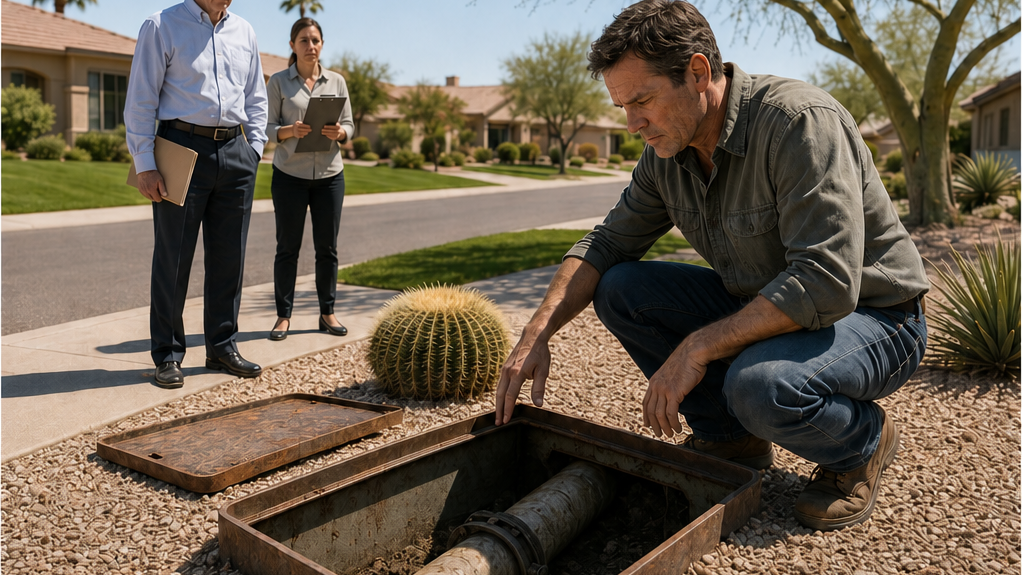
A few feet beyond it, nearly hidden under decomposed granite, was a rectangular metal lid the same dusty brown as the ground.
He had stepped over it hundreds of times.
An old irrigation valve box.
Probably original construction.
Michael nudged loose gravel away with his boot.
Then he stopped.
There was no reason to open it.
Not tonight.
The next morning, a certified envelope arrived.
SPECIAL COMPLIANCE HEARING.
Michael read the date twice.
Then he looked through the front window at the yard the board apparently considered dangerous enough to require a hearing.
For the first time since the fines had started, two hundred dollars no longer seemed like the real problem.
Chapter 2: The Fine That Landed Before the Wedding
The new notice lay across the wedding invitations.
Michael had been opening mail at the kitchen table when he slit the envelope and unfolded three pages of HOA letterhead over a stack of cream-colored cards Samantha had spent the previous night addressing.
He read the first page.
Then he read it again.
Required landscape restoration.
Approved turf installation.
Estimated compliance cost: $8,140.
And beneath it, in bold:
Failure to complete corrective work by the stated deadline may result in continuing penalties of up to $1,000 per day.
The date was Friday.
The Friday before their Saturday wedding.
Michael heard Samantha in the hallway and flipped the paperwork facedown.
She came in carrying her shoes.
“Do these look ridiculous?”
He glanced at them.
“No.”
“You didn’t look.”
“I saw shoes.”
“That’s not the same thing.”
She stopped.
Michael had put his hand over the papers.
Samantha’s eyes dropped to it.
“What is that?”
“HOA.”
Her shoulders fell.
“What now?”
“Compliance deadline.”
She waited.
Michael hated that waiting.
He lifted his hand.
Samantha read the first page standing up.
By the time she reached the second, her mouth had tightened.
“Eight thousand dollars?”
“It’s an estimate.”
“And a thousand dollars a day?”
“They can threaten it. That doesn’t mean it survives a challenge.”
She stared at him.
“How many fines have you paid?”
Michael said nothing.
“Michael.”
“Seven.”
She blinked.
“Seven months?”
“They were two hundred each.”
“That’s fourteen hundred dollars.”
“I know.”
“You told me this was basically paperwork.”
“It was.”
“No. You decided you could absorb it.”
Michael leaned back.
“I thought they’d stop.”
Samantha gave a short, disbelieving breath.
“And if they didn’t?”
He had no answer that wouldn’t sound worse aloud.
She sat opposite him.
“You did this with the business.”
Michael looked toward the window.
“That’s different.”
“You kept saying you could carry one more month because you didn’t want anybody to know how bad it was.”
“It is different.”
“You’re right. This time we’re getting married in ten days.”
That sentence stripped the argument clean.
Michael looked down at the invitation beneath the fine notice.
Their names were printed side by side.
He had wanted these weeks to be easy for her.
Instead, he had quietly brought another accumulating problem to the table.
“I’ll handle it,” he said.
Samantha’s expression hardened.
“That sentence is exactly the problem.”
That afternoon Michael attended the compliance meeting at the HOA office.
Frank sat at one end of the table with a management representative and two board members. Kathleen Thompson, the treasurer, had a calculator beside a stack of reserve reports.
Michael placed his water-use sheet on the table.
Frank barely looked at it.
“We’re not revisiting consumption.”
“I’m not asking you to.”
“Then what are you asking?”
“For the board to explain why a desert-adapted yard is suddenly an eight-thousand-dollar emergency.”
One board member shifted.
Frank folded his hands.
“We have three homes currently listed. We have two more owners who have indicated they may list before fall. We’ve received complaints regarding inconsistent enforcement.”
“Complaints from who?”
“Owners.”
“Names?”
“That’s not relevant.”
“It is if you’re threatening a thousand dollars a day because somebody doesn’t like gravel.”
Kathleen spoke for the first time.
“The daily figure is a maximum authorized escalation. It’s not necessarily what would be imposed.”
Michael looked at her.
“But it can be.”
She hesitated.
“Yes.”
Frank leaned forward.
“The point is compliance, not punishment.”
“Then give me a reasonable standard that recognizes low-water landscaping.”
“We have one. Your submission didn’t meet it.”
“My submission was never reviewed under the current desert-landscape guidelines.”
Frank’s face changed a fraction.
Michael noticed.
“What?”
“The board is enforcing the governing documents in place.”
“That wasn’t my question.”
The management representative slid a folder forward.
“You can submit a revised plan.”
“And install turf before next Friday?”
No one answered immediately.
Michael stood.
Frank said, “If you choose not to comply, that is your decision.”
Michael turned back.
“No. A choice is when both options are reasonable.”
Outside, the afternoon heat pressed down hard enough to flatten sound.
Frank followed him into the parking lot.
“I don’t enjoy this,” he said.
Michael faced him.
“Could’ve fooled me.”
Frank ignored it.
“People moved into this community because it looked a certain way. Every exception creates another argument.”
“You’re scared of precedent.”
“I’m responsible for precedent.”
Michael almost answered.
Then he saw something else in Frank’s expression—not enjoyment, exactly, but strain.
Frank believed this.
That made him more dangerous, not less.
The next morning, Frank arrived at Michael’s house with the management representative.
Samantha was inside packing table decorations.
Michael met them in the front yard.
Frank carried a clipboard.
“We need photographs confirming current conditions.”
“You have plenty.”
“We need current ones.”
Frank pointed toward the side yard.
“The approved conversion plan requires turf coverage extending from the driveway to that utility strip.”
Michael followed his finger.
The rust-colored valve lid sat half-hidden beside the barrel cactus.
For some reason, the phrase utility strip caught.
Michael walked toward it.
“Michael,” Frank said, “we’re not here to inspect irrigation.”
Michael crouched and scraped gravel from the lid.
“Maybe we should.”
He lifted it.
Inside sat a large brass valve connected to a thick PVC main far larger than anything feeding his own drip system.
Michael’s posture changed.
He knew residential irrigation.
This wasn’t a house line.
He leaned closer.
The pipe entered from the rear property line, passed through the box, and continued toward the street.
Frank said, “What are you doing?”
Michael brushed dirt from the valve body.
“Do you know what this feeds?”
“It’s association infrastructure.”
“That wasn’t what I asked.”
The management representative looked at Frank.
Michael traced the direction mentally.
The common-area controller sat east of his lot.
The neighborhood’s distribution lines also ran east.
He stood.
“Where’s the easement?”
Frank frowned.
“For what?”
“This main.”
“It’s part of the development.”
“Where’s the recorded easement across my parcel?”
Frank’s annoyance sharpened.
“I don’t carry subdivision records in my car.”
“You’re standing here telling me what I have to put on top of the ground.”
Michael pointed into the open box.
“I’m asking what lets the HOA run that underneath it.”
Frank looked down.
For the first time since the dispute began, he did not answer immediately.
Michael felt something click into place—not victory, not yet.
Direction.
Frank finally said, “The association has access rights to its infrastructure.”
“Good. Send me the recording reference.”
“We can get you the documentation.”
“Today?”
Frank closed his clipboard.
“I said we can get it.”
Michael lowered the valve-box lid but did not cover it with gravel again.
That evening Samantha found him at the dining table with the house closing documents spread around him.
“What are you looking for?”
“Easements.”
She pulled out a chair.
“Did they send one?”
“No.”
“Maybe it’s in the title package.”
“That’s what I thought.”
He had already read every recorded exception attached to his purchase.
Utility easements along the street.
Drainage.
Public service access.
Nothing that obviously granted the HOA a private irrigation corridor through the side yard.
Samantha watched him turn another page.
“You think this matters.”
“Yes.”
“How much?”
Michael stopped.
“I don’t know yet.”
That answer, for once, seemed to reassure her.
The next morning Frank emailed a copy of the subdivision plat.
No easement reference accompanied it.
Michael replied with one sentence.
Please provide the recording number for the HOA irrigation easement crossing my lot.
Three hours later Frank wrote back.
The association is reviewing its records.
Michael stared at the message.
Seven months of fines had required no review.
A thousand dollars a day apparently required no review.
But one buried pipe did.
Chapter 3: The Pipe Beneath Forty-Seven Lawns
The county clerk found the subdivision plat in less than four minutes.
The easement Michael asked for took considerably longer.
She searched the parcel number first, then the legal description, then several documents recorded by the original developer.
“You said homeowners association irrigation?” she asked.
“Private landscape irrigation. Main line crossing my lot.”
The clerk scrolled.
“There are utility easements.”
“I saw those.”
“And drainage.”
“Right.”
She opened another scanned instrument.
Michael leaned toward the monitor.
It covered access for electric, telecommunications, water service, and municipal utilities along designated corridors.
Nothing about the HOA.
Nothing matching the route through his side yard.
The clerk searched again.
Finally she sat back.
“I’m not saying it doesn’t exist.”
Michael understood the distinction.
“But you’re not finding one.”
“Not indexed to this parcel.”
A small surge of satisfaction went through him.
After months of being told that every line of HOA paperwork was obvious and binding, he had found something Frank could not produce.
He almost smiled.
The clerk saw it.
“Don’t celebrate yet.”
Michael looked at her.
“Old subdivisions can be messy. Documents get recorded under developer entities, tract numbers, master parcels. Sometimes rights are in declarations instead of separate easements.”
“So what would you do?”
“Get a title professional or surveyor to trace it properly.”
Michael nodded.
That afternoon he hired a licensed surveyor.
The surveyor met him at the property before sunset with a digital locator, copies of the recorded plat, and considerably less enthusiasm than Michael had hoped for.
Michael opened the valve box.
“That’s the main.”
The surveyor crouched, photographed it, then checked the boundary measurements.
“You know where it exits?”
“Toward the east side. I can trace part of it from valve locations.”
“Association says it’s theirs?”
“Yes.”
“And you think because there’s no easement, it’s yours?”
Michael hesitated.
“I think they don’t have the right to cross my land.”
“That’s a better sentence.”
Michael looked at him.
The surveyor stood.
“Ownership of the pipe and the right to occupy the land are different questions. So is the right to access it. So is what happened when the developer installed it.”
Michael’s easy sense of advantage thinned.
“If there’s no recorded easement?”
“That matters. It can matter a lot. It just doesn’t automatically turn the valve into your personal property.”
Michael folded his arms.
“So I can’t just tell them to remove it.”
“I didn’t say that.”
“You’re very careful.”
“That’s why you hired me.”
They spent the next hour tracing visible infrastructure.
A valve at Michael’s side yard aligned with another near the common entrance. An older control box sat beyond the next row of houses. The route made sense only if the main crossed Michael’s parcel diagonally before feeding the neighborhood distribution system.
Michael had worked around irrigation long enough to recognize scale.
The pipe wasn’t serving three houses.
It might serve nearly all of them.
He thought about the lawns on Sonoran Ridge Drive.
Forty-seven lots.
His was the only one that did not depend heavily on turf irrigation.
The number no longer felt incidental.
The next morning, Michael returned to the county office and requested the original development declarations.
He found language granting the developer broad access during construction.
Another document allowed maintenance of common-area improvements.
But nothing he read cleanly answered the question of a permanent private irrigation main beneath an individually owned lot after the developer turned control over to the HOA.
He emailed Frank.
I have not found a recorded permanent easement authorizing HOA irrigation infrastructure across Lot 18. Please suspend enforcement activity until the association identifies its access rights and we can review both issues properly.
Frank replied twenty-two minutes later.
Landscape compliance and association infrastructure are separate matters. Your violation remains active.
Michael read that twice.
Then another email arrived from the management company.
NOTICE OF CONTINUING NONCOMPLIANCE.
An additional fine had been posted to his account.
Michael laughed once, without humor.
Samantha looked over from the counter.
“What?”
He turned the screen toward her.
“They fined me again.”
“After you told them about the pipe?”
“Apparently separate matters.”
Samantha read Frank’s email.
“You know what I don’t understand?”
“What?”
“Why he won’t just stop for two days and check.”
Michael had been thinking the same thing.
He had expected Frank to become defensive.
He had not expected him to act as though the infrastructure question were irrelevant.
That afternoon Kathleen called.
Michael nearly let it go to voicemail.
“Michael,” she said when he answered, “I’m calling as treasurer, not for Frank.”
“All right.”
“I’ve seen your email.”
“And?”
“I’m not taking a position on the easement.”
“Of course not.”
“But I asked the management company for the fixed-asset records.”
Michael straightened.
“What did they say?”
“They have irrigation maintenance invoices going back years.”
“That’s not an easement.”
“I know.”
Her voice lowered.
“There are references to a developer installation map, but nobody has located the underlying access schedule yet.”
“Does Frank know that?”
A pause.
“He knows we’re looking.”
“That isn’t what I asked.”
Kathleen exhaled.
“Michael, the board has owners demanding enforcement. Frank thinks pausing your case now will look like you found a loophole and intimidated us into backing off.”
Michael stared through the window at his yard.
“So this is about how it looks.”
“It’s partly about whether the board can enforce anything consistently.”
“My yard is going to cost you your authority?”
“That’s not what I said.”
“No. It’s just what everybody keeps meaning.”
Kathleen didn’t answer.
That was the first confirmation Michael had received that Frank’s escalation was not really about cactus anymore.
It was about appearing unable to retreat.
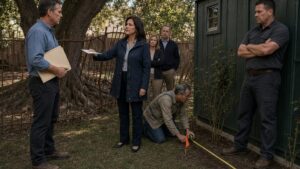
Two days later, the surveyor returned with marking paint and narrow flags.
Michael walked beside him as he established the property line and compared it with the infrastructure route.
The first mark went near the rear wall.
The second appeared beside the desert spoon.
The third landed three feet from the barrel cactus where the original violation notice had been clipped.
Then the surveyor stretched a line between the points.
Michael looked at the route.
The irrigation main passed well inside his parcel.
“How certain?”
“About the boundary? Very.”
“The pipe?”
“Based on the boxes and locator response, enough to document the alignment. I’ll put qualifications in the report.”
Michael stared at the painted marks.
For days he had imagined this moment as simple vindication.
Instead, he could hear the surveyor’s earlier warning.
The pipe was not automatically his.
The absence of an easily located easement was not automatically proof none existed.
The HOA might have inherited rights from the developer in some form nobody had found yet.
But one thing was no longer theoretical.
Their infrastructure crossed his ground.
His phone buzzed.
Another email.
Frank.
The board expects full compliance by Friday. Failure to complete the approved landscaping conversion may trigger the enhanced penalty schedule previously provided.
Michael read the sentence while standing over the marked pipe route.
Friday.
The day before his wedding.
The surveyor packed his equipment.
“You okay?”
Michael handed him the phone.
The surveyor read the message, then gave it back.
“I’d finish the records work before you touch anything.”
Michael looked down at the rusted valve box.
“I know.”
And he did know.
That was the problem.
He understood exactly what that valve could do.
For the first time, he also understood how many houses might be depending on him not to turn it.
Chapter 4: When the Water Stopped at Ninety-Eight Degrees
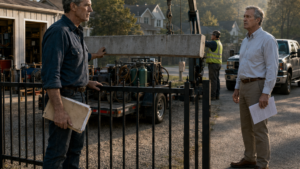
The irrigation contractor was standing at Michael’s side gate before seven in the morning.
His truck idled at the curb, orange warning light turning slowly on the roof. A coil of hose lay in the bed beside a shovel and a long valve key.
Michael stepped onto the porch.
“Can I help you?”
The contractor held up a work order.
“HOA sent me. They’ve got low pressure downstream. I need to get to the main valve.”
Michael looked toward the rusted box beside the barrel cactus.
“Do you have an access authorization?”
The contractor frowned.
“I have a work order.”
“For my property?”
“For association irrigation.”
Michael walked closer but did not open the gate.
“That’s not the same thing.”
The contractor looked uncomfortable rather than angry.
“Look, I’m just trying to get the system running.”
“So am I.”
That earned him a longer look.
Michael had barely slept. His surveyor’s preliminary markings still crossed the side yard in orange paint, joining narrow flags that showed the probable path of the main line.
Friday had arrived.
So had the enhanced penalty deadline.
The wedding was the next day.
Samantha had gone to her sister’s house early to finish preparations because she had finally told Michael she could not spend the morning watching another HOA confrontation.
He had understood.
He also knew he was the reason she had needed to say it.
The contractor pointed through the gate.
“That valve feeds the east distribution loop.”
“How much of the neighborhood?”
“I don’t have the zone map.”
“But more than the common entrance.”
“Yes.”
“How much more?”
The contractor hesitated.
“Probably most of this side. Maybe all the residential laterals branch downstream.”
Michael looked toward the row of green lawns.
“Forty-six houses?”
“I didn’t count them.”
Michael did.
Every time he looked down the street now, he counted forty-six.
The HOA owned common-area irrigation equipment. Individual homes had their own controllers, but the larger distribution system supplied pressure from the community source through the line crossing his parcel.
Michael had suspected it.
Now a contractor had practically confirmed it.
A white SUV turned onto Sonoran Ridge Drive.
Frank.
He parked behind the contractor’s truck and got out carrying a folder.
“This is association infrastructure,” he said before reaching the gate.
Michael folded his arms.
“And this is my property.”
“We have a service problem.”
“Then show me your access right.”
Frank stopped.
“Michael, this has gone far enough.”
“Agreed.”
“I’m serious.”
“So am I.”
Frank glanced at the contractor.
“Open the gate.”
Michael did not move.
Frank’s voice dropped.
“You are interfering with essential association maintenance.”
“Essential enough that somebody should have documented the right to get to it.”
“We are still reviewing records.”
“You’ve been reviewing them all week.”
“And you’ve been told the landscaping matter is separate.”
Michael almost laughed.
“Everything is separate when it helps you.”
The contractor shifted his weight.
“I can come back.”
Frank held up a hand.
“No.”
Then he faced Michael.
“Your account enters enhanced enforcement today.”
Michael felt the words hit harder than he expected.
He had known they were coming.
Still, hearing Frank say them while standing ten feet from undocumented infrastructure beneath his land made something inside him settle.
Not explode.
Settle.
Michael reached through the gate, unlocked it, and stepped inside the side yard.
Frank’s expression eased prematurely.
Michael walked to the valve box.
The contractor followed to the gate but did not enter.
Michael lifted the metal lid.
The brass valve sat below.
He had already photographed its position.
Already documented the markings.
Already sent written notice that access was disputed pending verification.
Now he put a hand on the operating nut.
Frank said, “What are you doing?”
Michael looked up.
“I’m isolating an undocumented line crossing my property until your access rights are established.”
The contractor’s face tightened.
“I wouldn’t do anything without legal advice.”
Michael nodded.
“That’s fair.”
He had received advice—not a promise of victory, but enough to understand that refusing entry and intentionally damaging infrastructure were different matters.
He wasn’t going to damage anything.
He fitted his own valve key over the nut.
Frank stepped forward.
“Michael.”
“Stay outside the gate.”
“You cannot shut down association property.”
“You still haven’t established what you can do on mine.”
He turned the valve slowly.
The resistance was heavy at first.
Then it moved.
One quarter turn.
Another.
The faint vibration through the pipe weakened.
The contractor watched without speaking.
Michael stopped when the valve seated.
Silence followed.
Nothing dramatic happened.
No burst pipe.
No alarm.
The desert morning looked exactly the same.
Frank stared at him.
“You’re making a serious mistake.”
Michael replaced the lid.
“Then show me the document that proves it.”
Frank left ten minutes later.
By eight-thirty, Michael’s phone began buzzing.
A homeowner on the next block asked whether he was having low water pressure outside.
Another reported that the common-area sprinklers had not run.
At nine-fifteen, the grass at the entrance monument was still dry.
At ten, Frank emailed demanding immediate restoration of service.
Michael replied with three sentences.
Please provide the association’s recorded right of access across Lot 18. I will permit emergency entry necessary to prevent damage to life or safety. Routine irrigation access remains disputed pending documentation.
He read the message twice before sending it.
At eleven, the temperature reached ninety-eight degrees.
Michael stood at his front window and watched sprinkler heads across the street rise from the lawn.
They clicked.
A few coughed air.
Then they sank again.
For months, that sound had irritated him—the endless hiss of water thrown over turf while his own yard sat quiet beneath the same sun.
Now the silence unsettled him.
Frank called shortly after noon.
Michael answered.
“We need the valve opened.”
“Did you find the easement?”
“No.”
“Then we’re still where we were.”
“We are not where we were. Residents are losing irrigation.”
“Now you acknowledge the line crosses my property?”
A pause.
“Yes.”
It was the first time Frank had said it plainly.
Michael looked toward the survey flags.
“Good.”
“Don’t mistake that for agreement with your interpretation.”
“I’m not.”
“The records are incomplete.”
“Also something you could’ve admitted before threatening me with a thousand dollars a day.”
Frank breathed into the phone.
“I have homeowners demanding answers. I have listings scheduled for showings. Common areas are drying out.”
Michael heard genuine strain underneath the anger.
For a moment Frank sounded less like an HOA president and more like a man watching a system he had trusted begin to fail.
Then Frank said, “Open the valve.”
“No.”
The sympathy disappeared.
By late afternoon, the front lawns had not turned brown. Not yet.
But the first signs were visible to Michael because he knew what to look for.
Bluegrass blades folding inward.
Edges losing their gloss.
A faint gray cast where full sun had baked the most exposed sections.
Samantha returned shortly after five.
She carried a garment bag over one arm.
“What happened?”
Michael closed the garage.
“What do you mean?”
“Three people have texted me asking why the sprinklers are off.”
He said nothing.
She stared at him.
“You closed it.”
“Yes.”
“All of it?”
“The main.”
Her eyes moved toward the side yard.
“Michael.”
“They still can’t produce access rights.”
“That’s not what I asked.”
“I gave them emergency access terms.”
“For drinking water?”
“It’s irrigation only.”
“For trees? Common landscaping? Everybody’s yards?”
Michael felt himself becoming defensive.
“They threatened us with a thousand dollars a day.”
“Frank did.”
“The board did.”
“Did the woman across the street?”
“No.”
“The couple with the little kids three houses down?”
“No.”
He looked away.
Samantha lowered the garment bag onto a chair inside the garage.
“You finally found something Frank can’t ignore.”
“Yes.”
“And now what?”
Michael didn’t answer.
She stepped closer.
“You spent months letting him use the rules against you because you thought taking it quietly made you stronger.”
“That’s not what this is.”
“Isn’t it?”
Michael looked at her sharply.
Samantha didn’t back away.
“You’ve got the valve now. He doesn’t. I’m asking what you’re going to do with that.”
Across the street, a sprinkler head rose automatically for the evening cycle.
It trembled.
No water came out.
Samantha watched it sink back into the grass.
Then she looked at Michael.
“Are you trying to stop Frank,” she asked, “or punish forty-six other houses because he gave you the chance?”
Chapter 5: The Victory Michael Could Not Enjoy
The neighbor across the street stood barefoot on his lawn taking pictures of brown patches.
When Michael opened his front door the next morning, the man turned his phone toward Michael’s house.
Not subtly.
Michael paused on the porch.
The neighbor lowered the phone.
“You know anything about the irrigation?”
“Yes.”
That answer seemed to surprise him.
“So this is you?”
“It’s an access dispute with the HOA.”
“My grass doesn’t know that.”
Michael could have given him the whole explanation.
The fines.
The missing easement.
The wedding deadline.
The survey.
Instead he said, “I know.”
The neighbor studied him.
“You going to leave it off?”
Michael had not decided.
That was the problem.
By nine o’clock, more residents had begun checking controllers, opening valve boxes, and comparing notes in driveways. The community entrance looked duller than it had the day before. A strip of turf along the sidewalk had taken on the flattened olive tone that came before real heat damage.
Michael had wanted Frank to feel pressure.
Now pressure had spread beyond Frank.
His phone rang.
Kathleen.
“There’s an emergency board meeting at eleven.”
“I wasn’t invited.”
“You are now.”
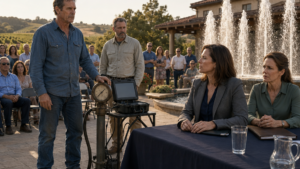
The temporary meeting took place in the small HOA office beside the community pool.
Frank was already seated when Michael arrived.
Kathleen sat with two board members and a stack of folders. The management representative occupied the far end.
No one offered coffee.
Frank began immediately.
“We have widespread irrigation interruption caused by unilateral action on Michael’s property.”
Michael sat.
“Caused by the HOA’s inability to document access.”
“Which does not authorize you to disable association infrastructure.”
Kathleen raised a hand.
“Before we go in circles, there’s something everyone needs to see.”
Frank looked at her.
She opened a folder.
“I asked management for all developer turnover records related to irrigation.”
“And?” Frank asked.
Kathleen slid several pages toward the center.
“There’s a system map. Maintenance history. Asset schedules. But the permanent access schedule referenced in the developer correspondence is missing.”
Michael leaned closer.
A letter dated years earlier referred to “final recording of private landscape utility access prior to turnover.”
There was no attached recording number.
Frank said, “Missing from our files doesn’t mean it wasn’t recorded.”
“No,” Kathleen replied. “But that isn’t the only issue.”
She removed another email.
“I raised this in March.”
Frank went still.
Michael looked from one to the other.
Kathleen continued.
“When we had the repair near Lot 18, the contractor couldn’t locate an access exhibit. I emailed Frank and management asking whether we needed title research before the next maintenance cycle.”
One board member turned toward Frank.
“You knew?”
Frank’s voice sharpened.
“I knew we had incomplete legacy files. That is not the same as knowing we lacked rights.”
Kathleen nodded slowly.
“That’s true.”
It was not the condemnation Michael expected.
She looked at Michael.
“The developer turned over a mess. Frank inherited part of it. So did the rest of us.”
Frank exhaled.
For the first time, Michael saw the conflict from somewhere other than his own driveway.
Frank had not created the missing document.
He had not buried the pipe.
He had inherited a neighborhood whose systems had been operating for years under assumptions no one had bothered to inspect.
But Kathleen wasn’t finished.
She tapped the March email.
“Where I disagree with Frank is what happened after Michael raised the same issue this week.”
Frank’s face hardened.
Kathleen continued.
“We knew enough to know the question was legitimate. Enforcement should have paused until we understood our exposure.”
“The landscape violation existed independently.”
“Maybe legally,” Kathleen said. “Not practically.”
Frank pushed back from the table.
“If we suspend every rule whenever an owner raises some unrelated dispute, we cannot govern.”
Michael heard the same fear he had heard outside his house.
Not grass.
Loss of authority.
Frank looked at him.
“You exploited a maintenance uncertainty to shut down irrigation for the entire community.”
Michael felt the room turn toward him.
And for once, he could not dismiss the accusation completely.
“I refused undocumented access.”
“You closed the valve.”
“Yes.”
“In ninety-eight-degree heat.”
“Yes.”
“Two days before dozens of homeowners had any opportunity to understand what was happening.”
Michael’s jaw tightened.
Frank’s tone was controlled now.
That made it harder.
“You want accountability?” Frank asked. “Fine. So do I. Start with your own.”
The words landed.
Michael looked through the glass wall toward the common lawn.
Brown was beginning along the curb.
Samantha’s question returned.
Are you trying to stop Frank, or punish forty-six other houses?
Michael stood.
Frank said, “Where are you going?”
“To fix the part that belongs to me.”
He left before anyone could ask what that meant.
At home, Michael printed a one-page temporary access condition.
It permitted limited irrigation operation for forty-eight hours without conceding any permanent easement, ownership claim, or unrestricted right of entry. It allowed documented emergency maintenance with advance notice.
Then he called the contractor.
“You still available?”
“Depends what you want.”
“I’m reopening partway.”
The contractor arrived twenty minutes later.
Frank arrived five minutes after that.
Michael handed him the paper.
Frank read it.
“This is not an agreement.”
“It isn’t supposed to be. It’s a temporary condition.”
“You don’t have the authority to dictate—”
Kathleen’s car pulled up behind him.
Frank stopped.
She walked over, read the page, and said, “Sign acknowledgment of receipt. Not agreement. Receipt.”
Frank looked at her.
“You’re taking his side now?”
“I’m taking the side that keeps us from replacing forty-six lawns while lawyers argue.”
Michael opened the valve box.
He fitted the key and turned the valve slowly—not fully open, but enough to restore pressure for controlled morning and evening cycles.
A minute later, the sprinkler heads across the street rose.
Water came out in weak arcs at first, then steadier.
The neighbor who had photographed Michael that morning stepped onto his porch.
He didn’t wave.
Michael didn’t either.
But some of the tightness left his chest.
Frank watched the water.
Then he turned toward the small cluster of residents gathering near the sidewalk.
“This entire situation exists because one homeowner decided to hold community infrastructure hostage.”
Michael straightened.
The relief disappeared.
Kathleen looked at Frank.
“That is not a fair description.”
“It is exactly what happened.”
“No,” she said. “What happened is we threatened extreme enforcement while we already had an unresolved question about our own access rights.”
The street went quiet.
Not dramatically.
No one applauded.
People simply stopped talking.
Frank’s expression changed as he realized Kathleen had said “we.”
Publicly.
Kathleen faced the residents.
“I’m requesting an independent review of both the irrigation records and the enforcement process used in this case.”
One board member nodded.
The other followed after a moment.
Frank stared at them.
Michael closed the valve-box lid.
The water was running again.
But the dispute had moved somewhere Frank could no longer control by issuing another notice.
Chapter 6: The Survey Frank Could Not Argue Away
Michael placed the stamped survey on the meeting table beside a printed ledger of every fine he had paid.
Nobody spoke for several seconds.
The contrast was almost absurd.
On the left: property boundaries, measurements, utility markings, and the irrigation route drawn through Lot 18.
On the right: seven identical charges of two hundred dollars, followed by notices preparing the account for enhanced enforcement.
Frank sat across from him.
Kathleen sat two chairs away with the independent review summary.
The board had moved the meeting to a larger room because residents wanted to attend, but Michael kept his eyes on the table.
He did not want a crowd.
He wanted a decision nobody could pretend had never happened.
Kathleen opened the meeting.
“The title and records review is complete enough for us to address immediate issues.”
Frank shifted.
“Not complete.”
“Complete enough.”
She looked at Michael.
“The review did not find a separately recorded permanent irrigation easement specifically describing the current main-line alignment across Lot 18.”
A murmur moved through the room.
Kathleen continued before anyone could interpret too much.
“That does not mean the association has no possible legal claim to continued use. The developer documents create ambiguity, and counsel has identified several theories that would require further analysis if litigated.”
Michael nodded.
That matched what the surveyor had warned him.
No magic document.
No instant ownership.
No simple victory.
Kathleen tapped the survey.
“But the physical location is not ambiguous.”
The main line crossed Michael’s parcel.
Well inside it.
“The association also lacks clear documentation governing routine access for maintenance.”
Frank leaned forward.
“We’ve maintained that system for years.”
Kathleen turned toward him.
“Yes.”
“Without objection.”
“Yes.”
“That matters.”
“It does.”
Michael watched Frank’s shoulders loosen slightly.
Then Kathleen opened the second folder.
“The enforcement review also matters.”
The loosening stopped.
Kathleen read from the summary.
Michael’s landscape had been cited under an older visual-standard interpretation even though the association had subsequently adopted limited provisions allowing water-conscious designs.
The board had authority to require architectural review.
But correspondence showed inconsistent guidance about what Michael needed to submit.
Then came the part Michael had been waiting for.
“The enhanced penalty schedule was authorized after the infrastructure access question had been raised and after management had acknowledged the association could not immediately produce the relevant access documentation.”
One board member looked at Frank.
Frank spoke before anyone asked.
“I have never denied that.”
Kathleen’s expression remained neutral.
“You argued they were unrelated.”
“They are.”
“Legally, perhaps. Administratively, the reviewer disagrees.”
Frank looked toward the residents.
“If Michael’s yard remained noncompliant, the board had an obligation to act. Several homeowners complained for months that we were selectively enforcing standards.”
A woman near the wall said, “I complained.”
Michael turned.
She looked uncomfortable but did not take it back.
“My house is for sale. Buyers asked why the standards looked different from one property to another.”
Frank seized on it.
“That is what I’m talking about.”
Michael looked at the woman.
He felt the old irritation rise, then fade.
She had not threatened him with a thousand dollars a day.
She had complained about something she thought affected her.
Frank had taken that pressure and turned it into policy by force.
That difference mattered.
Kathleen said, “No one is suggesting standards do not matter.”
Michael surprised himself by speaking.
“They matter.”
Frank looked at him.
Michael continued.
“So do boundaries.”
The room quieted again.
He pushed his water-use sheet forward.
“My yard isn’t unfinished. It isn’t weeds. It isn’t a dirt lot. It’s designed landscaping. I should’ve submitted a revised plan sooner when the guidelines changed. I didn’t because by then I was angry and I thought paying the fine was easier than dealing with the board.”
Samantha sat in the second row.
Michael looked at her briefly.
“That was my mistake.”
Frank’s expression shifted.
Perhaps he had expected defiance.
Michael had spent years treating admission as surrender.
It felt different now.
He looked back at the board.
“But once you threatened a thousand dollars a day, after I raised a legitimate access issue, this stopped being about getting a plan approved.”
Kathleen nodded.
“The reviewer agrees.”
She closed the report.
“Pending final resolution, all landscape fines against Lot 18 are suspended.”
Michael did not smile.
Not yet.
Frank looked down at the table.
Kathleen continued.
“The board will also review reimbursement after settlement of the infrastructure and landscaping matters.”
A small release moved through Michael’s chest.
Seven months.
Fourteen hundred dollars.
For the first time, the number might move backward instead of forward.
The board spent the next forty minutes on the irrigation issue.
No one got everything they wanted.
Counsel’s recommendation was to negotiate and record a formal easement describing location, maintenance access, notice procedures, liability, and compensation rather than spend association funds litigating historical developer intent.
The pipe could remain.
The HOA would receive reliable access.
Michael would receive defined protections.
It was the first solution anyone had proposed that acknowledged both sides existed.
When the meeting recessed, Michael stepped into the hallway for water.
Frank followed him.
For several moments neither spoke.
Then Frank said, “You wanted this.”
Michael turned.
“What?”
Frank gestured toward the meeting room.
“Public review. My decisions picked apart in front of everyone.”
“I asked you for an easement number.”
“You knew where this would go.”
“No. I knew where the pipe went.”
Frank almost smiled despite himself.
Then the expression disappeared.
“I have spent three years trying to keep this place from becoming arbitrary.”
Michael stared at him.
“That’s what you think you were doing?”
“Yes.”
“By threatening me with a thousand dollars a day?”
Frank looked toward the closed meeting-room door.
“You know what happens when enforcement becomes optional? Every owner decides their case is special. Paint colors. Parking. Rentals. Landscaping. Then the board gets accused of favoritism.”
“So you made an example out of me.”
“I enforced the rule.”
“Harder after I questioned you.”
Frank said nothing.
That silence was enough.
Michael took a drink from the paper cup.
Frank lowered his voice.
“I’ll resign.”
Michael looked at him.
Frank continued.
“I’ll submit it tonight. Effective immediately.”
Michael had imagined that possibility.
He had expected satisfaction.
Instead he felt wary.
“What do you want?”
Frank met his eyes.
“You withdraw reimbursement demands. No claim for compensation beyond whatever access agreement is necessary. We end this.”
There it was.
Not apology.
Trade.
Frank was willing to give up his position if Michael agreed to make the financial consequences disappear.
A month earlier, Michael might have accepted simply to prove he had won.
He pictured telling people Frank had resigned because of him.
He pictured the story shrinking into a neat ending.
Then he thought about the missing records.
The fines.
The next homeowner.
The next board president.
“If you resign privately and nothing changes,” Michael said, “then we do this again with somebody else.”
Frank’s face hardened.
“So this is punishment.”
“No.”
Michael set down the cup.
“That’s what I finally figured out.”
He returned to the meeting room.
On the table beside the survey and fine ledger was the draft settlement packet Michael had prepared with help reviewing the documents.
He opened it.
The terms were plain.
Recorded easement.
Defined access procedures.
Reasonable compensation for permanent property use.
Reimbursement of improper fines.
Formal review of the desert landscape under the current water-conscious standard.
Written limits on escalation while an owner had a pending good-faith architectural appeal.
No demand for Frank’s resignation.
No public apology.
No humiliation clause.
Michael signed his name at the bottom of the homeowner proposal.
Then he slid copies to Kathleen and both board members.
Frank entered the room behind him.
Kathleen looked down at the pages.
“What is this?”
“My terms.”
Frank remained standing.
Michael looked at the full board.
“Not his terms. Not mine in the hallway.”
He tapped the survey once.
“If the association wants access across my property, we put it in writing and record it. If I’m expected to follow rules, the board follows its procedures too.”
Kathleen turned to the first page.
Frank sat slowly.
For months, Michael had survived by paying whatever arrived and telling himself he could take one more hit.
Now the money was no longer the central point.
For the first time, he had put the boundary on paper before someone else defined it for him.
Kathleen finished reading the first page.
Then she looked at the other board members.
“We vote on whether to enter settlement negotiations under these terms.”
Michael leaned back.
Across the table, Frank said nothing.
The next move no longer belonged to either man alone.
Chapter 7: The Yard They Fined Became the New Standard
The survey crew drove two permanent markers into the ground beside Michael’s barrel cactus.
One landed near the rusted valve box.
The other went closer to the side wall, marking the edge of the recorded access corridor the HOA could now use under the agreement.
Michael stood on the driveway with a copy of the final easement folded beneath his arm.
The document had taken three weeks.
Three weeks of revisions, title review, insurance language, access conditions, maintenance notice requirements, and arguments over a strip of ground nobody had cared about until the day Michael asked who had the right to use it.
Now the answer existed in black ink.
Not implied.
Not inherited vaguely.
Recorded.
Kathleen arrived just as the surveyor finished checking the second marker.
She carried a small envelope and a ring holding two new keys.
“Morning,” she said.
Michael nodded toward the marker.
“Looks permanent.”
“That’s usually the goal with recorded easements.”
He smiled slightly.
Kathleen held out the envelope.
“The reimbursement cleared yesterday.”
Michael took it.
Inside was a statement showing seven fines reversed.
Fourteen hundred dollars credited back.
Below that was the association’s payment under the permanent access agreement.
The number was not the wild windfall some residents had predicted after rumors spread through the neighborhood, but it was substantial enough to acknowledge what the HOA was gaining: continuing use of infrastructure crossing private property without a lawsuit over whether that use could be forced.
Michael folded the statement again.
Kathleen watched him.
“You don’t look excited.”
“I am.”
“You hide it well.”
“I’ve had practice.”
She glanced toward the house.
“How’s Samantha?”
“Still married to me.”
Kathleen laughed.
“That’s a positive indicator.”
Michael looked at the front window.
Samantha had married him two days after the irrigation shutdown, during the strangest weekend either of them could remember.
The ceremony had gone forward.
No HOA talk at the reception.
That had been Samantha’s one nonnegotiable rule, and Michael had obeyed it.
Mostly.
One guest had asked why the common lawn near the entrance looked tired.
Samantha had simply said, “Ask us next month.”
Now next month had arrived.
A landscaping crew worked at the opposite end of the street, replacing several heat-damaged patches in a common area. Most of the neighborhood lawns had recovered after Michael restored limited service. A few had needed repair.
That bothered him more than he admitted.
He had been right to challenge the HOA.
He was less certain he had been right to close the valve as far as he did.
Being justified, he had learned, did not erase every consequence.
Kathleen seemed to read part of that on his face.
“The repair cost was manageable,” she said.
Michael looked at her.
“I didn’t ask.”
“No.”
“But you knew I was thinking about it.”
“Yes.”
He rubbed a thumb along the envelope edge.
“I could’ve handled that better.”
“So could we.”
That was as close to collective apology as the HOA had managed.
Michael found he could live with it.
A white utility van turned into the street.
The irrigation contractor parked beside Michael’s house and came through the open gate carrying a pressure gauge.
“Ready?” he asked.
Michael nodded.
Under the new agreement, the association had scheduled a full inspection of the main before normal access resumed.
For the first time, the contractor did not arrive with only a work order.
He had written notice.
A mapped access route.
And permission.
Michael unlocked the side gate.
The difference seemed small.
It wasn’t.
The contractor knelt beside the valve box while Michael and Kathleen stood back.
“Pressure downstream is holding,” he said. “I’m going to bring the main fully open.”
Michael stepped forward.
“I’ll do it.”
The contractor looked up.
Kathleen raised an eyebrow.
Michael fitted the key over the operating nut.
For weeks, the valve had represented leverage.
At first it had been nothing more than a rusted lid under gravel.
Then it became proof that the HOA depended on something it had never properly documented.
Then a weapon.
Then a responsibility.
Michael turned the key.
Slowly.
One rotation.
Then another.
Water moved through the pipe beneath his feet.
He could feel the faint vibration through the metal handle before he heard anything outside.
Across the street, sprinkler heads began rising from the lawn.
A hiss.
A click.
Then water arced into the sunlight.
Michael stopped turning when the valve was fully open.
The contractor checked the gauge.
“Good.”
Michael replaced the lid.
He did not cover it with gravel this time.
The easement required clear access.
Kathleen handed him one of the new keys.
“The association gets one. You keep one.”
Michael looked at it.
“So now everybody knows who can open the gate.”
“That’s the idea.”
Two days later, the board held its first regular meeting under the revised enforcement procedures.
Michael almost didn’t attend.
Samantha convinced him.
“You spent months wanting them to hear you,” she said. “You can survive one meeting where they actually do.”
The room was less crowded than the review meeting had been.
Frank’s chair at the front table was empty.
Kathleen had become acting president until the next election.
There was no announcement about Frank beyond what residents already knew.
He had resigned.
No final confrontation.
No apology at Michael’s door.
No angry speech.
He submitted a short letter stating that the association needed new leadership after the dispute.
Michael read it once when Kathleen circulated the packet.
Then he put it down.
He had thought Frank’s resignation would feel like the end.
It didn’t.
The important part came twenty minutes later.
Kathleen opened the revised landscaping policy.
“Next item: approval standards for water-conscious front-yard designs.”
Michael looked up.
The board had spent the previous weeks comparing its older landscape requirements with current low-water options.
The new language did not eliminate standards.
Owners still needed maintained ground cover.
Defined planting zones.
Approved hardscape percentages.
Weed control.
Sightline clearance.
But turf was no longer treated as the default measure of whether a yard looked complete.
One board member read the final sentence aloud.
“Climate-appropriate xeric and low-water designs may satisfy community landscape standards when maintained in accordance with approved plans.”
A resident near the back raised a hand.
“So Michael’s yard is compliant now?”
Kathleen looked at him.
“Michael submitted the revised plan.”
All eyes moved toward him.
He hated that.
Kathleen continued.
“It was approved yesterday.”
There was no applause.
Michael was grateful.
The woman whose house had been listed during the dispute spoke from the wall.
“I still like grass.”
A few people smiled.
Michael said, “You’re allowed.”
She looked at him.
“You’re not going to tell me how much water I’m wasting?”
“I’ll think it privately.”
That got a laugh.
Small.
Normal.
Better than applause.
After the meeting, the neighbor from across the street stopped Michael near the door.
His lawn had mostly recovered.
“I was pretty angry with you.”
“I know.”
“Still think shutting the whole thing down was a bit much.”
Michael nodded.
“Me too.”
The neighbor seemed surprised.
“That’s it?”
“What do you want me to say?”
“I don’t know. I figured you’d explain why you were right.”
“I was right about the access.”
“And the rest?”
Michael glanced toward the meeting room.
“I’m still working on the rest.”
The neighbor extended a hand.
Michael shook it.
Outside, Samantha waited beside the car.
She held up the approved landscaping notice.
“You keeping this?”
“Probably.”
“For sentimental reasons?”
“No.”
“Evidence?”
“Absolutely.”
She shook her head.
“You’ve learned nothing.”
Michael opened her door.
“I learned to keep better records.”
“That is not the lesson I meant.”
He smiled.
“I know.”
The next morning Michael worked in the front yard before the heat climbed.
He trimmed dead blooms from the brittlebush and adjusted one drip emitter beneath the palo verde.
Across the street, sprinklers ran their morning cycle.
Water struck grass.
His own yard remained almost silent.
A hummingbird moved briefly through the yellow flowers near the cactus, then disappeared.
Michael crouched beside the valve box.
The new access marker stood a few feet away, small and permanent.
For years, the line underneath him had existed without anyone thinking about what it meant.
Frank had assumed authority because the system had always worked that way.
Michael had assumed endurance because paying the next fine seemed easier than admitting the problem had become too large.
Both of them had trusted habits that stopped making sense long before either was willing to examine them.
Michael slid the metal key into the padlock on the side gate.
He locked it.
Then Kathleen’s car pulled up.
She got out carrying the HOA’s duplicate key in a labeled envelope.
“Management asked me to confirm access procedures.”
Michael held out his hand.
She gave him the envelope.
He checked the label, then handed it back.
“Looks right.”
Kathleen slipped the key onto the association ring.
“So if the contractor needs in?”
“Written notice unless it’s an emergency.”
“And emergency means?”
“Actual emergency. Not Frank deciding grass looks thirsty.”
Kathleen smiled.
“Understood.”
Michael stepped back from the gate.
For a moment the old instinct returned—the one that wanted to keep the key, control the valve, make certain no one could ever push him again.
Then he looked at the recorded marker.
That was not what the agreement meant.
A boundary was not a wall no one could cross.
It was a line everyone understood before crossing.
Michael opened the gate once more.
He showed Kathleen the clear path to the valve, the shutoff position, and the inspection tag the contractor had installed.
Then he closed it.
Locked it.
And watched Kathleen place the HOA’s documented access key on her ring.
Across the street, sprinklers turned through another cycle.
Behind Michael, barrel cacti stood in dry gravel, unchanged by all the weeks of argument over what a proper yard was supposed to look like.
The HOA still had rules.
Michael still had boundaries.
This time, both were written down.
The story has ended.