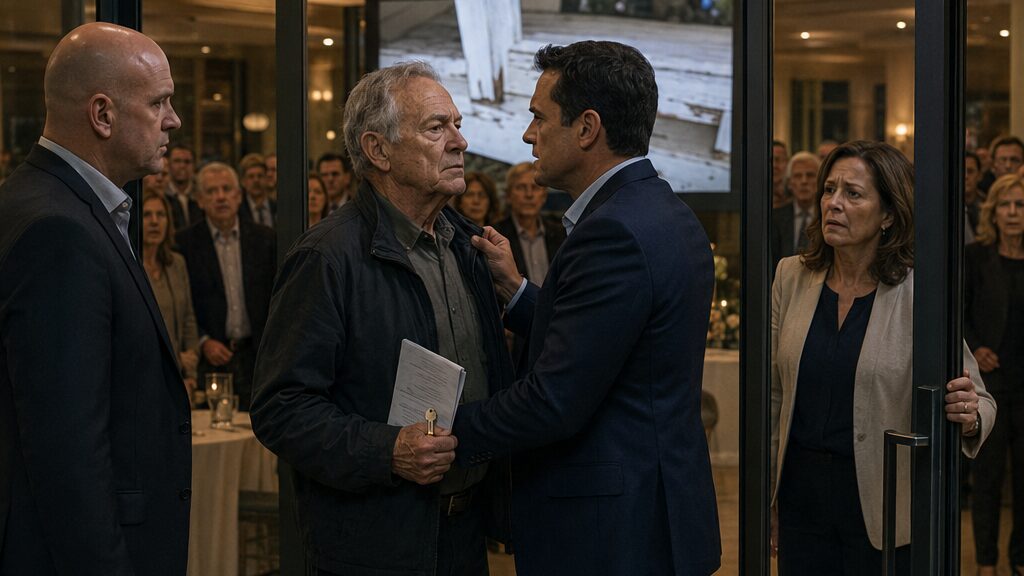
They Called His Porch Repair Ugly Until He Couldn’t Reach His Own Front Door
Chapter 1: The Board Across The Doorway
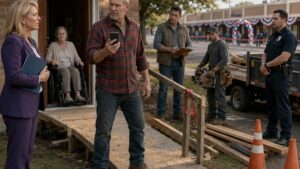
The red tag was already stapled to the porch board before William Hall opened the door.
He saw it through the narrow strip of glass beside the frame, a bright square of paper trembling in the morning air, fastened to the mismatched plank Daniel Carter had laid across the threshold three days earlier. The plank was plain, unfinished wood, pale against the dark porch boards, cut a little too wide on one side because Daniel had meant to shave it down after the approval came through. It was not beautiful. William had never claimed it was. But it kept the toe of his right shoe from catching in the broken drop beneath the door.
Outside, Thomas Scott stood at the porch edge with a phone held sideways, taking pictures.
William kept his hand on the brass knob until the shake in his fingers settled. The house behind him was quiet except for the refrigerator clicking on in the kitchen and the old wall clock Susan had bought at an estate sale ticking with patient disapproval. He looked down at his shoes, made sure both soles were flat, then opened the door.
Thomas lowered the phone only enough to glance at him.
“Morning, Mr. Hall.”
William looked from Thomas to the red tag. “You could have knocked.”
“I did.” Thomas’s suit jacket was too dark for that hour and too neat for a porch with old leaves caught in the rail. “No answer.”
“I was in the kitchen.”
Thomas smiled as if the answer had proved something. “I have to document exterior changes. You know that.”
William stepped carefully onto the plank. The wood gave its familiar small creak, and his left hand went to the doorframe before he told it to. He hated that. He hated any movement his body made before his mind had approved it.
Thomas’s eyes flicked to the hand.
“It’s temporary,” William said.
“That’s part of the problem.”
“It’s a board.”
“It is an unauthorized modification to a visible exterior entryway.” Thomas lifted his phone again and took another photo. The soft click sounded indecently loud.
William felt heat rise in his face. Across the street, a delivery driver slowed near a mailbox, looked over, and pretended not to. Two houses down, a curtain moved in the front window of the home with the white hydrangeas. William turned his shoulders a little, trying to block the plank from view, though the plank needed no protection from cameras. It was wood. It had no pride to bruise.
“Daniel is coming back Friday,” William said. “He’s replacing the whole threshold.”
“Has the Architectural Review form been approved?”
“You know it hasn’t. That’s why he put this down. So I could get in and out until—”
“Then he shouldn’t have put anything down.”
William looked at the break beneath the board. The old sill had sunk after the last heavy rain, leaving a narrow drop where his shoe had caught. A young man would step over it without noticing. A woman carrying groceries might swear and keep going. William had gone down on one knee with both hands against the door, his hip striking the jamb hard enough to make him sit on the porch step until the world quit flashing white at the edges.
He had told no one about that part.
“I filed the form,” William said. “I paid the fee. I sent the photo Daniel took.”
“The committee has thirty days.”
“I don’t have thirty days for a hole in my doorway.”
Thomas sighed, the kind of sigh a man used when he wanted credit for patience. He came up one step, not onto the board, but close enough that William could smell coffee on his breath. He reached toward the red tag and tapped it with one finger.
“This notice gives you until the weekend reception to remove the visible temporary material.”
“The reception?”
“At the clubhouse.”
“I’m not displaying it at the clubhouse. It’s on my porch.”
“The board will have guests touring the common lane for the donor walk. Your house faces the route.” Thomas looked past him into the dim hallway, as if measuring the inside too. “This is not personal.”
William almost laughed, but it would have come out wrong.
Behind him, the hallway runner lay straight from the front door to the kitchen. Susan had chosen it because the blue pattern reminded her of rain on a pond. After her first bad week, when the back steps became too much, William had shifted the chair by the front window, moved the mail basket beside the entry table, and made the front door the center of their days. Groceries came through that door. The clinic van stopped at that curb. Neighbors waved from that sidewalk when Susan still had the strength to lift her hand.
Not personal.
William touched the red tag. The paper was stiff, official, and already damp at the corners.
“Don’t pull it off,” Thomas said sharply.
William let his hand fall.
“I was reading it.”
“It states the violation clearly.”
William bent forward enough to see the printed lines. Unauthorized temporary exterior structure. Visible from street. Potential trip hazard. Subject to fine if not corrected.
Potential trip hazard.
The words sat there like a joke written by someone who had never needed to think about the distance between a floor and a porch.
“You’re calling the thing that covers the hazard a hazard,” William said.
Thomas put the phone into his jacket pocket. “I don’t write the standards.”
“No. You just staple them to people’s doors.”
Thomas’s smile disappeared. “Mr. Hall, I’m trying to handle this respectfully.”
William looked at the staple marks, the new holes in the wood, the red square flapping against Daniel’s temporary plank. He wanted to pull the tag free and hand it back. He wanted to say that after forty-one years of paying dues, mowing on schedule, repainting when told, trimming the hedges to the inch, and not once asking the board for help when Susan was sick, he had earned the right to cross his own threshold without a committee’s blessing.
Instead he said, “Daniel is scheduled to finish Friday morning.”
“He may not perform exterior work until approval is issued.”
“He already ordered the material.”
“He should have waited.”
“I should have waited to fall?”
The words came out sharper than he intended.
Thomas glanced again toward the street. The delivery driver had moved on, but now Rachel Williams stood at the end of her driveway in walking shoes, one hand shading her eyes. She lived three doors over. She had always been polite in a careful way, waving when the lawn looked good, looking away when it did not.
Thomas lowered his voice. “Nobody is asking you to fall.”
“You’re asking me to remove what keeps me from it.”
“I’m asking you to comply with the process.”
William nodded once, not because he agreed, but because if he did not move something, he might say too much. He shifted his weight from his right foot to his left. The board creaked again.
Thomas heard it. “That’s another issue. It isn’t secured to code.”
“It’s temporary.”
“Temporary does not mean exempt.”
“Neither does old,” William said.
Thomas looked at him then, really looked, and for a moment something like irritation hardened behind his eyes. Not anger exactly. More like the impatience people got when an old man refused to play the role assigned to him.
“I’ll note that you were informed in person,” Thomas said.
“You do that.”
“And Mr. Hall?” Thomas stepped back down to the walkway. “If it is still here by the reception, the fine begins Monday. The board may also require immediate removal.”
William looked at the plank under his feet. A short strip of morning light lay across it. The wood was raw and unpainted, ugly in the way useful things could be when nobody gave them time to be finished.
“How am I supposed to get out?”
Thomas paused at the sidewalk, phone already back in his hand. “That’s why we advise residents not to begin modifications without written approval.”
William stood there until Thomas had taken his last photograph and walked away.
Only when the street went quiet did he lower himself to the porch chair. The red tag moved in the breeze, tapping the board once, then again, a small official knock against the only safe place to put his foot.
Chapter 2: The Contractor Who Had To Stop
Daniel Carter arrived two mornings later with a measuring tape clipped to his belt and a bundled length of treated lumber strapped in the back of his truck.
William heard the engine before he saw him. He had been standing in the hallway with one hand on the entry table, timing the traffic of his own body. Three steps from kitchen to runner. Six along the hall. Pause at the umbrella stand. Left hand to frame. Right foot first onto the temporary board. The route had become ordinary enough that he could pretend it was not a route at all.
Daniel knocked once, then leaned into view through the glass. “Morning, Mr. Hall. You ready to make this thing look less criminal?”
William opened the door despite himself smiling. “Don’t say that too loud.”
Daniel glanced at the red violation tag still stapled to the board. His smile thinned. “They really did that?”
“They said it was a potential trip hazard.”
Daniel crouched, ran one hand over the plank, and pressed near the edge. “It’s not pretty, but it’s steadier than what’s under it.”
“That was my understanding.”
“It was supposed to be down for three days.” Daniel took out his tape measure. “I’ll get the permanent piece cut, set a beveled transition, add the short rail like we talked about. You’ll be able to step straight through without catching your foot.”
William kept his face still at the mention of catching his foot. Daniel had seen the scrape on the doorframe after the fall, but William had let him believe it came from moving furniture.
Daniel stretched the measuring tape across the doorway. The silver strip flashed in the sun, straight from jamb to jamb, touching the edge of the temporary board. William watched it with the odd relief of seeing a problem become numbers. Width. Rise. Drop. Slope. Things that could be cut, fitted, fastened.
Daniel made a pencil mark on the old sill. “The right side sank more than I thought.”
“Can you fix it?”
“I can. The question is whether they let me.”
“They won’t be here this early.”
A dark sedan turned into the lane before William finished saying it.
Daniel looked over his shoulder. “You expecting someone?”
William did not answer. The sedan stopped behind Daniel’s truck. Mark Perez stepped out first, wearing a navy suit and carrying a leather folder. Thomas Scott got out from the passenger side, phone already in hand.
Daniel stood slowly, tape still stretched across the threshold.
“Mr. Carter,” Mark called, walking up the path. “You need to stop.”
William felt the muscles along his shoulders lock. “He hasn’t started.”
“He is measuring for exterior work under active review.” Mark reached the porch but did not step onto it. He was younger than William by decades, with polished shoes that looked offended by the dust near the walkway. “That is not permitted.”
Daniel let the tape retract with a snap. “Measuring is not work.”
“It is preparation for unauthorized work.”
William said, “It’s preparation for approved work, once you approve what should have been approved before the board fell apart.”
“The board did not fall apart.” Mark opened his folder. “The threshold deteriorated due to age and maintenance.”
“It deteriorated because water ran under the sill after the drainage change behind the common bed.”
Thomas lifted his phone and photographed the tape, Daniel’s tool bag, the lumber in the truck.
Daniel looked at him. “You want a picture of my coffee too?”
Thomas did not smile.
Mark’s voice stayed level. “Mr. Hall, this is exactly why procedures exist. A temporary board appears, then a contractor appears, then materials appear, and suddenly the association is expected to accept a visible alteration after the fact.”
“It’s not an alteration,” William said. “It’s a repair.”
“Repairs still require approval when they affect exterior appearance.”
“It affects whether I can open my door and step outside.”
Mark glanced at the plank. “There is a back entrance.”
Daniel looked at William then, as if waiting for him to explain. William kept his gaze on Mark.
“I use this door.”
“That is a preference.”
“No,” William said. “It is not.”
The silence after that was brief but heavy. Rachel Williams had appeared on the sidewalk with a small white dog at her feet. Across the lane, a neighbor paused beside a recycling bin. The scene had gathered eyes without raising its voice.
Mark closed the folder halfway. “The association cannot operate on personal preference. We have standards. If we allow unfinished boards on front porches because one resident says it is temporary, we have no basis to deny the next resident who leaves plywood over a window for six months.”
Daniel said, “This isn’t plywood over a window.”
“I’m speaking about precedent.”
“You’re speaking about appearances,” William said.
Mark’s jaw tightened. “Appearance is part of property value. Liability is part of safety. Uniformity is part of the agreement every homeowner signed.”
“I signed when I could cross my doorway without asking permission.”
Thomas stepped closer to the porch. “Careful, Mr. Hall.”
William turned to him. The warning had been soft, but he heard the shape of it. Careful old man. Careful how you sound. Careful who is watching. Careful, because they can make this harder.
Daniel bent to gather his tape. “I’m not looking for trouble. But leaving this half-done is worse than finishing it.”
“Then you should not have begun it,” Mark said.
“I put down a temporary board because he had a drop at the sill.”
“Without authorization.”
Daniel looked at William. “Did you tell them about the fall?”
William felt the porch move under him, though it had not. Rachel’s dog gave a small restless whine.
Mark looked from Daniel to William. “What fall?”
William’s fingers tightened around the doorframe. He saw again the white flash at the edge of his vision, his knee against the porch, one hand scraping the frame as he tried not to land flat. He remembered sitting on the step, breathing through his teeth, telling himself he was lucky. Lucky was a word people used when damage stayed hidden.
“It wasn’t anything,” William said.
Daniel’s brows drew together. “Mr. Hall—”
“It wasn’t anything,” William repeated.
Mark’s expression shifted, not to concern, but to something more administrative. A fall would become a note. A note would become a concern. A concern would become someone’s suggestion that perhaps he needed supervision, perhaps a relative, perhaps a different arrangement. William had heard how those conversations started. Always kindly. Always with the person losing ground first.
Mark slid a paper from the folder. “Until formal review, no work may continue. Mr. Carter, if you proceed, the association may bar you from future approved exterior projects in the community.”
Daniel’s face darkened. “You’d threaten my work over a threshold?”
“I’m clarifying consequences.”
William stepped forward without thinking. His right shoe landed at the board’s edge, where the old sill dipped beneath it. The board shifted a fraction. His hand shot to the frame.
Everyone saw.
Thomas’s phone rose.
William straightened slowly.
“Put that down,” he said.
Thomas held the phone steady. “I’m documenting instability.”
“You’re documenting what happens when you stop a repair.”
Mark folded the stop-work paper and held it toward Daniel. “No further work until the board reviews the exterior modification request. The photographs will be included at the clubhouse reception and hearing packet this weekend.”
William stared at the paper. “You’re showing pictures of my porch at the reception?”
“As part of community standards review.”
“While I’m standing right here telling you what it’s for.”
Mark looked at the temporary board with practiced disappointment. “Then you may attend and explain why you placed an unfinished, visible, noncompliant structure across your front entrance.”
Daniel took the stop-work notice because William did not move.
The treated lumber stayed strapped in the truck. The measuring tape disappeared back into Daniel’s tool bag. The pencil mark remained on the sill, small and gray, a line showing where safety had almost become something finished.
After Mark and Thomas drove away, Daniel stood in the driveway with his hands on his hips.
“I can come back after approval,” he said quietly.
William nodded.
“You should tell them the truth about the fall.”
“I told you. It wasn’t anything.”
Daniel looked at the board, then at William’s hand still gripping the frame. “Things don’t have to be broken all the way before they matter.”
William did not answer.
By noon, the lane looked normal again. Trimmed grass. Washed cars. White shutters. No sign that a man had stood at his own doorway while a committee decided whether his next step was allowed.
But that evening, when William opened the mailbox, the notice for the clubhouse reception sat on top of the advertisements.
At the bottom, under Community Standards Review, was his address.
Chapter 3: The Glass Doors At The Clubhouse
William wore his dark jacket because it had inside pockets deep enough for the notice, the stop-work order, and the folded estimate Daniel had left on the kitchen table.
He had ironed his shirt twice and still found a crease near the collar. He had polished his shoes until the old leather gave back a dull shine. Before leaving, he stood at the front door longer than necessary, looking down at the temporary board under the porch light. The red tag was gone now, not because the violation had been lifted, but because rain had loosened one corner and William had finally removed the sodden paper before it tore apart. The staple holes remained.
He stepped across carefully, locked the door, and put the house key in his fist.
The clubhouse glowed at the end of the common lane.
From outside, it looked less like a neighborhood building than a place for people who had never tracked mud across carpet or balanced groceries against a doorframe. Warm light poured through tall glass panels. Inside, guests stood near round tables dressed in white cloth. Wine glasses caught the light. Men in jackets leaned toward one another with folded programs in their hands. A long display board stood near the dining room entrance.
William slowed when he saw his porch.
The photograph had been enlarged and clipped to the board with a typed caption beneath it. Even from the hallway outside the glass doors, he could recognize the pale plank across his threshold, the red tag, the edge of his old doormat with one corner curled. The picture made his home look neglected. It did not show the drop beneath the board. It did not show his hand on the frame. It did not show the way he measured each step before leaving.
A woman near the display lifted her phone, perhaps to take a picture of the reception, perhaps of the display. William could not tell.
He moved toward the doors.
Thomas Scott stepped in front of him before his hand reached the handle.
“Mr. Hall.”
William looked past him into the room. Mark Perez stood near the display board, speaking to two HOA members. Rachel Williams was inside too, standing near the edge of the group, a glass of water in her hand. She saw William and went still.
“I came for the review,” William said.
“The reception is for invited residents and committee participants.”
“I’m a resident.”
“The hearing portion hasn’t started.”
“My house is already on the board.”
Thomas’s expression did not change. He stood close enough that William could see a tiny nick above his collar where he had shaved too fast.
“You can wait in the lobby.”
William looked around. The lobby was a narrow strip of tile between the entrance and the dining room. No chairs. No table. No place to put his hand except the wall.
“I’ll wait inside.”
“That’s not possible.”
“It seems possible. There’s a door.”
Thomas placed one palm against William’s upper chest, not hard, just firmly enough to stop the movement before it began.
The touch stunned him more than force would have.
William looked down at the hand on his jacket. It was flat, controlled, official. A hand used to stopping delivery workers, contractors, people who had come to the wrong entrance. Through the glass, Mark glanced over. Several guests turned their heads. Rachel’s water glass lowered inch by inch.
“Take your hand off me,” William said.
Thomas did not move it. “Sir, you need to keep your voice down.”
William’s voice had not risen.
Inside the dining room, Mark turned back to the display. William heard only fragments through the glass.
“Visible modifications… liability exposure… uniform standards…”
Then Mark touched the photograph of William’s porch.
Something inside William steadied. Not calmed. Steadied.
He lifted the folded notice from his pocket and held it against his chest, just beneath Thomas’s hand. “That is my home.”
Thomas finally dropped his palm. “And this is a private association function.”
William reached for the handle.
Thomas blocked him again, this time with his shoulder. “Wait here.”
The glass door opened from the inside before William could answer. Mark Perez stepped out with a smile meant for the people behind him, not the man in front of him. Up close, the smile vanished.
“Mr. Hall,” Mark said. “This is not the time.”
“You put my front door on display.”
“We are discussing standards.”
“You are discussing my front door while keeping me outside a door.”
A few people near the glass shifted. One of the board members pretended to study a program. Rachel took one step closer.
Mark lowered his voice. “You were told the hearing portion would occur after the reception.”
“My photograph is not waiting.”
“That photograph illustrates an issue affecting the community.”
“It illustrates that you ordered my contractor to stop before the repair was finished.”
Mark’s eyes flickered toward the room. William understood the look. It was not guilt. It was calculation. How much had been heard? How much could be smoothed over?
“The board has not ordered you to live with an unsafe condition,” Mark said.
“No. You ordered me to remove the thing covering it.”
“You installed an unsafe temporary structure.”
William gave a small breath through his nose. “It is a board, Mr. Perez. It is not a structure.”
“It is visible from the street, unpainted, unsecured, and noncompliant.”
“It is how I get through my door.”
Mark’s face tightened. “You keep saying that as if repetition changes the rules.”
“No,” William said. “I keep saying it because no one here has listened once.”
The hallway seemed to shrink around them. William could feel Thomas at his side, ready to move. The glass doors reflected the three of them faintly: Mark in his suit, Thomas square-shouldered and watchful, William with his worn jacket and papers held in one hand like a man who had brought proof to a room that had already preferred the picture.
Mark stepped closer. “You are not being singled out.”
“My address is on your board.”
“Because your violation is visible.”
“My need is visible too. You just cropped it out.”
For the first time, Mark’s voice lost some of its polish. “Be careful accusing people of bad faith in a room full of your neighbors.”
William looked through the glass at the photograph again. The board. The red tag. The caption. His home turned into an example.
He thought of the morning Susan had stood in that doorway in her robe, one hand on the frame, laughing because the first crocus had come up near the porch before winter had fully let go. He thought of the months after, when her steps shortened and the front threshold became the line between the world she could still reach and the rooms that were closing around her. He thought of promising, after the last ambulance left, that he would not let the house become a museum of things he was afraid to touch.
He did not say any of that.
He said, “Open the door.”
Thomas moved first, reaching for William’s arm.
William pulled back. Not roughly. Enough to keep his sleeve his own.
Mark’s hand shot out and caught the front of William’s jacket near the collar.
The room behind the glass went quiet.
William felt the tug at his throat, the bunching fabric, the old seam tightening at the shoulder. His first instinct was not anger. It was balance. His right foot slid half an inch on the polished tile, and his hand closed hard around the house key in his palm.
Mark seemed to realize what he had done only after he had done it. But he did not let go at once.
“You will not make a scene,” Mark said, very softly.
William looked at him. He could feel every eye now. The neighbors. The board. Rachel at the glass with one hand lifted toward her mouth. Someone’s phone was raised, though William could not tell whether it was recording or frozen there.
He could have pulled free. He could have shouted. He could have made himself into the kind of old man they expected: confused, angry, embarrassing, easy to dismiss afterward.
Instead he stood still until Mark’s grip became the only ugly thing in the hallway.
Then William said, “You already made one.”
Mark released him.
The jacket fell crooked across William’s chest. His hand remained closed around the key. The teeth bit into his palm.
Rachel pushed open the glass door from inside.
“Let him in,” she said.
Mark turned his head. “Rachel, this is a procedural matter.”
“He’s standing outside while his porch is on display.”
“This isn’t your review.”
“No,” she said, looking at William now, not at the photograph. “But I can see it.”
Thomas shifted between them. “The hearing has a process.”
William looked past all of them into the dining room. The white tablecloths. The polished glasses. The warm light. His porch photo under the clipped caption. The place looked expensive enough to soften any cruelty done inside it.
He straightened his jacket with one hand. The other stayed around the key.
“I don’t need your reception,” he said. “I came because you put my door in that room and then told me to wait outside it.”
Mark’s mouth tightened. “You’ll have your chance to speak at the scheduled hearing.”
William nodded once. “Then I’ll speak.”
He turned to leave, but the movement pulled at his hip, and for one brief second his balance faltered. It was small. Most people might have missed it.
Rachel did not.
Her eyes dropped to his hand. The key was pressed so hard into his palm that his knuckles had gone pale.
“Mr. Hall,” she said, quieter now, “why does that board matter this much?”
William looked back at the glass, at the photograph that made his doorway look like evidence against him.
His voice, when it came, was low enough that only the people nearest could hear.
“That board,” he said, “is the reason I’m still inside my own house.”
Chapter 4: The Door He Would Not Explain
William did not remember driving home from the clubhouse.
He remembered the parking lot light sliding across the windshield. He remembered the house key pressed into his palm so long that when he finally opened his fingers, four small red marks remained. He remembered sitting in the driveway with the engine off, looking at his own porch as if it belonged to someone else.
The temporary board lay across the threshold under the porch light, pale and plain and accused.
For several minutes he did not get out of the car.
The house waited with its front window dark. When Susan was alive, she used to leave the lamp on by the chair even if he had only gone for milk. “A house should know you’re coming back,” she would say. After she died, he left that lamp on every evening for three months, then stopped because he began feeling foolish. Tonight he wished he had left it burning.
He opened the car door slowly, planted both feet, and stood until his balance settled. The night air smelled faintly of wet grass and pool chlorine from the clubhouse. Somewhere down the lane, laughter rose and fell, probably from guests leaving the reception. William kept his eyes on his porch.
One step to the path. Four steps to the rail. Hand to the post. Right foot to the temporary board.
The wood creaked.
He entered his house and locked the door behind him.
In the hallway, the quiet seemed too large. He took the notices from his jacket pocket and placed them on the entry table beside the shallow dish where Susan used to drop grocery coupons and loose buttons. The stop-work order had a crease where his hand had tightened around it. The violation notice smelled faintly of rain and paper dye.
He hung his jacket on the hook. Then he took it down again.
The fabric near the collar was stretched.
William smoothed it with both hands, slowly, as though the cloth might forget the shape of Mark Perez’s fist if treated gently enough. His thumb passed over a loosened thread. He pinched it, then let go.
“You will not make a scene,” Mark had said.
William looked toward the front door.
“I didn’t,” he said into the empty hall.
The house gave back nothing.
He went to the kitchen, filled the kettle, then turned it off before the water boiled. He was not thirsty. He was not hungry. His whole body felt like it had been listening too hard. He stood at the sink and looked at the small framed photo on the windowsill: Susan in a blue sweater, one hand on the front porch rail, laughing at something outside the frame.
The photo was twelve years old. Before the cane. Before the back path. Before the first time she had stopped halfway between the kitchen and the rear steps and said, lightly, “Maybe not that way today.”
By the end, the front door had become their safe route. Not because it was perfect. Because it was possible. The hallway was straight. The porch rail was close. The clinic van could see them from the curb. William had rebuilt the life of the house around that fact without telling anyone he was doing it.
He opened the drawer beneath the counter and took out the claw hammer.
The tool felt heavier than it used to. Its wooden handle was worn smooth at the end from years of small repairs: picture hooks, loose cabinet backs, the time Susan decided the laundry shelf had to be moved two inches lower because “reachable is not the same as useful, William.”
He carried the hammer to the front hall.
At the door, he stopped.
If he removed the board, the fine might stop. Thomas would come in the morning, take his photographs, and find nothing visible. Mark would have one less caption to pin beside his address. The neighbors would not see the pale plank from the sidewalk. Nobody could call it ugly if it was gone.
William opened the door.
Cold air moved around his ankles. He stepped back and looked down at the board from inside the threshold. Two screws held it near the corners. Daniel had set them only deep enough to keep the plank from sliding, intending to remove everything when the permanent piece arrived.
William lowered himself carefully to one knee.
Pain flared in his hip, then faded to a dull burn. He set the hammer beside him and took the screwdriver from the entry drawer instead. The first screw resisted. He pressed harder. The metal gave a small groan and began to turn.
Halfway out, his hand stopped.
Without the board, the drop beneath the sill opened like a dark line. It was not large. That was the insult of it. Nothing dramatic. Nothing anyone would photograph and gasp over. A narrow uneven gap, a shift in height, a place where a tired foot could catch just wrong.
He backed the screw another turn.
Then he tried to stand.
His right knee hesitated beneath him. He reached for the frame, missed, grabbed the edge of the open door instead, and felt it swing slightly under his weight. For one brief second the hallway tilted. The porch light blurred. His breath caught high in his chest.
He froze.
The screwdriver clattered against the board.
William stayed half-kneeling, one hand on the door, one palm flat against the floor, until the house became still again. Then he lowered himself fully onto the threshold and sat there with his legs inside and the night outside.
No one had seen. That was a mercy. Or it used to feel like one.
He looked at the half-loosened screw.
The board was ugly. The board was unfinished. The board was the difference between standing in his doorway and being found on either side of it.
His throat tightened, not with tears exactly, but with the effort of not making any sound in a house where nobody would answer.
“I need it,” he said.
The words embarrassed him even alone.
He put the screw back in.
It took longer than removing it. His hands shook, and the screwdriver slipped twice, scraping the wood. When the plank was tight again, he sat back against the doorframe and breathed until the pain in his hip loosened.
Only then did he notice the porch light catching the old scuff marks near the jamb. Some were his. One long mark near the bottom was from Susan’s walker, the afternoon she had insisted on stepping outside to feel the first warm day of spring.
He touched the mark with two fingers.
“I’m trying,” he said.
A sound came from the front path.
William stiffened. For one absurd moment he thought Thomas had returned with his phone.
But it was only paper sliding through the mail slot.
The envelope landed faceup on the hallway runner. The association seal sat in the corner. William stared at it before picking it up, as if waiting might change the words inside.
Emergency Compliance Inspection Notice.
Forty-eight hours.
He sat on the floor with the open door at his back, the repaired board beneath one hand, and the new notice in the other. The house was still his. The key was still in his pocket. But for the first time since Susan died, William wondered how long a man could own a place while other people decided whether he could safely cross into it.
Chapter 5: The Inspection That Called It Unsafe
Thomas Scott arrived exactly at nine, as if punctuality could make the inspection merciful.
William watched him through the front window before opening the door. Thomas stood on the walk with a clipboard under one arm and his phone in his hand. Behind him, Mark Perez remained near the curb, speaking quietly to an HOA board member William recognized but had never learned well enough to greet by name. Rachel Williams stood farther back on the sidewalk, not part of the inspection, not quite a passerby.
William opened the door before Thomas could knock.
The temporary board sat between them.
Thomas looked down at it. “Mr. Hall.”
“You’re here to inspect the hazard.”
“I’m here to document current conditions.”
“That’s the same thing with better shoes.”
Thomas’s mouth moved, but he decided against whatever he had planned to say. He stepped closer, then stopped at the edge of the porch. “For safety reasons, I’m not going to stand on the temporary piece.”
William almost smiled. “That’s considerate.”
Thomas looked up. “You understand why that sounds concerning.”
“I understand you’re afraid to stand on the thing you want me to remove before I step across the hole underneath it.”
Mark came up the walk then, folder in hand, composed as ever. “This is not a debate. The inspection is to determine whether the association must require immediate correction.”
“Correction,” William said. “That’s a soft word.”
“It means removal of an unauthorized and unsafe condition.”
Daniel’s pencil mark still showed on the sill, a thin gray line below the edge of the board. William had left it there. He had considered wiping it away, then decided against it. Let them see something measured by a person who knew what he was doing.
Thomas crouched and photographed the board from the left, then the right. He did not touch it. The phone clicked again and again.
Rachel shifted on the sidewalk. Her small white dog was not with her today. Without it, she looked less like someone passing by and more like someone who had chosen to stand there.
Mark opened his folder. “Mr. Hall, we’re prepared to offer a compliance agreement. If you sign today, remove the board by tomorrow evening, and keep the entry clear pending review, the board will consider reducing the initial fine.”
William looked at the paper Mark held out.
“Keep the entry clear,” he repeated.
“Yes.”
“Clear of what?”
“Temporary materials, loose wood, unapproved rail hardware, any visible work not authorized.”
“And clear of me, if I can’t get through it?”
Mark’s face hardened slightly. “That is not what I said.”
“It is what the paper means.”
Thomas stood and reviewed something on his clipboard. “The board is also concerned that the temporary board creates liability if a visitor trips.”
“I don’t have visitors.”
“Deliveries, inspectors, emergency services—”
“Emergency services would prefer I not be on the floor.”
Rachel’s eyes moved from William to the threshold.
Mark held the paper out farther. “The responsible path is to remove the temporary board and wait for approval. If the condition underneath is as severe as you claim, you may use another entrance temporarily.”
The words were clean, reasonable, and impossible. William looked past him toward the side of the house, where the narrow walkway led toward the back gate. From the street, it looked level enough. The hedge hid the uneven stones and the place where roots had lifted one edge. Nobody standing on the front path would know.
“Another entrance,” William said.
“The rear kitchen door, for example.”
“No.”
Mark lowered the paper. “No?”
“No.”
Thomas made a note. “Resident refuses alternate access.”
William looked at him. “Don’t write it like that.”
“That is what you said.”
“I said no to pretending the back door is safer.”
Mark’s patience thinned. “Mr. Hall, you cannot reject every reasonable accommodation and then accuse the association of endangering you.”
“Reasonable to whom?”
“The board.”
William gave a small nod. “That answers it.”
The board member near the curb murmured something to Mark. Mark answered without turning, “We’re handling it.”
Thomas stepped onto the first porch step, still avoiding the board. “The compliance agreement also states that if the temporary material remains after the deadline, the association may authorize removal by its maintenance vendor and bill the cost to your account.”
William felt the day narrow to the sheet of paper in Mark’s hand.
“You would send someone to take it off my porch?”
“If you refuse to correct it.”
“You would remove it knowing I need it.”
“We know you say you need it,” Thomas said.
William turned toward him. “Say that again.”
Thomas’s jaw shifted. “We need documentation.”
“You have photographs.”
“Of the board. Not of medical necessity.”
The words landed in the space between them, ugly because they sounded practical.
Medical necessity.
William heard what would come next. Notes. Forms. Proof. Someone asking about his gait, his hip, his driving, the back steps, his emergency contact. Someone deciding whether his private weakness belonged in a file so a board could decide whether a plank on his porch deserved mercy.
Rachel stepped off the sidewalk onto the bottom of the walk. “Thomas, he shouldn’t have to list his medical history on his porch.”
Mark looked back at her. “Rachel, please.”
“I’m serious.”
“This is an enforcement inspection.”
“Then inspect the whole problem.”
“That is what we are doing.”
“No,” William said.
Everyone looked at him.
He had not raised his voice. That helped. Anger made people stop listening and start collecting evidence.
“No,” he said again, more clearly. “You are inspecting the board because the board is visible. You are not inspecting the threshold because the threshold makes your delay visible.”
Thomas’s phone lowered a fraction.
William pointed to the gray pencil mark near the sill. “Daniel measured it. He was ready to replace it. You stopped him. The board stayed because the repair could not. Now you want to punish the board for still being here.”
Mark’s eyes flicked toward the mark. “The association did not create your deteriorated threshold.”
“No. But you kept it deteriorated after I tried to fix it.”
The board member at the curb shifted uncomfortably.
Mark extended the compliance agreement again. “Sign this, remove the temporary material, and submit a revised plan. That is the path that protects everyone.”
William took the paper.
For a moment, Mark seemed to relax.
William read the first paragraph. He read the second. The words were as polished as the clubhouse glass. Resident acknowledges unauthorized modification. Resident accepts responsibility for any injury or damage arising from said modification. Resident agrees to remove temporary structure within twenty-four hours.
At the bottom, a blank line waited for his name.
William handed it back.
“No.”
Thomas wrote something quickly. Mark did not take the paper at once.
“Refusing to sign will not help you,” Mark said.
“It will help me not lie.”
“You’re making this harder than it needs to be.”
“No,” William said. “You made it hard. I am only refusing to call it easy.”
Rachel came closer, stopping beside the porch rail. “Mr. Hall, why not use the back door just until they approve it?”
It was not accusation in her voice now. It was something softer, which was worse because it found the places he had been guarding.
William looked toward the side yard again. The hedge moved in the wind. For a second he saw Susan there, one hand gripping the kitchen doorframe, saying she was fine before she was fine, smiling because she hated being watched.
He closed his fingers around the porch rail.
“Because,” he said, and the word took more from him than he expected.
He looked at Rachel, not at Mark, not at Thomas.
“Because that door already cost me once.”
Rachel did not ask what he meant.
Mark cleared his throat. “The board will record your refusal. A vote may be scheduled to authorize removal.”
William nodded.
Thomas took one final photograph of the threshold board. This time, the picture caught William’s shoe at the edge of it.
Chapter 6: The Back Door Was Never Safer
Rachel came back after the inspectors left.
William had gone inside, placed the unsigned compliance agreement on the kitchen table, and made toast he did not eat. The house felt raw after people had stood outside measuring its weaknesses. He was rinsing the plate when he saw her through the kitchen window, paused near the side gate with both hands clasped around the strap of her bag.
She did not come to the front door.
William dried his hands and went to the hallway, then stopped. The front
Lỗi trong luồng tin nhắn
Thử lại
Chapter 4: The Door He Would Not Explain
William left the clubhouse with his jacket crooked and his key still pressed into his palm.
He did not remember walking the full length of the common lane. He remembered pieces: the warm rectangle of light shrinking behind him, the polished glass doors closing on Mark Perez’s face, the sound of his own shoes scraping the path where the pavement dipped near the storm drain. He remembered Rachel Williams calling his name once, not loudly, and not following when he did not turn.
By the time he reached his porch, the house was dark except for the small lamp he had left burning in the front hallway. Its light fell through the glass beside the door and landed across the temporary board like a warning stripe.
William stood at the bottom step and looked at it.
In daylight, the board was plain and unfinished. At night, under the porch light, it looked rougher than it was. The pale grain stood out against the painted porch. One corner was still square where Daniel had meant to bevel it. A thin smear of dirt marked the place William’s shoe landed each time he crossed.
Ugly, Mark had called it without using the word. Visible. Unfinished. Noncompliant.
William climbed the steps slowly and unlocked the door. When he stepped across the plank, his toe touched the raised edge, and a tremor went through him before he caught the frame. He stood there breathing through his nose, ashamed of the tremor more than the stumble.
Inside, the house smelled faintly of tea leaves and lemon furniture polish. The kitchen clock clicked toward nine. The chair by the front window sat angled toward the street, as Susan had liked it. He had not moved it after she died. At first because grief had made every object dangerous. Later because moving it seemed like admitting the room had become his alone.
He set the folded notices on the kitchen table. The stop-work order. The first violation notice, dried and wrinkled from the rain. The reception program with his address printed near the bottom. He smoothed them into a neat stack, then sat and looked at them until the words blurred.
His jacket collar felt tight where Mark had grabbed it. William took the jacket off and hung it over the back of the chair. The fabric was stretched near the seam. He touched the spot once, then pulled his hand away.
He did not want to think of Mark’s fist.
He thought instead of the photograph.
His doorway enlarged under warm clubhouse lights. His temporary board turned into an example for people holding wine glasses. His home flattened into evidence, stripped of mornings and mail and Susan’s hand on the frame.
William pushed himself up from the chair.
In the hall closet, behind a cracked umbrella and a box of old extension cords, he found the pry bar Daniel had left after adjusting the loose porch rail last winter. It was heavier than William remembered. He carried it to the front door, each step sounding too loud in the quiet house.
The porch light hummed outside.
William opened the door and stood with the pry bar in one hand.
For a moment, it seemed simple. Pull up the board. Lay it against the wall. Let them have their clean entrance, their street view, their reception route. Let Mark look at an empty threshold and call it compliant. Let Thomas photograph nothing.
William knelt slowly. His knee complained before it touched the floor. He set the pry bar against the edge of the plank where Daniel had left a slight gap.
The metal tip slid under the wood.
He leaned his weight.
The board lifted a fraction and gave a low groan.
The sound went through him like a voice.
Not because the wood mattered. Not because the repair was beautiful. Because beneath it was the old drop again, the broken line between hallway and porch, the place his shoe had disappeared under him before his body understood it was falling.
William stopped.
Cold air moved over his hands. He looked down at the gap he had opened. In the narrow shadow beneath the plank, he could see the uneven sill, the dark slant where rot and water had lowered the edge. It was not dramatic. It did not look like danger. It looked like one of the small betrayals houses offered when they grew old with the people inside them.
He saw himself falling again. The stupid surprise of it. One foot forward, then no floor where his body expected floor. His hand scraping the frame. His knee striking hard. His breath gone. The porch boards close to his face.
He had sat there afterward, not because he wanted to, but because standing had required admitting he had fallen.
Nobody had seen. That had felt like mercy then.
Now it felt like the start of everything.
William lowered the board back into place and sat beside it in the doorway. The cold came up through the porch and into his hip. He should have gone inside. He stayed.
Susan had once stood in that same doorway at five in the morning, wrapped in her blue robe, insisting she wanted to see the first snow from outside, not through glass. He had told her the porch was slick. She had said, “Then give me your arm and stop managing the weather.”
That was before the back path. Before the clinic visits. Before the day she stopped trusting the kitchen steps and began using the front entrance for everything that still felt like life.
William looked at the pry bar beside him.
“I didn’t abandon it,” he said into the empty hall.
The house gave no answer.
He put the tool away, locked the door, and washed his hands though they were not dirty. His palm still bore the red marks from the key. He opened his fingers and studied them under the kitchen light, small crescent dents pressed into the skin.
Near ten, something scraped softly against the mail slot.
William froze.
A white envelope slid through and landed on the hallway runner.
For a second he simply looked at it. Then he walked over, bent carefully, and picked it up.
The letterhead was the association’s. The language was brief.
Emergency compliance inspection. Forty-eight hours. Temporary structure deemed unstable. Resident cooperation required.
William folded the letter along its original crease and held it until the paper warmed in his hand.
Outside, the board lay across the threshold where he had left it, not fixed, not approved, not safe enough, but still there.
Chapter 5: The Inspection That Called It Unsafe
Thomas Scott arrived for the emergency inspection with a clipboard, a camera, and a manila folder tucked beneath his arm.
Rachel Williams arrived five minutes before him.
William saw her from the front window, standing at the edge of the walkway with her hands in the pockets of a light jacket, looking uncertainly at the porch as if the boards themselves might object to her presence. He considered not opening the door. Then she looked toward the window and saw him.
There was no graceful way to disappear.
He opened the door but did not step out.
“Mr. Hall,” Rachel said. “I’m sorry to come by without calling.”
“You walked here.”
“I did.”
“Then you didn’t come far enough to need an apology.”
Her mouth moved almost into a smile and then stopped. Her eyes went to the temporary board. The staple holes. The old threshold beneath it.
“I wanted to ask how you were after the other night.”
“I got home.”
“That isn’t what I asked.”
William looked past her toward the street. “The inspection is at nine.”
“I know. Mark sent notice to committee members.”
“You’re committee now?”
“Not architectural. Community standards.” She looked embarrassed by the distinction. “Mostly landscaping, mailboxes, seasonal things.”
“Porch boards.”
“Apparently porch boards.”
Before William could answer, Thomas’s car turned into the lane. He parked with official neatness, wheels exactly parallel to the curb. Mark was not with him. That should have made the morning feel less crowded. It did not.
Thomas walked up the path, nodded once at Rachel, then at William.
“Mr. Hall. This is an emergency compliance visit regarding the temporary exterior structure.”
“It’s still a board,” William said.
Thomas clicked his pen. “For the record, I’m documenting resident refusal to remove the noncompliant material after notice.”
“For the record, I’m standing in my own doorway because you told my contractor to stop.”
Rachel shifted slightly, but said nothing.
Thomas crouched near the threshold without touching the board. He took photographs from three angles. One from the street. One close to the edge. One with the porch rail in frame. He held a small measuring stick against the raised side.
“This edge is uneven,” he said.
“Daniel was going to bevel it.”
“But he didn’t.”
“You stopped him.”
Thomas wrote something down. “The board is loose at the right corner.”
“It covers the drop.”
“It creates a separate trip risk.”
William let his hand rest against the doorframe. “You like that phrase.”
“It’s accurate.”
“It would be more accurate if you took a picture underneath.”
Thomas paused. “Excuse me?”
“Lift the board. Photograph what it covers.”
“That’s not necessary for this notice.”
“It’s necessary if you want to understand why it’s there.”
“The reason it’s there does not change the fact that it is unauthorized.”
Rachel looked at Thomas then. “Couldn’t the underlying damage be part of the safety assessment?”
Thomas kept his eyes on the clipboard. “The assessment concerns the visible temporary structure.”
“That seems selective.”
“It’s procedure.”
William watched Rachel absorb the word. Procedure had a way of sounding clean until it touched someone’s doorway.
Thomas removed a document from the folder and held it out. “Mr. Hall, this is a compliance agreement. If you sign today, the board will allow you seventy-two hours to remove the temporary material without additional escalation. You may continue your application for a permanent threshold repair separately.”
William did not take the paper.
“Seventy-two hours without the board,” he said.
“Without the unauthorized board.”
“How do I get through the front door?”
“You may use another entrance temporarily.”
Rachel looked toward the side of the house. “Is there another entrance?”
“There’s a back door,” Thomas said before William could speak.
William kept his eyes on the paper. “You’ve never seen it.”
“I don’t need to inspect the back door to know most homes have more than one point of access.”
“Most people have more than one good knee too.”
The sentence came out dry, almost mild. Thomas’s jaw moved.
Rachel looked at William, but he did not look back.
Thomas extended the agreement farther. “Signing does not admit fault beyond the existing violation. It simply confirms cooperation.”
“Cooperation,” William said.
“Yes.”
“You mean I agree to make my house less safe so your paperwork can say I complied.”
“I mean you agree to remove a hazard.”
William stepped out onto the board. Slowly. Deliberately. He placed his right shoe in the worn dirt mark where it always went. Then his left. The board dipped slightly but held. He did not use the frame this time, though every muscle asked for it.
“This hazard is holding me up,” he said.
Thomas lowered the paper. “Mr. Hall, if you refuse, the board may authorize removal at your expense.”
Rachel’s head turned sharply. “They can remove something from his porch?”
“If it is an exterior violation and the owner refuses correction.”
“It’s attached to his entry.”
“That’s why this is urgent.”
William almost admired the neatness of it. They had delayed the permanent repair, labeled the temporary fix unsafe, and now called removal urgent.
“No,” he said.
Thomas blinked. “No?”
“No, I’m not signing.”
“Then I’ll mark refusal.”
“Mark it carefully.”
Thomas’s expression hardened. “You are making this more difficult than it needs to be.”
William looked at the folder under Thomas’s arm. “No. I am making it harder to pretend.”
Rachel’s dog was not with her that day, but William could hear one barking somewhere down the lane. A sprinkler clicked in a yard. Ordinary sounds. A neighborhood continuing to look peaceful while one man stood on a plank arguing for permission not to fall.
Thomas put the agreement back in the folder.
“Then the matter will proceed to board action.”
William nodded once.
Thomas took one last photograph. This time, the camera caught William’s shoes on the board.
After he left, Rachel remained near the walkway. William expected her to offer sympathy. He hoped she would not. Sympathy had weight, and he was already tired.
Instead she said, “Why don’t you use the back door?”
He gripped the frame then, not because he was unsteady but because the question struck too close.
“Everyone keeps saying that,” he said.
“I’m not everyone.”
He looked at her. She was not holding a phone. She was not holding a notice. Her hands were empty.
The answer sat behind his teeth for a long moment.
Finally he said, “Because that door already cost me once.”
Rachel did not ask what he meant. Not yet. She only looked toward the side path, where the narrow strip of concrete disappeared behind the house.
William followed her gaze and felt the morning tilt backward into a memory he had spent years keeping out of view.
Chapter 6: The Back Door Was Never Safer
The path to the back door began beside the garage, where the concrete narrowed between the wall and a row of old shrubs William had meant to cut back for two seasons.
Rachel followed two steps behind him, quiet enough that he could hear the dry leaves drag under her shoes. William carried his house key in one hand, though the back door was already unlocked from inside. It gave him something to hold. The side of the house was cooler than the front, shaded most of the day, and the concrete stayed damp long after rain. Thin green moss had gathered along the seam where the walkway met the foundation.
“You don’t have to show me,” Rachel said.
William kept walking. “You asked.”
“I asked because Thomas made it sound simple.”
“That’s how they make most things sound.”
The shrubs brushed his sleeve. Near the corner, the concrete dipped around a drain cover and rose again in a shallow hump where tree roots had pushed from underneath. William slowed there. He did not explain the pause. Rachel noticed it anyway.
The backyard opened behind the house, smaller than it looked from the street. A narrow strip of grass, a wooden fence, two empty planters on the patio. The kitchen entrance sat three steps up from the path, tucked beneath a little overhang. The steps were not broken. That was part of the problem. They looked fine from a distance. Painted gray, swept clean, with a black iron rail on one side. Acceptable. Compliant. Photogenic, if a person did not have to use them every day.
Rachel stopped at the bottom. “These are steeper than I expected.”
William put one hand on the rail. “They pass inspection.”
“That wasn’t what I said.”
“No.”
He climbed the first step, then the second. The rail was cold and thin beneath his palm. At the top, the small landing forced him to turn sideways before opening the kitchen door. It had always been awkward. When he and Susan first bought the house, they had laughed about it, bumping grocery bags against the frame, calling it the house’s bad handshake.
Later, nobody laughed.
William unlocked the door and pushed it open. The hinges gave a low, familiar squeak. He stood at the top, looking into the kitchen where morning light lay across the table.
“Susan used to come through here when she gardened,” he said.
Rachel stayed at the bottom step.
William did not turn around. “She liked the back because she could pretend the weeds were private. Front yard was for neighbors. Back was for whatever she hadn’t fixed yet.”
He heard Rachel’s small breath. Not pity. Attention.
“Her last year, the clinic told us to avoid stairs when she was tired. She hated that. Said the house was starting to boss her around.” William touched the doorframe. “We moved most things to the front. Chair by the window. Mail basket. Shoes. The front door became easier. One step out instead of three down.”
Rachel looked from the back steps to the narrow path. “What happened here?”
The question was soft. He could have refused it. A week ago, he would have.
He looked down at the landing.
“She fell there.” He nodded toward the middle step. “Not a bad fall, they said. Nothing broken, they said. People like to tell you what didn’t happen so you won’t talk about what did.”
Rachel’s hand went to the rail but did not grip it.
“She was trying to carry a pot of basil inside before the frost. I told her to wait. She told me she was not a package to be delivered.” His mouth shifted, not quite a smile. “That was Susan.”
The yard was silent except for a bird scratching under the shrubs.
“She slipped turning at the landing. Hit her shoulder. After that, she would stand in the kitchen and look at these steps like they had said something cruel.” William swallowed once. “So we stopped using this door.”
Rachel looked up at him. “And after she passed?”
“I kept not using it.”
“Because of her?”
“Because it isn’t safer.” His voice was firmer than he expected. “Because the path is narrow and damp, the steps are steep, and if I fall back here nobody sees me from the street. The front door is where deliveries come. Where the clinic van used to stop. Where neighbors pass. Where I can put one hand on the frame and still be part of the world.”
He heard the last words after he said them and wished he had made them smaller.
Rachel did not make them larger.
She climbed one step, then stopped, testing the height with her foot. “I didn’t know.”
“You weren’t required to.”
“No. But I voted last winter to keep the common-lane shrub height lower for visibility. I argued about mailbox colors for twenty minutes. I looked at your porch photo for maybe ten seconds and thought, That does look unfinished.”
“It is unfinished.”
“That isn’t the same as unnecessary.”
William looked at her then. She stood on the first step, level with the old planter Susan had painted blue years ago. The paint was flaking, and a dried stem leaned out of the soil.
“Mark doesn’t like exceptions,” Rachel said.
“Mark doesn’t have to like my doorway.”
“He has enough people worried about liability that they’ll listen when he says removal is safer.”
William came down one step at a time. Rachel moved aside without reaching for him. He was grateful for that.
At the bottom, she took a folded sheet from her jacket pocket. “I wasn’t sure whether to show you this.”
William looked at it but did not take it.
“What is it?”
“Updated agenda. Sent to committee members this morning.” Her eyes met his. “They scheduled a vote to authorize removal if you don’t comply before the hearing.”
“When?”
“Tomorrow night.”
The backyard seemed to lose its air.
William looked toward the side path, then past the corner of the house where the front porch waited out of sight. Somewhere beyond it lay the pale board across his threshold, ugly and temporary and holding the shape of his days together.
Rachel folded the agenda again, carefully.
“I can speak,” she said. “I can tell them I saw the back.”
William shook his head.
“Mr. Hall—”
“They’ve heard other people talk about my doors enough.”
The words surprised them both.
Rachel studied him for a moment. “Then what are you going to do?”
William looked at the back steps, at the compliant rail, at the clean gray paint, at the place where Susan had fallen and where no photograph would ever show what it cost.
Then he closed the kitchen door and locked it.
“I’m going to show them the picture they didn’t take.”
Chapter 7: The Photo They Used Against Him
The clubhouse doors opened for William that night without anyone touching his chest.
Thomas Scott stood just inside them, expression arranged into something neutral. He did not step aside quickly, but he did step aside. William noticed the difference. He noticed too that the glass reflected him from head to shoe: dark jacket, folded papers, house key in his left hand, shoulders straighter than they felt.
The meeting room had no white tablecloths this time. No wine glasses. No warm reception music. The chairs had been set in rows facing a long table where Mark Perez sat with the other board members. A screen stood behind them. On it, frozen in bright color, was William’s front porch.
The photograph looked even worse enlarged.
The temporary board cut across the threshold like a mistake. The red tag glared from the pale wood. The old doormat’s curled corner looked shabby. The porch rail, caught at an angle, seemed tired and narrow. Nothing in the image explained the sunken sill beneath the board. Nothing showed the measuring mark Daniel had made before being stopped. Nothing showed the path behind the house or Susan’s blue planter by the back steps.
Rachel Williams sat in the second row, hands folded around a notebook. Daniel Carter stood near the back wall in work boots and a clean shirt, his cap held in both hands. He gave William a small nod. William returned it once, then took the chair nearest the aisle.
Mark tapped the microphone. The sound popped softly.
“This special hearing concerns 1847 Common Lane, owned by Mr. William Hall, and the ongoing exterior modification violation at the front entry.”
William looked at the photograph until the words passed through him without landing.
Mark continued. “The board acknowledges Mr. Hall’s concern regarding threshold deterioration. However, the association must evaluate unauthorized modifications based on visible impact, liability, and procedural compliance. We have a temporary board, unfinished material, inconsistent color, unsecured edges, and documented instability.”
Thomas placed a printed packet before each board member. William could see the top page from where he sat: his porch, again, reduced to evidence.
Mark glanced toward him. “Mr. Hall, you’ll have time to respond. First, Mr. Scott will summarize inspection findings.”
Thomas stood. His voice was flat and practiced. “The temporary board remains in place after notice. The edge measures uneven across the right side. There is movement under pressure. The material is unpainted and visible from the street. The owner refused to sign a compliance agreement allowing seventy-two hours for voluntary removal.”
“I refused to make my doorway unsafe,” William said.
Mark looked over his glasses. “You’ll have your chance, Mr. Hall.”
William leaned back. His hand closed once around the key, then opened.
Thomas sat.
Mark turned a page. “The proposed action before the board is authorization to remove the temporary material at owner expense if not corrected within forty-eight hours, while allowing the permanent repair application to remain under review.”
Daniel made a low sound at the back of the room, not quite a laugh. Mark looked toward him.
“Mr. Carter, you are here as a contractor witness, not a participant.”
Daniel held up one hand. “Understood.”
Rachel raised hers.
Mark paused. “Ms. Williams?”
“Before discussion, can we confirm whether the board reviewed the condition under the temporary board?”
Thomas said, “The inspection concerned the visible violation.”
Rachel looked at the screen. “That photograph is being used to justify removal. If removal exposes the condition beneath it, shouldn’t that condition be part of the decision?”
Mark’s mouth tightened. “We are not disputing that a repair may be needed. We are disputing an unauthorized temporary structure.”
William stood before he had decided to.
The room turned toward him.
He held the stop-work notice in one hand and Daniel’s estimate in the other. For a second, the two pages trembled. He lowered them to his side until his hand steadied.
“You keep calling it a structure,” he said. “It’s a board. You keep calling it unauthorized. It was put down after I filed the form and before you stopped the man who came to fix what was broken. You keep calling it visible. That part is true.”
Mark sighed. “Mr. Hall—”
“No.” William’s voice stayed low, but it carried. “You used the picture. Let me use it too.”
Silence moved across the room.
Mark nodded once, reluctantly. “Proceed.”
William walked toward the screen. He did not hurry. The aisle seemed longer than it was. At the front, the photograph towered over him, his own doorway wider than life.
He pointed to the right side of the board. “This corner dips because the sill under it dropped. Daniel measured it. He marked where the permanent transition had to be cut.”
Daniel stepped forward enough to speak. “Three-eighths at the shallow side. Nearly an inch on the right.”
Mark said, “Mr. Carter—”
“That’s a fall risk,” Daniel said, then stopped before Mark could warn him again.
William touched the air near the red tag in the picture. “This notice was stapled to the thing covering the drop. Not beside it. Not with a request to inspect underneath. To it.”
Thomas shifted in his chair.
William turned to the board. “You told me to use the back door. Rachel saw it. Narrow path. Three steps. Damp concrete. A turn too tight for groceries, much less for a bad hip. That door looks better in a picture. It is not safer.”
Mark folded his hands. “Mr. Hall, personal preference—”
“My wife fell at that door.”
The room went still in a different way.
William had not meant to say it like that. So plain. So bare. But once the words were out, he did not take them back.
He looked at the photograph again. “After that, we used the front. Mail. Groceries. Clinic rides. Everything. When she got weaker, the front door let her stay part of the world longer than the house wanted to allow. After she died, I kept using it because it was still the safest way in and out.”
No one moved.
“I fell there last month.” He pointed to the hidden sill beneath the board. “Not badly enough for anyone to see. Badly enough to understand what would happen if I pretended I was twenty years younger than I am.”
Rachel looked down at her notebook.
William drew a breath. “I am not asking you to ignore your rules. I am asking you to make them do what you say they are for.”
Mark’s face changed slightly.
William laid Daniel’s estimate on the table, then the stop-work order beside it. “A permanent beveled threshold. Matching finish. Short support rail. Daniel can complete it in one day. I will pay for it. I will accept inspection after. I will not remove the temporary board first and create the danger your delay already made.”
Thomas said, “The issue remains precedent.”
William looked at him. “Then set one that says emergency access repairs get reviewed before display boards and fines.”
A board member near Mark whispered something. Mark did not answer. He looked at the screen, then at the stop-work order, then at William.
The silence stretched too long to be comfortable.
At last Mark took off his glasses and placed them on the table. “The board will need to discuss this in closed session.”
Rachel sat forward. “Without voting tonight?”
Mark looked at her, then at William. “Without voting yet.”
William picked up his papers, leaving Daniel’s estimate on the table.
The photograph remained on the screen behind him. It had not changed. The board still looked ugly. The porch still looked tired. But now the room knew the picture had been taken from the wrong side of the truth.
William walked back down the aisle.
Daniel stepped aside to let him pass. “You did fine,” he murmured.
William did not answer because his throat had tightened.
At the glass doors, he stopped and looked at his reflection. This time the room was behind him, not beyond him.
Mark’s voice followed from the table, measured and unsettled.
“We’ll reconvene after discussion.”
William put his key into his pocket and waited outside the doors, not because he had been told to, but because he chose where to stand.
Chapter 8: The Door Opens Without Permission
Daniel Carter finished the threshold on a Friday morning under a sky the color of clean tin.
William sat in the porch chair with a mug of coffee cooling beside him and watched the old temporary board come up for the last time. Daniel worked carefully, not rushing just because approval had finally arrived. He removed the screws, lifted the plank, and set it against the wall with more respect than anyone had shown it when it lay across the doorway.
Underneath, the broken sill looked smaller than William remembered. Still dangerous, still uneven, but less like an enemy in daylight. Just wood that had sunk, water that had done what water does, time that had not asked permission.
Mark’s letter had come two days after the hearing.
Conditional emergency repair approval. Fine withdrawn pending completion. Permanent threshold transition approved with matching finish and inspection. Temporary emergency access policy to be reviewed at next board session.
The language was stiff. No apology sat inside it. But at the bottom, beneath Mark Perez’s signature, someone had added one plain sentence in blue ink.
Work may proceed immediately.
William had read that sentence three times before calling Daniel.
Now the new threshold piece waited on sawhorses, cut smooth and beveled so there would be no abrupt rise where his shoe could catch. Daniel fitted it into place, checked it with a level, removed it, shaved a narrow edge, then fitted it again. The short support rail stood beside the door, simple and dark, not grand enough to announce itself. Useful enough to matter.
Rachel Williams came by just before noon with two paper cups of coffee from the bakery near the highway.
“I didn’t know whether you took sugar,” she said.
“I don’t.”
“I guessed wrong.”
“That happens.”
She smiled, and this time it stayed.
She did not step onto the porch until William nodded toward the empty chair. The small courtesy did not escape him. Nothing about doors and steps escaped him now.
Daniel fastened the last piece and stood back. “Try it.”
William set his cup down.
For one second, no one moved. Even Daniel, who had asked, seemed to understand that the test was not only a test. William pushed himself from the chair. His right hand hovered near the new rail, then closed around it. The metal was solid under his palm. Not flashy. Not decorative. There.
He stepped through the doorway.
Right foot first. No catch. No dip. No secret drop waiting beneath the plank. His weight moved forward, and the house received him without argument.
He stood in the hall, looking down at the place where rough wood had become a smooth line.
Daniel cleared his throat. “I’ll need to stain the edge after the inspection confirms fit. But functionally, you’re good.”
William nodded. “It works.”
Rachel looked away toward the street, giving him the privacy of not watching his face too closely.
Thomas Scott arrived that afternoon for inspection. He came alone. No clipboard this time, only a tablet and a measuring stick. His suit jacket was gone; he wore a gray shirt with the sleeves buttoned at the wrist. He paused at the walkway, looking at the old board leaning inside the porch wall.
“Mr. Hall.”
“Mr. Scott.”
Thomas climbed the steps and examined Daniel’s work. He measured the bevel. Checked the rail height. Took photos from the street, then from the porch. His movements were still official, but quieter.
“This matches the approved finish plan,” he said.
“It isn’t stained yet,” Daniel said.
“Pending final finish, noted.” Thomas lowered the tablet. He looked at William. “The fine has been withdrawn.”
“I read the letter.”
“The board will review emergency repair procedures next month.”
“I read that too.”
Thomas’s eyes shifted toward the doorway. “For what it’s worth, I should have looked under the board.”
William did not answer immediately. Across the lane, a neighbor pulled weeds from a flower bed. Somewhere farther down, a delivery truck backed up with three soft beeps.
“At the time,” Thomas added, “I thought I was preventing a liability.”
William rested one hand on the new rail. “You were preventing a repair.”
Thomas accepted that with a small nod. It was not enough to undo the hallway, the hand against his chest, the phone rising when his foot slipped. But it was something more useful than a polished apology. It was a sentence that knew what it had done.
After Thomas left, Daniel packed his tools. Rachel gathered the empty coffee cups. William walked the threshold twice more, not for anyone else, but because each crossing loosened a knot in him.
By the following week, the repair had taken stain. The new wood darkened until it belonged to the house. The rail no longer looked new by contrast; it looked as if it had been waiting for someone sensible to put it there years ago.
The old temporary board remained inside, leaning against the hallway wall near the umbrella stand. Rachel had asked once if he wanted Daniel to haul it away.
“Not yet,” William had said.
He did not keep it as a trophy. Trophies were for victories that felt clean. This had not. He had spoken more than he wanted, been seen more than he liked, and accepted help in places he had guarded too long. The board stayed because it remembered the part before things were smooth. It remembered the ugly necessity no one had wanted to understand.
At the next clubhouse meeting, William almost did not go.
Then he put on his dark jacket, the same one Mark had grabbed, though Susan would have told him to wear the brown one because it made him look less severe. He locked the front door and stepped over the finished threshold without bracing first. Halfway down the walk, he stopped, returned to the porch, and tested the rail once with his hand.
Solid.
The clubhouse glass doors reflected evening light when he arrived. Through them he could see rows of chairs, a coffee urn, Mark at the long table arranging papers. No reception. No photograph of his porch on display. Just a meeting.
William reached for the handle.
Before he touched it, the door opened from inside.
Mark stood there.
For a brief moment, neither man moved. The memory of the hallway passed between them, not spoken but present: the hand, the collar, the room watching through glass.
“Mr. Hall,” Mark said.
William waited.
Mark stepped back, leaving the doorway clear. “Come in.”
It was not an apology. It was not forgiveness. It was a door opening without argument, and for that evening, William let it be enough.
He walked past Mark into the clubhouse. No one applauded. No one needed to. Rachel gave him a small nod from the second row. Thomas looked down at his notes. The meeting began with language about emergency access repairs, review timelines, temporary safety measures, and residents’ right to request immediate consideration when entry to a home was affected.
William listened without speaking.
When he returned home, the porch light had come on by timer. The finished threshold waited in its square of yellow light. He unlocked the front door, stepped inside, and paused beside the old board leaning against the wall.
Its surface was still scarred by staple holes. A faint red stain from the violation tag remained near one end.
William touched it once, then set his key in the dish by the door.
The house was quiet. Not empty in the way it had been. Quiet in the way a place becomes when it has stopped holding its breath.
He crossed the new threshold one more time, out to the porch and back in again, because he could.
Then he closed the door behind him.
The story has ended.