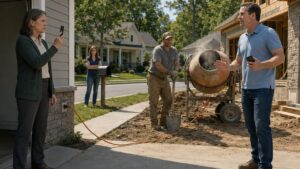
The HOA Contractor Broke Into His Home—Then the Board Learned Who Had Authorized the Wrong Door
Chapter 1: The Notice Hanging From the Broken Door
Robert White saw daylight through a place where his front door should have been solid.
He stopped halfway up the walk, grocery bag hanging from one hand, keys still between the fingers of the other.
A jagged split ran beside the deadbolt. One section of the wooden door had been driven inward hard enough to expose pale raw grain beneath the dark stain. The frame had pulled away from the wall near the latch, leaving a narrow wedge of evening light visible from outside.
Robert set the groceries on the concrete.
He did not touch the handle.
Twelve years in that house had given him an exact sense of what belonged where. The flowerpot beside the entry was six inches from its usual place. A rubber doorstop he kept inside lay near the threshold. Through the opening, he could see a small table tipped against the hallway wall.
And attached to the damaged door with bright adhesive tape was a fluorescent yellow sheet.
Robert read it without removing it.
NOTICE OF VIOLATION.
Below that, in smaller print, was the name of the homeowners association and a company Robert knew only vaguely from neighborhood emails: a private compliance contractor retained earlier that year.
The notice cited an exterior landscaping violation.
Robert looked past his driveway toward the narrow side yard.
Two ornamental grasses had grown over the edge of a stone border while he had been away for four days helping his brother clear out a storage unit. They were untidy. Nothing more.
The last line stopped him.
Corrective action undertaken due to failure to cure.
Robert read it twice.
Then he took out his phone.
He photographed the door from the sidewalk, the frame, the lock, the threshold, the notice, the disturbed entry visible through the gap, and finally the landscaping cited on the paper.
Only then did he call the police.
The responding officer examined the damage and asked whether anything appeared missing.
“I haven’t gone through the house yet.”
“You think this is connected to that?” The officer nodded toward the yellow paper.
“I think whoever left it wants me to think it is.”
The officer glanced at him.
Robert had retired from municipal code enforcement eight months earlier. He did not volunteer that fact unless it mattered. Years of dealing with angry property owners had taught him that announcing experience too early often encouraged people to perform for him.
The officer made a report. A locksmith temporarily secured the frame. Robert walked room to room afterward.
The damage was limited but unsettling.
A ceramic bowl had fallen from the entry table and shattered. A lamp had been knocked sideways. Dirt marked the floor near the hall. Nothing obvious had been stolen.
That almost made it worse.
Someone had entered without needing anything from him.
At the kitchen counter, Robert slid the yellow notice into a clear plastic sleeve.
He read it again.
The language bothered him more each time.
Municipal notices had authority because statutes and ordinances gave them authority. Private associations had authority because declarations, bylaws, covenants, contracts, and state law defined what they could do.
Authority had edges.
This notice behaved as though edges did not exist.
He opened his email and searched the association name.
Three weeks earlier, he had received a routine warning about the ornamental grasses. He had read it while traveling and mentally filed it under things to handle when he returned.
That had been his mistake.
Not because two plants justified a broken door.
Because Robert had spent his career telling people not to ignore official correspondence, then had treated an HOA email as background noise.
He found a second message sent five days later. It imposed a fine.
A third warned that continued noncompliance could result in “additional enforcement activity and recovery costs.”
None mentioned entry.
None mentioned abatement inside a secured area.
None mentioned physical access to the home.
Robert called the association’s management office.
The property manager answered after several transfers.
Robert kept his voice even.
“I’m calling about a compliance action at my address today.”
He gave the lot number.
Keyboard clicks followed.
“Yes,” the manager said. “I see an open landscaping matter.”
“My front door was forced.”
A pause.
“I’m sorry?”
“There is damage to the door and frame. A notice from your compliance vendor was attached to it stating corrective action was undertaken.”
Another pause, longer this time.
“The association uses a third-party compliance contractor.”
“I know what the notice says. I’m asking whether the board authorized someone to enter my house.”
“I can’t speak to the specifics of what occurred.”
“Then speak to the authorization.”
“The vendor is authorized by the board to perform compliance services.”
Robert looked at the damaged frame.
“That wasn’t my question.”
“I understand, Mr. White.”
He heard the shift in the manager’s tone—the careful flattening people used when they sensed liability approaching.
“I can forward your concern to the board president.”
“Please also send me the current vendor agreement.”
“I’ll have to check what can be released.”
“It’s an association contract paid for by association funds.”
“I understand.”
Robert almost said, So send it.
Instead he stopped himself.
That old impatience had helped push him out of public service. He had grown tired of watching obvious questions disappear beneath procedural fog, and eventually his contempt had become visible.
“Send me whatever the governing documents allow,” he said.
The manager promised to forward his complaint.
At seven twelve, Robert’s phone rang from an unfamiliar local number.
“Robert White?”
“Yes.”
“This is Matthew Torres. I handle compliance for the association.”
Robert stood near the patched door.
“I was told you had concerns about today’s action.”
“I have concerns about someone forcing my door.”
Matthew exhaled as if Robert had described a parking disagreement.
“You had an unresolved violation. There were repeated notices.”
“Did you enter my house?”
“Our field team performed an authorized compliance action.”
“That still isn’t an answer.”
“The property remained noncompliant.”
Robert looked through the glass storm door toward the ornamental grasses moving slightly in the evening air.
“You’re talking about two plants.”
“I’m talking about an account that went through the enforcement process.”
“Who authorized forced entry?”
Matthew’s voice hardened.
“You need to understand something. Once these files reach escalation, there are costs. You’re currently responsible for the original fines, the site visit, the corrective action, and recovery fees.”
Robert said nothing.
Matthew apparently took the silence as uncertainty.
“The balance is still due,” he added.
Robert looked at the fluorescent notice sealed in plastic on the counter.
His anger settled into something colder and more useful.
“How much?”
Matthew gave him a figure.
Robert wrote it down.
Then he asked, “And you believe the board authorized everything that happened here?”
“Yes.”
“Everything?”
Another brief pause.
“We operate under association authority.”
Robert capped the pen.
For the first time that evening, the broken door was no longer the question that bothered him most.
The question was whether Anthony Hill and the board truly knew what their contractor believed those words allowed him to do.
Chapter 2: The Man Who Said Compliance Meant Authority
Matthew Torres arrived the next morning carrying a clipboard.
Robert recognized him before he introduced himself. He had seen the man’s photograph on the compliance company’s website: forties, close-cropped hair, pressed polo shirt, expression designed to suggest competent seriousness.
Anthony Hill walked beside him.
That mattered more.
Anthony was the HOA president, a neighbor Robert knew well enough to wave to but not well enough to trust with anything important.
Robert stepped onto the front walk and closed the storm door behind him. The damaged main door remained visible through the glass.
Matthew extended a sheet.
“This is an acknowledgment of yesterday’s enforcement action and the outstanding account.”
Robert did not take it.
“Good morning to you too.”
Matthew withdrew the page half an inch.
Anthony cleared his throat. “Robert, we’re trying to get this handled before it becomes something bigger.”
Robert glanced at the split frame.
“It already became something bigger.”
Anthony’s eyes moved to the damage, then away.
Matthew tapped his clipboard. “The landscaping violation went uncured through multiple notice periods. Our agreement permits corrective compliance activity.”
Robert had placed the fluorescent notice inside a clear evidence sleeve. He picked it up from a small table beside the storm door.
“Show me where.”
Matthew frowned.
“Where what?”
“Where your agreement permits forced access to an occupied residence.”
“This was an enforcement action.”
“That phrase isn’t authority.”
Anthony stepped in. “Robert, nobody is saying the door should have been damaged.”
“Then who is paying for it?”
“We’ll sort out the property damage separately.”
Robert nodded once.
“Fine. Let’s separate it. Did the board vote to authorize forced entry?”
Anthony hesitated.
Matthew answered for him.
“The association delegated compliance enforcement.”
Robert looked at Anthony.
“That wasn’t what I asked him.”
Anthony’s expression tightened.
“No, there wasn’t a vote specifically about your door.”
“About forced access generally?”
“I don’t recall a vote phrased that way.”
Robert held up the notice.
“This says corrective action was undertaken. What corrective action required crossing my threshold?”
Matthew’s jaw shifted.
“Our employee attempted to make contact. There was an access issue.”
“An access issue?”
“The property was secured.”
Robert almost laughed.
“My house was locked. You’re describing a lock as an obstacle to HOA compliance.”
Matthew’s face reddened slightly.
“If homeowners ignore repeated notices, the association cannot function if every person gets to decide which rules apply.”
There it was.
Not an answer, but a belief.
Robert had heard versions of it for years from inspectors, administrators, property owners, contractors, supervisors: if the goal was legitimate, methods became easier to excuse.
Anthony spoke more quietly.
“We have had a real compliance problem, Robert. People complain when we don’t enforce. They complain when we do. Assessments are late. Maintenance costs are up. We hired Matthew because the old process wasn’t working.”
Robert studied him.
Anthony did not look triumphant. He looked tired.
That made the situation more complicated, not less.
“I don’t object to enforcement,” Robert said. “I object to pretending enforcement is unlimited.”
Matthew extended the acknowledgment again.
“This simply confirms receipt. Signing doesn’t waive your rights.”
Robert looked down.
The form listed outstanding fines, a site visit charge, a corrective-action fee, and something labeled escalation recovery.
He pointed at the last item.
“What did you recover?”
“Administrative cost.”
“From what?”
“From escalation.”
“That isn’t an answer either.”
Matthew’s patience thinned.
“You’ve been given the charges. Refusing to acknowledge them doesn’t erase them.”
Robert lifted his eyes.
“And inventing a label doesn’t create authority.”
For several seconds no one spoke.
A delivery truck slowed at the corner and continued past.
Robert turned to Anthony.
“I requested the vendor agreement last night.”
Anthony nodded. “Management is reviewing that request.”
“Why does it need review?”
“Because contracts can contain proprietary information.”
“It is a service agreement funded by homeowners.”
“Robert—”
“I don’t need pricing formulas if you consider them confidential. I need scope.”
Matthew shifted his clipboard under one arm.
“Our scope is compliance.”
Robert tapped the plastic sleeve with one finger.
“No. That’s your category. I’m asking for your limit.”
Matthew stared at him.
Robert felt the familiar temptation to tell them exactly who he had been before retirement, how many enforcement notices he had drafted, how many administrative hearings he had testified in, how many times he had watched a case collapse because someone confused convenience with legal authority.
He resisted.
His résumé did not matter.
The words on the page mattered.
Anthony looked at the broken frame again.
“I’ll make sure you get the agreement.”
“And the board minutes approving it.”
Matthew gave a short, incredulous breath.
“This is becoming excessive.”
Robert turned to him.
“My door was forced over ornamental grass.”
For once, Matthew had nothing immediate to say.
Anthony rubbed a thumb along the edge of his phone.
“Let’s not make this adversarial.”
Robert looked from him to Matthew.
“It became adversarial when someone crossed the threshold.”
Anthony’s voice lowered.
“You should understand that the account remains active. If you refuse the acknowledgment and the outstanding balance isn’t resolved, management may move it to collections under the normal process.”
That was the first clean threat of the morning.
Not shouted. Not dramatic.
Just administrative pressure delivered in a driveway.
Robert nodded.
“Send me that in writing.”
Anthony looked surprised.
“Why?”
“Because if that’s the association’s position after seeing this door, I don’t want to remember it incorrectly.”
Matthew closed the cover on his clipboard.
“We’ve explained ourselves.”
“No,” Robert said. “You’ve repeated your conclusion.”
Matthew stepped toward the driveway.
Anthony remained for another moment.
“I’ll get you the contract.”
Robert held up the yellow notice.
“Good. Because this says your contractor acted with your authority.”
Anthony looked at it longer than he had before.
For the first time, Robert saw uncertainty rather than irritation in his face.
By noon, the acknowledgment form had been emailed to Robert unsigned.
At three sixteen, the property manager sent another message with an attachment.
Vendor Services Agreement—Compliance Operations.
Robert printed it.
He sat at the small desk in the room he had once promised himself would never become another office.
He read every page.
Matthew’s company could photograph visible violations from common areas and public-facing locations. It could deliver notices. It could conduct follow-up inspections. With separate authorization, it could coordinate specified exterior corrective work where the governing documents allowed it.
Robert went back through the contract.
Once.
Twice.
There was no authority to enter a dwelling.
No authority to defeat a lock.
No general right of forced access.
No sentence that transformed “compliance” into whatever Matthew decided the word meant.
Robert laid the agreement beside the fluorescent notice.
The notice claimed an authority the contract did not contain.
That answered the first question.
It created a worse one.
If Matthew’s actual powers were this narrow, why had the board been letting him behave as though they were not?
Chapter 3: The Contract Said Less Than Everyone Claimed
The contract contained no phrase that even resembled the warning taped to Robert’s broken door.
By eight the next morning he had marked six sections with removable tabs and built a two-column list on a legal pad.
AUTHORIZED.
CLAIMED.
The left column was short.
The right one was not.
He resisted the urge to email Anthony immediately.
Proof of his own case was satisfying, but satisfaction was not the same thing as understanding.
Robert had made that mistake before in municipal work: find the violation, identify the rule, assume the rest would straighten itself out once intelligent people saw the mismatch.
Institutions rarely corrected themselves simply because someone highlighted the right sentence.
He requested the board resolution approving Matthew’s company, invoices for his own property, and any schedule of compliance-related charges.
The property manager replied that some records required an in-person review.
Two days later, Robert sat across from Angela Robinson in the management office.
She had three binders on the table and the guarded expression of someone who believed a meeting could become expensive.
“You understand some information has been redacted,” she said.
“I’m not looking for homeowner account details.”
“Good.”
“I’m looking for how the contractor gets paid.”
Angela folded her hands.
“Why?”
“Because my notice charged me for an escalation the contract doesn’t define.”
Her eyes flicked toward his folder.
Robert opened it.
He placed the vendor agreement on the table and beside it a copy of the fluorescent notice.
Angela read the headings but did not reach for either.
“The contract allows enforcement services.”
“It allows specific services.”
“That may be a legal distinction.”
“It is an operational distinction first.”
Angela leaned back.
“You did this kind of work, didn’t you?”
“Municipal code.”
“I heard.”
Robert said nothing.
He disliked the idea that his old job had begun circulating through the neighborhood. It invited an easy explanation: Robert knew how to fight paperwork, therefore Robert’s problem was unusual.
He wanted the documents to matter even if they belonged to Ruth Lee or someone who had never opened a set of bylaws.
Angela slid the first binder toward him.
Monthly vendor invoices.
Most contained a flat service amount. Several also included additional line items.
Resolved escalation.
Field recovery.
Corrective coordination.
Robert stopped at the phrase repeated across multiple months.
“What’s a resolved escalation?”
Angela looked at the invoice.
“A difficult compliance file that required additional work.”
“What work?”
“It varies.”
“Who verifies it?”
“The property manager reviews vendor reports.”
“And who approves payment?”
She hesitated.
“I do, as treasurer, after management coding.”
Robert turned another page.
The number of resolved escalations had risen steadily over six months.
“So the contractor earns more when a file escalates?”
Angela stiffened.
“That’s not how I would characterize it.”
“How would you characterize it?”
“They bill additional services when additional services are required.”
“Who decides they’re required?”
“Management and the contractor.”
“The board?”
“We don’t vote on every operational item.”
Robert nodded.
That was reasonable on its face. Boards could not function by voting on every photograph, mailing, or site visit.
But reasonable systems could still produce unreasonable incentives.
He found his own property.
The invoice had already been prepared.
Site escalation. Corrective field action. Recovery administration.
Robert pointed to it.
“What corrective action was performed?”
Angela read the line.
“I don’t have the field report here.”
“My front door was damaged.”
Her face changed.
Not much.
Enough.
“You saw the complaint.”
“Yes.”
“And you approved this invoice?”
“It hasn’t been paid yet.”
“Would it have been?”
Angela did not answer immediately.
Robert closed the binder halfway.
“I’m not trying to trap you.”
“It feels like you are.”
“Then I’ll ask it differently. Before my complaint, would anything on this line have caused you to stop payment?”
Angela looked back at the page.
Her voice was quieter.
“Probably not.”
That answer mattered more than a denial would have.
Robert opened the second binder.
Board meeting minutes.
There were references to worsening compliance, owner complaints, repeat violations, rising administrative costs. Anthony had pushed for measurable closure rates. Matthew had reported improved results.
One entry recorded praise for reducing the number of “aging open files.”
Nothing ordered forced entry.
Nothing authorized intimidation.
Nothing even suggested the board knew exactly how some of those files were being closed.
Robert felt a brief, unwelcome disappointment.
Part of him had wanted a clean villainous sentence.
Authorize whatever means necessary.
Do not tolerate resistance.
Something simple enough to point at.
Instead he found something more ordinary.
Pressure.
Metrics.
Vague language.
People pleased with results and uninterested in methods.
Angela watched him.
“You expected worse.”
“I expected clearer.”
“There’s a difference.”
“Yes.”
She folded her arms.
“Anthony didn’t tell Matthew to break your door.”
“I know.”
The answer seemed to surprise her.
“Then what exactly are you trying to prove?”
Robert looked at the invoice again.
“That a system can cause damage without anybody writing the damage down as policy.”
Angela’s expression hardened defensively.
“That’s a convenient conclusion.”
“It isn’t convenient for me.”
“You’re implying the board encouraged this.”
“I’m saying the board rewarded closures. I’m trying to find out what a closure meant in practice.”
Angela stood and went to a cabinet behind her.
“I shouldn’t show you other owner files.”
“Then don’t.”
She remained facing the cabinet.
After a moment she pulled out a summary sheet instead.
No names.
Just accounting codes and totals.
She placed it in front of him.
“There have been other escalation charges.”
“How many?”
“Enough that I noticed the category growing.”
“And you approved them.”
“Yes.”
She said it more sharply than necessary, then looked down.
“I thought management had verified the work. Management thought the contractor was acting within the board’s mandate. The board thought the contract controlled what he could do.”
Robert studied her.
“And Matthew?”
Angela gave a tired shake of her head.
“You’ll have to ask Matthew what he thought.”
Robert gathered his papers.
He had what he needed for his own house. The contract was clear enough. Whatever argument remained about fines, no reasonable reading of the agreement gave Matthew authority to force entry.
That should have felt like victory.
Instead Robert kept thinking about the growing column of escalation charges.
At the office door, Angela spoke again.
“Mr. White.”
He turned.
She looked as though she had decided whether to say something three times.
“You weren’t the only homeowner charged like this.”
Robert waited.
“How many?”
“I don’t know how many were improper.”
“That wasn’t my question.”
Angela almost smiled at the echo of his phrasing, but the expression disappeared.
“No,” she said. “It wasn’t.”
She would not give him a number.
Robert drove home with the contract on the passenger seat.
Near his subdivision entrance, he passed Ruth Lee walking slowly beside the curb with a small terrier. She lifted one hand. Robert returned the gesture and continued.
Months earlier, Ruth had stopped him near the mailboxes and mentioned that an HOA contractor kept adding fees to a fence complaint.
Robert remembered exactly what he had told her.
Probably routine. Ask management for the breakdown.
He had meant it as practical advice.
Now it sounded lazy.
At six forty that evening, someone knocked on his temporary door brace.
Robert opened the storm door.
Ruth stood on the porch without her dog.
In both hands she held three fluorescent yellow notices.
They were folded at the corners, worn from being handled, but Robert recognized the format immediately.
Ruth looked past him at the damaged frame.
“They did worse to yours,” she said.
Then she held the notices out.
“But yours wasn’t the first.”
Chapter 4: The Neighbors Who Paid Without Fighting Back
Ruth Lee had kept every notice in the same kitchen drawer for almost a year.
She pulled it open while Robert sat at the small table behind her. Inside were rubber bands, takeout menus, appliance manuals, expired coupons, and three fluorescent yellow sheets folded into thirds.
“I didn’t know what else to do with them,” she said.
Robert looked at the notices she had already shown him on his porch.
“You could have challenged them.”
Ruth turned.
The words had left his mouth before he heard how they sounded.
She set the drawer shut with her hip.
“I did.”
Robert remembered the mailbox conversation months earlier. Ruth standing beside her little terrier. A complaint about a fence. Extra charges. Something about a contractor.
Probably routine, he’d told her.
Ask management for the breakdown.
He had forgotten the conversation before dinner.
Ruth had not.
She poured coffee into two mismatched mugs.
“The first one was about the fence panel leaning,” she said. “It was leaning. I never argued that.”
Her back fence bordered a narrow drainage strip owned by the association. A windstorm had shifted one cedar panel several inches. Ruth had hired someone to repair it, but the contractor could not come for two weeks.
“The second notice came before the repair date.”
Robert examined the dates.
Seven days apart.
The third notice added an escalation charge.
“How much?”
“Altogether?”
“Yes.”
Ruth looked toward the counter.
“Eight hundred and forty dollars.”
Robert lowered the paper.
“For a leaning fence panel?”
“For not fixing it fast enough, apparently.”
“You asked management for an explanation?”
“Twice.”
“What did they say?”
“That the account had entered escalation.”
The word again.
Robert placed the notice flat on the table.
“And Matthew?”
“He came here once.”
“What happened?”
Ruth rubbed the rim of her mug with her thumb.
“He stood right where you’re sitting now? No. He wouldn’t come inside. He stood on the driveway and told me the costs would keep going up if I didn’t resolve it.”
“What costs?”
“I asked that.”
“And?”
“He said field costs. Administrative costs. Recovery costs.”
Robert recognized the pattern. Broad nouns that sounded official while explaining almost nothing.
“Did he threaten a lien?”
Ruth hesitated.
“He said unpaid association charges could become a lien.”
“That isn’t quite the same as saying these specific fees legally qualified.”
“It sounded the same to me.”
Robert leaned back.
There it was.
For him, the difference between could and would, between assessment and contractor fee, between authority and assertion, was obvious.
For Ruth, the message had been simpler.
Pay this or your house becomes the next problem.
She opened another drawer and brought him a bank statement with one line highlighted.
“I paid it.”
Robert stared at the amount.
“Why didn’t you push it further?”
Her expression changed.
Not angry. Worse.
Tired.
“I live alone, Robert.”
He said nothing.
“My husband handled most of this kind of thing before he died. Not because I couldn’t. Because he liked paperwork and I didn’t. Now every letter sounds like somebody knows something I don’t.”
She pointed toward the fluorescent notices.
“When something like that says fines, collections, enforcement, attorney costs—what am I supposed to assume?”
“That they’re required to prove the charge.”
Ruth gave him a small look.
“That sounds like something a retired code inspector would say.”
Robert looked down.
He had spent years believing access to rules was close enough to access to power.
It wasn’t.
They spent the next hour comparing notices.
The phrasing was nearly identical to his.
Failure to cure.
Escalation activity.
Recovery costs.
Corrective measures available.
The wording implied a ladder of consequences without clearly defining the rungs.
Robert asked whether she knew anyone else who had received similar demands.
Ruth named no one. She simply said, “I know I’m not the only person who paid.”
“How?”
“People talk.”
“About amounts?”
“Not always.”
“About Matthew?”
“Sometimes.”
Robert heard his own impatience returning.
“Ruth, I need specifics.”
She stiffened.
“You need them.”
He stopped.
She folded her hands.
“That right there is why I stopped telling you things.”
Robert felt the words settle.
“When did you tell me?”
“At the mailboxes.”
“I remember.”
“Do you?”
“Yes.”
“What did you say?”
He did not answer immediately.
Ruth did.
“You told me it was probably routine.”
Robert looked at the three yellow sheets between them.
“I was wrong.”
“You were busy.”
“I was retired.”
“That doesn’t mean you weren’t busy being done with everybody else’s problems.”
The sentence struck cleanly because there was no cruelty in it.
Robert had left municipal work exhausted by disputes, hearings, supervisors, angry owners, and agencies that defended bad decisions simply because admitting them required effort.
After retirement, he had promised himself he would stop being the person everyone asked to interpret a rule.
So when Ruth had tried, he had given her the quickest answer available.
Ask management.
Probably routine.
He had mistaken distance for peace.
“I should have looked at it,” he said.
Ruth’s shoulders loosened slightly.
“I didn’t come over to make you feel bad.”
“I know.”
“I came because they broke your door.”
Robert glanced toward her kitchen window.
From there he could see part of his house across the curve of the street, the temporary repair still obvious around the frame.
“Why did that make a difference?”
“Because I thought maybe somebody would finally believe the notices didn’t feel right.”
Robert looked back at the papers.
Not didn’t look right.
Didn’t feel right.
That distinction mattered.
The notice had worked on Ruth long before any lien, hearing, or attorney became real.
It had worked because she believed the people sending it possessed whatever authority the page suggested.
By Saturday afternoon, Robert had spoken with several other homeowners, careful not to present himself as anyone’s lawyer or investigator. Some had ordinary violation histories. Some had legitimate fines. But two showed him unexplained escalation charges, and another described a contractor employee moving patio furniture from a side-yard access path during an exterior correction.
Nothing matched Robert’s damaged door.
It did not need to.
The pattern was not identical acts.
It was expanding authority.
Each homeowner had assumed someone above Matthew must have approved whatever he was doing.
That evening, Robert returned home with copies of records in his folder.
His phone rang before he reached the kitchen.
Anthony.
“I understand you’ve been talking to neighbors.”
“I’ve been listening to them.”
“We need to be careful about misinformation.”
“So send a notice to the membership explaining what Matthew is authorized to do.”
Silence.
Then Anthony said, “I’d rather resolve your situation first.”
“My situation is already clear.”
“That’s why I’m calling.”
Robert heard paper moving.
“The association is prepared to cover the door, frame, interior damage, locksmith charges, and your disputed compliance fees.”
Robert stopped beside the kitchen counter.
“That was fast.”
“We don’t need to drag this out.”
“What do you need from me?”
Another pause.
“We’d need a standard settlement agreement.”
“Confidential?”
Anthony’s silence answered before his voice did.
“Yes.”
Robert looked at the fluorescent notice in its plastic sleeve.
For three days he had wanted exactly what Anthony was offering: his house repaired, the charges removed, the matter acknowledged.
Now he knew what accepting it would leave untouched.
Anthony spoke gently.
“Robert, this makes you whole.”
Robert kept looking at the notice.
Across the street, Ruth’s kitchen light came on.
“No,” he said. “It fixes one house.”
Chapter 5: The Settlement That Would Fix Only One House
The repair check was already printed when Robert entered the management conference room Monday evening.
It lay face down beside a stack of papers.
Anthony sat at one end of the table. Angela Robinson sat near the window with a yellow legal pad and a bottle of water she had not opened.
No Matthew.
Robert noticed that immediately.
Anthony followed his glance.
“This meeting is between you and the association.”
“Why?”
“Because we’re trying to resolve the association’s exposure.”
Not your damage, Robert thought.
Exposure.
He sat down.
Anthony slid the packet toward him.
The first page listed compensation for the damaged door, frame, locksmith service, interior items, and removal of Robert’s fines and contractor fees.
The amount was fair.
Possibly generous.
Robert had expected an argument over depreciation or whether the ceramic bowl could be valued at replacement cost. None appeared.
“Insurance involved?” he asked.
“We’ve notified the carrier.”
“And Matthew?”
“His company has been notified of the claim.”
“Is he still doing compliance work?”
Anthony’s mouth tightened.
“For the moment, yes.”
Robert left the settlement where it was.
Angela finally opened the water but did not drink.
Anthony leaned forward.
“I know you’re upset.”
“No. I’m past upset.”
“All right.”
“I want to understand what changed between Friday and today.”
“We reviewed the contract.”
“And?”
Anthony looked briefly at Angela.
“And it does not expressly authorize entry into a dwelling.”
“Expressly?”
Anthony exhaled.
“Robert.”
“Words matter in this room.”
“Yes, they do. The contract doesn’t authorize it.”
That was the first time Anthony had said it without qualification.
Robert waited.
“We’re prepared to fix what happened,” Anthony continued. “That’s what the check is for.”
Robert picked up the settlement.
The confidentiality provision was on page four.
It prohibited disclosure of settlement terms and required Robert to treat the dispute as resolved.
“Does this prevent me from discussing the contractor’s practices?”
“It prevents you from discussing the settlement.”
“And allegations related to it?”
Anthony looked toward the papers.
“The attorney drafted the language.”
“You’ve read it.”
“Yes.”
“Then answer.”
Anthony’s jaw tightened.
“It is intended to bring finality.”
Robert set the packet down.
Angela spoke for the first time.
“Anthony.”
He looked at her.
She said nothing else.
Something passed between them.
Robert noticed.
“What?”
Anthony rubbed both hands over his face.
For a moment he looked less like an HOA president than a man who had been sleeping badly.
“We had complaints about Matthew before your incident.”
Robert’s body went still.
“What kind?”
“His tone. Aggressiveness. Homeowners saying they felt pressured.”
“Property damage?”
“No.”
“Unauthorized entry?”
“Not that I’m aware of.”
“When did the complaints start?”
“Months ago.”
Robert looked at Angela.
She did not contradict him.
“And what did you do?”
“We talked to him.”
Anthony’s voice sharpened defensively.
“You need context. Before Matthew, compliance was a mess. We had files sitting open for six months. Homeowners were accusing the board of selective enforcement. Landscaping standards were slipping. People were refusing fines because they assumed nothing would happen.”
“So you hired someone tougher.”
“We hired someone who closed files.”
Robert thought of the invoice language.
Resolved escalation.
“How?”
Anthony looked irritated.
“Robert, nobody told him to break doors.”
“I didn’t say you did.”
“That’s what you’re implying.”
“No. I’m asking whether you cared how files got closed.”
Anthony stood and walked to the window.
Outside, the parking lot lights had come on.
“We’re volunteers,” he said. “People act like the board is some corporation with a compliance department. It’s five homeowners trying to keep the place functioning.”
Robert said nothing.
“Assessments are behind. The pool needs resurfacing. The retaining wall inspection came in higher than expected. Every time we raise dues, people accuse us of wasting money. Every time we don’t enforce, somebody sends pictures of weeds and boats and trash cans.”
He turned.
“Matthew got results.”
There was no pride in the sentence now.
Only admission.
Robert asked, “Did you know homeowners were being charged escalation fees?”
“Yes.”
“Did you know what actions produced those fees?”
“I assumed management verified them.”
Angela looked down at her legal pad.
Robert turned to her.
“And you assumed the same.”
“Yes.”
The word came softly.
Anthony returned to his chair.
“That’s why we’re correcting this.”
Robert tapped the settlement.
“This corrects me.”
“It removes the most serious claim.”
There it was.
Not cruelty.
Fear.
Anthony was afraid that if Robert’s damaged door became evidence of a broader enforcement problem, the association would face refunds, insurance disputes, legal bills, angry members, and perhaps years of distrust.
His solution was not to deny what happened.
It was to make the loudest problem disappear first.
Robert understood the impulse better than he wanted to.
Years earlier, he had watched municipal supervisors make the same calculation. Fix the file in front of you. Avoid reopening the stack behind it.
He had despised them for it.
Now a check sufficient to repair his house sat within arm’s reach.
“What happens to Ruth Lee’s fees?” he asked.
Anthony blinked.
“This meeting isn’t about another homeowner’s account.”
“What happens to other escalation charges?”
“We haven’t determined that they’re improper.”
“Will you review them?”
“If there’s a complaint.”
“So everyone has to know enough to complain correctly.”
“Robert, we cannot reopen every compliance file because Matthew mishandled yours.”
“Why not review every escalation fee?”
“Because there are hundreds of files.”
“Not hundreds of escalation fees.”
Anthony looked at Angela.
She said quietly, “No. Not hundreds.”
Robert folded the settlement closed.
Anthony’s face hardened.
“What do you want?”
The question was almost accusatory.
Robert considered it.
A week ago the answer would have been easy.
A repaired door. Charges removed. An apology he probably would not believe.
Now Ruth’s words sat heavier than the check.
I thought maybe somebody would finally believe the notices didn’t feel right.
“I want the membership told that the contractor’s authority is under review.”
Anthony shook his head immediately.
“That would cause panic before we know the scope.”
“I want enforcement suspended until you know the scope.”
“We can’t simply stop enforcing the covenants.”
“You can stop using Matthew.”
“We have a contract.”
“You have a bigger problem.”
Anthony’s voice dropped.
“Do you intend to sue?”
Robert looked at him.
“I haven’t decided.”
That was true.
He had not spoken to a lawyer.
This was not about manufacturing leverage.
It was about refusing to trade everyone else’s uncertainty for his certainty.
“I won’t sign confidentiality,” Robert said.
Anthony leaned back.
“Then the settlement offer may not remain open.”
“I understand.”
“And if you start making accusations publicly, the association will respond.”
“Then don’t make me accuse anyone. Open the records and explain them.”
Angela finally raised her eyes.
“Anthony.”
He turned.
She pushed her legal pad toward the center of the table.
On it were several accounting codes and dates.
“I think we should review all escalation charges.”
Anthony stared at her.
“You already reviewed them.”
“I approved invoices. That’s not the same thing.”
“You’re the treasurer.”
“I know exactly what I am.”
Her voice did not rise.
That made it land harder.
Anthony looked between them.
Something in his posture changed. Not surrender. Calculation.
“If Robert calls a special meeting himself, we lose control of how this is presented.”
Robert said, “I’m sitting right here.”
“I know.”
Anthony picked up his phone.
He stared at the screen for several seconds.
Then he opened the association’s management portal.
“What are you doing?” Angela asked.
Anthony began typing.
“Calling an emergency homeowner meeting.”
Robert watched him.
Anthony did not look defeated.
He looked like someone choosing the door he preferred because the other one had just closed.
Chapter 6: The Meeting Where the Notices Changed Meaning
By the time Robert entered the clubhouse, six homeowners were carrying fluorescent yellow notices.
He had brought only his own.
For a moment he stood just inside the doorway watching people compare pages.
One homeowner flattened a folded notice against a chair seat. Another held two together under the overhead light. A couple near the back whispered over a statement showing contractor fees.
The documents looked less official in a pile.
That surprised Robert.
Pinned alone to a front door, fluorescent paper commanded attention.
Spread across folding tables among coffee cups, reading glasses, pens, and skeptical homeowners, it looked like what it had always been.
Paper.
Anthony stood near the board table speaking with the HOA attorney. Angela arranged binders beside them.
Matthew Torres was not there.
At seven, Anthony called the meeting to order.
The room continued murmuring.
He waited.
Eventually the voices fell away.
“This meeting was called to address concerns regarding the association’s compliance enforcement process and its third-party vendor.”
No euphemism about routine business.
Robert noticed that.
Anthony continued.
“A recent incident resulted in property damage at a homeowner’s residence. Our preliminary review determined that certain actions taken by the contractor were not authorized under the current vendor agreement.”
A woman near the aisle raised her hand immediately.
“Which actions?”
Anthony glanced toward the attorney.
“Questions will be taken after the initial presentation.”
“That means the broken door, right?” someone said.
Heads turned toward Robert.
He disliked that.
He had not come to become the center of the room.
Anthony looked at him.
“Robert, do you want to explain what occurred?”
Robert stood.
He carried his folder to the front table.
Then he removed the original fluorescent notice from its clear sleeve and laid it beside the vendor agreement.
“I came home last Monday and found damage to my front door and frame. This was attached to the door.”
He tapped the notice.
“It said corrective action had been undertaken because of an unresolved landscaping violation.”
He opened the contract.
“The vendor was authorized to inspect visible conditions, deliver notices, conduct follow-up visits, and coordinate certain exterior corrective work when separately authorized.”
Robert looked around the room.
“The contract did not authorize entry into a dwelling or forced access.”
A man near the wall said, “Then how did they think they could do it?”
Robert could have answered.
He had theories.
Instead he looked at Anthony.
“That is part of what the board has to explain.”
The choice mattered.
This was not Robert’s hearing.
Anthony rested both hands on the table.
“We did not instruct the contractor to force entry into Robert’s home.”
The room stirred.
Anthony raised one hand.
“That does not mean the association has no responsibility.”
The murmuring stopped more quickly this time.
Robert looked at him.
Anthony’s face was tight.
“We hired the vendor. We monitored performance primarily through open and closed compliance files. We did not adequately review how escalation activity was being conducted.”
There it was.
Not everything.
But more than Robert had expected him to say publicly.
A homeowner held up a notice.
“What about these fees?”
Angela answered.
“We are reviewing them.”
“How many?”
Angela looked at Anthony, then at the room.
“I can tell you what I know.”
She opened one binder.
“The vendor’s invoices included additional charges coded as resolved escalation, field recovery, and corrective coordination.”
Robert watched several faces change as people recognized the terms.
Angela continued.
“I approved payment of many of those invoices after they were processed through management.”
Someone near the back said, “So you approved the charges.”
“Yes.”
The answer created a low wave of voices.
Angela did not retreat.
“I approved the invoices. I did not verify the specific enforcement method behind every line item.”
“Why not?”
“Because I assumed the vendor was operating within the contract.”
A homeowner laughed bitterly.
“So everybody assumed.”
Angela looked toward the voice.
“Yes.”
The room went quiet again.
That single word did more than a defense would have.
Robert saw Anthony look at her.
Angela’s hands were clasped tightly, but her voice remained steady.
“I believed that if management coded the invoice and the contractor reported the file closed, the service had been properly performed. That assumption was wrong.”
No applause followed.
Robert was glad.
People shifted in their chairs. Someone whispered, “Unbelievable.” Another homeowner turned a notice over as if checking whether something had been missed on the back.
Then Ruth stood.
Robert had not seen her enter.
She sat three rows from the rear, holding one of her folded notices in both hands.
Anthony recognized her.
“Ruth?”
Her voice was thinner than usual.
“I paid eight hundred and forty dollars.”
No one interrupted.
“I had a fence panel leaning after the windstorm. I had someone scheduled to fix it. Before he could come, I got another notice. Then another charge.”
She held up the yellow page.
“I asked what would happen if I didn’t pay. I was told association charges could lead to more collection costs and possibly a lien.”
The attorney leaned toward his microphone.
“I want to be careful about individual legal conclusions—”
Ruth looked at him.
“I didn’t ask for a legal conclusion then either.”
The attorney stopped.
Ruth continued.
“I paid because I was afraid not to.”
Robert felt something tighten in his chest.
He had known the facts.
Hearing her say them to the room changed their weight.
A homeowner on the aisle raised another notice.
“I paid a field recovery fee.”
Another voice: “So did I.”
A third homeowner said, “Mine says corrective coordination.”
The papers began appearing across the room.
Not identical harms.
Not proof that every charge was improper.
But enough to destroy the idea that Robert’s door was an isolated misunderstanding.
The HOA attorney stood.
“I need the board to hear me clearly.”
Anthony looked at him.
“Pending a full review, my recommendation is that all enforcement activity by this vendor be suspended immediately.”
The room broke into overlapping voices.
Anthony struck the table lightly with his palm.
“Please.”
The attorney continued.
“I’m also recommending review of any homeowner charge derived from escalation categories outside ordinary fines or assessments. That does not mean every charge will be refunded. It means the association needs to determine whether each charge was authorized, documented, and properly assessed.”
A man near Robert said, “And if it wasn’t?”
“Then the association will have to correct it.”
Anthony’s face had gone pale.
Robert understood why.
The sentence carried money behind it.
Maybe a great deal of money.
Anthony looked across the room and then down at the stack of yellow notices now resting near Robert’s contract.
For months those notices had represented efficiency to him.
Closed files.
Higher compliance.
Rules being taken seriously.
Now each page meant a question the board had failed to ask.
He lifted his microphone.
“Effective tonight, Matthew Torres’s company is suspended from all compliance activity pending termination review.”
The room reacted, but not with celebration.
Some people sounded relieved. Others angry. A few immediately began asking what would replace the contractor.
Anthony held up his hand.
“Existing legitimate violations do not disappear because our process failed.”
That earned several sharp comments.
He waited them out.
“If your fence is out of compliance, it may still need repair. If assessments are owed, they are still owed. What changes is that nobody should be charged or pressured through authority the association does not actually possess.”
Robert looked at him.
That sentence was closer to the truth than anything Anthony had said in Robert’s driveway.
Not because Anthony had become a different person.
Because the cost of pretending had finally exceeded the cost of admitting the problem.
After the meeting adjourned, homeowners clustered around Angela’s table asking how to request account reviews.
Ruth remained seated.
Robert walked over.
“You all right?”
She nodded.
“I hated that.”
“You did it anyway.”
“I almost didn’t.”
Robert looked toward the front of the room.
Anthony was gathering papers alone.
The fluorescent notices remained on the table beside the vendor agreement.
Robert had wanted that moment to feel like victory.
Instead it felt heavier.
Firing Matthew would be easy compared with what came next.
Every questionable charge had to be reviewed. Every legitimate rule still had to be enforced somehow. People who had learned not to trust notices would have to be given a reason to trust the next one.
Robert understood then that exposing bad authority was simpler than rebuilding credible authority after it failed.
Anthony picked up one of the yellow notices, stared at it, and then placed it back on the stack.
For the first time, the question was no longer whether Matthew Torres had gone too far.
The neighborhood already knew that.
The question was what they were willing to repair after he was gone.
Chapter 7: The Door Was Repaired but Not Replaced
The carpenter had already removed the damaged trim when he asked Robert whether he wanted to replace the entire door.
Robert stood in the entryway looking at the exposed wood around the lock.
The split section that had once let daylight through was gone. A clean piece of matching hardwood had been fitted into the damaged area, but the repaired grain would never be identical to the original.
“I can order a full replacement,” the carpenter said. “Insurance approved either option.”
Robert ran one finger along the edge of the patch.
“How noticeable will this be when you’re finished?”
“If you’re looking for it? You’ll see it.”
“And if you’re not?”
“Probably not.”
Robert nodded.
“Repair it.”
The carpenter glanced at him.
“You sure?”
“Yes.”
A few weeks earlier, Robert would have wanted every sign of the incident erased. New door. New frame. New lock. No scar left from Matthew Torres or the association that had failed to stop him.
Now the small mismatch in the wood seemed less offensive than pretending nothing had happened.
“Patch stays,” Robert said.
The carpenter shrugged.
“Your house.”
That phrase made Robert smile slightly.
“Yes,” he said. “It is.”
On the kitchen counter behind him sat the original fluorescent violation notice, still sealed inside its clear sleeve.
It had become strangely unnecessary.
The association had terminated Matthew’s compliance contract after the attorney’s review. The insurer and attorneys were still arguing about responsibility for Robert’s property damage and whether Matthew’s company owed reimbursement to the association.
Robert no longer followed every exchange.
The part that mattered had moved elsewhere.
Angela had spent three weeks reviewing every escalation charge from the previous year.
Some remained valid because homeowners had been billed for documented services specifically permitted under association rules.
Others did not.
Those were being credited or refunded.
Ruth’s was among them.
She appeared at Robert’s door that afternoon holding an envelope.
The carpenter was sanding the repaired section, so Robert stepped outside to escape the noise.
Ruth lifted the envelope.
“They’re giving it back.”
Robert looked at the association letter through the window in the envelope.
“All of it?”
“Six hundred and twenty dollars.”
“What about the rest?”
“The original fine stays.”
Robert nodded.
“That sounds right.”
Ruth raised an eyebrow.
“I knew you were going to say that.”
“The fence was out of compliance.”
“I know.”
“And the contractor fee wasn’t properly supported.”
“I know that too.”
They stood together on the front walk.
For a moment Ruth studied the repaired doorway.
“You’re not replacing it?”
“No.”
“I would.”
“I considered it.”
“Then why keep that?”
Robert looked at the narrow patch where the new wood met the old.
“Because it’s repaired.”
“That doesn’t answer the question.”
“It does for me.”
Ruth folded her refund letter.
“You always talk like you’re answering a hearing officer.”
Robert laughed once.
“That bad?”
“Sometimes.”
He glanced at her.
“You were right, you know.”
“About what?”
“When you said I was busy being done with everybody else’s problems.”
Ruth looked uncomfortable.
“I was irritated.”
“You were also right.”
She slipped the envelope under her arm.
“Well, don’t get too inspired. I don’t need you patrolling the neighborhood.”
“Good.”
“Because people already think you’re the new HOA expert.”
“Absolutely not.”
Ruth smiled.
“Then you should probably stop attending rules meetings.”
Robert’s expression changed.
She noticed.
“Oh no.”
“I haven’t agreed to anything.”
“You’re considering it.”
“Temporary review committee.”
Ruth laughed.
“You’re doomed.”
After she left, Robert went back inside.
The carpenter had finished staining the patched wood.
From several feet away, the repair nearly disappeared.
Nearly.
Robert could still see exactly where the old damage had been.
Later that week, the association distributed a new enforcement procedure to every homeowner.
The document was shorter than Robert expected.
That pleased him.
Warnings had to identify the exact governing provision involved.
Any additional fee had to state what service generated it.
Exterior corrective work required written authorization tied to a specific rule.
No vendor could enter a dwelling, enclosed area, or locked portion of property without the owner’s permission or a separately established legal right.
Disputed enforcement charges could be reviewed before collections activity continued.
And every vendor action had to be documented in the association’s records rather than hidden behind labels such as escalation or recovery.
Robert read the procedure twice.
Then once more.
Not because it was complicated.
Because it wasn’t.
That was the point.
Authority was easier to abuse when nobody could tell where it ended.
The new rules drew brighter lines.
Anthony remained HOA president.
That surprised some people.
At the next board meeting, several homeowners demanded his resignation. Others argued that forcing him out would allow everyone else involved to pretend the failure belonged to one person.
Anthony solved part of the question himself.
He announced that he would finish his term but surrender all direct oversight of compliance enforcement.
“I pushed too hard for closed files,” he told the room. “I cared about whether the numbers improved and not enough about how they improved.”
He did not ask anyone to forgive him.
Robert respected that more than an apology written to sound complete.
Angela retained responsibility for the finances but implemented an additional review for unusual vendor charges.
She also began placing monthly compliance-cost summaries in the homeowner portal.
No one celebrated that either.
Transparency mostly looked like spreadsheets.
Robert thought that was appropriate.
Real repair rarely looked dramatic.
Near the end of the meeting, Anthony approached him beside the clubhouse door.
“You were right about the contractor,” Anthony said.
Robert shook his head.
“That isn’t the useful part.”
Anthony frowned.
“What is?”
“We were all wrong about something.”
“Speak for yourself.”
Robert almost smiled.
“There he is.”
Anthony gave him a tired look.
Robert continued.
“You thought an official process was safe because a contract existed. Angela thought the invoices were safe because management coded them. Ruth thought the charges were valid because the notices looked official.”
Anthony crossed his arms.
“And you?”
Robert looked toward the parking lot.
“I thought people who didn’t understand the rules should simply ask better questions.”
Anthony said nothing.
Robert had learned enough not to fill every silence.
After a moment Anthony asked, “Will you join the review committee?”
“I said temporary.”
“Everything in an HOA is temporary until nobody else volunteers.”
“That sounds like a threat.”
“It’s a warning.”
Robert accepted the position for six months.
Not because he wanted authority.
That distinction mattered to him now.
He wanted the next homeowner who received a notice to understand exactly what it meant, what it did not mean, and what could be challenged before fear did the work for the association.
The committee’s first meeting took place at a folding table in the clubhouse.
Robert brought no old municipal manuals and offered no lecture about his years in code enforcement.
He brought the new procedure, the governing documents, and one question.
“What would this look like to somebody who has never read any of this before?”
That question slowed the meeting down.
Robert considered that progress.
Several days later, he came home near sunset and stopped at the front door.
The repaired section caught the light differently from the surrounding wood.
He could see it from the walkway.
Anyone else probably would have missed it.
Inside, the fluorescent violation notice still hung beside the entry, tucked into its clear sleeve where Robert had temporarily placed it after the board meeting.
He had kept it there longer than necessary.
At first it had been evidence.
Then leverage.
Then proof that he had been right.
Now it was only an old piece of paper.
Robert removed it from the wall.
He carried it into the small room that had slowly become an office again and placed it inside the folder with the vendor agreement, board correspondence, and final repair invoice.
He closed the folder.
When he returned to the entryway, the wall beside the door was empty.
The patch in the wood remained.
Robert opened the door and stepped outside.
Across the street, Ruth was walking her terrier. She lifted one hand.
This time Robert crossed the street instead of merely waving back.
The story has ended.