My Neighbor Cut Down the Oak My Family Protected for Generations—Then the HOA Found the Rule He Never Read
Chapter 1: The Note Sitting on the Fresh Oak Stump
Charles Miller turned onto his street and took his foot off the accelerator.
Something was wrong with the sky.
For as long as he could remember, the road curved toward his house beneath the dark reach of the old oak. Its crown rose above the roofs and power lines, wide enough that Charles usually saw the tree before he saw his own porch.
Now there was only open blue.
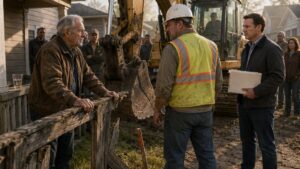
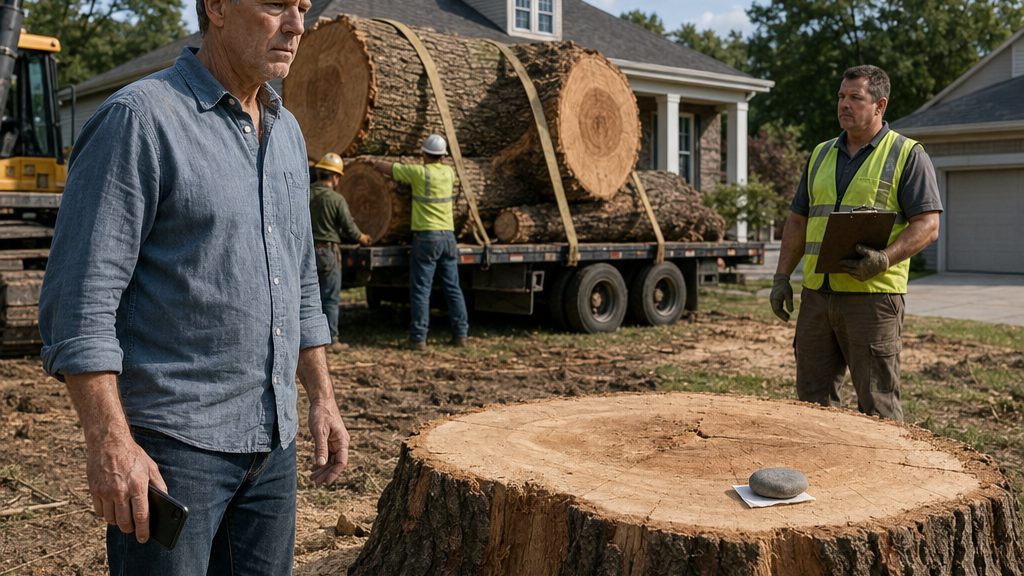
A truck with a wood chipper blocked half his driveway. Fresh sawdust coated the curb. Beyond it, a worker in an orange vest was tightening straps around several enormous sections of trunk already loaded onto a flatbed.
Charles stopped his car in the street.
He did not remember turning off the engine.
The oak was gone.
Where its trunk had stood was a pale stump almost six feet across, its cut surface wet and raw. Splintered roots pushed through the grass near the property line. Small leaves, severed twigs, and chips of bark covered the lawn.
Charles got out.
A worker glanced at him and then toward the foreman.
“Who did this?”
The foreman approached slowly. “You the homeowner?”
Charles looked at him.
“That tree.”
“Yes, sir.”
“Who told you to cut down that tree?”
The foreman’s expression changed. Not guilt exactly. Caution.
“We had authorization.”
“From whom?”
The foreman pointed toward the neighboring house.
Eric Carter’s driveway was empty.
Charles stared at it, then back at the stump.
“My neighbor doesn’t own this yard.”
“We were told the boundary limbs were approved for removal.”
“You didn’t remove boundary limbs.”
Charles’s voice stayed low, but his hands had begun to shake.
“You removed the tree.”
The foreman looked toward his crew. “I can show you the work order.”
Charles almost told him he didn’t care about a work order. Then something in the man’s hesitation stopped him.
“Show me.”
The foreman retrieved a clipboard from the truck.
Charles took out his phone first.
He photographed the stump. The equipment. The trailer. The pieces of trunk. The torn ground where heavy machinery had crossed his lawn.
Only then did he accept the paper.
The description was brief.
Prune and remove encroaching limbs along eastern residential boundary. Coordinate access through adjacent property as needed.
Charles read it twice.
“Where does this say remove the tree?”
The foreman frowned.
“It doesn’t.”
“Then why is my tree on your truck?”
The man rubbed the back of his neck. “Mr. Carter was here this morning. He walked us through what he wanted.”
“What exactly did he tell you?”
“He said the problem needed to be taken care of.”
“That doesn’t answer me.”
The foreman lowered his voice. “Once we got into the crown, he said he wanted the whole thing handled. Said he had approval.”
Charles looked again at Eric’s empty driveway.
“And you believed him?”
“We had paperwork from the association.”
Charles’s jaw tightened.
He wanted to shout. Wanted to order them to unload every section of trunk, though he knew that would accomplish nothing. He wanted to cross the lawn and pound on Eric’s door until somebody answered.
Instead he lifted his phone.
“What’s your company name?”
The foreman told him.
“And your name?”
The man gave it.
Charles recorded both.
“Do not remove anything else from this property until I have photographs.”
The foreman nodded.
Charles walked around the stump.
Its rings were exposed in tight, uneven circles. He could not count them. His grandfather once claimed the oak had been planted when the original farmhouse stood alone beyond the county road, long before the subdivision existed. Charles’s father had repeated the story so often that Charles had stopped thinking of it as a story.
It was simply where the tree came from.
His great-great-grandfather had planted it.
His grandmother had been photographed beneath it in a white summer dress.
Charles had learned to ride a bicycle in its shade.
His father had stood under it the last afternoon they spent together in the yard.
Look after it, his father had said.
Charles had.
Or he had believed he had.
Something white caught his eye.
A small folded piece of paper sat near the stump’s center beneath a smooth landscaping stone.
Charles stared at it.
He stepped closer and lifted the stone.
The note contained only two words.
You’re welcome.
For a few seconds, all he heard was the chipper idling.
He photographed the note exactly where it lay.
Then he picked it up carefully by one corner.
The foreman watched him.
“Was that there when you arrived?”
The man hesitated. “Mr. Carter put something on the stump before he left.”
Charles folded the note along its existing crease and slipped it into his shirt pocket.
The property manager returned his call twenty minutes later.
Charles stood beside the stump while the crew waited.
“I need to know what the HOA authorized for Eric Carter.”
There was keyboard noise on the other end.
“I see an approved landscaping request.”
“For what?”
“Tree work along a shared property boundary.”
“That tree was on my property.”
“I understand you’re upset.”
“No. You understand there used to be a tree here.”
A pause.
“The association does not authorize contractors directly, Mr. Miller. We reviewed a homeowner request.”
“For removal?”
More keyboard tapping.
“It says vegetation encroachment and hazard mitigation.”
“Does it say removal?”
“I would need to pull the attachment.”
“Please do.”
The manager sighed softly. “This may ultimately be a private matter between you and Mr. Carter.”
Charles looked at the pieces of oak stacked on the flatbed.
“A private matter doesn’t explain why your approval is in the contractor’s hand.”
“I said I’ll review it.”
Charles ended the call without saying goodbye.
The crew left the trunk sections where they were for the moment. The foreman gave Charles a copy of the work order and promised no more material would be hauled away until Monday.
Charles sat on his front steps after they shut down the chipper.
Without the oak, every sound seemed too exposed. A lawn mower two houses away. A garage door closing. Children talking somewhere behind a fence.
His own house looked wrong in full afternoon sun.
At 5:17, an email arrived from the property manager.
Attached was the HOA approval issued to Eric.
Charles opened it.
The request concerned branches extending across the shared property line. It allowed pruning consistent with association standards and local requirements.
There was no authorization to cut the trunk.
No authorization to remove the tree.
No sentence that could reasonably be read as permission to erase it from the yard.
Charles read the approval once more, then looked toward Eric’s house.
The question was no longer whether the HOA had approved tree work.
It was who had decided that permission to trim a few branches meant permission to take everything.
Chapter 2: Three Inches Across a Line Became Everything
“I asked you for two years.”
Eric Carter said it before Charles had even reached the conference table Monday morning.
Michelle Adams, the HOA president, looked up sharply. “Eric.”
But Eric kept his eyes on Charles.
“Two years,” he repeated. “Emails. Pictures. The gutter repair. The branch over the garage. You ignored all of it.”
Charles set a folder on the table.
“And that gave you the right to cut down my tree?”
“I had the right to deal with what crossed onto my property.”
“You dealt with the trunk.”
“I dealt with a problem you wouldn’t.”
Michelle raised a hand. “We’re not going to settle this by talking over each other.”
The HOA office occupied two converted rooms beside the community pool. Charles had been there for meetings about road resurfacing and mailbox replacements. Until that morning he had never noticed how small it was.
The property manager placed copies of Eric’s landscaping application between them.
Michelle tapped the first page.
“This is what the board approved.”
Charles had already read it a dozen times.
Boundary pruning. Hazard mitigation. Work to remain compliant with municipal requirements.
Eric leaned forward. “Exactly.”
Charles turned toward him. “Where does that say remove the tree?”
“It says mitigate the hazard.”
“By pruning.”
“That’s your interpretation.”
“It’s the word on the page.”
Eric’s face tightened. “You know what else was on paper? My insurance letter.”
He opened his own folder.
The first photograph showed a section of bent gutter hanging from Eric’s garage. A heavy oak limb lay across the roof edge.
The second showed broken shingles.
Then came a letter from Eric’s homeowner insurer requesting that overhanging vegetation posing a foreseeable risk be professionally evaluated and corrected.
Charles read it without speaking.
He remembered the storm.
He also remembered telling Eric that the fallen limb had been deadwood from the outer crown and that he would “get someone out eventually.”
Eventually had become months.
Michelle watched him.
“Were you aware of this damage?”
“Yes.”
Eric gave a short laugh with no humor in it. “Finally.”
Charles ignored him.
“Damage doesn’t transfer ownership.”
“No,” Michelle said. “It doesn’t.”
Eric sat back.
That answer seemed to surprise him.
Michelle continued. “But Charles, it does matter whether the original concern was reasonable.”
Charles looked at the photographs again.
He hated that she was right.
They walked outside an hour later with a measuring tape and copies of an old survey.
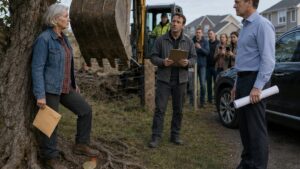
The stump dominated Charles’s yard.
Someone had wrapped yellow caution tape around the deepest machinery ruts. Against the bare lawn, the stump seemed larger than it had Saturday.
The survey marker sat several feet east of the trunk’s center.
The consulting arborist who had agreed to meet them studied photographs taken before the cutting.
“Several major limbs extended across,” he said.
“How far?” Charles asked.
“Not the trunk. But the crown, significantly.”
Eric pointed toward his roof. “That one there.”
The arborist examined the image.
“Yes. That limb was over your property.”
“And I could trim it.”
“Generally, boundary pruning may be permissible if it doesn’t destabilize or kill the tree. Local rules can add restrictions.”
Eric turned to Charles. “That’s what I’ve been saying.”
Charles crouched beside the survey marker.
A smaller branch had crossed only inches above the fence line near the rear corner. Eric had photographed it with a measuring tape: three inches past the vertical boundary plane at one point.
Three inches.
Charles looked from that image to the enormous stump.
The disproportion made him angry again, but now the facts resisted the clean story he wanted.
Eric had not invented the encroachment.
He had not invented the roof damage.
He had not invented the insurance concern.
The arborist stood and brushed dirt from his knees.
“None of that means the entire tree needed to come down.”
Eric said nothing.
Michelle asked, “Would removing the disputed limbs have killed it?”
“Not if done correctly. Based on the photographs, I would have recommended selective reduction.”
Charles looked at him.
“Recommended?”
The arborist paused.
“I believe I evaluated this tree before.”
Eric immediately opened his folder again.
Charles felt something tighten under his ribs.
Eric pulled out a printed email.
“I was wondering when we’d get to that.”
Michelle read the first lines.
Her expression shifted.
“Charles?”
He knew the message before she handed it to him.
The subject line was Tree Assessment Follow-Up.
It had been sent fourteen months earlier.
Eric had copied the HOA.
The arborist had recommended selective pruning of two major lateral limbs, deadwood removal, and follow-up inspection within twelve months.
No removal.
No claim that the tree was beyond saving.
Just maintenance.
Charles had never responded.
Eric pointed at the paper.
“You didn’t even answer.”
Charles folded his arms.
“I didn’t agree with how much you wanted cut.”
“That report wasn’t written by me.”
“You kept pushing beyond it.”
“Because you kept doing nothing.”
Michelle stepped between them before either man moved closer.
“We need to separate two questions,” she said. “Whether Charles should have addressed legitimate maintenance, and whether anyone had authority to remove the whole tree.”
Eric looked toward the stump.
“I relied on the approval.”
Michelle’s voice became careful.
“The association may determine this is ultimately a private property dispute. Our approval was for boundary work. We did not contract with the crew.”
Charles stared at her.
“So you approved something vague enough for him to wave at a contractor, and now it’s private?”
“That isn’t what I said.”
“It’s what it sounds like.”
Michelle held his gaze. “Then give me time to review the full record.”
Charles almost told her the full record was standing ten yards away with two hundred years of rings exposed to the sun.
Instead he looked down at the unanswered email in his hand.
He remembered seeing it fourteen months earlier.
He had opened it after dinner.
He had read the arborist’s recommendation.
Then he had closed his laptop because the phrase crown reduction had made him hear his father’s voice.
Look after it.
He had told himself he needed another opinion.
He never arranged one.
Eric took the paper back.
“This didn’t happen because nobody warned you.”
Charles looked at him.
“No.”
For the first time since Saturday, the word came without anger.
That was the problem.
Eric’s complaint had been real.
Charles’s silence had been real too.
But the stump was still real.
And somewhere between those truths, somebody had crossed a line far wider than three inches.
Chapter 3: The Report Charles Never Wanted to Discuss
Margaret Miller remembered the arborist’s report before Charles finished explaining why Eric had brought it to the HOA.
“You mean the one you put in the kitchen drawer?”
Charles stopped.
His mother sat at his table with both hands around a mug she had barely touched.
“What kitchen drawer?”
“The one beside the refrigerator.”
“I don’t keep papers there.”
“You did when your father was alive.”
Charles looked toward the narrow cabinet.
For an instant he was irritated with her for remembering something he had worked hard not to remember himself.
Then Margaret said, “You showed it to me.”
Charles sat down.
On the table lay the photographs he had gathered since Saturday. His grandparents beneath the oak. His parents on their wedding anniversary. Charles at eleven with one hand on the trunk. A photograph of his father in a folding chair beneath the lower branches, taken less than a month before he died.
Margaret touched that one.
“You were angry about the pruning recommendation.”
“I wasn’t angry.”
“You called it butchering.”
Charles looked away.
The arborist’s report was on his laptop now. The language was clinical.
Selective reduction of two lateral limbs.
Deadwood removal.
Weight reduction at specified unions.
Inspection after major storms.
Nothing dramatic.
Nothing resembling removal.
“I thought once Eric got them started, he’d keep asking for more,” Charles said.
“He probably would have.”
“That’s my point.”
“No.” Margaret looked at him. “That’s Eric’s problem. Not yours.”
Charles frowned.
She continued. “Your problem was deciding that because Eric wanted too much, you didn’t have to do anything.”
The words landed harder because she did not raise her voice.
Charles stood and carried his coffee to the sink.
“He wanted branches cut back every year.”
“He was afraid one would hit his house.”
“He wanted the whole side cleared.”
“And the arborist didn’t.”
“No.”
“So why didn’t you do what the arborist recommended?”
Charles watched water run over the untouched coffee in the sink.
Because his father had asked him to protect the tree.
Because the oak had already survived road widening, new utility lines, ice storms, drought, and the subdivision itself.
Because every request to remove part of it felt like the beginning of losing all of it.
He did not say any of that.
Margaret did.
“You thought your father meant never touch it.”
Charles turned.
She was looking at the photograph.
“He said to look after it.”
“I know.”
“You made that mean something he never said.”
Charles felt his throat tighten.
“You don’t know what he meant.”
Margaret gave him a tired look.
“I was married to him for forty-one years.”
That silenced him.
She slid the photograph toward him.
“Your father trimmed that tree.”
Charles shook his head.
“Not those main limbs.”
“Of course not those exact limbs. They weren’t that heavy yet.”
She pointed toward the old photograph.
The oak looked different then. Still immense, but more balanced, with daylight showing between limbs that had later thickened over Eric’s side.
“He hired people after the ice storm in ninety-eight,” Margaret said. “And again when you were working out of state.”
Charles stared at the image.
He remembered the ice storm.
He did not remember the pruning crew.
“You were protecting a memory,” Margaret said. “That’s not the same as taking care of a tree.”
He wanted to reject the sentence.
Instead he sat down again.
By Wednesday afternoon, Eric’s attorney had incorporated the unanswered report into a formal response.
The argument was simple: Charles had been notified of a hazardous condition, had received a professional recommendation, and had failed to act.
The letter did not say Eric had been authorized to remove the tree.
It did something more useful.
It made Charles look unreasonable.
At the kitchen table, Charles read the letter twice.
Then he called Michelle.
“I should have approved the pruning.”
There was silence on the line.
Michelle said, “I wasn’t expecting you to say that.”
“It was recommended. I ignored it.”
“That doesn’t settle the removal issue.”
“I know.”
“You understand Eric’s attorney will use that admission?”
“Yes.”
“Then why tell me?”
Charles looked through the window.
The stump was visible from the kitchen now in a way the trunk never had been. Before, the oak filled the view. Now the absence did.
“Because I’m not going to claim he had no reason to complain.”
Michelle exhaled softly.
“That may make this more complicated.”
“It already is.”
Later that evening, Charles drove to Margaret’s house.
She had asked him to help retrieve a box from the hall closet. Instead, when he arrived, she had three boxes open across the dining room floor.
“Your father kept everything,” Charles said.
“Yes. It was one of his less charming qualities.”
She handed him a thin community booklet with a faded green cover.
Charles recognized the old subdivision emblem.
The neighborhood had been built around the family property in phases. His grandparents had sold portions of surrounding acreage decades earlier but retained the house and the oak.
The booklet appeared to date from the earliest development years.
Margaret sat beside him as he turned the brittle pages.
There were drawings of planned streets, landscaping standards, drainage corridors, and original common-area plantings.
Then Charles stopped.
A black-and-white photograph occupied half a page.
The oak.
Not merely a generic tree.
His oak.
The caption identified its location relative to the original Miller parcel.
Beneath the photograph was a short paragraph describing several mature landscape features incorporated into the development plan rather than removed during construction.
Charles read the final sentence again.
Designated legacy specimens are to be retained and protected as identified in the approved landscape schedule.
He looked at Margaret.
“Did Dad know about this?”
“I don’t know.”
Charles turned another page.
A schedule number appeared beside the oak’s entry.
Not a sentimental nickname.
Not family history.
An official reference.
Margaret leaned closer.
“Why would the subdivision list one tree separately?”
Charles closed the booklet carefully.
For the first time since he had seen the stump, his anger changed shape.
He was no longer wondering only what Eric had been allowed to cut.
He was wondering why an oak important enough to be recorded before half the neighborhood existed had somehow become, in the HOA’s modern files, ordinary landscaping.
Chapter 4: The Rule Buried Behind Thirty Years of Amendments
The oak had a number.
Charles found it Thursday morning in a cardboard archive box marked LANDSCAPE—PHASE I, beneath drainage maps and photocopied architectural plans that smelled faintly of dust and warm paper.
L-17.
Beside the number was a hand-drawn circle in the exact place where his front yard now held a stump.
Michelle Adams leaned over the table.
“That’s your lot.”
“I know.”
“And that’s the tree.”
Charles placed Margaret’s old neighborhood booklet beside the landscape schedule. The same photograph appeared in both documents: the oak before most of the surrounding houses existed, its crown spreading over open ground.
Below the schedule entry were five words Charles had not seen in any modern HOA document.
Retain. Protect during all construction.
Michelle read them silently.
The property manager stood at the end of the records-room table with a binder of later amendments.
“This is from the original development approval,” the manager said. “That doesn’t necessarily mean it remained in force.”
“Then show me where it stopped,” Charles said.
“I’m looking.”
For three days, Michelle had insisted they trace the rules properly before making another statement. Charles had expected resistance. Instead, she had unlocked the association’s storage room herself.
What they found was not a conspiracy.
It was worse in a quieter way.
Thirty years of revisions had been stacked on top of one another.
Landscaping standards had been rewritten. Architectural guidelines had been reformatted. Responsibility for routine tree maintenance had shifted from the developer to individual owners. Several old exhibits had vanished from the packets distributed to homeowners.
But nowhere did Charles see language releasing L-17 from protection.
Michelle flipped through a 1997 amendment.
“Nothing.”
The property manager checked another.
“2004 just changes common-area maintenance.”
“Keep going.”
By noon they had built two piles: documents that mentioned trees generally, and documents that said nothing about the original designated specimens.
Charles’s phone buzzed.
His attorney had forwarded another letter from Eric’s side.
Reasonable reliance on association authorization.
Charles read the phrase twice.
Eric’s argument was changing.
At first he had said he possessed the right to handle branches over his property.
Now he was saying the HOA had effectively told him he could.
Charles handed the phone to Michelle.
She read the message.
“This is exactly why I didn’t want the board making assumptions.”
“You already did.”
Michelle gave him a tired look. “Yes.”
It was the first time she had said it without qualification.
The admission did not satisfy him as much as he expected.
Perhaps because the stump was still outside his kitchen window.
Michelle closed the binder.
“We need the city file.”
The preservation office occupied the second floor of an old municipal building downtown. A clerk met them at a counter and disappeared into a back room after Charles provided the development schedule number.
When the clerk returned, she carried a folder thick enough to make Michelle straighten in her chair.
The first pages concerned subdivision approval.
Then came landscaping conditions.
Then an inspection record.
The clerk traced a line with one finger.
“This is the relevant designation.”
Charles leaned closer.
The oak was identified by location, approximate trunk diameter at the time, and schedule number L-17.
Its preservation had been made a condition of the original site approval.
“What does that mean now?” Michelle asked.
“It means we have to determine whether the condition was amended or released.”
“Was it?”
The clerk did not answer immediately.
She turned to a computer, searched by parcel and schedule reference, then checked a second database.
Finally she shook her head.
“I’m not finding a release.”
Charles felt his pulse in his jaw.
“So the protection is still active?”
“According to these records, yes.”
Michelle sat back.
The clerk continued.
“For ordinary maintenance, there may be separate allowances. But removal or major alteration of a designated specimen would normally require review.”
“By whom?” Charles asked.
“Depending on the work, both the property owner and the city. If an association has additional restrictions, those can apply too.”
Charles thought of the crew foreman standing beside the flatbed.
Boundary pruning.
Not removal.
Michelle asked the clerk to print the relevant pages.
Outside the municipal building, Charles expected to feel vindicated.
Instead he stood on the sidewalk holding a document that proved the tree should still be alive.
People moved around them carrying lunch bags and folders. A bus sighed at the corner.
Michelle held her own copy.
“We missed it.”
Charles looked at her.
“The board?”
“The management review. Me. All of us.”
“You approved Eric’s request.”
“We approved what we thought was routine boundary pruning.”
“Without knowing the tree wasn’t routine.”
“Yes.”
She did not defend herself.
That made it harder for Charles to direct his anger at her.
Michelle looked back toward the building.
“The original landscape schedule never got incorporated into the digital property flags. Someone reviewing a modern application wouldn’t see it unless they knew to check the development archive.”
“And nobody did.”
“No.”
Charles folded the city record carefully.
“What happens now?”
“Now the association has a problem too.”
Eric’s attorney recognized that immediately.
By Friday morning, another letter arrived arguing that Eric had reasonably relied on a written HOA approval and had no reason to know of an obscure decades-old restriction missing from current homeowner materials.
Charles read that sentence twice.
It was not ridiculous.
That was what bothered him.
If Michelle and the property manager had missed the old rule, perhaps Eric genuinely had too.
Charles drove home that afternoon with the city documents on the passenger seat.
The stump came into view as he turned onto his street.
For the first time, he saw it not only as what Eric had done but as the endpoint of several failures.
His own refusal to prune.
The HOA’s careless review.
Eric’s decision to push beyond what the approval actually said.
But one question remained.
How far had Eric believed that approval went?
The answer began to emerge before dinner.
The tree crew foreman called.
“I heard there’s some dispute over what happened.”
“There’s more than some.”
“I figured.”
Charles stepped onto the porch.
The stump sat beyond the railing, darker now where the exposed wood had begun to dry.
The foreman cleared his throat.
“I went back through my notes.”
Charles waited.
“Mr. Carter was there longer than I remembered when we spoke Saturday.”
“How long?”
“Most of the morning.”
Charles gripped the porch rail.
“When you started on the trunk?”
Silence.
Then the foreman said, “Yes.”
Charles looked at the stump.
“You’re sure?”
“I remember asking him whether he wanted us to stop after the boundary side was cleared.”
“And?”
“He looked at the tree.”
The foreman paused again.
“He said to keep going.”
Charles closed his eyes briefly.
The old rule had proved the tree was protected.
It had not yet proved Eric understood that.
But the question was no longer whether Eric had been somewhere else while a contractor made a catastrophic mistake.
He had been standing in the yard when the first cut went into the trunk.
Chapter 5: The Moment Eric Could Have Stopped Them
“The crew went farther than I intended.”
Eric Carter said it before anyone asked him a question.
They sat in a mediation room the following Wednesday, separated by a polished table that seemed absurdly narrow given the months of hostility it now had to hold.
Charles’s attorney sat beside him. Eric’s attorney sat across from them. Michelle occupied a chair near the end as the HOA’s representative.
Between the folders lay the handwritten note.
You’re welcome.
Eric avoided looking at it.
Charles did not.
The mediator asked, “What did you intend?”
“To solve the overhang.”
“By removing the tree?”
“No.”
Charles remained still.
A month earlier, that answer would have made him furious.
Now he wanted details more than anger.
Eric continued. “I hired professionals. I showed them the approval. They made decisions about how to perform the work.”
The crew foreman’s written statement lay in Charles’s folder.
The mediator glanced toward it.
“Were you present?”
“For part of the morning.”
“How much?”
Eric shifted.
“I came and went.”
Charles’s attorney asked permission to walk through the timeline.
At 8:06, Eric had texted the crew confirming access.
At 8:41, the foreman photographed the first major limb after removal.
At 9:17, Eric sent another message asking whether the work would be completed that day.
At 9:32, the foreman’s notes recorded a discussion about whether to stop after clearing the eastern crown.
At 9:46, the first trunk section was cut.
At 10:03, Eric sent the contractor a photo from the yard.
Charles watched Eric’s face as the times were read aloud.
“You were there,” Charles said.
Eric’s attorney began, “Let’s let the mediator—”
“I’m asking him.”
Eric met Charles’s eyes.
“Yes.”
“When they started cutting the trunk?”
Eric did not answer immediately.
“Yes.”
Charles felt something inside him become very quiet.
“You could see what they were doing.”
“Yes.”
“And you didn’t stop them.”
Eric’s jaw worked.
“They told me once they took that side down, the tree could be unbalanced.”
The mediator looked toward the foreman’s written statement.
“That is not how he describes the conversation.”
Eric’s attorney placed one hand over a document.
“My client is not an arborist.”
“No,” Charles said. “Neither am I.”
Eric looked at him.
Charles continued.
“That’s why there was an arborist report.”
The words cost him something.
Everyone in the room knew it.
Charles opened his own folder.
“I should have followed it.”
Eric blinked.
Charles turned to the mediator.
“The recommendation fourteen months earlier was reasonable. Two major limbs needed reduction. Deadwood needed removal. I didn’t authorize it.”
His attorney had warned him that morning not to overstate the admission.
Charles did not care.
“I thought if I let Eric start cutting, there would always be another branch he wanted. I treated every request as if he were trying to take the whole tree.”
Eric gave a small, bitter shake of his head.
“That’s exactly what you did.”
“Yes.”
The word removed some of Eric’s momentum.
Charles looked directly at him.
“I was wrong about the pruning.”
Then he touched one finger to the photograph of the stump.
“You were wrong about this.”
For several seconds nobody spoke.
Michelle looked down at her notes.
The mediator asked Eric again about the moment the crew had proposed stopping.
Eric stared at the table.
“You want me to say I knew some old rule existed?”
“No,” Charles said.
“I didn’t.”
“I believe you.”
That startled Eric more than an accusation would have.
Charles continued.
“I’m asking whether you knew the approval said pruning.”
Eric leaned back.
“I knew what the HOA had approved.”
“Which was pruning.”
“It said hazard mitigation.”
“And boundary limbs.”
“Because those were the hazard.”
“Then why take the trunk?”
Eric looked toward his attorney.
No answer came from that direction.
The silence lengthened.
Charles’s gaze fell to the note.
You’re welcome.
He remembered finding it beneath the stone, as though Eric had wanted to leave a receipt for a favor.
Finally Eric said, “Because I was tired of it.”
His attorney turned sharply.
Eric kept speaking.
“I was tired of calling. Tired of cleaning branches out of my yard. Tired of wondering what would hit the roof next. Every conversation was the same. You’d tell me the tree had been there longer than the houses.”
“It had.”
“That doesn’t make my house disposable.”
“I never said it did.”
“You acted like it.”
Charles had no answer to that.
Eric rubbed both hands over his face.
“When the foreman said they could stop, I looked at what was left. I knew if they stopped, we’d be right back in the same argument in a year.”
Michelle said quietly, “So you told them to continue.”
Eric looked at her.
“Yes.”
There it was.
Not a hidden conspiracy.
Not a forged document.
Not an accident.
A tired, resentful man standing in a yard, given one last chance to stop an irreversible act, deciding he preferred certainty.
Charles expected satisfaction.
What he felt was smaller and sadder.
Eric had not cut down the oak because he hated history.
He had cut it down because, in that moment, ending the argument mattered more to him than the limits of his authority.
Charles understood that kind of stubbornness more than he wanted to.
The mediation did not settle that day.
There were questions involving the contractor, the HOA approval, city restrictions, insurance coverage, and Charles’s own prior maintenance failure.
But the argument had changed.
Eric could no longer credibly say the entire removal happened beyond his knowledge.
Before they left, Charles put the handwritten note back inside a clear document sleeve.
Eric looked at it for the first time.
“I shouldn’t have written that.”
Charles slid the sleeve into his folder.
“No.”
“I thought you’d be relieved I finally handled it.”
Charles stared at him.
Eric lowered his eyes.
That sentence hurt almost more than the insult itself.
The following morning, Charles received the independent valuation.
He opened it at the kitchen table.
The report considered species, age, size, condition before removal, replacement limitations, historic significance, and restoration factors.
Charles reached the estimated loss range and stopped.
He had expected a large number.
Not this large.
He looked through the window at the stump.
For weeks everyone had been arguing over responsibility.
Now there was another question waiting for them.
What did justice look like when the thing being priced could not be bought back at any price?
Chapter 6: A Dollar Figure Cannot Grow Two Hundred Years
The number silenced the hearing room.
Even Eric’s attorney stopped turning pages.
The independent valuation appeared on a large display beside a photograph of the oak taken the previous spring, its crown spreading across both properties.
The figure represented far more than the cost of planting another tree.
It accounted for the oak’s extraordinary size, condition, landscape contribution, historic designation, and the practical impossibility of replacing a mature specimen of comparable age.
Charles looked at the number only once.
Then he looked at the photograph beside it.
Money had made the room pay attention.
That did not mean money understood what was gone.
Several months had passed since the mediation.
The dispute had become a civil proceeding involving Eric, the contractor’s insurer, and the HOA’s own liability carrier. The city had maintained a separate administrative review of the unauthorized removal.
No single party could simply point elsewhere anymore.
The contractor argued it had relied on the person directing the work.
Eric argued he had relied on the HOA approval.
The HOA argued its approval covered limited pruning and had never authorized removal.
Charles’s earlier failure to follow the arborist recommendation sat in the middle of all three arguments.
When his attorney called him, Charles took the chair.
He expected questions about family history.
Instead the first question concerned the limb that had damaged Eric’s gutter.
“Did you know it fell from your tree?”
“Yes.”
“Did Mr. Carter ask you to address other overhanging limbs afterward?”
“Yes.”
“Did an arborist recommend corrective pruning?”
Charles looked toward Eric.
“Yes.”
“Did you approve that pruning?”
“No.”
A slight movement passed through the observers behind him.
His attorney asked, “Why not?”
“Because I was stubborn.”
No legal phrase softened it.
Charles continued.
“I believed every request to cut the oak threatened the whole tree. The report didn’t say that. It recommended limited work. I should have done it.”
Across the room, Eric’s attorney watched closely.
“Then Mr. Carter’s concern was legitimate?”
“The concern was.”
“And his right to trim branches crossing his property line?”
“I’m not here to say he had no rights.”
Charles pointed toward the enlarged photograph of the stump now displayed beside the living tree.
“I’m saying those rights had a boundary too.”
The room became still again.
His attorney asked, “Where?”
“Before the trunk.”
That answer became the center of everything that followed.
The consulting arborist testified that selective pruning could have addressed the overhang without destroying the tree.
The city documentation established that major alteration required additional review.
The HOA records showed Eric received permission for boundary pruning, not removal.
The crew foreman’s statement established that Eric had been present when the work moved beyond the disputed crown.
And Eric’s own mediation admission showed why he had allowed it.
He had wanted the recurring problem finished.
Charles listened without pleasure.
The stronger his case became, the less interested he felt in turning Eric into a monster.
Eric had been wrong.
Seriously wrong.
But Charles had already learned what happened when a person treated his own fear or frustration as permission to ignore every limit.
During a break, Eric stood alone near the hallway vending machines.
Charles passed him on the way to the restroom.
Eric said, “You could have destroyed me with that testimony.”
Charles stopped.
“I told the truth.”
“You could have said I made everything up.”
“You didn’t.”
Eric looked toward the hearing-room doors.
“My insurer would have liked that answer less.”
“This isn’t about what your insurer likes.”
“No.” Eric gave a thin smile. “I noticed.”
The eventual resolution divided responsibility rather than pretending only one failure existed.
Eric bore the largest share because he had knowingly allowed the work to move from limited pruning into total removal.
The contractor accepted responsibility for proceeding without confirming ownership or the scope of authority once the work changed.
The HOA’s carrier accepted a smaller share tied to the association’s deficient review process and outdated records.
Charles’s earlier failure to perform reasonable maintenance affected parts of the negotiation but did not erase the distinction between neglecting pruning and authorizing destruction.
The financial terms were substantial.
More than Charles ever expected to receive because of a tree.
When his attorney explained the final numbers, Charles listened, signed where required, and felt no triumph.
“What am I supposed to do with this?” he asked afterward.
His attorney closed the folder.
“That part isn’t legal advice.”
Two evenings later, the HOA held a special meeting.
There was no packed-room confrontation. No applause when Charles entered.
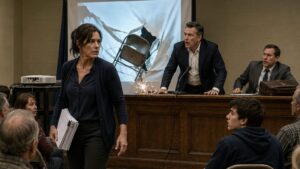
Residents sat in folding chairs beneath fluorescent lights while Michelle summarized the association’s failure.
“We approved a request without identifying an older property-specific restriction,” she said. “That should not have happened.”
One board member shifted uncomfortably.
Michelle continued.
“We also used language that was too broad for work involving a disputed boundary tree.”
A homeowner near the back asked whether the HOA was taking responsibility for Eric’s decision.
“No,” Michelle said. “We’re taking responsibility for ours.”
Charles respected the distinction.
The board proposed temporary procedures until the governing documents could be formally updated: verified ownership, written notice to adjoining owners, qualified assessment for major tree work, and explicit descriptions of what was and was not authorized.
Someone asked Charles whether he supported the changes.
Months earlier, he would have demanded stronger rules.
No cutting without owner consent.
No touching designated trees.
No exceptions.
Instead he looked at the draft.
“What happens when a protected tree is actually dangerous?”
Michelle answered, “There would be an assessment process.”
“Put that in clearly.”
She nodded.
“And emergency work?”
“Documented afterward if advance approval genuinely isn’t possible.”
“Good.”
Michelle studied him for a moment.
“You’re not asking us to freeze everything.”
Charles thought of Margaret’s words.
You were protecting a memory.
“No.”
After the meeting, as chairs scraped across the floor and residents filtered toward the parking lot, Michelle approached him carrying the revised draft.
“I could use your help.”
“With what?”
“The permanent version.”
Charles almost laughed.
“You want the man who refused to prune his own tree helping write tree rules?”
“That’s partly why.”
He looked at her.
Michelle tapped the document.
“You know what overprotection looks like now. You also know what vague permission can cost.”
Charles folded the draft once.
Outside, the streetlights had come on.
He could picture the stump waiting in his yard.
For months he had wanted the association to recognize what the oak had been.
Now Michelle was asking something harder.
Not how to preserve one tree that was already gone.
How to protect the next one without repeating his mistakes.
Chapter 7: What Charles Chose to Leave Beside the Stump
The first green shoots appeared beside the stump in March.
Charles noticed them because he nearly stepped on them carrying a box of old photographs to the porch.
Three thin stems had pushed through the soil near one of the exposed roots. They were too small to identify confidently, and he knew enough now not to romanticize what they might become.
They were not the oak.
Nothing was going to become that oak again in his lifetime.
He set the box down and crouched beside the shoots anyway.
The stump had weathered through winter. Its pale surface had darkened and cracked. Rain had settled into the outer rings. One side still bore the flat scar where the contractor’s saw had passed through wood older than every house on the street.
For months Charles had debated whether to grind it out.
The insurance settlement would have covered the work easily.
Instead he had asked the arborist to inspect it.
“Leave it low if you want,” the man had said. “Just don’t pretend it’s still a living tree.”
Charles had appreciated the bluntness.
So the stump remained.
Not as a shrine.
Not as an accusation.
Just as evidence that something had stood there.
Margaret arrived an hour later carrying a paper grocery bag and complaining that Charles had not answered his phone.
“I was outside.”
“You own pockets.”
“I was using both hands.”
“That excuse has never stopped anyone else.”
She stepped onto the porch, then stopped when she saw the new growth near the stump.
“Oh.”
Charles followed her gaze.
“Don’t start.”
“I didn’t say anything.”
“You were about to.”
Margaret smiled. “I was going to ask what they are.”
“I don’t know yet.”
“Good.”
She handed him the grocery bag.
Inside were sandwiches, two bottles of iced tea, and a small envelope.
Charles recognized the envelope immediately.
He had kept it in a desk drawer since the mediation.
The note was inside.
You’re welcome.
He looked at his mother.
“Why did you bring this?”
“Because you asked me to help sort the family papers.”
“That isn’t a family paper.”
Margaret raised one eyebrow.
“That is exactly why I brought it.”
They spent the afternoon arranging photographs by generation.
Some were faded enough that faces had become pale shapes beneath the tree. Others were sharp color prints from the seventies and eighties. Charles found one of himself at sixteen leaning against the trunk with an expression of exaggerated boredom while his father adjusted the camera.
Margaret laughed when she saw it.
“You hated photographs.”
“I hated standing still.”
“You hated being told to stand still.”
“That too.”
At the bottom of the box was the picture taken shortly before his father died.
Charles placed it separately.
Margaret watched him.
“You still hear him saying it, don’t you?”
Charles knew which words she meant.
Look after it.
“Yes.”
“And?”
He ran one finger along the photograph’s edge.
“I think I finally understand the difference.”
Margaret waited.
“Looking after something isn’t the same as refusing to let anything change.”
She nodded once.
Charles looked toward the stump.
“I should have pruned it.”
“Yes.”
“He still shouldn’t have cut it down.”
“No.”
The simplicity of those two truths no longer felt like a contradiction.
For months Charles had thought admitting the first weakened the second.
Now he understood that refusing to admit one mistake did not make another person’s larger mistake easier to prove. It only made him less honest.
Margaret tapped the envelope.
“What are you going to do with that?”
Charles looked at the two handwritten words.
For a time, he had imagined framing the note beside the HOA approval and the original landscape schedule.
Proof.
Not just of what Eric had done, but of the attitude behind it.
Then the thought had begun to bother him.
The note would outlast the anger if he let it.
It would sit among family photographs as though Eric deserved a permanent place in the story of the oak.
Charles stood.
He carried the envelope into the kitchen, removed the note, tore it once down the middle, then again.
Margaret watched from the doorway.
“That’s all?”
“That’s all.”
He dropped the pieces into the trash.
The following Thursday, the HOA held its final vote on the revised landscape rules.
The meeting lasted less than an hour.
There were no speeches.
Michelle read the key provisions aloud.
Any work involving a designated legacy tree required confirmation of ownership.
Adjoining owners had to receive written notice before non-emergency work affecting a shared boundary.
Major pruning required assessment by a qualified professional.
Removal required explicit written authorization identifying removal as the approved action.
Emergency work remained possible when immediate danger existed, but the reason had to be documented afterward.
Charles had helped write the last section.
A year earlier, he would have opposed it.
Now he was the one who insisted it stay.
A board member asked, “Are we comfortable giving that much discretion in an emergency?”
Charles answered before Michelle could.
“If a tree is actually about to fall on someone’s house, nobody should have to wait three weeks for a committee meeting.”
Several people nodded.
He continued.
“But emergency should mean emergency. Not inconvenient. Not annoying. Not ‘I got tired of waiting.’”
No one looked at Eric.
Charles noticed that too.
The vote passed.
Afterward, residents stacked chairs against the wall. Michelle gathered the signed pages into a binder.
“You know,” she said, “I was afraid you’d want a rule that nobody could ever touch one of these trees.”
“I did.”
“What changed?”
Charles thought of the old arborist report.
“My mother.”
Michelle smiled.
“That sounds expensive.”
“You have no idea.”
They were almost finished when Eric approached.
He had attended the meeting quietly from the back row.
For months their conversations had happened through attorneys, mediators, or careful distance across driveways.
Now he stopped several feet away.
“Charles.”
Charles waited.
Eric glanced toward Michelle, then back at him.
“I wanted to say something without anybody billing us for the hour.”
Michelle quietly picked up her binder and walked toward the office.
Eric put his hands in his jacket pockets.
“I was wrong.”
Charles said nothing.
Eric swallowed.
“Not about the branches.”
“No.”
“About what I did after that.”
Charles watched him.
Eric’s voice stayed low.
“I kept telling myself you forced the situation. That if you had just handled the pruning, none of it would have happened.”
“There’s some truth in that.”
Eric looked surprised.
Charles continued.
“If I’d followed the arborist report, we probably wouldn’t have been arguing that morning.”
Eric nodded.
“But you were still standing there when they cut the trunk.”
“Yes.”
Silence settled between them.
Eric looked toward the floor.
“I knew I could stop them.”
Charles did not rescue him from the admission.
“I didn’t,” Eric said. “I wanted it finished.”
“I know.”
“I’m sorry.”
There was no performance in the words.
No demand for forgiveness.
No claim that the settlement had been punishment enough.
Charles appreciated that.
He also discovered that appreciation was not forgiveness.
“Thank you for saying it.”
Eric nodded.
“That’s fair.”
They left separately.
The next afternoon, Margaret came back to Charles’s house with one final idea.
“Stand there,” she said.
Charles looked at her suspiciously.
“You brought a camera.”
“I brought my phone.”
“That’s worse.”
She positioned him near the stump.
The spring shoots were visible at one edge.
Charles started to move so the stump would be hidden behind him.
Margaret lowered the phone.
“No.”
“What?”
“Leave it in.”
He looked back at the broad weathered circle.
For months he had avoided photographing the yard from that angle.
Every picture felt like proof of absence.
Margaret said, “It was there. Now this is here.”
Charles stepped aside enough that the stump remained fully visible.
She took the photograph.
Later that evening, he printed it and carried it to the dining room.
The family photographs were spread across the table again.
Five generations beneath the oak.
His grandparents.
His parents.
Charles as a boy.
His father in the folding chair.
He placed the new photograph at the end.
There was no towering crown above him.
No deep shade across the lawn.
Only Charles, older now, standing beside the weathered stump with three small green shoots near its edge.
For a long moment he considered moving the photograph somewhere else.
Then he left it exactly where it was.
The oak had been part of the family because it had lived.
The stump did not need to pretend otherwise.
It only needed to tell the truth about what had been lost, what had been learned, and what would be handled differently the next time someone mistook care for control.
The story has ended.