He Let His Neighbor Use Six Feet of His Yard for Years—Then the HOA Tried to Make It Permanent
Chapter 1: The Concrete Was Already Too Far Over
The jackhammer hit the driveway hard enough to rattle the glass in David Miller’s front window.
Across the narrow strip of lawn, a worker leaned his weight into the machine while another man stood beside a compact excavator. A white chalk line ran through Gregory Nelson’s driveway from the sidewalk toward the side yard. On one side of it, the concrete remained smooth and gray. On the other, it had already been broken into slabs.
Gregory sat on his porch with both hands resting on his knees.
He wasn’t watching the workers.
He was watching David’s house.
David stepped away from the window.
Six years earlier, there had been no chalk line.
There had only been concrete meeting grass.
When David bought the house, he noticed the odd shape of Gregory’s driveway during the first week. Most driveways on the street ran straight from garage to sidewalk. Gregory’s widened as it approached the property line, bulging toward David’s side yard.
David had stood there one Saturday with a garden hose in his hand, looking down at the edge.
“That seems close,” he had said to himself.
Then Gregory had come outside carrying a trash bag.
“Settling in okay?”
“Yeah. Still finding things I didn’t know I owned.”
Gregory laughed. “That never stops.”
He had lived on the street for years. He knew which garbage day changed after holidays, which trees belonged to the HOA, and which sprinkler head near the entrance never worked properly.
David had no reason to begin their relationship with an argument over concrete.
So he didn’t.
That choice became easier every year.
Gregory shoveled snow from the shared area near the sidewalk when winter came. David brought Gregory’s packages inside when he traveled. They borrowed tools. They talked about roof repairs and property taxes and the endless emails from the HOA.
The driveway stayed exactly where it was.
David occasionally noticed it when mowing. The strip between Gregory’s concrete and David’s house narrowed farther back than seemed right. But nothing depended on knowing the exact line.
Until the fence.
Six years after moving in, David decided to fence the side yard.
It was not an ambitious project. He wanted privacy around the patio and a secure place for visiting family to let a dog outside without watching the street.
The fence contractor walked the side yard with a clipboard.
“You know where your pins are?”
David pointed vaguely toward the front.
“I know approximately.”
The contractor stopped.
“Approximately isn’t enough for me.”
David smiled. “I’m not building a courthouse.”
“Doesn’t matter. If I put a post six inches onto somebody else’s lot, suddenly everybody turns into a courthouse.”
He walked toward Gregory’s driveway and studied the concrete.
“Especially here.”
David felt an old discomfort return.
“You think that driveway’s over?”
“I think I don’t know.”
The contractor pointed to the edge.
“And I’m not guessing.”
David called a survey company that afternoon.
The surveyor arrived three days later carrying equipment that made the whole matter feel more serious than David wanted it to be. He set up near the curb, checked recorded measurements, located reference points, and moved slowly along the side yard.
David tried not to hover.
He failed.
“How close is the driveway?” he finally asked.
The surveyor kept looking through his instrument.
“Let me finish.”
That answer bothered David more than reassurance would have.
An hour later, the surveyor walked toward the front with a wooden stake and a small hammer.
David followed.
The surveyor stopped several feet from the grass.
On the concrete.
David stared down.
“That’s the line?”
“That’s one point on it.”
“You’re standing in Gregory’s driveway.”
The surveyor glanced at him.
“I’m standing on your property.”
He drove the stake beside the concrete where he could, marked the corresponding position, then stretched the line farther back.
The result became harder to dismiss with every measurement.
The legal boundary did not follow the edge of the driveway.
It ran through it.
David crouched near the grass and measured roughly with his hand before standing again.
“How far?”
The surveyor checked his notes.
“Near the widest point? Just under six feet.”
David looked toward Gregory’s garage.
Six feet was not a surveying technicality.
Six feet was enough for a table.
Enough for a garden bed.
Enough for a hallway.
Enough, David thought, for something he had ignored to become something nobody else had.
The surveyor continued toward the rear.
The line remained inside the concrete for nearly forty feet.
David stood still while the man marked another point.
All those years, he had treated the driveway as an awkward edge.
Now a stake sat several feet inside the surface Gregory had always called his own.
Chapter 2: Six Feet Changed the Entire Conversation
Gregory’s SUV slowed halfway into the driveway.
David was watering a newly planted shrub when the brake lights came on.
Gregory lowered his window.
“What are those?”
David turned off the hose.
The survey markers were impossible to miss now. Small flags and bright marks traced a line that entered the concrete near the sidewalk and stayed there.
“I had the property surveyed.”
Gregory looked from one marker to the next.
“For the fence?”
“Yeah.”
He parked, got out, and walked toward the nearest mark.
For several seconds he said nothing.
Then he laughed once, but there was no humor in it.
“That can’t be right.”
David had expected that response.
He had also feared it.
“The surveyor checked it twice.”
Gregory pointed down.
“You’re saying this is yours?”
“I’m saying that’s where the surveyed line is.”
“This driveway was here when I bought the house.”
“It was here when I bought mine too.”
“Exactly.”
David felt himself reaching for the familiar exit—the sentence that would make the conversation softer, postpone the problem, let both men go inside and pretend nothing had changed.
Instead he said, “I’m getting the certified drawing in two days. We can look at it together.”
Gregory crossed his arms.
“I know where my driveway is, David.”
David almost answered, So did I.
He didn’t.
Two days later, the certified survey arrived as a large folded sheet with the surveyor’s seal and measurements David had already seen in the yard.
The line looked even stranger on paper.
Gregory’s driveway was drawn as a hard rectangle. The property boundary cut through its outer side, leaving a long wedge of pavement clearly within David’s parcel.
David measured the widest section.
Six feet.
The encroachment extended roughly forty feet before narrowing.
He carried the copy next door after dinner.
Gregory opened the door but did not invite him inside.
“I got the final survey.”
Gregory looked at the paper in David’s hands.
“I figured.”
“I thought you should see it before I do anything about the fence.”
Gregory took the sheet.
His eyes moved slowly over the measurements.
David watched his expression change—not into surprise, exactly, but concentration.
That unsettled him.
“You see the line?” David asked.
“I see what they drew.”
“It’s certified.”
“I can see the stamp.”
Gregory folded the paper along an existing crease.
“So what are you asking me?”
David had rehearsed a careful answer.
“I’m not asking you to do anything tonight. I want us to understand what’s here.”
Gregory looked toward the driveway.
“What’s here is my driveway.”
“The survey says part of it is on my lot.”
“The driveway predates you.”
“That doesn’t change the line.”
Gregory’s jaw tightened.
“You moved in six years ago. You never said a word.”
There it was.
The fact David had been trying not to think about.
“No,” David said. “I didn’t.”
“And now suddenly there’s a problem.”
“I’m building a fence. I had to locate the boundary.”
“You’ve mowed beside that driveway for six years.”
David felt heat rise in his face.
He forced his voice lower.
“I should’ve checked sooner.”
Gregory looked almost surprised by the admission.
Then he handed the survey back.
“Well, I’m not tearing up my driveway because somebody put a line on a new drawing.”
“It isn’t a new boundary.”
“That’s your interpretation.”
“No. That’s the surveyor’s measurement.”
Gregory stepped backward toward his door.
“You should talk to the HOA.”
David frowned.
“Why?”
“Because they approved the driveway.”
“When?”
“Years ago. Before you lived there.”
Gregory began closing the door.
“They approved it exactly like it is.”
David stood on the porch holding the survey.
“Do you have that approval?”
Gregory paused.
“I can find it.”
The door shut.
David walked home feeling less certain than when he had arrived.
He knew a survey established a property boundary. He also knew HOAs approved exterior changes. What he did not know was what happened when those two records contradicted each other.
At his kitchen table, he opened the survey again.
The black property line was unambiguous.
But Gregory had sounded equally certain.
David searched the HOA portal and found old architectural-review guidelines, most of them addressing roofs, paint colors, fences, decks, driveways, and landscaping.
Driveway modifications required prior approval.
That much Gregory had been right about.
David read farther.
The guidelines said homeowners were responsible for complying with easements, setbacks, and applicable laws.
That sounded useful, but it didn’t answer the question.
His phone buzzed.
A message from Gregory.
Attached was a scanned page bearing the subdivision association’s old letterhead and an approval stamp.
The document showed a driveway expansion.
David enlarged the image.
The shape looked disturbingly familiar.
Near the bottom were the words APPROVED AS SUBMITTED.
David sat back.
For the first time since the surveyor drove the stake into the concrete, the problem no longer looked like a clean line between right and wrong.
The HOA had approved the driveway.
And now David had to find out what, exactly, that approval meant.
Chapter 3: The Board Asked Him to Give It Away
“Your survey is new information,” Carol Thompson said, “but the driveway is an established condition.”
David had been sitting at the HOA clubhouse table for less than four minutes.
Already, he regretted coming without coffee.
Carol sat at the center of the board table with Gregory two chairs away. Rachel Moore, a member of the architectural-review committee, had a yellow legal pad in front of her. Two other board members sat beside the management-company representative.
David placed his certified survey on the table.
“The boundary isn’t new.”
“I didn’t say the boundary was new.”
“You called the survey new information.”
“Because it is new to the association.”
Gregory shifted in his chair.
“The association approved my driveway.”
Carol raised a hand slightly.
“Let’s keep this orderly.”
David looked around the room.
There were no angry spectators. No crowd waiting for a fight. Just fluorescent lights, folding chairs, a coffee urn nobody had touched, and people trying to make an inconvenient problem fit inside meeting procedure.
Carol slid a copy of the old architectural approval toward David.
“Our records show the driveway expansion was reviewed and approved.”
David looked at the drawing again.
It showed the house, garage, and proposed wider driveway.
There was no surveyor’s seal.
No dimensions to the neighboring boundary.
Only a hand-drawn lot edge that appeared to follow the pavement.
“So what is the board’s position?” David asked.
Carol folded her hands.
“Our preference is to avoid unnecessary demolition.”
“Okay.”
“We think there may be a reasonable solution that preserves the existing driveway while acknowledging your survey.”
David waited.
Carol nodded toward the management representative, who passed him a one-page summary.
The heading read PROPOSED PERMANENT ACCESS EASEMENT.
David read the first paragraph twice.
“You want me to grant Gregory an easement.”
“We’re proposing that the two of you discuss one.”
“For the part of the driveway on my property.”
“Yes.”
Gregory leaned forward.
“You don’t use that strip.”
David looked at him.
“That isn’t really the point.”
“It’s grass beside your house.”
“It’s six feet of my lot.”
Carol spoke before Gregory could answer.
“David, nobody is questioning that you have concerns. But we have to balance individual concerns with neighborhood continuity.”
Something about the phrase made David sit straighter.
“Neighborhood continuity?”
“The driveway has existed in its current form for many years. Removing part of it could affect appearance, access, drainage, and potentially resale concerns.”
“For Gregory.”
“For the community.”
David looked down at the proposed easement.
He knew what was happening.
Nobody was ordering him to give away his land. They were doing something subtler.
They were describing his refusal as disruption.
Rachel tapped her pen.
“Would the easement be compensated?”
Carol hesitated.
“That would be between the homeowners.”
Rachel looked at David.
“So the board is recommending he permanently burden his property to preserve an improvement on Gregory’s?”
“We’re recommending discussion.”
Gregory exhaled sharply.
“This is getting ridiculous.”
David felt every old instinct telling him to soften the room.
He could say he understood.
He could say he was open to options.
He could promise to think about it and go home.
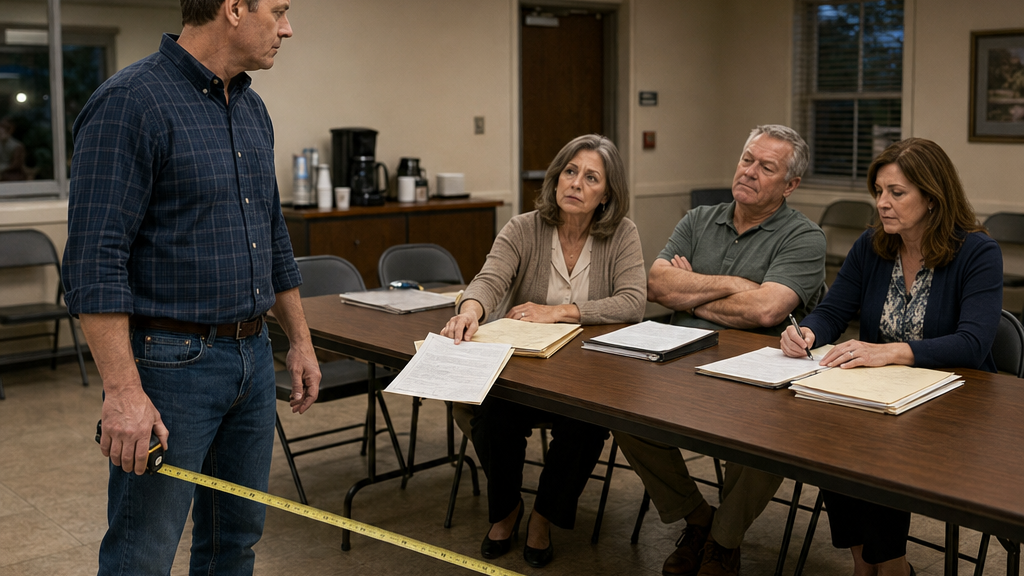
Instead, he reached into the canvas bag beside his chair.
The metal hook of a measuring tape clicked against the table.
Carol frowned slightly.
David stood.
“Can I show you something?”
Nobody answered quickly enough to stop him.
He hooked the tape at the leg of the conference table and walked backward.
One foot.
Two.
Three.
Four.
Five.
Six.
He locked the tape.
The bright strip stretched across the clubhouse floor.
“That’s the widest part of the encroachment.”
Everyone looked at it.
Six feet sounded administrative on paper.
Across a room, it looked like space.
Rachel glanced from the tape to the survey.
David looked at Carol.
“I have a question.”
Carol’s expression tightened, but she nodded.
“If your neighbor poured concrete six feet into your yard, and years later someone asked you to sign a permanent easement because removing it would be inconvenient, would you sign it?”
The room stayed quiet.
Carol looked down at the old approval.
“That isn’t a fair way to characterize—”
“It’s exactly what you’re asking me to do.”
“We’re asking you to consider the least disruptive solution.”
“For everyone except me.”
Gregory pushed his chair back.
“You didn’t care about it for six years.”
David turned toward him.
“You’re right.”
Gregory stopped.
“I should’ve checked when I bought the house. I didn’t. That was my mistake.”
The words cost David more than anger would have.
“But my mistake doesn’t turn six feet into yours.”
Rachel leaned over the old approval packet.
“Where’s the boundary documentation?”
Carol looked at her.
“What?”
“The survey that was submitted with this application.”
The management representative began flipping through the file.
Rachel pointed to the drawing.
“This shows the driveway. It doesn’t show a verified property line.”
Carol said, “These records are old.”
“I understand.”
Rachel kept scanning.
“Is there an easement?”
Nobody answered.
“A deed amendment?”
The representative shook her head.
“Not in this file.”
Gregory’s face changed.
Only slightly.
David noticed.
Carol closed the folder.
“We are not going to resolve property law at an HOA meeting.”
“No,” David said. “We’re not.”
Carol looked relieved until he continued.
“But you’re asking me to sign something permanent based on an approval packet that doesn’t show the property line.”
“That is not what I said.”
“It’s what the proposal does.”
One of the board members cleared his throat.
“Couldn’t David just build the fence along the driveway and deal with the legal issue separately?”
Carol shook her head.
“The architectural committee cannot approve a fence where the boundary is disputed.”
David stared at her.
“The boundary has been surveyed.”
“Gregory disputes it.”
“Gregory disputing it doesn’t erase the survey.”
“It creates an unresolved neighbor conflict.”
“And because there’s a conflict, you’re denying my fence?”
“We’re holding the application pending resolution.”
That landed harder than the easement proposal.
The fence had caused David to investigate the line in the first place.
Now the HOA was using the resulting dispute to stop the fence.
He rolled the measuring tape back into its case.
The six-foot strip disappeared with a metallic snap.
Carol gathered the papers.
“I suggest you and Gregory speak privately and find a practical solution.”
The meeting moved to the next agenda item.
David collected his survey.
He was halfway to the clubhouse door when Rachel caught up with him.
“David.”
He stopped.
She glanced back toward the board table before lowering her voice.
“I meant what I asked in there.”
“About the survey?”
“About what they actually approved.”
She held up the old application copy.
“Read the approval language carefully.”
“I have.”
“No. Read what it authorizes.”
David waited.
Rachel tapped the page once.
“Then read what it never mentions.”
She returned to the table before Carol could look over.
David walked into the parking lot with the certified survey under one arm and the old HOA approval in his hand.
For the first time, he stopped asking whether the board had approved Gregory’s driveway.
He began asking a different question.
Approved it to do what?
Chapter 4: The Approval Was Not What It Looked Like
The first thing David noticed the next morning was what the HOA approval did not have.
No surveyor’s seal.
He had the old packet spread across his home-office desk beside the certified survey, and the difference between the two documents looked almost embarrassingly obvious once Rachel had told him where to look.
The survey was dense with bearings, distances, reference points, parcel numbers, and signatures. Gregory’s old architectural application was mostly boxes, handwritten notes, and a sketch of a driveway widening beside a simplified outline of the house.
At the bottom, the approval stamp still looked authoritative.
APPROVED AS SUBMITTED.
David read the conditions beneath it.
Homeowner responsible for permits.
Homeowner responsible for compliance with applicable setbacks and easements.
Approval does not supersede governing documents or governmental requirements.
He sat back.
The HOA had approved a project.
That was not the same thing as approving a property line.
Still, he had learned enough during the past few weeks not to trust the first interpretation that favored him.
By ten that morning, he was at the county records office.
The clerk helped him pull the recorded plat for both lots. David laid it beside the survey and followed the lines with his finger. The dimensions matched.
“Is there anything recorded between these parcels?” he asked. “An easement? Boundary adjustment?”
The clerk searched.
Nothing.
“No deed amendment?”
Nothing.
“No access agreement?”
“Not recorded here.”
David thanked her and stepped away from the counter with copies tucked under his arm.
It was a small payoff, but it did not feel like victory.
It felt like subtraction.
One by one, the explanations that might have made Gregory’s claim legitimate were disappearing.
At home, David sent the records to the surveyor and asked one careful question: Was there anything in the HOA approval that could change the boundary shown on the certified survey?
The response arrived an hour later.
An architectural approval could authorize a homeowner to build something under association rules. It could not, by itself, transfer neighboring land or move a deeded boundary.
David read the message twice.
Then his phone rang.
The number belonged to the former owner of his house, whom David had contacted the night before through information in the closing file.
“David?”
“Yes. Thanks for calling me back.”
“I wasn’t sure I had the right number. You’re in the old place on Briar Glen?”
“That’s right.”
They talked briefly about the house before David explained why he had called.
“The driveway next door,” he said. “Do you remember ever having a boundary issue with Gregory?”
There was a pause.
Not a confused one.
A remembering one.
“The wide side?”
David sat straighter.
“Yes.”
“I wondered about that.”
“Did you ever survey it?”
“No. Never got that far.”
“Did you talk to Gregory?”
The former owner exhaled.
“Once, maybe twice. Nothing formal.”
“What did you say?”
“That I thought his driveway might be over. I found an old corner marker when I was cleaning out some shrubs. It didn’t line up with the concrete.”
David looked toward the window.
Gregory’s driveway was visible between the houses.
“What did Gregory say?”
“He said the HOA had approved the driveway. Same thing he’s probably telling you.”
“So he knew there was a question.”
“I wouldn’t say he knew where the line was. Neither did I.”
That distinction mattered.
David forced himself not to turn uncertainty into an accusation simply because it would help him.
“Why didn’t you pursue it?”
A short laugh came through the phone.
“Because we were moving eventually, and Gregory was a decent neighbor. I didn’t want to spend thousands of dollars fighting about a strip of yard I wasn’t using.”
David closed his eyes.
The reasoning sounded painfully familiar.
“Did you ever tell him you were letting him use it?”
“No.”
“Did you agree the driveway could stay?”
“No. I just stopped bringing it up.”
There it was again.
Silence mistaken for settlement.
David thanked him and ended the call.
For several minutes he remained at the desk, staring at the two documents.
He had wanted evidence that Gregory was simply wrong.
Instead, he had found something less comfortable.
Gregory had been warned.
But so had David, in a different way. He had seen the driveway from the first week he owned the house and chosen not to ask what it meant.
The HOA had accepted an old drawing without verifying the boundary.
The former owner had raised a concern and abandoned it.
Gregory had benefited from everyone preferring uncertainty to conflict.
No single decision had created the entire problem.
But somebody was going to have to stop repeating it.
That evening David walked next door.
Gregory was in the garage, reorganizing tools on a shelf.
“I talked to the previous owner of my house.”
Gregory’s hand stopped on a plastic case.
Then he continued moving it.
“Okay.”
“He remembers discussing the driveway with you.”
Gregory turned.
“He mentioned a marker once.”
“So you knew the line might be wrong.”
“No. I knew he thought it might be wrong.”
“That’s different?”
“Yes.”
David stayed near the garage opening.
“Did you ever check?”
Gregory gave him an irritated look.
“Why would I? The driveway had been approved. Nobody challenged it. Your previous owner didn’t. You didn’t.”
“Until now.”
“Exactly.”
David held out a copy of the old approval.
“This approved materials and layout. It says nothing about ownership. There’s no easement recorded. No boundary adjustment.”
Gregory’s expression hardened.
“You’ve been busy.”
“I needed to know.”
“And now you know what you wanted to know.”
“No. I know the HOA approval didn’t move the property line.”
Gregory looked toward the concrete.
For a moment, he seemed older than David remembered.
“You know what happens if you cut that side off?”
David waited.
“My wife used to park there before she died. That extra width is why we could get two cars around each other without moving one every time. I kept it that way because it worked.”
David had not expected the mention of Gregory’s wife.
The anger inside him lost some of its clean edges.
But Gregory continued.
“That driveway has worked for this house for years. Nobody cared until you decided to put up a fence.”
David looked down at the concrete between them.
“I cared enough to wonder. I just didn’t do anything.”
“That sounds like the same thing.”
David shook his head.
“No. It isn’t.”
Gregory’s mouth tightened.
Then he said quietly, “I remember the conversation with the old owner.”
David said nothing.
Gregory looked directly at him.
“I remember him saying the marker didn’t look right.”
“And?”
“And nobody ever made an issue of it.”
The sentence stayed between them.
Not denial.
Not exactly an admission.
Something more revealing than either.
Gregory had not known the surveyed answer.
But he had known there was a question, and as long as nobody forced the question to be answered, the driveway remained useful.
David folded the approval paper.
The problem had changed again.
It was no longer whether Gregory had been innocently unaware.
It was how much responsibility came with choosing not to know.
Chapter 5: Sixty Days Made Silence Mean Something Else
Gregory signed for the certified envelope at 9:17 on a Thursday morning.
David knew because the postal receipt appeared online less than an hour later.
He stared at the tracking page longer than necessary.
Delivered.
Signed.
For weeks, every meaningful conversation about the driveway had carried an escape hatch. Gregory could say they were still talking. Carol could say the HOA hoped for compromise. David could tell himself he was gathering information rather than making a demand.
The envelope changed that.
Inside was a formal notice describing the certified survey, the approximate six-foot encroachment, and David’s request that Gregory correct it voluntarily.
David had written the letter himself, then rewritten it three times to remove every sentence that sounded like anger.
No threats.
No accusations about what Gregory had known.
No demand for immediate demolition.
He gave him sixty days.
That afternoon, Gregory crossed the strip of grass between their houses with the letter folded in one hand.
“You sent me certified mail.”
“Yes.”
“You live twenty feet away.”
“I wanted the date documented.”
Gregory laughed without humor.
“So now we’re documenting each other.”
“We already disagree about what years of silence meant.”
“That’s what this is about?”
“It’s part of it.”
Gregory held up the letter.
“Sixty days to tear up my driveway.”
“Sixty days to resolve the encroachment.”
“What does that mean besides tearing it up?”
David had prepared for the question.
“You could remove the section all at once. Or phase it. If access is the issue, I’m willing to coordinate timing so you’re not blocked from the garage.”
Gregory stared at him.
“You’ve thought this through.”
“I’m trying to.”
“You make it sound generous.”
“I’m not trying to sound generous.”
“Then what are you trying to sound like?”
David almost said reasonable.
The word had been used so often against him that he stopped himself.
“Clear.”
Gregory lowered the letter.
For a moment neither man spoke.
Then Gregory said, “I did wonder about the line.”
David waited.
“Years ago,” Gregory continued. “After the old owner mentioned the marker.”
“Why didn’t you check?”
Gregory looked toward the driveway.
“Because the driveway worked. Because the HOA had approved it. Because nobody was complaining.”
Each answer was ordinary.
That made them harder to dismiss.
Gregory rubbed the folded edge of the envelope with his thumb.
“I didn’t pour it. I bought the house like this.”
“I know.”
“And now I’m supposed to pay because somebody before me measured wrong.”
David understood the unfairness in that.
But there was another unfairness that had been invisible precisely because he had carried it quietly.
“I didn’t pour it either.”
Gregory looked up.
David continued.
“But if it stays where it is, I’m the one paying for the mistake. Not in a contractor bill. In land.”
Gregory’s expression shifted.
Not agreement.
Recognition, perhaps.
Then it closed again.
“The HOA thinks an easement makes more sense.”
“The HOA doesn’t own the strip.”
“They’re trying to keep this from turning ugly.”
“So am I.”
Gregory glanced at the certified envelope.
“This looks pretty ugly.”
He walked back home.
The following week Carol emailed David again.
The board remained willing to facilitate an easement agreement. The fence application would continue to be held while the boundary dispute remained unresolved. She noted that removal could affect “neighborhood aesthetic continuity” and encouraged both owners to pursue a mutually acceptable solution.
David drafted a reply.
Deleted it.
Drafted another.
Deleted that too.
Finally he wrote three sentences.
He would not grant a permanent easement.
He remained willing to coordinate a voluntary correction with Gregory.
The sixty-day deadline remained unchanged.
He sent it.
Days accumulated without visible movement.
At first David checked Gregory’s driveway for contractor markings every evening. Then he became annoyed at himself for checking.
He stopped.
At day twenty-one, Gregory waved while collecting his mail.
David waved back.
At day thirty-three, a delivery driver left Gregory’s package at David’s door by mistake. David carried it next door.
“Thanks,” Gregory said.
Neither mentioned the driveway.
The civility was almost worse than open hostility.
It made the conflict feel suspended rather than resolved.
At day forty-two, Rachel emailed David privately.
The architectural committee had reviewed the old approval process. Several legacy files lacked boundary surveys when improvements were shown close to lot lines.
David read that sentence twice.
He replied with a single question.
Did that change his fence application?
Not yet, Rachel wrote. Carol wanted the Nelson matter resolved first.
David pushed away from his desk.
That was the moment his patience stopped feeling principled.
The HOA knew its old process was weak.
It still expected him to absorb the consequence while the board protected itself from admitting the weakness mattered.
He could feel the familiar temptation to wait longer simply because formal escalation made him uncomfortable.
He recognized the habit now.
His parents had spent years fighting with neighbors over hedges, parking, noise, and a fence nobody remembered installing. David had grown up watching every disagreement become proof of some earlier grievance. He had promised himself he would never live that way.
Somewhere along the line, he had turned that promise into another rule:
If you are patient enough, conflict cannot make you resemble the people you disliked.
But patience had not prevented conflict.
It had only delayed the moment when he had to state what he meant.
On day fifty-seven, David saw Gregory standing near the widest part of the driveway with a measuring tape.
He almost went outside.
He didn’t.
Gregory measured from the garage side toward the grass, wrote something on a scrap of paper, and went back inside.
No contractor came.
On day sixty, David returned from work after sunset.
The driveway looked exactly as it had two months earlier.
No chalk.
No saw marks.
No scheduled equipment.
The fence application remained on hold.
He went inside and opened the folder he had built over the previous weeks.
Certified survey.
Recorded plat.
Old HOA approval.
Architectural guidelines.
Email correspondence.
Certified notice.
Delivery receipt.
His offer to coordinate phased removal.
Carol’s responses.
He placed everything in order.
The next morning, day sixty-one, David drove to the county enforcement office before work.
At the counter, the officer asked what he wanted the county to do.
For one second David heard his own old instinct.
Nothing dramatic. Maybe just tell me what you think.
He did not say it.
“I want the boundary condition independently reviewed,” he said. “And if the encroachment violates county requirements, I want the correction process started.”
The officer took the folder.
For the first time in six years, David did not leave room for silence to mean something else.
Chapter 6: The County Measured What Everyone Had Debated
The county vehicle stopped with its front bumper almost exactly between David’s house and Gregory’s.
Gregory came out before the officer had fully closed the driver’s door.
David watched from his front walk.
Two weeks had passed since he filed the complaint, and during that time Gregory had said almost nothing to him. Carol had sent one email acknowledging that the county review was now “outside the association’s process.”
The wording had irritated David more than he expected.
As if the HOA had not helped create the need for it.
The officer carried a measuring wheel, a clipboard, and copies of the submitted records.
“You’re Mr. Miller?”
“Yes.”
“And Mr. Nelson?”
Gregory nodded.
The officer looked toward the driveway.
“I’ve reviewed the survey and recorded plat. I’m going to verify the physical conditions against what was submitted.”
Gregory folded his arms.
“The HOA approved this driveway.”
The officer glanced at him.
“I saw the approval.”
“So that matters.”
“It may matter to the HOA.”
Gregory frowned.
“What does that mean?”
“It means I’m here to look at the recorded property line and the improvement in relation to it.”
David said nothing.
That was harder than he expected.
For months he had imagined someone official arriving and immediately declaring him right. Instead, the officer behaved as if neither homeowner’s confidence mattered much.
He located the survey marks, checked reference measurements, then began walking the wheel along the concrete.
Click.
Click.
Click.
The small mechanical sound seemed absurdly ordinary after all the arguments.
Near the sidewalk, the officer stopped and measured laterally.
Then again farther back.
Gregory followed him.
“That stake could have been moved.”
The officer looked at the survey reference points.
“That’s why I’m not relying on one stake.”
He continued.
At the widest section, he stretched the tape.
David already knew the number.
Hearing it from someone else still changed something.
“Approximately six feet inside the Miller parcel here.”
Gregory looked away.
The officer moved farther toward the rear.
“And the encroachment continues for roughly forty feet before tapering.”
There was no satisfaction in his voice.
Just measurement.
David felt relief, then immediately disliked the form it took.
He did not want Gregory humiliated in his own driveway.
He wanted the argument to stop depending on who sounded more certain.
The officer returned to the front and studied the old HOA packet.
“This approval does not show a recorded easement or boundary adjustment.”
Carol had arrived midway through the inspection and now stood near the curb.
She spoke carefully.
“The association understood the approved plan to be compliant when it was reviewed.”
“I’m not making a finding about what the association understood.”
The officer handed the document back.
“I’m saying an association approval does not change the property boundary shown in county land records.”
Carol’s lips pressed together.
Gregory said, “The driveway has been there for years.”
“I understand.”
“So there has to be some consideration for established use.”
“That may be something you discuss with private counsel if you believe you have a separate property claim. From the county’s standpoint, the improvement as it sits crosses the documented boundary.”
Gregory turned toward David.
“You hear that? He’s telling me to get a lawyer.”
The officer corrected him.
“I’m telling you what I can and cannot decide. I can verify the condition in front of me. I can’t create property rights for either of you.”
That distinction settled over the driveway.
David realized how much of the dispute had grown from people speaking beyond their authority.
Gregory had treated use as ownership.
Carol had treated architectural approval as property permission.
David himself had once treated silence as harmless.
The officer wrote for several minutes.
Then he explained the next step.
Gregory would receive a formal correction notice. The encroaching portion of the improvement had to be brought into compliance by the listed deadline unless the owners produced a legally recognized alternative arrangement.
Gregory looked at David.
“Meaning the easement.”
David answered before Carol could.
“I’m not granting one.”
His voice did not rise.
The statement felt different from every previous refusal because there was no apology attached to it.
The officer nodded once and continued.
Failure to correct after the deadline could lead to daily penalties under the applicable enforcement process.
David saw Gregory’s face tighten.
He spoke quickly.
“I’m not asking for fines.”
The officer looked at him.
“They’re not something you request. They’re part of noncompliance after notice.”
“I understand. I’m saying if correction starts, I’m not looking for anything beyond correcting the line.”
Gregory stared at him.
David met his eyes.
“This doesn’t need to get bigger.”
Gregory gave a bitter laugh.
“It already is.”
“Yes.”
David looked at the driveway.
“That’s why I want it finished.”
The officer packed away the measuring tape.
Before leaving, he marked the verified location where any cut would need to remain on Gregory’s side of the legal boundary.
Carol lingered after the county vehicle pulled away.
She looked tired.
“There are other old applications we may have to review now.”
David understood then what Rachel had hinted at.
“This was never just about my fence for you.”
Carol shook her head.
“It became larger than your fence.”
“How many?”
“I don’t know.”
“That’s what you were worried about.”
“I was worried about telling residents that approvals issued years ago might have been based on incomplete submissions.”
“That still doesn’t make the line mine to give away.”
“No.”
It was the first time Carol had said it without qualification.
She looked toward Gregory, who had gone back inside.
“We should have separated the HOA question from the ownership question sooner.”
David could have asked for an apology.
He didn’t.
“Then separate them now.”
Carol nodded.
The next several days were quiet.
Then, late Friday afternoon, a pickup towing a small equipment trailer stopped in Gregory’s driveway.
A concrete contractor stepped out.
David watched him and Gregory walk the property line together.
The contractor consulted the county markings, stretched a tape, and snapped a chalk line from the sidewalk toward the side yard.
White against gray.
Straight through the driveway.
Gregory stood with his hands in his pockets while the contractor marked the final section.
For six years the edge between concrete and grass had been easy to ignore because it looked permanent.
Now a different edge existed.
A line showing exactly what would have to come out.
Chapter 7: The New Edge Between Their Yards
The jackhammers started at 7:42 the next morning.
David knew the time because he had just poured coffee when the first burst came through the front window hard enough to make him look up.
Across the yard, the concrete crew had already positioned a compact excavator near Gregory’s driveway. One worker followed the chalk line with a saw while another stood beside the county marker, checking the cut against a tape.
Gregory sat on his porch.
For a few seconds, the scene looked almost exactly like the one David had imagined during the worst parts of the dispute: officials proven right, concrete coming out, Gregory forced to watch.
The reality felt nothing like victory.
The saw screamed.
A pale cloud of concrete dust lifted from the cut.
David stepped away from the window.
He could have stayed inside. Part of him wanted to. Watching from behind glass made the correction feel impersonal, like a process that had finally moved beyond him.
Then he saw the contractor stop near the widest section and point toward David’s side yard.
Gregory stood.
The two men spoke, then both looked toward David’s house.
David set down his coffee and went outside.
The contractor met him near the line.
“I want to verify this section before we break it.”
He pointed to a county stake standing beside the concrete.
“We’ve got the mark here and the survey dimension here. Mr. Nelson wants to know if you’re asking us to take anything beyond that for the fence clearance.”
David looked at the strip.
Six feet at its widest point.
For months, people had spoken about those six feet as if they were symbolic. A principle. A test of reasonableness. A neighborhood problem.
Now they were simply six feet of concrete waiting for an answer.
“No,” David said.
Gregory watched him.
David pointed to the surveyed line.
“Stop there.”
The contractor nodded.
“We can give you a cleaner edge if we come over another few inches.”
“I don’t need another few inches.”
“It might look better.”
“It isn’t mine.”
Gregory’s expression shifted.
The contractor shrugged.
“Survey line it is.”
He returned to the crew.
David started back toward his house.
“David.”
Gregory’s voice stopped him.
Gregory came down from the porch.
He looked tired. Not defeated, exactly. More like a man who had spent too many weeks trying to hold something in place after it had already begun moving.
“I scheduled them before the county deadline,” he said.
“I figured.”
“I’m not paying daily fines over this.”
“I didn’t think you should.”
Gregory glanced toward the workers.
The saw started again.
“You know what this is costing?”
David could have answered badly.
He could have said it had cost him months too.
He could have pointed out that none of it would have happened if Gregory had acted sixty days earlier.
Instead he said, “I know it isn’t cheap.”
Gregory looked at him for a long moment.
“My wife hated backing out of this garage.”
David said nothing.
“That’s why the width mattered. She’d get nervous if another car was parked close. After she died, I guess I kept treating the driveway like changing it meant changing something else.”
The admission was quiet enough that the machinery nearly swallowed it.
David looked toward the concrete.
“I’m sorry.”
Gregory nodded once.
“That doesn’t make it my land.”
“No.”
It was the first time Gregory had said that.
No argument attached.
No mention of HOA approval.
Just no.
A worker drove a jackhammer into the first cut section.
The slab cracked.
Gregory flinched at the sound.
David did too.
For the next two hours, the crew worked backward from the street. The concrete did not come out neatly. It broke into irregular gray pieces with dark soil beneath them, the earth compacted from years under pavement.
The excavator lifted each slab and dropped it into the trailer.
At the widest section, six feet disappeared.
The side of Gregory’s driveway suddenly looked narrower than David remembered it ever being.
Not wrong.
Just different.
Gregory remained on the porch for most of the work.
David did not film him.
He did not call anyone.
He did not stand at the property line pretending not to enjoy the spectacle.
He went inside, answered work emails, and came out only when the contractor needed access or clarification.
Near noon, the contractor walked over.
“We’re done with removal. We’ll clean the edge and grade the soil.”
David followed him along the cut.
The county stake remained untouched.
Broken concrete ended inches from it.
Everything on Gregory’s side stayed intact.
David crouched and ran his fingers through the newly exposed soil.
For six years, that ground had existed under somebody else’s driveway.
Now it looked raw and surprisingly ordinary.
By afternoon, the crew had removed its equipment.
Gregory’s driveway had a straight new edge.
On David’s side lay a long strip of fresh soil where concrete had once been.
No monument.
No dramatic marker.
Just land.
Three days later, Carol emailed him.
The board had released the hold on his fence application.
David read the sentence once.
Then he read the rest.
The architectural committee would require boundary verification for future projects proposed within a specified distance of a lot line. Older approvals would remain valid as architectural decisions, but they would no longer be treated as evidence of property ownership or boundary placement.
The final paragraph asked whether David would attend the next board meeting so the record could formally reflect the resolution.
He almost declined.
Then he remembered the six-foot measuring tape stretched across the clubhouse floor.
He went.
The meeting was smaller than the previous one.
Gregory did not attend.
Carol sat in the same center chair. Rachel was beside her with the same yellow legal pad.
When the driveway item came up, Carol read a prepared summary.
“The association’s prior architectural approval addressed the proposed improvement as submitted but did not independently verify the underlying property boundary.”
She paused.
“The board should have distinguished those issues earlier.”
That was as close to an apology as David expected.
It was enough.
Carol continued.
“We were concerned about the broader effect of revisiting an older approval. In doing so, we placed too much weight on administrative continuity and not enough on the fact that the association cannot resolve ownership questions by convenience.”
One of the board members nodded.
Rachel looked at David.
“Your fence approval is complete.”
“Thank you.”
Carol folded her paper.
“I hope we can consider the matter closed.”
David thought about the word closed.
For months, that had been what everyone wanted.
Close the issue.
Preserve the driveway.
Keep the peace.
But closing something too early was how the problem had survived for years.
“I think it’s corrected,” he said.
Carol looked at him.
David added, “That’s better than closed.”
Rachel’s mouth lifted slightly.
Nobody applauded.
The board moved to the next item.
Two weeks later, the fence contractor returned.
This time there was no hesitation about where the posts belonged.
David walked the side yard with him, checking the survey points as they went.
At the front, the contractor looked at the fresh strip of soil between the new driveway edge and the planned fence.
“You want the fence right on the line?”
David considered it.
He had spent months insisting that the line mattered.
He could put the fence as close to it as the rules allowed and make the boundary unmistakable.
Instead he shook his head.
“Set it inside a little.”
“How much?”
“Enough that I can maintain both sides without stepping onto Gregory’s property.”
The contractor marked the position.
“You’re giving up space.”
“No.”
David looked at the surveyed stake.
“I’m choosing where my fence goes.”
The distinction felt important.
The fence went up over two days.
Simple boards.
No decorative top.
No attempt to make a statement.
Along the exposed strip near the driveway, David planted low shrubs and ground cover rather than extending the fence all the way to the sidewalk.
A week later, he was watering them when Gregory came outside.
They had exchanged little more than nods since the concrete removal.
Gregory walked toward the new edge of his driveway and stopped.
“That looks better than dirt.”
David shut off the hose.
“That was the idea.”
Gregory looked at the fence.
“You left some room.”
“Maintenance.”
Gregory nodded.
Another silence settled.
Once, David would have rushed to fill it.
He would have made a joke or changed the subject, anything to prove there were no hard feelings.
This time he let the silence exist without assigning it a meaning.
Finally Gregory said, “I was wrong about one thing.”
David waited.
“I kept saying nobody had made an issue of the driveway.”
He looked down at the new concrete edge.
“That made it easy to pretend nobody had a claim.”
David rested the hose against his leg.
“I made the same mistake from the other side.”
Gregory looked at him.
“I saw it years ago and decided not saying anything was the neighborly thing to do.”
“Was it?”
David considered the question.
“For a while.”
Gregory gave a small nod.
Then he went back toward his house.
There was no handshake.
No promise that things would return to the way they had been.
They probably wouldn’t.
Some losses were practical. Gregory had lost driveway width. David had lost the easy assumption that avoiding conflict preserved relationships unchanged.
But something more useful remained.
A known boundary.
A corrected record.
A fence placed deliberately rather than defensively.
And a narrow planted strip where concrete had once crossed from one property into another because everyone found it easier not to ask exactly where the edge belonged.
By late summer, the plants had begun to fill in.
From the sidewalk, the boundary no longer looked like a wound cut through Gregory’s driveway.
It looked ordinary.
David preferred that.
He had never wanted a monument to winning.
He wanted six feet of his yard back.
More than that, he wanted to stop believing that kindness required leaving every difficult thing unsaid.
The new edge between their yards was visible now.
So was the difference between peace and silence.
The story has ended.