The HOA Tried to Stop His Backyard Airplane Restoration—Then the Jet Engine Forced Everyone to Read the Rules Again
Chapter 1: The Airplane Behind the Cedar Fence
Ronald Davis appeared at the backyard gate while James Mitchell still had a sanding block in his hand.
James noticed him because the motor on the shop vacuum had just cut out, leaving the yard suddenly quiet enough for the latch to rattle.
Ronald stood on the other side of the cedar fence in a tucked blue polo and khaki pants, holding a white envelope against a clipboard. Behind James, the stripped aluminum fuselage of an old light airplane rested on padded stands beneath the open-sided workshop roof.
Ronald looked past James before he looked at him.
“So it’s true.”
James brushed gray dust from his forearm. “Depends what you heard.”
“That there’s an airplane back here.”
James glanced over his shoulder as if the fuselage might have disappeared.
“There’s most of one.”
Ronald did not smile.
James had bought the house six years earlier largely because of the lot. Most properties in the subdivision ended in shallow rectangles of lawn. His ran deep, narrowing behind the house before meeting a strip of open county land covered in scrub grass and young pine.
The workshop sat near the rear, barely visible from the street.
That had been the point.
James had spent thirty years repairing aircraft for other people. The machine behind him was the first one he had ever bought for himself.
Ronald lifted the envelope.
“This is a cease-and-desist notice from the association.”
James stared at it.
“For sanding aluminum?”
“For operating what appears to be an aircraft maintenance business from a residential property.”
The irritation James had felt when Ronald arrived became something harder.
“I’m not operating a business.”
“We’ve had complaints.”
“From who?”
“I’m not discussing individual homeowners.”
“Then discuss the airplane.”
Ronald handed him the notice.
The first paragraph cited prohibited commercial activity. The second mentioned exterior storage and visual nuisance. The third referred to potential effects on neighboring property values.
James read it twice.
“Where’s the commercial activity?”
“The equipment. Deliveries. Aircraft components. Specialized tools.”
James looked toward his workbench. A pneumatic rivet gun lay beside a torque wrench. Cleco fasteners filled three coffee cans. A compressor stood against the wall.
He had owned most of it longer than Ronald had lived in the subdivision.
“These are my tools.”
Ronald pointed through the gate. “That is not ordinary residential use.”
“It doesn’t have to be ordinary.”
“It has to comply with the covenants.”
James folded the notice once, precisely along its center.
“The airplane is mine.”
“That doesn’t change the appearance issue.”
“You accused me of running a business.”
“I’m telling you what the board is concerned about.”
James stepped into the workshop and opened a metal cabinet. He returned with a worn folder containing the bill of sale, registration paperwork and photographs from the day he had hauled the battered aircraft home.
He held them through the open gate.
“My name. My aircraft. No customers.”
Ronald looked at the first page without taking it.
“You expect me to evaluate federal aircraft paperwork standing at your fence?”
“No. I expect you to stop calling my property a commercial operation without evidence.”
Ronald’s jaw tightened.
“There have been deliveries.”
“Parts.”
“Exactly.”
“For my airplane.”
“There have been people here.”
“A friend helped me lift a wing.”
“You see the problem.”
“No,” James said. “I see you collecting ordinary facts and assigning them whatever meaning lets you issue a violation.”
The silence between them was brief but different from the one before.
Ronald lowered the clipboard.
“You may know aircraft regulations, James. I’m responsible for a neighborhood.”
There it was.
Not the violation. Not the envelope.
The division Ronald believed existed between them.
James had heard versions of it for years. Engineers spoke about designs; managers spoke about schedules; owners spoke about investments. Mechanics were expected to make the machinery behave and leave the interpretation to somebody wearing cleaner clothes.
He had learned long ago not to react.
This time, he did.
“I know how to read rules too.”
Ronald’s expression changed slightly.
“I hope so.”
He took the paperwork James offered, glanced at the bill of sale, then handed it back.
“I’ll forward your objection to the board.”
“And withdraw the notice?”
“I didn’t say that.”
James felt the folded cease-and-desist letter in his hand.
“If the basis is commercial activity and I’ve shown you it isn’t commercial—”
“There are additional concerns.”
“Which appeared after the first one failed.”
Ronald pushed the gate until it caught the latch.
“We’ll be in touch.”
James stood there listening to his footsteps disappear along the side path.
For several minutes he did nothing.
Then he returned to the fuselage.
The work required only twenty minutes more. He finished sanding a repaired section of skin, wiped it clean, measured the edge distance around a row of rivet holes, and entered the work into the aircraft logbook.
Date.
Task.
Material.
Inspection.
His handwriting was small and square.
James had always liked logbooks because they did not care how an airplane looked from somebody else’s fence. A part was airworthy or it was not. A measurement was within tolerance or it was not.
When he closed the book, the white HOA notice was lying beside it.
For the first time, James wondered exactly what Ronald had been shown before coming to his gate.
Two days later, he received the answer—or something that looked like one.
A second envelope had been pushed beneath his front door.
The board had reviewed his objection and declined to withdraw the violation.
Beginning the following Friday, continued noncompliance would result in a five-hundred-dollar fine.
Additional fines could be imposed each week.
James read the last line standing barefoot in his kitchen.
Then he turned the page over.
Attached was a grainy photograph of the aircraft visible through a gap in his cedar fence.
Chapter 2: Five Hundred Dollars Every Friday
The second five-hundred-dollar fine arrived before James unlocked the workshop.
He found the envelope in the mailbox at 6:40 Friday morning, neatly folded between a utility bill and an advertisement for lawn treatment.
He opened it beside the curb.
Balance due: $1,000.
James carried the notice into the house, placed it beside the first one, and made coffee without turning on the kitchen lights.
By the sixth week, the stack was thick enough to need a binder clip.
Three thousand dollars.
Each Friday produced another page.
James responded to every one.
He sent the board copies of the aircraft bill of sale, registration, receipts for parts purchased in his own name, photographs showing the workshop from neighboring sight lines, and a statement explaining that no customers were receiving services at his property.
He even included selected entries from the aircraft logbook.
Ronald’s answers grew shorter.
The board has reviewed your submission.
The violation remains unresolved.
Enforcement will continue.
James stopped calling him.
Instead he requested a formal hearing.
The HOA office occupied a converted room beside the clubhouse, between a small fitness center and a storage closet filled with folding tables. When James arrived, Ronald was already seated behind a laminate conference table with Catherine Ramirez and two other board members.
Catherine had a calculator, a yellow legal pad, and the expression of someone who had been told a meeting would take fifteen minutes.
Ronald opened a folder.
“James, this isn’t meant to be adversarial.”
James placed his own folder on the table.
“Then stop billing me five hundred dollars every Friday.”
Catherine looked at Ronald.
Ronald continued.
“The issue is continued commercial or industrial-type activity inconsistent with residential use.”
James slid a sheet across the table.
“Show me the commercial transaction.”
Ronald did not touch it.
“We are not required to wait for a storefront sign before acting.”
“I didn’t ask about signs.”
James opened his folder.
“These are the parts you photographed.”
He placed receipts beside enlarged copies of the HOA’s own evidence.
“Brake assembly. Mine. Replacement control cable. Mine. Aluminum sheet. Mine. Propeller hardware. Mine.”
Catherine leaned forward.
“And the deliveries?”
“Those.”
“No customer parts?”
“No.”
She flipped through the HOA file.
“Do we have invoices?”
Ronald answered first.
“The violation isn’t based on invoices alone.”
“That wasn’t my question.”
James said nothing.
Catherine turned another page.
“Do we have anything showing someone paid him?”
Ronald’s face tightened.
“We have repeated specialized deliveries, visible aircraft components, shop equipment and reports of visitors.”
James almost laughed.
“Visitors.”
“One homeowner reported seeing two men carrying an aircraft wing.”
“My brother-in-law helped me move it.”
The board member beside Catherine cleared his throat.
Ronald looked toward James.
“The covenants do not require us to ignore obvious indicators until money changes hands.”
“But you’re calling it a business.”
“We’re describing the use.”
“You’ve fined me three thousand dollars under a commercial-activity violation.”
Catherine checked the ledger.
“That’s correct.”
James pushed the aircraft registration toward her.
“That airplane has belonged to me since before the first notice. Every part in your photographs belongs to me. Every log entry is restoration work on my aircraft.”
For the first time since the fines began, somebody on the board read more than the first page.
Catherine went slowly through the registration, then the receipts, then the maintenance entries.
“When did you buy the property?” she asked.
“Six years ago.”
“Why this lot?”
James hesitated.
Ronald watched him.
“Because it was deep,” James said. “The back boundary opens onto county land. I wanted room to build a workshop without bothering anybody.”
Ronald seized the phrase.
“A workshop.”
“A private one.”
“With commercial-grade equipment.”
“I’m an aircraft mechanic. Should I use toy tools?”
One of the board members shifted in his chair.
Catherine put down the logbook copy.
“I’m not seeing evidence of customers before the violation date.”
Ronald’s voice hardened.
“The concern is larger than whether we can identify a customer.”
That sentence changed the hearing.
James heard it immediately.
“So now it isn’t commercial activity.”
“I didn’t say that.”
“You just said the concern is larger.”
“The aircraft is visible from adjoining property. We have concerns about nuisance conditions, property appearance, machinery and the possibility of expansion.”
James sat back.
He had spent six weeks disproving the accusation written at the top of every fine.
Now Ronald was moving the boundary.
Catherine noticed too.
“Ronald, were the fines coded as commercial-use violations?”
“Yes.”
“Not nuisance?”
“The categories overlap.”
“Do they?”
He looked at her.
“They can.”
Catherine made a note.
James could feel the room changing, but it was not victory.
If Ronald had admitted the original evidence was weak, the matter might have narrowed.
Instead, the accusation was becoming elastic.
Anything James disproved could simply become something else.
He closed his folder.
“What exactly would make me compliant?”
Ronald paused.
“Removing the aircraft and discontinuing aircraft maintenance activity on the property.”
“Even my own?”
“We believe that is the cleanest solution.”
James looked at Catherine.
She did not agree. He could see that.
But she did not object either.
That silence mattered.
James stood.
“I’m not removing my airplane because you don’t like what it looks like through a crack in a fence.”
Ronald folded his hands.
“Then enforcement will continue while the board reviews the broader issues.”
Outside, James sat in his truck for several minutes before starting the engine.
He had gone to the hearing believing documentation would force the board back toward the original question.
Instead, Ronald had taught him something.
The board did not need one argument.
It could move from business to appearance, from appearance to nuisance, from nuisance to whatever came next.
James drove home, entered the workshop and opened the aircraft logbook.
He stared at six weeks of careful entries.
Every task precise.
Every part traceable.
Every action recorded.
It was the kind of evidence he trusted.
Apparently it was not the kind of evidence that ended this fight.
That evening, he opened his laptop and began reading.
Not HOA rules.
Federal aviation regulations.
He moved from mechanic certification requirements to maintenance facilities, then to repair-station standards, inspection procedures, housing requirements and recordkeeping.
Most of it was more demanding than he expected.
Some of it immediately ruled out the easy version of the idea forming in his head.
He kept reading anyway.
By midnight, fourteen pages were open across two browser windows.
James printed the relevant sections.
Then he took a yellow marker and began drawing straight lines beneath the requirements.
Chapter 3: The Inspector at the Backyard Gate
The FAA inspector stepped through the same backyard gate Ronald had once treated like the entrance to an illegal business.
James noticed the irony before he could stop himself.
The inspector did not.
He was too busy looking at the workshop.
“Show me your controlled storage.”
James led him past the restored fuselage section and opened a locked cabinet.
The inspector checked labels, shelf separation and documentation.
“Calibration records?”
James handed him a binder.
“Hazardous material storage?”
“Outside cabinet.”
“Current technical data?”
James pointed to another shelf.
The inspector opened a manual, checked its revision, then closed it.
Two months of preparation had reduced James’s life to checklists.
The deeper he had gone into the certification process, the less it resembled the loophole Ronald would probably imagine.
James had needed to revise procedures, separate personal tools from tools used under the proposed operation, establish recordkeeping practices, define capabilities, document inspection authority and correct deficiencies that would have been invisible to anybody outside aviation maintenance.
That was part of why he wanted it now.
The first week, he had told himself the application was protection.
By the fourth, he had begun imagining Ronald’s face.
He did not like examining the difference.
The inspector moved toward the aircraft.
“This the personal restoration?”
“Yes.”
He held out his hand.
“Logbook.”
James gave it to him.
The inspector read the latest entries, then walked to the exposed section of fuselage and compared James’s notes with the actual repair.
His finger stopped on a line.
“You documented final inspection here.”
“Yes.”
“Who performed it?”
“I did.”
The inspector looked up.
“Under your mechanic privileges?”
“Yes.”
“And under the procedures you’re proposing for the repair station?”
James hesitated.
“That work predates the station application.”
“I know. I’m asking about your procedure.”
James understood.
The wording in his proposed quality-control manual did not cleanly separate personal work from work conducted under the station’s authority.
A technical distinction.
Exactly the kind James normally caught.
The inspector tapped the binder.
“This needs clarification. If you’re going to maintain both personal projects and certificated work at the same location, your records have to make it obvious which authority applies.”
James felt heat rise behind his ears.
“I can revise it.”
“You’ll need to.”
The inspector handed the logbook back.
“No certificate today.”
The words hit harder than James expected.
Not because the problem was serious.
Because Ronald would love hearing them.
James caught himself thinking that and disliked it even more.
“What else?”
The inspector studied him for a moment.
“Nothing unusual. Fix the procedure, send it back, and we’ll continue.”
James nodded.
After the inspector left, he remained beside the gate with the logbook in his hand.
Across the adjoining fence, Barbara Green was watering a row of potted plants.
She shut off the hose.
“Was that who I think it was?”
James looked over.
“FAA.”
Her eyebrows lifted.
“So Ronald wasn’t exaggerating about that part.”
“About what part?”
“That you’re trying to turn this into an actual aviation facility.”
James felt the old defensiveness arrive immediately.
“I’m applying for certification.”
“In your backyard.”
“In my workshop.”
Barbara rested both hands on the fence rail.
They had been friendly for years in the quiet suburban way that meant borrowing a ladder, moving trash cans during vacations and speaking across property lines without ever entering one another’s houses.
Since the notices began, she had spoken less.
James had assumed he knew why.
“Did you complain?” he asked.
Barbara’s face changed.
“About your airplane?”
“About any of it.”
“I told the board I didn’t want a business with customers coming and going all day.”
“There wasn’t one.”
“I know that now.”
“Did you tell Ronald?”
“I told him I had questions.”
“That isn’t what I asked.”
Barbara looked toward the workshop.
“What exactly does certification mean?”
James almost answered with regulations.
Capabilities.
Ratings.
Inspection requirements.
Records.
Instead he said, “It means I can perform certain work under an approved system if I meet the requirements.”
“Engines?”
“Potentially.”
Her grip tightened on the fence.
“Running engines?”
“Testing is part of maintenance.”
“In the yard?”
The question was simple.
James did not have a simple answer.
“There are procedures.”
“That doesn’t answer me.”
He looked toward the open county land behind his property.
Barbara followed his gaze.
“When you moved in, you told me you bought this place because there was nobody behind you.”
“There isn’t.”
“There are people beside you.”
James said nothing.
Barbara turned the hose back on, but before she walked away she said, “I don’t care if you finish your airplane, James. I never did.”
That stayed with him longer than the failed inspection.
For three days, James rewrote the quality-control procedure.
He created explicit separation between personal restoration work and any work performed under repair-station authority. He reorganized storage, revised forms and changed how tools and records would be assigned.
The inspector returned the following week.
This time he spent nearly two hours trying to find the ambiguity James had left.
At the end, he closed the binder.
“This is better.”
James waited.
The inspector looked around the workshop one final time.
“You’ve done the work.”
Several administrative steps still followed, but the major corrective issue was satisfied.
When the authorization was finalized, James held the paperwork alone in the workshop.
He had imagined calling Ronald.
Instead he set the document beside the aircraft logbook.
For several minutes the two objects lay together beneath the fluorescent light.
One represented the work James had started before anybody complained.
The other represented what the complaint had pushed him to become.
He should have felt finished.
Instead he felt possibility.
Within days, word moved through the aviation contacts James had built over three decades. He was not taking complete aircraft into a suburban backyard, and he had no intention of turning the driveway into a customer parking lot. But specialized component work was different.
One afternoon, his phone rang.
An aircraft owner he knew had a turbine-related component requiring inspection and repair within the capabilities James had established.
“Paid job?” James asked.
There was a laugh on the other end.
“I was hoping that was the idea.”
James looked through the workshop door toward the cedar fence.
For six weeks Ronald had fined him for running a business that did not exist.
Now James had the authority, procedures and records to perform work that actually could generate income.
He should have considered how that distinction would look to the people living next door.
Instead he pictured Ronald standing at the gate with his clipboard.
James accepted the job.
Chapter 4: The Business They Accused Him Of
The delivery truck stopped in front of James’s house at 8:12 on a Tuesday morning, and Ronald Davis was standing across the street before the driver had lowered the liftgate.
James watched from his driveway.
Ronald had no clipboard this time. He had a coffee cup in one hand and his phone in the other.
The crate was waist-high, strapped to a pallet and marked with shipping labels from an aviation supplier. The delivery driver wheeled it toward the garage.
Ronald raised his phone.
James looked directly at him.
“Morning.”
Ronald lowered the phone a few inches. “That for your airplane too?”
“No.”
The answer seemed to catch him off guard.
James signed the delivery receipt.
Inside the crate was a turbine accessory assembly sent by an aircraft owner James had known professionally for years. The job was narrow: inspection, measurement, replacement of specified components, documentation.
Paid work.
James had spent months insisting Ronald was wrong to accuse him of running a business.
Now he was about to do exactly what Ronald had claimed—only under a formal system Ronald had helped push him toward.
Ronald crossed the street.
“So we agree now.”
“About what?”
“That this is commercial.”
“This job is.”
Ronald gave a short laugh. “That distinction is going to be difficult to sell to the board.”
“It shouldn’t be.”
“You spent two months telling us there was no business here.”
“There wasn’t.”
“And now there is.”
“Yes.”
Ronald stared at him, perhaps expecting embarrassment.
James felt none.
What he felt was satisfaction.
That bothered him less than it should have.
“You don’t get to make your original accusation true retroactively,” James said.
“We get to enforce what is happening on the property.”
“Then enforce what is happening now.”
Ronald’s expression hardened.
“Believe me. We will.”
James rolled the crate into the workshop.
He created a separate work order, assigned the component its own tracking number and entered it into the records required for the new operation.
His personal aircraft logbook remained on the opposite side of the bench.
The separation pleased him.
There was something clean about it.
Before, Ronald had taken photographs of parts and tools and treated them as proof of a business. Now James could point to the exact moment the business had actually begun.
That evening, another HOA notice arrived.
This one cited commercial use, nuisance concerns and increased delivery activity.
James read it twice, then laughed once without humor.
At the next board meeting, he placed the new notice beside the old ones.
Catherine Ramirez was already reviewing the association ledger when Ronald called the meeting to order.
James waited until homeowner comments.
“I want the record separated by date.”
Ronald frowned. “Separated how?”
“Before my certification and after.”
“The ongoing activity is relevant to the entire violation history.”
“No. It isn’t.”
James placed copies of his documents in front of each board member.
“Before this date, every aircraft part on my property belonged to me. Every work entry was on my own airplane. After this date, I accepted limited outside component work.”
Ronald leaned back.
“You’re admitting the property is now being used commercially.”
“I’ve never denied what I’m doing now.”
“Then I don’t understand why we’re arguing.”
“Because you fined me thousands of dollars for doing it before I was doing it.”
Catherine stopped writing.
Ronald looked toward her.
She turned several pages of the ledger.
“What category was used on the first six fines?”
“Commercial use.”
“And the next two?”
Ronald hesitated.
“Commercial use and nuisance.”
Catherine looked down again.
“The seventh was entered as exterior storage.”
James turned toward her.
“The airplane never moved.”
“I know.”
Ronald straightened. “These are administrative categories. They reflect overlapping concerns.”
Catherine tapped the ledger.
“They matter if we ever have to defend why we charged him.”
Silence spread across the table.
One of the unnamed homeowners seated behind James shifted in a folding chair.
Ronald lowered his voice.
“The board had a consistent concern from the beginning. Aircraft maintenance of this scale is inappropriate in a residential neighborhood.”
“That may be your argument now,” James said. “It wasn’t the factual claim you used to start the fines.”
Catherine looked at James.
“When did you receive your first paid component?”
“Tuesday.”
“And before Tuesday?”
“No paid work.”
“No customer storage?”
“No.”
“No customer invoices?”
“No.”
She turned to Ronald.
“We need counsel to look at the earlier ledger.”
Ronald’s face changed.
Not defeat.
Something closer to alarm.
James recognized it and felt the satisfaction return.
For months Ronald had controlled the categories, the notices, the deadlines.
Now somebody else was asking whether those categories would survive scrutiny.
James should have let that be enough.
Instead, after the meeting, he lingered near the clubhouse door until Ronald came out.
“You should’ve listened the first time,” James said.
Ronald stopped.
“This isn’t over.”
“I know.”
“You seem happy about that.”
James almost denied it.
Ronald studied him.
“That certification didn’t change where you live.”
“No,” James said. “It changed what you can pretend I don’t know.”
Ronald walked away without answering.
The next morning James regretted the line.
By afternoon, he was thinking about it with satisfaction again.
The paid component work went well.
Then another job followed.
Nothing arrived in whole-aircraft scale. No customers parked in the driveway. No stream of workers appeared. James kept the operation intentionally narrow.
But the work had changed the yard.
There were more labeled containers, more controlled storage, more procedures taped inside cabinet doors.
The workshop looked less like a hobbyist’s refuge and more like what Ronald had feared.
Barbara Green noticed.
She stood at the fence one evening while James secured a shipping container.
“More business?”
“Component job.”
“Quiet one?”
James looked at her.
“So far.”
She did not smile.
He remembered her question about running engines.
He had not answered it.
Later that week, James received an offer from a salvage supplier he knew through aviation contacts.
A small turbine engine, incomplete for flight use but suitable for ground-testing applications, was being sold at a price low enough to make him read the message twice.
James knew immediately what it could do for his operation.
He also knew immediately what Ronald would think.
That second thought should have warned him.
Instead, it became part of the appeal.
He arranged the purchase.
Over the next two weeks he designed a restrained test setup behind the workshop, using the depth of the property and the open land beyond the rear boundary as part of his planning.
The engine would not be pointed toward a house.
He would establish an exclusion area.
He would document the run.
He told himself those facts were the only ones that mattered.
When the metal test stand arrived, Barbara watched from her side of the cedar fence.
James was tightening one of the mounting points when he heard her gate open.
She walked far enough into her yard to see around the fence line.
Her eyes settled on the compact turbine mounted on the steel frame.
“That’s an engine.”
“Yes.”
“The kind you said you might have to test?”
James wiped his hands.
“Yes.”
Barbara stared at the open county land behind him, then at the row of houses to either side.
“When?”
James hesitated only a second.
“Saturday.”
She looked back at him.
“You’re actually going to run that here?”
Chapter 5: The Morning the Windows Started Shaking
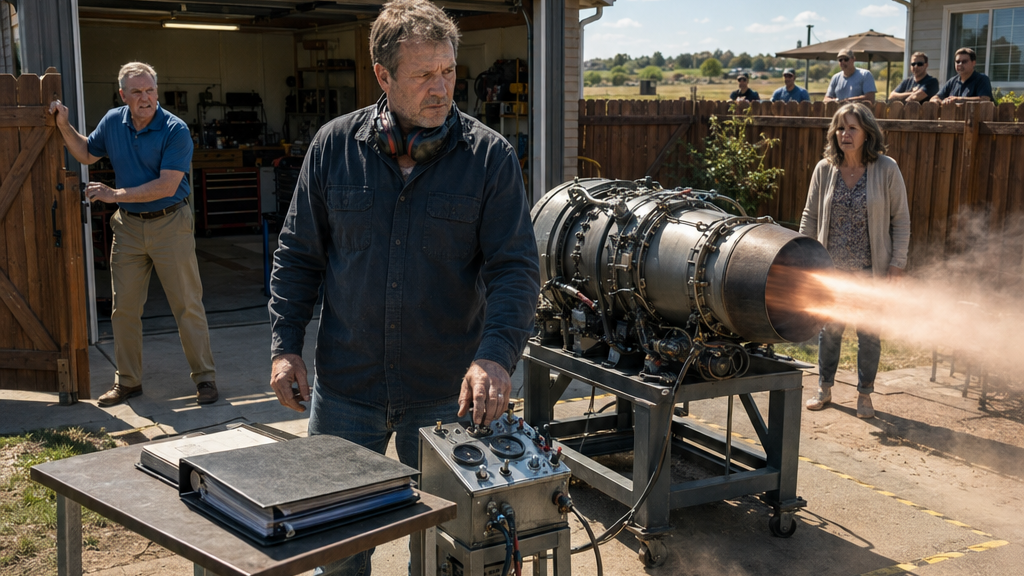
The turbine began to spool at 8:04 Saturday morning.
At first, it sounded almost harmless—a rising metallic whine buried beneath the starter system.
Then the pitch sharpened.
James stood behind the marked safety line with one hand near the controls and the other resting beside the running checklist. The aircraft logbook lay closed beneath a clear plastic cover on the portable worktable. Beside it were the test documentation, equipment records and inspection binder.
He had prepared everything.
Except the neighborhood.
A patio door opened two houses away.
Then another.
James saw Barbara step into her backyard wearing slippers and a light jacket.
At the far end of the side path, Ronald appeared beside the cedar gate.
He had come before James invited him through.
“Shut it down.”
James did not turn.
“Stay outside the marked area.”
Ronald rattled the gate.
“You cannot run a jet engine in a residential neighborhood.”
“It’s a turbine test.”
“I don’t care what vocabulary you use.”
James checked the instrument readings.
Temperatures stable.
Speed rising.
Fuel flow normal.
The sound climbed another register.
Ronald shouted something, but the turbine swallowed most of it.
James looked toward the rear boundary.
The exhaust path was clear.
No loose material behind the stand.
No people beyond the marked area.
He had spent days ensuring the setup was technically controlled.
That fact had become his shield against every other question.
The engine settled at idle.
Even there, the sound carried farther than James had expected.
Barbara put both hands over her ears.
James saw it.
He looked away.
Ronald was still at the gate.
James reduced the engine and approached far enough to hear him.
“I’m notifying the police.”
“You can.”
“And the city.”
“You can do that too.”
“You think a certificate makes this acceptable?”
“I think you accused me of illegal commercial aviation work before there was any.”
“That has nothing to do with this.”
James almost smiled.
“Funny how often you say that when the dates matter.”
Ronald stared at him.
“This is exactly what residents were afraid would happen.”
“What residents?”
“You really want a list while that thing is running?”
James looked past him.
Two neighbors had gathered near the sidewalk. Another stood behind a second-story window.
He had assumed that anybody who came out would be there because Ronald had stirred them up.
The assumption felt thinner now.
“I notified the adjacent properties,” James said.
“You put a note in mailboxes saying there might be equipment testing.”
“That’s notification.”
“No,” Ronald said. “That’s covering yourself.”
James returned to the controls.
He had planned a short test sequence.
Idle stabilization.
Intermediate power.
Brief high-power run.
Shutdown.
The entire procedure could be completed in minutes.
He told himself stopping now would prove Ronald could still interrupt his work merely by appearing at the gate.
That thought decided it.
James increased power.
The turbine screamed.
The sound changed from loud to physical.
Air pushed across the rear yard. Dust lifted beyond the test stand in a low rolling cloud. A loose plastic flowerpot in an adjoining yard toppled over.
Somewhere behind James, glass rattled in a window frame.
His instruments remained within limits.
He watched the numbers.
That was where he was strongest.
Temperature.
Pressure.
Rotational speed.
Values that did not care who was offended.
For a few seconds, James felt the clean satisfaction he had imagined.
Months of notices.
Months of being told he did not understand what belonged on his own property.
Ronald outside the gate.
The turbine operating exactly as James had prepared it to operate.
Then he looked toward Barbara.
She was no longer watching the engine.
She was watching him.
James reduced power.
Before the turbine fully settled, a police cruiser turned onto the street.
Ronald saw it too.
“There,” he said. “Now we’ll find out.”
James shut the engine down according to sequence.
The whine took a long time to die.
When it finally did, the neighborhood felt unnaturally silent.
The responding officer came through the side path after James opened the gate. Ronald followed until James held up a hand.
“Only him inside the work area.”
“You don’t own the investigation,” Ronald said.
“No, but I control this safety area.”
The officer glanced between them.
“Everybody stay calm.”
James almost laughed at the phrase.
Instead he handed over identification and explained what had occurred.
The officer looked at the turbine.
“You running an aircraft engine?”
“A turbine used for ground testing.”
“Business?”
“Maintenance-related operation.”
Ronald folded his arms.
“There. He admits it.”
James ignored him.
He produced the certification records, facility information and test documentation.
The officer read enough to understand the documents were outside his expertise.
“I’m not an aviation inspector.”
“I know.”
“I’ve also got a noise complaint.”
“That’s separate.”
Ronald stepped forward.
“No, it isn’t.”
James looked at him.
“It may be separate legally.”
The officer raised a hand.
“Stop.”
He made two calls from beside the cruiser.
The first was to the municipal side.
The second took longer.
James heard enough words to know aviation authorities were being consulted about the nature of the operation.
While the officer waited for a return call, Barbara walked through the open side gate.
James was surprised to see her.
Ronald was not.
“That engine shook my kitchen window,” she said.
James nodded.
“I’ll check for damage.”
“I’m not asking you to buy a window.”
“What are you asking?”
She looked at the turbine.
“I’m asking why you needed to prove this here.”
James’s mouth tightened.
“It’s part of the work.”
“Is this the only place the work could be done?”
He did not answer.
Barbara continued.
“I told Ronald months ago that the fines were ridiculous.”
James looked at her sharply.
“What?”
“I told him your airplane wasn’t a business. I told him I didn’t care if you restored it.”
Ronald shifted near the gate.
Barbara did not look at him.
“But I also told him I didn’t want engine testing behind my house.”
James felt the argument he had been carrying for months lose one of its supports.
He had put Barbara mentally on Ronald’s side because it made the conflict easier to understand.
“You never told me that.”
“You never asked me what I actually said. You asked if I complained.”
“You said you had questions.”
“Because I did.”
She pointed toward the test stand.
“This was one of them.”
The officer returned.
“I’ve spoken with an aviation contact. Your certification and maintenance authorization are not something I’m going to make a determination on roadside.”
Ronald opened his mouth.
The officer continued.
“That does not mean every other rule disappears. Noise, land use and local nuisance questions may be separate matters. The city will have to review those.”
James nodded slowly.
It was not the vindication he had imagined.
It was narrower.
Much narrower.
“Am I being ordered to stop?”
“I’m asking that you not conduct another run today while the complaints are reviewed.”
James looked at the turbine.
He could argue.
The officer had said “asking.”
James understood the difference instantly.
Ronald understood it too.
“If he’s not prohibited—”
James cut him off.
“I’m done for today.”
Ronald looked surprised.
So did Barbara.
James began securing the controls.
The officer took statements and left.
The neighbors drifted back toward their houses.
Ronald remained.
“You see?” he said quietly. “This is what happens when every question becomes a challenge.”
James locked the fuel control.
“You don’t get to pretend you had this right from the beginning.”
“I didn’t say I did.”
That answer stopped him.
Ronald looked older than he had at the first gate confrontation.
“I had people calling me,” he said. “They wanted to know if the board had any control at all. First the airplane. Then deliveries. Then certification. Then paid work. Now this.”
“You fined me before half of that existed.”
“And you decided to make the other half exist.”
James looked at him.
Ronald walked away.
Barbara remained by the gate.
James went to the worktable and closed the binder.
The logbook beneath the plastic cover had not moved.
He had documented everything correctly.
The test sequence.
The equipment.
The procedure.
The shutdown.
Nothing in those pages recorded Barbara standing with her hands over her ears.
Nothing recorded the plastic flowerpot falling over.
Nothing recorded the moment James had seen Ronald at the gate and decided that stopping would feel like losing.
His phone vibrated.
An email notification from the HOA.
Emergency board hearing.
Proposed noise and hazardous-equipment restriction.
Meeting scheduled for Wednesday evening.
James read the notice twice.
Then another message appeared beneath it.
From Catherine Ramirez.
Please bring every fine notice you have received.
Chapter 6: The Rule Written After the Noise
Ronald placed the proposed emergency restriction on the table before anyone had voted to put it on the agenda.
James noticed that first.
The document sat in front of every board member with the title centered in bold type and an effective date beginning the following morning.
He placed his aircraft logbook on the table beside his stack of fine notices.
He left it closed.
Ronald called the meeting to order.
“This is an emergency measure addressing excessive mechanical noise, turbine equipment, hazardous testing activity and commercial aviation operations within the community.”
James raised a hand.
“You circulated this yesterday.”
“Yes.”
“The bylaws require notice before adopting new use restrictions.”
“This is an emergency.”
“Where’s the emergency provision?”
Ronald’s expression tightened.
“We have counsel here precisely to address procedure.”
The HOA attorney sat near the end of the table, reading the proposed restriction.
“That would be useful,” James said.
Ronald ignored the tone.
The first homeowner spoke about the Saturday test. He described windows vibrating and his child coming downstairs frightened by the sound.
The second said she had never objected to James’s airplane but did not believe turbine testing belonged behind residential fences.
James listened.
A week earlier, he would have categorized both comments as another version of Ronald’s campaign.
Now he could still hear the engine at high power.
When his turn came, he did not argue that the complaints were fabricated.
He argued about the rule.
“You can address unreasonable noise,” James said. “You can investigate land use. What you cannot do is rewrite the last four months as though every activity was the same.”
Ronald leaned forward.
“Nobody is doing that.”
Catherine opened a ledger.
“I think we did.”
The room quieted.
She had placed colored tabs beside several entries.
“The initial fines were recorded as commercial-use violations. Later fines use commercial activity and nuisance. One uses exterior storage. Two later entries refer to unapproved business activity without identifying what changed.”
Ronald looked at her.
“We’ve discussed this.”
“We discussed concerns. I went back through the actual accounting.”
She turned the ledger toward the attorney.
“Several fines were assessed before there is any documented evidence of paid work.”
James did not move.
This was the moment he had wanted.
He expected satisfaction.
Instead he found himself watching Ronald.
The HOA president’s face had gone still.
The attorney examined the dates.
“When did paid work begin?”
James gave the date.
Catherine pointed to the corresponding line.
“Nearly two months after the first fine.”
The attorney continued reading.
“That doesn’t necessarily dispose of every covenant issue, but it creates a problem if the violation stated was commercial activity.”
Ronald exhaled.
“The board was trying to address a developing situation.”
“Then the notices should have addressed the situation that actually existed,” Catherine said.
James looked down at his closed logbook.
Ronald turned toward the attorney.
“What about federal preemption? He has repeatedly implied we have no authority because he’s federally certificated.”
James looked up.
“I said you don’t control aviation maintenance standards.”
“You said federal authority superseded us.”
“I said it limits what you can regulate as aviation.”
The attorney held up a hand.
“Both of you are making this broader than it is.”
Nobody spoke.
“Federal aviation regulation matters. So do private covenants, zoning and nuisance law. Certification does not automatically convert a residential parcel into a location free from every local or contractual restriction. At the same time, the association should be careful not to regulate technical aviation safety matters outside its competence.”
Ronald looked displeased.
James probably did too.
The attorney tapped the emergency rule.
“This draft is too broad.”
Ronald stared at him.
“You’re saying we can’t stop turbine testing?”
“I’m saying I would not adopt this document tonight in this form.”
A murmur passed through the room.
James felt the old impulse rise.
He could press.
He could force Ronald to admit the earlier fines were unsupported.
He could emphasize every procedural mistake.
Then Ronald opened a folder.
“I want the complaints entered into the record.”
He passed them down.
They were not anonymous.
James recognized addresses.
Some came from houses he had barely thought about.
One homeowner had written that the restoration itself had never bothered him but the escalating equipment made him uncertain what might come next.
Another mentioned early-morning mechanical noise before the turbine test.
Barbara’s statement was shortest.
She opposed punitive fines unsupported by evidence.
She also opposed high-power engine testing beside occupied homes.
James read that sentence twice.
Ronald said, “This is the pressure I’ve been dealing with.”
James looked at him.
Ronald’s voice had lost some of its boardroom sharpness.
“Every time somebody asked whether the association had limits, I had to answer. Every time something new showed up behind that fence, the calls increased.”
“So you kept changing the violation.”
“I kept trying to get ahead of the next thing.”
“That’s not the same as enforcing a rule.”
“No,” Ronald said. “Maybe it isn’t.”
The admission was small.
No apology.
No surrender.
But James heard it.
He also heard what Ronald had not said: that fear of losing control had mattered as much as the aircraft.
James opened the logbook.
He turned to the entries Ronald had once dismissed as evidence of a business.
Then he closed it again.
“I’ll suspend high-power turbine runs at the property.”
Ronald blinked.
James continued before he could answer.
“Voluntarily. While we sort out what belongs here and what doesn’t.”
Catherine watched him carefully.
“In exchange for what?”
“Not in exchange for silence.”
He pushed the stack of notices toward the board.
“I want the fines reviewed individually. By the rule cited, by the facts that existed on the date assessed, and separately from anything I did later.”
Ronald shook his head.
“You’re asking us to erase the enforcement history.”
“No. I’m asking you to correct it.”
“And your paid work?”
“Review that separately too.”
The attorney leaned back.
“That is a more defensible approach.”
Ronald looked around the table.
For the first time since the dispute began, James saw that the board president did not have a simple next move.
If Ronald refused, he would be defending fines the association’s own attorney had questioned.
If he accepted, he would be acknowledging that months of enforcement had mixed different problems together.
James could have enjoyed that.
Instead he thought of Barbara’s kitchen window.
“I’m not giving up the workshop,” he said. “I’m not giving up my airplane. And I’m not agreeing that the original commercial violation was valid.”
Ronald’s jaw tightened.
“What are you giving up?”
James looked at the proposed emergency restriction, then at the closed logbook.
“The idea that because I can prove something is permitted under one set of rules, everyone else has to live with every consequence.”
The room was quiet.
Catherine reached for the fine ledger.
“I move that we postpone the emergency restriction, obtain a narrower draft from counsel, and conduct a line-by-line review of James’s enforcement account.”
One board member seconded.
Ronald did not.
The motion passed anyway.
As people began gathering papers, Ronald remained seated.
James picked up his logbook.
“Two weeks,” Catherine said. “We’ll have the review completed.”
Ronald finally looked at James.
“And no turbine tests during that time?”
James held his gaze.
“No high-power tests here.”
Ronald nodded once.
It was not trust.
It was the first agreement they had made since the aircraft appeared behind the cedar fence.
James reached the clubhouse door before Ronald called after him.
“If the board removes those fines, people are going to say we backed down.”
James turned.
For months, that sentence would have invited an answer designed to hurt.
This time he only said, “Then tell them what actually happened.”
Ronald looked toward the ledger in Catherine’s hands.
James stepped outside.
Behind him, the board president remained in the room with the records he had spent months treating as proof.
Now they were about to be read one line at a time.
Chapter 7: What the Logbook Could Not Settle
The revised fine statement was waiting in James’s mailbox two weeks later.
He opened it beside the curb, expecting another dense page of citations.
Instead, most of the balance had disappeared.
The original commercial-use fines had been reversed. So had several later charges that the board could not connect cleanly to the rule cited on the date they were imposed. What remained was much smaller: one penalty tied to paid work conducted after James had begun accepting outside components, along with an administrative charge the association’s attorney had advised the board it could reasonably defend.
James read the total twice.
For months, he had imagined this moment.
He had imagined carrying the statement into the clubhouse and placing it in front of Ronald Davis. He had imagined asking whether six weeks of accusations had been worth it. He had imagined Ronald having no answer.
Instead James folded the page and put it in his pocket.
Behind the house, the turbine test stand sat empty.
The engine itself had already been prepared for transport to a commercial facility where James could conduct high-power runs without suburban fences on either side. The steel stand remained because moving it required equipment he had scheduled for the following week.
Without the turbine mounted on it, it looked smaller.
Almost foolish.
James walked into the workshop.
His restored airplane occupied the same space it had when Ronald first appeared at the gate. The fuselage was farther along now, its repaired skin catching thin bands of light from the open doors.
James opened the aircraft logbook.
He made one final entry for the latest restoration task, checked the date, then closed the book.
The clubhouse meeting began at seven.
Catherine Ramirez had prepared a written summary of the account review. She moved through it line by line, explaining which charges had been removed and which remained.
Ronald sat beside her.
He did not interrupt.
“The board’s revised position,” Catherine said, “is that the original evidence did not sufficiently establish commercial use during the period covered by the first notices.”
James looked at Ronald.
Ronald kept his eyes on the paper.
Catherine continued.
“The later paid component activity presents a separate issue. The association is not withdrawing every restriction applicable to that activity.”
“I understand,” James said.
Ronald finally looked up.
“We also need the operating agreement.”
The HOA attorney slid a revised document across the table.
It was narrower than the emergency rule.
No blanket ban on aircraft maintenance.
No claim that the HOA controlled technical aviation procedures.
Personal restoration could continue inside James’s workshop. Limited component work was permitted subject to existing residential-use conditions, delivery restrictions and defined hours. High-power turbine or jet-engine testing would not occur on the residential property.
James read that paragraph again.
“I said I’d suspend those tests while this was reviewed.”
Ronald’s shoulders stiffened.
“And I’m saying suspension isn’t enough.”
Catherine looked between them.
The old argument was still there, waiting.
James could feel it.
Ronald continued.
“If we sign this and six months from now you decide the law lets you run that turbine again, we’re back where we started.”
James tapped the document.
“You want me to give up something before anyone has conclusively said you can prohibit it.”
“Yes.”
The answer came without decoration.
James leaned back.
“Why?”
Ronald was silent long enough that Catherine glanced toward him.
Then he said, “Because I don’t want to spend another year finding out.”
James almost answered sharply.
Ronald continued before he could.
“When the airplane first showed up, I thought if the board didn’t act quickly, every complaint after that would become harder to manage.”
“You didn’t have evidence.”
“No.”
The word landed differently from the carefully qualified admissions of the previous meeting.
Ronald looked at the table.
“I had people asking whether we were going to enforce anything. They were asking what came next. Parts deliveries. Customers. Engines. They wanted certainty.”
“So you gave them certainty you didn’t have.”
“Yes.”
Catherine stopped writing.
Ronald rubbed one thumb along the edge of the document.
“I was more worried about the board looking like it had lost control than I was about your airplane.”
James said nothing.
There it was.
Not corruption.
Not hatred of aircraft.
Fear.
Ordinary and damaging.
Ronald looked at him.
“And then you made it very easy for me to keep believing I was right.”
James thought of the turbine at full power.
He thought of Barbara standing beyond the fence with her hands over her ears.
“You mean I started taking paid work.”
“I mean every time I pushed, you found a way to push harder.”
James looked down at the agreement.
He could refuse the high-power testing clause.
He could preserve the argument.
Perhaps he could even win it eventually.
But winning would mean continuing a fight over an activity he no longer believed belonged there.
He took the pen.
“I’ll commit the high-power runs to an off-site facility.”
Ronald’s expression shifted, but James raised a finger.
“Not because the original fines were valid.”
“They weren’t,” Catherine said.
James looked at her.
She slid the revised account statement forward.
“We’ve already corrected that.”
“And the remaining penalty?”
Catherine pointed to the date.
“This one occurred after you accepted paid work. The board believes the notice requirements were properly met for that period.”
James disagreed with part of the interpretation.
He could have challenged it.
Instead he looked at the amount.
It was irritating.
It was also defensible enough that fighting it would keep everyone exactly where they had been.
“I’ll pay it.”
Ronald stared at him.
James signed the operating agreement.
Ronald read James’s signature, then added his own.
No applause followed.
Nobody congratulated anybody.
Catherine collected the papers and moved to the next administrative item.
James preferred it that way.
Two evenings later, he was in the backyard removing the last mounting hardware from the empty turbine stand when Barbara appeared at the side gate.
“You moving it?”
“The engine’s already gone.”
“Where?”
“Approved test facility.”
Barbara nodded.
“So the board won.”
James looked at her.
“No.”
She smiled slightly.
“Then you won.”
“No.”
“That sounds inconvenient.”
“It is.”
Barbara came through the gate.
For months she had opened it only far enough to speak across the boundary.
Now she walked toward the workshop and stopped beside the restored aircraft.
James picked up a finished component from the bench.
“I’m putting this back on tonight.”
“The airplane still staying?”
“Yes.”
“Good.”
James looked at her.
“You mean that?”
“I always meant it.”
He thought about how long it had taken him to believe her.
“I should’ve asked you what bothered you before Ronald started speaking for everybody.”
Barbara considered that.
“I should’ve walked over before I called the board.”
Neither apology was complete.
Both were enough.
James carried the component toward the aircraft.
Behind him, Barbara returned to the side gate.
For a second he expected to hear the latch close.
Instead she pushed the gate fully open and hooked it against the fence so it would stay that way while he worked.
James looked toward the empty turbine stand, then toward the logbook resting on his bench.
The book could record what he repaired, when he repaired it, and under what authority.
It could prove dates.
It could prove ownership.
It could prove that Ronald had been wrong.
What it could not record was the difference between having the right to do something and needing to do it here.
James set the component into place.
Then he reached for his tools.
The story has ended.