The HOA Locked Matthew Out of His Family Farm—Then Learned Their Only Entrance Crossed His Land
Chapter 1: The Morning Matthew Found His Road Locked
Matthew Hall saw the black iron bars before he saw the keypad.
For ten years, the road had been nothing more than pavement running between trimmed subdivision lawns and the county highway beyond. He had driven it before sunrise with feed sacks in the truck bed, after dark with mud dried hard around the wheel wells, and once with his father sitting beside him, already too sick to work but still pointing out where the old fence line had been.
On Monday morning, the road ended in a gate.
Matthew slowed his pickup until the tires whispered over the asphalt. Two black leaves of wrought iron met in the center beneath a stone entrance sign. A keypad stood on a steel pedestal beside the driver’s window.
He stared at it.
He had seen the construction crew the previous week. He had also seen three HOA notices in his mailbox over the past two months and left all three unopened on the kitchen counter.
The subdivision had never owned his route through it.
Whatever they were building, he had assumed, could not change that.
A small green light blinked on the keypad.
Matthew lowered his window and pressed the button marked CALL.
Nothing happened.
He tried again.
A voice finally crackled through the speaker.
“Can I help you?”
“I need the gate opened.”
“Resident code?”
“I don’t have one.”
A pause.
“Then you’ll need to contact management.”
Matthew looked through the bars at the road he had traveled almost every working day since the development was built.
“I’m Matthew Hall.”
Another pause, longer this time.
“I don’t have a resident by that name.”
“I’m not a resident.”
“Then you’ll need to use the visitor entrance.”
“This is the entrance.”
The speaker went silent.
Behind him, a compact SUV rolled up and stopped. The driver waited a few seconds, then tapped the horn.
Matthew ignored it.
He pressed the button again.
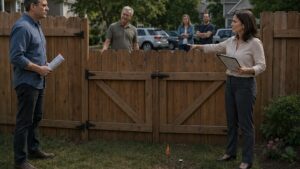
Before anyone answered, a woman crossed from the small gatehouse area carrying a tablet under one arm. Matthew recognized Catherine Roberts from two brief conversations at county meetings. She was in her late forties, neat without looking formal, wearing a navy polo with the association logo stitched over the chest.
She approached his window.
“Mr. Hall?”
“Yes.”
“I thought that might be you.”
“Good. Then you can open it.”
Her expression tightened by a fraction.
“We activated the system this morning. Credentials were distributed to residents last week.”
“I’m not asking for resident credentials.”
“What are you asking for?”
“The same access I’ve had for ten years.”
The SUV behind him honked again.
Catherine glanced over his shoulder.
“Could you pull into the shoulder so residents can get through?”
Matthew looked at the narrow strip of grass beside the pavement.
“No.”
“Mr. Hall—”
“The gate is what’s blocking traffic.”
The driver behind him leaned out the window. “Come on, man.”
Matthew kept his eyes on Catherine.
She lowered her voice. “We discussed the gate project for months.”
“You discussed it with your homeowners.”
“We mailed adjacent property owners.”
Matthew thought of the unopened envelopes on his counter and felt the first uncomfortable pinch of responsibility.
He had seen the return address.
He simply had not believed anything inside could matter to him.
“You knew I used this road,” he said.
“I knew you passed through the neighborhood occasionally.”
“Every day isn’t occasionally.”
Catherine tapped the tablet. “The property packet we were given shows association roads serving association lots. There’s no record here requiring us to issue credentials to an outside landowner.”
Matthew almost laughed.
Not because it was funny.
Because she had said outside landowner while standing on a road that would not exist in its present form without his family’s agreement.
“My farm was here before every house behind you.”
“I understand that.”
“No. I don’t think you do.”
The line behind him had grown to four vehicles.
Catherine drew a breath.
“We’ve had theft complaints, trespassing, and two incidents involving vehicles entering after midnight. Residents have been asking for controlled access for more than a year. The board approved the system. Our insurer wanted the entrance secured. This isn’t aimed at you.”
Matthew rested one hand on the steering wheel.
“Then give me a code.”
“I can’t create exceptions without board authorization.”
“It isn’t an exception.”
“That’s what I’m telling you. In our records, it is.”
He heard his father’s voice then, not dramatically, but exactly as it had sounded one humid afternoon when the subdivision entrance was still raw gravel.
The road we lent each other.
His father had never called it the developer’s road.
Never called it theirs.
Matthew had been thirty-something and impatient when the papers were signed. He remembered sitting at the kitchen table while his father read every page twice.
The developer needed enough of the Hall property to connect the new subdivision to the county highway. The Halls needed dependable passage through the development after an older farm track became impractical for heavy equipment.
Each side got something.
That was the point.
“Open the gate this morning,” Matthew said. “Then we can straighten out whatever your packet is missing.”
Catherine shook her head.
“I don’t have authority to do that.”
“You are the HOA president.”
“Which means I have to follow the rules we approved.”
“The rules you approved don’t erase my property rights.”
“I haven’t seen documentation establishing the right you’re describing.”
The answer landed harder than Matthew expected.
For years, nobody had asked him to prove it.
The developer knew.
The first board knew.
His father knew.
Matthew had mistaken continuity for permanence.
Catherine stepped back from the truck.
“There is another public route to your property.”
His jaw tightened.
“You mean Miller Cutoff.”
“Yes.”
“That’s fourteen miles around.”
“It’s a public road.”
“Half of it’s gravel.”
“I’m aware.”
“No, you’re aware it exists. That’s different.”
The resident behind him sounded the horn again, holding it this time.
Catherine looked toward the growing line.
“Mr. Hall, I’m asking you to move.”
Matthew stared through the gate.
On the other side, the road curved between ornamental trees, then disappeared toward the highway. He could see only a few hundred yards of it, but he knew every turn.
His father had driven that route on the last morning he ever visited the cattle pens.
Matthew put the truck in reverse.
For a second Catherine’s shoulders relaxed.
Then he stopped.
“You said your packet doesn’t show my access.”
“Correct.”
“Does it show who owns the ground under this end of the road?”
Catherine’s eyes moved toward the pavement.
“I’d have to check.”
Matthew nodded once.
“So would I.”
He backed onto the shoulder, turned around carefully, and drove toward the farm.
The fourteen-mile detour took him past an abandoned convenience store, a low-water crossing, and three miles of washboard gravel that rattled a wrench out of the cup holder.
By the time he reached his barn, his anger had settled into something heavier.
He went inside the house without removing his boots.
The HOA envelopes still lay on the kitchen counter.
He opened the newest one.
Most of it concerned access procedures, resident decals, visitor management, and the activation date. His name did not appear anywhere.
Neither did the word easement.
That bothered him more than the gate.
He went to the back bedroom, where metal file cabinets from his father’s office still stood against one wall.
Matthew had not gone through them properly after the funeral. He had taken what he needed for taxes, cattle registrations, and insurance, then closed the drawers.
Now he pulled out folders until dust streaked his hands.
Old surveys.
Feed contracts.
Receipts.
A yellowed subdivision map.
Then, wedged inside a folder marked ROAD, he found a narrow metal key tag attached to a worn brass ring.
COUNTY ROAD, his father had scratched into the tag by hand.
Matthew turned it over.
On the back was a number.
Not a key number.
A deed book and page reference.
He stared at it for a long moment before reaching for his phone.
Chapter 2: The Gate Became More Than an Inconvenience
The livestock hauler called at 6:17 on Thursday morning.
“I’m looking at a black gate,” the driver said. “You got somebody coming to open this thing?”
Matthew straightened so quickly he struck his shoulder against the cattle-panel latch.
“What gate?”
There was a pause.
“Only one I’m seeing.”
Matthew closed his eyes.
The delivery had been scheduled for seven.
The truck carried breeding cattle Matthew had arranged months earlier, animals that were supposed to unload at the south pens before the heat built. The transporter had been given the normal route from the county highway through the subdivision.
“Stay there,” Matthew said. “Don’t turn around.”
He drove fast enough down the farm lane to throw gravel against the truck’s rocker panels.
For almost two weeks he had used Miller Cutoff.
He had told himself the inconvenience was temporary.
Fourteen extra miles each way had already cost him fuel, time, and one broken tie-down after a particularly rough section of county gravel. But he had kept working. He had not called Catherine again.
Partly because he was busy.
Partly because he was angry.
Mostly because some stubborn part of him refused to beg for passage over a route he believed was already his to use.
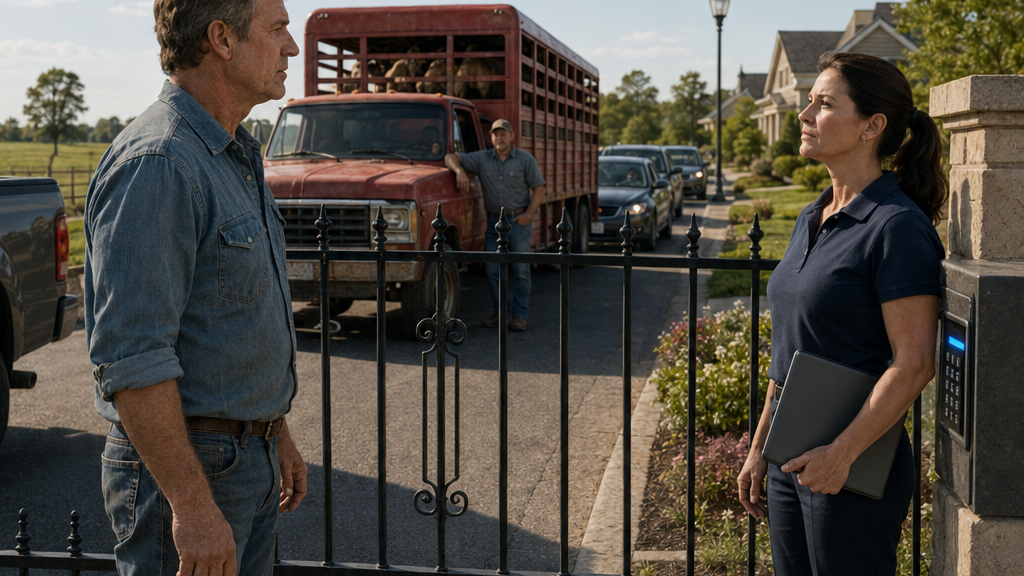
As he approached the subdivision entrance from the farm side, he could see the livestock trailer beyond the black bars.
It was long and red, with ventilation slots along both sides. Cattle shifted inside, making the suspension rock slightly.
Three resident vehicles had already stacked behind it.
Matthew stopped on his side of the gate and got out.
The driver climbed down from the cab.
“You Matthew?”
“Yes.”
“Keypad doesn’t recognize the delivery code they gave me.”
“What delivery code?”
“Somebody from your office texted it yesterday.”
Matthew frowned. “I don’t have an office.”
The driver held up his phone.
The message had come from the HOA property manager after the trucking company apparently called for access instructions.
Matthew read it twice.
“That code doesn’t work?”
“Not unless I suddenly forgot how numbers work.”
The gate’s motor hummed briefly, then stopped.
A sedan behind the trailer honked.
Matthew walked to the keypad and pressed the call button.
The property manager answered.
“Hall farm,” Matthew said. “I need the livestock truck through.”
“One moment.”
He waited.
Two minutes later Catherine appeared from a side walkway near the entrance.
She looked less polished than the first morning. Her hair was pulled back, and she held a coffee in one hand and the same tablet in the other.
“Matthew.”
“Open it.”
She looked toward the trailer.
“The vehicle isn’t in our vendor system.”
“It’s carrying my cattle.”
“I understand.”
“Then open the gate.”
“The temporary access code should have worked.”
“It didn’t.”
“We’ll need the management company to issue another.”
Matthew stared at her.
“There are live animals sitting in that trailer.”
“I know.”
“Then use the override.”
Catherine’s mouth tightened.
“We aren’t supposed to manually override except for emergency services or system failures.”
“The code failed.”
“That’s not technically a system failure.”
The driver glanced between them.
Matthew heard movement inside the trailer. One animal struck a hoof against the metal floor.
He lowered his voice.
“Catherine, I told you this road is covered by a recorded agreement.”
“You told me you believe it is.”
“I gave your manager the reference number.”
“And it’s being reviewed.”
“For thirteen days?”
“Our attorney hasn’t finished.”
“That’s your problem, not mine.”
A pickup behind the sedan honked. Someone shouted through an open window.
Catherine looked toward the residents.
“You’re blocking the main entrance.”
Matthew followed her gaze to the line of cars.
Then he looked down at the asphalt beneath their feet.
The question from the first morning returned.
He had spent three evenings going through his father’s files but had not found the full easement. What he had found were old tax maps showing the property line running strangely close to the subdivision entrance.
Close enough to bother him.
He turned back to Catherine.
“Before this gate went live, did your board verify who owns the strip of land under this section of road?”
The resident who had been complaining went quiet.
Catherine’s expression changed.
Not much.
But enough.
“The HOA maintains this entrance.”
“That’s not what I asked.”
“Matthew—”
“Did you verify ownership?”
She shifted the tablet against her hip.
“I’d need to refer to the survey.”
“So you don’t know.”
“What I know is that this is the association’s controlled entrance.”
Matthew nodded toward the livestock truck.
“And my access through here came from the same deal that let the developer build this approach.”
That sentence changed the air around them.
The driver looked at Catherine.
A woman in the sedan lowered her window.
Catherine said, “We’re not litigating land records at the gate.”
“I’m trying not to.”
He pointed toward the control box.
“Open it.”
“I can’t.”
“Won’t.”
“My responsibility is to the residents.”
“And mine is to those animals and my farm.”
For the first time, Catherine sounded tired rather than authoritative.
“We had two catalytic-converter thefts, packages stolen from porches, and a truck come through here at two in the morning and tear up landscaping. People wanted this gate.”
“I don’t care that there’s a gate.”
She looked at him sharply.
“I care that you put it across my route and then decided I needed your permission to use it.”
Neither spoke for a moment.
The cattle shifted again.
The driver checked his watch.
“Mr. Hall, I can’t keep them sitting here indefinitely. I have another pickup two counties over.”
Matthew looked at the truck, then at Catherine.
“You understand what happens if he leaves?”
“I understand you’re inconvenienced.”
The word hit him.
“Inconvenienced?”
She seemed to hear it too late.
“I didn’t mean—”
“These aren’t patio chairs.”
He took out his phone and photographed the trailer, the closed gate, the keypad, and Catherine standing beside it.
Not for social media.
For a record.
Something his father would have done before Matthew ever thought to.
Catherine watched him.
“What are you doing?”
“What I should’ve done two weeks ago.”
The hauler waited another twenty minutes.
The replacement code never came.
Eventually the driver climbed into his cab.
“I’m sorry,” he told Matthew. “But I can’t make the unload and still keep the rest of my route.”
Matthew stood with both hands on his hips as the truck reversed slowly away from the entrance.
The cattle inside swayed with the movement.
The cost was not merely freight. The deal involved deposits, rescheduling charges, and a price adjustment if the animals could not be delivered within the contracted window.
By afternoon, Matthew had the number.
Just under eight thousand dollars.
He sat at his father’s old desk with the invoice open on his phone.
The worn brass key ring lay beside it.
That was when he noticed the folder underneath.
ROAD AGREEMENT—FINAL.
He opened it.
Inside were photocopies of correspondence, an old survey, and a letter from the developer’s attorney thanking Matthew’s father for executing “the reciprocal access instruments.”
Reciprocal.
Matthew read the word twice.
Near the bottom of the page, his father had written in pencil:
Keep county copy reference with deed.
Matthew turned over the yellowed map.
The same deed book and page number was written there.
He had spent nearly two weeks trying to prove the situation to himself before asking anyone trained to read the documents.
That realization irritated him almost as much as Catherine’s refusal.
Pride had cost him time.
Possibly money.
He picked up his phone and called Jeffrey Allen.
Jeffrey had handled a boundary dispute for Matthew five years earlier and had once told him that most land problems were caused by people who relied on memory after the paperwork had changed hands.
Matthew had not appreciated the comment then.
Jeffrey answered on the fourth ring.
“Allen.”
“It’s Matthew Hall.”
“What’s happened?”
Matthew looked through the office window.
Across the field, beyond the hay ground and a row of trees, the top of the black entrance gate was just visible.
“I need you to pull a county record.”
“Give me the reference.”
Matthew read the number from his father’s key tag.
Jeffrey repeated it.
Then he asked, “What am I looking for?”
Matthew looked at the eight-thousand-dollar loss on his phone.
“I don’t know yet.”
He paused.
“But I think my neighbors just locked a gate across an agreement they never read.”
Chapter 3: The Agreement Nobody Put in the Board Packet
Jeffrey Allen placed two documents side by side on his conference table and looked at Matthew.
“Which one of these do you think Catherine Roberts has seen?”
Matthew leaned over them.
One was a clean, modern exhibit from the HOA’s gate packet. It showed the subdivision streets in pale gray, common areas shaded green, and the main entrance marked with a heavy black line.
The second was twenty years older.
Its paper had been scanned crookedly at the county office, and faint survey notations crowded the margins.
Matthew pointed to the newer one.
“That.”
“That’s my guess too.”
Jeffrey tapped the older document.
“And that’s the problem.”
Two days earlier, they had met the county records clerk shortly after the office opened. The clerk had pulled the referenced deed book, then a second instrument cross-indexed against it.
Matthew had watched Jeffrey become quieter with every page.
Not excited.
Not triumphant.
Careful.
That had made Matthew more nervous than enthusiasm would have.
Now, in Jeffrey’s office, the old county survey lay between them.
A narrow strip crossed the Hall property from the county highway to the subdivision boundary.
Matthew knew the ground immediately.
It was where the decorative entrance sign stood.
Where the black gate stood.
Where Catherine had told him the HOA controlled access.
Jeffrey traced the survey line with one finger.
“The developer needed this strip to connect the subdivision road system to the public highway.”
“I know.”
“You know generally. This tells us how.”
Jeffrey slid the first recorded instrument forward.
“Your father and the developer granted reciprocal rights. The subdivision received access across this portion of Hall property.”
He moved his finger to another section.
“And the Hall parcel received continued passage through the development road network.”
Matthew sat back.
“So I was right.”
“About having access? Yes.”
A small, hard satisfaction rose in Matthew’s chest.
For thirteen days, he had wondered whether he had remembered the deal incorrectly.
Whether his father had described a handshake arrangement as something stronger.
Whether Catherine’s packet reflected a later amendment he had missed.
Jeffrey pushed another page toward him.
“Don’t celebrate yet.”
Matthew frowned.
“What?”
“The documents are connected.”
“I thought that was good.”
“It is, until you read the remedy language.”
Jeffrey turned the page.
The clause was dense and awkward, written in the kind of legal phrasing Matthew’s father had always insisted on reading aloud because he said confusing language became easier to recognize when it had to survive a human voice.
Jeffrey summarized instead.
“The rights were intended to be mutual and continuing. Neither party can materially interfere with the other’s access.”
“The gate interferes.”
“Almost certainly.”
“Then they remove it.”
“Maybe.”
Matthew stared at him.
“Maybe?”
“The existence of a gate isn’t necessarily the breach. If you had reliable credentials, emergency access, and practical passage for agricultural traffic, they could argue the security system doesn’t materially obstruct you.”
“But they didn’t give me any of that.”
“Correct.”
“And the livestock truck?”
“That helps establish actual interference.”
Matthew thought of the trailer reversing away.
Eight thousand dollars.
He felt the old anger return.
“Then what’s the complication?”
Jeffrey rotated the page.
“Read this part.”
Matthew did.
He reached the sentence twice before its meaning settled.
In the event of an uncured material obstruction, the reciprocal grant could be subject to termination proceedings.
Matthew looked up.
“So terminate it.”
Jeffrey did not answer immediately.
Matthew’s satisfaction sharpened.
“That’s what this says, isn’t it?”
“It says termination may be available after notice and failure to cure.”
“Fine.”
“Matthew.”
“What?”
Jeffrey pulled the old survey closer.
“If the reciprocal grant terminates, you don’t just lose your right through their streets.”
He tapped the narrow strip crossing the Hall parcel.
“They can lose theirs across yours.”
Matthew looked down.
The line suddenly seemed darker.
He remembered Catherine standing at the gate saying, You’re blocking the main entrance.
He had thought the irony was merely that their security system caused its own traffic problem.
Now he saw another meaning.
“How much of the road is on me?”
“Approximately two hundred feet from the public right-of-way before the subdivision parcel begins.”
Matthew stared at the map.
The entrance monument.
The keypad.
The gate motor.
The first stretch of pavement.
All of it sat on or depended upon rights crossing land his family had never sold outright.
“They built their gate on my property?”
“Careful. The easement may allow improvements connected to access. We would need to analyze the exact construction rights. Don’t jump farther than the documents take us.”
“But they can’t block me.”
“That part is much stronger.”
Jeffrey opened the HOA gate exhibit.
“Notice what’s missing.”
Matthew compared the maps.
The modern drawing stopped its ownership detail at the entrance landscaping. It showed the road as a continuous association feature, but no underlying parcel line crossed it.
“They erased the line.”
“I wouldn’t say erased unless we know intent. More likely somebody simplified the exhibit. Then the simplified exhibit became the board’s working truth.”
Matthew rubbed a thumb over his knuckles.
His father would have hated that.
Not because it was malicious.
Because it was careless.
A legal relationship that had lasted a decade had vanished from institutional memory because someone prepared a cleaner map.
Matthew picked up the old county copy.
“This is why he kept everything.”
Jeffrey glanced at the brass tag beside Matthew’s folder.
“Your father?”
“He’d save a receipt for a six-dollar hinge.”
“Sounds useful today.”
Matthew almost smiled.
Then Jeffrey leaned back.
“There is another thing you need to understand.”
Matthew waited.
“If we send notice alleging material breach and they refuse to cure, the termination threat is real enough that their attorney will have to take it seriously.”
“Good.”
“But leverage isn’t the same as outcome.”
“I know.”
“I’m not sure you do.”
Matthew’s expression hardened.
Jeffrey continued.
“You came in here wanting your road back. That’s straightforward. But the documents give you something larger than that.”
Matthew looked through the office window toward the courthouse square below.
“How large?”
Jeffrey folded his hands.
“I checked the subdivision plat and county GIS before you arrived.”
He turned his monitor toward Matthew.
An aerial photograph filled the screen.
The Hall farm occupied a broad irregular block of open land. Along its eastern edge sat the subdivision: curved streets, cul-de-sacs, roofs arranged in neat rows.
The main road ran from the center of the neighborhood toward the highway.
There was no second connection.
Matthew leaned closer.
“What about the service road on the north end?”
“Emergency-access strip. Not built as a public entrance, and from what I can tell it crosses another parcel under separate restrictions.”
“So if this easement goes away—”
“I’m not saying everyone becomes legally landlocked overnight. Courts dislike catastrophic results, and the HOA would seek emergency relief.”
“But they’d have a problem.”
“A serious one.”
Jeffrey clicked on the county parcel data.
“One hundred eighty-three homes use that main entrance.”
Matthew did not answer.
He thought he would feel vindicated.
For two weeks he had pictured Catherine being forced to admit she had been wrong. He had imagined driving through while the gate stood open and the keypad became irrelevant.
This was different.
One hundred eighty-three homes meant people leaving for work.
School buses.
Ambulances.
Karen Lee, though Matthew did not yet know her name, driving home with groceries.
Families who had never sat in the boardroom when Catherine refused the title review.
The power he had wanted was suddenly heavier than the injury that created it.
Jeffrey watched him.
“You asked me whether you had enforceable rights.”
Matthew nodded slowly.
“You do.”
“And if they don’t restore them?”
“We prepare notice.”
“Termination?”
“If that’s what you instruct me to pursue.”
Matthew looked again at the old survey.
The black gate was not drawn there, of course.
Only the road.
His father’s agreement had been designed to connect two pieces of land.
Now a gate built for security had turned that connection into leverage.
Matthew folded the county copy carefully.
“How many did you say?”
“One hundred eighty-three.”
Matthew put the document back into the folder.
For the first time since the gate closed in front of his truck, he was no longer asking whether he could force it open.
He was asking what would happen to everyone else if he did.
Chapter 4: Winning the Easement Could Hurt the Wrong People
Karen Lee arrived at Matthew’s fence before breakfast on Saturday and asked if he intended to trap one hundred eighty-three families inside their own neighborhood.
She did not introduce herself first.
Matthew was tightening a hinge on the cattle gate when her voice carried across the gravel.
“Are you Matthew Hall?”
He straightened slowly.
A woman stood outside the fence in jeans and a light jacket, one hand hooked through the strap of a canvas bag. Her car was parked on the shoulder near the farm entrance.
“Depends who’s asking.”
“Karen Lee. I live over there.”
She pointed across the field toward the subdivision.
Matthew set the wrench on the fence post.
“Then I suppose you know who I am.”
“I know what the email says.”
“What email?”
“The board notice.”
That got his attention.
Karen took out her phone but did not step onto his property.
“It says you’re threatening legal action that could terminate the neighborhood’s access rights.”
Matthew stared at her.
“Does it say why?”
“It says there’s a dispute over your use of the new gate.”
“That’s one way to describe it.”
Karen glanced at the cattle pens behind him.
“I don’t know what happened between you and Catherine. I’m asking what happens to the rest of us.”
Matthew wiped his hands on his jeans.
“Your board put a gate across my route to the highway and refused to let me through.”
“I heard you weren’t a resident.”
“There it is.”
“What?”
“The same mistake.”
Her expression tightened.
“I’m not trying to insult you.”
“You’re telling me I don’t belong on a road because I don’t own one of those houses.”
“I said I heard—”
“And did you hear that the entrance crosses my property?”
Karen stopped.
The silence was answer enough.
Matthew walked to the fence.
“The road didn’t appear when the first house went up. The developer needed a connection to the county highway. My family granted access across our land. In return, the farm got access through the subdivision.”
Karen’s eyes moved toward the distant black gate.
“No one told us that.”
“Apparently nobody told your board either.”
“Then why is the notice saying you may terminate it?”
“Because that’s what happens when one side of a reciprocal agreement blocks the other side.”
Her shoulders stiffened.
“So you could close the entrance.”
Matthew thought of Jeffrey’s aerial map.
One hundred eighty-three roofs.
“I could pursue termination.”
“That’s not the same answer.”
“No.”
Karen looked down at her phone.
“My husband leaves for work at five in the morning. My mother lives with us. She’s seventy-eight. If an ambulance couldn’t get through—”
“I’m not blocking ambulances.”
“Not yet.”
The words landed sharper than she seemed to intend.
Matthew felt anger rise, but it was not the same anger Catherine provoked. Karen looked worried, not powerful.
He leaned against the post.
“Did you vote for the gate?”
“Yes.”
“Why?”
She hesitated.
“Someone stole tools out of our garage last winter. We had two catalytic converters taken on the same street. A truck came through after midnight and tore up the entrance landscaping. People were scared.”
Matthew remembered Catherine telling him nearly the same thing.
Karen continued.
“We weren’t trying to keep you off your farm.”
“But you did.”
“We didn’t know.”
That was the first sentence from anyone in the subdivision that loosened something in him.
Not an apology.
Not an excuse.
Just an admission of ignorance.
Karen unlocked her phone.
“The board notice makes it sound like you’re angry the neighborhood became gated and now you’re using an old technicality to retaliate.”
Matthew gave a short laugh.
“An old technicality.”
“I’m telling you what it says.”
“Did it mention the livestock truck?”
“No.”
“Eight thousand dollars.”
Her eyes lifted.
“What?”
“That’s what their gate cost me when they refused to override it.”
Karen looked back toward the subdivision.
“The email didn’t say that.”
“Did it mention I warned Catherine about the recorded agreement before that happened?”
“No.”
Matthew looked at the wrench lying on the post.
He had wanted Catherine forced into a corner.
But this was something different: two versions of the same dispute moving through the community, each one making the other side look unreasonable.
“When was the gate project approved?” he asked.
“Months ago.”
“That’s not what I asked. When did the board know there might be an easement problem?”
Karen frowned.
“I don’t know.”
“You were on the board?”
“Two years ago. Not now.”
“But you still know people.”
“I know neighbors. That’s different.”
Matthew nodded.
“So ask them.”
She studied him.
“Why?”
“Because if Catherine didn’t know, then your board made a bad mistake.”
“And if she did?”
“Then she made a choice.”
Karen slipped the phone into her bag.
For the first time since arriving, she seemed less afraid of Matthew than uncertain about what she had been told.
“I’ll ask.”
“Good.”
She started toward her car, then stopped.
“For what it’s worth, I don’t think most people over there want to take anything from you.”
Matthew looked across his fields.
From this angle, he could see only the tops of roofs beyond the trees.
“I don’t think most of them knew they were.”
Karen drove away.
By afternoon, a printed HOA notice appeared in Matthew’s mailbox.
Jeffrey had warned him not to communicate directly about legal remedies beyond basic facts, but Matthew read the notice twice.
It described “a claim by an adjacent landowner” that could “adversely affect community ingress and egress.”
No mention of the blocked farm access.
No mention of the recorded reciprocal grant.
No mention of the failed livestock delivery.
The notice asked residents not to engage with outside parties while the HOA consulted counsel.
Matthew laid it on the kitchen table beside his father’s file.
Outside party.
He looked at the brass key tag.
His family had owned the ground before there was an association to be outside of.
Still, Karen’s visit stayed with him.
So did her mother.
So did the idea of people waking up to a legal fight they never knew existed.
Late Sunday afternoon, Karen returned.
This time she did not look angry.
She looked tired.
Matthew met her at the fence.
“You asked when Catherine knew,” she said.
“And?”
“I called someone who still has the board emails.”
Matthew waited.
Karen opened her phone and held it where he could see.
“There was an email from the property manager before activation. You’d given them the deed-book reference by then.”
Matthew felt his jaw tighten.
“What did Catherine say?”
Karen scrolled.
“She said the claimed easement should be reviewed after activation because delaying the gate would create additional contractor charges and undermine the security rollout.”
Matthew read the date.
Three days before the livestock truck had been turned away.
Catherine had not merely lacked the document.
She had known there was a document to find.
Karen lowered the phone.
“I don’t know whether she understood what it meant.”
Matthew looked toward the black gate in the distance.
“Neither did I.”
“But she knew enough to check.”
“Yes.”
Karen nodded.
“That’s what I thought.”
Matthew took out his own phone and photographed the screen with her permission.
The anger came back, but cleaner now.
Not anger at the subdivision.
Not anger at the people who had wanted a safer entrance.
Anger at one decision made after a warning.
He sent the image to Jeffrey.
A moment later, the phone rang.
Jeffrey’s voice was quiet.
“This changes the next meeting.”
Matthew looked at the date on the email again.
Three days before the gate had cost him eight thousand dollars.
Catherine had not known the answer.
But she had known there was a question.
Chapter 5: Catherine Had Been Warned Before the Gate Closed
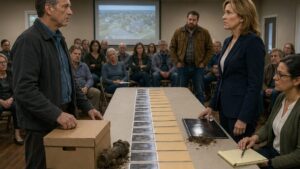
Matthew carried the county file into the HOA clubhouse under one arm.
The room went quieter before he reached the table.
About thirty residents sat in folding chairs facing the board. Catherine Roberts was at the center, flanked by two board members and the property manager. A tablet displaying the gate-control interface lay beside her.
The screen showed a neat diagram of the entrance.
No property line crossed it.
Matthew placed the old county survey on the table.
“There,” he said.
Catherine looked at the document.
“What is this?”
“The record you told me you didn’t have.”
One of the board members leaned forward.
Jeffrey stood a few feet behind Matthew but said nothing.
Catherine’s expression remained controlled.
“We’ve received your attorney’s correspondence.”
“This isn’t correspondence.”
Matthew unfolded the survey.
“This is the land.”
A few residents shifted in their chairs.
Catherine glanced toward the audience.
“This is an open board meeting. Legal matters need to be handled through counsel.”
“Fine. Then let’s discuss the practical part.”
Matthew pointed to the tablet.
“Give me temporary credentials tonight. Manual override for deliveries until this is resolved. Then nobody has to argue at your gate again.”
The property manager murmured something to Catherine.
She shook her head.
“We can’t change access classifications while counsel is reviewing the matter.”
Matthew looked at her.
“You can.”
“Not responsibly.”
“Your system blocked an agricultural delivery after I warned you.”
“We issued a temporary vendor code.”
“It failed.”
“We don’t know why.”
“And you refused to open the gate.”
Catherine’s tone hardened.
“The board has obligations beyond one property owner.”
A man in the audience said, “What about our access?”
Another voice followed.
“Is he actually trying to close the road?”
Matthew turned.
“No.”
The room quieted.
He had surprised himself.
Jeffrey looked at him but did not intervene.
Matthew continued.
“I haven’t filed to terminate anything. My attorney found that the rights are reciprocal. I’m asking your board to restore the access it interrupted.”
Catherine said, “And your attorney has also raised termination as a possible remedy.”
“Because your gate is sitting across an agreement your board didn’t verify.”
One of the board members looked at Catherine.
“Did we have this survey?”
“No.”
“Did management?”
Catherine hesitated.
Matthew took out the printed copy of the email Karen had shown him.
“You had the reference number.”
The room changed.
Catherine looked at the paper but did not touch it.
“That communication was about an unverified claim.”
“Correct.”
“You had not supplied a certified copy.”
“Correct.”
“And we had a scheduled activation date.”
“Also correct.”
Matthew’s voice stayed level.
“So you knew I claimed recorded rights. You decided to turn the gate on first and check later.”
Catherine’s jaw tightened.
“We had a contract deadline.”
A resident near the aisle spoke.
“What does that mean?”
Catherine looked toward him.
“The installer had already delayed activation twice. We were facing additional charges. Our insurance carrier was also asking for confirmation that the access-control measures approved by the board were operational.”
“How much were the charges?” someone asked.
The property manager shifted uncomfortably.
Catherine raised one hand.
“This isn’t productive.”
“It is to me,” Matthew said.
She looked back at him.
He no longer saw arrogance as cleanly as he had at the gate.
He saw pressure.
Residents demanding security.
A contractor waiting.
An insurer asking questions.
A board president who had promised a solution and received a warning that threatened to make months of work look careless.
None of that excused her choice.
But it explained why she had made it.
Jeffrey finally stepped forward.
“My client is requesting temporary restoration of practical access while the legal review continues. That is significantly narrower than the remedies available under the recorded instrument.”
The HOA attorney, seated near the end of the table, spoke for the first time.
“We disagree with the characterization of available remedies.”
Jeffrey looked at him.
“Do you disagree that the Hall parcel underlies the entrance strip?”
The attorney paused.
“No.”
A murmur moved through the room.
“Do you disagree that the subdivision’s access across that strip derives from the reciprocal instrument?”
Another pause.
“Not as a general statement.”
“And do you disagree that the instrument prohibits material obstruction of reciprocal access?”
The HOA attorney looked down at his copy.
“The application of that provision is fact-dependent.”
Jeffrey nodded.
“Of course.”
Matthew almost smiled.
It was the politest possible way to say yes.
Catherine called a brief recess.
Residents stood and began talking at once.
Matthew moved toward the side hallway to get away from the noise.
Catherine followed him.
“Matthew.”
He stopped.
For the first time since the gate had gone live, she was not holding a tablet.
“Karen gave you the email.”
“She did.”
Catherine crossed her arms.
“I should have ordered the title review.”
“Yes.”
“I know that now.”
“You knew enough then.”
Her eyes narrowed.
“You think I did this because I wanted to keep you out.”
“I think you decided I could wait.”
She looked away toward the meeting room.
“You weren’t at the meetings.”
“No.”
“You didn’t answer the notices.”
“No.”
“We spent eight months getting screamed at about thefts, insurance, property values, people cutting through at night. Every time activation slipped, I got twenty emails asking why the board couldn’t complete one basic project.”
Matthew said nothing.
Catherine continued.
“When your deed reference came in, the contractor was already scheduled. We’d paid the deposit. The manager said it might take weeks to get a proper title review.”
“So you gambled.”
“I thought your use was informal.”
“After I told you it wasn’t.”
“I thought you believed it wasn’t.”
That stopped him.
Not because she was right.
Because he understood the distinction.
To Catherine, he had been an angry adjacent owner asserting a privilege nobody else recognized.
To Matthew, she had been a new board president pretending ten years of history disappeared because her tablet did not show it.
Both had assumed the other should know better.
Only one of them, though, controlled the gate.
Catherine rubbed her forehead.
“I had told everyone this system would fix the security problem. If I delayed it because a farmer outside the association said he had an old access right nobody could immediately find, I would’ve looked incompetent.”
Matthew’s expression hardened.
“So instead you made me absorb the risk.”
Her eyes met his.
“Yes.”
The word was so plain that he had no response ready.
She did not apologize.
Not yet.
But she stopped defending the choice as unavoidable.
That mattered.
A door opened behind them.
The HOA attorney stepped into the hall.
“Catherine.”
She turned.
“We need to talk before the meeting resumes.”
“About what?”
He glanced at Matthew, then back at her.
“The termination language.”
Her face changed.
“Is it serious?”
He chose his words carefully.
“It’s credible enough that we should not assume the association would prevail quickly.”
Matthew felt the old surge of vindication.
Then he pictured Jeffrey’s aerial map.
One hundred eighty-three houses.
The feeling cooled.
Catherine looked toward him.
“So that’s what you want?”
Matthew did not answer.
The meeting resumed twenty minutes later.
The board agreed to provide a temporary manual-access protocol for Matthew while counsel negotiated. It was less than he had asked for and more than Catherine had offered before.
No one applauded.
Several residents still looked suspicious of him.
One looked openly angry.
That felt more honest.
Outside, Jeffrey walked with Matthew toward his truck.
“Well,” Jeffrey said, “they’ve stopped pretending the problem doesn’t exist.”
“That’s something.”
“It’s also time to decide what we’re asking for.”
Matthew unlocked the truck.
“I told you. My access restored.”
“That’s the immediate issue.”
Jeffrey opened his briefcase and removed two draft letters.
“They have a cure period under the instrument. We can send notice demanding correction.”
“And the other?”
“Notice preserving your right to pursue termination if they don’t cure.”
Matthew looked at the two envelopes.
Jeffrey held one in each hand.
“Same facts,” he said. “Different destination.”
Matthew stared at them.
A week earlier, he would have chosen the harsher one without reading past the first paragraph.
Now he could see Karen’s worried face at the fence.
He could also hear Catherine saying, Yes.
She had made him absorb the risk because admitting uncertainty would have made her look weak.
Jeffrey lowered the letters.
“Which one do you want me to send?”
Matthew looked past him toward the black gate.
For the first time, the question was no longer whether he had enough power to hurt the association.
It was what he intended that power to repair.
Chapter 6: Matthew Chose What the Easement Was For
Jeffrey brought both draft notices to the farm on Monday morning and laid them on Matthew’s kitchen table.
One began with a demand to cure.
The other preserved a direct path toward termination.
Matthew’s father’s brass key tag sat between them.
For several seconds, neither man spoke.
Jeffrey finally tapped the first document.
“This restores your access, requires working credentials, emergency override, accommodation for agricultural deliveries, reimbursement of documented losses, and correction of the association’s property records.”
Then he tapped the second.
“This does all of that, but makes clear that failure to perform within ten days will trigger termination proceedings.”
“Meaning their entrance.”
“Meaning we pursue the remedy the instrument allows.”
Matthew poured coffee into two mugs.
“You still think that’s the cleanest legal option.”
Jeffrey accepted a mug.
“I think clear consequences get attention.”
“That’s not what I asked.”
Jeffrey looked at him.
“Yes. From a litigation standpoint, maximum leverage usually gets attention.”
Matthew sat.
“And from every other standpoint?”
“That’s your question, not mine.”
Outside the window, morning traffic moved along the subdivision entrance in the distance.
Cars disappeared behind trees, then emerged onto the county highway.
Matthew had watched that movement his entire adult life in one form or another.
Before the subdivision, it had been farm trucks.
During construction, concrete mixers and graders.
Afterward, minivans and commuters.
His father had never seemed resentful of the houses.
Matthew remembered asking him once whether he regretted agreeing to the road.
His father had looked at him as if the question were strange.
Roads are for getting somewhere.
At the time, Matthew thought he meant it literally.
He picked up the termination draft.
“If I send this, do they have to remove the gate?”
“Not necessarily.”
“If they cure?”
“Then the dispute can end without termination.”
“And if they don’t?”
“We escalate.”
Matthew turned the page.
A sentence near the bottom reserved all rights to seek cessation of the subdivision’s access across the Hall parcel.
He imagined Catherine reading it.
Then Karen.
Then one hundred eighty-three families receiving another board email telling them the farmer might shut their road.
His anger still wanted the sentence.
His judgment did not.
He placed the letter down.
“Take that part out.”
Jeffrey frowned.
“Which part?”
“Immediate termination as the demanded outcome.”
“Matthew, I’m not suggesting you waive it.”
“I’m not waiving it.”
“Then what are you doing?”
“Giving them a chance to fix what they broke.”
Jeffrey leaned back.
“They’ve already had chances.”
“They had chances to open the gate. Now they know what the agreement actually says.”
“That distinction may matter morally. I’m not sure it matters strategically.”
“It matters to me.”
Jeffrey studied him.
Matthew picked up his father’s key tag.
The metal was worn smooth at the edges from years of being carried with equipment keys.
“This agreement wasn’t written so either side could threaten the other,” Matthew said. “It was written so both sides could get through.”
Jeffrey’s expression softened slightly.
“All right.”
Matthew slid the cure draft closer.
“But I want it stronger.”
“In what way?”
“Permanent credentials that can’t be canceled because a board changes.”
Jeffrey nodded.
“Recorded acknowledgement.”
“Manual override if the system fails.”
“Reasonable.”
“Delivery access for livestock, feed, equipment, veterinarians. No making every truck apply like it’s bringing pizza.”
Jeffrey made notes.
“And the eight thousand.”
“We’ll demand documented compensation.”
Matthew looked toward the window.
“And the map.”
“What about it?”
“Their records need to show the property line. I’m not doing this again in five years because somebody makes another clean drawing.”
Jeffrey wrote that down too.
“There is one more question.”
“What?”
“Do you want a written admission of breach?”
Matthew hesitated.
“Yes.”
“That may become a sticking point.”
“It should.”
Jeffrey looked at him over the top of his notes.
“You’re choosing cure over immediate termination but asking them to put responsibility in writing.”
“I’m not asking them to humiliate themselves.”
“It may feel that way to Catherine.”
“Then she can remember how that gate felt from my side.”
Jeffrey gave a small nod.
“Fair enough.”
The formal notice went out that afternoon.
Ten days.
For the first three, nothing happened.
Matthew’s temporary access worked, though each passage required a call to the property manager. The black gate would open after a delay, just long enough to remind him that someone else still controlled the mechanism.
On the fourth day, the HOA attorney requested revisions.
On the fifth, Jeffrey rejected most of them.
On the sixth, Catherine offered permanent credentials but no reimbursement.
Matthew refused.
On the seventh, the board agreed to discuss reimbursement but objected to language acknowledging that its activation had materially obstructed Matthew’s rights.
On the eighth, Jeffrey told Matthew they were circling.
“They want resolution without admitting the reason resolution is necessary.”
Matthew stood beside the barn while they spoke by phone.
“Then they don’t have resolution.”
“You’re willing to let the deadline expire?”
Matthew looked across the field at the black gate.
“I didn’t choose cure because I was afraid of the other option.”
There was silence on the line.
“Understood,” Jeffrey said.
That evening Karen stopped her car beside Matthew’s mailbox.
The gate had made neighbors of them in a way ten years of geography never had.
“They’re nervous,” she said.
“So am I.”
“I don’t believe that.”
“You should.”
Karen rested her hands on the steering wheel.
“Some people think you’re waiting for the deadline so you can close the road.”
“I’m not waiting for anything except a yes or no.”
“What’s still missing?”
“Responsibility.”
She sighed.
“That’s a hard word for boards.”
“It’s a hard word for everybody.”
Karen looked at him.
“Are you actually prepared to go after termination?”
Matthew did not answer immediately.
“I am prepared not to accept a solution that can disappear with the next election.”
“That’s not exactly an answer.”
“No.”
Karen almost smiled.
Then she grew serious.
“For what it’s worth, people are starting to understand what happened.”
“I don’t need them on my side.”
“Maybe not. But Catherine does.”
The ninth day passed.
On the tenth morning, Jeffrey called before seven.
“They accepted compensation.”
“All of it?”
“Documented amount, yes.”
“And permanent access?”
“Yes.”
“Property-record correction?”
“Yes.”
“Written acknowledgment?”
Silence.
Matthew looked at the clock.
“No?”
“Catherine won’t sign the current wording.”
“Then we’re not done.”
“Deadline is five this afternoon.”
“I know.”
At noon, the HOA attorney sent another revision.
It described the incident as “an administrative access interruption.”
Matthew read the phrase twice.
Administrative access interruption.
The livestock truck turning around.
Fourteen-mile detours.
His route converted into a privilege subject to approval.
He called Jeffrey.
“No.”
“I assumed.”
“Don’t soften it again.”
“Then we may hit five.”
Matthew looked at his father’s key tag lying beside the documents.
“So be it.”
At 4:12, his phone buzzed.
The message was not from Jeffrey.
It was from Catherine.
Can you meet me at the gate at 4:30? Just you and me. No board.
Matthew read it twice.
Outside, the late-afternoon sun caught the black iron bars at the far end of the field.
For weeks, every important conversation had begun with that gate closed.
Matthew slipped the old brass key tag into his pocket and headed for his truck.
Chapter 7: The Gate Opened Differently This Time
Catherine Roberts was standing beside the black gate when Matthew arrived at 4:28.
The metal override box mounted on the stone column was open.
Its small door hung toward the road, exposing a row of switches and wiring Matthew had never seen before. Catherine stood with one hand resting against the box and no tablet, folder, or board member beside her.
Matthew parked on the farm side and got out.
Neither of them spoke immediately.
Traffic passed through the opposite lane as residents returned from work. Each car triggered the gate, waited for the iron leaves to swing apart, then disappeared into the subdivision.
Catherine looked at her watch.
“Thirty-two minutes.”
“Until five.”
“I know.”
Matthew stopped several feet from her.
“You asked me to come.”
She nodded toward the open override box.
“I wanted you to see this before we talked.”
“See what?”
“That the gate can be opened manually even if the electronic system fails.”
Matthew looked inside.
“So it always could.”
“Yes.”
The answer was quiet.
He thought of the livestock trailer rocking behind the bars while Catherine told him the failed code was not technically a system failure.
“You could’ve opened it that morning.”
“Yes.”
Matthew slipped one hand into his jacket pocket and closed his fingers around his father’s brass key tag.
Catherine did not try to defend herself.
That made it harder to stay angry in the simple way he had expected.
“The board met this afternoon,” she said.
“And?”
“We approved the access terms your attorney proposed, with one change.”
Matthew’s expression tightened.
“What change?”
“The physical gate stays.”
He stared at her.
Catherine continued before he could answer.
“Permanent credentials for you. Separate agricultural vendor access. Manual override procedures. Emergency access. The property maps get corrected. Your access rights get referenced in the association’s operating records so a future board can’t pretend they don’t exist.”
“And the loss?”
“Paid.”
“All of it?”
“The documented amount.”
Matthew said nothing.
“And the acknowledgment?” he asked.
Catherine looked toward the road.
“We changed the language.”
“Then we’re still here.”
“Listen first.”
She took a folded sheet from her back pocket and handed it to him.
Matthew read.
The language was not Jeffrey’s.
But it was no longer “administrative access interruption” either.
The association acknowledged that activation and enforcement of the gate had materially interfered with Matthew Hall’s recorded reciprocal access rights and had caused a documented agricultural delivery loss.
Matthew read the sentence again.
Catherine watched him.
“I signed it.”
He looked at the bottom.
Her signature was there as HOA president.
“So why keep the gate?”
“Because the people who wanted it weren’t wrong about everything.”
Matthew folded the sheet.
Catherine pointed toward the subdivision.
“We did have thefts. We did have people cutting through at night. Residents paid for a security system because they wanted some control over who entered.”
“And I wasn’t the threat.”
“No.”
“That took you a while.”
“Yes.”
There it was again.
No excuse.
Just the admission.
Matthew looked at the iron bars.
For weeks he had imagined them coming down.
In some versions, he had imagined a contractor unbolting the hinges while Catherine watched.
In others, he had imagined driving through the open entrance after forcing the board to remove every piece.
But standing there now, he realized the iron itself had never been what angered him most.
It was the permission.
The assumption that someone else could decide whether he belonged on a route his family had helped create.
“If it stays,” he said, “I don’t call anyone to get through.”
“You won’t.”
“No expiration every time there’s a board election.”
“No.”
“No property manager deciding a cattle truck isn’t an approved vendor.”
“We’re creating a standing agricultural class tied to your parcel, not individual companies.”
Matthew looked at her.
“You’ve been talking to Jeffrey.”
“Our attorney has been talking to Jeffrey.”
“Same difference.”
For the first time, Catherine almost smiled.
Then her face settled.
“There’s something else.”
She stepped closer to the override box.
“I want the manual instructions posted inside here and included in the manager’s procedures. If your credential fails, they open it. They don’t debate whether the failure qualifies.”
Matthew looked at the switch.
“That would’ve saved us a month.”
“Yes.”
A car approached from the subdivision side and stopped.
Karen Lee was driving.
She lowered her window but did not interrupt.
Catherine glanced toward her, then back at Matthew.
“I owe you an apology.”
Matthew waited.
“I treated your access like a favor the association could manage instead of a right the association was obligated to respect.”
The words were plain.
No meeting-room phrasing.
No attorney’s qualifiers.
“I was more worried about looking indecisive than about finding out whether you were right.”
Matthew’s thumb moved over the edge of the brass tag in his pocket.
“My part wasn’t perfect either.”
Catherine looked surprised.
“I got your notices.”
“All of them?”
“Three.”
“And you didn’t open them.”
“No.”
She let out a breath that might have been a laugh if the situation had been different.
“That would’ve been useful information three weeks ago.”
“I thought nothing your board mailed could change an agreement recorded before most of those houses existed.”
“You weren’t entirely wrong.”
“No. Just stubborn.”
Catherine nodded.
“So was I.”
Matthew looked at the signed acknowledgment again.
“What happens to the termination clause?”
“Nothing. It remains in the easement.”
“Good.”
She met his eyes.
“I assumed you’d say that.”
“It should remain.”
“I agree.”
That surprised him more than the apology.
Catherine closed the override box.
“The point isn’t that either side gets to erase the consequence.”
“No.”
“The point is not needing it.”
Matthew looked down at the road.
His father’s phrase returned.
The road we lent each other.
For years Matthew had understood that as family history.
Now he understood it as a warning.
Reciprocity had to be maintained deliberately or it became leverage.
He removed the brass key tag from his pocket.
Catherine glanced at it.
“What’s that?”
“My father’s.”
He turned it over.
“He kept the county record number on the back.”
“Smart man.”
“Annoyingly.”
That drew the first real smile from her.
The deadline passed at five without a termination notice being filed.
Jeffrey completed the final documents the next week.
The association reimbursed Matthew’s documented livestock loss. The recorded-access acknowledgment was incorporated into the HOA’s property files, and corrected maps replaced the simplified exhibit that had erased the Hall boundary.
Matthew received two electronic credentials.
One stayed in his truck.
The other went into the farm office beside the brass key tag.
Three weeks later, he approached the subdivision entrance before sunrise.
He was pulling an empty livestock trailer.
For a moment, old instinct made him ease off the accelerator.
He expected the gate to remain closed.
Expected the green keypad light.
Expected a speaker asking who he was.
Instead, a sensor recognized his credential.
The black iron leaves began to swing apart before his truck stopped.
Matthew drove forward.
No call.
No permission.
No one standing beside the control box deciding whether he belonged.
He crossed the two hundred feet of entrance road that lay over his family’s ground and continued into the subdivision.
The gate began closing behind the trailer.
Then Matthew noticed headlights approaching from the farm-side road.
Karen’s car.
He stopped beyond the sensor line and pressed the secondary control on his credential.
The gate paused.
Karen rolled through and pulled alongside him for a moment.
Her window came down.
“Showing off your special privileges?”
Matthew looked at the open gate.
“No.”
He thought of the phrase Catherine had used the first morning.
Exception.
Then he looked back at Karen.
“Just using the road.”
Karen smiled and drove ahead.
Matthew waited until her taillights disappeared around the curve.
Behind him, the black gate closed again.
It still protected the neighborhood.
It still marked a boundary.
But it no longer decided that one side of the old agreement mattered more than the other.
Matthew touched the brass key tag hanging from the truck’s ignition beside the new electronic credential.
Then he put the truck in gear and followed the road his family had never owned alone—and had never given away.
The story has ended.