She Sent a Crew to Tear Down His Farm Fence Before Learning Why It Had to Stand
Chapter 1: The Crew Was Already Pulling Fence Posts
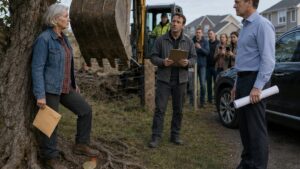
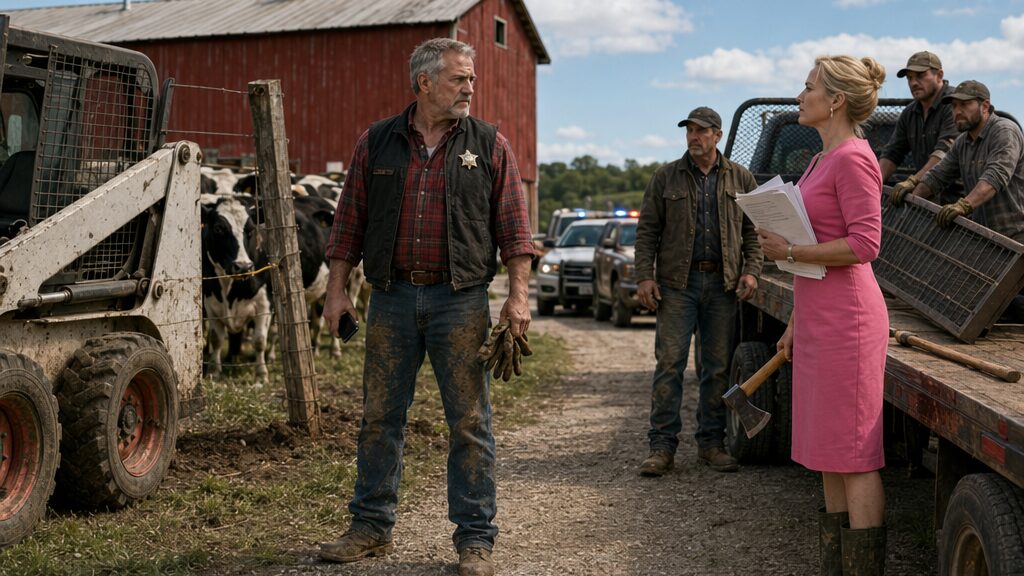
The skid steer was already running when William Walker stepped out of the barn, its bucket lifted under the first reinforced fence panel like a hand prying loose a rib.
One worker had a chain looped around a cedar post. Another stood near the truck bed, guiding the panel as it came free. Fresh dirt spilled from the posthole onto the gravel lane. Beyond the broken section, three Holsteins pressed their black-and-white heads toward the widening gap, curious in the patient, dangerous way cattle could be when a boundary stopped meaning anything.
William did not shout.
He crossed the lane with his phone in one hand and his work gloves in the other. Mud clung to the cuffs of his jeans. His red plaid shirt was still damp at the elbows from washing down the milking room, and the badge clipped to his black vest caught the morning light only when he turned.
“Shut the machine off,” he said.
The operator looked toward the woman standing beside the crew truck.
Margaret Roberts had dressed like she expected to be photographed. Pink dress, polished hair, muddy boots too new for the ground she was standing on. A folder of papers was tucked beneath her arm, and a small hatchet hung from her right hand, its blade clean enough to prove it was more symbol than tool.
“Keep working, Paul,” she said.
The crew supervisor, Paul Miller, did not move. His eyes shifted from Margaret to William, then to the badge.
William lifted his phone. “I am recording this. Shut the machine off until you show me the order.”
The skid steer coughed once and went quiet.
Margaret’s mouth tightened. “You were notified.”
“I was in my barn ten minutes ago,” William said. “You came onto my property with machinery while my cattle were inside that pasture.”
“This is not your private kingdom.” Margaret stepped forward and snapped one page out of the folder. “This fence section violates the Heritage Rural Exterior Standards adopted by the association. Reinforced industrial panels, unauthorized post height, nonconforming gate hardware, and no final approval.”
William looked past her at the missing panel. The postholes were dark, wet, and wide open. The lane ran forty yards beyond them, down to the road where delivery trucks came too fast and school buses came twice a day.
“Put that panel back,” he said.
Margaret laughed once, sharp and humorless. “No.”
Paul shifted his weight. “Ma’am, I was told this was cleared.”
“It is cleared,” Margaret said, not looking at him. “Continue.”
William stepped between the skid steer and the next post.
He did not put his hands on the machine. He did not raise his voice. He simply stood where the bucket would have to go through him to reach the fence.
Margaret’s eyes flashed. “You think that badge lets you ignore the rules?”
“No,” William said. “That badge is why I’m asking you to follow them.”
The worker near the truck stopped tying down the panel. The cows pushed closer. One of them bumped the temporary rope William had strung along the inside rail the night before, after the old storm-damaged boards had finally begun leaning toward the road.
Margaret thrust the paper toward him. “Emergency removal authorization. Approved this morning.”
“This morning,” William repeated.
“That’s what I said.”
“What time?”
Her chin lifted. “The time is on the notice.”
William did not take the page. “What time did the crew arrive?”
Margaret looked at Paul.
Paul cleared his throat. “Little before eight.”
William looked at the sun, then at the long tracks pressed into the damp gravel. “And what time was the notice delivered?”
Margaret’s hand tightened on the papers.
Before she answered, a siren chirped once at the end of the lane.
Two sheriff vehicles rolled past the old mailbox and came to a slow stop behind Margaret’s SUV. A deputy stepped out first, then another. Richard Young took off his sunglasses as he approached, his gaze taking in the skid steer, the loosened posts, the cows, the phone in William’s hand, and Margaret’s hatchet.
“Sheriff,” Richard said, careful.
Margaret turned so fast the papers slapped against her dress. “Good. You’re here. I want him removed from the work area before someone gets hurt.”
Richard did not answer her right away.
William hated that pause. He hated the way every person on the lane suddenly remembered who he was in town, what he wore on his vest, what authority followed him into rooms even when he did not ask it to. He had spent thirty-four years learning that the badge could settle a room too quickly. On his own land, in front of his own torn fence, that power felt like a trap.
“Deputy Young,” Margaret said, louder. “This man is interfering with lawful HOA enforcement.”
Richard glanced at William. “Who called 911?”
“I did,” Margaret said. “There is a livestock hazard and a noncompliant structure.”
William’s jaw moved once.
“You called 911 to report me?” he asked.
Margaret pointed at his badge. “I called because you refused to comply.”
William looked at Richard, then back at her. “Margaret, this is my office.”
For the first time that morning, her certainty flickered. Just a small thing. A blink held too long. A glance at the other deputies.
William lowered his phone slightly. “But that is not why the work stops.”
Margaret recovered fast. “Then why?”
He pointed toward the fence gap. “Because you do not have a court order. Because an HOA enforcement notice is not a right to enter and dismantle livestock containment before proper notice. Because your crew is opening a road hazard and calling it compliance.”
“The hazard is your fence,” she said.
“No.” His voice stayed even. “The hazard is what happens when that fence is gone.”
One of the cows leaned hard against the temporary rope. The line stretched and twanged against a post. Paul looked at it, then at the open truck bed where the first removed panel lay.
Margaret flipped through the papers and pulled out another page. “You were denied because you used nonapproved materials. The association gave you sufficient opportunity to correct it voluntarily.”
“I submitted a repair request four weeks ago.”
“You submitted an incomplete request.”
“It was storm damage.”
“It was an exterior modification.”
“It was containment.”
“It was noncompliant.”
The words struck the lane like tools dropped one by one, each useful in another place, each useless here.
Richard stepped closer. “Sheriff, I need to treat this as a property dispute and a 911 response.”
William nodded. He did not like the formality, but he respected it. “Do your job.”
“I intend to.” Richard turned to Margaret. “Ma’am, set the hatchet down on the truck bed.”
Margaret looked offended. “This is for marking stakes.”
“Set it down.”
After a stiff second, she placed it on the truck bed beside William’s fence panel.
Richard looked at Paul. “No more work until we know what authority you’re acting under.”
Paul raised both hands slightly. “Fine by me.”
Margaret’s face flushed. “This is absurd. He is using his position to bully this board.”
William gave a short, dry breath that was almost a laugh and not quite. “I have not used my position yet.”
“That sounded like a threat.”
“That sounded like restraint.”
The lane went quiet except for cattle breathing and a chain swinging lightly against the skid steer bucket.
Richard took the papers from Margaret and read the top page. His brow tightened, not enough for anyone else to notice unless they had known him for twenty years. William noticed.
“What?” William asked.
Richard looked up slowly. “The complaint does not just say HOA violation.”
Margaret reached for the page. “It is all in there.”
Richard kept it out of her hand. “It says your fence repair created a livestock nuisance and public hazard.”
William looked toward the open gap, then at the panel already loaded in the truck.
Richard’s voice dropped. “Sheriff, according to this, the hazard they called in is yours.”
Chapter 2: The Notice Was Left Too Late
The violation notice was wedged into William’s front door so neatly it looked staged.
No dust on the folded edge. No dampness from the morning air. No mud splatter, even though the crew’s tire tracks had cut deep black arcs across the lane before eight. The paper had been placed there after the machinery arrived, after the first panel came loose, after Margaret already had men on his land.
William stood on the porch with the notice in his hand and felt his anger cool into something heavier.
Richard stood two steps below him, notebook open. “Time?”
William turned the page. “Notice says seven forty-five.”
Richard looked at the gravel drive. “You saw it when?”
“After you stopped the crew. Nine eleven.”
“Anyone else in the house?”
“No.”
“Doorbell camera?”
William’s mouth tightened. “Ruth wanted one. I never put it in.”
Richard wrote that down without comment.
The old farmhouse behind William held its silence the way it had since Ruth died. A porch swing hung near the railing, one side slightly lower than the other because William had never fixed the chain. He fixed barns, gates, engines, water lines, calf stalls. He had let the house keep its small broken things because repairing them felt too much like admitting she was not coming back to point them out.
He folded the notice once and slid it into his shirt pocket. “I need my files.”
In the barn office, the air smelled of dust, iodine, old leather, and printer ink. William unlocked a metal cabinet and pulled out a folder marked Fence Repair—North Lane. Inside were sketches, invoices, material receipts, two photographs of the old storm-damaged rails, and the HOA application he had dropped off four weeks earlier.
Richard stayed by the doorway, giving him space.
William set the application on the desk. “Date-stamped.”
Richard leaned in. “Received.”
“That means they had it.”
“It means they received something.”
William looked at him.
Richard did not soften it. “I’m not arguing with you. I’m telling you what they’ll say.”
William flipped through the pages. There was the contractor estimate. There was the photograph of the cracked cedar posts after the spring storm. There was the note explaining replacement panels would be reinforced steel-faced wood, painted dark brown to match the existing fence.
There was not, he realized, the county livestock containment notice.
He checked again.
Then a third time.
The space where it should have been seemed to widen with every page.
Richard saw his hand stop. “Missing something?”
William opened the second drawer, then the third, then a stack of papers beneath a coffee-stained extension report. “I had it.”
“What?”
“The containment letter.” William’s voice came out flatter than he intended. “After the last windstorm, the county insurance inspector said if the north fence failed again, I needed reinforced repair before summer hauling picked up. I had the letter.”
“But you didn’t file it with the HOA packet?”
William found the copy under a feed invoice, clipped to a different folder. The paper was creased at the corner. County letterhead. Clear language. North boundary fence recommended for immediate livestock containment reinforcement due to proximity to public gravel access road.
He stared at it.
Richard waited.
“I meant to attach it,” William said.
It sounded weak even to him.
Ruth would have looked at him over her glasses and said, You meant to. That helps nobody who has to read your mind.
He placed the letter beside the HOA packet. The difference between them was brutal. One showed damaged fence boards. The other explained why the repair mattered.
Without the second, Margaret had seen only materials, height, appearance, rules.
William rubbed his thumb over the old crease. “I told them it was urgent.”
“In writing?”
“I wrote storm damage.”
Richard’s face did not change, but his silence did.
William pushed back from the desk. “Don’t look at me like that.”
“I’m not.”
“You are.”
“I’m looking at the problem.”
“The problem is they came onto my land.”
“That is one problem.” Richard tapped the missing attachment. “This is another.”
William stood still, the barn office suddenly too small around him. Outside, a cow bawled near the half-open line, and a worker’s chain clanked as Paul’s crew waited beside the truck, doing nothing and still being paid.
His phone buzzed on the desk.
The email subject line was from the HOA board account.
Emergency Hearing Notice and Cost Assessment.
William opened it.
Margaret’s language was clean, formal, and cold. The board would meet that evening to address the unauthorized reinforced fence installation, emergency removal costs, continuing daily fines, and potential recovery of enforcement expenses. Attached were photographs of the fence, the removed panel, and William standing in front of the skid steer.
Not one photograph showed the cows pressing against the gap.
Not one showed the road.
Richard read over his shoulder. “They’re moving fast.”
“They started before I knew there was a meeting.”
William scrolled down. At the bottom was a line in bold.
Failure to comply may result in continued removal action at owner expense.
His hand closed around the phone until the case creaked.
Richard said, “Let me document the notice timing. That helps.”
William turned toward him. “Do not help me because I’m sheriff.”
“I’m not.”
“Do not hurt them because they embarrassed me.”
“I won’t.”
“And do not stand there pretending this is ordinary.”
Richard shut his notebook. “It stopped being ordinary when they called 911 while taking down the thing they called dangerous.”
For a moment, neither man spoke.
William picked up the county containment letter. It should have been the first page Margaret saw. It should have been in the packet. It should have been clipped to every photograph and every receipt. Instead, it had sat in the wrong folder because he had assumed the need was obvious.
He could hear Ruth in the pause.
Don’t make people guess what matters.
He slid the letter into a new folder, then added copies of the notice, the application, the invoices, and the photographs. His hands moved carefully. Too carefully. The way they did when he was angry enough to make a mistake and knew it.
Another email arrived before he closed the folder.
This one came directly from Margaret.
Richard saw William’s expression change. “What now?”
William opened the attachment.
A property survey filled the screen, old lines and shaded sections marked in red. Margaret’s message was only two sentences.
The attached survey confirms the reinforced fence section sits within the association-controlled drainage and access easement. Removal will continue pending board review.
William stared at the red line crossing the place where his fence had stood for twenty-two years.
Richard leaned closer. “Is that accurate?”
William did not answer right away.
Outside, one of the cows pushed the temporary rope again, and the sound came through the barn wall like something beginning to tear.
Chapter 3: The Pink Papers Made It Official
William walked into the HOA clubhouse just as a photograph of his torn-open fence filled the screen.
The room had once been a feed store, and no amount of paint or framed covenant language had completely erased it. The floor still dipped near the old loading door. A faint smell of grain lived beneath the coffee and printer toner. Folding chairs faced a long table where the board sat beneath a sign that read Heritage Rural Estates Community Association.
On the screen, William looked like a man blocking lawful work. The skid steer sat behind him. Paul’s crew stood idle. Margaret’s papers were visible in the corner of the frame, bright pink tabs clipped to the top.
The cows, the road, and the missing county letter were not in the picture.
Margaret stood beside the projector with the confidence of someone who had already arranged the room before the other side arrived. The hatchet was gone, replaced by a laser pointer.
“Sheriff Walker,” she said.
“William is fine.”
A few people turned at the title. He saw it land. Sheriff. He hated that it entered the room before his evidence did.
Anna Hill sat at the board table with a calculator, a legal pad, and the expression of a woman trying not to inherit someone else’s mess. She glanced at him, then at the folder under his arm.
“Please take a seat,” she said.
“I’ll stand.”
Margaret clicked to the next slide.
There it was: his fence before the removal. Reinforced panels, dark-stained wood facing, steel bracing hidden badly from this angle because the repair was unfinished. The photo made the structure look heavier than it was, almost industrial against the older cedar rails.
“This,” Margaret said, “is not a repair. It is an unapproved exterior modification.”
William heard the room accept the sentence before anyone questioned it.
Margaret continued. “Heritage Rural Standards require exterior structures visible from association roads to maintain consistent material, height, and historical appearance. Mr. Walker installed reinforced panels exceeding the approved post profile and failed to obtain final authorization.”
“It was storm damage,” William said.
Margaret did not look at him. “He submitted a partial request. No emergency variance. No county requirement. No engineering attachment. No livestock control exemption.”
Anna looked up. “Mr. Walker, did you submit those documents?”
William opened his folder. The county letter was on top now, clean and copied. It looked almost accusing.
“Not with the first packet,” he said.
The room shifted.
Margaret’s eyebrows lifted just enough.
William felt the old instinct rise in him—the urge to say less, to let the badge and years and common sense fill in what he did not want to explain. He had stood in kitchens after accidents, on porches after domestic calls, in ditches after rollovers. He knew how to speak when other people were in trouble.
When it was his own need on the table, the words felt like tools with broken handles.
“I should have attached it,” he said. “I didn’t.”
Margaret folded her hands. “Then the board acted on the application it had.”
“You acted before notice.”
“We acted under emergency enforcement authority.”
“You created the emergency.”
A board member murmured. Anna raised one hand. “One issue at a time. Mr. Walker, why was this fence materially different from the old one?”
William pulled out the photographs of the cracked cedar posts. “Because the old one failed twice after spring storms. The north lane carries dairy pickup, feed trucks, school traffic, and neighbors cutting through to the county road. The inspector recommended reinforced containment before summer hauling.”
Margaret clicked the remote again. A covenant section appeared.
“Recommended,” she said, “is not required. And even if some reinforcement were necessary, appearance standards still apply.”
William looked at the screen. “A cow does not care what the rail looks like.”
Margaret’s smile thinned. “The association does.”
That sentence did more damage to her than she knew. Anna’s pen stopped moving.
William saw it, but did not press. Pressing too hard made people defend what they might otherwise reconsider.
Anna turned a page on her legal pad. “Margaret, why was removal started before tonight’s review?”
“Because the violation continued after written notice.”
William took the notice from his folder. “This notice was in my door after the crew arrived.”
Margaret’s chin lifted. “It was posted this morning.”
“What time?”
“As stated.”
“It says seven forty-five.”
“Yes.”
“Your crew arrived before eight.”
Margaret looked toward Paul, who stood at the back of the room in a clean work shirt, arms folded. He clearly wished he had never taken the job.
Anna followed the look. “Mr. Miller?”
Paul rubbed the back of his neck. “We pulled in about seven forty. Maybe seven thirty-eight. I didn’t check the door. I was told notice was handled.”
Margaret’s face hardened. “Approximate times should not distract from the violation.”
“They matter if removal started before proper notice,” Anna said.
For the first time, Margaret’s confidence showed strain. She opened a different folder and removed a large folded survey.
“Then let us address the underlying land issue,” she said.
William felt Richard’s warning from that morning settle in his stomach.
Margaret spread the survey across the table and weighted the corners with a coffee mug, a stapler, her phone, and a stack of pink-tabbed papers. Red marker circled the north fence line.
“This association-controlled drainage and access easement runs here,” she said, tapping the paper. “Mr. Walker’s reinforced fence section extends across it. That means the structure is not merely noncompliant in appearance. It obstructs association-controlled land.”
The room went quiet in a different way.
Anna stood to look closer. “What year is this survey?”
“Recorded and attached to the founding documents,” Margaret said.
“What year?”
“Nineteen ninety-eight.”
William stared at the red line. The creek bend on that map sat where it had been before the flood year, before the county cut the bank back, before the north ditch was moved and stone-set. But on paper, under fluorescent lights, with Margaret’s finger pressed firmly to the line, it looked official enough to hurt him.
Anna looked at William. “Can you disprove this tonight?”
He could explain the creek. He could talk about old markers. He could say the fence had stood in that place longer than Margaret had lived under the association’s rules.
But disprove?
Not tonight.
“No,” he said.
Margaret closed the folder with care. “Then I recommend the board assess removal costs, maintain the violation, and authorize continued correction of the obstructing section pending verification.”
William looked at the screen again. His torn fence. His unfinished repair. His own missing attachment. His silence had made room for every clean, wrong sentence in that room.
Anna conferred quietly with the other board members. The minutes stretched. William heard the old building creak around them, as if the feed store itself disliked what it had become.
Finally Anna looked up.
“The board will pause final cost assessment for forty-eight hours,” she said. “During that time, Mr. Walker may submit updated survey evidence and county documentation. However, the existing removal authorization remains partially active for any section deemed to obstruct the easement. No additional reinforcement may be installed until review.”
William’s hand tightened around the back of the chair in front of him. “You’re leaving the fence open.”
Margaret answered before Anna could. “You may use temporary compliant measures.”
“Temporary rope won’t hold cattle.”
“Then perhaps,” Margaret said, “you should have waited for approval.”
William looked at the projected photograph one last time. In it, he stood in front of the machine, looking like the obstacle.
By morning, if the cows found the gap, the picture would change.
Chapter 4: The Survey Proved the Wrong Thing
A cow had her muzzle under the temporary rope before William reached the fence line.
“Back,” he said, sharper than he meant to.
The Holstein lifted her head, chewing as if she had only been testing a blade of grass instead of the weak place between pasture and road. The rope bowed where her neck had pressed it. One cedar stake leaned toward the gravel, already loose in soil torn by the skid steer tracks.
Richard stood a few feet behind William with Margaret’s survey unfolded over the hood of his cruiser. The paper flapped in the light wind, its old red line bright against faded black ink.
“That rope won’t hold if they push together,” Richard said.
“I know.”
“You want me to call Paul’s crew back to brace it?”
“Not until I know where I can put the brace without giving Margaret another page to wave.”
William crouched beside the exposed posthole. The earth still held the round shape of the post the crew had pulled. Dark clay, crushed gravel, a pale root cut clean by the auger when he had repaired the fence two days earlier. He laid his tape measure from the posthole to the nearest marker stone, then checked it against the notes he had pulled from the barn.
The numbers did not match Margaret’s survey.
They matched his.
That should have calmed him. It did not.
Richard pinned one corner of the survey under his palm. “This map shows the creek bend cutting closer to the lane.”
“It used to.”
“When?”
“Before the flood year.”
Richard looked up. “How long before?”
“Twenty-one years.” William stood and pointed toward the tree line beyond the pasture. “Water came through hard that spring. County cut the bank back afterward and set stone along the ditch. The old creek line was abandoned when they rebuilt the drainage.”
“Was it recorded?”
William did not answer quickly enough.
Richard’s expression changed. Not accusing. Worse. Careful.
William walked past him toward the shallow creek bed. The ditch was mostly dry now, a strip of stones and weeds running behind the pasture before turning toward the county road. Orange survey flags from the 1998 map would have placed the easement where the old water line once curved. But the actual drainage had shifted west after the county work, leaving his north fence where it had always been: on his side of the pasture, outside the usable access line.
He knew it because he had lived with the land.
The board would want paper.
The cow pressed the rope again behind him. The stake creaked.
“Back,” William called, and clapped once.
She stepped away. Two others moved closer to see what she had found.
Richard folded the survey and walked to the creek bank. “If the drainage changed and the easement description wasn’t updated, Margaret’s map can look right and still be wrong.”
“That’s a pleasant kind of wrong.”
“It’s the kind that wins meetings.”
William looked toward the red barn. The roofline, the lane, the pasture—all of it had the steady look of things that had survived because someone kept repairing them before they failed. He had done that his whole adult life. Tightened bolts. Rehung gates. Replaced boards. Fixed what broke. The idea that a line on old paper could make the obvious vanish felt like being asked to prove his own hands belonged to him.
“I need the old county work order,” he said.
They found it in the barn records room after thirty minutes of dust and frustration.
The room was narrow, lined with metal shelves and plastic tubs Ruth had labeled in her careful square handwriting. Feed contracts. Equipment warranties. Calving records. Insurance. Drainage. Fence.
William pulled the drainage tub down too fast, and a stack of folders slid onto the floor.
Richard bent to help.
“I’ve got it,” William said.
Richard paused, then stood back.
The words hung there, too familiar.
William knelt among the spilled folders. Ruth’s handwriting looked up at him from every tab, patient and unimpressed. She had believed in labels, copies, signatures, and sending one extra page even when everybody involved “already knew.” William used to tease her for it. She used to tell him memory was not a filing system.
He opened the folder marked North Ditch / Flood Year.
Inside were photographs of the washed-out bank, a county drainage notice, a contractor invoice, and a hand-drawn sketch Ruth had made in blue ink. At the bottom of the folder, clipped to the old work order, was a small note in her handwriting.
File containment letter with every fence repair. Don’t assume they remember why it matters.
William did not move.
Richard, from the doorway, said, “Sheriff?”
William folded the note slowly, then unfolded it again, as if the act might make it say something else.
“She told me,” he said.
Richard said nothing.
William slid the note beside the county work order and the containment letter. The pieces were there now: the old survey, the drainage shift, the livestock containment recommendation, the missing attachment. Not one magic paper. A chain. A chain he should have kept together from the beginning.
Outside, wood cracked.
Both men turned.
The sound came again—thin, sharp, wrong.
William was out of the records room before Richard reached the door. He crossed the barn aisle at a run and burst into the lane.
The temporary rope had not snapped. The stake had.
One end hung loose across the dirt. The cow that had been testing it stood still, startled by her own success. Behind her, a small brown-and-white calf slipped through the opening where the reinforced panel had been removed, hooves skidding in the churned mud.
“Hey!” William shouted.
The calf bolted.
Not toward the barn. Not toward the inner pasture. Toward the gravel lane.
William ran after it, boots hitting the hard ground, one hand raised low and wide the way Ruth used to when turning calves back from a gate. Richard shouted behind him, already moving toward the cruiser.
The calf reached the open lane and hesitated, head high, ears pricked.
From down the road came the sound William knew before he saw it: diesel engine, loose gravel, the faint rattle of windows.
A school bus horn blasted once, long and panicked, as the calf stepped into the road.
Chapter 5: The Road Showed What the Fence Protected
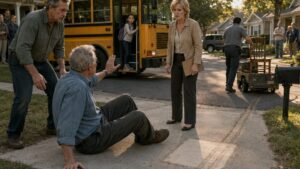
The calf shot across the gravel just as the school bus brakes grabbed hard enough to make every window tremble.
Dust kicked up around the tires. The bus angled slightly toward the ditch, stopped crooked across the lane, and sat there with its red lights flashing though its door stayed shut. The calf froze in the road, legs stiff, white face turned toward the huge yellow shape bearing down on it no longer but still close enough to reflect in its dark eyes.
William slowed before he reached the animal.
Running straight at a calf made it run harder. He knew that. His body remembered even while his heart hammered against his ribs.
“Easy,” he said, breath tight. “Easy now.”
Behind him, Richard’s cruiser door slammed. A neighbor’s truck stopped on the far side of the bus. Someone leaned out but did not speak. The bus driver held both hands high against the wheel, face pale behind the glass.
The calf took one step sideways.
William lowered his shoulders. He moved in a half circle, gently closing the angle between the calf and the open field beyond the fence. The animal tossed its head, confused by the bus, the road, the people, the gap that should not have been there.
“Don’t crowd her,” William called.
Richard stopped where he was.
Then William saw Margaret.
She stood near her SUV at the farm entrance, papers clutched to her chest, one hand pressed against the open door. He had not seen her arrive. Maybe she had come to inspect the half-open fence. Maybe she had come to make sure the board’s order still held. Whatever reason had brought her back, it had placed her where she could see the bus, the calf, and the missing rail all in one line.
Her face had gone empty.
Not satisfied. Not frightened in the ordinary way.
Gone.
The calf shifted toward the ditch.
William clicked his tongue softly. “No. Not there.”
A larger cow bawled from the pasture, and the calf answered, high and distressed. That sound turned it back. William used the moment, stepping wide, then closer, guiding without rushing, one hand out, palm low.
The bus driver finally cracked the window. “Is it safe?”
“Stay put,” Richard said.
William angled the calf toward the lane opening, not the broken fence. If he could push it along the gravel shoulder, through the service gate near the barn, he could get it inside the inner lot. Slow. No sudden moves. No pride. No anger.
The calf broke left.
William moved with it and slipped in the gravel. His knee struck the ground hard, pain flashing up his leg. The calf darted past him.
For one sick second, it headed straight for the bus again.
Then Margaret stepped into the lane.
“Hey,” she said, but the word was too small.
The calf stopped anyway, startled by the bright color of her dress and the papers flapping in her hand.
William got to his feet. “Margaret, do not wave those.”
She looked down, as if surprised to find them there.
The calf backed away from her and turned just enough for William to close the angle. Richard moved in from the other side, slow now, understanding. Together they made a loose human gate, guiding the calf along the shoulder and through the service opening near the barn.
When the calf crossed into the inner lot, William shut the gate with both hands and dropped the latch.
Only then did the road breathe again.
The bus driver sat with his forehead against one hand. The neighbor in the truck muttered something William could not hear. A child’s face appeared in one bus window, wide-eyed, then disappeared when the driver turned back.
William leaned against the gate. His knee throbbed. His palms were scraped. The calf stood near its mother, shaking off fear already, alive because luck had arrived before weight and speed and steel.
Richard came up beside him. “You all right?”
“No.”
The answer surprised both of them.
Margaret had not moved from the lane.
Richard looked toward her, then back at William. “You want me to take a statement?”
“From the driver. From the neighbor. Photos of the gap and the broken stake.”
“And from her?”
William watched Margaret’s hand open. The papers bent in the wind, but she did not tighten her grip.
“Yes,” he said.
Richard started toward her.
William stayed by the gate until he trusted his leg, then followed.
Margaret spoke before either man reached her. Her voice was quiet enough that the idling bus nearly swallowed it.
“It was a truck last time.”
William stopped.
She stared past him at the road. “Not a bus. A feed truck. Years ago. Before I was on the board.” Her fingers pressed into the edge of the folder. “A cow got loose from the south pasture near the community entrance. The driver swerved. Hit the drainage culvert. Nobody died, but the passenger sued everybody whose name appeared anywhere near the road.”
William said nothing.
Margaret blinked, and the present returned to her face in pieces. First embarrassment. Then defensiveness. Then the stiff posture she wore like armor.
“That is why the association has standards,” she said. “That is why we cannot let every owner build whatever they think is necessary.”
William looked at the bus, still crooked in the lane. “You saw what happened when the fence came down.”
“I saw an animal escape from your property.”
“Through the hole your crew opened.”
“Through a temporary barrier you chose to use.”
His anger rose fast enough to blur the edges of the road. He had to look away from her to keep his voice level.
“I chose it because your board left me with a half-removed fence and a threat of fines if I repaired it.”
“You chose to install first and ask later.”
“I asked four weeks ago.”
“You submitted incomplete paperwork.”
The words hit the same place because they were partly true.
William wiped dirt from his palm and found blood in the scrape. He closed his hand.
Margaret saw it. Something in her expression moved, but she held her line.
Richard returned from the bus, face set. “Driver says he had to brake hard. No contact. Kids are shaken, but nobody reports injury.”
“Good,” William said.
“County road office will hear about it.”
“I know.”
Richard hesitated. “And the dairy buyer called dispatch while I was speaking to the driver. They were delayed at the lower road and saw the bus lights. They’re asking whether the north lane remains safe for pickup.”
William shut his eyes for one beat.
The dairy route. If the buyer marked the lane unsafe, even temporarily, milk pickup could be suspended or rerouted at his expense. One day was painful. Two days spoiled product. More than that meant questions from insurance, lenders, contracts he could not afford to have questioned.
Margaret’s gaze sharpened. She understood the word buyer even if she did not understand the work behind it.
Richard lowered his voice. “County may restrict use until containment is secured.”
“The fence needs to go back.”
“Under whose order?” Richard asked.
There it was.
If William treated the crew’s entry as unlawful removal and pushed charges, the fence became evidence. The dispute could freeze. Lawyers could argue while rope and stakes failed in the real world. If he requested emergency repair approval, he would have to submit the full packet, including the containment letter he had failed to attach and the drainage records he had failed to keep ready.
He would have to say, plainly and publicly, that his silence had helped create the space Margaret used.
Margaret seemed to read the choice forming in him.
“You cannot expect the board to ignore process because today was frightening,” she said.
“No,” William said. “I expect the board to stop pretending process is separate from consequences.”
Her face flushed. “You are not the only person trying to prevent harm.”
For the first time, he believed she meant it.
That made him angrier in a cleaner, sadder way.
“No,” he said. “But you are the one who sent a machine to take down a fence before you understood what it held back.”
The bus engine shifted. The driver eased forward after Richard signaled the road clear. As it passed, William saw several children turn to look through the windows at the broken fence, the sheriff in the muddy lane, the woman holding papers against her chest like they could keep anything safe.
When the bus disappeared around the bend, the road felt too quiet.
Richard took out his notebook again. “What do you want to do?”
William looked toward the red barn, the open gap, the cows gathered behind the weak line, and the removed panel still lying in Paul’s truck from the day before.
He could file the complaint. He could make Margaret answer for the trespass, the timing, the damage. Part of him wanted the clean authority of that. He wanted a report number and signatures and consequences that did not require him to admit he had left the most important page out of the first folder.
Then the calf bawled from the inner lot.
William felt Ruth’s note in his shirt pocket, folded against the county letter.
Don’t assume they remember why it matters.
He looked at Richard. “Get me the county attorney.”
Richard’s pen stopped. “For charges?”
William shook his head once, the motion costing him more than it should have.
“For an emergency containment order review,” he said. “And tell Anna Hill I’m bringing every page I should have brought the first time.”
Chapter 6: He Chose the Order Over the Badge
William placed his badge on the county meeting room table before he sat down.
The sound was small. Metal against wood. But every person in the room heard it.
Margaret looked at the badge, then at him. Anna Hill sat two chairs to her left with a folder open and a pen already in her hand. Richard stood near the back wall, not beside William, not beside the board. Paul waited near the door in a stiff work shirt, holding his cap like a man attending the wrong kind of service.
The county attorney sat at the head of the table. No robe, no raised bench, no ceremony. Just a pitcher of water, a stack of documents, and a room full of people who had learned too late that a fence could become an argument about everything behind it.
William kept his hands flat on the table.
“I’m here as the property owner,” he said.
Margaret’s mouth tightened. “That distinction has not always been clear.”
“No,” William said. “It hasn’t.”
Anna looked up.
William let the answer sit. He did not soften it. He did not explain it away.
The county attorney adjusted his glasses. “We are here to determine whether the north boundary fence repair qualifies for emergency livestock containment under county safety guidance, whether the association’s removal action was procedurally valid, and what immediate measures are required.”
Margaret opened her folder. “The association acted under its authority to correct a visible violation.”
The county attorney held up one hand. “You will have time.”
William opened his own folder. On top was Ruth’s note. He had almost left it at home. It was not evidence in the formal sense. It did not prove a boundary line or invalidate a notice. But it was the page that had made him understand the failure was not only theirs.
He moved it aside and began with the documents that mattered to everyone else.
Photographs of the storm-damaged cedar posts. The original HOA application. The material invoice. The county livestock containment recommendation. The drainage work order from the flood year. A marked comparison of the 1998 survey and the current county ditch alignment.
Piece by piece, he laid out the chain he should have laid out four weeks earlier.
Margaret watched in rigid silence.
When he finished, the county attorney turned to her. “Was the containment recommendation included in the original association packet?”
“No,” Margaret said.
William answered at the same time. “No.”
The room went still.
Margaret looked at him, suspicious of the admission.
William did not look away. “I wrote storm repair. I attached photos and materials. I did not attach the county letter. I should have.”
Anna’s pen paused.
The county attorney asked, “Why not?”
William could have said he was busy. He could have said the association knew the road, knew the cows, knew the history. He could have said any number of things that were partly true and mostly useless.
“Because I assumed the need was obvious,” he said. “Because I don’t like explaining what I think people should be able to see.”
Margaret’s face changed by a fraction.
William looked at her, then at Anna. “That was my mistake. It did not give anyone the right to come onto my land with machinery and remove containment before proper notice.”
Richard moved then, stepping forward with a small stack of papers. “I documented the call response, crew arrival statements, and notice placement.”
The county attorney took the stack.
Richard’s voice stayed even. “Paul Miller stated his crew arrived around seven forty. The posted notice states seven forty-five. Mr. Walker discovered the notice after nine. There is no confirmation that notice was posted before the crew began removal.”
Paul’s ears reddened. “That’s accurate. I was told it was handled. I didn’t see it posted.”
Margaret turned toward him. “You told me your crew would not begin until the site was clear.”
“I said I’d begin when authorized,” Paul said. “I assumed you had the authorization you described.”
“You did have authorization.”
“From the HOA,” he said. “Not from a court. Not from the county. Not from anyone who told me livestock were behind it.”
The words landed harder because Paul did not sound angry. He sounded tired of being the tool someone else had picked up.
The county attorney read through Richard’s notes. “Margaret, who posted the notice?”
She hesitated.
Anna looked at her. “Margaret.”
“I placed it at the door that morning.”
“What time?” Anna asked.
Margaret’s hands moved once over the folder. “Shortly before eight.”
“The crew was already present,” Anna said.
“They had not removed much.”
“That is not the question.”
Margaret’s eyes flashed. For a second William saw the woman from the lane again, papers raised like a shield and a weapon both.
“The association has been threatened over road hazards before,” Margaret said. “You all remember the south entrance claim. You remember the insurance letters. You remember being told one more livestock incident could raise premiums for every home under this association. I acted because delay creates exposure.”
“And yesterday?” Anna asked.
Margaret looked away.
“The bus,” Anna said. “Did the removal reduce exposure?”
Margaret said nothing.
The county attorney turned a page. “The 1998 survey appears to reference a drainage course that was altered by county work after flooding. Based on current alignment and the work order provided, the fence location requires verification but is not clearly within the usable easement as claimed in the removal notice.”
Margaret’s shoulders stiffened.
William felt no triumph. Only the unpleasant relief of a man watching a machine stop inches from a wall after it had already torn off the siding.
The county attorney continued. “The county livestock containment recommendation does not exempt Mr. Walker from all association appearance standards. But it does establish a safety basis for emergency reinforcement. The association may review finish, facing, and reasonable visual conformity. It may not require removal that creates an immediate livestock hazard.”
Anna closed her folder. “Then we need a revised vote.”
Margaret turned to her. “Anna.”
“No.” Anna’s voice was quiet, but the word held. “We reviewed the wrong question. We treated this as an appearance violation when it was a containment repair with incomplete documentation. That does not excuse the missing attachment, William.”
“I know.”
“And it does not excuse removal before proper notice,” Anna said, looking at Margaret.
Margaret’s jaw tightened.
The county attorney drafted the order in plain language. Emergency containment permitted. Existing violation withdrawn pending revised application. HOA allowed to require dark-stained wood facing and capped posts matching the original fence profile. Removed section to be restored immediately. No additional removal without further review.
It was practical. Imperfect. Livable.
William could accept livable.
Then the county attorney added the last part.
“The association compliance chair will issue a written withdrawal of the removal notice before work resumes.”
Margaret looked up. “Publicly?”
“To the affected owner, the board, the crew supervisor, and any agency contacted regarding the alleged hazard.”
Richard’s expression did not change, but William saw his eyes shift toward Margaret.
Margaret’s fingers closed over her pen. “You’re asking me to admit fault.”
Anna said, “We are asking you to correct the record.”
“The record is complicated.”
“So was the fence,” William said.
Margaret looked at him then, really looked, as if the room had finally run out of papers to stand between them.
He could have made it harder for her. He could have mentioned the bus again. The hatchet. The 911 call. He could have reached for the badge on the table and let everyone remember what else this could become.
Instead, he picked the badge up and slid it into his vest pocket.
“I don’t need you humiliated,” he said. “I need that fence back before another calf finds the gap.”
The sentence did not absolve her. It did not comfort her. It gave her a path, and that seemed to unsettle her more than accusation would have.
The county attorney pushed the draft order across the table.
Margaret stared at the signature line.
Anna placed her own pen beside it. “Sign the withdrawal, Margaret. Then send it before Paul’s crew returns.”
Chapter 7: The Rails Went Back Where the Cows Waited
The same crew truck returned three mornings later with William’s fence panels stacked neatly in the bed, but this time Paul Miller climbed down before anyone touched a chain.
William stood by the open gap with a posthole digger in one hand and the approved plan clipped to a board beside the lane. The paper fluttered where the violation notice had once been folded against his front door. Same wind. Same gravel. Same red barn behind him. But the truck had backed in slower this time, and no machine engine ran until William nodded.
Paul removed his cap. “We’re here to put it back.”
William looked past him at the panels. The dark-stained wood facing had been added over the reinforced frame, capped and trimmed to match the older fence. The steel was still there, hidden where it could do its work without becoming the argument.
“Set them by the first two holes,” William said. “No bucket near the cows until the brace is in.”
Paul nodded and turned to his workers. “You heard him. Slow.”
The crew moved differently when they were repairing what they had taken. No one swung chains casually. No one laughed. One worker carried the first panel with both hands, careful around the stained face. Another set new caps beside the posts. The skid steer stayed at the edge of the lane, quiet and waiting, its bucket lowered like it had learned manners.
The cows gathered behind the temporary barrier, watching with the same solemn curiosity they had given the demolition. The calf that had reached the road stood close to its mother now, ears flicking, alive and forgetful. William was not.
A dark SUV stopped near the mailbox.
Margaret stepped out with a folder held flat against her side. She wore boots again, but not the polished pair from the first morning. Her dress was plain, her hair pulled back without ceremony. No hatchet. No pink tabs flaring from the papers. She closed the SUV door and stood for a moment as if the lane itself required permission.
Paul saw her and stiffened.
William did not walk toward her.
Margaret came to the clipped board and removed a single page from her folder. “The withdrawal notice.”
William held out his hand.
She did not hand it to him. She signed it first on the hood of her SUV, pressing hard enough that the pen dented the paper. Her name looked smaller than he expected beneath the formal language.
Violation withdrawn. Removal authorization voided. Emergency containment repair permitted under revised exterior finish conditions. Prior hazard complaint corrected.
She passed it to him without meeting his eyes.
William read every line.
Margaret looked toward the fence gap. “The board has been copied.”
“And the county road office?”
“Yes.”
“The dairy buyer?”
Her jaw moved once. “Anna sent it yesterday. I sent a second copy this morning.”
William folded the notice once and clipped it beside the approved plan.
For a second, the two papers hung together: what she had taken back, and what he had finally put forward clearly enough that nobody had to guess.
Margaret’s gaze touched the cows, the road, the school bus tracks still faint in the gravel shoulder. “The association will still require final inspection after installation.”
William nodded. “Reasonable.”
“And maintenance of the exterior facing.”
“Reasonable.”
Her eyes flicked to him then, surprised not by the words but by the absence of a fight.
He could have given her one. Richard had told him there was still a clean path for a trespass complaint, still a question of improper emergency reporting, still enough in the notice timing to make the association uncomfortable for months. The county attorney had not told him to drop anything. Anna had not asked him to.
The papers were there if he wanted them.
So was the badge.
William looked at Paul’s crew easing the first restored panel into place. The post slid into the old hole, then deeper, corrected by an inch to match the current county line. Paul crouched with a level, adjusted, checked again, and called for gravel pack.
“You’ll receive my repair costs,” William said.
Margaret’s shoulders tightened.
“Documented,” he added. “Not inflated. Not punitive.”
She swallowed. “The board agreed to cover the reinstatement labor through the removal contractor.”
Paul looked over from the posthole. “I’m absorbing part of it.”
William turned to him.
Paul wiped his hands on his jeans. “I should have asked what the fence held before I started pulling it out. Authorization or not.”
Margaret looked away.
William studied Paul for a moment, then nodded once. “Set the next post true.”
“Yes, sir.”
The work resumed.
This time, the sounds were different. Gravel tamped around posts. Drill bits tightened hardware. Wood tapped into alignment. A rail slid home with a solid, low knock that William felt in his chest. Piece by piece, the open place became a boundary again.
Margaret stayed by her SUV, arms folded, watching the crew undo what her order had done. She did not apologize. William did not ask for it. Some apologies came too fast and left nothing changed. This, at least, was slower. Harder to perform.
When the first panel stood braced, William unclipped Ruth’s folded note from his shirt pocket. He had carried it every day since finding it in the drainage folder. The paper had softened at the creases.
He did not show it to Margaret. It was not for her.
Paul called, “Ready for the second.”
William slid the note back into his pocket and stepped forward. “Bring it in.”
The second panel fit more cleanly than the first. By noon, the reinforced section ran from the gate to the older cedar rails with capped posts and dark facing, strong without shouting about itself. The cows pressed near it, tested it once, and found no answer. The calf nosed the lower rail, then turned back toward its mother.
Margaret signed the final site acknowledgment on the same board where the approval plan hung. Her pen paused above the date.
“There will be people who think I backed down because you’re sheriff,” she said.
William leaned one hand on the finished rail. “There will be people who think I only won because I’m sheriff.”
She looked at him then.
He said, “Both would be wrong.”
The sentence sat between them, not friendly, not cruel.
Margaret capped the pen. “I thought I was preventing another road claim.”
“I know.”
“That doesn’t excuse the timing.”
“No.”
“And your first packet was incomplete.”
William’s mouth tightened, but he nodded. “Yes.”
She seemed almost relieved that he did not fight the truth that belonged to him. “Then maybe the record should say both.”
“It can.”
Margaret placed the signed acknowledgment beneath the clip. For the first time since the morning of the demolition, her hand was empty.
She walked back to her SUV without looking at the cows.
Paul’s crew loaded the leftover stakes, broken rope, and bent temporary hardware into the truck. The removed pieces that could not be reused went last. William watched them go not with satisfaction, but with the quiet attention a farmer gives anything that has failed and taught him where the strain was.
Richard arrived near the end, not in a hurry, not with lights. He parked by the mailbox and came up the lane in uniform.
“Looks better,” he said.
“Looks closed,” William answered.
Richard glanced at the approved plan, the withdrawal notice, and the final acknowledgment clipped together. “You filing anything else?”
William looked toward Margaret’s SUV disappearing down the road. Then toward the school bus route. Then at the cows standing behind the rails.
“I’m filing copies,” he said. “Everywhere they should have been the first time.”
Richard nodded. “That sounds like you.”
“No,” William said, and touched the note in his pocket. “It sounds like Ruth.”
When the crew truck finally left, the lane settled into the ordinary noises of the farm: cattle shifting, wind moving across the pasture, a tractor ticking as it cooled near the barn. The sheriff vehicles were gone. The skid steer was gone. Margaret’s papers were gone except for the ones that corrected the damage they had caused.
William stood alone by the fence and checked the latch twice.
Not because he doubted it.
Because it mattered.
The approved plan and withdrawal notice remained clipped to the post beside the gate, where anyone coming up the lane could see them. Behind the repaired rails, the cows lowered their heads to graze, contained not by argument, not by authority, not by pride, but by a fence strong enough to do the job it had always been meant to do.
The story has ended.