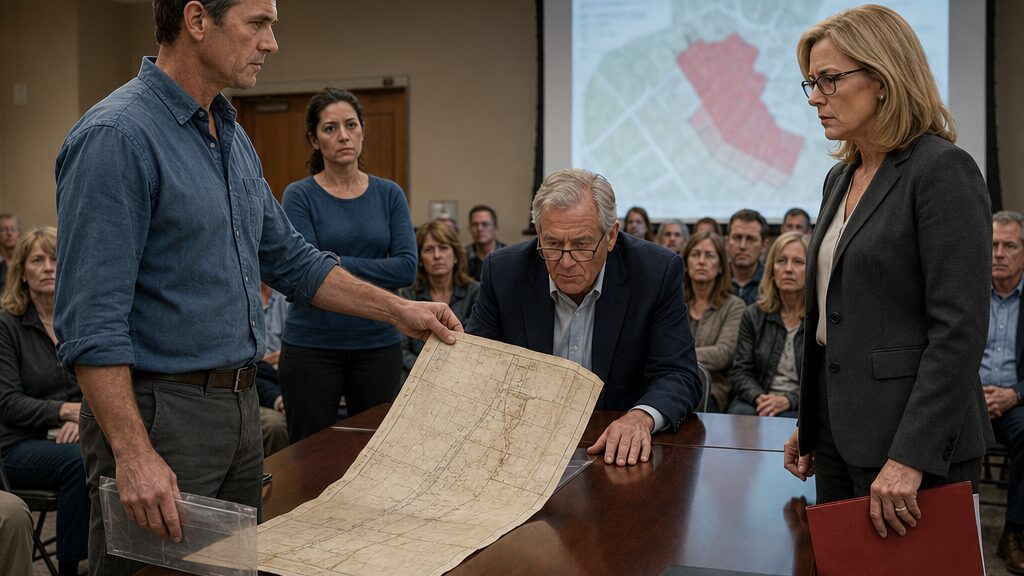
Three Days After Buying the Farm, He Was Billed for a Neighborhood He Never Joined
Chapter 1: The Invoice Waiting Inside the Farm Mailbox
The envelope was stamped PAST DUE in red before David Harris had owned the farm long enough to receive a utility bill.
He stood beside the roadside mailbox with one boot in the gravel and the other in the grass, staring at his mother’s address beneath a printed demand for $9,200. Beyond him, the barn leaned into the afternoon light, its red paint faded almost brown. Across the road, identical stone entrance pillars marked the beginning of Cedar Ridge, the subdivision that had spread along the farm’s eastern fence during the years David stayed away.
The notice identified the property as Lot 87.
The Harris farm had never had a lot number.
David read the first page twice. Retroactive assessments. Storm-repair surcharge. Late fees. Administrative penalties. The balance supposedly covered more than three years, though he had taken legal possession three days earlier.
A white crossover slowed near the mailbox. It turned onto the farm drive without signaling and stopped in front of him.
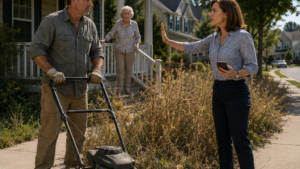
The woman who stepped out wore pressed slacks, low heels, and an expression that suggested she had already explained this matter too many times. She carried a clipboard under one arm.
“David Harris?”
He folded the notice once. “Who’s asking?”
“Karen Miller. Cedar Ridge compliance chair.” She nodded toward the envelope. “I see you received our account statement.”
“Account statement?”
“The previous notices were returned. Now that ownership has transferred, we can finally update the file.”
David looked from her clipboard to the subdivision roofs beyond the split-rail fence. “There shouldn’t be a file.”
Karen’s expression barely shifted. “The property has been carried as delinquent for some time.”
“My farm isn’t in your HOA.”
She inhaled slowly, the way people did when preparing to correct a child. “Every property using Cedar Ridge access and infrastructure contributes.”
“This driveway meets the county road.”
“The rear entrance connects to Willow Lane.”
“The rear gate has been chained for years.”
“That isn’t what our records show.”
David held up the notice. “Your records call this place Lot 87.”
Karen glanced at the page but not long enough to read it. “Parcel designations change.”
“County parcels do. Farms don’t turn into subdivision lots because someone types a number into a spreadsheet.”
Her jaw tightened. “The balance is already overdue. If you dispute it, the board meets Thursday evening.”
“I’m not disputing the amount.”
“Then I’m glad we understand each other.”
“I’m disputing your right to send it.”
For the first time, Karen looked past him toward the farmhouse. The porch sagged at one corner. Blue tarps covered a section of roof. A stack of salvaged lumber lay under the pecan tree where David had begun sorting repairs.
“You’ve taken possession of a property that benefits from our roads, drainage system, and patrol contract,” she said. “You may not like how the obligation reached you, but that doesn’t make the obligation disappear.”
David almost told her that he had spent fifteen years estimating construction costs and could identify a manufactured obligation faster than most people could read one. Instead he folded the invoice again.
“Thursday,” he said. “What time?”
“Seven. Cedar Ridge clubhouse.” She handed him a hearing notice from her clipboard. “If the board authorizes collection costs, the balance will increase.”
She returned to her car before he could ask how a volunteer board intended to collect against land outside its boundary.
The tires scattered gravel as she left.
David carried the envelope into the farmhouse and set it on the kitchen table, where the outline of his mother’s last coffee mug still marked the varnish. Most of the room remained as Elizabeth had left it: seed catalogs by the telephone, grocery lists clipped to the refrigerator, a row of canning jars on the sill.
He had spent the first three days fixing leaks and avoiding drawers.
Now he opened them.
The farm papers had always been kept in the narrow cabinet beside the pantry. He found tax receipts, equipment warranties, veterinary records from animals long gone, and a deed folded inside a cracked plastic sleeve. Beneath it lay an old county survey, yellowed at the creases.
David spread it beside the invoice.
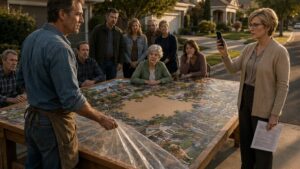
The survey showed the Harris parcel as an irregular block of forty-one acres. Cedar Ridge curved around its eastern and southern edges but did not include the farmhouse, barn, fields, or main drive. A narrow strip near the rear boundary touched what was now Willow Lane.
He checked the parcel number printed in the lower corner.
Then he checked the invoice.
One digit differed.
David found his phone and called the number on the notice. Karen answered after two rings.
“The parcel number is wrong,” he said.
“That number came from our management records.”
“It belongs to the strip east of the drainage easement, not the farm.”
There was a pause, brief but distinct.
“You can present that concern Thursday.”
“You knew there was a separate strip?”
“I know there are several historical documents. The board will review everything together.”
“Why wasn’t everything reviewed before you billed me?”
Her voice cooled. “Because the debt predates your ownership.”
David looked at the $9,200 total. “That doesn’t answer the question.”
“No,” Karen said. “But it explains why the account cannot simply be erased because the name changed.”
The call ended.
David remained at the table, listening to the refrigerator hum. He had assumed the invoice was an ordinary clerical mistake. Karen’s answer suggested otherwise. Someone had assigned the farm a subdivision account long before his mother died, and someone had kept charging it despite returned notices.
He unfolded the survey fully.
Something slid from inside the deepest crease and landed face down on the table.
It was a small square of paper in Elizabeth’s handwriting. David recognized the sharp downward strokes, the block capitals she used when she wanted no misunderstanding.
On one side she had written a date from fourteen months earlier.
On the other were seven words:
DO NOT LET THEM REDRAW THIS LINE.
Chapter 2: Every Neighbor Had Already Heard His Name
The sign at David’s gate had been made from the back of a campaign placard.
PAY YOUR SHARE had been written across it in black marker and wired to the chain before sunrise.
David cut it down with pliers, folded it so the words disappeared, and placed it in the truck bed. As he drove toward the county offices, two women walking on Willow Lane stopped talking when he passed.
By nine o’clock, he understood that the $9,200 invoice was no longer private.
The county records clerk examined the parcel number through narrow reading glasses. “This one is Cedar Ridge common property,” she said. “Drainage and access.”
“And this one?” David tapped the number from the deed.
“Harris agricultural parcel. Recorded before the subdivision.”
“Is it subject to the HOA declaration?”
She searched the index, then pulled up a scanned plat. “Not according to this.”
The words should have brought relief. Instead David watched her enlarge the eastern boundary. The thin line from his mother’s survey matched the county image exactly, cutting between the farm and Cedar Ridge.
“So they have no claim.”
“I didn’t say that.” The clerk leaned back. “I said the agricultural parcel isn’t shown inside the declaration.”
“What’s the difference?”
“A boundary answers where the association exists. It doesn’t answer whether an owner signed a separate agreement.”
David thought of Karen’s pause on the phone.
“What kind of agreement?”
“Road maintenance. Drainage contribution. Temporary access. Developers made all kinds of arrangements when subdivisions went in around older properties.”
“Would it be recorded here?”
“Usually. Sometimes it’s indexed under the grantor rather than the parcel.”
She searched Elizabeth Harris’s name. Several entries appeared: utility easement, drainage easement, temporary construction license.
Then one line stopped her.
PRIVATE ROAD MAINTENANCE AGREEMENT.
David leaned closer. “Open it.”
The clerk clicked. A notice appeared stating that the image had not been digitized.
“The original is in archive storage.”
“How long to retrieve it?”
“Two business days, possibly three.”
“My hearing is tomorrow.”
She gave him the patient look of someone accustomed to deadlines created by other people. “I can certify the recorded plat today. The agreement will take longer.”
“Can you tell whether it expired?”
“Not from the index.”
“Can you tell whether it made the farm part of the HOA?”
“No.”
David looked again at the plat. The farm was outside the boundary. That fact was clean. The rest had begun to blur.
He purchased a certified copy and returned to the truck. A man in a work jacket stood near the curb, studying the Harris name printed on the document in David’s hand.
“You the farm fellow?” he asked.
David opened the driver’s door. “Depends who’s asking.”
“My daughter lives in Cedar Ridge. Says you’re trying to get out of paying for the road.”
“I use the county road.”
“Your mother used Willow when the bridge was out.”
“That was years ago.”
The man shrugged. “Road sti
Chapter 4: His Mother’s Signature Changed What Victory Meant
The county archive released the missing page at 8:14 the next morning.
David opened the email over the farmhouse sink, where a slow drip struck an empty enamel basin. The scan loaded from top to bottom, revealing the paragraph that had been cut off in Karen’s copy.
This agreement shall continue for the temporary construction period and terminate upon formal acceptance of Willow Lane by the Cedar Ridge Homeowners Association, or eighteen months from execution, whichever occurs first.
David read it three times.
The agreement had expired twelve years ago.
He printed the page, laid it beside Elizabeth’s survey, and called Benjamin Roberts.
“I have the complete instrument.”
Benjamin was silent for a moment. “Does it contain the missing termination language?”
“Eighteen months. Or acceptance of Willow Lane. Whichever came first.”
Another pause.
“Send it to me.”
“I’m bringing it.”
“The board has not scheduled another meeting.”
“Then you can read it without an audience.”
David disconnected before Benjamin could object.
He carried the documents toward the truck, but stopped when he noticed water moving where it should not have been.
A thin brown stream crossed the rear lane behind the barn. It cut through the weeds, gathered beneath the chained gate, and disappeared toward Willow Lane. The previous night’s rain had not been heavy enough to produce that much runoff.
David followed it downhill.
The old farm lane was barely visible beneath grass and fallen branches, but the culvert at the lower bend still carried water from the western field toward Cedar Ridge’s drainage ditch. One side had collapsed. Mud had washed across the lane, exposing a strip of newer gravel beneath the weeds.
He crouched and touched it.
The gravel was clean, angular, and compacted by machinery. It had not been there twelve years ago.
A truck door closed behind him.
An elderly neighboring farmer stood at the top of the lane with a shovel over one shoulder. “You planning to clear that?”
“I didn’t know anyone maintained it.”
“They cleaned the ditch after the storm last fall.”
“Cedar Ridge?”
“Contractor had their logo on the truck.”
David looked toward the rear gate. “Did they come through the farm?”
“Worked from Willow. Replaced stone around this culvert too.”
“Who authorized that?”
The farmer shrugged. “Your mother used to call when the water backed up. After she got sick, I figured the association kept doing it.”
David stared at the repaired stone. The agreement had expired, but the benefit had not stopped neatly with the paperwork.
“Did she use this road often?” he asked.
“When the creek bridge flooded. Sometimes for feed deliveries. Not much near the end.”
“Did she ever say the farm belonged to Cedar Ridge?”
The farmer gave him a sharp look. “Elizabeth would have burned the barn before she said that.”
Despite himself, David almost smiled.
The farmer lowered the shovel. “But she didn’t believe every shared thing was theft, either.”
David straightened.
“She paid for gravel when she used the road,” the man continued. “Argued about every receipt, but she paid. What she wouldn’t do was let them call that membership.”
That distinction stayed with David as he drove to the clubhouse.
Benjamin met him in the parking lot rather than inviting him inside. He wore no jacket, and his sleeves were rolled unevenly, as though he had dressed while thinking about something else.
David handed him the full agreement.
Benjamin read the termination clause and exhaled through his nose. “This changes the legal basis.”
“It ends it.”
“It ends the recorded agreement.”
“Twelve years ago.”
“Yes.”
“Then cancel the invoice.”
Benjamin folded the copy carefully. “The board must act.”
“The board created the account without acting.”
“The account may predate the current board.”
“That doesn’t make it valid.”
“No.” Benjamin looked toward the clubhouse windows. “It makes the correction more complicated.”
David’s irritation rose. “Complicated for whom?”
“For homeowners who were told this property contributed. For budgets approved on that assumption. For the board, if prior statements were false.”
“And for me?”
Benjamin met his eyes. “For you, too, if the farm continued using the road and drainage after the agreement expired.”
David thought of the replaced gravel and the repaired culvert. He could have denied knowing anything about it. Three days earlier, he would have.
“The culvert was repaired last fall,” he said.
Benjamin’s expression sharpened. “You knew?”
“I found out this morning.”
“Did your mother request the work?”
“I don’t know.”
“That matters.”
“It does not make the farm an HOA member.”
“I agree.”
The words were so direct that David’s prepared answer stalled.
Benjamin handed back the page. “Membership and maintenance are separate questions. Karen has treated them as one. You are treating them as though only the first matters.”
David slid the paper into the folder. “I came here to correct a false bill.”
“And you should. But if you want the board to separate what was imposed from what was received, you will have to do the same.”
Benjamin returned to the clubhouse.
Back at the farm, David searched the office more thoroughly.
Elizabeth had kept her papers in layers. Current bills were in labeled folders. Older disputes were tucked inside seed envelopes, appliance manuals, and feed invoices, as though hiding them among ordinary things made them less capable of summoning him home.
In the bottom drawer of the metal desk, he found a narrow notebook filled with dates and terse entries.
Willow grading—paid share directly.
Drainage contractor refused separate invoice.
Board insists account required.
County hearing set. David called.
The next line had been pressed hard enough to dent three pages beneath it.
David cannot come.
He closed the notebook.
The memory returned without invitation. His mother had called while he was walking through a hotel lobby between client meetings. She had said the county was reviewing access, maps, and some agreement with the development. He had told her to email the documents.
“I need you here,” she had said.
“You know more about that land than I do.”
“That is becoming the problem.”
He had promised to look at the email that night. Instead he had flown out early for another estimate. By the time he opened her message, the hearing had passed.
David had told himself she would manage. Elizabeth always managed.
A loose paper protruded from the rear cover of the notebook. It was a copy of the survey, reduced to letter size and marked in his mother’s handwriting.
Beside the rear access strip she had written:
PAY FAIR SHARE FOR USE. NEVER ACCEPT MEMBERSHIP.
Below it, an arrow pointed to the drainage line:
THEY KEEP COMBINING THESE ON PURPOSE.
David traced the sentence with his thumb. The survey no longer looked like a weapon he could place between himself and the board. It looked like a set of instructions he had refused to receive while she was alive.
His phone rang.
Karen’s name appeared on the screen.
“I understand you found another page,” she said.
“I found the rest of the agreement.”
“The board will review it.”
“It expired.”
“The farm continued receiving services.”
“Then bill for a documented service, not three years of HOA dues.”
“The association cannot maintain separate systems for every owner who wants a private arrangement.”
“I’m not an owner in your association.”
“You use infrastructure funded by people who are.”
David looked at Elizabeth’s note.
“Then show me the actual cost,” he said. “Not landscaping. Not the clubhouse. Not patrols. Not penalties. Show me what touched this property.”
Karen’s silence lasted longer this time.
“That is not how the account is structured,” she said.
“Then the account is the problem.”
“It is easy to demand precision after benefiting from everyone else’s payments.”
“And it was easy to call my mother delinquent after she asked you to separate the charges.”
Karen’s breath caught slightly. “You did not attend those discussions.”
“No,” David said. “I didn’t.”
The admission emptied some of the anger from his voice.
Karen seemed to hear the difference. “Then you may not know how many times she rejected reasonable solutions.”
“Maybe I don’t.”
“She wanted road access without association oversight.”
“She wanted an invoice she could verify.”
“She wanted every benefit treated as an exception.”
David looked through the office window toward the rear lane. “And you wanted every exception treated as membership.”
Neither spoke.
Finally Karen said, “The board will conduct a records review next week.”
When the call ended, David returned to the desk.
Beneath the notebook lay an unsealed envelope addressed to him. The postmark was fourteen months old. It had never been mailed.
Inside was a one-page letter in Elizabeth’s hand.
David,
The county hearing is Tuesday at ten. I know you think this is another argument I can finish alone. I probably taught you to think that. But they have started using the temporary road paper as proof that the whole farm belongs to them. I can keep telling them no. I cannot make them understand the difference if the next owner will not stand beside me and say it too.
He stopped reading.
At the bottom she had written:
If you do not come, they will mistake my silence afterward for agreement.
David sat at the desk until the drip in the kitchen basin counted another dozen minutes.
The boundary had not become uncertain because Elizabeth lacked proof.
It had remained uncertain because, when she had asked him to help make the proof public, he had stayed away.
Chapter 5: The Board Needed His Farm to Balance Its Books
“The budget assumes the Harris account pays before December.”
The HOA treasurer said it without looking at David.
They were gathered around the clubhouse conference table five days later: Benjamin at the head, Karen beside a stack of binders, Sarah representing the finance committee, and David across from the projected reserve worksheet.
On the screen, his farm was not shown as land. It was a number.
$9,200 appeared in a column labeled EXPECTED RECOVERY.
David leaned forward. “You counted disputed money as income?”
“Not income,” the treasurer said. “Receivable.”
“A receivable requires a valid debt.”
Karen opened a binder. “The account had been carried for several years.”
“So repetition became proof?”
“It became part of financial planning.”
Benjamin turned toward the treasurer. “When was the Harris property first entered into the assessment system?”
The treasurer scrolled through archived notes. “The current software begins six years ago. There’s a migrated balance from the prior company.”
“Source document?”
“I don’t see one attached.”
Karen spoke before David could. “The maintenance agreement was the source.”
“It expired before the software was installed,” David said.
“The services did not expire.”
“Then where are the service invoices?”
The treasurer switched screens. Road resurfacing, storm cleanup, drainage repair, patrol contracts, common landscaping, clubhouse insurance, legal fees. Costs had been divided among Cedar Ridge accounts by formula. The Harris farm appeared in the denominator even though no payment had ever been collected.
Benjamin studied the figures. “Removing the account changes the per-property allocation.”
“By how much?” Sarah asked.
The treasurer entered a command.
A new figure appeared.
Sarah’s face tightened. “That would trigger another special assessment.”
“Likely,” the treasurer said. “Unless reserve expenditures are deferred.”
“What gets deferred?”
“Pond stabilization. Two retaining walls. Possibly the second drainage phase.”
Sarah looked at David for the first time since the meeting began. “That’s why people are angry.”
“No,” David said. “That’s why people are afraid. They’re angry because someone gave the fear my address.”
Karen closed the binder. “The farm benefits from the drainage phase.”
“One culvert may.”
“That culvert connects to the system.”
“Then price that work.”
“We are not a utility company issuing metered bills.”
“You are also not allowed to create members by spreadsheet.”
Benjamin raised a hand before Karen answered. “We need to keep membership separate from reimbursement.”
Sarah stared at the revised assessment figure. “Separate on paper, maybe. Not for the people paying it.”
David heard the strain beneath her words. At the farm she had seemed like Karen’s willing messenger. Here, with the numbers exposed, she looked exhausted.
“My furnace failed during the storm,” Sarah said. “The special assessment came the same week. I put both on a credit card.”
No one replied.
She tapped the projected total. “I’m not saying the invoice is right. I’m saying when the board told us one property had refused to pay for years, people believed that was why we kept getting charged more.”
Karen shifted in her chair. “The farm’s unpaid account is one factor.”
“One account you never collected,” David said. “How did unpaid money cover anybody’s costs?”
“It supported the assumption that recovery remained available.”
“An assumption cannot repair a road.”
“It can prevent the board from shifting the balance prematurely.”
David stared at her. “You postponed telling residents the real cost by counting money you had no right to collect.”
Karen’s face flushed. “We inherited reserve deficiencies, storm damage, and contracts negotiated before most of us joined this board. Every decision has consequences. If we remove the farm without replacing the allocation, families receive another bill.”
“That still doesn’t put my land inside your boundary.”
“I know where the boundary is.”
The room went quiet.
Benjamin’s gaze settled on her. “Since when?”
Karen looked at the open binders. “Since the county plat was presented.”
“You told residents at the hearing that the service-area map proved inclusion.”
“It proved inclusion in the service system.”
“You used the word member,” David said.
“I used the account classification available.”
“You stood under a screen calling me a delinquent owner.”
Karen’s voice sharpened. “Because you arrived after years of silence and acted as though everyone here had invented the history to inconvenience you.”
The accusation landed closer than David wanted.
He could have told them about Elizabeth’s letter. He could have admitted that he had ignored the hearing, that his absence had allowed the board’s version to harden unchallenged. Instead he said, “My history doesn’t validate your invoice.”
“No,” Karen replied. “But it may explain why nobody corrected it sooner.”
Benjamin looked between them. “We are not assigning fault for twelve years today.”
“We should,” Sarah said quietly. “Because we’ve been assigning it to him.”
The treasurer closed the budget spreadsheet and opened a folder of correspondence. “There are notes from the prior management company. They questioned whether the farm should remain assessable after the agreement expired.”
Karen reached for the mouse. “Those notes were never formal opinions.”
“What do they say?” Benjamin asked.
The treasurer read from the screen. “‘Recommend county verification before further collection activity. Recorded declaration appears not to include Harris agricultural parcel.’”
David’s hands went still on the table.
“What date?” he asked.
“Six years ago.”
Benjamin’s expression hardened. “Was the account placed on hold?”
“For one cycle. Then restored.”
“By whom?”
The treasurer scrolled. “Compliance instruction. No name in the migrated log.”
Karen’s posture remained controlled, but her fingers pressed white against the binder edge.
Sarah saw it too.
“Did you know about this?” she asked.
Karen looked at her. “I knew prior management had raised questions. I also knew the farm continued to use the drainage connection.”
“That is not the same thing.”
“No. It is the reason the account remained unresolved.”
David leaned back. The deeper truth was not that Karen had invented the problem. She had inherited uncertainty and chosen the version that kept the budget intact.
Benjamin asked the treasurer to print the correspondence.
Karen spoke before the printer finished. “There is a practical resolution available.”
She removed a prepared packet from beneath her binder and slid it across the table to David.
The first page was titled MEMBERSHIP CONFIRMATION AND SETTLEMENT.
“The board cancels all penalties and reduces the balance to documented maintenance contributions,” she said. “In exchange, the Harris property signs full membership acknowledgment going forward.”
David did not touch the packet.
“How much is the reduced balance?”
“Thirty-four hundred dollars.”
“For which services?”
“Road and drainage allocations.”
“Itemized?”
“Calculated under the standard formula.”
“And future dues?”
“The same as any comparable property.”
“My farm is not comparable property.”
Karen held his gaze. “This prevents another special assessment and ends the dispute.”
“It ends it by making the false account true.”
“It creates certainty.”
“For you.”
“For everyone.”
Sarah looked at the agreement. “Would the farm get voting rights?”
Karen hesitated. “The membership class would need to be determined.”
David almost laughed. “You want my land, my dues, and a later discussion about whether my vote counts.”
“That is an unfair characterization.”
“It’s the document you put in front of me.”
Benjamin took the packet and read the first page. “This should not have been presented without board approval.”
“It is a proposal,” Karen said. “Nothing more.”
“It asks him to surrender th
Chapter 7: The Line Stayed, but the Relationship Changed
The certified letter was waiting in the mailbox exactly one month after the red past-due notice had arrived.
David recognized the Cedar Ridge return address before he opened the metal door all the way. For a moment, he stood beside the road with his hand resting on the cold handle, watching a delivery truck disappear beyond the subdivision entrance.
The first envelope had demanded $9,200 from a property the HOA did not own.
This one was thinner.
He broke the seal with his thumb.
The letter confirmed that all dues, penalties, collection charges, and membership claims associated with the Harris farm had been canceled. The farm’s parcel number had been removed from Cedar Ridge’s membership roll. A corrected account record and a certified copy of the board resolution were enclosed.
Near the bottom, one sentence had been set apart:
Nothing in this correction shall prevent the parties from entering a separate voluntary agreement concerning limited road, drainage, or emergency access.
David read the sentence twice.
It did not call the farm Lot 87.
It did not call him delinquent.
It did not claim that cooperation required surrender.
He carried the letter to the kitchen and placed it beside Elizabeth’s survey. The survey was now stored in a new protective sleeve, though its creases remained. David had considered having it flattened, but the folds belonged to its history. His mother had carried it to county offices, board meetings, and the farm table often enough to wear pale lines through the paper.
The doorbell rang before he finished comparing the corrected parcel record with the old map.
Sarah Nelson stood on the porch holding a manila envelope.
“I thought the board would mail this,” David said.
“They did. I brought the version the neighborhood approved.”
She handed him the envelope but did not step inside.
The final maintenance agreement was six pages long. It covered the rear access strip, the culvert, and the section of connected drainage serving the Harris property. Costs required itemized contractor invoices. Routine work required advance notice. Emergency access was allowed for fire, flood, ambulance, and infrastructure failure. The agreement granted no HOA membership, architectural authority, voting classification, lien power, or control over the farm.
Either side could terminate with ninety days’ notice. If that happened, David would permanently close the Willow Lane gate and assume responsibility for creating an independent drainage solution.
At the bottom were two signature lines.
Benjamin Roberts had signed for Cedar Ridge.
Karen Miller’s initials appeared beside several revisions.
David looked up. “The vote passed?”
“Four to one.”
“Karen voted for it?”
Sarah nodded. “She said the emergency language was finally adequate.”
“That sounds like her.”
Sarah glanced toward the barn. New boards had replaced the worst section of siding, though David had left the faded red paint untouched.
“The special assessment passed too,” she said.
He waited.
“Six hundred and forty dollars per house. Less than people expected, more than anyone wanted.”
“I’m sorry.”
She looked at him sharply. “You didn’t create the shortfall.”
“No. But the bill still arrives.”
Sarah gave a tired half smile. “That may be the first thing everyone agrees on.”
She stepped down from the porch, then stopped.
“I wanted to tell you something before the next meeting turns it into a speech.”
David leaned against the doorframe.
“When Karen took over compliance, the reserve account was nearly empty. The previous board had delayed storm work, and one retaining wall was already moving. She kept calling contractors until someone agreed to come before the next heavy rain.”
“I know.”
“She was wrong about your farm.”
“I know that too.”
“She still thinks you waited too long to show up.”
David looked through the open doorway at Elizabeth’s survey.
“She’s right about that.”
Sarah studied him as though she had expected resistance. “That doesn’t make the invoice right.”
“No.”
“And the invoice being wrong doesn’t make everything she feared imaginary.”
“No.”
The word sat between them without argument.
Sarah walked toward her car. “The board signs at seven tonight. You should come through the front entrance.”
“Not the rear gate?”
“Not unless you want your first use under the new agreement to be arriving at the meeting about the new agreement.”
He almost smiled. “Front entrance, then.”
At seven, the clubhouse contained fewer people than the hearing that had displayed his debt. There was no projector and no crowd pressed against the walls. The corrected county record lay at the center of the board table beside Elizabeth’s survey.
Benjamin read the resolution into the minutes.
“The Harris agricultural parcel is not, and has never been, a lot within the recorded Cedar Ridge declaration,” he said. “Prior internal classification of that parcel as an association membership account was unsupported and is permanently withdrawn.”
He looked at David.
“The board also acknowledges that road and drainage use must be addressed through separate consent rather than presumed membership.”
The words were plain. That made them stronger.
The HOA treasurer gave David a printed account screen. The balance showed zero. Beneath it, the property status read NONMEMBER—SEPARATE MAINTENANCE CONTRACT.
Karen sat at the far end of the table. She had no red folder this time.
Benjamin signed the agreement and passed it to David.
David opened his pen, then paused over the line.
The old instinct returned: take the victory, close the rear gate, owe no one anything. The agreement created obligations. It allowed inspections of a narrow strip. It required payment when documented work benefited the farm. It tied him, however carefully, to people he had spent weeks resisting.
Then he saw his mother’s annotation through the clear sleeve.
PAY FAIR SHARE FOR USE. NEVER ACCEPT MEMBERSHIP.
Not isolation.
A boundary.
David signed.
Benjamin collected the pages for notarization. “The agreement becomes effective Monday.”
Karen spoke for the first time. “The culvert inspection should happen before the next storm season.”
“I agree,” David said.
“The western stone is already shifting.”
“I saw it.”
“The contractor can provide separate estimates for the farm share and association share.”
“That’s what I asked for.”
Karen’s expression tightened slightly. “Yes.”
The room waited for something more—perhaps an apology, perhaps another argument.
Karen closed her copy of the agreement.
“I should have suspended collection when the county warned us,” she said. “I believed delay would make the financial damage worse.”
David watched her carefully.
“It made different damage,” he said.
“Yes.”
She did not apologize for every accusation or for arriving at his mailbox as though authority were the same as proof. David did not forgive her on behalf of Elizabeth. Neither offered a clean ending the other had not earned.
Karen extended her hand.
“This agreement is better than the old one.”
David shook it. “Because it says where it ends.”
Her grip loosened. “That helps.”
After the meeting, Benjamin walked with David to the parking lot.
“Your mother would have corrected my wording in the second paragraph,” he said.
“She corrected everyone’s wording.”
“She kept the old board honest.”
“Not honest enough.”
Benjamin accepted that without defense. “No.”
David folded the zero-balance record and placed it inside the survey sleeve. The crisp new paper looked temporary beside the worn map, but perhaps that was the point. Rules changed. Software changed. Boards changed. The recorded line remained only if someone insisted that memory and convenience could not move it.
The following week, contractors repaired the culvert.
David stood with the HOA treasurer while the crew measured the drainage flow and divided the invoice according to the area served. His share was smaller than Karen’s original reduced settlement and larger than he would once have volunteered.
He paid it the same afternoon.
The rear gate remained chained except for emergencies, but David cleared the brush along the lane so equipment could reach the culvert without crossing the fields. Sarah organized a neighborhood workday to remove storm debris from the shared ditch. David brought the tractor, stayed until the last trailer was loaded, and left before the gathering became ceremonial.
No one applauded him.
No one needed to.
A few days later, another envelope appeared in the roadside mailbox. This one had no official markings. Inside was a handwritten note signed by several Cedar Ridge residents.
Thank you for helping make the costs clear.
Below that, in different handwriting, someone had added:
And for paying the part that was yours.
David carried the note to the farmhouse office. He placed it with the corrected account record, the limited maintenance agreement, Elizabeth’s notebook, and the original survey.
Then he wrote a page of his own.
He explained that the farm was not part of Cedar Ridge. He listed the parcel numbers, recording references, and expiration date of the old agreement. He described the separate maintenance contract and where its authority began and ended. At the bottom he added one sentence:
Shared use deserves a fair contribution, but contribution is not consent to control.
David signed and dated it.
At the mailbox, he hesitated before placing the copy inside a weatherproof envelope marked FOR THE NEXT OWNER.
He had once thought protecting the farm meant keeping every outside claim beyond the fence. Elizabeth had understood something more difficult. A person could share a road, a culvert, a burden, even a future with neighbors—and still refuse to let them redraw the line.
David closed the mailbox door.
Across the road, Cedar Ridge remained where it had always been. Behind him, the farm remained outside it.
The boundary had not moved.
He had.
The story has ended.