
What He Broke to Save Them
What He Broke to Save Them
Part I — The Sound of Cardboard Tearing
The first thing Talia heard was the rip.
Not the ordinary sound of wet paper coming apart in someone’s hands. This was harsher than that. Violent. Deliberate. The kind of sound that made her head snap around before her thoughts caught up.
She had been cutting through the side yard behind Mercer Street, taking the shortcut she always took on late mornings when the neighborhood felt half awake and the sun had not yet burned the chill out of the air. The alley was narrow, fenced on one side and backed by a row of storage sheds on the other. Weeds pushed through packed dirt. Old crates leaned against warped boards. Someone had left a rusted bicycle frame near the wall months ago, and no one had ever claimed it.
It was the kind of place people passed without seeing.
Talia had seen it because of the dog.
The mother had been there for nearly a week, curled beside a pathetic little structure made from soggy cardboard and broken plastic, her puppies tucked against her belly in a cluster of trembling ribs and oversized paws. Talia had noticed them three days earlier and started bringing what she could: a little water in a plastic bowl, scraps of chicken, an old towel she had almost left behind because she knew it wouldn’t stay dry for long.
She had told herself she was helping.
She had told herself that if she kept an eye on them, figured out whether the mother was friendly, found a rescue number that actually answered, something would work out.
But every morning the shelter looked smaller. Softer. Less like shelter and more like a lie.
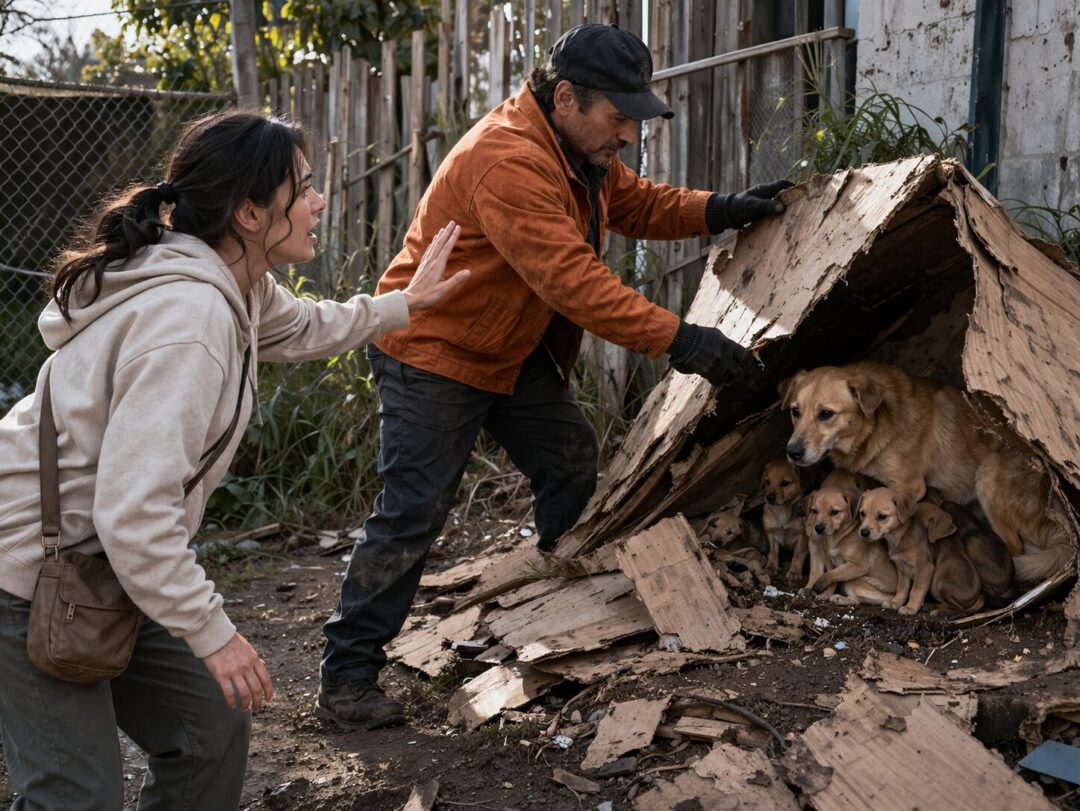
And now a man in an orange utility jacket was ripping it apart.
“Hey!” Talia shouted before she knew she had opened her mouth. “Don’t do that!”
The man didn’t turn immediately. He just planted his boots more firmly in the dirt, gripped a sagging panel with his black-gloved hands, and yanked. The cardboard split down the middle with a damp, ugly groan. A strip of it collapsed into the mud.
The mother dog jerked up, her whole body going rigid. The puppies shifted and squeaked in confusion.
Talia’s pulse hit hard in her throat.
She rushed forward, her crossbody bag thumping against her hip. “What is wrong with you?”
Now he looked at her.
He was older than she’d expected from behind. Late thirties, maybe early forties. Square jaw. Broad cheekbones roughened by sun and weather. The dark cap shadowed his eyes, but not enough to hide how calm he was. That was what made her angrier—that calm. As if tearing apart the only thing standing between a nursing dog and the cold ground was just another task on a list.
“It’s not safe,” he said.
His voice was low, steady. Not defensive. Not embarrassed. Just certain.
Talia stared at him. “That was their home.”
He bent again and pulled another piece free. The mother dog let out a warning sound, not quite a bark, not quite a growl. He didn’t go near her. He only tore away the collapsed flap that had been hanging over the entrance.
No. Not an entrance, Talia thought with a flash of anger. A doorway. A doorway to the only place those puppies had.
She took another step forward. “Why would you smash it?”
The man straightened. For a second he said nothing. Then he hooked two fingers under a slab of cardboard darkened almost black with moisture and lifted it away from the dirt.
Underneath was a soaked patch of ground, slick and dense, with water pooled in the shallow places. The towel Talia had left two mornings ago was half buried there, stained and clinging to the mud. One corner of the cardboard was furry with gray mold.
The man looked at the ground, not at her.
“No,” he said quietly. “That was a trap.”
The words landed harder than she expected.
For a moment, Talia could only hear the puppy noises—the thin, blind-sounding little cries of creatures too young to understand that their world was changing around them.
Her anger didn’t vanish. Not yet. But something in it loosened.
The man moved again, dragging the ruined pieces aside in a quick practiced rhythm. He knew exactly what he was doing. Not reckless. Not improvising. Not cruel for the pleasure of it.
Still, he had not asked permission from the dog, from the neighborhood, from anyone. He had arrived and begun destroying something fragile. It was hard to forgive that on instinct alone.
The mother dog stood over the puppies, ears sharp, body angled protectively toward him.
Talia swallowed. “Then what were you planning to do?”
For the first time, the man’s mouth shifted at one corner. Not a smile. Just a brief acknowledgment that the question had changed.
He glanced behind him, toward the mouth of the alley.
“Give me a second,” he said.
Then he turned and disappeared out toward the street, leaving Talia in the side yard with the mother dog, the puppies, and the wet wreckage of what she had mistaken for mercy.
She should have felt relieved that he was gone.
Instead she felt suddenly, deeply uncertain.
Because if he truly had been cruel, he would have laughed. Or shrugged. Or walked away from the mess he had made.
But he had said it wasn’t safe in the tone of a man talking about a gas leak or rotten flooring or an exposed wire.
As if danger did not stop being danger just because it had once looked like kindness.
Talia turned to the dog and crouched slowly, palms open.
“It’s okay,” she whispered, though she had no idea whether it was.
The mother dog’s gaze stayed fixed on the alley entrance, waiting.
Talia waited with her.
And then she heard wheels.
Part II — The Thing She Didn’t Expect
The sound came first as a dull rattle over broken pavement, then a scrape, then the low drag of weight being pulled by hand.
The man reappeared, backing into the alley with a small utility trailer behind him.
Talia stood so quickly her knees hurt.
At first all she saw was wood.
Pale, clean wood catching the morning light. A pitched roof. A raised floor. Side panels fitted tightly enough to keep out the wind. It was not decorative. It was not cute. It was solid in the plain, practical way things were when they had been built to last.
“Then what is that?” she asked.
The question came out smaller than her earlier accusations.
He stopped the trailer beside the patch of churned mud where the cardboard had been. The doghouse filled the alley in a way the old shelter never had. Its shape was simple, but there was dignity in it. Room. Dryness. Intention.
“A real home,” he said.
He said it without looking at Talia, as though the answer belonged to the dog and not to her.
For a long second she could not speak.
The new shelter sat there like an answer to a prayer she had been too cautious to say aloud. She had thought about calling someone. Thought about asking the pet supply store on Halpern if they had a damaged crate they might throw out cheap. Thought about starting a little fundraiser online and then felt embarrassed by the idea before she even opened an app.
She had been collecting scraps.
This man had brought a house.
“Where did you get that?” she asked.
He crouched beside the trailer, working at a latch with his gloved fingers. “Workshop on Clark. One of the guys built it from leftover materials.”
One of the guys.
The words made him suddenly larger in her mind—not just a man passing through, but part of some quiet machinery of care she had never noticed because it didn’t advertise itself.
He tipped the trailer slightly and guided the doghouse down with a careful slowness that didn’t match the violence of the earlier ripping. Every movement now was deliberate, measured so the structure wouldn’t slam or tilt. He had the body language of someone used to lifting heavy things without letting them break.
The mother dog watched him, trembling with tension. The puppies clustered in a tumbling knot behind her back legs.
Talia found herself holding her breath.
The man set the doghouse on the driest patch of ground available and stepped back at once, giving the animals space.
Only then did he remove one glove and wipe his forehead with the back of his wrist.
Up close, the new shelter was even better than it had looked on the trailer. The floor sat slightly raised above the dirt on narrow runners. The roof overhung enough to keep rain from the entrance. Inside, Talia could see a layer of straw and something folded toward the back that looked like thick fabric.
Warmth.
The man noticed her looking. “Liner’s removable,” he said. “If it gets wet.”
Talia nodded as if that detail had struck somewhere painful.
Because of course he had thought of that too.
The mother dog took one cautious step forward, then another. Her nose worked the air. Her body was still angled to shield the puppies, but curiosity had begun to pull against fear.
The man stayed motionless.
So did Talia.
The whole alley seemed to narrow around that moment—the fence, the weeds, the bright flat daylight, the ruined cardboard off to one side like the shed skin of an old mistake.
The dog reached the entrance and stopped. She sniffed the edge. The roof. The straw. The clean wood. She lowered her head and looked inside.
One of the puppies stumbled against her hind leg and squeaked.
She went in.
Not all the way at first. Just halfway, front paws inside, body taut as a wire. Then she turned, looked back toward the puppies, and shifted deeper into the shelter.
That was all it took.
The puppies began tumbling after her in clumsy bursts—one bold, one hesitant, one needing to be nudged by accident from behind. Their little bodies disappeared one after another into the dim interior, where there was finally room enough for them not to be stacked on top of cold mud.
Talia let out a sound that was almost a laugh and almost something else.
Relief could hurt, she discovered. It could ache in the chest like guilt.
Beside her, the man exhaled, slow and quiet.
Only then did she look at him again.
The hard lines she had built around him in her mind had nowhere to go now. He was still broad-shouldered, still practical, still dressed in that glaring orange jacket that had first made him seem like an intruder against the alley’s faded colors. But there was gentleness in the way he watched the doorway of the doghouse.
Not sentimentality. Not showmanship.
Just attention.
As if the only part of this that mattered was whether the animals chose to stay.
Talia’s face went hot.
“I thought you were cruel,” she said.
The confession felt humiliating, but not as humiliating as silence would have.
He kept his eyes on the little wooden shelter.
“They just needed better,” he said.
There was no triumph in it. No rebuke. He didn’t make her pay for being wrong.
That almost made it worse.
Talia folded her arms across her chest, less from cold now than from the need to hold something in place inside herself. “I’ve been checking on them,” she said after a moment. “Bringing food when I can.”
He nodded. “I figured.”
“You figured?”
“You left the bowl too close the first day. She kicked dirt into it before she’d drink.” He glanced at her, then back at the doghouse. “Second day it was farther away. Smarter.”
Talia blinked. “You saw that?”
“I’ve been coming by before my shift.”
The alley changed shape again in her mind.
Not just this morning. Not just the tearing and the trailer and the reveal. There had been other mornings. Quiet ones. Unseen ones. He had been part of the story long before she knew there was a story.
“What are you?” she asked, then winced at how stupid it sounded. “I mean—do you work for the city? Animal control?”
“Maintenance,” he said. “Mostly. Sometimes people call us before they call anyone else.”
He slid his glove back on.
Sometimes people call us before they call anyone else.
That sounded like a whole world of small emergencies no one bragged about. Broken locks. Flooded basements. Fallen branches. Loose pavement. Stray dogs in alleys with puppies pressed against them for warmth.
Talia looked toward the shelter again. A puppy’s pale paw appeared briefly in the entrance and disappeared.
The ruined cardboard lay in a damp heap behind them. She could still remember how furious she had felt watching it come apart. That fury had been real. Honest. Born from wanting the right thing.
But honesty wasn’t the same as accuracy. She knew that now in the way one knew a lesson that had found the softest and most necessary place to bruise.
Part III — The Weight of Being Wrong
His name, she learned a few minutes later, was Soren.
It came up only because another city truck rolled slowly past the mouth of the alley and a driver leaned out to ask if he needed help loading the debris. Soren waved him on with a shake of his head and said he’d handle it.
Talia stored the name without meaning to.
It fit him. Spare and unadorned.
She offered to help carry out the ruined cardboard. He hesitated only a second before handing her a pair of spare work gloves from the trailer. They were too big for her, making her fingers clumsy, but she was grateful for the chance to do something that was not just standing there with her shame.
They worked mostly in silence.
Not an uncomfortable silence, exactly. Just one that had not yet decided what it wanted to be.
The cardboard was worse than it had looked. It sagged under its own weight and smelled faintly sour, like rainwater trapped too long in something meant to stay dry. Beneath the top layers there were bits of old insulation, scraps of plastic, and patches where mold had stitched itself into the fibers in dark spreading circles.
A trap, he had called it.
He had not been exaggerating.
“She would’ve stayed there,” Talia said quietly, nodding toward the doghouse.
“Of course she would.”
“Even if it was making them sick.”
Soren carried an armful of debris to the trailer. “Bad shelter still feels like shelter when it’s all you’ve got.”
The sentence settled between them with more force than the conversation seemed to deserve.
Talia thought of all the things people stayed inside because they were better than exposure. Jobs. Apartments. Relationships. Versions of themselves.
She looked over at him. “You talk like this happens a lot.”
He gave a short breath that might have been a laugh. “Not exactly this.”
“But enough.”
“Enough.”
By the time they were done, the side yard looked transformed. It was still rough, still fenced in, still littered with the neighborhood’s habit of neglecting whatever lay one step out of sight. But in the center of it now sat a structure that acknowledged the existence of the creatures inside. Not garbage arranged into usefulness. Not desperation pretending to be protection. Something built.
Talia crouched near the entrance of the doghouse, keeping a respectful distance. She could hear faint rustling from within. One puppy squeaked. The mother made a low sound, not warning this time, just present.
“She’ll remember me yelling at you,” Talia said.
Soren was coiling a strap back onto the trailer. “She’ll remember who brought food.”
Talia smiled despite herself. “That still counts?”
“It should.”
She stood. The too-large gloves slipped a little at the wrists. “You could have said something first.”
He paused, then nodded once. “Probably.”
The answer surprised her.
No argument. No self-justification. No lecture about urgency. Just a plain admission that people trying to help in different ways had collided in the wrong order.
That softened something else in her too.
“I would still have panicked,” she admitted.
“I know.”
She laughed then, a real laugh, and the sound startled both of them.
For the first time all morning, the alley felt wide enough to breathe in.
Part IV — What Stayed Behind
Talia began taking the longer route to work after that.
Not every day. She was not dramatic enough to reorganize her life around a side yard and a family of stray dogs. But often enough.
Sometimes she found Soren there before his shift, checking the shelter roof after rain or replacing the liner when it had gone damp around the edges. Sometimes she found only signs that he had already been through: a fresh bowl of water, a patch of swept ground, a bag of kibble tied high on a fence post where rats couldn’t reach it.
The mother dog grew less skeletal. The puppies grew less ridiculous and more opinionated, tumbling over one another in dusty bursts of confidence. One by one, with the help of a rescue contact Soren finally managed to pin down and a foster network Talia had once been too timid to call, they were taken somewhere safer.
The last to leave was the mother.
Talia cried when the rescue van pulled away, though she tried not to do it where anyone could see.
Soren pretended not to notice.
A week later the doghouse was still there, empty now, catching late afternoon light along its roofline. Talia stood in the alley with her hands in the pocket of her jacket, looking at it as if the animals might somehow reappear if she waited long enough.
“She trusted it in the end,” she said.
Soren, beside her, nodded. “Yeah.”
“I almost didn’t.”
He looked at her then, more directly than he usually did. “The shelter?”
“No.” She smiled faintly. “You.”
The corner of his mouth moved.
It would have been easy to turn that into something bigger than it was. A moral about assumptions. A neat speech about appearances and truth. The kind of lesson that sounded polished and useful and detached from the ordinary embarrassment of being human.
But what stayed with Talia was simpler than that.
She had not been wrong to care.
She had been wrong about what caring looked like in someone else’s hands.
The difference mattered.
There were people, she realized now, whose kindness did not announce itself in the language she expected. It did not always arrive softly. It did not always ask to be admired. Sometimes it sounded like cardboard tearing apart. Sometimes it looked like making a mess before making something safer. Sometimes it wore heavy boots and a city-issued jacket and spoke in sentences so brief they barely seemed to count as explanations.
And sometimes, because of that, it was easy to mistake for hardness.
The doghouse stayed in the alley for another month before someone from the rescue came to collect it. By then Talia had passed it enough times that its absence felt strange, like a missing tooth the tongue kept searching for.
But the side yard never looked invisible to her again.
Neither did the quiet work people did when no one was watching.
Years later, when she would think back to that morning, she would still remember the first sound—the rip of wet cardboard splitting open like something beyond saving.
But she would remember something else too.
The stillness after.
The moment when the mother dog stood at the entrance of the new shelter, every muscle in her body holding the decision.
The careful sniff.
The first step inside.
And the puppies, clumsy and trusting, following her into the dark that was no longer a trap, but warmth.
That was the part that stayed.
Not the mistake.
Not even the shame of it.
The proof that something broken in the right hands could become a doorway instead of a ruin.





Great story!!! Really enjoyed reading it and looking forward to reading more!!!