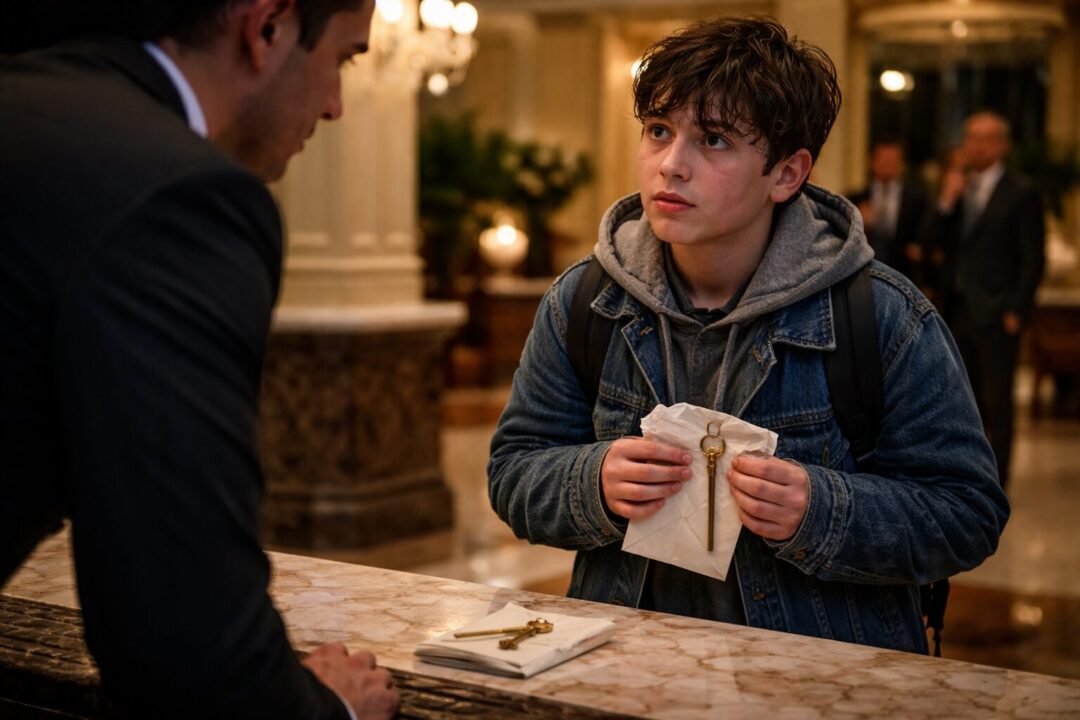
The Boy at the Marble Desk
The Boy at the Marble Desk
Part I — Mud on Marble
By the time the boy reached the front desk, he had already left a trail behind him.
Not a dramatic one. Nothing anyone in the Grand Lexington would have considered worth noticing on an ordinary night. Just a few wet marks on polished marble. A little dirt where the sole of his sneaker had split near the toe. A faint brown smear where rainwater and street dust had mixed and followed him into the brightest lobby in the city.
But in that hotel, where everything gleamed on purpose, even a trace of mud looked like a form of trespass.
The boy stood still beneath the chandeliers, breathing hard from the walk, his shoulders wet under a faded denim jacket that was too thin for the weather. He couldn’t have been more than twelve. His dark hair clung damply to his forehead. One hand gripped a tissue-wrapped brass key. The other held a sealed envelope, softened at the edges from being clutched too tightly.
He looked as though he had crossed half the city to get there and had nearly lost his nerve at the revolving doors.
Behind the marble counter, the front-desk manager lowered his eyes and studied him in silence. The man’s name tag read Nolan, though nothing about him suggested the need for introductions. He belonged to the hotel the way the chandeliers did. His suit was flawless, his hair sharply combed, his posture so exact it felt rehearsed.
For a moment, Nolan simply waited for the problem to explain itself.
When the boy didn’t speak right away, Nolan offered the kind of smile that never reached the eyes.
“Can I help you?”
The boy swallowed. “I need to see the owner.”
Nolan glanced once at the dirty sneakers, then at the envelope. “Do you have a reservation?”
The boy shook his head.
“Then you can leave whatever that is with the desk.”
“No.” His grip tightened around the envelope. “My mom said only him.”
Something flickered in Nolan’s face then, though it was not sympathy. More like controlled impatience. Around them, the lobby glowed with the quiet wealth of people who never had to ask permission to enter places like this. A couple in evening clothes crossed toward the elevators. A bellman wheeled polished luggage across the far side of the room. Soft piano music drifted from the lounge.
The boy looked painfully out of place in all of it.
Nolan rested both hands on the marble counter. “That’s not how this works.”
The boy lowered his eyes to the tissue-wrapped key. His voice came smaller this time, but steadier too.
“She worked here.”
Nolan said nothing.
“My mom,” the boy added. “She said if anything happened, I had to bring this back myself.”
The words hung between them, awkward and exposed.
Something about them should have sounded sacred. Instead, under the gold light of the lobby, they sounded implausible. Like the kind of story desperate people invented when they wanted to be let into rooms that weren’t built for them.
At first only Nolan was watching him.
Then, slowly, the room began to notice.
A woman near the lounge looked over the rim of her glass. A server carrying a silver tray slowed almost imperceptibly. The bellman stopped with one hand on the cart handle and pretended to adjust a strap that did not need adjusting. No one approached. No one said a word. But silence, in places like that, could be a crowd all by itself.
The boy felt every eye without lifting his head.
He placed the brass key on the counter.
It was old-fashioned, heavy, attached to a narrow metal tag with a room number stamped into it. The tissue paper around it was worn through in one corner, as though it had been wrapped and unwrapped many times by careful hands.
For the first time, Nolan’s expression shifted.
The key looked real.
Still, he said, “If your mother worked here, I can call housekeeping records in the morning.”
The boy’s face changed. Not with anger. That would have been easier. It changed with the effort of holding something together.
“She can’t wait till morning.”
The piano in the lounge continued as if no one were standing there under the chandeliers trying not to break.
Nolan drew a measured breath. “What was her name?”
The boy’s mouth opened, then closed. Whatever strength had carried him through the revolving doors seemed suddenly thinner than the soaked fabric on his shoulders.
Before he could answer, light swept across the entrance.
The hotel doors brightened with the reflection of headlights from outside. The doorman, who had spent the last ten minutes standing with ceremonial stillness, straightened almost invisibly. On the driveway beyond the glass, a long black car rolled to a stop under the awning.
The air in the lobby changed.
Staff noticed before guests did. They always did. Nolan turned his head toward the entrance, then back to the boy, then to the key lying between them. A doubt entered his expression—not enough to soften him, but enough to crack the smooth certainty he had been wearing.
The boy saw it too.
“It has to be him,” he whispered.
Part II — What Mara Left Behind
His mother had never wanted him to come to the hotel alone.
That was the truth of it, the one she would have admitted if she had been given more time.
Her name had been Mara. She had worked nights at the Grand Lexington for almost fourteen years, though “worked” was too small a word for the life she gave it. She knew the hotel in the way only invisible people ever truly know a place. She knew which suite faucets clicked before they failed. Which ballroom carpets stained permanently if red wine sat too long. Which housekeepers cried in linen closets and which ones sang under their breath when they thought no one was listening. She knew how to polish a room until it looked untouched by human life.
And she knew that the richer a place was, the less anyone noticed the hands that held it together.
To her son, Eli, the hotel had always seemed half real and half mythical.
He had never seen the guest rooms, only heard about them in fragments at the kitchen table of their apartment three bus rides away. Rooms with views over the river. Rooms where flowers were replaced before petals could curl. Rooms where the sheets felt, according to Mara, “like sleeping inside a cloud that doesn’t trust anyone.”
Sometimes she came home so tired she could barely untie her shoes. Sometimes she brought stories she swore were not gossip because gossip required equals, and hotel guests treated workers like weather. She told him about lost watches, midnight apologies, champagne in bathtubs, wedding dresses steamed at dawn.
But she almost never spoke about the owner.
When she did, it was with unusual care.
“Mr. Vale is different,” she once said while mending the cuff of Eli’s school shirt. “Not better all the time. Just… not blind all the time.”
Eli had not understood what that meant.
He understood even less the day, two weeks before she died, when she took an old brass key from the back of her dresser and wrapped it in tissue paper. Alongside it she placed a cream-colored envelope with no address written on the front.
“If anything happens to me,” she said, not looking at him, “you take these to him yourself.”
Eli laughed then because children do that when adults say something too frightening too calmly. “Nothing’s going to happen.”
Mara folded the tissue paper again, slower this time. “Listen to me.”
So he listened.
“You do not leave them at the desk. You do not give them to a driver, a guard, a clerk, nobody. Him. Only him.”
“Why?”
She smiled, but only with half her mouth. “Because promises go missing in buildings like that.”
He wanted to ask more. Instead, he asked what boy-shaped fear always asks.
“Will I know him?”
“You will.” She tied the tissue with a thin strip of thread. “And if he sees the key, he’ll know.”
Three days later she developed the cough.
A week after that, she could not make it out of bed.
By the end, the apartment smelled faintly of medicine and rain, because March had settled over the city with a wet heaviness that never seemed to lift. Eli spent those last nights bringing her water, answering calls from neighbors, pretending the future was something adults would handle when they arrived.
But the future arrived anyway.
After the funeral, people spoke around him rather than to him. They used phrases like arrangements and temporary and figure something out. A woman from the building brought soup he never ate. A cousin from Yonkers called once and never came. The world did what it often does around grief: it kept moving and asked him to move with it.
On the third morning alone, Eli opened the dresser.
The key and envelope were waiting exactly where she had left them.
He almost didn’t go.
He stood at the apartment window for a long time, looking down at buses passing through rainwater and exhaust, trying to imagine himself walking into a place where even his mother had spent years being seen only when something needed fixing. But the envelope had weight. Not physical weight, exactly. The heavier kind.
By the time he reached the hotel, his socks were wet through.
And now, standing at the desk under Nolan’s polite disbelief, he realized courage did not feel like courage at all. It felt like being too scared to leave because leaving would mean failing someone who could no longer forgive you.
The black car outside settled under the awning.
The doorman opened the rear door.
A man stepped out in a dark overcoat, silver at the temples, carrying himself with the unhurried precision of someone long accustomed to people parting around him. He was not tall in a theatrical way or stern in an obvious way. What marked him was something quieter: the gravity of a man whose decisions had been shaping rooms for decades.
Nolan straightened fully.
Eli knew at once.
That had been his mother’s promise. You will.
Part III — The Envelope
The man crossed the lobby without hurry, yet the space seemed to reorder itself around his movement.
A hostess near the restaurant lowered her voice mid-sentence. Two guests stepped aside before they even realized they had. Nolan’s face reset itself into professional composure, though Eli noticed the flicker of uncertainty still trapped underneath it.
“Mr. Vale,” Nolan said.
The owner gave the slightest nod and might have continued toward the private elevators if Eli had not spoken.
“My mom told me to give this only to you.”
The words came out clearer than he expected.
The entire lobby seemed to stop breathing.
Nolan moved at once, not roughly, but with sudden urgency. “Sir, I’m sorry. He came in unannounced and—”
Mr. Vale had already seen the key.
His eyes dropped to the tissue paper, then to the room tag, and something in his face altered so completely that Eli forgot, for a second, to be afraid. It was not shock exactly. It was recognition sharpened by memory.
He took one step closer to the desk.
“Where did you get that?” he asked.
“My mother,” Eli said. “Mara.”
The name landed.
Whatever Nolan had intended to say next disappeared. Mr. Vale’s hand, still gloved from outside, came to rest lightly on the marble edge. For the first time since entering the hotel, Eli saw an adult lose the protection of performance.
“How long has he been standing here?” Mr. Vale asked quietly.
No one answered.
The question was not loud, but it struck harder than anger would have. Nolan’s mouth opened, closed, then settled into silence.
Eli held out the envelope with both hands.
“She said only you.”
Mr. Vale removed one glove before taking it. The gesture was so careful it almost undid Eli more than cruelty had. People accepted things from boys like him all the time—forms, change, excuses, blame—but rarely with that kind of deliberate respect.
Mr. Vale looked at the handwriting on the envelope for a long second before opening it.
He read the first lines standing there.
The lobby remained very still. No music now; the pianist had stopped between pieces. Somewhere near the entrance, rain tapped softly against the glass. Eli watched the owner’s face as the words moved through him. Whatever the letter said, it did not arrive as a surprise. It arrived like a reckoning he had once hoped he might avoid.
When he finished the first page, he folded it back into the envelope and closed his eyes briefly.
Then he looked at Eli.
“She was one of the best people this hotel ever had.”
The sentence entered the room like a verdict.
Nolan lowered his gaze.
Mr. Vale drew in a breath and, in a motion so small yet so startling the watching guests nearly shifted where they stood, bent slightly to bring himself nearer to Eli’s eye level.
“I’m sorry you came here alone.”
Eli had spent three days carrying himself like a tray nobody must drop. Those seven words nearly broke him. He bit the inside of his cheek and nodded because anything more felt dangerous.
Mr. Vale glanced once at the key, and his voice softened further.
“Your mother kept this from the old Riverside Suite.”
Eli said nothing.
“She saved my family with it.”
Nolan looked up then, startled despite himself.
Mr. Vale did not seem to notice. Or perhaps he noticed and chose not to care.
Years ago, he explained later, when a scandal had threatened to shatter both his marriage and the hotel at the same time, Mara had found something left behind in that suite—something that could have been sold, leaked, weaponized, turned into humiliation for people powerful enough to survive it and a hotel too public not to bleed from it. Instead, she had taken it directly to him. Quietly. No leverage. No bargain. No audience.
She had asked for only one thing in return.
“Make sure my son is never made to feel small for where he comes from.”
Mr. Vale’s eyes moved to Nolan, then away again.
“I told her I understood,” he said.
The shame of that unfinished promise passed through the lobby more cleanly than any speech could have.
He turned back to Eli. “May I ask what happened?”
The answer came in fragments. Fever. Hospital. Funeral. The neighbor who said she’d help. The envelope in the dresser. The long walk because bus fare had to be saved. Eli told it in the flat, careful voice of someone who had not yet decided whether speaking made any difference.
When he finished, Mr. Vale was silent for a moment.
Then he said, “Come with me.”
Nolan stepped aside before being asked.
Part IV — A Seat by the Fire
They did not go to an office.
That surprised Eli almost as much as anything else.
Instead Mr. Vale led him to a private sitting room just off the main lobby, a place warm with amber lamps and a low fire behind glass. It was meant for important guests who wanted quiet without solitude. Eli sat on the edge of an armchair as if softness itself might reject him.
A server appeared with tea and a bowl of soup, then left without comment.
Mr. Vale removed his coat and read the letter in full.
Eli looked everywhere except at him—at the framed black-and-white photographs of the hotel under construction, at the perfect brass fire tools by the hearth, at his own mud-darkened shoes on an antique rug worth more than anything in the apartment he had just come from. He kept expecting someone to return and say there had been a misunderstanding after all.
Instead Mr. Vale read in silence until the silence became its own kind of testimony.
At last he folded the pages neatly.
“Your mother knew I’d remember the key,” he said. “She also knew I might need to be reminded of the promise.”
Eli’s hands tightened around the soup spoon. “Did she write something bad?”
Mr. Vale almost smiled. “Honest, not bad.”
He did not offer the whole letter, but he gave Eli enough.
Mara had written that she was dying and did not trust illness to leave time for formalities. She wrote that she had never regretted protecting the hotel’s secrets, because some secrets were really people’s pain wearing expensive clothes. She wrote that loyalty meant little if it moved only upward. And she wrote that if Mr. Vale truly believed dignity belonged to everyone in the building, not just those who could afford its rooms, then he would prove it now.
Not with charity.
With regard.
That word stayed in the air between them.
Mr. Vale set the letter on the table. “Your mother was braver than most men I’ve known.”
Eli looked down at the steam rising from the soup. “She cleaned rooms.”
Mr. Vale’s answer came gently, but without sentimentality. “Yes. And still.”
After that, things changed in ways both large and quiet.
An apartment manager connected to the hotel was called. Not to send Eli away, but to arrange for him to stay in the building where Mara had once lived without the rent notices piling up immediately at the door. A school counselor was contacted. A legal adviser came, not with forms to bury him in, but with practical questions Mr. Vale insisted be answered in language Eli could understand. There was talk of a trust Mara had never known existed, built years earlier for employees in emergencies and seldom used well enough.
Yet the most important thing was not any of that.
It happened an hour later, when Nolan came to the sitting room door.
He stood there without the marble desk between them, and some essential part of him looked different without it.
“I owe you an apology,” he said.
Eli did not answer.
Nolan stepped inside. “I thought I was protecting the hotel from a problem.” He swallowed. “What I was actually protecting was my own idea of who belongs here.”
Mr. Vale said nothing. He left the silence for Eli to own.
At last Eli asked, “Do you say that to everyone?”
The question colored Nolan’s face more deeply than any reprimand could have.
“No,” he said. “I should.”
It was not forgiveness. It was not even the beginning of forgiveness. But it was the first true thing Nolan had said since Eli entered the building, and because of that, it mattered.
Later, before Eli left that night, Mr. Vale walked him back through the lobby himself.
The same guests were gone now or tucked into restaurants and bars. The chandeliers still glowed. The marble still shone. But the room had altered in a way architecture could not explain.
Eli paused near the front desk and looked down at the faint marks his shoes had made earlier. Someone had already polished them away.
For a second, that hurt.
Then he realized the trail was no longer necessary.
Mr. Vale handed back the brass key. “Keep it,” he said.
Eli frowned. “But my mom said—”
“She said to return it to me.” His voice carried a tired warmth now. “I’m giving it to you.”
The metal felt cool in Eli’s palm.
“It opens nothing now,” Mr. Vale added. “Not upstairs, anyway. But some things should still be carried.”
Eli slipped the key into his jacket pocket.
Outside, the rain had thinned to a mist. The city lights blurred softly across the wet street, and the black car that had brought Mr. Vale there waited once more beneath the awning. This time, when the doorman opened the door, he did not look past Eli as if he were incidental. He looked at him directly and said, “Good night.”
It was such a small thing.
Yet Eli understood, with the strange sharpness grief sometimes gives, that small things were how a life changed shape. A hand receiving an envelope carefully. A powerful man lowering himself to meet a child’s eyes. An apology spoken without marble to hide behind. A door opened not out of pity, but recognition.
When the car pulled away, Eli turned for one last look at the Grand Lexington.
From the street, the hotel still looked like what it had always been: gold-lit, distant, too polished to belong to people who counted bus fare. But now he knew something the building did not advertise. Under its marble and chandeliers and practiced elegance, part of its soul had once belonged to a woman carrying cleaning cloths and spare room tags in her apron pocket.
And because of her, a boy who had entered it as an interruption was leaving as a promise remembered.
He put his hand over the key in his pocket and walked into the damp city night, no longer feeling like someone who had come to beg at the door.
He felt like someone who had been seen.