The Morning She Couldn’t Afford to Fall Apart
The Morning She Couldn’t Afford to Fall Apart
Part I — The Blazer Behind the Glass
The first thing Willa noticed was not the man’s voice.
It was the blazer.
It hung behind the counter in a clear plastic garment bag, pressed so sharply it seemed to belong to a different life than the one she had walked in wearing. Navy wool. Clean lapels. Fresh lining. The kind of jacket that could make a woman look steadier than she felt.
On any other morning, it would have just been clothing.
That morning, it looked like permission.
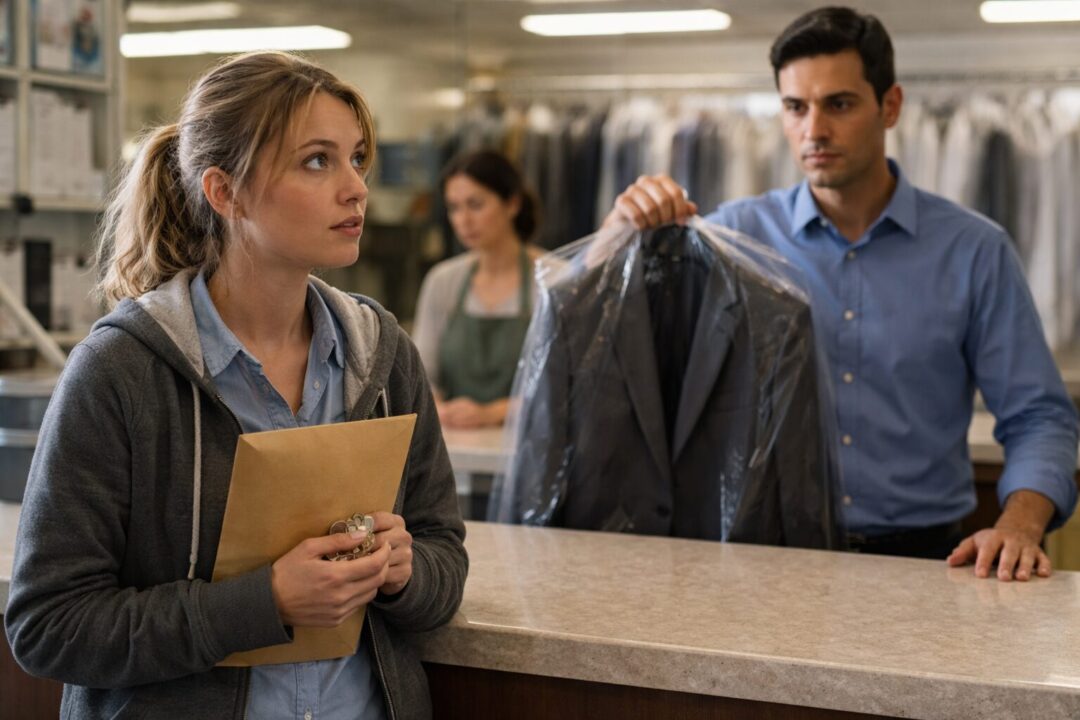
Willa stood at the counter of BrightStar Cleaners with an envelope in one hand and a fistful of coins in the other. The envelope held three copies of her resume, already creased at the corners from being pulled out and pushed back too many times. The coins left pale half-moons in her palm.
Across from her, a man in a pressed blue work shirt glanced down at the money and then at her as if both had offended him.
“That’s not enough,” he said.
The words were simple. The tone was not.
Outside, the city was already awake. Cars hissed over damp pavement. A bus exhaled at the corner. Through the front windows of the shop, the morning moved with ruthless purpose. Inside, the fluorescent lights made everything look sharper than it needed to be—lint on the floor, steam at the back, the faint smudge of fingerprints on the counter glass.
Willa swallowed. “I know. I’m short by eleven dollars.”
The man did not blink. His name tag read Brent.
“Then you’re short a blazer.”
He reached for the hanger before she could. In one smooth motion, he drew the garment bag back behind the register, hanging it farther out of reach.
The humiliation landed so quickly it made her feel lightheaded.
Two women folding sheets near the front window looked over and then away. An older man waiting for his shirts adjusted his glasses and studied a price sign with sudden fascination. Nobody said anything. That was somehow worse.
Willa had learned that public shame was rarely loud at first. Sometimes it arrived in tiny movements—the pause in someone’s hands, the way strangers found something else to look at, the way a room quietly agreed that your worst moment was not their business.
She kept her voice low. “I have an interview in forty minutes.”
Brent shrugged. “That’s not my problem.”
It would have been easier if he had shouted. Anger could be pushed against. Coldness simply locked every door.
Willa looked at the blazer again and thought of the bathroom mirror in her apartment that morning, the one with the crack running through the top-left corner. She had stood in front of it wearing a blouse she had ironed twice with a borrowed travel iron. She had curled her hair with a flat iron because the curling iron had broken months ago. She had told herself, very quietly, that if she could just look put together for one hour, maybe no one would see how narrow her life had become.
The job was entry-level on paper but life-changing in practice: benefits, predictable hours, enough money to move out of the apartment above the auto shop where the pipes rattled all night and the heat failed twice a month. Enough money to stop calculating groceries against bus fare. Enough money to stop saying next month to herself like a prayer.
And now the blazer sat behind a pane of glass while Brent watched her come apart one inch at a time.
“I can bring the rest tomorrow,” she said.
“No.”
“It’s eleven dollars.”
“No money, no pickup.”
His voice rose on the last word—not to a shout, but enough to travel.
Willa felt every pair of silent eyes in the room. She wanted to disappear. She wanted to be the kind of woman who could laugh this off, swipe another card, call someone for help. But there was no one to call, and pretending otherwise had exhausted her months ago.
She slid the coins back into her palm, suddenly ashamed of their sound.
That was when the older woman emerged from the steam at the back of the shop.
Willa had noticed her when she came in—a small woman in a faded apron, sleeves rolled to the elbow, gray threaded through dark hair pinned back loosely at the neck. She moved with the practiced steadiness of someone who had spent years doing work people depended on and rarely noticed. Up until then, she had been pressing shirts at the rear station, half-hidden by hanging garments and warm mist.
Now she came forward, drying her hands on a towel.
“What’s going on?” she asked.
Brent did not look at her. “Customer’s short.”
The woman’s gaze shifted to Willa, and the whole atmosphere changed.
Some people looked at a problem first and a person second. She did the opposite.
Willa hated how close she suddenly was to crying.
“It’s for an interview,” she said, and heard the crack in her own voice.
The woman looked at the envelope, the blazer, the coins in Willa’s hand. She seemed to understand the entire shape of the morning in one breath.
Then she turned to Brent.
“Give it to her.”
He laughed once, disbelieving. “She didn’t pay.”
The woman’s expression did not harden. It steadied.
“I said give it to her.”
There was nothing dramatic in her tone. No speech about kindness. No anger. Just a calm certainty that made Brent’s resistance suddenly look childish.
For one moment, he held onto the hanger as if the principle of the thing mattered more than the human being standing inches away.
Then, with visible irritation, he yanked the blazer free and shoved the bag across the counter.
The older woman intercepted it before it could slide, smoothed the plastic with her palm, and placed it carefully into Willa’s hands.
Not like a favor.
Like dignity returned.
Willa stared at her.
“Go,” the woman said softly. “Don’t miss your shot.”
The words struck deeper than Willa could explain. Not because they were sentimental. Because they were practical. Permission without pity.
“Why would you help me?” she whispered.
The woman gave a small shrug. “Because you need it.”
For a second, Willa couldn’t move. She saw the loose threads at the woman’s cuff. The faint crease lines in her face. The exhaustion there, yes—but also something stronger than exhaustion. A kind of quiet refusal to let another person be made small if she could stop it.
Willa nodded once, too fast. “Thank you.”
Then she left before the tears could start.
At the bus stop three blocks away, she stood with the garment bag clutched to her chest and finally let herself breathe.
She did not know the woman’s name.
But all morning, through the interview, through the waiting, through the polite handshakes and the final smile from the hiring manager, she carried the feeling of those hands placing the blazer into hers.
By evening, she had an offer.
Part II — The Shape of a New Life
The first three weeks at Calder & Rowe Consulting felt unreal.
Willa kept waiting for someone to discover that she had arrived by accident, that beneath the pressed slacks and careful smile was the woman who had once counted quarters at a dry cleaner counter while strangers watched. But the work was real. The badge around her neck was real. The paycheck that hit her account two Fridays later was real.
So was the exhaustion.
Starting over, she learned, was not glamorous. It was paperwork and bus schedules and dinners eaten over the sink because buying a table would have to wait. It was falling asleep with her work shoes still on. It was pretending not to flinch the first time a manager said, “We’re trusting you with this,” because she had spent so long being treated as if she could not be trusted with anything at all.
Still, some things changed quickly.
She moved out of the apartment above the auto shop and into a studio with clean windows and working heat. She bought groceries without doing math in the aisle. She replaced the cracked phone case she had kept held together with tape.
And every now and then, usually when she was getting dressed for work, she thought of the woman at BrightStar Cleaners.
Not Brent.
Never Brent.
She thought of the woman’s voice: Go. Don’t miss your shot.
The memory stayed with her because it was so undramatic. The woman had not saved her life in some cinematic way. She had done something smaller, which in certain moments is the same as doing something enormous. She had interrupted humiliation. She had refused to make a lesson out of another person’s desperation. She had protected a stranger’s dignity when it would have been easier to follow policy and look away.
Willa had spent years discovering how often people mistook rules for morality. She had met landlords who quoted lease terms like scripture, managers who weaponized professionalism, family members who confused judgment with honesty. Mercy, by contrast, was rarely loud. It appeared in small decisions that cost something.
Eleven dollars.
That was all the distance there had been between one version of her life and the next.
On her first month’s anniversary at work, Willa found herself parked at a red light two blocks from BrightStar.
She had not meant to come this way. Her new supervisor had asked her to drop off a signed client packet downtown, and a colleague—one of the few people in the office who had become a real friend—had offered her a ride back in his car. It was a sleek black sedan that still smelled faintly of new leather and peppermint gum.
When the shop’s familiar front windows slid into view, Willa sat up straighter.
There it is, she thought.
Her colleague glanced over. “You okay?”
“Yes,” she said, then smiled. “Actually… yes.”
The light turned green. He began to drive on.
“Wait,” she said. “Can you pull over?”
He did, a little puzzled.
Willa looked down at her cream-colored suit, at the folder on her lap, at the phone buzzing with calendar reminders she would answer in a minute. For a second she saw both versions of herself at once—the woman with the coins and the woman with the office badge—and felt the strange tenderness of surviving your own life.
“I won’t be long,” she said.
She stepped out onto the sidewalk and stood for a moment beside the black car.
The windows of BrightStar reflected her back at her in fragments: pale blazer, straight posture, soft gold earrings she had bought after her second paycheck because they made her feel like a grown woman instead of an improvisation. She almost laughed at the symmetry of it.
Then she opened the door and walked inside.
Part III — What the Counter Remembered
The bell above the door gave its thin familiar chime.
For one suspended second, nothing happened.
Then Brent looked up.
Recognition did not arrive in his face all at once. First came the bland customer-service smile. Then the narrowing of the eyes. Then the flicker of memory. Willa watched the exact moment the past returned to him and refused to fit with what he was seeing.
He straightened.
This time, there was no garment between them. No coins. No glass separating need from judgment.
“Can I help you?” he asked.
The politeness sounded borrowed.
Willa did not answer immediately. Her gaze moved past him, toward the pressing station in the back.
The older woman was there, folding a stack of laundered shirts with the same calm precision she had carried that morning weeks ago. Her apron was different, but everything essential about her remained unchanged: the careful hands, the grounded shoulders, the face that had looked directly at Willa when being looked at mattered most.
Willa felt an unexpected sting in her eyes.
The woman glanced up.
At first she simply saw a well-dressed customer. Then something in her expression shifted. She tilted her head slightly, as if listening to a memory she had nearly misplaced. And then she knew.
“Oh,” she said softly.
She came forward, slower than before, drying her hands again out of habit.
Willa crossed the room before she could second-guess herself.
“I came back for you,” she said.
The woman’s mouth parted, and for the first time Willa saw surprise break cleanly through her composure.
“I got the job,” Willa said. “That day. I got it because I made it there. And I made it there because of you.”
Brent said nothing.
Nobody else in the shop moved.
Willa reached for the woman’s hands. They were warm and roughened from work. Honest hands.
“I never even asked your name.”
“Lorena,” the woman said.
Willa smiled through the blur in her vision. “I’m Willa.”
Lorena let out the smallest breath, almost a laugh, almost disbelief. “You look…” She searched for the word and then seemed to reject all the obvious ones. “You look happy.”
That was the thing no expensive suit could have conveyed on its own.
“I am,” Willa said.
She was not rich. She was not magically healed. She still woke some mornings with old fear lodged in her chest before memory caught up. She still knew how thin security could be. But happiness was there now—uneven, hard-earned, no longer theoretical.
She squeezed Lorena’s hands. “I wanted to thank you the right way.”
From the folder she carried, Willa pulled a small envelope. Inside was a gift card, enough money to matter, and a handwritten note she had rewritten three times because nothing sounded large enough for what eleven dollars had done.
Lorena looked at the envelope as if it embarrassed her.
“You didn’t have to—”
“Yes,” Willa said gently. “I did.”
Then, because language suddenly felt too small, she stepped forward and hugged her.
It was not a delicate embrace. It was full and human and public in the exact place where humiliation had once stood. Willa felt Lorena’s arms come around her after the briefest hesitation, felt the older woman’s frame shake once with emotion she did not speak aloud.
When they pulled apart, Brent was still there behind the counter, silent under the fluorescent lights.
Willa looked at him then—not with triumph, exactly, but with clarity.
He was smaller than he had seemed that morning. Not physically. Morally. Stripped of the power of circumstance, he was just a man who had once mistaken another person’s worst hour for proof of who she was.
He opened his mouth, perhaps to say congratulations, perhaps to say nothing useful at all.
Willa spared him the effort.
“She helped me when she didn’t have to,” she said, still looking at Lorena. “I won’t forget that.”
It was not an accusation. That made it sharper.
Brent lowered his eyes.
The silence that followed felt complete.
Outside, traffic moved past the window in restless ribbons of light. Inside, the counter held both versions of the morning at once: the one where Willa had nearly walked away defeated, and the one where she stood upright, no longer asking permission to belong to her own future.
She stayed a few more minutes. Lorena asked about the job, and Willa told her enough to make her smile: the office downtown, the workload, the tiny kitchenette with terrible coffee, the fact that she had already been trusted with client files. She left out the harder details because this was not a confession booth. It was a thank-you.
Before she left, Lorena touched the sleeve of Willa’s suit jacket, almost absentmindedly.
“Fits you,” she said.
Willa laughed softly. “I think so too.”
At the door, she turned back one last time.
Lorena was still watching her, one hand resting lightly on the envelope, as if uncertain whether to keep it. Brent stood behind the register in a silence of his own making.
Willa stepped out into the afternoon with the odd, steady feeling that a circle had closed exactly where it needed to.
Her colleague was waiting in the car, tapping the steering wheel to music she couldn’t hear through the glass. When she got in, he glanced at her face and smiled.
“That good?” he asked.
Willa looked back at the shop.
Through the window, Lorena lifted a hand.
Willa lifted hers in return.
“Yeah,” she said. “That good.”
As the car pulled away, the city opened in front of her—busy, indifferent, alive. The old fear had not vanished, and maybe it never would. But it no longer owned the whole road ahead.
Some people changed your life by offering you a job.
Some changed it by opening a door.
And once in a while, someone changed it by handing you a blazer across a counter and refusing to let the world make you smaller than you already felt.
Willa leaned back in her seat, the afternoon sun warming the side of her face, and carried that truth with her into the life she had finally begun.