The Man Everyone Wanted Silenced Was Practicing for One Last Chance to Give the Building Something Back
Chapter 1: Thirty Minutes Through a Wall That Never Truly Went Quiet
The pounding came through the wall before Daniel Moore finished the first phrase.
Three hard blows.
Not a neighborly knock. Not plumbing. A fist against drywall.
Daniel lowered the trumpet, but the last note seemed to remain in the room, caught somewhere between the bookcase and the narrow wall he shared with Unit 4B. On the music stand, his phone timer kept counting down.
27:43.
He stared at it for one second too long.
Then a baby began crying next door.
Daniel closed his eyes.
“Damn it.”
The pounding came again.
He set the trumpet carefully on the folded towel beside the stand, crossed the living room, and opened his front door just as Emily Harris stepped out of her own unit.
She had the exhausted look of someone who had slept in pieces for weeks. Her hair was pulled back badly, as though she had done it with one hand. A pale stain marked one shoulder of her T-shirt. Behind her, the baby’s crying rose and fell.
“Can you stop?” she asked.
Daniel kept his voice low. “I already did.”
“I mean stop doing this every evening.”
A door farther down the walkway opened two inches.
Daniel noticed. Emily did too.
Neither acknowledged it.
“I practice for thirty minutes.”
“You always say that.”
“Because it’s thirty minutes.”
Her face tightened. “Do you think that makes the baby wake up less?”
Daniel felt the answer form too quickly.
I’m within the permitted hours.
He swallowed it.
The building’s posted quiet hours began at ten. It was six eighteen. He knew the rule. Virginia Scott had once sent the entire complex a reminder after someone ran a blender at midnight. Daniel knew exactly what he could say.
Instead he said, “I’m careful about the time.”
Emily gave a short, humorless laugh.
“You start at almost the same time every day.”
“Yes.”
“That’s the problem.”
Daniel looked past her, toward the half-open door down the walkway.
“Maybe we shouldn’t do this out here.”
“I tried knocking.”
“I heard you.”
“After the baby woke up.”
That landed where she intended it to.
Daniel glanced back into his apartment. The phone screen still glowed beside the trumpet.
26:51.
He should have stopped the timer. He did not.
Emily followed his eyes.
“There. That thing.”
“What thing?”
“The timer.”
Daniel looked at her.
“You really set it for thirty minutes.”
“Yes.”
“As if that makes it reasonable.”
“I didn’t say that.”
“You say it every time.”
The baby’s crying sharpened. Emily flinched before she could hide it, turning one shoulder toward her door.
Daniel lowered his voice further. “Go take care of the baby. We can talk later.”
Her head snapped back toward him.
“Don’t tell me to go take care of my baby.”
“That’s not what I meant.”
“It sounded exactly like what you meant.”
The door down the walkway opened wider. A phone appeared at chest level in someone’s hand.
Daniel felt heat rise under his collar.
He had spent years learning not to react when someone watched him struggle. Rehearsal rooms. Repair jobs. Auditions. Parents waiting outside cheap community classrooms while children missed notes he was supposed to fix. The discipline had once been useful.
Now it made him sound cold.
Emily took a breath through her nose.
“I asked you yesterday if you could move it later for a while.”
Daniel’s jaw tightened.
“You asked me to practice after eight.”
“Yes.”
“That doesn’t work.”
“Why?”
He looked at her.
There it was.
The question he had been refusing for twelve days.
Why?
He could have answered in one sentence.
Because the city orchestra audition is in three weeks and my only reliable preparation window comes between getting home from repair work and the evening noise from the street.
Or perhaps the truer answer:
Because if I change one thing now, I am afraid everything will fall apart again.
He said neither.
“It just doesn’t.”
Emily stared at him.
“You expect me to rearrange an infant’s sleep around something you won’t even explain?”
“I’m not asking you to rearrange anything.”
“You are. Every day.”
The baby gave a broken cry from inside 4B.
Emily’s anger flickered into pain.
Daniel saw it and still made the mistake.
“I stop at thirty minutes.”
Her expression changed.
Not louder anger. Worse.
Recognition.
As if she had finally decided what kind of man he was.
“The baby wakes before your thirty minutes are over,” she said. “Sometimes in the first five.”
Daniel said nothing.
“That’s what you don’t understand.”
She turned back toward her apartment.
“Emily.”
She stopped with one hand on the doorframe.
“I can try the mute for part of it.”
She looked at him over her shoulder. “Tonight?”
Daniel hesitated.
Only a fraction.
But she saw it.
“Right.”
The door closed.
The phone down the walkway disappeared.
Daniel returned to his apartment and shut his own door without slamming it. He stood in the living room listening to the baby through the wall.
The crying was softer now.
His timer read 24:09.
He picked up the phone and stopped it.
For several seconds, the apartment felt unnaturally still.
Then he lifted the trumpet again.
Not to play.
Just to hold it.
On the stand, the audition passage waited under a row of pencil marks. The exposed section was six measures long. Daniel had circled the same transition four times.
He had missed it that morning before work.
Missed it the previous evening.
Missed it in the rented rehearsal room on Saturday.
His eyes moved to the small black practice mute on the shelf.
He could use it. He sometimes did.
But the mute changed resistance. Changed the feedback against his lips. Changed the way the instrument answered. For most practice that was manageable. For this passage, with the audition this close, he wanted the horn open.
He told himself that was the reason.
Twenty minutes later, while he cleaned the valves at his kitchen table, his phone buzzed.
A message in the residents’ group thread.
He usually muted it.
This one contained a video.
Daniel tapped before thinking.
The image shook slightly, filmed from down the exterior walkway. Emily stood outside his door, one arm wrapped across herself. Daniel faced her.
The sound was thin but clear.
“I practice for thirty minutes.”
Then Emily:
“Do you think that makes the baby wake up less?”
The clip ended there.
Below it, a resident had written:
This has apparently been going on every day. People need to respect that families live here.
Another reply appeared while Daniel watched.
Thirty minutes daily through shared walls is a lot.
Then another.
Depends on the time. Not everything is a violation just because someone dislikes it.
Then:
A BABY IS WAKING UP.
Daniel put the phone facedown.
It buzzed again.
Again.
Again.
He went to the window.
Across the courtyard, lights glowed in kitchen windows and living rooms. A man on a balcony looked down at his phone. Someone in the opposite building pulled a curtain aside.
Daniel had lived there eleven years.
He knew which residents left for work before dawn, which one dragged recycling out every Sunday, which couple argued only in their car because they believed the parking garage offered privacy.
Now people he barely spoke to were deciding whether he was selfish.
He looked toward Emily’s darkened window.
For the first time, he wondered whether she was reading the same thread.
The next evening, he began at six fifteen.
He told himself consistency mattered.
He told himself he had reduced volume.
He told himself the baby might already be awake.
He set the timer.
30:00.
His thumb hovered over Start.
From next door came no sound.
Daniel pressed it.
The countdown began.
He raised the trumpet.
At 28:36, a thud came through the wall.
He stopped.
Silence.
Then a softer sound.
Not pounding.
A baby crying.
Daniel lowered the instrument.
He looked at the timer.
For once, he did not think about the audition passage.
He thought about Emily saying, Sometimes in the first five.
At 27:58, he stopped the clock.
That should have felt like compromise.
Instead, it felt like failure.
The following afternoon, an envelope waited under his door.
Heavy white paper. Condominium association letterhead.
Daniel opened it standing in the hallway.
NOTICE OF ALLEGED NUISANCE VIOLATION.
Below that, in smaller type:
Repeated musical instrument noise affecting adjacent residents.
A hearing date had been scheduled for the following week.
Daniel read the page twice.
Then he saw the last paragraph.
Continued violations may result in escalating fines and restrictions on use of association-managed common facilities.
He looked toward the stairwell, then toward Emily’s door.
Inside his apartment, the trumpet rested in its case.
His phone alarm went off at six fifteen.
Practice time.
Chapter 2: The Complaint Became Official Before Anyone Checked the Building
Emily discovered strangers were arguing about her baby at 3:17 in the morning.
She was sitting on the edge of the couch with the child against her chest, one hand supporting the small warm weight under the blanket. The apartment lights were off except for the kitchen hood lamp. Her spouse had an early shift and was asleep behind the closed bedroom door.
Emily should have been asleep too.
Instead she opened the residents’ thread.
Forty-three unread messages.
She scrolled once and immediately regretted it.
Somebody wrote that young parents expected the world to become silent.
Another person replied that musicians should rent proper rehearsal space.
Someone asked whether the baby had a medical sleep problem.
Emily stopped scrolling.
Her baby.
Discussed by people who had never held the child at two in the morning.
A new message appeared.
Maybe the mother is exaggerating because she doesn’t like the guy.
Emily’s fingers went cold.
She began typing.
Deleted it.
Typed again.
Deleted that too.
The baby shifted against her.
Emily put the phone facedown.
At seven forty-five, after barely sleeping, she opened the notebook she kept beside the microwave.
She had started the log five days earlier because Virginia Scott had asked for dates.
Not opinions, Virginia had said. Specifics help.
Emily had written:
6:16 p.m. — trumpet begins.
6:18 — baby wakes.
6:43 — crying settles.
The next day:
6:15 — trumpet begins.
6:19 — baby wakes.
6:46 — low vibration still audible.
She frowned.
Daniel’s thirty minutes should have ended at 6:45.
She turned the page.
6:14 — begins.
6:17 — baby wakes.
6:48 — wall still humming near vent?
Emily read that last line twice.
She remembered writing the question mark because she had been too tired to decide whether she was imagining it.
At nine, she carried the notebook into the small HOA office beside the mailroom.
Virginia Scott sat behind a narrow desk with a tablet propped on a stand. She wore a navy blazer despite the building’s unreliable air-conditioning. Margaret Lewis sat near the filing cabinet with a yellow legal pad.
Virginia gestured toward the empty chair.
“Emily. Come in.”
Emily remained standing for a moment.
“I don’t want my baby discussed in the residents’ thread.”
Virginia’s expression tightened. “I saw that.”
“Can you stop it?”
“The board can remind residents about appropriate communication. We can’t control every comment.”
“It started because somebody posted a video.”
“I understand.”
“No, I don’t think you do.”
Margaret looked up.
Virginia folded her hands.
“I do understand. That is one reason formal procedure is better than public argument.”
Emily set the notebook on the desk.
“I want the noise to stop. I don’t want him publicly destroyed.”
Virginia’s eyes shifted to the log.
“Those aren’t mutually exclusive.”
“They might be now.”
For the first time, Margaret spoke.
“May I?”
Emily slid the notebook toward her.
Margaret read slowly.
Virginia said, “We served notice yesterday. If the conduct continues, the schedule allows escalating fines.”
Emily looked at her. “How much?”
“The first fine is modest. Repeated violations can increase.”
“And the common facilities?”
Virginia’s mouth flattened slightly.
“If necessary, the association can restrict reservable amenities for unresolved account or compliance issues.”
Emily pictured Daniel carrying his trumpet through the lobby. She had seen him use the community practice room twice, though not recently.
“I didn’t ask for that.”
“You filed a nuisance complaint.”
“I asked what the process was.”
“And I explained it.”
Emily looked at Margaret.
Margaret was still reading.
“What?” Emily asked.
Margaret tapped one line with her pen.
“You wrote that the sound continued after the thirty minutes.”
“I think it did.”
“From the trumpet?”
“I don’t know.”
Virginia leaned back.
“Buildings carry sound unpredictably.”
“That’s my point,” Emily said. “Should someone check?”
Virginia’s answer came too quickly.
“We don’t need an engineering investigation to establish that musical practice is occurring.”
“I didn’t say engineering.”
“A technical inspection would cost money and delay relief.”
Emily stared at her.
Virginia softened her tone.
“We had a nuisance case last year that dragged on for four months because everyone insisted on testing, reviewing, retesting. Residents accused the board of doing nothing. This time we have direct evidence, a daily pattern, and an admission from Daniel himself.”
“An admission that he practices.”
“Yes.”
“That isn’t the same as proving everything I hear is him.”
Silence settled between them.
Margaret closed the notebook.
Virginia said, “Are you withdrawing the complaint?”
Emily thought of the baby’s body jerking awake. The crying. Her own resentment each evening when the first note came through the wall and she knew exactly what would follow.
“No.”
“Then we proceed based on what we know.”
Emily took the notebook back.
The sentence sounded reasonable.
That was what bothered her.
In the hallway outside the office, she nearly walked into Daniel.
He carried a black instrument case in one hand and an envelope in the other.
For a moment neither moved.
Emily spoke first.
“I saw the notice.”
“I assumed.”
“I didn’t know about the facility restrictions.”
Daniel’s face gave nothing away. “Now you do.”
“I’m not asking them to ban you from rooms.”
“You’re asking them to enforce the rules.”
“Yes.”
“Then they decide what enforcement means.”
Emily felt the familiar anger rise.
“You always do that.”
“Do what?”
“Make everything technically somebody else’s fault.”
His eyes sharpened.
“I didn’t file anything.”
“No. You just keep doing the one thing you know wakes the baby.”
Daniel glanced toward the HOA office door.
“Is Virginia in there?”
“Yes.”
He stepped past her.
Emily turned.
“Daniel.”
He stopped.
She held up the notebook.
“The noise doesn’t always stop when you stop.”
That got his attention.
“What?”
“I wrote down the times.”
He looked at the notebook, then at her.
“Maybe you wrote them wrong.”
The instant he said it, she saw regret in his face.
Too late.
Emily laughed once.
“Of course.”
“That came out wrong.”
“No. It came out exactly like you.”
She walked away.
By noon, Emily hated herself for making that sentence feel satisfying.
She spent the afternoon watching the baby monitor and checking the notebook. At 6:15, Daniel’s first note came through the wall.
Emily started a stopwatch.
The baby stirred at 6:19.
At 6:27, the crying began.
Emily lifted the child from the crib and stood in the hallway between the nursery and kitchen.
The trumpet stopped at 6:45.
She checked.
Exactly.
Then she waited.
At 6:47, a faint metallic hum seemed to remain near the return vent.
At 6:49, something vibrated behind the wall.
Not a note.
Not music.
A low resonance, intermittent but real enough that she placed two fingers against the painted drywall.
She felt it.
The baby whimpered against her shoulder.
Emily looked toward Daniel’s unit as if she could see through concrete and studs.
At 6:53, the vibration disappeared.
The next morning, she returned to the HOA office.
Virginia was speaking with Daniel.
The door stood partly open.
Emily stopped before they saw her.
Virginia’s voice was controlled.
“You’ve been notified. The hearing is your opportunity to respond.”
Daniel said, “I asked for the complaint details.”
“You received the summary.”
“I received a conclusion.”
“You received dates and allegations.”
“No decibel readings.”
“Not required.”
“No inspection.”
“Not required.”
“No attempt to determine whether the building is carrying sound from another source.”
Virginia exhaled.
“Daniel, you have acknowledged daily trumpet practice.”
“Yes.”
“Then what exactly are you disputing?”
Emily expected him to say the baby was too sensitive.
Or that thirty minutes was reasonable.
Or that he had rights.
Instead Daniel was quiet for several seconds.
Then he said, “The complaint is fair.”
Virginia did not answer.
Daniel continued.
“The conclusion isn’t.”
Emily tightened her hold on the notebook.
Inside the office, Virginia asked, “What does that mean?”
Daniel looked toward the open doorway.
He saw Emily.
Something in his expression changed.
Not fear.
Decision.
“You want to know why I won’t move the practice window?” he said.
Chapter 3: When the Room Learned Why He Refused to Put the Instrument Away
“Mr. Moore has demonstrated a repeated pattern of nuisance behavior after receiving direct notice from an affected resident.”
Virginia Scott read the sentence without looking at Daniel.
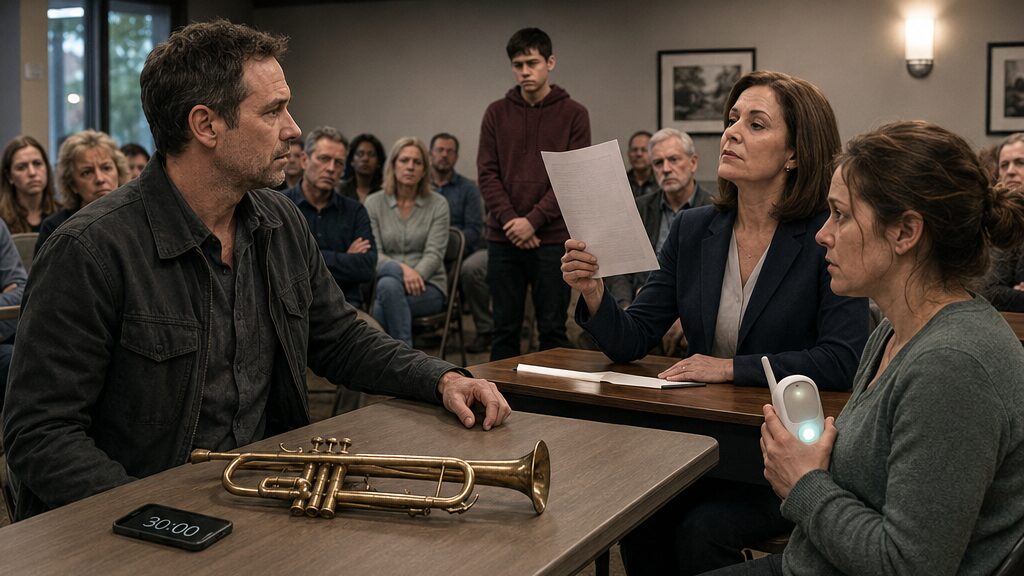
The HOA community room was full enough that several residents stood along the rear wall. Folding chairs scraped whenever someone shifted. Near the front, Emily sat with a small baby monitor in her hand, its screen glowing pale blue.
Daniel placed his trumpet case on the table before him.
Beside it, he set his phone.
The timer display showed 30:00.
A murmur passed through the room.
Someone behind him whispered, “That’s the timer from the video.”
Daniel heard it.
Virginia did too.
She continued.
“The board’s concern is not artistic activity in itself. It is repeated conduct affecting another resident’s reasonable use of her home.”
That wording was careful.
Daniel almost admired it.
He had expected anger. Instead Virginia had built a case that sounded balanced enough to be difficult to attack.
One of the board members asked, “Mr. Moore, do you dispute that you practice most evenings?”
“No.”
“Approximately thirty minutes?”
“Yes.”
“After being told the practice wakes the child next door?”
Daniel looked at Emily.
She did not look away.
“Yes.”
The room changed at that answer.
Not dramatically. A few shoulders shifted. A woman in the second row shook her head.
Virginia folded her hands.
“Then you understand why the association has acted.”
Daniel touched the edge of his phone.
Thirty minutes.
He had used those words as shield and measurement and excuse.
He looked at the baby monitor.
“Emily deserves quiet in her home.”
The room went still.
Emily’s eyebrows lifted slightly.
Virginia said, “Then I’m not sure what remains in dispute.”
“A lot.”
Daniel opened the trumpet case.
Several residents leaned forward.
He did not lift the instrument.
Instead he removed a folded sheet from beneath the cleaning cloth and placed it on the table.
“I have an audition scheduled twelve days from now.”
Virginia’s face remained neutral.
“For what?” a resident asked.
Daniel turned toward the room.
“The city orchestra’s substitute brass roster.”
No one spoke.
A chair creaked.
Someone near the back said, “Seriously?”
Daniel disliked the sudden warmth in the question.
He had known this might happen.
That was one reason he had said nothing.
Virginia glanced at the paper. “Do you have documentation?”
Daniel slid it toward her.
She read the first lines.
The silence deepened.
Emily looked from Virginia to Daniel.
“You could have told me,” she said.
Daniel met her eyes.
“Yes.”
“Why didn’t you?”
He could feel the room waiting for a noble answer.
He had none.
“I didn’t want the complaint decided by whether people liked my reason.”
“That’s not what I asked.”
“No.”
Emily’s thumb moved across the edge of the baby monitor.
Daniel looked at Virginia.
“The practice window isn’t random. I work repair calls most days. I get home around five thirty. The audition material requires open playing, and the street noise gets worse later.”
A resident interrupted.
“So you’re trying to make the orchestra and everybody’s attacking you for practicing?”
Emily’s face closed.
Daniel turned immediately.
“No.”
The resident blinked.
Daniel said, “That’s not what I said.”
Another murmur.
He continued before he lost his nerve.
“She told me the baby was waking. I kept practicing.”
Emily looked down.
“I thought thirty minutes was a fair limit. I treated the duration like it settled the impact.”
The words tasted worse spoken aloud.
Virginia watched him carefully now.
One of the board members asked, “Why not use a mute?”
“I do for some work.”
“For this?”
“Not enough.”
“Why?”
“Because it changes resistance and feedback. I’m preparing specific audition passages.”
That explanation seemed too technical for some people and too convenient for others.
Daniel let it stand.
Then a voice from near the rear asked, “If this position matters so much, why are we only hearing about it now?”
Daniel looked toward the speaker.
He knew the real answer.
Because the last time he told people what he wanted, he failed publicly.
Because he could still remember parents asking when classes would resume.
Because saying I am trying again made failure visible before it happened.
He said, “Because I chose not to tell anyone.”
Virginia leaned back.
“That does not change the nuisance issue.”
“No.”
The room shifted again.
Daniel saw confusion now.
People wanted the reveal to simplify him.
He would not let it.
Virginia looked at the document.
“A substitute roster is not a permanent appointment.”
“I know.”
“There is no guarantee of work.”
“I know.”
Emily looked up sharply.
Daniel had expected that too.
The city orchestra maintained a substitute list. Winning a place did not mean a salary, benefits, or a triumphant new life. It meant being eligible for calls. A credible foothold. Perhaps nothing more.
He took a breath.
“There’s another reason I’m trying.”
He immediately regretted the sentence.
Too theatrical.
Too close to asking.
But the room was already listening.
Daniel glanced toward the back.
Anthony Rivera stood against the wall with his arms crossed.
The teenager had grown taller since Daniel had last taught him. His expression was unreadable.
Daniel looked away.
“If I can get steadier orchestra work,” he said, “I want to restart free music classes here.”
The reaction came fast.
A resident said, “For the kids?”
“For anyone starting out. Kids first if space is limited.”
Another person laughed softly in surprise.
“That would be incredible.”
Someone clapped once.
Then another.
Daniel felt his stomach tighten.
The sound spread.
Not a standing ovation. Nothing that clean. But enough applause to change the temperature of the room.
A man near the aisle said, “We’ve got teenagers with nowhere to go after school.”
A woman behind Emily said, “My granddaughter would sign up tomorrow.”
Virginia raised one hand.
“Please. This is still an enforcement hearing.”
But even she had to wait for the room to settle.
Daniel looked at Emily.
She was not clapping.
The baby monitor screen lit under her thumb.
A small graph moved across it.
She turned it toward him.
“6:17,” she said.
Daniel frowned.
“What?”
“That was tonight. The baby woke at 6:17.”
The room quieted again.
Emily’s voice remained controlled.
“I believe you about the audition.”
No one moved.
“I believe the classes would be generous.”
Daniel felt the sympathy he had not asked for begin to drain away.
Emily continued.
“But my baby still woke up.”
A resident near the front said, “Maybe for twelve days she could—”
Emily turned.
“No.”
The single word stopped him.
She faced Daniel again.
“I’m not withdrawing the complaint because everybody likes your reason now.”
Daniel nodded.
“Okay.”
Her expression flickered.
Perhaps she had expected argument.
She held up a small notebook.
“I tracked the times.”
Daniel remembered the hallway.
Maybe you wrote them wrong.
Shame moved through him.
Emily said, “Sometimes the sound continues after you stop.”
Virginia spoke before Daniel could.
“Sound transmission in buildings can be imprecise.”
Emily turned toward her.
“Then why didn’t anyone inspect it?”
Margaret Lewis lowered her pen.
Virginia’s jaw tightened.
“We have already discussed the cost and necessity of—”
“No,” Emily said. “You told me it wasn’t necessary.”
The room went very still.
Daniel looked at Margaret.
Margaret was no longer watching Emily.
She was watching Virginia.
Daniel saw the first crack in the hearing’s prepared shape.
Then a chair scraped hard against the floor.
Anthony pushed away from the rear wall.
Daniel’s attention snapped toward him.
The teenager headed for the door.
“Anthony.”
Anthony kept walking.
Daniel felt every eye in the room.
He went after him.
Virginia said, “Mr. Moore, the hearing is not concluded.”
Daniel stopped at the doorway.
For years he had obeyed rooms like this. Audition rooms. Job offices. Parent meetings. He had learned to remain where people judged him until they were finished.
Anthony disappeared into the hall.
Daniel looked back at Virginia.
“Then continue without me for a minute.”
He stepped outside.
Anthony was already near the stairwell.
“Anthony.”
The teenager stopped but did not turn.
Daniel approached slowly.
“I didn’t know you were coming.”
“That’s obvious.”
“What does that mean?”
Anthony turned.
His face held none of the admiration Daniel had seen in the meeting room.
“You’re doing free classes?”
Daniel lowered his voice.
“That’s the plan.”
“The plan.”
“Yes.”
Anthony laughed under his breath.
Daniel felt something old and unwelcome tighten behind his ribs.
“Say what you came to say.”
Anthony looked at him.
“You promised lessons before.”
Daniel went still.
The community room door remained open behind them. Voices murmured inside.
Anthony continued.
“You told my mom I was getting good. You told me we’d work through summer.”
Daniel could see the old folding chairs in the basement room. Bent music stands. Anthony at twelve years old, cheeks puffing incorrectly, refusing to give up on a note.
“Anthony—”
“Then you disappeared.”
Daniel looked toward the floor.
“I stopped teaching.”
“I noticed.”
“It wasn’t about you.”
“That’s what adults say when they want credit for hurting somebody by accident.”
Daniel lifted his eyes.
Anthony’s anger was controlled.
That made it worse.
Inside the meeting room, someone called Daniel’s name.
Anthony stepped closer.
“You get up in there and tell everybody you’re going to give something back.”
Daniel said nothing.
Anthony’s voice dropped.
“You promised lessons before. Then you disappeared.”
Chapter 4: The Dream He Hid Was Not the Only Promise He Had Broken
The mouthpiece was sitting on Daniel’s doormat when he opened the door at six in the morning.
Small. Silver-plated. Tarnished around the rim.
He knew it before he bent to pick it up.
Anthony’s beginner mouthpiece.
Daniel turned it in his fingers and found the shallow scratch near the shank where, years earlier, Anthony had dropped it on the basement floor and looked ready to cry.
Daniel had told him then, “It still works. That matters more than how it looks.”
Now the words came back with cruel precision.
Across the hall, a door opened.
Daniel closed his fist around the mouthpiece.
Anthony was not there.
No note. No message.
Just the object.
Daniel carried it inside and placed it beside his phone.
The timer read 30:00.
For ten minutes he stood in the kitchen without touching either one.
By eight, he had a repair call across town. A leaking supply line under a bathroom sink. Then a loose stair rail in an older building. Then a cabinet door in a rental unit where the tenant apologized three times for the mess while Daniel worked around a pile of children’s shoes.
He liked repair work because damaged things usually admitted what they were.
A hinge pulled loose.
A valve corroded.
A screw stripped.
No one asked the hinge whether failure had made it ashamed.
At noon, his phone buzzed.
HOA NOTICE: INITIAL FINE ASSESSED.
He opened the message in the parking garage.
The amount was not ruinous.
That made it worse.
A modest punishment could repeat indefinitely.
Below the fine notice was another line:
Pending resolution of compliance matter, access to reservable association practice room is suspended.
Daniel read that twice.
The community practice room was small and ugly, with old acoustic tiles and a window that looked onto the dumpsters. But twice a week he had used it for open playing when his schedule allowed.
Now that option was gone.
He called Virginia.
She answered on the fourth ring.
“You received the notice.”
“Yes.”
“The board followed the enforcement schedule.”
“You said the hearing wasn’t concluded.”
“The underlying conduct continued.”
“You suspended the room I could use instead of my apartment.”
A pause.
“The room is an association amenity.”
“And you think restricting it reduces the nuisance?”
“That room is not guaranteed to any resident under active enforcement.”
Daniel leaned against his van.
“You know how that sounds.”
“I know exactly how it sounds.”
Something in her voice stopped him.
Not triumph.
Fatigue.
Virginia continued.
“Last year a resident accused this board of selective enforcement for four months. We delayed, we gave extensions, we tried informal solutions. Half the building said we were weak. The other half said we were biased.”
“So now you move faster.”
“Now I follow the written schedule.”
“Even when it makes the problem worse?”
“I’m not discussing policy by phone.”
The line went quiet.
Daniel said, “Emily asked for an inspection.”
“I’m aware.”
“You rejected it.”
“We have evidence of your practice.”
“That wasn’t my question.”
Virginia exhaled.
“Daniel, if you had cooperated when she first asked—”
He ended the call.
The instant the screen went dark, he knew what he had done.
Not because Virginia was right about everything.
Because she was right about that.
That evening, Daniel drove to a rented rehearsal room twenty minutes away.
The place smelled of dust and old carpet. Someone in the next room worked scales on a saxophone. A drummer farther down the corridor hit the same pattern repeatedly.
Daniel set his trumpet on the stand.
30:00.
Start.
He began the audition passage.
The first entrance was clean.
The second phrase tightened.
At the transition he had circled four times, the note cracked.
Daniel stopped.
27:12.
He began again.
Missed it.
Again.
Too sharp.
Again.
His lips hardened with frustration.
At 19:46, he lowered the instrument.
The timer kept running.
He stared at the music.
Then, without warning, he saw Anthony at twelve.
Not the teenager in the hallway.
The child in the basement community room, holding the trumpet too tightly.
“Again?” Anthony had asked.
Daniel had said, “Again.”
That summer there had been six students.
Three folding music stands.
A plastic tub for loaner mouthpieces.
Daniel had believed the classes were temporary until his own career restarted. Then came the audition in another city. He told the students he would miss one week.
He failed in the second round.
He came back to the building and left the instruments boxed.
Parents called.
He ignored two messages.
Answered one and said he needed time.
Then stopped answering.
It had been easier to tell himself the program had simply ended than to face the children who had believed he knew how to keep going.
The timer reached 14:02.
Daniel still had not played.
He picked up the trumpet, but his arms felt heavy.
When the thirty minutes ended, the alarm sounded in the silent room.
He shut it off.
The next afternoon Anthony was standing beside the elevators when Daniel came through the lobby.
Daniel held out the mouthpiece.
“You left this.”
Anthony looked at it.
“Yeah.”
“Why?”
“You knew why.”
Daniel lowered his hand.
A delivery cart rattled past them. Neither spoke until the elevator doors closed again.
Daniel said, “I should have told you I was stopping.”
Anthony’s face hardened.
“That’s it?”
“No.”
“Because it sounds like that’s it.”
Daniel looked at the mouthpiece.
“I had an audition.”
Anthony gave a short laugh.
“Of course you did.”
“I failed.”
That stopped him.
Daniel continued.
“I thought I was finally getting back in. I’d built everything around it.”
“The classes too?”
“No.”
“Then why did we lose them?”
Daniel did not answer quickly enough.
Anthony nodded.
“Right.”
“I was ashamed.”
“So?”
Daniel looked up.
Anthony’s voice sharpened.
“You think I cared whether you got some orchestra job?”
“I cared.”
“That’s not what I asked.”
Daniel felt the old instinct rise: explain, narrow, defend.
He forced it down.
Anthony said, “You told us missing notes was part of learning. Then you missed one thing and vanished.”
The elevator chimed behind them.
Neither moved.
Daniel said, “You’re right.”
Anthony looked almost angrier.
“Don’t do that.”
“Do what?”
“Say I’m right because it ends the conversation.”
Daniel closed his fingers around the mouthpiece.
“It doesn’t end anything.”
“Good.”
Anthony stepped toward the elevator.
Daniel spoke before the doors closed.
“The classes in the meeting weren’t for show.”
Anthony held the door with one hand.
“I know.”
Daniel stared at him.
That was not the answer he expected.
Anthony said, “That’s why I’m mad.”
The doors closed.
Daniel stood alone in the lobby.
That night he returned to his apartment and opened Emily’s message thread.
Her earlier proposal was still there.
Could you move practice to 8:00 for the next couple weeks? We can try to have the baby down earlier.
He had answered:
That time doesn’t work for me.
Nothing else.
Daniel read the exchange until his face warmed.
He had treated explanation as humiliation.
But the message did not show dignity.
It showed refusal.
He typed:
I should have explained why I said no.
Deleted it.
Typed again:
I’m sorry I dismissed the schedule idea.
He sent that before he could revise it.
Emily did not answer.
At six fifteen, Daniel set the timer.
30:00.
He raised the trumpet.
He played six minutes, then stopped.
The timer continued.
At 21:38, he sat down.
He could hear the baby faintly through the wall, but the child was not crying.
Daniel looked at the black practice mute.
Then at Anthony’s old mouthpiece beside the phone.
For the first time, he understood that his routine had stopped being only preparation.
It had become proof.
If he kept the thirty minutes unchanged, then the failure years ago had not frightened him.
If he kept the exact hour, then this audition was still under control.
If no one influenced the routine, no one could see how afraid he was.
His phone buzzed.
Not Emily.
Margaret Lewis.
The message contained a photograph of an old invoice.
Daniel enlarged it.
Building maintenance contractor.
Inspection of shared ventilation chase, Units 4A/4B.
Recommended: reseal penetration gaps; vibration transfer observed.
The invoice was dated eight months earlier.
Below the image, Margaret had written:
I do not know yet what this proves. But I thought you should see it.
Daniel read the final line on the invoice.
REPAIR DEFERRED PENDING BUDGET APPROVAL.
He looked at the wall separating his apartment from Emily’s.
Then at the date.
Eight months.
Long before the complaint.
Long before anyone had called his trumpet a nuisance.
Chapter 5: The Noise Was Real, but the Blame Had Been Assigned Too Easily
The contractor raised one finger.
“Don’t move.”
Emily stood in her kitchen holding the baby against her shoulder.
On the other side of the wall, Daniel was playing.
The contractor pressed his palm near the return vent, head tilted.
Emily watched the stopwatch on her phone.
29:51.
29:58.
30:00.
The trumpet stopped.
The apartment went quiet.
The contractor kept his hand on the wall.
Three seconds.
Five.
Nine.
Then his eyes narrowed.
“There.”
Emily felt it too.
A faint vibration beneath her fingertips.
Not music.
Not exactly.
A low tremor inside the wall cavity, as if the building had remembered the note after Daniel released it.
The contractor stepped back.
“That isn’t him still playing.”
Emily stared at the vent.
“What is it?”
“Could be resonance through the chase. Loose metal. Gaps around penetrations. Hard to say until I open the access.”
The baby stirred.
Emily lowered her voice.
“Can that make the trumpet sound louder?”
“Yes.”
“How much?”
He shrugged.
“I’m not giving you a number without measuring. But shared cavities carry vibration. If somebody already flagged this, it should’ve been checked.”
Emily looked at him.
“Somebody did.”
The contractor stopped.
Daniel stood in the doorway between the hall and kitchen, arms crossed.
He had agreed to the inspection only after Emily insisted she be present. Neither of them had called it cooperation.
The contractor removed the vent cover.
A stale draft moved through the opening.
He aimed a flashlight inside.
“Well,” he said.
Emily felt her stomach tighten.
“What?”
“There’s old sealant missing around part of the chase.”
Daniel stepped closer.
“Enough to matter?”
“Enough that I’d repair it before pretending I knew what sound levels should be.”
Emily looked at Daniel.
He did not look pleased.
That surprised her.
She had expected vindication.
Instead his jaw was tight.
The contractor continued.
“Doesn’t mean the instrument isn’t a disturbance. It means the building may be helping it travel.”
That distinction settled heavily in the kitchen.
Emily nodded first.
“Okay.”
Daniel looked at her.
She knew what he was waiting for.
An apology.
Or maybe he expected accusation.
She gave neither.
“The baby still woke up.”
“I know.”
“The wall being bad doesn’t change that.”
“I know.”
His answer came without resistance.
That was new.
The contractor said he would document what he found and left them beside the open vent.
For several seconds, Emily and Daniel listened to the building.
Pipes.
A distant elevator.
Footsteps overhead.
Normal sounds, each finding its own route.
Emily said, “Margaret sent me the invoice.”
Daniel’s eyes narrowed.
“When?”
“Last night.”
“She sent it to me too.”
“So Virginia knew?”
“I don’t know.”
The answer was careful.
Emily almost accused him of protecting Virginia from a conclusion he had never offered her.
Then she remembered her own notebook.
The assumption written into every page.
Trumpet begins.
Baby wakes.
Case closed.
“I’m going to the records room,” she said.
Daniel looked at her. “Why?”
“Because I filed the complaint.”
“That’s exactly why they’ll say you’re biased.”
Emily adjusted the baby against her shoulder.
“They already say that.”
By afternoon, she was seated beside Margaret at a metal table in the small records room.
Virginia stood near the door.
“This is becoming disproportionate,” Virginia said.
Margaret opened a maintenance binder.
“It is one invoice.”
“And one contractor’s preliminary observation.”
Emily watched Virginia.
“You told me an inspection wasn’t necessary.”
Virginia met her eyes.
“I told you we had sufficient evidence that musical practice was occurring.”
“That isn’t the same thing.”
“No. It isn’t.”
The admission came so evenly that Emily hesitated.
Virginia stepped closer to the table.
“Do you know what happened last year?”
Emily said nothing.
“We spent nearly four thousand dollars investigating a repeated impact-noise complaint. Specialists. Follow-up visits. Board review. The final cause was a resident’s exercise equipment being used after midnight, exactly as the original complainant said.”
Margaret turned a page.
Virginia continued.
“For months, residents accused us of wasting dues because we would not enforce what everyone already knew.”
Emily understood then.
Not agreement.
But shape.
Virginia had not invented her urgency from nothing.
“You didn’t want that again,” Emily said.
“No.”
Margaret stopped turning pages.
“This one is different.”
Virginia’s expression tightened.
Margaret slid a copy across the table.
Board maintenance review.
Emily read the highlighted line.
Ventilation chase resealing deferred to next fiscal cycle due to noncritical classification.
Her eyes moved down.
President approval.
Virginia Scott.
The room became very quiet.
Virginia looked at the paper.
“Yes.”
Emily stared at her.
“You approved delaying it.”
“I approved the maintenance list.”
“Knowing there was vibration transfer.”
“Knowing a contractor observed possible transfer. There had been no formal nuisance complaint linked to it.”
Margaret said, “The estimate was under a thousand dollars.”
Virginia turned toward her.
“We had garage drainage, roof flashing, and elevator service in the same quarter.”
“I know.”
“Then you know why.”
Margaret’s voice remained soft.
“I know why you made the choice. That isn’t the same as saying it had no consequence.”
Emily looked from one woman to the other.
There it was again.
The thing she kept wanting the story to give her and kept refusing.
One person at fault.
One clean explanation.
Instead she had a musician who ignored her, a board president who made a budget choice, a wall that carried sound, and herself filing a complaint because her baby really did wake.
Her phone buzzed.
A message from Daniel.
Audition moved up. Tomorrow morning.
Emily read it twice.
Another message followed.
Personnel scheduling issue. I only found out now.
She stood.
Virginia said, “Emily?”
Emily picked up her notebook.
“I’m not withdrawing the complaint.”
Virginia’s shoulders relaxed slightly.
“But I’m attaching this.”
She tapped the maintenance record.
Virginia’s expression changed.
“The board will review—”
“No. I’m attaching it to my statement.”
Emily left before the argument could restart.
She found Daniel in the corridor outside his unit.
His trumpet case was open on the floor. Sheets of music lay across the table.
He looked as though he had not moved since sending the message.
“Tomorrow?” Emily asked.
“Ten forty.”
“You thought you had another week.”
“Yes.”
She noticed the practice mute on the table.
“Are you ready?”
“No.”
The honesty startled both of them.
Emily leaned against the doorframe.
Daniel said, “I need tonight.”
The old anger returned immediately.
“Of course.”
He closed his eyes.
“That sounded wrong.”
“You keep saying things sound wrong after you say them.”
“I know.”
The baby shifted in Emily’s arms.
Daniel looked toward the child, then away.
Emily said, “My spouse can take the baby to family for part of the evening.”
Daniel stared at her.
“I’m not asking you to do that.”
“I know.”
“Then why?”
“Because I don’t want you to lose the audition.”
The words stayed between them.
Daniel’s face changed in a way she could not name.
Emily continued before either of them made too much of it.
“This is one night. Not a permanent solution. Not proof that your reason matters more.”
“I understand.”
“Do you?”
“Yes.”
She opened her notebook.
“Six to six fifteen. Then seven to seven fifteen.”
Daniel frowned.
“Two blocks.”
“Yes.”
“I may need longer than thirty minutes tonight.”
Emily looked at him.
There was no defiance in his voice.
That made the answer harder.
She closed the notebook.
“Then I need to know whether we’re actually changing anything.”
Daniel glanced at the timer on his table.
The screen was dark.
When he looked back at her, fear had replaced the certainty she had come to hate.
“I don’t know if thirty minutes is enough.”
Emily held his gaze.
“Then tonight you get to decide what matters when it isn’t.”
Chapter 6: On the Night That Mattered Most, He Finally Changed the Timer
The passage failed for the fourth time with one minute and twelve seconds left.
Daniel pulled the trumpet from his lips.
His phone timer counted down.
1:09.
1:08.
The first fifteen-minute block was almost gone.
On the stand, the audition excerpt looked mutilated by pencil marks.
He began again at the difficult entrance.
Too tense.
Stopped.
0:41.
His mouth was dry.
He could hear his pulse.
The old timer setting—thirty minutes—would have given him another quarter hour. Enough for five or six attempts. Enough to find one clean repetition and convince himself it would hold tomorrow.
The digits reached zero.
The alarm sounded.
Daniel did not lower the trumpet.
His finger hovered above Restart.
From next door came nothing.
Emily’s baby was away with family for part of the evening.
He could keep going.
No crying.
No pounding.
No immediate consequence.
Daniel stared at the screen.
Then he set the trumpet down.
The silence that followed felt worse than a missed note.
He stopped on time.
At 6:17, someone knocked.
Daniel opened the door.
Anthony stood there holding two temporary acoustic panels.
Daniel looked at them.
“Where did you get those?”
“Storage room.”
“You’re not supposed to take things from—”
“Margaret signed them out.”
Anthony pushed past him.
Daniel almost smiled.
Almost.
They carried the panels into the living room and leaned them against the shared wall.
Anthony looked at the music stand.
“You stopped?”
“Window ended.”
“You could’ve kept playing.”
“Yes.”
Anthony adjusted one panel.
“Why didn’t you?”
Daniel looked at the phone.
“Because I said I wouldn’t.”
Anthony gave a small shrug as if that answer were insufficient.
Maybe it was.
Daniel said, “I used to think changing the routine meant losing control.”
Anthony glanced at him.
“Used to?”
Daniel let out a breath.
“Working on it.”
They set the second panel.
Anthony noticed the old beginner mouthpiece beside the phone.
“You kept it.”
“For now.”
“It’s mine.”
“I know.”
Anthony’s mouth twitched.
Not forgiveness.
But not nothing.
At seven o’clock, Daniel reset the timer.
15:00.
His thumb paused above Start.
For years, 30:00 had meant discipline.
Then defense.
Then stubbornness.
Now the smaller number looked almost humiliating.
He pressed Start.
The countdown began.
Anthony moved toward the door.
“You staying?” Daniel asked.
“No.”
“Okay.”
Anthony stopped.
“Play the transition slower first.”
Daniel stared at him.
Anthony opened the door.
“You told me that once.”
Then he left.
Daniel turned back to the stand.
He played the passage under tempo.
Again.
Again.
At 8:22 remaining, the transition settled.
At 5:10, he brought it closer to audition speed.
The first attempt cracked.
The second held.
Daniel did not celebrate.
He breathed and tried again.
2:03.
Clean.
1:21.
Almost clean.
0:32.
He lifted the trumpet for one final attempt.
The alarm sounded before he began.
Daniel stood motionless.
He could restart for five minutes.
Emily was still away.
The building defect meant some of the complaint was not his fault.
Virginia had ignored the maintenance issue.
The audition was tomorrow.
Every argument was available.
Daniel lowered the trumpet.
He stopped.
At 7:19, Emily knocked.
She had returned alone.
“The baby’s still with family,” she said. “You had more time.”
“I know.”
“Why did you stop?”
“Because the schedule said fifteen.”
She studied him.
Daniel waited for the satisfaction he thought should come from doing the right thing.
It did not come.
He was still underprepared.
He was still afraid.
Emily looked past him at the panels.
“Anthony?”
“Yes.”
“Are you two okay?”
“No.”
A faint smile touched her face.
“That sounded honest.”
Daniel nodded.
She lifted a folded sheet.
“The contractor sent his report.”
He took it.
The language was cautious but clear: incomplete sealing and vibration pathways could materially increase sound transmission between the units.
Daniel read the final recommendation.
Immediate resealing.
“Virginia has it?” he asked.
“Yes.”
“And?”
Emily’s expression hardened.
“She sent notice that enforcement remains active pending board review.”
Daniel looked up.
“After this?”
“She says the defect doesn’t erase your conduct.”
Daniel almost laughed.
“She’s right.”
Emily stared at him.
He folded the report.
“She’s also not entirely right.”
“No.”
For the first time, they stood on the same side of a sentence without pretending they were on the same side of everything.
Daniel’s phone buzzed.
An email from the HOA.
He opened it.
The board intended to proceed with scheduled penalties while reviewing maintenance implications separately.
Anthony’s panels leaned against the wall.
The practice timer sat at 00:00.
Daniel read the message again.
Emily said, “What are you going to do?”
The old answer came first.
Fight.
Demand rescission.
Prove the wall had caused everything.
He looked at her notebook in her hand.
Then at the closed trumpet case.
“I’m going to write them.”
Emily frowned. “Tonight?”
“Before I change my mind.”
Daniel sat at the kitchen table.
The first sentence took eight minutes.
I dispute the association’s conclusion that I am solely responsible for the reported sound transmission.
He stopped.
Too safe.
He deleted solely.
Then wrote:
I also acknowledge that I continued practicing after Ms. Harris told me the schedule was waking her child, and I rejected a proposed compromise without explaining my circumstances or making a serious effort to negotiate.
Daniel stared at the words.
Emily said nothing.
He continued.
The maintenance defect must be addressed. My own choices must be addressed too. I request that the board review both.
He attached the contractor’s report.
Attached the old invoice Margaret had sent.
Then added a proposed interim schedule with two short open-practice blocks and muted work outside them.
His finger rested above Send.
Emily asked, “You know Virginia can use the admission against you.”
“Yes.”
“You’re sending it anyway?”
Daniel looked at the timer.
“Yes.”
He sent it.
At 7:02 the next morning, Daniel stood in the parking garage wearing his one dark suit, trumpet case in hand.
The audition building was across the city.
He had slept badly.
His lips felt uncertain.
The difficult passage had not become reliable enough.
As he reached his van, his phone buzzed.
A reply from Margaret.
Received. Special board meeting requested.
Another message followed from Virginia.
Your statement will be included in the record.
Nothing more.
Daniel put the phone in his pocket.
Behind him, the garage door began to rise.
He thought about the clean attempt he had not taken after the timer expired.
Perhaps he would miss that note today.
Perhaps stopping had cost him the last repetition he needed.
He placed the trumpet case on the passenger seat.
For once, there was no way to turn the uncertainty into a schedule.
Daniel started the engine and drove toward the audition.
Chapter 7: He Returned Without a Victory Speech and Asked the Board for Something Harder
Daniel came back to the building two days after the audition, and nobody knew whether he had won anything.
That fact irritated people more than he expected.
A resident caught him near the mailboxes and asked, “Well?”
Daniel kept walking.
Another called from the lobby, “Did you make it?”
He lifted one hand without turning.
“Don’t know yet.”
By six thirty, the special board meeting was full.
Daniel entered carrying no trumpet case.
Only a folder and his phone.
Virginia Scott sat at the center table with Margaret Lewis to one side and the other board members arranged beside them. Emily was in the second row, notebook closed on her lap.
Daniel noticed Anthony standing near the rear wall again.
This time the teenager did not leave when Daniel looked at him.
Virginia called the meeting to order.
“We are here to address two related matters,” she said. “The nuisance enforcement proceeding involving Mr. Moore and the maintenance findings concerning sound transfer between Units 4A and 4B.”
Daniel took his seat.
Margaret leaned toward him before Virginia continued.
“I reviewed your statement.”
“I assumed.”
“We may be able to dismiss the enforcement action entirely.”
Daniel looked at her.
Margaret lowered her voice.
“With the defect report, the prior invoice, and the procedural issues, there is a basis.”
For half a second, relief moved through him so sharply it almost felt like weakness.
Every fine gone.
Every notice erased.
The word nuisance removed from the record.
He could take it.
He had spent days wanting exactly that.
Daniel opened his folder.
“No.”
Margaret blinked.
“What?”
“I don’t want every complaint dismissed.”
She stared at him.
Virginia had begun summarizing the contractor’s findings, but Daniel barely heard her.
Margaret whispered, “You understand what I’m saying?”
“Yes.”
“Then why?”
Daniel looked toward Emily.
“Because some of it happened.”
Margaret sat back.
Virginia finished reading the report.
“The board accepts that incomplete sealing in the shared ventilation chase materially increased sound transmission. The board also accepts that this condition should have been addressed earlier.”
A low murmur moved through the room.
Virginia lifted one hand.
“However, that does not establish that all reported disturbances resulted from building conditions.”
Daniel stood.
Virginia looked at him.
“You will have time to speak.”
“I’m asking now.”
A pause.
Then she nodded.
Daniel walked to the table and placed his folder down.
He set his phone beside it.
For a moment the screen showed 30:00.
Several residents noticed.
Daniel turned the phone face down.
“I’m not asking you to declare that I did nothing wrong.”
The room quieted.
Virginia’s expression shifted almost imperceptibly.
Daniel continued.
“I practiced after Emily told me the baby was waking. I rejected a schedule change without explaining why. I treated thirty minutes as if the limit made the impact acceptable.”
He looked at Emily.
“I was wrong about that.”
Emily did not smile.
She nodded once.
Daniel opened the folder.
“But the board also had information that sound transfer between these units might be abnormal.”
Virginia’s jaw tightened.
“A maintenance observation is not the same as proof.”
“No. It isn’t.”
Daniel slid a copy of the invoice across the table.
“That’s why someone should have checked.”
One of the board members looked toward Virginia.
Margaret said nothing.
Daniel placed the contractor’s newer report beside the old invoice.
“You don’t have to make me innocent to admit the building mattered.”
Virginia leaned forward.
“And you do not get to use a maintenance defect to erase repeated conduct.”
“I’m not.”
“Then what are you asking for?”
Daniel took out a single page.
“A correction.”
He placed it on the table.
Virginia looked down.
It was a practice schedule.
Two short open-instrument blocks on weekdays.
Muted technical work outside them.
No open playing during the baby’s established evening sleep window unless Emily agreed in advance to a specific exception.
A review date after repairs.
Virginia read it silently.
Daniel said, “I’m asking the board to repair the chase, rescind penalties based on the claim that I alone caused the entire disturbance, and keep the complaint record accurate.”
A resident near the aisle said, “Why not just throw the whole complaint out?”
Daniel turned.
“Because the baby woke up.”
No one answered.
Emily stood.
Virginia looked at her.
“I want to speak.”
“Go ahead.”
Emily came forward carrying her notebook.
She placed it beside Daniel’s schedule.
“The noise was real.”
Daniel kept his eyes on the table.
Emily continued.
“So was the building problem.”
She opened the notebook.
“These are the times I recorded. Some nights the baby woke within minutes of Daniel starting. Some nights vibration continued after he stopped.”
She looked at Virginia.
“I filed the complaint because I needed relief. I still think filing was reasonable.”
Virginia nodded.
“But I don’t think the board handled the conclusion reasonably.”
That landed harder.
Virginia’s face tightened.
Emily said, “I asked for someone to inspect the sound transfer. You said it wasn’t necessary.”
“I said we had sufficient evidence to act on the admitted practice.”
“You also knew there had been a prior vibration concern.”
The room became silent.
Virginia looked at the old invoice.
One board member asked, “Did you know?”
Virginia did not answer immediately.
When she did, her voice was controlled.
“I knew the contractor had noted possible vibration transfer during a broader maintenance review.”
“And you deferred repair?” the member asked.
“Yes.”
“Why?”
Virginia folded her hands.
“Because the board had limited funds and multiple higher-priority projects. Garage drainage. Roof flashing. Elevator service. There was no active complaint connected to the chase at that time.”
Margaret looked down.
Virginia continued.
“When this complaint arose, I believed the direct evidence of daily practice was sufficient to proceed.”
Daniel watched her carefully.
She was not lying.
That almost made it harder.
One resident said, “And when Emily asked for inspection?”
Virginia’s face changed.
Just slightly.
“I believed further delay would repeat the board’s mistake from last year.”
“What mistake?”
Virginia looked toward the room.
“Doing too little for too long.”
There was no applause.
No easy condemnation.
Several residents knew the case she meant. Daniel remembered the angry email chains. The accusations that Virginia had let a nuisance drag on because she feared confrontation.
She had learned something from that failure.
The wrong thing, perhaps.
But something.
Virginia looked at Daniel.
“You still violated nuisance standards.”
Daniel nodded.
“Some nights, yes.”
The answer surprised her.
He continued.
“That’s why the schedule is enforceable.”
He tapped the page.
“I’m not asking for special treatment because I had an audition.”
The word had barely left his mouth before someone called from the back, “So did you get it?”
A few nervous laughs broke the tension.
Daniel did not turn.
“I don’t know.”
The laughter faded.
“I came here before the result because the result shouldn’t decide whether the board fixes the wall or whether I admit what I did.”
Anthony lowered his arms.
Daniel saw it.
Virginia read the schedule again.
Emily said, “I’ll agree to this as an interim plan.”
Virginia looked at her.
“You understand that means documenting any future violations?”
“Yes.”
Daniel said, “That’s the point.”
The vote took twenty-seven minutes.
Too long for drama.
Long enough for amendments.
Repair authorization.
Temporary practice terms.
Rescission of fines tied to the board’s unsupported assumption that Daniel was solely responsible for all reported transmission.
Retention of the underlying complaint as partially substantiated.
A requirement that future nuisance cases involving plausible structural transmission receive technical review before escalating beyond initial notice.
Virginia voted last.
Her face revealed nothing.
“Yes.”
The motion passed.
The room exhaled.
Not cheered.
Just exhaled.
Daniel gathered his papers.
Margaret touched his sleeve.
“You could have walked out cleared.”
“No.”
“You know that.”
“Yes.”
“Why didn’t you?”
Daniel looked toward Emily’s notebook.
“Because that would’ve been another way of disappearing.”
Margaret released his sleeve.
Across the room, Virginia remained seated while residents approached her with questions. She looked older than she had at the first hearing.
Daniel almost went to her.
He did not.
Not yet.
His phone buzzed.
One email.
He saw the sender.
City Orchestra Personnel.
His hand stopped.
Anthony noticed from across the room.
Emily did too.
Daniel opened the notification just enough to see the subject line.
Audition Results.
He locked the screen.
Emily stared at him.
“You’re not opening it?”
“Not here.”
Anthony shook his head.
Daniel slipped the phone into his pocket.
For the first time in years, he had asked for something harder than victory.
Now the answer to the thing he had wanted most was waiting against his leg, unread.
Chapter 8: The First Lesson Began Before Anyone Knew Whether His Last Audition Had Worked
Anthony appeared in the community-room doorway after Daniel had already put away one chair.
Daniel had set out eleven.
There had been twelve.
He had told himself the room looked less crowded that way.
Anthony leaned against the frame.
“You short on chairs?”
Daniel looked at the empty space where the twelfth had been.
“No.”
Anthony’s eyes moved to the table.
Beginner books.
Loaner mouthpieces.
Two battered music stands.
A phone timer.
30:00.
Three weeks had passed since the board meeting.
The ventilation chase had been resealed. Emily’s unit no longer carried the same metallic after-hum. The interim practice schedule remained taped inside Daniel’s kitchen cabinet, though no one had needed to cite it yet.
The free class had six confirmed students.
Daniel had set out eleven chairs anyway.
Then removed one.
Anthony stepped inside.
“Class starts in five minutes.”
“I know.”
“You joining?”
Anthony shrugged.
“Maybe.”
Daniel nodded toward the chairs.
“Then sit or don’t.”
Anthony gave him a flat look.
“You still do that.”
“Do what?”
“Act like you don’t care before somebody can tell you no.”
Daniel looked at him.
A child and parent entered behind Anthony, ending the moment.
Then two more residents.
The room filled gradually.
Emily arrived last, carrying the baby.
Daniel’s eyes went immediately to the child.
Emily noticed.
“Quiet part only,” she said.
Daniel nodded.
“That’s the first half.”
“Good.”
The baby was awake, looking around with solemn concentration.
Daniel glanced at his phone.
The timer still showed 30:00.
He had divided the class into fifteen minutes of listening and breathing work, then fifteen minutes of playing.
He almost smiled at the irony.
Thirty minutes had survived.
Just not in the form he had defended.
When everyone settled, Anthony remained at the doorway.
Daniel began without calling attention to him.
“No instruments yet.”
A few disappointed faces.
Daniel held up one finger.
“First thing you learn is when not to play.”
Emily looked down, hiding a smile.
Daniel heard it anyway.
He guided the room through breathing. Posture. Listening for the soft hum of the ventilation system. The elevator cables faintly moving beyond the wall. Someone shifting in a chair.
The baby made a small sound.
Every head turned.
Daniel said, “That counts too.”
The room relaxed.
At fourteen minutes, Emily stepped toward the rear.
“I’m taking the baby out before the playing starts.”
Daniel nodded.
She paused beside him.
“You opened the email?”
He looked toward Anthony.
The teenager was still standing.
“Yes.”
Emily waited.
Daniel said, “Substitute roster.”
Her face brightened.
“That’s good.”
“It’s limited.”
“Still good.”
“No guaranteed calls.”
She lowered her voice.
“Daniel.”
He stopped.
Emily smiled.
“Still good.”
He looked at the floor.
“Yeah.”
She shifted the baby.
“When did you find out?”
“Three weeks ago.”
Her eyes widened.
“You knew at the board meeting?”
“No. Opened it after.”
“And you didn’t tell anyone?”
“I told the people who needed to know.”
Emily looked pointedly at the room full of residents.
Daniel sighed.
“I’m working on it.”
She laughed softly and carried the baby out.
Daniel turned back.
Anthony had moved inside.
Not seated.
But inside.
The first half ended.
Daniel stopped the timer.
15:00 remaining.
He reached for the instruments.
Anthony spoke.
“You never apologized.”
The room quieted.
Daniel froze.
Several residents looked away, sensing something private and not private at all.
Anthony stepped closer.
“You admitted you stopped teaching.”
“Yes.”
“You said you were ashamed.”
“Yes.”
“That’s not an apology.”
Daniel placed the mouthpieces back on the table.
The old instinct rose immediately.
Explain the failed audition.
Explain the money.
Explain how impossible it had felt to stand before those children.
He let every explanation pass.
Then said, “I’m sorry I left.”
Anthony did not move.
Daniel continued.
“I’m sorry I made you think you weren’t worth showing up for.”
The room stayed silent.
“I was ashamed of myself. I used that as a reason not to face you. It wasn’t a reason.”
Anthony’s jaw tightened.
Daniel said, “You didn’t deserve it.”
No speech followed.
No request for forgiveness.
Daniel waited.
Anthony looked toward the instruments.
Then back at him.
“What happens if the orchestra drops you?”
Daniel frowned.
“What?”
“You got on the roster. Fine. What happens if they never call? Or they call once and then reject you later?”
Daniel felt the entire room narrow to that question.
Years earlier, the answer would have been obvious.
He would regroup.
Disappear.
Wait until he had something respectable to return with.
Anthony said, “Do the classes stop again?”
Daniel looked at the timer.
Then at the chairs.
Then at the old beginner mouthpiece, cleaned now and resting near the edge of the table.
“No.”
Anthony’s eyes stayed on him.
Daniel said it again.
“No.”
Something in Anthony’s face loosened.
Not all the way.
Enough.
He crossed the room and took the chair Daniel had nearly removed.
Daniel picked up the old mouthpiece.
“Yours.”
Anthony held out his hand.
Daniel gave it to him.
The room shifted as instruments were distributed.
Outside, someone rolled a cart down the corridor. Pipes clicked in the wall. A door closed upstairs.
Ordinary building sounds.
Daniel set his phone where everyone could see it.
15:00.
He looked at Anthony.
“Ready?”
Anthony raised the instrument.
Daniel pressed Start.
“Yes,” he said.
The story has ended.