He Lent His HOA Neighbor Thousands in Tools—Then Learned What Her New Fence Was Really Hiding
Chapter 1: The Table Saw in Her Driveway
Stephen Miller knew the sound of his table saw the way some people knew the sound of their own truck pulling into the driveway.
So when the high, steady whine floated across the street on Tuesday afternoon, he stopped halfway through setting a grocery bag on his kitchen counter.
For a second he just listened.
The saw rose in pitch, bit into lumber, then eased down again.
Stephen walked to the front window.
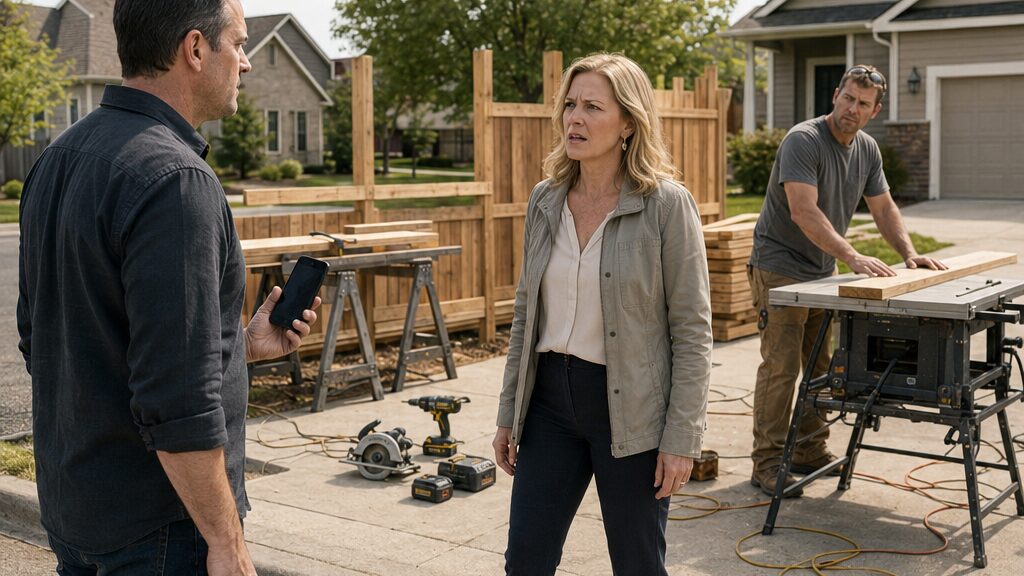
Across the street, Sharon Walker’s driveway looked like a temporary jobsite. Stacks of cedar boards sat beside a half-finished privacy fence. A contractor in work gloves was measuring a post. Another man stood near a folding work table.
And near the garage, under a pale layer of sawdust, was Stephen’s table saw.
He stared at it long enough to notice the details that removed any possibility of mistake: the black extension wing he had repaired himself, the dent along the lower rail, the narrow strip of blue tape he used to mark the power switch after installing the connected control module.
Then he saw his cordless impact driver sitting on the tailgate of a pickup.
His circular saw was on the pavement.
His battery charger was plugged into an exterior outlet.
Stephen picked up his phone, then put it back in his pocket.
He had learned years ago that anger made people careless. He preferred measurements, records, square corners. Anything that could be checked twice before being cut once.
He crossed the street.
Sharon noticed him before he reached the driveway. She stepped away from the workers with the expression of someone responding to an interruption rather than welcoming a neighbor.
“Stephen.”
He nodded toward the saw.
“What’s going on?”
Sharon glanced over her shoulder as if the answer were obvious.
“The fence.”
“I can see that.”
A worker lifted another board onto the table.
Stephen kept his voice level. “You told me the tools were for the community landscaping project.”
“They were.”
He waited.
Sharon folded her arms. “The project changed.”
There was enough confidence in the sentence that Stephen almost thought he had missed some announcement.
“Changed into your fence?”
“It’s more complicated than that.”
The saw started again behind her.
Stephen felt the vibration of the motor through the soles of his shoes. He had bought that machine after replacing an older saw that had finally become impossible to keep square. It had cost more than some people spent on a used car payment over several months.
He looked past Sharon.
“How long have they been using it here?”
She exhaled. “Stephen, I’m trying to get something finished.”
“That wasn’t my question.”
“Since yesterday.”
He glanced at the unfinished fence. At least twelve posts were already set. Fresh boards ran along one side of the property.
That was more than a few hours of work.
“And the landscaping project?”
Sharon’s mouth tightened.
“The association decided not to move forward the way we expected.”
“We?”
“The committee.”
“You’re the committee chair.”
“I’m one member of it.”
Stephen looked again at his tools.
On Saturday morning, none of this had sounded complicated.
Sharon had caught him in his garage while he was fitting drawer slides into a built-in cabinet. The door had been open, and she had stood just beyond the threshold, admiring the wall where his cordless tools hung by type and battery platform.
She had asked for help with a community landscaping job near the rear entrance.
Not labor. Equipment.
A saw. A drill. Maybe an impact driver.
Something temporary.
Stephen had agreed because he had helped neighbors before. He had repaired mailbox posts, cut shelving, lent a ladder, fixed a sagging gate. Sharon had been around his workshop enough times to know he took care of his equipment.
He had assumed that meant she would too.
Now she was standing between him and thousands of dollars’ worth of his property while a contractor cut cedar for her backyard.
“I need everything back,” he said.
“We’re still using it.”
“That’s not really relevant.”
Her eyebrows rose.
“It’s relevant to me.”
“Then rent equipment.”
“That would be ridiculous when this is already here.”
Stephen felt something shift in his chest. Not anger exactly. Something colder.
“You didn’t borrow it for this.”
“I borrowed it for work connected to the neighborhood.”
“This is your house.”
“And the reason I’m building it has everything to do with the neighborhood.”
One of the workers glanced toward them, then deliberately looked away.
Stephen lowered his voice.
“I’m not having this conversation in front of your contractor. I want everything returned by Friday morning.”
“Friday?”
“Yes.”
“That’s two days.”
“That’s more notice than you gave me before changing what you were using it for.”
Sharon gave a short laugh, but there was no humor in it.
“You volunteered them.”
“I volunteered them for a landscaping project.”
“And there was no paperwork.”
Stephen looked at her.
She continued, softer now, as if explaining something he should have understood.
“You didn’t give me a written restriction. You didn’t give me a return date. You handed me the access fob and said we could use what we needed.”
“That isn’t what I said.”
“It’s close enough.”
Behind her, the saw stopped.
For the first time, the sudden silence felt more threatening than the noise.
Stephen stared at Sharon for another second, then turned back toward his house.
“Friday morning,” he said.
She called after him.
“Stephen, you’re making this into something it doesn’t need to be.”
He kept walking.
When he reached his garage, he looked automatically toward the small metal hook beside the workbench where the tool-access fob normally hung.
It was empty.
He remembered placing it in Sharon’s hand on Saturday.
At the time, it had felt like trust.
Now he could only think about what she had said.
No paperwork.
No restriction.
No return date.
And for the first time since crossing the street, Stephen had to ask himself a question he did not like.
What, exactly, had he agreed to?
Chapter 2: The Favor Stephen Never Defined
Sharon had known precisely which tools she wanted.
That detail bothered Stephen more on Wednesday morning than it had on Saturday.
He stood in his garage before work, looking at the empty spaces on the wall.
Table saw.
Circular saw.
Impact driver.
Drill.
Two batteries.
Fast charger.
The list was larger than he had allowed himself to remember during the argument.
On Saturday, Sharon had arrived carrying coffee and urgency.
“The rear entrance landscaping is finally moving,” she had said.
Stephen had been kneeling beside a cabinet carcass, adjusting a drawer slide.
“That’s the one by the retention area?”
“Exactly.”
She had stepped farther into the garage, careful not to touch anything.
“We’ve got volunteers, but the association doesn’t own enough equipment. Robert said you might have what we need.”
Stephen had smiled at that.
Of course Robert had said that.
Everyone on the street knew Stephen’s garage was better equipped than most small contracting vans.
“What are you cutting?”
“Border material. Some posts. Maybe edging.”
“What kind of posts?”
Sharon hesitated only briefly.
“Four-by-fours, I think.”
He should have asked more.
Instead, he had stood up and begun pointing.
“You can use the circular saw for most of that. Impact driver for exterior screws. If you’re doing repeated cuts, the table saw is cleaner, but don’t move the fence on it once it’s calibrated.”
Sharon had listened closely.
“What about the batteries?”
“I’ll give you two.”
“You have that system where everything is registered, right?”
That should have stood out too.
Instead, Stephen had felt the familiar small satisfaction of being asked about something he had built well.
“Most of it.”
He walked her over to the wall-mounted control hub.
“The smart modules track the connected tools. Location, usage time, battery status. I can lock them out if anything disappears.”
Sharon laughed.
“Like a kill switch?”
“More or less.”
“That’s serious.”
“Tools walk off jobsites.”
Stephen had said it lightly.
Then he had removed the access fob from its hook.
The fob allowed temporary pairing and simplified check-in for tools he loaned out. He had built the system after losing equipment years earlier during a bad business partnership.
That part he had not explained.
He had merely dropped the fob into Sharon’s palm.
“Keep this with the gear.”
“For how long?”
Stephen remembered the question now.
He also remembered his answer.
“Until you’re done.”
Two careless words.
No date.
No inventory sheet.
No written purpose.
Not even a text confirming what she was borrowing.
Stephen leaned against the workbench.
He had spent most of Tuesday evening telling himself Sharon was exploiting his generosity.
That was true.
But another truth had begun irritating him beneath it.
He had made generosity easy because he liked what it said about him.
Dependable.
Useful.
The person people called when something needed fixing.
Years earlier, when Stephen still ran a small cabinet installation partnership, he had been the same way. He had absorbed extra jobs, loaned tools, covered missed shifts, allowed expenses to remain undocumented because writing things down felt unfriendly.
By the time the partnership failed, several thousand dollars of equipment and unpaid invoices had become arguments about memory.
Stephen had promised himself never again.
Yet on Saturday, a neighbor had arrived with urgency and praise, and he had handed over the fob without even opening the notes app on his phone.
At noon, he received a message from Sharon.
Need the saw through Friday afternoon. Installer schedule changed.
Stephen stared at it.
He typed:
Everything needs to be returned Friday morning as I told you yesterday.
Three dots appeared.
Then disappeared.
Then returned.
Stephen waited.
Finally:
The work is still serving the community, Stephen. Stopping now creates a bigger problem.
He read the sentence twice.
Serving the community.
That phrase had become a kind of solvent. Sharon seemed able to pour it over any distinction she found inconvenient.
Stephen typed:
Your private fence is not the project I agreed to support.
Her response came almost immediately.
You don’t know the full situation.
Then tell me.
This time the three dots stayed for nearly a minute.
When the message arrived, it did not answer him.
I have committee responsibilities you’re not considering.
Stephen set the phone down.
Later that afternoon, as he walked back from the mailbox, he saw Sharon speaking with one of the neighboring homeowners near the unfinished fence. She gestured toward the rear lot line, then toward the street.
The neighbor nodded.
Stephen could not hear them.
Sharon noticed him watching and turned slightly away.
That small movement unsettled him more than another argument would have.
He went inside and opened the tool-management app.
The location history showed every connected device in the same place.
Sharon Walker’s address.
No trip to the rear entrance.
No community landscaping area.
No movement anywhere else.
He expanded the timeline.
Sunday afternoon.
Monday morning.
Monday afternoon.
Tuesday.
Wednesday.
The tools had spent their entire loan period at her house.
Stephen leaned back in the chair.
The evidence brought a brief sense of relief. At least he was not imagining things.
Then he remembered Sharon’s words.
You don’t know the full situation.
He hated that part of him still wanted to know.
Thursday passed without the tools returning.
At 8:17 that evening, Stephen sent one final message.
Reminder: all borrowed equipment must be back in my garage by 8:00 tomorrow morning.
Sharon did not answer for nearly an hour.
When she finally did, the message was only one sentence.
The work isn’t finished, and it is still serving the community whether you agree with that or not.
Stephen looked across the dark street toward the outline of the unfinished fence.
He had thought the question was whether Sharon would give his tools back.
Now a different question had taken its place.
What did she believe that fence was protecting the neighborhood from?
Chapter 3: When Every Tool Went Quiet
At 8:06 Friday morning, Stephen heard the table saw start.
He was standing in his garage with his phone already in his hand.
For several seconds he did nothing.
The deadline had passed.
Across the street, the fence installer had set up for another morning of cutting. One worker carried boards from the driveway. Sharon stood near the garage speaking to him, coffee mug tucked against her chest.
No one was bringing Stephen’s equipment home.
He opened the management app.
The screen listed each connected tool.
TABLE SAW — ACTIVE.
IMPACT DRIVER — ACTIVE.
CIRCULAR SAW — IDLE.
BATTERY PLATFORM — CONNECTED.
Stephen tapped the location tab.
All of them showed the same address they had shown for three days.
Sharon’s.
He zoomed out anyway.
He checked the rear entrance landscaping area.
Nothing.
He checked the last seventy-two hours.
Nothing.
His tools had never gone anywhere connected to the community project she had described.
The anger Stephen had been holding since Tuesday hardened into something that felt almost clean.
He selected the table saw.
A control window opened.
Remote lock.
He hesitated.
The installer across the street pushed another cedar board into position.
Stephen could simply walk over again.
He could argue again.
He could hear Sharon explaining that she was almost finished, that he was being unreasonable, that everyone benefited from whatever she believed the fence solved.
He thought about the empty fob hook.
The unanswered deadline.
Nothing in writing.
His thumb pressed the screen.
LOCK DEVICE?
Stephen confirmed.
Across the street, the table saw’s motor dropped in pitch.
The worker looked down as the blade coasted to a stop.
He touched the switch.
Nothing happened.
Stephen selected the impact driver.
Lock.
Then the circular saw.
Lock.
Then the remaining connected batteries.
Lock.
One after another, the green indicators in the app turned gray.
Across the street, confusion spread through the driveway.
The worker holding the impact driver squeezed the trigger twice.
A brief electronic click.
Silence.
The second worker checked the battery.
Sharon stepped toward them.
Stephen felt the first pulse of satisfaction.
Not joy.
Relief.
For four days, Sharon had acted as though possession had become permission.
Now the tools were still physically across the street, but the choice was his again.
His phone rang seven minutes later.
Sharon.
He let it ring.
A second call came two minutes after that.
Then a third.
Stephen stayed at his workbench, tightening a clamp on a cabinet door he had no intention of working on.
The fourth call arrived twenty minutes after the shutdown.
He answered.
“What did you do?”
No hello.
Stephen looked through the open garage door.
Sharon stood in her driveway with the phone pressed to her ear.
“I disabled my equipment.”
“You shut down powered tools while people were working.”
“I gave you a return deadline.”
“You could have caused an accident.”
The sentence cut through his satisfaction.
Stephen glanced toward the table saw.
The blade had not stopped instantly. The system cut power; normal mechanical braking handled the rest. He knew that.
But he also knew there had been a board on the table.
“You were told to return them.”
“That isn’t the point.”
“It is exactly the point.”
“No, Stephen. The point is that you remotely interfered with active equipment while contractors were using it.”
“They were using equipment you didn’t have permission to keep.”
“I did have permission.”
“For a community landscaping project.”
“The fence is connected to that issue.”
“You keep saying that and refusing to explain how.”
A pause.
Then Sharon said, “You’ll get the explanation.”
Something in her tone changed.
Stephen straightened.
“What does that mean?”
“I requested an emergency hearing.”
“With who?”
“The board.”
He almost laughed.
Not because it was funny. Because the escalation felt absurdly predictable.
“You’re taking me to the HOA over my own tools?”
“I’m asking the board to review what you did this morning.”
“And are you going to tell them why the tools were at your house for three days?”
“I’m going to tell them the whole situation.”
“Good.”
“You may not think that after they hear it.”
The call ended.
Stephen lowered the phone.
The clean satisfaction from fifteen minutes earlier was gone.
He opened the app again.
There it was in the activity log.
8:08 A.M. — REMOTE LOCK COMMAND.
TABLE SAW — ACTIVE AT TIME OF COMMAND.
His stomach tightened.
He knew why he had done it.
He knew the tools were his.
He knew Sharon had ignored him.
But the log did not show anger, context, or the argument on Tuesday.
It showed an active machine and his decision to cut its power.
Stephen sat down at the workbench.
Across the street, the fence installer was unplugging his equipment from Stephen’s batteries and carrying replacement tools from the truck.
Sharon stood watching him, no longer calling.
A notification appeared on Stephen’s phone.
HOA Board — Emergency Conduct Review Requested.
He opened it.
The meeting had not yet been scheduled, but the request named both parties.
Property dispute.
Unauthorized retention of personal equipment.
Remote disabling of powered tools during active contracted work.
Stephen read the last line twice.
For four days, he had been waiting for Sharon’s version of events to collapse under the facts.
Now he understood something he should have known before touching the lock button.
Facts did not arrive at meetings alone.
People arranged them.
And Sharon had just made sure the board would hear hers.
Chapter 4: The Complaint Was Bigger Than the Tools
Emily Garcia called Stephen before noon.
“I want you to understand something before this gets any farther,” she said. “The board is not reviewing only Sharon’s conduct.”
Stephen stood at his kitchen counter with the notification still open on his phone.
“I figured that from the wording.”
“I’m making sure.”
“What exactly am I being reviewed for?”
Emily paused.
“The remote shutdown. Whether it created a safety issue. Whether the dispute should have been handled through the property manager first.”
Stephen looked across the street.
His table saw sat where it had stopped that morning, unplugged now, with a tarp thrown loosely over it. The unfinished fence cut across Sharon’s lot in pale vertical sections.
“And her keeping my equipment?”
“That’s also part of it.”
“Also.”
“Stephen.”
He could hear the warning in her voice.
Emily had been HOA secretary for three years. She spoke carefully even when discussing broken irrigation heads.
“I’m not saying the situations are equal,” she said. “I’m saying the board needs facts before anyone decides what happened.”
“I can give you facts.”
“Good. Save everything.”
He almost told her he already had location histories, device records, messages and timestamps arranged in folders.
Instead he said, “I will.”
Emily lowered her voice.
“One more thing.”
Stephen waited.
“The fence issue didn’t start this week.”
“What does that mean?”
“You should talk to Robert.”
The call ended before Stephen could ask much more.
Robert Hill lived two houses beyond Sharon, where the street curved toward the lower end of the subdivision. Stephen found him that afternoon dragging a green trash bin toward his garage.
Robert took one look at him.
“So you finally heard.”
“Heard what?”
Robert stopped moving.
“That depends on how much Sharon told you.”
“Almost nothing.”
“That sounds like Sharon.”
Stephen glanced back toward her property.
“She says the fence is connected to some community problem.”
Robert nodded slowly.
“It is.”
Stephen felt irritation rise again.
“Then why didn’t anybody say that before she took half my shop?”
Robert gave him a flat look.
“Because two things can be true at once.”
That answer irritated him more.
Robert led him around the side of his house.
Behind the subdivision lots, the ground dipped toward a shallow landscaped drainage corridor. It looked harmless at first: grass, decorative stone, a few shrubs. Then Robert pointed toward Sharon’s rear property line.
A narrow rut cut through the soil.
The dirt had dried in rippled layers.
“After a hard storm,” Robert said, “water comes down through here harder than it should.”
Stephen crouched.
The rut deepened as it approached Sharon’s lot.
“From the common area?”
“Mostly.”
Robert walked several steps farther and pointed again.
“Her back corner stays wet for days. Sometimes the water crosses behind the patio.”
Stephen looked toward the new fence.
From this angle, he could see something else: the neighboring street behind the drainage corridor sat slightly higher. Cars turning through the bend had a direct sightline into the rear portion of Sharon’s yard.
Robert said, “She complained about runoff. Then about privacy after they removed those old shrubs last year.”
“To the board?”
“More than once.”
“And they ignored her?”
“They discussed it.”
“That’s not the same thing.”
“No.”
Stephen straightened.
“Why didn’t they fix it?”
“Money. Responsibility. Whether the drainage is association property or tied to the original grading plan. Pick one.”
Robert rubbed his jaw.
“She wanted a barrier and some landscape work before her daughter came to stay with the grandkids for a few weeks.”
Stephen looked at him.
“That’s what this is about?”
“Part of it.”
“And the rest?”
Robert gave him the kind of expression contractors used when somebody asked why a wall was crooked after ignoring three warnings about the foundation.
“She promised people.”
“Promised what?”
“That she’d get the rear boundary problem handled.”
Stephen stared at the unfinished fence.
Robert continued.
“She pushed it hard at committee meetings. Told a couple neighbors the drainage and visibility issues would be fixed before summer got worse.”
“With what authority?”
“Apparently less than she thought.”
Stephen remembered Sharon’s message.
I have committee responsibilities you’re not considering.
Robert kicked lightly at the dried edge of the rut.
“Doesn’t excuse taking your tools.”
“No.”
“Doesn’t excuse lying about what they were for.”
“No.”
“But the problem underneath it is real.”
Stephen stayed quiet.
Robert looked at him.
“You know that’s the part you don’t like.”
“What?”
“The part where she can be wrong and still have a point.”
Stephen almost answered.
Then a memory arrived before he could stop it.
Three months earlier, he had been trimming a cabinet door in his garage when Sharon had stopped near the driveway.
She had mentioned standing water.
Something about the rear lots.
Something about visibility after shrubs had been removed.
Stephen had barely looked up.
“That committee stuff never ends,” he had said.
He remembered smiling when he said it.
He remembered Sharon going quiet.
At the time, he had assumed she was trying to recruit him into another HOA argument.
He had never walked back here.
Never looked at the rut.
Never asked where the water went.
Robert watched him recognize it.
“You remember.”
Stephen said nothing.
Across Sharon’s property, his locked tools sat beside the very drainage line he had once dismissed without seeing.
The image stripped some of the pleasure from Friday morning.
He still wanted every tool back.
He still believed Sharon had manipulated him.
But the story was no longer clean.
On Monday, Stephen went to the HOA office to drop off preliminary records.
Emily met him in the small conference area.
“I’ve reviewed the complaint,” she said.
“And?”
“And I think both of you are going to dislike the questions.”
“That usually means they’re good questions.”
She almost smiled.
Then she slid a sheet across the table.
There were separate headings for property authorization, equipment use, committee representation, safety, and prior drainage complaints.
Stephen scanned the page.
One question stopped him.
Had you previously been informed of drainage or privacy concerns affecting the Walker property?
He looked up.
Emily noticed.
“You don’t have to answer now.”
“I know.”
“But you do have to answer before the hearing.”
Stephen folded the paper once.
“When?”
“Tomorrow afternoon.”
He left the office carrying the questions.
By the time he reached home, Emily had emailed the same list to both parties.
Stephen opened it at his kitchen table.
The first questions were easy.
Who owned the tools?
When were they loaned?
What was the stated purpose?
Then came the ones he did not want.
What restrictions were communicated?
Was a return date established at the time of transfer?
Was the remote shutdown initiated while equipment was actively being operated?
Had Stephen previously been made aware of the property condition Sharon claimed she was trying to address?
Stephen rested his hand beside the page.
For the first time since Tuesday, the hardest part of the dispute was no longer proving what Sharon had done.
It was deciding whether he was willing to describe what he had done too.
Chapter 5: Nothing in Writing Cut Both Ways
Stephen found the message at 7:42 Monday evening.
He had been searching Sharon’s texts for the original borrowing request when a phrase caught his eye.
Approved work.
The message was from Sunday morning.
Installer is here. We’re moving ahead with the approved work today. I may need the extra battery until Tuesday.
Stephen read it again.
Approved work.
He searched the thread.
There were two more references.
Committee project.
Approved boundary work.
Neither phrase matched what Sharon had told him Saturday about landscaping near the rear entrance.
Stephen took screenshots and placed them in a folder marked COMMUNICATION.
For several seconds, he felt the old sense of order returning.
This was evidence.
Clear words.
Clear dates.
Something that could not be softened afterward into competing memories.
He called Emily.
She answered on the fourth ring.
“I’m looking at Sharon’s messages to me,” Stephen said. “She described the fence as approved work.”
“What date?”
“Sunday.”
Silence.
“Was it approved?”
“Not as an association project.”
“Was the fence itself approved?”
“That’s a different question.”
Stephen leaned back.
“Emily.”
“The architectural committee had discussed a private fence application. That doesn’t mean the HOA approved the work as a community expense or authorized borrowing equipment.”
“So when she told me it was approved work—”
“She may have been referring to architectural approval.”
“She called it a committee project too.”
“That would be harder to justify.”
Stephen looked toward the garage.
The empty hook beside his workbench was visible through the open interior door.
“Did she have any authority to borrow equipment on behalf of the association?”
“No.”
“Any authority to commit HOA resources?”
“Not by herself.”
“Any approved budget?”
“No.”
The answers came faster now.
Stephen felt the satisfaction build again.
Not because Emily sounded angry. She didn’t.
Because the ambiguity was narrowing.
Sharon had not simply misunderstood a rule. She had borrowed private equipment using language that implied authority she did not possess.
Emily interrupted his thoughts.
“Before you get too comfortable, there’s something you should check.”
“What?”
“The device log.”
“I have it.”
“Look at the status at the exact moment you initiated shutdown.”
Stephen’s grip tightened slightly on the phone.
“I already saw it.”
“Then you know why I’m asking.”
He did.
After they hung up, Stephen returned to the garage.
The smart hub glowed faintly above the workbench.
He opened the activity report on his laptop.
Friday.
8:08:14.
TABLE SAW — ACTIVE.
REMOTE LOCK COMMAND RECEIVED.
8:08:15.
POWER ACCESS DISABLED.
Below that:
IMPACT DRIVER — ACTIVE.
REMOTE LOCK COMMAND RECEIVED.
He had known all of this abstractly.
Seeing it printed line by line was different.
The system did not record intention.
It did not record that the equipment belonged to him.
It did not record Sharon ignoring his deadline.
It simply showed that Stephen had deliberately revoked power while equipment was being used.
He exported the report.
Then he stopped.
His cursor hovered over the file.
If he submitted only the location data, the board would see three days of unauthorized use.
If he submitted Sharon’s messages, they would see misrepresentation.
If he submitted the entire device log, they would also see his moment of anger translated into precise technical language.
He could omit the detailed activity report.
Not lie.
Just provide what was requested.
Stephen stood and walked to the wall.
The fob hook was still empty.
Years ago, after his business partnership failed, he had spent months reconstructing transactions from incomplete records.
His former partner had always had an explanation.
I thought that was mine.
You said I could use it.
You never told me that expense was separate.
There had always been enough missing information for certainty to dissolve.
Stephen had hated that.
It was the reason his garage was labeled.
The reason his equipment was registered.
The reason every loaned tool had location tracking.
Documentation was supposed to protect him from arguments built around selective memory.
Now he was considering selective documentation because complete records might hurt him.
He sat down again.
His phone vibrated.
A message from Sharon.
Are you planning to return access before the hearing so the installer can finish?
Stephen stared at it.
He typed:
No.
Then deleted it.
He wrote:
The tools remain my property and must be returned.
Her reply came quickly.
You know the fence cannot stay half finished.
That is not a reason to retain my equipment.
Stephen sent it.
A minute passed.
Then:
You are treating this like theft when you know there is a legitimate property issue.
Stephen read the sentence.
She still had not apologized.
Still had not offered to return the tools first and argue later.
But she was no longer pretending the fence was simply a community landscaping project.
The language had shifted.
Legitimate property issue.
Closer to the truth.
He opened a blank document and began answering the board’s questions.
He wrote that Sharon had requested equipment for a community landscaping project.
He wrote that he had not created a written loan agreement.
He wrote that no specific return date had been established at the initial transfer.
He wrote that he later demanded return by Friday morning.
He attached the messages.
Then he reached the safety question.
Was the remote shutdown initiated while equipment was actively being operated?
Stephen stared at the cursor.
Yes.
He typed it.
He added:
I believed remote lockout was the least confrontational way to stop continued unauthorized use. I did not first verify whether every tool was idle before issuing the command.
He stopped.
That sentence cost him more than attaching Sharon’s messages.
It also felt necessary.
He included the full device activity report.
At 9:14, he emailed the packet to Emily.
Her acknowledgement arrived six minutes later.
Received. Thank you for providing the complete log.
Complete.
Stephen shut the laptop.
The word stayed with him.
He went into the garage and reached automatically toward the empty fob hook, then caught himself.
That space had bothered him all week because it represented something Sharon had not returned.
Tonight it represented something else.
Permission he had handed over without limits.
Control he had taken back without enough restraint.
On the workbench sat two evidence folders.
One showed what Sharon had done.
The other showed what Stephen had done.
He placed them together in the same binder.
If honesty cost him the ruling, he would know exactly when he had made that choice.
Chapter 6: The Hearing Neither Neighbor Controlled
The first thing Sharon returned was the access fob.
Not the table saw.
Not the impact driver.
Not the batteries.
The small black fob.
She placed it on the conference table between them before the HOA president called the meeting to order.
Stephen looked at it.
For days he had imagined getting it back.
He had not imagined Sharon sliding it toward him without meeting his eyes.
Emily sat at one end of the table with a laptop open. The HOA president occupied the center seat. Two other board members sat beside him. The property manager had a folder in front of her.
No crowd.
No audience waiting for a winner.
Just fluorescent lights, paper cups, and the soft hum of the clubhouse air conditioner.
The HOA president began.
“This is not a trial. We are reviewing three related matters that became entangled.”
Stephen noticed Sharon’s expression tighten at the word entangled.
“First, use and retention of privately owned equipment. Second, conduct relating to the remote disabling of powered equipment. Third, the underlying drainage and boundary concerns affecting the Walker property.”
Sharon spoke immediately.
“The third issue is why the first two happened.”
Emily looked up.
“It may explain them. It does not automatically excuse them.”
Sharon sat back.
Stephen almost felt satisfaction.
Then Emily turned to him.
“The same applies to you.”
That removed it.
The president asked Stephen to begin with the loan.
He kept it simple.
Saturday request.
Community landscaping.
Equipment provided.
No written agreement.
No initial return date.
Then Sharon interrupted.
“He said we could use what we needed until we were done.”
Stephen looked at her.
“I said until you were done with the project you described.”
“You assumed what that meant.”
“You described landscaping at the rear entrance.”
“I described work related to the rear boundary issue.”
“No. You didn’t.”
Emily raised a hand.
“We have the messages. We don’t need either of you to recreate exact wording from memory.”
Stephen opened his binder.
He presented the Sunday message referring to approved work.
Then the committee project reference.
Then the location history showing every connected tool had remained at Sharon’s address.
The property manager examined the timestamps.
“None of these devices traveled to the common landscaping area?”
“No.”
Sharon leaned forward.
“Because the board abandoned that part.”
The president looked at her.
“Abandoned?”
“Delayed. Deferred. Whatever word you want.”
“And when that happened, did you tell Mr. Miller his equipment would instead be used for your private fence?”
Sharon’s face changed slightly.
“No.”
“Why not?”
She looked at Stephen.
“Because I knew what he would say.”
The room became very still.
It was the first answer all evening that sounded completely unguarded.
Stephen said nothing.
The president asked, “What would he have said?”
“No.”
Sharon folded her hands.
“And I was tired of hearing no.”
The statement did not help her case.
But it changed the room.
She continued before anyone interrupted.
“I had runoff behind my house for months. The shrubs came out. Cars on the upper street could see straight into the yard. I filed requests. I raised it at meetings. Every answer was review, budget, engineering, next quarter.”
Emily said, “Those concerns were documented.”
“Yes. Documented. That didn’t make the water stop.”
Sharon’s voice remained controlled, but the strain beneath it was visible now.
“My daughter was bringing the kids for three weeks. I had told neighbors the boundary issue would be addressed. I told them because I believed it would be.”
Stephen heard Robert’s words again.
She promised people.
Sharon looked at the board.
“Then nothing moved.”
“So you moved it yourself,” Emily said.
“Yes.”
“Using Stephen’s tools.”
“Yes.”
“Without telling him the project had changed.”
Sharon hesitated.
“Yes.”
There it was.
Not an apology.
Not yet.
But no longer an argument that the distinction did not exist.
The president turned to Stephen.
“Now we need to discuss Friday morning.”
Stephen opened the binder to the device report.
Before Sharon could speak, he said, “I made a mistake.”
She looked at him sharply.
So did one of the board members.
Stephen continued.
“I had the right to revoke access to my property. I don’t believe I handled the timing responsibly.”
Sharon’s attorney was not there because neither side had brought one. There was no dramatic objection. Only Sharon’s expression changing as the argument she had prepared shifted under her.
Stephen slid the report forward.
“The tools were active when I sent the lock command.”
The president read the first line.
“You knew that at the time?”
“I knew people were working. I didn’t verify each tool was idle.”
Sharon said, “Exactly.”
Stephen looked at her.
“That doesn’t change why they were there.”
“No, but—”
Emily interrupted.
“It changes one question. Not all of them.”
Stephen explained the remote modules.
Power revocation rather than abrupt mechanical braking.
Normal shutdown behavior.
Still, he did not soften the main point.
“I was angry. I chose control because I was tired of asking.”
The admission surprised him as he said it.
It sounded larger than the tool system.
Sharon looked down at the fob.
For the first time, Stephen wondered whether she heard that too.
The HOA president turned back to Sharon.
“Why did you characterize the fence as approved committee work?”
Sharon rubbed her thumb along the edge of a paper.
“Because the fence itself had architectural approval.”
“That is not the same thing as HOA-sponsored work.”
“I know that now.”
“You were committee chair then too.”
Sharon looked at Emily.
“I knew the distinction.”
No one spoke.
She corrected herself.
“I didn’t want the distinction to matter.”
That was worse legally, perhaps, but more honest.
She explained that she had spent months telling nearby homeowners the drainage and visibility concerns would be fixed. She had pushed the board harder each meeting. She had made herself the face of the problem.
When the association declined immediate funding, she had felt trapped by her own certainty.
“I thought if I got the fence up and documented the runoff afterward, people would see the problem had been real.”
Stephen asked, “So why tell me it was community landscaping?”
“Because you help with community projects.”
“And not private ones.”
Sharon met his eyes.
“Not usually.”
There was no excuse left in the answer.
Only the motive.
She had not taken the tools because she believed they belonged to everyone.
She had taken them because she believed the outcome mattered enough to bend the meaning of permission.
Stephen understood that impulse more than he wanted to.
The board recessed for fifteen minutes.
When they returned, the president did not announce a winner.
Instead, he separated the mess.
“The equipment issue is private property with association-governance implications. The board’s preliminary finding is that committee membership did not authorize Mrs. Walker to obtain or retain privately owned equipment for personal construction.”
Sharon’s jaw tightened.
“Second, Mr. Miller’s remote shutdown does not transfer ownership or excuse retention. However, initiating a lock command while powered equipment was active was poor judgment and created an avoidable safety concern.”
Stephen nodded once.
“Third, the drainage complaint is legitimate and will proceed independently. It should not have been delayed simply because responsibility is complicated.”
Emily added, “We’re requesting a property assessment and drainage walkthrough.”
Stephen looked at Sharon.
She looked tired now, not defeated.
The president continued.
“Restitution, equipment condition, and any repair costs will be documented separately. The fence remains a private improvement. Any remaining construction must proceed through ordinary private arrangements.”
The meeting was nearly over when Sharon pushed the access fob the final few inches toward Stephen.
He picked it up.
It felt absurdly light.
For days, he had imagined the board exposing Sharon, forcing a clean admission, giving him the satisfaction of being unquestionably right.
Instead, everyone had left something uncomfortable on the table.
Sharon had misused his trust.
Stephen had used control carelessly.
The HOA had allowed a real maintenance issue to drift.
None of those truths erased another.
As they stood to leave, Emily handed both of them separate packets.
“One is for property restitution,” she said. “One is for conduct findings. The drainage issue will be handled under a third file.”
Stephen looked at the three folders.
The board had done what neither he nor Sharon had managed to do all week.
Draw boundaries around the problems.
Outside the clubhouse, Sharon stopped beside her car.
“My daughter arrives Friday.”
Stephen looked at her.
“I know.”
“The fence won’t be finished.”
“No.”
She gave a small, tired nod.
Then she said, “I should have told you what it was for.”
Stephen waited.
“That’s not the same as saying the drainage didn’t matter.”
“I know.”
She opened her car door.
Stephen held the fob in his hand.
The apology was incomplete.
So was the victory.
For the first time, he suspected that might be the only kind either of them had earned.
Chapter 7: The Boundary They Should Have Drawn Earlier
Two weeks later, Sharon appeared at Stephen’s garage carrying his impact driver in one hand and a folded repair invoice in the other.
Stephen saw her before she reached the driveway.
He had been standing at the workbench, fitting hinges to a cabinet door, when her shadow crossed the concrete.
For a moment neither of them spoke.
Then Sharon lifted the tool slightly.
“This is the last one.”
Stephen set down his screwdriver.
The impact driver looked cleaner than he expected. The housing had been wiped, but there was still a narrow scrape near the battery slot that had not been there before.
Sharon held out the invoice.
“The service center checked it. The chuck was damaged. I paid for the repair.”
Stephen took the paper and looked over the total.
It matched the estimate he had submitted to the board.
“You didn’t have to bring this personally.”
“I know.”
That answer surprised him.
He took the impact driver and placed it on the bench.
Behind Sharon, the unfinished fence still stopped abruptly near the rear corner of her property. The contractor had removed Stephen’s table saw and other equipment days earlier. Temporary bracing held the last completed section upright.
The board’s written findings had arrived three days after the hearing.
Sharon was required to return the equipment, reimburse documented repair costs, and acknowledge that her architectural committee position did not authorize her to borrow private property on behalf of the association.
Stephen received a separate finding.
His ownership rights were recognized.
So was his poor judgment in disabling equipment while it was actively in use.
There was no fine.
No dramatic punishment.
Just a written instruction that future disputes involving property or safety should be routed through the property manager rather than handled through remote interference.
The final section concerned the issue that had nearly disappeared beneath the fight.
Drainage.
The HOA had approved an independent inspection of the common-area runoff and rear sightline problem.
Stephen folded Sharon’s invoice once.
“I got the board letter.”
“So did I.”
“You going to appeal anything?”
“No.”
He looked at her.
She gave a tired shrug.
“I read it three times and got angry all three times. That seemed like enough.”
Stephen almost smiled.
Almost.
Sharon glanced past him into the garage.
Her eyes stopped on the small metal hook beside the workbench.
The access fob hung there again.
Stephen had returned it to its place the night after the hearing.
Sharon noticed.
“I guess that’s staying put now.”
“Yes.”
Another silence.
Then Sharon said, “The contractor comes back Monday.”
“With rental equipment?”
“With his own equipment.”
“Good.”
She nodded.
There was no edge in the exchange.
Only a line neither of them needed explained.
A white SUV pulled up at the curb.
The property manager stepped out carrying rolled plans and a clipboard.
Behind her came Robert Hill with a tape measure tucked through his belt.
Sharon looked toward them.
“That’s the drainage walkthrough.”
Stephen frowned.
“I thought that was this afternoon.”
“It is.”
He checked the wall clock.
He had lost track of the time.
The property manager raised a hand from the sidewalk.
“Stephen? We could use you if you have a few minutes.”
He looked at Sharon.
She did not ask.
That mattered.
Stephen wiped his hands on a shop towel and stepped toward the driveway.
Robert called, “Bring your laser level if you’ve got it.”
Stephen stopped.
The garage was three steps behind him.
The level hung on the far wall.
Beside it sat measuring rods, a cordless light, two batteries, and a case of survey markers.
Two weeks earlier, he would have gathered half of them automatically.
Useful.
Prepared.
The person everyone could count on.
Instead he turned back to Robert.
“I’ll bring a tape.”
Robert looked surprised, then nodded.
“That’ll work.”
Stephen opened a drawer and took out an ordinary thirty-foot tape measure.
Nothing electronic.
Nothing loaned.
Nothing that required an access code.
They walked toward the rear property line.
The property manager unrolled a copy of the development drainage plan on a folding board.
Robert pointed to the shallow channel behind Sharon’s yard.
“This is where it jumps after heavy rain.”
Stephen followed the line with his eyes.
Now that he had seen the rut once, it was impossible to miss.
The common-area grade pushed water toward the lower corner. The original shrubs had slowed some of it, but after they were removed the flow had a clearer path.
Sharon stood several feet away.
“The worst part is right there.”
Stephen looked.
She was correct.
The soil beneath the unfinished fence remained darker than the rest of the yard even though it had not rained in several days.
The property manager made a note.
“We may need an engineer to determine whether the swale was altered during earlier landscaping.”
Robert crouched near the edge.
“Even if it wasn’t, this should’ve been looked at sooner.”
Stephen said nothing.
The property manager turned toward him.
“You mentioned at the hearing that Sharon had raised this with you before.”
He felt Sharon look at him.
“Yes.”
“What did you see then?”
“Nothing.”
The manager waited.
Stephen added, “Because I didn’t come look.”
Robert straightened.
Sharon’s expression changed, but she remained quiet.
Stephen continued.
“She mentioned standing water. I assumed it was another committee argument. I dismissed it.”
The words were easier now than they had been in the hearing.
Not painless.
Just cleaner.
The property manager wrote something down.
“We’ll include that in the site history.”
Sharon said, “It wouldn’t have changed the board’s budget.”
“No,” Stephen said. “Probably not.”
“But you might’ve believed me.”
He met her eyes.
“Maybe.”
That was as far as either of them seemed willing to go.
They measured the distance from the drainage channel to the fence line.
Robert called out numbers.
Stephen held the tape at one end while the property manager marked the plan.
For ten minutes, the conversation stayed practical.
Slope.
Distance.
Runoff.
Sightlines.
Then the property manager said the HOA would likely need a professional assessment before approving corrective work.
Sharon’s shoulders dropped slightly.
“How long?”
“Several weeks at least.”
Stephen expected her to argue.
She did not.
“Okay.”
It was the first time he had heard her accept delay without trying to force the next step.
Robert noticed too.
He said, “The temporary fence section can stay braced until then.”
Sharon nodded.
The walkthrough ended near Stephen’s side yard.
The property manager collected the plans.
Robert headed home.
Sharon lingered.
“I meant what I said at the hearing,” she told Stephen.
“Which part?”
“That I should have told you.”
He waited.
She looked toward the unfinished fence.
“I convinced myself that because the problem was real, the way I handled it didn’t matter.”
Stephen looked at the tape measure in his hand.
“I convinced myself that because the tools were mine, the way I stopped them didn’t matter.”
Sharon gave a small nod.
Neither apologized again.
They did not need to turn the moment into something larger than it was.
She started toward her house.
Stephen called after her.
“If the drainage report says the association needs to fix the grade, I’ll support it.”
Sharon stopped.
“Thank you.”
“But I’m not lending tools for it.”
This time she smiled.
Not broadly.
Just enough.
“I figured.”
Stephen returned to the garage.
He placed the impact driver back in its marked position.
Then he hung the tape measure beneath it.
The access fob remained on its small metal hook.
He looked at it for a second, then closed the garage door.
A few minutes later, the property manager called from the rear boundary.
They needed one more measurement.
Stephen walked around the side of the house.
He carried nothing but the tape.
The unfinished fence stood between two yards, not yet finished, not yet removed, no longer pretending to be anything except what it was.
A boundary.
Stephen stepped toward it.
This time, before deciding where anything belonged, they measured together.
The story has ended.