The Daughter Tried To Close The Door, But The Old Veteran Still Held Her Father’s Last Letter
Chapter 1: The Blue Door Only Opened As Far As The Chain
Frank Mallory had climbed steeper steps in his life, but the three wooden ones in front of the blue house nearly stopped him.
He stood with one hand on the porch rail and the other closed around a yellowed envelope sealed inside a clear plastic sleeve. The rail needed paint. The porch boards dipped slightly under his shoes. Somewhere inside the house, a television murmured, then went quiet.
Frank drew a breath that caught halfway down.
The envelope felt heavier than his cane.
He looked once at the brass numbers beside the door. He had checked them from the curb, then again from the sidewalk, then again at the foot of the steps, as if numbers could change when an old man was not ready. The address matched the paper in his shirt pocket. The name matched the record Susan Moore had copied for him at the courthouse three days earlier.
Avery.
For sixty years, that name had been written wrong, sent wrong, filed wrong, remembered right.
Frank lifted his hand to knock, then lowered it.
His fingers shook. He hated that. Not the shaking itself, not anymore, but the way strangers watched it first, before they watched his eyes. He adjusted the faded veteran’s cap on his head, straightened his jacket, and tucked his cane under his wrist so the envelope stayed visible.
Then he knocked.
The sound was too soft.
He knocked again.
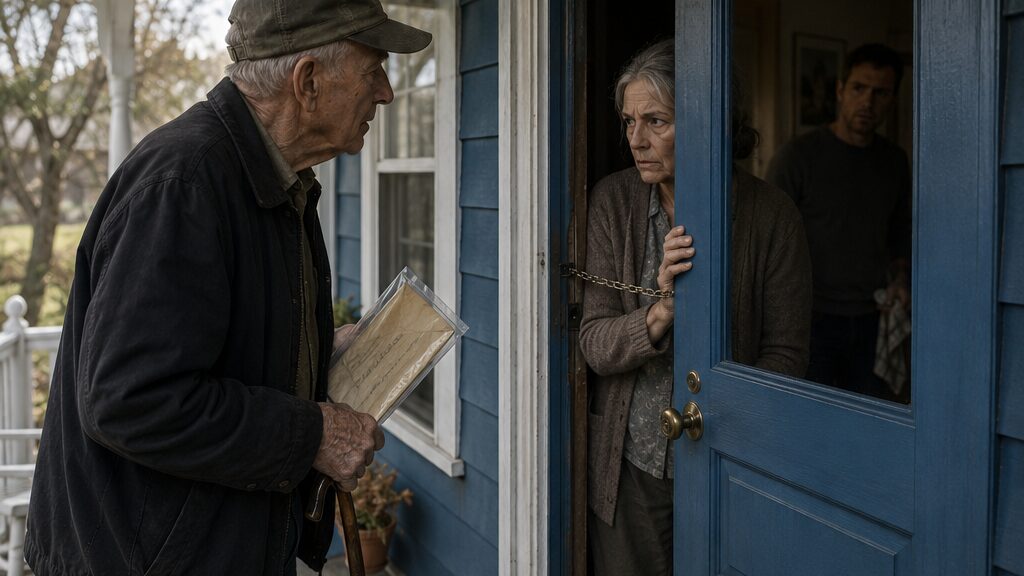
A chain slid on the other side. A lock turned. The blue door opened four inches and stopped hard against the chain.
The woman who looked out was older than the little girl he had spent half his life looking for, but not as old as he had feared. Late sixties, maybe. Silver in her hair, sharpness in her mouth, one hand still hidden behind the door as if she might close it before he finished his first sentence.
Her eyes went to his cap. Then to his shaking hand. Then to the envelope.
“Can I help you?”
Frank had practiced the first line in motel rooms, hospital waiting rooms, parking lots, and once in a church bathroom mirror when he thought he had found the right family in Kansas. Every time, it sounded too small.
“I’m looking for the family of Thomas Avery.”
The woman’s face changed before she moved. It was not surprise. Surprise opened people. This closed her.
“My father’s been dead thirty-one years.”
“I know.”
The door shifted inward by an inch.
Frank raised the envelope before the blue door could become only wood again. The plastic sleeve caught the afternoon light, showing the faded ink across the front in a young man’s slanted hand.
For my girl.
The woman looked at the words, then back at him.
“Whatever you’re selling, I’m not buying.”
“He didn’t ask me to sell it,” Frank said. “He asked me to bring it.”
The chain rattled as her fingers tightened on the door.
“You people show up when someone dies,” she said. “Or when some anniversary comes around. Medals, flags, copied papers, stories about men you barely knew. My mother waited for answers her whole life. We don’t need another stranger making up a version of him.”
Frank nodded once.
He had expected anger. He had not known what shape it would take, but he had expected it. A clean refusal would have been easier than this, easier than hearing the mother in the daughter’s voice, the years between them packed so tight there was no room for him.
“I didn’t come to tell you a version,” he said.
“No?” Her laugh had no humor in it. “Then what do you call showing up on my porch with an old envelope and a hat?”
“A late delivery.”
“That’s convenient.”
“No,” Frank said. His grip tightened around the plastic sleeve until it crackled. “It’s cruel.”
Something in the word made her pause, but not enough to open the door. Her eyes narrowed, searching his face for a trick.
“What’s your name?”
“Frank Mallory.”
“That supposed to mean something to me?”
“No, ma’am.”
“Then why should I believe you?”
“You shouldn’t,” Frank said.
The answer disturbed her. He saw it in the small lift of her chin.
“You shouldn’t believe a man because he’s old,” he said. “You shouldn’t believe him because he wears a cap. You shouldn’t believe him because he came a long way and looks tired on your porch.”
“Then we agree.”
He swallowed. His mouth had gone dry. The words he needed were old, and they came with old smoke, old rain, old metal, old fear. He had locked them away for so long that speaking even one felt like touching a live wire.
“I knew your father at the end.”
The woman’s face hardened again, but her eyes flickered.
“My father died in 1968.”
“Yes.”
“You waited sixty years to knock on his daughter’s door?”
“I didn’t know where the door was.”
“You found it today.”
“I found it last week,” Frank said. “It took me this long to get here.”
She stared at him. “From where?”
“Missouri.”
“For a letter.”
“For a promise.”
The word landed between them and did not move.
From inside the house came the sound of running water being shut off. A cabinet closed. Someone called, “Mom?”
The woman did not answer.
Frank’s arm had begun to ache from holding the envelope up. He did not lower it. It had spent too many years hidden in drawers, wrapped in cloth, carried inside suit pockets where nobody could see it. At this door, it deserved the light.
“Look,” the woman said, and her voice dropped, which made it worse. “I don’t know who sent you. I don’t know what you think we have. There’s nothing here. No money. No collection of war things. My mother’s gone. My father’s gone. Whatever story you’re carrying, carry it somewhere else.”
“I’m not asking you for anything.”
“You’re asking me to open something I buried a long time ago.”
Frank looked at the chain, then at the narrow slice of hallway behind her. There was a framed picture on the wall, too far away for him to see clearly. A coat rack. A small table stacked with mail. An ordinary house, guarded like a fort.
“He gave me this before he died,” Frank said.
Her hand moved to the door again.
“Don’t.”
The word cracked out of her, not loud, but final.
For a moment Frank saw what she must have seen all her life: men arriving too late, men speaking carefully, men folding flags, men saying sorry in voices that did not answer anything. He had become one more man at a door with a thing her mother never received.
“Please leave,” she said.
Frank lowered the envelope then, not in defeat, but because his arm could not hold it any longer. The plastic sleeve rested against his chest.
“I will,” he said. “But I need to say one thing first.”
“No, you don’t.”
“Yes,” Frank said softly. “I do.”
The door began to close.
He heard the chain slide across its track. The blue edge moved toward the frame, cutting her face narrower and narrower.
Frank spoke before he lost sight of her.
“Your mother’s name was Elaine.”
The door stopped.
The woman’s eyes stayed on him through the gap.
Frank’s heart knocked once, hard enough to hurt.
“She wore a red coat in the photograph he kept in his left breast pocket,” he said. “He called her Ellie only when he was scared.”
The porch went very still.
Behind the woman, a younger man appeared in the hallway, drying his hands on a dish towel. He looked from his mother to Frank, then to the envelope.
“Mom?” he said. “Who is this?”
The woman did not turn around.
For the first time, Frank saw her anger lose its footing.
“He says he knew your grandfather,” she said.
Frank held the envelope in both hands now.
“I was with him at the end,” he said.
The woman’s fingers slipped from the door, but she did not open it.
She looked at the words on the envelope again.
For my girl.
And the chain stayed between them.
Chapter 2: The Name He Had Written Wrong For Twenty Years
The chain did not come off until Frank’s knee bent without his permission.
It was not much. Just a small dip, a betrayal of muscle and age, but the woman saw it. Her eyes dropped to his leg, then to his cane, then back to his face with an expression he could not read. Not pity. Frank would have stepped backward from pity. This was something warier, as if his weakness had complicated her refusal.
“Hold on,” she said.
The door closed.
For one terrible second, Frank thought she had shut him out after all.
Then the chain scraped free. The lock clicked. The blue door opened wide enough for the hallway to show itself: mail on a narrow table, a pair of shoes beside the wall, a family photograph in a dark frame, the younger man standing behind her with the dish towel clenched in one hand.
The woman did not invite Frank in. She simply stepped back.
That was enough.
Frank crossed the threshold carefully. He lifted his shoe over the sill as if entering a place where careless movement could break something. The house smelled faintly of coffee and furniture polish. From somewhere deeper inside came the hum of a refrigerator. Ordinary sounds. Living sounds.
The woman shut the door behind him.
“My name is Ruth Avery,” she said.
Frank turned toward her.
“I know.”
Her mouth tightened again.
“That doesn’t help you.”
“No, ma’am.”
“And this is my son, Daniel.”
Daniel gave a short nod, still watching the envelope.
Frank nodded back. “Daniel.”
Ruth pointed to a chair in the front room, but the gesture was not warm. It was controlled, almost official, as if she were seating him for questioning.
“Sit before you fall down.”
Frank sat.
The chair was lower than he expected, and his body folded into it with an audible stiffness he wished no one had heard. He placed his cane against the armrest but kept the envelope on his lap. His hand covered the writing.
Ruth remained standing.
“Show it to me again.”
Frank lifted the envelope.
Daniel took a step closer. “That’s Grandpa’s handwriting?”
Ruth did not answer.
The plastic sleeve was old but clear enough. Inside it, the paper had yellowed unevenly. The seal had darkened with age. The three words across the front were still legible.
For my girl.
Daniel read them aloud under his breath, and something in Ruth’s face pulled tight.
“My mother never showed me his letters,” she said.
Frank looked down at the envelope. “This one never reached her.”
“You’re sure of that?”
“I never mailed it.”
“Why not?”
“Because he didn’t give me an address I could use.”
Ruth’s eyes sharpened. “That’s your explanation?”
“It’s the first part.”
Daniel dragged a chair from the corner but did not sit. “What happened?”
Ruth glanced at him. “Daniel.”
“What? If he came all the way here, let him say it.”
“I decide what gets said in my house.”
“Yes,” Daniel said quietly. “But it’s my family too.”
That struck harder than he seemed to intend. Ruth looked at him as if he had stepped across a line neither of them had named before. Daniel lowered his eyes, but he did not leave.
Frank placed the envelope on the small table beside his chair. His fingers resisted letting go. Even with the plastic between his skin and the paper, he felt its absence the instant it left his hand.
“I met Thomas Avery in 1968,” he said. “I was twenty-four. He was younger than me by two years and acted like it whenever there was coffee. He had a photograph tucked in his breast pocket. Your mother in the red coat. He had a ring on a chain around his neck. He talked too much when he was nervous and not at all when he was scared.”
Ruth folded her arms. “You remember all that after sixty years?”
Frank looked at her. “Some things don’t fade. They sharpen.”
She looked away first.
Daniel’s gaze stayed on the envelope. “Why didn’t the Army deliver it?”
“It wasn’t official property. It wasn’t in a packet. It wasn’t in a record. He pushed it into my hand.”
Ruth’s voice came quick. “And what? You just walked out with it?”
“No.”
The room tightened around the word.
Frank drew a slow breath. “I was moved before I could do anything with it. Then wounded. Then sent through hospitals. By the time I could write, I had a name and what I thought was a town. Avery. Ohio. But the unit records had been shifted during a night movement. Somebody copied a middle initial wrong. Then a county. Then a town.”
“That sounds very convenient.”
“Yes,” Frank said. “It does.”
Ruth blinked at him.
He removed a folded paper from inside his jacket and held it out. Not too close. He had learned not to thrust proof at people. It made them feel cornered.
Daniel took it before Ruth could refuse.
“It’s a list,” Frank said. “Places I tried. Not all of them. Just the ones I could still prove.”
Daniel unfolded the paper. “Akron. Toledo. Marion. Dayton. A Kansas address?”
“That came later.”
Ruth turned. “Kansas?”
“I found an Avery family there. Wrong Thomas. Right age. Wrong war. I didn’t know that when I wrote them.”
“You wrote strangers about my father?”
“I wrote everyone I could.”
“You had no right.”
Frank’s hand tightened on the arm of the chair. “I know.”
The admission stopped her, but only briefly.
“If you know, why keep doing it?”
“Because stopping would have meant deciding he asked the wrong man.”
Ruth looked at him then, really looked, and Frank wished she had not. It was easier when she saw a nuisance. Harder when she saw the old wound under the jacket.
Daniel lowered the paper. “You said the wrong town cost you twenty years.”
Frank nodded.
“Twenty years before you knew?”
“Before I knew enough to know I didn’t know.”
“That’s not an answer,” Ruth said.
“No,” Frank said. “It’s what happened.”
He could feel the room turning against him again, not from disbelief alone but from the sheer ugliness of time. Sixty years was too big to explain. It made every sentence sound like an excuse. He had lived each year one at a time, but Ruth had received them all at once, delivered by a stranger in her front room.
She walked to the table and looked down at the envelope without touching it.
“My mother waited,” she said. “Do you understand that? She waited through men in uniforms, through letters that said nothing, through neighbors who told her to move on. She remarried eventually, but she still kept his photograph in a drawer under her slips. I found it after she died. She never told me why she kept it there.”
Frank’s throat worked.
“She should have had this.”
“Yes.”
“She should have had it before she died.”
“Yes.”
Ruth turned on him. “Then why did you stop?”
The question found the place in him he had spent years walking around.
Frank did not answer quickly enough.
Ruth noticed.
Daniel noticed too.
The silence made its own accusation.
Frank reached into the inside pocket of his jacket. His fingers found the small cloth pouch by feel. He had brought it because the letter alone might not be enough. Because handwriting could be doubted. Stories could be doubted. Old men could be doubted. But metal carried its own kind of memory.
He untied the pouch with slow, clumsy fingers.
Ruth watched him as if expecting a trick.
Frank tipped the pouch over his palm.
A tarnished ring dropped out, dull gold, worn thin at one edge, hanging from a broken length of chain.
Ruth’s face went colorless.
Daniel whispered, “Mom?”
Frank placed the ring beside the envelope.
For the first time since he had entered the house, Ruth took a step back.
“My mother said that ring was lost,” she whispered.
Frank looked at the ring, not at her.
“It was on a chain around his neck,” he said.
Ruth’s hand rose toward her mouth, but she stopped it halfway, as if refusing herself the comfort of shock.
“If that was with him,” she said, “then how did it get to you?”
Frank’s fingers remained open on his knee, empty and shaking.
“He put it in my hand,” he said. “When he could no longer hold it himself.”
Chapter 3: The Ring That Was Never Supposed To Leave His Neck
Ruth would not touch the ring.
She stood above it with both hands pressed against the back of a chair, staring as if the small circle of tarnished gold had rolled into her kitchen under its own power and come to accuse everyone there.
Daniel had moved the envelope and ring from the front room to the kitchen table at his mother’s request, though Ruth had not phrased it as a request. “Not in there,” she had said, meaning the room with the family photographs, the room where visitors sat, the room where grief could be kept polite. The kitchen was harder. The light was brighter. The table was scarred with knife marks and coffee rings and years of ordinary meals.
Frank sat nearest the door, because Ruth had pointed him there.
The envelope lay between them, sealed side down.
The ring rested beside it.
“You said he wore it around his neck,” Ruth said.
“Yes.”
“Why?”
Frank looked at the ring. “He said wearing it on his hand made him think too much.”
“That doesn’t sound like my father.”
Frank lifted his eyes.
Ruth’s expression dared him to correct her.
“No,” he said quietly. “It sounds like a twenty-two-year-old man trying not to be afraid.”
Her fingers tightened on the chair.
Daniel pulled out the chair opposite Frank, sat halfway, then stood again. He seemed unable to decide whether sitting made this real.
“Did he talk about us?” Daniel asked.
Ruth turned sharply. “Daniel.”
“I want to know.”
“He doesn’t know us.”
“No,” Daniel said, looking at Frank. “But maybe Grandpa did.”
Ruth flinched at the word. Grandpa. It had not had weight in that house before. Frank could hear that. The word sounded borrowed, set down for the first time.
Frank rubbed his thumb along the side of his cane.
“He talked about Elaine more than anything,” he said. “Your grandmother. He tried not to. Men did that. They acted like home was something you folded small and kept dry. But he had that photograph.”
“The red coat,” Daniel said.
Frank nodded.
Ruth stared at him. “You could have learned that.”
“How?”
“I don’t know. Online. Records. Old newspapers.”
“Was the photograph ever published?”
She did not answer.
Daniel turned toward the hallway. “There’s a box.”
“Leave it.”
“Mom.”
“I said leave it.”
Daniel held still for a second, then moved anyway.
Ruth’s face hardened. “Daniel Green.”
He stopped at the sound of his full name, one hand on the hallway wall.
“We are not dragging your grandmother’s things out for him.”
Daniel looked back. “Maybe we’re dragging them out for us.”
He disappeared down the hall.
Ruth closed her eyes briefly. When she opened them, Frank saw anger there, but not only at him.
“He doesn’t understand,” she said.
“No.”
“He thinks old things explain themselves.”
Frank almost smiled. “They don’t.”
Ruth looked at the envelope. “You still haven’t told me how he died.”
“No.”
“Why?”
“Because that is not the first thing he gave me.”
Her mouth tightened. “That sounds like another way not to answer.”
“It is,” Frank said.
The bluntness unsettled her again.
Frank had spent years learning that people expected old veterans either to talk too much or not at all. They did not know what to do when a man admitted he was choosing where to place the pain.
Daniel returned carrying a shallow cardboard box. Dust marked one side of his shirt. He set the box on the counter, not the table, as if giving Ruth a chance to refuse the next step.
She did not move.
Daniel opened it.
The smell of old paper rose faintly into the kitchen.
“There are albums,” he said. “Some envelopes. A Bible. Mom, look.”
“I know what’s in there.”
“No,” Daniel said. He lifted a black photo album with cracked corners. “I don’t think you do.”
He laid it on the counter and turned pages carefully. Frank kept his hands on his knees. He did not want to seem hungry for proof, though something in him leaned toward the album despite himself.
Daniel stopped.
The kitchen quieted.
He turned the album so Ruth could see.
A young woman stood beside a winter-bare tree, laughing at whoever held the camera. Her coat was bright even in the faded photograph, a deep red with large buttons. Her hair lifted in the wind. On the white border below the picture, someone had written, Elaine, February.
Ruth did not speak.
Daniel looked at Frank. “Is this it?”
Frank’s vision blurred before he could stop it. Not from tears, he told himself. From age. From kitchen light. From the fact that he had seen that same woman against Thomas Avery’s chest, creased and sweat-softened, while a young man pretended he was not scared.
“Yes,” Frank said. “That’s the coat.”
Ruth took the album from Daniel. Her thumb hovered over the photograph without touching the image.
“My mother hated red,” she said.
Daniel frowned. “What?”
“She always said it was too loud. I never saw her wear it.”
Frank looked at the photograph. “He said she bought it because he liked seeing her from far away.”
Ruth’s lips parted, then closed.
Daniel’s voice dropped. “Mom.”
But Ruth was already shaking her head.
“No. A picture proves he saw a picture. That’s all. Maybe my mother showed someone. Maybe someone told someone. Maybe this is what people do. They collect details.”
Frank accepted the blow because part of him agreed. Details could be collected. Names could be copied. Photographs could travel. A ring could be stolen, sold, found, lied about.
Only the letter had remained sealed.
He looked at it.
Ruth followed his gaze.
“No,” she said.
“I didn’t ask.”
“You were going to.”
“I was not.”
“Then why bring it?”
Frank leaned back. The chair creaked under him. “Because it is yours.”
“If it’s mine, I decide when it opens.”
“Yes.”
“And if I decide never?”
The question struck him harder than accusation.
He had imagined refusal many times. Door closed. Letter returned. Police called. Laughter. Disbelief. He had not imagined being allowed inside and then told the promise might stop inches from completion, sealed on a kitchen table under fluorescent light.
“If you decide never,” he said, “then I leave it here.”
Ruth stared at him.
“You’d walk away?”
“Yes.”
“After sixty years?”
Frank’s gaze dropped to the envelope. “It was never mine to open.”
Daniel sat down slowly.
Ruth walked to the sink and gripped the edge. Her shoulders rose and fell once. Twice.
When she turned, the anger had changed. It was still there, but now it had found a sharper place to point.
“You survived,” she said.
Frank did not move.
“My father died, my mother waited, I grew up with a folded flag in a drawer and a man nobody could explain. But you survived. You married. You had a life. You carried his ring like some holy thing and decided when we deserved to know he had left us a letter.”
“Ruth,” Daniel said.
“No.” She faced Frank fully now. “Did you leave him?”
The kitchen seemed to tilt.
Frank heard, for one second, the sound of rain that was not falling in Ohio. He saw Thomas’s hand pushing the envelope at him. Saw mud on knuckles. Saw the ring chain caught around two fingers. Saw a mouth trying to shape Elaine and failing before trying again.
His chest tightened.
Daniel’s voice came from far away. “Mom, stop.”
But Frank raised one hand.
“She has the right to ask.”
Ruth’s eyes shone, but she did not look away.
Frank could have given the practiced answer. No. I did what I could. I was ordered out. He was gone before help came. All true, and none of it enough.
Instead he looked at the sealed envelope.
“I was with him at the end,” he said. “But I was not brave enough to find you right after.”
Ruth went still.
Daniel’s hand closed over the back of a chair.
Frank lifted his head, and the old silence inside him finally showed its first crack.
“That,” Ruth said, her voice low, “is the part you’re going to tell me now.”
Chapter 4: The Wrong Avery Family Opened The Door First
“Another family cried over that envelope before I took it back.”
Frank said it so plainly that Ruth did not seem to understand him at first. Her face held the anger from a moment before, but the words entered slowly, changing the shape of it.
Daniel looked from his mother to Frank. “What do you mean, another family?”
Frank kept his eyes on the sealed envelope.
The kitchen light made the plastic sleeve shine along its edges. It looked wrong there, too clean around paper that had survived dirt, drawers, hospitals, and hands that no longer existed.
“I mean I went to the wrong door,” Frank said. “Not this one. Not Ohio. Kansas.”
Ruth’s hand slipped from the back of the chair. “You gave my father’s letter to strangers?”
“No.”
“But you said they cried over it.”
“I said they cried over the envelope.”
Daniel sat down again, slowly this time, as if the floor had shifted under everyone.
Frank reached for his water glass, then stopped before touching it. His hand shook too badly. He folded both hands together instead and pressed them lightly against his knee.
“It was 1989,” he said. “I had a county record that looked right. Thomas A. Avery. Born around the right year. Served in the military. Moved after the war. There was a widow listed, but the initials were wrong. I told myself initials got copied wrong all the time.”
“They do,” Daniel said, too quickly, as if helping.
Ruth gave him a sharp look.
Frank shook his head. “I wanted them to be wrong. That’s different.”
No one spoke.
He could see the house in Kansas without trying. White siding. Wind moving across an open yard. A woman with a tissue already in her hand because his letter had warned her what he was coming about. Two grown sons standing behind her, hungry for a father’s missing piece.
“I wrote first,” Frank said. “I didn’t just appear. I asked whether Thomas Avery had served in 1968. They said yes. I asked whether he had a wife named Elaine. The woman who answered said no, but maybe before her. Families get complicated. Records get thin. I convinced myself it was possible.”
Ruth’s voice was quiet and hard. “Because you wanted to be finished.”
Frank nodded.
The admission had weight. It was the kind of truth that did not make him nobler.
“Yes.”
Daniel looked at the envelope. “What happened?”
“I drove there with this in my jacket and the ring in my pocket. I sat in their living room. They had cookies on a plate nobody ate. The woman kept looking at the envelope like it might give her back twenty years. One of her sons asked if I had known his father. I said I believed I had.”
“Believed?” Ruth said.
“That was the word I used because I still had just enough doubt to be ashamed of myself.”
Ruth did not answer. Her eyes moved to the envelope. For the first time, Frank saw something like fear there—not of him, but of how easily need could make people believe the wrong thing.
“I told them some of what Thomas told me,” Frank said. “Not the private things. Not Ellie. Not Ruth. I asked questions. The more they answered, the worse it got. Their Thomas had lived through the war. Came home changed, but came home. Died years later in a mill accident. The woman had been his second wife. The first had not been Elaine. There was no red coat. No baby girl. No ring missing from a chain.”
Daniel exhaled. “So you knew.”
“I knew.”
“And you just took it back?” Ruth asked.
“I apologized. Then I took it back.”
Ruth’s mouth tightened. “That sounds too clean.”
“It wasn’t.”
Frank looked down at his hands. The skin had thinned so much that the veins seemed laid over bone with blue thread. Hands that had held the envelope firmly once. Hands that had tried to retrieve it from a stranger’s hope.
“The widow held on to it,” he said. “Not hard. Just enough. She said, ‘Are you sure?’ And I said yes. She asked if maybe there was more than one letter. I said no. Her son looked at me like I had killed his father twice. I deserved that look.”
Ruth stepped away from the sink. “You think telling me that helps?”
“No.”
“Then why tell it?”
“Because you asked for the part I hide.”
The words landed heavily.
Daniel rubbed both hands over his face. “Mom, he’s not making himself look good.”
“That doesn’t mean he’s telling the truth.”
“No,” Frank said. “It doesn’t.”
Ruth turned on him. “Stop agreeing with me like that.”
Frank looked up.
“You come in here with your hat and your sad voice and every time I accuse you of something, you nod like that proves you’re honest. Maybe you’re just good at this.”
Daniel said, “Mom.”
“No. I want to know.” Ruth pointed at the envelope. “You dragged that thing through other people’s grief. You almost gave it to the wrong family. You kept it after my mother died. Now it sits on my table like it has more right to be here than I do.”
Frank took the blow without moving, but his chest tightened around the last sentence.
The letter did not have more right. That was the terrible thing. It had no rights at all. It was paper. Ink. A dead man’s unfinished reach. But Frank had built his life around treating it like a living charge, and Ruth could feel that. She could feel the years he had given it, and those years looked like theft from her side of the table.
“You’re right,” he said.
Ruth’s eyes flashed. “Don’t.”
“No, I mean it. I made mistakes with it. I made the promise too much mine in some years and not enough in others. There were times I was searching for him, and times I was searching for an end to myself.”
The kitchen stilled.
Even Ruth seemed caught by that.
Frank drew a breath. “But I never opened it.”
Daniel looked at the seal.
Ruth’s voice dropped. “Why not?”
“Because then his last words would have belonged to me.”
Frank saw the sentence move through her. She did not soften, not fully, but she stopped leaning away.
“He did not ask me to know what was inside,” Frank said. “He asked me to bring it. That was the only clean line I had left.”
Ruth looked at the envelope a long time.
Then she said, “Clean lines don’t bring mothers back.”
“No.”
“They don’t give children fathers.”
“No.”
“They don’t fix wrong doors.”
Frank swallowed. “No.”
Daniel pushed back from the table. “There might be a way to confirm the record issue.”
Ruth turned. “What are you doing?”
“Calling the courthouse.”
“At this hour?”
“It’s not that late. And if Susan Moore gave him the address, maybe she remembers him.”
Frank looked at Daniel sharply.
Daniel already had his phone out. “You said Susan Moore, right?”
Frank hesitated. “Yes.”
Ruth folded her arms. “Daniel, don’t make this worse.”
“It’s already bad,” he said. “At least let it be bad with facts.”
That silenced her.
Daniel stepped into the hallway, but not far enough to be out of earshot. Frank heard the low murmur of his voice, the pause, then another attempt. He had known Daniel might call. He had brought Susan’s name because proof mattered. Still, his stomach tightened.
Ruth remained at the table with Frank.
The envelope sat between them.
“You said my mother remarried,” she said suddenly.
“I found that in a record years after.”
“You knew her new name?”
“Eventually.”
“And still didn’t find us?”
“No.”
“Why?”
Frank looked toward the hallway where Daniel’s voice had gone quiet. “Because by then some records led to dead ends. Some led to people who did not answer. Some led to me standing outside places I couldn’t enter.”
Ruth’s eyes narrowed. “What does that mean?”
Before Frank could answer, Daniel came back into the kitchen with the phone still pressed to his ear. His expression had changed.
He put the call on speaker.
A woman’s careful voice filled the room.
“Mr. Mallory did come into the county office,” Susan Moore said. “Several times. I remember because he had a list folded so many times it was nearly cloth.”
Ruth stared at the phone.
Susan continued, “The old military-adjacent records he showed me had a transfer notation that did not match the state file. There was a copied middle initial that appears to have sent earlier searches toward a different Thomas Avery. I can’t certify all of that tonight, but I can tell you the confusion was real.”
Daniel looked at his mother. “You hear that?”
Ruth did not move.
Frank closed his eyes briefly. He should have felt relief. Instead he felt the old dread of a door opening onto a deeper room.
Susan’s voice softened. “But there is one thing I don’t understand.”
Frank opened his eyes.
Daniel looked at the phone. “What?”
“I helped Mr. Mallory trace Elaine Avery’s remarried name through a probate file,” Susan said. “That gave us the final path here. But in his older notes, there’s a gap. A long one.”
Ruth turned slowly toward Frank.
Susan said, “Mr. Mallory was searching steadily. Then nothing for eleven years.”
The kitchen seemed to draw in around him.
Frank looked at the sealed envelope, still lying exactly where he had placed it.
Ruth’s voice was barely above a whisper.
“Why did you stop looking for eleven years?”
Chapter 5: The Years He Could Not Bring Himself To Knock
“So you did give up.”
Ruth did not shout it. That made it worse. The words came flat and certain across the kitchen table, past the sealed envelope, past the ring, past the phone Daniel had lowered after thanking Susan Moore and ending the call.
Frank sat with his hands folded on his cane, and for the first time since stepping into the blue house, he wanted to lie.
Not a large lie. Not a cruel one. Just a smaller truth shaped to fit better in Ruth’s kitchen. He could say illness stopped him. He could say records ran cold. He could say life interrupted. All of those were true enough to stand in public.
But not true enough to sit beside Thomas Avery’s unopened letter.
“Yes,” Frank said.
Daniel looked up.
Ruth’s face tightened, but the anger did not flare. It settled.
“For eleven years,” she said.
“Yes.”
“My mother was alive for some of those years.”
Frank closed his eyes once.
“Yes.”
“You knew there was still a chance, and you stopped.”
“Yes.”
Daniel shifted beside the counter. “Mom—”
“No,” Frank said. “Let her say it.”
Ruth’s eyes shone, but her voice stayed controlled. “You let her die without it.”
The sentence entered Frank cleanly, like a blade that had always been meant for that exact place.
“I may have,” he said.
Daniel’s head snapped toward him. “Mr. Mallory.”
Frank looked at Ruth, because looking away would be another kind of hiding.
“I don’t know the date I would have found you if I hadn’t stopped. Maybe I still would’ve been too late. Maybe not. That uncertainty is part of what I carry.”
Ruth gripped the back of the chair. “Don’t make that sound noble.”
“It isn’t.”
“Then what happened?”
Frank’s thumb moved along the worn curve of his cane. He had bought it after the first heart surgery, though he had needed one before that. Pride had cost him several falls and one cracked rib. Pride had also kept the envelope in his possession when he should have handed the search to someone stronger.
“My wife got sick,” he said.
Ruth blinked, thrown by the turn.
Frank did not give his wife a name. Not because she did not deserve one, but because this was not her story to place in Ruth’s house. “She had been patient with the letters. With the phone calls. With me driving half a state because a courthouse clerk thought she remembered an Avery. She used to say Thomas had become a fourth person at our kitchen table.”
Daniel’s expression softened.
Ruth’s did not, but she listened.
“When she got sick, I put the envelope in the top drawer of my dresser and told myself I was setting it down for a season.” Frank looked at the table. “A season became a year. Then another. She died. After that, I did not want to touch anything that belonged to death.”
The refrigerator hummed. Somewhere outside, a car passed, its tires whispering against the street.
Ruth said, “But you did touch it.”
“Eventually.”
“Why not then?”
“Because when I opened the drawer, I saw his handwriting and thought, if I find them, I have to go back.”
“Back where?”
Frank’s jaw tightened.
Daniel’s voice was quiet. “To him.”
Frank nodded.
He had never liked the word trauma. It sounded too clean, too clinical, as if what woke a man at night were a file category. He preferred not to name things. Naming invited questions.
But silence had already failed him.
“I had carried Thomas as a duty,” he said. “That was easier than carrying him as a man. A duty has steps. Write this office. Call that clerk. Check that record. A man has a voice. A weight. A hand pushing a ring into yours because he knows he won’t be able to do it later.”
Ruth looked at the ring.
“He was alive when he gave it to you?”
Frank drew in a breath.
“Yes.”
“How long after?”
“Not long.”
Her face tightened again, but she did not ask for details. Frank was grateful. He would not have given them.
“I stopped looking because I was tired,” he said. “Because my wife was gone. Because I had failed enough people to fear one more door. Because if your mother looked at me and asked why I lived, I did not know how to answer.”
Ruth’s lips parted slightly.
Frank looked down at his cane. “And because some part of me thought keeping the promise unfinished meant Thomas was still asking. If I delivered it and it was rejected, then there would be nothing left but what happened.”
The admission seemed to disturb Daniel most. He moved to the sink and stared out the dark window over it.
Ruth’s voice came softer, though not gentler. “You made my father into your punishment.”
Frank nodded. “Yes.”
“And my mother paid for it.”
He could not nod at that. Not because it was untrue, but because his body had reached some limit of accepting blows while sitting upright.
“I don’t know how much she paid because of me,” he said. “I know she paid. I know you did.”
Ruth pulled out a chair and sat for the first time since the call. The movement seemed to surprise her as much as anyone. She put both hands flat on the table, not touching the envelope or the ring.
“When I was little,” she said, “I thought my father was in the flag.”
Daniel turned from the sink.
Ruth kept looking at the table. “It was folded in a triangle in a case in my mother’s room. I didn’t understand what it meant. I thought if she opened the glass, something would come out. A voice, maybe. A note. Anything.”
Frank’s throat tightened.
“She never opened it,” Ruth said. “Not once. When I asked, she said some things stay folded because there’s no one left to answer them.”
The envelope lay between her hands now, still sealed, still folded around whatever Thomas had found the courage to write and not the time to send.
Frank wanted to say he was sorry. He had said it to so many people in so many forms that the words had worn thin. He stayed silent.
Daniel came back to the table.
“You said eventually,” he said. “You eventually touched it again.”
Frank nodded.
“Why?”
“A hospital.”
“Yours?”
“Yes.”
Ruth looked up.
“Heart,” Frank said. “Second surgery. I had packed the envelope in my bag without remembering doing it. Or maybe I did remember and pretended not to. A nurse found it when she was looking for my slippers. She said, ‘Is this important?’”
He gave a small, tired breath that was almost a laugh.
“I said yes. She said, ‘Then why is it still with you?’”
Daniel looked at the plastic sleeve.
“That started you again?”
“Not that day. But soon after.”
The kitchen had softened around the edges, but Frank did not trust softness. Softness could close quicker than anger.
He reached into his jacket and removed a second folded sheet, older than the list Daniel had read. The paper had split at one crease and been repaired with clear tape.
“This is the address I did not knock on,” he said.
Ruth stared at it. “What?”
Frank set it beside the envelope.
“It was another possible lead. Before Susan. Before this house. A woman at a veterans’ office found a remarriage notice that might have been Elaine’s. I drove nine hours. I got to the street before sunrise.”
Daniel picked up the paper. “This is in Indiana.”
“Yes.”
“Was it them?”
“No. I learned later it was another wrong branch. But I didn’t know that then.”
Ruth’s eyes stayed on Frank. “You sat outside?”
“Until morning.”
“And?”
“And watched a woman about your mother’s age come out to water flowers. She had white hair and a limp. I had the envelope on the seat beside me.”
He could see the street again. The early light. The woman’s robe. The letter waiting like a command.
“I started the car and left.”
Ruth’s voice was small despite herself. “Why?”
Frank looked at her.
“Because I was afraid she would open the door.”
No one spoke.
For the first time, Ruth did not seem to know where to put her anger.
Frank felt the room tilt, not from memory this time, but from his body. The kitchen light brightened at the edges. He reached for his cane and missed it by an inch.
Daniel was beside him immediately.
“Mr. Mallory?”
“I’m all right.”
“You’re pale.”
“I’m old. It happens.”
Daniel did not smile. He pulled another chair close and eased Frank’s arm onto it. Ruth stood, then stopped, caught between suspicion and concern.
“Do you need a doctor?” Daniel asked.
“No.”
“That wasn’t a question I trust you to answer.”
Frank looked at him, and despite everything, a faint smile touched his mouth. “You sound like my cardiologist.”
“Then your cardiologist is probably tired of you.”
Ruth went to the cabinet and took down a glass. She filled it with water, set it in front of Frank, and stepped back before he could thank her.
He drank with both hands.
The tremor embarrassed him. A drop slid down the side of the glass and fell onto the table near the envelope.
Ruth watched it spread.
“You said his final sentence was for my mother,” she said.
Frank lowered the glass.
“I said he spoke her name.”
“And the letter?”
Frank looked at the envelope. The words For my girl faced Ruth now, not him.
“He said two things clearly at the end,” Frank said. “One was for Elaine.”
Ruth’s fingers curled.
“The other was for his little girl.”
Ruth sat down as if her knees had loosened all at once.
Frank’s voice dropped.
“He knew your name.”
The kitchen seemed to stop breathing.
Ruth stared at the unopened envelope, and for the first time, she looked not angry that it had come, but afraid it might speak directly to the child who had waited beside the folded flag.
“What,” she whispered, “did he need me to know?”
Chapter 6: The Letter Opened Before Anyone Was Ready
Daniel held the envelope in both hands, but he would not break the seal.
He had lifted it from the table only after looking at his mother, and now he stood frozen beside her chair with the plastic sleeve removed and the yellowed paper bare under the kitchen light. The envelope looked smaller outside its protection. More fragile. Less like proof and more like something that could be ruined by breath.
Ruth stared at it.
Frank looked away.
“Mom,” Daniel said quietly.
Ruth did not answer.
“You have to say yes.”
Her eyes stayed on the handwriting.
For my girl.
Frank could hear his own heartbeat in the pause. For sixty years, the letter had remained unopened because that was the boundary he could still keep. Now the boundary belonged to Ruth, and the old reflex in him—the one that wanted to protect the envelope from everyone, even its rightful owner—tightened painfully.
He folded his empty hands together.
Ruth looked at Frank. “You never read it.”
“No.”
“Not once.”
“No.”
“Not even when you thought you’d die before finding us?”
Frank’s jaw worked. “Especially then.”
Daniel’s thumb rested under the flap, waiting.
Ruth’s eyes shifted to the ring. It lay dull and small beside the torn plastic sleeve, no longer hidden in Frank’s pocket, no longer warmed by Thomas’s body, no longer protected by anyone’s certainty.
“My mother should be here,” Ruth said.
The words came out with such quiet force that Daniel lowered the envelope.
Frank said nothing.
Ruth looked at the photograph album still open on the counter, Elaine in her red coat laughing into a winter wind. “She waited. She kept his flag. She kept that picture in a drawer. She would sit on the edge of the bed sometimes with the drawer open, and when I came in, she would close it like I’d caught her doing something wrong.”
Daniel’s face changed. “You never told me that.”
“I didn’t tell anyone.”
Ruth touched the edge of the table. Not the letter. Not the ring. Just the wood near them.
“If I open it now,” she said, “it feels like taking something from her.”
Frank’s voice came rougher than he intended. “It was meant for both of you.”
“You don’t know that.”
“No,” he said. “I know what he said. I don’t know what he wrote.”
Ruth looked at him sharply.
That distinction mattered. Frank saw it reach her. Spoken words belonged to memory, and memory could bend under age and guilt. Written words would not bend for anyone.
Daniel lowered himself into the chair beside his mother. “We can stop.”
Ruth gave a small laugh that broke at the end. “Can we?”
The envelope rested between Daniel’s hands.
“After this?” she said. “After he walked up to my door with my father’s ring? After he said my name came out of a dying man’s mouth before I knew how to say it myself? No, Daniel. We can’t stop. I just don’t know how to begin.”
Frank looked at the blue-dark window over the sink. His reflection floated there: cap, hollow cheeks, shoulders that had once been squared by uniform and now only by habit.
He heard Thomas, not clearly, never clearly all at once. Fragments had survived. Ellie. Ring. Girl. Clean. Home. The rest came in breath and grip and eyes.
“Your father said Elaine first,” Frank said.
Ruth closed her eyes.
“He tried to say it more than once. Couldn’t get all of it out. Then he pressed the envelope toward me. I thought he meant your mother. Then he said, ‘My girl.’”
Ruth’s eyes opened.
“And then,” Frank said, “he said your name.”
The kitchen light hummed.
Ruth looked at Daniel.
“Nod if you want me to,” he said.
She swallowed.
Then she nodded.
The old glue did not want to give.
Daniel worked slowly, using a butter knife Ruth fetched with trembling irritation because she could not bear to watch him tear it. Even so, the paper made a dry sound, a brittle sigh that seemed too loud in the kitchen.
Frank turned his face toward the window.
He did not deserve to see the first moment.
Behind him, Daniel unfolded the sheets. One page. Then another, thinner, creased tight. Ruth made a sound, but no word followed.
Daniel said, “Do you want me to read it?”
“No.”
Her voice was barely there.
Frank kept looking at the window.
He saw only the kitchen reflected now. Daniel’s bowed head. Ruth’s hand pressed against her mouth. The envelope lying open like a wound that had finally been allowed air.
Ruth began to read.
The silence that followed was not empty. It had weight and movement. A chair leg shifted. Paper trembled. Ruth drew in a breath and lost it.
Then she stopped.
“No,” she whispered.
Daniel leaned toward her. “Mom?”
Ruth pushed the letter away, not far, only a few inches, but enough that Daniel caught the edge before it slid against the ring.
“She should have seen this first,” Ruth said.
Frank closed his eyes.
“My mother should have seen it. Not me. Not after she spent her whole life wondering whether he died thinking of her or thinking of nothing at all.”
“He did think of her,” Frank said.
Ruth turned on him, tears standing openly now. “That doesn’t give the years back.”
“No.”
“You keep saying no like that fixes anything.”
“It doesn’t.”
“Then stop making it sound gentle.”
Frank nodded once and fell silent.
Daniel had picked up the letter. His eyes moved quickly over the page, then slowed. His expression changed in degrees—curiosity first, then pain, then something like awe he tried to hide for his mother’s sake.
Ruth saw it.
“What?” she demanded.
Daniel hesitated.
“What does it say?”
“It’s not bad,” he said.
“That’s not an answer.”
“It’s not what you’re afraid of.”
Ruth took the letter back with both hands.
Frank heard the paper tremble.
This time she read farther.
A tear dropped onto the table, missing the page by inches.
“He says he wanted to come home clean,” she whispered.
Frank’s hand tightened.
Daniel looked at him. “What does that mean?”
Frank did not answer immediately.
Ruth read the line again, silently this time. Her face twisted—not because she did not understand the words, but because she understood too many possible meanings.
“He says he was afraid,” she said.
Frank looked at the ring.
“He was.”
“My mother always said soldiers weren’t afraid.”
Frank’s voice stayed low. “Your mother was trying to give you something you could survive.”
Ruth’s eyes lifted to him.
“He was afraid,” Frank said. “He was brave too. Those two things often came together.”
Ruth looked down again.
The letter shook harder as she reached the second page.
Then she made a sound Frank had no defense against.
“Oh.”
Daniel moved closer.
Ruth pressed the paper to the table with her palm.
“He knew about me.”
Frank nodded.
“He says Elaine wrote that I had dark hair.”
“Yes.”
Ruth’s mouth trembled. “He says she named me Ruth because his mother used to sing from that book in church.”
Frank had not known that. The newness of it struck him with surprising force. For sixty years, he had carried a letter containing truths that had waited even for him.
Ruth read another line, and the anger broke through the grief.
“He says he was scared I’d grow up thinking he didn’t know my name.” She looked at Frank, and her face crumpled. “I did.”
Frank had no answer.
“I did grow up thinking that.”
Daniel put his arm around her shoulders. She let him, but her eyes stayed on Frank as if he were both messenger and wound.
“He wrote,” she said, struggling over the words, “that if he didn’t come home, I should be told he knew I was real.”
Frank’s vision blurred.
Ruth looked back at the page.
“And that he loved my mother before he knew how to be a husband worth coming home to.” Her voice cracked. “That he was trying.”
The kitchen seemed too small for the dead, the living, and the years between them.
Ruth folded over the letter, not quite touching her forehead to it. When she spoke again, her words came into the paper.
“He was trying to get home.”
Frank’s voice was barely audible. “Yes.”
“With this.”
“With that. With the ring. With her picture.”
“And you carried it all that time.”
Frank looked down at his empty hands.
He had imagined that question as accusation. It still was, partly. But now it held something else, something that hurt differently.
“It was never mine to put down,” he said.
Ruth pressed the letter against her chest suddenly, fiercely, as though someone might take it back.
For a moment she looked like the child Frank had searched for: not the guarded woman at the door, but the girl whose name had crossed a battlefield before she could remember being loved.
Then she turned her face away.
Daniel looked at Frank. “There’s more on the back.”
Ruth stiffened.
Frank did too.
She lowered the page slowly.
On the back, the handwriting had changed. The lines slanted harder, letters uneven, as if written in haste or with a failing hand.
Ruth read silently.
The color left her face.
“What is it?” Daniel asked.
She did not answer.
“Mom?”
Ruth looked at Frank, and this time there was no anger ready to protect her.
Only fear.
“He wrote your name,” she said.
Frank stopped breathing for a moment.
Ruth held the page out, but not far enough for him to take.
“He says, ‘If Frank Mallory brings this, believe him. He stayed when he could have run.’”
The room tilted around Frank.
He closed his eyes, but the words had already entered him, undoing something he had spent sixty years keeping tied tight.
Ruth’s voice broke.
“Tell me what he sounded like.”
Chapter 7: He Talked About You Like Home Was Still Possible
“He had a bad singing voice.”
The sentence came out before Frank knew he was going to say it.
Ruth stared at him across the kitchen table, the opened letter still trembling in her hands, her face wet and startled. For one second, the room seemed to reject the words. They were too ordinary. Too small to follow what had just been read. Too alive for the dead man whose handwriting lay between them.
Then Ruth gave a sound that was almost a laugh and almost pain.
“What?”
Frank looked at the ring because it was easier than looking at her. “Thomas Avery could not carry a tune in a bucket. He knew it, too. That made him worse, because he’d sing louder if anyone complained.”
Daniel sat down slowly, as if afraid sudden movement might stop him.
“What did he sing?” Daniel asked.
Frank rubbed his thumb along the head of his cane. “Bits of things. Whatever someone else started. Church songs. Radio songs. One line of a song about leaving on a train that he never knew past the first line. He’d hum when he was cleaning his boots. Drove everybody half mad.”
Ruth pressed the letter carefully to the table and held it there with her palm, as if anchoring herself.
“My mother never said he sang.”
“She may not have known how badly.”
That time Ruth’s laugh came clearer, small and wounded, but real enough that Daniel looked at her as if he had just heard a door open somewhere inside the house.
Frank saw the change and nearly stopped.
It frightened him, this new task. Carrying Thomas’s last message had been hard, but it had rules. Keep the envelope sealed. Keep the ring safe. Find the family. Do not claim what is not yours. But Ruth had asked for his voice, and a voice was not an object. It could not be handed over cleanly. It lived in Frank’s body, tangled with things he had spent years avoiding.
Ruth drew the letter closer. “Tell me another thing.”
Frank looked at the window. Night pressed against the glass. His reflection looked thinner than before.
“He touched that ring when he was thinking of her,” he said. “Not all the time. Not in front of everyone if he could help it. But if there was a long wait, or bad news, or some officer saying hurry up and then making us sit, his hand would go here.”
Frank lifted his fingers to the base of his throat.
Daniel’s eyes moved to the chain on the table.
“He kept it under his shirt?”
“Yes.”
“Because wearing it on his hand made him think too much,” Ruth said quietly.
Frank nodded. “That’s what he told me. But I think wearing it near his heart made him think just enough.”
Ruth’s mouth trembled. She looked at the photograph album open on the counter, Elaine laughing in her red coat. “Did he talk about my mother like he missed her?”
Frank took care with the answer. “He talked about her like home was a place he could see if he said her name right.”
Ruth closed her eyes.
“He called her Elaine when he told stories,” Frank said. “Ellie when things got quiet. I didn’t know that meant scared until near the end. Men didn’t explain themselves much. You learned by hearing what name came out when their guard dropped.”
Daniel reached for his phone from the table. “Can I record this?”
Frank’s body tightened.
Ruth opened her eyes. “Daniel.”
“I don’t want to lose it.”
The phone was already in his hand, black screen catching the kitchen light. He looked young then, though he was a grown man, young in the way a person becomes when he finds out a family has rooms he was never shown.
Frank shook his head once.
Daniel stopped. “I’m sorry.”
“No,” Frank said. “You’re not wrong to want it.”
“Then why not?”
Frank looked at the phone and saw for an instant the old mistake in a new shape: taking what was alive and trapping it before anyone had time to feel it.
“Some memories should be heard before they’re archived,” he said.
Daniel lowered the phone slowly.
Frank regretted the words as soon as he saw Daniel’s face. They sounded like judgment, and the young man had done nothing but try to keep the evening from collapsing.
“I don’t mean never,” Frank added. “Just not first.”
Daniel nodded and set the phone facedown. “Okay.”
Ruth watched Frank with an expression that had shifted again. Not trust, not fully. Trust was too large a word for one night. But there was room now where suspicion had been pressed wall to wall.
“You said he said my name,” she said.
“Yes.”
“How?”
Frank’s hand tightened around the cane.
There it was.
Not what Thomas said. Not the letter. Not the ring. The sound. The living shape of it. The thing Frank had heard in rain and fever and hospital rooms, sometimes so clearly that he woke expecting to see Thomas beside the bed.
He could lie gently. Say it was peaceful. Say he smiled. Say the name came easy.
Ruth deserved better than comfort dressed as truth.
“He had trouble at first,” Frank said. “His mouth was dry. He was angry about that. Kept trying to make his voice work right. He said Elaine, then Ellie. Then he pushed the envelope at me. I thought he meant your mother was his girl. Then he said, ‘No. My little girl.’”
Ruth’s fingers curled around the letter.
“He said Ruth like he was afraid the world might not know who you were if he didn’t get it out.”
She bowed her head.
Daniel looked down at the table.
Frank’s own breath had grown shorter. He paused, ashamed of needing the pause, but Ruth did not rush him now.
“He said it twice,” Frank continued. “The first time like a question. The second like an order.”
“To you?” Daniel asked.
“To himself, maybe. To me. To God. I don’t know.”
Ruth wiped her cheek with the heel of her hand, impatient with the tears. “Did he know he was dying?”
Frank looked at the ring.
“Yes.”
A long silence followed.
Ruth did not ask how. Frank was grateful again. There were details that would not help her know her father. There were facts that only made the dead smaller and the living sicker. He had not come to place those in her kitchen.
“He was scared,” Frank said. “The letter says that, so I can say it. He was scared. But he was not thinking of himself first. He was trying to get the ring off the chain. His hands weren’t doing what he wanted. He got mad at them. That was Thomas. Angry at his own fingers because they were slowing him down.”
Daniel let out a breath that sounded almost like a laugh.
Frank looked at him. “He had a temper with objects. Buttons, lighters, bad pens. If something stuck, he took it personally.”
Ruth covered her mouth, but the smile showed anyway, trembling through grief.
“My mother used to fight with jar lids,” she said. “She’d say, ‘Your father would have hated this thing.’ I thought she meant because he was strong.”
Frank shook his head. “Because he was impatient.”
Ruth looked at the photograph again, and something in her face changed. Her parents became less like a folded flag and a hidden picture. They became two young people somewhere in time, both capable of being foolish over stuck jars and bad songs.
Daniel reached for a napkin and slid it toward his mother without looking at her. She took it.
Frank leaned back. The room had grown warmer, or he had grown weaker. He could feel the long day in his ribs.
“I should go,” he said.
Ruth looked at him quickly. “No.”
The word came out sharper than she intended.
Frank blinked.
“I mean,” she said, then stopped. Her hand moved to the letter. “You drove from Missouri.”
“I have a motel.”
“You nearly fell on my porch.”
“I didn’t fall.”
“That is not the same thing.”
Daniel looked between them, and this time a faint, careful smile touched his mouth.
Frank shook his head. “I did not come here to be tended.”
Ruth’s eyes flashed. There she was again, the woman at the door, but changed now, the anger turned toward keeping him in the chair rather than out of the house.
“And I didn’t ask you to come here and collapse politely after handing me my father’s last letter.”
Frank almost answered. He had lived a long time by answering too little, then too late. He felt the old habit rise, a wall made of courtesy.
Instead he said, “I don’t want to be thanked like a hero.”
Ruth went still.
Daniel’s smile vanished.
Frank looked at the envelope, now empty of secrecy, and at the ring, free of his pocket at last.
“That is not why I came. If I let you make this about me, then I take something from him again.”
Ruth’s expression softened, but her voice stayed firm. “Then don’t let us. Stay because you’re tired.”
“I have been tired for years.”
“Then stay because tonight the letter is here and you are the only person alive who can tell me how he sounded when he was still hoping.”
The words held him where argument would not have.
Frank looked down at his hands. They were empty. He had expected them to feel relieved. Instead they felt unsure, as if they did not know what to do without the old weight.
Daniel pushed the phone farther away and took out a notepad from a kitchen drawer instead.
Frank lifted an eyebrow.
Daniel shrugged. “Not recording. Just writing down what I’m afraid I’ll spell wrong later.”
Ruth gave him a look through tears. “You don’t know how to spell ‘bad singing’?”
“Depends how bad.”
Frank surprised himself by laughing.
It hurt his chest a little, but he let it happen.
For the next hour, Thomas Avery came into the kitchen in pieces.
Not as a hero. Not as a name carved into military records. As a young man who traded coffee he hated for socks he needed. As a soldier who pretended not to miss home until somebody mentioned winter. As a husband who folded Elaine’s photograph into wax paper when rain came. As a father who had never held his child but spoke of her dark hair like it was a landmark he meant to reach.
Ruth asked careful questions at first.
Then hungry ones.
Did he know how old I was?
Did he know Mom had moved back to Ohio?
Did he ever say what he wanted to do after?
Did he write other letters?
Did he blame anyone?
Frank answered what he could and refused what would only wound.
“No,” he said once, when Daniel asked about the final hour in too much detail. “That part stays with me unless your mother asks for it.”
Ruth looked at him for a long moment. Then she nodded.
Near midnight, the kitchen had changed without anyone moving much. The envelope lay open beside the plastic sleeve. The ring rested on top of the folded cloth pouch. The album had been brought to the table, and Elaine in her red coat watched them from a photograph none of them could stop glancing at.
Ruth held the letter differently now. Not like evidence. Not like a threat. Like something fragile that had finally chosen a home.
Frank’s eyes had begun to close between sentences.
Daniel noticed first. “Mom.”
“I see.”
“I’m awake,” Frank said.
“No, you’re not,” Ruth said.
He opened his eyes. “I can drive.”
“No.”
“I have driven tired before.”
“I’m sure that sentence explains a lot about you.”
Daniel laughed quietly.
Frank wanted to object, but the truth was his body had become a distant country sending bad news. His legs ached. His chest felt hollow. The day had taken too much and returned something he did not yet know how to hold.
Ruth stood and gathered the letter carefully. “You can sleep in the front room.”
Frank began to protest.
She pointed at him with the folded letter. “Do not make me close another door on you tonight.”
He closed his mouth.
The blue front door was visible from where he sat, locked now, no chain stretched across it. He looked at it and thought of all the wrong doors, all the almost doors, all the doors he had left untouched.
Ruth followed his gaze.
“My mother is buried ten minutes from here,” she said.
Frank looked back at her.
Her hand tightened around the letter. The ring lay on the table between them, waiting.
“In the morning,” Ruth said, “I want you to come with us.”
Daniel looked at her, surprised.
Ruth did not look away from Frank.
“I want to take this to her,” she said. “The letter. The ring. What you remember. Not all of it, maybe. But enough.”
Frank felt the old duty stir, then falter. He had thought the delivery ended at the table. He had thought his part was done the moment Ruth received what belonged to her.
But the letter had reached the daughter.
It had not yet reached the woman in the red coat.
He looked at the ring, then at Ruth.
“I don’t know if I’ll have the strength,” he said.
Ruth’s voice was steady.
“Then we’ll go slow.”
Chapter 8: The Right Door Finally Stayed Open
Frank almost refused the gravesite before Ruth finished pouring the coffee.
The words rose in him out of habit, ready and polite. I shouldn’t intrude. This belongs to your family. I have done what I came to do. He had used sentences like those for years to leave rooms before anyone could ask him to stay inside the hardest part.
But Ruth set a mug in front of him and said, “Don’t start.”
Frank looked up from the kitchen chair where he had slept badly and woken early, still wearing yesterday’s shirt under a blanket Daniel had put over him sometime in the night.
“I didn’t say anything.”
“You had the face of a man about to say something noble and useless.”
Daniel, standing by the counter with the photograph album under one arm, coughed into his coffee.
Frank looked toward the table.
The letter had been copied at dawn on Ruth’s small printer, each page handled like it might bruise. The original lay in a clean folder beside the ring. The copy rested in Ruth’s purse. She had decided that without asking him, and Frank had been grateful. The original belonged in the house now. With Ruth. With Daniel. With whatever children or grandchildren might someday ask why an old envelope was kept with a tarnished ring and a photograph of a woman in a red coat.
Elaine would receive the words too, but not by taking them away.
Ruth saw him looking. “I’m keeping the original.”
Frank nodded.
“And the ring.”
“Yes.”
Her jaw tightened, as if she expected him to challenge her.
“It’s yours,” he said.
Ruth looked down at the folder. “I don’t know what that means yet.”
“You don’t have to know today.”
She absorbed that quietly.
Ten minutes later, Frank stood on the porch of the blue house again, cane in one hand, Ruth on one side of him and Daniel waiting near the car. The door behind him remained open while Ruth checked her purse for the copy of the letter. The sight of it unsettled him more than he expected.
Yesterday, that blue door had held a chain between him and the promise.
This morning, it stood open to an empty hallway and a kitchen where Thomas Avery’s handwriting lay on the table.
“You ready?” Daniel asked.
Frank looked at the steps.
Three wooden steps. No steeper than before. But his legs knew the difference between arriving with a burden and leaving without one. Yesterday the envelope had pulled him forward. Today emptiness made him careful.
Ruth noticed. She did not offer her arm right away. She waited, letting him choose whether pride would be useful or dangerous.
Frank took one step.
Then another.
On the third, his knee trembled.
Ruth put out her arm without a word.
This time, he took it.
The cemetery was small and set behind a white church with a cracked walkway and two maple trees shading the older stones. Morning light lay thin across the grass. A groundskeeper worked far off near a shed, the sound of his rake faint and steady.
Ruth led them to a stone near the back.
Elaine Avery’s married name was carved there, but beneath it, in smaller letters, was the name she had carried when Thomas knew her. Ruth had told Frank in the car that she had added it after her mother died, though she had never been able to explain why.
“Maybe I wanted both lives to stop fighting,” she said.
Now she stood before the grave with the copy of the letter in her hands and no idea what to do next.
Daniel held the photograph album against his chest.
Frank stayed a few feet back.
Ruth glanced at him. “You’re too far away.”
“This is for you.”
“You keep saying that.”
“Because it’s true.”
She looked at the paper in her hands. “It’s also true that you’re the only one here who heard him say her name.”
Frank moved closer.
The stone was clean. Someone had brought flowers recently, faded now at the edges. Ruth bent and removed one brown leaf from the grass, then seemed embarrassed by the gesture.
“My mother hated messy flowers,” she said.
Frank nodded. “Thomas said she liked things bright but not careless.”
Ruth looked at him quickly.
“He said that?”
“About the coat. He said red was brave only if you kept it brushed.”
For a moment, Ruth almost smiled. Then she looked down at the grave and unfolded the copied letter.
“I don’t know if this is how you do it,” she said.
Daniel stepped beside her. “There’s no rule.”
Frank thought of all the rules men had made for death. Fold the flag this way. Write the name that way. Notify the family. Seal the packet. File the record. Ship the belongings. So many rules, and still a letter could wander for sixty years.
“No,” he said. “There isn’t.”
Ruth began to read.
At first her voice held. She read Thomas’s greeting to Elaine, the awkward apology for writing badly, the line about the photograph in the red coat. Her voice shook when Thomas admitted he was afraid, but she kept going.
Then she reached the part about Ruth.
If I do not get home before she knows my face, tell our little girl I knew hers was waiting for me.
Ruth stopped.
Her mouth moved once, but no sound came.
Daniel looked at her. She held the paper out without turning her head.
He took it.
His voice was lower than hers, and not steady either, but he read the line again from the beginning. Then the next. Thomas saying that he had not yet earned the right to be remembered kindly, but hoped his daughter might one day be told he wanted to try. Thomas asking Elaine not to let silence become the only thing left of him. Thomas naming Frank Mallory in uneven script and asking that, if Frank brought the letter, he be believed.
Daniel stopped after that.
None of them spoke for a long moment.
The maple leaves moved above them, and the groundskeeper’s rake whispered far away.
Ruth knelt and placed the copy of the letter at the base of the stone, weighted with a small smooth rock Daniel found near the path. She did not leave the ring. She had tied it that morning onto a new chain and now wore it under her sweater, near the place Thomas had carried it.
“My girl,” Ruth whispered, and touched the stone. “He knew.”
Frank looked away.
It was not his moment. But it passed through him anyway, because the promise had passed through him first.
When they returned to the blue house, Ruth insisted he come in for his cap, which he had left on the front room chair. Frank stood in the doorway and realized the chain was not latched. The door opened with