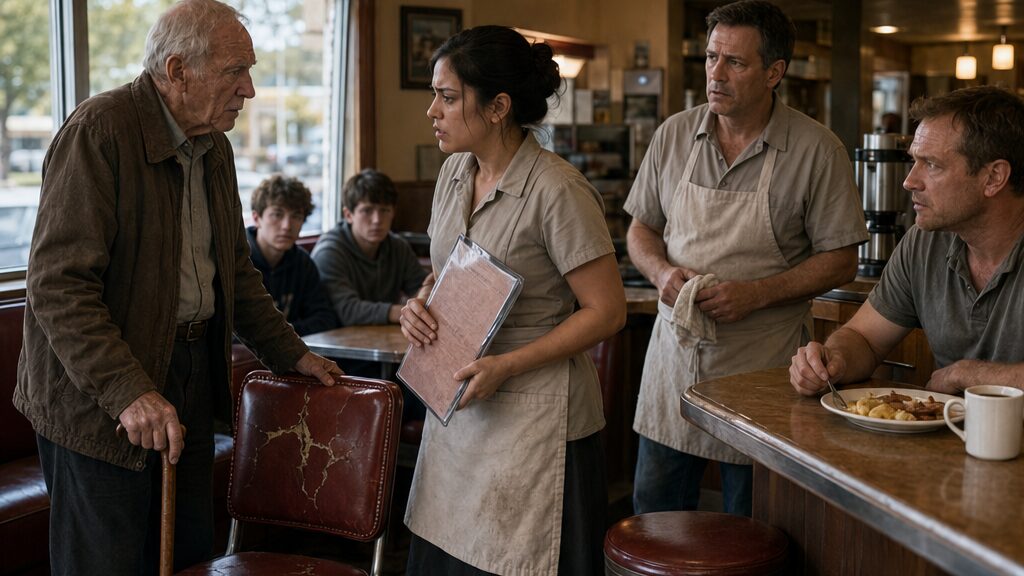
The Old Navy Man They Moved From The Window Chair Left A Debt No One Expected
Chapter 1: The Chair They Said He Had Not Paid For
Melissa Perez moved the menu before Samuel Wilson’s fingers could touch it.
It was not a large movement. Just a quick slide of laminated plastic across the edge of the table, away from his reaching hand, as if she were clearing crumbs. But the sound of it against the worn tabletop was sharp enough to make the two teenagers in the booth behind him stop laughing into their phones.
Samuel’s hand remained in the air for a moment.
Then he lowered it slowly to the back of the chair.
The chair was nothing special to anyone else. It stood by the front window of Miller’s Diner with one leg that needed a folded sugar packet under it and a cracked strip of red vinyl curling at the back corner. The morning sun hit that spot first in winter. In summer, the window held the reflection of buses pulling in and out of the stop across the street. Samuel had sat there every Thursday for eleven years, always facing the window, always with his cane hooked over the left side, always with one small white cup of coffee.
That morning, the cup was already waiting near the machine.
Melissa had poured it out of habit before she had decided to follow the rule.
“Sir,” she said, and her voice was tired enough to turn hard before she meant it to, “we need tables for paying customers.”
Samuel looked at the three folded dollar bills in his hand. He had counted them once outside beneath the striped awning, again at the door, and a third time after stepping inside because his fingers were stiff and he did not like to make people wait.
“I have enough for coffee,” he said.
The teenagers went quieter.
At the counter, Ryan Green paused with a forkful of eggs halfway to his mouth. He wore a work shirt with plaster dust at the cuff. He came in most mornings before seven and always sat where he could see the front door. He had seen Samuel before. Everyone had seen Samuel before.
Seeing was not the same as knowing.
Melissa folded the menu against her chest. “You can’t keep coming in here to sit all morning on one coffee.”
Samuel glanced at the clock above the register. “I don’t stay all morning.”
“You stay through breakfast rush.”
“I leave before nine.”
“Mr. Mitchell said we can’t let people camp anymore.”
At that, Samuel’s fingers tightened around the top rail of the chair. The knuckles rose white beneath the thin skin. He looked for a second not angry, but as if he had been told to move from somewhere he had not known he was still allowed to stand.
The diner kept going around him because diners did that. Bacon hissed behind the pass-through. A spoon clinked inside a mug. Someone at the far end of the counter asked for more toast and then lowered his voice as the room adjusted itself around the old man by the window.
Samuel wore a faded brown coat that had lost its shape at the shoulders. The hem hung unevenly. The cuffs were brushed clean but frayed. His cane was polished at the grip where his palm had rubbed it smooth over years. He did not wear a cap. He did not wear pins. Nothing on him announced service, grief, or importance.
Only age.
Melissa saw his coat, his cane, his careful counting. She had been on her feet since five-thirty. Gary Mitchell had spent the week warning her that tables were not benches, coffee was not rent, and kindness did not keep the lights on. The diner had three booths torn at the seams, a freezer making a bad sound, and a stack of bills Gary carried like an illness.
So she stood between Samuel and the cracked chair, holding a menu he had not asked for.
“Just coffee today,” Samuel said. “If that’s all right.”
The words should have ended it. They were quiet, reasonable, almost apologetic.
Instead, Melissa heard Gary’s voice in her head: If they sit for an hour and spend two dollars, we lose the table. Be polite, but move them along.
She lowered her voice, but not enough. “You said that last week too.”
Samuel’s gaze moved past her to the white cup near the coffee machine. Steam lifted from it in a faint thread.
“I paid last week.”
“I’m not saying you didn’t.”
“I paid the week before.”
“Sir, that’s not the point.”
Samuel nodded once.
It was a small nod, almost formal. Ryan noticed it and put his fork down. It looked like the nod a man gave when he understood an order, even one he did not agree with.
The kitchen door swung open and Gary Mitchell stepped out wiping his hands on a towel. He was in his late forties, broad through the shoulders, with dark half-moons under his eyes that had become part of his face since his mother died. He looked first at Melissa, then at Samuel, then at the empty chair by the window.
“What’s the problem?” Gary asked.
“No problem,” Samuel said before Melissa could answer.
Gary frowned. “Mr. Wilson?”
Samuel turned slightly. Not fully. His hand stayed on the chair.
“I only came to leave something for Sharon.”
The name landed harder than the menu had.
Melissa’s expression changed first into confusion, then discomfort. She knew the name, of course. Everyone who worked there knew it. Sharon Miller had owned Miller’s Diner for nearly forty years before Gary took over. Her picture hung behind the register, the one where she was younger and smiling with a coffee pot in her hand. But since her funeral in January, customers had gradually stopped saying Sharon and started saying your mom to Gary, or the old owner when speaking around him.
Gary stopped wiping his hands. “For my mother?”
Samuel reached inside his coat. The movement was slow, careful, and Melissa took a half-step forward as if he might drop whatever he was holding. He did not. He drew out a small envelope softened at the edges, the paper rubbed almost clothlike from being handled too often. It had no stamp. No address. Only a name written across the front in thin, careful letters.
Sharon.
Melissa folded her arms, but the gesture had lost strength. “Sharon’s not here.”
Samuel looked at her. His eyes were pale gray, steady despite the tremor in his hand.
“I know.”
The room changed then. Not dramatically. No one gasped. The teenagers did not put their phones away. The man waiting for toast still waited. But something about the old man knowing she was gone, and bringing her something anyway, made the air around the window chair feel suddenly less ordinary.
Gary stepped closer. “Mr. Wilson, what is this?”
“Something I should have returned a long time ago.”
“To my mother?”
“Yes.”
“She passed in January.”
“I know.”
“You came all this way to leave her an envelope?”
Samuel looked toward the chair. Not at Gary. Not at Melissa. At the cracked vinyl corner, at the sugar packet under the front leg, at the window beyond it where the bus stop sign leaned slightly toward the curb.
“I came to leave it where she’d understand.”
Melissa’s cheeks flushed. “Sir, if this is about money—”
“It is,” Samuel said.
Gary’s jaw shifted. “What kind of money?”
Samuel placed the envelope on the counter instead of handing it to him. He reached into his coat pocket again, took out two quarters, and set them on top of the envelope. The quarters made a soft, final sound.
“So it won’t slide,” he said.
Gary stared at the envelope. “Mr. Wilson, wait a minute.”
But Samuel had already taken his cane from the chair.
The act looked harder than it should have. His shoulder dipped; his breath caught once, not loudly enough for most people to hear. Ryan heard it. He half-stood, one hand on the counter.
“You need a hand with the door?”
Samuel shook his head without looking at him. “No, thank you.”
Melissa stood frozen with the menu still against her chest. The white coffee cup waited near the machine, steam thinning now. She could feel the eyes of the room on the old man and on her, and she wished suddenly that she had said it differently. Not because she thought she had been wrong exactly, but because she had been public.
Public made everything heavier.
Samuel moved toward the door with the slow precision of a man who did not want anyone to see how much each step cost. His cane touched the floor, then his right foot, then his left. He did not rush. He did not look back at the chair.
Outside, the bus coughed at the curb, doors folding open.
Melissa found her voice just as Samuel reached the door.
“Sir,” she called.
He paused with one hand on the metal bar.
“You forgot your coffee.”
The whole diner seemed to wait for him to turn around.
He did not.
“That wasn’t what I came for,” Samuel said.
Then he pushed the door open and stepped into the morning light. The little bell above the frame gave a bright, foolish jingle as he left.
For several seconds, nobody moved.
The teenagers looked down at their table. Ryan sat back slowly, his eggs untouched. Melissa stared at the coffee cup as if it had become evidence of something she did not want named.
Gary picked up the envelope.
The two quarters slid a little under his thumb but stayed on the paper. He had meant to call after Samuel. He had meant to ask why, to tell him they could talk in the office, to say something that would repair the shape of what had just happened. But the old man was already outside, already crossing toward the bus stop, his cane angled carefully against the curb.
Gary looked down at the handwriting again.
Sharon.
His mother had written that name a thousand times on schedules, invoices, Christmas cards taped above the coffee machine, notes telling him not to forget to order onions. The letters on the envelope were not hers, but something about the careful curve of the S made him think of the old ledger books she used to keep in the office, the ones where she wrote regulars’ names in the margins because she said numbers didn’t tell the whole truth.
Melissa swallowed. “Should I throw that away?”
Gary looked at her so sharply she took a step back.
“No.”
“I just thought—”
“Don’t touch it.”
He had not meant to sound cruel. He heard the bite in his own voice and hated that it sounded like fear.
The bus pulled away from the curb. Through the window, Samuel’s brown coat passed behind the dirty glass for one brief moment before the bus moved into traffic.
Gary stood with the envelope in his hand, feeling the weight of something that should have been too light to matter.
On the front, under Sharon’s name, there was a small crease where the paper had been folded and unfolded, worried and smoothed, carried and almost delivered, maybe for weeks.
Maybe for years.
And in the lower corner, almost hidden beneath one of the quarters, Gary saw three words written in the same shaky hand.
Paid in full.
Chapter 2: The Envelope That Made The Lunch Rush Go Quiet
The two quarters were still on the envelope when Gary carried it into the office, as if the old man’s instruction had become part of the thing itself.
He set it on the desk between an unpaid produce invoice and a cracked calculator. The office was barely larger than a pantry. It smelled of old coffee, receipt paper, and the lemon cleaner Melissa used when she was trying to look busy between rushes. Through the slatted blinds, Gary could see the front window chair sitting empty while a family of four waited near the door.
He should have been seating them. He should have been checking the grill. He should have been doing any one of the hundred small things that kept Miller’s Diner from falling apart before noon.
Instead, he stared at his mother’s name.
Someone knocked once on the doorframe.
Melissa stood there, no longer holding the menu. Without it, her hands seemed unsure what to do. She tucked one strand of dark hair behind her ear and glanced at the envelope.
“Do you want me to cover the register?” she asked.
Gary rubbed both hands over his face. “I want you to cover the floor.”
“I am.”
“Then go.”
She didn’t.
The lunch rush had thinned but not ended. A bell kept ringing from the kitchen. Somewhere outside the office, a child was asking for chocolate milk in a voice loud enough to make every adult tired.
Melissa said, “Was he… homeless?”
Gary looked up. “What?”
“The old man. Mr. Wilson.” She swallowed. “Was he homeless?”
“I don’t know.”
The answer bothered him as soon as he said it.
Samuel Wilson had been coming to the diner for as long as Gary had been back running the place. Every Thursday. Same chair. Same coffee. Sometimes toast if the weather was bad. He paid in cash, folded bills, exact change when he had it. He never complained if service was slow. He never sent anything back. At Christmas, he left two dollars under the saucer and a note that said Thank you.
Gary knew all of that.
He did not know where Samuel lived.
He did not know if he had children.
He did not know why he always watched the bus stop.
He did not know why his mother’s name had made the old man’s hand tremble harder than the cane did.
Melissa stared at the floor. “I didn’t mean it like that.”
“You meant what you said.”
“Because you told me to.”
Gary’s head came up.
She looked sorry the second the words left her, but she did not take them back.
“I told you not to let people sit for two hours on coffee when we’ve got a line out the door,” Gary said.
“He doesn’t sit for two hours.”
Gary said nothing.
“He’s usually gone before the second bus after eight.” Melissa’s voice was smaller now. “I only noticed because he always checks the window when he hears it.”
From the floor, someone laughed too loudly. The sound ended quickly. The diner had a strange feel after Samuel left, as if everyone was trying to return to breakfast but had misplaced the old rhythm of forks and talk.
Gary looked down at the envelope again.
“Close the door,” he said.
Melissa did. Then she stayed inside.
Gary wanted to tell her to leave. He did not. Maybe because she had been part of the moment. Maybe because guilt needed a witness to become anything useful.
He lifted the quarters and placed them on the desk. Then he slid a thumb under the flap.
The paper resisted. It had been sealed years ago, or sealed too carefully by an old hand. When it opened, the sound seemed too loud.
Inside was a photograph.
Gary pulled it out first because it was thick and caught at the lip of the envelope. The edges had yellowed. One corner was bent. Two people stood outside Miller’s Diner before the sign was replaced, back when the letters were painted red and the window still had chrome trim.
The woman was his mother.
Not the mother he had buried in January, thin and angry at the oxygen tube in her nose. This was Sharon Miller with dark hair pinned loosely, laughing so hard one hand covered her mouth. Beside her stood a younger Samuel Wilson in a Navy pea coat, shoulders straight, face narrower, eyes not yet hidden behind age. He was not smiling, not exactly, but he was looking at Sharon as if she had said something that had almost made him remember how.
Behind them, taped to the diner window, was a hand-lettered sign.
Free coffee for servicemen. No questions asked.
Melissa leaned closer before she could stop herself. “That’s him?”
Gary turned the photo slightly away, then regretted it and let her see.
“It’s him.”
“He was Navy?”
“Looks like.”
Melissa’s face tightened. “I didn’t know.”
Gary almost said neither did I, but he felt the cowardice in it. He had known enough to know Samuel was old, quiet, regular, and attached to the place. He had known enough to ask one question and never had.
He reached into the envelope again.
The next paper was a receipt, brittle at the fold. The date at the top read 1972. Coffee, toast, soup. The total was small enough to be almost painful. Across the bottom, in his mother’s unmistakable handwriting, were three words.
Paid in full.
Gary touched the ink with one finger.
His mother’s handwriting had always leaned forward like she was hurrying even on paper. The P in Paid had a long stem. The two l’s in full nearly touched.
Melissa whispered, “Why would he keep that?”
Gary did not answer.
There was another folded sheet beneath the receipt. He opened it carefully. The handwriting was Samuel’s—thin, deliberate, each letter formed as if steadiness could be forced by discipline.
Gary began to read silently, then stopped because Melissa was watching his face.
“What does it say?” she asked.
He should have told her no. But the diner floor had watched Samuel leave. Melissa had said the words. Gary had allowed the rule that made her say them.
So he read aloud.
“Mrs. Miller would not take my money. I tried for many weeks. She said a man ought to be allowed to sit down somewhere without explaining why his hands shook.”
His voice caught there, not because he wanted it to, but because the sentence sounded exactly like something his mother would say and exactly like something she would never have told him.
Melissa’s eyes dropped to her own hands.
Gary continued.
“I have counted what I owed as best I could. Coffee first, then toast when she made me eat it, then soup on days I could not go home yet. I know money is not the same as kindness. But I was taught to pay debts that could be paid.”
A ticket bell rang twice outside. Neither of them moved.
Gary unfolded the last part of the sheet.
“Please put this where she would have put it. If that is not possible, then forgive an old man for being late.”
The office seemed smaller when he finished.
Melissa wiped at one eye with the heel of her hand, irritated with herself for it. “So he came to pay for coffee from fifty years ago?”
Gary looked at the receipt again. “Maybe.”
“But your mother marked it paid.”
“I can see that.”
“Then why—”
“I don’t know.”
He reached back into the envelope and felt cloth.
Not cloth. A napkin.
It was one of the old Miller’s napkins, the paper thicker than the cheap ones they bought now, folded around something soft and rectangular. Sharon’s name was written across the outside, not by Samuel this time but in faded blue ink that had bled slightly at the folds.
Gary opened it.
Small bills lay inside.
Ones. Fives. A few tens. No twenties. All of them flattened, folded, saved, pressed into a bundle with the care of someone who had built it slowly from what he could spare. Gary counted the first few before stopping. His chest felt tight.
Melissa understood before he said it. “How much?”
Gary lifted the napkin and found a smaller note tucked under the money.
Eleven hundred dollars.
The number stood alone, written on the back of an old deposit slip. Beneath it, Samuel had added: Not enough, but all I could keep from disappearing into ordinary things.
Melissa’s mouth parted. “He gave you eleven hundred dollars?”
“He gave it to Sharon.”
“She’s gone.”
Gary looked through the blinds toward the floor.
A man in a cap was sitting at the counter where Samuel never sat. The family of four had taken the booth by the jukebox. The window chair remained empty, not because anyone had reserved it, but because the whole staff kept failing to bring customers there.
The white coffee cup still sat near the machine.
Cold now.
Gary had noticed it three times and done nothing.
Melissa followed his gaze. “I should dump that.”
“No,” Gary said.
“It’s cold.”
“I said no.”
She flinched.
He softened his voice because he had already heard enough harshness for one day. “Leave it.”
For a moment, neither spoke.
Then Melissa said, “I asked if he was homeless.”
Gary looked at her.
“I asked you. After. Like that made it better.” She shook her head. “I moved the menu away from him like he was going to steal it.”
Gary wanted to tell her she was young, tired, doing what she’d been told. He wanted that because it would excuse him too.
Instead, he looked down at the photograph of his mother laughing beside a young man in a Navy coat. Sharon’s hand was over her mouth, but her eyes were on Samuel, bright and unguarded, as if she had recognized something in him the rest of the street had missed.
Gary had inherited the building, the booths, the fryer, the payroll, the cracked window chair.
He had not inherited the part that mattered. Or maybe he had, and he had been treating it like clutter.
Melissa touched the back of the office chair. “What are you going to do?”
Gary folded the receipt along its old crease. “Read the rest.”
“There’s more?”
He lifted the final sheet from the envelope. It had been folded twice and worn soft along the seams. At the top, Samuel had written Gary Mitchell, if Sharon is gone.
Gary felt the back of his neck prickle.
He unfolded it.
The first line waited there in careful, shaking script, and before he read it aloud he already knew the day was not finished with him.
Your mother gave me coffee when I came home and couldn’t sleep.
Chapter 3: The Sign In The Window Before Anyone Forgot
Gary found the old sign behind tax records, mouse-chewed placemats, and a box of Christmas garland his mother had refused to throw away for twenty years.
He had gone into the storage room looking for proof that the photograph was real, though he did not know who he meant to prove it to. Himself, maybe. The room was narrow and hot, stacked with things Sharon Miller had once insisted might be useful someday. Extra salt shakers without tops. A broken napkin holder. Menus from three price changes ago. A framed newspaper clipping about the diner’s reopening after a kitchen fire.
At the bottom of the third box, folded between two yellowed vendor contracts, he found a piece of poster board.
Free coffee for servicemen. No questions asked.
The letters were thick black marker, uneven in a way he recognized from childhood. His mother always made signs too quickly, impatient with rulers. The word coffee slanted downhill. One corner still held a strip of brittle tape, the kind that went amber with age.
Gary crouched there with the sign across his knees.
From the diner floor came the low murmur of evening customers and the scrape of chairs being turned down from tables. The rush had gone. Melissa was restocking sugar packets with the quiet obedience of someone afraid to make another mistake.
Gary had read Samuel’s note three times.
Your mother gave me coffee when I came home and couldn’t sleep.
The rest had been worse because it was gentle.
Samuel had not described what he saw in the Navy. He had not named ships or places or dates beyond the receipt. He wrote instead about arriving home and finding that his own rooms felt too small, that silence had a sound in it, that sleep came only in short pieces and never when expected. He wrote that Sharon never asked him to explain why he needed the chair by the window. She only placed coffee there and let him watch the street until he could believe he was in it again.
Gary had read the line aloud once and then stopped because Melissa was crying.
Now he carried the sign back through the kitchen. The cook glanced at it, then at Gary, and wisely said nothing.
Melissa saw it first. Her hands froze over the sugar caddy.
“That’s in the picture,” she said.
Gary leaned it against the counter beneath his mother’s framed photograph. In the photograph on the wall, Sharon was older than in Samuel’s envelope but wore the same lifted chin, the same look that made people straighten up without feeling scolded.
“I used to think she gave too much away,” Gary said.
Melissa did not answer.
“She’d tell me to put soup in a cup for the man at the bus stop. She’d send pie home with waitresses whose kids were sick. She’d let people pay Friday if Friday was when they got paid.” He looked at the sign. “I thought she was bad at business.”
Melissa twisted the paper band around a stack of napkins until it tore. “Maybe she was good at something else.”
Gary almost smiled. It did not arrive.
The bell over the door jingled, and Ryan Green stepped inside wearing the same work shirt from breakfast, now with more dust across one shoulder. He stopped when he saw the sign.
“Closed?” he asked.
“Not yet.”
Ryan’s eyes moved from the sign to the empty window chair. “That about Mr. Wilson?”
Gary’s face tightened. “You know him?”
“Not know him.” Ryan took off his cap. “Seen him. Thursdays.”
“For how long?”
Ryan shrugged. “Years. Longer than I’ve been coming regular, I guess. My dad used to mention him.”
“Your dad?”
“Said there was a Navy fellow who sat by the window and watched buses like he was waiting for one that already left.” Ryan looked embarrassed the second he said it. “Not in a mean way. Just something he noticed.”
Gary leaned both hands on the counter. “Did he ever bother anyone?”
“No.”
“Did he ever stay all morning?”
Ryan glanced at Melissa, then back to Gary. “No.”
Melissa looked down.
Ryan continued, careful now. “He’d come in about the same time. Sit there. Coffee. Sometimes toast if your mother pushed him. After she got sick, he still came. Didn’t talk much. Left before the second bus after eight. You could set a clock by him.”
Melissa whispered, “He checked the buses.”
“Always.” Ryan pointed toward the window. “But he wasn’t waiting for one, I don’t think. More like making sure they were still running.”
The words settled over the counter.
Gary looked at the chair. He had seen Samuel look out that window dozens of times. He had thought old men liked windows. He had thought nothing else because nothing else had been required of him.
“How long did my mother keep that chair open?” he asked.
Ryan shook his head. “That I don’t know.”
Gary picked up Samuel’s receipt. “Since 1972, maybe.”
Ryan let out a low breath. “That’s a long time to owe coffee.”
“It wasn’t coffee,” Gary said, surprising himself with the certainty of it.
Melissa looked up then.
The phone rang before anyone could answer.
Gary grabbed it from behind the register because the sound cut too sharply through the room. “Miller’s.”
He listened.
The expression on his face changed so gradually Melissa noticed only when his shoulders dropped.
“Yes,” he said. “I know it’s late.”
He turned slightly away from them.
“No, I’m not ignoring it. I just need another week.”
A pause.
“Monday is not another week.”
Melissa looked at the register drawer, then at the office door, then at the envelope she knew Gary had locked inside the desk.
Gary’s voice lowered. “I understand.”
He hung up without saying goodbye.
Ryan shifted his cap from one hand to the other. “Bad news?”
Gary gave a short laugh with no humor. “Depends how you feel about rent.”
No one spoke.
The diner had been failing in ways that did not show from the street. The sign still lit. Coffee still poured. The grill still worked most days. But suppliers wanted payment faster now, and customers did not come in like they used to, and Gary had discovered that nostalgia did not cover payroll. The landlord had been patient when Sharon was sick. Patience had ended when sympathy did.
Melissa’s face went pale. “Is it really that bad?”
Gary did not answer quickly enough.
Ryan looked toward the office. “How much was in the envelope?”
Gary’s eyes snapped to him.
Ryan raised both hands slightly. “Sorry. None of my business.”
“No,” Gary said. “It’s not.”
But the number had already begun moving through the air, even unspoken. Eleven hundred dollars. Not enough to save the diner. Enough to quiet one notice. Enough to tempt a man who had spent the day telling himself he was not his worst choice.
Melissa said, “You can’t use it.”
Gary turned on her. “Don’t.”
“I’m just saying—”
“You don’t know what I can or can’t do.”
“I know he didn’t bring it for rent.”
“He brought it to my mother, who is dead.”
Melissa recoiled as if he had slammed a plate.
Gary regretted it instantly. He looked away, jaw tight. His mother’s old sign leaned against the counter between them, asking for a kind of man he was not sure he could afford to be.
Ryan put his cap back on. “I’ll come tomorrow for breakfast,” he said quietly. “Bring a couple guys from the job.”
Gary nodded once, unable to thank him.
After Ryan left, Melissa picked up the cold white coffee cup from beside the machine.
Gary saw her do it too late.
“What are you doing?”
“It’s been sitting there all day,” she said. “It’s cold.”
“Melissa.”
But she had already poured it into the sink.
For a second neither of them moved. The thin brown stream vanished down the drain. The cup hung in her hand, empty and ordinary.
Melissa’s face crumpled. “I didn’t think.”
Gary stared at the cup.
All day, that coffee had stood for the cup Samuel had paid for and had not taken. For the chair he had touched and not sat in. For a debt folded into an envelope because an old man had not known how else to say what someone’s kindness had meant.
Gary’s voice came out harsher than he intended, but he could not stop it.
“That might have been the last cup he ever accepted from us.”
Chapter 4: The Bus Stop Where He Learned To Sit Still
Samuel Wilson stood across from Miller’s Diner on Friday morning and let the bus leave without him.
The doors folded shut with a sigh. The driver glanced once toward the curb, saw the old man with the cane standing under the senior housing awning, and pulled away. Samuel watched the bus move past the diner window, past the chair with the cracked red vinyl, past the place where his white cup would have been waiting if yesterday had gone differently.
He had his three dollars in his pocket.
He had his cane in his right hand.
He did not cross the street.
The bus turned at the corner and disappeared behind the pharmacy. Samuel stayed where he was until the tail lights were gone.
Behind the diner glass, someone moved near the counter. Not Sharon. Not the girl who had moved the menu. Not even Gary, maybe. Just a shape passing through morning work. The neon sign flickered once, then steadied.
Samuel lowered his gaze to the bus schedule folded inside his coat pocket. He knew the times without looking. He kept the paper because habits were sometimes easier to carry than reasons.
“Samuel?”
He turned carefully.
Sandra stood in the doorway of the senior housing building with a laundry basket against one hip and a look sharp enough to cut through any polite lie. She was in her seventies, silver hair pinned unevenly, slippers on her feet though she was pretending she had only stepped out for the mail.
“You missed it,” she said.
“Yes.”
“You never miss it.”
“I did today.”
“That isn’t an answer.”
“It’s the one I have.”
Sandra came down the ramp slowly, not because she needed to, but because she knew Samuel disliked being approached too quickly. She stopped beside him, leaving a respectful space between her basket and his cane.
“You going to the diner?”
“No.”
“You’re dressed for it.”
Samuel looked down at his coat. He had brushed it that morning. He had chosen a clean shirt. He had put the folded bus schedule in his pocket and the three dollars beside it. His body had prepared for Thursday out of memory even though the calendar had turned.
“It’s Friday,” he said.
Sandra gave him a long look. “That diner serves coffee on Friday too.”
“I know.”
“But you’re standing here watching it like it might come over and apologize.”
Samuel almost smiled. It did not last long enough to become one.
Across the street, a customer opened the diner door. The bell gave its little sound, faint through the traffic. Samuel’s fingers tightened on his cane.
Sandra noticed.
“What happened?”
“Nothing.”
“Don’t insult me.”
He looked at her then. The morning light showed the fine web of lines around her eyes, the worry she hid behind scolding. Sandra had lived two doors down from him for six years. She knew when he put his trash out, knew he folded grocery bags, knew he hated the television in the lobby when it was too loud. She knew he went to Miller’s on Thursdays and came back quieter than when he left, but steadier.
She did not know why.
Samuel preferred it that way.
“They were busy,” he said.
“And?”
“I left something.”
“At the diner?”
“For someone who is gone.”
Sandra’s face softened too quickly, and he looked away before she could put pity on him. He could bear many things when they came plain. Pity never came plain. It came with soft voices and tilted heads and hands reaching before he asked.
“Sharon?” Sandra asked.
He turned back.
“You’ve said her name before,” she explained. “Once. When the elevator broke and we sat in the lobby for half an hour. You said Sharon would have had coffee ready by now.”
“I said that?”
“You did.”
Samuel breathed through his nose. “Then I’m getting careless.”
“No. You were tired.”
He tapped the cane once against the concrete. The sound was too loud under the awning.
Sandra shifted the basket to her other hip. “Did they do something to you over there?”
“No.”
“Samuel.”
He watched a second bus stop across the street. Not his route. A young mother climbed down with a child. A man in a delivery uniform stepped around them and went into the diner without looking at the chair.
“They run a business,” Samuel said. “I took a table.”
“You bought coffee.”
“Coffee doesn’t rent a window.”
Sandra stared at him. “Who told you that?”
He did not answer.
That was how he had survived many years: letting silence stand in the place where anger might have made him careless. In the Navy, silence had been discipline. Afterward, it had become shelter. Later, when people asked questions with faces already prepared for what they thought he would say, silence had become dignity.
But sometimes silence did something else.
Sometimes it let a young woman move a menu away and think she understood the whole room.
Sandra set the laundry basket down on the bench beside the awning. “Come upstairs.”
“I’m all right here.”
“You are not all right anywhere you’re pretending this hard.”
He gave her a look.
She ignored it. “Come upstairs before I start yelling across the street, and then everyone will know your business.”
That moved him. Not quickly. But it moved him.
In the lobby, the television was on too loud, a morning show full of bright voices. Samuel stopped near the mailboxes until Sandra walked over and turned the volume down without asking anyone’s permission. A man reading a newspaper looked up, saw her expression, and wisely went back to the sports page.
Samuel sat in one of the lobby chairs because Sandra pointed to it and because refusing would take more strength than sitting. The chair was brown vinyl, cracked along one arm. It was not the same. It faced the wrong direction. There was no window to the street, only the glass doors and the reflection of the lobby plants.
Sandra sat beside him.
For a few moments they said nothing.
Then she reached toward his coat pocket.
Samuel caught her wrist gently before she touched it.
“Don’t.”
Sandra looked at his hand on her wrist. He released her at once.
“I’m sorry,” he said.
“No,” she said, quieter now. “I am.”
He took the folded bus schedule from his pocket himself. Something came with it and slipped to the floor.
A napkin.
It landed print side down near Sandra’s shoe. Samuel stared at it as if it had betrayed him.
Sandra bent and picked it up before he could stop her. The napkin had yellowed at the folds. It was not one from the building’s vending machine. It was thick, old paper, printed with Miller’s Diner in faded red across one corner.
On the back, in blue ink, were two words.
Window’s open.
Sandra read them once, then again, and her scolding face disappeared.
“She wrote this?”
Samuel held out his hand.
Sandra gave it back.
He folded the napkin along lines already worn soft. “A long time ago.”
“Sharon?”
“Yes.”
“What did it mean?”
He looked toward the lobby doors. The street beyond them was bright, ordinary, moving. A bus passed without stopping.
“It meant I didn’t have to ask.”
Sandra waited.
Samuel was not sure why he continued. Maybe because the envelope had been delivered. Maybe because yesterday had already made his silence public, and there was no dignity left in pretending nothing had been touched.
“When I first came home,” he said, “I couldn’t sit in my apartment.”
Sandra did not move.
“It was too quiet. Then it wasn’t quiet enough. Pipes. Neighbors. A radio somewhere. Cars outside. I knew where I was, but my body didn’t. I would walk until morning. One day I sat at the bus stop across from the diner because my legs decided they were finished before I was.”
He looked at the napkin in his hand.
“Sharon came out with coffee. I told her I didn’t ask for any.”
Sandra’s mouth trembled once, then steadied. “What did she say?”
“She said she wasn’t asking either.”
The television audience laughed softly at something no one in the lobby heard.
Samuel rubbed one thumb over the old ink. “After that, if the chair was empty, she’d put this on the table. Window’s open. That was all. No questions. No fuss. If I had money, I paid. If she took it, I felt better. If she didn’t, she marked the receipt anyway.”
“Paid in full,” Sandra said.
Samuel looked at her.
“I guessed,” she said.
He put the napkin back into his pocket. “When she died, I kept going. Thursdays. Not because I needed the coffee. Because somebody ought to remember a promise when the one who made it isn’t here to keep it.”
“And yesterday?”
He did not answer quickly.
Yesterday the chair had still been there. That was the part that shamed him most. The chair had been there, and his hand had been on it, and he had let a tired young woman tell him what he was worth in front of two boys and a man eating eggs. He could have told them about Sharon. He could have said Navy. He could have said 1972. He could have said that he had sat in worse places than a diner and still knew when a man was being moved along.
Instead, he had nodded.
As if given orders.
“I left what I owed,” he said. “That’s finished.”
Sandra studied him. “And you?”
“I’m still here.”
“That is not the same thing.”
He stood, slowly enough that she did not try to help.
“Samuel, if they hurt you, you don’t have to make it easy for them.”
He gave her a tired look. “People don’t need my help to be what they are.”
“Maybe not. But sometimes they need your help to become better.”
The words unsettled him more than he wanted to show.
He walked to the mailboxes and opened his, though he knew nothing useful would be there. A coupon sheet. A clinic notice. One envelope addressed to a tenant who had moved out months ago. He closed the little metal door.
Sandra lifted her laundry basket. “Gary Mitchell came by.”
Samuel turned.
“This morning, before you came down. I saw him from my window. He stood by the directory looking lost, then left.”
Samuel’s face did not change, but his hand on the cane tightened.
“Did he ask for me?”
“He asked the front desk if you lived here. They wouldn’t tell him. Good for them.”
Samuel looked toward the street again. Across the road, the diner sign glowed red in the morning.
Sandra stepped closer. “He may come back.”
Samuel slid the mail into his coat pocket beside the napkin.
“Then he found the debt,” he said. “That should be enough.”
Chapter 5: The Money That Could Save The Diner Or Shame It
Gary put Samuel Wilson’s money in the register drawer at six-thirteen Saturday morning and took it back out before the drawer finished sliding shut.
The bills lay in his hand, soft and worn, bound now with a rubber band because he could not bear to keep unfolding Sharon’s old napkin. Ones, fives, tens. Eleven hundred dollars saved in pieces small enough to hurt. He had counted it twice the night before, not because he doubted the amount, but because part of him kept measuring it against the overdue rent notice taped inside his office drawer.
Eleven hundred would not save Miller’s Diner.
It would buy time.
Time was the one thing every failing business needed and every guilty man knew how to justify stealing.
Gary stood behind the counter while the kitchen fan rattled awake and Melissa filled sugar caddies with red-rimmed eyes. The window chair sat empty under the pale morning light. He had not moved it. He had not let anyone else move it either. It stood slightly crooked, sugar packet still wedged under the front leg, a piece of cracked vinyl curled like a lifted scab.
Melissa noticed the money in his hand.
“You’re taking it to him today?”
Gary pushed the drawer shut with his hip. “I tried yesterday. Front desk wouldn’t give me his apartment.”
“That’s good.”
He looked at her.
“I mean,” she said quickly, “for him. They shouldn’t tell just anybody.”
“I’m not just anybody.”
Melissa said nothing.
The silence irritated him because it was true enough to sting. To Samuel, Gary might have been just anybody now. Worse than that. He was the man who had inherited Sharon’s diner and let her old kindness be enforced out of the room.
Gary put the money into an envelope from the office and wrote Samuel Wilson on it. His handwriting looked clumsy beside Samuel’s careful script.
Melissa tied the sugar packet wrapper too tight and split it open. White grains scattered over the counter.
She stared at them.
Gary sighed. “Melissa.”
“I’ll clean it.”
“I didn’t say you wouldn’t.”
She swept the sugar into her palm with a napkin. “Are you firing me?”
The question came out hard, as if she had meant to sound ready for it. Her face betrayed her.
Gary leaned against the counter. “No.”
“You should.”
“I told you to move people along.”
“You didn’t tell me to talk to him like that.”
“No,” Gary said. “I didn’t.”
The kitchen bell rang before either could say more. A delivery driver came through the back with eggs, the cook swore at the freezer, and the first customers arrived in a burst of cold air and hunger. Miller’s Diner became what it had always become in the morning: a machine powered by coffee, impatience, and habit.
Only one habit had broken.
At seven-twenty, a man in a suit pointed toward the front window. “Can I get that table?”
Melissa turned with two menus in her hand.
The chair waited. Empty.
The man followed her gaze. “Something wrong with it?”
“No,” she said.
Gary, watching from the register, did not move.
The man gave a little laugh. “Then I’ll take it.”
Melissa’s hand tightened on the menus. Gary could see the rule and the shame fighting in her face. A table was a table. A customer was a customer. Saturday breakfast did not care about old envelopes or handwritten signs.
She swallowed.
“I have a booth open by the wall,” she said.
“I asked for the window.”
“The booth is warmer.”
“I don’t want warmer.”
Gary nearly stepped in. Not because Melissa was wrong, but because he had trained her to fear the exact choice she was now trying to make. Before he could speak, Ryan Green came through the door with two workmen behind him.
“Morning,” Ryan said loudly enough to cut the tension without naming it. “Three at the counter if you’ve got it.”
Melissa looked relieved enough to hate herself for it.
The man in the suit rolled his eyes and took the booth by the wall. Melissa seated him with a politeness so careful it sounded fragile. When she returned to the counter, she did not look at Gary.
Ryan sat near the register. “Coffee, black.”
Gary poured it.
Ryan nodded toward the window chair. “Holding it?”
Gary hesitated. “I don’t know what I’m doing.”
“That’s honest.”
“Honest doesn’t cover rent.”
Ryan took the cup. “No. But sometimes it keeps a place worth renting.”
Gary almost laughed, but the words struck too close to something Sharon might have said, and the laugh died.
By eight-thirty, the diner was full. The man in the suit had finished eating and left no tip. Ryan’s workmen ordered seconds. The teenagers from Thursday came in but did not sit in the booth behind the window. They stood awkwardly near the door until Melissa offered them the counter. They accepted without joking.
One of them looked at the empty chair and then quickly away.
Gary saw it.
The room had changed, but not enough. Change, he was learning, did not arrive as forgiveness. It arrived as discomfort, and then everyone decided what to do with it.
Near nine, when the rush thinned, Melissa came to the register holding her phone.
“You need to see this,” she said.
Gary was adding receipts and did not look up. “If it’s another freezer coupon, I’m not in the mood.”
“It’s about us.”
He took the phone.
The post was from a local food page called County Bites, run by a woman who came in twice a month and photographed pancakes from above. Gary recognized the profile picture. He also recognized his own front window in the blurred image beneath the headline.
MILLER’S DINER FINALLY CRACKS DOWN ON TABLE CAMPERS?
Under it was a short paragraph about “elderly loiterers,” “small-town restaurants trying to survive,” and “a sad but necessary line between kindness and business.” The photo showed Samuel from behind as he stepped out the door on Thursday morning, cane in one hand, brown coat hanging loose. His face was not visible. That made it worse somehow. He had become a shape for strangers to discuss.
Gary read the first comments.
Good for them. These places aren’t shelters.
That poor old man. Anyone know if he’s okay?
I saw this happen. Hostess was rude.
Restaurants can’t run on one coffee all day.
Does anyone know who he is?
Gary handed the phone back as if it had become hot.
Melissa’s voice shook. “I didn’t send anything.”
“I know.”
“I would never—”
“I know.”
But the words had already left the room. The thing he had wanted to fix privately had found a public shape without Samuel’s consent and without the truth. Gary felt a familiar pressure rising—the business owner’s instinct to answer fast, protect the diner, manage the damage.
He could write a comment. He could explain there had been a misunderstanding. He could mention Samuel’s Navy service, Sharon’s old sign, the envelope. He could turn shame into sympathy, maybe even good publicity. People loved stories about diners and old veterans when they could consume them from a distance.
His eyes moved to the office door, where Samuel’s money waited inside the envelope.
Melissa whispered, “What are we going to do?”
Gary looked through the front window.
Across the street, a bus opened its doors. For one foolish second he expected Samuel to step down, cane first, shoulders squared, ready to forgive them or condemn them. But the passengers were strangers. A student with headphones. A woman with grocery bags. A man looking at his watch.
No Samuel.
Ryan came up beside the register and read the post over Melissa’s shoulder. His face hardened.
“That’s not how it happened,” he said.
“No,” Gary said.
“You going to say something?”
Gary looked at the empty chair. He imagined Samuel seeing the post, seeing himself reduced again, this time not to an old man taking space in a diner but to a topic strangers could argue over before lunch.
He put both hands on the counter.
“If I say what happened, I use him.”
“If you don’t,” Ryan said, “they keep guessing.”
Gary had no answer.
Melissa’s phone buzzed again. Another comment appeared beneath the blurred photograph.
Who is the old man?
Then another.
Is he homeless?
Melissa covered her mouth.
Gary turned away from the phone and walked into the office. He opened the drawer, took out Samuel’s envelope, and held it against his chest for a moment like he could keep the whole thing from spilling farther.
Outside, the diner bell jingled.
Another customer came in. Another table filled. Another cup of coffee poured.
And on Melissa’s phone, under the blurred picture of Samuel Wilson’s back, the questions kept multiplying.
Chapter 6: The Note He Never Meant To Become Public
Gary knocked on Samuel Wilson’s door with the envelope in both hands, and for a full minute nothing moved on the other side.
The hallway in the senior building smelled faintly of boiled vegetables and floor wax. A television murmured behind one door. Somewhere downstairs, a cart rattled over tile. Gary stood under a buzzing light, feeling too large for the narrow corridor, too late for the apology he had carried up three flights because the elevator was out.
He knocked again, softer.
“Mr. Wilson?”
Silence.
“It’s Gary Mitchell. Sharon’s son.”
The peephole darkened.
Gary straightened without meaning to. He had spent two days telling himself exactly what he would say. I’m sorry. We were wrong. I want to return this. My mother would be ashamed of me. Each sentence had sounded necessary in the car and useless in the hallway.
The door opened only as far as the chain allowed.
Samuel stood in the gap wearing a gray cardigan over a buttoned shirt. Without the brown coat, he looked thinner. His cane was not in sight, but one hand rested on the doorframe, fingers curled around the wood.
“Mr. Mitchell.”
The formality landed hard.
“May I speak with you?”
“You are.”
Gary swallowed. “I’d rather not do it through a chain.”
Samuel’s eyes rested on the envelope. “Then say less.”
Gary looked down at it. “I brought your money back.”
“It isn’t mine.”
“It isn’t ours.”
“It was Sharon’s.”
“My mother is gone.”
“I know that.”
The words could have been cruel from another man. From Samuel, they were simply facts placed in order.
Gary exhaled. “Mr. Wilson, please. I owe you an apology at least.”
Samuel studied him for a moment. Then he closed the door.
Gary’s stomach dropped.
The chain slid.
The door opened again.
Samuel stepped back, not quite inviting him in, not quite refusing. Gary entered carefully, as if the apartment were a place where noise would be disrespectful. It was small and neat. A narrow table by the wall held mail stacked by size, a lamp, and a white mug turned upside down on a saucer. Near the window sat a chair facing the street.
Not a recliner. Not a comfortable chair. A straight wooden chair with a worn cushion, angled so Samuel could see the bus stop below.
Gary noticed, then wished he had not shown that he noticed.
Samuel saw him see it.
“Sit,” Samuel said.
Gary took the chair by the table. Samuel remained standing for a moment, then lowered himself into the window chair with controlled effort. He did not ask for help. Gary did not offer.
The envelope lay between them on the table.
Gary pushed it forward. “I can’t keep this.”
Samuel did not touch it. “Then give it to someone who can.”
“That’s not what I mean.”
“It usually isn’t.”
Gary pressed his palms to his knees. “What happened at the diner was wrong.”
“Yes.”
The answer was so plain that Gary had to look away.
“Melissa is sorry,” he said.
“She should be.”
“I’m sorry.”
“You should be too.”
Gary nodded. There was no softness in Samuel’s voice, but no cruelty either. It was worse because it left Gary no way to defend himself.
“I told the staff to move people along,” Gary said. “We’ve been struggling. Rent’s late. Repairs are piling up. I thought if we kept tables open—”
Samuel raised one hand.
Gary stopped.
“I did not come to hear why the chair was expensive.”
The sentence struck him silent.
Samuel looked out the window. The street below was dimming toward evening. A bus sighed at the curb, opened, closed, moved on.
Gary said, “There’s a post online.”
Samuel did not turn.
“Someone took a photo when you left. People are asking who you are. Some are saying things that aren’t true.”
“What things?”
“That you were loitering. That you might be homeless.”
Samuel’s jaw shifted once.
Gary leaned forward. “I can correct it. I have the photo. The receipt. The sign my mother made. Your note. I can tell them—”
“No.”
“You don’t even know what I was going to say.”
“I know enough.”
“I wouldn’t embarrass you.”
Samuel looked at him then. “You already did.”
Gary sat back as if he had been pushed.
The room hummed around them. Refrigerator motor. Distant television. Traffic below. None of it covered the truth.
Samuel reached for the envelope at last, not to take it but to rest two fingers on the flap. “Your mother never asked what I saw.”
Gary’s throat tightened.
“She knew I had served. That was all. Men came home then and people expected them to be grateful, proud, hungry, tired, ready. I was some of those things. Not all at once. Not in the right order.”
He looked toward the upside-down mug on the table.
“I went into Miller’s because it was open before the sun was fully up. I had been walking since two. Sharon asked if I wanted breakfast. I said coffee because coffee was cheaper and because a man can refuse food without sounding afraid.”
Gary pictured his mother young, behind the counter, pouring coffee for a man who could not sit in his own home.
“I tried to pay,” Samuel said. “She took the money the first time. Maybe the second. Then one morning my hands were bad. Worse than usual. I spilled half the cup before I got it to my mouth.”
He rubbed one thumb slowly against the arm of the chair.
“I put money on the table and left before she could see my face. Next week I found the receipt under the cup. Paid in full. After that, if the window was free, she put a napkin there. Window’s open. That meant I could sit down without asking permission.”
Gary bowed his head.
“She gave you free coffee,” he said, though he knew before Samuel answered that it was too small.
“She gave me a way to accept it.”
The sentence entered the room quietly and took up all the space.
Gary looked at the envelope. “Then why save the money?”
Samuel’s mouth tightened. “Because I am proud.”
The answer surprised him.
Samuel saw that too. “Not noble. Proud. There were weeks I needed what she gave and hated needing it. I thought if I could return the money someday, then maybe the needing would not have counted.”
“That isn’t how kindness works.”
“No,” Samuel said. “I learned that late.”
For the first time since Gary entered, Samuel looked tired in a way that had nothing to do with age. He turned his face toward the window again.
“When Sharon died, I realized there was no one left who knew what the chair had been. So I kept going. Thursdays. Coffee. The window. I thought that was enough remembering.”
Gary’s voice was low. “And then we moved you.”
“You tried.”
Gary flinched, but Samuel’s tone had no triumph in it.
“I left because I did not trust myself to speak well,” Samuel said. “That is not the same as having nothing to say.”
Gary sat with that.
He thought of Melissa moving the menu, himself stepping out with the towel, the room watching. He thought of the online comments asking if Samuel was homeless, as if a man’s life could be sorted by the price of his coat. He thought of how easy it would be to post the photograph of young Samuel in the Navy pea coat and let strangers reverse themselves, praise what they had mocked, feel clean by bedtime.
“I won’t post your note,” Gary said.
“No.”
“Or the photo.”
“No.”
“The sign?”
Samuel considered this. “The sign belonged to your mother.”
“That doesn’t answer.”
“It is the answer I have.”
Gary almost smiled despite himself.
He pushed the envelope forward again. “At least take the money.”
Samuel shook his head.
“Mr. Wilson—”
“I carried it too long to carry it home.”
“I don’t know what to do with it.”
“That may be good for you.”
Gary looked up.
Samuel’s eyes were steady. “Your mother knew what to do with a cup of coffee. You have to decide if you learned anything from her.”
Gary touched the edge of the envelope. “If I keep it, it feels like stealing from you.”
“If you return it, it becomes only money again.”
“What do you want?”
Samuel was silent long enough that Gary thought he might refuse to answer. Then the old man leaned back, one hand resting on the arm of the chair.
“I want no speeches,” he said. “No article. No picture of me in a coat I wore when my back was straighter. No telling strangers what I could not sleep through.”
“All right.”
“I want the girl not to lose her job because shame needs somewhere to go.”
Gary blinked.
“She hurt you.”
“Yes.”
“And you’re defending her?”
“No. I am refusing to become her excuse.”
Gary did not know what to do with that, so he said nothing.
Samuel looked back out the window. “If you keep the money, use it where Sharon would recognize it. Not for rent. Not for pride. Not to make people call you kind.”
Gary nodded slowly. “Coffee.”
“Coffee is a start.”
“For veterans?”
Samuel turned back to him.
Gary heard the mistake before Samuel answered.
“For anyone who needs to sit down,” Samuel said.
The hallway outside creaked. Someone passed the door slowly, then moved on.
Gary picked up the envelope, but this time it felt different in his hands. Not lighter. More exacting.
“I still owe you an apology in the diner,” he said.
“You owe the diner better than an apology.”
“I don’t know how to fix it without saying who you are.”
Samuel reached for the cane leaning against the wall beside him. Gary had not seen it there before.
“That may also be good for you.”
Gary stood.
At the door, he paused. “Will you come back?”
Samuel’s hand rested on the knob.
“No.”
Gary nodded once, though the answer struck lower than he expected.
Samuel opened the door.
Gary stepped into the hall with the envelope against his chest. The apology he had brought felt unfinished, but not rejected. It had become harder, which was different.
Behind him, Samuel spoke once more.
“Mr. Mitchell.”
Gary turned.
Samuel stood framed in the doorway, one hand on the wood, his face half-shadowed by the apartment light.
“You may keep the money,” he said, “if you can use it without turning me into a lesson.”
Chapter 7: Reserved For Whoever Needs To Come Home
Samuel stopped outside Miller’s Diner because the chair was turned toward the door.
It was raining hard enough to blur the front window, hard enough to make the bus late and the sidewalk shine black under the morning traffic. He had not meant to come in. That was what he had told himself at the corner, at the crosswalk, at the bus stop where the bench was slick with water and the schedule had curled at the edges inside its plastic frame.
He had meant only to stand under the awning until the next bus came.
Then he saw the chair.
The cracked red vinyl was still there. The sugar packet under the leg was gone, replaced by a small wooden shim that looked carefully cut. The chair had been wiped clean and set at the front window, not tucked under the table the way chairs were usually left before opening, but angled slightly toward the door as if someone had expected him to notice it from outside.
Samuel’s hand tightened around the top of his cane.
Rain ran from the brim of the diner awning onto the pavement in silver ropes. Behind the glass, Melissa Perez stood near the coffee machine with both hands wrapped around a white cup.
She saw him.
For one second neither moved.
Then Melissa came around the counter too quickly, stopped herself, and walked the rest of the way with the kind of care people used near sleeping babies or open wounds. She unlocked the door though the sign already said open.
“Mr. Wilson,” she said.
The sound of his name spoken gently unsettled him more than the rain.
“I was waiting for the bus,” he said.
She looked past him. The bus stop was empty except for water beating against the bench.
“Yes, sir.”
“I didn’t come to make trouble.”
Her face changed. Not dramatically. Just a small tightening around the mouth, the look of someone receiving something deserved and still wishing it had not needed to be given.
“You didn’t,” she said.
The diner behind her was not full yet, but it was not empty. Ryan Green sat at the counter with a coffee in front of him and one hand around the mug. The two teenagers from the other day were in the back booth, speaking quietly over pancakes. Gary Mitchell stood near the register with his sleeves rolled up, holding himself still as if any movement might spoil something fragile.
Samuel looked at the room, then at the chair.
On the back rail, where his hand had rested so many Thursdays, a small brass plate had been fixed into the wood. It was plain, not polished bright. Rainlight caught the edges just enough for him to read it.
Reserved for anyone who needs a quiet place to come home.
Samuel stared at the words until they seemed to shift under the blur in his eyes.
Melissa stepped aside. “Your cup is ready.”
She held it with both hands.
Not out to him like a waitress serving a customer. Not down on the table like a thing owed. She held it steady, waiting for him to decide whether to accept it.
Samuel did not move.
Gary took one step from behind the register, then stopped. Good, Samuel thought. He had learned at least that much.
The room stayed quiet, though not unnaturally so. Forks still moved. The grill still hissed. Rain ticked against the glass. No one stood. No one said thank you for your service. No one reached for the old photo Gary had been forbidden to show.
Samuel entered because staying in the doorway would have made a performance of refusing.
The bell above the door jingled.
Melissa’s hands trembled slightly as she offered the cup. Samuel saw it and remembered his own hands around Sharon’s coffee, the morning half of it had spilled into the saucer before he could lift it. He remembered the shame of that. The fury at his body for making a public thing of what he had tried to keep private.
He took the cup carefully.
“Thank you,” he said.
Melissa swallowed. “I’m sorry I moved the menu.”
Samuel looked at her.
She did not look away, though her cheeks had gone pale. “I’m sorry I said we needed tables for paying customers. I’m sorry I said it where people could hear me. And I’m sorry I asked the wrong question after.”
“What question was that?”
“I asked if you were homeless.”
A few feet away, Gary lowered his gaze.
Samuel held the cup between both hands. The heat settled into his fingers.
“What should you have asked?”
Melissa drew one breath through her nose. “Why the chair mattered.”
Samuel’s eyes moved toward the window chair.
The brass plate sat on the back rail where his palm had worn the finish dull. Beneath it, the cracked vinyl still curled at the corner. Gary had not tried to make the chair look new. Samuel was grateful for that. New would have been an apology with paint over it.
He walked to the chair.
No one helped him.
The distance from door to window had never felt so long. The cane touched floor, then his right foot, then his left. He could feel the room aware of him, but awareness was not the same as staring. Ryan looked down into his coffee. The teenagers pretended to argue over syrup and did not lift their phones.
Samuel stopped behind the chair and laid his hand above the plate.
The metal was cool.
Gary approached then, slowly. In his left hand he held no envelope. In his right, he held one of the old napkins from the storage box, the thicker kind with Miller’s Diner printed in red. He had set a glass jar near the register with a handwritten card beside it, but Samuel had not seen the words yet.
“I didn’t post your story,” Gary said quietly.
Samuel kept his hand on the chair. “I know.”
“You don’t know that.”
“If you had, people would be looking at me differently.”
Gary accepted that.
“I did write something,” he said. “About the diner. Not you.”
Samuel looked at him.
Gary gestured toward the jar.
Samuel read the card.
Coffee Fund. No questions asked.
The words were not exactly Sharon’s. Close enough to hurt.
“The post online is still out there,” Gary said. “Some people are still talking. I answered once. I said Miller’s made a mistake with a longtime customer and would be doing better. That’s all.”
“That is more than some men say.”
“It’s less than I owe.”
“Most owing is.”
Gary looked at the chair. “I thought about putting my mother’s old sign back in the window.”
Samuel’s grip tightened slightly.
“I didn’t,” Gary said. “It felt like advertising.”
“It was never advertising.”
“No.”
Melissa came over with a small plate. One slice of toast, buttered lightly, cut corner to corner. She set it on the table without speaking and stepped back.
Samuel looked at it, then at her.
“On the house?” he asked.
“No, sir.” Her voice was careful. “From the fund.”
He almost refused. Pride rose in him, old and familiar, the same stubborn animal that had made him save money in small bills for years. Then he saw Melissa waiting not for gratitude, but for correction if she had misunderstood.
He sat down.
The chair gave its old small creak beneath him.
For the first time in days, the street lined itself up properly beyond the glass: bus stop, pharmacy corner, crosswalk signal, the slant of the utility pole, the passing shapes of people going somewhere. Rain moved down the window in thin crooked lines. The diner wrapped around him in ordinary sounds.
Samuel lifted the cup.
The coffee was too hot. Sharon’s had often been too hot. He took the smallest sip and set it down.
A man near the door stepped in, shook water from his jacket, and looked around at the nearly full diner. He was middle-aged, impatient, carrying a folded newspaper under one arm.
“That table open?” he asked, pointing toward Samuel’s chair though Samuel was sitting in it.
Melissa turned. “This one is taken.”
“I mean when he’s done. I’m in a hurry.”
Gary moved from behind the register. “We have counter seats.”
“I don’t want the counter.”
“The counter is what’s open.”
The man glanced at the brass plate and gave a short laugh. “Reserved? You’re reserving window seats now? Place must be doing better than it looks.”
The room tightened.
Samuel set his cup down.
Gary’s face flushed, but his voice stayed even. “That chair has a purpose.”
“The purpose of a diner chair is somebody eating in it.”
The words were not shouted. That made them worse. They carried easily in the morning room.
Melissa opened her mouth, but Gary spoke first.
“You’re welcome to the counter,” he said. “If that doesn’t suit you, there are other places.”
The man stared at him. “You’d turn away a paying customer over a chair?”
Gary glanced at the coffee fund jar, then at Samuel, then back at the man.
“No,” Gary said. “Over what kind of place this is.”
The man shook his head and left, making the bell above the door jangle hard.
No one applauded.
Ryan looked at his mug. One of the teenagers stared at the table. Melissa let out a breath she had been holding. Gary stood near the door until the man’s shape disappeared through the rain.
Samuel looked down at his coffee.
The old part of him wanted to leave. A man should not cost a business money. A man should not be the reason someone walked out. A man should not need a chair defended by people he had only just forgiven enough to sit near.
But then he saw the jar by the register.
No questions asked.
He had given Gary a hard thing to learn. Leaving now would make it impossible.
“Mr. Mitchell,” Samuel said.
Gary turned.
“Bring the envelope.”
Gary hesitated, then went into the office. When he returned, the envelope was in his hand. Not Sharon’s original one—that had been placed somewhere safe, Samuel hoped—but the newer envelope Gary had used to carry the money to his apartment.
Gary set it on the table.
Samuel rested one hand on it. “You kept it separate?”
“Yes.”
“Good.”
Melissa stood near the counter, watching.
Samuel looked at the coffee fund jar. “Use it for coffee.”
Gary nodded. “I will.”
“And soup, if someone’s hands are bad enough to pretend coffee is supper.”
Gary’s expression shifted.
Samuel looked back out the window, then returned his gaze to Gary. The room was quiet enough now that anyone listening could hear him, though he had not raised his voice.
“But don’t make people earn the chair by telling you their sorrow.”
Gary did not answer at once.
He looked like a man receiving orders he should have known already.
“No,” Gary said. “We won’t.”
Samuel picked up his cup again. Melissa returned to the counter. Ryan lifted his coffee but did not drink. Outside, another bus pulled to the curb, doors opening to the rain.
Samuel watched the passengers step down one by one.
For the first time in years, he did not count them to steady himself.
He sat in the cracked chair by the window, the brass plate cool against his back, and let the diner go on around him.
Chapter 8: The Quiet Place Left Open After Him
The older woman reached for the window chair, saw the brass plate, and pulled her hand back as if she had touched something that belonged to the dead.
Melissa saw it from the counter.
The woman had come in during the quiet part between breakfast and lunch, when the grill was wiped down and the coffee in the pot was fresh enough to matter. Her coat was damp at the shoulders though there had been no rain that morning, only a cold mist rising off the street. She carried a pharmacy bag in one hand and a bus transfer in the other.
She looked tired in a way Melissa had learned not to hurry.
“That one’s all right,” Melissa said.
The woman glanced over, embarrassed. “It says reserved.”
Melissa came around the counter with a menu, then remembered and set the menu on the table instead of holding it between herself and the customer.
“It means it’s for you if you need it.”
The woman looked at the plate again.
Reserved for anyone who needs a quiet place to come home.
“I don’t want to take someone’s seat.”
“You’re not.”
The woman stood uncertainly, eyes moving from Melissa to the chair to the street beyond the window. There was a bus at the stop. Its doors opened, released no one, then folded shut.
Finally, the woman sat.
The chair creaked.
Melissa felt the sound in her chest.
At the register, Gary looked up from a stack of bills but said nothing. He had become better at saying nothing when nothing was the kinder thing.
It had been several weeks since Samuel Wilson returned in the rain. The diner had not transformed into the kind of place people wrote glowing stories about. The freezer still made a bad sound. The landlord still called on Tuesdays. One booth still needed tape across the tear because replacing vinyl cost more than dignity did.
But small things had changed.
The coffee fund jar sat beside the register with folded bills and coins inside. Sometimes people put money in without reading the card. Sometimes they read the card and looked toward the window. Once, one of the teenagers from that Thursday came in alone, bought a soda, and dropped four quarters into the jar without meeting anyone’s eye.
Gary never mentioned it.
Melissa never thanked people loudly.
The old sign Sharon had made was not in the window. Gary had cleaned it, pressed it flat between two pieces of glass, and hung it in the office where staff could see it when they came for schedules or hid from difficult customers. Free coffee for servicemen. No questions asked. Beneath it, he had taped a new note in his own handwriting: We do not ask people to prove need before we show decency.
The cook had read it once and said, “Your mother would have corrected the handwriting.”
Gary had laughed for the first time in days.
The older woman at the window ordered coffee and toast. When Melissa brought it, the woman looked at the cup for a long moment before wrapping both hands around it.
“My husband used to meet me here,” she said.
Melissa held the coffeepot. “Did he?”
“Years ago. Before the buses changed.” The woman’s mouth pulled into something too tired to be a smile. “I got off at the wrong stop today. Then I saw the sign.”
Melissa did not ask which sign she meant. The diner sign outside. The brass plate. Something else only the woman could see.
“Take your time,” Melissa said.
The woman looked up quickly, as if she had expected the opposite.
Melissa returned to the counter.
Gary was sliding an envelope into the office drawer. She had seen it arrive that morning, cream-colored, business-sized, with the landlord’s return address printed in the corner. He had opened it, read it, folded it carefully, and placed it away without swearing. That was how she knew it was bad.
“How much time?” she asked quietly.
Gary looked toward the dining room to make sure no one heard. “Less than I’d like.”
“Are we closing?”
“Not today.”
“That isn’t an answer.”
“It’s the one I have.”
She almost smiled despite herself. Samuel had said something like that once, she thought. Or maybe all stubborn people sounded alike when cornered by care.
Gary leaned both hands on the counter. “We’re not using the fund.”
“I didn’t ask.”
“I know. I’m telling myself.”
Melissa glanced at the jar. There was more in it than usual—several ones folded neatly, a five, loose coins. Enough to buy coffee for strangers. Not enough to repair a business. It would have been easy to borrow from it and call it temporary. Easy things had become suspicious to Gary.
The bell over the door jingled.
Ryan Green stepped in with two workmen and pointed them toward the counter before Melissa could ask. Then he noticed the woman in the window chair and gave the smallest nod, not to her, but to the room, as if something had been done properly.
A young man behind him pointed toward the window. “That table taken?”
Ryan touched his sleeve and nodded toward an empty booth. “That one’s better if you’re eating fast.”
The young man shrugged and followed.
Melissa saw Gary watching. Neither said anything. That, too, was new. They had stopped announcing every act of decency as if it needed a witness to become real.
Near eleven, Samuel came in.
Melissa did not see him arrive until the bell sounded and the room shifted in that quiet way it did now, not because people recognized a hero, but because some of them recognized a man they had once watched leave.
He wore the brown coat. His cane touched the tile once, then again. He paused near the door and looked toward the window.
The older woman was still there. Her pharmacy bag sat on the table beside the toast plate. Her coffee had been refilled twice. She was looking out at the bus stop with both hands around the cup.
Melissa started to move, uncertain.
Samuel lifted one hand slightly.
No.
The gesture was almost nothing. It stopped her anyway.
Gary came from behind the register. “Mr. Wilson.”
“Mr. Mitchell.”
The old formality remained, but something inside it had loosened.
“Coffee?” Gary asked.
Samuel looked toward the window chair again.
For a second Melissa felt a flicker of worry, sharp and old. Had they taken too much from him? Had they made his place into a symbol so large there was no room left for the man himself?
Then Samuel turned toward the counter.
“Here is fine.”
Gary blinked. “At the counter?”
“If you still serve coffee there.”
Ryan looked down quickly, hiding whatever had crossed his face.
Melissa took a white cup from the stack. Her hands did not tremble now. She poured carefully and set it in front of the stool nearest the register, the one with a clean view of the front window.
Samuel eased himself onto the stool. It took effort. Gary shifted but did not help. Samuel settled, placed his cane against the counter, and looked across the room.
The woman in the chair did not know him. That seemed to please him.
“She been there long?” Samuel asked.
“About an hour,” Melissa said.
“Good.”
Gary set a small plate of toast beside the cup. “From the fund?”
Samuel looked at him.
Gary held his gaze, then corrected himself. “No. From the diner.”
Samuel took a slow sip of coffee.
It was quiet at the counter for a while. Ryan’s workmen talked low over their eggs. The woman by the window reached into her pharmacy bag and took out a folded tissue. The bus stop filled and emptied twice.
Gary opened the register, closed it, then leaned near Samuel without lowering his voice too much. “Another rent warning came.”
Samuel nodded.
“I’m telling you because I don’t want you thinking the chair fixed everything.”
“I never thought chairs fixed everything.”
“No. I guess not.”
“But sometimes they keep a man in one place long enough to decide what he’ll do next.”
Gary looked toward the office where Sharon’s old sign hung. “She would have liked that.”
“She would have told you to stop talking and check the biscuits.”
Gary smiled then, small and real.
Melissa came by with the coffeepot. “Warm it up?”
Samuel looked into his cup. “Please.”
She poured.
After she moved away, he reached into his coat pocket and took out the old napkin. Window’s open. He did not unfold it all the way. Just enough to see the words. Then he laid it flat on the counter beside his cup.
Gary saw it.
So did Melissa.
Neither touched it.
Samuel looked at the woman in the chair, then at the brass plate, then at the street beyond the glass. He had thought, for many years, that dignity meant needing nothing visible from anyone. A clean shirt. Exact change. A steady voice. A chair used briefly, paid for, left as if he had never required it.
But there was another kind of dignity, harder for him because it had less pride in it.
Letting a kindness outlive the person who first gave it.
The woman at the window finished her coffee. She turned to reach for her purse, then noticed the card by the fund jar. Melissa was too far away to stop her even if stopping had been right. The woman rose, came to the register, and dropped two folded dollars into the jar.
“For the next one,” she said.
Gary nodded. “Thank you.”
The woman looked back at the chair. “I hope they find it.”
“Most people do when they need it,” Samuel said.
She looked at him then, not knowing why he had the right to answer and somehow accepting that he did. She gave a small nod and left.
The bell jingled softly behind her.
For a moment, the window chair stood empty.
Melissa looked at Samuel.
Gary looked at Samuel.
Samuel looked at the chair.
Then the door opened again, and a delivery driver stepped in, soaked in sweat despite the cold, holding a stack of parcels and breathing hard.
“Could I sit a minute?” he asked. “Just until my legs stop acting up?”
Melissa smiled, not brightly, not with pity.
“Window’s open,” she said.
Samuel looked down at the napkin beside his cup.
His thumb rested once over Sharon’s faded words.
Then he lifted his coffee, turned slightly on the counter stool, and watched someone else take the chair without having to explain why.
The story has ended.