He Came Back To That Empty Military Grave Every June Until His Granddaughter Finally Asked Why
Chapter 1: The Flowers Were Not Trash
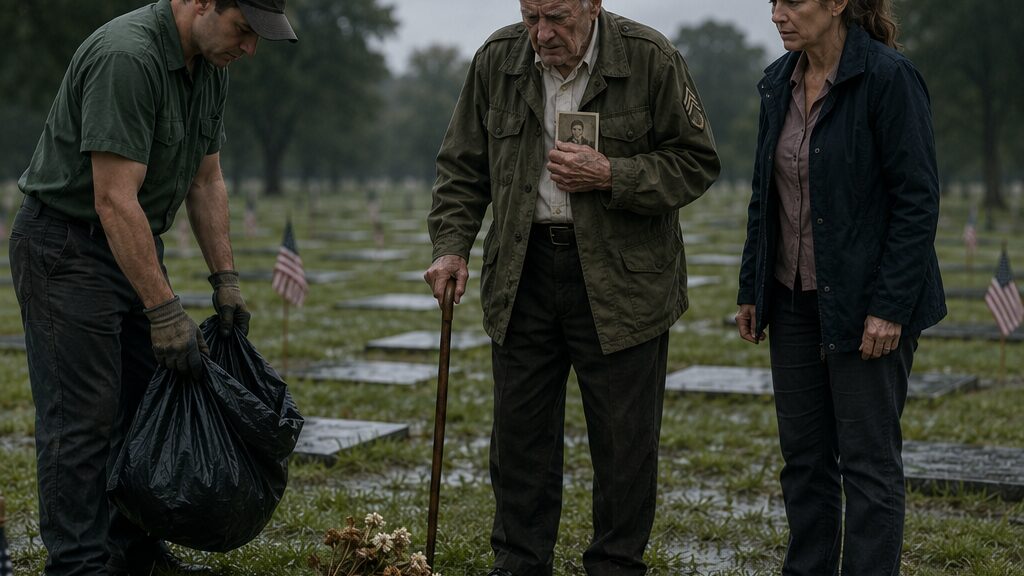
The cemetery worker had already lifted the dead flowers from the grave when Raymond Harris caught his wrist with two trembling fingers and said, “Those aren’t trash.”
The young man froze with the stems halfway over the mouth of a black garbage bag. His other hand tightened around a claw tool, the kind used to pull old flags and wilted arrangements from the wet ground. He looked at Raymond’s fingers first, then at Raymond’s face, as if deciding whether the old man understood what he was doing.
Raymond understood.
The flowers were brown at the edges. The white ribbon had been soaked by rain until the lettering bled into blue smears. Two of the carnations had bent at the neck. One had lost most of its petals in the grass. But the small card, tied with a curling strip of silver string, still faced upward against the flat military marker.
Daniel Williams.
The name was written in Raymond’s careful blue ink, each letter pressed deeper than it needed to be.
“Sir,” the worker said, keeping his voice low, “I’m just clearing old arrangements. They were from Memorial Day.”
Raymond’s cane stood planted beside the marker. His Army field jacket hung loose from his shoulders, faded almost gray at the seams, the cuffs polished thin from decades of use. He had dressed for the visit the same way he always did: dark trousers, polished shoes, white shirt buttoned to the throat though the collar had begun to gap around his neck. In his left hand he held a folded photograph, thumb pressed hard over the middle of it.
“They weren’t from Memorial Day,” Raymond said.
The worker glanced at the card. “They’re dead, sir.”
Raymond did not blink. “They’re his birthday flowers.”
Across the cemetery lane, Laura Thompson sat in the driver’s seat of her car with the engine running and one hand still on the gearshift. She had driven him because his doctor had taken his license after the second dizzy spell, and because no one else in the family had the patience to argue with Raymond Harris when he appeared at the front door wearing his field jacket in June.
She had watched him polish his shoes the night before at the kitchen table, moving the cloth in slow circles over leather older than she was. She had watched him take something from the top drawer of his dresser and slip it inside his jacket as if concealing a wound. She knew he came to this cemetery every June. She knew he returned quiet and exhausted. She knew he placed flowers somewhere among the military stones, though he had never invited anyone to walk beside him.
What she did not know was why he was gripping a stranger’s wrist beside a grave that was not family.
Laura shut off the engine.
“Grandpa?” she called, stepping out.
The worker straightened but did not pull away from Raymond’s hand. He looked young enough to be embarrassed by the whole situation, maybe thirty, maybe less. His name patch read Stephen Green. Sweat darkened the collar of his cemetery polo despite the cool morning.
“Ma’am,” Stephen said, relieved to see someone who might translate the old man into common sense. “We’re doing cleanup before the inspection. Anything over two weeks old has to be removed. I was trying to explain.”
“He heard you,” Raymond said.
Laura stopped a few feet from the grave. “Grandpa, it’s all right. We can bring fresh ones.”
Raymond turned his head just enough for her to see the side of his face. His jaw worked once. He had shaved badly that morning; a strip of white stubble ran along his chin where his hand must have missed.
“Fresh ones won’t know his birthday,” he said.
The sentence settled between the three of them in a way Laura did not know how to answer.
Stephen lowered the flowers, still holding them awkwardly above the grave. “I didn’t see the card.”
“You didn’t look,” Raymond said.
There was no anger in it. That made it worse.
Stephen’s face flushed. He looked down, and only then did Laura follow his gaze. The marker lay flat in the grass, simple and clean except for damp leaves gathered in the carved letters. Daniel Williams. PFC. U.S. Army. The dates were far apart enough to tell a whole life had not happened. Nineteen years old, if Laura was doing the math right.
She had passed stones like this before. Rows of names. Rows of flags in May. Rows of men who belonged to the country more than they belonged to anyone still standing there. But Raymond was looking at this one as if the earth might hear whether he was careful.
“Sir,” Stephen said, softer now, “I’m sorry. We’re supposed to clear anything that’s dead so the section stays respectful.”
Raymond finally released his wrist.
The worker offered the flowers back, not quite meeting his eyes. Raymond took them with both hands. His fingers trembled, but he moved slowly, deliberately. He lowered himself enough to set the stems against the stone, adjusting them so the card rested where rain could not hide the name. Then he brushed grass from the carved letters with the side of his thumb.
Laura had never seen him touch anything that gently.
At home he kept drawers shut, conversations short, and his pain folded so tightly inside him that most people mistook it for temper. He did not tell stories unless asked twice, and even then he gave only the part necessary. He had been a stern father to her mother, a quiet grandfather to Laura, and a man who somehow filled a room with things he did not say.
Now his shoulders had dropped, and for one startling second he looked less like her grandfather than a boy who had arrived too late.
Stephen shifted the garbage bag behind his leg. “I can leave them,” he said. “I’ll make a note.”
Raymond nodded once.
Laura came closer. “Grandpa, who is Daniel Williams?”
His thumb tightened over the folded photograph.
The movement was small, but Laura saw it. She saw the white edge of an old picture, softened by handling, tucked against his palm. On the visible half, a young soldier stood in front of a bus station sign, his uniform too big in the shoulders and his grin uncertain under the stiff brim of his cap. Raymond. It had to be Raymond, though the face was almost impossible to connect to the old man beside her.
The other half of the photograph was covered by Raymond’s thumb.
“Grandpa,” she said again, quieter.
Raymond did not answer at first. He bent toward the marker, slowly, with his cane taking half his weight and pride taking the rest. Laura moved to help him, but he lifted two fingers from the cane in warning. Not yet.
He straightened after touching the edge of the card.
“Daniel,” he said, like the name had to be placed in the air before any explanation could stand beside it.
Stephen took one step back, but he did not leave.
Laura felt a strange irritation rise in her, then shame for feeling it. They had a prescription to pick up. Raymond had not eaten enough breakfast. His hip had been worse all week. She had taken time from work, promised Jacob she would be home by lunch, and told herself this cemetery stop would be quick.
But Raymond’s eyes were fixed on the marker as if time did not get to make demands here.
“Was he in your unit?” she asked.
Raymond’s mouth tightened.
The cemetery was quiet except for the distant growl of a mower. Flags from Memorial Day still stood on some graves, newer ones bright against wet grass. Stephen had left a small trail of discarded flowers in his cart, plastic bouquets faded from sun, wreaths collapsed inward, ribbons printed with names that had begun to peel.
Raymond looked at the cart once. His face did not change, but Laura understood he was imagining Daniel’s flowers among them.
“Two houses down,” he said.
Laura waited.
“He lived two houses down,” Raymond added. “Before the Army.”
Stephen murmured, “I’ll go work the other row,” and backed away. He dragged his cart carefully now, making less noise than before.
Laura and Raymond remained by the marker.
“Grandpa,” she said, “why didn’t you ever tell us?”
He gave a dry little breath that was not a laugh. “People ask that when they’re ready to hear it. Not when you’re ready to say it.”
Laura folded her arms, then unfolded them. She did not know whether to apologize or press him. With Raymond, both could become mistakes.
He turned the photograph slightly, and for a second she saw the other boy. Dark hair under the cap. Crooked grin. One arm flung around young Raymond as if the world was something they planned to face together and return from together.
Then Raymond folded the photo back into his palm.
The grave looked empty except for the dead birthday flowers and the small flag Raymond must have put there himself. No stone pebbles from visitors. No fresh bouquets. No family marker beside it. Just Daniel Williams in carved letters, kept company by an old man in a faded jacket and a card written in blue ink.
Laura’s voice came out more carefully than before. “Does anyone else come?”
Raymond looked across the rows. “Not anymore.”
“Family?”
“Gone.”
“Friends?”
His eyes returned to the name. “Most men who knew him are under their own stones now.”
That should have been the end of it. A sad thing, yes, but an old sad thing. The kind people carried because time had no place to put it down. Laura had heard fragments of Raymond’s service all her life: a base overseas, bad food, cold mornings, letters from home, one injury he would not discuss. Never this. Never Daniel.
She looked at her grandfather’s hand. The photograph trembled against his knuckles.
“Was he your best friend?” she asked.
Raymond did not answer right away. When he did, the words were plain and almost too steady.
“He was the boy I promised I’d bring home.”
Laura looked from him to the stone, and suddenly the grave did not seem empty at all.
Chapter 2: The Boy In The Folded Photograph
“Why didn’t you ever tell anyone about him?” Laura asked before Raymond had lowered himself fully onto the cemetery bench.
The question came out sharper than she meant it to. He had taken three slow steps from Daniel’s grave to the old stone bench under the maple tree, and each one seemed to cost him. His right hand clamped around the cane. His left stayed closed over the photograph. Halfway there, his breath caught once, quick and quiet, but when Laura reached for his elbow, he looked at her with the old warning in his eyes.
So she waited until he sat.
Then the question escaped.
Raymond rested the cane between his knees. “You ask like I hid a receipt.”
“I’m asking like I just watched you fight a cemetery worker over dead flowers for a man whose name I’ve never heard.”
His eyes moved toward the grave. From the bench, Daniel’s marker was partly hidden behind a row of low flags. Raymond had chosen this spot on purpose, Laura realized. Close enough to watch. Far enough that no one standing near the grave could hear him breathe.
“He liked birthdays,” Raymond said.
Laura stared at him. “Daniel?”
Raymond nodded.
“That’s what you want to tell me?”
“That’s what came first.”
He opened the photograph and flattened it with two fingers on his knee. The paper had been folded down the middle so long that the crease cut between the two boys like a crack in glass. Laura leaned closer.
Young Raymond stood stiffly on the left, chin raised too high, cap crooked, hands balled at his sides. Daniel stood on the right with a grin that made the whole picture feel warmer. His arm hooked around Raymond’s shoulders. Behind them was a bus station, a blurred sign, and a woman’s gloved hand caught at the edge of the frame, as if someone had been reaching in when the shutter clicked.
“We were eighteen here,” Raymond said. “He turned nineteen three weeks later.”
“June fourteenth,” Laura said, glancing back toward the grave.
Raymond’s fingers stopped on the edge of the picture.
“You read the card.”
“I saw the date.”
He nodded, but it was the kind of nod a man gave when a door had opened behind him.
“Daniel Williams lived two houses down from us,” he said. “His mother made biscuits that could crack a tooth if she was distracted, and his father kept a radio on the back porch that only worked when Daniel hit it in the right spot. He could make anything with wires talk again.”
Laura sat slowly beside him.
“He fixed radios?”
“Radios. Toasters. His mother’s sewing machine. Once the church microphone died during a Christmas program, and Daniel crawled under the pulpit in his good pants while the choir kept singing. Came out with dust in his hair and everyone hearing the preacher twice as loud as they wanted.”
Laura almost smiled. Raymond did not.
“He sounds funny.”
“He was,” Raymond said. “Except when water was involved.”
The word changed his face so quickly Laura felt it.
“Water?”
Raymond folded the photograph halfway, then forced it open again. “He couldn’t swim. Not properly. We grew up near a creek, and boys were cruel about things like that. He’d wade in up to his knees and pretend he didn’t care to go deeper.”
“Then why enlist?”
“Because I did.”
The answer landed harder than Laura expected.
Raymond looked at the maple roots pushing through the grass. “I got my papers first. He came over that evening and sat on our porch steps without knocking. I thought he was going to talk me out of it. Instead he said, ‘Well, I’m not letting you go over there alone and get yourself killed by stupidity.’”
Laura’s throat tightened in spite of herself. “And you went together.”
“Same bus,” Raymond said. He tapped the photograph once. “This was that morning.”
The woman’s gloved hand at the edge of the photo seemed suddenly important.
“Who took it?”
“Virginia Martin. Daniel’s girl.”
“His girlfriend?”
“Fiancée, near enough. No ring yet. He had twenty-two dollars saved and a plan bigger than that. She wore white gloves to church even in July, and Daniel acted like that made her royalty.” The faintest crease touched the corner of his mouth, not quite a smile. “He said he would marry her when he came back. She told him he’d better learn to stand still first.”
Laura watched his face while he spoke. This was not the distant, closed Raymond she knew from holiday dinners and doctor appointments. His voice was still controlled, but each detail seemed to come from a room he had kept locked and dusted at the same time.
“What happened to her?” Laura asked.
“She married years later.”
“Did that bother you?”
Raymond turned the photograph facedown.
“No one was wrong to live.”
The sentence had edges.
Laura did not push it. A grounds cart passed on the lane below them, Stephen at the wheel now, his cap pulled low. He looked once toward the bench and then away quickly. In the cart’s back were bags of dead arrangements. Laura wondered how many names had been carried away without anyone stopping a wrist.
“Did Daniel’s family know you came?” she asked.
“For a while.”
“For a while?”
Raymond rubbed a thumb along the cane handle. The wood had a worn hollow where his hand belonged.
“His mother wrote me every Christmas until her hands got too bad. His father didn’t write, but he signed. After she passed, letters came from his sister for a few years. Then a change of address got missed. Then another. People move. People die. People forget to tell old men things.”
“Did you try to find them?”
His eyes sharpened, not at her, but inward. “I was not always as old as I look. Yes, I tried.”
Laura accepted the rebuke. “I’m sorry.”
He gave no sign he heard.
“What did you write back?” she asked.
“To his mother?”
“Yes.”
“What she needed.”
“That he was brave?”
Raymond’s jaw tightened.
Laura had stepped wrong. She knew it immediately.
“He was brave,” Raymond said. “That wasn’t all she needed.”
“What else?”
He looked toward Daniel’s grave. “That he was not alone.”
The air beneath the maple felt colder.
Laura’s hands rested in her lap. She noticed they were clenched and made herself open them. “Was that true?”
Raymond did not answer.
The silence stretched long enough that she heard a bird tapping somewhere high in the branches. Beyond the lane, Stephen had stopped beside another row of markers. He crouched, read a card before touching the flowers, and placed one arrangement back.
Laura saw it. Raymond did too.
“That worker didn’t mean harm,” she said.
“Most forgetting doesn’t.”
It was a simple sentence, but it made Laura look again at the grave, the row, the cart, the flags already leaning in the damp ground. Forgetting did not always arrive as cruelty. Sometimes it came with a schedule, a clipboard, a family obligation, a nurse’s reminder, a granddaughter with the engine running.
She looked down at the photograph. “Can I hold it?”
Raymond’s fingers tightened at once.
“Just for a second,” she said.
He hesitated so long she thought he would refuse. Then he handed it to her.
The photograph was soft, almost clothlike, from years of handling. Laura held it by the edges. Young Daniel’s grin seemed aimed directly at whoever held the camera. Young Raymond looked as if he had not yet learned how much a man could carry without bending.
On the back, in faded pencil, someone had written: Bus station. Ray and Danny. Don’t let them look so serious.
“Virginia wrote this?” Laura asked.
Raymond nodded.
“You kept it all this time.”
He reached for the photograph. “A picture doesn’t ask you to explain.”
She gave it back, but not before she saw how his thumb covered Daniel’s face again.
They rose slowly. Raymond insisted on walking back past Daniel’s grave before going to the car. He paused there only long enough to make sure the birthday card had not fallen. Laura wanted to say something, but she had no words that did not feel borrowed.
At the car, Raymond lowered himself into the passenger seat with difficulty. His hip had stiffened badly. His breath came in short, controlled pulls, and his hand shook when he tried to fasten the seat belt.
Laura reached over to help. This time he let her.
“You’re hurting,” she said.
“I’m old.”
“That isn’t an answer.”
“It’s the one I have.”
She started the car but did not pull away. Daniel’s grave remained visible between two trees. The dead flowers looked smaller from here, but the card still showed a corner of white.
“Grandpa,” Laura said, “you said he was the boy you promised to bring home.”
Raymond looked out the window.
“How did he die?”
His face went still. It was not the stillness of someone who had not heard. It was the stillness of a door being held shut from the other side.
“Not today,” he said.
Laura kept both hands on the steering wheel. “I’m not trying to hurt you.”
“I know.”
“Then why not tell me?”
He unfolded the photograph one last time and looked at it without hiding Daniel’s face. For a moment, Laura thought he might answer.
Instead, he turned the picture facedown against his knee.
“Not today,” Raymond said. “Not the part with the water.”
Chapter 3: The Cards Hidden Behind The Insurance Papers
Laura opened the wrong shoebox and found Daniel Williams’s name written sixty-one times.
She had come to Raymond’s house three days after the cemetery visit with a folder, a grocery bag, and a promise to herself that she would not argue with him unless absolutely necessary. His doctor’s office needed insurance updates. The pharmacy had changed one of his prescriptions. A bill from the hospital had arrived with a number in red at the top, and Raymond had left it folded under the sugar bowl as if paper could be trained to disappear by neglect.
He was in the living room, asleep or pretending to be, with the television murmuring low. Laura had asked where he kept the older insurance cards.
“Hall closet,” he said without opening his eyes. “Top shelf. Blue box.”
There were three blue boxes.
The first held appliance manuals for machines Raymond no longer owned. The second held Christmas cards bundled by year, most still in their envelopes. The third was a shoebox with a cracked lid and a rubber band around it so old it broke the moment Laura touched it.
Inside were cards.
Not greeting cards from other people. Birthday cards. Plain ones mostly. Drugstore cards with faded balloons. Blank notecards with a blue border. A few military exchange cards with eagles embossed on the front. Some handmade from folded stationery when, Laura guessed, Raymond had not gone to a store.
Every envelope had the same name.
Daniel Williams.
The first few were addressed in firm block letters. Later ones leaned slightly to the right. The newest envelope, on top, showed the tremor she knew from Raymond’s hand now, the letters pressed unevenly into the paper.
Laura stood in the hallway closet with dust on her sleeve and felt as if she had walked into a room where someone had been speaking for decades after everyone else left.
“Grandpa?” she called.
No answer.
She carried the shoebox to the kitchen table because her knees had begun to feel unreliable. The insurance papers lay forgotten beside her folder. She lifted the top card.
June 14.
No year on the outside. She opened it carefully.
Danny,
They cleaned the section early this year. I told them not to touch yours until after I left. I brought white carnations because the red ones looked too much like Decoration Day and this is not that. This is yours.
My hand is worse. Don’t make fun.
Ray
Laura put the card down slowly.
Her throat tightened at the casualness of it. Don’t make fun. As if Daniel might answer. As if the joke had been running between them all this time and Raymond had refused to stop his side of it.
She checked the next one.
Danny,
You would have turned eighty this morning. I tried to imagine that and failed. In my head you are still nineteen and smirking because I got old for both of us.
The old woman at the flower shop asked if they were for my wife. I said no. She asked if they were for my brother. I said close enough.
Ray
Laura pressed her fingers to her mouth.
She should stop. She knew that. This was not hers. Raymond had not given her permission to open his grief and spread it across the kitchen table. But the sealed silence of the cemetery had followed her for three days. It had sat in her car, stood beside her at the pharmacy, watched her make Jacob’s lunch. Daniel’s name had become a closed door in her mind, and now she was standing in front of it with the handle in her hand.
She lifted a stack and saw the oldest cards at the bottom.
The first was dated June 14, 1965.
The envelope had yellowed almost brown at the edges. Raymond’s handwriting was young, dark, certain.
Danny,
I got home today. Your mother hugged me so hard I couldn’t breathe and then looked behind me like maybe you were late getting off the bus.
I told her what they told me to tell her. I told her you were not alone.
I don’t know what to do with your place beside me.
Ray
Laura read the last line twice.
The kitchen seemed too ordinary for what she was holding. Sink with one cup in it. Calendar from the pharmacy. Raymond’s pill sorter on the counter, Wednesday morning still full because he had insisted he already took them. A plastic bag of groceries with bananas going soft. And between all that ordinary evidence of a life still being managed, there were sixty-one years of a boy who had not come home.
She set the oldest card beside the newest. The handwriting changed. The name did not.
Beneath the cards lay a yellow envelope sealed shut.
It was heavier than she expected. On the front, in Raymond’s careful print, were the words:
For when I can’t come anymore.
Laura touched the seal but did not open it.
That was when the television stopped.
She turned.
Raymond stood in the kitchen doorway in his socks, one hand on the frame, the other closed around the handle of his cane. She had not heard him rise. His face was pale, and the look in his eyes was not anger at first. It was exposure. Like she had caught him undressed in a place he could not cover.
“I was looking for the insurance papers,” Laura said.
He looked at the table.
“I’m sorry,” she added quickly. “I opened the wrong box.”
Raymond came forward slowly. Each step was measured, but not because of his hip. Because he was holding himself together.
“You read them.”
“Only a few.”
“That means yes.”
Laura pushed back from the table. “Grandpa, I didn’t know—”
“No,” he said. “You didn’t.”
The words cut because they were true and because he had made sure of it.
He reached for the oldest card first, then stopped before touching it. His hand hovered above the paper. Laura saw the tremor spread from his fingers into his wrist.
“I should have asked,” she said.
He lowered himself into the chair opposite her. The movement took time. Neither of them spoke until he was seated. The yellow envelope lay between them like a third person.
“How many are there?” Laura asked, though she already had counted the years in her head.
“Sixty-one.”
“Every birthday?”
“Yes.”
“You never mailed them.”
His eyes flicked up. “Where would I mail them?”
She looked away.
It was the wrong question, and he had let her hear it.
“I mean—” she began.
“I know what you meant.”
Raymond gathered the cards into a stack, but he did not put them back in the shoebox. He squared their edges carefully. The act was so practiced that Laura realized he had done it many times, probably every year, maybe every time he wondered whether he was still capable of going to the cemetery.
“Why birthday cards?” she asked.
“Because everyone remembers the day a soldier dies if there’s a ceremony. For a while.” He pressed the stack flat with his palm. “Fewer remember he had a birthday.”
Laura looked at the envelope. “What is that?”
Raymond’s hand moved to cover it.
“For later.”
“For when you can’t come anymore.”
His eyes closed briefly.
“Grandpa, that could be soon.”
He opened them.
She regretted it immediately, but the words were out. His last doctor’s visit had not gone well. The dizziness, the hip, the blood pressure, the quiet recommendation that he consider more help at home. Raymond had listened as if the doctor were discussing someone else’s roof.
“I’m not trying to be cruel,” Laura said. “But you can’t drive. Walking from the car to the grave hurt you. If Stephen hadn’t been there, if I hadn’t—”
“If you hadn’t what?”
She stopped.
If she had not been there, Raymond would still have gone. Somehow. Cab, neighbor, stubbornness, fall risk, pride. The realization frightened her.
“You should have told me,” she said.
Raymond’s expression hardened, but underneath it she saw something more fragile. “And what would you have done with it?”
“With Daniel?”
“With all this.”
Laura looked at the cards. “I don’t know. Remembered him, maybe.”
“You didn’t know him.”
“Neither does anyone now.”
The words struck the table and stayed there.
Raymond looked at her for a long moment. She expected him to snap, to close the box, to order her out of the room in the clipped voice that had ended family arguments for years.
Instead, his shoulders dropped.
“That was the trouble,” he said.
Laura waited.
He touched the yellow envelope again, not possessively this time, but as if testing whether it was still real.
“I wrote it three years ago,” he said. “After I fell in the driveway and couldn’t get up before the mailman came. I lay there thinking, stupid thing to think, but I did. I thought, ‘If this is it, nobody knows to go in June.’”
Laura’s eyes burned.
“That’s why you wrote the envelope?”
“It tells where he is. What day. What flowers he liked. Where the picture is. Some of it.”
“Some?”
Raymond looked toward the hallway, toward the closet, toward all the rooms where he had hidden a man’s name in paper because saying it aloud had cost too much.
“I wasn’t brave enough to give it to anybody,” he said.
Chapter 4: The Argument Over An Empty Name
“Grandpa, I need to know what matters before somebody else throws it away,” Laura said, and Raymond’s hand closed over the yellow envelope so hard the paper buckled.
He had not put the cards back in the shoebox. They sat stacked between his pill sorter and the hospital bill, Daniel’s name hidden now but somehow louder for being covered. Laura stood at the sink with the blue insurance box open beside her folder, trying to make her voice practical and failing.
Raymond looked up at her. His eyes were pale and sharp.
“You’re already holding him like clutter,” he said.
The words struck harder than if he had raised his voice.
Laura stared at him, one hand still on the folder. “That isn’t fair.”
“No?”
“No. I’m trying to help you. I’m trying to keep things from getting lost.”
“You found them by accident.”
“And if I hadn’t?” The question came out before she could soften it. “If I hadn’t opened that box, what then? You fall again? You end up in the hospital? Someone comes in here to clean and sees a shoebox full of old cards to a dead man nobody knows?”
Raymond pushed his chair back an inch. The legs scraped against the linoleum.
“Don’t say it that way.”
“What way?”
“Like he’s paperwork.”
Laura took a breath through her nose. She had promised herself she would not argue. She had promised because she knew Raymond could turn silence into a wall, and because part of her still felt ashamed for reading the cards. But the envelope was there. The pills were there. The doctor’s note sat in her purse, folded around words Raymond would hate: increased supervision, fall risk, consider assisted living options.
She pointed at the yellow envelope. “You wrote instructions because you knew somebody would have to know.”
“That doesn’t mean I asked you to open my closet and put him under a lamp.”
“I didn’t open the envelope.”
“You wanted to.”
“Yes,” she said. “I did.”
His jaw worked once.
Laura expected anger. Instead, he looked tired in a way she had not seen before. Not sleepy. Nearly used up.
The kitchen was small, and everything in it seemed to have been kept because Raymond had outlasted the habit of replacing things. The chipped mug by the coffee pot. The calendar with a hardware store logo from three years ago because the dates still worked if he crossed them out. The chair with tape around one leg. He had made a life out of keeping things going beyond their expected use.
Maybe Daniel was part of that too.
Raymond turned the envelope slightly with two fingers. On its face, his print looked formal, almost official.
For when I can’t come anymore.
“You have other instructions,” Laura said quietly.
He did not answer.
“I saw the paper under the cards. The cemetery location. The flower shop number. June fourteenth circled. You wrote that Daniel’s grave should have flowers even if you were—”
“Don’t.”
“Even if you were in assisted living.”
His eyes lifted.
The phrase hung in the kitchen like an accusation neither of them had meant to make.
“I am not going there,” he said.
“I didn’t say you were.”
“You thought it.”
“I think a lot of things I don’t want to think.”
Raymond looked away first.
The admission changed something. Not enough to soften him fully, but enough that his hand loosened on the envelope.
Laura came back to the table and sat across from him. The cards made a small wall between them. She reached toward the stack, then stopped before touching it.
“I’m scared,” she said.
Raymond’s mouth tightened with discomfort, as if fear were an untidy thing to bring into a kitchen.
“I am,” she continued. “I’m scared I’m going to get a call one morning and have to make decisions about your house, your bills, your medicine, your funeral, and I’ll be standing in the middle of all of it realizing there were whole parts of you I never knew because you wouldn’t let me.”
He looked at her then.
Laura swallowed. “And now there’s Daniel. A man you’ve visited longer than I’ve been alive. A man you wrote to every year. And I didn’t know his name until a cemetery worker tried to throw his flowers away.”
Raymond flinched at that, just barely.
“That isn’t only on me,” she said.
His face closed.
Laura thought she had lost him. Then he touched the top card, not picking it up, only resting his fingertips on the corner.
“No,” he said. “It isn’t.”
The words were so low she almost missed them.
Outside, a delivery truck passed the house, rattling the front windows. Raymond waited until the sound faded. His breathing had grown rougher, but he would not admit pain, so Laura did not ask.
“My father didn’t talk about his war,” he said suddenly.
Laura stilled.
“He came home and put every bit of it in a drawer nobody opened. I used to hate him for it. Then I learned the trick.”
“What trick?”
“You keep quiet long enough and people stop asking. After a while, you can pretend that’s mercy.”
Laura’s eyes dropped to the shoebox.
“Was it mercy?” she asked.
Raymond’s hand moved from the card to the envelope. “No.”
The answer was plain. It did not forgive anything. It only opened the next door.
Laura reached for the oldest card from the stack. “May I read one?”
“No.”
She withdrew her hand.
Raymond looked at the card as if the refusal had surprised him too. He closed his eyes briefly, then opened them.
“Not that one.”
“Which one?”
He sifted through the stack slowly. The cards made a dry whisper against each other. His hands knew the order without needing dates. Near the bottom, he pulled out the earliest envelope, yellowed and soft at the corners.
Laura recognized it from the hallway closet.
Raymond did not hand it to her at first. He looked at Daniel’s name on the front.
“I wrote this before I knew I was going to keep writing,” he said.
Laura’s voice softened. “What did you think it was?”
“A place to put the noise.”
He slid it across the table.
Laura took it carefully. The envelope had already been opened years ago, the flap tucked in. She removed the card. It was plain white, no picture, no printed greeting. Just Raymond’s handwriting covering the inside, younger and firmer than the man across from her.
She looked up. “Are you sure?”
“No.”
That was the closest he could come.
Laura read silently at first. The first line made her chest tighten.
Danny,
I got home today.
She stopped.
“Out loud,” Raymond said.
She looked at him.
“If you’re going to know,” he said, “then say his name.”
Laura nodded and started again, her voice unsteady.
“Danny, I got home today. Your mother hugged me so hard I couldn’t breathe and then looked behind me like maybe you were late getting off the bus.”
Raymond’s eyes fixed on the table.
“I told her what they told me to tell her. I told her you were not alone.”
Laura’s voice caught on the next sentence. She pressed her thumb against the edge of the card, steadying herself.
“I don’t know what to do with your place beside me.”
The kitchen held still.
Raymond did not cry. His face did not break. But his right hand, the one not holding the envelope, moved an inch across the table as if reaching for something that was no longer there.
Laura lowered the card.
“That was the day you came home?”
“Yes.”
“From overseas?”
“Yes.”
“And Daniel didn’t.”
“No.”
She wanted to ask the next question and feared the answer. Raymond seemed to know. He reached for the card, but then stopped.
“Read the last line,” he said.
Laura looked down. She had missed it, written smaller near the bottom, almost as if Raymond had added it after signing.
“I sat by the window until dark because I kept thinking I heard your boots on the steps.”
Raymond closed his eyes.
Laura put the card down between them. Not on top of the stack. Between them.
For the first time, Daniel did not seem hidden in Raymond’s house. He seemed present, not as a ghost, not as a dramatic thing, but as an empty chair pulled close to the kitchen table.
Laura touched the yellow envelope. Raymond did not stop her this time, but he did not let go either.
“What did you survive?” she asked.
His fingers pressed the envelope flat.
Raymond opened his eyes and looked at her with a grief so controlled it frightened her more than tears would have.
“A night I should have been sitting beside him,” he said.
Chapter 5: The Night The Truck Went Under
Thunder cracked over the house, and Raymond said, “It sounded like that when the canvas went under.”
Laura had been reaching to turn on the lamp. Her hand froze at the switch. The living room had gone dim with the storm, the windows silvered by rain, the afternoon pulled suddenly toward evening. Raymond sat in his old chair with the stack of cards on the side table and the folded photograph resting facedown on his knee.
He had not spoken for nearly twenty minutes after the kitchen. Laura had thought the day was over. She had put the insurance papers away, checked his pills, and started coffee neither of them wanted. Then the first hard roll of thunder shook the glass, and Raymond’s voice came from the chair like something dragged up from deep water.
She turned slowly. “The canvas?”
He lifted the photograph but did not look at it.
“Truck canvas,” he said. “Back was covered. Rain made it heavy. Men think canvas is nothing until it’s wet and dark and your hands won’t find the edge.”
Laura sat on the couch across from him. She made herself stay quiet.
Raymond noticed. His mouth moved in something like approval, but without warmth. “You want the part with the water.”
“I want what you can tell me.”
“That’s not the same.”
“No,” she said. “It isn’t.”
Rain struck the windows harder. In the kitchen, the old refrigerator clicked on and hummed. Raymond turned the photograph over and smoothed the crease with his thumb. Daniel’s grin reappeared in the fading light.
“We were overseas,” he said. “Not a famous place. Not one people write books about. Training roads. Bad drainage. Too many boys in one truck and a driver who couldn’t see past the rain. That’s all it was.”
Laura did not believe that was all it was, but she let him continue.
“We’d been out all day. Daniel had been working on a field radio that kept cutting in and out. He said if the Army wanted men to hear orders, maybe it ought to stop buying equipment held together by prayer and wire. Somebody told him to shut up. He didn’t.”
A faint memory of humor passed through Raymond’s face and disappeared.
“He sat near the back. I was supposed to be beside him.”
“Supposed to be?”
Raymond’s thumb stopped on the photograph.
“I traded places.”
Laura’s chest tightened.
“Why?”
“Because I was mad at him.”
The answer came so plainly that Laura almost missed the weight inside it.
“At Daniel?”
Raymond nodded once. “He had a letter from Virginia. Sprayed perfume on it. Not much. Just enough that every man in the truck gave him grief. He read it three times and wouldn’t tell me what she said. I told him he was getting soft. He said at least somebody was writing him who could spell.”
Laura could almost see the two boys, wet and tired, needling each other because affection at nineteen had to wear a harder face.
“What did you do?”
“I took my pack and sat closer to the front. Stupid little thing. Pride. Nothing.” His eyes remained on the photograph. “Then the truck went over.”
The rain filled the pause.
Raymond’s voice changed. It did not grow dramatic. If anything, it became flatter, more careful, like he was reading from a report he had written in his bones.
“Front wheels slid first. Driver corrected too hard. Road edge gave. The truck tipped, not all the way at once. Men started cussing, grabbing. Then the whole thing rolled down into a drainage ditch. Water came in through the back before anybody understood we were in water.”
Laura’s fingers dug into the couch cushion.
“You don’t know dark until canvas drops over men and the water is climbing,” Raymond said. “There was shouting. Boots. Elbows. Somebody’s helmet hit my mouth. I tasted blood. The side flap was pinned under mud. The tailgate jammed. Men were pushing the wrong way because nobody knew which way up was.”
He stopped.
Laura wanted to say his name, but the room felt balanced on the thin line of his voice.
“Daniel was afraid of water,” Raymond said.
“You told me.”
“No. I told you he wouldn’t swim. That isn’t the same as knowing what fear does to a body.”
He swallowed. His hand shook against the photograph.
“He was in the back where the water came first. I heard him. Not screaming. Daniel didn’t scream. He said, ‘Ray.’ Just once. Like he was asking where I’d gone.”
Laura closed her eyes for a second, then opened them because he was still sitting there, still holding the picture, still having to say it.
“I tried to get back,” Raymond said. “Men between us. Packs tangled. Rifle straps. Someone kicked me in the shoulder. I found a tear in the canvas near the side where a metal bracket had ripped it open. Small. Not enough.”
“But you got out.”
His expression hardened, not against her, but against the word.
“Daniel shoved me.”
Laura went still.
Raymond looked up. “He had both hands on my pack. I thought he was pulling himself up. I grabbed for him. His fingers slipped on my sleeve. Then he pushed. Hard. Pushed me toward the tear like he was throwing a sack of grain.”
The storm pressed against the windows.
“I got one arm through,” Raymond said. “Then my head. Water was in my mouth. Someone outside grabbed my collar and dragged. I still had hold of him. I know I did.”
His right hand closed around empty air.
“I know I had him.”
Laura’s throat burned.
“What happened?”
Raymond’s eyes stayed dry. “Canvas shifted. Or somebody pulled me too hard. Or Daniel let go. I don’t know. That’s the part men hate. You think the truth will have a clean edge because pain deserves one. It doesn’t. One second I had his sleeve. Next I had mud.”
He turned the photograph facedown again.
Laura realized she had stopped breathing normally. She let air out slowly.
“How many died?” she asked.
“Three that night. One later. Daniel was the youngest.”
“And they called it a training accident.”
“That’s what it was.”
“But that doesn’t make it smaller.”
Raymond looked at her then. Something in his face shifted, not softening exactly, but allowing the words to land.
“No,” he said. “It didn’t.”
Another roll of thunder moved farther away. The rain remained. Laura stood, but only to bring the lamp closer and turn it on. Warm light filled the space between them. She did not touch him. She had learned enough by now not to grab for grief just because it was visible.
“What did you tell his parents?” she asked.
Raymond reached toward the side table and took the oldest card. He did not open it.
“What I was told to tell them. That he served honorably. That the accident was quick. That he was not alone. His mother needed the last one.”
“Was he?”
Raymond’s face changed.
“What?”
“Was he alone?”
His mouth tightened so hard a muscle jumped in his jaw. For a moment she thought he would retreat into silence. Then he reached into his shirt pocket and removed the yellow envelope. He must have carried it from the kitchen without her noticing.
“I was alive,” he said. “That is not the same thing as being with him.”
Laura let the sentence stand.
Raymond laid the envelope on the arm of the chair. His fingers rested over the writing.
“When we came home, Daniel’s mother stood at the bus station,” he said. “Same place as the photograph. Same steps. She wore a blue coat though it was warm. His father stood behind her with his hat in both hands. They knew before I stepped down. I could see it. Mothers know the shape of a missing body before anyone says the words.”
Laura’s eyes filled. She wiped them quickly, almost angrily.
“Virginia was there too?”
Raymond nodded. “White gloves.”
“What did you give them?”
“Folded flag. His personal effects. A watch with water under the glass. A small Bible. A comb. Two letters. Not the last one.”
Laura looked at the envelope.
“Virginia’s?”
His hand covered it.
“Not yet.”
“Grandpa—”
“Not yet.”
The old sharpness returned, but it was not only pride. It was fear. He had told her more than he had planned. She could see it in the way he held his shoulders, as if waiting for the room to punish him for opening.
“Why did you keep going to the grave?” she asked instead.
“Because his mother asked me whether he suffered.”
Laura wished suddenly that she had not asked anything.
Raymond’s gaze moved past her, toward some bus station platform only he could see.
“I lied,” he said.
“You were trying to spare her.”
“I lied,” he repeated. “Then she took my hands and said, ‘Raymond, promise me someone will come on his birthday. Not just Memorial Day. His birthday. He was born before he ever wore a uniform.’”
The words seemed to hollow him out.
“So you promised.”
“Yes.”
“And after she died, you kept going.”
“Yes.”
Laura looked at the cards, the photograph, the envelope. Sixty-one years no longer seemed like stubbornness. It seemed like a man standing watch because he had once been dragged through a tear in wet canvas without the boy who pushed him there.
Raymond stared at his hand. “Daniel was afraid of water. He pushed me out anyway.”
Laura whispered, “That isn’t your fault.”
His eyes cut to hers, and for the first time all day, anger flashed.
“Don’t tidy it up for me.”
She fell silent.
The anger faded almost as quickly as it came, leaving him smaller in the chair.
“I promised his mother I would bring him home,” he said. “All I brought was a flag, a box, and a story with the worst part removed.”
Rain ticked against the glass.
Raymond picked up the yellow envelope and turned it over. The seal remained unbroken, old glue darkened at the flap.
“There’s one part I never told his mother,” he said.
Chapter 6: The Letter That Was Never Meant To Save Him
Raymond placed the yellow envelope on the kitchen table the next morning, then kept his palm flat over it as if the paper might leave without permission.
Laura stood across from him with two cups of coffee going cold between them. She had barely slept. Every time she closed her eyes, she saw dark canvas and Daniel’s hands pushing Raymond toward a tear in it. She had heard plenty of family stories in her life, the safe kind told around pie and birthdays. None had prepared her for a grief that had been sitting inside her grandfather’s house in a shoebox.
“Are we opening it?” she asked.
Raymond’s fingers spread over the envelope. The blue veins under his skin looked like fragile lines on an old map.
“I put things in here so somebody would know what to do,” he said. “Not so they could judge what I didn’t do.”
“I’m not here to judge you.”
“You say that before you know.”
Laura pulled out the chair but did not sit. “Then let me know.”
His eyes rose to hers.
The old Raymond might have ended the conversation there. He might have tucked the envelope back into the shoebox, asked for his pills, turned on the television, and made silence do the work of a lock. But the storm had changed something. Or the first card had. Or maybe the envelope had waited so long that even Raymond could no longer pretend later was a safe place.
He slid it toward her.
“No,” he said when she reached for it. “I’ll do it.”
His thumbnail worried the corner of the flap. The seal resisted, then gave with a dry tear that made Laura wince. Raymond paused at the sound. For a moment his face went far away, as if breaking old glue had disturbed more than paper.
Inside were three things.
A folded sheet in Raymond’s handwriting. A smaller envelope, Army issue, yellowed but unsealed. And a photograph Laura had never seen before: a young woman on church steps, wearing white gloves, her hair pinned back, her smile uncertain and bright at the same time.
Laura looked at the photograph. “Virginia?”
Raymond nodded.
“She’s beautiful.”
“Daniel thought so loudly it made him stupid.”
The line came with no smile, but Laura heard affection in it.
Raymond unfolded the smaller envelope. Inside was a single page, creased and stained faintly at one corner. The handwriting was not Raymond’s. It leaned fast and uneven, as if written wherever a flat surface could be found.
He held it but did not read.
“Daniel’s?” Laura asked.
“Yes.”
“To Virginia?”
“Yes.”
“Was this the one you didn’t give her?”
Raymond’s hand closed slightly around the page. “It wasn’t finished.”
Laura waited.
“He’d started it that afternoon. I found it in his kit after. There were other letters already sealed. Those went home. This one…” Raymond looked down. “This one was just a beginning.”
“Why keep it?”
“Because it said what I couldn’t bear to hand her.”
Laura sat slowly.
Raymond passed the page to her, then seemed immediately to regret it. She looked at him for permission. He gave one short nod.
Laura read.
Ginny,
Ray is being sour because you wrote me and not him. I told him that is what happens when a man makes himself unpleasant to women and dogs.
The line stopped there for a crossed-out word. Laura felt a brief, painful laugh rise and vanish.
Below it, Daniel had continued:
We had rain today. You would have laughed at all of us sliding around like fools. Don’t worry about the water here. I stay where I can see the road.
Another crossed-out line.
When I get home, I am going to fix your aunt’s porch radio, marry you before Ray says something insulting, and never sit in the back of any truck if I can help it.
The rest of the page was blank.
Laura lowered it.
“He wrote about the water,” she said.
Raymond’s eyes were on the table. “He was trying to make her not worry.”
“And you thought giving it to her would hurt her.”
“I thought it would tell her he was afraid.”
“That isn’t shameful.”
“At nineteen, everything is.”
Laura looked again at the unfinished note. Daniel’s humor sat beside fear so plainly that it made him feel alive in a way the marker had not. He was not brave because he had lacked fear. He was brave because the fear had been there, inked on paper, and still his hands had found Raymond’s pack in the dark.
Raymond unfolded his own sheet now. “I wrote this for whoever found the box.”
Laura recognized his older handwriting.
“What does it say?”
“Where the grave is. June fourteenth. White carnations if they can be found. Blue ink on the card. Not black.”
“Why blue?”
“Daniel hated black ink. Said it made every word look like bad news.”
Laura pressed her fingers to the table’s edge.
Raymond continued, “It says the photograph is in the dresser. Says the cards don’t need to be kept if there’s no room.”
Laura looked up sharply.
“You wrote that?”
His face tightened. “People don’t want boxes of old paper.”
“I do.”
He seemed to have no answer for that.
Later, while Raymond slept in his chair with the opened envelope on the side table beside him, Laura took the photograph of Virginia to the kitchen and used her phone to search old records. She told herself she was only trying to understand what Raymond had kept, but the deeper truth was less tidy. Daniel’s memory had entered her hands now, and she did not know where its edges were.
Virginia Martin.
The name appeared in an old church anniversary booklet, scanned poorly and posted by a historical society. Laura enlarged the page until the words blurred, then sharpened. There she was in a group photograph from decades earlier, older, still poised, gloved hands folded in front of her. Virginia Martin, later Virginia Campbell, longtime choir volunteer.
Laura found an obituary next. Virginia had died seven years ago.
Seven.
Not fifty. Not sixty. Seven.
Laura stared at the screen.
Raymond had lived in the same county all that time, believing Daniel’s girl had moved on into a life where his name no longer belonged. But the obituary said Virginia had served for years on a committee preserving church archives. It said she was preceded in death by her husband, survived by nieces and nephews, including Ashley Martinez. It said, in a small line near the bottom, that she loved old hymns, handwritten letters, and “the brave young people of a country that often forgets how young they were.”
Laura read that sentence three times.
She carried the phone back to the living room.
Raymond opened his eyes before she spoke. “You found something.”
“I found Virginia.”
His face went still.
“She died seven years ago,” Laura said gently. “She stayed nearby most of her life.”
Raymond looked at the photograph on the side table. “I knew she married.”
“Yes. But maybe that doesn’t mean she forgot.”
“She had a right to live.”
“I’m not saying she didn’t.”
“Then what are you saying?”
Laura held out the phone. “Her obituary mentions letters. And young people the country forgot. Grandpa, what if she remembered him too?”
Raymond did not take the phone.
The possibility seemed to trouble him more than comfort him. Laura realized why only after watching his face close around it. If Virginia remembered, then Raymond’s solitude had not been entirely forced by the world. Some of it had been built by his own silence.
“She never came to the grave,” he said.
“Maybe she didn’t know where it was.”
“His parents knew.”
“Did they tell her?”
Raymond’s eyes sharpened, then faltered. He did not know.
Laura sat on the edge of the couch. Daniel’s unfinished note lay between them on the side table, still open to the line about the back of any truck.
“Does his story only belong to you?” she asked.
Raymond turned toward her slowly.
The question had no accusation in it. That made it harder for him to reject.
“I kept it,” he said.
“I know.”
“I didn’t keep it to own it.”
“Then maybe it can be shared.”
His hand moved toward the note, but he stopped before touching it. “With who?”
Laura looked down at her phone again. The obituary remained on the screen. At the bottom, in the list of surviving family, one name seemed to wait there.
“Ashley,” she said. “Virginia had a niece named Ashley.”
Chapter 7: The Name Someone Else Needed To Hear
“My aunt kept a picture of a soldier,” Ashley said through the phone, “but nobody knew who he was.”
Laura held the phone between herself and Raymond at the kitchen table. The speaker was on. Raymond had agreed to that much and no more. He sat stiffly in the chair, his cane hooked over the table edge, Daniel’s unfinished note lying facedown beneath his hand.
For three days after Laura found Ashley’s name, Raymond had refused.
“No,” he had said the first time.
The second time, he had said, “You don’t walk into a stranger’s life carrying a dead boy.”
The third time, after Laura placed Virginia’s photograph beside Daniel’s unfinished note, he had not said anything at all. He had only turned the photograph so Virginia’s white-gloved hands faced him.
Now Ashley’s voice filled the kitchen, careful and uncertain.
“She had it in a little frame on her dresser,” Ashley said. “A young man in uniform. My mother said Aunt Virginia knew him before she married. But nobody ever told the story. Or maybe they tried and I was too young to understand.”
Raymond’s eyes closed.
Laura leaned toward the phone. “Was he alone in the picture?”
“No,” Ashley said. “There was another soldier with him. The frame cropped him out mostly. You could see a shoulder. Maybe part of a face.”
Laura looked at Raymond.
His hand moved to his shirt pocket, where the folded bus station photograph had returned to its place. He did not take it out.
“Ashley,” Laura said, “the soldier’s name was Daniel Williams.”
The other end of the line went quiet.
Raymond’s breathing changed.
When Ashley spoke again, her voice was smaller. “Danny.”
Raymond opened his eyes.
“You heard that name?” Laura asked.
“All my life,” Ashley said. “Not often. Just sometimes. Aunt Virginia would say it when she saw boys leaving for service on the news or when the church put flags out. My uncle never made a fuss about it. He was a kind man. But there was always this one old picture, and once I asked if Danny was family.”
“What did she say?” Laura asked.
“She said, ‘Almost.’”
Raymond’s fingers tightened around the note.
Laura watched the effect of that one word move through him. Almost. It was close enough to comfort and far enough to wound. He had spent decades believing Daniel’s memory had narrowed to the width of his own shoulders, and now a woman’s niece, a stranger, had spoken the name as if it had been waiting in another house all along.
“I’m Raymond Harris,” he said suddenly.
Laura went still.
Ashley did too. “Raymond?”
“I was with him.”
The kitchen seemed to shrink around those four words.
Ashley drew a breath. “Aunt Virginia wrote your name on the back of the picture. Ray and Danny. I didn’t know if you were still alive.”
Raymond looked at Laura as if the fact surprised him too.
“I am,” he said.
“I’m glad,” Ashley answered, then seemed to realize how insufficient that was. “I mean—I don’t know what to say.”
“There isn’t a right thing,” Raymond said. “People waste years looking for it.”
Laura lowered her eyes.
Ashley gave a short, unsteady laugh. “That sounds like something my aunt would have liked.”
Raymond did not smile, but his shoulders shifted.
They spoke for only a few more minutes. Laura explained as simply as she could that Daniel was buried in the military section of the local cemetery, that Raymond visited every June fourteenth, that there was a letter Daniel had started to Virginia but never finished. At that, Ashley fell silent again.
“A letter?” she asked.
“Only a beginning,” Raymond said. “Not enough.”
“Enough for what?”
He did not answer.
Laura touched the edge of the phone. “Enough to know he was thinking of her.”
Ashley’s voice changed. “May I see it sometime?”
Raymond’s hand covered the note fully.
Laura watched the old instinct return: protect, conceal, decide alone. For one sharp second she thought he would say no. Then his hand loosened, but not entirely.
“Maybe,” he said.
It was not generosity yet. It was a door unlatched.
After the call, Raymond insisted on going to the cemetery office.
Laura argued because his hip was bad, because the sky looked ready for rain, because Jacob would need picking up from a summer program by three. Raymond did not argue back. He only put on his field jacket and slipped the photograph and Daniel’s note into the inside pocket.
At the cemetery office, the air smelled of paper, cut grass, and old coffee. A clerk behind the counter looked up from a computer, then toward Raymond’s jacket, then to Laura as if she were responsible for whatever request was coming.
Before Raymond could speak, a familiar voice came from the side room.
“Mr. Harris?”
Stephen Green stepped out holding a clipboard. He looked different without the cart and black garbage bag. Younger, somehow. More uncertain.
Raymond turned toward him.
Stephen removed his cap though they were indoors. “I wanted to apologize.”
Laura felt Raymond stiffen beside her.
Stephen glanced at her, then back at Raymond. “That day at the grave. I should have read the card before I touched the flowers.”
“You had rules,” Raymond said.
“I did.” Stephen swallowed. “But I used them so I didn’t have to see what I was holding.”
The clerk looked down at her desk.
Raymond said nothing.
Stephen shifted the clipboard from one hand to the other. “After you left, I went back. The card had fallen a little, so I fixed it. I read the name. The birthday. I looked him up in the cemetery records.”
Raymond’s eyes sharpened.
“I wasn’t prying,” Stephen added quickly. “I just—what you said bothered me. About being afraid nobody would know.”
Laura had not told him that line. Raymond had said it at the grave, low and plain, after Stephen had apologized. She had not realized Stephen carried it away.
“He’s in Section C, Row Twelve,” Stephen continued. “The file has no next of kin current. No visitor notes except flags placed by cemetery staff and private flowers most years in June. I guess those were yours.”
Raymond’s mouth tightened. “Most years?”
Stephen looked ashamed. “Records don’t go back all the way.”
“They never do,” Raymond said.
It could have been bitter. It came out tired.
Stephen opened the clipboard and slid a form across the counter. “We can add a care note. It won’t make the flowers permanent, but it can tell workers to check the card before clearing anything. Birthday placement. June fourteenth. Veteran family contact if needed.”
“Veteran family?” Raymond repeated.
Stephen looked from him to Laura. “That’s the category that fits closest. Unless you want another.”
Raymond did not touch the pen.
Laura could see the struggle in his face. A cemetery care note was not a memorial wall, not a ceremony, not a promise carved in stone. It was a small administrative thing. But to Raymond, it meant admitting there would be workers after Stephen, seasons after his own legs failed, Junes when someone else might have to know why dead flowers could still belong.
Laura picked up the pen and held it out.
He took it.
His hand shook too badly to write the full note. He managed Daniel Williams, then stopped.
Laura moved closer. “May I?”
He looked at the half-written name. Then he handed her the pen.
She filled in the date. June 14. White carnations preferred. Birthday remembrance. Contact Laura Thompson.
When she added her own name, Raymond looked away.
Stephen watched quietly. When Laura finished, he took the form with both hands, not like paperwork now, but like something breakable.
“Thank you,” Laura said.
Stephen shook his head. “No. Thank you for telling us.”
Raymond’s answer came after a pause. “We didn’t tell you much.”
Stephen put the form into a folder. “Enough to start looking.”
They left the office and went to Daniel’s grave because Raymond had come to the cemetery and could not leave without standing there. The birthday flowers were more brittle now, the card faded, but still in place. Stephen had kept his word before there had been a form to require it.
Raymond stood over the marker with the folded photograph in his hand.
Laura’s phone buzzed. A message from Ashley appeared on the screen.
I found Aunt Virginia’s picture. The back says: “Ray and Danny leaving. Bring them home safe.” I don’t think she forgot him.
Laura showed Raymond.
He read it once. Then again.
His face did not collapse. He did not weep. But his thumb moved over Daniel’s name on the photograph, then away from it, leaving the young man’s face uncovered.
That afternoon, Jacob came to Raymond’s house with grass stains on his knees and questions he had clearly been saving in the car. Laura had told him only that they were helping Great-Grandpa remember someone important. That was not enough for a child who could sense when adults were walking around something.
At the kitchen table, Daniel’s photograph lay between the shoebox and the sealed envelope, now opened. Jacob stood on tiptoe to see it.
“Is that you?” he asked Raymond, pointing to the stiff boy on the left.
Raymond grunted. “Unfortunately.”
Jacob grinned, then pointed to Daniel. “And that’s him?”
“That’s Daniel.”
“The one at the cemetery?”
“Yes.”
Jacob studied the picture with the solemn concentration of a child trying to make the past obey. “Mom said he helped you.”
Laura looked at Raymond, warning and apology in one glance.
Raymond did not scold her. He took a long breath. “He did.”
“How?”
“He helped me get home.”
Jacob frowned. “Like drove you?”
“No.”
The room tightened.
Laura started to say, “Jacob, maybe later,” but Raymond lifted a hand.
The old man looked at the boy, then at Daniel’s crooked grin in the photograph. His voice, when he spoke, was careful.
“There was an accident. I was trapped. Daniel was scared too, but he pushed me where someone could reach me.”
Jacob absorbed this. His eyes moved from Raymond’s lined face to the photograph and back again.
“So if he didn’t save you,” Jacob said slowly, “you wouldn’t have had Grandma, and then Mom, and then me?”
Laura stopped breathing for a second.
Raymond’s face turned very still.
Jacob looked worried. “Did I say it wrong?”
Raymond reached across the table and touched the edge of the photograph. Not Daniel’s face. Not his own. The white space between them.
“No,” he said. “You said it plain.”
Jacob’s brow furrowed. “If he saved you, does that mean I’m here because of him?”
Chapter 8: The First Birthday Without Being Reminded
Raymond saw the flowers already at Daniel’s grave and gripped his cane so hard Laura heard the rubber tip skid against the pavement.
For one terrible second, he thought he had missed the day.
His body went cold with the old panic, the kind that did not need reason. June fourteenth. He had checked the calendar three times before breakfast. He had polished his shoes the night before, though Laura had told him no one would notice. He had placed Daniel’s photograph in his inner pocket and stood by the door ten minutes before she arrived. Still, seeing white carnations already leaning against the marker struck him like waking late for guard duty.
“I didn’t forget,” he said.
Laura turned from locking the car. “I know.”
“They’re already there.”
“I know.”
Raymond looked at her then.
She held his gaze, keys in one hand, purse strap over her shoulder, the morning sun catching silver in her hair that had not been there the year before. She looked nervous, not guilty. That confused him more.
Jacob stepped out of the back seat carrying a small folded card in both hands.
Raymond stared at it.
The boy had grown taller in a year, or perhaps Raymond had shrunk further into his jacket. Jacob had combed his hair badly and worn a collared shirt without being asked twice, which meant Laura had explained enough for him to understand this was not an ordinary cemetery visit.
“You brought flowers,” Raymond said.
Jacob nodded.
“White carnations,” Laura added. “The florist remembered your order from past years. She asked if they were for Daniel before I said the name.”
Raymond looked toward the grave.
The flowers were fresh, clean, tied with a blue ribbon. A small flag stood beside them. The grass around the marker had been trimmed neatly but not shaved bare. No cart waited nearby. No black bag. No careless hand reaching for what did not look alive enough to matter.
His chest hurt.
He did not tell Laura. At his age, too many feelings disguised themselves as medical concerns, and too many medical concerns arrived wearing the face of feeling. He walked slowly, each step measured by the cane, Laura close but not touching him.
Daniel’s marker came fully into view.
Daniel Williams. PFC. U.S. Army.
The carved letters held morning light in their grooves. The new card rested against the stone, not tied to the flowers this time but tucked carefully beneath the ribbon where wind could not take it. Raymond could see the blue ink from where he stood.
Not his handwriting.
Jacob’s.
Raymond stopped before the grave.
For sixty-two years, this had been the moment that belonged to him alone. The placing. The straightening. The quiet check that the name was still there. The brief foolish sensation that if he arrived carefully enough, Daniel would not have been waiting long.
Now the task was already done.
Something inside him resisted.
It was small and ashamed, but real. He wanted to adjust the flowers. To correct the angle of the card. To make sure the ribbon did not cover the name. To prove, in some private court no one else could see, that he was still necessary.
Laura must have sensed it. She said nothing.
Jacob stepped beside him. “I wrote the card myself.”
Raymond cleared his throat. “Did you?”
“Mom helped with the spelling.”
“Daniel had opinions about spelling.”
Jacob looked up. “Really?”
“He had opinions about everything.”
That made Laura smile, but carefully.
A cemetery cart moved along the far lane. Raymond turned his head. Stephen Green was driving. When he saw them, he slowed, then stopped at a distance. He stepped out, removed his cap, and stood beside the cart without approaching.
Raymond looked away first.
Not because he was offended. Because the respect was too visible, and visible things made grief harder to control.
Laura opened her purse. “There’s something else.”
Raymond stiffened. He had not learned, even now, to trust surprises.
She took out an envelope. Not yellowed, not sealed by age. New, white, with his name written on it in Ashley’s hand.
“She couldn’t come this year,” Laura said. “Her husband’s having surgery. But she asked me to bring this.”
Raymond did not reach for it.
Laura waited.
Finally, he took the envelope and opened it with a thumbnail. Inside was a small note and a copy of a photograph. Virginia’s dresser photograph. Daniel in uniform, the frame cropped close around his face, young and grinning as if he knew someone loved him enough to keep him in a room.
Raymond read Ashley’s note silently.
Then he handed it to Laura.
She read aloud, softly enough for the cemetery to remain a cemetery.
“Mr. Harris, Aunt Virginia kept Danny’s picture through two houses, one apartment, and the nursing room where she spent her last months. We never knew his full name until you gave it back to us. I don’t think she forgot him. I think she was waiting for someone who knew the rest of the story. Thank you for keeping his birthday. We will keep it too.”
Laura lowered the note.
Raymond looked at Daniel’s marker. His mouth trembled once, barely, then steadied.
“She kept him,” he said.
“She did,” Laura answered.
“I thought—”
“I know.”
He nodded, but not as if agreeing. As if accepting that some truths arrived too late to change the years but not too late to change what they meant.
Jacob shifted beside him. “Can I read mine now?”
Raymond looked down at the boy.
The old part of him wanted to say no. Not yet. Not until I have gone first. Not until I have put my own words between Daniel and the morning. But Jacob stood with both hands empty now, having already done what Raymond once feared no one would do. The card at the grave waited in handwriting that was not his.
“Yes,” Raymond said.
Jacob knelt in the grass. Laura started to tell him not to stain his pants, then stopped herself.
The boy lifted the card from beneath the ribbon and opened it. His voice was clear at first, then wavered when he realized both adults were listening as if every word mattered.
“Dear Daniel,” he read, “Happy Birthday. My great-grandpa says you fixed radios and were funny and did not like black ink. He says you helped him come home. My mom says that means our family got to keep going. I think that means you are part of why I am here, even though I never met you. I put the flag in straight. I hope you like the flowers. From Jacob.”
Raymond closed his eyes.
The sentence was not exactly right. Daniel had not saved a family he did not know would exist. He had pushed a friend toward a tear in wet canvas because that was what his hands found to do in the dark. Turning it into destiny was too simple, too clean.
Raymond opened his mouth to correct it.
Then he looked at Jacob kneeling beside the grave, at Laura standing with Ashley’s note in her hand, at Stephen in the distance with his cap held against his chest, at the carnations placed before Raymond could ask.
A new generation would remember differently. Of course it would. Memory was not a museum case. It changed shape when it moved from one hand to another. The danger was not that Jacob’s words were too simple. The danger had been silence.
Raymond closed his mouth.
“They’re good flowers,” he said.
Jacob smiled, relieved, and tucked the card back carefully.
Laura touched Raymond’s elbow. He let her. Her hand was warm through the worn sleeve of his field jacket.
“Do you want the photograph?” she asked.
Raymond reached inside his jacket and took out the bus station picture. The crease was deeper now, the faces softer with age. He held it for a long time.
In the photograph, young Raymond still looked too serious. Daniel still grinned like the world could not separate them. Behind them, Virginia’s gloved hand remained caught forever at the edge of the frame, reaching in.
Raymond held it out to Laura.
She did not take it at once. “Are you sure?”
“No.”
Her eyes filled.
“But take it,” he said. “Before I change my mind for another sixty years.”
Laura accepted the photograph with both hands.
His fingers lingered on the edge. For a moment the picture belonged to both of them, suspended between old duty and new promise. Then Raymond let go.
The loss of its weight in his hand startled him. He had expected emptiness. Instead, he felt the ache of circulation returning after something held too long.
Laura slipped the photograph into a protective sleeve she had brought without telling him. He almost objected because the plastic looked too new, too clean for something that had lived in his pocket through heat and rain and hospital waiting rooms. But then Jacob leaned over to see it, and Laura tilted it so the boy could look without touching the fragile crease.
“That’s Daniel?” Jacob asked.
“Yes,” Raymond said.
“And that’s you looking mad?”
“I was not mad.”
Laura made a sound that might have been a laugh and might have been a sob.
Raymond sat slowly on the stone bench under the maple tree. The walk had taken more from him than he wanted to admit. Laura and Jacob joined him after a moment, one on each side. From there, Daniel’s grave was visible between the flags.
For once, Raymond did not need to sit where he could guard it.
Stephen drove past after a while, slow enough to nod but not stop. The flowers remained. The card remained. The name remained.
Laura held the photograph in her lap.
“Grandpa,” she said, “will you tell it from the beginning?”
Raymond looked at her.
“All of it?” he asked.
“As much as you can.”
Jacob leaned against Laura’s shoulder, waiting.
Raymond turned his gaze back to the grave. The morning had warmed the stone, and the blue ribbon moved lightly in the breeze. Daniel’s name sat in the grass, no longer depending on one old man’s hand to lift it into the world.
He drew a breath.
“There were two houses between us,” Raymond said. “But Daniel never used the sidewalk. He cut through the yards like he owned every blade of grass.”
Laura smiled down at the photograph.
Jacob looked toward the grave, then back at Raymond, as if trying to see the boy before the soldier, the birthday before the marker, the life before the loss.
Raymond rested both hands on his cane.
This time, when he said Daniel’s name, someone younger heard it. Someone younger would remember. And for the first June in sixty-two years, Raymond did not feel that he was leaving Daniel behind when he rose to go home.
The story has ended.