The Old Veteran Emptied One Mess Tray and Made a Whole Unit Remember Hunger
Chapter 1: The Tray Fell Before Anyone Understood
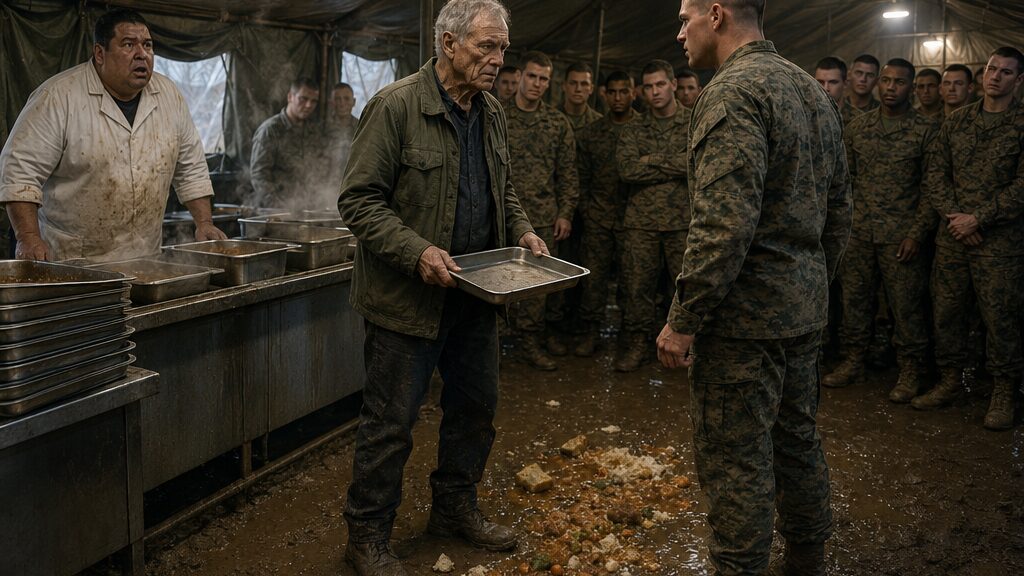
Matthew Brown shoved the tray forward so hard that stew slapped over the rim and ran across Thomas Mitchell’s thumb.
The line behind him laughed before anyone decided whether it was safe to laugh. Boots shifted in the mud. Plastic ponchos rustled against wet field jackets. Steam rose from the serving pans and blurred the faces of the young soldiers waiting for lunch, but it did not blur Matthew’s grin.
“You want to call this food?” Matthew said.
Thomas kept one hand on the ladle and one on the edge of the metal counter. His knees had been stiff since morning, and the damp had found the old places in his bones. He had served two hundred trays since sunrise without asking any of the soldiers to notice him. That was how he preferred it. A man could do useful work and remain almost invisible. There was peace in that, most days.
Matthew lifted the tray higher, holding it between them like evidence. Stew, rice, vegetables, and a thick piece of bread sat in their sections, the same as every other plate in the line.
“Maybe you ought to eat it,” Matthew said. “You’re the one looking at it like it’s treasure.”
A few soldiers laughed again. One tried to cover it with a cough. One looked down.
Thomas looked at the tray.
Not at Matthew first. Not at the grin, not at the clean young jaw, not at the name tape across the uniform. He looked at the food. The bread was torn on one corner where Matthew had pinched it, rolled it between finger and thumb, then dropped it back as if it were something found under a boot. Rice clung to the lip of the tray. A smear of stew had crossed the divider and settled into the vegetables.
“You got something to say?” Matthew asked.
Behind Thomas, William Garcia was shouting for another pan from the rear prep table. The field kitchen was too hot under the canvas roof, too cold near the open flaps, and thick with the smells of onions, wet wool, diesel, and mud. A generator rattled beyond the tent wall. Somewhere outside, a truck backed up with a sharp beeping that made no one move faster.
Thomas wiped the stew from his thumb with a towel and set the ladle down.
That small sound—the metal handle against the rim of the serving pan—quieted the first row of soldiers.
Matthew’s grin thinned. “What, you offended?”
Thomas’s eyes moved from the tray to Matthew’s face.
The boy was not a boy. Thomas knew that. Mid-twenties maybe, with a squad leader’s posture and a young man’s hunger to look harder than he felt. But there was still boyishness in the way he performed for the line behind him, the way his shoulders squared only when he sensed an audience.
Thomas had seen that kind of hunger before. It was not the kind that needed feeding. It was the kind that wanted witnesses.
“Move along,” Thomas said.
His voice was low enough that only the first few heard it.
Matthew smiled again because he thought he had won something. “That’s it? Move along?”
The soldier behind him shifted. “Brown, just take it.”
Matthew did not move. He tilted the tray toward Thomas, enough that gravy gathered at the front edge. “Come on. Tell us why we’re supposed to be grateful for this.”
Thomas heard the word before the rest of the sentence. Grateful. It struck something low and old inside him, something he had spent years keeping packed away like a field kit never opened after return.
The steam thickened for a second. In it, the tent canvas changed color. The wet boots became dust-colored. The metal counter became the sideboard of a supply truck. A hand not Matthew’s held out a torn half of bread and said, You take it, Mitch. You’re shaking worse than me.
Thomas closed his fingers once, slowly, until the pain in his knuckles brought him back.
The soldiers waited.
Matthew’s tray trembled only slightly, but Thomas saw it. The young man was not as steady as he wanted everyone to believe.
Thomas stepped around the serving station.
William noticed too late. “Tom?”
Thomas took the tray from Matthew’s hands.
For half a breath, Matthew allowed it because he did not expect an old man to take anything from him. Then his face changed.
“Hey.”
Thomas held the tray level between them. The heat came through the thin metal into his palms. It was a good tray. Old, dented at two corners, but sound. The kind that had survived being dropped, stacked, scrubbed, transported, forgotten, and returned to service.
“Some men,” Thomas said, “have lived on less than what you just insulted.”
The line went quiet enough for the generator to sound louder.
Matthew’s jaw tightened. “Then they can have mine.”
It was meant as a joke. The kind that needed laughter behind it to become safe. No one laughed this time.
Thomas looked down at the tray again. The bread. The rice. The stew sliding into one corner because Matthew had held it crooked.
He placed two fingers into the stew.
A sharp breath moved through the line.
Matthew’s eyes widened. “What are you doing?”
Thomas did not answer. He pressed his fingers down until they touched the metal bottom beneath the food, feeling the heat, the texture, the weight of it. Then he lifted his hand and looked at the smear across his fingertips.
He was not angry in the way Matthew expected. That would have been easier. A shouted insult. A shove. Something ordinary enough to write down in a report.
Thomas turned the tray.
The food fell all at once.
Stew hit the muddy floor first, spreading dark and glossy. Rice scattered through it. Vegetables bounced once and disappeared into boot prints. The bread landed face down with a soft, final sound.
Someone cursed under his breath.
Matthew stared at the floor as if Thomas had struck him.
Thomas held the empty tray with both hands. A thin streak of gravy ran from one corner and dropped into the mud.
No one moved. Even William stopped halfway between the prep table and the line, a towel clutched in one hand, his mouth open and his face red from the kitchen heat.
Thomas looked at Matthew.
The young soldier’s cheeks had gone bright. Public embarrassment came fast to men who lived by public hardness. His hands opened and closed at his sides.
“You crazy old—”
“Enough,” a training officer snapped from somewhere near the tent flap.
But the word came too late. Everyone had already heard the first part. Crazy. Old.
Thomas should have answered. He should have said what no one in that line knew, what no one had earned the right to know, what no one could have carried anyway. Instead, he held the tray level, empty and shining in the steam.
Matthew took one step forward. “You think that teaches something?”
Thomas’s shoulders ached. His hand smelled of stew. The old memory had withdrawn, but not far. It waited under the ribs, patient as a buried thing.
“No,” Thomas said. “I think you missed the lesson before I got here.”
William came rushing then, heavy boots slipping in the mud. “What in God’s name happened?”
No one answered at first.
William looked at the floor, then at the line, then at Thomas. “Tell me you didn’t just dump a full tray during lunch service.”
Thomas held out the empty tray.
William did not take it. “Tom.”
The use of the shorter name made it worse. Thomas saw it in Matthew’s face: so the old man was known here, protected here, part of some soft arrangement that let him stand where stronger men worked.
A few soldiers began murmuring. One near the back lifted his phone, then thought better of it when the training officer turned.
William lowered his voice, but not enough. “Do you have any idea what kind of position this puts us in?”
Thomas looked past him to the spilled meal. A boot heel had already pressed rice into the mud.
William’s face tightened with something more complicated than anger. Fear, maybe. Exhaustion. The man had been counting portions all morning, stretching pans farther than they wanted to go.
Matthew seized on the silence. “He grabbed my tray. I didn’t do anything.”
The soldier behind him looked up sharply but said nothing.
Thomas did not correct him.
That, more than the spill, made William stare.
“Tom,” he said again, quieter. “Say something.”
Thomas slid the tray onto the edge of the counter. Metal struck metal, clean and flat.
“I need a mop,” Thomas said.
The soldiers nearest him looked at one another, unsure whether the sentence was surrender or command.
William rubbed a hand down his face. “No. You need to step outside.”
“I’ll clean it.”
“You need to step outside before this becomes worse.”
Thomas looked at the bread in the mud.
It had already become worse.
Matthew stepped back into the line, but no one made room for him the same way. His shoulders stayed high. The grin was gone, replaced by a look that kept searching the room for support and finding less than he wanted.
William turned toward the staff. “Shut the line down for five minutes. Get that floor cleared.”
A groan moved through the waiting soldiers. Lunch was short. Training schedules were shorter. Hunger made every delay personal.
The training officer came closer, eyes moving between Matthew and Thomas. “Garcia, I need a report on this.”
William’s face changed again. The fear sharpened.
“A report,” he repeated.
“And I don’t want rumors doing the work before paper does.”
Thomas reached for the mop leaning near the dish buckets.
William caught his wrist. Not hard, but enough that Thomas looked at the hand.
For a second, neither man spoke.
William released him first.
“You don’t understand,” William said. “The inspection team arrives tomorrow morning.”
The soldiers heard that. Matthew heard it. Thomas heard what William did not say: one old man, one tray, one muddy floor, and now the whole kitchen had a problem bigger than lunch.
Thomas looked back at the empty tray on the counter. Steam curled around it, then vanished.
Chapter 2: A Complaint Written Over Muddy Stew
Sarah Torres received the complaint while Thomas Mitchell was still standing at the wash sink with stew drying between his fingers.
The form came through on a tablet carried by a training officer who looked as if he had already decided the incident was too strange to touch directly. Sarah stood just inside the mess office, one shoulder against a plywood wall that vibrated whenever the generator coughed outside. The words on the screen were clean and official, which made the accusation feel colder than the mud still visible through the open door.
Volunteer kitchen assistant became physically aggressive during lunch service.
Sarah read that line twice.
“Who wrote this?” she asked.
“Brown gave the statement,” the training officer said. “Garcia wants it handled before tomorrow.”
Of course William did.
Sarah looked past the officer into the dish area. Thomas stood alone at the sink, sleeves rolled to the elbows, gray hair damp at the temples. He was not scrubbing like a man trying to erase evidence. He was washing carefully, one finger at a time, as if whatever remained on his hand deserved attention.
Matthew Brown stood across the room near the stacked bread crates, speaking to two soldiers who kept glancing toward Thomas. He had changed his tray but not his expression. His face held that tight, injured anger Sarah had seen in young service members who felt embarrassed and wanted someone else punished for the feeling.
“What exactly happened?” Sarah asked.
The training officer gave a tired shrug. “Depends who you ask. Brown says Mitchell took his tray and dumped it. Several witnesses agree with that part.”
“That part,” Sarah repeated.
The officer looked uncomfortable. “Some say Brown was running his mouth.”
From the dish area, William Garcia’s voice cut through the steam. “He was doing more than running his mouth. But Tom still dumped food in front of half a unit.”
Sarah handed the tablet back without signing anything. “I’ll talk to them.”
William came into the office wiping his hands on a towel that had stopped being clean hours earlier. His face was flushed, his collar dark with sweat. He carried the sharp smell of onions, dishwater, and panic.
“I need him gone from the line,” William said before Sarah could speak.
“Temporarily?”
“Before inspection, yes. After that, we’ll see.”
Sarah watched him. “Thomas has been helping this kitchen three training cycles a year for how long?”
William’s jaw worked. “Seven.”
“And how many complaints?”
“That’s not the point.”
“It becomes the point when the first complaint says he became physically aggressive.”
William looked toward the dish area. “He dumped a soldier’s tray in the mud.”
“I saw the mud.”
“You didn’t see the line stop. You didn’t see every soldier in the tent staring like we run some kind of circus.” He lowered his voice. “We are already thin on supplies. I am already explaining short deliveries and temporary staff. Now I’ve got an elderly volunteer throwing food on the ground the day before inspection.”
Sarah let the word sit between them. Elderly. Not veteran. Not Thomas. Not a man who had earned his place by showing up again and again before dawn.
“Did Matthew touch him?” she asked.
“No.”
“Threaten him?”
“Not exactly.”
“What did he say?”
William glanced away.
That was enough to make Sarah step out of the office and into the dish area. The heat wrapped around her immediately. Pans clanged. Someone sprayed mud and rice toward a floor drain. The smell of wasted stew still hung close to the ground.
Thomas did not look up when she approached.
“Thomas.”
He rinsed his hands once more.
“Did you take Matthew Brown’s tray?”
“Yes.”
“Did you dump it?”
“Yes.”
“Did he say something first?”
Thomas shut off the water. The sudden absence of it made the kitchen seem louder.
“He had a full tray,” Thomas said.
“That isn’t what I asked.”
“No.”
Sarah waited.
Thomas dried his hands with a paper towel, slow and complete. The skin across his knuckles was thin, mottled, scarred in places too old to explain with kitchen work.
“I’m asking because the report says you became aggressive,” Sarah said.
Thomas folded the towel once, then twice. “Reports like verbs.”
“What does that mean?”
“It means they need a thing a person did. Took. Dumped. Threatened.” He dropped the towel into the trash. “They don’t have a box for let something be small too long.”
Sarah studied his face. He looked tired, but not confused. He knew exactly what he had done. That troubled her more than if he had snapped.
Behind her, Matthew’s voice rose.
“He stuck his fingers right in it,” Matthew said. “Like some kind of point. Everybody saw it.”
A younger private near the crates shifted his weight. He was thin, muddy to the knees, still holding his own uneaten tray.
Sarah turned to him. “You were in line?”
The private looked toward Matthew first.
Sarah softened her voice. “I’m asking what you saw.”
“He dumped it,” the private said.
Matthew nodded once, vindicated.
The private swallowed. “But Brown was pushing him.”
Matthew’s head snapped toward him. “I wasn’t pushing anybody.”
“With words,” the private said, quieter. “He said the food was slop. Said if Mr. Mitchell cared so much, he could eat it.”
The room changed slightly. Not enough to absolve Thomas. Enough to disturb the clean shape of Matthew’s complaint.
Matthew laughed without humor. “That’s not a threat.”
“No,” Sarah said. “It isn’t.”
Matthew looked at her like she had sided with him, then realized she had not.
Thomas remained by the sink, eyes lowered, hands still.
“Why didn’t you mention that?” Sarah asked Matthew.
“Because old men don’t get to throw things because somebody hurts their feelings.”
Thomas’s hand closed on the edge of the sink.
Sarah saw it. So did William.
But Thomas did not speak.
William moved in before silence could turn dangerous. “This is exactly what I’m talking about. We can sort out tone later. What we need now is containment.”
“Containment?” Sarah said.
“We need Brown’s statement. We need Tom’s acknowledgment. We need corrective action before inspectors walk in here and ask why there’s a discipline issue in my mess.”
“Your mess?”
William’s eyes flashed. “Yes. My mess. My staff. My contract. My people who haven’t slept right in two days because the delivery came short and the schedule didn’t change.”
Sarah took that in. It did not excuse him, but it explained the sweat under the anger.
Thomas looked toward William then. For a second, something like pity crossed his face. It vanished before William saw it.
Sarah stepped closer to Thomas. “Did Matthew’s words make you angry?”
Thomas looked at the soldiers, the trays, the steam. “No.”
Matthew scoffed.
Sarah ignored him. “Then what did they make you?”
Thomas’s gaze lowered to the floor drain where rice and mud gathered against the grate.
“Old,” he said.
The word was so quiet Sarah almost missed it.
William exhaled sharply. “That’s not an explanation.”
“No,” Thomas said. “It isn’t.”
And that was all he gave them.
By late afternoon, the lunch rush had become a story told in pieces. Some soldiers said Thomas had gone crazy. Some said Matthew had it coming. Some said no meal was worth that much drama. William shut down every version he heard, but his corrections only fed the rumor. Sarah watched Thomas return to work without being asked, lifting clean trays from the washer and stacking them with mechanical care.
One tray he set aside.
Sarah noticed because everything else went into high stacks near the serving line, but this one remained alone beside the sink. It was the tray from the spill; she recognized the dented corner and the faint brown stain caught near the rim.
When Thomas stepped away to carry a bucket outside, Sarah picked it up.
It was heavier than she expected. Older, too, the metal dulled by years of scrubbing. Along the underside of one rim, almost hidden where a thumb would rest, were scratches. At first they looked like random damage.
Then she turned the tray toward the light.
Four letters had been carved there by something sharp and patient.
JOHN.
Sarah stood with the tray in both hands while the kitchen moved around her.
Outside, Thomas came back through the flap, saw what she was holding, and stopped as if she had spoken a name aloud.
Chapter 3: The Name Scratched Beneath the Rim
Sarah Torres held the cleaned tray out to Thomas as evening steam faded from the mess line, and the scratched name under the rim sat between them like a question neither of them had permission to ask.
Thomas did not take it at first.
The storage tent behind the mess hall was colder than the kitchen and smelled of cardboard, wet canvas, onions, bleach, and old metal. Empty crates lined one wall. Stacked trays leaned in dull silver columns beside folded tables. Through the tent flap, soldiers moved in tired clusters toward their barracks, their voices low after a day of drills and rumors.
Sarah kept the tray level. “Who was John?”
Thomas looked at the underside of the rim, not at her.
“Lots of men named John.”
“Not on this tray.”
His mouth tightened.
She had learned in her work not to fill silence too quickly. Families of deployed soldiers, older veterans, widows who came in angry about forms when they were really angry about absence—most people told the truth crookedly if you gave them room. But Thomas’s silence did not feel like hesitation. It felt built.
He reached for the tray.
Sarah let him take it.
His fingers found the scratched letters without looking. Thumb to J. Middle finger to N. A motion worn smooth by repetition.
“I shouldn’t have dumped the meal,” he said.
“That isn’t what I asked.”
“No.”
He turned the tray over. In the low light, its surface caught a pale reflection of the tent bulb. Clean now. Empty. Harmless to anyone who did not know better.
Sarah leaned back against a stack of folded tables. “The complaint is going forward.”
“I figured.”
“William wants you pulled from the line tomorrow.”
“That’ll make things easier for him.”
“Will it make things easier for you?”
Thomas gave the smallest shake of his head, not quite answer, not quite refusal.
Outside, someone laughed too loudly, then lowered his voice. A group of soldiers passed the tent flap. One of them said, “That old guy really dumped Brown’s whole lunch?” Another replied, “Maybe the tray was haunted.”
Sarah saw Thomas hear it. He did not flinch. That made it worse.
“Thomas.”
He set the tray on a crate between them.
“It was never supposed to come home,” he said.
The sentence changed the air in the tent.
Sarah waited.
Thomas rubbed his thumb across the scratched name. “Field trays move around. They get lost. Crushed. Left in trucks. Burned with trash if they’re bad enough. Nobody tracks one tray.”
“But you tracked this one.”
“No.” His eyes stayed on the metal. “It tracked me.”
He gave a dry breath that was not a laugh.
Sarah did not understand, and he seemed to know that. He seemed almost relieved by it.
“You were a field cook?” she asked.
“Quartermaster first. Cook when they needed cooks. Driver when they needed drivers. Man with hands when hands mattered more than job titles.”
“During deployment?”
Thomas nodded once.
“Was John in your unit?”
Thomas picked up the tray again. “John White.”
The name came out whole. Not just John now, but a person with weight.
Sarah repeated it softly. “John White.”
Thomas’s eyes moved to the tent flap as if expecting someone to correct her pronunciation.
“He scratched his name under everything,” Thomas said. “Said if the Army was going to lose half his gear, he’d make the other half harder to steal.”
“That sounds like a joke.”
“It was.” Thomas’s face changed almost invisibly. “He was good at those.”
Sarah looked at the tray differently. The scratched letters no longer seemed like damage. They seemed like a man leaving proof he had touched the world.
“What happened to him?”
Thomas set the tray down too fast. The metal rang against the crate.
Outside, boots slowed.
A shadow paused near the tent flap.
Thomas saw it before Sarah did. His expression closed.
“Private storage,” he called.
The shadow shifted, then Matthew Brown stepped just enough into view to pretend he had not been listening.
“Garcia said I could grab extra trash bags.”
Sarah straightened. “They’re by the kitchen door.”
Matthew looked past her to Thomas, then to the tray on the crate.
“That the famous tray?” he asked.
Thomas said nothing.
Matthew stepped inside anyway. His face still carried the embarrassment of lunch, but now it had hardened into something more performative. He had likely been telling his version for hours and needed the room to keep agreeing with it.
“I heard it’s got a name on it,” Matthew said. “That why you threw my food? Ghost didn’t like the seasoning?”
“Brown,” Sarah warned.
He lifted both hands. “Just asking.”
“No,” Sarah said. “You’re not.”
Matthew’s gaze flicked toward her. He looked irritated that she had named the shape of what he was doing.
Thomas picked up the tray and slid it into a canvas sleeve on the storage shelf.
That quiet movement bothered Matthew more than anger would have.
“You know,” Matthew said, “you could’ve just said the food mattered. Instead you made everybody look stupid.”
Thomas turned back slowly.
Sarah felt the danger in the pause. Not physical danger. Something more delicate. The possibility that Thomas might open the door to whatever he carried and let it crush the wrong person.
But he only said, “I made one tray fall.”
Matthew’s nostrils flared. “You made me look like I don’t respect anything.”
Thomas looked at him then, fully.
“Did I?”
The question landed without force, and that was why it landed hard.
Matthew’s mouth opened, then shut. He looked toward Sarah as if she might object to the unfairness of being asked the plain thing.
She did not.
From the kitchen, William shouted for someone to move the trash before dark.
Matthew backed toward the flap. “Whatever. Hearing’s tomorrow, right? We’ll see how poetic a tray sounds on paper.”
He left without the trash bags.
Sarah listened to his boots retreat through the mud. When she looked back, Thomas was staring at the shelf where he had put the tray away.
“He’s embarrassed,” she said.
“He should be.”
“So are you.”
Thomas’s eyes sharpened.
Sarah held her ground. “Not because you dumped it. Because he saw something he wasn’t meant to see.”
The tent bulb hummed. Outside, a truck door slammed. The evening cold pushed through a gap at ground level and moved the canvas wall in and out like breath.
Thomas lowered himself onto an overturned crate. For the first time that day, he looked his age. Not weak. Not fragile. Just older than the room had allowed him to be.
“John used to say chow was proof the day hadn’t beaten us yet,” he said.
Sarah sat across from him on another crate, careful not to rush the moment.
Thomas’s hands rested on his knees. One finger twitched once, as if still finding the scratched letters.
“We were short more often than we admitted,” he said. “Everybody thinks supply is numbers. Cases in, cases out. But out there, a late truck isn’t a late truck. It’s men pretending they aren’t hungry because the man next to them is hungrier.”
Sarah said nothing.
Thomas looked toward the kitchen lights glowing through the canvas seam. “That tray fed men who would’ve thanked God for what Brown called slop.”
It was the most he had said. It answered one question and opened a worse one.
“What happened to John?” Sarah asked again, softer.
Thomas stood.
The crate scraped against the ground.
“Service starts at the line,” he said. “Most people don’t learn that until something is missing.”
Then he took the trash bags from the shelf himself and walked them toward the kitchen.
Sarah remained in the storage tent, the cold working through her jacket, the name John White now lodged in the day like a splinter.
Outside, near the corner of the mess hall, Matthew’s voice rose just loud enough for the junior soldiers gathered around him.
“Careful with dinner,” he said. “Old ghost tray might come back for seconds.”
The laughter that followed was thin, uncertain, and Thomas walked straight through it without turning his head.
Chapter 4: The Kitchen Was Stretching More Than Soup
William Garcia counted the supply boxes for the third time and came up short by the same ugly number.
He stood behind the prep tables before dawn, clipboard in one hand, pencil in the other, staring at the crates as if more canned vegetables might appear if he refused to blink. The mess hall beyond the prep flap was still dark except for the low bulbs over the serving line. Steam had not yet softened the corners of things. Everything looked bare in the early light: dented pans, cracked plastic bins, muddy boot prints dried into the plywood runners, and half the breakfast bread he had ordered.
Half.
William ran the pencil down the list again.
Rice. Short.
Bread. Short.
Stew base. Short.
Coffee. Barely enough.
Fresh vegetables. Not coming until afternoon, if the driver had not been lying to get him off the phone.
He pressed the clipboard against his chest and listened to the kitchen wake around him. A staff member dragged a stockpot from the lower rack. Someone outside cursed at a stuck fuel line. Water thudded through pipes with a sound that always made William think of debt coming due.
The inspection team would arrive after breakfast.
He had one elderly volunteer who had dumped food in front of witnesses, one young squad leader filing a complaint, a rumor spreading through the unit, and not enough food to make the trays look full unless he stretched everything thin.
William set the clipboard down and reached for the stew base.
“Add another gallon,” he told the cook at the pot.
The cook looked up. “Another gallon of water?”
“Another gallon.”
“It’ll run thin.”
“It’ll run.”
The cook hesitated, then lifted the water bucket.
William turned away before he could see his own order obeyed. He had been in food service long enough to know that every kitchen lied a little under pressure. A smaller scoop when supply ran short. A pan held back for late arrivals. A substitution written in clean language on a form. None of that made a man corrupt. It made him employed.
But yesterday’s spill had changed the smell of the place. It was still in the seams. Muddy stew. Rice under boots. Public silence.
And Thomas Mitchell’s face.
William hated that part most. Not the spill. Not the inspection. The face. The old man had looked at the wasted food as if William himself had failed some test neither of them had agreed to take.
A metal tray clanged behind him.
William turned.
Thomas stood at the end of the prep table with a stack of washed trays held against his hip. He was early. Of course he was early. Shirt buttoned, jacket hung on the hook, sleeves rolled with the same plain care as always. His gray hair was combed back, still damp from the sink.
“I told Sarah you weren’t on the line until this was settled,” William said.
Thomas set the trays down. “Line isn’t open.”
“That’s not clever.”
“Wasn’t meant to be.”
William rubbed at his forehead. “Tom, I do not have the space for this today.”
Thomas looked past him at the stockpot.
The cook was stirring now. The stew moved too easily, pale broth sliding around bits of meat and vegetable that should have stayed suspended in something thicker.
Thomas did not comment.
That was worse than comment.
William picked up the clipboard. “We’re adjusting portions.”
Thomas walked to the supply boxes. He did not ask permission. He lifted the flap on one, checked the label, checked the contents, then moved to the next.
“Don’t,” William said.
Thomas continued.
“Tom.”
The old man opened the bread crate and paused.
William knew what he was seeing: the count too low, the spacing too wide, the tucked-back emergency sleeve already broken open.
Thomas closed the crate. “How many for breakfast?”
“Enough.”
“How many?”
William lowered his voice. “Two hundred forty expected through first service. Another thirty late from the range if weather holds.”
Thomas nodded toward the pot. “That won’t feed two hundred seventy.”
“It will if people take what they’re given.”
Thomas looked at him then, and William heard the sentence inside the look before Thomas spoke it.
“That is not the same thing.”
William stepped close enough that the cook looked away. “You do not get to stand there and measure me after yesterday.”
“I’m measuring breakfast.”
“No. You’re measuring me. Same as Sarah. Same as every soldier who thinks kitchens make food out of gratitude and air.” William tapped the clipboard. “The delivery was short. The replacement truck is delayed. The schedule didn’t change. The inspection didn’t change. The training officer still wants bodies fed in twenty minutes and gone in thirty.”
Thomas glanced again at the pot. “Then tell them.”
William laughed once. “Tell them? And when they ask why I didn’t adjust earlier? When they ask why the invoice shows full delivery? When they ask why I signed receipt before checking every crate because the driver was blocking the road and command was screaming about lunch? You think truth fixes paperwork?”
Thomas was quiet.
William wished he would argue. Arguing could be answered. Silence made room for the truth.
The old man lifted the clipboard from the table and ran his finger down the numbers. William almost snatched it back, but pride stopped him. Thomas’s finger stopped at the ration count.
“You listed late range return at fifteen.”
William said nothing.
Thomas looked up. “You just told me thirty.”
“It was an estimate.”
“It’s a lie.”
The word was soft. That made it land harder.
William took the clipboard back. “It’s a cushion.”
“It’s fifteen hungry soldiers.”
“It is a line on an internal sheet that keeps this place from being shut down over one delayed delivery.”
Thomas’s face did not change, but his hand settled on the edge of the bread crate. Not gripping. Holding.
William lowered his voice further. “I know you think food is holy. I know. But I have staff who need work next month. I have a contract review after this cycle. I have inspectors who won’t care that the truck was late. They’ll care that my kitchen looked uncontrolled.”
“Yesterday looked uncontrolled.”
William stared at him. “Because you made it that way.”
For the first time that morning, something like anger moved through Thomas’s eyes.
Then it disappeared.
He took a pencil from beside the clipboard, reached across the table, and corrected the fifteen to thirty.
William looked down at the changed number.
“You can’t write on my count sheet.”
“You can change it back.”
The cook stopped stirring.
William did not change it back.
Breakfast opened under a ceiling of low steam. Soldiers came through tired and cold, boots caked, faces gray with too little sleep. William stood behind the line with a fixed expression, watching portions land smaller than usual. One scoop, not one and a half. Bread placed, not offered. Coffee kept to half cups.
Thomas worked the tray station instead of the food pans. He handed each soldier a tray without speaking, metal to gloved hand, metal to bare hand, metal to fingers shaking from the cold. If anyone joked, he let it pass. If anyone looked at him too long, he looked back until they moved on.
Matthew Brown came through near the middle of service with his unit.
The line tightened around him. William felt it happen before he saw it. Conversations dropped. Soldiers watched from the corners of their eyes.
Matthew took a tray from Thomas without meeting his gaze.
Thomas released it.
No word passed between them.
When Matthew reached the stew, he looked into the pan and gave a short laugh. “They watered it down.”
A few soldiers behind him smiled.
William stepped forward. “Keep moving.”
Matthew lifted his tray. “No, I’m serious. Look at it.”
“Brown.”
“It’s soup pretending to be stew.”
One of the younger soldiers behind him, the thin private from the day before, looked into the pan and then at Matthew. His tray remained empty in his hands.
Matthew noticed. “Save yourself. Coffee’s probably stronger.”
The private gave a nervous smile and stepped past the stew.
Thomas’s eyes followed him.
William saw it and felt irritation flare. He wanted to blame Thomas for judging again, but the old man had not said a word. He was only watching a soldier walk away from food.
The inspection team arrived just as breakfast ended. They came in clean boots and field jackets, carrying tablets, polite smiles, and the authority to make every shortcut look worse than it had felt when taken. William walked them through storage, prep, serving, sanitation. He answered questions with careful truth where possible and useful vagueness where needed.
Thomas stayed out of the way, washing trays.
That should have relieved William.
It did not.
Near midmorning, Matthew’s unit returned from a short field exercise earlier than expected. Mud to the knees. Faces drawn. The kind of hunger that made jokes ugly.
William was near the prep table reviewing lunch options when a shout came from the front.
“Medic!”
His whole body went cold.
He rushed through the flap and saw the thin private sitting on a bench, head between his knees, one hand braced on the mud-slick floor. A soldier beside him held his shoulder. Matthew stood a few feet away, face gone pale beneath the dirt.
“What happened?” William demanded.
“He got light-headed,” someone said. “Almost went down.”
“Did he eat breakfast?”
No one answered.
William looked at Matthew.
Matthew’s mouth opened, but Thomas spoke first from behind the tray station.
“He skipped the stew.”
The private lifted his head weakly. “Wasn’t hungry.”
Thomas looked at the untouched tray abandoned near the bench, then at Matthew.
The kitchen, the inspection, the complaint, the watered stew, yesterday’s spilled meal—all of it narrowed to the space between a hungry soldier and the food he had been taught to despise.
William heard the inspection officer step up behind him.
“Mr. Garcia,” the officer said, “we need to talk about your meal counts.”
Chapter 5: The False Apology Made the Line Go Quiet
Sarah placed the apology statement in front of Thomas and watched his eyes stop at the first sentence.
The mess hall had not yet opened for dinner, but the room was already full of pressure. Stacks of clean trays waited beside the line. Untouched, they gave off a faint metallic smell under the heat lamps. The stew pans had been replaced for evening service, thicker now after William had found emergency supplies and admitted more than he wanted to the inspection officer. Still, no one seemed proud of the food. The whole kitchen moved as if one wrong sound might make the day collapse.
Thomas sat at the end of a folding table with his hands folded loosely in front of him. Sarah sat across from him. William stood near the wall, arms crossed. Matthew lingered by the far counter, pretending he had not been summoned into the same room.
Sarah had drafted the statement herself after rejecting William’s first version.
It still felt false.
Thomas read the first line again.
I apologize for disrupting lunch service and creating concern among the soldiers and staff.
His eyes did not move to the second.
Sarah felt heat rise in her neck. “It’s only a starting point.”
Thomas pushed the paper back with two fingers.
“No.”
William’s arms dropped. “You haven’t even read it.”
“I read enough.”
“We need something on record before the hearing.”
Thomas looked toward the stacked trays. “Then put what happened on record.”
“That is what this is.”
“No.”
William made a frustrated sound. “You dumped a tray. That happened.”
Thomas looked at him. “It did.”
“And you disrupted service.”
“Yes.”
“And you created concern.”
Thomas’s face tightened. “Concern is a clean word.”
Sarah touched the edge of the paper. “Thomas, nobody is asking you to take all the blame.”
William said nothing.
Thomas noticed.
Sarah did too.
Outside the mess hall flap, a group of soldiers passed, talking low. One of them said, “I’m not eating that ghost tray stuff.” Another answered, “Brown said don’t trust anything out of that line.” The words moved away with their boots, but they left the trays on the table looking suddenly heavier.
Thomas looked toward the sound.
Matthew looked down.
Sarah stood. “Matthew.”
He straightened too quickly. “Ma’am?”
“Walk with me.”
William began to object, then thought better of it. Sarah led Matthew past the food line and out behind the mess hall where empty crates were stacked under a tarp. The air outside was cold enough to cut through the kitchen grease clinging to her clothes.
Matthew kept his hands behind his back, posture formal now that privacy had removed his audience.
“Did you tell soldiers not to eat?” Sarah asked.
“No.”
“Did you joke that the food shouldn’t be trusted?”
He looked away.
“That is not no.”
Matthew shifted his jaw. “I said things.”
“Why?”
“Because everybody was already saying things.”
“That’s not why.”
His eyes flashed. “Because he dumped my tray in front of everyone.”
“And that embarrassed you.”
“It made me look weak.”
Sarah let that sit.
Matthew looked angry that he had said it. He turned toward the muddy training field beyond the tents, where floodlights were beginning to glow in the gray evening.
“I’m supposed to lead them,” he said. “You think they listen to a guy who lets some old kitchen volunteer snatch his food and throw it on the ground?”
“Do they listen to a guy who tells them not to eat?”
He flinched.
Sarah saw then what the swagger had been covering: not cruelty alone, but fear. Matthew Brown was terrified of becoming small in front of the men he wanted to lead. Thomas had not made him small. Thomas had revealed the smallness he had been trying to hide.
“I didn’t expect anybody to actually skip meals,” he said.
“But they did.”
“I know.”
“Do you?”
His face hardened again. “What do you want me to say? I made a joke. He made a scene.”
Sarah studied him. “You still think those are equal?”
Matthew did not answer.
When they returned to the mess hall, Thomas had not moved. William was pacing now, taking three steps one way, three steps back, like a man trapped in a kitchen-sized problem he could not cook his way out of.
Sarah sat again and pulled the apology statement toward herself.
“We can change it,” she said.
Thomas’s gaze stayed on the paper.
“What would be true?” she asked.
William gave a humorless laugh. “True? Fine. Write that Thomas Mitchell dumped a full tray during service, humiliated a soldier, delayed lunch, and made a supply inspection worse.”
Matthew looked up.
Thomas’s voice came quiet. “I didn’t humiliate him.”
Matthew scoffed, but softer than before. “You didn’t?”
“No,” Thomas said. “I stopped before that.”
The room went still.
Sarah felt the sentence pass through each of them differently. William heard risk. Matthew heard accusation. Sarah heard a door opening to something darker and older.
“What does that mean?” she asked.
Thomas’s hands remained folded, but the knuckles had whitened.
“It means I could have said more.”
Matthew’s face worked. “Then say it.”
Thomas looked at him for a long moment.
“No.”
William slapped the table with the flat of his hand. The sound cracked through the room. “This is exactly the problem. You won’t explain yourself, but you won’t cooperate. You won’t apologize, but you won’t tell us why we shouldn’t write you up as unstable.”
Sarah looked sharply at William. “Enough.”
“No, not enough.” William pointed toward the trays. “You see those? Dinner starts in twenty minutes. Half the unit is suspicious of the food because of this. The inspection officer is coming back in the morning because my counts were corrected in front of him. I have staff asking whether their jobs are safe. So forgive me if I don’t have patience for mysterious old-man silence.”
Thomas rose slowly.
For a second Sarah thought he might leave. Instead, he picked up the apology statement.
He held it, read the first line once more, then tore the paper in half.
Not violently. Carefully. One clean tear down the middle.
William stared. “You just made this official.”
“No,” Thomas said. “That paper would have.”
Sarah stood too. “Thomas—”
He put the torn halves on the table. “It says I created concern. That’s not the lie. It says I disrupted lunch. That’s not the lie. The lie is that I’m sorry for making them look at what was already there.”
Matthew’s eyes narrowed. “Which is what?”
Thomas turned to him. “A full tray in the hands of a man teaching other men to sneer at being fed.”
Matthew’s face reddened. “You don’t know anything about me.”
“No,” Thomas said. “But I know what you did with a full tray.”
The silence after that was not empty. It held the soldiers outside, the private on the bench, the watered stew, the scratched name under metal, the word ghost carried like a joke from one young mouth to another.
Sarah lowered her voice. “What truth is the statement protecting you from saying?”
Thomas looked at her, and for the first time since she had met him, he looked less guarded than cornered.
William’s anger faded by a degree. Matthew stopped shifting.
Thomas turned toward the food line. The trays were stacked high, waiting. Clean, empty, ready to receive whatever was placed on them. He touched the top tray with the back of his fingers.
“I promised a man he’d eat before dark,” he said.
Sarah did not move.
Thomas’s eyes did not leave the tray. “John died hungry after I promised he wouldn’t.”
Chapter 6: The Meal Nobody Wanted to Serve
Matthew Brown came to the empty kitchen expecting punishment and found Thomas Mitchell already cutting bread.
The hour was late enough that the mess hall felt abandoned, though the place still held the day’s heat in its metal surfaces. Most of the lights were off. One row of bulbs burned above the prep table, turning the stacked trays into dull gray shapes and the clean knives into narrow strips of light. Outside, generators muttered. Rain tapped once in a while against the canvas roof, not steady, just enough to remind the tent it was temporary.
Thomas did not look up when Matthew stepped through the flap.
“You’re late,” he said.
Matthew stopped. “I was told twenty-one hundred.”
“It is twenty-one hundred.”
Matthew glanced at the wall clock. The second hand had just crossed twelve.
He looked annoyed, then caught himself. “Where’s Garcia?”
“Office.”
“Sarah?”
“On the phone with the inspection officer.”
Matthew took two steps in. “So it’s just us?”
Thomas slid the knife through a loaf, each slice even, each motion economical. “Until it isn’t.”
Matthew stood there in his field jacket, hair still damp from a shower, face drawn with the humiliation of a day that had not given him a place to put his pride. He looked younger without an audience. Thomas noticed and did not forgive him for it yet. Youth was not innocence. But it was not guilt by itself either.
“They said I’m supposed to help prep breakfast,” Matthew said.
Thomas moved the sliced bread into a tray. “You are.”
“Is this your idea?”
“No.”
“Garcia’s?”
“No.”
Matthew’s mouth tightened. “Hers, then.”
Thomas did not answer.
Sarah had suggested it after Thomas spoke John’s name and then refused to say more in front of William. Not punishment, she had said. Repair. Thomas had nearly refused. Working beside Matthew felt too close to rewarding him with a story he had not earned. Then Thomas had looked at the untouched trays, at the evening line moving stiffly because rumor had spoiled what hunger should have clarified, and he had said yes.
Matthew washed his hands at the sink longer than necessary. Thomas heard the water run, heard the young man trying to make delay look like discipline.
When Matthew returned, Thomas pointed to a crate of potatoes.
“Scrub.”
Matthew stared at the crate. “All of them?”
“Breakfast doesn’t make itself.”
He dragged the crate closer and began. For several minutes, the only sounds were knife on board, brush on potato skin, water dripping from the sink, rain against canvas. The quiet did not settle peacefully. It worked at the room.
Matthew broke first.
“You meant what you said?”
Thomas set another slice in the tray. “I try to.”
“About John.”
The knife paused.
Matthew saw it and looked back to the potatoes.
Thomas resumed cutting. “Yes.”
“Was he a cook too?”
“No.”
The answer closed the door. Matthew scrubbed harder.
Thomas knew that rhythm. Men who wanted to ask and did not know how often attacked whatever work sat in front of them.
A misshapen potato slipped from Matthew’s hand, hit the floor, and rolled under the prep table. He muttered, reached for it, then seemed to decide it was too dirty. He tossed it toward the trash bucket.
Thomas’s hand came down on the table.
The sound was not loud, but Matthew froze.
“Pick it up,” Thomas said.
“It hit the floor.”
“Wash it.”
Matthew looked at him. “It’s one potato.”
Thomas held his gaze.
The young man bent, retrieved it, and carried it to the sink. His ears had gone red again, but this time there was no line of soldiers to rescue him with laughter.
When he returned, he set the potato with the others.
Thomas said, “Food doesn’t become nothing because it touched dirt.”
Matthew looked as if he wanted to argue. Instead, he picked up the brush again.
The small obedience settled differently than an apology would have. It was not enough. But it was a beginning Thomas had not expected to see.
They worked on. Bread stacked. Potatoes scrubbed. Oats measured. Coffee grounds portioned into filters. Matthew watched Thomas weigh dry ingredients without a scale, adjust a count after glancing at a tray stack, set aside bruised vegetables for stock instead of trash. There was no softness in the work. Only attention.
At the end of the table, near Thomas’s folded jacket, a small cloth bundle rested beside a row of clean trays.
Matthew noticed it after the third crate.
“What’s that?”
Thomas did not look. “Nothing for you.”
That was the wrong thing to say to a young man already raw with being corrected. Matthew reached for it before thinking.
Thomas caught his wrist.
The movement was quick enough that Matthew’s eyes widened. Thomas’s grip was not strong by young standards, but it was exact. Two fingers against tendon. A warning made of knowledge rather than force.
“Don’t,” Thomas said.
Matthew pulled back slowly.
Thomas released him.
The cloth bundle sat between them now, more present because it had been protected. Matthew looked at it, then at Thomas, and something ugly crossed his face—not mockery this time, but suspicion.
“You keeping food?”
Thomas’s jaw tightened.
“I’m just asking,” Matthew said, though his voice said more than that. “After all that about waste.”
Thomas picked up the bundle.
For a moment he seemed ready to put it away without explanation. The old habit rose in him, familiar and clean. Silence. Let them think what they wanted. Let the story harden around him. It had worked for years, except it had not worked. It had brought him here, in an empty kitchen with a young man who thought contempt was armor and a wrapped piece of bread was evidence.
Thomas opened the cloth.
Inside lay half a roll, dry and hard at the edge.
Matthew blinked. “That’s old.”
“Yes.”
“How old?”
“Not the original.” Thomas touched the cloth edge. “I replace it.”
Matthew stared at him.
Thomas almost smiled at the absurdity of trying to explain a ritual that had outlived reason. “Every field cycle. First bread from the first service. Half wrapped. Half left.”
“For who?”
The name waited in the room.
Thomas folded the cloth back from the bread.
“John White gave away half his ration once,” he said. “We were short. Shorter than command admitted. Shorter than I admitted when I sent the count up.”
Matthew’s face changed at the word admitted.
Thomas continued before silence could reclaim him. “There was a younger soldier shaking from hunger. Trying not to show it. John tore his bread in half and gave it to him. Made a joke of it. Said he was watching his figure.”
Matthew did not smile.
Thomas looked down at the half-roll. “I told John I’d get him fed before dark.”
The kitchen seemed to draw in around them.
“Did you?” Matthew asked.
Thomas wrapped the bread again.
“No.”
He did not say more. Not yet. Even that much had opened something behind his ribs that felt less like memory than weather.
Matthew leaned against the table, all the performance gone from him now. “Is that why you dumped my tray?”
Thomas looked at the trays stacked beside them. Clean. Empty. Waiting.
“I dumped your tray because you had a full one and wanted witnesses for your contempt.”
Matthew swallowed.
“That’s not the same as John,” Thomas said. “Don’t make it cleaner than it is.”
Matthew nodded once, barely.
They finished the potatoes in silence. Later, when Thomas moved to discard a torn roll end too small for service, Matthew stopped him.
“Stock?” Matthew asked, awkwardly.
Thomas looked at the scrap, then at Matthew. “Bread pudding for staff, if William remembers people who cook also eat.”
Matthew gave a short breath that might have become a laugh on another night.
Near midnight, William stepped in, saw the completed prep, and said nothing for once. Sarah looked in from behind him, eyes moving from the washed potatoes to Matthew’s damp sleeves to Thomas’s wrapped half-roll on the table. She did not ask. Thomas was grateful for that.
After they left, Matthew remained by the sink, drying his hands on a towel.
“Did John blame you?” he asked.
Thomas picked up the cloth bundle and held it against his palm.
For years, he had answered that question before anyone asked it. In dreams. In kitchens. In the space between a full tray and an empty one.
He looked at Matthew, who stood waiting without a grin, without a crowd, without anything to gain from the answer except the weight of it.
“No,” Thomas said. “That was worse.”
Chapter 7: The Hearing Changed When Thomas Chose Mercy
The cleaned tray sat in the middle of the hearing table with John White’s scratched name facing down.
Thomas noticed that first. Not the inspection officer with the tablet, not William Garcia standing stiff near the tent wall, not Sarah Torres with her hands folded over a thin folder, not Matthew Brown seated across from him with eyes red from too little sleep. The tray held the center because someone had decided evidence belonged where everyone could see it.
A tray could look innocent when it was clean.
That troubled Thomas more than the mud had.
The administrative tent had no kitchen heat to soften anything. Folding chairs scraped against packed ground. A portable heater clicked without doing much. Outside, breakfast traffic moved toward the mess line, and every few seconds the tent flap lifted with cold air and the smell of coffee.
The inspection officer tapped the tablet. “We’re here to document the lunch service incident, related meal-count discrepancies, and any corrective action needed before this training cycle continues.”
William stared at the floor.
Matthew stared at the tray.
Thomas kept his hands on his knees so they would not reach for it.
Sarah spoke first. “Thomas Mitchell has volunteered in this field kitchen for seven years without prior complaint.”
The inspection officer nodded. “That is noted.”
William shifted. “And yesterday he dumped a full tray during service.”
“That is also noted,” Sarah said.
Thomas looked at her. She did not look back. Her face was professional, but he could see the strain under it. She wanted truth and order to fit together. They rarely had.
The officer turned to Thomas. “Mr. Mitchell, did you take Specialist Brown’s tray and empty it onto the floor?”
“Yes.”
“Were you physically threatened?”
“No.”
“Did you intend to create a disruption?”
Thomas looked at the tray.
Intent was a clean word too. It made a man choose one reason when the truth was usually a crowded room.
“I intended to stop something,” he said.
Matthew’s head lifted.
The officer paused over the tablet. “Stop what?”
Thomas heard the answer he could give. Disrespect. Contempt. Waste. A young man teaching younger ones to laugh at being fed. All true. None enough.
Before he could speak, Matthew said, “I made a joke.”
His voice was rougher than Thomas expected.
The officer looked at him. “You’ll have your turn.”
“No, sir. I mean—” Matthew stopped, swallowed, and started again. “I made more than one. About the food. About him.”
William closed his eyes briefly.
Matthew’s hands were clasped so tightly his knuckles had gone pale. “I didn’t think anybody would skip meals because of it. I didn’t think—”
“That is your statement?” the officer asked.
Matthew looked at Thomas once, then away. “Part of it.”
The tent flap lifted. A burst of breakfast noise came in: trays sliding, a cook calling for more coffee, boots in mud. Thomas smelled bread warming somewhere down the line.
The officer turned to William. “Mr. Garcia, the meal-count issue. Yesterday morning, the corrected number of late-return soldiers differed from your written sheet.”
William’s mouth tightened. “Yes.”
“Why?”
William looked toward Thomas, then toward Sarah, then at the tray. “Because I wrote down the number I could feed, not the number expected.”
The admission entered the tent quietly and stayed there.
The officer’s stylus stopped moving.
William rubbed both hands over his face. When he lowered them, he looked older than he had at breakfast. “The delivery came short. I signed before checking every crate because the truck was blocking the lane and command was pushing service times. I thought I could stretch it. I thought if nobody complained, we’d get through inspection and correct it afterward.”
Sarah’s expression changed, not with surprise but with the sad confirmation of something suspected.
The officer asked, “Did Mr. Mitchell know?”
“No,” William said. Then, after a breath, “Not until he looked.”
Thomas watched William fight the instinct to protect himself with more words. The man had made bad choices, but he had made them under weight. That mattered. It did not erase the harm. It made punishment alone too simple.
Matthew turned toward William. “So the stew really was watered down.”
William’s eyes sharpened. “Yes. And you made sure half the line believed that meant it was worthless.”
Matthew looked back at the tray.
The officer said, “This appears to be a combined conduct and operations issue. Mr. Mitchell, your action remains inappropriate. Specialist Brown, your conduct contributed to food refusal among junior soldiers. Mr. Garcia, your counts and supply handling raise compliance concerns.”
There it was. Three men, three failures, one clean arrangement.
Thomas could have let it stand.
He could have said only what protected him. He could have told them John White’s story in a way that made Matthew look small, William careless, the whole kitchen guilty of not understanding what a tray meant. Pain, once spoken, could become a weapon easily. Thomas knew that. He had spent years keeping it sheathed not only because it hurt him, but because he did not trust himself with it.
Sarah looked at him as if she knew the choice had arrived.
The officer asked, “Mr. Mitchell, is there anything you wish to add before I recommend corrective actions?”
Thomas reached for the tray.
No one stopped him.
He turned it over and set it down again with the scratched name visible.
Matthew leaned forward despite himself.
William read the letters for the first time and frowned.
“John White,” Thomas said.
His voice sounded steady. That surprised him. “He served with me. Long time ago now. He liked to scratch his name under things. Said the Army misplaced everything that wasn’t nailed down, and sometimes what was.”
No one smiled, but the room shifted around the shape of a living man.
“We were short on food before a movement. Not officially. Officially we had enough. On paper, everybody was fed.” Thomas looked at William then, not accusing, only including him. “Paper can be full while men are hungry.”
William’s face tightened.
“John gave half his ration to a younger soldier who was shaking. He joked about it. He always joked when things got bad.” Thomas’s thumb moved over the scratched name. “I told him I’d get him fed before dark.”
Matthew’s eyes had fixed on the tray.
“I didn’t,” Thomas said.
The heater clicked. Outside, someone laughed near the mess line, then the sound faded.
“He died later that day?” Sarah asked softly.
Thomas nodded once. “And before anyone makes that cleaner than it was, hunger didn’t kill him. A missed meal didn’t kill him. War did what war does. But the last promise I made him was small enough that I should have been able to keep it.”
The words settled deeper than accusation would have.
Matthew’s face had changed completely. Not absolved. Stripped.
“Did he blame you?” he asked.
Thomas looked at him.
The question came from last night, from the empty kitchen, from the half-roll wrapped in cloth.
“No,” Thomas said. “He thanked me for trying. That was worse.”
Matthew closed his eyes.
Thomas turned the tray back over, hiding the name again. “Yesterday, I saw a full tray held like an insult. I saw a line of younger soldiers watching to learn whether contempt made a man stronger. I did wrong when I dumped it. But I did not do it because I am unstable, and I will not sign a paper saying the only harm was that service got delayed.”
The inspection officer was quiet for a moment. “What corrective action are you asking for, Mr. Mitchell?”
William looked up sharply. Matthew did too.
Thomas had not expected the question to come to him. For a second, the old habit rose again: say nothing, take what comes, let the room decide. Silence had carried him through worse rooms than this.
But silence had also let Matthew write the first version. It had let William hide numbers. It had let John’s name become a ghost joke outside a storage tent.
Thomas placed both hands flat on the table.
“No one gets removed today,” he said.
William stared. “Tom—”
Thomas did not look at him. “Not before the unit eats.”
The officer’s brow furrowed. “Explain.”
“Mr. Garcia corrects the counts. In writing. He reports the supply shortage and stops stretching meals without saying so.”
William’s jaw worked, but he nodded.
“Specialist Brown works the lunch line.”
Matthew looked up.
Thomas continued, “Not as punishment for show. Work. Tray to hand. Food to tray. No jokes. No speeches. He serves the meal he taught men to distrust. Then he eats it.”
The officer studied him. “And your own corrective action?”
Thomas looked down at his hands. “I will state in writing that I emptied the tray and that I should not have wasted food to make a point about waste.”
Sarah’s eyes moved to him.
“But,” Thomas added, “I won’t call it snapping. I won’t call it confusion. And I won’t apologize for believing a full tray deserves respect.”
No one spoke.
The officer made a note. “That is a workable recommendation.”
William exhaled as if he had been holding his breath all morning.
Matthew was still looking at Thomas. “Why are you not asking them to write me up?”
Thomas picked up the tray and pushed it gently toward him.
“Because you already know what you did,” Thomas said. “If I make this about your punishment, you’ll remember being punished. If you serve today, maybe you’ll remember why.”
Matthew touched the edge of the tray but did not take it yet.
Outside, the breakfast line clattered on. Soldiers received food, complained softly, thanked no one, thanked someone, moved on. The ordinary sound of being fed.
Matthew finally lifted the tray from the table.
His voice was low enough that only those in the room heard it.
“I’ll work lunch.”
Chapter 8: The Empty Tray Went Back Clean
The first soldier in the lunch line received his tray from Matthew Brown.
He almost made a joke. Thomas saw it form in the young man’s face—the quick glance toward the others, the nervous lift at one corner of the mouth, the need to cut discomfort down to a size everyone could laugh at. Then Matthew placed the metal tray into his hands with both palms steady and said, “Keep moving. Stew first, bread last.”
The soldier blinked, took the tray, and moved.
Thomas stood at the far end of the serving counter with a towel over one shoulder, close enough to see, far enough not to rescue him. His knees hurt from the morning cold. His hands smelled faintly of soap and metal. The mess hall was full again: steam lifting from the pans, mud dark under boots, soldiers lined shoulder to shoulder beneath the canvas roof.
The same room.
Not the same line.
Matthew handed out the next tray. Then the next.
He did not perform humility. Thomas was glad of that. Performance would have been another kind of contempt. The young man worked stiffly at first, jaw tight, eyes avoiding the watching faces. A few soldiers studied him with open curiosity. One elbowed another until the training officer’s look stopped it. William moved behind the pans with a sharper eye than usual, checking portions honestly now, calling for refills before the trays looked bare.
“Full scoop,” William told the cook.
The cook looked relieved to hear it.
Sarah stood near the tent flap with the inspection officer, both of them pretending not to watch too closely. Their presence kept the line orderly, but it was not the reason the room had changed. The change sat in smaller things. Soldiers took bread without pinching it apart first. One nodded to the cook. Another looked at Thomas and opened his mouth as if to say something, then thought better of it and simply moved on.
That was enough.
A young soldier near the middle of the line received his tray from Matthew and said, “So we trust the ghost tray now?”
The words were light, but the room heard them.
Matthew froze.
Thomas’s hand tightened around the towel.
For a second, the old pattern waited for them all: laughter, embarrassment, another small cruelty pretending it was harmless.
Matthew looked down at the tray in his hands. It was the same one from the hearing. Thomas knew the dented corner, the scratch near the rim. John’s name was underneath, hidden against Matthew’s palm.
Matthew handed it to the soldier.
“No ghost,” he said. “Just a tray. Don’t waste what’s on it.”
The soldier’s face colored. “I was just—”
“I know,” Matthew said.
No anger. No show. Just a line drawn.
The soldier moved on.
Thomas let go of the towel.
By the time the last unit came through, Matthew’s sleeves were damp with steam and his hands had found the rhythm. Tray, step, tray, step. He learned to keep the stack tilted so the next one came free cleanly. He learned not to rush the handoff when gloves were wet. He learned that a soldier carrying exhaustion receives even a metal tray differently from one carrying pride.
Near the end of service, one of the junior soldiers began clapping, one beat against the back of his tray. It was uncertain at first, half-joke, half-approval, looking for permission to become something larger.
Thomas turned his head.
The clapping stopped after the second beat.
The soldier lowered his eyes, embarrassed but not shamed.
Thomas looked away first.
Respect did not need a noise.
When the line cleared, William set a tray for Matthew at the end of the counter. Same stew. Same rice. Same bread. Same vegetables. No special portion, no symbolic arrangement, no speech over it.
Matthew looked at it for a long moment.
Then he picked it up and sat at the corner table where soldiers had watched him the day before.
The room did not go silent, but it thinned around him. Conversations continued in careful pieces. Spoons struck metal. Boots scraped. Rain tapped the tent roof. Matthew took one bite of stew. Then another. He tore the bread in half, looked at it, and placed both halves on the tray instead of letting either touch the table.
Thomas watched only long enough to see that he would finish.
Then he returned to the dish area.
Work came after meaning. It always had.
Trays arrived in heavy stacks, smeared with stew, grains of rice caught in corners, bread crumbs dampened by steam. Thomas rinsed, scrubbed, stacked. The motion steadied him. At one point Sarah joined him without asking, taking a towel and drying the trays he set aside.
“You stopped the clapping,” she said.
“Wasn’t the point.”
“No,” she said. “It wasn’t.”
For a while, that was all.
William came through later carrying the corrected count sheet in a clear plastic sleeve. He did not wave it like proof. He set it on a shelf near Sarah.
“Filed,” he said. “Supply shortage, late correction, portion adjustment, all of it.”
Thomas looked at him.
William’s face held embarrassment, gratitude, and the stubborn remains of pride. “Inspection officer says we’ll get a follow-up. Not a shutdown.”
“Good.”
“I should have told them before breakfast.”
“Yes.”
William nodded once, accepting the plainness of it. “You should not have dumped the tray.”
Thomas looked toward the wash rack. “No.”
They stood there in the noise of running water, two men with different failures and no easy way to dress them up.
William cleared his throat. “Staff gets bread pudding tonight.”
Thomas almost smiled. “Good.”
After the last pan was scrubbed and the floor rinsed clean, Matthew came into the dish area carrying one tray.
Not a stack. One.
He had washed it himself, but not well. A thin line of starch remained near the divider. He stood awkwardly with it in both hands.
Thomas took it from him, inspected the corner, then passed it back.
“Again,” he said.
Matthew nodded and returned to the sink.
Sarah, watching from the doorway, did not hide her small smile.
The second time, the tray came back clean.
Thomas took it and turned it over.
John’s name rested under the rim, scratched and stubborn.
Matthew saw it too. “I’m sorry,” he said.
The words were quiet. No one else in the room was close enough to claim them.
Thomas held the tray between them.
“For the joke?” he asked.
Matthew swallowed. “For the joke. For the complaint. For making other people think respect was weakness.”
Thomas waited.
Matthew looked at the tray instead of at him. “For needing everybody to see me win.”
That was the first apology Thomas believed.
He set the tray on the rack, not gently enough to make ceremony of it, not carelessly enough to insult it.
“I needed everybody to see you learn,” Thomas said. “That wasn’t clean either.”
Matthew looked up, surprised.
Thomas took the towel from his shoulder and wiped the edge of the rack. “A man can be right about the wrong thing in the wrong way.”
The young soldier nodded slowly.
Outside, the last of the unit moved toward afternoon duty. Their voices rose and fell beyond the canvas, ordinary again. The mess hall smelled of soap now, and cooling coffee, and bread pudding beginning somewhere in the back under William’s watchful eye.
Sarah stepped away from the doorway to give them privacy.
Matthew shifted his weight. “Do I say anything to them?”
Thomas knew who he meant. The soldiers. The line. The room that had watched him sneer and then serve.
“No.”
Matthew looked uncertain.
“Not today,” Thomas said. “Tomorrow, hand them trays the same way.”
Matthew absorbed that.
Then he nodded.
When he left, he did not square his shoulders for the room. He simply walked out through the flap and into the muddy afternoon.
Thomas remained by the rack.
He picked up the cleaned tray once more and turned it so the underside faced him. John White’s name caught the light in uneven cuts. The letters were crude, almost childish. Alive, somehow, because a living hand had made them.
Thomas touched the J with his thumb.
For years, he had kept the name facing outward in storage, as if someone might finally ask and force him to answer. Today, he turned the tray around. He slid it into the clean rack with the scratched name facing inward, protected against the other metal.
Not hidden.
Resting.
Then Thomas took the next dirty tray from the stack and began again.
The story has ended.