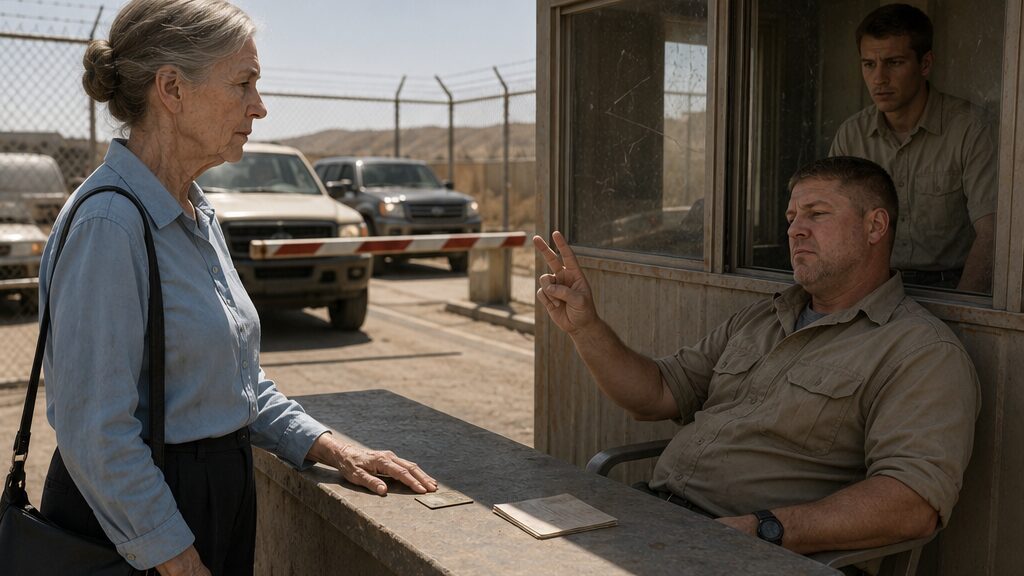
The Old Woman Laid Her Faded Base Card On The Counter And Waited
Chapter 1: The Card Stayed Flat On The Counter
Jason Miller looked at the faded card for less than a second before he lifted two fingers and pointed Margaret Carter toward the side of the lane.
“Ma’am, step over there.”
The card stayed flat on the concrete counter between them.
Margaret did not move it. She did not pull it back into her purse or cover it with her palm. She kept two fingers resting lightly across one corner, just enough to keep the hot wind from catching it. The plastic had yellowed around the edges. The old seal in the center had faded to a dull ghost of blue. A thin crack ran from one corner toward the photograph, stopping just short of the face she had worn forty years ago.
Behind her, an engine coughed.
Someone in the line of vehicles gave a short, impatient honk.
Jason leaned back in his chair beneath the shade of the checkpoint booth, one boot braced against the low wall, one hand loose near the radio clipped to his vest. The sun had not touched him all morning. Margaret could see the thin line where the booth roof ended and the heat began. She stood on the wrong side of that line.
“I have an appointment,” she said.
Her voice was not loud. It carried because she had spent years learning how not to waste breath.
Jason glanced from her face to the card again, then to the printed visitor sheet she had placed beside it. “This is old format.”
“Yes.”
“We don’t use these anymore.”
“You still cross-reference the back code.”
His eyebrows drew together, not in interest, but in the small irritation of a man hearing a correction from someone he had already sorted into the wrong category. “Ma’am, I’m telling you what the process is now.”
Margaret looked at him. He was maybe mid-forties, broad through the shoulders, with close-cropped hair and a sunburn line at his collar. Not cruel. Tired, maybe. Too comfortable in the chair. Too sure the counter made him taller.
“I’m asking you to check the back code,” she said.
A pickup behind her rolled forward three feet and stopped too close. Gravel cracked under its tires. The driver leaned sideways, trying to see what the delay was. Beyond the booth, the base road shimmered. Chain-link fencing ran in both directions, silver and hard against the pale sky. A sign bolted to the gate read AUTHORIZED ACCESS ONLY. Below it, a smaller temporary notice announced that the west communications wing would close at 1300 for renovation clearance.
Margaret had read that notice twice on her walk from the visitor parking area.
Jason tapped the counter beside the card, not touching it. “Do you have a current military ID?”
“No.”
“Current contractor badge?”
“No.”
“Sponsor?”
“Records office. Anna Lopez.”
He exhaled through his nose and looked into the booth. A younger man sat behind the scratched glass, half turned toward a computer monitor. Timothy Allen, according to the stitched strip on his shirt. He had been watching since Margaret placed the card down.
Jason raised his voice without taking his eyes off Margaret. “You got a Lopez appointment?”
Timothy clicked through something. “Records office has a Lopez on duty.”
“Appointment.”
Another click. “Visitor Carter, Margaret. Eleven-thirty.”
Jason gave a small shrug, as if the existence of her name had not improved her case. “Appointment doesn’t clear access.”
“I know.”
“Then you know why I’m asking you to step aside.”
Margaret felt the first bead of sweat move behind her ear. She had pinned her gray hair close that morning because wind at desert bases always found loose strands. Her blouse was pale blue, buttoned cleanly at the throat. Her shoes were old black walking shoes polished more carefully than they needed to be. In her purse, folded in a white envelope, was the appointment confirmation Anna Lopez had mailed after three phone calls and one handwritten request.
On the counter lay the only thing Anna had said might help.
Bring anything with old room designation, she had told Margaret. Anything with a channel mark, drawer number, unit routing, even if it looks obsolete.
Margaret had brought the card because it was the last thing she owned with the room printed into its back code.
Jason lifted the visitor sheet and frowned at it. “Purpose says archive review.”
“Yes.”
“Archive review for what?”
“Communications log.”
“You family?”
“No.”
“Press?”
“No.”
“Then why are you reviewing a communications log?”
Margaret heard the honk behind her again, longer this time. The pickup driver muttered something through his open window. A second vehicle idled behind him. The smell of heated rubber and dust spread across the lane.
She could have answered sharply. She could have said she had served before Jason had learned to read a gate sign. She could have said she knew the difference between a valid cross-reference code and a souvenir. She could have said she had sat behind a field console with a headset pressed so hard to her ear it left bruises.
Instead, she slid the card one inch closer to him.
“Please check the back.”
Jason did not pick it up.
He looked past her at the growing line, then raised the same two fingers again, this time more firmly, aiming them toward a narrow strip of shade beside the fence. “Ma’am. Step aside. I’ll get to you when I can.”
The words were polite enough to be defensible. The tone was not.
Margaret left the card where it was for one breath longer. The counter had small pits in the concrete, and a crescent stain from old coffee near the radio log. She watched Jason’s fingers lower. She watched Timothy behind the glass look away from the card as though he had been caught seeing too much.
Then she picked up the visitor sheet, but not the faded card.
Jason’s eyes flicked down. “You need to take that with you.”
“You need it to check the back code.”
“I didn’t say I was checking anything.”
“No,” Margaret said. “You didn’t.”
The heat pressed against the back of her neck. Her knees had been stiff since the walk from the parking area, but she made them bend cleanly as she stepped out of the lane and toward the fence. She could feel the pickup driver staring at her. She could feel, more than hear, the quiet judgment of people delayed by an old woman with papers.
Jason took the card at last, pinching it between two fingers as if it might leave dust on him. He turned it over with a careless little flip.
Margaret stopped in the strip of shade beside the fence. It was too narrow to cover both shoulders. She held her purse strap with one hand and the visitor sheet with the other. The old gate booth window reflected the sky, the fence, and her own small figure standing apart from the flow of traffic.
Inside the booth, Timothy leaned closer to Jason’s hand.
At first, the younger man’s face stayed neutral. Then his smile faded. His mouth tightened slightly, not in alarm, but in recognition of something that did not match the way Jason had spoken.
He looked from the back of the card to Margaret.
Then he stopped smiling altogether.
Chapter 2: The Window Made Everyone Look Smaller
From inside the booth, everyone looked reduced by glass.
The drivers became faces cut into pieces by glare and windshield frames. Jason became a shoulder, an elbow, a hand moving across forms and badges. The old woman near the fence became pale hair, blue blouse, black purse strap, and two steady shoes planted in the dust.
Timothy Allen had learned not to stare at people while they were being delayed. It made them either angry or ashamed, and neither helped the line move faster. But he kept finding his eyes pulled back to Margaret Carter.
She had not complained once.
Most people complained by the second minute. Contractors complained because they were paid by the hour. Delivery drivers complained because they believed every gate was personally designed to ruin their route. Visitors complained because bases made them nervous and nervous people filled silence with explanations.
Margaret stood with the visitor sheet folded in both hands and watched the booth as if waiting were an assigned duty.
Jason slid her card onto the inside shelf through the pass slot. “Look up old format access. Probably nothing.”
Timothy took it carefully before Jason could drop it.
The card was warmer than he expected from lying on the counter. Its front showed a photograph of a young woman with dark hair pulled back, direct eyes, and the unsmiling expression of someone told not to smile for official records. The name was worn but readable: CARTER, MARGARET. The old base designation had changed twice since then. The expiration date was decades gone.
“See?” Jason said. “Souvenir.”
Timothy turned it over.
The back was worse, rubbed nearly smooth by years in a wallet or drawer. A strip of numbers remained under the laminate, faint but not gone. Below it, printed in small block letters, was a designation Timothy had seen only in archived lists: W-COMM AUX 3.
He sat up.
“What?” Jason asked.
“Nothing. Just old.”
Jason gave him a look. “That’s what I said.”
Outside, the pickup rolled through after Jason waved it on. The driver glanced toward Margaret with the brief annoyance of someone who had already decided the whole delay was her fault. Margaret did not look at him. She kept her face turned toward the booth window.
The glass was scratched from years of blown sand. Timothy could see her only in broken pieces whenever the sun shifted. Her eyes were calm, but not empty. That bothered him most. He had seen confused visitors. He had seen lonely retirees who wanted to talk about when the base still had a bowling alley, a chapel choir, a theater. Margaret did not have that searching, wandering look.
She looked like someone watching a clock no one else could hear.
“Lopez said records?” Timothy asked.
Jason was stamping a temporary pass for the next vehicle. “That’s what the sheet says.”
“Maybe we should call.”
“We did. Appointment exists. Access doesn’t.”
“The appointment is for eleven-thirty.”
Jason checked the wall clock. “Then she should’ve brought current credentials at eleven-twenty.”
Timothy glanced toward the temporary notice by the gate. WEST COMMUNICATIONS WING CLOSURE: 1300. Clearance crews report at 1230. He had taped that notice to the sign himself that morning, smoothing the corners with the side of his hand.
“Isn’t the comm wing closing today?”
Jason did not look up. “Half the west side is closing.”
“For renovation clearance.”
“That’s what closing means.”
Timothy kept the card low, out of the window’s glare. “Her back code says W-COMM AUX 3.”
Jason paused. Not long. Just enough to show he had heard.
“Old labels,” he said.
“They still use some of them in archive cross-reference.”
Jason turned his head slowly. His expression warned Timothy to be careful where he placed his concern. “You want to clear her through on a dead badge?”
“No.”
“Good.”
“I just think we should call records again.”
Jason leaned back, chair creaking under him. “You’re new enough to think every odd thing is a special case. You know how many old cards come through here? People keep everything. Base stickers from 1988. Retired dependent cards. Contractor badges from buildings that don’t exist. They show up wanting to see where they used to work, and if we let one in wrong, it lands on us.”
Timothy knew that was true. He also knew truth could become a shield for laziness if a man held it at the right angle.
Outside, Margaret shifted her weight. Not much. Her right hand moved briefly to her knee, then returned to the visitor sheet. The shade had slipped away from one shoulder. She did not step into the traffic lane to reclaim it.
Jason picked up the desk phone and dialed records with the weary motion of someone doing a favor he planned to resent.
“Records? Checkpoint Three. I’ve got Margaret Carter here for Lopez.” He listened. “I understand she has an appointment. That’s not access.” Another pause. “Old format card, no current ID.” He looked at the card in Timothy’s hand. “Some kind of comm code on the back.”
Timothy watched Margaret through the scratched window.
At the mention of the code, she looked down. Not embarrassed. Braced.
Jason covered the receiver. “Lopez is coming to the front office. Says keep her there.”
“Inside or outside?”
Jason gave him a flat look.
Timothy held the card a little tighter. He almost said, She’s seventy-something and standing in the heat. He almost said, She had the code right. He almost said, You didn’t even check before you made her step aside.
Instead he asked, “Should I give her a chair?”
Jason uncovered the receiver, finished the call, and hung up. “Don’t turn a delay into a situation.”
The words settled between them.
Through the glass, Margaret seemed both close and far away. She had folded the visitor sheet into a smaller rectangle, each crease exact. Timothy thought of his own grandmother, who folded receipts the same way at pharmacy counters, as if neatness could protect her from being rushed.
He looked back at the card.
W-COMM AUX 3.
There were laminated binders under the side shelf for old routing conversions. Timothy had used them only once, during training, when the shift supervisor told him the new system was never as complete as people pretended. He pulled the bottom binder free.
Jason heard the plastic cover scrape. “What are you doing?”
“Looking up the old code.”
“You already know it’s old.”
“That’s why I’m looking it up.”
Jason stared at him long enough to make Timothy’s neck warm. Then another vehicle pulled up, and the guard turned away to handle it.
Timothy opened the binder on his lap below the window line.
The pages smelled faintly of dust and copier toner. Most codes had been crossed out, replaced by newer routing numbers. He flipped past motor pool, chapel annex, field storage, medical overflow, west administration. His finger slowed near the communications section.
W-COMM MAIN. Converted.
W-COMM TOWER. Removed.
W-COMM AUX 1. Sealed.
W-COMM AUX 2. Digitized.
Then he found it.
W-COMM AUX 3 — communications emergency channel file room. Archive cross-reference active. Manual review required before disposal.
Timothy read the line twice.
Outside, Margaret Carter waited without asking whether anyone had finally believed her.
Chapter 3: The Old Room Was Already On The Work Order
Anna Lopez first saw Margaret Carter through the front office camera, a small figure standing beside the checkpoint fence while traffic moved around her.
The screen sat above Anna’s desk between two stacks of transfer forms. She had been initialing disposal holds since eight that morning, each paper tagged with a color strip according to urgency. Green for digitized. Yellow for partial review. Red for restricted. The west communications wing had too many yellows and not enough staff.
When the checkpoint called again, Anna answered with one hand still on a file box label.
“Yes, I know she has an appointment.”
She listened.
Then she stopped writing.
“What code?”
The line crackled. Anna pressed the receiver closer. Across the office, a copier dragged paper through its rollers with a tired mechanical cough.
“Say that again.”
W-COMM AUX 3.
Anna looked at the red folder on the corner of her desk. She had not expected that designation to come through the gate. She had expected, at most, an elderly visitor with an old unit memory and a sincere but impossible request. The letter Margaret Carter had mailed three weeks earlier had been careful, almost spare.
I am requesting review of one paper communications log before west wing closure. I believe one service member’s final transmission was filed under an incomplete identifier.
No accusation. No drama. No demand for ceremony.
Anna had approved the appointment because the request was specific and because the room was closing. She had not expected the checkpoint to make it harder than it already was.
“Send her to records,” Anna said. “No, not alone. Give her a visitor sticker and have someone escort her.” She paused, hearing resistance form before it was spoken. “Then call the shift supervisor and say I requested it.”
By the time Margaret reached the records office, the visitor sticker on her blouse looked too bright against the faded blue fabric. It was printed with the wrong kind of authority: new ink, clean barcode, temporary permission. In her hand, she carried the old card.
Anna stepped out from behind the counter before Margaret could be made to wait again.
“Mrs. Carter?”
“Margaret is fine.”
“I’m Anna Lopez. I’m sorry about the delay at the gate.”
Margaret’s eyes moved over Anna’s face, not searching for pity, simply measuring whether the apology was useful. “I’m here now.”
“Yes.” Anna gestured toward the corridor. “Come with me.”
The records office occupied a low building with thick walls and narrow windows. It smelled of toner, cardboard, floor wax, and old paper that had been boxed too long. A wall clock above the intake desk read 11:52. Anna saw Margaret notice it.
“We have just over an hour before the clearance crew takes control of the west wing,” Anna said.
Margaret’s hand closed around the card. “Then I’ll be brief.”
Anna led her past rows of labeled cartons and a metal cart stacked with folders. At the end of the corridor, a temporary barrier blocked the passage toward the old communications wing. Beyond it, the floor changed from polished tile to dull sealed concrete. Work lights had been strung along the hall. A maintenance worker knelt by a baseboard, removing a cover plate.
“That section is already on the work order,” Anna said. “Utilities first, then fixtures, then file remnants.”
“File remnants?”
“Anything not already transferred.” Anna heard how careless it sounded as soon as she said it. “That’s the term on the work order.”
Margaret looked down the blocked corridor. “Paper has a way of becoming a remnant when everyone gets tired of looking at it.”
Anna did not answer quickly. She had spent six years defending records against people who thought every box contained either treasure or trash, never ordinary evidence of ordinary duty. She knew the limits of paper. She also knew the arrogance of believing a database had swallowed history whole.
“You mentioned a communications log,” Anna said.
“Yes.”
“Do you have a box number?”
Margaret unfolded a small appointment note from her purse. It had been written in firm, slanted handwriting. At the top was the old designation: W-COMM AUX 3. Below it, a shorter line: channel 4 relay / west board / night intake. Under that, a number that did not match current formatting.
Anna studied it. “Where did this number come from?”
“From my shift copy.”
“You still have that?”
“No. I copied it before I turned the sheet in.”
“When?”
Margaret’s eyes stayed on the temporary barrier. “A long time ago.”
Anna walked her back into the office and pulled up the archive system on a side terminal. Margaret did not sit until Anna offered the chair twice. Even then, she perched near the edge, purse in her lap, card resting on top of it. The visitor sticker on her blouse had begun peeling at one corner from the heat.
Anna entered W-COMM AUX 3.
The system took too long to respond.
A list opened: digitized summaries, equipment inventories, closure photographs, environmental checks, cable maps. She searched within results for channel 4 relay. Nothing. West board. Nothing. Night intake. Too many hits, most unrelated.
“What year?” Anna asked.
Margaret gave it.
Anna entered the date range. The list thinned.
Still nothing.
She tried William Robinson.
No result.
Margaret did not react outwardly, but Anna saw one finger press against the edge of the old card until the cracked plastic bent slightly.
“Could it be under a unit number?” Anna asked.
“It should be under his name.”
“But if it was misfiled—”
“It was misheard first,” Margaret said.
The copier across the room stopped. For a moment, the office seemed to listen.
Anna lowered her voice. “What was misheard?”
Margaret turned the card over on her lap. The back code caught the overhead light in a faint broken line.
“A call sign. Then a surname. Then everything after it got treated like noise.”
Anna waited. She had learned that pushing too fast made people close doors they had spent years opening.
Margaret looked at the clock. “I’m not asking for a ceremony. I’m not asking for a display case. I’m asking for the paper log from that room.”
Anna checked the system again, this time searching the old box number exactly as Margaret had written it.
No match.
She tried removing the dash.
No match.
She tried the old designation with the number.
The screen returned a blank gray pane.
Anna felt the familiar bureaucratic dread of an absence that looked official. A missing thing in a database did not appear lost. It appeared never to have existed.
She printed the search results anyway, because paper sometimes gave people something to hold when systems refused them.
Margaret watched the page emerge.
Anna took it from the tray but did not hand it over immediately.
“I’m sorry,” she said. “That box number doesn’t exist in the system.”
Margaret’s face did not change.
Only her hand moved, closing over the faded base card as if the old plastic had become the last solid object in the room.
Chapter 4: William Robinson Was Only A Blank Line
Margaret had known the system would not find him.
Still, hearing Anna Lopez say it made the old air leave her chest in a slow, careful way. She did not sigh. She had learned long ago that a sigh could be mistaken for surrender, and she was not surrendering. She only looked at the page Anna had printed, at the empty result box where William Robinson’s name should have been.
No matching records.
The words were clean. That was what made them cruel.
Anna stood beside the terminal holding the paper by one corner. She did not push it across the desk. Margaret appreciated that. Some people handed bad news too quickly, as if transferring it made them less responsible for how it landed.
“There may be alternate spellings,” Anna said. “There may be a unit file, not a personal file. Sometimes old transmissions were indexed under—”
“Noise,” Margaret said.
Anna looked at her.
Margaret set the faded base card on top of her purse. The old plastic made a small, dry sound against the leather. “That was the word they used.”
Anna lowered herself into the chair opposite her. The records office kept moving around them. Phones rang softly. A cart squeaked past the doorway. Somewhere behind the counter, a clerk was tearing tape from a roll in quick, sharp pulls. The day had no respect for what was missing.
Margaret looked toward the hallway. Beyond it was the temporary barrier, the concrete floor, the work lights, the room they had decided was nearly empty.
“I was on night intake,” she said. “Not the main board. Auxiliary three. We took overflow when traffic got heavy or when weather pushed signals off their regular path.”
Anna did not interrupt.
Margaret’s thumb found the crack in the corner of the card. She remembered the photograph on the front, the young woman with the hard mouth and the dark hair pulled back. She had disliked that photograph when it was taken. She had thought it made her look severe. Now she thought it made her look untested, though she had not been.
“There was a convoy reroute that night,” Margaret said. “No one expected it on our line. We were getting fragments from three channels at once. Rain in one sector, dust in another, interference from equipment that should have been replaced six months earlier.”
She stopped, because she had not come to tell the whole story. Whole stories were how people made displays out of other people’s last moments. They picked the parts that made listeners hold their breath. They polished the pain until it shone.
William Robinson had not asked to shine.
Anna’s voice stayed low. “Was William Robinson in that convoy?”
Margaret shook her head. “He was ahead of it.”
The hallway seemed to narrow in her memory, although she was sitting in a bright office. The old room returned in pieces: black console, green indicator lights, clipped maps curling at the corners, the dry taste of powdered coffee gone cold. A headset pressing her hair flat. Her own handwriting on a message pad. Rain static bursting in her ear though the base outside had been clear.
A voice cutting through.
Not strong. Not cinematic. Strained, clipped, breath held between words.
Robinson. West ridge washed. Do not send them through channel road. Repeat. Do not send them—
Then static so hard it felt like tearing cloth.
“There were two Robinsons in theater,” Margaret said. “One on the official roster for that night. One attached temporarily to route clearance. William was the temporary attachment. His call sign got clipped. His surname came through, then part of the warning. The reroute was entered. The convoy turned. Men came home because it turned.”
Anna’s hands were still on the printed page.
“But his transmission?”
“Filed under the other Robinson first. Then corrected to an unidentified auxiliary source. Then left that way because the corrected sheet never reached the main packet.”
“How do you know?”
Margaret looked at the card. “Because I wrote the corrected sheet.”
The office sounds seemed to pull farther away.
“I was twenty-nine,” she said. “Old enough to know procedure, young enough to believe procedure saved everything if you followed it cleanly. I wrote the sheet before dawn. Full name. Temporary attachment. Relay path. Time stamp. Channel note. I put it in the outgoing tray for review.”
“What happened to it?”
“The power failed in the west wing after the storm system hit the relay tower. We moved three cabinets that morning. Intake got split between main and auxiliary. Someone bundled the outgoing tray with manual logs.” Margaret pressed her thumb more firmly into the card’s cracked corner until it hurt. “I was told it would be sorted.”
Anna did not ask the obvious question. Margaret answered it anyway.
“It wasn’t.”
A door closed somewhere in the hall. Margaret blinked once, slowly.
“I checked later. Twice. Then I was reassigned. Then there were other duties, other names, other mistakes that belonged to other people. Years passed. The digital archive came. I requested a correction in writing. They sent back a form saying the record was incomplete.” She folded her hands over the purse. “Incomplete is a soft word. It sounds like the paper got tired.”
Anna looked down at the empty result sheet. “Why now?”
Margaret could have said because she was old. Because the people who remembered the old routing system were dying, retiring, forgetting, being moved into smaller houses by adult children who threw away boxes they did not understand. Because three weeks ago she had received a forwarded notice from a former unit family mailing list saying the west communications wing would close, and she had sat at her kitchen table for forty minutes with the card in front of her before reaching for a pen.
Instead, she said, “I promised him once.”
Anna waited.
“Not in person.” Margaret’s mouth tightened at the foolishness of how that sounded. “He said, ‘Make sure they hear it.’ That was the last clear thing I heard. I thought he meant the warning.”
Anna’s face changed a little. Not pity. Worse would have been pity. This was attention.
“He meant the warning,” Margaret said. “Maybe that was all. But I have wondered for forty years if he also meant his name.”
She had not meant to say that much.
The words sat between them, bare and unfiled.
Anna turned back to the terminal. Her fingers moved faster now, not frantic, but committed. She searched by date, by auxiliary source, by channel road, by temporary attachment. She searched for the other Robinson and found pages too quickly, too neatly indexed under a different first name. She opened a scanned summary with several redactions and a box reference in the lower margin.
“Here,” Anna said.
Margaret leaned forward.
The file contained a convoy reroute entry. It noted a warning received through auxiliary communications. It credited the correction to a routing officer whose name Margaret recognized only as someone who had signed off later. The source line read: ROBINSON / partial / noise.
No William.
Anna printed that page too.
Margaret did not touch it.
“I’m sorry,” Anna said.
Margaret nodded once, not accepting the apology exactly, but acknowledging that Anna had offered something human instead of procedural.
Anna kept scanning the lower margin. “This box reference is different from the one you brought.”
“Yes.”
“Your number might be a drawer designation, not a box number.”
“It was written on the side of the manual cabinet.”
“The cabinet should have been inventoried.”
“Should have been.”
Anna stood so quickly her chair rolled back and bumped the wall. She took a red folder from the corner of her desk, opened it, and pulled out the west wing demolition intake sheet. Margaret watched her move through the pages, lips pressed together, one finger tracing columns.
“Most of the furniture is cleared,” Anna said. “But there’s a note from maintenance. One metal file drawer still in place because the cabinet was bolted beneath a relay shelf.”
Margaret’s hand went still.
Anna turned the sheet around.
The handwritten note near the bottom was crooked and almost missed between two work-order stamps: unlisted drawer under Aux 3 bench — stuck / remove during clearance.
Margaret read it once. Then again.
Anna looked toward the hallway. “The clearance crew reports in less than half an hour.”
Margaret picked up the faded card and rose from the chair. Her knee caught, a small sharpness that crossed her face before she smoothed it away.
Anna reached for the phone. “I’ll get an escort.”
Margaret looked at the temporary visitor sticker peeling from her blouse, then at the old card in her hand.
“Get the one who has to unlock the door,” she said.
Chapter 5: The Guard Had To Unlock What He Had Mocked
Jason Miller had spent eleven years learning that gates punished hesitation.
One wrong clearance, one overlooked badge, one contractor waved through because the line was long and the heat was bad, and the error came back with signatures attached. The last time he had made a judgment call, the shift supervisor had stood in the booth doorway holding a report and asked why Jason had decided a rule was optional. The visitor had been harmless. That had not mattered. Harmless mistakes still counted.
So Jason trusted systems. He trusted current badges, fresh printouts, active barcodes, valid sponsorships. He did not trust old cards carried in purses by people who remembered buildings by names no map used anymore.
At least, that was what he told himself while walking behind Margaret Carter toward the west communications wing with the old key ring heavy in his hand.
Anna Lopez walked ahead with the red folder pressed to her side. Timothy followed half a step behind Jason, carrying the printed cross-reference pages and trying not to look as if he had won an argument. Margaret walked between them all, slow but steady, her purse tucked close, her faded base card now back in her hand.
Jason had not meant to return it carefully.
When Anna called the booth and told him to escort Margaret to the west wing, he had picked up the card from the shelf where Timothy had placed it. The old habit of irritation had risen first. Then he saw, truly saw, the crack near the photograph. The worn back code. The place where Margaret’s fingers had polished one edge smooth over years.
He had slid it across the counter instead of setting it down.
Margaret had looked at the card, then at him.
Not grateful. Not triumphant. Just aware.
That had been worse than if she had snapped.
Now the corridor smelled of warm concrete and disturbed dust. Temporary work lights hung from orange cords along the wall. The farther they walked from the front office, the less the base felt like a clean modern installation and the more it felt like something being opened after a long illness. Ceiling panels were missing in places. Old conduit ran exposed near the corners. Blue painter’s tape marked doors scheduled for removal.
Jason cleared his throat. “Ma’am, step around that cable.”
Margaret had already seen it. She stepped over it with deliberate care.
Timothy looked down.
Anna stopped at the temporary barrier and signed the entry sheet clipped to a stand. “We have authorization for manual review of one unlisted drawer.”
The maintenance worker near the wall glanced up from his tools. “You got twenty minutes before the crew lead wants this corridor locked.”
Anna looked at him. “We’ll take what the authorization gives us.”
The worker shrugged and went back to removing a metal plate.
Jason unlocked the barrier chain. The padlock resisted for a second, gritty from outdoor storage. He felt Margaret waiting behind him. The small sound of the key scraping inside the lock seemed louder than it should have.
He opened the chain and held it aside.
Margaret walked through without comment.
That was how she kept doing it. Without comment. She did not make it easier for him by being angry. She did not make it harder by forgiving him. She simply carried on, and each quiet step made the scene at the checkpoint replay in his head with less defense available.
Ma’am, step over there.
Her card flat on the counter.
His two fingers in the air.
The drivers watching.
He had not shouted. He had not insulted her. If the report described it, it would say he delayed an unclear visitor pending access verification. Proper words could make almost anything look clean.
But he had seen the way the pickup driver looked at her. He had heard his own tone. He had watched her move into that thin strip of shade like someone obeying an order she did not deserve.
The communications wing door stood at the end of the hall, paint faded around a removed sign. Only the outline remained: a pale rectangle where words had once been. Anna checked the work order, then nodded to Jason.
“This one.”
Jason selected a larger key from the ring. “Not sure this opens anymore.”
Margaret spoke behind him. “It will if it was never replaced.”
He glanced back despite himself. “You remember the lock?”
“I remember the room.”
The answer was simple. It carried no challenge. Still, Jason felt heat climb his neck.
He fitted the key.
It turned halfway and stopped.
The maintenance worker called from down the hall, “That door sticks. Whole frame shifted.”
Jason tried again, harder. The key refused. He adjusted his grip.
“Don’t force it,” Margaret said.
He almost said, I know how to open a door. The words reached the back of his teeth and died there.
Margaret stepped closer. “May I?”
Jason looked at Anna. Anna looked at Margaret. Timothy held the papers tighter.
Jason moved aside.
Margaret did not take the key from him. She placed her fingertips against the door just above the handle, testing not the lock, but the weight of the wood. Then she pressed her palm near the upper hinge and nodded toward Jason’s hand.
“Lift while you turn. Not much. Just enough to take the sag off the latch.”
Jason stared at the door.
The maintenance worker had stopped pretending not to listen.
Jason lifted the handle gently and turned the key. The lock gave with a dull metal click.
Margaret stepped back.
No one spoke for a moment.
Anna reached for the knob, but Jason opened the door himself. A stale breath of trapped air moved out into the corridor. Dust, old wiring, dry paper, and something metallic.
Inside, the room was smaller than Jason expected. A long bench ran along one wall beneath dead relay panels. A few shelves stood empty. On the far side, under a mounted strip of obsolete equipment, sat a gray metal drawer built into the base of the bench. A paper tag hung from its handle, curled and brown at the edge.
UNLISTED — REMOVE.
Margaret stood at the threshold.
For the first time that day, Jason saw hesitation in her. Not fear. Something more disciplined than fear and more painful than reluctance.
Anna softened her voice. “Mrs. Carter?”
“Margaret,” she said, but she did not move.
Jason looked at the drawer. Then at the card in her hand.
He remembered Timothy reading the code aloud. W-COMM AUX 3. He had dismissed it because it was old. Now the old room had opened for her hand on a shifted door and a key he had nearly forced wrong.
He held the key ring lower.
“Do you want me to stay outside?” he asked.
Margaret turned her head. Her eyes were tired, but clear.
“No,” she said. “You opened it. You should see what delay looks like after forty years.”
The words were not sharp. That made them land harder.
Jason nodded once.
Anna entered first to check the floor, then Timothy with the papers. Margaret stepped in after them. Jason followed last.
The old drawer waited beneath the bench.
Jason crouched and fitted a smaller key into its lock.
This one did not turn at all.
Chapter 6: The Drawer Opened Without Making A Sound
The room remembered sound differently than Margaret did.
It held silence in square shapes: the blank place where the wall clock had hung, the empty brackets above the bench, the dead relay panels with their dark little windows. Once, this room had clicked and hummed and breathed with voices arriving broken from distances no one in the room could see. Now every footstep sounded borrowed.
Margaret stood just inside the doorway and let the others notice the dust first.
Anna covered her mouth with the back of one hand, then lowered it as if embarrassed by the gesture. Timothy moved carefully around a coil of cable near the wall. Jason remained crouched at the drawer, trying the key again with less force this time.
“It’s not taking,” he said.
Margaret looked at the drawer. Gray metal. Narrow handle. A chipped label holder at the top left corner. The paper tag hanging from the handle was new, but beneath it, almost hidden by dust, was the outline of an older label.
She stepped closer.
Her knees did not like crouching anymore, so she lowered herself slowly, one hand on the bench. Jason shifted as if to help her. She pretended not to see it, and he pretended he had not started.
The drawer face was colder than the room. Margaret wiped the corner of the label holder with her thumb. Dust streaked away in a pale crescent.
AUX 3 / NIGHT / RELAY
The letters were faded, but there.
Anna inhaled. “That was not in the inventory.”
“No,” Margaret said.
“Can you open it?” Timothy asked.
Margaret looked at Jason’s key ring. “Not with that.”
Jason’s face tightened. “It’s the set they gave me.”
“I know.”
She took the faded card from her pocket and turned it over. The back code, half rubbed smooth, caught the light from the work lamp. W-COMM AUX 3. Below the printed line, almost invisible, were three small punched notches along the lower edge of the plastic.
Timothy leaned nearer. “I didn’t notice those.”
“You weren’t meant to,” Margaret said.
Jason looked from the card to the drawer. “That card is a key?”
“No. It told us which key not to use.”
Anna knelt beside Margaret now, no longer caring about the dust on her slacks. “What does that mean?”
Margaret rested the card against her palm. The old plastic fit there differently than it had at the gate. On the counter, it had been evidence no one wanted. Here, beneath the dead panels, it became a map of a habit almost no one alive would remember.
“Auxiliary drawers had manual lock overrides,” Margaret said. “Different from door keys. If a cabinet had an emergency channel record, the room card carried a notch pattern. It matched the release slot under the drawer. We used it when power failed or when the key cabinet was sealed.”
Jason bent closer to the drawer. “There’s no slot.”
“Under the lip.”
He reached, then stopped. “You should do it.”
Margaret heard the effort that cost him. She did not reward it aloud.
She felt beneath the drawer handle until her fingertips found the narrow groove. For a moment she was twenty-nine again, annoyed at a jammed drawer during a storm watch, one hand holding a headset to her ear while another operator snapped, Carter, get the manual sheets before the board goes blind.
Her hand trembled now. Not much. Enough.
She steadied it by placing the faded card flat against the drawer face, aligning the notches with a mark she could barely see.
Nothing happened.
The maintenance worker appeared in the doorway. “Crew lead says ten minutes.”
Anna looked back sharply. “We’re in an active manual review.”
“He says ten.”
Margaret did not look away from the drawer.
She adjusted the card one notch to the left.
The groove accepted it.
There was no dramatic snap, no groan of metal, no release loud enough for anyone in the doorway to hear. The drawer opened without making a sound. It slid forward half an inch, as if it had been waiting too long to resist.
Timothy whispered, “I’ll be.”
Jason said nothing.
Margaret pulled the drawer open.
Inside were hanging folders, brittle at the edges, their tabs handwritten in ink that had browned with age. Some contained equipment checks. Some held routing sheets. Some were empty except for dust and paper clips. Anna began photographing the drawer before touching anything, her professional instincts returning at last.
“Date range?” she asked.
Margaret gave the year.
Anna found the section. Timothy held the printed cross-reference pages beside her. Jason stood back, one hand resting against the bench, as if keeping himself from interfering.
Margaret did not reach for the folders at first. She let Anna lift them because records had rules, and rules mattered when used correctly. But she watched each tab. Her eyes moved faster than her hands could have.
Night intake.
Relay interruption.
Weather deviation.
Auxiliary source correction.
“There,” Margaret said.
Anna froze. “This one?”
Margaret nodded.
The folder was thin. Too thin for forty years of carrying.
Anna opened it on the bench beneath the work light. The first sheet was a routing summary. The second, an equipment interruption report. The third was torn at the corner. The fourth was a manual message intake sheet, yellowed and creased, with carbon smudges near the bottom.
Margaret knew her handwriting before she saw her initials.
It was smaller than she remembered. Tighter. The letters leaned forward as if running ahead of time.
Channel 4 relay. West board overflow. Warning received 0238. Source: W. Robinson, temporary route clearance attachment. Message partial but actionable. Do not send convoy through channel road. Ridge washout confirmed by follow-up.
Below it, in a different hand, a later note: Entered as Robinson / partial due to signal loss. Verify full first name before final packet.
No verification signature followed.
The line simply stopped.
Margaret placed one hand on the bench. She had expected relief to be warm. It was not. It was cold and clean and moved through her so sharply that for a second she could not speak.
Anna read the sheet twice. “This is it.”
Timothy looked at Margaret. “He warned them.”
“Yes.”
“And they turned?”
“Yes.”
“How many?”
Margaret closed her eyes for one breath. She saw headlights in rain she had never stood under. She saw map grease pencil. She heard a voice saying, Make sure they hear it.
“Enough,” she said.
Anna’s voice was careful. “This can support a correction. It may still need review, but with the original manual sheet, the entry can be amended.”
“Under his name?”
“Yes. Under William Robinson.”
The name entered the room and stayed.
Jason turned away slightly. Margaret noticed, but did not follow his face. He deserved privacy for whatever was happening to him now, just as she had deserved privacy at the gate and had not received it.
The maintenance worker spoke again from the doorway, quieter this time. “They really do need to lock this section.”
Anna gathered the sheet into a protective sleeve from her folder. “I’m taking custody of this record now.”
Margaret looked at the paper through the clear sleeve. Her handwriting blurred a little, then steadied.
Jason stepped closer. “Mrs. Carter.”
She turned.
He held her faded card in both hands. She had not realized she had set it down.
For a moment, no one else moved.
Jason did not apologize. Not yet. Maybe he understood that the room was not the place for him to make himself the center of the wound. He simply held the card out carefully, the way he should have held it at the counter.
Margaret took it.
His voice was rougher when he spoke again. “Do you want me to call the base commander?”
Anna looked up. Timothy looked between them.
Margaret slid the card into her pocket beside the appointment note. The old plastic pressed against her side, light as ever.
“No,” she said.
Jason blinked. “Ma’am?”
“She asked for review,” Margaret said, nodding toward Anna. “She found the record. You opened the door. That’s enough noise for one name.”
Jason looked as if he wanted to argue, but could not find a version of arguing that would not shame him further.
Margaret looked once more at the dead panels, the empty brackets, the drawer that had kept what the system lost. Then she turned toward the hallway.
Behind her, Anna held William Robinson’s name inside a clear sleeve, no longer a blank line, no longer noise.
Chapter 7: She Left Before Anyone Could Applaud
By the time they returned to the checkpoint, the sun had shifted far enough to put the counter in shade.
Margaret noticed that first. Not Jason’s silence, not Timothy walking ahead to open the booth door, not Anna holding the protected sheet against her chest as if the paper had become fragile because it was finally important. She noticed the counter where her card had lain that morning, the small pits in the concrete, the old coffee stain, the place where Jason’s two fingers had tapped beside the plastic without touching it.
The lane was quieter now. The lunch rush had passed. One delivery truck waited at the far sign, engine idling low. A driver inside looked down at a phone, unaware that anything had changed in the small booth ahead of him.
That seemed right to Margaret.
Most things that mattered did not change the weather.
Anna stopped beside the counter. “I’ll take this straight to records custody. The correction request will be entered today.”
Margaret looked at the clear sleeve. William Robinson’s name sat beneath the plastic in her own younger handwriting. Not carved in stone. Not announced from a podium. Not safe from every future error. But no longer only memory.
“Under his full name,” Margaret said.
“Yes.”
“And the source line?”
“Attached to the original manual sheet.”
Margaret nodded. “Good.”
Anna hesitated. “I can send you a copy once the record is amended.”
“I’d like that.”
“And if his family is still reachable—”
Margaret’s face moved before she could stop it. Not much, but enough. Anna saw it and stopped.
“If they are reachable,” Margaret said, “the record should go first. Not a story. Not a ceremony. A record.”
Anna accepted the correction with a small nod. “A record.”
Jason stood inside the booth, not sitting. The chair behind him had been pushed back against the wall. The scratched window was open now, slid aside so there was no glass between him and the counter.
Timothy noticed that Margaret noticed.
Jason removed the faded base card from the temporary clipboard where he had placed it for the walk back. He did not pinch it between two fingers this time. He held it flat in both hands, thumbs at the edges, careful of the crack near the photograph.
For a moment, Margaret saw again the young woman on the card. Dark hair. Direct eyes. A face trying not to look nervous. A face that believed the right entry in the right log could keep the world in order.
Jason set the card on the counter.
Not tossed. Not slid carelessly. Set down.
Then he moved his hands away.
“Mrs. Carter,” he said.
Margaret waited.
Jason looked at the card as if it might help him find the right words. “I was wrong at the gate.”
The delivery truck behind the sign rolled forward a few feet and stopped. Its brakes sighed. Timothy glanced toward it, then stayed still.
Jason swallowed. “I treated your card like it was just old. I treated you like you were confused. That wasn’t procedure. That was me.”
Margaret rested her fingers lightly on the card. It was cooler now than it had been in the late morning heat.
“You were guarding a gate,” she said.
“That doesn’t cover it.”
“No,” she said. “It doesn’t.”
His eyes lifted.
She had not said it sharply, but he took it as if she had handed him something heavy and expected him not to drop it.
“I’m sorry,” he said.
The apology stood in the open space where the window had been. No audience had gathered. No supervisor appeared to approve it. No one clapped. The delivery driver tapped his steering wheel, bored with waiting for a delay he did not understand.
Margaret looked at Jason’s chair pushed back against the wall.
“When people come to a gate,” she said, “they already know you can stop them. You don’t have to make them feel small to prove it.”
Jason’s jaw tightened. He nodded once.
“My grandmother used to fold every paper anyone gave her,” Timothy said quietly.
All three of them looked at him.
He flushed but did not retreat. “Receipts. Prescriptions. Appointment slips. She said if she kept them neat, people at counters couldn’t pretend she didn’t bring what they asked for.”
Margaret looked down at the folded visitor sheet still in her purse. She had folded it smaller at the fence without thinking.
“What was her name?” she asked.
Timothy’s answer caught in him for a second. “She’s gone now.”
Margaret nodded. She understood the correction. Some names were not ready to be brought into a room.
Jason glanced at the delivery truck. Then he reached for the pass printer, stopped, and looked back at Margaret. “Do you need a ride to visitor parking?”
“I walked in.”
“Yes, ma’am. I saw.”
“I can walk out.”
The old answer rose in him—policy, courtesy, heat, time—but he seemed to hear it before saying it. Instead he asked, “Would you allow an escort to the parking area?”
Margaret almost smiled. Not quite. “No.”
Jason accepted that too.
Anna shifted the red folder under one arm. “Margaret, I’ll need your mailing address confirmed before you leave. The corrected copy may take time.”
Margaret gave it. Anna wrote it carefully, repeating each number back. The act was simple, ordinary, and because it was ordinary, it steadied something in the afternoon.
When Anna finished, she held out her hand.
Margaret took it.
Anna’s grip was firm, professional, no longer hurried. “Thank you for insisting.”
Margaret looked toward the west wing, hidden beyond the low buildings and fencing. “I should have insisted sooner.”
Anna shook her head. “You came before the room closed.”
The sentence was kinder than forgiveness and more useful than regret.
Margaret placed the faded card back into her purse, but not deep inside. She tucked it in the side pocket where she could reach it without searching. The visitor sticker on her blouse had curled loose at one corner. She peeled it off carefully and set it on the counter beside the pass log.
Jason picked it up and placed it in the disposal tray.
The gesture should have meant nothing. It did not.
At the exit lane, Timothy lifted the small barrier arm before Margaret reached it. The red-and-white stripe rose with a mechanical hum. That morning, the barrier had seemed like the base itself deciding whether she still belonged to any part of it. Now it looked like painted wood on a hinge.
Margaret stepped past the booth.
“Mrs. Carter,” Jason called.
She turned.
He stood behind the counter, hands at his sides. For the first time all day, he did not seem larger for standing there.
“I’ll make sure the morning shift knows about old cross-reference cards,” he said. “Not as a favor. As procedure.”
Margaret studied him. “Procedure is better when someone remembers why it exists.”
“Yes, ma’am.”
She let that be enough.
The walk to visitor parking was longer in the afternoon. Heat lifted from the asphalt and pressed against her knees. She moved slowly, not because she wanted anyone to see her age, and not because she wanted to hide it. She moved at the pace her body allowed and carried herself as if that pace deserved room.
Halfway down the path, she stopped beside the fence and looked back.
Through the open booth window, Timothy was speaking to the delivery driver. He did not stay seated while the man searched for papers. He came to the counter. He waited while the driver checked a folder. When the driver apologized for the delay, Timothy shook his head and pointed to the shade.
Margaret could not hear the words, but she saw the shape of them.
Take your time.
She turned away before anyone could notice she had stopped.
At her car, she sat behind the wheel without starting the engine. For a while she simply let the silence gather. No static. No clipped voice. No one saying repeat, repeat, repeat into a channel breaking apart.
She opened her purse and took out the faded card.
The young woman in the photograph looked back with her severe mouth and untested eyes. Margaret placed the card on the passenger seat. Beside it, in her mind if not yet in paper, was William Robinson’s name restored to the line where it belonged.
She had thought the promise would leave when the record was found. It did not leave. It changed weight.
Lighter, but still hers.
A base vehicle passed at a distance. Somewhere beyond the buildings, workers would be sealing the old room, removing the stuck drawer, clearing the bench, taking down panels that had not carried a voice in decades. They could do it now. The room had held what it needed to hold until someone came for it.
Margaret started the engine.
Before pulling out, she looked once more toward the checkpoint. Jason was outside the booth now, directing the delivery truck through. He used two fingers to point the driver forward, then stopped, lowered his hand, and opened his palm instead.
It was a small correction.
Small corrections were still corrections.
Margaret drove toward the gate, past the fence, past the warning signs, past the booth window that no longer looked quite as scratched from this side. Jason stood straighter when she passed, but he did not salute. She was grateful for that.
She did not need a salute.
At the road, the barrier lifted.
Margaret Carter left before anyone could turn William Robinson into a speech, before anyone could call a commander, before anyone could ask her to stand in a room and receive a kind of attention that would have missed the point.
Behind her, in a records office that smelled of cardboard and toner, Anna Lopez carried a clear sleeve to a custody desk and wrote William Robinson’s full name on a correction form.
Ahead of her, the desert road shimmered.
Margaret drove into it with both hands steady on the wheel, the old card resting beside her, no longer proof that she had once belonged somewhere, but proof that she had come back long enough to leave someone else where he belonged.
The story has ended.