They Told the Old Mechanic to Step Back Before the Engine Remembered Him
Chapter 1: The Old Man Beside the Open Engine
Samuel Thompson saw the blackened wire before anyone told him the aircraft was grounded.
It sat half-hidden beneath the opened housing, no thicker than a line of burnt thread, twisted around a fastener near the bracket where clean metal should have held its shine. The younger technician had rolled the engine component onto the workbench under the warm hangar lights, and everybody else had been looking at the obvious things: the scorch marks, the scraped panel edge, the red tag hanging from the cowling, the maintenance tablet blinking with fault codes.
Samuel looked at the wire.
He did not touch it at first. He stood with his left hand in the pocket of his gray coveralls and his right hand curled against his thigh, fingers dark with grease from another job he had not finished. The hangar smelled of hydraulic fluid, dust, cold coffee, and rain blown in from the open bay doors. Beyond the bench, the grounded aircraft waited with its nose angled toward the light, broad and silent, as if embarrassed to be seen with its insides exposed.
“Mr. Thompson?” the younger technician asked.
Samuel lifted his eyes.
The kid had a torque wrench in one hand and worry in the other. Samuel could always see worry in hands. They moved too fast, or too carefully, or not at all.
“You were on the intake panel yesterday, right?”
“Morning shift,” Samuel said.
“Before the preflight?”
Samuel nodded once.
The younger technician swallowed. “They said not to move anything until the investigator gets here.”
Samuel looked back at the open housing. The wire had darkened unevenly, not from one clean failure but from heat gathering over time. The twist was old-style, tight enough to pass a glance, but pulled at a slight angle, like it had been fighting vibration in the wrong direction.
He leaned closer.
“Sir,” the technician said, softer this time.
Samuel stopped with his hand suspended over the component. His fingertip hovered an inch above the blackened loop. He could feel the memory of wire between his fingers even without touching it: the stiff bend, the bite of metal, the small discipline of twisting something so it would hold when the air did not forgive mistakes.
Behind him, boots struck the hangar floor.
Not the loose, quick steps of mechanics. These were formal steps, measured and unhappy.
Samuel straightened slowly.
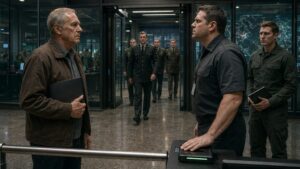
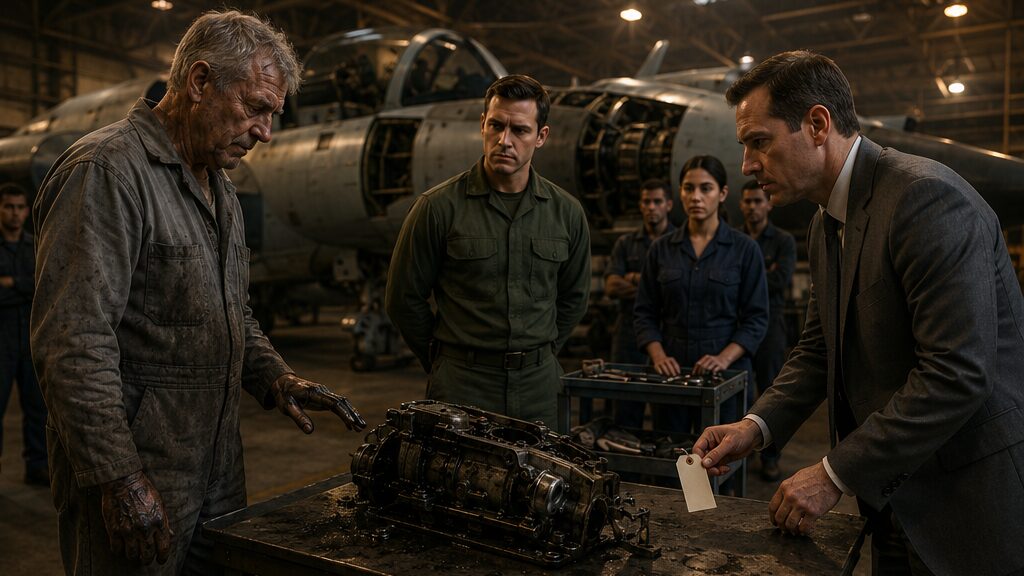
Ryan Green came in first, uniform pressed so sharp it seemed almost separate from his body. He was younger than the aircraft, younger than the fault, younger than most of the stains on Samuel’s coveralls. His face held the careful control of an officer who had been told he could not afford surprise. Beside him walked a man in a gray suit, narrow tie, polished shoes, and an expression that had already begun writing a report.
The hangar changed around them. Conversations thinned. Tools settled onto carts. The grounded aircraft seemed to draw every eye without making a sound.
Ryan stopped several feet from the bench. His gaze went from the opened housing to Samuel’s hands.
“Mr. Thompson,” he said.
Samuel had been called Chief in another life, Sam by men who were gone now, and sir by kids whose engines he had kept breathing. He had no objection to his name. Still, the way Ryan said it made the syllables feel like an item number.
“Lieutenant,” Samuel said.
The suited man stepped closer. “Nicholas Carter. Civilian safety review.”
Samuel nodded.
Nicholas did not nod back. He looked at Samuel’s coveralls, then at the component, then at the younger technician. “Who opened this assembly?”
“Maintenance team pulled it under procedure,” Ryan said. “After the irregularity.”
“Which team?”
The technician glanced at Samuel before he could stop himself.
Nicholas caught it.
Samuel watched that small glance do more damage than a spoken accusation.
“I was assigned to the intake panel yesterday,” Samuel said. “Not this housing.”
“But you were near this section?”
“Yes.”
“And this morning?”
Samuel did not answer too quickly. In hangars, quick answers often meant fear. “I came over when they rolled it out.”
“Why?”
“Because I saw the fault code.”
Nicholas looked at the tablet on the cart. “The fault code is preliminary.”
“It still came from somewhere.”
Ryan’s jaw tightened. “Mr. Thompson, we have a formal review now. We need the component preserved exactly as found.”
Samuel looked down at the bench again. The blackened wire waited in the light, ordinary to anyone who did not know how many ways ordinary things could fail.
“I haven’t moved it,” he said.
Nicholas’s eyes dropped to Samuel’s right hand. “But you were reaching toward it.”
Samuel could have said he had spent more years around engines than Nicholas had spent around reports. He could have said a man could read heat on metal the way another man read ink on paper. He could have said the aircraft had spoken before the tablet had understood.
Instead he wiped his fingers once against the rag tucked into his pocket.
“I was looking,” he said.
A small group of younger technicians had gathered near the tool cage. Not close enough to be accused of listening. Close enough to hear everything.
Ryan seemed aware of them too. His voice lowered, but the tone sharpened. “We had an engine surge during preflight test. The pilot trainee aborted before rotation. Until we establish cause, this aircraft is grounded and this area is controlled.”
Samuel looked toward the aircraft. He pictured the pilot trainee’s hands on the controls, the first wrong shiver through the frame, the second it took to decide whether a machine was lying or warning.
“How hard did it cough?” he asked.
Ryan blinked. “Excuse me?”
“The engine,” Samuel said. “Did it cough once and clear, or did it catch and drag?”
Nicholas turned fully toward him now. “Mr. Thompson, we’re not conducting interviews on the floor.”
“It matters.”
“The data will tell us what matters.”
Samuel let the words settle. He had known men who trusted gauges too little and died stubborn. He had known men who trusted them too much and nearly took others with them. The trick was never choosing between data and hands. The trick was having the humility to let both speak.
Ryan stepped to the bench. He did not crowd Samuel, exactly, but he placed himself between Samuel and the component.
“Were you the last person to handle the intake panel before preflight?”
“Yes.”
“Did you notice anything abnormal?”
Samuel looked past Ryan’s shoulder. The wire sat inside its shadow, black at the curve, silver near the twist.
“Yes,” he said.
Ryan’s face changed. Not much. Enough.
Nicholas pulled a small recorder from his pocket. “What did you notice?”
Samuel stared at the exposed housing. He wanted to answer cleanly. He wanted to give them the shape of it and watch them follow. But there were too many people now, too many eyes ready to turn one sentence into a confession or a joke.
“Heat where it shouldn’t have been,” he said.
Nicholas glanced at the component. “You observed heat damage yesterday?”
“No.”
“This morning?”
Samuel nodded.
“After the incident.”
“Yes.”
Nicholas let that hang.
Ryan looked toward the technicians near the tool cage. One of them looked away. Another pretended to check a clipboard.
Samuel felt the hangar become smaller.
Nicholas stepped closer to the bench and removed a folded evidence tag from his inside jacket pocket. He placed it near the component, careful not to touch the metal.
“Until we ask you a direct question,” he said, “do not touch another thing.”
Chapter 2: One Greasy Finger and Three Silent Men
Samuel looked at the evidence tag beside the component.
It was a small thing, white paper with a wire tie, its printed blanks waiting for somebody else’s certainty. Date. Time. Item. Handler. The tag lay near the blackened loop as if paper could understand metal by proximity.
Nicholas Carter clicked his pen.
“Do you understand the instruction?” he asked.
The hangar was quiet enough for Samuel to hear water dripping from the edge of the open bay door. Beyond it, the morning rain had faded into a gray mist over the tarmac. Inside, every sound had become careful. A socket set settling in a drawer. A boot shifting on concrete. Someone’s breath catching and being swallowed.
Samuel withdrew his hand fully and let it hang at his side.
“I understand,” he said.
Ryan Green stood between him and the bench, but his eyes stayed on Samuel’s fingers. “This isn’t personal.”
Samuel almost smiled at that. Not because it was funny. Because men said that most often when the thing had already become personal.
“No,” Samuel said. “It’s an aircraft.”
A couple of the younger technicians looked down quickly, hiding whatever passed over their faces.
Nicholas moved closer to the component and looked into the opened housing without touching it. He was careful. Samuel gave him that. The man’s shoes were wrong for a hangar floor, and his suit sleeve rode too close to the workbench, but his hands obeyed procedure. He held the pen back, kept his elbows in, and let his eyes do the first pass.
“What is your certification status?” Nicholas asked.
Ryan answered before Samuel could. “Mr. Thompson is a civilian mechanic assigned to support maintenance overflow. Retired Navy. Current on basic access. Limited sign-off authority.”
Limited.
Samuel kept his face still.
He had signed off aircraft when Ryan was likely still learning to lace boots. He had stood under carrier deck noise so loud it made a man feel hollow behind the ribs. He had wired bolts in weather that made fingers clumsy and afraid. But Ryan had not lied. Not in the present tense. Samuel’s authority now was limited.
Nicholas wrote something. “Age?”
Ryan shifted. “Is that relevant?”
“It is standard identification.”
“Seventy-two,” Samuel said.
Nicholas looked up, and for the first time his expression softened by half an inch. Not kindness. Calculation adjusted for old bones.
“Mr. Thompson,” Nicholas said, “were you aware that the engine irregularity occurred less than twelve hours after your panel work?”
“Yes.”
“Were you aware your work station was the only one recorded in this section yesterday?”
“My station was the panel. Not the bracket.”
“But adjacent.”
“Adjacent isn’t the same.”
“No,” Nicholas said. “But it is close.”
Samuel looked at Ryan. “Was there a vibration report from the last rotation?”
Ryan’s eyes narrowed. “We’re asking the questions right now.”
“That wasn’t an answer.”
“Mr. Thompson.”
Samuel heard the warning in the title, the way rank could bend even civilian names into place. A younger Samuel might have pushed back. An older Samuel knew exactly how quickly a room could stop listening when a man raised his voice. He lowered his gaze to the bench instead.
The blackened safety wire lay partly looped beneath the bracket, one side dark, one side still dull silver. The twist was too neat to have failed from careless handling. The discoloration had crept from heat, not snapped from force. Whoever first installed it had known the proper motion but not the hidden pressure that would work against it.
Ryan followed his gaze. “What are you looking at?”
Samuel did not answer.
Nicholas stepped in. “Officer Green asked you a question.”
Samuel breathed through his nose. The old smell rose from the component: burned oil, hot metal, insulation warmed past comfort. Under it was something sharper, almost sweet, the smell of a part that had been asked to endure too much.
“That wire,” Samuel said.
Nicholas pointed his pen without touching the part. “The safety wire?”
“Yes.”
“It will be logged.”
“It needs to be read before it’s logged.”
Ryan’s mouth tightened. “Read?”
Samuel glanced at him. “A wire has memory.”
One of the younger technicians near the tool cage let out a breath that almost became a laugh, then stopped. Samuel did not look over. He had heard that sound for years, the little release people made when they were not sure whether an old man was wise or simply strange.
Nicholas heard it too. His face closed.
“Mr. Thompson,” he said, “this review is not going to be conducted by metaphor.”
Samuel nodded once.
Nicholas reached for a pair of nitrile gloves from the evidence kit. “We’ll document the wire and send the assembly for analysis.”
“If you remove it first, you’ll lose the angle.”
“We’ll photograph it.”
“Pictures flatten things.”
Ryan stepped closer. “Enough.”
That word landed hard in the hangar.
Not loud. Not shouted. Hard.
Samuel looked at him. Ryan’s face was controlled, but underneath it Samuel saw the strain: the training schedule, the grounded aircraft, the base commander waiting for a clean answer, the pilot trainee who had nearly carried a fault into the air. Ryan was not cruel. He was cornered. Cornered men often mistook speed for leadership.
Ryan lowered his voice. “We respect experience here. But we also have current procedures for a reason.”
Samuel heard the rest of it though Ryan did not say it. Your way is not this way. Your time is not now.
Nicholas tore the backing from a small red seal and placed it over one fastener on the housing.
Samuel’s right hand moved before he meant it to.
Not far. Only enough that the grease-darkened tip of his index finger came to rest on the edge of the workbench, beside the component, not on it. A careful stop. A visible one. He kept that finger there as if pinning himself in place.
Nicholas looked at it.
Ryan looked at it.
So did the younger technicians.
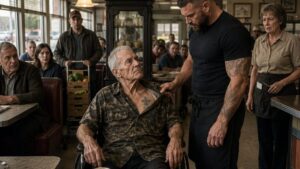
The three men stood around the open engine part: one in worn coveralls, one in a pressed uniform, one in a gray suit. Under the warm hangar lights, the blackened wire lay between them like a question nobody wanted to ask correctly.
Nicholas’s voice sharpened. “Please remove your hand from the table.”
Samuel did not move at once.
He was not touching the evidence. He was touching the scarred metal edge of the workbench, a bench older than some of the people watching. There were cuts in it from decades of parts laid down too quickly and picked up too late. His fingertip found one groove and stayed there.
Ryan said, quieter, “Mr. Thompson.”
Samuel lifted his hand.
His finger left a small crescent of grease on the bench.
Nicholas stared at the mark as if it were contamination.
Samuel took one step back. Then another. His knees disliked the second one, but he did not let the movement show.
“I’ll stand where you want,” he said.
The words did not taste like surrender. They tasted like oil and restraint.
Ryan looked away first. He picked up the tablet from the cart and woke the screen. Blue diagnostic lines reflected faintly on his face.
“Engine surge during preflight power increase,” he read. “Transient temperature spike. Intake pressure instability. System recovered after abort.”
“Caught and dragged,” Samuel said.
Ryan looked up. “What?”
“You said surge. That report says it caught and dragged.”
Nicholas’s pen paused.
Samuel nodded toward the component. “If it coughed once, I’d look at intake contamination. If it caught and dragged, I’d look at vibration walking heat into a place the sensor only sees after the fact.”
“The sensor suite logged within tolerance before the event,” Ryan said.
“I believe it.”
“Then why are you arguing?”
“I’m not.”
Nicholas made a small sound of impatience. “You just suggested the sensor missed something.”
“No,” Samuel said. “I suggested it told you late.”
The hangar stayed quiet.
Emma Rivera stood behind the front line of technicians, half-hidden by a rolling cart. Samuel knew her by the way she listened. Some people listened only until it was their turn to talk. Emma listened as if the thing itself might speak next. She had asked him once why he rubbed safety wire between his fingers before clipping it. He had told her, “Because your eyes can be proud.” She had not laughed.
Now her gaze moved from his handprint on the bench to the blackened loop.
Nicholas folded the evidence tag around the wire tie but did not secure it yet. “You said you noticed heat damage after the incident.”
“Yes.”
“Then for the record, you have no prior basis to say this wire predates today’s event.”
Samuel looked at the wire.
He remembered another hangar. Another morning. Red light washing over the floor because alarms made everything look wounded. He remembered a young crewman trying to joke while pain made his face gray. He remembered a report that had used the phrase within acceptable deviation.
He brought himself back to the present by pressing his thumb against the seam of his coveralls.
“That wire did not fail today,” he said.
Nicholas stared at him. “You cannot know that without analysis.”
Samuel’s voice remained low. “I didn’t say it failed.”
Ryan’s brow shifted. For the first time, not irritation. Attention.
Nicholas did not follow. “Then what exactly are you claiming?”
Samuel looked at the blackened loop, then at the aircraft beyond it, grounded and silent under the hangar lights.
“That wire remembers more than the report will.”
Chapter 3: The Report That Made the Hangar Smaller
Emma Rivera had never seen a hangar shrink before.
It did not happen all at once. The aircraft stayed the same size, broad-winged and silent. The workbenches stayed where they were. The tool cages, yellow safety lines, fire extinguishers, parts bins, ladders, and rolling carts all remained in their places. But after Samuel Thompson stepped back from the open engine component, every path across the floor felt narrower.
People walked around him now.
Not rudely. That made it worse. They gave him careful space, as if respect and suspicion used the same distance.
Emma watched from the records counter with a tablet in one hand and a parts request in the other. The tablet had gone dark three times while she stood there. Each time, she woke it with her thumb and pretended she was busy.
On the far side of the hangar office window, Nicholas Carter sat with Ryan Green and the base commander. Their mouths moved behind the glass. Every few minutes Nicholas tapped something on his laptop, and Ryan looked toward the grounded aircraft.
Samuel sat alone on a metal stool near the tool cage.
He had not been told to sit there. Not exactly. After Nicholas sealed the blackened wire in a clear evidence pouch and had the component photographed from six angles, Ryan had asked Samuel to “remain available.” A younger person might have heard that as permission to wait anywhere. Samuel heard instructions beneath instructions. He chose the stool nearest the place where he could be found.
His hands rested on his knees. The grease had dried in the lines of his fingers.
A technician beside Emma muttered, “Bad timing.”
Emma looked over.
He was scrolling through the diagnostic summary on his tablet. “Yesterday panel work. This morning engine event. Old guy reaches into the component before review. That’s how reports write themselves.”
Emma kept her voice even. “He didn’t reach into it.”
“He was about to.”
“You saw where his finger stopped.”
The technician glanced at her. “You defending him?”
“No.”
But the answer felt thin.
Across the floor, the pilot trainee who had aborted the test stood by the aircraft’s nose, helmet bag hanging from one shoulder. He looked too young to carry the memory of a machine misbehaving under him. He kept glancing at the engine bay, then away, as if eye contact with the aircraft might ask him to explain why he had brought it back.
A printer coughed behind the records counter. The parts clerk tore off a page and handed it to Emma.
“Diagnostics packet,” the clerk said. “They want two copies.”
Emma took the warm paper. The top sheet was stamped PRELIMINARY REVIEW in bold block letters. Beneath it, a neat chain of system entries made the morning sound cleaner than it had felt.
Engine response abnormality during controlled preflight increase.
Transient thermal event.
Intake pressure fluctuation.
Manual inspection pending.
Possible maintenance contamination in adjacent panel area.
Emma read the last line twice.
Adjacent panel area.
That was Samuel.
No name. No accusation. Just a phrase clean enough to be dangerous.
She looked through the office window again. Nicholas was speaking now. Ryan sat back with one arm across his chest. The base commander’s face did not change.
The training rotation was posted on the wall outside the office, a color-coded schedule with names, aircraft numbers, and times. Emma had helped update it the day before. This grounded aircraft had three blocks assigned before sundown and another at first light. Students, instructors, fuel crews, tower windows, weather openings—one machine slipping out of place dragged a net behind it.
Ryan came out of the office first. He carried himself the same way he had before, but Emma noticed the crease between his eyes had deepened.
“Rivera,” he said.
She straightened. “Yes, sir.”
“Take the diagnostics packet to the review table. Then pull yesterday’s access logs for the intake-side work platforms.”
“Yes, sir.”
Ryan hesitated, then glanced toward Samuel. “And find out whether Mr. Thompson had any unscheduled access after his shift.”
Emma felt heat rise in her face. “Yes, sir.”
He heard something in her voice. His gaze sharpened, but he did not challenge it. He went back toward the aircraft.
Emma carried the packet to the conference table near the hangar office. Nicholas had left the evidence pouch there inside a shallow plastic tray. The blackened safety wire loop lay sealed within it, distorted by the clear plastic, smaller now than it had seemed on the component. It looked harmless, almost foolish.
She set the packet down beside it.
For a moment she could see Samuel’s fingertip again, stopped beside the wire instead of touching it. She could see the crescent of grease left on the workbench, already wiped away by someone wearing gloves.
Nicholas entered behind her. “Those the diagnostics?”
“Yes, sir.”
“Good.” He picked up the first page, skimmed it, and nodded to himself. “Clean enough to start.”
Emma kept her eyes on the tray. “Start what?”
Nicholas looked at her as if deciding whether she was old enough to deserve an answer. “A timeline.”
“Right.”
“Facts first,” he said. “Feelings later.”
She said nothing.
He softened, perhaps thinking he had been too sharp. “That’s not a criticism. It’s how we protect people. Including Mr. Thompson.”
Emma looked through the office glass at Samuel.
He had risen from the stool. A younger technician had approached him with a question, then seemed to think better of it and walked away. Samuel watched him go without calling him back.
“He knows things,” Emma said before she meant to.
Nicholas folded the packet. “Knowing things is not the same as documenting them.”
“No, sir.”
When Nicholas left, Emma remained beside the tray. The wire in the pouch had one end bent outward. Not broken. Bent. She had seen Samuel teach that difference during routine safety checks. A break shouted. A bend whispered. A good mechanic listened for both.
She turned away before anyone could ask why she was still staring.
The access logs were in the records room behind the parts counter, a narrow space that smelled of paper, dust, and warm electronics. Most logs lived digitally now, but old diagrams and printed maintenance bulletins filled two metal cabinets along the wall. Samuel kept a locker there too—not a personal locker exactly, more a narrow gray cabinet assigned to part-time staff who did not need much space.
Emma pulled the access logs first. Yesterday’s record showed Samuel badge-in at 0603, intake platform assignment at 0612, panel closeout at 1028, badge-out for lunch, return, then another job on the auxiliary bay. No unscheduled access after shift.
She should have stopped there.
Instead she stood in front of Samuel’s cabinet.
It was not locked. Few things in the hangar were, unless regulation demanded it. Inside sat a folded pair of gloves, a tin of old pencils, two maintenance manuals with cracked plastic covers, and a clipboard hung on a hook.
Emma touched nothing at first.
Then she saw the corner of a diagram tucked behind the manuals.
It was yellowed at the edges, printed from an older system. The aircraft variant number was close but not identical. A bracket assembly filled the center of the page, drawn in clean black lines, with a safety wire path marked in red pencil.
A circle had been drawn around the same twist angle she had seen sealed in the evidence pouch.
Below it, in Samuel’s small block handwriting, were four words.
Check after heat walk.
Emma stared at the words until the records room felt smaller than the hangar.
Behind her, someone called her name.
She folded the diagram once, carefully, and held it against the access logs.
Chapter 4: What Samuel Would Not Say Out Loud
By afternoon, the rain had stopped, and the hangar light turned flat and white.
Samuel stood alone beneath the aircraft’s left wing, where the shadow was cool and the noise of the review had faded into office walls and distant phone calls. The grounded aircraft gave off small settling sounds as metal changed temperature. A tick in the panel. A sigh near the landing gear. A faint, dull creak from somewhere deeper inside.
Machines were never truly silent. People only stopped listening.
He kept his hands behind his back so no one could mistake stillness for interference. The order had been clear: stay available, touch nothing. He had obeyed. He had watched Nicholas seal the wire. He had watched Ryan speak with the base commander. He had watched younger technicians glance at him, then at their shoes.
The part of him that was tired wanted to go home.
The part that remembered would not let him.
“Mr. Thompson.”
Ryan’s voice came from the edge of the wing shadow.
Samuel turned.
Ryan had removed his cap and held it under one arm. Without it, he looked less like a figure of authority and more like a man who had not slept enough. The crease between his eyes was still there.
“Walk with me,” Ryan said.
It was framed as a request. It was not one.
They moved toward the empty side bay where unused stands and covered tool carts sat in rows. Their footsteps echoed more loudly there. No technicians followed, but Samuel knew sound traveled in hangars. Every private conversation had edges.
Ryan stopped beside a work platform and turned to face him.
“I need a direct answer,” he said. “Did you touch the component after the engine event?”
“No.”
“Did you touch any adjacent housing after the engine event?”
“No.”
“Did you remove, adjust, clean, bend, tighten, loosen, or otherwise alter anything connected to that assembly?”
Samuel held his gaze. “No.”
Ryan exhaled through his nose. “Then why didn’t you just say that on the floor?”
“I did.”
“You said a lot of other things too.”
Samuel looked toward the aircraft. From this angle, only the tail was visible beyond stacked equipment. “You didn’t ask the question you needed answered.”
Ryan’s face tightened. “I asked whether you touched it.”
“That’s the question for blame. Not cause.”
For a moment Ryan said nothing.
A cart rattled somewhere beyond the bay. A phone rang in the office and stopped.
Ryan lowered his voice. “You understand how this looks.”
“Yes.”
“Do you?”
Samuel looked back at him. “Old man assigned near a panel. Aircraft coughs the next morning. Old man reaches toward the evidence before the review team arrives. Then old man talks about wire memory instead of giving clean statements.”
Ryan blinked once.
Samuel had not said it bitterly. That seemed to make it harder for Ryan to hear.
“I’m trying to keep this professional,” Ryan said.
“Good.”
“I’m also trying to keep an aircraft from being down for a week if the answer is simple.”
Samuel nodded. “Simple answers are useful when they’re true.”
“And when they’re not?”
“They’re expensive.”
Ryan looked away.
The word had landed where Samuel intended, though not with cruelty. Expensive did not always mean money. Sometimes it meant a young pilot staring at his own hands after aborting. Sometimes it meant a mother receiving a call made by someone who had practiced the words. Sometimes it meant an old mechanic remembering the sound of metal dragged past its limit.
Ryan put his cap on a covered cart. “Tell me what you think happened.”
“You won’t like it.”
“I didn’t ask whether I’d like it.”
Samuel studied him. There was pride in Ryan, but not emptiness. Pride was dangerous only when it had no door. Ryan’s had a door, perhaps not open, but visible.
“The wire is not the cause,” Samuel said. “It’s a witness.”
Ryan waited.
“That bracket has been walking under vibration. Not enough to fail inspection. Enough to pull heat where it doesn’t belong. Someone replaced the wire clean, but they followed the old angle. The angle looks correct until the bracket moves under load.”
“The bracket passed last inspection.”
“I believe it.”
“Again with that.”
“Passing inspection doesn’t mean nothing is happening. It means nothing crossed the line while you were looking.”
Ryan crossed his arms. “And you recognized this from one wire.”
Samuel looked toward the empty workbench in the distance. “From the way the heat sat on it.”
“That’s not going to satisfy Carter.”
“No.”
“Or the commander.”
“No.”
“Then give me something that will.”
Samuel almost did.
The words came close. There was an old bulletin. There had been a bracket pattern. There had been a temporary workaround that became habit because parts were late and schedules were hungry. There had been a night when the shop smelled of rain and hot insulation. There had been a young crewman named only by role now in Samuel’s memory because naming him too often made the day too present.
He saw the red hangar light again.
Not this hangar. Another one. Years folded badly when memory found the right smell.
He was younger then, though not young. Navy coveralls. Tired eyes. A line of aircraft waiting. A supervisor with a clipboard. Weather closing. Training window narrowing. The bracket had shown heat walk twice. Samuel had said it should come off. The supervisor had said the bulletin allowed continued operation if the wire was replaced and the sensor stayed within tolerance.
Within tolerance.
Samuel had twisted the replacement wire himself. Tight. Clean. Beautiful, even.
The aircraft did not fall from the sky. That had been the mercy and the punishment. It landed hard after a systems warning and an emergency return. A crewman was injured during the scramble out, not killed, not enough to make headlines, enough to end a career and bend a life. The report spread responsibility so thin that no one had to hold much of it.
Samuel had held his portion anyway.
“Mr. Thompson.”
Ryan’s voice pulled him back.
Samuel realized his right hand had curled as if holding safety wire pliers.
He opened it.
“There was an old maintenance bulletin,” Samuel said. “Different variant. Same bracket family. It warned about heat walk after vibration.”
Ryan’s posture changed. “Number?”
“I don’t remember the number.”
“Year?”
Samuel gave a dry breath. “I remember red lights and bad coffee. Not the year.”
Ryan rubbed his forehead. “That’s not enough.”
“No.”
“Where would it be?”
“Archived maintenance bulletins. Maybe engineering. Maybe nowhere useful.”
Ryan studied him. “Why didn’t you mention this earlier?”
Samuel looked at the floor. A line of old paint had been worn thin by years of wheels and boots. “Because memory can sound like an old man wanting the room back.”
Ryan did not answer quickly.
When he did, his voice was quieter. “Is that what this is?”
Samuel looked up.
The question was not cruel. That made it worse.
“No,” Samuel said.
Ryan seemed to want more.
Samuel had more. He had a whole room inside him full of things he had never said properly. He had the name of the crewman folded somewhere with letters he had never mailed. He had the old habit of waking before dawn and feeling his fingers twist wire against the bedsheet. He had decades of letting good work stand in place of confession.
But the hangar did not need all that. Not yet.
“What this is,” Samuel said, “is an aircraft asking you not to rush.”
Ryan’s mouth flattened, but he did not dismiss it.
They walked back toward the hangar office together. Nicholas was at the conference table, laptop open, phone on speaker with a thin voice from off-site engineering listing acceptable ranges and likely contamination paths. The evidence pouch sat in its tray beside the diagnostic packet.
Emma stood near the records counter with papers held tight against her chest. When she saw Samuel, she looked as if she had found something and wished she had not found it alone.
Samuel noticed. Ryan noticed Samuel noticing.
Nicholas ended the call. “Good. Engineering agrees the preliminary data is consistent with post-maintenance contamination or foreign residue migration from the adjacent panel area.”
Ryan said, “Mr. Thompson believes there may be an old bulletin related to bracket heat walk.”
Nicholas turned slowly.
Samuel met his eyes.
“A bulletin,” Nicholas said.
“Yes.”
“Current?”
“No.”
“For this exact aircraft?”
“Related bracket family.”
Nicholas leaned back in his chair. “Do you have the bulletin?”
“No.”
“A number?”
“No.”
“A date?”
“No.”
Nicholas’s expression settled into something almost polite. “Then what are you asking me to do?”
“Pull the archive.”
“We are not delaying a safety review based on a half-remembered bulletin from an unspecified year on an unspecified variant.”
Ryan glanced at Samuel, then at Nicholas. “If there’s a chance—”
“There are procedures for chances,” Nicholas said. “Right now we have a documented event after maintenance activity, a component that was approached before evidence control, and no hard reference for this theory.”
Emma’s fingers tightened on the papers.
Samuel looked at the evidence pouch. The wire inside had been flattened slightly by the plastic. Removed from the bracket, it looked less like a warning and more like debris.
He felt the old weariness rise. Not fear. Not anger. The heavy knowledge that being right too early often looked exactly like being difficult.
“Let me see the old bulletins,” Samuel said.
Nicholas closed the diagnostic packet.
“No,” he said. “Not until we finish the contamination timeline.”
Chapter 5: The Clean Report and the Dirty Truth
By evening, Ryan Green had read the preliminary report four times and trusted it less each time.
The words were clean. That was the problem. Clean words had a way of sliding past dirty facts. They arranged the morning into a line neat enough to brief upward: aircraft grounded after preflight irregularity, fault likely associated with recent maintenance activity, evidence controlled, component removed, contamination pathway under review.
No one reading it cold would hear the engine catch and drag.
No one would see Samuel Thompson’s finger stop beside the part.
Ryan sat at the conference table inside the hangar with his cap beside his elbow and the evidence pouch between him and Nicholas Carter. The pouch had not been opened since Nicholas sealed it. Inside, the blackened safety wire lay curled like something dead and too small to explain the trouble it had caused.
Nicholas turned his laptop toward Ryan. “This is the cleanest recommendation I can make before lab confirmation.”
Ryan read the highlighted paragraph.
Probable cause remains consistent with contamination or residue migration from adjacent maintenance access. No confirmed evidence currently supports historical bracket instability or pre-existing heat walk condition.
Currently.
Ryan hated that word when it was useful.
Across the hangar, Samuel stood near the old workbench, not close enough to be accused of hovering, not far enough to be uninvolved. Emma Rivera moved past him with a stack of access logs. She slowed as if she wanted to say something, then continued toward the records counter.
Nicholas tapped the table. “We are not assigning final fault tonight. We are identifying the most likely path and releasing the aircraft for limited follow-up pending lab results.”
“Limited follow-up still means return to schedule.”
“After inspection and clearance, yes.”
Ryan looked through the office glass at the aircraft. The base commander wanted an answer before night briefing. The instructors wanted the schedule recovered. The pilot trainee had been pulled from the rotation and was being evaluated, which meant another trainee had already been shifted forward. Every delay made noise.
A week down would spread through the whole training wing.
A rushed clearance would spread farther if Samuel was right.
“Engineering was comfortable with this?” Ryan asked.
Nicholas leaned back. “Engineering was comfortable with the data. They did not endorse Mr. Thompson’s unsupported theory.”
“He said the wire wasn’t the cause.”
“He said a lot of things.”
Ryan looked at the pouch. “He said it was a witness.”
Nicholas sighed through his nose. “Which means nothing in a report.”
“Maybe not.”
“Officer Green.”
Ryan glanced up.
Nicholas folded his hands in front of the laptop. The gesture made him look patient. Ryan had begun to understand that patience could be its own form of pressure.
“I know how this feels,” Nicholas said. “An older mechanic. Long service. Strong instincts. Nobody wants to be the person who dismisses that. But an investigation cannot run on respect for age.”
“It shouldn’t run on convenience either.”
“It isn’t.” Nicholas’s voice cooled. “The system logged a transient thermal spike only after power increase. The intake panel was worked yesterday. Mr. Thompson was assigned there. There is no documented prior bracket complaint in the current maintenance chain. The component was approached before evidence control. Those are facts.”
Ryan looked again at Samuel through the glass. He was wiping his hands with the same old rag, though there was little left to wipe.
“Facts can line up wrong,” Ryan said.
Nicholas’s mouth tightened. “And instincts can flatter the person having them.”
Ryan did not answer.
That was what made this hard. Nicholas was not foolish. He was not trying to bury anything. If Ryan had received the same report from another hangar with another old mechanic and another grounded aircraft, he might have accepted the chain. He might have called it disciplined. He might have told his own people not to go chasing ghosts because a respected elder saw a pattern in a stain.
But he had been there when Samuel said the report would remember less than the wire.
Some men spoke to fill a room. Samuel spoke as if each word cost him.
Emma knocked lightly on the open doorframe.
Ryan looked up. “What do you have?”
“Access logs,” she said. “No unscheduled badge access for Mr. Thompson after his shift.”
Nicholas reached for them. “That helps establish timeline.”
Emma did not release the pages immediately.
Nicholas noticed. “Rivera?”
She handed over the access logs, then kept a second folded sheet against her side.
Ryan saw it. “What’s that?”
Her eyes moved to Samuel beyond the glass.
Ryan stood. “Rivera.”
She unfolded the paper and placed it on the table.
The diagram was old, yellowed at the edges and creased down the middle. A bracket assembly sat at the center, with a safety wire path marked in red pencil. One loop had been circled. Beneath it, in small block handwriting, were the words: Check after heat walk.
Nicholas frowned. “Where did this come from?”
Emma’s shoulders stiffened. “Mr. Thompson’s cabinet.”
Nicholas looked up sharply. “You searched his cabinet?”
“It was open.”
“That is not an answer.”
Ryan held up a hand, not taking his eyes off the diagram. “Is this the same bracket?”
“Not exact,” Emma said. “Older variant. Same family, I think.”
“You think?”
She swallowed. “The wire path matches the evidence pouch.”
Nicholas picked up the diagram by two corners. “This is not controlled documentation.”
“No, sir.”
“It is marked by hand.”
“Yes, sir.”
“And taken from a personal cabinet without authorization.”
Emma’s face colored, but she did not step back. “I thought it mattered.”
Ryan looked at the four handwritten words.
Check after heat walk.
“Did Samuel give this to you?”
“No, sir.”
“Did he ask you to look?”
“No.”
Nicholas laid the diagram down as if it might contaminate the report by touching it. “This does not change the preliminary recommendation.”
Ryan looked at him.
Nicholas continued, “At best, it confirms Mr. Thompson has been thinking about a similar issue for some time. It does not prove the issue exists here.”
“It proves he didn’t invent it this morning.”
“No,” Nicholas said. “It proves he kept an old annotated diagram. That could mean experience. It could also mean bias.”
Ryan almost pushed back, then stopped. He could hear the truth inside the sentence. A man carrying an old fear could find it everywhere. A man under pressure could miss it entirely.
Both things could be true enough to hurt people.
The base commander entered without knocking. The room tightened. Ryan stood straighter. Nicholas closed the laptop halfway but left the report visible.
“Where are we?” the commander asked.
Nicholas gave the summary. Clean, brief, confident. Ryan listened to the words form the path everyone wanted: run final inspection, clear limited operation, send component for lab confirmation, continue training with caution.
The commander turned to Ryan. “Your recommendation?”
Ryan looked at the aircraft. Then at the pouch. Then at the old diagram.
“Controlled bench check on bracket heat response before release,” he said.
Nicholas’s head turned. “That is not required by current findings.”
Ryan kept his voice level. “I’m requiring it locally.”
The commander studied him. “How long?”
“Tomorrow morning.”
The pause felt longer than it was.
“Tomorrow morning,” the commander said. “Then I want a release decision.”
When he left, Nicholas closed the laptop with more force than necessary.
“You just bought time,” he said. “Not evidence.”
Ryan picked up the old diagram. “Then we’ll find out which one it is.”
Samuel entered only after Ryan called him in. He did not look at Emma, though Ryan saw her watching for it. He stood at the end of the table, hands at his sides, eyes on the pouch.
Nicholas slid the preliminary report across the table. “Mr. Thompson, this is a limited witness acknowledgment. It does not assign final fault. It confirms you have reviewed the current timeline and do not dispute the documented events.”
Samuel did not pick up the pen.
Ryan said, “We’re running a bench check tomorrow.”
Samuel looked at him then. Just once.
Nicholas tapped the signature line. “This is not a release form. It is an acknowledgment.”
Samuel read the page slowly. Ryan wondered whether he needed his glasses, then realized he was not reading slowly because of his eyes. He was giving each sentence the respect of possible danger.
At last Samuel placed the paper back down.
“This says the aircraft may return to limited operation if final inspection finds no contamination,” he said.
Nicholas’s voice remained controlled. “That is the current procedural path.”
“The wire won’t show contamination.”
“No one is asking you to certify the wire.”
Samuel pushed the paper gently back across the table.
“No,” he said.
Nicholas stared at him. “No?”
Samuel’s hands were still.
“I won’t sign a path that clears the aircraft before the bracket is made to tell the truth.”
Chapter 6: The Part That Passed Every Test
The next morning, Samuel arrived before sunrise and found the hangar lights already on.
They washed the aircraft in pale gold, making the open bay doors look like the mouth of a cave. Outside, the tarmac was dark and wet. Inside, the workbench had been cleared, labeled, wiped, photographed, and prepared until it looked less like a place where mechanics worked and more like a place where evidence waited to be judged.
Samuel preferred a bench with scars.
The evidence pouch sat in a tray at the center of the table. Beside it lay a fresh safety wire, a replacement bracket from stores, torque records, inspection forms, and a portable heat source approved for controlled checks. Nicholas had arranged everything in straight lines. Ryan stood nearby with a clipboard. Emma waited behind the bench with gloves on, shoulders squared, as if she had been told she could observe and had decided to do more than that if allowed.
Samuel stopped a few feet short.
Nicholas looked up. “We will conduct a controlled comparison. No one touches the original evidence without my direction.”
Samuel nodded.
Ryan watched him. “You’ll walk us through what you believe happens.”
“Not believe,” Samuel said. “Suspect.”
Nicholas made a mark on his form. “Suspect is acceptable.”
That was as close to courtesy as the morning offered.
They began with the fresh bracket. Emma mounted it according to current procedure while Nicholas called out each step. Ryan checked the torque values against the tablet. Samuel stood with his hands behind his back and said nothing unless asked. He could feel Nicholas waiting for him to overreach, to correct too soon, to become the old man interfering with a clean test.
Samuel gave him no such gift.
The new wire shone silver under the light. Emma threaded it through the fastener with steady hands, made the proper pull, and twisted. Her first twist was too loose. She stopped before Samuel spoke.
“Again?” Ryan asked.
Emma looked at Samuel.
He kept his face neutral. “Your eyes caught it.”
She clipped the wire, started again, and this time the twist held clean. Not perfect. Clean enough. Samuel saw the small pride she tried to hide.
Nicholas recorded the installation.
“Current inspection criteria satisfied,” he said.
“Yes,” Ryan answered.
Samuel looked at the bracket. “Now ask it to work.”
The controlled test began gently. Heat first, then vibration simulation, then a staged load against the bracket. The off-site engineering voice joined by speaker, thin and distant, asking for readings at intervals. The first numbers came back normal. The second set did too.
Nicholas glanced at Samuel after twenty minutes.
Samuel did not look away from the wire.
The bracket behaved. The wire held. The temperature stayed within tolerance. The system, if asked, would have said yes to the aircraft. Samuel did not blame it. Instruments answered the questions they were built to hear.
Ryan shifted his weight. “Anything?”
“Not yet.”
Nicholas said, “We cannot run an indefinite test.”
“I’m not asking for indefinite.”
“What are you asking for?”
Samuel looked at the mounting assembly. “Change the angle of load.”
Ryan checked the procedure. “Within approved range?”
“Barely.”
Nicholas frowned. “The aircraft would not see that angle under normal conditions.”
Samuel turned to him. “It would if the replacement bracket was installed after wear on the mount instead of with a full mount inspection.”
“That is a separate maintenance failure.”
“It’s the same aircraft.”
Ryan’s eyes moved to the records. “The mount passed visual.”
“Visual sees what stands still,” Samuel said.
Nicholas folded his arms. “You keep speaking in phrases.”
Samuel looked at him for a long moment, then nodded toward the assembly. “Fine. The bracket face is true when unloaded. Under heat, the mount expands unevenly. With vibration, it walks one hair toward the intake side. The wire holds the fastener, but it begins carrying side stress it wasn’t meant to carry. It doesn’t break. It cooks. Then the bracket shifts just enough to let pressure flutter. Sensor catches the event late because the part has already moved back by the time the system flags it.”
The hangar seemed to hold still after he finished.
Nicholas’s face had changed, not into belief, but into reluctant attention.
The engineering voice crackled through the speaker. “That would require pre-existing mount wear.”
Samuel said, “Yes.”
Ryan turned to Emma. “Pull mount history.”
Emma moved fast.
Nicholas objected. “Mount wear was not flagged.”
“No,” Samuel said. “Because the bracket passed every test you gave it.”
Ryan looked at him. “But not the one that matched the failure.”
Samuel gave no answer. He did not need to.
Emma returned with the tablet. “Mount replaced eighteen months ago. Bracket replaced twice since. Last replacement was after parts delay. Inspection note says wear monitored, no corrective action required.”
Nicholas took the tablet. “That note was closed.”
Samuel heard the old phrase underneath.
Within acceptable deviation.
He rubbed his thumb against his forefinger. The motion was small, but the memory behind it was not.
Red hangar light. Bad coffee. A supervisor’s hand on a clipboard. The pressure of wire pliers in his palm. A younger crewman joking that at least the bird had waited until after breakfast to complain. Later, that same man pale under emergency lights, one arm held wrong, trying not to show pain.
Samuel had not caused the system that rushed them. But he had twisted the wire. He had watched the line bend and accepted the note because accepting was easier than standing alone in the doorway of a moving machine.
“Mr. Thompson?”
Ryan’s voice again.
Samuel looked at the fresh assembly. “Run it at the worn angle.”
Nicholas’s mouth opened.
Ryan spoke first. “Within safe bench limit?”
Emma checked the procedure sheet and then the engineering notes. “Yes, sir. Edge of limit, but yes.”
Ryan nodded. “Do it.”
The second test did not fail quickly.
That mattered.
If it had failed at once, Nicholas could have called it staged. Ryan could have called it abnormal. Samuel himself might have distrusted the neatness of it. Instead, the assembly behaved for long minutes, holding just enough dignity to deceive the impatient.
The first change was not on the tablet.
It was a smell.
Samuel caught it and closed his eyes for half a second. Hot metal. Not burning. Warming past where it should.
Emma caught it next. Her head lifted.
Ryan saw them both. “What?”
“Wait,” Samuel said.
The temperature reading stayed inside tolerance. The vibration line fluttered, then steadied. Nicholas leaned closer to the tablet as if numbers might confess under pressure.
The wire did not snap. It did not spark. It did not give the room a dramatic answer.
It began to change color at the bend.
A faint straw-dark stain crept along the fresh silver, barely visible at first. Emma leaned in, then stopped herself before crossing the evidence line.
Ryan set down his clipboard.
Nicholas whispered, “That could be surface oil.”
Samuel shook his head. “No one touched that section after cleaning.”
Emma’s voice came soft. “I cleaned it myself.”
The engineering voice asked for a repeat reading.
Ryan did not answer immediately. He was looking at the wire.
The fresh loop darkened a little more at the curve.
Not black yet. Not enough for a final report. Enough for every person at the bench to understand that the old wire in the pouch had not been telling a simple story.
Nicholas stepped forward, then stopped, as if afraid his own movement might change what he was seeing.
Samuel kept his hands behind his back.
He did not feel triumph. That surprised him, though it should not have. The small darkening on the wire brought no pleasure. It brought the old heaviness and something beside it, something quieter. A door opening in a room he had kept locked too long.
Ryan looked from the fresh wire to the evidence pouch.
Then to Samuel.
“Continue the test,” Ryan said.
Nicholas’s voice was low. “We need to document this angle exactly.”
Emma reached for the camera, hands steady now.
Samuel stayed where he was, still outside the line, still not touching the part.
Under the approved heat and vibration, the fresh safety wire began to discolor.
Chapter 7: When the Officer Finally Looked Down
Ryan Green had spent most of his career learning how not to look uncertain in front of other people.
Uncertainty was not forbidden. It was simply supposed to move through the proper channels before it reached the face. You could question, review, delay, escalate, and revise. You could lose sleep over a decision after making it. But on the hangar floor, with technicians watching and aircraft waiting, uncertainty had to wear a uniform and stand straight.
By midday, Ryan could feel his certainty coming apart one documented step at a time.
The fresh safety wire lay beside the evidence pouch now, both sealed and labeled, both marked by heat at the same bend. The controlled test had been repeated once, then paused. The second run did not make the failure dramatic. It made it worse. Slow discoloration. Subtle bracket shift. Pressure flutter arriving late to the sensor. Each reading stayed almost defensible until placed beside the next.
Almost safe.
Ryan had begun to dislike almost more than failure.
Nicholas stood at the workbench with his jacket off, sleeves rolled once, tie loosened. He had taken more photographs in the last hour than he had taken all morning. The neatness had not left him, but something else had entered it: caution.
Emma entered the final test values into the tablet. Samuel stood on the opposite side of the bench, in the same place he had occupied when Nicholas first told him not to touch another thing. He had not moved closer since. The evidence line remained between him and the component, though Ryan no longer believed Samuel needed it.
The old mechanic’s hands were folded in front of him. Grease still darkened the cracks around his nails. A small crescent mark remained on the workbench edge where his fingertip had stopped the day before. Someone had wiped it, but not well enough. Under the light, Ryan could still see the shadow of it.
Nicholas read from the engineering summary on speaker. “Repeat bench test indicates possible bracket movement under combined heat-vibration load at worn mount angle. Recommendation: aircraft remains grounded pending full mount inspection and fleet comparison.”
The off-site voice added, “Do not release for training load.”
No one spoke after that.
The hangar noises came back slowly: a cart rolling near the tool cage, rainwater dripping from a wingtip outside, the low hum of fluorescent lights. The aircraft sat beyond them with its open panels and red tags, no longer merely delayed. Protected.
Ryan picked up the evidence pouch with the original blackened wire. It weighed almost nothing.
That bothered him.
The thing that had stopped the schedule, embarrassed the shop, strained his authority, and nearly sent an aircraft back into rotation was light enough to lose in a pocket.
He looked at Samuel’s hands.
Yesterday, those hands had seemed like a problem in the evidence chain. Old, stained, too close to the part. Today, Ryan saw the restraint in them. Not weakness. Not hesitation. Control learned so deeply it had become quiet.
Nicholas cleared his throat. “We need to amend the preliminary recommendation.”
Ryan looked at him. “Yes.”
“I’ll note that the original contamination path is no longer the leading explanation.”
“You’ll remove the implication against adjacent panel maintenance.”
Nicholas’s eyes flicked toward Samuel, then back to the report. “I’ll revise it according to the evidence.”
Ryan let that stand. He knew what pride sounded like when it was trying not to break in public.
The base commander entered with two clipped steps and one glance at the workbench. “Decision?”
Ryan held the evidence pouch in one hand and the test summary in the other.
“Aircraft remains grounded,” he said. “Full mount inspection. Compare bracket history across the assigned fleet. Suspend training load on this aircraft until engineering clears the bracket assembly.”
The commander’s face hardened at the schedule cost, then settled. “Cause?”
“Not final. But not contamination from Mr. Thompson’s panel.”
The words landed in the hangar.
Not loudly. There was no announcement, no gathering, no applause. Still, Ryan felt the attention shift. A younger technician near the tool cage stopped pretending not to listen. Emma’s shoulders lowered slightly. Nicholas looked at his laptop. Samuel looked at the wire.
The commander followed Ryan’s gaze to Samuel. “You found it?”
Samuel did not lift his chin. “The test found it.”
Ryan felt the sentence strike him more sharply than any accusation would have.
The commander nodded once, then left to make the calls that would anger schedules and possibly save lives.
Nicholas began packing his notes into a tighter stack than necessary. “Mr. Thompson,” he said, without looking up at first. Then he stopped and tried again. “Samuel.”
Samuel looked at him.
Nicholas’s face had lost some of its official polish. Under it was fatigue. Maybe embarrassment. Maybe the discomfort of a man who had trusted the right process and still nearly reached the wrong conclusion.
“I should not have characterized your observation as interference,” Nicholas said.
The words were formal, but not empty.
Samuel accepted them with a small nod. “You were protecting the evidence.”
Nicholas looked at the wire pouch. “Not all of it, apparently.”
Samuel did not answer.
Ryan watched the old man give Nicholas a way to remain a professional instead of forcing him to stand there as a fool. It would have been easy for Samuel to say more. A lesser man might have enjoyed it. Ryan understood then that silence could be mercy, not defeat.
Emma approached with the old diagram, now copied and placed inside a clear sleeve. “Engineering asked for this scan attached to the bracket history.”
Nicholas took it carefully. “We’ll mark it as informal reference pending archive confirmation.”
Emma glanced at Samuel. “I can keep searching for the bulletin.”
Samuel’s eyes moved to the circled wire path. For a moment Ryan saw something old pass through his face. Not triumph. Not satisfaction. A memory with weight.
“Search,” Samuel said. “But don’t make the paper do all the work. The part already told you where to look.”
Ryan set the evidence pouch back on the tray.
He thought of yesterday morning. His own voice saying enough. His own clean uniform standing between Samuel and the component. His own certainty that current procedure and command pressure were not the same thing.
He had not mocked Samuel. He had not shouted. He had not been cruel.
He had still been wrong in a way that mattered.
The hangar floor between them felt longer than it had.
Ryan walked around the bench and stopped beside Samuel, not too close. He looked down at the original blackened wire, then at the fresh one beside it. Two small loops, both darkened in the same place. One had been dismissed as residue. One had been asked the right question.
“I owe you an apology,” Ryan said.
Samuel kept his eyes on the bench. “You owe the aircraft a mount inspection.”
Ryan nodded. “It’s getting one.”
“And the fleet?”
“That too.”
Samuel’s shoulders eased by the smallest measure.
Ryan lowered his voice. “I made this about your hands.”
Samuel looked at him then.
There was no anger in his face. That made it harder.
“They’ve been wrong before,” Samuel said.
Ryan did not know what to do with that at first. It was not a confession he could use, not a comfort he could return. It was a door opened an inch and left there.
Nicholas joined them with the amended report draft on his tablet. The first paragraphs had changed. Contamination had been moved down. Bracket heat response had been moved up. Samuel’s name appeared only where his assignment required it, not as a shadow underneath every sentence.
Ryan read in silence.
The report still felt incomplete. It had facts, readings, photographs, recommendations. It had none of the moment when an old man’s finger stopped beside evidence because dignity and obedience met at the edge of a workbench. It had none of the way Samuel had refused to turn vindication into punishment. It had none of the cost of almost.
Ryan handed the tablet to Samuel.
Samuel did not take it. “I don’t write your reports.”
“No,” Ryan said. “But I need to know what belongs in it.”
Samuel looked toward the grounded aircraft, then back at the blackened wire lying between them.
Ryan waited.
This time, he did not rush the silence.
At last he asked, “What should be written?”
Chapter 8: The Wire Left in the Training Case
Several days later, the blackened safety wire sat inside a clear training case under a label that did not mention Samuel Thompson.
That had been his choice.
The case was mounted on the wall of the hangar training room, just below a laminated diagram of the bracket assembly and beside a printed notice Ryan Green had signed that morning. The notice changed the inspection sequence for every aircraft using that bracket family. It added a manual heat-walk check after vibration complaints, required mount history review before bracket replacement, and warned against clearing a system only because the sensor caught the problem late.
The words were plain. No tribute. No ceremony. No old man made into a story for others to feel good about.
Samuel stood at the back of the room while younger technicians filed in with coffee cups, notebooks, and the restless faces of people pulled from active work for mandatory training. Emma Rivera sat near the front, her tablet open, the old copied diagram beside it. She did not look back at him right away. That was another kindness. She let him decide whether he was part of the room or only passing through it.
Ryan stood by the training case. His uniform was pressed as always, but the sharpness in his face had changed. He looked tired in a useful way, like a man who had spent several nights arguing with his own certainty and had not fully won.
Nicholas Carter stood near the door with a folder tucked beneath one arm. His gray suit had returned to its clean lines, but he no longer looked untouched by the hangar. A small oil mark stained one cuff. Samuel had noticed it when Nicholas arrived and said nothing.
The grounded aircraft remained in the main bay, panels open, mount assembly removed for deeper inspection. Two other aircraft had been pulled for comparison. The schedule had suffered. The commander had not smiled about it. But the training wing had adjusted, and no pilot trainee had been asked to trust a machine still carrying an unanswered question.
Ryan tapped the clear case lightly with one knuckle.
“This wire,” he said, “was initially logged as possible contamination evidence.”
The room stayed quiet.
Samuel watched the technicians’ eyes move to the curled dark loop. In the case, it looked almost delicate. The kind of object someone might sweep into a trash bin if it fell from a bench.
“It is now part of the bracket heat-walk training set,” Ryan continued. “Not because it solved the investigation by itself. It didn’t. It mattered because someone knew enough to ask why it looked the way it did.”
He did not look at Samuel when he said it.
Samuel appreciated that.
Nicholas opened his folder. “The amended report removes adjacent panel contamination as the leading probable cause. The current finding identifies combined mount wear, bracket movement under heat-vibration load, and insufficient inspection criteria after replacement. Lab confirmation is pending, but the aircraft remains grounded until the full corrective action is complete.”
A younger technician raised a hand. “So the original diagnostics weren’t wrong?”
Nicholas answered before Ryan could. “They were incomplete.”
Samuel saw Ryan glance at him then, just briefly.
Incomplete was a hard word and a fair one.
Emma lifted the old diagram. “This is the informal reference that led us to the archived bulletin. The bulletin wasn’t current, and it wasn’t for the exact variant, but the failure pattern matched closely enough to justify the bench test.”
“Who marked the diagram?” another technician asked.
Emma looked toward Samuel.
So did a few others.
Samuel felt the room turn without moving. Not like before, when suspicion had narrowed every path across the hangar. This was different, but it still put weight on his shoulders. He had not wanted to become an exhibit beside the wire.
Ryan answered for him, but carefully. “One of our mechanics kept it.”
Samuel looked down at his hands.
Our mechanics.
Not old-timer. Not civilian overflow. Not limited authority. Not a problem in the chain.
One of our mechanics.
The phrase did not heal everything. Samuel did not expect words to do work that choices had to keep doing. But it settled somewhere inside him, near the place where he had carried worse sentences for longer.
After the session, the room emptied slowly. Technicians came close to the case, studying the blackened loop and the fresh wire beside it. A few glanced at Samuel as they passed. One nodded. Another said, “Morning, Mr. Thompson,” though it was afternoon. Small, awkward offerings. Samuel accepted them as they came.
Emma stayed behind.
“I found the bulletin,” she said.
“I heard.”
“It was misfiled under the older bracket kit. Records archivist said it probably got buried during the system transfer.”
Samuel nodded. “Paper has its own ways of hiding.”
She stood beside him, both of them facing the training case. “You could have told them the diagram was yours.”
“They knew.”
“That’s not the same.”
“No.”
Emma looked at him. “Why didn’t you?”
Samuel watched light catch on the sealed wire. “Because then the room starts looking at me instead of the part.”
She thought about that. “Maybe both mattered.”
He did not answer quickly.
Through the open door, he could see the main hangar bay. Ryan and Nicholas stood by the workbench where the first confrontation had happened. Their heads were bent over the amended report. Nicholas said something, and Ryan listened without crossing his arms.
Samuel remembered the red hangar light from years ago. For once, the memory did not arrive with the same sharpness. It came as a photograph left too long in the sun. Still there. Still true. Less able to command the whole room.
“I signed a wire once because the note said it could fly,” he said.
Emma turned toward him.
Samuel kept his eyes on the case. “It didn’t end as bad as it could have. That’s what people said after. As if that was a blessing big enough to cover the rest.”
She did not speak.
“A man got hurt. Report spread it around. Schedule pressure. Parts delay. Procedure. Judgment call. All true.” He flexed his fingers once. “But I was the one holding the pliers.”
Emma’s voice was low. “Is that why you kept the diagram?”
“Partly.”
“And the rest?”
Samuel looked at the wire. “So I’d remember what almost safe costs.”
They stood in the training room until the hum of the lights seemed louder than the hangar.
Ryan appeared in the doorway. He did not enter at once.
“Samuel,” he said. “When you have a minute.”
Emma gathered her tablet and left them without making it feel like retreat.
Samuel followed Ryan into the main bay. Nicholas waited near the workbench with the amended report printed and clipped. The bench had been cleaned again, but one faint crescent mark remained along the edge where Samuel’s grease-darkened fingertip had stopped days earlier.
Nicholas noticed Samuel notice it.
“I didn’t remove that,” Nicholas said.
Samuel looked at him.
Nicholas seemed uncomfortable with his own confession. “Not intentionally symbolic. It just seemed unnecessary.”
Samuel nodded. “Most useful marks are.”
Ryan handed him the report. “You don’t have to sign this. I’m not asking for that. But I wanted you to see the final language before it goes up.”
Samuel took the pages.
His name appeared once, in the witness list. The failure path appeared clearly. The old bulletin appeared as archived supporting reference. The procedure change appeared in firm language, not suggestion. The aircraft remained grounded pending full mount correction.
No sentence praised him.
No sentence blamed him.
That felt right.
Samuel handed the pages back. “Write it that way.”
Ryan held the report against his side. “I should have asked better questions the first morning.”
“Yes.”
The answer came plainly. Ryan absorbed it.
Nicholas looked down at his cuff, at the small oil stain that had survived whatever he had used to clean it. “And I should have understood that preserving evidence includes preserving context.”
Samuel gave him the same small nod he had given on the first day. This time, Nicholas returned it.
For a while the three men stood around the workbench without speaking. No one blocked Samuel from the component now. No one asked him to step back. The aircraft beyond them waited in patient pieces, not yet cleared, not yet whole, but safer for having been doubted properly.
Ryan looked toward the training room. “Emma is assigned to the bracket inspection team tomorrow. I’d like you to walk her through the manual check.”
Samuel slid the rag from his pocket and folded it once. “She already sees more than she says.”
“Then show her how to trust it.”
The words stayed with Samuel after Ryan and Nicholas left.
He returned alone to the training room near the end of shift. The hangar had quieted into evening. Tool drawers closed. Carts rolled into place. The wide bay doors framed a strip of darkening sky.
The blackened wire rested in its clear case.
Samuel stood before it for a long time.
For years, he had thought remembering meant carrying the old failure privately, like a penalty assigned without paperwork. But the wire looked different behind the clear panel. Not forgiven. Not erased. Used.
He touched two fingers to the edge of the case, not the glass over the wire. Just the frame.
Then he turned off the training room light and stepped into the main bay.
At the door, he paused and looked back at the aircraft, the workbench, the faint mark where his finger had stopped, and the row of overhead lights still glowing for the night crew.
He reached to the switch panel, then left the hangar lights on.
The story has ended.