The Forgotten Veteran in the Torn Jacket Who Stopped a Military Graduation Ceremony Without Saying a Word
Chapter 1: The Man Nobody Reserved a Seat For
“Sir, family seating is over there.”
George Miller stopped halfway up the grandstand stairs.
The young officer who had spoken wasn’t rude. If anything, he sounded practiced. Efficient. The tone of someone who had repeated the same instruction a hundred times that morning.
George glanced toward the section being indicated.
Rows of folding chairs filled with parents, spouses, and children.
“Thank you,” George said.
The officer gave a quick nod and turned away before George could say anything else.
George remained where he was for a moment.
Around him, the ceremony grounds buzzed with anticipation. Freshly pressed uniforms moved in groups. Families took photographs. Graduates laughed loudly, trying to hide their nerves.
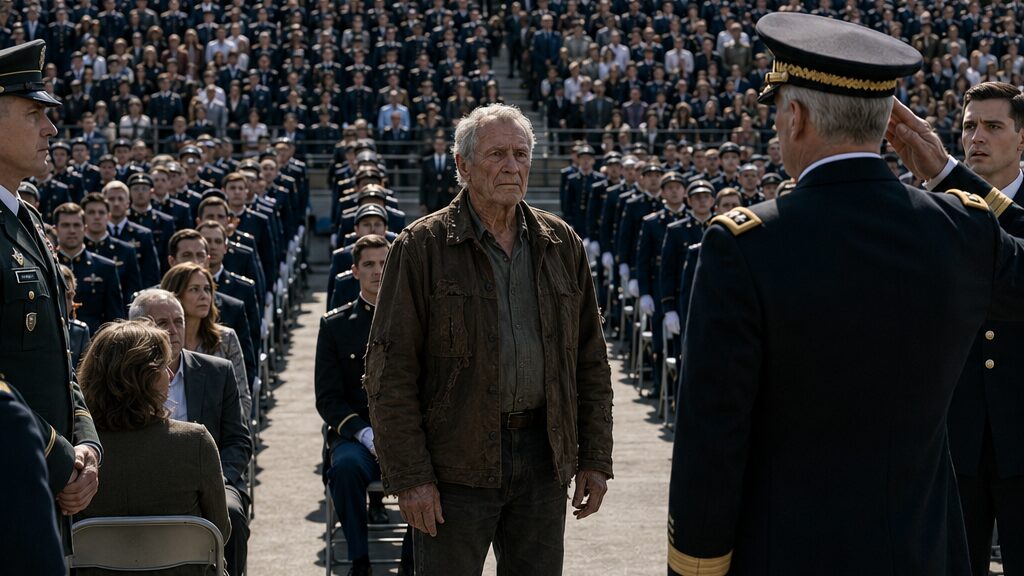
Nobody looked twice at the old man in the faded brown jacket.
The jacket hung loosely from his thin shoulders.
The elbows had been patched years ago.
The collar was worn smooth.
A small tear near one pocket had been carefully stitched by hand.
George pulled it tighter around himself and continued walking.
Not toward the family section.
Toward the back.
As usual.
He found an empty spot near the highest row of benches and sat down.
From there he could see everything.
The stage.
The flags.
The formation area where hundreds of recruits stood waiting.
The podium where senior officers would soon speak.
He preferred the back.
People rarely asked questions there.
His hand drifted unconsciously toward the inside pocket of his jacket.
Still there.
Good.
He let his hand fall away.
A loudspeaker crackled overhead.
The ceremony would begin in thirty minutes.
Plenty of time to leave.
The thought arrived as it always did.
Just leave.
No one would notice.
No one expected him.
No one had reserved a seat.
No one even knew he was there.
A small smile touched his face.
That was usually how he preferred things.
A group of recruits passed below the grandstand.
Their uniforms were immaculate.
Sharp lines.
Bright insignia.
Boots polished until they reflected sunlight.
George watched them move together.
Young.
Strong.
Confident.
For a brief moment he saw different faces layered over theirs.
Faces long gone.
He blinked.
The vision disappeared.
A child nearby pointed toward him.
“Mom, is he military too?”
The mother glanced over.
“Maybe, honey.”
Then she returned to adjusting her camera.
George looked away before the child could ask another question.
The loudspeaker crackled again.
More people arrived.
The crowd grew thicker.
The noise grew louder.
Yet somehow George felt increasingly alone.
An elderly man among thousands.
A forgotten figure at the edge of a celebration.
A voice interrupted his thoughts.
“Excuse me, sir.”
George looked up.
Another officer stood nearby.
Younger than most.
Neatly pressed uniform.
Focused expression.
Nameplate: CLARK.
Dennis Clark.
“I need to check seating assignments,” Dennis said.
George nodded.
“Of course.”
Dennis looked around.
Then back at George.
“Who are you here with?”
“No one.”
Dennis frowned slightly.
“No family member graduating?”
“No.”
“A guest of one of the officers?”
“No.”
The young officer’s expression tightened.
Not hostility.
Confusion.
George had seen that look before.
People liked categories.
Boxes.
Labels.
An old man sitting alone didn’t fit neatly into any of them.
“I’m just attending,” George said.
Dennis glanced at the worn jacket.
Then at George’s scuffed shoes.
Then back toward the stage.
“You understand this is an official military event.”
“I do.”
“Access is restricted in some areas.”
George smiled faintly.
“So I’ve noticed.”
Dennis seemed unsure whether that was a joke.
“I’m only trying to avoid problems.”
“I know.”
For a moment neither spoke.
Then Dennis nodded.
“All right.”
He started to leave.
A flash of color caught his eye.
A tiny ribbon partially visible beneath George’s jacket collar.
Dennis paused.
His gaze lingered.
George quietly adjusted the jacket.
The ribbon disappeared.
Dennis looked away.
Whatever he had noticed clearly wasn’t enough to matter.
“Enjoy the ceremony, sir.”
“You too.”
The officer continued down the stairs.
George watched him go.
A decent young man.
Nervous.
Trying hard.
The kind of officer who followed every rule because he cared about getting things right.
George couldn’t fault him for that.
The seats continued filling.
The ceremony was minutes away.
The crowd’s attention focused on the stage.
Not on the old man sitting alone in the back row.
Exactly as George preferred.
Or at least that’s what he kept telling himself.
The band began tuning instruments.
Flags stirred gently above the field.
A low murmur spread through the audience.
Senior officers were arriving.
Among them was General Charles Harris.
Even from a distance, George recognized him immediately.
The years changed faces.
But not always posture.
Not always presence.
The General moved across the stage greeting officials.
George considered standing.
Considered leaving.
The thought pressed harder now.
The same thought that returned every year.
You came.
That was enough.
Go home.
Instead he remained seated.
Hands folded.
Eyes fixed on the field.
The ceremony began.
Music echoed across the grounds.
The recruits marched into formation.
Families applauded.
George joined them.
Quietly.
Respectfully.
Then the speeches started.
One after another.
Introductions.
Announcements.
Formal acknowledgments.
The crowd settled into attentive silence.
Finally General Harris approached the podium.
The applause lasted nearly a minute.
George lowered his eyes.
Maybe he would slip away before the end.
Maybe nobody would notice.
Maybe that was best.
The General adjusted the microphone.
Began speaking.
The crowd listened.
Minutes passed.
George stared at the recruits.
The young faces.
The proud families.
The futures waiting ahead.
Then, without warning, he felt something strange.
Not a sound.
Not a movement.
A feeling.
He looked toward the stage.
General Harris had stopped speaking.
The General’s eyes were fixed somewhere deep within the crowd.
Searching.
Then locking onto something.
Someone.
At the very back of the grandstand.
George felt his stomach tighten.
For the first time that morning, General Charles Harris wasn’t looking at the graduates.
He was looking directly at him.
Chapter 2: The Reason He Almost Stayed Home
The moment General Harris looked toward him, George’s first instinct was not pride.
It was escape.
He shifted slightly on the bench.
Maybe the General was looking at someone else.
Maybe another veteran sat nearby.
Maybe—
A memory interrupted him.
Three days earlier.
Patrick Hill stood in George’s kitchen holding a coffee mug and losing patience.
“You’ve got the invitation.”
“It’s in a drawer.”
“Then take it out.”
“No.”
Patrick stared at him.
George stared back.
The two men had known each other too long to bother pretending.
“You promised me you’d think about it.”
“I did think about it.”
“And?”
“And I thought no.”
Patrick sighed heavily.
The kitchen was silent except for the ticking clock.
The same clock that had occupied George’s wall for decades.
“You go every year,” Patrick finally said.
“Not every year.”
“Most years.”
“Not lately.”
Patrick set down his mug.
“That’s exactly why you should go.”
George looked out the window.
The answer came automatically.
“They don’t need me there.”
Patrick laughed once.
Not because anything was funny.
Because he couldn’t believe what he had heard.
“They absolutely need you there.”
“No.”
“They should know.”
George’s jaw tightened.
“Know what?”
Patrick stopped.
The question carried more weight than it appeared.
Know what?
The battle?
The medal?
The names?
The losses?
Which part mattered?
Patrick softened his voice.
“The history.”
George looked away.
History.
That word always sounded clean.
Organized.
Neat.
Real memories weren’t neat.
Real memories smelled like smoke and mud.
Real memories never stayed inside books.
“You remember what happened the last time,” George said quietly.
Patrick nodded.
A local event.
Photographs.
Questions.
People wanting stories.
George had left halfway through.
He had not attended another public recognition in years.
“You can’t spend the rest of your life hiding.”
“I’m not hiding.”
Patrick looked around the empty house.
The answer didn’t require words.
George felt irritation rise.
Not because Patrick was wrong.
Because Patrick was right.
The conversation ended without resolution.
Yet somehow Patrick had still convinced him to come.
That was Patrick’s gift.
Persistence.
Now, sitting in the grandstand, George wondered if he should have listened to himself instead.
A burst of laughter pulled him back to the present.
Several recruits stood near the edge of the field waiting for instructions.
Young.
Energetic.
One shoved another playfully.
A second adjusted his uniform.
A third grinned broadly while scanning the crowd.
George watched them.
The sight created an unexpected ache.
Not because they resembled the men he had lost.
Because they didn’t.
Time had moved on.
Entire generations had appeared since then.
The world belonged to them now.
Perhaps it should.
Perhaps that was the point.
His hand brushed the sleeve of his jacket.
The fabric felt thin.
Years ago it had been sturdy.
Strong.
Now it carried dozens of repairs.
Each patch had a story.
Each stitch a year.
He could have replaced it.
People had offered.
He never did.
The jacket reminded him where he’d been.
Who he owed.
A movement on stage caught his attention.
General Harris continued speaking.
The audience listened carefully.
George relaxed slightly.
Maybe he had imagined the look.
Maybe the General had been scanning the crowd.
Nothing more.
Then a voice nearby spoke.
“Sir?”
George turned.
Dennis Clark again.
The young officer seemed uncertain.
“I hope I didn’t offend you earlier.”
George smiled.
“You didn’t.”
Dennis nodded.
“Good.”
An awkward pause followed.
“You served?” Dennis asked.
George looked at the field.
“A long time ago.”
Dennis waited.
When no further explanation came, he cleared his throat.
“My grandfather served.”
George nodded politely.
Another silence.
Dennis seemed to want to ask something else.
Instead he said, “Enjoy the ceremony.”
Then he walked away.
George watched him go.
The young officer wasn’t suspicious anymore.
Just curious.
That was somehow worse.
Curiosity led to questions.
Questions led to attention.
Attention led to recognition.
Recognition led to memories.
George lowered his eyes.
On stage, General Harris reached the middle of his speech.
The audience remained focused.
Everything appeared normal.
Then the General suddenly stopped.
Not paused.
Stopped.
Mid-sentence.
The microphone carried a fragment of unfinished words before silence swallowed them.
Confused murmurs spread across the grandstand.
The General wasn’t reading notes.
Wasn’t checking the podium.
Wasn’t looking at another officer.
He was staring directly toward the rear rows.
Toward George.
And this time there was no mistaking it.
Chapter 3: A Name That Changed the Air
The silence spread faster than sound.
General Harris stood motionless behind the podium.
Five hundred recruits remained frozen in formation.
Families exchanged confused looks.
Officers glanced toward one another.
Nobody understood what had happened.
George did.
Or at least he feared he did.
He lowered his gaze immediately.
Too late.
The General had already stepped away from the microphone.
One officer approached him quickly.
A brief exchange followed.
Then another.
George felt his chest tighten.
Not fear exactly.
Something older.
Something heavier.
Please don’t.
The thought arrived before he could stop it.
Not here.
Not today.
Several rows below, Dennis Clark noticed the change instantly.
Years of training taught officers to read disruption.
Something had shifted.
He followed the General’s line of sight.
Toward the rear of the grandstand.
Toward the old man in the worn jacket.
Dennis frowned.
That couldn’t be right.
He looked again.
The General was still watching the same person.
A senior colonel nearby suddenly stiffened.
Then another officer.
A quiet message passed between them.
Dennis saw recognition appear on faces that moments earlier had shown only confusion.
His stomach dropped.
What had he missed?
George rose slowly from his seat.
If he left now, perhaps—
“Sir.”
A voice stopped him.
One of the colonels had reached the stairs.
The officer approached respectfully.
Far too respectfully.
George knew what came next.
“Please remain where you are.”
George sighed softly.
“You don’t have to do this.”
The colonel’s expression changed.
Not offense.
Almost sadness.
“Yes, sir. We do.”
Sir.
The word echoed strangely.
Nearby spectators began noticing.
Heads turned.
Whispers spread.
Who is he?
What’s happening?
George sat down again.
There was nowhere left to go.
On stage, General Harris finally moved.
Not toward the microphone.
Toward the grandstand.
The entire audience watched.
The General descended the platform steps.
Every movement deliberate.
Every step increasing the tension.
Dennis felt heat rising in his face.
His mind replayed the earlier conversation.
Family seating is over there.
The words now sounded terrible.
He looked again at the old jacket.
Noticed details he had ignored before.
The careful repairs.
The faded ribbon hidden near the collar.
The posture.
The stillness.
Not weakness.
Discipline.
The realization unsettled him.
He had judged too quickly.
Far too quickly.
General Harris reached the lower section of the grandstand.
The crowd parted instinctively.
No one understood why.
Yet everyone sensed importance.
George remained seated.
Looking almost annoyed.
The General stopped several feet away.
For a moment neither man spoke.
Then General Harris came to attention.
Perfectly.
Instantly.
The movement struck the crowd like a physical force.
Gasps sounded across the stands.
A four-star General was standing at attention before an elderly man in a torn jacket.
George closed his eyes briefly.
Not because he enjoyed the moment.
Because he had spent decades trying to avoid it.
When he opened them again, the General spoke quietly.
Only those closest could hear.
“It’s good to see you, sir.”
George shook his head.
“You shouldn’t have stopped the ceremony.”
“I disagree.”
A faint smile appeared on the General’s face.
“The ceremony can wait.”
The words traveled farther than intended.
Nearby spectators heard them.
Then repeated them.
The ceremony can wait.
For him.
Confusion transformed into curiosity.
Curiosity transformed into astonishment.
Dennis stood frozen.
The old man he had redirected minutes earlier was being treated as someone extraordinary.
Yet George seemed uncomfortable.
Almost trapped.
That detail bothered Dennis most.
People usually wanted recognition.
This man appeared to want escape.
General Harris turned toward a nearby aide.
The aide hurried away.
Orders began moving through the command structure.
Invisible at first.
Then unmistakable.
Senior officers repositioned.
NCOs received instructions.
The atmosphere changed.
George recognized the signs immediately.
The machine was moving now.
Military organizations did not stop once momentum began.
He looked toward the nearest exit.
Still possible.
Perhaps.
Then he noticed the recruits.
Rows upon rows of young faces.
Watching.
Waiting.
Somewhere among them, he imagined other faces.
Faces from another time.
Another war.
Another life.
His hand tightened around the edge of the bench.
The General followed his gaze.
Neither man spoke.
Neither needed to.
A runner reached a Drill Sergeant near the formation area.
The message was delivered in seconds.
The Drill Sergeant’s eyes widened.
Then narrowed.
He looked toward George.
Then toward General Harris.
Understanding arrived.
The Sergeant straightened immediately.
Across the field, officers began taking positions.
The crowd sensed something enormous approaching.
No one knew what.
Only that the day had suddenly become about something far bigger than graduation.
George watched the Drill Sergeant draw a slow breath.
And knew the moment he had spent years avoiding was now only seconds away.
Chapter 4: The Weight Behind the Medal
George rose halfway from the bench.
Then sat back down.
The decision felt small to everyone watching.
To him, it felt enormous.
Leaving had always been easy.
Staying had always been difficult.
Below the grandstand, the Drill Sergeant stood motionless beside the formation. A message had reached him. Whatever he had been told, it had changed the way he carried himself.
The crowd could feel it.
Whispers moved through the rows.
Questions multiplied.
Who is he?
What happened?
Why did the General stop?
George wished none of them were asking.
General Harris remained nearby.
Not crowding him.
Not forcing conversation.
Simply standing there.
Protecting the moment from becoming something careless.
“You still don’t like this,” Harris said quietly.
George gave a dry laugh.
“You always were observant.”
The General smiled faintly.
“I learned from good people.”
George looked away.
The compliment landed heavily.
For a few seconds neither man spoke.
Families watched.
Officers watched.
Recruits watched.
An entire ceremony seemed suspended between breaths.
“You could have ignored me,” George said.
“I could have.”
“And finished your speech.”
“I could have.”
George nodded.
Neither needed to discuss why that had never been a real possibility.
A movement in the crowd caught his attention.
Dennis Clark.
The young officer stood near an aisle, looking as though he wished the ground would open beneath him.
George almost felt sorry for him.
Almost.
The young man wasn’t cruel.
Just inexperienced.
He saw uniforms before he saw people.
Many officers learned that lesson eventually.
Some never did.
Dennis met George’s eyes for a moment.
Then quickly looked away.
Shame had arrived.
George recognized it immediately.
He had carried his own version of it for decades.
The difference was that Dennis’s shame was fresh.
Still sharp.
Still capable of teaching something.
George’s hand slipped into the inner pocket of his jacket.
The familiar object rested there.
Cold.
Solid.
Heavy.
The medal.
He rarely touched it.
He almost never wore it.
Most years it remained locked away.
Today had been an exception.
Patrick had insisted.
“You don’t have to display it,” Patrick had said.
“Then why bring it?”
“Because hiding everything isn’t the same thing as honoring people.”
George had disagreed.
He wasn’t entirely sure he disagreed now.
His fingers closed around the metal.
Instantly another memory surfaced.
Not a ceremony.
Not applause.
Not pride.
Smoke.
Noise.
Mud.
A young soldier laughing while trying to brew terrible coffee from ration packets.
Another arguing about baseball scores.
A third writing a letter home.
Ordinary moments.
Nothing heroic about them.
Nothing historic.
Just people.
The memory vanished as quickly as it came.
George opened his eyes.
The medal remained hidden in his pocket.
The men did not.
Not really.
They never did.
General Harris noticed the change in his expression.
“You still carry them.”
George stared toward the recruits.
“Someone has to.”
The General looked toward the field as well.
Five hundred young men and women stood waiting for orders.
An entire future spread across the parade ground.
For a moment the old veteran and the General shared the same silence.
Not awkward.
Not uncomfortable.
Understanding.
Then another officer approached.
He stopped several feet away.
Respectful.
Careful.
“Sir.”
The officer addressed Harris.
“The command staff is asking how you’d like to proceed.”
The wording made several nearby listeners blink.
How you’d like to proceed.
Not how should we proceed.
Not what’s happening.
The answer apparently rested with the General.
And perhaps with George.
Harris looked toward him.
George immediately shook his head.
“No.”
The General sighed.
“I was afraid you’d say that.”
“The graduates are the reason everyone came.”
“They’re not going anywhere.”
“Neither am I.”
The response came too quickly.
George regretted it immediately.
Because it wasn’t entirely true.
Part of him still wanted to leave.
Part of him always wanted to leave when people started paying attention.
The officer waited.
Unsure.
Harris dismissed him gently.
“We’ll continue shortly.”
The officer departed.
George looked toward the field again.
One recruit in the front rank shifted slightly.
A tiny movement.
Barely visible.
Yet it triggered something.
The posture.
The age.
The nervousness.
Suddenly another face appeared in memory.
Not a recruit.
A soldier.
Young enough to think he would live forever.
Old enough to carry a rifle.
The memory hit harder this time.
George closed his eyes.
A dusty road.
A sudden burst of gunfire.
Shouting.
Confusion.
Someone falling.
Someone not getting back up.
He opened his eyes quickly.
The ceremony returned.
The grandstand.
The flags.
The uniforms.
The silence.
His breathing felt heavier now.
General Harris said nothing.
He understood better than most that some memories arrived without permission.
“They think it’s about the medal,” George said eventually.
The General followed his gaze toward the audience.
Many spectators were indeed staring toward George’s jacket.
Toward the pocket.
Toward whatever they imagined was hidden there.
“Most of them do.”
George nodded.
“They always do.”
A bitter smile touched his face.
“The medal was the easiest part.”
The General’s expression changed.
Not surprise.
Recognition.
He understood exactly what George meant.
The medal had been awarded afterward.
The burden came first.
Far too many years of it.
Far too many names.
Far too many empty places at reunions.
A distant command echoed somewhere near the formation area.
Preparations.
Movement.
The ceremony machinery beginning to shift again.
George felt attention growing heavier around him.
The crowd wasn’t simply curious anymore.
They were waiting.
Waiting for explanation.
Waiting for meaning.
Waiting for him.
That realization made him uncomfortable in a way battlefield memories never had.
Because bullets had never asked him to represent anyone.
People did.
And people were harder.
A small girl in the audience slipped free from her mother’s hand and pointed toward him.
“Mom, why’s everybody looking at that man?”
The mother hesitated.
“I don’t know.”
Neither did most of the audience.
Not yet.
George looked down at the worn sleeve of his jacket.
The stitching near the elbow had come loose again.
Patrick would complain when he saw it.
The thought almost made him smile.
Then another memory surfaced.
Not from war.
From years afterward.
Memorial services.
Cemeteries.
Quiet anniversaries attended by fewer people each year.
The same jacket.
The same folded hands.
The same names spoken aloud so they would not disappear.
That was what the jacket truly carried.
Not age.
Not poverty.
Memory.
And memory weighed more than any medal.
A sharp voice suddenly rang out somewhere near the field.
Not yet a command.
Not yet.
But close.
Very close.
George looked up.
The Drill Sergeant had stepped forward.
The recruits instantly stiffened.
The crowd fell silent again.
Something was about to happen.
And for the first time all day, George realized he might not be able to stop it.
Chapter 5: The Men Who Never Returned
The sound of marching boots reached George before the memory did.
A small formation was repositioning near the edge of the parade ground.
The rhythm echoed across the ceremony field.
Left.
Right.
Left.
Right.
Simple.
Orderly.
The sound struck him harder than it should have.
His hand tightened against the bench.
For a second the graduation disappeared.
The grandstand vanished.
And he was somewhere else.
Years earlier.
Watching a line of soldiers move through dust and heat.
Young men joking to hide fear.
Young men pretending tomorrow was guaranteed.
The memory wasn’t dramatic.
That was what made it painful.
Most of the moments he remembered weren’t battles.
They were ordinary conversations that had unknowingly become final conversations.
A complaint about bad food.
A joke.
An argument about music.
Promises about what everyone would do when they got home.
George remembered those things more clearly than the fighting.
Because those things belonged to people.
The fighting belonged to history.
A voice beside him pulled him back.
General Harris.
“You all right?”
George nodded automatically.
The General didn’t look convinced.
Neither was George.
Across the field the recruits stood waiting.
Hundreds of young faces.
George wondered how many families had traveled to be here.
How many cameras were ready.
How many futures were beginning.
Years ago he had stood among young men who believed their futures were beginning too.
Not all of them had received one.
The thought settled heavily in his chest.
A promise surfaced.
One he hadn’t thought about in months.
Maybe years.
But it was still there.
Waiting.
A hospital tent.
Night.
Generators humming somewhere in the darkness.
A young soldier lying still except for his breathing.
George sitting beside him.
Holding a hand that was growing colder.
The soldier had been afraid.
Not of dying.
Of being forgotten.
That was what people rarely understood.
Most feared disappearance more than death.
“Tell them,” the young soldier had whispered.
George remembered that much.
Not every word.
Not every detail.
Just the request.
Tell them.
Tell them we were here.
Tell them we tried.
Tell them we mattered.
The memory ended there.
The rest had never left him.
He had spent decades keeping that promise.
Memorials.
Reunions.
Visits to families.
Letters.
Quiet conversations.
Names spoken aloud.
Yet lately he had begun withdrawing.
Avoiding events.
Avoiding attention.
Avoiding responsibility disguised as recognition.
Maybe Patrick had seen it before George did.
Maybe that was why he had pushed so hard.
Patrick wasn’t worried about George disappearing.
He was worried about the memories disappearing with him.
The realization stung.
Nearby, Dennis Clark remained standing near the aisle.
The young officer looked different now.
Less certain.
Less rigid.
He had stopped trying to manage the situation.
Now he was simply observing.
Learning.
George respected that.
Learning usually began with discomfort.
Dennis approached slowly.
Not because he had been ordered to.
Because he wanted to.
He stopped several feet away.
“Sir.”
George looked up.
Dennis swallowed.
“I owe you an apology.”
George immediately shook his head.
“No.”
“I judged you.”
“Yes.”
The blunt answer surprised Dennis.
George continued.
“So have plenty of people.”
“That’s not an excuse.”
“No.”
Silence followed.
The young officer stood awkwardly.
George almost rescued him from it.
Then decided not to.
Some lessons required a little discomfort.
Finally Dennis spoke again.
“I thought important people looked different.”
The honesty caught George off guard.
No defense.
No excuse.
Just truth.
George looked down at his jacket.
The patched sleeves.
The faded fabric.
The years stitched into every repair.
Then back at Dennis.
“That’s usually the problem.”
Dennis nodded slowly.
The words landed.
Not fully.
Not yet.
But enough.
The young officer stepped back.
Something had changed.
Not redemption.
Understanding.
The beginning of it.
George watched him leave.
Then turned his attention toward the field again.
The recruits remained waiting.
The Drill Sergeant remained waiting.
The command staff remained waiting.
An entire ceremony paused around one old man’s reluctance.
It felt wrong.
Deeply wrong.
The day belonged to the graduates.
Yet another realization slowly emerged.
Perhaps this wasn’t really about him.
Perhaps it never had been.
Perhaps everyone else simply understood that before he did.
General Harris spoke quietly.
“They deserve to hear it.”
George knew immediately who he meant.
Not the audience.
Not the officers.
The recruits.
The next generation.
The people standing in formation.
George looked at them.
Young faces.
Confident faces.
Nervous faces.
Living faces.
Faces that reminded him why he kept coming back every year despite telling himself he wouldn’t.
Not because they resembled the dead.
Because they proved the dead had not been the end of the story.
A long breath left him.
The burden shifted slightly.
Not lighter.
Different.
The years of silence suddenly seemed less noble than he had imagined.
There was humility in refusing recognition.
But there could also be selfishness.
If memory mattered, it had to be shared.
The thought unsettled him.
Because it challenged something he had believed for years.
The crowd remained silent.
Waiting.
Watching.
The tension stretched across the grandstand.
Then movement rippled through the formation.
Precise.
Immediate.
The recruits stepped aside in synchronized motion.
One row.
Then another.
Then another.
A path appeared through the center of the ceremony grounds.
Perfectly straight.
Perfectly deliberate.
The sea of uniforms had opened.
And every eye in the grandstand turned toward George Miller.
The question he had avoided for decades could no longer be postponed.
Would he finally speak?
Chapter 6: The Silent Attention
The Drill Sergeant stepped forward.
His voice struck the air like a rifle crack.
“ROOM, ATTENTION!”
Five hundred recruits moved at once.
The effect was immediate and almost frightening.
Conversations died.
Movement stopped.
Even the rustle of programs seemed to disappear.
The entire ceremony snapped into perfect stillness.
George felt the silence settle across the grandstand.
Not empty silence.
Military silence.
Disciplined silence.
Intentional silence.
Every recruit stood rigid.
Every officer faced forward.
Every spectator instinctively understood that something sacred had entered the space.
George remained seated.
His pulse felt strangely loud.
General Harris turned toward him.
The General’s right hand rose.
A salute.
Precise.
Unwavering.
For a heartbeat nothing else happened.
Then another officer saluted.
Then another.
And another.
The gesture spread through the ceremony like a ripple crossing water.
Rows of officers came to attention.
Senior commanders.
Instructors.
Decorated veterans seated among family members.
One by one.
Without command.
Without discussion.
The sea of salutes grew.
George stared at them in disbelief.
He hated attention.
Always had.
The younger version of himself would have escaped long ago.
The older version desperately wanted to.
Yet something held him in place.
The faces.
The recruits.
The memory of promises made long ago.
The path through the formation remained open.
Waiting.
General Harris lowered his salute.
Not out of disrespect.
Out of invitation.
“George.”
The use of his first name surprised him.
Few people still did.
The General nodded toward the path.
George understood.
For several seconds he didn’t move.
Then slowly, with visible reluctance, he rose from the bench.
The crowd watched.
No applause.
No cheering.
The silence remained intact.
That silence meant more than any noise could have.
George descended the steps carefully.
The old jacket shifted around his shoulders.
Years ago he had worn uniforms pressed sharply enough to cut fingers.
Now he wore patched sleeves.
Loose stitching.
Faded fabric.
Yet for the first time all day, nobody seemed to notice the wear.
Or perhaps they noticed it more than ever.
Not as weakness.
As history.
Dennis Clark stood near the bottom of the stairs.
Frozen.
George paused beside him.
The young officer looked devastated.
“Sir…”
The apology died before it fully emerged.
George studied him for a moment.
Then gave a small nod.
Nothing more.
The gesture wasn’t forgiveness exactly.
But it was enough.
Dennis straightened instinctively.
His eyes followed George as the old veteran stepped onto the ceremony ground.
The path through the recruits stretched ahead.
Hundreds of young men and women stood perfectly still.
George began walking.
One step.
Then another.
The silence deepened.
As he moved between the formations, faces came into focus.
Some curious.
Some emotional.
Some confused.
Many simply respectful.
He wondered how many understood what was happening.
Perhaps not many.
Perhaps enough.
Halfway down the path he noticed a recruit struggling not to blink.
The young soldier looked barely twenty.
The sight triggered a memory.
Another young face.
Another uniform.
Another road.
The memory arrived unexpectedly.
A frightened private trying to hide shaking hands.
George had sat beside him before a mission.
Neither of them had known it would be their last conversation.
The memory faded.
The recruit remained.
Alive.
Standing proudly.
The contrast nearly stole George’s breath.
By the time he reached the center of the formation, every eye in the ceremony rested on him.
Not because of a medal.
Not because of a title.
Because everyone else had decided the moment mattered.
That realization changed something.
For years George had viewed recognition as self-indulgence.
As if accepting respect somehow stole it from the dead.
Now he began to understand another possibility.
Maybe remembrance required witnesses.
Maybe memory carried alone eventually disappeared.
General Harris stepped beside him.
The microphone waited nearby.
George immediately shook his head.
“No speeches.”
The General almost smiled.
“Nobody asked for one.”
The answer eased some tension.
A little.
Nearby, Dennis watched senior officers exchange brief words.
Pieces of the story were reaching him now.
Names.
Events.
Fragments of history.
Enough to understand the scale of his mistake.
Yet what struck him most wasn’t George’s reputation.
It was George’s discomfort.
The old man genuinely did not want this.
That made the respect feel real.
Across the field, the recruits remained frozen.
Not one moved.
Not one broke formation.
The discipline itself became part of the tribute.
George slowly looked around.
The crowd.
The flags.
The uniforms.
The faces.
Then his hand drifted toward the inside pocket of his jacket.
The motion was small.
Yet everyone noticed.
The medal rested there.
Heavy.
Cold.
Patient.
Waiting.
George closed his fingers around it.
And for the first time all day, he stopped trying to escape.
Chapter 7: Not for Me
The entire ceremony seemed to hold its breath.
George withdrew the medal slowly.
Sunlight caught the metal.
A faint glimmer passed across the field.
No one spoke.
No one moved.
The recruits remained locked at attention.
The crowd watched.
Waiting.
Expecting.
George looked down at the medal resting in his hand.
How many years had passed since he last held it in public?
He wasn’t sure.
Time blurred after a while.
Memorial services.
Anniversaries.
Funerals.
Visits.
Decades had slipped by.
Yet the weight never changed.
Not physically.
Emotionally.
The medal felt heavier now than the day he received it.
Because every year had added another layer of memory.
General Harris stood beside him but slightly behind.
The position was deliberate.
The moment belonged to George.
Or rather, George realized, it belonged to what he represented.
The microphone stood within reach.
He hated microphones.
Always had.
Too many people listened.
Too many people looked.
Yet avoiding them had become impossible.
A strange calm settled over him.
Not confidence.
Acceptance.
The kind that arrives only after every escape route has disappeared.
George raised his eyes.
The recruits stood before him.
Rows and rows of young faces.
Some nervous.
Some emotional.
Some trying desperately to understand why seasoned officers looked at an old man with such reverence.
George saw none of them as strangers.
Not really.
They were simply the newest chapter.
The continuation.
The reason memory mattered.
His gaze drifted toward Dennis Clark.
The young officer stood perfectly still.
Embarrassment remained written across his face.
Yet there was something else now.
Humility.
George appreciated that.
People learned little from certainty.
They learned from moments that unsettled them.
Dennis had received one today.
George finally stepped toward the microphone.
The silence deepened.
He looked at the medal.
Then at the recruits.
Then at the crowd.
For a second words refused to come.
Instead another memory surfaced.
A field hospital.
Dust hanging in the air.
A hand gripping his wrist.
A voice asking not to be forgotten.
Not a request for glory.
Not a request for monuments.
Just remembrance.
That memory settled everything.
George lifted the medal slightly.
His voice, when it emerged, was quiet.
Yet every person heard it.
“I wear this for the boys who didn’t come back.”
The words landed gently.
The effect was immediate.
Faces changed.
Expressions softened.
George looked down at the medal again.
Then shook his head.
“Not for me.”
Silence followed.
No speech came after.
No dramatic story.
No list of accomplishments.
No explanation.
Nothing else was needed.
The simplicity struck harder than any prepared remarks could have.
Several recruits lowered their eyes.
One instructor swallowed visibly.
Dennis felt his throat tighten.
For the first time all day he understood the difference between recognition and admiration.
Recognition pointed backward.
Toward sacrifice.
Toward memory.
Toward responsibility.
George wasn’t accepting honor for himself.
He was redirecting it.
The realization spread through the crowd.
Not through words.
Through understanding.
General Harris slowly returned his salute.
This time others followed.
Hundreds of hands rose.
A sea of salutes.
George looked across them.
The recruits.
The officers.
The families.
The people who had arrived expecting a graduation ceremony and found themselves participating in something else.
Something larger.
For years he had believed staying silent protected the memory of the dead.
Now he saw the flaw in that belief.
Silence preserved memory only as long as someone carried it.
Eventually every carrier disappeared.
The memories disappeared with them.
Today, for the first time in many years, he had shared the burden.
Not all of it.
Never all of it.
But enough.
The torn jacket shifted in the breeze.
For decades he had worn it to memorials.
To cemeteries.
To quiet anniversaries attended by fewer people each year.
People had mistaken it for evidence of neglect.
Of poverty.
Of insignificance.
In truth it had become something else entirely.
A record.
A witness.
A reminder.
The jacket had survived because the memories had survived.
Now both belonged to more than one man.
George lowered the medal.
The crowd remained silent.
No applause erupted.
No cheers.
The absence of noise felt perfect.
The ceremony resumed only after several long moments.
Yet everything had changed.
The graduates would still receive their honors.
Families would still celebrate.
Photographs would still be taken.
Life would continue.
As it should.
George glanced once more at the recruits.
The future stood before him.
The past stood behind him.
For the first time, neither felt alone.
General Harris extended a hand.
George accepted it.
Not because he needed help walking.
Because he understood the gesture.
Shared responsibility.
Shared remembrance.
As they turned back toward the ceremony, Dennis Clark came to attention one final time.
George returned the nod he had given earlier.
The young officer would remember this day for the rest of his life.
Perhaps that was enough.
Perhaps that was how memory survived.
Not through medals.
Not through ceremonies.
Through people carrying stories forward.
George touched the medal once more before returning it to the pocket of his worn jacket.
Then he looked toward the formation and allowed himself a small, genuine smile.
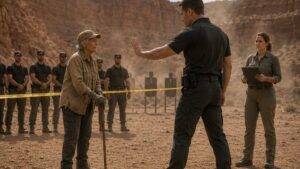
The story has ended.