The Empty Plate Across The Hospital Table And The Drawing That Finally Brought Him Back
Chapter 1: The Empty Seat Across From Him
The cafeteria worker noticed the second plate before she noticed the man.
The lunch crowd had already begun to thin. A few families sat near the windows. Two nurses hurried through a late meal. A television mounted in the corner played a daytime talk show nobody was watching.
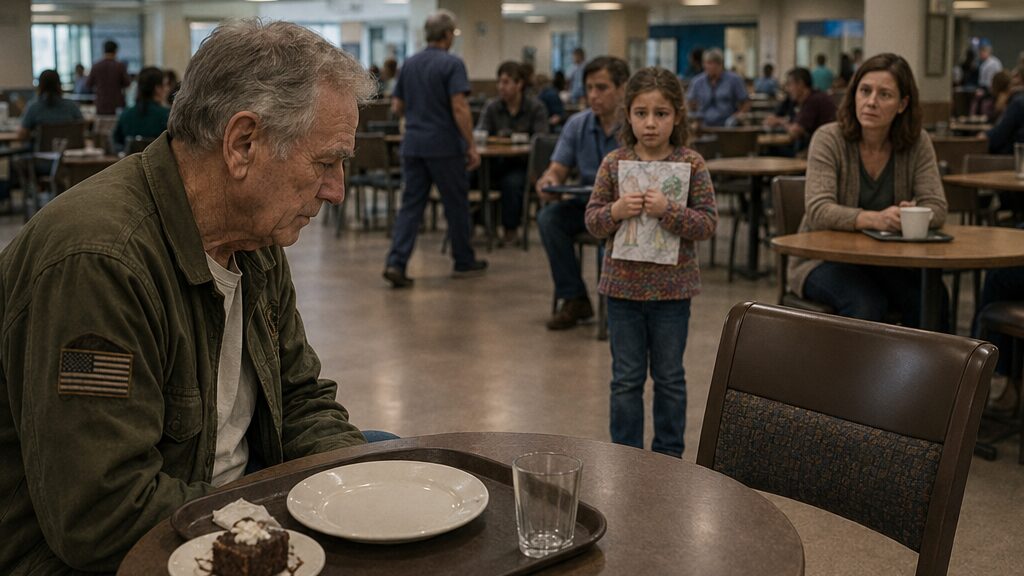
At a table near the far wall, an elderly man carefully unfolded a paper napkin and placed it beside an untouched plate.
Then he positioned an empty glass across from himself.
The movements were precise.
Practiced.
Almost ceremonial.
The worker paused with a tray in her hands.
The man wasn’t waiting for anyone. She knew that because she had seen him do the same thing three times this week.
He always arrived around noon.
He always sat at the same table.
And nobody ever occupied the second chair.
The worker glanced toward the cafeteria supervisor behind the register.
The supervisor followed her gaze.
“There he is again,” she said quietly.
The supervisor sighed.
“Leave him alone.”
“You don’t think it’s strange?”
“I think hospitals are full of strange things.”
The worker looked back.
The old man sat motionless now.
One hand wrapped around a coffee cup.
His eyes fixed on the empty chair.
Not looking at it exactly.
Looking through it.
As if someone invisible sat there.
The worker felt a chill she couldn’t explain.
A moment later she carried her tray away.
Edward Johnson remained where he was.
The cafeteria faded around him.
Conversations blurred.
Dishes clattered.
Announcements echoed from distant hallways.
None of it mattered.
Across from him sat the absence he knew better than any living person.
He took a sip of coffee.
“You’re late,” he muttered.
The empty chair offered no reply.
That wasn’t unusual.
He sat there for another minute.
Then another.
The silence between them was familiar.
Comfortable, even.
At a nearby table, a visitor watched him.
The man looked to be in his forties, exhausted from whatever reason had brought him to the hospital.
Eventually curiosity won.
He stood and approached.
“Excuse me, sir.”
Edward looked up.
The visitor pointed toward the empty chair.
“You expecting somebody?”
Edward’s expression hardened immediately.
“No.”
The visitor blinked.
“Oh.”
His gaze moved to the untouched plate.
“Sorry. I just thought—”
“I know what you thought.”
The visitor shifted awkwardly.
Edward looked away.
Conversation over.
The man retreated to his table.
But he wasn’t the only one paying attention now.
Others had noticed.
A nurse glanced over.
Two elderly women whispered to each other.
The cafeteria worker kept stealing looks.
Edward ignored them all.
He was used to being watched.
People often noticed eventually.
Most couldn’t help themselves.
An old man talking to an empty chair attracted attention.
What they never understood was that the chair wasn’t empty.
Not to him.
A loud burst of laughter erupted near the entrance.
A group of teenagers entered carrying snacks and drinks.
They filled two tables and immediately began arguing over something on a phone.
Their voices echoed across the room.
Edward didn’t react.
Years ago, noise like that would have bothered him.
Now it barely registered.
The world belonged to younger people.
He was simply passing through it.
One of the teenagers noticed the extra place setting.
He nudged a friend.
Both glanced toward Edward.
They laughed quietly.
Edward saw it.
Pretended he didn’t.
The cafeteria supervisor noticed too.
Her expression tightened.
She walked toward the worker.
“Has anyone talked to him recently?”
The worker shook her head.
“No.”
“Maybe somebody should.”
“Why?”
The supervisor lowered her voice.
“He spends hours here some days.”
“Maybe he’s lonely.”
“Or maybe he needs help.”
The worker didn’t answer.
Because she wasn’t sure.
From where she stood, the old man didn’t look dangerous.
He looked tired.
The kind of tired that sleep couldn’t fix.
At his table, Edward reached into his jacket pocket.
He removed a folded receipt.
Not because he needed it.
Because habit demanded movement.
The alternative was staring too long.
Thinking too much.
The receipt slipped from his fingers.
It floated to the floor.
A young nurse walking past bent to retrieve it.
“Here you go.”
Edward accepted it with a nod.
“Thank you.”
The nurse smiled politely.
Then her eyes drifted to the second plate.
Her smile faded.
Questions appeared.
She swallowed them.
For that, Edward was grateful.
After she left, he looked toward the chair again.
A memory surfaced.
Not a complete one.
Just fragments.
Dust.
Heat.
A laugh he hadn’t heard in decades.
He pushed the memory away.
The cafeteria worker approached cautiously.
“Sir?”
Edward looked up.
“Can I get you anything?”
He shook his head.
“No.”
Her eyes shifted toward the untouched plate.
“You know… if nobody’s coming, I could clear that.”
The words were gentle.
Meant kindly.
But something inside him tightened immediately.
“No.”
The worker looked startled.
“I’m sorry. I didn’t mean—”
“No.”
His voice softened slightly.
“Leave it.”
She nodded.
“Of course.”
When she walked away, the supervisor frowned.
The refusal bothered her.
Not because of the plate.
Because of how fiercely he’d protected it.
As though removing it would cause real harm.
Another hour passed.
The crowd changed.
People came and went.
Edward remained.
Eventually the supervisor approached directly.
“Mr. Johnson?”
He recognized her from previous visits.
“Yes.”
“Can I sit for a moment?”
He shrugged.
She sat in the chair beside him.
Not the empty one.
Never the empty one.
“Some of the staff are concerned.”
Edward almost smiled.
“About what?”
“You spend a lot of time here.”
“So do your employees.”
She ignored that.
“You seem alone.”
“I am alone.”
The honesty caught her off guard.
She hesitated.
“Do you have family?”
“Not nearby.”
“Friends?”
Edward looked toward the empty chair.
A long silence followed.
The supervisor watched him carefully.
Then she understood something.
Not everything.
Just enough.
The concern in her face changed shape.
Became sadness instead.
She stood.
“If you need anything, let us know.”
Edward nodded.
She walked away.
For a while he sat quietly.
Watching the untouched plate.
Watching the empty glass.
Watching years pass inside his own head.
The cafeteria lights flickered slightly as afternoon approached.
The teenager who had laughed earlier glanced over once more.
This time he didn’t laugh.
Neither did his friends.
Something about the old man’s expression had silenced them.
Edward finally pushed back his chair.
Slowly.
Carefully.
His knees protested.
He reached for his cane.
The cafeteria worker moved closer.
She wasn’t sure why.
Maybe curiosity.
Maybe concern.
Maybe both.
Edward stood beside the table.
Looking at the empty chair one final time.
The worker couldn’t stop herself.
“Sir…”
He paused.
“Who were you waiting for?”
The question hung between them.
The room seemed quieter suddenly.
Edward stared at the chair.
His eyes softened.
And for the first time all day, he answered.
Not loudly.
Not dramatically.
Just honestly.
“He should have been sitting there.”
Then he picked up his coat and walked away.
Behind him, the untouched plate remained on the table.
And now everyone who had seen it was wondering the same thing.
Who was he?
Chapter 2: The Name Never Spoken Loudly
The next day, Edward was already speaking when the visitor rounded the corner.
“You would’ve hated this coffee.”
The words were quiet.
Casual.
As if spoken to an old friend.
The visitor froze.
Edward sat alone.
The empty chair remained across from him.
The extra plate.
The extra glass.
Exactly where they always were.
The visitor quickly looked away.
But not before Edward noticed.
He sighed.
The hospital was teaching him something unfortunate.
People could tolerate grief.
They struggled with rituals.
Especially the ones they couldn’t understand.
He lifted his coffee cup.
“Still complaining after all these years,” he murmured.
A faint smile appeared.
Then disappeared.
The visitor left without speaking.
Yet within an hour, word had spread among staff.
Again.
The supervisor found herself answering questions she couldn’t answer.
“Who is he talking to?”
“Does he have dementia?”
“Should somebody call someone?”
The supervisor disliked speculation.
But she couldn’t stop it.
Not entirely.
Meanwhile, Edward unfolded a small cloth from his pocket.
Inside rested a tarnished military challenge coin.
Its edges were worn smooth.
The engraving nearly faded away.
He rubbed his thumb across it.
The motion automatic.
Comforting.
A cafeteria worker delivering fresh coffee noticed.
“That’s military?”
Edward looked down.
“Yes.”
“My father served.”
He nodded politely.
She hesitated.
Then pointed carefully toward the empty chair.
“Is that who you’re remembering?”
For several seconds Edward said nothing.
Then he surprised himself.
“Not family.”
The worker waited.
“He was my friend.”
The answer was simple.
But it felt heavier than anything he’d said in years.
The worker smiled softly.
“I see.”
She didn’t.
Not really.
But she respected the boundary.
That mattered.
After she left, Edward stared at the coin.
The metal felt colder than usual.
A memory returned.
Not the battle.
Never the battle first.
Always the moments before.
A young man laughing.
Sharing terrible jokes.
Arguing about baseball.
Complaining about coffee.
Alive.
The memories that hurt most were the ordinary ones.
A shadow fell across the table.
The supervisor stood there.
“I heard you served together.”
Edward’s jaw tightened.
Hospital gossip traveled quickly.
She noticed immediately.
“I’m sorry. I wasn’t trying to pry.”
He looked away.
“I know.”
She remained standing.
“People worry because they don’t understand.”
Edward almost laughed.
Neither do I.
The words stayed inside.
Instead he asked, “Do they need to understand?”
The supervisor considered that.
“No.”
“Then we’re done.”
A hint of irritation crossed her face.
Not anger.
Frustration.
She genuinely wanted to help.
But every path ended at a locked door.
She walked away.
By afternoon the cafeteria had grown busier.
A family occupied the table beside Edward.
Their young daughter stared openly at the empty chair.
Children rarely hid curiosity.
The mother eventually whispered for her to stop.
Edward pretended not to notice.
But he remembered another child.
Not his own.
Because he never had children.
The memory belonged elsewhere.
At home.
Years ago.
His wife laughing while a neighbor’s little girl showed them a drawing.
The memory arrived suddenly.
Sharp enough to hurt.
He reached into his wallet.
Inside sat an old photograph.
The edges were bent.
The image faded.
He looked at it only briefly before returning it.
Too briefly for anyone else to see.
But not brief enough.
The cafeteria worker had noticed.
Later, as Edward slowly crossed the parking lot toward his truck, she watched from the entrance.
A gust of wind caught something as he opened his wallet again.
The photograph slipped free.
Fluttered to the pavement.
Edward didn’t see it.
The worker hurried outside.
“Sir!”
He turned.
She picked up the photograph.
“I’m glad I caught it.”
Edward accepted it immediately.
Almost too quickly.
As though protecting something fragile.
For a second she glimpsed the image.
Two people sat at a table.
One was clearly Edward.
The other was a woman.
Smiling.
Very much alive.
Edward noticed her expression.
And knew what she’d seen.
His hand tightened around the photograph.
Without a word he slipped it back into his wallet.
Then climbed into his truck.
The worker remained standing in the parking lot.
Watching him leave.
A question now replaced the old one.
The empty chair belonged to a fallen friend.
That much was finally clear.
But the photograph revealed another mystery.
Someone else had once occupied that place beside him.
Someone whose absence seemed just as important.
Who was the woman in the photograph?
Chapter 3: The Woman Missing From The Table
The note fell from Edward’s wallet before he even reached the cafeteria.
He was halfway across the hospital courtyard when a folded piece of paper slipped onto the pavement.
He nearly walked past it.
Then he recognized the handwriting.
His breath caught.
Slowly, he bent down and picked it up.
The paper had been folded so many times the edges were beginning to tear.
He unfolded it carefully.
Only one sentence appeared.
Don’t eat alone if you can help it.
Love, always.
For a moment the hospital disappeared.
The courtyard.
The traffic.
The voices.
All gone.
Only the handwriting remained.
Rachel’s handwriting.
He stared at the note until the words blurred.
Then he folded it again and slipped it back into his wallet.
Not quickly enough.
The ache had already arrived.
It settled behind his ribs and refused to leave.
He continued walking.
Toward the cafeteria.
Toward the empty chair.
Toward the ritual he told himself he couldn’t stop.
And perhaps no longer wanted to examine too closely.
The automatic doors opened.
The familiar smell of coffee and disinfectant greeted him.
He chose the same table.
Placed the same plate.
The same glass.
Everything exactly where it belonged.
Everything except Rachel.
For years there had been three places.
His.
The empty seat.
And hers.
Now there were only two.
That fact felt wrong every single day.
He sat down heavily.
The note weighed more than the wallet containing it.
Across the room, Rachel Robinson helped her daughter carry a tray.
Mary chatted endlessly about something involving crayons, cartoons, and a classmate who had stolen a cookie.
Rachel listened with half an ear.
Her mother had been undergoing treatment upstairs for weeks.
Hospital visits had become routine.
Necessary.
Exhausting.
She was searching for a quiet table when Mary pointed.
“The soldier man.”
Rachel followed her gaze.
The elderly veteran sat exactly where he always did.
The extra place setting remained untouched.
Mary looked at him with the open fascination only children possessed.
Rachel looked away first.
Some sadness felt private.
She didn’t want to intrude.
At Edward’s table, the cafeteria supervisor approached again.
Not because she wanted conflict.
Because she worried.
“You’ve been here every day this week.”
Edward nodded.
“I know.”
“Are you waiting for someone upstairs?”
“No.”
She hesitated.
“Then why come here?”
Edward looked toward the empty chair.
The answer sat right there.
But he couldn’t say it.
Not to her.
Not to anyone.
Instead he shrugged.
“I like the coffee.”
The supervisor snorted despite herself.
“That’s the least believable thing you’ve ever said.”
For the first time, a faint smile touched Edward’s face.
It disappeared quickly.
But she saw it.
So did he.
Neither mentioned it.
When she left, Edward pulled the photograph from his wallet again.
This time he allowed himself to look.
The image showed three people.
Himself.
An empty chair.
And Rachel.
His wife.
She sat beside him, smiling directly at the camera.
Years ago she had insisted on taking the picture.
“You’ll want proof someday.”
“Proof of what?”
“That grief doesn’t get the whole table.”
At the time he hadn’t understood.
Now he wished he had listened more carefully.
His throat tightened.
He returned the photograph to his wallet.
Then took out the note.
Then put both away again.
Like a man searching for something he couldn’t find.
Across the cafeteria, Rachel Robinson noticed.
The veteran wasn’t simply lonely.
He was carrying someone.
Not physically.
Emotionally.
The distinction mattered.
Mary was watching too.
Children often saw what adults explained away.
“Why does he look sad?” she asked.
Rachel considered lying.
Instead she said, “Maybe he misses someone.”
Mary accepted that answer immediately.
Missing people made sense to children.
She thought about her grandmother upstairs.
Then about the old man.
Then about the empty chair.
The pieces connected in a way only a child could manage.
Meanwhile, outside the cafeteria, Edward stepped into the courtyard for air.
The note remained in his hand.
He sat on a bench beneath a tree.
For several minutes he simply stared ahead.
Then the memory came.
Not of the war.
Of Rachel.
A rainy afternoon years earlier.
Her carrying two trays through the cafeteria.
Her setting food down beside the empty place.
Her acting as though the invisible guest belonged there.
Never mocking.
Never questioning.
Never asking him to stop.
She had shared the burden.
Quietly.
For decades.
And he had never truly thanked her.
The realization struck harder than expected.
A sharp breath escaped him.
He lowered his head.
For the first time in months, tears threatened.
He fought them.
Lost.
Only briefly.
But long enough.
“Mr. Johnson?”
Edward looked up abruptly.
Rachel Robinson stood several yards away.
Concern filled her face.
Not curiosity.
Concern.
“I didn’t mean to interrupt.”
He wiped his eyes quickly.
“You didn’t.”
She knew that wasn’t true.
But she respected the effort.
“My daughter likes seeing you here.”
Edward seemed surprised.
“Why?”
Rachel smiled slightly.
“You’d have to ask her.”
That answer puzzled him.
Before he could respond, she added, “Take care of yourself.”
Then she walked away.
Simple words.
Yet they lingered.
Take care of yourself.
The phrase followed him back inside.
Back to the table.
Back to the chair.
He sat down again.
Staring at the extra plate.
For the first time, a thought entered his mind.
Maybe he should stop.
The idea frightened him immediately.
Stop and then what?
Forget?
Move on?
Pretend?
The thought felt like betrayal.
His hand clenched.
No.
He couldn’t.
Wouldn’t.
The plate remained.
The chair remained.
The ritual remained.
Even if it was the only thing left.
Across the room, Mary sat with a box of crayons she had brought from home.
Her mother was distracted by a phone call.
Mary looked at the old veteran again.
Then at the empty chair.
Then at the paper in front of her.
Carefully, she picked up a blue crayon.
And began to draw.
Chapter 4: The Drawing In Crayon Colors
Mary kept looking at the empty chair.
Not at Edward.
Not even at the extra plate.
The chair itself.
As though she expected someone to appear there if she watched long enough.
Rachel ended her phone call and returned to the table.
Mary was bent over a piece of paper, coloring carefully.
“What are you making?”
Mary covered the page immediately.
“It’s a surprise.”
Rachel smiled.
“For me?”
Mary shook her head.
“For him.”
She pointed toward Edward.
Rachel’s smile faded.
“Oh.”
Mary returned to drawing.
Rachel watched her for a moment before glancing across the cafeteria.
Edward sat exactly where he always sat.
Coffee untouched.
Eyes drifting occasionally toward the empty chair.
The sight pulled at something uncomfortable inside her.
She had spent weeks sitting in hospital waiting rooms while her mother battled a stubborn illness. During that time she had learned to recognize different kinds of loneliness.
Some people were temporarily alone.
Others seemed abandoned by life itself.
Edward belonged to the second group.
“Mommy?”
Rachel looked down.
“Yes?”
“Why doesn’t anybody sit there?”
The question wasn’t new.
But today it felt different.
Rachel considered her answer.
“Maybe because he wants to remember someone.”
Mary looked thoughtful.
“Like Grandma?”
Rachel swallowed.
Her mother was still alive upstairs.
But illness had a way of introducing grief before loss arrived.
“Something like that.”
Mary nodded.
Then resumed coloring.
Across the room, the cafeteria supervisor approached Edward’s table carrying a cup of coffee.
“You forgot this.”
Edward looked surprised.
“I didn’t order another one.”
“It’s on the house.”
He frowned slightly.
“Why?”
The supervisor pulled out the chair beside him.
“Because the staff took a vote.”
“A vote?”
“We decided the coffee here is terrible.”
Despite himself, Edward laughed quietly.
The supervisor smiled.
“There it is.”
“What?”
“The smile everybody keeps talking about.”
Edward shook his head.
Nobody talked about his smile.
People talked about the chair.
The plate.
The ritual.
Not him.
The supervisor seemed to sense his discomfort.
Her expression softened.
“People worry.”
“I’ve noticed.”
“They aren’t trying to be cruel.”
“I know.”
That was the difficult part.
Nobody meant harm.
The concern was genuine.
Which somehow made it harder to dismiss.
The supervisor looked toward the empty chair.
“I still don’t understand it.”
Edward followed her gaze.
“You don’t have to.”
“No.”
She stood.
“But I hope somebody does.”
The comment lingered after she walked away.
Edward stared at the chair.
A familiar defensiveness rose inside him.
Nobody needed to understand.
Nobody needed explanations.
The ritual belonged to him.
To the dead.
To Rachel.
That should have been enough.
Yet lately he found himself wondering if secrecy had become another prison.
Across the room, Mary was erasing something.
Then drawing it again.
Then erasing it once more.
Rachel leaned closer.
The picture showed a large American flag.
Beneath it stood a smiling stick figure wearing a military cap.
The proportions were wildly wrong.
The colors wandered outside every line.
It was unmistakably the work of a child.
“That’s lovely.”
Mary beamed.
“You think he’ll like it?”
Rachel hesitated.
The question carried more weight than her daughter realized.
“I don’t know.”
Mary looked disappointed.
Rachel immediately regretted her answer.
“I mean… I think kindness is usually a good thing.”
Mary returned to coloring.
But the uncertainty remained.
Rachel felt it too.
The veteran clearly valued privacy.
Would a stranger’s child approaching him help?
Or embarrass him?
Neither possibility seemed impossible.
Hours passed.
People came and went.
Mary’s drawing slowly gained shape.
At one point Edward stood and carried his tray toward the trash.
The extra plate remained behind.
The cafeteria worker watched him.
“Sir.”
Edward paused.
She gestured toward the untouched place setting.
“You left something.”
His gaze moved to the table.
“No.”
The worker looked confused.
Edward simply returned to the table and sat down again.
The plate stayed exactly where it was.
The interaction lasted only seconds.
Yet Mary observed every moment.
When Edward resumed his seat, she leaned closer to her mother.
“He doesn’t want it moved.”
“No.”
“Why?”
Rachel looked at the old man.
Then at the empty chair.
“Maybe because it belongs to someone.”
Mary frowned.
“But nobody’s there.”
Rachel opened her mouth.
Then stopped.
Because children often asked questions adults spent years avoiding.
“Maybe somebody can still belong somewhere after they’re gone.”
Mary considered that carefully.
The answer seemed to satisfy her.
At least for now.
Meanwhile Edward removed the old photograph from his wallet again.
The picture had become almost translucent with age.
He studied Rachel’s smile.
Not the little girl’s mother.
His Rachel.
The woman who had sat beside him through forty years of memories.
The woman who had quietly carried burdens she never created.
A memory surfaced.
Rachel teasing him about the extra plate.
Not mockery.
Affection.
“One day,” she’d said, “you’re going to tell somebody why it’s there.”
“No, I won’t.”
“You will.”
“What makes you think that?”
She’d smiled.
“Because somebody’s going to care.”
At the time he had dismissed the idea.
Now he wasn’t so sure.
Across the cafeteria, Mary folded the finished drawing.
Then unfolded it.
Then folded it again.
Nervous energy.
Decision battling uncertainty.
Rachel noticed.
“You don’t have to do anything.”
Mary stared at Edward.
“He’s sad.”
Rachel couldn’t argue.
“He might want to be left alone.”
“What if nobody asked him?”
The question landed harder than expected.
Rachel looked toward the veteran.
For all the concern surrounding him, very few people had actually spoken to him.
Not really.
Most had asked questions.
Few had offered companionship.
Mary carefully picked up the drawing.
Rachel immediately felt tension knot in her stomach.
“Mary…”
Her daughter paused.
“Yes?”
Rachel looked at Edward.
Then at the paper.
Then back at her daughter.
Every protective instinct told her to stop this.
Every human instinct told her not to.
“I don’t know if that’s a good idea.”
Mary stared at the drawing.
“I think it is.”
Rachel almost laughed.
The confidence of children could be terrifying.
Across the room, Edward sat quietly.
Unaware.
The teenagers near the entrance were louder than ever.
Hospital staff hurried between shifts.
Announcements echoed overhead.
Life continued around him.
Yet somehow the room felt as though it were waiting.
Rachel looked toward her daughter once more.
Mary had already climbed down from her chair.
Drawing clutched tightly in both hands.
Rachel’s heart immediately accelerated.
“Mary.”
The little girl stopped.
Rachel hesitated.
One final opportunity to stop her.
To protect her.
To prevent embarrassment.
Instead she heard herself say, “Be polite.”
Mary nodded.
Then began walking.
Step by step.
Across the cafeteria.
Toward Edward Johnson.
Chapter 5: The Thing He Could Not Survive Alone
Edward noticed the little girl when she was halfway across the room.
At first he assumed she was heading somewhere else.
A vending machine.
The exit.
Her mother.
Then he realized she was looking directly at him.
He straightened slightly.
Confused.
Mary stopped beside the table.
For a moment neither spoke.
The cafeteria seemed oddly quiet.
Or perhaps Edward simply noticed everything more sharply.
The paper in her hands.
The nervous shift of her feet.
The way she kept glancing at the empty chair.
“Hello,” she said.
Edward blinked.
“Hello.”
Mary held up the folded drawing.
“I made this.”
Edward looked at the paper.
Then at her.
“For me?”
She nodded.
The simple certainty in the gesture caught him off guard.
Nobody had brought him anything in a very long time.
Slowly, Mary placed the drawing on the table.
Near the extra plate.
Near the empty glass.
Near all the things nobody else touched.
Edward stared at it.
Neither of them moved.
Around the cafeteria, conversations began to fade.
People were watching.
Not intentionally at first.
Then deliberately.
Rachel felt every eye turning toward her daughter.
Part of her wanted to intervene.
Another part understood that the moment no longer belonged to her.
Mary pointed at the paper.
“You can open it.”
Edward swallowed.
His hands suddenly felt unsteady.
He carefully unfolded the drawing.
A flag.
Bright colors.
A smiling stick figure soldier.
Blue sky.
Yellow sun.
The proportions made no sense.
The message made perfect sense.
Something tightened inside his chest.
He stared for several seconds.
Unable to speak.
Mary shifted nervously.
“I hope it’s okay.”
Edward opened his mouth.
Nothing came out.
Because the drawing wasn’t just a drawing anymore.
It had become something else.
A memory.
A doorway.
A voice.
Years earlier another child had handed Rachel a picture almost exactly like this.
He remembered standing in a neighbor’s kitchen.
Rachel laughing.
Holding the paper as though it belonged in a museum.
He remembered thinking she made too much of small things.
Now he understood.
Small things lasted.
The room blurred slightly.
Mary looked worried.
“Did I do something wrong?”
Edward immediately shook his head.
“No.”
The word emerged rougher than intended.
He cleared his throat.
“No.”
Still not enough.
Still not what he meant.
Mary waited.
Then delivered the line she had practiced.
“My mommy said you’re a real superhero.”
A few people nearby smiled.
Mary continued.
“Superheroes need to eat dessert.”
Silence followed.
Complete silence.
Even the teenagers near the entrance had stopped talking.
Edward looked at the little girl.
Then at the drawing.
Then at the empty chair.
For one impossible second he imagined Rachel sitting there.
Smiling.
Waiting.
Not judging him.
Just waiting.
The thought struck with surprising force.
His fingers trembled.
Mary noticed immediately.
“Are you okay?”
Edward laughed softly.
The sound cracked in the middle.
“I don’t know.”
It was the most honest answer he had given anyone in years.
Mary seemed satisfied.
Children rarely demanded perfect explanations.
She simply nodded.
“Okay.”
Then she remained standing there.
As though that settled the matter.
Across the room Rachel covered her mouth.
Not because anything dramatic had happened.
Because something real had.
The old man looked different.
Smaller somehow.
Less guarded.
The cafeteria supervisor noticed it too.
She had spent weeks watching him preserve distance from everyone around him.
Now a child had crossed that distance in under a minute.
Edward lowered his gaze to the drawing again.
A memory surfaced.
Rachel standing beside him after a nightmare years ago.
Holding his hand.
Speaking quietly into darkness.
“You don’t have to carry him alone.”
At the time Edward had ignored the words.
Now they returned with painful clarity.
Maybe because the voice speaking through memory sounded exactly right.
Maybe because he was finally tired.
Tired of carrying everything.
Tired of protecting grief.
Tired of mistaking suffering for loyalty.
He touched the edge of the drawing.
Carefully.
As though it might tear.
Mary smiled.
“You like it.”
“I do.”
The answer came immediately.
No hesitation.
No defenses.
No avoidance.
Just truth.
The little girl seemed pleased.
Mission accomplished.
She started to leave.
Then stopped.
“Can he have it too?”
Edward looked up.
“What?”
She pointed toward the empty chair.
The question landed gently.
Yet it shattered something.
Not painfully.
Mercifully.
Because she had spoken about the chair without fear.
Without discomfort.
Without judgment.
Simply accepting its importance.
Edward glanced across the table.
The chair remained empty.
Yet for the first time in months it felt less lonely.
“Yes,” he said quietly.
“He can have it too.”
Mary nodded.
Satisfied.
Then she returned to her mother.
Only after she left did Edward realize everyone was still watching.
The awareness should have embarrassed him.
Instead he found he didn’t care.
His gaze returned to the drawing.
To the uneven flag.
The crooked soldier.
The impossible colors.
A tear landed on the paper.
Then another.
Edward quickly removed his glasses.
Too late.
The tears kept coming.
Not dramatic.
Not uncontrollable.
Just honest.
The kind that had been postponed for far too long.
Nobody interrupted.
Nobody applauded.
Nobody spoke.
The room simply allowed the moment to exist.
Several minutes later Edward finally looked up.
His eyes were wet.
His hands still trembling.
Yet a smile had appeared.
Not the polite smile he offered strangers.
Not the practiced smile used to end conversations.
A real one.
The kind Rachel used to coax from him.
The kind he thought he had forgotten.
Across the cafeteria, Rachel Robinson smiled back.
The supervisor quietly turned away.
Even the teenagers near the entrance looked uncomfortable in the presence of something genuine.
Edward lowered his gaze to the drawing once more.
Then carefully placed it beside the empty plate.
And for the first time in years, he wondered whether the chair had been waiting for this all along.
Chapter 6: What The Empty Chair Really Meant
The next morning Edward carried the drawing into the cafeteria before he carried his coffee.
The paper had been flattened overnight.
Not perfectly.
The creases remained.
He was strangely grateful for that.
The folds proved it had been held by small hands.
He reached his usual table.
The familiar chair waited across from him.
The familiar ritual waited too.
His hand moved automatically toward the tray station.
Toward the second plate.
Toward the second glass.
Then stopped.
He stood motionless.
The cafeteria worker noticed immediately.
Something had changed.
Not dramatically.
Just enough.
Edward looked down at the drawing.
Then at the empty chair.
Then back at the serving counter.
For the first time in years, he wasn’t sure what came next.
Eventually he collected only one plate.
One cup.
Nothing more.
The decision felt wrong.
And right.
Both at once.
He sat down carefully.
The empty chair remained across from him.
Waiting.
Accusing.
Inviting.
He couldn’t tell which.
Several minutes passed.
The supervisor approached.
She glanced at the table.
Then stopped.
“No extra plate today?”
Edward looked at the chair.
“No.”
She studied him.
Concern gave way to surprise.
“What changed?”
His eyes drifted toward the folded drawing resting beside his coffee.
Understanding flickered across her face.
She sat down.
Not to interrogate.
Simply to listen.
After a long silence she asked, “Who was he?”
Edward stared at the chair.
For once he didn’t avoid the question.
“He was my friend.”
The words felt easier now.
“He died young.”
The supervisor waited.
Edward continued.
“He was supposed to come home.”
The sentence hung in the air.
“He didn’t.”
The supervisor nodded slowly.
No clever response.
No attempt to fix anything.
Just acknowledgment.
Strangely, that helped.
A cafeteria worker brought fresh coffee.
She noticed the missing plate too.
News traveled quickly.
Within an hour half the staff knew something was different.
Edward remained at the table.
Watching people move through their ordinary lives.
Watching conversations begin and end.
Watching strangers comfort one another.
Years ago Rachel had sat beside him doing exactly this.
Never demanding that he let go.
Only asking that he not disappear.
The realization returned with uncomfortable clarity.
The ritual had changed after her death.
Not after the war.
Not after losing his friend.
After losing her.
Before then the extra plate had been remembrance.
Afterward it had become punishment.
He could finally see the difference.
The truth settled heavily into place.
Rachel had shared the burden.
When she died, he had picked up both halves.
Then convinced himself he was honoring everyone.
In reality he had been hiding.
The insight hurt.
Mostly because it was true.
Near lunchtime the cafeteria began filling.
The same teenagers entered.
Louder than necessary.
Arguing about sports.
One of them noticed Edward.
Then noticed the missing plate.
His expression shifted briefly.
Recognition.
Nothing more.
Yet Edward found it oddly meaningful.
People noticed changes.
Even small ones.
His hand moved toward the drawing.
Slowly he unfolded it.
The bright flag appeared.
The smiling soldier.
The crooked lines.
The impossible optimism.
Then, without fully planning to, he lifted the drawing and placed it in the center of the empty chair.
Not on the table.
Not beside his coffee.
In the chair itself.
As though offering the seat to something new.
The gesture startled him.
It startled the supervisor too.
She happened to be watching.
Edward stared at the paper.
A memory surfaced.
Rachel laughing.
Rachel carrying trays.
Rachel refusing to let grief become the only voice at the table.
Suddenly he understood what she had been doing all those years.
Not supporting the ritual.
Balancing it.
Protecting him from it.
The realization nearly broke him.
He lowered his head.
For several moments he simply sat there.
Breathing.
Thinking.
Remembering.
Then something unexpected happened.
Relief.
Small.
Fragile.
But real.
By late afternoon the cafeteria had grown quiet again.
Edward finished his coffee.
Gathered his belongings.
Picked up the drawing.
Then stood.
The supervisor approached one final time.
“Will you come back tomorrow?”
Edward considered the question.
“I think so.”
The answer surprised them both.
Not because of the words.
Because of the tone.
It sounded like a future.
At the entrance he paused.
The teenagers stood nearby.
The loudest among them reached the door first.
For a second Edward expected nothing.
Then the teenager stepped aside and held the door open.
No speech.
No performance.
Just a simple gesture.
The others followed.
Edward nodded.
“Thank you.”
The teenager shrugged awkwardly.
“No problem, sir.”
Edward stepped through the doorway.
Drawing tucked carefully beneath one arm.
The hospital behind him.
The evening ahead.
And for the first time in a very long while, the empty chair no longer felt like a sentence waiting to be served.
Chapter 7: The Seat That Was No Longer Empty
The cafeteria worker nearly dropped a stack of trays when she saw Edward walk through the doors.
Not because he had returned.
Because something was missing.
She stared at his table.
Then stared again.
The absence was unmistakable.
No extra plate.
No extra glass.
Just one tray.
One cup of coffee.
One elderly veteran moving slowly toward the same seat he had occupied for months.
The worker exchanged a glance with the supervisor.
Neither said anything.
Edward settled into his chair and looked around the room.
Several weeks had passed since Mary handed him the drawing.
The hospital looked exactly the same.
The televisions still muttered in the background.
Visitors still hurried through meals.
Nurses still ate standing up whenever they could.
Yet the place felt different.
Or perhaps he did.
The drawing rested inside a simple folder beneath his arm.
Not because he feared losing it.
Because he carried it with him now.
The way other people carried photographs.
The supervisor approached first.
“You came back.”
Edward smiled.
“I said I would.”
She sat down across from him before realizing what she had done.
The chair.
The chair that nobody had occupied.
For months people had instinctively avoided it.
Now she sat there without thinking.
Both of them noticed.
Neither moved.
The supervisor looked down.
Then back up.
“Should I—”
“No.”
Edward surprised himself with the answer.
“No. Stay.”
The supervisor nodded.
A silence followed.
Not awkward.
Simply unfamiliar.
For the first time the chair held a living person.
Not memory.
Not absence.
A person.
The realization settled quietly inside him.
Across the cafeteria, the worker continued watching.
Eventually curiosity defeated restraint.
She approached carrying a fresh coffee refill.
“Mr. Johnson?”
“Yes?”
She looked toward the table.
“No extra plate today.”
Edward followed her gaze.
The words should have hurt.
Instead they felt like the closing of a long chapter.
“No.”
The worker hesitated.
Then asked softly, “Why not?”
Edward leaned back.
Thinking.
Searching for the right answer.
The old version of him would have avoided the question.
Changed the subject.
Protected the ritual.
Now he found himself wanting to answer.
“Because it was never really about the plate.”
The worker listened.
The supervisor listened too.
Edward folded his hands.
“I thought I was honoring somebody.”
“Weren’t you?” the worker asked.
“I was.”
He looked toward the empty space beside the table.
“But somewhere along the way I started punishing myself instead.”
Neither woman spoke.
Edward appreciated that.
People often rushed to fill silence.
Sometimes silence deserved room.
A nurse passed through the cafeteria.
A family laughed near the windows.
Life continued around them.
The worker glanced at the folder beneath Edward’s arm.
“The drawing?”
A smile touched his face.
“Yes.”
“Do you still have it?”
Edward opened the folder.
Carefully.
Inside rested the crayon picture.
The paper was slightly wrinkled.
The colors remained bright.
The worker laughed softly.
“It survived.”
“So did I.”
The words escaped before he planned them.
For a moment he simply stared at the drawing.
Then added, “Thanks to more people than I realized.”
The supervisor looked away briefly.
Giving him privacy.
Giving herself composure.
Because she suddenly understood something.
The drawing hadn’t healed him.
The drawing had reminded him he wasn’t carrying everything alone.
That was different.
Much more important.
Later that afternoon Rachel Robinson entered the cafeteria with Mary.
Her mother’s treatments had finally ended.
The visits had become less frequent.
But not completely gone.
Mary spotted Edward immediately.
“There he is.”
Rachel smiled.
The enthusiasm never seemed to fade.
They collected food and searched for a table.
Before Rachel could choose one, Edward stood.
Slowly.
Carefully.
Then raised a hand.
The gesture startled her.
For weeks he had occupied his own distant corner.
Now he was inviting them over.
Rachel looked genuinely surprised.
Mary didn’t.
She picked up her tray and marched directly toward him.
“Hi!”
Edward laughed.
“Hello, Mary.”
The little girl immediately searched the table.
Her forehead wrinkled.
“Where’s the other plate?”
The question made Rachel cringe.
Edward smiled.
“It’s gone.”
Mary looked concerned.
“Did somebody take it?”
“No.”
“Then where did it go?”
Edward considered the question seriously.
Because children deserved serious answers.
“I think it finished its job.”
Mary thought about that.
Then nodded.
The explanation made perfect sense to her.
Rachel sat down.
For the first time, the table held four people.
Edward.
Rachel.
Mary.
And the supervisor, who politely excused herself after a few minutes.
As she walked away, she glanced back once.
The image stayed with her.
Not because it was dramatic.
Because it was ordinary.
A shared table.
A conversation.
A laugh.
The very things grief had stolen.
Mary pointed toward the folder.
“Can I see it?”
Edward handed it over.
She opened it carefully.
The drawing emerged.
Her drawing.
Rachel expected embarrassment.
Children often judged their old artwork harshly.
Instead Mary’s eyes widened.
“You kept it.”
Edward looked at her.
“Of course I did.”
The sincerity in his voice silenced the table.
Mary smiled.
Then smiled even wider.
As though she had received a gift rather than given one.
A little later, after lunch ended, Rachel helped Mary gather their things.
“We should go.”
Mary nodded.
Then hugged Edward without warning.
The old veteran froze.
Then awkwardly returned the embrace.
When she stepped back, she grinned.
“Bye.”
“Goodbye, Mary.”
Rachel offered a quiet smile.
“Take care of yourself.”
Months earlier the phrase had felt impossible.
Now Edward answered without hesitation.
“I intend to.”
After they left, he remained seated.
Not because he needed the table.
Because he wanted one final moment.
The cafeteria worker approached.
“You know,” she said, “I think people are going to miss that extra plate.”
Edward chuckled.
“Maybe.”
She glanced around.
Then back at him.
“The funny thing is…”
“What?”
“The chair doesn’t look empty anymore.”
Edward followed her gaze.
The chair sat unoccupied.
Just another chair.
Yet she was right.
It wasn’t empty.
Not really.
The memories remained.
His friend remained.
Rachel remained.
Mary’s kindness remained.
Everything that mattered remained.
The difference was that none of it required an untouched plate to exist.
Edward stood.
Picked up the folder.
Then reached into his wallet.
The old photograph waited there.
The one showing himself, Rachel, and the chair.
He studied it briefly.
Then slipped it away.
Not because he was hiding it.
Because he no longer needed proof.
As he walked toward the exit, the afternoon sun spilled through the glass doors.
A reflection flashed briefly across the folder.
The bright colors of a child’s drawing.
The colors of something unexpected.
Hope.
Outside, life continued.
Inside, the table remained.
And for the first time in years, Edward understood that remembering someone did not mean staying behind with them.
It meant carrying them forward.
The story has ended.