The Day a Grieving Sister Was Accused of Stolen Valor While Waiting for Her Brother’s Final Return
Chapter 1: Waiting Beneath the Arrival Board
People kept staring.
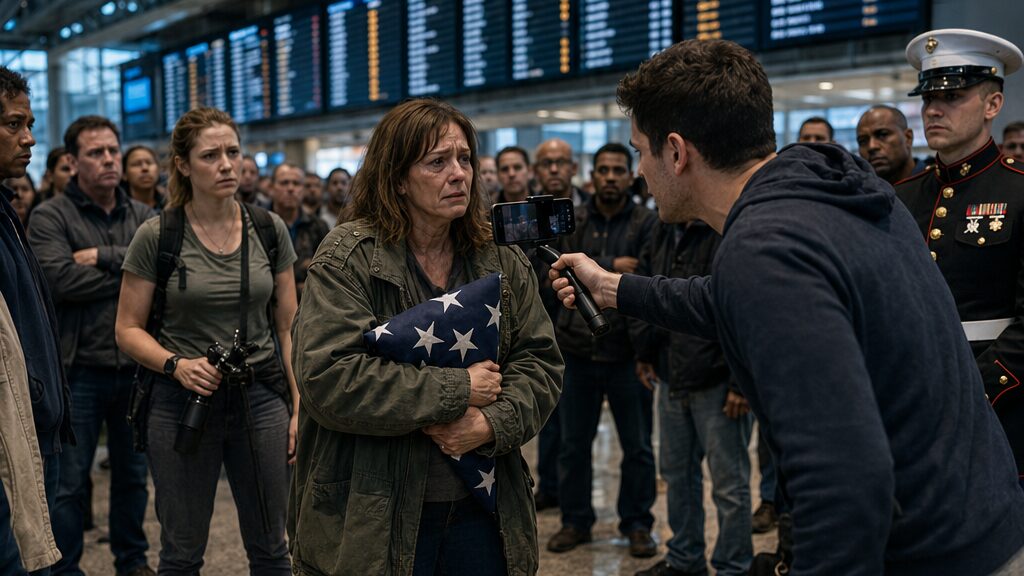
Mary Campbell felt their eyes before she looked up and confirmed it. A businessman pretending to check his phone. A woman whispering to her husband. Two teenagers glancing over, then looking away when she noticed.
The oversized military jacket hanging from her shoulders attracted attention everywhere she went.
She knew that.
The folded American burial flag pressed against her chest attracted even more.
She knew that too.
But she hadn’t come to the airport to explain herself.
The departures and arrivals board glowed above the waiting area, constantly shifting letters and numbers. Most travelers were focused on vacations, business trips, reunions.
Mary sat alone.
The jacket sleeves hung past her wrists. The shoulders were too broad.
It had belonged to her brother.
She adjusted the collar gently.
The fabric was old but carefully preserved.
A hand had once occupied those sleeves.
A voice had once laughed inside that jacket.
Now only silence remained.
She looked down at the folded flag.
The edges were perfect.
The navy-blue field rested against her fingertips.
The flag had arrived years after the telegram.
Years after the searches.
Years after the military officially listed Andrew Campbell as Missing in Action.
Years after everyone else had begun speaking about him in the past tense.
Mary never had.
The loudspeaker crackled overhead.
“Attention passengers…”
She barely listened.
Her eyes remained fixed on the terminal entrance where military personnel would soon arrive.
That was why she was here.
A military transport flight.
Another recovery mission.
Another ceremony.
Another attempt at closure.
She hated that word.
Closure.
As if grief were a door that could simply be shut.
A small child nearby pointed toward her.
“Mom, why does she have a flag?”
The mother immediately lowered the child’s hand.
Mary looked away.
She wasn’t angry.
People were curious.
Curiosity was easier than pity.
The terminal filled gradually.
Travelers moved around her like water around a stone.
Most ignored her.
Some didn’t.
An older man approached cautiously.
“Excuse me.”
Mary looked up.
He pointed toward the jacket.
“Were you military?”
She forced a small smile.
“No.”
The man nodded awkwardly.
“Sorry. Didn’t mean to pry.”
“It’s okay.”
He walked away.
The exchange lasted less than thirty seconds.
Still, it left her exhausted.
Questions always did.
Because answers led to more questions.
And eventually someone always asked about Andrew.
The name alone felt heavy.
She remembered the last phone call.
His laughter.
His promise to come home.
The argument they’d had over something so small she couldn’t even remember it anymore.
What she remembered was hanging up too quickly.
What she remembered was believing there would always be another conversation.
A loud announcement interrupted her thoughts.
“Attention passengers and visitors. A military transport flight is expected to arrive within the hour. Portions of Terminal C may experience temporary restrictions.”
Several heads turned.
Mary felt her stomach tighten.
Within the hour.
She had prepared for this day for months.
Yet suddenly she wanted to leave.
Her grip tightened around the folded flag.
A shadow fell across her.
Someone stood nearby filming himself.
Young.
Confident.
Holding a smartphone mounted on a stabilizer.
He spoke directly into the camera.
“Guys, we’re live.”
His voice carried farther than he realized.
Mary looked away.
Plenty of people filmed content in airports.
She paid him little attention.
At first.
The young man continued talking.
“Airport edition today.”
He grinned at his viewers.
“We’ll see if anything interesting happens.”
A woman stood beside him.
Ashley Martin.
She carried equipment and occasionally checked comments on another phone.
The pair moved through the terminal looking for reactions, conversations, attention.
Mary recognized the type.
People whose lives existed through screens.
The young man scanned the crowd.
Then his gaze stopped.
On her.
On the jacket.
On the flag.
His expression changed.
Interest sharpened into focus.
He lowered the phone slightly.
“What do we have here?”
Ashley glanced over.
Her smile faded.
“Maybe leave it alone.”
But the man was already studying Mary.
Watching.
Calculating.
Mary felt it immediately.
The same instinct that tells someone they are being followed.
She looked down at the flag.
Please not today.
Not today.
The young man checked something on his screen.
Comments streamed rapidly.
His eyes widened.
Viewers had noticed her too.
He zoomed in.
The jacket.
The flag.
The civilian woman wearing military clothing.
An opportunity.
Ashley shifted uncomfortably.
“You don’t know anything about her.”
“That’s why we ask questions.”
The answer came too quickly.
Too eagerly.
Mary stood.
She wanted coffee.
Or perhaps simply distance.
But when she moved, she saw him moving too.
Not directly.
Just enough.
Tracking.
Observing.
Waiting.
The loudspeaker announced another update.
The transport flight was ahead of schedule.
Passengers murmured.
Airport employees began repositioning barriers.
Mary’s pulse quickened.
Less time.
Less preparation.
The young man smiled at his camera.
“Oh, guys. This might actually be something.”
He turned fully toward her.
And started walking.
Chapter 2: Going Live for Millions
The camera appeared in Mary’s face before she could turn away.
“Ma’am.”
She froze.
Jonathan Baker’s smile looked friendly from a distance.
Up close, it felt sharp.
Manufactured.
Hungry.
“Quick question.”
Mary stepped sideways.
“I’d rather not.”
Jonathan kept pace.
Thousands of viewers watched through his phone.
The number climbed steadily.
Comments rolled faster than he could read them.
“Won’t take long.”
“Please leave me alone.”
Ashley shifted behind him.
“Jonathan…”
He ignored her.
His eyes remained fixed on the jacket.
The flag.
The potential story.
The potential views.
Mary resumed walking.
Jonathan followed.
“Are you military?”
“No.”
“Then why are you wearing that?”
Several nearby travelers slowed.
People always slowed when conflict appeared.
Human nature.
Mary kept moving.
“It’s personal.”
Jonathan raised his eyebrows dramatically toward the camera.
“Personal.”
Laughter erupted from his livestream speaker.
Mary heard it.
Dozens of strangers reacting to her existence.
Her chest tightened.
“Please stop recording.”
Jonathan smiled.
“If everything’s legitimate, why are you nervous?”
The question wasn’t really for her.
It was for the audience.
The viewers.
The clip.
The future upload.
People nearby began paying attention.
A businessman stopped.
A family paused.
Airport employees glanced over.
Mary hated crowds.
Especially this kind.
The kind that gathered around someone else’s discomfort.
Jonathan pointed toward the jacket.
“That military issue?”
She said nothing.
“Did you earn that?”
Still nothing.
His confidence grew.
Silence looked suspicious through a camera lens.
He knew that.
He had built a career on that.
A confrontation video from months earlier flashed briefly through his mind.
Millions of views.
Sponsors.
Interviews.
Recognition.
People loved exposure content.
They loved certainty.
Heroes and villains.
Truth was slower.
Truth rarely went viral.
“Guys,” Jonathan announced, speaking directly to his audience, “I think we may have another one.”
Ashley looked uncomfortable.
“What if you’re wrong?”
Jonathan lowered his voice.
“What if I’m not?”
The comments surged.
Ask for ID.
Call her out.
Expose her.
Mary felt trapped.
The terminal suddenly seemed much smaller.
She held the folded flag tighter.
A woman nearby frowned.
“Maybe just answer him.”
Mary looked at her.
The woman wasn’t cruel.
Just curious.
Curiosity turning into suspicion.
Jonathan sensed momentum.
“Exactly.”
He pointed toward Mary.
“If you’re carrying military symbols in public, people have a right to know.”
“No they don’t.”
The words escaped before she could stop them.
Jonathan immediately seized on them.
“So you’re refusing?”
Mary closed her eyes briefly.
Every answer became another question.
Every explanation became another conversation she didn’t want.
Not here.
Not now.
Not today.
Especially today.
A loud announcement echoed overhead.
Military personnel would begin arriving shortly.
Mary felt panic rising.
Jonathan mistook it for guilt.
His confidence exploded.
“There it is.”
He turned the camera toward himself.
“Guys, she’s getting nervous.”
The crowd grew larger.
A circle forming.
Not physically.
Socially.
People watching.
Judging.
Waiting.
Ashley looked from Mary to Jonathan.
Something about Mary’s face bothered her.
Not anger.
Not deception.
Pain.
Raw pain.
But Jonathan either didn’t see it or didn’t want to.
His audience was approaching a record number.
He couldn’t stop now.
Not when attention was finally flooding in.
“Last chance.”
Mary stared at the floor.
Jonathan stepped closer.
“Show me your military ID right now.”
The terminal became silent around them.
Even strangers leaned in.
Jonathan pointed at the jacket.
“Or I’m physically removing that jacket myself.”
A shocked murmur rippled through the crowd.
Ashley immediately looked horrified.
“Jonathan.”
But he had already crossed the line.
Mary slowly looked up.
Her eyes glistened.
Not with fear.
Not with guilt.
Something else.
Something older.
Much heavier.
For the first time, Jonathan hesitated.
Only briefly.
Then the comments surged again.
He pushed forward.
“Well?”
Mary swallowed.
Then shifted the folded flag into one arm.
With trembling fingers, she reached inside the oversized jacket.
The crowd leaned closer.
Jonathan’s camera zoomed in.
And for the first time all afternoon, Mary decided she could not remain silent.
Chapter 3: The Letter Inside the Jacket
“What are you pulling out?”
Jonathan’s voice carried through the terminal.
The crowd watched.
Phones appeared.
People began recording from different angles.
Mary’s hand remained inside the jacket.
Searching.
Her fingers found the familiar folded paper.
The edges had softened over the years.
The creases had become permanent.
She had unfolded and refolded it so many times that parts threatened to tear.
Jonathan smiled.
Certain he was about to expose something.
Certain the moment belonged to him.
Mary finally withdrew the document.
The paper shook visibly in her hands.
Not because she feared Jonathan.
Because she knew what was written there.
Every word.
Every line.
Every sentence that had changed her life.
Jonathan leaned closer.
“What is that?”
Mary didn’t answer.
She unfolded the paper slowly.
The terminal seemed quieter.
Even the crowd felt different.
Less excited.
More uncertain.
Ashley stared at Mary’s hands.
Something about the way she held the document reminded her of people carrying photographs at funerals.
Jonathan was still talking.
Still performing.
Still narrating.
But some of the certainty had vanished from his voice.
“Go ahead. Let’s see it.”
Mary lifted her eyes.
For the first time she looked directly at him.
The anger he expected wasn’t there.
Neither was embarrassment.
Only exhaustion.
The kind that settled into a person after carrying the same grief for years.
“This isn’t yours,” Jonathan said.
Mary’s lips parted.
“It was sent to me.”
The terminal remained silent.
She looked down at the page.
Then began reading.
“To the family of Staff Sergeant Andrew Campbell…”
The words immediately changed the atmosphere.
Jonathan’s smile vanished.
Mary continued.
“…following recent identification efforts regarding personnel previously listed as Missing in Action…”
Someone in the crowd lowered their phone.
Another person stepped back.
Jonathan’s livestream comments began moving in a different direction.
Wait.
MIA?
Is this real?
Mary’s voice trembled.
“The Department of Defense respectfully returns the personal effects recovered during recovery operations…”
Her throat tightened.
For a moment she couldn’t continue.
The folded flag pressed against her arm.
The jacket hung from her shoulders.
Her brother surrounded her even now.
“He never came home,” she whispered.
Nobody spoke.
“He wore this jacket.”
She touched the sleeve.
“He carried this flag before it was folded for my family.”
Her voice broke.
“And this letter is all I have left that proves they finally found him.”
The silence became absolute.
Jonathan stared at the document.
His confidence draining away.
“This… this could still—”
“Stop.”
The voice came from Ashley.
For the first time she stepped away from Jonathan.
Mary looked down again.
The letter blurred through tears.
She forced herself onward.
“The recovered remains are being transported today…”
A nearby loudspeaker interrupted.
“Attention visitors. The military transport carrying recovered service members has entered final approach.”
The announcement hit Mary like a physical blow.
Today.
Not someday.
Not eventually.
Today.
The paper slipped slightly in her hand.
A tear landed on the page.
Jonathan looked around.
The crowd no longer stood with him.
Their expressions had changed.
Confusion.
Regret.
Discomfort.
A few people looked ashamed.
Ashley covered her mouth.
Mary stared at the letter.
Years of searching.
Years of hoping.
Years of refusing to believe.
And now she stood in an airport reading proof that hope had finally run out.
Her shoulders shook.
The document trembled.
The folded flag remained pressed against her chest.
For the first time since arriving, she couldn’t hold herself together.
And as tears finally fell onto the letter, a new question rose above everything else:
If Andrew was truly coming home today, why had she spent so many years refusing to let him?
Chapter 4: The Years She Refused to Bury
“Mary Campbell?”
The voice reached her through the blur of tears.
She lowered the letter slightly.
A Marine stood several feet away, careful not to crowd her.
His uniform was immaculate. His posture straight.
But his expression carried something else.
Recognition.
Not from the livestream.
Not from the scene.
From somewhere older.
Mary wiped her eyes.
The folded flag remained tucked tightly against her side.
The crowd had become strangely quiet.
Jonathan stood frozen near Ashley.
Nobody was paying attention to him anymore.
The Marine stepped forward.
“My name is John Rivera.”
Mary nodded weakly.
“I know who you are.”
The words made her look up.
“What?”
John hesitated.
“I’ve seen your name in reports.”
The terminal noise seemed to fade again.
Mary stared at him.
Reports.
Years of paperwork.
Years of military correspondence.
Years of letters she often refused to answer.
John looked at the document in her hands.
Then at the jacket.
Then at the flag.
His eyes softened.
“You came.”
The statement landed harder than she expected.
Not because of what he said.
Because of what it implied.
There had been a chance she wouldn’t.
John seemed to realize it too.
His expression shifted slightly.
Not judgment.
Understanding.
The kind that comes from seeing the same story many times.
“You’ve been contacted before.”
Mary looked away.
A silence answered for her.
John didn’t press.
The crowd listened anyway.
She hated that.
Her private failures unfolding in public.
A memory surfaced.
A phone call three years earlier.
A military liaison explaining new recovery efforts.
Promising updates.
Requesting cooperation.
Mary had ended the conversation quickly.
Another memory followed.
A certified letter she left unopened for almost four months.
Then another.
An invitation to attend a remembrance ceremony.
She never went.
Because every step toward closure felt like betrayal.
As long as she stayed away, uncertainty survived.
As long as uncertainty survived, hope survived too.
John seemed to understand exactly what she was remembering.
“We tried reaching you.”
Mary’s fingers tightened around the paper.
“I know.”
The admission barely escaped her lips.
John nodded.
No accusation.
That somehow made it worse.
A loud announcement echoed overhead.
Airport staff began directing travelers away from a section of the terminal.
The military transport would arrive soon.
Mary felt panic stirring again.
John noticed immediately.
“You don’t have to explain anything to me.”
The kindness nearly broke her.
Nearby, Ashley stepped away from Jonathan completely.
She crossed the distance cautiously.
“I’m sorry.”
Mary looked at her.
Ashley swallowed.
“I should’ve stopped him sooner.”
Mary didn’t know what to say.
The apology felt sincere.
But it also felt distant.
Like something happening to another person.
Because her attention kept returning to the same thought.
The transport.
The arrival.
The thing she had avoided for years.
John glanced toward the secured section.
Then back at Mary.
“There were other notifications.”
Mary closed her eyes.
She knew.
Every unopened envelope.
Every ignored message.
Every request for confirmation.
Every opportunity she postponed.
Not because she didn’t care.
Because she cared too much.
A crowd member spoke quietly.
“You thought he might still be alive.”
Mary opened her eyes.
No one laughed.
No one mocked her.
The question carried genuine understanding.
Her answer came slowly.
“Sometimes.”
The truth felt embarrassing.
Andrew had been missing for decades.
Logic had abandoned hope long ago.
But grief obeyed different rules.
John studied her face.
Then reached into a folder tucked beneath his arm.
Mary’s stomach tightened.
For one terrible second she thought another document was coming.
Another confirmation.
Another finality.
Instead, he withdrew a photograph.
He handed it to her.
Mary stared.
The image showed several service members standing beside recovery personnel.
Behind them sat weathered equipment recovered from a remote site.
And among the recovered items—
Her breath caught.
A familiar watch.
Andrew’s watch.
She recognized the scratch near the edge immediately.
The photo shook in her hands.
“We found that with him,” John said quietly.
Not found him.
Found that with him.
The careful wording mattered.
But not enough.
The truth was already there.
Closer than ever.
More real than ever.
Mary stared at the watch.
A physical object.
Not a possibility.
Not a rumor.
Not hope.
Reality.
The crowd had disappeared from her awareness entirely.
Only John remained.
And the photograph.
And the flag.
And the years.
Years spent refusing to open doors.
Refusing ceremonies.
Refusing conversations.
Refusing grief itself.
John finally spoke again.
“The ceremony starts soon.”
Mary nodded.
But her feet remained planted.
A battle raged inside her.
One direction led forward.
The other led back toward the exit.
Toward familiar denial.
Toward safety.
The loudspeaker announced another update.
Military personnel had arrived.
The transport was minutes away.
Mary’s pulse surged.
Suddenly she couldn’t breathe.
Not properly.
Not enough.
She handed the photograph back.
Then took a step backward.
John saw it immediately.
So did Ashley.
“Mary?”
She took another step.
Toward the terminal exit.
Away from the ceremony.
Away from the truth.
Away from Andrew’s final return.
And for the first time all day, leaving felt easier than staying.
Chapter 5: The Crowd Changes Sides
Ashley grabbed Jonathan’s arm before he could restart the livestream.
“Don’t.”
Jonathan pulled away.
“What are you doing?”
“What am I doing?” Ashley stared at him in disbelief. “Look around.”
People were staring now.
Not at Mary.
At him.
The change had happened gradually.
Then all at once.
Jonathan felt it.
The same crowd that had supported him twenty minutes earlier now watched him with open disgust.
His livestream numbers remained high.
But the comments had transformed.
Delete this.
Leave her alone.
What’s wrong with you?
Jonathan scrolled frantically.
There had to be supporters somewhere.
There always were.
Instead he found criticism.
Questions.
Anger.
His chest tightened.
“This isn’t fair.”
Ashley laughed once.
A short, shocked sound.
“Fair?”
Jonathan looked toward Mary.
She was moving away from the ceremony area.
Toward the exit.
John Rivera had started after her.
For a moment Jonathan considered following too.
Getting another angle.
Fixing the narrative.
Salvaging something.
But even he knew how that would look now.
Ashley removed her microphone pack.
The movement caught his attention immediately.
“What are you doing?”
“I’m done.”
The words hit harder than he expected.
Jonathan stared.
“Seriously?”
“Yes.”
She folded her arms.
“I thought we exposed people who lied.”
“We do.”
“No.” Her voice sharpened. “You wanted a headline.”
Jonathan opened his mouth.
Closed it again.
Because part of him knew she wasn’t entirely wrong.
The crowd nearby began murmuring.
A traveler stepped forward.
“I’ve seen your videos.”
Jonathan turned hopefully.
Then the man continued.
“You do this a lot, don’t you?”
The hope vanished.
The man shook his head.
“My father served.”
Another person joined in.
“So did mine.”
A woman spoke next.
“You saw she was upset.”
Jonathan immediately defended himself.
“I was asking questions.”
“No,” Ashley said. “You threatened her.”
That landed heavily.
Because everyone had heard it.
The threat.
The jacket.
The demand.
Jonathan suddenly wished he could erase the last ten minutes.
But the internet rarely allowed that.
His phone buzzed.
A sponsor notification.
Then another.
Then messages.
Too many messages.
He ignored them.
Across the terminal, Mary stopped walking.
John had caught up to her.
They stood near a window overlooking the secured section.
Talking quietly.
Jonathan couldn’t hear them.
For the first time all day, he wasn’t the center of attention.
And he hated how much that bothered him.
Ashley noticed.
That bothered her too.
Not because he was upset.
Because even now he seemed more concerned about himself than Mary.
The realization settled heavily inside her.
Maybe this hadn’t started today.
Maybe she had ignored warning signs.
Jonathan finally lowered his phone.
The livestream ended.
No dramatic farewell.
No final defense.
Just a blank screen.
Around them, people began dispersing.
The spectacle was over.
Reality remained.
John stood beside Mary near the window.
Neither spoke for several seconds.
Finally he asked, “Do you want to leave?”
Mary stared through the glass.
Airport vehicles moved slowly across the tarmac.
Beyond them waited a runway.
A destination.
An ending.
“I don’t know.”
The answer was honest.
John nodded.
“Most people don’t.”
She almost laughed.
Almost.
Instead she looked down at the folded flag.
“Everyone thinks I came here for closure.”
“And?”
Mary swallowed.
“I came because I was afraid I wouldn’t.”
The confession surprised even her.
John didn’t answer immediately.
When he finally did, his voice remained calm.
“That’s why you’re here.”
Mary looked at him.
He continued.
“Not because you’re ready.”
The words settled into place.
Not because you’re ready.
Because you’re not.
A strange kind of relief followed.
No expectation.
No judgment.
Just truth.
A sudden roar echoed faintly through the terminal.
Every conversation paused.
Every head turned.
The sound came again.
Louder.
Closer.
The military transport had arrived.
Across the windows, people began gathering.
Airport staff moved quickly.
Service members appeared near the secured area.
The moment Mary had spent years avoiding was no longer approaching.
It was here.
John looked toward the runway.
Then back at her.
“Whatever you decide, decide now.”
The engines continued rumbling outside.
Mary’s grip tightened around the folded flag.
The jacket felt heavier than ever.
And as the transport rolled into view beyond the glass, she realized there was no longer anywhere left to hide.
Chapter 6: The Return She Feared Most
The aircraft door opened.
Every conversation disappeared.
Mary stood among a small gathering near the secured area, unable to look away.
The transport seemed impossibly ordinary.
Metal.
Paint.
Engines.
Yet everything inside it carried the weight of decades.
John stood nearby.
Not pushing.
Not guiding.
Simply present.
The folded flag felt different now.
Not a shield.
Not quite.
Something else.
The first transfer team emerged.
Uniformed personnel moved with precise, practiced respect.
No one rushed.
No one spoke loudly.
The stillness itself felt sacred.
Mary’s eyes burned.
She thought about turning away.
She almost did.
Then a casket appeared.
Her breath caught.
Not because she knew which one belonged to Andrew.
She didn’t.
Because suddenly the reality she had resisted for years existed outside her imagination.
Real people.
Real remains.
Real endings.
The crowd remained silent.
Even those who had no personal connection seemed to understand.
Jonathan stood far back now.
Alone.
No camera raised.
No audience.
Only distance.
Mary barely noticed him.
Her world had narrowed to the tarmac.
To the transfer team.
To Andrew.
A memory surfaced unexpectedly.
Two children racing bicycles down a neighborhood street.
Andrew laughing as he pulled ahead.
Mary screaming that he was cheating.
He had looked over his shoulder and shouted back.
“Then catch me.”
The memory arrived so vividly that for a moment she forgot where she was.
Then it vanished.
Leaving only the ache behind.
John quietly approached.
“Mary.”
She looked at him.
“They’d like you to come forward.”
Her pulse jumped.
“No.”
The answer arrived instantly.
Too instantly.
John nodded.
“As you wish.”
He started to step away.
Mary watched him go.
Then looked back toward the ceremony.
A terrible realization settled over her.
If she refused now, she would spend the rest of her life wondering why.
Wondering what she had missed.
Wondering what she had avoided.
Again.
The same pattern.
The same retreat.
The same fear.
She closed her eyes.
The letter remained tucked safely inside the jacket.
The jacket belonged to Andrew.
The flag belonged to Andrew.
The memory belonged to Andrew.
But the choice belonged to her.
“John.”
He turned.
Mary inhaled carefully.
“I’ll come.”
A few minutes later she stood near the front.
Her knees felt weak.
The transfer continued.
Each movement precise.
Each gesture respectful.
No applause.
No performance.
Only dignity.
Someone invited her to speak.
Panic immediately surged.
She wasn’t prepared.
She hadn’t planned words.
For years she had avoided conversations about Andrew.
Now dozens of people waited.
John met her eyes.
Not encouraging.
Not pressuring.
Simply waiting.
Mary unfolded the letter.
Her hands trembled.
She stared at the words.
Then lowered the paper.
“I spent a long time being angry.”
The confession surprised her.
The crowd listened quietly.
“I was angry at the military.”
She swallowed.
“Angry at the war.”
A shaky breath escaped.
“Mostly I was angry at the idea that accepting what happened meant giving up on him.”
Silence surrounded her.
Mary continued.
“I thought if I stopped searching… if I attended a ceremony… if I opened certain letters…”
Her voice cracked.
“…then I’d be abandoning my brother.”
The folded flag pressed against her side.
A familiar weight.
But lighter somehow.
Tears blurred her vision.
For a moment she couldn’t continue.
Then she remembered the bicycle.
The laughter.
The promise.
Then catch me.
A sob escaped unexpectedly.
Mary covered her mouth.
The ceremony faded around her.
Years of grief finally breaking apart.
Not dramatically.
Not all at once.
Just enough.
John stepped forward slightly.
Ready if needed.
Mary lowered her hand.
“No.”
Her voice trembled.
But held.
She looked toward the caskets.
Toward the transport.
Toward the years she could never reclaim.
Then she spoke one final sentence.
“He came home long before today. I was the one who got lost.”
The silence that followed felt different.
Not empty.
Complete.
When she stepped back, the folded flag remained in her hands.
The jacket remained on her shoulders.
The grief remained too.
But something had changed.
Not disappeared.
Changed.
As the ceremony concluded, John approached quietly.
Without a word, he adjusted the oversized jacket and settled it properly across her shoulders.
Like someone returning something valuable.
Mary closed her eyes briefly.
For the first time in decades, she did not feel like she was waiting anymore.
Chapter 7: Carrying Him Forward
The crowd had mostly dispersed.
Airport employees returned to their routines. Travelers checked flights. Conversations resumed.
Life moved forward.
For years, Mary Campbell had hated that fact.
How could life continue when someone never came home?
How could strangers laugh, eat, travel, and make plans while a family remained suspended in the same unanswered question?
Yet now, standing near a quiet memorial display set up inside the terminal, she found herself watching ordinary people with different eyes.
The folded flag rested carefully in her arms.
Not clutched.
Held.
There was a difference.
The jacket still hung from her shoulders.
It no longer felt like armor.
Nearby, a television silently displayed airport news.
A headline flashed briefly across the screen.
A social media controversy.
A streamer.
A public backlash.
Jonathan’s face appeared for only a second before the segment changed.
Mary looked away.
She felt no satisfaction.
No triumph.
Only distance.
Jonathan had spent the day chasing attention.
Now attention had turned on him.
The punishment belonged to itself.
She had no interest in carrying that burden too.
A quiet voice approached from behind.
“Ms. Campbell?”
Mary turned.
A terminal employee stood nearby.
“There are a few people asking if they can speak with you.”
Mary glanced toward a small group standing respectfully several yards away.
Not reporters.
Not content creators.
Just ordinary travelers.
One older couple.
A veteran in a wheelchair.
A young woman holding the hand of a child.
People who had witnessed what happened.
Mary hesitated.
Her old instinct immediately returned.
Leave.
Avoid.
Disappear.
Protect the wound.
The familiar reflex felt almost comforting.
Then she looked down at the folded flag.
For decades she had protected grief by hiding it.
Where had that led?
To unopened letters.
Missed ceremonies.
Empty rooms.
She drew a slow breath.
“It’s okay,” she said.
The employee nodded and stepped aside.
The older couple approached first.
The man removed his cap.
“We didn’t want to disturb you.”
Mary offered a small smile.
“You aren’t.”
The woman touched her husband’s arm.
“Our son served.”
That was all she said.
No long story.
No comparison.
No attempt to claim understanding.
Just four simple words.
Our son served.
Mary nodded.
And somehow that felt enough.
The veteran in the wheelchair came next.
His hands trembled slightly with age.
He looked at the jacket.
Then at the flag.
Then at Mary.
“He’d be proud.”
The words landed gently.
Not because they were dramatic.
Because they weren’t.
No speech.
No performance.
Just sincerity.
Mary thanked him.
The young woman approached last.
The child remained close to her side.
The little girl looked curiously at the folded flag.
Then at the oversized jacket.
Finally she asked the same question another child had asked hours earlier.
“Who was he?”
For a moment Mary froze.
The answer should have been simple.
Yet years of silence made it difficult.
Who was Andrew?
Not a service record.
Not a casualty report.
Not a photograph in a frame.
A person.
A brother.
The child waited.
Mary surprised herself by smiling.
“He cheated at bicycle races.”
The little girl blinked.
“What?”
Mary laughed softly.
The sound felt unfamiliar.
“He always cheated.”
The child grinned.
“And he hated vegetables.”
The grin widened.
“And he never stopped talking.”
The young woman laughed.
The little girl laughed.
And for the first time in years, Andrew existed in conversation as something other than a tragedy.
The realization hit unexpectedly.
Mary looked down at the flag.
For so long it had represented absence.
Now it also represented memory.
A memory that could be shared.
Not protected behind walls.
Shared.
John Rivera approached as the small group drifted away.
He carried something in his hand.
A copy of the photograph he had shown her earlier.
The one containing Andrew’s watch.
He offered it to her.
“I thought you might want this.”
Mary accepted it carefully.
The photograph showed recovery personnel standing beside recovered items.
The scratched watch remained visible near the edge.
For years she had imagined Andrew frozen at the moment he disappeared.
Young.
Unchanged.
Waiting.
The photograph shattered that illusion.
Time had moved.
History had moved.
People had spent decades searching.
He had never been forgotten.
Not by them.
And now she realized she had not been forgotten either.
John nodded toward the picture.
“He mattered to a lot of people.”
Mary swallowed.
“I know.”
This time she truly did.
John glanced at the flag.
“What will you do now?”
Months ago the question would have terrified her.
Now she considered it carefully.
Not because she had all the answers.
Because she no longer needed them.
“I’ll answer my mail.”
John smiled.
A real smile.
Mary laughed quietly.
“That’s probably a good place to start.”
He nodded.
“It is.”
For a while they stood together near the windows overlooking the runway.
The transport aircraft remained in the distance.
Workers moved around it.
The day continued.
The world continued.
And surprisingly, so would she.
Eventually John was called away.
Duty.
Responsibilities.
Life.
Before leaving, he paused.
“Your brother came home.”
Mary looked at the photograph.
Then at the folded flag.
Then at the jacket.
“Yes.”
The word no longer hurt the way it once had.
After he left, she found a seat near the memorial display.
The airport noise settled into a distant hum.
For the first time all day, she unfolded the letter again.
Not to search for proof.
Not to relive pain.
Simply to read.
Her eyes moved slowly across familiar lines.
Near the bottom, one sentence caught her attention.
A sentence she had somehow overlooked despite reading the letter dozens of times.
The Department of Defense remains grateful for the patience and dedication of families who keep the memory of the missing alive.
Mary stared at the words.
Keep the memory alive.
Not keep the wound alive.
Not keep the search alive.
The memory.
A small but important difference.
Tears filled her eyes again.
Gentler this time.
She folded the letter carefully and returned it to the jacket pocket.
Then she stood.
The burial flag rested securely in her arms.
The jacket settled comfortably on her shoulders.
Neither felt like a burden anymore.
As she walked toward the terminal exit, she passed a large window overlooking the runway one final time.
For a brief moment she saw her reflection.
A woman carrying a flag.
Wearing a jacket too large for her.
Walking alone.
Yet somehow not lonely.
She stopped.
Touched the jacket sleeve.
And remembered Andrew laughing over his shoulder during a childhood race.
Then catch me.
The memory no longer pulled her backward.
It pulled her forward.
Mary smiled.
Then she stepped through the airport doors and into the rest of her life.
The story has ended.