The Officer Called Him Useless Until the Old Sailor Heard the Pipe Beat Wrong
Chapter 1: The Old Man Heard Something Beneath the Engines
The pipe shuddered wrong on the third beat.
George Walker felt it before anyone else heard it. The engine room was already full of noise—fans chopping the hot air, pumps pushing seawater through steel veins, boots ringing on grated platforms, young sailors calling measurements from one station to another. But under all of that, beneath the clean machinery hum the officers wanted their inspection guests to hear, one line carried a hitch.
Not a knock. Not yet.
A hesitation.
George stopped with one hand halfway to the railing.
The security guard behind him bumped his shoulder. “Keep moving.”
George did not move.
The main engine room stretched ahead in hard light and sweating steel. Pipes ran overhead like old ribs. Pressure gauges trembled under glass. Yellow tags fluttered from valves. The smell of oil, paint, warm metal, and seawater pressed into George’s lungs with such force that for a moment he was twenty again, then thirty-seven, then seventy-four all at once.
He had not meant to come this far inside.
He had come because the ship was open for the inspection ceremony, because the training vessel sat at the pier with visitors smiling at polished brass and fresh signs, because the shipyard gates were less strict on days when officers wanted the public to see confidence. He had come because yesterday, from the pier, he had heard that same pump line coughing under idle load.
And now, inside the room itself, he heard the third beat.
Thrum. Thrum. Slip.
Thrum. Thrum. Slip.
His fingers closed around the railing.
“Sir,” the guard said, louder now. He was young, square-shouldered, dark uniform neat, beret sharp, hand near the radio clipped to his chest. “You can’t stop here.”
George looked past him.
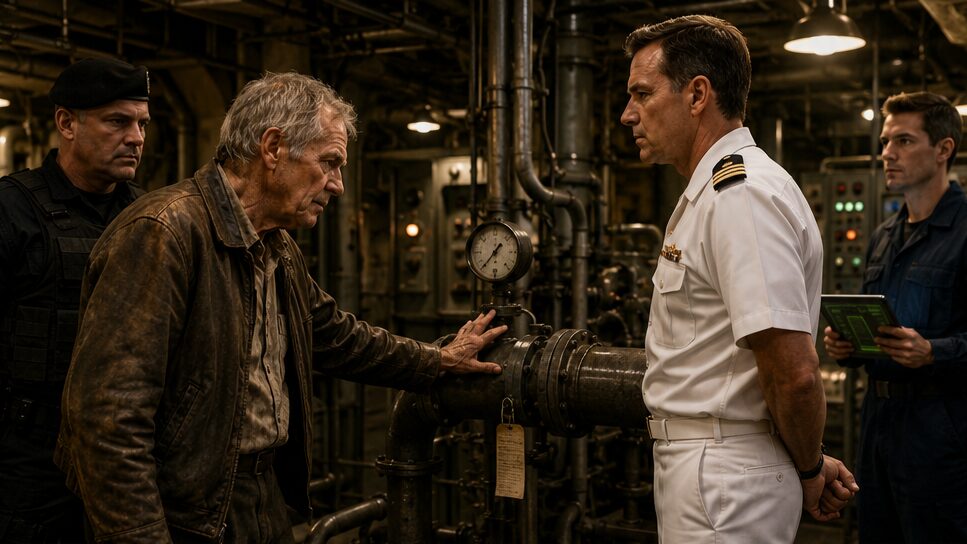
A white-uniformed officer stood near the control console, surrounded by two inspection guests and a junior engineering officer holding a tablet. The officer’s shoes were black enough to catch the overhead light. His sunglasses hid his eyes, though there was no sun below decks. His collar carried authority cleanly, as if it had been pressed into him.
George knew his name from the schedule board outside.
Brandon Scott.
Commander Brandon Scott was watching him now, mouth set in the tired line of a man whose morning had just been disturbed by something untidy.
George stepped off the marked visitor path.
The guard moved quickly. “Sir, stay behind the line.”
George ignored the painted stripe on the deck. His knees disliked the narrow step down. His left hip gave its usual complaint. He let the pain pass through him and placed his palm against the pipe below the nearest gauge.
Heat entered his skin.
Thrum. Thrum. Slip.
The gauge needle barely moved. That was what made it worse. A bad problem wanted to hide when men expected it to announce itself.
“Sir.” The guard’s voice sharpened.
George lifted his other hand, not to argue, only to ask for quiet. The habit was old. In engine rooms, the hand came first. Voices after.
No one gave him quiet.
The junior officer, James King according to the name patch on his coveralls, looked up from the tablet with polite impatience. “Commander?”
Brandon Scott crossed the deck with measured steps. Behind him, the inspection guests paused, whispering. Two younger sailors pretended to keep working while staring openly.
George kept his palm on the pipe.
“You need to step away from that line,” Brandon said.
George turned his head just enough. “Pump three is walking.”
James glanced at the pipe, then at his tablet. “No, sir. Pump three is within normal vibration tolerance.”
George did not look at the tablet. “I didn’t say it was shaking. I said it’s walking.”
A small silence opened, then closed under the fans.
Brandon’s jaw tightened. “And you are?”
George felt the question land the way questions like that always did now. Not who are you really. Not what do you know. Only what gives you the right to interrupt men in uniform.
“George Walker.”
The name did nothing for Brandon. It did nothing for the guard. James entered something on the tablet with one thumb.
“Mr. Walker,” Brandon said, smooth and cool, “this is a restricted engineering space during a readiness inspection. You can’t wander in from the pier and handle equipment.”
George looked at the gauge again. The needle trembled, came back, trembled, came back. On the third pulse, it held a hair too long.
“Your bearing’s loosening under the coupling,” George said. “When you bring her up to load, the valve timing will chase it. Shut down pump three and check the seat.”
James gave a short breath that was not quite a laugh. “Sir, the diagnostics would show a bearing issue.”
George’s thumb pressed harder into the paint. The pipe answered him through old skin and old bone.
“Not if the sensor’s reading the housing and the trouble’s traveling through the line.”
James’s face changed, but only a little. Young men did not like being corrected in front of officers. George remembered that too.
Brandon removed his sunglasses slowly. His eyes were not cruel. That almost made it harder. They were controlled, assessing, already assigning George to the category where interruptions belonged.
“You worked on this class?” Brandon asked.
George looked at the pump assembly beyond the rail, at the narrow access path that had been moved since his day, at the newer tags fixed over older scars in the paint. “Worked on her older sister.”
“Recently?”
George did not answer.
A faint flush moved up James’s neck. “Commander, all systems are green. We ran diagnostics at 0600. Vibration logs are inside range. Pressure is stable.”
George tapped the pipe once. Not hard. Just enough to feel the returning rhythm.
Thrum. Thrum. Slip.
He said, “Pressure’s lying.”
One of the inspection guests murmured something. Brandon heard it. George saw the officer’s attention split between the machine and the people watching him. That was dangerous too. A man responsible for a ship could be careful. A man responsible for looking careful might miss what mattered.
Brandon stepped closer. “Mr. Walker, I’m going to be direct. You appear to have entered an active inspection area without authorization. You’re touching equipment you are not cleared to touch. You are making claims my engineering officer cannot verify. I don’t know whether you’re confused, upset, or trying to make a point, but this stops now.”
The words were clean. Nothing in them could be called an insult if someone wrote them down later.
George took his hand from the pipe.
Without his palm on it, the wrongness seemed to vanish into the engine-room roar. The others relaxed almost at once. That was the trouble with some warnings. You had to be willing to feel them.
“Bring her up slow,” George said.
Brandon’s expression hardened. “Excuse me?”
“When you test,” George said. “Bring her up slow. Don’t jump load to prove a schedule.”
James looked away.
The guard moved to George’s side, one hand out but not touching him yet. “Sir, let’s go.”
George turned toward Brandon fully. The room swam for half a second, heat and memory pushing at the edges of his sight. He steadied himself with the railing and hated that Brandon noticed.
“You think I’m in your way,” George said.
Brandon said nothing.
George nodded once. “Maybe I am.”
He started toward the marked visitor path. Each step felt louder than it should have. Behind him, sailors resumed movement. The inspection guests shifted, relieved to have the odd moment ending. James spoke softly into the control console, probably logging a security interruption rather than a warning.
George reached the yellow stripe and stopped.
The pipe behind him shuddered again.
This time the third beat carried far enough that the nearest hanging tag fluttered without a draft.
George turned back.
Brandon saw it too, or saw George see it. For one suspended moment, command and age and polished shoes and worn leather all stood inside the same breath.
Then Brandon’s face closed.
“Escort him out,” he said.
The guard took George gently but firmly by the elbow.
George let him.
He did not shout. He did not pull away. He did not tell them what the third beat had sounded like the last time he ignored it.
But as the guard led him toward the ladder, George looked once more at the pipe below the gauge and counted under his breath.
Thrum.
Thrum.
Slip.
Chapter 2: The Panel Said Normal While George Remembered Otherwise
The corridor outside the engine room was cooler, but George’s palm still burned where it had touched the pipe.
The guard walked half a step behind him, close enough to remind him that leaving was not a choice. Ahead, the shipyard passage narrowed between gray bulkheads and temporary signs pointing visitors toward safe areas. Voices rose and fell behind sealed doors. Somewhere above, a ceremony microphone squealed briefly and was corrected.
George flexed his fingers.
Paint dust had caught in the creases of his hand. A thin line of grease marked the heel of his palm. He rubbed it against his dirty brown leather jacket, but the warmth stayed.
“You local?” the guard asked.
George glanced at him.
The young man’s face had softened now that they were away from Brandon and the guests. He looked less like enforcement and more like somebody’s son trying to do a job without creating trouble.
“Used to be,” George said.
“You can’t just walk into restricted spaces.”
“I know.”
The guard seemed unsure what to do with that.
They reached the base of the ladderwell near the main deck. The guard pointed upward. “Visitors exit that way.”
George looked past the ladder to a small control alcove set into the corridor. A glass window revealed a secondary panel, two chairs, a wall phone, and a clipboard hanging from a chain. Through the glass he could see a duplicate line of readings from the pump system.
The guard noticed his attention. “Sir.”
“One minute.”
“No.”
George turned from him, not defiantly, just with the tired patience of someone moving toward a thing he had already decided. The guard stepped in front of him.
George stopped.
For a moment they stood close enough that George could smell the starch in the young man’s uniform.
“I’m not trying to embarrass your commander,” George said.
“Then don’t.”
“That’s not the same as being wrong.”
The guard’s radio crackled. He touched it, listened, then spoke low. “Yes, sir. He’s at the ladderwell.”
George looked through the glass again. The panel display showed calm green lines. Pressure stable. Vibration within range. Flow rate steady.
Everything normal.
That was what men trusted now. Numbers behaved better than old hands. Numbers did not smell of grease, did not limp on ship ladders, did not stand in worn jackets and say things that delayed important mornings.
James King appeared at the far end of the corridor, tablet tucked under one arm. He walked with quick purpose, but his eyes flicked once to George’s hand, then away.
“Commander wants the incident logged,” James said to the guard. “I can handle him from here.”
The guard hesitated.
James added, “I’ll walk him to the records office. We may need a statement.”
That was not true, and all three of them knew it. But the guard was grateful for an order-shaped solution. He nodded and stepped back.
James waited until the guard moved out of earshot. “Mr. Walker, I looked at pump three again.”
George said nothing.
“It’s clean,” James continued. “We’ve got fresh calibration, bearing temps normal, vibration bands normal, no pressure deviation.”
“On idle.”
“It was a full pre-test diagnostic.”
“Not load.”
James’s jaw worked once. “You understand this system uses updated monitoring, right?”
George looked at him then. “Does the seawater know that?”
The young officer blinked.
George regretted the sharpness as soon as it left his mouth. He had not come to win an argument with a man young enough to still trust clean answers. He looked back through the glass at the panel.
James shifted the tablet in his hands. “Look, I’m not saying you never worked around machinery. But you can’t come in during an inspection and tell a commander his equipment is lying because you felt a pipe.”
George reached into the inside pocket of his leather jacket and found an old shipyard pencil, half its eraser gone. From a narrow ledge beneath the window, he picked up a scrap of discarded packing paper. His hand shook slightly as he flattened it.
He drew three short marks.
Long. Long. Broken.
Then again below it.
Long. Long. Broken.
James watched despite himself.
George tapped the paper in rhythm with the pencil. “The first two pulses are the pump doing what it’s told. Third pulse, line answers late. Not enough for your sensor to call it. Enough for the bearing to start eating its seat.”
James leaned a fraction closer, then caught himself. “You’re saying a sequencing issue.”
“I’m saying don’t load her like she’s healthy.”
“Based on that?” James pointed at the marks.
“Based on that and forty years of being wrong only once.”
The words came out quieter than George intended.
James heard the change. His face lost some of its professional impatience. “You served?”
George folded the scrap before the question could become something ceremonial. “Navy.”
“What rate?”
“Machinist’s mate.”
James looked back toward the engine-room door. “On this ship?”
“No.”
“Then how would you know this layout?”
George slipped the folded paper into his jacket pocket. “Because whoever refit her moved the access path but not the bones.”
For the first time, James did not answer quickly.
They walked together toward the records office, not quite side by side. George could feel the ship under his shoes. Even tied to the pier, even dressed up for visitors, a vessel had a body. Men liked to think they owned it because they painted numbers on the hull and signed forms. But a ship kept its own memory in welds and repairs and places where one generation had fixed what another generation would later forget.
At the records office, the door stood open. Inside, file cabinets lined one wall; the other held rolled plans, a coffeemaker, and a desk fan that clicked at the end of every turn. A woman with silver-threaded hair and reading glasses looked up from a stack of maintenance folders.
“Can I help—”
She stopped.
The folder in her hand lowered an inch.
George saw recognition pass across her face like a shadow moving over water.
“George Walker,” she said.
James looked between them. “You know him?”
Virginia Nelson rose slowly from her chair. She was older than James, younger than George, with the careful posture of someone who had spent decades inside offices where every document mattered only after somebody ignored it.
“I know the name,” she said.
George looked at the floor. “Morning, Virginia.”
She came around the desk, still studying him. “I heard you were living inland.”
“I was.”
“And now you’re back aboard ships during inspections?”
“Not aboard,” George said. “Just near one.”
Virginia’s eyes moved to the folded scrap edge showing from his jacket pocket. “What did you hear?”
James gave a strained laugh. “That’s what I’m trying to determine. Commander Scott wants this handled cleanly.”
Virginia did not look at him. She kept her attention on George.
George took out the folded scrap and set it on her desk. The pencil marks looked foolish in the office light. Three uneven strokes. Nothing more. No official header. No printed timestamp. No sensor data.
Virginia unfolded it.
For a few seconds, the fan clicked and clicked.
James said, “The panel says normal.”
George tapped three fingers once against the seam of his jacket.
Long. Long. Broken.
Virginia’s hand tightened on the paper.
George saw it, and a weariness deeper than age settled inside him.
“You remember,” he said.
Virginia looked up slowly. “I remember the old incident file.”
James frowned. “What incident file?”
George reached for the scrap, but Virginia did not let it go.
She said, very softly, “Why have you come back to this ship after so many years?”
Chapter 3: The Dirty Jacket Carried More Than Grease
George had not eaten since dawn, but the sandwich in front of him seemed like somebody else’s problem.
The shipyard break area sat between a storage passage and a row of vending machines that hummed with more confidence than half the equipment on the pier. Through a wire-glass window, he could see the training ship’s upper deck and the bright movement of visitors crossing under flags. The readiness inspection had turned the yard into a performance. Fresh paint where rust had been yesterday. Clean signs over old dents. Officers walking fast enough to seem busy but not fast enough to seem worried.
George sat alone at the end of a scarred table.
His leather jacket hung heavy on his shoulders, stiff with old grease in the seams. He had tried replacing it twice. Once with a canvas coat his daughter had bought him before she moved west, once with a new brown jacket that looked like it belonged to a retired man in a catalog. Neither had lasted a week. This one still knew how to hang from him when he bent over machinery. Its left cuff was dark from years of wiping oil before he remembered not to. Near the inside pocket, where the folded scrap now rested, a burn scar from another ship’s steam leak had hardened the leather to a shine.
Virginia had offered him coffee. He had said no. James had been called away by Brandon before the records office conversation could turn into anything official. That had left Virginia looking at George with too much memory in her face.
Now she sat across from him with two paper cups anyway.
“You look like you could use one,” she said.
George pulled the nearer cup toward him but did not drink.
Virginia watched the window. “He’s not a bad officer.”
“Didn’t say he was.”
“No. You never say much when saying less will do.”
That almost made him smile.
Outside, a group of inspection guests paused near the gangway while a sailor pointed upward toward radar equipment. Their faces held the easy interest of people being shown strength at a safe distance.
Virginia lowered her voice. “The file I remembered wasn’t this ship. It was the Allen.”
George’s fingers curled around the coffee cup.
The USS Allen had been gone from the fleet for years, stripped and sold and cut down until no one could stand inside her engine room again. But George could still walk it in darkness. He knew which ladder rung sat a little lower than the others. He knew which valve wheel had a nick that caught the edge of a glove. He knew how the air smelled before a watch changed and how steam settled on the throat during a long night underway.
And he knew the sound that came three beats before the accident.
“You don’t need that file,” he said.
“I didn’t bring it up for me.”
George looked at her.
Virginia’s expression was steady, but not unkind. “If this is connected, Brandon needs to know.”
“Brandon needs to slow his test.”
“He won’t do it because of a memory you won’t explain.”
George pushed the cup away. The coffee had gone untouched.
The storage passage beyond the break area was dimmer, lined with shelves of spare gaskets, labeled bins, rolled hoses, and tools locked behind mesh. George stood, and Virginia did not stop him. His hip protested after sitting. He let the pain make him slow instead of bitter.
In the passage, the shipyard noise dulled. He rested one hand on a shelf and listened. Not to the ship now. To the past that had been waiting all morning.
The Allen had been running hard in rough water. He was chief of the watch then, old enough to be trusted, young enough to think trust meant never hesitating where others could see. The pump had spoken beneath the general noise—two clean pulses and a lagging third. He had heard it. He had put his hand on the line and frowned.
A younger sailor had asked, “Chief?”
George had looked at the gauge. The needle had held steady. The log had been clean. A delay would have meant waking officers, slowing operations, proving what he could not yet put on paper.
“Keep an eye on it,” George had said.
He could still hear himself.
Keep an eye on it.
Twenty minutes later, the bearing seat walked loose enough to throw the coupling out of line. Nothing exploded the way stories liked things to explode. It was worse than that. A contained failure, metal screaming, steam and motion and men moving too fast in too little room. The younger sailor had slipped where oil struck the deck. A valve wheel spun back under pressure. The injury had ended his service.
George had written the incident statement three times. Each version contained the same official facts. None contained the truth that mattered: he had heard the ship ask for help and had waited for permission from a gauge.
After that, George had become a man people trusted because he trusted less. He checked what others skipped. He touched pipes with his bare palm when gloves lied. He listened before reading. He taught sailors to respect panels but not worship them. And when retirement came, he carried away no speeches, no framed certificate that could soften the private arithmetic of one delayed warning.
Virginia appeared at the entrance to the storage passage. She kept her distance.
“George.”
He looked down at his hand. It had found the seam of his jacket again. Three fingers rested there.
Long. Long. Broken.
“I told myself I wouldn’t do it twice,” he said.
Virginia said nothing.
He turned toward the wire-glass window at the far end of the passage. Through it he could see the ship’s gray side and the open gangway. A sailor moved a signboard near the pier. The readiness schedule was clipped to it, laminated, neat, already revised with a new strip of paper over the old time.
George narrowed his eyes.
The full-load demonstration had been moved up.
Not late afternoon. Not after lunch checks. Earlier. Soon.
He stepped closer to the glass.
Virginia followed his gaze. “They changed it?”
George was already moving, the pain in his hip forgotten until it caught up with him halfway down the passage.
“George, wait.”
He did not wait. At the end of the passage, he pushed through the door into the corridor where the sounds of the shipyard rushed back around him.
On the pier, visitors were being guided toward the observation deck.
Above them, the training ship’s stacks trembled faintly in the pale afternoon light.
George pressed one hand against the bulkhead to steady himself and listened.
Even from here, beneath the voices and gulls and metal footsteps, he thought he could feel it starting again.
Thrum.
Thrum.
Slip.
Chapter 4: The Officer Protected the Inspection, Not the Ship
Brandon Scott stood behind the glass wall of the observation deck and watched the pier fill with people who expected confidence.
They had come in pressed shirts, polished shoes, visitor badges, and careful smiles. Local officials. Shipyard representatives. Two inspection guests from the readiness board. A photographer who knew when to lift the camera and when to disappear. None of them would understand the language of a pump housing or the difference between a harmless shiver and a warning hidden inside vibration. They would understand delay. They would understand embarrassment. They would understand a commander who could not keep an elderly civilian from interrupting his engine room.
Brandon removed his sunglasses and folded them carefully.
Below the observation deck, the training ship sat with her gray side clean enough to look younger than she was. Men had worked late to make her presentable. Paint had dried overnight on handrails. Tags had been replaced. The deck had been cleared of loose gear. Every visible thing said readiness.
That was the point.
Behind him, James King stood with the tablet tucked against his ribs. He had already given the same answer twice, and Brandon could see he was tired of giving it.
“Once more,” Brandon said.
James brought the tablet awake. “Pump three remains within vibration tolerance. Bearing temperature normal. Pressure steady. Flow rate stable. No alarm history. No active fault. No predictive maintenance flag.”
“And the line he touched?”
“Secondary seawater feed tied into the pump three assembly. There’s ordinary vibration through the pipe. Nothing outside range.”
“Ordinary.”
“Yes, sir.”
Brandon looked through the glass toward the engine-room access. “But you looked again.”
James hesitated. “Yes, sir.”
“Because of him.”
“I looked because he was specific.”
That answer irritated Brandon more than a denial would have. He turned fully.
James held his ground, but his ears colored slightly. “He wasn’t just saying something felt bad. He mentioned coupling walk, bearing seat, load behavior. He knew the refit layout had changed.”
“Plenty of old shipyard hands know enough words to sound convincing.”
“I know, sir.”
Brandon waited.
James looked at the tablet again though he did not need to. “The system doesn’t support his warning.”
The sentence landed where Brandon needed it to land. Procedure. Data. Chain of responsibility. He could trust those in a way he could not trust the troubled expression of an old man in a filthy jacket.
Still, the image remained: George Walker’s palm against the pipe, his face going still as if the room had whispered to him.
Brandon disliked that the image remained.
A communications sailor appeared at the doorway. “Commander, readiness board is asking whether the full-load demonstration is still on the updated schedule.”
Brandon felt James watching him.
“Yes,” Brandon said. “It remains on schedule.”
The sailor left.
James did not move.
“Say it,” Brandon said.
“I didn’t say anything, sir.”
“You’re standing there loudly.”
James looked down. “It might be worth bringing load up in smaller steps.”
“That was already considered.”
“We moved the demonstration earlier.”
“Because we have a window with the board before weather shifts and before the pier traffic locks down the afternoon.”
“Yes, sir.”
Brandon walked to the chart table and picked up the printed inspection packet. On the top sheet, a photograph of the gauge cluster showed needles at attention, clean and steady. It had been taken at 0600, time-stamped, logged, approved. On paper the engine room looked like truth.
His thumb rested on the image.
One gauge needle, frozen by the camera, sat exactly where it belonged.
But Brandon found himself imagining it holding one fraction too long on the third pulse.
He closed the packet.
“Mr. Walker is not part of this crew,” he said. “He is not assigned to this vessel. He entered without authorization, handled equipment, and made an unverified claim in front of visitors. If I delay a scheduled readiness demonstration on that basis, I don’t look careful. I look unfit to command it.”
James took that in. “Understood.”
“Do you disagree?”
The younger officer’s shoulders tightened. “I think the equipment is within range. I also think he believed what he said.”
“Belief is not a maintenance category.”
“No, sir.”
Brandon looked again toward the pier. Visitors had begun moving up the gangway toward the observation area. Their faces were open and expectant, the way civilians looked when they wanted to admire discipline without touching its costs.
He had spent too many months preparing this ship to become a headline about failed readiness culture. Too many mornings answering questions from men who had never stood watch below decks. Too many evenings signing off delays that made him look hesitant. Command was not only knowing when to stop. It was also knowing when not to let fear dress itself as caution.
“Proceed,” Brandon said.
James nodded once, but he did not leave immediately.
“What?”
“Virginia Nelson asked whether she should pull an old incident file.”
Brandon’s patience thinned. “For what purpose?”
“She said Walker served on a related class.”
“That does not make him an inspector.”
“No, sir.”
“It also does not make him wrong by default.” Brandon heard the concession in his own voice and disliked that too. “But we do not halt operations because a records clerk remembers a retired sailor.”
James accepted that with a quiet, “Aye, sir,” and left.
Brandon remained by the chart table longer than he meant to. Through the glass, he saw movement near the engine-room entrance.
George Walker had returned.
Not inside. The old man stood beyond the security boundary in the passage, one hand against the bulkhead, his leather jacket dark against the painted metal. Virginia Nelson was several steps behind him, speaking urgently, but George’s attention was fixed on the access hatch. Even from a distance, Brandon could read the posture: not confused, not theatrical, not harmlessly curious.
Waiting.
Brandon took the stairs down.
By the time he reached the engine-room entrance, the security guard had already stepped in front of George.
“You were instructed to leave the restricted area,” Brandon said.
George turned slowly. The heat from the engine room threw a dull sheen across his lined face.
“You moved the test up,” George said.
“That is not your concern.”
“It became my concern when pump three started talking.”
The guard shifted, embarrassed by the phrase.
Brandon lowered his voice. “Mr. Walker, listen carefully. You are interfering with a military readiness inspection. I have been patient because I believe you may have served and because my crew has shown you courtesy. That courtesy has limits.”
George looked past him into the engine room. “So does that bearing.”
Brandon stepped closer. “Do you have documentation? A current inspection certification? A work order? Any standing authority aboard this vessel?”
“No.”
“Then stop.”
The word struck cleanly.
George’s jaw moved once, as if he had bitten down on something too hard. For a second, Brandon expected anger. Instead the old man reached into his jacket and withdrew a folded scrap of paper. He held it out.
Brandon did not take it.
George unfolded it himself. Three pencil marks. Three more beneath them. A rhythm written by hand.
“That’s what I heard,” George said.
Brandon stared at the marks, then at him. “You expect me to delay a formal demonstration because of pencil lines?”
“No. I expect you to bring her up slow.”
“That is a delay.”
“That is a choice.”
Brandon’s face warmed. Not because George had raised his voice. He had not. The old man’s restraint made the words harder to dismiss.
From inside the engine room came the crisp call of a sailor confirming pre-run checks. James’s voice answered from the control station. The demonstration was assembling itself around Brandon’s decision.
Virginia stepped forward. “Commander Scott, I don’t think he’s trying to undermine you.”
Brandon turned his head just enough to include her. “Ms. Nelson, this is not a records matter.”
“No,” she said. “It’s a memory matter.”
“That is even less useful to me right now.”
George folded the scrap carefully, as though protecting it from the air.
Brandon saw the tremor in his hand. Age, heat, strain—whatever it was, it strengthened the decision Brandon wanted to make. The old man was tired. Maybe sincere. Maybe once skilled. But there were sailors inside who had trained on the current system, instruments reading live, guests waiting above, and a schedule that did not bend around ghosts.
“Guard,” Brandon said.
The security guard straightened.
“Mr. Walker is not to enter the engine room. Keep him behind the access line until the demonstration is complete.”
The guard nodded. “Yes, sir.”
George looked at Brandon then, not with hatred. That would have been easier. His eyes held something worse: recognition. As if he knew exactly what kind of mistake Brandon was making and how lonely it would feel later.
“Commander,” George said quietly, “if you hear it under load, you won’t have much time to decide who you’re protecting.”
Brandon held his gaze. “I am protecting the ship.”
George slipped the folded paper back into his jacket.
Inside the engine room, a bell sounded once to mark the beginning of the test sequence. Voices tightened. A pump deep below the deck changed pitch.
The guard moved between George and the hatch.
Brandon turned away first.
He walked into the engine room under the hard overhead lights, past the pipe George had touched, past the gauge from the morning photograph, past James at the control station. The room looked disciplined. The readings looked calm. The visitors watched from above.
Behind him, beyond the access line, George Walker was barred from the room as the test began.
Chapter 5: The Third Beat Returned Under Full Load
At first, James King heard nothing but a successful demonstration.
The main display showed green across the board. Pump three came up on command. Flow rate increased smoothly. Bearing temperature held. Pressure stabilized exactly where the pre-run model predicted it would. On the observation deck above, the inspection guests leaned closer to the glass with the satisfied attention of people watching proof unfold.
James kept one eye on the tablet and one on the physical gauges. He had learned early that commanders liked to see officers use both. It showed competence. It showed discipline. It also kept his mind too busy to think about an old man’s pencil marks.
Long. Long. Broken.
He blinked the memory away and confirmed the next step. “Pump three at sixty percent load. Readings normal.”
Brandon stood near the control station, arms loose at his sides, face composed. “Proceed to seventy-five.”
The sailor at the console repeated the order. The machinery answered.
The pitch changed first. Not dramatically. A deepening note in the room, the kind of thing engine crews absorbed into their bodies without needing to name it. James felt it through the soles of his boots. The deck plates trembled evenly.
Then the line below the gauge flicked.
James looked up.
The needle held steady.
He returned to the tablet. The vibration graph remained inside the band. No alarm. No predicted failure. No red, no amber, no polite warning box offering him a reason to stop a demonstration in front of the readiness board.
“Seventy-five percent,” the console sailor called. “Stable.”
Brandon looked toward James.
James nodded.
A minute passed. Maybe less. Time in machinery spaces did not behave like time above deck. It compressed around sound.
Then came the beat.
Thrum.
Thrum.
Slip.
James’s fingers tightened around the tablet.
No one else reacted. A sailor moved a checklist from one clip to another. One inspection guest pointed at the overhead piping while a guide explained the seawater system. Brandon took two steps toward the gauge cluster, looked, and seemed satisfied.
The beat vanished into the surrounding noise.
James told himself he had imagined it because George Walker had planted it in his head. That was all. Suggestion. Pattern-seeking. Every junior officer knew the danger of hearing what he feared after someone told him to fear it.
“Bring to eighty-five,” Brandon said.
James turned sharply. “Sir.”
Brandon paused. “Issue?”
The tablet stayed green in James’s hands.
He could feel the eyes from the observation deck above. The crew waiting. Brandon waiting. The old man outside the hatch, maybe still standing there with his dirty jacket and folded paper.
James looked at the pump three line.
The hanging tag near the gauge fluttered once without a draft.
“No confirmed issue,” James said.
It was not agreement. It was not warning. It was the weakest possible bridge between fear and procedure.
Brandon heard that weakness and chose the firmer ground. “Proceed to eighty-five.”
The order passed through the room.
Pump three loaded higher.
This time the wrongness did not hide.
The pipe spoke through the deck, through the handrail, through the bones of the room.
Thrum.
Thrum.
Slip.
A faint metallic chatter followed the third pulse, quick as teeth touching. The gauge needle did not swing wildly. It simply hesitated, dipped the width of a hair, then returned. On the tablet, the vibration graph thickened but remained inside tolerance.
James stepped away from the control station and went to the pipe.
He did not intend to copy George. That would have been absurd. He was an officer, trained on current systems, responsible for interpreting data, not superstition. But his hand lifted anyway.
He placed his palm where George’s hand had been.
Heat. Vibration. Two steady pulses.
Then the third.
A lag, a sidewise answering motion, almost too subtle to name.
James’s stomach tightened.
He looked at the gauge and saw, for the first time, not the needle’s position but its timing.
Long.
Long.
Broken.
“Commander,” he said.
Brandon was already beside him. “What do you have?”
James swallowed. “There’s a pulse delay through the line.”
“Is it in alarm?”
“No.”
“Temperature?”
“Normal.”
“Pressure?”
“Nominal, but the needle is lagging on every third pulse.”
Brandon looked at the gauge. For two cycles nothing obvious happened. On the third, the needle caught for less than a second.
The officer’s face changed, not enough for the observation deck to see.
James kept his palm on the pipe. “He said the sensor could be reading the housing while trouble traveled through the line.”
Brandon’s eyes flicked toward the access hatch.
The metallic chatter came again, louder now.
One of the sailors at the console called out, “Minor vibration rise on pump three.”
James looked back at the tablet. The green band had acquired a yellow edge.
Still not an alarm. Still not enough to make the decision easy.
Brandon said, “Reduce load to seventy-five.”
The console sailor repeated the order and began the adjustment.
For half a breath, James thought they had caught it.
Then the valve response lagged.
It was visible only because he was watching for it now: a delay between command and mechanical answer, followed by the pump line trying to correct itself. The vibration came back through his palm with a small wandering twist.
The chatter deepened.
The display flashed amber, then cleared, then flashed again.
Above them, the visitors’ calm shifted. They could not understand the readings, but they understood the change in posture. Sailors who had been moving easily now moved with clipped purpose. Brandon stepped toward the console, issuing instructions in a voice that remained level through effort.
“Hold seventy-five. Confirm valve response.”
“Valve response delayed,” the console sailor called.
“Bearing temp rising two degrees,” another said.
James heard himself before he decided to speak.
“Get Walker.”
Brandon turned.
James removed his hand from the pipe. The absence of vibration felt worse than its presence. “Sir, he described the failure path before the panel showed it.”
“We have procedures.”
“Yes, sir. And he knows which one we’re not seeing.”
The room seemed to wait with the machinery.
Brandon looked at the hatch.
Beyond it, through the small wired-glass window, George Walker stood behind the access line, one hand braced against the bulkhead, head slightly bowed. The security guard stood in front of him but was no longer relaxed. Even from inside, James could see George was listening.
Not watching.
Listening.
The pipe knocked again, still contained, still not catastrophic, but no longer polite.
Brandon said nothing.
James stepped past him.
“Mr. Walker!” he shouted toward the hatch.
The guard startled.
George lifted his head.
James moved faster, crossing the grated deck toward the engine-room entrance. The heat thickened as the system fought itself behind him. Amber returned to the panel and stayed. Voices rose, controlled but urgent.
“Mr. Walker!” James called again.
Brandon’s voice cut across the room. “King.”
James stopped with one hand on the hatch frame.
The commander stood between the control station and the pipe, the white of his uniform harsh under the lights. For a moment he looked exactly as he had that morning: polished, contained, responsible for every eye in the room.
Then another sound came from pump three.
Not loud. Not dramatic.
A low, walking grind beneath the third beat.
James saw Brandon hear it.
Outside the hatch, George had gone very still.
The security guard looked from George to Brandon, waiting for the order that would tell him which version of obedience mattered now.
James kept his hand on the frame. “Sir.”
Brandon did not answer.
The amber warning blinked again, brighter this time, and the engine room held its breath.
Chapter 6: George Taught Them How to Listen Before Turning the Valve
When Brandon Scott said, “Let him in,” George did not move at once.
The security guard stepped aside so quickly his shoulder struck the bulkhead. James held the hatch open. Heat rolled into the passage, carrying the smell of oil and strained metal. Behind them, the engine room had changed from demonstration to problem. George could hear it in the clipped voices, in the shortened orders, in the way footsteps hit the grating without wasted rhythm.
He could also hear pump three.
Thrum.
Thrum.
Slip.
And now, under the slip, a faint scrape beginning to find its teeth.
“Mr. Walker,” James said, breathless. “Please.”
That word did what orders had not. George stepped over the access line.
His hip caught on the first rise in the deck. James reached for him, then stopped himself short, unsure whether help would insult him. George took the offered space instead of the hand and moved forward with one palm brushing the rail.
No one laughed now. No one looked at his jacket first.
Brandon met him near the gauge cluster. His face was pale beneath discipline. “We reduced load. Valve response is delayed. Bearing temperature is rising but not critical.”
George put his hand on the pipe.
The room narrowed.
He closed his eyes for two pulses. Not because it looked wise. Because sight could lie when a man was afraid. The pipe trembled against his palm. The first beat carried the pump. The second carried the line. The third dragged sideways and answered late, then the valve corrected too sharply after it.
He opened his eyes.
“You’re chasing it with the valve,” George said.
James moved closer. “Sequencing?”
“Bearing’s walking just enough to throw the line’s answer late. Control tries to correct pressure. Valve bites after the pulse, not with it. Every correction kicks the bearing harder.”
Brandon turned to the console. “Recommendation?”
The word was formal, almost stiff. But it was there.
George looked at the pump assembly, then at the faces watching him. Young sailors, James, Brandon, the guard at the hatch, even the visitors behind the glass above. Too many eyes. Too much heat. He felt the Allen rise in him, the old room, the young sailor waiting for him to decide, the gauge that had looked so steady.
His throat tightened.
James saw something in his face. “Mr. Walker?”
George took his hand off the pipe and flexed the fingers once.
“Don’t kill it all at once,” he said. “You’ll slam the line and make it kick back. Isolate the demand first. Then bleed the correction pressure. Then bring pump three down.”
The console sailor looked to Brandon.
Brandon looked to George. “Can you guide it?”
George almost said no.
Not because he did not know. Because knowing had never been the same as saving. Because a man could carry one failed moment so long that when the chance came to do better, he feared touching it.
The pipe scraped again.
George nodded.
“James,” he said, and the younger officer straightened at hearing his first name. “Hand on the line. Not the gauge. Tell me when the third beat stops slipping farther.”
James placed his palm against the pipe where George pointed.
“Don’t press like you’re proving something,” George said. “Let it talk.”
James adjusted his hand.
George looked to the console sailor. “Who has valve control?”
The sailor raised a hand.
“Good. When I say, take correction down in small bites. Not more than two marks at a time.”
The sailor looked confused.
James translated quickly. “Two percent increments.”
George nodded. “Two, then wait. She’ll answer slow.”
Brandon stepped beside the console. “Follow his direction. Confirm every change.”
The order settled the room. Not completely. Fear remained. But confusion gave way to sequence, and sequence was something men could stand on.
George pointed to a lower line half-hidden behind a support. “You’ll need that bypass cracked before the second reduction.”
James looked. “That bypass isn’t in the immediate procedure.”
“No. It’s in the ship.”
A flicker crossed James’s face. He understood.
Brandon said, “Do it.”
A sailor moved toward the lower valve, ducking under the pipework. George watched his grip.
“Slow,” George said. “That wheel jumps if pressure’s waiting behind it.”
The sailor slowed.
George listened to the room.
The first reduction came. The system answered with a tremor that climbed through the deck and made the overhead tags flutter. One inspection guest stepped back from the glass. The amber light held.
“Again?” the console sailor asked.
“Wait,” George said.
No one liked waiting. Waiting looked like doing nothing. But in an engine room, waiting was sometimes the work.
James kept his hand on the pipe. His brow tightened. “Third beat is still late.”
“Worse?”
“No.” He paused. “No, holding.”
“Now again.”
The second reduction brought a metallic complaint from the pump housing. George heard three men inhale at once.
“Hold,” he said before anyone could react.
Brandon’s hand hovered near the console edge. He did not interfere.
George looked at him once. That restraint mattered. It did not erase the morning. But it mattered.
The bypass valve cracked open below. A hiss moved through the line, controlled and thin.
“Good,” George said. “Now bring pump three down five. No more.”
“Five percent down,” the console sailor repeated.
The pump pitch dipped.
For a moment, the third beat worsened. James jerked his hand away.
“Back on it,” George said.
James obeyed, jaw clenched.
“Machines complain when you stop hurting them too,” George said. “Listen past the complaint.”
James put both feet squarely on the deck and listened with his palm.
The room waited again.
“Third beat still there,” James said. “But less side motion.”
George let out a breath he had not meant to hold.
They worked in pieces after that. Two percent. Wait. Bypass. Wait. Five percent down. Wait. Watch the gauge, but feel the line. Bearing temperature rose once more, then steadied. The valve response lag shortened. The amber warning stayed on long enough to frighten everybody, then flickered as if uncertain of itself.
George’s back began to ache. Sweat ran beneath his collar. Twice his hip threatened to buckle when he shifted between the pipe and the console sightline. The second time, Brandon silently moved a metal stool closer with one foot.
George saw it.
He did not sit.
But he did not resent it either.
“Pump three at forty percent,” the console sailor called.
James’s palm remained on the pipe. “Third beat is almost even.”
“Almost isn’t even,” George said.
James nodded, serious now. “No, sir.”
Sir. The word landed strangely. George did not look at him.
“Take her to thirty,” George said. “Then isolate.”
Brandon repeated the order with full command voice, and the crew moved.
The engine room’s pitch lowered. The heat seemed to loosen. Somewhere above, the observation deck had gone silent. The visitors were still there, but they no longer mattered. Nothing beyond the pipe mattered until the sound changed.
Pump three came down.
The valve answered.
The line trembled.
Thrum.
Thrum.
Thrum.
No slip.
George closed his eyes.
For a moment he did not stand in the training ship. He stood in the Allen, younger, stronger, hearing the sound he had once treated as a question instead of an order. He saw the younger sailor’s face. He heard his own voice saying, Keep an eye on it.
Then the memory passed, not gone, but no longer the only thing in the room.
James whispered, “It stopped.”
George opened his eyes. “Now secure the pump.”
The final steps were procedural, and George let the crew take them. That mattered too. He had not come to replace them. He had come to make them hear in time.
Pump three wound down into stillness. The amber warning cleared. The pressure steadied along the alternate line. The engine room, stripped of its strained beat, seemed suddenly larger.
No one applauded.
A sailor exhaled too loudly and then looked embarrassed. The security guard at the hatch lowered his eyes. James took his hand from the pipe slowly, as if leaving a conversation unfinished.
Brandon approached George.
For a moment, neither man spoke. The commander’s uniform was no longer immaculate. Sweat marked his collar. A smudge from the console edge darkened one cuff. He looked less polished and more present.
“You were right,” Brandon said.
George looked at the pump housing instead of the officer.
“No,” he said. “I was early.”
Brandon absorbed that. “How did you know?”
The question was quieter than an apology and heavier than one.
George stared at the old pump housing, at fresh paint over old metal, at bolts that had held through more years than most men were asked to remember. He could feel every eye waiting, but this time the waiting did not press him toward performance.
He lifted his hand and rested it lightly on the pipe, now almost calm.
“Because I didn’t listen once,” George said. “And a ship doesn’t forgive that just because the report came out clean.”
Chapter 7: No One Applauded When the Engine Finally Went Quiet
By morning, the engine room had been cleaned of yesterday’s urgency, but not of its memory.
George noticed the difference as soon as he stepped inside. The deck plates had been wiped down. The amber warning had gone dark. Pump three sat tagged out behind a neat red notice, its access panels open, its housing exposed under work lights. The air still smelled of oil and warm steel, but the strained note was gone. No third beat hid beneath the room. No sideways answer traveled through the pipe.
For the first time since he had come back to the pier, the line was quiet.
Not dead. Resting.
James King stood near the pipe with a clipboard in one hand and a tablet tucked under the other arm. He had grease on his sleeve now, a narrow black mark just below the elbow. When he saw George, he straightened, then seemed to think better of making the gesture formal.
“Morning, Mr. Walker.”
George nodded. “Morning.”
The security guard was at the hatch again, but he did not step in front of George this time. He only shifted aside and held the door as if George were expected.
That small motion almost stopped him.
George walked in slowly. His hip had stiffened overnight. The work of standing through the shutdown had collected in his joints, and his right hand ached from gripping rails. He had slept badly in a room near the shipyard, not because the bed was poor, but because silence after a saved thing could be louder than danger.
Brandon Scott stood beside the open pump housing, speaking with two members of the maintenance crew. His white uniform had been replaced by a darker working uniform, sleeves rolled once. He looked younger without the sunglasses and older without the polish.
On a workbench nearby lay the bearing assembly.
George did not need anyone to tell him.
The seat had begun to wear unevenly, not enough to fail on idle, not enough to alarm the system early, but enough to walk under load. A thin crescent of polished metal showed where the motion had been wrong. Beside it rested a small valve timing component with bright fresh scoring along one edge.
James followed George’s eyes. “You were right about the sequence. The bearing wasn’t the whole problem. The valve correction was making it worse.”
George looked at the parts for a while. “Parts rarely get lonely when they fail.”
James wrote that down.
George frowned. “Don’t write everything I say.”
James lowered the pen, embarrassed. “Sorry.”
Brandon heard them and came over. For a moment, the three men stood around the workbench without speaking. Yesterday, the same space would have bent under rank, age, and suspicion. Now the pump parts did most of the talking.
Brandon picked up the bearing seat, turned it once, then set it down carefully.
“The readiness board has delayed the demonstration pending repair and review,” he said.
George nodded.
“I filed the interruption as a valid safety challenge.”
George looked at him then.
Brandon’s face remained controlled, but there was effort in it. “Not an unauthorized disturbance. Not a trespass issue. A safety challenge.”
George put both hands in the pockets of his leather jacket. “That makes paperwork cleaner.”
“It also makes it true.”
The room moved around them. Sailors carried tools. A maintenance worker checked a tag. Above, no visitors crowded the glass. The ship felt less like a stage and more like a ship again.
Brandon lowered his voice. “I should have slowed the load.”
George did not answer quickly.
An apology could ask for too much if a man grabbed it wrong. It could ask to be accepted before the damage had even been measured. It could ask the person harmed to make the room comfortable again. George had seen men use apologies like rags over oil, spreading what they meant to clean.
But Brandon did not add anything. He did not explain pressure, or schedules, or the readiness board, or how many systems had been checked correctly. He let the sentence stand unfinished.
George took one hand from his pocket and touched the edge of the workbench.
“Yes,” he said. “You should have.”
Brandon took it without flinching.
James looked down, not to hide shame exactly, but to give the older men privacy inside a public room.
After a moment Brandon said, “I’d like your help writing a supplemental check. Not to replace diagnostics. To catch what they don’t.”
George’s first instinct was refusal.
He felt it rise immediately, old and protective. He did not want his name on a lesson. He did not want young sailors rolling their eyes at a retired man’s pet warning. He did not want to become a story officers told when they wanted to sound humble. Most of all, he did not want the Allen dragged into a training room and made neat.
Virginia Nelson saved him from answering too soon.
She entered carrying a thin folder and a yellow legal pad. Her glasses sat low on her nose, and her expression carried the quiet satisfaction of someone who had found the right shelf after years of remembering it existed.
“I pulled the old documents,” she said.
George’s shoulders tightened.
Virginia noticed and softened her voice. “Not for display. For comparison.”
She set the folder on the workbench but did not open it. That restraint mattered. George looked at her, and she gave the smallest nod.
James gestured to the pipe. “Ms. Nelson and I drafted language. It’s rough.”
Virginia handed George the legal pad.
He read slowly.
Supplemental sensory check during load transition: assigned engineer will make physical contact with designated seawater feed line and observe timing between pump pulse, gauge response, and valve correction. Any recurring third-pulse lag requires reduced load and mechanical inspection before proceeding.
Below that, James had written a possible title.
Walker Check.
George stared at it long enough that James shifted.
“No,” George said.
James’s face fell. “The wording?”
“The name.”
Virginia’s mouth moved, almost a smile.
George handed back the pad. “Call it a third-pulse check.”
James nodded at once and crossed out the title. “Third-pulse check.”
Brandon watched George. “You don’t want it named for you?”
“No.”
“Why?”
George looked toward pump three, open now, ordinary now, no longer hiding its wound.
“Because if it works, they should think about the pipe. Not me.”
No one replied.
The answer settled into the room with the same quiet weight as the stopped machinery.
Virginia opened the folder only halfway and slid out a copy of an old diagram, not the incident statement. The paper had yellowed at the edges. George recognized the Allen’s system before he read the label. His throat tightened, but the pain was smaller than he expected. Or maybe the room was finally large enough to hold it.
James leaned over the diagram, careful not to touch it until Virginia gave permission.
“Same layout family,” he said.
“Older,” George said. “Meaner in some ways. More honest in others.”
James looked at him. “Would you show me?”
George almost said he already had.
Then he saw James’s hand, hovering near the pipe but not touching it. Waiting. Not for permission from the tablet. Not even from Brandon.
From him.
George stepped closer to the line. “Don’t plant your palm flat at first,” he said. “You’ll feel too much and understand too little. Use the heel of your hand. Let the first two beats teach you what normal is before you go hunting for wrong.”
James set down the tablet.
That, too, mattered.
He placed the heel of his hand on the pipe.
George watched his face, not the gauge. At first James listened like a man performing a task. Then his expression changed. The room’s ordinary vibration reached him. A small uncertainty entered his eyes, then concentration, then respect for the thing itself.
“There’s no third beat now,” James said.
“No,” George said. “That’s the lesson too.”
Brandon stood a few feet back, saying nothing, allowing the moment to belong where it belonged.
George rested his own hand on the pipe beside James’s. The metal was warm, steady, almost gentle. For years, he had remembered the sound he failed to answer. Now he felt the quiet that came after answering in time.
It did not erase the Allen.
Nothing would.
But somewhere inside that old arithmetic, a new number had been added. A warning heard. A ship slowed. A young officer listening before checking the panel.
George removed his hand first.
James kept his there a moment longer.
Then, before looking at the tablet, before reading the gauge, before asking the machine to translate itself into numbers, James closed his eyes and listened.
The story has ended.