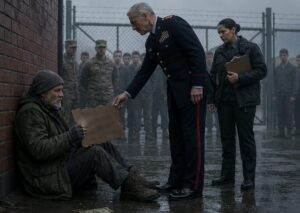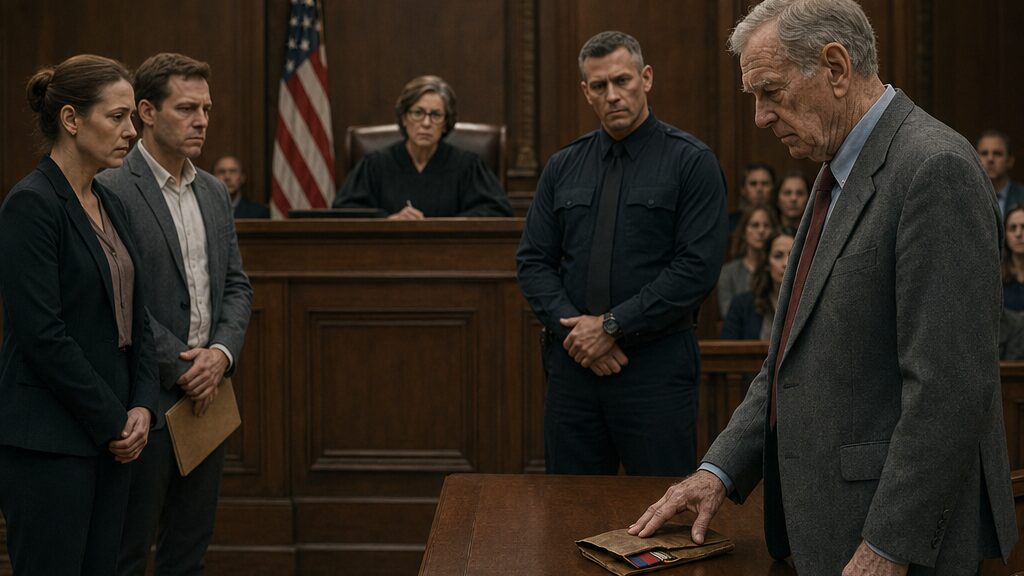
The Judge Told the Old Veteran to Put Away His Medal Before the Bailiff Recognized the Ribbon
Chapter 1: The Old Man With the Medal Packet
The metal detector screamed when Joseph Campbell stepped through it.
Not beeped. Screamed.
The sharp sound cut across the courthouse lobby, over the shuffle of shoes, the rustle of file folders, and the low cough of people waiting to have their pockets emptied into gray plastic trays. A woman behind Joseph sighed before the sound had even finished. Somewhere farther back in line, a man muttered that some folks should have their own line if they could not move faster.
Joseph stopped with both feet planted on the far side of the arch.
He did not turn around.
The security officer lifted one hand. “Sir, step back through for me.”
Joseph’s right hand closed around the inside of his suit jacket.
The movement was small, but the officer saw it. So did the people behind him. So did Joseph. He knew how a room changed when a hand moved toward a pocket. He knew the old habits that lived in the shoulders of men trained to watch other men. The officer’s face tightened.
“Sir,” the officer said again, firmer this time, “keep your hands where I can see them.”
Joseph let his hand drop.
His fingers shook once before settling against the seam of his trousers. He had dressed carefully that morning, though the suit hung too loose at the shoulders and the shirt collar had begun to rub the thin skin at his neck. The dark red tie had taken three tries. The first knot sat crooked. The second caught a tremor in his hand. The third would do.
“I have a packet,” Joseph said.
His voice came out low, worn flat by age and morning air.
The officer pointed toward the tray. “Then place it there.”
Joseph looked at the plastic tray. Keys. Belts. Phones. Loose coins. One child’s pink hair clip. A courthouse full of things people gave up temporarily because someone else told them to.
He reached inside his jacket slowly.
The packet fit in his palm as if his hand had learned its shape over years. It was not large. An old brown envelope, softened at the edges. A folded citation copy, its creases worn pale. A medal wrapped in a square of clean white cloth, the ribbon tucked but not fully hidden. Red, blue, and gold showed where Joseph’s thumb rested.
The officer glanced at it.
“Put it in the tray.”
Joseph did not move.
The woman behind him sighed louder. “Oh, for heaven’s sake.”
Joseph kept his eyes on the tray.
“If I put it there,” he said, “I would like to stand beside it.”
“That’s not how this works.”
“It won’t take long.”
“Sir, I need you to place the item in the tray and step aside.”
Joseph felt the line pressing at his back without anyone touching him. He could hear the impatience before it became words. He had heard versions of it in grocery aisles, pharmacy counters, bank lobbies, parking lots. Old man blocking the way. Old man confused. Old man making a simple thing hard.
He lifted the packet with both hands and set it in the tray.
He did not release it.
“Sir.”
Joseph’s thumb pressed over the ribbon.
The officer’s jaw worked once. “Is there something sharp in there?”
“No.”
“Then let go of it.”
Joseph looked up at him. The officer was younger than Emily, young enough to think patience was a courtesy and not a discipline. His uniform was neat. His eyes were already tired.
“It’s not for display,” Joseph said.
The officer did not understand. Joseph saw that clearly. He almost preferred it that way. Understanding cost too much.
The man behind the woman in line leaned to see around her. “Can we move this along?”
The packet rested in the tray between Joseph and the officer. The ribbon showed through the gap in Joseph’s fingers. He could feel the texture of the cloth under his thumb, feel the hard edge of the medal beneath.
The officer softened by a fraction, not from respect, but from the decision to manage him.
“All right,” he said. “I’ll carry the tray through. You step to the side.”
Joseph nodded once. It was not agreement so much as surrender to the next necessary thing.
He released the packet.
For the few seconds it took the officer to carry the tray around the detector, Joseph’s right hand stayed open at his side, fingers curved as if still holding weight. He watched the tray, not the officer. He watched every jolt, every tilt. When the officer set it down on the inspection table, Joseph reached for the packet before his keys, before his belt, before the folded notice from the court that had brought him there.
The officer placed a hand lightly over the tray before Joseph could lift it.
“Sir, may I see that?”
The phrase landed wrong.
Not cruel. Not disrespectful. Just wrong in the way ordinary things could be wrong when said without knowing. Joseph looked at the officer’s hand over the tray, then at the packet, then at the long hallway leading toward the courtrooms.
“No,” he said.
The officer held his gaze a moment. Behind Joseph, the line shifted, restless and annoyed.
“You’re here for court?” the officer asked.
Joseph slid the hearing notice from beside the tray and showed him the top page.
The officer read only the first lines. “Guardianship matter?”
Joseph folded the paper back along its crease.
“That’s what they call it.”
The officer looked at him differently then, but not better. More carefully. More cautiously. As if Joseph had become something fragile and possibly troublesome.
“You have family with you?”
Joseph put his belt back through the loops with slow, practiced hands. “My daughter is meeting me inside.”
The officer stepped back. “Courtroom Two. Down the hall, left side.”
Joseph gathered the packet and placed it inside his jacket before he picked up anything else. The paper notice went in his outer pocket. Keys in the left. Wallet in the right. All things returned to their assigned places. He had learned long ago that order could keep a man standing when much larger things were gone.
The hallway smelled of floor wax and old paper. Joseph walked slowly, not because he did not know where to go, but because the left knee had been stiff since dawn and the courthouse floor was polished enough to punish hurry. People passed around him. A young man with a briefcase brushed his sleeve and did not apologize. A woman in a blue jacket spoke into her phone about lunch plans and continuances. No one looked long.
Courtroom Two stood with its double doors open.
Joseph paused outside.
A printed docket sheet was taped beside the door. He leaned closer. The small black type blurred, then sharpened, then blurred again. He found his name halfway down.
Campbell, Joseph. Petition for guardianship and property authority.
Emily’s name appeared below his, and Matthew’s beside it. Seeing them printed there made them feel less like family and more like weather. Something moving toward him whether he liked it or not.
His hand went to the packet again.
A deputy clerk at a small table by the door looked up. “Name?”
“Joseph Campbell.”
She ran a finger down a list. “You’re the respondent.”
Joseph had been called worse things by better men, but the word still sat cold in the air.
“Yes.”
“Your party is already inside.”
He looked through the doorway.
Emily sat on the left side of the courtroom, near the front. Her hair was pulled back tightly, the way it got when she wanted to be calm. Matthew sat beside her in a gray jacket, one ankle over the other, reading from a folder. Emily turned as if she had felt Joseph arrive rather than heard him.
For one second, her face was only his daughter’s. Not petitioner. Not worried adult child. Not the woman who had measured his medicine bottles and opened his mail and told him the stove was not safe anymore.
Just Emily, who used to stand on a kitchen chair to reach the sink and insisted she could wash her own cup.
Then her eyes dropped to his jacket.
To the place where the packet rested.
Her mouth tightened.
“Dad,” she said softly when he reached the aisle. “I thought we agreed you wouldn’t bring that.”
Joseph stopped beside the row, one hand on the bench back.
“We didn’t agree.”
“You said you understood.”
“I understood what you wanted.”
Matthew closed the folder. “Joseph, this is exactly what we talked about. Today needs to be simple.”
Joseph looked at him.
Matthew was not a bad man. Joseph had told himself that often enough that the words had become both fair and useless. Matthew fixed leaky faucets when asked, paid bills on time, used phrases like liability exposure and realistic options. He treated trouble as something that could be solved if people stopped attaching memories to it.
Emily touched Joseph’s sleeve. “Please sit with us.”
The hearing notice crackled in Joseph’s pocket.
“No,” he said.
Emily blinked. “Dad.”
“I’ll sit over here.”
He crossed the aisle before she could answer and lowered himself onto the right-side bench. The wood was hard and too low. He placed both hands on his knees until the small pain behind his left hip settled. Then he took the packet from his jacket and held it in his lap under folded hands.
Across the aisle, Emily watched him.
Matthew leaned toward her and whispered something Joseph could not hear. He did not need to. The shape of Matthew’s mouth was enough. Concern. Delay. Difficult. Words that wore clean shoes.
At the front of the room, the court clerk arranged files near the judge’s bench. A uniformed bailiff stood beside the wall, hands folded in front of him. Joseph noticed the man because old training noticed uniforms before names. Tall. Square shoulders. Close-cropped hair beginning to gray. Shoes polished, but not new. A man who knew how to stand still without looking idle.
Their eyes met briefly.
The bailiff looked away first, not rudely, just professionally. Joseph became part of the room’s inventory: benches, flag, seal, old man with packet.
Cases before his moved quickly. A traffic matter. A landlord dispute. A continuance requested and granted. Joseph listened to voices rise and fall around terms that turned human mess into neat phrases. Failure to appear. Temporary order. Competency evaluation. Property access.
Emily twisted a tissue in her hands.
When Joseph looked down, the packet had shifted. A sliver of ribbon showed between his fingers. Red. Blue. Gold.
He covered it with his thumb.
“All rise.”
The courtroom rose as Judge Barbara Hall entered.
Joseph stood more slowly than the others. His knee caught halfway. No one helped him, and he preferred it that way until he did not. The judge took her seat, looked over the room, and began.
Her voice was practiced, brisk, not unkind.
The clerk called another case. Then another.
Joseph waited. His left hand had gone stiff from holding the packet too long. He loosened it one finger at a time.
Then the clerk lifted the next file.
“In the matter of Joseph Campbell.”
Emily stood on the opposite side of the aisle before Joseph had fully pushed himself up from the bench.
Chapter 2: The Judge Asked Him to Put It Away
Joseph rose with the packet in his right hand.
The courtroom did not become silent for him. It only lowered itself into a different kind of noise—the rustle of spectators adjusting their coats, the faint squeak of the clerk’s chair, the whisper of paper sliding across the judge’s bench. Joseph stepped into the aisle and walked toward the front table on the right. Emily and Matthew took the left.
Judge Barbara Hall looked down at the file before she looked at Joseph.
“Mr. Campbell,” she said. “Good morning.”
“Morning.”
The judge glanced at Emily. “Ms. Wilson.”
“Good morning, Your Honor.”
Matthew nodded without speaking.
Joseph stood behind his table because no one had told him to sit. His hand rested on the medal packet. He could feel the edges through the worn envelope.
Judge Hall adjusted her glasses. “We are here on a petition for limited guardianship and property authority filed by Emily Wilson concerning her father, Joseph Campbell. The petition requests authority over certain financial decisions, medical scheduling, home repairs, and potential disposition of real property.”
“Sale,” Joseph said.
The word came out before he had planned it.
The judge looked at him.
Matthew looked annoyed. Emily looked pained.
Judge Hall said, “Potential disposition can include sale, yes, depending on findings and future orders.”
Joseph nodded once.
It was a fine courthouse sentence. Clean as a folded sheet. It did not smell like old wood after rain. It did not know the sound of the back window rattling in November. It did not know the mark on the pantry door where Emily’s height had been penciled every birthday until twelve.
Judge Hall continued. “Mr. Campbell, do you understand why you are here today?”
Joseph held the packet against the table.
“My daughter wants permission to decide for me.”
Emily made a small sound. “Dad, that’s not fair.”
Judge Hall lifted a hand. Not sharp, but enough. Emily stopped.
“Mr. Campbell,” the judge said, “the petition raises concerns about your ability to manage daily affairs safely. There is a doctor’s letter. There are photographs of the property. There are reports of missed payments and a utility shutoff.”
“It was one bill.”
“Nevertheless.”
“I paid it.”
“Nevertheless,” the judge repeated, and this time the word closed a door.
Joseph looked at the seal above her bench. He had been in rooms where orders arrived without anger. Anger was not required to change a man’s life.
Emily stepped forward slightly. “Your Honor, I love my father. I want that understood.”
Joseph kept his eyes on the bench.
“He has fallen twice,” Emily said. “He forgets appointments. The porch railing is loose. There’s mold near the back room. He won’t let contractors in. He won’t let us clear anything out. He keeps important documents in boxes no one can find. And he keeps carrying that old—”
She stopped.
Joseph knew what word she had almost used.
Thing.
Judge Hall followed Emily’s glance.
“What are you holding, Mr. Campbell?”
Joseph’s fingers closed around the packet.
“Mine.”
The judge waited.
Joseph added, “Personal.”
“Is it related to the petition?”
Joseph did not answer quickly enough.
Matthew spoke. “Your Honor, with respect, this is part of the concern. He fixates on items from years ago. We’re not trying to take anything sentimental away from him, but we cannot make basic decisions because everything becomes about history.”
Joseph looked at Matthew then.
Everything becomes about history.
The words sat between them, so ordinary and so careless that Joseph almost smiled.
Judge Hall leaned back. “Mr. Campbell, I need to keep us focused. If that item is not evidence you intend to submit today, please put it away.”
Joseph did not move.
Emily whispered, “Dad, please.”
The bailiff shifted near the wall.
Joseph heard the shift more than saw it. A small redistribution of weight. Leather against polished floor. He kept his gaze on Judge Hall.
“It’s not for display,” Joseph said.
“I understand it may be meaningful to you,” the judge replied. “But today’s issue is capacity and property management. The court cannot evaluate that based on personal keepsakes.”
Joseph looked down at the packet.
The envelope had softened from years of being carried, opened, closed, hidden, found again. The corner had been repaired with clear tape that had yellowed along the edge. Beneath the paper, the medal made a slight rise under his thumb.
Matthew exhaled. Not loudly. Just enough.
Judge Hall’s voice sharpened by one degree. “Mr. Campbell, please place the item in your jacket or on the table and remove your hand from it.”
The room watched him now.
Not with interest. With the discomfort people felt when an old person did not follow instructions quickly enough.
Joseph set the packet on the table.
He did not remove his hand.
The judge’s mouth tightened. “Mr. Campbell.”
The bailiff took one step away from the wall.
His nameplate caught the light. Christopher Davis.
“Sir,” Christopher said, automatic and formal, “may I see that?”
Joseph turned his head.
The phrase had followed him from the security line into the courtroom. There it had sounded like procedure. Here, spoken by the bailiff, it held something else. Not yet respect. Not yet understanding. But caution.
Joseph’s thumb covered the ribbon.
“No,” he said.
Christopher did not reach.
Judge Hall looked at the bailiff. “Mr. Davis?”
Christopher’s eyes remained on the thin strip of ribbon visible beneath Joseph’s thumb. Red. Blue. Gold. The old citation copy had shifted inside the envelope. A line of faded type showed through a torn seam, not readable from the bench, but perhaps enough to a man who had seen old paper preserved by people who could not let it go.
Christopher’s shoulders changed.
It was not dramatic. No one else would have called it a change. He stood a fraction straighter. His chin lowered. His hands, which had been loosely folded, came apart and rested at his sides.
When he spoke again, his voice had lost its courtroom edge.
“Mr. Campbell,” he said, “may I ask what ribbon that is?”
Joseph looked at him.
The room seemed to draw farther away. The judge, Emily, Matthew, the benches, the clock, the flag—all present, all distant.
Joseph said, “It wasn’t mine first.”
The words were quiet enough that the clerk looked up to see whether she had heard correctly.
Christopher swallowed.
Judge Hall watched him now, not Joseph.
“Mr. Davis?” she said.
Christopher did not take his eyes from the packet. “Your Honor, I request permission to approach.”
“For what purpose?”
“To look at the item before the court proceeds.”
Matthew’s chair scraped lightly. “Your Honor, I don’t see how—”
Judge Hall raised her hand.
Matthew stopped.
The judge studied Christopher’s face. Perhaps she knew him well enough to hear what had changed. Perhaps the courtroom had been hers long enough that any unexpected stillness mattered.
“Approach,” she said.
Christopher walked toward Joseph’s table.
He did not hurry. He did not perform. He stopped a respectful distance away, not close enough to crowd the old man’s hands.
“Mr. Campbell,” he said, lower now, “I won’t touch it unless you allow me.”
Joseph looked at the packet. Then at Christopher’s uniform. Not military, but close enough in bearing to wake old rooms in the mind. Close enough that Joseph could see the man had learned some things the hard way.
Joseph lifted his hand.
The ribbon showed.
Christopher looked at it fully.
His face did not break. It tightened. The way a man’s face tightens when memory and recognition arrive together and he has to keep standing in public.
He looked at the folded citation copy through the torn seam. Then at the medal beneath the cloth.
“Sir,” he said, and this time the word was not routine, “did you serve?”
Joseph’s thumb returned to the ribbon.
“A long time ago.”
Emily stared at him across the aisle. “Dad?”
Joseph did not look at her.
Christopher’s voice dropped further. “Army?”
Joseph nodded.
The bailiff took half a step back. Not because he was finished looking. Because the space around Joseph had changed.
Judge Hall leaned forward. Her expression had not softened exactly, but it had become more careful.
“Mr. Campbell,” she said, “is that service record connected to this matter?”
Joseph looked at her.
For one sharp moment, he wanted to say no. He wanted to gather the packet, place it back inside his jacket, sit down, let them call him stubborn, confused, sentimental, whatever helped them finish the morning. A man could protect a thing by burying it deep enough that no careless hand ever reached it.
But Emily was standing on the other side of the aisle, asking the court to take from him the authority to decide what could be touched and what could not.
Joseph looked at his daughter.
Her eyes had filled, though she looked angry with herself for it. Matthew’s mouth was set. Judge Hall waited. Christopher stood still beside the table, changed but silent.
“It’s connected,” Joseph said.
The judge did not rush in. That was the first difference.
“How?” she asked.
Joseph drew the packet closer.
“It belongs with the house.”
Emily frowned. “What does that mean?”
Joseph’s hand tightened.
Judge Hall looked from Joseph to Emily, then back to the file. “Mr. Campbell, I am going to continue this matter briefly today if needed, but I need to understand whether there are documents relevant to the property that have not been disclosed.”
Matthew said, “Your Honor, the deed is clear. The house is in Joseph’s name. We’re not disputing that. The issue is his ability to manage it.”
Christopher stepped back toward the wall, but he did not resume his former posture. He stood with his hands at his sides, eyes lowered, as if guarding the silence itself.
Joseph said, “The deed isn’t the whole of it.”
The words seemed to cost him more than all the standing.
Judge Hall looked at the clerk. “We may need to set a continued hearing.”
Matthew leaned forward. “Your Honor, we have taken time off work. The property condition is getting worse.”
“And the respondent has indicated there may be relevant history or documents not before the court,” Judge Hall said.
Respondent.
The word had less bite now, but it remained.
Joseph folded the packet against his chest.
Judge Hall noticed.
“Mr. Campbell,” she said, “no one is ordering you to surrender that packet today.”
Emily looked at the judge, then at Joseph. Something like shame crossed her face and vanished.
Judge Hall continued, “But if you intend the court to consider anything inside it, you will need to provide enough information for the record. Do you understand?”
Joseph nodded.
“Yes.”
His voice sounded steadier than he felt.
Judge Hall looked toward Christopher. “Mr. Davis.”
Christopher stepped forward.
The courtroom waited.
He inclined his head slightly toward the bench, then toward Joseph. “Your Honor, may I approach the bench?”
Chapter 3: The House They Called a Hazard
By the time Emily unlocked her father’s front door that afternoon, the smell of the house had already made Matthew impatient.
“It’s damp again,” he said.
Emily stood with the key still in the lock.
The house smelled the way it always did after rain: old wood, dust, the faint mineral odor of the basement, and something warm beneath it that Emily had never been able to name. When she was little, she thought every house smelled like itself because every family had a private weather. Her friends’ houses smelled like laundry soap or carpet or fried onions. Her father’s house smelled like cedar drawers, coffee grounds, machine oil, and the hallway rug that had been there since before she was born.
Now Matthew called it damp.
He was not wrong.
That was the part that exhausted her.
Emily pushed the door open.
“Dad, watch the threshold,” she said.
Joseph stood behind her on the porch, one hand on the railing, the other inside his suit jacket. He had not spoken much since court. He had answered direct questions in the car with yes, no, and once, I heard him. Emily had not asked what the bailiff had whispered to the judge after approaching the bench. The judge had continued the hearing for two days, requested property records, and told them all to return prepared to address Joseph’s statement about the house.
Joseph had looked smaller when the hearing ended, but not defeated.
That frightened Emily more than defeat would have.
“I know the threshold,” he said.
She stepped aside.
Joseph entered slowly, pausing just inside as if the house needed to recognize him before letting him pass. He removed his hat, though Emily could not remember him wearing hats indoors even when no one cared. His eyes moved over the front room.
Same brown recliner near the window. Same side table with a ring from a coffee mug. Same narrow bookshelf. Same framed photograph of her mother on the mantel, not centered because one corner of the frame stand had bent years ago.
Matthew carried in a folder and a small tablet. “We need to take pictures of the back room while there’s still light.”
Joseph’s head turned. “No.”
Emily closed the door carefully. “Dad, the court asked for documentation.”
“The court asked for records.”
“And property condition.”
“No one needs the back room.”
Matthew gave a short laugh without humor. “The mold is coming from the wall next to it. The contractor said that months ago.”
“He didn’t go in.”
“Because you wouldn’t let him.”
Joseph walked past them into the living room. He set the medal packet on the side table beside an old brass house key. The key had hung by the back door for as long as Emily could remember, though she had never known which lock it belonged to. It was too large for any modern door, darkened in the grooves, heavy-looking even from across the room.
The packet looked wrong beside it and right at the same time.
Emily watched her father’s hand hover over both objects before he withdrew it.
“Dad,” she said gently, “this is what I mean. There are parts of the house no one is allowed to touch. Papers no one can sort. Rooms no one can enter. If something happens to you, I won’t even know where to start.”
Joseph lowered himself into the recliner. “You start by asking.”
“I have asked.”
“You ask while holding boxes.”
Emily’s mouth closed.
Matthew set his folder on the dining table, which had become a landscape of unpaid bills, repair estimates, pharmacy receipts, and court papers. “Joseph, nobody wants to bulldoze your memories. But the porch railing is unsafe. The back room wall is damaged. The roof patch didn’t hold. The assessor’s report says the property value drops every month we wait.”
Joseph looked toward the hallway.
At the end of it stood the locked room.
The door was painted white, but age had yellowed it near the handle. A narrow crack ran from the upper hinge to the frame. Emily had not been inside since she was nineteen, maybe younger. After her mother died, Joseph began keeping it locked. When Emily asked, he said it was storage. Later, when she pressed, he said there was nothing in there she needed.
That had been his answer for twenty years.
Nothing you need.
Emily took off her coat and placed it over a chair. “The petition isn’t to punish you.”
Joseph did not look at her.
“I know what it says.”
“It says limited authority.”
“It says sale.”
“It says possible sale.”
He turned then, and for a moment she saw the man from court—the stillness, the hand over the packet, the quiet refusal.
“Possible is a door,” he said. “People open it when they get tired of waiting.”
Matthew rubbed his forehead. “This is exactly why the judge needs to intervene. We’re talking about structural issues, and you’re talking in riddles.”
Emily shot him a warning glance.
But she was tired too. Tired from leaving work early to check whether her father had eaten. Tired from finding notices under magazines. Tired from lying awake imagining him on the kitchen floor, the phone across the room, too proud or too dazed to call. Tired from loving a man who had taught her to check tire pressure and balance a checkbook but would not tell her what was behind one locked door.
She sat on the edge of the couch.
“Dad, I’m scared.”
The words came out smaller than she intended.
Joseph’s face changed, but only at the edges.
Emily held onto that tiny change. “I am. I don’t know what you need because you won’t tell me. I don’t know what matters because everything is off-limits. You say ask, but when I ask, you close the door.”
Joseph looked at the medal packet.
Emily followed his gaze.
“Is this about the medal?” she asked.
“No.”
“Then what?”
He picked up the brass key and turned it once in his palm.
Matthew watched the movement. “Is that for the back room?”
Joseph’s fingers closed over it.
No answer.
Emily stood. “Dad.”
He put the key back beside the packet. “Not today.”
Matthew exhaled sharply and went toward the hallway.
“Matthew,” Emily said.
“I’m just looking at the outside of the wall.”
Joseph began to rise.
Emily moved before he did. “Matthew, stop.”
Matthew stopped near the hallway entrance, but frustration had already colored his face. “We have forty-eight hours before we’re back in court. If we go in there with nothing but stories and a secret room, this won’t go well.”
Joseph stood fully now.
His left hand rested on the arm of the chair. His right hand stayed close to the packet. Not touching. Ready.
Emily saw the tremor in his fingers. She also saw the effort he made to still it.
She hated herself for noticing both.
“I’ll get the old property box,” she said. “The one from the hall closet. Maybe there are records there.”
Joseph did not stop her.
The hall closet smelled of dust and winter coats. Emily knelt and pulled out two cardboard boxes stacked beneath an old vacuum hose. The top one held tax returns, appliance manuals, warranty cards for machines long dead. The bottom one was heavier. Inside were envelopes bundled with rubber bands gone brittle, a water bill from years ago, insurance papers, photographs turned face down.
She carried the box to the dining table.
Matthew joined her, calmer now, and began sorting by category. Joseph remained in the living room, standing beside the recliner as if sitting again would concede something.
Emily found the envelope near the bottom.
It was cream-colored, thicker than the others, with a military return address faded almost to nothing. Across the front, in handwriting she did not recognize, was Joseph Campbell. But beneath Joseph, faint and crossed out with one deliberate line, was another first name.
Not Joseph.
The surname remained the same.
Campbell.
Emily stared at it.
“Matthew,” she said quietly.
He leaned over. “What is it?”
She did not answer.
Joseph’s shadow fell across the table.
Emily looked up.
For the first time all day, fear showed plainly on her father’s face. Not confusion. Not age. Not stubbornness.
Fear.
He reached for the envelope, but Emily had already seen the crossed-out name.
Chapter 4: The Record That Did Not Explain Enough
Samantha Lopez had learned that most people came to the courthouse carrying the wrong paper.
They brought hospital bills when they needed affidavits. They brought photographs when they needed dates. They brought anger when they needed signatures. They brought every version of the truth except the one a clerk could file.
Joseph Campbell came to the legal aid desk two days after the first hearing carrying a brown envelope inside his jacket and nothing in his hands.
Samantha noticed that first.
He stood in front of her counter with his shoulders square, his coat buttoned, and his eyes fixed just above the sign that said intake closes at 3:30. Behind him, people shifted in the waiting area. A young mother bounced a child on one hip. An older couple argued softly over a landlord packet. A man in work boots filled out a form with the heavy pressure of someone unused to writing in public.
Joseph did not take a number from the machine.
Samantha looked up from her screen. “Can I help you?”
He held out the continued hearing notice, folded once down the middle.
She took it and read the top lines. “Mr. Campbell?”
“Yes.”
“You’re here about the guardianship matter?”
He nodded.
Samantha had seen him in the courtroom from the back row. Not clearly, but enough. She remembered the judge pausing. She remembered the bailiff, Christopher Davis, stepping away from his wall and speaking differently to the old man. She remembered the packet on the table and the way the courtroom, which usually swallowed everyone into procedure, seemed for a moment to notice one person.
“Do you have an appointment?” she asked.
“No.”
“We can still do intake if it’s urgent. The continued hearing is tomorrow?”
“Yes.”
“Do you have counsel?”
“No.”
“Do you want counsel?”
Joseph considered that as if it were not a simple question.
“I want to understand what they can take.”
Samantha set the notice down gently.
“Let’s sit.”
She came around from behind the counter and led him to a small interview table near the records window. He waited for her to sit first. She had not expected that. Most clients were too tired, too scared, or too angry to notice those things. Joseph lowered himself carefully into the chair across from her and placed both hands on his knees.
Samantha opened a blank intake sheet.
“I’m going to ask some basic questions first.”
“All right.”
“Full name?”
“Joseph Campbell.”
“Address?”
He gave it.
“Date of birth?”
He gave that too, then added, “Seventy-nine.”
Samantha wrote slowly enough that he would not feel rushed. “Your daughter filed the petition?”
“Emily.”
“And Matthew Miller is her husband?”
“Yes.”
“What are they asking for?”
Joseph looked at the hearing notice on the table. “Permission.”
“To make decisions for you?”
“To make decisions without me.”
Samantha’s pen paused.
The answer was not legally precise, but it was clearer than many legal answers.
She made a note. “The petition says limited guardianship and property authority. Did someone explain what limited means?”
“It means they say it kindly.”
Samantha looked up.
Joseph’s face had not changed. He was not trying to be funny. He was not trying to be bitter. The sentence came out of him like a measurement.
“It can mean different things,” Samantha said. “Sometimes it really is narrow. Sometimes it expands.”
“That’s what I thought.”
She asked about the house. He answered in short, exact statements. The roof patch was temporary. The porch railing needed work. The back room had water damage along one wall. The utility shutoff had lasted six hours. He had paid the bill. He knew where his medicines were. He had missed one appointment because the office changed the time and left a message on a phone he did not check before going.
“Do you use the phone often?” Samantha asked.
“When it rings.”
“And messages?”
“Less often.”
She wrote that down too. Not as proof against him. As a thing that mattered.
Then she said, “Mr. Campbell, Judge Hall asked whether there were documents relevant to the house. Do you have any with you?”
Joseph’s hand moved to the inside of his jacket and stopped.
Samantha saw it. She lowered her pen.
“If there’s something you don’t want copied, we don’t copy it without permission.”
His eyes lifted to hers.
She could feel the thinness of trust in the room. Not because he was suspicious by nature, but because too many people had been asking him to hand over pieces of his life as if sorting a drawer.
“Sir,” she said, more softly, “may I see that?”
The words hung there.
Joseph’s jaw tightened. She realized too late that she had used the same phrase everyone else had used before touching what mattered.
“I’m sorry,” she said. “Let me ask that differently. Is there something in the packet that you want the court to know exists?”
Joseph waited a moment longer.
Then he drew the envelope from his jacket and laid it on the table.
He did not push it toward her.
The brown paper had been handled so often it looked almost like cloth. One corner bore a strip of old tape. A medal lay wrapped within a square of white fabric, the ribbon partly visible. Red, blue, and gold. A folded citation copy rested behind it, brittle at the folds. There was also a second envelope, cream-colored, the kind Emily had found in the box.
Samantha did not touch anything.
“Is this the item from court?”
“Yes.”
“The bailiff recognized it.”
Joseph looked down.
“He recognized the ribbon.”
“Did he know what it meant?”
“Enough.”
Samantha kept her hands folded. “May I read the citation copy?”
Joseph opened the packet himself.
He lifted the folded page with great care and turned it so she could see, keeping two fingers on the lower edge. The paper was a copy, not the original. The type was faded, but legible in pieces. Name. Unit. Action under fire. Evacuation route. Civilian shelter. The medal named on the page was not for Joseph.
Samantha read the name once, then again.
The first name was not Joseph’s.
The surname was Campbell.
She looked up before asking.
Joseph said, “No relation by blood.”
The correction came before the question. It had been asked before, then. Probably many times. Maybe not aloud.
“The house,” Samantha said carefully. “How is this connected to the house?”
Joseph folded the citation copy back along its old creases.
“It was his mother’s.”
“The other Campbell?”
Joseph nodded once.
Samantha did not press. She turned to the records request form instead, giving him room to breathe.
“There may be property transfer records. Deed history. Probate records. Tax records. If there was an unusual transfer, we can search.”
Joseph looked toward the records window. “How far back?”
“Depends on what’s been digitized. Older records may be on microfilm or in bound volumes.”
“I don’t need everything.”
“What do you need?”
His hand rested beside the cream envelope.
“To show it wasn’t bought like furniture.”
That answer stayed with her.
Samantha filed two record requests and walked with Joseph to the records office, where a clerk behind thick glass looked at the forms, then at Joseph, then at Samantha. There were fees. Samantha asked for the fee waiver. There was a delay. Samantha asked what could be pulled today. There was a sigh. Samantha waited through it.
Joseph stood beside her without complaint.
The records office smelled colder than the rest of the courthouse. Old paper, toner, metal shelving. While the employee searched, Samantha watched Joseph’s reflection in the glass. His face did not look confused. It looked guarded against remembering.
The first record came as a scanned deed from decades earlier. Joseph Campbell as current owner. Nothing unusual there.
The second was a prior transfer. A widow with the Campbell surname. A nominal sale. One dollar and other consideration. Samantha read the line twice.
The third was a probate notation, older still, incomplete. A handwritten reference to surviving family assistance, military casualty correspondence, and temporary occupancy.
Temporary.
Samantha copied the file numbers.
Joseph said nothing.
The records office employee slid another page under the glass. “That’s all we have without pulling the archive box.”
“How long would that take?” Samantha asked.
“Could be tomorrow. Could be next week.”
“The hearing is tomorrow.”
The employee shrugged with bureaucratic regret. “Then tomorrow might be tight.”
Samantha turned back to the documents they had. They showed something, but not enough. They showed the house had passed through grief before it passed to Joseph. They did not show why he held it like a duty.
At the legal aid desk again, she placed the copies in a clean folder. “These records don’t prove the whole story.”
Joseph’s expression did not change. “Records don’t usually.”
“They do show the property has history connected to the man on the citation.”
“Yes.”
“Will you tell the judge that?”
Joseph looked toward the hallway leading to the courtrooms.
People hurried past with folders pressed to their chests. A child cried near the elevator. Somewhere, a clerk called a case number. The courthouse kept taking private lives and giving them public names.
“I’ll tell her what is necessary,” he said.
Samantha slid the folder toward him, then stopped before it reached his hand.
“Mr. Campbell,” she said, “the court has been asking whether you can manage property. But maybe the first question should be what the property is.”
Joseph looked at the folder.
For the first time, the corner of his mouth moved. Not quite a smile. Something smaller and older.
“That would be a better question.”
Samantha placed the folder beside his medal packet instead of on top of it.
He noticed.
As he gathered his things, the cream envelope slipped halfway free. Samantha saw again the crossed-out first name before Joseph covered it with his palm.
“Is that the same man?” she asked.
Joseph stood.
The packet disappeared inside his jacket.
“It was his house before it was mine,” he said.
Then he left Samantha with the copies, the file numbers, and the uneasy knowledge that the courthouse record had opened a door it could not yet walk through.
Chapter 5: What Joseph Refused to Say
The night before the continued hearing, Joseph unlocked the back room and stood outside it for nearly a full minute before turning on the light.
The switch clicked. The bulb hummed once, then steadied.
Nothing inside moved.
He had expected that. Still, some part of him always waited. Old rooms had their own breathing. This one breathed dust, dry wood, a faint line of damp from the damaged wall, and cedar from the trunk beneath the covered window. The window itself had a crack running from one corner to the latch, thin as a vein. Rain had found it more than once.
Joseph stepped inside.
The room was smaller than memory made it. That happened with rooms, with roads, with men. Things that once held whole parts of your life became narrow when you returned carrying too many years.
Against the wall stood a metal shelving unit with labeled boxes. Emily believed he kept chaos behind the locked door. She believed this because he let her believe it. It was easier than explaining that the room was not messy because he had forgotten order. It was ordered because he could not bear surprise.
Top shelf: tax papers, appliance records, house insurance.
Middle shelf: photographs, letters, service copies.
Bottom shelf: tools wrapped in canvas, a broken radio, a coffee tin of old screws.
The cedar trunk sat under the window.
Joseph carried a kitchen chair into the room and sat facing it.
The medal packet rested on his lap.
For years he had opened it only halfway. Enough to check for dryness. Enough to make sure the ribbon had not frayed. Enough to remind himself that some things did not disappear simply because no one else knew to ask.
Tonight, he unfolded the white cloth completely.
The medal lay in the center, dull at the edges where handling had worn the shine. The ribbon held its colors better than it had any right to. Red, blue, and gold. Not bright. Steady.
Behind it lay the citation copy. Behind that, the old cream envelope.
Joseph touched the envelope last.
The crossed-out name on the front seemed darker in the yellow light.
Not Joseph Campbell.
Another Campbell.
The man in the photograph inside the trunk had been twenty-three when Joseph knew him. Too young to own a house, old enough to talk about one as if he had built it with his hands. He carried a picture of it folded in his wallet: white porch, narrow steps, a maple tree that shaded half the roof in summer. He had told Joseph his mother kept tomatoes on the back sill and worried the pipes would freeze if no one watched them.
Joseph had listened because listening was sometimes all a man could offer.
He opened the trunk.
The hinges complained softly.
Inside were things no court would know what to do with. A field notebook with curled pages. A small flag folded by someone else’s hands. Photographs of men standing in dusty light, their helmets tilted back, their faces trying to look older than fear. A packet of letters tied with string. A rusted key that no longer fit anything in the house. A sealed plastic sleeve holding the original citation, kept away from air and fingers.
Joseph did not remove the photograph first.
He removed the letter.
The paper had been read enough times that the folds had begun to separate. It was addressed to him in a hand that had once been firm and had grown weaker line by line.
Mr. Campbell, it began, though he had told her to call him Joseph.
He did not read the whole thing. He did not need to. He knew where the words lived.
Thank you for bringing my son home in the only way you could.
Thank you for seeing that I was not alone.
If the house is ever too much, do what is right. But while you can, keep it from strangers.
Not forever. Just while you can.
That had been the line that trapped him and freed him in equal measure.
Not forever. Just while you can.
Joseph folded the letter and held it against the medal.
He could hear Emily’s voice from earlier that week, tired and afraid. I don’t know what you need because you won’t tell me.
That had been true.
He had confused privacy with protection until they became tangled. He had taught his daughter to respect closed doors, then punished her for not knowing what was behind them. He had refused Matthew’s categories—asset, liability, hazard—but had offered no better words in their place.
The house had been shelter once.
After the war, when Joseph came home with one duffel, bad sleep, and a name he could not stop hearing, the widow who owned this house had taken him in for one week. That had been the plan. One week in the spare room while he looked for work and delivered the packet her son could not carry home.
One week became winter.
He fixed the porch step. Repaired the kitchen pipe. Drove her to appointments. Sat at the table while she read the official letter, then the citation, then the unofficial truth Joseph gave her in pieces small enough to survive. He never told her everything. Some mercy was silence. Some silence was cowardice. He had lived long enough not to confuse them, though he still did not always know which one he had chosen.
When she died, the house came to him through papers no one now understood.
Emily had been a child then. She knew the widow only as the woman in the back-room photograph, the one Joseph called Mrs. Campbell though she was not family. Later, when Emily asked why they had the same last name, Joseph said there were many Campbells in the world.
It had been true.
It had not been enough.
Joseph took out the photograph.
The young soldier looked directly at the camera, grinning with one shoulder raised as if someone had shoved him just before the shutter clicked. On the back, in faded ink, was written: Tell Ma I stood straight.
Joseph sat with that sentence in the quiet room.
The hearing tomorrow would not know what to do with it either.
He could already hear Matthew. The past doesn’t change the roof. The medal doesn’t fix mold. A promise doesn’t make stairs safe.
And Matthew would not be entirely wrong.
That was the hardest part.
Joseph’s knee hurt. His left hand sometimes went numb before breakfast. He had forgotten the new appointment time because the office left a message instead of sending a card. He hated the phone. He hated the way people spoke slowly to him when he asked them to repeat themselves. He hated that Emily watched his hands when he carried coffee.
He hated most that she had reason.
He was not incapable. He was not unchanged.
Both truths could stand in the same room.
Joseph rose and moved to the damaged wall. The paint near the baseboard had bubbled slightly. He touched it with two fingers. Damp. Not terrible yet. Not safe to ignore.
He looked at the shelves. At the labeled boxes. At the trunk. At the window crack. The room did not need to remain sealed to remain sacred. He had known that for years and refused it anyway.
From the hallway came the old house settling in the cold.
Joseph returned to the chair and placed the medal back on the cloth. He did not wrap it yet. Instead, he opened the cream envelope and removed the documents inside: a copy of the nominal transfer, the widow’s letter, the photograph, and a second page written in Joseph’s own hand years ago but never signed.
It was not a legal document. He knew that.
It was a statement. A record of how the house came to him, what he had promised, what he had failed to say, and what he believed should happen when he could no longer keep it rightly.
He had written it after his wife died, then hidden it because signing it felt like surrender.
He read it now.
The words were too stiff in places. Too guarded. A man trying to make grief sound orderly. He took a pen from his shirt pocket and crossed out one sentence. Then another.
At the bottom, where the signature line waited, his hand hovered.
He did not sign yet.
Instead, he turned the page over and wrote a new sentence on the back.
I am willing to accept help repairing the house, but I am not willing to have its meaning sold without being heard.
The pen trembled near the end. The word heard tilted downward.
Joseph set the pen aside.
He carried the kitchen chair back to the table and made coffee he did not drink. Then he laid out what he would take to court: the medal, the citation copy, the widow’s letter, the transfer record, the photograph, the statement. Not everything. Enough.
At midnight, he stood at the threshold of the back room with the packet in his hand.
For the first time in years, he did not turn the lock.
He left the door open.
Chapter 6: The Court Finally Heard His Name
Joseph placed the medal packet on the courtroom table and took his hand away.
The act was small enough that no one in the back row would have noticed it. But Judge Barbara Hall noticed. Christopher Davis noticed. Emily noticed most of all.
The packet rested there between Joseph and the bench, the brown envelope repaired with yellowed tape, the white cloth folded around the medal, the cream envelope tucked beneath the citation copy. Joseph’s fingers remained open on the table beside it.
Not guarding.
Ready.
Judge Hall looked over her glasses. “Mr. Campbell, before we proceed, I want to make clear that this hearing is not about taking more from you than the law permits. It is about whether assistance is necessary and, if so, what kind.”
Matthew shifted at the other table.
Emily sat very still.
Joseph nodded.
The judge turned to Emily. “Ms. Wilson, I have reviewed the supplemental materials, including the property photographs and the doctor’s letter. I have also received deed records and preliminary archive references from the legal aid desk.”
Matthew leaned forward. “Your Honor, if I may, the property condition is still the immediate issue. The back room has water damage. The porch is unsafe. Joseph has blocked access repeatedly. We’re trying to prevent a crisis.”
Judge Hall lifted one hand.
“Mr. Miller, I understand your position. I will hear from you. But first I am going to hear directly from Mr. Campbell.”
The sentence landed quietly, but it changed the room.
Joseph felt Emily turn toward him.
Judge Hall faced him fully. “Mr. Campbell, do you understand what your daughter is asking this court to grant?”
“Yes.”
“What is your understanding?”
“She wants authority to make decisions about my appointments, bills, repairs, and whether my house can be sold.”
Emily’s eyes lowered.
“Do you believe you need assistance with any of those things?” the judge asked.
Joseph looked at the packet.
“Yes.”
Matthew’s expression flickered with surprise.
Joseph continued before anyone else could speak. “I need help with the phone messages. I need the railing repaired. I need the back wall opened before it gets worse. I need someone to go through the bill calendar with me once a month because the companies change their notices and call it simple.”
No one laughed.
Joseph folded his hands, then unfolded them.
“I do not need to be removed from my own decisions.”
Judge Hall let the words settle.
“That distinction matters,” she said.
Joseph heard it. The difference from the first hearing. Not kindness, exactly. Attention.
Matthew said, “With respect, Your Honor, we have tried informal help. He refuses. He won’t let contractors inside. He won’t let us clear the room. He keeps bringing up things none of us understand.”
“Then perhaps,” Judge Hall said, “we should understand them.”
She looked back to Joseph. “Mr. Campbell, you indicated at the last hearing that the packet belonged with the house. Are you willing to explain what you meant?”
Joseph’s throat tightened.
For one moment, the courtroom disappeared and the back room returned: the trunk, the letter, the photograph, the sentence on the back of the statement. I am willing to accept help repairing the house, but I am not willing to have its meaning sold without being heard.
He reached for the packet, then stopped.
“May I open it?” he asked.
Judge Hall’s expression changed by the smallest degree.
“Yes, Mr. Campbell.”
Christopher stood near the wall, hands at his sides, eyes forward. He did not move closer. He did not perform respect for the room. That steadiness helped more than Joseph expected.
Joseph opened the packet.
He unfolded the white cloth first and left the medal on it. He did not lift it for display. Then he placed the citation copy beside it, the widow’s letter beneath that, and the photograph last.
Emily leaned forward.
Joseph touched the photograph once with two fingers.
“This was not my medal,” he said.
His voice held. He had wondered whether it would.
“It was awarded to a man I served with. He died before it reached him. I brought it to his mother with the letter and what I could tell her. Not all of it. Enough.”
The courtroom remained still.
Judge Hall asked, “Was that man connected to the house?”
“It was his mother’s house.”
Emily’s hand went to her mouth.
Joseph did not look at her yet.
“When I came home, I stayed here. Supposed to be a week. Mrs. Campbell had no one close. I fixed what broke. She fed me when I didn’t want food. She let me sleep in the room at the back because it was quiet.”
He paused.
The word quiet had nearly opened too much.
“She left the house to me later. Not because I earned it in court terms. Because we had both lost the same man in different ways.”
Matthew looked down at the table.
Joseph took the widow’s letter and slid it toward the center, not all the way to the judge. “She wrote that if the house ever became too much, I should do what was right. But while I could, she asked me to keep it from strangers.”
Judge Hall did not reach for the letter immediately.
“May I?” she asked.
Joseph looked at her hand.
At the first hearing, she had told him to put the packet away. Now she waited.
He nodded.
She took the letter carefully.
Christopher’s eyes lowered for a moment.
Judge Hall read in silence. She did not read aloud for the room. Joseph was grateful for that. When she finished, she placed it back on the table exactly where she had taken it from.
Emily whispered, “Why didn’t you tell me?”
Joseph looked at his daughter then.
She was not a child. He knew that. She had lines at the corners of her eyes now, worry held in the set of her shoulders, her own life worn into her hands. But he could still see her on the kitchen chair, sleeves pushed up, declaring she could wash a cup by herself.
“I thought keeping it quiet kept it safe,” he said.
Emily’s eyes filled. “From me?”
Joseph did not answer quickly.
That was answer enough.
Emily looked down.
Matthew cleared his throat, less forcefully than before. “Joseph, no one is saying the house doesn’t matter. But meaning doesn’t repair structural damage.”
“No,” Joseph said. “It doesn’t.”
The agreement seemed to disarm him.
Joseph picked up the statement he had written and set it beside the medal. “I wrote what I am willing to do.”
Judge Hall accepted the page after asking permission with her eyes. She read it once, then again.
“You are willing to allow repairs to the porch, the back wall, and the window?”
“Yes.”
“And allow Ms. Wilson access to bill notices and appointment scheduling?”
“With me. Not instead of me.”
Judge Hall nodded.
“You are not willing to authorize sale at this time.”
“No.”
“Would you accept a limited order requiring repairs and monthly accounting support, without granting authority to sell the property?”
Emily looked sharply at Matthew.
Matthew whispered, “That doesn’t solve long-term—”
“It might solve now,” Emily said.
Her voice shook.
Joseph looked at her.
Judge Hall turned to Emily. “Ms. Wilson, this court does not ignore safety concerns. But neither does it erase a competent adult’s voice because the family is frightened and the house is difficult.”
Emily wiped under one eye with the side of her finger. “I was afraid he’d fall. Or that I’d find out too late. I thought if I could get authority, I could make everything safe.”
Joseph said, “Safe is not the same as decided.”
Emily nodded once, looking ashamed and relieved and still afraid.
Judge Hall made notes. Then she looked at Matthew. “Mr. Miller, you may address the repair concerns, but I am not inclined to sign the petition as presented.”
Matthew sat back.
The sentence did not make him a villain. It made him a man whose shortcut had failed.
Joseph felt the room tilt toward him, not with pity, not with applause, but with attention. That was harder to stand under than dismissal.
Judge Hall set down her pen.
“Mr. Campbell,” she said, “I want the record to reflect that you have answered the court’s questions directly. I also want the record to reflect that the item you brought today was not presented as decoration or distraction, but as context for the property history and your stated wishes.”
Joseph nodded.
His hands had begun to tremble. He placed them flat on the table.
Christopher stepped forward only when Judge Hall asked him to collect the copied records for the clerk. He came to Joseph’s table and stopped.
“Mr. Campbell,” he said, “may I handle the copies?”
Joseph looked at the documents. Then at the medal still resting on the cloth.
“Copies only,” he said.
“Yes, sir.”
There was no salute. No grand gesture. Christopher simply waited until Joseph separated the copies from the originals. Then he took them with both hands, as if paper could be heavy.
Judge Hall watched that too.
When Christopher returned to the clerk, Joseph folded the white cloth over the medal. He placed the widow’s letter back inside the cream envelope. He slid the photograph behind it.
Emily remained standing across the aisle, but her body no longer leaned toward the court as if asking it to protect her from him.
It leaned toward him.
Judge Hall reviewed her notes, then looked up.
“The petition for guardianship and property authority will not be granted as requested,” she said. “The court will consider a narrower temporary order focused on specific safety repairs, appointment communication, and financial organization, with Mr. Campbell’s participation required. No sale authority will be granted today.”
Joseph closed his eyes once.
Not long. Not enough for anyone to mistake relief for weakness.
When he opened them, the packet was back in his hands.
Judge Hall’s voice softened, but did not become sentimental.
“This court will hear from Mr. Campbell before any future decision concerning the house.”
Emily began to cry silently then.
Joseph did not cross the aisle. Not yet.
He held the packet in both hands and listened as the clerk entered the order into the record.
Chapter 7: Respect Became What They Did Next
One week later, Emily stood on her father’s porch holding a repair estimate, a grocery bag, and the uncomfortable knowledge that she no longer knew how to knock.
She had a key. She had always had a key. For years she had used it the way adult children used keys when they were worried: quickly, apologetically, already calling out before the door had opened. Dad? It’s me. Don’t get up. I’m just checking.
That morning, she stood outside with the key in her palm and looked at the old brass doorbell beside the frame.
The porch railing had been braced with temporary boards. The contractor would replace it properly the following week. The back room wall had been inspected, not opened yet. Joseph had insisted on being present when they did it. Emily had agreed, then caught herself wanting to praise him for agreeing, as if cooperation were something she had won.
She pressed the bell instead of using the key.
Inside, she heard the slow movement of a chair, then footsteps. Not quick. Not unsafe. Just his.
Joseph opened the door with his cardigan buttoned wrong at the bottom and his eyes already narrowed against the morning light.
“You have a key,” he said.
“I know.”
He looked at the grocery bag. “That heavy?”
“A little.”
He stepped back. “Then come in before you make a point and drop the eggs.”
She almost laughed.
Almost.
The house smelled of coffee, wood, and the faint dust raised by workmen measuring walls. The dining table no longer looked like a legal storm had passed over it. Emily had helped sort the papers into three folders: bills, repairs, court. Joseph had labeled them himself in block letters. The handwriting leaned more than it used to, but it was clear.
She carried the groceries to the kitchen.
Joseph followed and took the eggs from the top of the bag before she could say she had them. He opened the refrigerator, moved a jar of pickles to the left, and placed the carton on the middle shelf.
Emily watched the small act with unexpected care. He knew where things belonged. Not everything. Not always. But more than she had let herself admit.
“I brought the new appointment card,” she said. “The clinic printed it this time.”
“Put it in the folder.”
“Which one?”
He looked at her.
She held up both hands. “Asking, not testing.”
His mouth shifted.
“Bills,” he said. “Front pocket. It has the calendar.”
She did as he said.
For a while, they moved around the kitchen without speaking. Emily unpacked bread, apples, milk, a small bag of coffee she had bought because the label said dark roast and that was what her mother used to buy. Joseph wiped the counter where flour from yesterday’s toast had scattered near the toaster. He did not need to wipe it. He did anyway.
Finally, Emily said, “Matthew wanted to come.”
Joseph folded the dishcloth once. “And?”
“I told him not today.”
Joseph looked toward the window.
“He’s not angry exactly,” she said. “He thinks we delayed the inevitable.”
“Maybe we did.”
The answer startled her.
Joseph took his mug from the counter. “I’m seventy-nine, Emily. I know what inevitable is. Your husband didn’t invent it.”
She sat at the small kitchen table.
“I was trying to get ahead of it,” she said.
“I know.”
“I thought if I waited until you asked for help, it would be too late.”
Joseph lowered himself into the chair across from her.
The morning light laid itself across his hands. She could see the raised veins, the thin skin, the tremor he did not try to hide now that the mug was on the table.
“I thought if I asked,” he said, “I’d lose the right to say no.”
Emily swallowed.
The words did not accuse loudly. That made them harder to bear.
“I’m sorry,” she said.
He looked down at his coffee.
She had apologized in the courthouse hallway after the hearing too, but there had been too many people nearby: Matthew checking his phone, the clerk calling the next case, Christopher Davis standing near the door with copied records. Joseph had nodded then, accepting the apology only as far as the place allowed.
Here, the apology entered the kitchen and sat with them.
“I was afraid,” Emily said. “I still am.”
“I know.”
“I don’t want to find you hurt.”
“I don’t want to be found helpless before I am.”
She closed her eyes briefly.
When she opened them, Joseph was looking toward the hall.
The back room door stood open.
Not wide. Not inviting. Open enough.
Emily had not gone in since the night before the second hearing, when she had seen only the threshold and the edge of a cedar trunk. She had waited for him to close it again. He had not.
“Can I see it?” she asked.
Joseph did not answer at first.
Then he stood.
She followed him down the hallway at his pace, which was slower than hers and more deliberate. The floorboards creaked in the places she remembered avoiding as a child when she snuck out for water after bedtime.
The back room smelled of dust and cedar.
It was not chaos.
That was the first thing she understood. The shelves were labeled. The boxes were stacked. The window was cracked, yes, and the wall near the baseboard showed water damage, but the room was not a symptom. It was a kept place.
Joseph stood beside the cedar trunk.
On top of it lay the medal packet.
Not hidden in a drawer. Not locked away. The brown envelope sat beside the folded white cloth, the citation copy, the widow’s letter, and the photograph of the young soldier grinning at a camera from another lifetime.
Emily did not move toward it.
Joseph noticed.
“You can come closer.”
She stepped beside him.
The photograph drew her first. The young man’s face was open and bright in a way that made grief feel delayed rather than past. She read the words on the back.
Tell Ma I stood straight.
Her eyes burned.
“She knew?” Emily asked.
“His mother?”
Emily nodded.
“She knew he was brave,” Joseph said. “She didn’t need me for that.”
“What did she need you for?”
Joseph looked at the cracked window.
“To sit at the table after everyone else stopped coming.”
Emily held that answer carefully.
Outside, a truck passed, rattling the glass. The cracked line in the window trembled but held.
“The contractor said he can start here,” Emily said. “He can open the damaged part of the wall and leave the shelves until you decide what moves.”
Joseph nodded.
“I want to be here.”
“I told him that.”
He looked at her.
“I did,” she said. “I said you need to be here because you know what’s in the room.”
Joseph touched the edge of the cedar trunk. “Some of it can move.”
“Not today.”
“No. Not today.”
They stayed there until the doorbell rang.
Emily turned. “Are you expecting someone?”
Joseph frowned. “No.”
In the hallway, he paused before the front door, then opened it.
Christopher Davis stood on the porch in civilian clothes, a dark jacket zipped to the collar. Without the courthouse uniform, he looked younger and more tired. He held a clean white envelope with both hands.
“Mr. Campbell,” he said.
Joseph blinked once, surprised but not displeased. “Mr. Davis.”
Emily stood a few steps behind her father.
Christopher did not step inside without invitation. “Judge Hall asked the clerk’s office to send certified copies of the records accepted at the hearing. I was passing near this side of town and offered to bring them. The clerk said mailing would be fine, but…”
He looked down at the envelope, then back at Joseph.
“I thought these should not be bent.”
Joseph looked at the way he held it.
Not like mail. Like something entrusted.
“Come in,” Joseph said.
Christopher stepped over the threshold and removed his cap though he was not wearing one. The old habit was visible in the brief movement of his hand, and Joseph saw it. Emily saw that he saw it.
In the dining room, Christopher placed the envelope on the table. He did not put it on top of the grocery receipt, the repair estimate, or the court folder. He waited until Joseph cleared a space, then set it down.
“The originals remain with you,” Christopher said. “These are only certified copies.”
Joseph nodded. “Thank you.”
Christopher’s eyes moved once toward the hallway, where the open back room could be seen. He did not look long.
“I also wanted to say,” he began, then stopped.
Joseph waited.
Christopher adjusted his stance, less like a bailiff now and more like a man choosing his words because the wrong ones would make the moment smaller.
“At the first hearing, I almost treated that packet like evidence before I understood it was more than that.”
Joseph said nothing.
Christopher continued, “I’m sorry for that.”
Emily looked at her father.
Joseph touched the clean envelope on the table.
“You stopped before touching it,” he said.
Christopher’s face changed.
It was not forgiveness exactly. It was recognition of the effort.
“Yes, sir.”
Joseph opened the envelope and checked the top copy. The court seal was embossed near the corner. His statement had been copied cleanly, including the line he had written on the back.
I am willing to accept help repairing the house, but I am not willing to have its meaning sold without being heard.
He read it once, then slid it toward Emily.
She read it too.
No one spoke until she finished.
Christopher stepped back. “I should go.”
Joseph walked him to the door.
On the porch, Christopher turned as if considering a salute and deciding against turning respect into display. Instead, he stood straight, lowered his voice, and said, “Take care, Mr. Campbell.”
Joseph gave a small nod.
“You too, Mr. Davis.”
After Christopher left, Emily remained at the dining table with the copy in her hands. Joseph returned slowly from the door.
She looked up at him.
“I didn’t know how to ask,” she said.
He sat across from her. “I didn’t know how to answer.”
That was not everything. It was enough for the morning.
Later, after lunch, they opened the repair estimate together. Joseph crossed out one item he did not approve and circled two he did. Emily wrote the contractor’s number on the calendar in the bills folder. When she reached for the phone, she stopped and looked at him.
“Do you want to call, or do you want me to?”
Joseph considered.
“You call,” he said. “Put it on speaker.”
She did.
When the contractor answered, Emily did not speak over Joseph. She introduced herself, then said, “My father is here with me.”
Joseph leaned toward the phone.
“This is Joseph Campbell,” he said. “The back room window first.”
Emily wrote it down.
After the call, Joseph carried the medal packet back to the open room. Emily followed but stayed at the doorway.
He placed the packet on the cedar trunk, beside the photograph and the widow’s letter. Not hidden. Not displayed. Kept.
Then he picked up the old brass key from the shelf and set it in Emily’s palm.
She looked at it, startled.
“What is this for?”
“The trunk.”
Her fingers closed around it carefully. “Are you sure?”
“No.”
The answer made her smile through tears.
Joseph looked toward the cracked window.
“But I’m trying.”
Emily nodded and slipped the key into the front pocket of the folder marked repairs, where both of them could find it.
Joseph stood in the open room a moment longer. The afternoon light touched the medal cloth, the old photograph, the labeled boxes, the damaged wall waiting to be opened. His life had not become simple. The house was still old. His knee still hurt. Emily was still afraid. Matthew would still have opinions. The court order would still require signatures, appointments, and proof.
But the door was open.
Joseph turned to his daughter.
“Before the wall,” he said, “we fix the window.”
Emily looked at the crack in the glass, then at him.
“All right,” she said. “The window first.”
The story has ended.