The Promise That Waited Beside Him in the Corner Bar
Part I — Two Glasses
Anthony Miller saw the old man before the old man saw him.
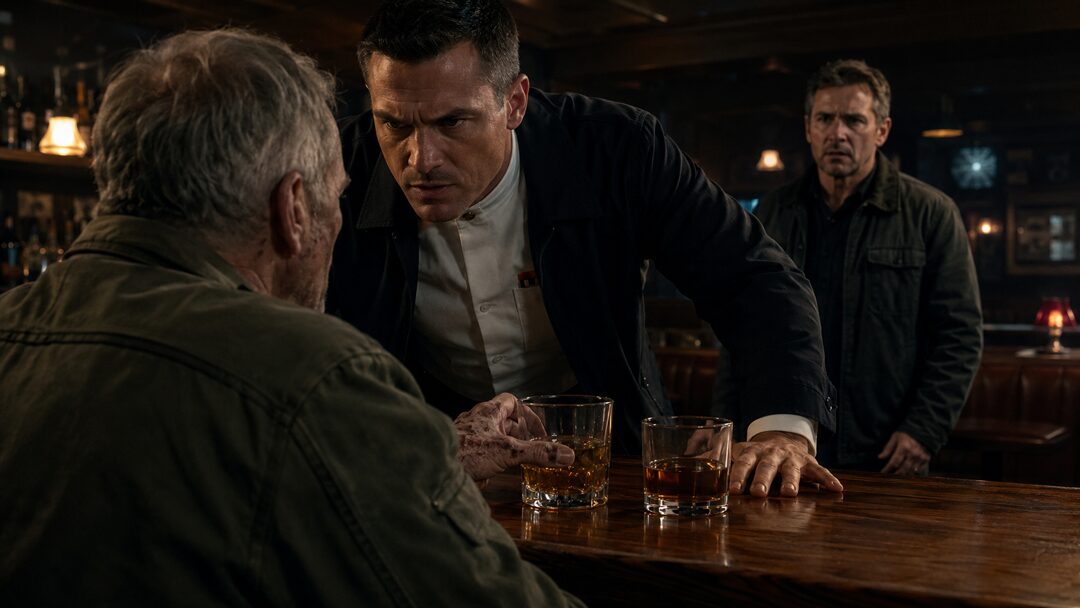
He was sitting alone at the far end of the bar, bent over two whiskey glasses like they were keeping him company. One glass had been touched. The other sat full and clean under the amber light, waiting for a mouth that never came.
Anthony stopped in the doorway.
The ceremony had ended less than an hour ago. He still wore the pressed white shirt from his National Guard dress uniform under a dark jacket. His shoes were too polished for the old wood floor. His jaw still ached from smiling through handshakes, speeches, and strangers telling him his father would have been proud.
Then he saw the man who had not clapped.
At the Memorial Day ceremony, the old man had stood near the back fence in a faded field jacket, hands folded over a cane he barely used. While everyone else applauded Anthony’s speech about duty and sacrifice, the old man had only stared at the flag with a face too tired to admire anything.
That silence had followed Anthony down Main Street.
Now it sat at the bar with two drinks.
Anthony crossed the room.
The place went quieter before he reached the counter. Not silent. Just careful. Pool balls clicked once in the back and did not click again. A spoon stopped inside a coffee cup. Melissa, the bartender, looked up from wiping a glass and went still.
The old man did not turn.
Anthony planted one hand on the counter beside the untouched drink and leaned in close enough for the old man to smell the rain on his jacket.
“Do you always drink for two,” Anthony asked, “or only when there’s an audience?”
The old man’s weathered hand rested near the base of the full glass. His fingers were long, thin, and scarred at the knuckles. He did not pick it up.
He said nothing.
That made Anthony angrier than an answer would have.
“You heard me.”
The old man looked at the reflection of Anthony’s face in the bar mirror, not at Anthony himself. His hair was cut short and gray. His cheeks had hollowed with age. On the left side of his jacket collar, a small unit pin caught the light.
Anthony had seen old men wear those pins like permission slips. Permission to interrupt. Permission to lecture. Permission to look wounded when younger men refused to bow.
Melissa set the glass she had been drying on the shelf with too much care.
“Anthony,” she said softly. “Not tonight.”
He did not look at her.
“Tonight seems perfect.”
The old man finally turned his head. His eyes were pale and steady, not frightened. That irritated Anthony too. The man should have been embarrassed. He should have been defensive. He should have explained why he had stood in the back of the ceremony like every word had offended him.
Instead he looked at Anthony the way a tired doctor might look at a child refusing medicine.
“You should step back,” the old man said.
His voice was low. Not threatening. Worse than threatening.
Certain.
Anthony laughed once, without humor.
“You didn’t step back when the mayor asked everyone to honor the men who didn’t come home.”
The old man’s hand moved half an inch closer to the full glass.
That was all.
Anthony lowered his voice, but not enough to make the conversation private. “You stood there like the whole town owed you an apology.”
The old man looked away again.
Anthony followed his gaze to the mirror. Behind them, in a booth against the wall, a broad-shouldered man in a dark jacket had stopped eating. He was maybe forty-eight, with a hard face softened by exhaustion and one leg stretched carefully beneath the table.
Samuel Grant.
Anthony knew him by sight. Everyone in town did. Owned the garage near the county road. Fixed engines. Donated quietly. Walked with a stiffness nobody asked about.
Samuel was watching the bar like he already knew how this ended.
Anthony turned back to the old man.
“You’ve got something to say, say it.”
The old man said nothing.
And that silence, in front of everyone, felt like disrespect all over again.
Part II — The Man Who Wouldn’t Clap
Anthony had practiced his speech for three weeks.
Not because he liked speeches. He hated them. He hated standing behind a microphone with local officials behind him and folding chairs in front of him. He hated how people softened their voices when they said his father’s name.
But he had agreed because the town asked.
Because his mother still kept his father’s photograph on the mantel.
Because every time Anthony put on the uniform, someone said, “You’re walking in Patrick Miller’s footsteps,” and Anthony had never known how to say that the footsteps felt more like a hallway with no doors.
His father had been a captain. He had died overseas when Anthony was six. There had been a folded flag, a sealed report, a chaplain with kind eyes, and a mother who stopped singing in the kitchen.
That was almost everything Anthony knew.
The rest had been built from other people’s reverence.
So at the ceremony, Anthony had spoken with the clean voice people expected.
He had said sacrifice.
He had said honor.
He had said men like his father gave everything so others could come home.
And then he had seen the old man in the back refusing to clap.
That refusal had entered Anthony like a splinter.
Now, inside the bar, he stared at the same old man and let twenty-five years of swallowed questions sharpen his tongue.
“What was it?” Anthony asked. “Too polished for you? Too public? Not enough suffering in the music?”
Melissa’s face tightened. “That’s enough.”
Anthony turned on her. “Did he tell you why he stood there like that? Or does everyone just let him play mysterious because he’s old?”
The old man’s eyes flicked to Melissa, not pleading. Warning.
She pressed her lips together.
Anthony noticed.
The room knew something.
That realization did not slow him down. It pushed him harder.
He pointed toward the old man’s collar. “You wear the pin. You sit in the veterans’ bar. You let people look at you like you carried the whole country on your back. But when a town honors men who didn’t make it, you can’t even put your hands together?”
The old man looked at him.
For the first time, the old man’s expression changed. Not much. A small tightening around the mouth. A faint drop in the eyes.
Anthony mistook it for guilt.
“Yeah,” he said. “That’s what I thought.”
The old man’s voice stayed even. “You don’t know what you’re talking about.”
“Then educate me.”
“No.”
That single word landed harder than an argument.
Anthony leaned closer. His hand slid along the bar until his knuckles nearly touched the full glass.
“Men like you love silence,” he said. “Makes people fill it in with respect.”
The old man’s jaw shifted.
Anthony saw it and pressed.
“My father didn’t get silence. He got a sealed file. My mother got a flag. I got strangers telling me stories that never had enough details. And then I get to watch you stand in the back of a ceremony like his name bored you.”
The old man’s eyes fixed on him.
Anthony said the name like a challenge.
“Patrick Miller.”
The change was so slight most people would have missed it.
But Anthony was close enough to see the old man’s fingers tighten around the base of the untouched glass.
Close enough to see something old and painful move across his face before he locked it away.
Samuel rose from the booth.
His chair scraped the floor.
Everyone heard it.
Part III — The Room Turns
Samuel took two slow steps toward the bar.
He did not look like a man eager to intervene. He looked like a man walking toward a door he had avoided for years.
“Captain,” he said.
The title was respectful.
The tone was not.
Anthony glanced at him. “This doesn’t concern you.”
Samuel stopped a few feet away. His weight shifted off his bad leg. “It does.”
The old man did not turn around. “Sit down, Samuel.”
Anthony looked between them.
There it was again. That quiet exchange. That hidden room behind the room.
“You know him,” Anthony said.
Samuel did not answer.
Anthony looked at Melissa. “You all know him.”
Melissa’s hands were flat on the bar now. She had that stillness people get when one wrong movement might break something.
“Anthony,” she said, “let it go.”
“Why?”
No one answered.
Anthony laughed again, but this time it came out thin.
“Look at this,” he said, gesturing around the room. “Everybody knows something except the man whose father didn’t come home.”
The old man closed his eyes.
Not for long. Just long enough.
Anthony saw it and felt a brief, ugly satisfaction.
“You didn’t like my speech?” he asked. “Fine. Maybe you were there. Maybe you saw something I didn’t. Or maybe you just don’t like hearing people call sacrifice by its name.”
The old man opened his eyes. “Your father teach you to talk over men before you listen to them?”
Anthony’s face hardened.
“My father died before he could teach me anything.”
The words fell into the bar and stayed there.
The old man’s hand tightened so sharply around the full glass that the ice inside the other one gave a soft crack.
For a second, Anthony thought the old man might finally shout.
Instead he said, “Then don’t use him to excuse it.”
The room changed.
Anthony felt it before he understood it. The sympathy he had assumed would be there was gone. No one looked at the old man like he had been beaten. They looked at Anthony like he had stepped somewhere sacred without seeing the ground.
His skin went hot beneath his collar.
He could have stopped.
He knew that later.
At that moment, stopping felt like falling.
“You don’t get to talk about my father,” Anthony said.
The old man looked directly at him. “You brought him here.”
“No. You did.” Anthony pointed at the untouched drink. “With this little performance.”
Melissa inhaled.
Samuel took another step. “Captain—”
Anthony turned on him. “If everyone in this room knows what this is, somebody say it.”
Samuel looked at the old man.
The old man gave him nothing.
No nod. No permission. No rescue.
Samuel’s mouth closed.
Anthony smiled, but there was no triumph in it. “That’s what I thought.”
Then the old man moved.
Not quickly. Not dramatically.
He lifted the untouched glass with both hands, held it for one second in front of him, and set it down closer to Anthony.
The bottom of the glass made a soft wooden knock.
“That one,” he said, “was never mine.”
Anthony stared at the drink.
The room seemed to pull back from the bar.
“What does that mean?”
The old man’s eyes did not leave him.
“It means your father was not alone.”
Anthony’s breath stopped.
The words struck so cleanly that, for a moment, anger had nowhere to go.
Then it found the only path left.
“You don’t know that.”
The old man looked older suddenly. Not weaker. Just worn down by the weight of being believed too late.
“Yes,” he said. “I do.”
Part IV — The Name Inside the Silence
Anthony did not move away.
He should have. His hand was still on the bar. His body was still angled over the old man. His polished shoes were still planted wide like he had come to win.
But the room had tilted.
“You knew my father?” he asked.
The old man took a long breath through his nose.
Melissa looked toward the door, as if hoping no one new would walk in and make this even more public.
Samuel stood frozen beside them.
“I was attached to his unit,” the old man said. “Medic.”
Anthony searched his face for fraud. “You expect me to believe that because you say so?”
“No.”
“Good.”
“I expect you not to make it easier by hating me first.”
That line hit Anthony in a place he did not want anyone to see.
He straightened halfway, then stopped. Retreat still felt like surrender.
“My father died during an evacuation,” he said. “Classified mission. That’s all they’d tell us.”
The old man nodded once.
“Then tell me something that isn’t on a plaque.”
The old man looked at the full glass.
For the first time, his restraint looked less like pride and more like a door held shut with both hands.
“It was a field station,” he said. “Not much of one. Concrete walls. Bad wiring. Too many people in too little space. We were told the ceasefire would hold through morning.”
Samuel’s face tightened.
The old man continued, his voice low enough that the room had to listen carefully.
“It didn’t.”
Anthony swallowed. He had imagined his father’s death a thousand ways. Always clean. Always brave. Always something with meaning arranged around it like a frame.
The old man gave him no frame.
“Your father got people out,” he said. “Then he heard there were still three inside. An interpreter and two younger men. One of them was Samuel.”
Anthony’s eyes moved to Samuel.
Samuel did not look away.
“You?” Anthony asked.
Samuel nodded once.
His face had gone gray.
“My radio was gone,” Samuel said. “Leg pinned. I don’t remember all of it.”
The old man said, “Patrick went back.”
Anthony flinched at the first name.
Not Captain Miller.
Not your father.
Patrick.
An ordinary name in the old man’s mouth.
Anthony hated him for having it there.
“He ordered everyone else out,” the old man said. “Then disobeyed his own order.”
“That sounds like him?” Anthony asked, bitter. “You knew him well enough for that?”
The old man looked up.
“Your father had a habit of making jokes when everybody else was deciding whether to be afraid. Bad jokes. Usually about cards. Or coffee. Once about a goat that stole his boot.”
A strange pain opened in Anthony’s chest.
No one had ever given him that.
Not a medal. Not a flag. Not a speech.
A bad joke about a goat.
He gripped the edge of the bar.
The old man noticed and stopped.
Anthony snapped, “Keep going.”
The old man’s gaze hardened. “Don’t give me orders in this.”
That was the first time real steel entered his voice.
Anthony stared at him.
The old man stared back.
And for the first time all night, Anthony was the one who looked away.
Part V — The Coin
The old man reached toward his jacket pocket, then stopped.
His fingers stayed there, pressed against the fabric.
Anthony noticed the motion now. He had seen it earlier and dismissed it as nerves.
It was not nerves.
It was a man standing with his hand on a locked drawer.
“You waited all these years?” Anthony asked. “You sat here with a drink and a story and never thought my mother deserved to hear it?”
The old man’s face folded inward.
There was no defense in it.
“I went to your house once.”
Anthony’s mouth went dry.
“When?”
“First winter after we came back.” The old man looked at the bar instead of him. “I got as far as the porch. Your mother opened the door before I knocked. You were behind her with one sock on and one in your hand.”
Anthony remembered none of this.
The old man did.
“She looked like she had been awake for a month,” he said. “I had your father’s words in my mouth. And I thought giving them to her would be mercy.”
He stopped.
“What happened?” Anthony asked, though he already knew.
“I left.”
The answer was plain. No excuse around it.
Anthony’s anger returned, but changed shape.
“You left?”
“Yes.”
“You could carry men out of a collapsed building, but you couldn’t knock on a door?”
The old man took that without blinking.
“No,” he said. “I couldn’t.”
That honesty was harder to hit than denial.
Anthony stepped back half an inch, then hated himself for giving ground.
“My mother spent years wondering if he called for us,” he said. “If he suffered. If he knew he was leaving us. Do you understand what that did to her?”
“I do.”
“No, you don’t.”
The old man nodded slightly. “Maybe not.”
Samuel spoke then.
“I should have gone too.”
Anthony turned toward him.
Samuel’s hands hung at his sides, heavy and useless.
“He came back for me,” Samuel said. “Your father. So did Frank. I knew your name because Patrick kept a picture folded in his notebook. You were missing a front tooth.”
Anthony’s throat tightened.
Samuel’s voice broke, but he did not stop.
“I come here every year. Same night. I sit over there. I tell myself being in the room is enough.”
He looked at the old man.
“It wasn’t.”
Melissa wiped at the same clean spot on the bar once, then stopped pretending.
The old man reached into his pocket.
This time he did not stop.
He took out a small coin and laid it on the bar between the two glasses.
It was dark with age, its ridged edge worn unevenly. One side bore an old unit insignia. Along the rim, a rough mark cut through the metal like something hot had kissed it and moved on.
Anthony knew that coin.
He had seen it in a photograph on his mother’s dresser. His father, younger than Anthony was now, holding it between two fingers with a grin that looked almost embarrassed.
Anthony stared at it until the bar blurred.
The old man pushed it toward him.
“He gave it to me on the medevac,” he said. “I’d lost mine two days before. He said no medic should be allowed to gamble with empty pockets.”
Anthony did not touch it.
He could not.
The old man’s voice grew quieter.
“He was conscious. Not all the way. Enough.”
Anthony’s anger had nowhere left to stand.
“What did he say?”
The old man looked at the untouched glass.
“He said, ‘Tell my boy not to let this make him hard.’”
Anthony’s face changed.
The room saw it.
He hated that they saw it.
“He said that?”
The old man nodded.
“Not brave?” Anthony asked. “Not proud? Not serve well?”
“No.”
Anthony’s voice dropped. “That’s what everyone said he would have wanted.”
“I know.”
“He didn’t?”
The old man looked at him with the terrible gentleness of someone who had carried the answer too long.
“He wanted you whole.”
Something in Anthony gave way.
Not loudly.
No chair overturned. No glass broke. No dramatic apology came rushing out of him.
His shoulders simply lost the shape they had been holding for years.
He looked at the coin. Then at the full glass. Then at the old man’s scarred hand beside it.
All his life, he had tried to become evidence that his father’s death had meant something.
Now a stranger had handed him a different command.
Not from the country.
Not from a podium.
From a dying man who had still remembered a boy with one missing tooth.
Anthony reached for the stool beside the old man.
He sat down.
Part VI — What He Sounded Like
No one spoke for a while.
The bar sounds returned slowly, but softer than before. A refrigerator hummed. Rain tapped the front window. Somewhere in the back, ice shifted in a bin.
Anthony sat beside the old man instead of over him.
That changed everything.
The coin remained on the bar. Anthony finally touched it with two fingers, not lifting it, just confirming that it was real. The metal was cool. The damaged edge caught lightly against his skin.
“I thought he was abandoned,” Anthony said.
The old man looked down.
“He wasn’t.”
“You were there.”
“Yes.”
“And you kept him from us.”
The old man accepted that too.
“Yes.”
The word should have made Anthony angry again.
It did.
But now the anger had grief inside it, and grief made it less clean.
Melissa moved behind the bar. She took a fresh glass from the shelf, set it down beside the other two, and poured without asking anyone.
No one thanked her.
No one needed to.
Samuel pulled out the stool on the other side of Anthony. He hesitated, as if even now he was waiting for permission.
This time the old man gave it.
Not with words.
He moved his elbow an inch, making room.
Samuel sat.
His face carried the relief of a man who had finally stopped standing at the edge of his own life.
Anthony looked at the three glasses.
One for the man who carried the story.
One for the man who never came home.
One for the man who had been saved and had not known how to live beside the saving.
Then there was Anthony, with his hand on the coin, understanding that inheritance could be a burden even when it was made of love.
He looked at the old man.
There were a hundred questions he could have asked. How long did he suffer? Was he afraid? Did he say my mother’s name? Did he know I loved him, though I had been too young to understand what love would cost?
But the first question came out smaller.
More human.
“Tell me what he sounded like.”
The old man closed his eyes.
For a moment Anthony thought he had asked too much.
Then the old man opened them again.
“He laughed too quietly when he was scared,” he said.
Anthony breathed in like someone had opened a window in a room he had lived in for years.
The old man continued, not as a speech, not as a confession, but carefully, one piece at a time.
“He hated powdered eggs. Said they were an insult to chickens. He folded letters twice before putting them away, even if they were already folded. He checked on the youngest men when he thought nobody noticed.”
Samuel gave a broken little smile. “He cheated at cards.”
The old man glanced at him. “Badly.”
Samuel nodded. “Still took my money.”
The corner of Anthony’s mouth moved before he could stop it.
It was not happiness.
It was something stranger.
The first shape of his father that did not belong to a ceremony.
Melissa leaned on the back counter, watching them with wet eyes she would deny later.
Anthony looked down at the untouched glass.
It was still full.
Waiting had not made it sacred. Waiting had made it heavy.
He wrapped his hand around it.
The old man did not tell him to drink.
Samuel did not tell him not to.
Melissa did not look away.
Anthony held the glass for a long moment, then set it back down exactly where it had been.
Not rejected.
Not claimed.
Just there.
The old man understood.
Some things could not be swallowed the first night they were offered.
Anthony slid the coin closer to himself, but not into his pocket.
“Keep talking,” he said.
The old man’s hand trembled once near his own glass.
Then it steadied.
“Your father,” he began, and stopped to clear his throat. “Patrick used to say the worst coffee in the world was still better than no coffee, which tells you he had no standards.”
Samuel laughed once, quietly.
Anthony looked at the old man beside him, at the witness on his other side, at the bartender who had turned a private ritual into a table with room.
Outside, the rain kept falling on the town that had spent years calling his father brave because brave was easier than known.
Inside, the old man spoke.
And for the first time in Anthony’s life, his father began arriving as a person instead of a symbol.
The glass waited between them.
This time, it was not waiting alone.