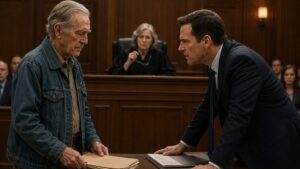
The Young Instructor Mocked Frank’s Old Rifle Case Until The Desert Target Came Back Silent
Chapter 1: The Old Rifle Case At Lane Seven
The first thing Eric Allen noticed was the case.
Not the man carrying it, not at first. The case came through the gate before the old man did, long and narrow and made of wood darkened by years of oil, sun, and handling. One brass latch hung a little crooked. The handle had been wrapped in old leather, cracked along the edges where fingers had worried it smooth. It looked out of place among the hard plastic rifle boxes, wheeled gear carts, carbon-fiber rests, and black nylon range bags lined up beneath the shade canopies.
Then Frank King stepped through after it.
He moved slowly, but not uncertainly. His boots found the packed desert dirt without dragging. His faded cap sat low over pale eyes that took in the firing line, the wind flags, the target berms, and the rows of young trainees in tan shirts waiting beside their rifles. He wore a brown jacket despite the heat, buttoned only at the middle, and under one arm he carried a folded invitation card softened at the corners.
The desert range stretched wide and bright under the morning sun. Far beyond the firing line, targets stood white against red dust. Heat shimmered above the ground. Someone had set up folding tables for the charity event: donation jars, water coolers, registration sheets, laminated safety rules, and a small memorial display with a framed photograph turned slightly away from where Frank stood.
Frank paused when he saw it.
Only for a second.
Then he adjusted his grip on the wooden case and kept walking.
A range staff member at the table glanced up. “Morning, sir. Participant check-in?”
Frank laid the card flat with two fingers.
The staff member read it, looked once at Frank, then at the case. “You’re here for the memorial qualification?”
Frank nodded.
Before the staff member could speak again, a sharper voice cut across the table.
“Hold on.”
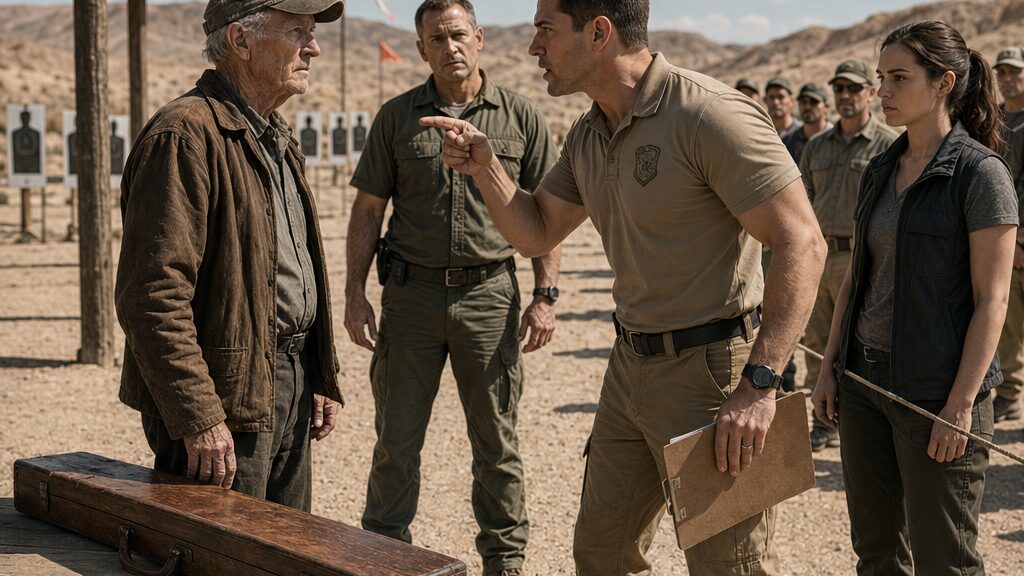
Eric Allen came from the firing line with a clipboard tucked under one arm and mirrored sunglasses pushed onto his head. He was young enough to still look polished by effort, all squared shoulders and clean lines, his range uniform pressed, his instructor badge catching the sun. He had the walk of a man used to being watched.
His eyes went straight to Frank’s hands.
They were old hands. Knuckled, veined, scarred in thin white lines. One thumb trembled slightly where it rested against the case latch.
Eric’s expression tightened into something that was almost concern and almost annoyance.
“Sir,” he said, “this is an active training range today. Spectators are behind the yellow rope.”
Frank looked at the yellow rope. Then at the invitation card.
“I was invited,” he said.
His voice was low, dry from the desert air.
Eric took the card from the table before the staff member could return it. He read the printed name, then the event title, then the signature at the bottom. His mouth curved, not quite into a smile.
“Frank King,” he said, loud enough that the nearest trainees turned their heads. “You’re shooting?”
Frank held out his hand for the card.
Eric did not return it immediately. “We’ve got a safety briefing, equipment check, basic qualification, and then the charity match. This isn’t a county fair booth.”
“I know what a range is,” Frank said.
A few trainees looked down. Someone coughed softly.
Eric glanced at the wooden case. “What’s in there?”
“A rifle.”
“That part I guessed.”
Frank said nothing.
The silence seemed to irritate Eric more than an argument would have. He shifted his weight, looked back toward the firing line, then toward Patricia Thomas, the charity coordinator, who was moving between tables with a headset and a stack of forms. She saw the delay and approached with a worried crease between her brows.
“Everything all right?” she asked.
Eric held up the invitation card. “Participant says he’s here for the memorial qualification.”
Patricia looked at Frank with professional kindness, then at the case with less confidence. “Mr. King, we’re grateful you came. Truly. But today’s schedule is a little more demanding than some people expected. There’s a lot of walking, controlled firing positions, timed commands.”
“I read the card,” Frank said.
Eric gave a short laugh through his nose. “The card doesn’t show wind, recoil, or heat stress.”
Frank’s thumb moved once along the leather handle.
The young instructor stepped closer. Not close enough to touch, but close enough that his shadow crossed the case.
“I’m responsible for everyone on this line,” Eric said. “If you’re not steady, if your equipment is questionable, if you can’t follow commands, I pull you. No exceptions.”
Frank looked past him to the range.
A wind flag twitched near the hundred-yard mark, then sagged. The one beyond it moved a breath later.
“I follow commands,” Frank said.
Eric studied him. The old jacket. The faded cap. The wooden case. The slight tremor in the hand.
“You shoot recently?”
Frank did not answer right away.
“Recently enough,” he said.
That brought the first real smile to Eric’s face. It was not a kind one. It was the smile of a man who thought the day had handed him a problem and an audience at the same time.
“Recently enough,” Eric repeated. “That’s not a qualification standard.”
The trainees were watching openly now. Some were young soldiers. Some were civilian guests paired with range staff. A few older veterans sat beneath the canopy with coffee cups and event badges. Nobody spoke. The morning had found its first entertainment.
Frank took the invitation card from Eric’s hand. He folded it once along its old crease and placed it inside his jacket pocket.
“If you need me checked,” Frank said, “check me.”
Eric blinked, as if the calm answer had stolen the line he meant to use next.
“All right,” he said. “We’ll check you.”
He turned and pointed toward the far end of the firing line, where the shade grew thin and the desert wind cut across the lane at an angle. Most of the firing positions were already assigned. Lane Seven sat slightly apart, near the edge where dust gathered against the sandbags.
“Lane Seven,” Eric said. “You can set your antique down there.”
Patricia’s face flickered. “Eric—”
“It’s open,” he said. “And I want space around him until I see that rifle cleared and safe.”
Frank followed the line of Eric’s finger.
Lane Seven.
The hardest lane on the range, not because of distance, but because the wind curled there after striking the low berm. Anyone who had watched the flags for more than a minute would have seen it.
Frank did not object.
He lifted the wooden case, feeling the old leather settle into his palm, and began walking toward the far lane while the young trainees parted without quite knowing why.
Behind him, Eric’s voice carried.
“Everybody keep eyes open. We’re going to make sure granddad here doesn’t turn charity day into paperwork.”
A few people laughed.
Frank kept walking.
The case knocked softly against his leg with each step, steady as a metronome. At Lane Seven, he set it on the bench, aligned it parallel with the firing line, and rested both hands on top of it. For a moment he did not open it.
He looked out over the desert, past the white targets and the flags moving at different times, past the heat shimmer and the red berm, as if listening for something no one else had noticed.
Then he took one slow breath.
The latch clicked beneath his thumb.
Chapter 2: The Wind Moved Before The Flag Did
Emily Roberts had been trying not to stare at the old man since he walked onto the range, but Lane Seven made that impossible.
Everyone knew Lane Seven was bad. The instructors had joked about it before the briefing, saying it was where good scores went to die. The wind there never did what the first flag promised. It slid low along the berm, crossed left, curled back right, and embarrassed anyone who trusted only the flag closest to the firing line.
Eric had assigned it to the old man with the wooden case.
That bothered Emily more than she wanted it to.
She stood two lanes down with a borrowed rifle resting on the bench in front of her, bolt open, chamber flag visible, hands folded behind her back the way Eric had told them. She was new enough to the range to follow every command exactly and nervous enough to hear every mistake before it happened.
The old man did not look nervous.
Frank King opened the case slowly. Inside, the rifle rested in worn cloth cut to fit it. It was plain, older than every rifle on the line, with blued metal dulled by use and wood polished where hands had held it for decades. There was nothing flashy about it. No oversized optic, no bright aftermarket parts, no expensive competition stock.
Eric walked over with two assistants and made a show of checking it.
“Action open,” Eric said.
Frank opened it before the words finished.
“Chamber clear.”
Frank angled the rifle without pointing it anywhere but downrange and slightly toward the bench, letting Eric see.
“Muzzle discipline,” Eric said, like he expected to catch him.
Frank’s muzzle never wandered.
Emily watched Eric’s face change in tiny increments. The young instructor wanted irritation to become evidence. He wanted the old man to fumble. But Frank moved with slow, exact care, each motion completed before the next began. His hands looked shaky only when they were empty. On the rifle, they seemed to remember where to go.
The safety briefing began under the canopy.
Eric paced in front of the trainees with his clipboard. He spoke well. Emily had to admit that. His voice carried. His rules were clear. His confidence made people stand straighter.
“Safety is not tradition,” Eric said. “Safety is procedure. You don’t get credit for what you used to know. You follow today’s commands, today’s standards, on my range.”
His eyes passed over Frank at the edge of the group.
Frank looked at the ground near Eric’s boots, not in submission, but attention. Emily wondered if he was listening to the speech or to the wind tapping loose paper against the registration table.
The first relay prepared to fire. Emily was in the second, so she stood back with the others while Eric moved quickly from lane to lane, adjusting elbows, correcting cheek welds, reminding nervous shooters not to crowd the scope.
At Lane Four, one of the younger trainees mishandled a magazine during dry preparation. It slipped from his fingers, hit the bench, and startled him. His support hand twitched toward the rifle before Eric saw it.
Frank saw it first.
“Leave it,” Frank said.
His voice was quiet, but it landed.
The trainee froze.
Eric turned sharply. “I give the commands here.”
Frank kept his eyes on the rifle. “His hand was moving before his head was.”
The trainee looked pale. His fingers hovered inches from the bench.
Eric strode over, anger already forming, then stopped when he saw the angle. The rifle was still safe, bolt open, but the young man had been reaching across the muzzle line in confusion. Not dangerous yet. Close enough to matter.
Eric’s jaw tightened.
“Hands back,” he ordered.
The trainee obeyed.
Frank said nothing else.
Emily felt something shift among the people watching. Not admiration. Not yet. More like discomfort. The old man had noticed what the instructor missed, and he had done it without raising his voice.
Eric recovered quickly. “That’s why we don’t move without command,” he said, making the lesson his again. “Everyone clear?”
“Yes, sir,” several trainees answered.
Frank stepped back into silence.
Emily’s relay came next. The sun had climbed higher, sharpening every edge of the range. Dust stuck to sweat at the back of her neck. She took her position and tried to remember everything at once: feet, hips, shoulder, cheek, breathing, trigger.
Eric came behind her.
“Too stiff,” he said. “You’re fighting the rifle.”
She swallowed. “Yes, sir.”
“Don’t muscle it. Control it.”
She tried to adjust and only felt more awkward.
From Lane Seven, Frank’s voice came softly. Not directed at her, exactly. Almost to himself.
“Let the breath settle first.”
Emily turned her eyes, not her head.
Frank stood behind his bench with his rifle still untouched. His right hand rested lightly on the closed bolt. He was watching the far flags.
Eric heard him too. “Mr. King, I don’t need guest instruction.”
Frank nodded once.
Emily looked downrange. The closer wind flag hung loose. The far one stirred. A strip of dust lifted near the left berm before either flag showed much of anything.
“The wind moved before the flag did,” she whispered.
Frank’s eyes flicked toward her.
“For low ground,” he said, so quietly she almost missed it, “watch dust before cloth.”
Eric stepped between them. “Eyes forward.”
Emily faced downrange again, heat burning her cheeks. She expected Frank to look offended, but he only inhaled slowly and let the air out through his nose.
The line fired under command.
Emily’s first shot landed low. Her second pulled right. Her third felt better but still wrong. Eric corrected her quickly, sharply, and moved on. She tried not to feel embarrassed.
When the relay ended and the rifles were cleared, Frank passed behind her on his way to the water table.
“You were holding your breath too early,” he said.
Emily looked up, startled.
He picked up a paper cup, filled it halfway, and held it with both hands.
“Breath is not something you trap,” he said. “It’s something you let finish.”
Then he walked away.
Emily stood there with the advice turning over in her mind. It did not sound like a trick. It sounded like something learned the hard way and kept because it still worked.
A vehicle rolled in through the side gate, tires crunching over gravel. Conversation thinned as a senior officer stepped out, removing his sunglasses as he looked across the range.
Charles Moore had a face the sun had worked on for years and the posture of a man who never needed to hurry to be obeyed. Patricia went to meet him, speaking quickly. Eric straightened when he saw him.
Charles listened, nodded, then scanned the firing line.
His gaze stopped at Lane Seven.
Frank stood beside the old wooden case, cap low, jacket moving lightly in the desert wind.
Patricia said something Emily could not hear.
Charles did not answer.
He stared at the name tag clipped to the lane marker.
Frank King.
The color seemed to leave his face slowly, not from fear, but recognition.
Chapter 3: The Instructor Laughed At His Hands
Frank knew the exact moment Charles Moore recognized him.
It was in the way the senior officer stopped trying to look like he was only observing. His shoulders changed first. Then his eyes. Men who had once been students always showed it the same way when memory caught them unprepared. They became younger for half a second and hated being seen that way.
Frank looked away first.
He had not come for that.
The sun sat high now, flattening shadows beneath the benches. The charity event had moved from basic qualification into demonstration relays. Spectators drifted closer to the rope line. Veterans sat beneath shade, talking in low voices. Trainees compared targets, some proud, some embarrassed, all pretending not to watch Lane Seven.
Eric watched it most of all.
Frank could feel the young instructor’s impatience from twenty feet away. Eric had expected an unsafe old man, then a confused one, then perhaps a stubborn one. Frank had given him nothing solid enough to push against. That made men like Eric search harder.
Charles approached Lane Seven with Patricia beside him.
“Mr. King,” Charles said.
Frank turned.
For one dangerous second, Charles almost saluted. Frank saw the beginning of it in the fingers, the old reflex. Then Charles caught himself and offered his hand instead.
Frank shook it.
“Charles,” he said.
Eric looked between them. “You two know each other?”
Charles held Frank’s hand a second too long. “A long time ago.”
“That right?” Eric said.
Frank released Charles’s hand. “He was better at listening than most.”
The corner of Charles’s mouth moved, then settled. “Not at first.”
Eric gave a laugh that came out too loud. “Well, today we’re all listening to current range command.”
The words hung there.
Charles looked at him. Not sharply. That would have been easier. He looked at Eric as if weighing how much embarrassment a younger man could survive before it became cruelty.
Eric mistook the silence for permission.
“All right,” he called out, clapping his hands once. “We’re going to run a controlled challenge for the crowd. Nothing fancy. Three-round group, one hundred yards, seated or kneeling, shooter’s choice. This is about fundamentals.”
Several trainees turned toward the firing line. The charity spectators leaned in.
Eric looked at Frank. “Mr. King, since you were invited to qualify, let’s see where you are.”
Patricia’s expression tightened. “Eric, maybe the match list—”
“He said check him,” Eric said. “I’m checking him.”
Frank rested one palm on the wooden case.
Eric stepped closer, lowering his voice just enough to pretend it was private and raising it enough for people nearby to hear.
“I’m going to be clear,” he said. “I don’t care who you knew twenty years ago. I don’t care what stories people tell. Those hands shake. That rifle belongs in a display case. If you can’t keep up, there’s no shame in stepping back.”
Frank looked at his hands.
They did shake a little. Empty, they always did now. The right one more than the left in the morning, the left more when he was tired. Age had its own weather. No point denying it.
Eric glanced at the trainees. “See, this is what I mean. Pride gets people hurt.”
Frank lifted his eyes.
“The first rule,” he said, “is respect.”
Eric’s jaw flexed. “The first rule is safety.”
Frank nodded. “That too.”
Someone at the rope line gave a small laugh. Eric smiled, encouraged by it.
“All right, then. Show us safety.”
Frank opened the wooden case.
The cloth inside smelled faintly of oil and cedar. He took the rifle out with both hands, muzzle kept downrange, bolt open. The movement quieted the people nearest him, not because it was dramatic, but because it was exact. The old rifle looked plain under the hard sun. Its stock bore scratches that had darkened over time. Near the butt, almost hidden by wear, three small initials had been carved and sanded nearly smooth.
Frank checked the chamber though he knew it was clear. He checked the magazine well. He touched the safety. He studied the bench, the lane, the ground, the flag near the target, the dust at the berm.
Eric folded his arms. “You need help getting into position?”
Frank did not answer.
He lowered himself carefully.
One knee touched the mat. Then the other foot adjusted. It took time. Too much time for the impatient. His jacket pulled tight at one shoulder. A murmur moved through the trainees as his hand trembled against the mat.
Eric leaned slightly toward them. “This is why we don’t romanticize old methods.”
Frank settled the rifle into position.
The tremor left.
It did not vanish all at once. It drained away as his body found the old architecture: bone under weight, breath under sight, finger resting where pressure became decision. His cheek touched the stock. His left elbow set. His right hand closed around the grip with the gentleness of someone holding a bird that trusted him.
The range changed.
Not visibly. Not in any way a camera would catch at first. But the sound thinned. The wind seemed louder because no one spoke over it.
Eric looked downrange. “Wind is quartering left. Hold center. At this distance it won’t matter much.”
Frank stayed behind the rifle.
“Not left,” he said.
Eric’s head snapped toward him. “Excuse me?”
Frank watched dust curl low along the berm. “It is touching left here. Right at the target.”
Eric laughed once. “The flag says otherwise.”
“The flag is late.”
That did it. The trainees heard. The veterans heard. Patricia closed her eyes briefly as if wishing the sentence could be taken back.
Eric stepped into the space behind Frank. “You want to correct my wind call in front of my line?”
Frank’s finger rested straight along the receiver, outside the trigger guard.
“No,” he said. “I want the bullet to land where I send it.”
Charles looked at the far berm. His mouth went still.
Eric backed away and raised his voice. “Fine. Shooter on Lane Seven. Three-round group. One hundred yards. On command.”
Frank lifted his head slightly. “One.”
Eric paused. “What?”
“One round.”
“That’s not the drill.”
“It will answer your question.”
The crowd seemed to lean without moving.
Eric looked at Charles, expecting intervention. Charles said nothing.
Frank returned his cheek to the stock.
The old rifle rested into him. The target downrange blurred, cleared, blurred again in the shimmer. He did not chase it. He let it come back. Breath entered. Breath left. The world narrowed until there was no Eric, no crowd, no charity banner snapping behind the tables. Only dust, distance, weight, and the small white center waiting without opinion.
“Shooter ready?” Eric called.
Frank did not speak.
His breath finished.
“Fire.”
The shot cracked once across the desert.
No flourish. No drama. No echo worth remembering. Just one clean report and the smell of powder crossing the bench.
Frank opened the bolt, cleared the rifle, and set it safely on the mat before lifting his head.
Eric exhaled through a smile, already preparing the next line. “Well, one shot doesn’t make a group.”
Charles raised his hand.
“Hold the target,” he called toward the target station.
The staff member halfway downrange stopped.
Eric turned. “Sir?”
Charles did not look at him. His eyes remained on Frank, who was slowly getting one foot beneath him again.
“I said hold the target,” Charles repeated.
The range went quiet enough that the old wooden case could be heard when Frank closed its brass latch.
Chapter 4: The Target Nobody Wanted To Explain
Charles Moore had spent enough years on firing lines to know when silence meant respect and when it meant confusion.
This silence was neither.
It had weight in it.
The target runner stood halfway between the berm and the covered station, one hand on the frame, looking back toward the line as if he had misunderstood the order. Charles raised his hand again, palm flat.
“Bring it in slow,” he called.
Eric’s face had gone tight around the mouth. “Sir, with respect, it’s one round. There’s nothing to explain yet.”
Charles kept his eyes downrange. “Then explaining it should be easy.”
Frank had already cleared the rifle and closed the old wooden case. He stood with both hands resting on the handle, not looking toward the target, not looking toward Eric, not looking at the trainees who had begun shifting for better sight lines. If he felt the crowd gathering around the moment, he did not show it.
That was what unsettled Charles most.
Decades ago, Frank King had taught young soldiers to let pressure pass through them instead of letting it move the rifle. Charles had been twenty-two then, too proud of his speed and too impatient with correction. Frank had never raised his voice. He had only taken Charles’s target, held it up against the light, and tapped the paper where every mistake had already confessed.
The target will tell you, he had said.
Charles had not heard that voice in more than thirty years. Now here it was, dry with age but unchanged where it mattered.
The runner brought the target frame to the station table. The paper faced away from the crowd at first. Eric reached for it before anyone else could.
Charles stopped him with one word.
“Wait.”
The range staff member set the frame upright.
The white paper showed a clean black center and, just off the exact middle where Frank had corrected for the wind, one small hole.
Only one.
Eric’s shoulders loosened. “There. Clean hit. Good shot. Nobody’s saying he can’t hit paper.”
Charles moved closer.
The staff member beside him frowned. “Sir.”
Charles saw it too.
The paper was not new.
Not exactly.
This target had been used earlier in the demonstration. Three prior holes, patched with small black adhesive dots, sat beneath the fresh face. The shot Frank had fired had not simply landed in the center. It had cut through the edge of one of those old patches so perfectly that the fresh tear widened it into a single ragged mark. A shot placed into a repaired hole, after a wind correction Eric had dismissed.
At one hundred yards, with one round, from Lane Seven.
Charles touched the paper, not the hole. He felt heat rise along the back of his neck.
Eric leaned in. “What?”
The staff member turned the target slightly. “It went through an existing patch.”
“So?”
Charles looked at him.
Eric’s confidence faltered under the attention. “That could happen.”
“It could,” Charles said.
Frank stood a few paces away, as if the matter belonged to someone else.
Eric seized on the softness in Charles’s answer. “Exactly. It could happen. One lucky shot through a patched target doesn’t mean we stop the program and act like—”
“Eric,” Patricia said quietly.
But he was already speaking to the trainees, to the spectators, to the version of himself that could not allow the morning to tilt away from him.
“Listen, good fundamentals matter. He made a good shot. Fine. But I’m not going to let people turn this into some legend because an old rifle got lucky on a patched paper.”
Frank’s right hand trembled on the case handle.
Charles saw Emily Roberts watching that hand with a look different from the others. She did not seem entertained. She seemed as if she had noticed the tremor and the stillness after it, and could not make them belong to the same man.
Charles turned to Frank. “Would you like to fire the rest of the group?”
Frank shook his head.
Eric’s laugh came back, thinner now. “There it is.”
Frank looked at him without anger. “I came to qualify, not perform.”
“You challenged my wind call.”
“I corrected my shot.”
“You made one shot.”
Frank nodded. “Yes.”
Eric threw one hand toward the target. “And now everybody’s supposed to stand around whispering because it touched an old patch?”
Charles felt the old irritation rise, but he held it. He could not win this for Frank. That would cheapen what the old man had refused to cheapen himself.
So Charles did what Frank had taught him once.
He let the evidence stay visible.
“Post the target,” he said.
Eric turned. “Sir?”
“On the board beside the relay scores. Mark it Lane Seven. One round.”
Patricia glanced between them, then nodded to the staff member. “Do it.”
The staff member took the target toward the result board. People moved aside as it passed. Some leaned close. A veteran spectator lifted his glasses to study it. A trainee whispered, “That was from the far lane?”
Eric heard. His face reddened.
The day resumed, but not in the same shape.
Charles watched Eric run the next relay. The young man’s commands remained crisp, but his timing was off. He corrected too quickly. He glanced toward Lane Seven too often. Twice, he almost interrupted a shooter who had done nothing wrong.
Frank stood apart beneath the edge of the canopy, drinking water from a paper cup. He had not accepted praise. He had not defended the shot. He had not even asked to see the target.
Charles went to him after the relay ended.
“You still dislike attention,” Charles said.
Frank looked toward the result board. “Attention makes men hurry.”
Charles smiled faintly. “You used to say that.”
“I used to say a lot of things.”
“You were right about most of them.”
Frank’s eyes stayed on the range. “That depends who was listening.”
The answer struck closer than Charles expected. He looked away first.
“You remember me?” he asked.
Frank turned the paper cup between his hands. “You pulled low and right when you got angry.”
Charles let out a small breath. “That was a long time ago.”
“You still plant your left heel when you’re holding back words.”
Charles looked down at his boots despite himself.
Frank’s mouth moved, not quite a smile.
For a moment Charles was twenty-two again, sunburned and furious, standing beside a target that proved his pride had outrun his skill. He had hated Frank King that day for being right. Later, he had built half his career on the lesson.
Patricia approached before he could say more. “Charles, we need the memorial match roster finalized. Donors are asking when the long-range demonstration starts.”
“I’ll be there,” Charles said.
She lowered her voice. “Is he safe to continue?”
Frank answered before Charles could.
“If I am not,” he said, “I will step off the line.”
Patricia looked at him, then at Charles. Her concern had softened into uncertainty. “Mr. King, I didn’t mean—”
“I know what you meant.”
There was no bitterness in it. That made it harder for her to meet his eyes.
Eric came from the firing line carrying his clipboard like a shield. “Final charity match has twelve slots. I assume Mr. King isn’t entering.”
Frank folded his empty cup once, then again. “I have no need to.”
“Good,” Eric said too quickly.
Charles watched the young instructor’s relief and knew pride when he saw it gasping for air.
“The invitation card includes qualification,” Charles said. “It also includes eligibility for the charity match.”
Eric’s head turned. “Sir, with his age and equipment, putting him in the long-distance stage is unnecessary.”
Frank placed the folded cup into the trash. “Unnecessary is not the same as unsafe.”
Eric’s jaw worked.
Patricia touched the edge of her roster. “We don’t have to decide this second.”
“No,” Charles said. “But we do need his registration verified.”
He walked toward the range office with the invitation card Frank had handed him for confirmation. Inside, the air smelled of dust, printer toner, and old gun oil soaked into wood. A metal filing cabinet stood beneath framed photographs of past instructors, charity events, and range founders.
Charles searched the digital roster first. Frank King’s name had been typed in from the invitation list only that morning. No age listed. No credentials. No note except Guest of Memorial Family.
Then Charles opened the archive binder used for old instructor numbers, mostly ceremonial now.
He did not expect to find the name quickly.
He did.
King, Frank.
Instructor No. 017.
Charles stared at the line beneath it.
Senior Marksmanship Instructor. Foundational Safety Curriculum Contributor. Wind Reading Course, original author.
Behind him, the office door creaked.
Eric stood in the doorway, seeing enough of Charles’s face to know something had changed.
Chapter 5: The Name Behind The Safety Rule
Frank had avoided the memorial wall all morning because the photograph on it had been turned just enough that he recognized the posture before the face.
Some men stood the same way in every picture.
The young soldier in the frame had stood with his shoulders back, chin slightly tucked, smile controlled because he had never liked being photographed. There was a ribbon pinned beside the frame, a folded program, and a small brass plaque with words Frank had not yet made himself read.
He stood before it now while the noise of the range softened behind the office wall.
The old invitation card rested in his jacket pocket like a weight.
Charles had asked him to wait inside after finding the archive entry. Not ordered. Asked. That courtesy had made refusal harder.
Patricia stood near the desk, holding the roster. Eric remained by the doorway, arms folded, but the fold had lost its sharpness. His eyes kept moving from Frank to the binder lying open on the desk.
Charles did not read from it aloud.
Frank was grateful for that.
“Mr. King,” Patricia said carefully, “I didn’t know you had history with this range.”
Frank looked at the memorial photograph. “Neither did the range, from the look of it.”
Charles closed the binder halfway. “Records were moved twice. Some names got buried.”
“Names do that,” Frank said.
Eric shifted. “So you used to teach here?”
Frank did not answer.
Charles did. “Before this facility had permanent classrooms. Before the east berm was raised. Before half the safety language on those signs existed.”
Eric glanced toward the window, where the laminated rules were visible near the firing line.
Keep your mind ahead of your hands.
He had repeated that line in every briefing that morning.
Frank saw the moment Eric connected it.
The young man’s face tightened, not with anger this time, but embarrassment made defensive.
“A lot of people contribute to safety rules,” Eric said.
Frank nodded. “The good ones outlive whoever wrote them.”
The room fell quiet.
Patricia looked down at the invitation card she had taken from Charles. “You were invited by the memorial family?”
Frank’s hand went to his pocket before he remembered the card was not there. “His mother mailed it.”
Patricia followed his gaze to the photograph.
The fallen soldier’s name sat beneath the frame. Frank let himself read it now. The letters stayed still only because he forced them to.
He had first known the young man as a stubborn private who rushed his trigger and apologized with jokes. Later, as a sergeant who wrote once a year, usually around Thanksgiving, always with bad handwriting and better questions. The last letter had arrived eight months before the news. In it, the soldier had written that Frank’s rule about the mind staying ahead of the hands had saved people during a training accident overseas.
Frank had folded that letter and put it in the rifle case under the cloth.
He had not read it since.
Charles’s voice gentled. “You trained him.”
Frank looked at the photograph. “I trained many.”
“But him?”
Frank swallowed once. “Yes.”
No one moved.
Outside, a relay fired in controlled sequence. The reports came evenly through the wall. Frank counted them without meaning to. Five shots. Pause. One late. A correction from the line.
Eric’s eyes dropped.
Patricia’s voice came lower. “His family wanted you here?”
“They wanted all who knew him here.”
“That’s not what I asked.”
Frank turned from the photograph. “His mother asked me to stand where he learned. That is all.”
Charles studied him. “And qualify?”
Frank gave a faint, tired smile. “She underlined that part.”
Patricia’s face softened. “Why?”
Frank took a long breath.
Because the dead asked things through the living. Because mothers knew how to put a man back in the place he had been avoiding. Because there were ranges Frank no longer visited, names he did not say, rifles he cleaned without firing. Because if his hands shook too much to honor a student properly, he wanted the target to tell him that in private, not in the dark at his kitchen table.
He said only, “She thought it would be good.”
“For you?” Charles asked.
Frank looked at him.
“For him,” he said.
Eric uncrossed his arms. The movement was small, but Frank saw the young man’s confidence rearranging itself around something less comfortable than pride.
“I didn’t know,” Eric said.
Frank nodded. “No.”
It was not forgiveness. It was fact.
Eric’s chin lifted slightly, old defense returning. “You could have said.”
“And you could have asked different.”
The sentence landed cleanly because it was not loud.
Eric looked away.
Patricia set the roster on the desk. “The long-range charity match begins in forty minutes. Mr. King, no one will pressure you to enter. But the invitation does make you eligible.”
“I did not come to take a prize.”
“The prize is a donation in the winner’s name,” she said. “To the junior veterans’ safety program.”
Frank’s eyes moved back to the memorial photograph.
That changed the shape of the thing.
Charles noticed. He always had noticed too much once he learned how.
“You don’t have to prove anything,” Charles said.
Frank almost laughed. Not because it was funny. Because every man who said that had usually brought proof with him and set it on the table between you.
“I know,” Frank said.
But knowing was not the same as being free of it.
Through the window, Emily Roberts stood near the result board, looking at the posted target from Lane Seven. She was not whispering with the others. She was studying the hole, then the wind flags, then her own hands. Frank recognized that look. A student listening without wanting anyone to see she was listening.
Eric followed Frank’s gaze.
“She’s got potential,” Eric said, perhaps to reclaim ordinary ground.
“She listens,” Frank said.
Eric took that quietly.
Patricia checked her watch. “I need final names.”
Charles looked at Frank, but said nothing.
That was the gift.
No push. No speech about legacy. No reminder of what a dead student’s mother had asked. No pretending the match was only a match.
Frank walked to the memorial table.
Beside the photograph sat a small bowl of spent brass collected from ceremonial demonstrations. He touched the edge of the table, then removed the invitation card from Patricia’s hand. Its crease had deepened from being folded so many times. On the bottom, beneath the printed schedule, an older woman’s handwriting leaned across the margin.
He always said you taught him to breathe before fear could move his hands.
Frank closed his eyes.
For years, he had told himself staying away was humility. Maybe some of it was. Maybe some of it was cowardice dressed in a clean shirt.
When he opened his eyes, Eric was watching him.
Not mockingly now. Not kindly either. Something harder. A young man realizing he had stepped into a story already in progress and mistaken himself for the author.
Frank put the card back in his pocket.
“I’ll enter,” he said.
Patricia nodded once, as if sudden emotion might embarrass him. “I’ll add you.”
Eric picked up his clipboard. “Then I’m entering too.”
Charles turned. “You’re scheduled to supervise.”
“I can shoot and supervise under your oversight,” Eric said. His voice was controlled, but pride had found a new place to stand. “If this is becoming a lesson, I’d like to take it properly.”
Frank studied him.
Eric did not smile.
For the first time all day, the young instructor looked less interested in humiliating him than surviving the space between them.
Outside, the wind flags lifted and twisted in opposite directions.
Frank reached for the wooden case.
Chapter 6: The Final Line Went Quiet
By sunset, the desert had become a different range.
The morning glare softened into amber light. Shadows stretched long from the benches. The target berms glowed red, then darkened at their bases. Wind moved in visible layers now: dust low over the ground, flags snapping high, mirage swimming between them as if the air itself had turned to water.
Frank carried the wooden case to the long-distance line.
No one laughed this time.
That was not victory. Not to him. Laughter was easy to bear. Expectation was heavier.
The final charity match had drawn everyone to the rope line. Trainees stood shoulder to shoulder with veteran spectators. Staff members who had pretended not to care now found reasons to linger. Patricia stayed near the scoring table with the roster pressed flat beneath one hand. Charles stood behind the firing line, quiet and unreadable.
Eric arrived last with his competition rifle, sleek and modern, its optic large enough to catch the sun. He had changed nothing about his appearance, but something in him had been stripped down. His movements were still confident. They were also faster than they needed to be.
Frank noticed because speed had always told the truth.
The match rules were simple. Five rounds. Long-distance target. Shooters could choose position within safety guidelines. Best group and score combined. Timed, but not rushed.
Eric checked his rifle, chamber open, muzzle downrange. Properly done. Frank saw that too.
The young man looked over. “Lane assignment?”
Charles answered before anyone else. “Eric, Lane Three. Frank, Lane Seven.”
A murmur moved through the crowd.
Eric’s eyes flicked toward Charles. “Same lane?”
Frank set his case on the bench at Lane Seven. “It’s open.”
The wind crossed his face, dry and cool now. His hands trembled as he opened the latch. More than before. Fatigue had entered them, and memory did not erase age. He flexed his fingers once below the edge of the bench where few could see.
Emily saw anyway.
She stood just behind the rope, cap brim pulled low, eyes fixed not on the rifle but on Frank’s hands. When he glanced toward her, she straightened as if caught doing something wrong.
Frank gave her the smallest nod.
Eric began setting his gear with quick competence. Rear bag. Front support. Data card. Wind meter. He checked the air, checked his scope, made a note, adjusted. Nothing careless. Nothing foolish. He was good, Frank admitted. Better than his mouth had suggested.
That made the day worth more.
Charles called the preparation period.
Frank removed his rifle from the case. The old wood caught the sunset along its worn edges. He set no electronics on the bench. Only the rifle, ammunition, and the folded invitation card, which he placed beneath the case latch so the wind would not take it.
Eric glanced over. “You’re not using a meter?”
Frank looked downrange. “I have one.”
Eric followed his gaze to the dust moving along the berm.
He did not laugh.
The shooters settled.
Frank lowered himself into position more slowly than before. His knee objected first, then his hip. He let the discomfort arrive without arguing with it. Pain was information. Pride was noise. He adjusted until bone held what muscle did not need to. The rifle came into his shoulder.
His hands trembled.
For a moment, through the scope, the target swam.
He heard nothing and too much. The flag rope tapping. Someone shifting behind the line. Eric working his bolt during dry preparation. Charles breathing through his nose the way he did when he was worried but would not interfere.
Frank closed his eyes.
A classroom long gone returned in fragments: young faces sunburned and impatient, brass in the dust, his own voice telling them to slow down before speed taught them bad habits. One face among them, grinning after finally placing three shots where he meant them to go.
I got it that time, Sergeant King.
No, Frank had said. You let it happen that time. There’s a difference.
He opened his eyes.
The tremor remained. He did not fight it. He breathed until the tremor had rhythm, until rhythm became something he could work with.
“Shooters ready,” Charles called.
Eric answered, “Ready.”
Frank stayed silent.
“Fire when ready.”
Eric fired first.
A crisp report, controlled and clean. He worked the bolt smoothly, checked his sight picture, adjusted. His second shot came after a shorter pause. Then the third. He was choosing pace over panic, but beneath it Frank could hear the argument in him: prove it, prove it, prove it.
Frank did not fire.
The crowd noticed.
Eric’s fourth shot cracked. Then his fifth.
He opened his bolt and sat back, breathing hard through his nose. His group would be respectable. Frank knew it without seeing the paper. Maybe very good.
Charles waited. “Lane Seven?”
Frank watched the low dust. The wind at the firing line touched his right cheek. At the target, the shimmer leaned the other way. The flag was telling a truth that had already expired.
He shifted his hold.
The first shot left on the end of a breath.
He opened the bolt, closed it, waited.
No one spoke.
The second shot came nearly thirty seconds later.
Eric looked over, impatience rising despite himself. Frank could feel it like heat.
The third shot did not come until the wind dropped low and the mirage steadied for half a heartbeat.
Frank fired.
His shoulder absorbed the rifle. His cheek stayed on the stock.
Fourth.
Then the wind changed.
He lifted his finger away from the trigger and waited.
A minute thinned itself across the line. Someone behind the rope whispered and was hushed. Eric stared downrange, then at Frank, then at Charles, as if delay itself violated something.
Frank heard his old student’s mother in the handwriting on the card.
Breathe before fear could move his hands.
He breathed.
The fifth shot cracked.
Frank opened the bolt, checked clear, and set the rifle down.
The line remained quiet until Charles called the range cold and sent the targets in.
Eric stood quickly, too quickly, then forced himself to slow. Frank stayed seated a moment longer, letting his knee forgive him before asking it to work again. When he finally rose, Emily stepped forward as if to help, then stopped before crossing the rope. Frank appreciated that more than help.
The targets arrived together.
Eric’s came first.
A tight group. Strong score. One shot slightly high where the wind had lifted more than his meter predicted. The crowd murmured approval. Eric looked relieved, then ashamed of being relieved.
Patricia marked the score.
Then Lane Seven’s target was placed beside it.
No one made a sound.
Five holes sat in a cluster so tight that from a few steps back they looked like a single torn mark with four shadows touching it. Not impossible. Not magic. Just the kind of shooting that left no room for argument.
Eric stepped closer.
He did not speak for a long time.
The red sunset lay across his face and made him look younger than he had all day.
Charles looked at the paper, then at Frank. There was pride in his eyes, but he kept it private.
Patricia’s pen hovered above the roster.
The crowd waited for triumph.
Frank gave them none.
He took the invitation card from beneath the case latch and folded it carefully along the softened crease.
Eric turned from the target. “What did I miss?”
The question was not loud. It was not for the crowd. It had lost the need to be impressive.
Frank closed the case around the old rifle.
“The wind,” he said.
Eric looked down.
Frank rested his hand on the worn leather handle.
“And yourself.”
Chapter 7: What The Old Hands Remembered
By evening, most of the desert had gone blue.
The crowd thinned in pieces. First the guests who had come for photographs and donation receipts. Then the trainees who kept looking back at the long-distance board as if the paper might change when they stopped watching it. Then the older veterans who shook hands with Patricia, nodded to Charles, and left more quietly than they had arrived.
Frank waited until the range no longer needed him.
That had always been easier than leaving while people were still looking.
His target lay on the memorial table beside Eric’s. Patricia had placed them there without ceremony, weighted at the corners with spent brass so the evening wind would not take them. Eric’s group was strong. Frank’s was smaller. The difference needed no speech.
The prize envelope sat unopened beside the targets.
Frank stood before the memorial photograph with the wooden rifle case at his feet. The old invitation card was in his hand, folded and unfolded enough times that the crease had begun to whiten. The handwriting along the bottom had softened from the day’s handling.
He always said you taught him to breathe before fear could move his hands.
Frank read the words once more, then lowered the card.
The young man in the photograph smiled with the guarded patience of a soldier trying to endure a camera. Frank remembered him younger, angry at his own misses, pretending not to care. He remembered the day the boy had finally listened to the wind instead of arguing with it. He remembered writing a note in his training file: Learns best after pride gets tired.
That had been true of many.
Maybe of Frank too.
Behind him, footsteps crossed the dirt, slowed, then stopped. Frank did not turn until Eric spoke.
“Mr. King.”
The title was plain this time. No edge in it.
Frank turned.
Eric stood with his cap in one hand and his clipboard tucked under the other arm. Without the line of trainees behind him, he looked less like a man in command and more like a man trying to decide what part of himself could still be useful after being wrong in public.
“I owe you an apology,” Eric said.
Frank waited.
Eric’s eyes moved to the targets. “Not because you outshot me. I can live with that.” He swallowed. “Because I judged you before you touched the rifle. Because I called concern safety when some of it was pride.”
The wind moved lightly between them.
Frank looked at the clipboard under Eric’s arm. “You handled your rifle well.”
Eric blinked, not expecting that. “Sir?”
“You lost to the wind,” Frank said. “Not to carelessness.”
Eric’s face tightened, but not with offense. With the effort of receiving correction without hiding from it.
“I wanted the line to see I had control,” he said.
Frank nodded. “Control is quiet.”
Eric looked down at the dirt. “Yes, sir.”
Frank almost corrected the sir. Then he let it stand. Some men needed a shape for respect before they learned the weight of it.
Charles came from the range office carrying a small folder. Patricia walked beside him, her headset finally removed, leaving a faint mark in her hair. Emily followed a few steps behind, holding the posted Lane Seven target from the first shot in both hands like she was afraid to crease it.
Patricia stopped at the memorial table. “Mr. King, the winning donation can be made in your name, or in the name of someone you choose.”
Frank looked at the envelope.
“How much?” he asked.
Patricia told him.
It was not a fortune. It was enough to matter.
Frank glanced toward the junior training posters near the registration table, where the day’s wind had curled one corner loose. Young shooters. Safety education. Veterans volunteering instruction.
“In his name,” Frank said, nodding toward the photograph. “For the junior safety program.”
Patricia’s eyes softened. “I thought you might say that.”
“No,” Frank said. “You hoped.”
A small smile touched her face. “Maybe.”
Charles opened the folder. Inside was a copied page from the old archive, Frank’s instructor number and course notes reproduced in careful black print.
“I won’t put this on a wall unless you allow it,” Charles said.
Frank studied the page. Instructor No. 017. Senior Marksmanship Instructor. Foundational Safety Curriculum Contributor.
So many words for mornings in dust, for correcting elbows, for saying the same sentence until young men finally heard it.
“I don’t need a wall,” Frank said.
Charles nodded, but disappointment passed through his eyes before he could hide it.
Emily stepped forward then, nervous enough that her voice nearly failed. “Mr. King?”
Frank turned to her.
She held out the first target, the one with the single shot through the old patch. “Would you sign this?”
Eric looked at her sharply, then away, as if afraid his earlier self might still be standing nearby.
Frank took the target.
The paper was rough under his thumb. The hole near the center looked smaller now that the day had ended. Less like proof. More like a period at the end of a sentence.
“Why?” he asked.
Emily straightened. “Because I want to remember what I saw.”
“What did you see?”
She looked toward Lane Seven, now empty except for dust collected against the mat. “You waited. Everyone else wanted you to hurry, and you waited.”
Frank held the target a moment longer.
Then he took the pen Patricia offered and wrote at the bottom, not his title, not his old instructor number, not anything worth framing for pride.
Let the breath finish.
He signed his name beneath it.
Emily read the words. Her fingers tightened carefully on the edges.
“Thank you,” she said.
Frank nodded. “Practice safety more than shooting. The shooting will know.”
She did not smile as if he had said something clever. She nodded as if he had handed her work.
That pleased him.
Charles cleared his throat. “We have a volunteer class next month. Small group. New shooters, some veterans’ families. One morning only.”
Frank looked at him.
Charles kept his face neutral and failed at it. “You would not have to demonstrate. Just talk fundamentals. Safety. Breath. Whatever you think they need.”
Eric glanced toward Frank, then surprised him by speaking.
“I’d attend,” he said.
Charles looked at him.
Eric held his ground. “If that’s allowed.”
Frank rested his hand on the wooden case. The old leather handle had warmed during the day and cooled with the evening. He thought of his kitchen table at home, the rifle cleaned and put away, the invitation card lying unopened for three days before he had found the nerve to unfold it. He thought of telling himself he had given enough. He thought of the target returning silent, not to praise him, but to remind him that the hands still remembered more than fear did.
“One morning,” Frank said.
Charles looked down, then back up. “One morning.”
“No speeches.”
“No speeches.”
“No stories unless they serve the line.”
Charles’s mouth moved. “Understood.”
Frank looked at Eric. “And no calling old habits outdated until you know why they lasted.”
Eric nodded once. “Understood.”
The last of the sun touched the targets and went out.
Patricia gathered the donation envelope. Charles returned the archive copy to his folder. Emily carried her signed target as if it were not proof of Frank’s skill, but a warning against her own impatience. Eric stayed a moment longer by the firing line, looking out toward the darkening berm where the wind no longer showed itself.
Frank closed the wooden case.
The brass latch clicked softly.
He picked it up and felt the familiar weight pull against his shoulder. It was heavier than it had been in the morning. Or maybe he was simply tired enough to admit it.
At the gate, he stopped and looked back.
Lane Seven sat empty beneath the fading range lights. The mat still held the faint mark of his knee. Beyond it, the targets were shadows. No crowd, no challenge, no laughter. Only the desert, cooling into night, and a line that would be used again by people who had not yet learned what their hands might remember.
Frank touched the folded invitation card in his pocket.
Then he walked out carrying the old rifle case, slow and steady, while behind him no one laughed at it anymore.
The story has ended.